Cambridge IGCSE English - First Language 0500 — 2008 Oct/Nov Paper 1 · Variant 1
0500/11/O/N/08 · 50 marks · ≈56 min
The question paper and its mark scheme, free to read here and free to download. This is Cambridge’s own paper, exactly as it was sat.
Question paper4 pages
Mark scheme5 pages
Answers below. Sit the paper first if you are practising.
Paper as text
Question paper, page 1
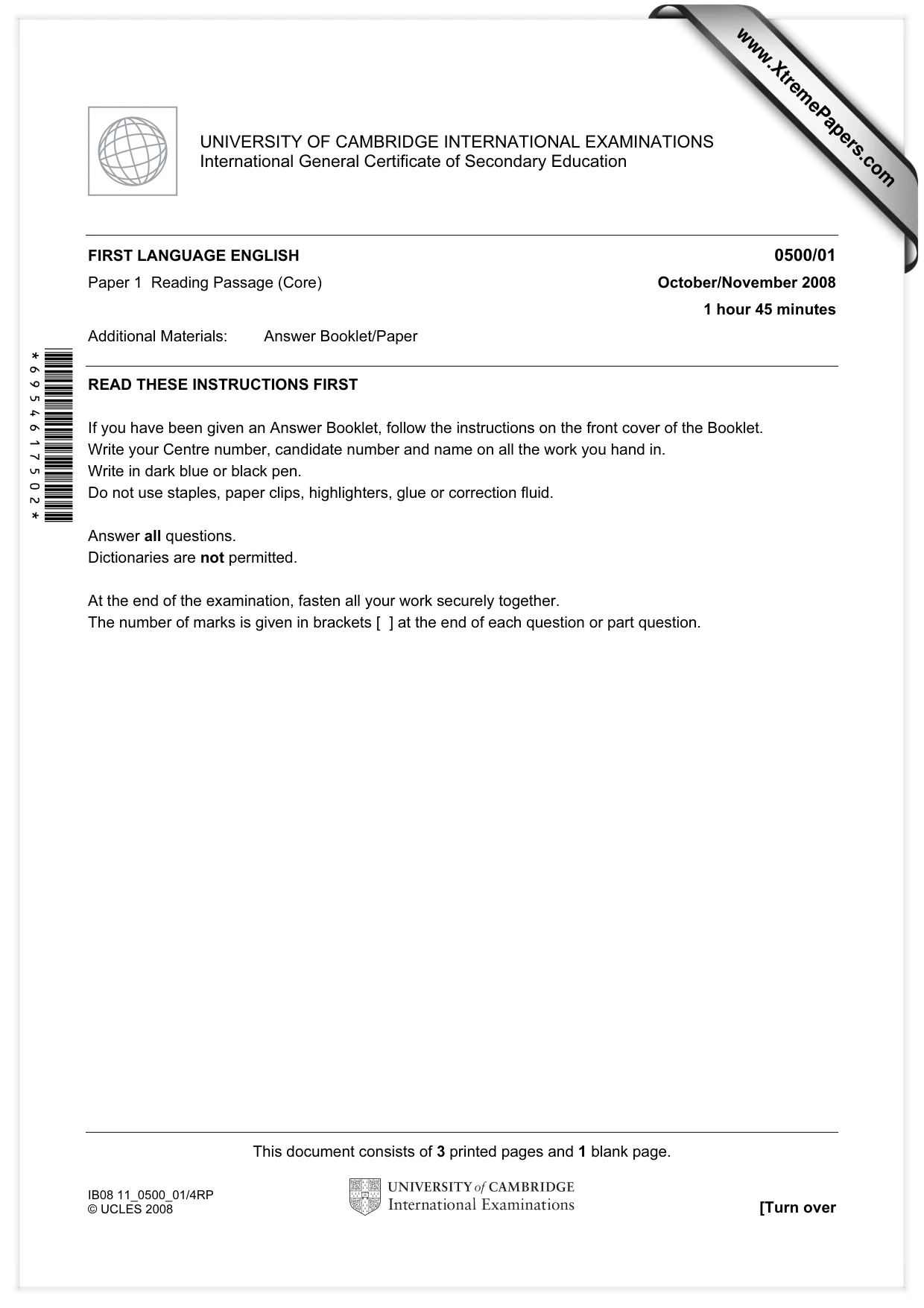
This document consists of 3 printed pages and 1 blank page. IB08 11_0500_01/4RP © UCLES 2008 [Turn over *6954617502* UNIVERSITY OF CAMBRIDGE INTERNATIONAL EXAMINATIONS International General Certificate of Secondary Education FIRST LANGUAGE ENGLISH 0500/01 Paper 1 Reading Passage (Core) October/November 2008 1 hour 45 minutes Additional Materials: Answer Booklet/Paper READ THESE INSTRUCTIONS FIRST If you have been given an Answer Booklet, follow the instructions on the front cover of the Booklet. Write your Centre number, candidate number and name on all the work you hand in. Write in dark blue or black pen. Do not use staples, paper clips, highlighters, glue or correction fluid. Answer all questions. Dictionaries are not permitted. At the end of the examination, fasten all your work securely together. The number of marks is given in brackets [ ] at the end of each question or part question. www.XtremePapers.com
Question paper, page 2
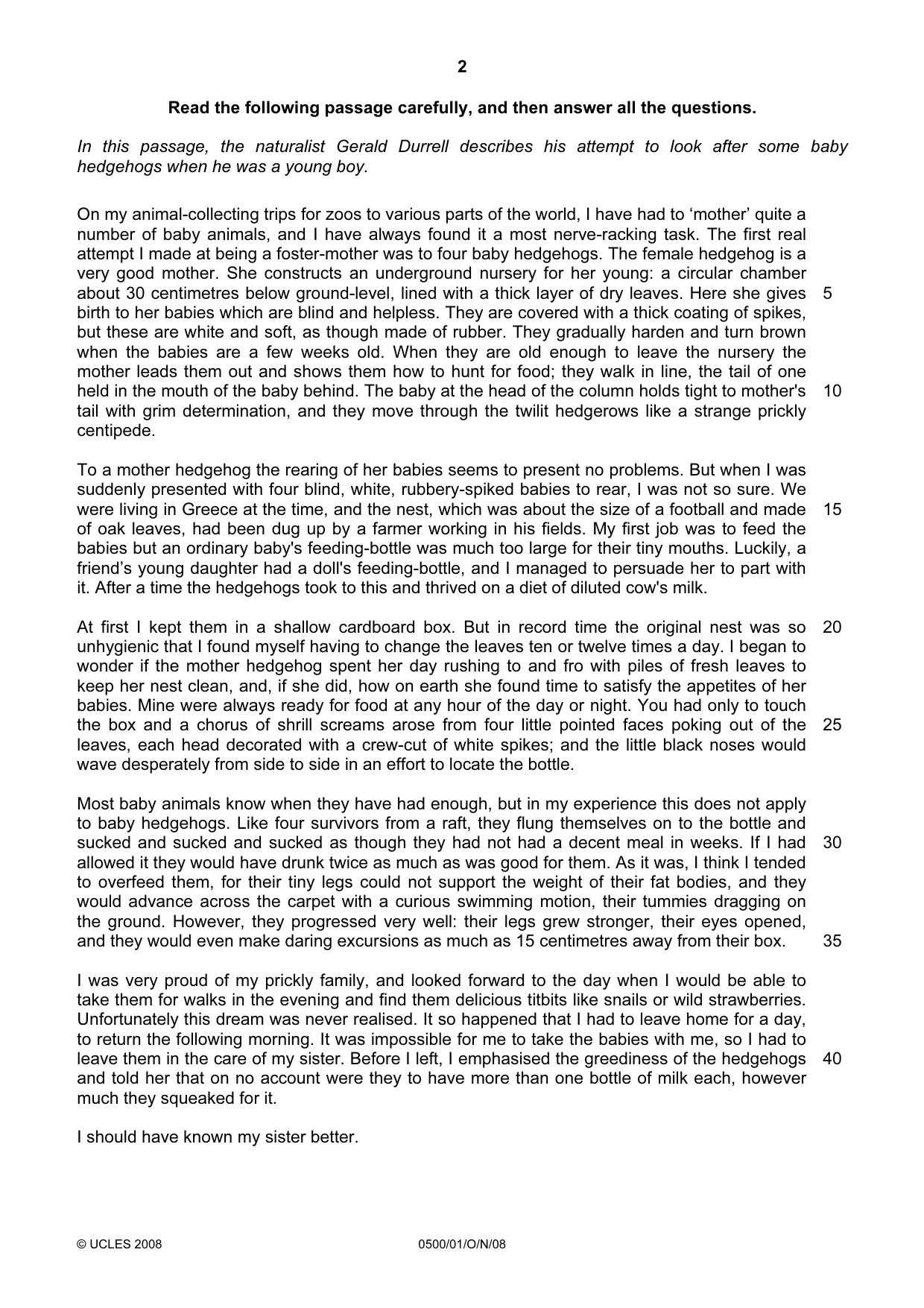
2 © UCLES 2008 0500/01/O/N/08 Read the following passage carefully, and then answer all the questions. In this passage, the naturalist Gerald Durrell describes his attempt to look after some baby hedgehogs when he was a young boy. On my animal-collecting trips for zoos to various parts of the world, I have had to ‘mother’ quite a number of baby animals, and I have always found it a most nerve-racking task. The first real attempt I made at being a foster-mother was to four baby hedgehogs. The female hedgehog is a very good mother. She constructs an underground nursery for her young: a circular chamber about 30 centimetres below ground-level, lined with a thick layer of dry leaves. Here she gives birth to her babies which are blind and helpless. They are covered with a thick coating of spikes, but these are white and soft, as though made of rubber. They gradually harden and turn brown when the babies are a few weeks old. When they are old enough to leave the nursery the mother leads them out and shows them how to hunt for food; they walk in line, the tail of one held in the mouth of the baby behind. The baby at the head of the column holds tight to mother's tail with grim determination, and they move through the twilit hedgerows like a strange prickly centipede. To a mother hedgehog the rearing of her babies seems to present no problems. But when I was suddenly presented with four blind, white, rubbery-spiked babies to rear, I was not so sure. We were living in Greece at the time, and the nest, which was about the size of a football and made of oak leaves, had been dug up by a farmer working in his fields. My first job was to feed the babies but an ordinary baby's feeding-bottle was much too large for their tiny mouths. Luckily, a friend’s young daughter had a doll's feeding-bottle, and I managed to persuade her to part with it. After a time the hedgehogs took to this and thrived on a diet of diluted cow's milk. At first I kept them in a shallow cardboard box. But in record time the original nest was so unhygienic that I found myself having to change the leaves ten or twelve times a day. I began to wonder if the mother hedgehog spent her day rushing to and fro with piles of fresh leaves to keep her nest clean, and, if she did, how on earth she found time to satisfy the appetites of her babies. Mine were always ready for food at any hour of the day or night. You had only to touch the box and a chorus of shrill screams arose from four little pointed faces poking out of the leaves, each head decorated with a crew-cut of white spikes; and the little black noses would wave desperately from side to side in an effort to locate the bottle. Most baby animals know when they have had enough, but in my experience this does not apply to baby hedgehogs. Like four survivors from a raft, they flung themselves on to the bottle and sucked and sucked and sucked as though they had not had a decent meal in weeks. If I had allowed it they would have drunk twice as much as was good for them. As it was, I think I tended to overfeed them, for their tiny legs could not support the weight of their fat bodies, and they would advance across the carpet with a curious swimming motion, their tummies dragging on the ground. However, they progressed very well: their legs grew stronger, their eyes opened, and they would even make daring excursions as much as 15 centimetres away from their box. I was very proud of my prickly family, and looked forward to the day when I would be able to take them for walks in the evening and find them delicious titbits like snails or wild strawberries. Unfortunately this dream was never realised. It so happened that I had to leave home for a day, to return the following morning. It was impossible for me to take the babies with me, so I had to leave them in the care of my sister. Before I left, I emphasised the greediness of the hedgehogs and told her that on no account were they to have more than one bottle of milk each, however much they squeaked for it. I should have known my sister better. 5 10 15 20 25 30 35 40
Question paper, page 3
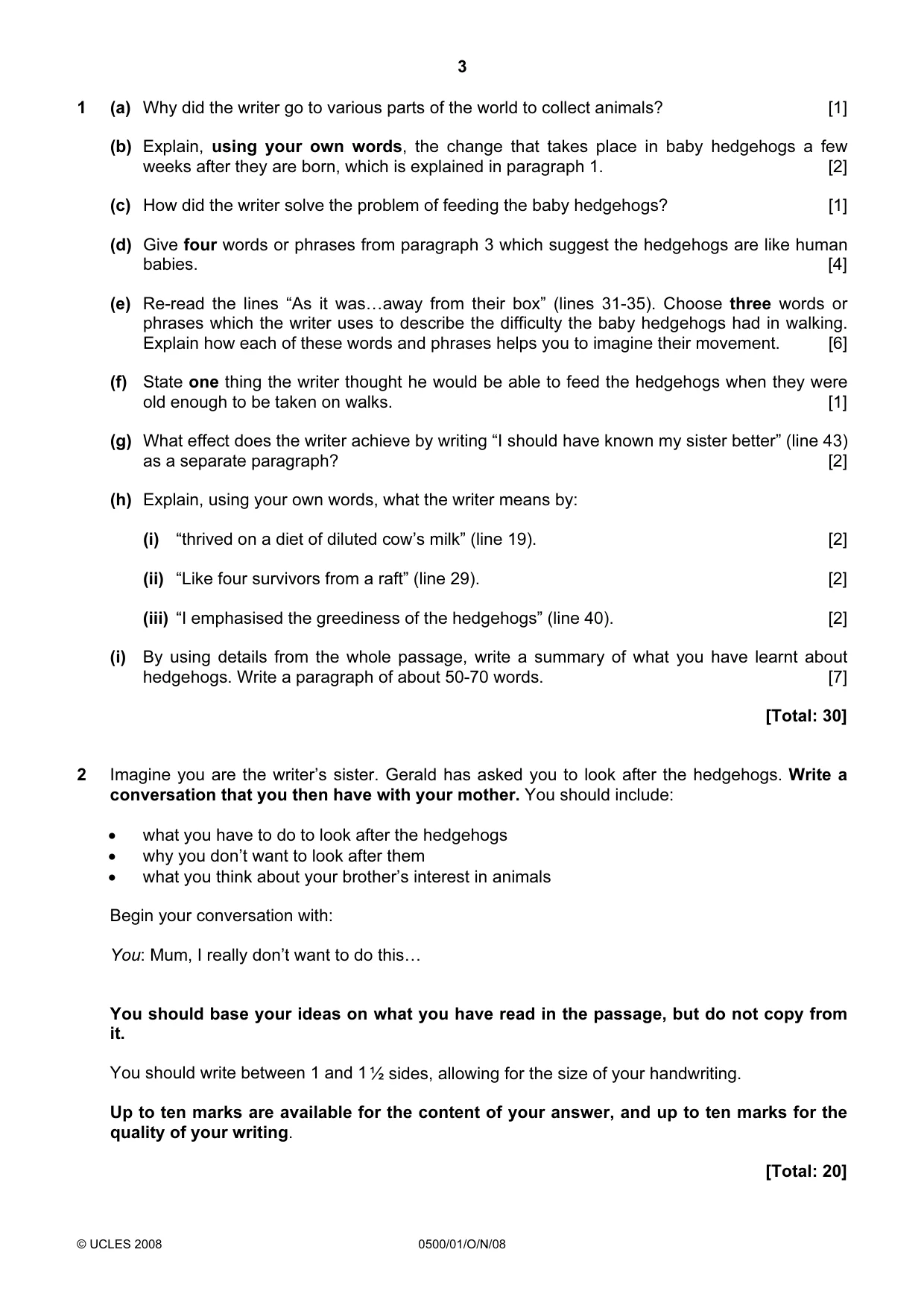
3 © UCLES 2008 0500/01/O/N/08 1 (a) Why did the writer go to various parts of the world to collect animals? [1] (b) Explain, using your own words, the change that takes place in baby hedgehogs a few weeks after they are born, which is explained in paragraph 1. [2] (c) How did the writer solve the problem of feeding the baby hedgehogs? [1] (d) Give four words or phrases from paragraph 3 which suggest the hedgehogs are like human babies. [4] (e) Re-read the lines “As it was…away from their box” (lines 31-35). Choose three words or phrases which the writer uses to describe the difficulty the baby hedgehogs had in walking. Explain how each of these words and phrases helps you to imagine their movement. [6] (f) State one thing the writer thought he would be able to feed the hedgehogs when they were old enough to be taken on walks. [1] (g) What effect does the writer achieve by writing “I should have known my sister better” (line 43) as a separate paragraph? [2] (h) Explain, using your own words, what the writer means by: (i) “thrived on a diet of diluted cow’s milk” (line 19). [2] (ii) “Like four survivors from a raft” (line 29). [2] (iii) “I emphasised the greediness of the hedgehogs” (line 40). [2] (i) By using details from the whole passage, write a summary of what you have learnt about hedgehogs. Write a paragraph of about 50-70 words. [7] [Total: 30] 2 Imagine you are the writer’s sister. Gerald has asked you to look after the hedgehogs. Write a conversation that you then have with your mother. You should include: • what you have to do to look after the hedgehogs • why you don’t want to look after them • what you think about your brother’s interest in animals Begin your conversation with: You: Mum, I really don’t want to do this… You should base your ideas on what you have read in the passage, but do not copy from it. You should write between 1 and 1 ½ sides, allowing for the size of your handwriting. Up to ten marks are available for the content of your answer, and up to ten marks for the quality of your writing. [Total: 20]
Question paper, page 4
4 BLANK PAGE Copyright Acknowledgements: Question 1 © Reproduced with permission of Curtis Brown Group Ltd, London on behalf of the Estate of Gerald Durrell. Copyright © Gerald Durrell, 1958. Permission to reproduce items where third-party owned material protected by copyright is included has been sought and cleared where possible. Every reasonable effort has been made by the publisher (UCLES) to trace copyright holders, but if any items requiring clearance have unwittingly been included, the publisher will be pleased to make amends at the earliest possible opportunity. University of Cambridge International Examinations is part of the Cambridge Assessment Group. Cambridge Assessment is the brand name of University of Cambridge Local Examinations Syndicate (UCLES), which is itself a department of the University of Cambridge. 0500/01/O/N/08
Mark scheme, page 1
UNIVERSITY OF CAMBRIDGE INTERNATIONAL EXAMINATIONS International General Certificate of Secondary Education MARK SCHEME for the October/November 2008 question paper 0500 FIRST LANGUAGE ENGLISH 0500/01 Paper 1 (Reading Passage – Core), maximum raw mark 50 This mark scheme is published as an aid to teachers and candidates, to indicate the requirements of the examination. It shows the basis on which Examiners were instructed to award marks. It does not indicate the details of the discussions that took place at an Examiners’ meeting before marking began. All Examiners are instructed that alternative correct answers and unexpected approaches in candidates’ scripts must be given marks that fairly reflect the relevant knowledge and skills demonstrated. Mark schemes must be read in conjunction with the question papers and the report on the examination. • CIE will not enter into discussions or correspondence in connection with these mark schemes. CIE is publishing the mark schemes for the October/November 2008 question papers for most IGCSE, GCE Advanced Level and Advanced Subsidiary Level syllabuses and some Ordinary Level syllabuses. www.XtremePapers.com
Mark scheme, page 2
Page 2 Mark Scheme Syllabus Paper IGCSE – October/November 2008 0500 01 © UCLES 2008 NB: All Examiners are instructed that alternative correct answers and unexpected approaches in candidates’ scripts must be given marks that fairly reflect the relevant knowledge and skills demonstrated. 1 (a) Why did the writer go to various parts of the world to collect animals? To put them in zoos. [1] (b) Explain, using your own words, the change that takes place in baby hedgehogs a few weeks after they are born which is explained in paragraph 1. Their spikes change from being soft and white (1 mark) to being hard and brown (1 mark)/the spikes change (1 mark). [2] (c) How did the writer solve the problem of feeding the baby hedgehogs? He used a doll’s feeding bottle. [1] (d) Give four words or phrases from paragraph 3 which suggest the hedgehogs are like human babies. • ready for food at any hour of the day or night • (a chorus of) shrill screams • little (pointed) faces/(black) noses • (each head decorated with) a crew-cut of white spikes • (noses would) wave desperately from side to side • (in an effort to) locate the bottle Also allow a reference to the need to clean the nest regularly. Award one mark per point up to a maximum of four. [4] (e) Re-read the lines “As it was…away from their box” (lines 31–35). Choose three words or phrases which the writer uses to describe the difficulty the baby hedgehogs had in walking. Explain how each of these words and phrases helps you to imagine their movement. • could not support their weight • curious swimming motion • tummies dragging Give 1 mark for each of any 3 of the above, and 1 mark for an adequate explanation of it. [6] (f) State one thing the writer thought that he would be able to feed the hedgehogs when they were old enough to be taken on walks. • snails • (wild) strawberries Give 1 mark for either of the above. [1]
Mark scheme, page 3
Page 3 Mark Scheme Syllabus Paper IGCSE – October/November 2008 0500 01 © UCLES 2008 (g) What effect does the writer achieve by writing “I should have known my sister better” (line 43) as a separate paragraph? • It gives emphasis to the sentence. • It prepares you for the fact that something significant is about to happen. Give 2 marks for a well explained justification of either or both points; 1 mark for some sense of understanding. [2] (h) Explain, using your own words, what the writer means by: (i) “thrived on a diet of diluted cow’s milk” (line 19). Grew strong and healthy by drinking watered-down cow’s milk (ii) “Like four survivors from a raft” (line 29). They were like people who had been shipwrecked and hanging on to a life-raft for survival. (iii) “I emphasized the greediness of the hedgehogs” (line 40). I stressed strongly how eager for food they were. Give up to 2 marks for an explanation in own words of each of the three phrases. [6] (i) By using details from the whole passage, write a summary of what you have learnt about hedgehogs. Write a paragraph of about 50–70 words. 1. They are very good mothers. 2. They build underground nurseries/nests (of leaves). 3. They are born blind. 4. They have spikes. 5. The mother teaches the young to hunt for food/look after themselves. 6. They follow her in a joined-up line. 7. They feed on cow’s diluted milk when young. 8. The young are always looking for food/greedy/scream for food. 9. They have pointed faces/black noses. 10. They don’t know when to stop feeding. 11. Their eyes open as they grow. 12 They also eat snails and strawberries. Give 1 mark for each of these points up to a maximum of 7. [7] [Total: 30]
Mark scheme, page 4
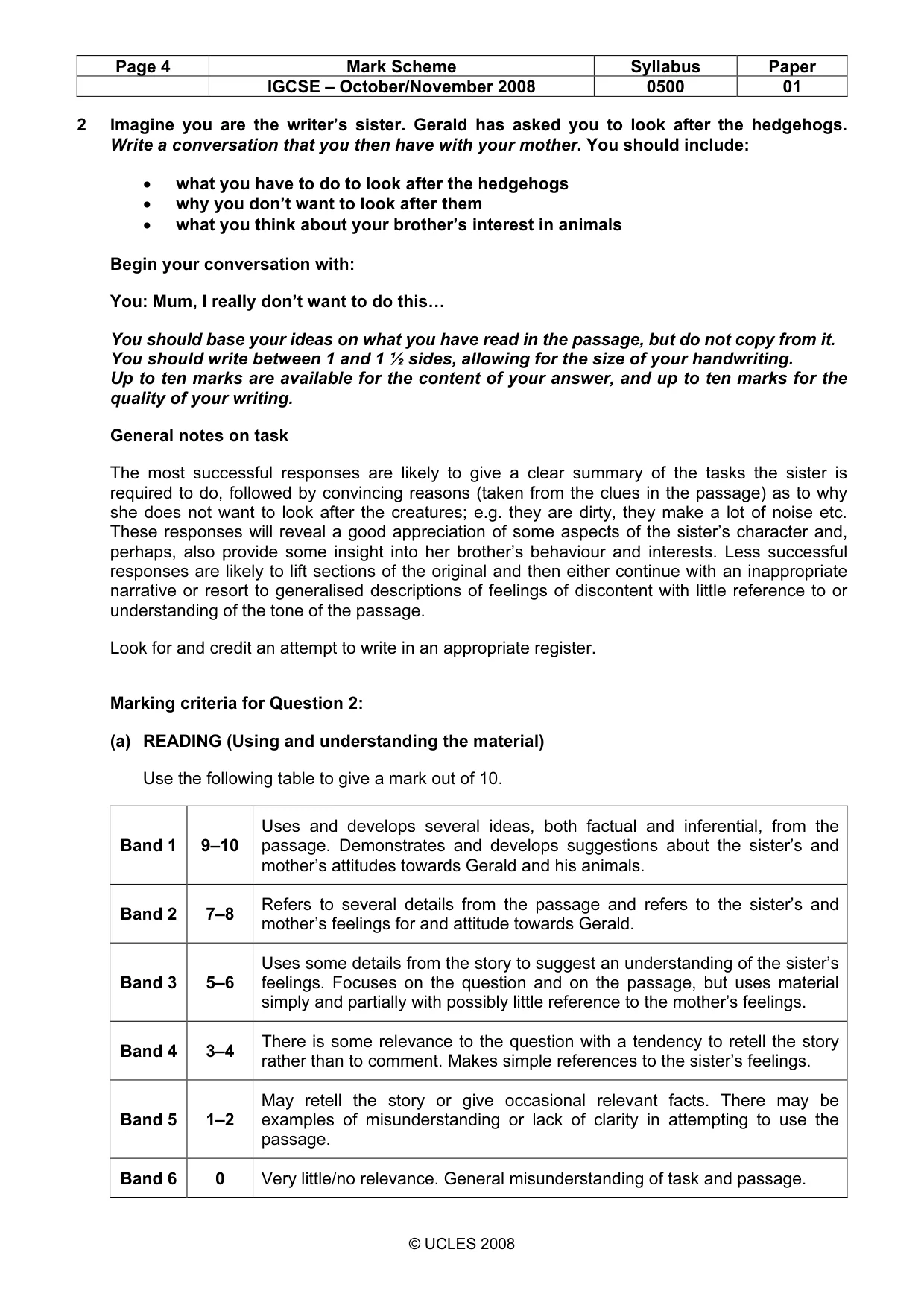
Page 4 Mark Scheme Syllabus Paper IGCSE – October/November 2008 0500 01 © UCLES 2008 2 Imagine you are the writer’s sister. Gerald has asked you to look after the hedgehogs. Write a conversation that you then have with your mother. You should include: • what you have to do to look after the hedgehogs • why you don’t want to look after them • what you think about your brother’s interest in animals Begin your conversation with: You: Mum, I really don’t want to do this… You should base your ideas on what you have read in the passage, but do not copy from it. You should write between 1 and 1 ½ sides, allowing for the size of your handwriting. Up to ten marks are available for the content of your answer, and up to ten marks for the quality of your writing. General notes on task The most successful responses are likely to give a clear summary of the tasks the sister is required to do, followed by convincing reasons (taken from the clues in the passage) as to why she does not want to look after the creatures; e.g. they are dirty, they make a lot of noise etc. These responses will reveal a good appreciation of some aspects of the sister’s character and, perhaps, also provide some insight into her brother’s behaviour and interests. Less successful responses are likely to lift sections of the original and then either continue with an inappropriate narrative or resort to generalised descriptions of feelings of discontent with little reference to or understanding of the tone of the passage. Look for and credit an attempt to write in an appropriate register. Marking criteria for Question 2: (a) READING (Using and understanding the material) Use the following table to give a mark out of 10. Band 1 9–10 Uses and develops several ideas, both factual and inferential, from the passage. Demonstrates and develops suggestions about the sister’s and mother’s attitudes towards Gerald and his animals. Band 2 7–8 Refers to several details from the passage and refers to the sister’s and mother’s feelings for and attitude towards Gerald. Band 3 5–6 Uses some details from the story to suggest an understanding of the sister’s feelings. Focuses on the question and on the passage, but uses material simply and partially with possibly little reference to the mother’s feelings. Band 4 3–4 There is some relevance to the question with a tendency to retell the story rather than to comment. Makes simple references to the sister’s feelings. Band 5 1–2 May retell the story or give occasional relevant facts. There may be examples of misunderstanding or lack of clarity in attempting to use the passage. Band 6 0 Very little/no relevance. General misunderstanding of task and passage.
Mark scheme, page 5
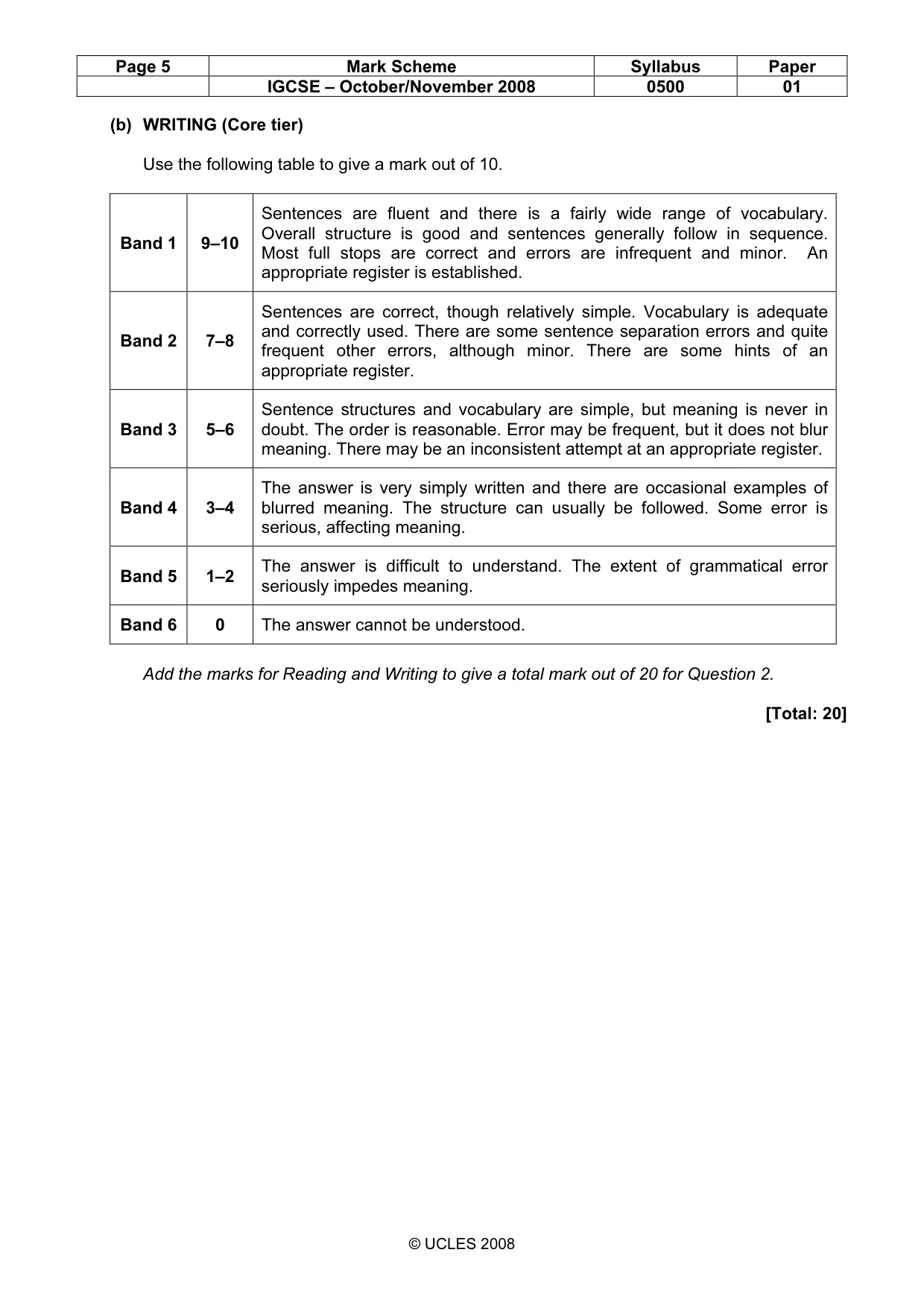
Page 5 Mark Scheme Syllabus Paper IGCSE – October/November 2008 0500 01 © UCLES 2008 (b) WRITING (Core tier) Use the following table to give a mark out of 10. Band 1 9–10 Sentences are fluent and there is a fairly wide range of vocabulary. Overall structure is good and sentences generally follow in sequence. Most full stops are correct and errors are infrequent and minor. An appropriate register is established. Band 2 7–8 Sentences are correct, though relatively simple. Vocabulary is adequate and correctly used. There are some sentence separation errors and quite frequent other errors, although minor. There are some hints of an appropriate register. Band 3 5–6 Sentence structures and vocabulary are simple, but meaning is never in doubt. The order is reasonable. Error may be frequent, but it does not blur meaning. There may be an inconsistent attempt at an appropriate register. Band 4 3–4 The answer is very simply written and there are occasional examples of blurred meaning. The structure can usually be followed. Some error is serious, affecting meaning. Band 5 1–2 The answer is difficult to understand. The extent of grammatical error seriously impedes meaning. Band 6 0 The answer cannot be understood. Add the marks for Reading and Writing to give a total mark out of 20 for Question 2. [Total: 20]
What you needed in this session
Cambridge’s own grade thresholds for 2008 Oct/Nov, Paper 1 · Variant 1. A higher threshold means an easier paper — the bar moves with how the cohort did.