Cambridge IGCSE English - First Language 0500 — 2008 May/June Paper 2 · Variant 1
0500/21/M/J/08 · 50 marks · ≈56 min
The question paper and its mark scheme, free to read here and free to download. This is Cambridge’s own paper, exactly as it was sat.
Question paper8 pages


Mark scheme7 pages
Answers below. Sit the paper first if you are practising.
Paper as text
Question paper, page 1
This document consists of 5 printed pages and 3 blank pages. IB08 06_0500_02/3RP © UCLES 2008 [Turn over *3480199416* UNIVERSITY OF CAMBRIDGE INTERNATIONAL EXAMINATIONS International General Certificate of Secondary Education FIRST LANGUAGE ENGLISH 0500/02 Paper 2 Reading Passages (Extended) May/June 2008 2 hours Additional Materials: Answer Booklet/Paper READ THESE INSTRUCTIONS FIRST If you have been given an Answer Booklet, follow the instructions on the front cover of the Booklet. Write your Centre number, candidate number and name on all the work you hand in. Write in dark blue or black pen. Do not use staples, paper clips, highlighters, glue or correction fluid. Answer all questions. Dictionaries are not permitted. At the end of the examination, fasten all your work securely together. The number of marks is given in brackets [ ] at the end of each question or part question. www.XtremePapers.com
Question paper, page 2
2 © UCLES 2008 0500/02/M/J/08 Part 1 Read Passage A carefully, and then answer Questions 1 and 2. Passage A This passage is about a visit to a remote part of Mongolia, where the writer, Donovan Webster, meets a woman who still farms in the old style. Visiting Diudiu We reach the top of a pass through giant sand dunes, and below us is a bowl-shaped valley. At the valley’s northern end, fringed in rich green grasses and reeds, there’s a small lake so saturated with salt-loving bacteria that its colour is glittering vermilion. Sheep and goats drift across the dune hillsides, eating the sagebrush-like artemisia that grows on them. Camels and a few horses graze near the shore. At the far end of the lake, all alone, sit two small, square blockhouses. We trudge down the dune, surprising the lady who lives in the valley. Her name is Diudiu, and she’s seventy-two. She was born to a semi-nomadic Mongolian family near here. She never had children, and her husband died in 1974, leaving her as the last of her family. With the same hospitality we’ll find in the whole area, Diudiu sets up for visitors. She goes inside her house and fills a tea-kettle from a small container, then walks outside to a mirrored solar collector the size of a TV satellite dish. At the dish’s centre, where the rays of the sun will be focused, Diudiu snaps the kettle into an iron fitting, and then pivots the dish to face the afternoon sun. Within three minutes, the water is boiling furiously. ‘I sold hair from my camels and sheep to buy this,’ she says, turning the mirrored face of the dish from the sun so that she can retrieve the kettle. ‘It keeps me from having a fire going all day.’ Diudiu invites me inside. A wide earthen platform for sleeping and sitting occupies the back wall. The other walls are lined with wooden cupboards and lockers; the boxes hold bags of rice and dried meat, a few potatoes and wild onions in baskets, and some extra clothes. In the corner, a stack of folded blankets waits for winter. There’s a small hole in the roof for the chimney of Diudiu’s potbellied Mongolian stove, which is now outdoors for summer cooking. She sprinkles dried tea into the kettle’s hot water, then pulls out drinking bowls and some rock sugar. ‘Come and drink,’ she says, motioning me to sit. Diudiu is a metre and a quarter tall and dressed in Modern China’s standard outfit: loose trousers and a button-front jacket, both of blue cotton. Her black hair is covered with a bandanna, her dark eyes sharp and quick. She has a wide face – broad planes of cheekbones – which has weathered into a map of wrinkles. I gesture towards a swallow’s nest that clings to the interior front wall, above the door. Diudiu smiles. ‘I like birds in the house,’ she says. ‘They’re good company.’ Spending the next few days with Diudiu, I will see that she possesses everything she needs. Though winter can get very cold, she is prepared and experienced against it. Outside the house there’s a sheep and goat pen with walls made of camel-dung, wetted and pressed into bricks. In winter, she burns these bricks to warm her house and provide cooking fire. She also eats four or five sheep each winter, deep-freezing what she doesn’t need by hanging the carcass in a shady spot outdoors. After an hour or so, Diudiu goes outside. She fires up her stove and boils a pot of rice. In a wok she stir-fries potatoes and wild onions. Then she walks into her house, opens one of two large ceramic containers, and dips a plastic water bottle inside. ‘Rice drink,’ she says. ‘Have some. I drink one of these bottles a day. There’s always a good supply of it. It’s my recreation.’
Question paper, page 3
3 © UCLES 2008 0500/02/M/J/08 [Turn over Slipping back outside, Diudiu checks the rice and lifts the food, carrying it to her small table. ‘See? I have everything,’ she says. ‘I don’t understand the outside world. I know only eating, drinking, tending animals. This is what my parents did. The young people today, once they leave, never return. I don’t blame them. The old life of herding is coming to an end. Work in cities is the future. But for me, I will live in this place until I die.’ 1 Imagine that you are Donovan Webster. You are being interviewed for a television programme about your visit to Diudiu in Mongolia. Your interviewer asks the following questions: • Could you start by telling the viewers a little about Diudiu’s lifestyle? • What did you admire most about Diudiu? • How has your meeting with her made you consider your own life-style and values? Write the words of the interview. Begin as follows: Interviewer: Could you start by telling the viewers a little about Diudiu’s lifestyle? Donovan Webster: Yes, of course. I think the first thing I noticed was… You should write between 1 ½ and 2 sides, allowing for the size of your handwriting. Up to 15 marks will be available for the content of your answer, and up to 5 marks for the quality of your writing. [Total: 20] 2 Re-read the descriptions of: (a) the countryside in paragraph 1; (b) Diudiu in paragraph 6. By selecting words and phrases from these paragraphs to support your answer, explain the effects the writer creates in using these descriptions. [Total: 10]
Question paper, page 4
4 © UCLES 2008 0500/02/M/J/08 Part 2 Question 3 is based on both Passage A and Passage B. Read Passage B and re-read Passage A. Passage B This passage describes the daily life of a man who decided to live in the woods in order to raise money for the protection of trees. Life in the Cold The idea of living in the woods has been in my mind for years. When I was growing up I spent a lot of time playing in the forest. I sleep in a sleeping-bag under a tarpaulin tied between two trees, which keeps the rain off, but it’s not very warm. At 6.30am I jump up and pack quickly. I take everything with me in my rucksack. I have to sleep in my clothes because it is so cold, and I add another couple of layers when I get up. Then I have to run for the bus and I get really hot. The journey to London can take two hours, but at least I get to sit in comfort. My work at Sotheby’s, the famous auction-house, is split between two places in London. I have to place bids for people who can’t be present at auctions. I stand next to the auctioneer, acting as a second pair of eyes, making sure that bidding runs smoothly. Everyone is very understanding at work, although I get teased relentlessly. They think I’m crazy. Work starts at 9.00am, when I tend to have another breakfast at my desk, normally a full English breakfast. I eat a very large amount at the moment because I use so much energy keeping warm at night, and I’m so much more sensitive to temperature now. The heating at work is oppressive and can make me feel ill when the room is too hot. Work finishes at 5.00pm, and I go to the gym. I went there a lot before winter, aware that I needed to be as fit as possible for the cold months. I’ve been going less frequently recently; I’m just concentrating on surviving. I get back to the woods around 8.30pm and change into my ‘wood’ clothes. I have three sets of clothes: a scruffy set for the wood, a casual set for travelling, and my smart clothes for work. Trying to co-ordinate my laundry can be really difficult. I’m on public display for my job, so it’s important to look the part, but I have found myself working in Hammersmith, only to realise my clean clothes are in Bond Street, in the centre of the city. I often end up in the woods with suits hanging from trees. In the evenings, I sometimes go into town to see friends. Some nights I’m too exhausted, though. Last weekend I slept thirty-two hours out of thirty-six. It is nice to have the woods to go back to, especially when there’s a lot going on at work. With no phones or anything, I can just relax. But it’s also nice, after a weekend of getting grimy, to go to work and be smart. I have been ill a couple of times from not cooking meat properly, and being careless about filtering water from the stream. I’ve also had bronchitis. But it’s an adventure. There’s something deeply satisfying about being out here. If I can light a fire and cook meat, as people have been doing for thousands of years, it strikes a chord. I get into bed about 10.00pm and only leave the fire burning when it’s really cold. It isn’t scary, although I did get a shock once. I was in my hammock and heard a loud gnawing noise. I had visions of axe murderers and quickly sat up. I realised, as I came crashing to the floor, that it had just been the sound of a branch breaking. Once I’ve drawn the sleeping-bag cord as tight as possible, I’m ready to sleep. I hear owls a lot, or the odd visitor having a peek at the shelter.
Question paper, page 5
5 © UCLES 2008 0500/02/M/J/08 3 Summarise: (a) the things that make the writer’s lifestyle difficult in Passage B; (b) the things that enable Diudiu to cope with the challenges of her lifestyle in Passage A. Use your own words as far as possible. You should write about 1 side in total, allowing for the size of your handwriting. Up to 15 marks will be available for the content of your answer, and up to 5 marks for the quality of your writing. [Total: 20]
Question paper, page 8
8 Copyright Acknowledgements: Passage A © Donovan Webster; National Geographic Magazine. Passage B © Seb Morton-Clark; The Sunday Times, April 2006. Permission to reproduce items where third-party owned material protected by copyright is included has been sought and cleared where possible. Every reasonable effort has been made by the publisher (UCLES) to trace copyright holders, but if any items requiring clearance have unwittingly been included, the publisher will be pleased to make amends at the earliest possible opportunity. University of Cambridge International Examinations is part of the Cambridge Assessment Group. Cambridge Assessment is the brand name of University of Cambridge Local Examinations Syndicate (UCLES), which is itself a department of the University of Cambridge. 0500/02/M/J/08 BLANK PAGE
Mark scheme, page 1
UNIVERSITY OF CAMBRIDGE INTERNATIONAL EXAMINATIONS International General Certificate of Secondary Education MARK SCHEME for the May/June 2008 question paper 0500 FIRST LANGUAGE ENGLISH 0500/02 Paper 2 (Reading Passages – Extended), maximum raw mark 50 This mark scheme is published as an aid to teachers and candidates, to indicate the requirements of the examination. It shows the basis on which Examiners were instructed to award marks. It does not indicate the details of the discussions that took place at an Examiners’ meeting before marking began. All Examiners are instructed that alternative correct answers and unexpected approaches in candidates’ scripts must be given marks that fairly reflect the relevant knowledge and skills demonstrated. Mark schemes must be read in conjunction with the question papers and the report on the examination. • CIE will not enter into discussions or correspondence in connection with these mark schemes. CIE is publishing the mark schemes for the May/June 2008 question papers for most IGCSE, GCE Advanced Level and Advanced Subsidiary Level syllabuses and some Ordinary Level syllabuses. www.XtremePapers.com
Mark scheme, page 2
Page 2 Mark Scheme Syllabus Paper IGCSE – May/June 2008 0500 02 © UCLES 2008 Note: all Examiners are instructed that alternative correct answers and unexpected approaches in candidates’ scripts must be given marks that fairly reflect the relevant knowledge and skills demonstrated. 1 Imagine that you are Donovan Webster. You are being interviewed for a television programme about your visit to Diudiu in Mongolia. Your interviewer asks the following questions: • Could you start by telling the viewers a little about Diudiu’s lifestyle? • What do you admire most about Diudiu? • How has your meeting with her made you consider your own lifestyle and values? Write the words of the interview. Begin as follows: Interviewer: Could you start by telling the viewers a little about Diudiu’s lifestyle? Donovan Webster: Yes, of course. I think the first thing I noticed was… (For this question, 15 marks are allocated to assessment of Reading Objectives R1–R3 (see syllabus); 5 marks are allocated to assessment of Writing Objectives W1–W5 (see syllabus). General notes on possible content Note: there are three parts to a complete answer. Good candidates will cover all three sufficiently to make a valid and relevant discursive commentary on Diudiu’s lifestyle. Less good candidates will be more likely to repeat the details of the passage mechanically and to treat the two questions thinly. Their answers will be more informative. The content must be clearly related to and derived from the passage. Candidates may use the following ideas: Mark A: Could you start by telling the viewers a little about Diudiu’s lifestyle? Reward candidates who provide sound overviews such as: frugal, healthy, satisfying, lonely AND who support their judgements from the text. Reward candidates who prioritise details that they have noticed. Less good candidates will rehearse the text, sometimes at undue length. Mark B: What things do you admire most about Diudiu? Reward candidates who infer qualities from what they have read, such as independence, cheerfulness, doggedness, etc. Two would be enough, but they require explanation and support from the text to score highly. Less good candidates list, or provide only loosely relevant ideas. Mark C: How has your meeting with her made you consider you own lifestyle and values? Allow any relevant viewpoint and allow from the variety of candidate backgrounds. 1 Candidates may take up the final paragraph and agree that Diudiu is the last of her kind. 2 They may discuss the simple life and how theirs is complex and hectic: How to be satisfied with little (‘Everything she needs’). 3 Some may be attracted by her connection with animals and birds. 4 They may discuss her ideas of entertainment and company (there is a hint that she might have occasional company from visitors). 5 Candidates may decide that their life has been proved to be greedy and selfish.
Mark scheme, page 3
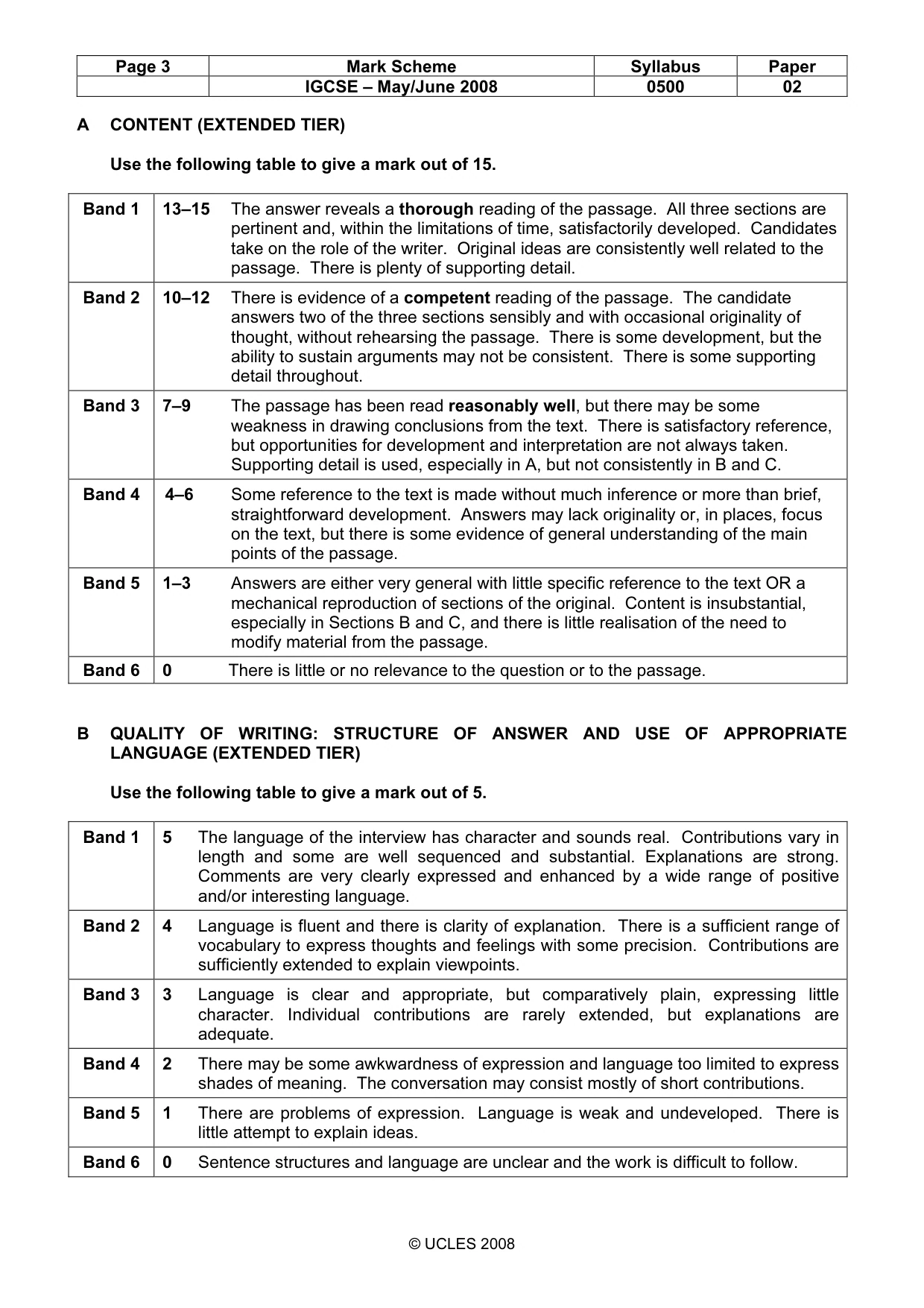
Page 3 Mark Scheme Syllabus Paper IGCSE – May/June 2008 0500 02 © UCLES 2008 A CONTENT (EXTENDED TIER) Use the following table to give a mark out of 15. Band 1 13–15 The answer reveals a thorough reading of the passage. All three sections are pertinent and, within the limitations of time, satisfactorily developed. Candidates take on the role of the writer. Original ideas are consistently well related to the passage. There is plenty of supporting detail. Band 2 10–12 There is evidence of a competent reading of the passage. The candidate answers two of the three sections sensibly and with occasional originality of thought, without rehearsing the passage. There is some development, but the ability to sustain arguments may not be consistent. There is some supporting detail throughout. Band 3 7–9 The passage has been read reasonably well, but there may be some weakness in drawing conclusions from the text. There is satisfactory reference, but opportunities for development and interpretation are not always taken. Supporting detail is used, especially in A, but not consistently in B and C. Band 4 4–6 Some reference to the text is made without much inference or more than brief, straightforward development. Answers may lack originality or, in places, focus on the text, but there is some evidence of general understanding of the main points of the passage. Band 5 1–3 Answers are either very general with little specific reference to the text OR a mechanical reproduction of sections of the original. Content is insubstantial, especially in Sections B and C, and there is little realisation of the need to modify material from the passage. Band 6 0 There is little or no relevance to the question or to the passage. B QUALITY OF WRITING: STRUCTURE OF ANSWER AND USE OF APPROPRIATE LANGUAGE (EXTENDED TIER) Use the following table to give a mark out of 5. Band 1 5 The language of the interview has character and sounds real. Contributions vary in length and some are well sequenced and substantial. Explanations are strong. Comments are very clearly expressed and enhanced by a wide range of positive and/or interesting language. Band 2 4 Language is fluent and there is clarity of explanation. There is a sufficient range of vocabulary to express thoughts and feelings with some precision. Contributions are sufficiently extended to explain viewpoints. Band 3 3 Language is clear and appropriate, but comparatively plain, expressing little character. Individual contributions are rarely extended, but explanations are adequate. Band 4 2 There may be some awkwardness of expression and language too limited to express shades of meaning. The conversation may consist mostly of short contributions. Band 5 1 There are problems of expression. Language is weak and undeveloped. There is little attempt to explain ideas. Band 6 0 Sentence structures and language are unclear and the work is difficult to follow.
Mark scheme, page 4
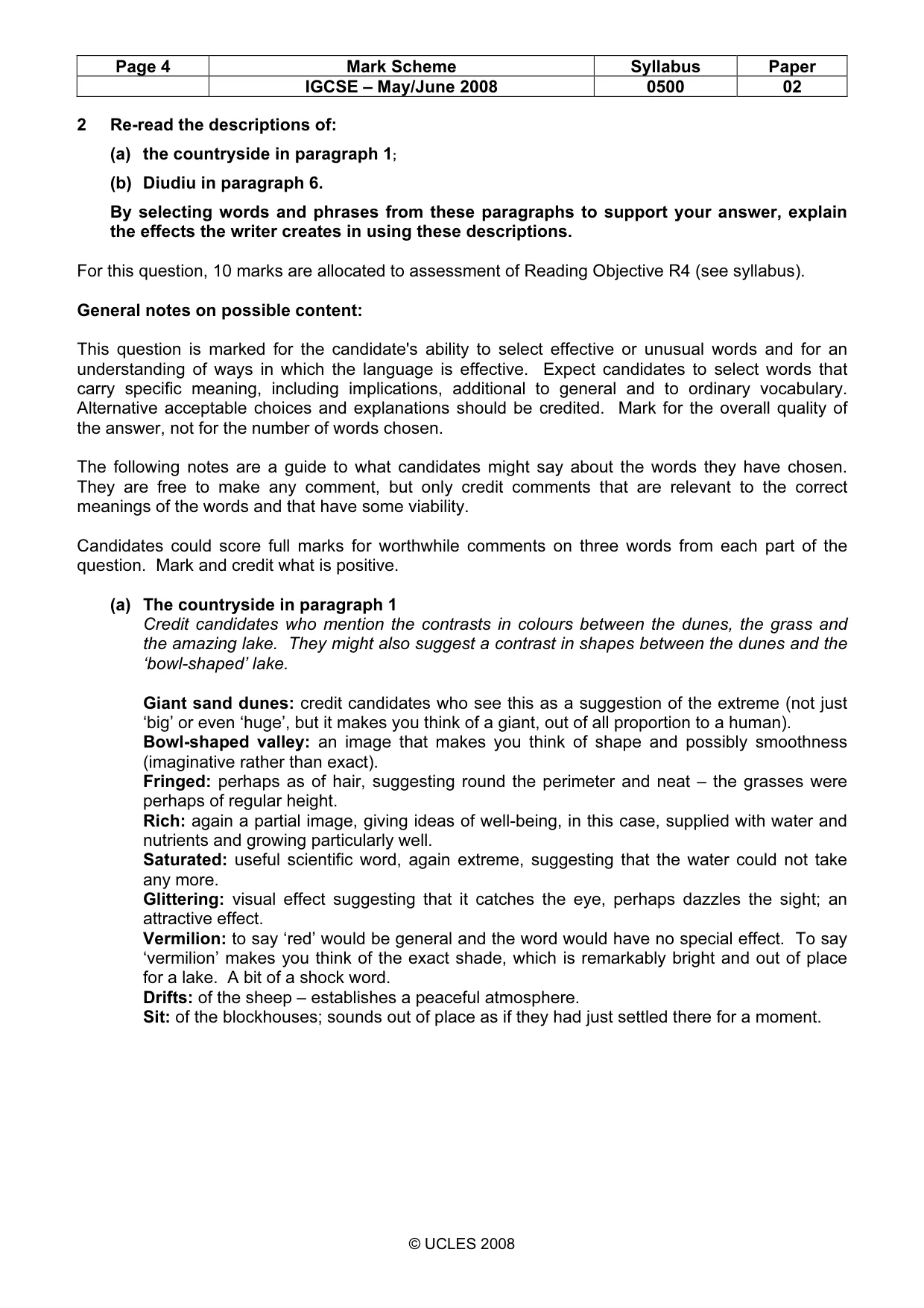
Page 4 Mark Scheme Syllabus Paper IGCSE – May/June 2008 0500 02 © UCLES 2008 2 Re-read the descriptions of: (a) the countryside in paragraph 1; (b) Diudiu in paragraph 6. By selecting words and phrases from these paragraphs to support your answer, explain the effects the writer creates in using these descriptions. For this question, 10 marks are allocated to assessment of Reading Objective R4 (see syllabus). General notes on possible content: This question is marked for the candidate's ability to select effective or unusual words and for an understanding of ways in which the language is effective. Expect candidates to select words that carry specific meaning, including implications, additional to general and to ordinary vocabulary. Alternative acceptable choices and explanations should be credited. Mark for the overall quality of the answer, not for the number of words chosen. The following notes are a guide to what candidates might say about the words they have chosen. They are free to make any comment, but only credit comments that are relevant to the correct meanings of the words and that have some viability. Candidates could score full marks for worthwhile comments on three words from each part of the question. Mark and credit what is positive. (a) The countryside in paragraph 1 Credit candidates who mention the contrasts in colours between the dunes, the grass and the amazing lake. They might also suggest a contrast in shapes between the dunes and the ‘bowl-shaped’ lake. Giant sand dunes: credit candidates who see this as a suggestion of the extreme (not just ‘big’ or even ‘huge’, but it makes you think of a giant, out of all proportion to a human). Bowl-shaped valley: an image that makes you think of shape and possibly smoothness (imaginative rather than exact). Fringed: perhaps as of hair, suggesting round the perimeter and neat – the grasses were perhaps of regular height. Rich: again a partial image, giving ideas of well-being, in this case, supplied with water and nutrients and growing particularly well. Saturated: useful scientific word, again extreme, suggesting that the water could not take any more. Glittering: visual effect suggesting that it catches the eye, perhaps dazzles the sight; an attractive effect. Vermilion: to say ‘red’ would be general and the word would have no special effect. To say ‘vermilion’ makes you think of the exact shade, which is remarkably bright and out of place for a lake. A bit of a shock word. Drifts: of the sheep – establishes a peaceful atmosphere. Sit: of the blockhouses; sounds out of place as if they had just settled there for a moment.
Mark scheme, page 5
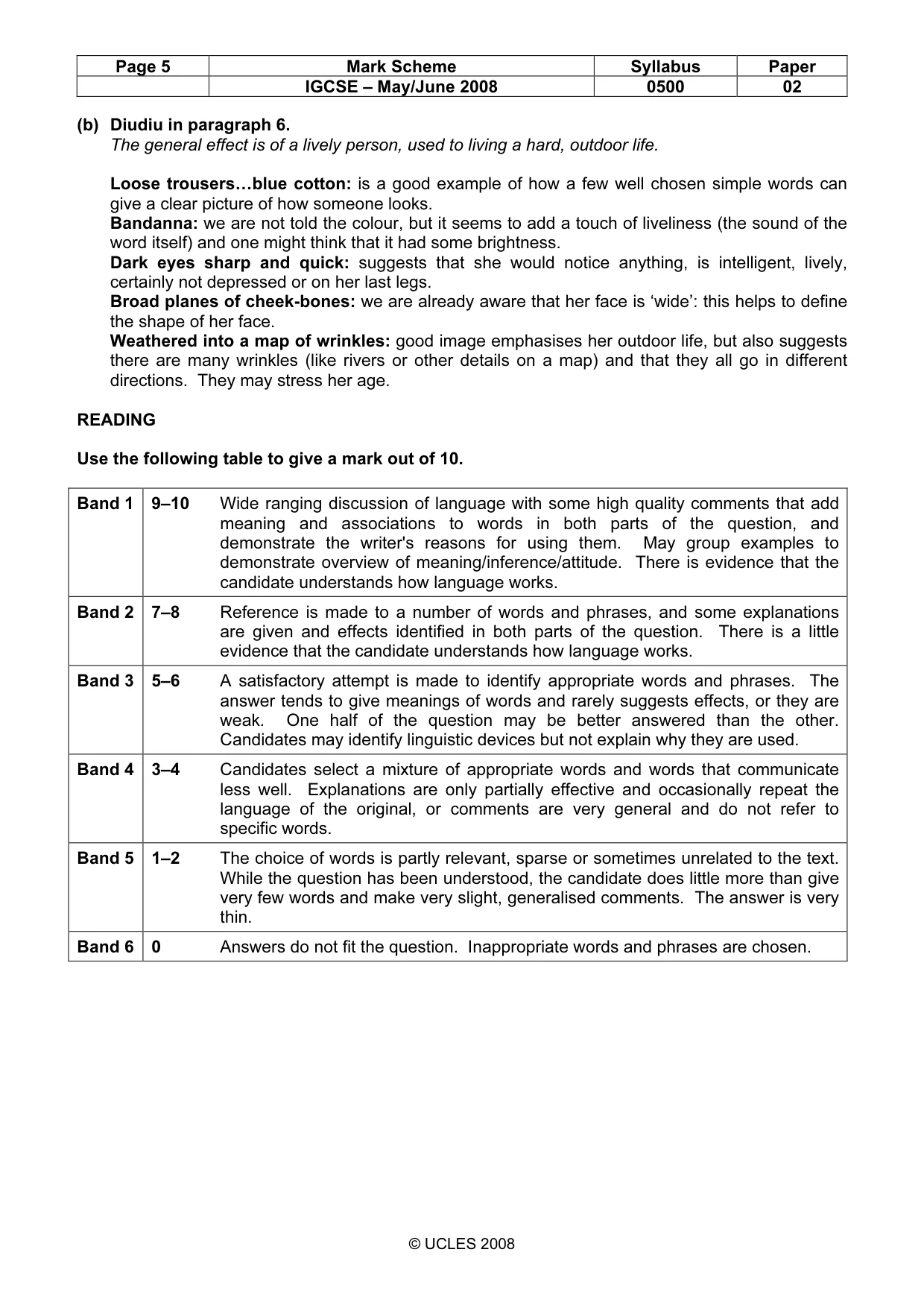
Page 5 Mark Scheme Syllabus Paper IGCSE – May/June 2008 0500 02 © UCLES 2008 (b) Diudiu in paragraph 6. The general effect is of a lively person, used to living a hard, outdoor life. Loose trousers…blue cotton: is a good example of how a few well chosen simple words can give a clear picture of how someone looks. Bandanna: we are not told the colour, but it seems to add a touch of liveliness (the sound of the word itself) and one might think that it had some brightness. Dark eyes sharp and quick: suggests that she would notice anything, is intelligent, lively, certainly not depressed or on her last legs. Broad planes of cheek-bones: we are already aware that her face is ‘wide’: this helps to define the shape of her face. Weathered into a map of wrinkles: good image emphasises her outdoor life, but also suggests there are many wrinkles (like rivers or other details on a map) and that they all go in different directions. They may stress her age. READING Use the following table to give a mark out of 10. Band 1 9–10 Wide ranging discussion of language with some high quality comments that add meaning and associations to words in both parts of the question, and demonstrate the writer's reasons for using them. May group examples to demonstrate overview of meaning/inference/attitude. There is evidence that the candidate understands how language works. Band 2 7–8 Reference is made to a number of words and phrases, and some explanations are given and effects identified in both parts of the question. There is a little evidence that the candidate understands how language works. Band 3 5–6 A satisfactory attempt is made to identify appropriate words and phrases. The answer tends to give meanings of words and rarely suggests effects, or they are weak. One half of the question may be better answered than the other. Candidates may identify linguistic devices but not explain why they are used. Band 4 3–4 Candidates select a mixture of appropriate words and words that communicate less well. Explanations are only partially effective and occasionally repeat the language of the original, or comments are very general and do not refer to specific words. Band 5 1–2 The choice of words is partly relevant, sparse or sometimes unrelated to the text. While the question has been understood, the candidate does little more than give very few words and make very slight, generalised comments. The answer is very thin. Band 6 0 Answers do not fit the question. Inappropriate words and phrases are chosen.
Mark scheme, page 6
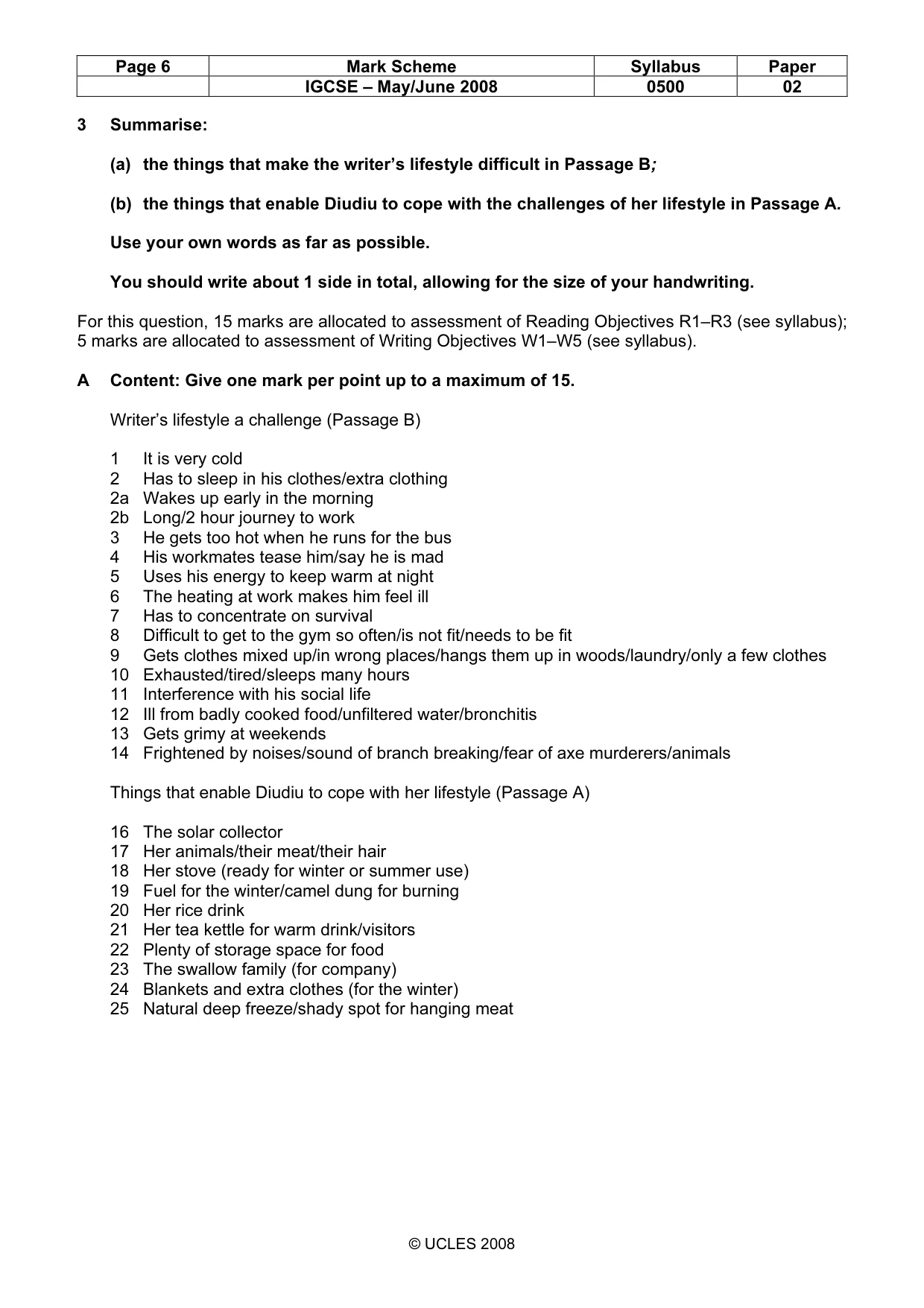
Page 6 Mark Scheme Syllabus Paper IGCSE – May/June 2008 0500 02 © UCLES 2008 3 Summarise: (a) the things that make the writer’s lifestyle difficult in Passage B; (b) the things that enable Diudiu to cope with the challenges of her lifestyle in Passage A. Use your own words as far as possible. You should write about 1 side in total, allowing for the size of your handwriting. For this question, 15 marks are allocated to assessment of Reading Objectives R1–R3 (see syllabus); 5 marks are allocated to assessment of Writing Objectives W1–W5 (see syllabus). A Content: Give one mark per point up to a maximum of 15. Writer’s lifestyle a challenge (Passage B) 1 It is very cold 2 Has to sleep in his clothes/extra clothing 2a Wakes up early in the morning 2b Long/2 hour journey to work 3 He gets too hot when he runs for the bus 4 His workmates tease him/say he is mad 5 Uses his energy to keep warm at night 6 The heating at work makes him feel ill 7 Has to concentrate on survival 8 Difficult to get to the gym so often/is not fit/needs to be fit 9 Gets clothes mixed up/in wrong places/hangs them up in woods/laundry/only a few clothes 10 Exhausted/tired/sleeps many hours 11 Interference with his social life 12 Ill from badly cooked food/unfiltered water/bronchitis 13 Gets grimy at weekends 14 Frightened by noises/sound of branch breaking/fear of axe murderers/animals Things that enable Diudiu to cope with her lifestyle (Passage A) 16 The solar collector 17 Her animals/their meat/their hair 18 Her stove (ready for winter or summer use) 19 Fuel for the winter/camel dung for burning 20 Her rice drink 21 Her tea kettle for warm drink/visitors 22 Plenty of storage space for food 23 The swallow family (for company) 24 Blankets and extra clothes (for the winter) 25 Natural deep freeze/shady spot for hanging meat
Mark scheme, page 7
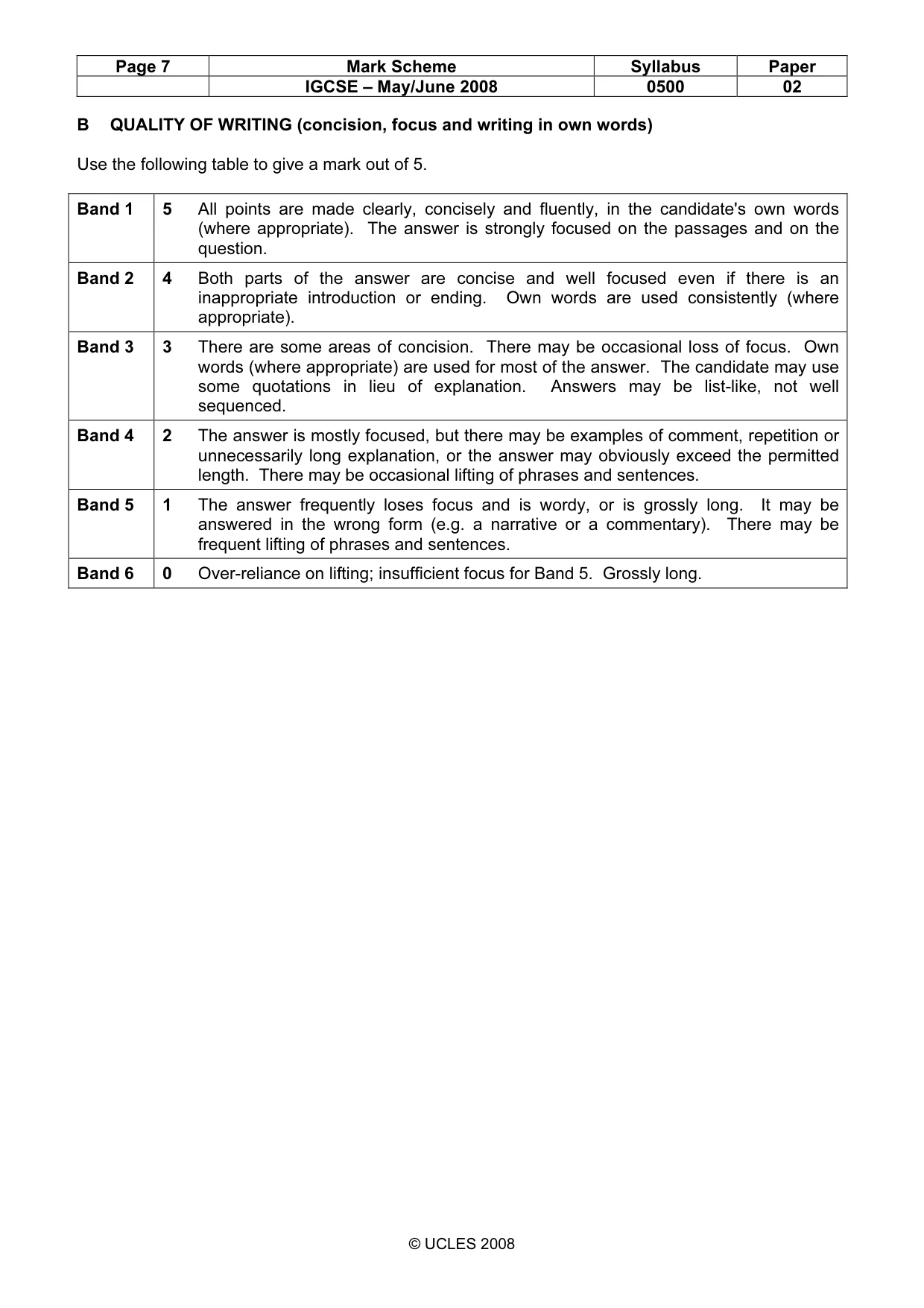
Page 7 Mark Scheme Syllabus Paper IGCSE – May/June 2008 0500 02 © UCLES 2008 B QUALITY OF WRITING (concision, focus and writing in own words) Use the following table to give a mark out of 5. Band 1 5 All points are made clearly, concisely and fluently, in the candidate's own words (where appropriate). The answer is strongly focused on the passages and on the question. Band 2 4 Both parts of the answer are concise and well focused even if there is an inappropriate introduction or ending. Own words are used consistently (where appropriate). Band 3 3 There are some areas of concision. There may be occasional loss of focus. Own words (where appropriate) are used for most of the answer. The candidate may use some quotations in lieu of explanation. Answers may be list-like, not well sequenced. Band 4 2 The answer is mostly focused, but there may be examples of comment, repetition or unnecessarily long explanation, or the answer may obviously exceed the permitted length. There may be occasional lifting of phrases and sentences. Band 5 1 The answer frequently loses focus and is wordy, or is grossly long. It may be answered in the wrong form (e.g. a narrative or a commentary). There may be frequent lifting of phrases and sentences. Band 6 0 Over-reliance on lifting; insufficient focus for Band 5. Grossly long.
What you needed in this session
Cambridge’s own grade thresholds for 2008 May/June, Paper 2 · Variant 1. A higher threshold means an easier paper — the bar moves with how the cohort did.