Cambridge IGCSE English - First Language 0500 — 2008 May/June Paper 1 · Variant 1
0500/11/M/J/08 · 50 marks · ≈56 min
The question paper and its mark scheme, free to read here and free to download. This is Cambridge’s own paper, exactly as it was sat.
Question paper4 pages
Mark scheme5 pages
Answers below. Sit the paper first if you are practising.
Paper as text
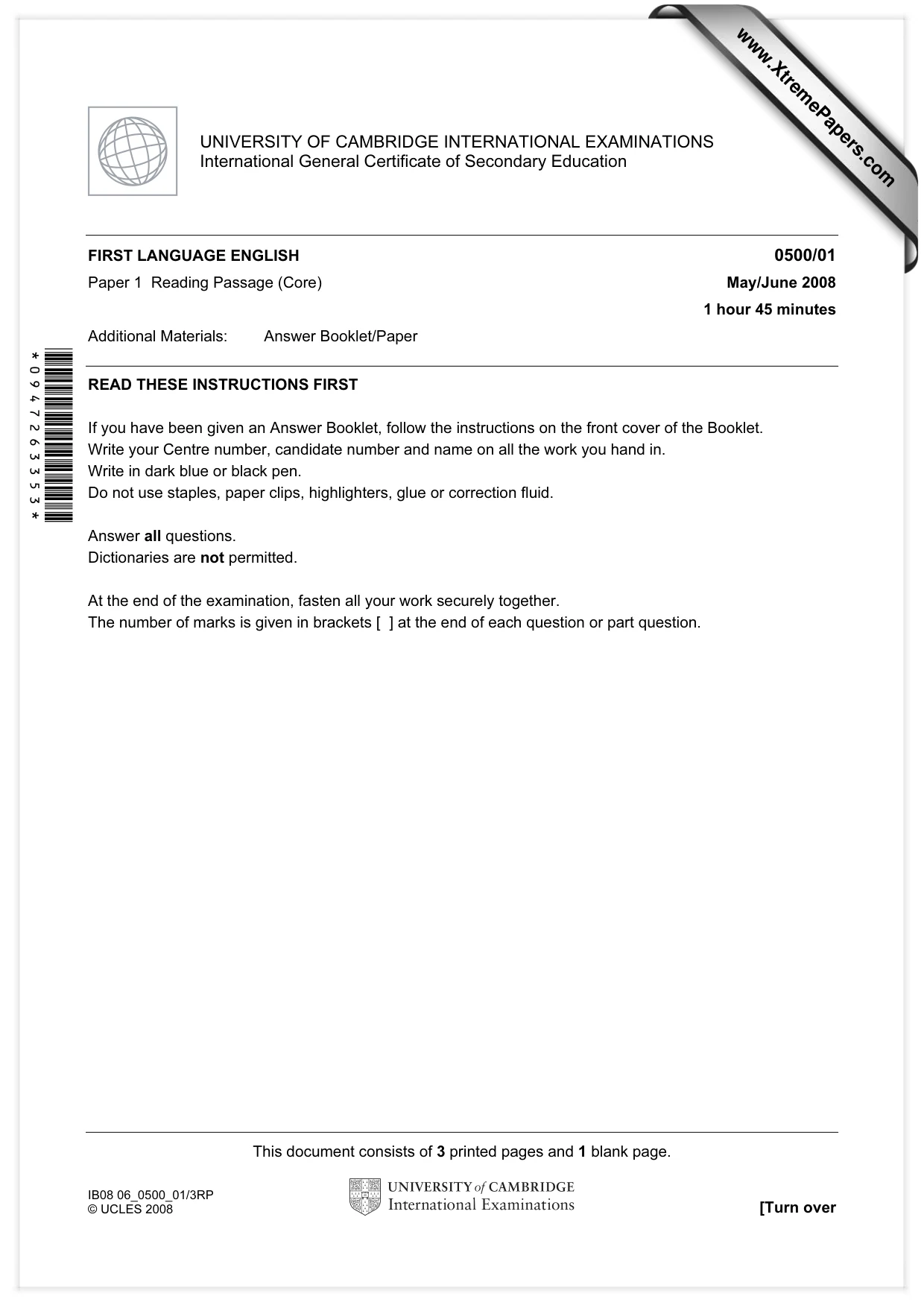
Question paper, page 1
This document consists of 3 printed pages and 1 blank page. IB08 06_0500_01/3RP © UCLES 2008 [Turn over *0947263353* UNIVERSITY OF CAMBRIDGE INTERNATIONAL EXAMINATIONS International General Certificate of Secondary Education FIRST LANGUAGE ENGLISH 0500/01 Paper 1 Reading Passage (Core) May/June 2008 1 hour 45 minutes Additional Materials: Answer Booklet/Paper READ THESE INSTRUCTIONS FIRST If you have been given an Answer Booklet, follow the instructions on the front cover of the Booklet. Write your Centre number, candidate number and name on all the work you hand in. Write in dark blue or black pen. Do not use staples, paper clips, highlighters, glue or correction fluid. Answer all questions. Dictionaries are not permitted. At the end of the examination, fasten all your work securely together. The number of marks is given in brackets [ ] at the end of each question or part question. www.XtremePapers.com
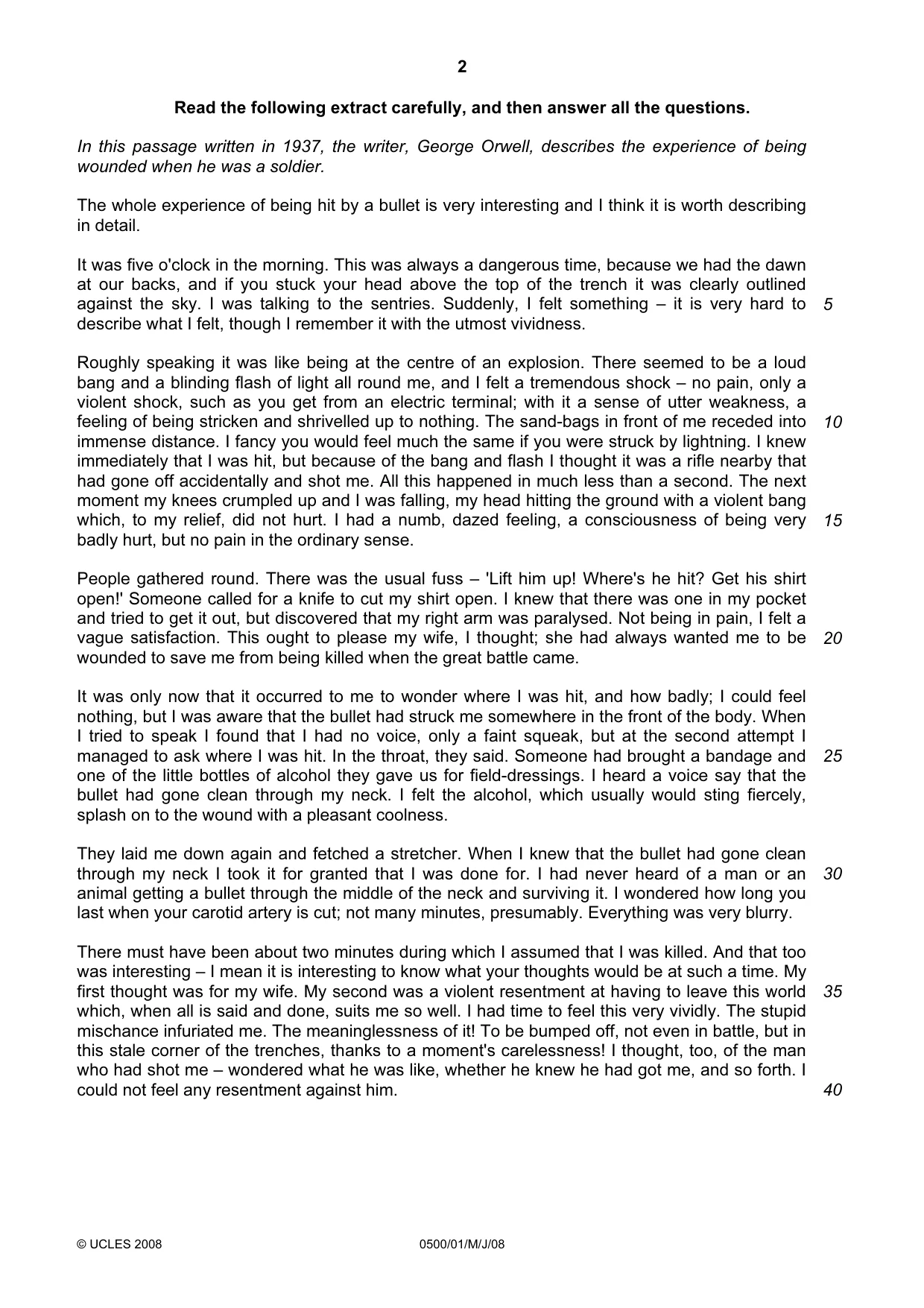
Question paper, page 2
2 © UCLES 2008 0500/01/M/J/08 Read the following extract carefully, and then answer all the questions. In this passage written in 1937, the writer, George Orwell, describes the experience of being wounded when he was a soldier. The whole experience of being hit by a bullet is very interesting and I think it is worth describing in detail. It was five o'clock in the morning. This was always a dangerous time, because we had the dawn at our backs, and if you stuck your head above the top of the trench it was clearly outlined against the sky. I was talking to the sentries. Suddenly, I felt something – it is very hard to describe what I felt, though I remember it with the utmost vividness. Roughly speaking it was like being at the centre of an explosion. There seemed to be a loud bang and a blinding flash of light all round me, and I felt a tremendous shock – no pain, only a violent shock, such as you get from an electric terminal; with it a sense of utter weakness, a feeling of being stricken and shrivelled up to nothing. The sand-bags in front of me receded into immense distance. I fancy you would feel much the same if you were struck by lightning. I knew immediately that I was hit, but because of the bang and flash I thought it was a rifle nearby that had gone off accidentally and shot me. All this happened in much less than a second. The next moment my knees crumpled up and I was falling, my head hitting the ground with a violent bang which, to my relief, did not hurt. I had a numb, dazed feeling, a consciousness of being very badly hurt, but no pain in the ordinary sense. People gathered round. There was the usual fuss – 'Lift him up! Where's he hit? Get his shirt open!' Someone called for a knife to cut my shirt open. I knew that there was one in my pocket and tried to get it out, but discovered that my right arm was paralysed. Not being in pain, I felt a vague satisfaction. This ought to please my wife, I thought; she had always wanted me to be wounded to save me from being killed when the great battle came. It was only now that it occurred to me to wonder where I was hit, and how badly; I could feel nothing, but I was aware that the bullet had struck me somewhere in the front of the body. When I tried to speak I found that I had no voice, only a faint squeak, but at the second attempt I managed to ask where I was hit. In the throat, they said. Someone had brought a bandage and one of the little bottles of alcohol they gave us for field-dressings. I heard a voice say that the bullet had gone clean through my neck. I felt the alcohol, which usually would sting fiercely, splash on to the wound with a pleasant coolness. They laid me down again and fetched a stretcher. When I knew that the bullet had gone clean through my neck I took it for granted that I was done for. I had never heard of a man or an animal getting a bullet through the middle of the neck and surviving it. I wondered how long you last when your carotid artery is cut; not many minutes, presumably. Everything was very blurry. There must have been about two minutes during which I assumed that I was killed. And that too was interesting – I mean it is interesting to know what your thoughts would be at such a time. My first thought was for my wife. My second was a violent resentment at having to leave this world which, when all is said and done, suits me so well. I had time to feel this very vividly. The stupid mischance infuriated me. The meaninglessness of it! To be bumped off, not even in battle, but in this stale corner of the trenches, thanks to a moment's carelessness! I thought, too, of the man who had shot me – wondered what he was like, whether he knew he had got me, and so forth. I could not feel any resentment against him. 5 10 15 20 25 30 35 40
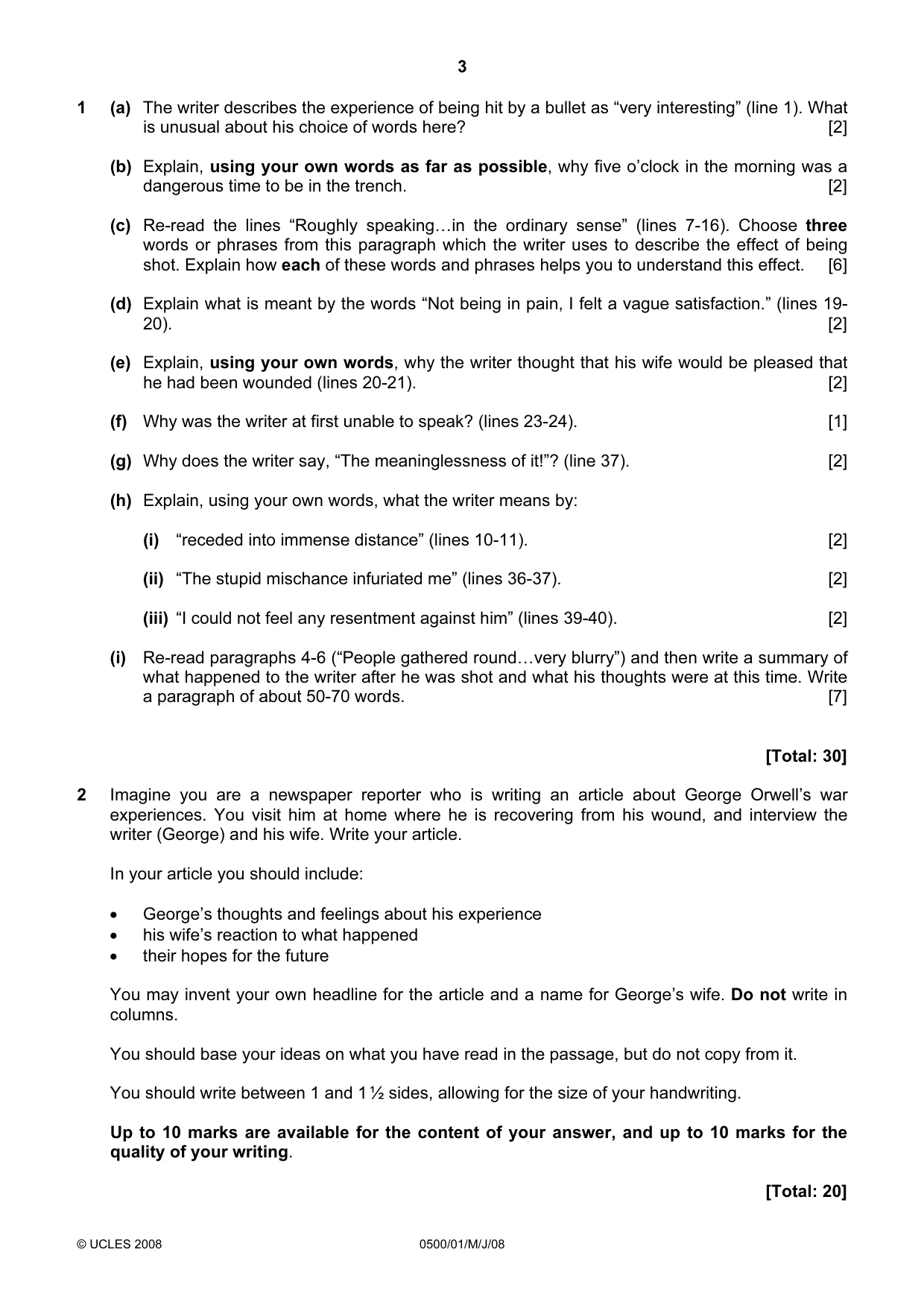
Question paper, page 3
3 © UCLES 2008 0500/01/M/J/08 1 (a) The writer describes the experience of being hit by a bullet as “very interesting” (line 1). What is unusual about his choice of words here? [2] (b) Explain, using your own words as far as possible, why five o’clock in the morning was a dangerous time to be in the trench. [2] (c) Re-read the lines “Roughly speaking…in the ordinary sense” (lines 7-16). Choose three words or phrases from this paragraph which the writer uses to describe the effect of being shot. Explain how each of these words and phrases helps you to understand this effect. [6] (d) Explain what is meant by the words “Not being in pain, I felt a vague satisfaction.” (lines 19- 20). [2] (e) Explain, using your own words, why the writer thought that his wife would be pleased that he had been wounded (lines 20-21). [2] (f) Why was the writer at first unable to speak? (lines 23-24). [1] (g) Why does the writer say, “The meaninglessness of it!”? (line 37). [2] (h) Explain, using your own words, what the writer means by: (i) “receded into immense distance” (lines 10-11). [2] (ii) “The stupid mischance infuriated me” (lines 36-37). [2] (iii) “I could not feel any resentment against him” (lines 39-40). [2] (i) Re-read paragraphs 4-6 (“People gathered round…very blurry”) and then write a summary of what happened to the writer after he was shot and what his thoughts were at this time. Write a paragraph of about 50-70 words. [7] [Total: 30] 2 Imagine you are a newspaper reporter who is writing an article about George Orwell’s war experiences. You visit him at home where he is recovering from his wound, and interview the writer (George) and his wife. Write your article. In your article you should include: • George’s thoughts and feelings about his experience • his wife’s reaction to what happened • their hopes for the future You may invent your own headline for the article and a name for George’s wife. Do not write in columns. You should base your ideas on what you have read in the passage, but do not copy from it. You should write between 1 and 1 ½ sides, allowing for the size of your handwriting. Up to 10 marks are available for the content of your answer, and up to 10 marks for the quality of your writing. [Total: 20]
Question paper, page 4
4 Copyright Acknowledgements: Passage © George Orwell; Homage to Catalonia. Permission to reproduce items where third-party owned material protected by copyright is included has been sought and cleared where possible. Every reasonable effort has been made by the publisher (UCLES) to trace copyright holders, but if any items requiring clearance have unwittingly been included, the publisher will be pleased to make amends at the earliest possible opportunity. University of Cambridge International Examinations is part of the Cambridge Assessment Group. Cambridge Assessment is the brand name of University of Cambridge Local Examinations Syndicate (UCLES), which is itself a department of the University of Cambridge. 0500/01/M/J/08 BLANK PAGE
Mark scheme, page 1
UNIVERSITY OF CAMBRIDGE INTERNATIONAL EXAMINATIONS International General Certificate of Secondary Education MARK SCHEME for the May/June 2008 question paper 0500 FIRST LANGUAGE ENGLISH 0500/01 Paper 1 (Reading Passage – Core), maximum raw mark 50 This mark scheme is published as an aid to teachers and candidates, to indicate the requirements of the examination. It shows the basis on which Examiners were instructed to award marks. It does not indicate the details of the discussions that took place at an Examiners’ meeting before marking began. All Examiners are instructed that alternative correct answers and unexpected approaches in candidates’ scripts must be given marks that fairly reflect the relevant knowledge and skills demonstrated. Mark schemes must be read in conjunction with the question papers and the report on the examination. • CIE will not enter into discussions or correspondence in connection with these mark schemes. CIE is publishing the mark schemes for the May/June 2008 question papers for most IGCSE, GCE Advanced Level and Advanced Subsidiary Level syllabuses and some Ordinary Level syllabuses. www.XtremePapers.com
Mark scheme, page 2
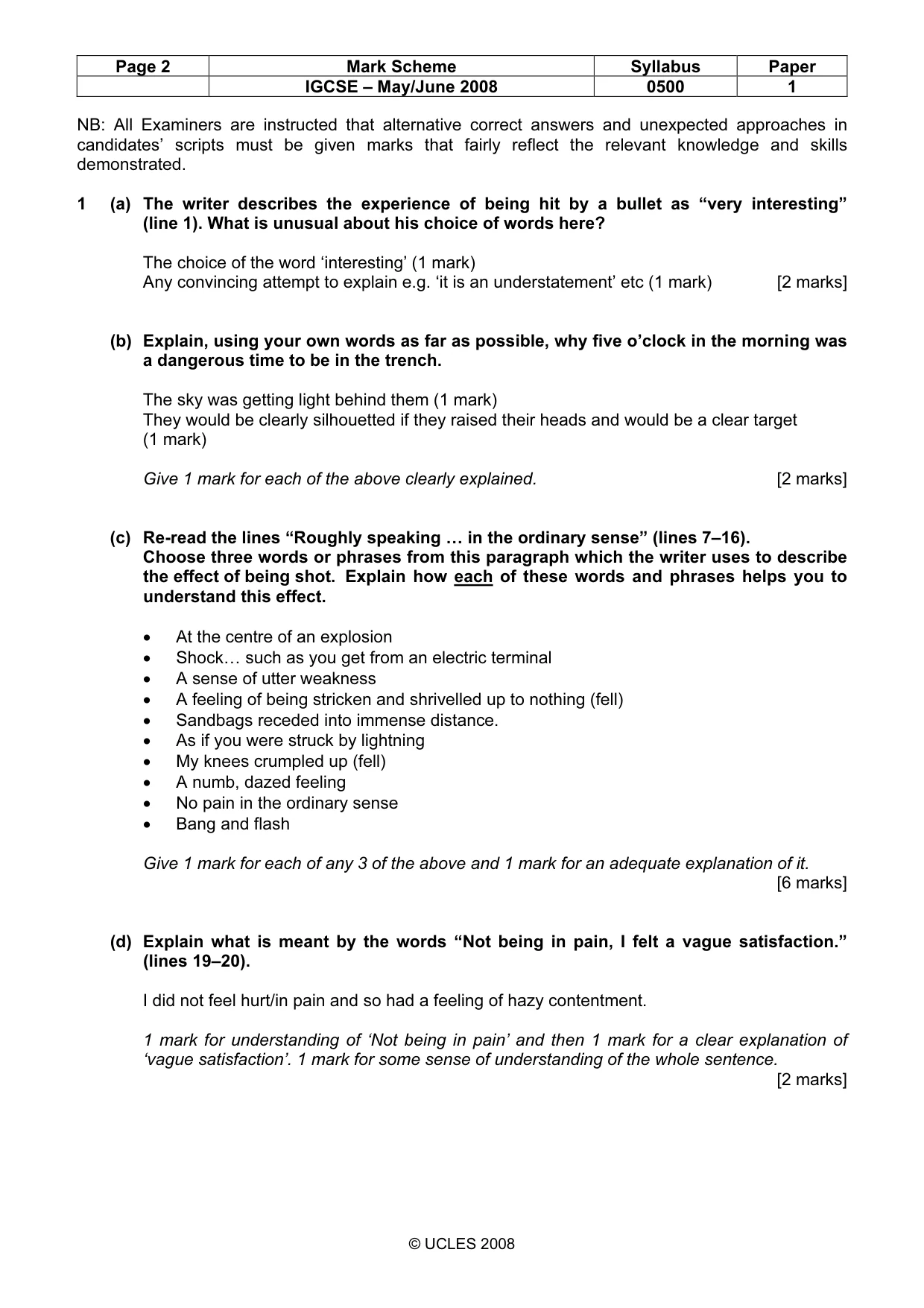
Page 2 Mark Scheme Syllabus Paper IGCSE – May/June 2008 0500 1 © UCLES 2008 NB: All Examiners are instructed that alternative correct answers and unexpected approaches in candidates’ scripts must be given marks that fairly reflect the relevant knowledge and skills demonstrated. 1 (a) The writer describes the experience of being hit by a bullet as “very interesting” (line 1). What is unusual about his choice of words here? The choice of the word ‘interesting’ (1 mark) Any convincing attempt to explain e.g. ‘it is an understatement’ etc (1 mark) [2 marks] (b) Explain, using your own words as far as possible, why five o’clock in the morning was a dangerous time to be in the trench. The sky was getting light behind them (1 mark) They would be clearly silhouetted if they raised their heads and would be a clear target (1 mark) Give 1 mark for each of the above clearly explained. [2 marks] (c) Re-read the lines “Roughly speaking … in the ordinary sense” (lines 7–16). Choose three words or phrases from this paragraph which the writer uses to describe the effect of being shot. Explain how each of these words and phrases helps you to understand this effect. • At the centre of an explosion • Shock… such as you get from an electric terminal • A sense of utter weakness • A feeling of being stricken and shrivelled up to nothing (fell) • Sandbags receded into immense distance. • As if you were struck by lightning • My knees crumpled up (fell) • A numb, dazed feeling • No pain in the ordinary sense • Bang and flash Give 1 mark for each of any 3 of the above and 1 mark for an adequate explanation of it. [6 marks] (d) Explain what is meant by the words “Not being in pain, I felt a vague satisfaction.” (lines 19–20). I did not feel hurt/in pain and so had a feeling of hazy contentment. 1 mark for understanding of ‘Not being in pain’ and then 1 mark for a clear explanation of ‘vague satisfaction’. 1 mark for some sense of understanding of the whole sentence. [2 marks]
Mark scheme, page 3
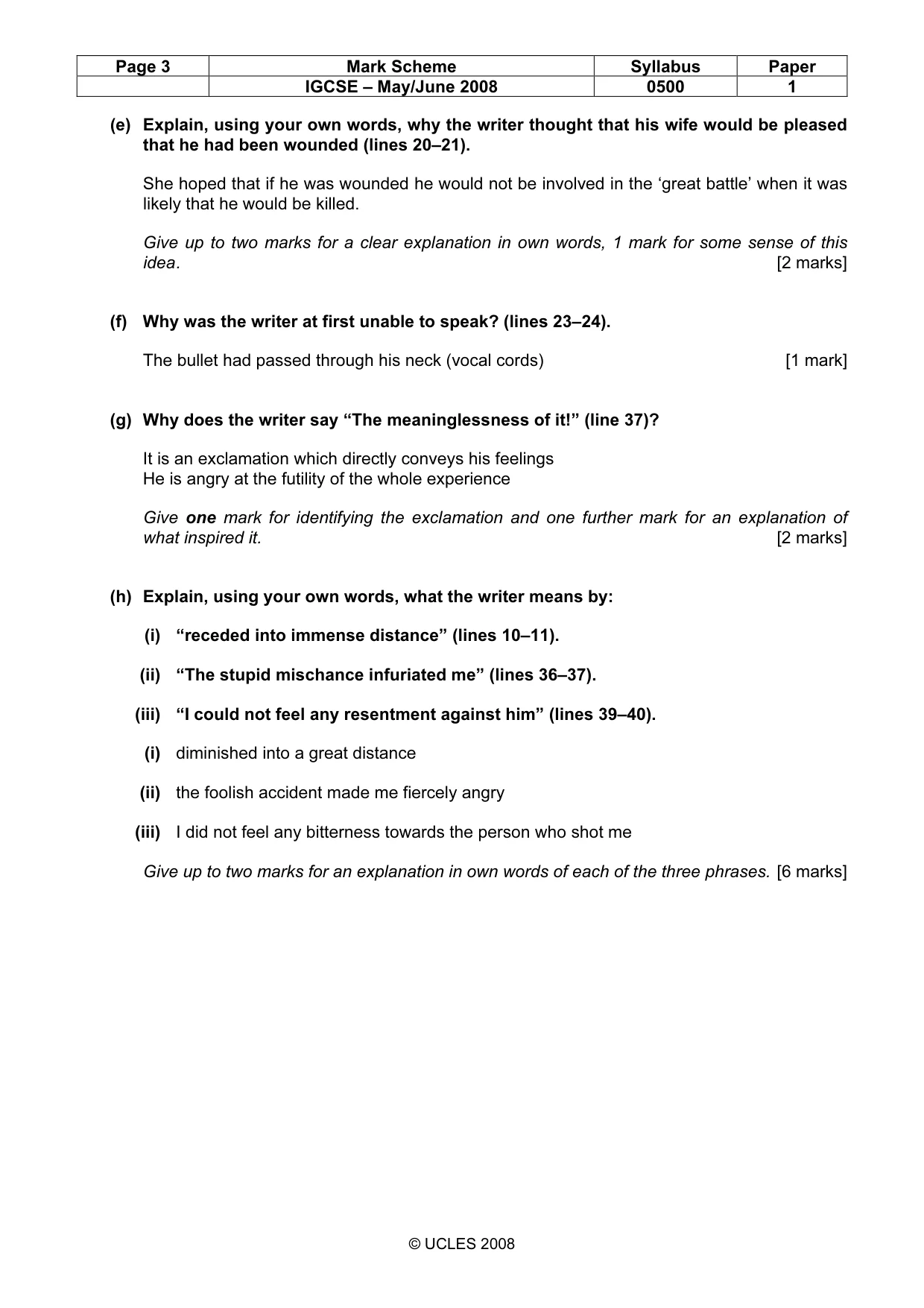
Page 3 Mark Scheme Syllabus Paper IGCSE – May/June 2008 0500 1 © UCLES 2008 (e) Explain, using your own words, why the writer thought that his wife would be pleased that he had been wounded (lines 20–21). She hoped that if he was wounded he would not be involved in the ‘great battle’ when it was likely that he would be killed. Give up to two marks for a clear explanation in own words, 1 mark for some sense of this idea . [2 marks] (f) Why was the writer at first unable to speak? (lines 23–24). The bullet had passed through his neck (vocal cords) [1 mark] (g) Why does the writer say “The meaninglessness of it!” (line 37)? It is an exclamation which directly conveys his feelings He is angry at the futility of the whole experience Give one mark for identifying the exclamation and one further mark for an explanation of what inspired it. [2 marks] (h) Explain, using your own words, what the writer means by: (i) “receded into immense distance” (lines 10–11). (ii) “The stupid mischance infuriated me” (lines 36–37). (iii) “I could not feel any resentment against him” (lines 39–40). (i) diminished into a great distance (ii) the foolish accident made me fiercely angry (iii) I did not feel any bitterness towards the person who shot me Give up to two marks for an explanation in own words of each of the three phrases. [6 marks]
Mark scheme, page 4
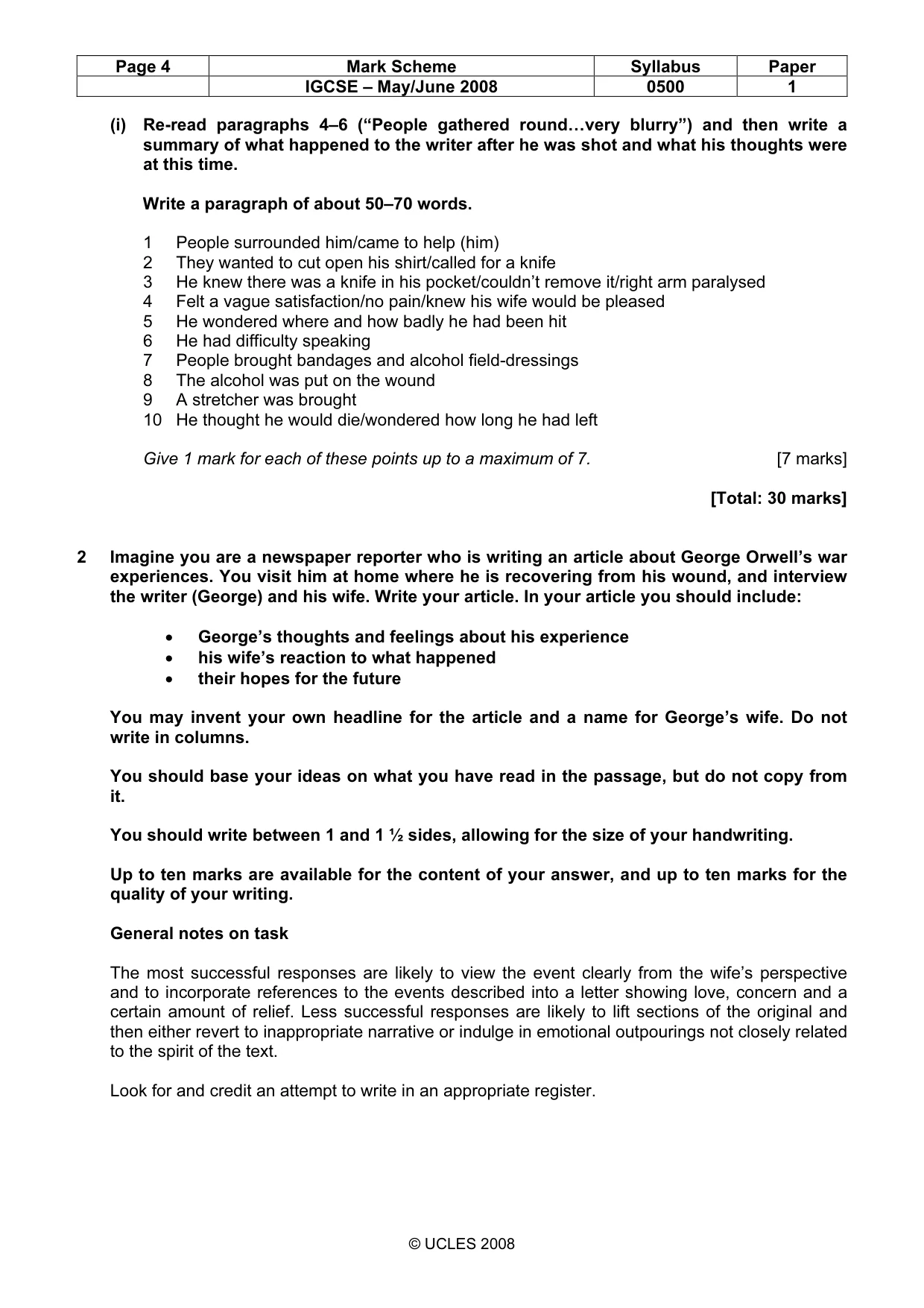
Page 4 Mark Scheme Syllabus Paper IGCSE – May/June 2008 0500 1 © UCLES 2008 (i) Re-read paragraphs 4–6 (“People gathered round…very blurry”) and then write a summary of what happened to the writer after he was shot and what his thoughts were at this time. Write a paragraph of about 50–70 words. 1 People surrounded him/came to help (him) 2 They wanted to cut open his shirt/called for a knife 3 He knew there was a knife in his pocket/couldn’t remove it/right arm paralysed 4 Felt a vague satisfaction/no pain/knew his wife would be pleased 5 He wondered where and how badly he had been hit 6 He had difficulty speaking 7 People brought bandages and alcohol field-dressings 8 The alcohol was put on the wound 9 A stretcher was brought 10 He thought he would die/wondered how long he had left Give 1 mark for each of these points up to a maximum of 7. [7 marks] [Total: 30 marks] 2 Imagine you are a newspaper reporter who is writing an article about George Orwell’s war experiences. You visit him at home where he is recovering from his wound, and interview the writer (George) and his wife. Write your article. In your article you should include: • George’s thoughts and feelings about his experience • his wife’s reaction to what happened • their hopes for the future You may invent your own headline for the article and a name for George’s wife. Do not write in columns. You should base your ideas on what you have read in the passage, but do not copy from it. You should write between 1 and 1 ½ sides, allowing for the size of your handwriting. Up to ten marks are available for the content of your answer, and up to ten marks for the quality of your writing. General notes on task The most successful responses are likely to view the event clearly from the wife’s perspective and to incorporate references to the events described into a letter showing love, concern and a certain amount of relief. Less successful responses are likely to lift sections of the original and then either revert to inappropriate narrative or indulge in emotional outpourings not closely related to the spirit of the text. Look for and credit an attempt to write in an appropriate register.
Mark scheme, page 5
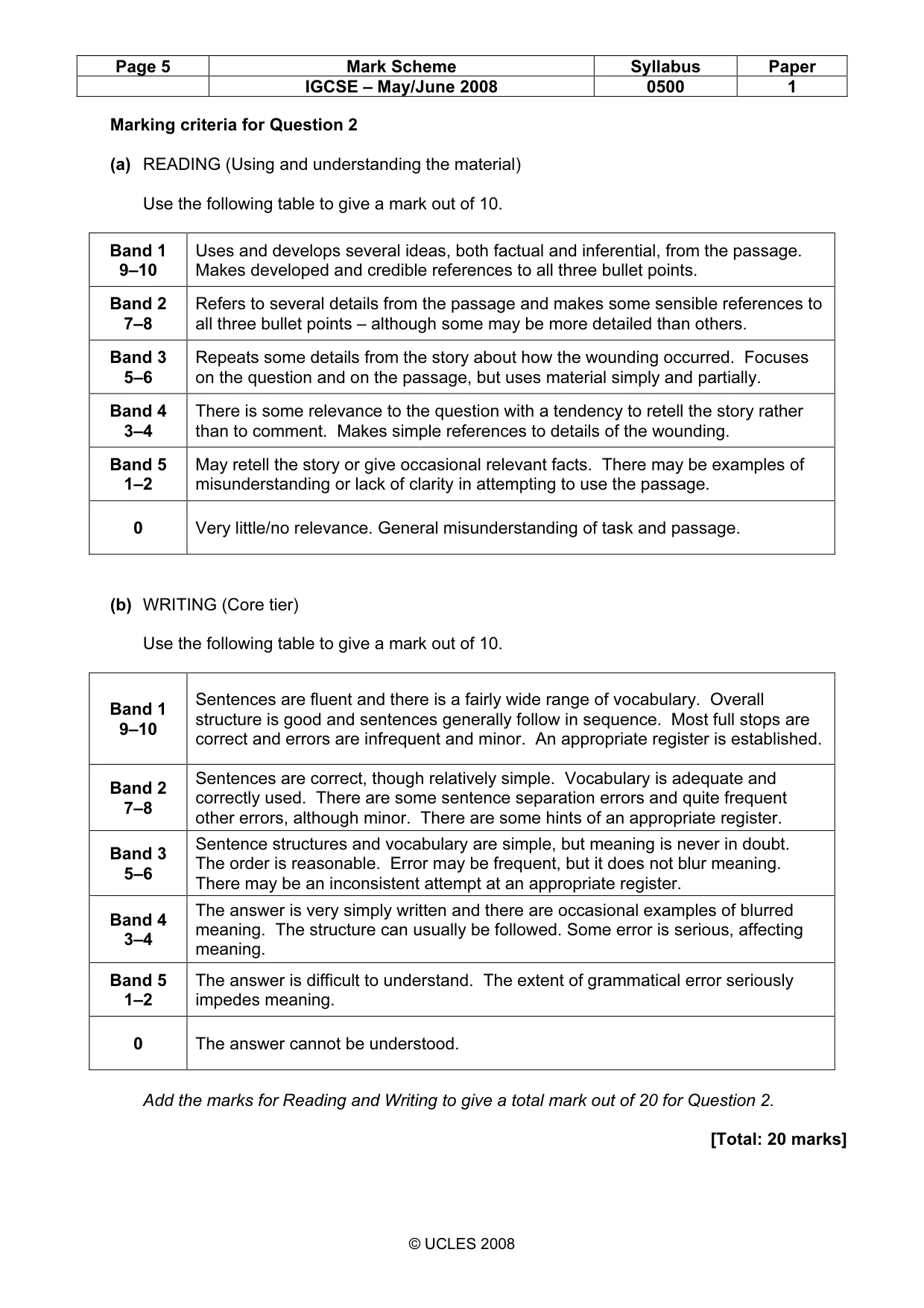
Page 5 Mark Scheme Syllabus Paper IGCSE – May/June 2008 0500 1 © UCLES 2008 Marking criteria for Question 2 (a) READING (Using and understanding the material) Use the following table to give a mark out of 10. Band 1 9–10 Uses and develops several ideas, both factual and inferential, from the passage. Makes developed and credible references to all three bullet points. Band 2 7–8 Refers to several details from the passage and makes some sensible references to all three bullet points – although some may be more detailed than others. Band 3 5–6 Repeats some details from the story about how the wounding occurred. Focuses on the question and on the passage, but uses material simply and partially. Band 4 3–4 There is some relevance to the question with a tendency to retell the story rather than to comment. Makes simple references to details of the wounding. Band 5 1–2 May retell the story or give occasional relevant facts. There may be examples of misunderstanding or lack of clarity in attempting to use the passage. 0 Very little/no relevance. General misunderstanding of task and passage. (b) WRITING (Core tier) Use the following table to give a mark out of 10. Band 1 9–10 Sentences are fluent and there is a fairly wide range of vocabulary. Overall structure is good and sentences generally follow in sequence. Most full stops are correct and errors are infrequent and minor. An appropriate register is established. Band 2 7–8 Sentences are correct, though relatively simple. Vocabulary is adequate and correctly used. There are some sentence separation errors and quite frequent other errors, although minor. There are some hints of an appropriate register. Band 3 5–6 Sentence structures and vocabulary are simple, but meaning is never in doubt. The order is reasonable. Error may be frequent, but it does not blur meaning. There may be an inconsistent attempt at an appropriate register. Band 4 3–4 The answer is very simply written and there are occasional examples of blurred meaning. The structure can usually be followed. Some error is serious, affecting meaning. Band 5 1–2 The answer is difficult to understand. The extent of grammatical error seriously impedes meaning. 0 The answer cannot be understood. Add the marks for Reading and Writing to give a total mark out of 20 for Question 2. [Total: 20 marks]
What you needed in this session
Cambridge’s own grade thresholds for 2008 May/June, Paper 1 · Variant 1. A higher threshold means an easier paper — the bar moves with how the cohort did.