Cambridge IGCSE English - First Language 0500 — 2007 Oct/Nov Paper 2 · Variant 1
0500/21/O/N/07 · 50 marks · ≈56 min
The question paper and its mark scheme, free to read here and free to download. This is Cambridge’s own paper, exactly as it was sat.
Question paper8 pages
Mark scheme9 pages
Answers below. Sit the paper first if you are practising.
Paper as text
Question paper, page 1
This document consists of 6 printed pages and 2 blank pages. IB07 11_0500_02/3RP © UCLES 2007 [Turn over *7371145536* UNIVERSITY OF CAMBRIDGE INTERNATIONAL EXAMINATIONS International General Certificate of Secondary Education FIRST LANGUAGE ENGLISH 0500/02 Paper 2 Reading Passages (Extended) October/November 2007 2 hours Additional Materials: Answer Booklet/Paper READ THESE INSTRUCTIONS FIRST If you have been given an Answer Booklet, follow the instructions on the front cover of the Booklet. Write your Centre number, candidate number and name on all the work you hand in. Write in dark blue or black pen. Do not use staples, paper clips, highlighters, glue or correction fluid. Answer all questions. Dictionaries are not permitted. At the end of the examination, fasten all your work securely together. The number of marks is given in brackets [ ] at the end of each question or part question. www.XtremePapers.com
Question paper, page 2
2 © UCLES 2007 0500/02/O/N/07 Part 1 Read Passage A carefully, and then answer Questions 1 and 2. Passage A In 1972, the writer and his family were crossing the Pacific in their boat the Lucette when she was wrecked by a killer whale. They took to their dinghy, Ednamair, and at the start of this passage, had been adrift for thirty-seven days. Rescue at Sea My eye caught sight of something that wasn’t sea. I stopped talking and stared; the others all looked at me. ‘A ship,’ I said. ‘There’s a ship and it’s coming towards us!’ I could hardly believe it but it seemed solid enough. ‘Keep still now!’ In the sudden surge of excitement, everyone wanted to see. ‘We mustn’t capsize now!’ I felt myself tremble as I told them I was going to hold a flare above the sail. ‘Remember what happened with the last ship we saw!’ They suddenly fell silent at the memory of that terrible despondency when our signals had been unnoticed. ‘Oh God!’ prayed my wife, Lyn, ‘please let them see us.’ I could see the ship quite clearly now, a Japanese fishing vessel. Her grey and white paint stood out clearly against the dark cross swell. The flare sparked into life, the red glare illuminating Ednamair and the sea around us in the twilight. ‘Hand me another! I think she’s altered course!’ My voice was hoarse with pain and excitement, and I felt sick with apprehension that it might only be the ship cork-screwing in the swell. But it wasn’t needed: she had seen us and was coming towards us. ‘Our ordeal is over,’ I said quietly. Lyn and the twins were crying with happiness. I put my arms around Lyn, feeling the tears stinging my own eyes. ‘We’ll get these boys to land after all.’ The high flared bows of Tokamaru 1 towered over us as she closed in, pitching and rolling in the uneasy swell. We emptied turtle oil on the sea to try to smooth it as the dinghy rocked violently in the cross chop of waves. As they drew near enough, the sailors threw heaving lines. Willing hands reached down and we were hauled bodily on board. When I reached the foredeck the family were already seated, in their hands tins of orange juice and blissful content on their faces. I picked up the tin that was left for me, smiled my thanks to the sailors who grinned broadly back at me, then lifting my arm, said ‘Cheers.’ I shall remember the taste of that beautiful liquid to the end of my days. The crew carried the twins to the large four-feet deep, hot sea-water bath. There, in the fresh water shower (we had to adjust our ideas to the notion that fresh water could be used for other things besides drinking) they soaped and lathered and wallowed in luxury, scrubbing at the brown scurf which our skins had developed. Then Lyn and I luxuriated in the warmth of the deep tub. The ecstasy of not having to protect boil-covered parts of our anatomies from solid contacts had to be experienced to be believed, but the simple joy of soap lathering in fresh water is surely one of the greatest luxuries of mankind. New clothes had been laid out for us from the ship’s stores and the kind concern shown us by these smiling, warm-hearted sailors was almost too much for our shattered emotions. How cosy to have garments that were soft and dry! On our return to the foredeck, there on the hatch stood a huge tray of bread and butter and a strange brown liquid called coffee. Our eyes gleamed as we tasted these strange luxuries.
Question paper, page 3
3 © UCLES 2007 0500/02/O/N/07 [Turn over We tried to settle down to sleep on the tarpaulins spread out for us, but the unaccustomed warmth became a stifling heat; the vibration of the engines, the whole attitude of relaxation and freedom to move around was so strange that sleep would not come. At about midnight, we could stand it no longer and staggered out on deck to seek the cool night air, the starlit skies and the swell of the ocean. In the days that followed, we indulged in the luxury of eating and drinking wonderful food, the meals growing in quantity and sophistication. The familiar figure of the cook became the symbol round which our whole existence revolved as he bore tray after tray of spinach soup, prawns, fruit juices, fried chicken, and fermented rice-water. The crew took the twins to their hearts and showered them with kindness. They had already made gifts of clothing to us all, soap and toilet requisites, towels, notebooks, and pens. They delighted in watching the twins draw, write and play together.
Question paper, page 4
4 © UCLES 2007 0500/02/O/N/07 1 Write a newspaper report using the headlines printed below. Base what you write closely on the reading material in Passage A. Lost family found alive and well − hours from death Dramatic rescue by fishermen Include the following in your report, in any order you wish: • comments about the rescue made by some of the people involved • reference to what life on the Ednamair was like before the rescue took place • feelings experienced by the family and the Japanese crew Write between 1 ½ and 2 sides, allowing for the size of your handwriting. Up to 15 marks will be available for the content of your answer, and up to 5 marks for the quality of your writing. [20] 2 Re-read the descriptions of: (a) the mixed feelings of the writer and his family when they see the Japanese ship in paragraphs 1-4; (b) the reactions of the writer and his family to the bath and the shower in paragraph 7. Explain the effects the writer creates by using these descriptions. Support your answer by selecting words and phrases from these paragraphs. [10]
Question paper, page 5
5 0500/02/O/N/07 [Turn over BLANK PAGE PLEASE TURN OVER FOR PART 2
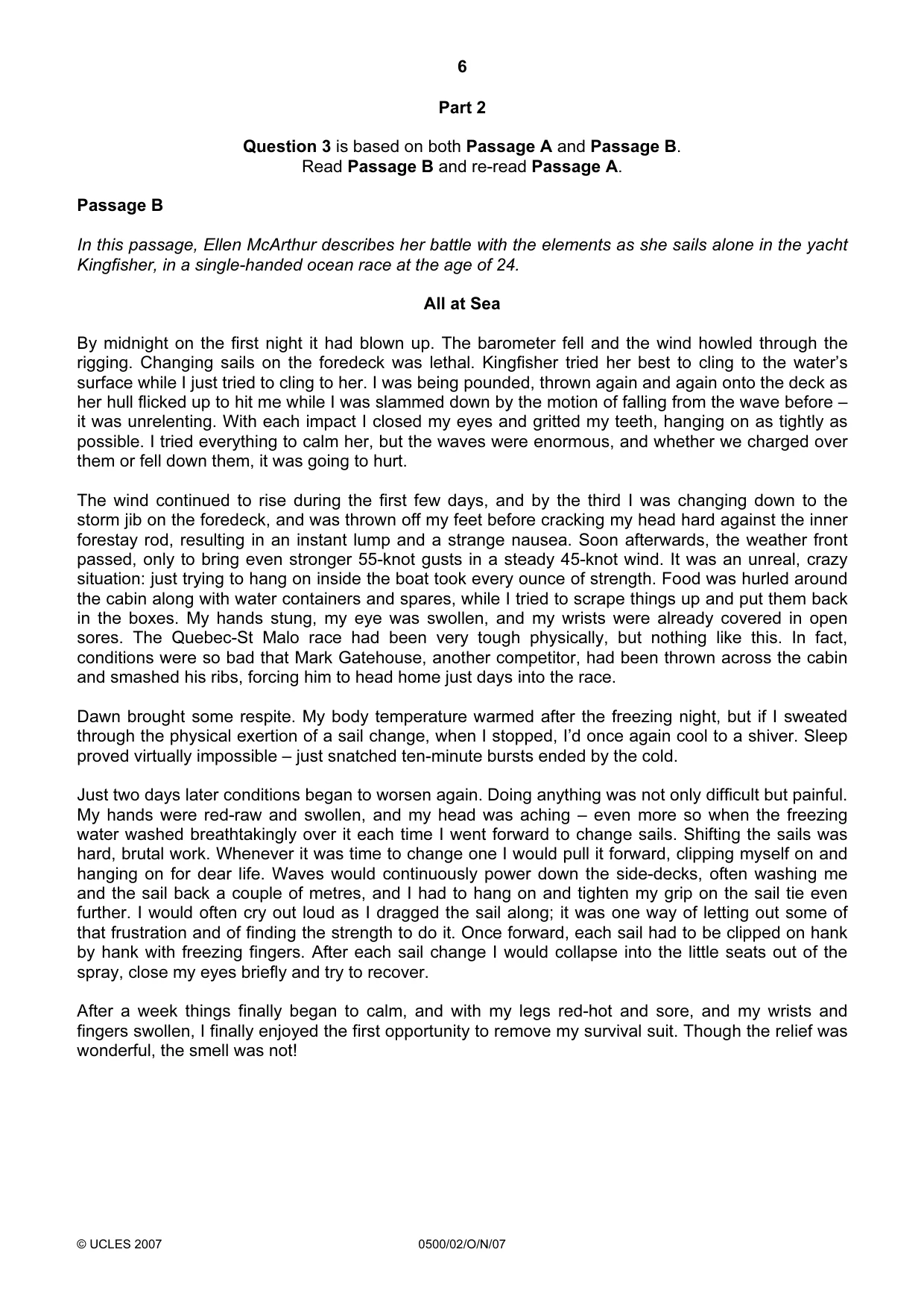
Question paper, page 6
6 © UCLES 2007 0500/02/O/N/07 Part 2 Question 3 is based on both Passage A and Passage B. Read Passage B and re-read Passage A. Passage B In this passage, Ellen McArthur describes her battle with the elements as she sails alone in the yacht Kingfisher, in a single-handed ocean race at the age of 24. All at Sea By midnight on the first night it had blown up. The barometer fell and the wind howled through the rigging. Changing sails on the foredeck was lethal. Kingfisher tried her best to cling to the water’s surface while I just tried to cling to her. I was being pounded, thrown again and again onto the deck as her hull flicked up to hit me while I was slammed down by the motion of falling from the wave before – it was unrelenting. With each impact I closed my eyes and gritted my teeth, hanging on as tightly as possible. I tried everything to calm her, but the waves were enormous, and whether we charged over them or fell down them, it was going to hurt. The wind continued to rise during the first few days, and by the third I was changing down to the storm jib on the foredeck, and was thrown off my feet before cracking my head hard against the inner forestay rod, resulting in an instant lump and a strange nausea. Soon afterwards, the weather front passed, only to bring even stronger 55-knot gusts in a steady 45-knot wind. It was an unreal, crazy situation: just trying to hang on inside the boat took every ounce of strength. Food was hurled around the cabin along with water containers and spares, while I tried to scrape things up and put them back in the boxes. My hands stung, my eye was swollen, and my wrists were already covered in open sores. The Quebec-St Malo race had been very tough physically, but nothing like this. In fact, conditions were so bad that Mark Gatehouse, another competitor, had been thrown across the cabin and smashed his ribs, forcing him to head home just days into the race. Dawn brought some respite. My body temperature warmed after the freezing night, but if I sweated through the physical exertion of a sail change, when I stopped, I’d once again cool to a shiver. Sleep proved virtually impossible – just snatched ten-minute bursts ended by the cold. Just two days later conditions began to worsen again. Doing anything was not only difficult but painful. My hands were red-raw and swollen, and my head was aching – even more so when the freezing water washed breathtakingly over it each time I went forward to change sails. Shifting the sails was hard, brutal work. Whenever it was time to change one I would pull it forward, clipping myself on and hanging on for dear life. Waves would continuously power down the side-decks, often washing me and the sail back a couple of metres, and I had to hang on and tighten my grip on the sail tie even further. I would often cry out loud as I dragged the sail along; it was one way of letting out some of that frustration and of finding the strength to do it. Once forward, each sail had to be clipped on hank by hank with freezing fingers. After each sail change I would collapse into the little seats out of the spray, close my eyes briefly and try to recover. After a week things finally began to calm, and with my legs red-hot and sore, and my wrists and fingers swollen, I finally enjoyed the first opportunity to remove my survival suit. Though the relief was wonderful, the smell was not!
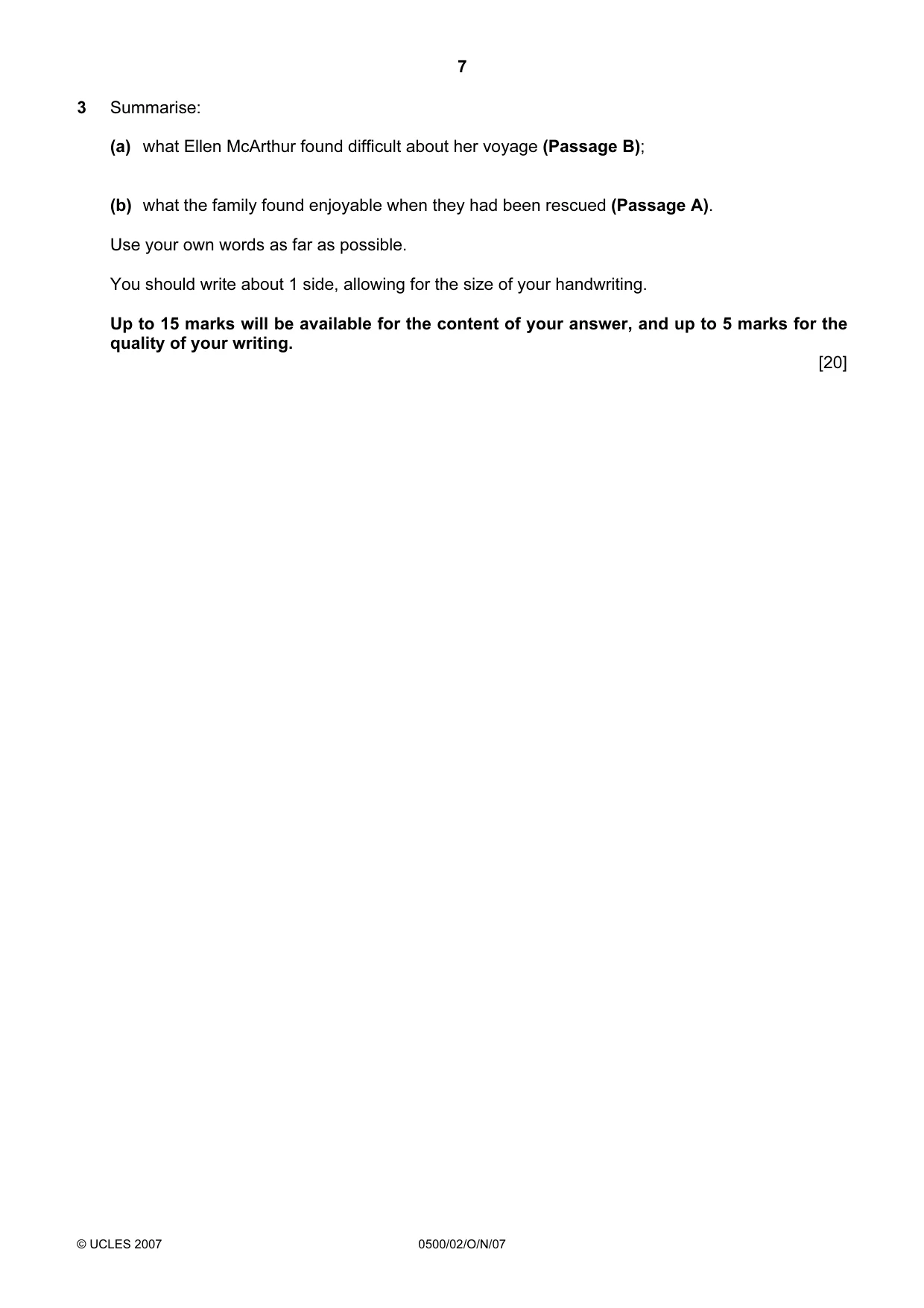
Question paper, page 7
7 © UCLES 2007 0500/02/O/N/07 3 Summarise: (a) what Ellen McArthur found difficult about her voyage (Passage B); (b) what the family found enjoyable when they had been rescued (Passage A). Use your own words as far as possible. You should write about 1 side, allowing for the size of your handwriting. Up to 15 marks will be available for the content of your answer, and up to 5 marks for the quality of your writing. [20]
Question paper, page 8
8 Copyright Acknowledgements: Passage A © Dougal Robertson; Survive the Savage Sea. Passage B © A P Watt Ltd on behalf of Offshore Challenges Ltd. Permission to reproduce items where third-party owned material protected by copyright is included has been sought and cleared where possible. Every reasonable effort has been made by the publisher (UCLES) to trace copyright holders, but if any items requiring clearance have unwittingly been included, the publisher will be pleased to make amends at the earliest possible opportunity. University of Cambridge International Examinations is part of the Cambridge Assessment Group. Cambridge Assessment is the brand name of University of Cambridge Local Examinations Syndicate (UCLES), which is itself a department of the University of Cambridge. 0500/02/O/N/07 BLANK PAGE
Mark scheme, page 1
UNIVERSITY OF CAMBRIDGE INTERNATIONAL EXAMINATIONS International General Certificate of Secondary Education MARK SCHEME for the October/November 2007 question paper 0500 FIRST LANGUAGE ENGLISH 0500/02 Paper 2 (Reading Passages – Extended), maximum raw mark 50 This mark scheme is published as an aid to teachers and candidates, to indicate the requirements of the examination. It shows the basis on which Examiners were instructed to award marks. It does not indicate the details of the discussions that took place at an Examiners’ meeting before marking began. All Examiners are instructed that alternative correct answers and unexpected approaches in candidates’ scripts must be given marks that fairly reflect the relevant knowledge and skills demonstrated. Mark schemes must be read in conjunction with the question papers and the report on the examination. • CIE will not enter into discussions or correspondence in connection with these mark schemes. CIE is publishing the mark schemes for the October/November 2007 question papers for most IGCSE, GCE Advanced Level and Advanced Subsidiary Level syllabuses and some Ordinary Level syllabuses. www.XtremePapers.com
Mark scheme, page 2
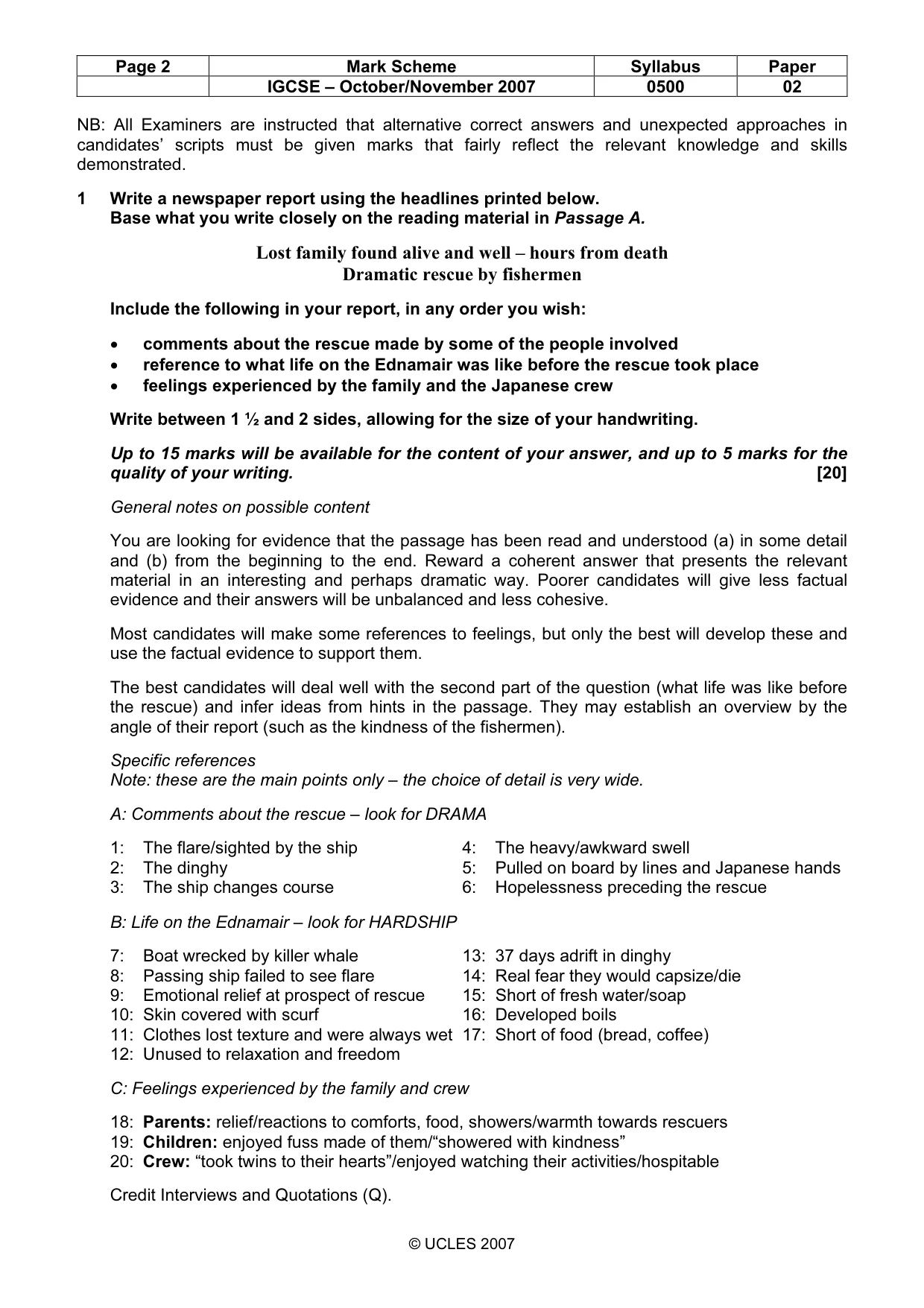
Page 2 Mark Scheme Syllabus Paper IGCSE – October/November 2007 0500 02 © UCLES 2007 NB: All Examiners are instructed that alternative correct answers and unexpected approaches in candidates’ scripts must be given marks that fairly reflect the relevant knowledge and skills demonstrated. 1 Write a newspaper report using the headlines printed below. Base what you write closely on the reading material in Passage A. Lost family found alive and well – hours from death Dramatic rescue by fishermen Include the following in your report, in any order you wish: • comments about the rescue made by some of the people involved • reference to what life on the Ednamair was like before the rescue took place • feelings experienced by the family and the Japanese crew Write between 1 ½ and 2 sides, allowing for the size of your handwriting. Up to 15 marks will be available for the content of your answer, and up to 5 marks for the quality of your writing. [20] General notes on possible content You are looking for evidence that the passage has been read and understood (a) in some detail and (b) from the beginning to the end. Reward a coherent answer that presents the relevant material in an interesting and perhaps dramatic way. Poorer candidates will give less factual evidence and their answers will be unbalanced and less cohesive. Most candidates will make some references to feelings, but only the best will develop these and use the factual evidence to support them. The best candidates will deal well with the second part of the question (what life was like before the rescue) and infer ideas from hints in the passage. They may establish an overview by the angle of their report (such as the kindness of the fishermen). Specific references Note: these are the main points only – the choice of detail is very wide. A: Comments about the rescue – look for DRAMA 1: The flare/sighted by the ship 4: The heavy/awkward swell 2: The dinghy 5: Pulled on board by lines and Japanese hands 3: The ship changes course 6: Hopelessness preceding the rescue B: Life on the Ednamair – look for HARDSHIP 7: Boat wrecked by killer whale 13: 37 days adrift in dinghy 8: Passing ship failed to see flare 14: Real fear they would capsize/die 9: Emotional relief at prospect of rescue 15: Short of fresh water/soap 10: Skin covered with scurf 16: Developed boils 11: Clothes lost texture and were always wet 17: Short of food (bread, coffee) 12: Unused to relaxation and freedom C: Feelings experienced by the family and crew 18: Parents: relief/reactions to comforts, food, showers/warmth towards rescuers 19: Children: enjoyed fuss made of them/“showered with kindness” 20: Crew: “took twins to their hearts”/enjoyed watching their activities/hospitable Credit Interviews and Quotations (Q).
Mark scheme, page 3
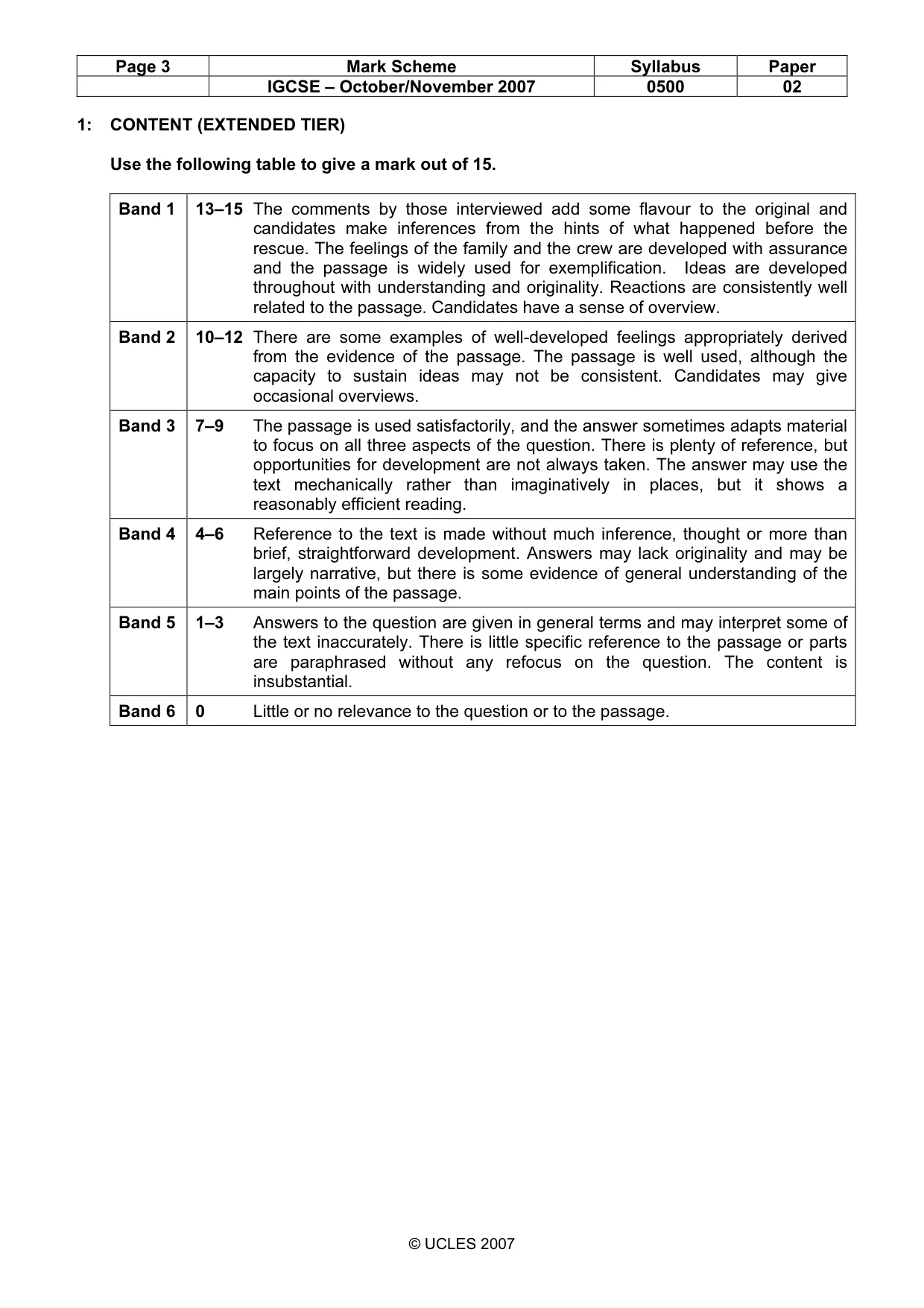
Page 3 Mark Scheme Syllabus Paper IGCSE – October/November 2007 0500 02 © UCLES 2007 1: CONTENT (EXTENDED TIER) Use the following table to give a mark out of 15. Band 1 13–15 The comments by those interviewed add some flavour to the original and candidates make inferences from the hints of what happened before the rescue. The feelings of the family and the crew are developed with assurance and the passage is widely used for exemplification. Ideas are developed throughout with understanding and originality. Reactions are consistently well related to the passage. Candidates have a sense of overview. Band 2 10–12 There are some examples of well-developed feelings appropriately derived from the evidence of the passage. The passage is well used, although the capacity to sustain ideas may not be consistent. Candidates may give occasional overviews. Band 3 7–9 The passage is used satisfactorily, and the answer sometimes adapts material to focus on all three aspects of the question. There is plenty of reference, but opportunities for development are not always taken. The answer may use the text mechanically rather than imaginatively in places, but it shows a reasonably efficient reading. Band 4 4–6 Reference to the text is made without much inference, thought or more than brief, straightforward development. Answers may lack originality and may be largely narrative, but there is some evidence of general understanding of the main points of the passage. Band 5 1–3 Answers to the question are given in general terms and may interpret some of the text inaccurately. There is little specific reference to the passage or parts are paraphrased without any refocus on the question. The content is insubstantial. Band 6 0 Little or no relevance to the question or to the passage.
Mark scheme, page 4
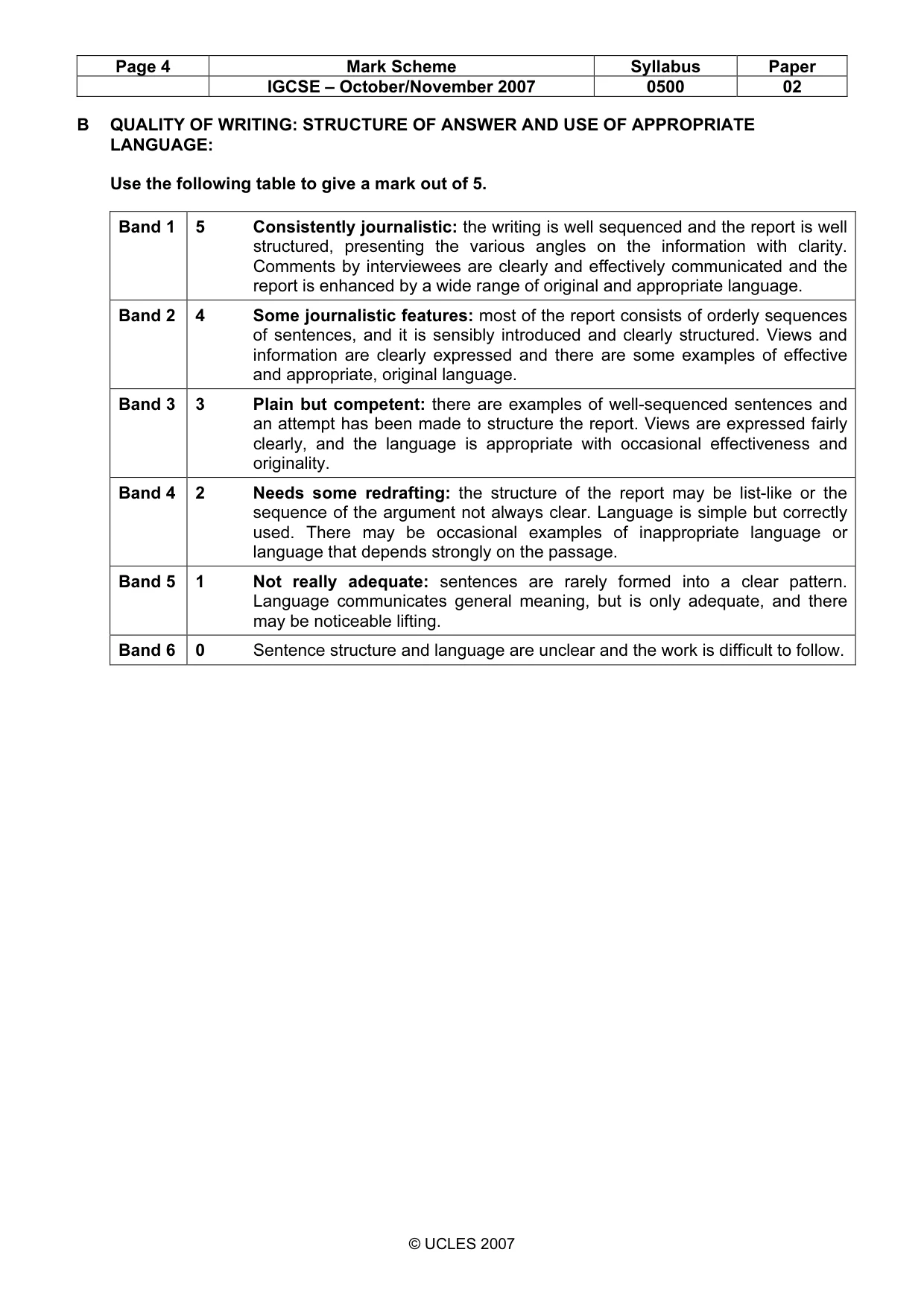
Page 4 Mark Scheme Syllabus Paper IGCSE – October/November 2007 0500 02 © UCLES 2007 B QUALITY OF WRITING: STRUCTURE OF ANSWER AND USE OF APPROPRIATE LANGUAGE: Use the following table to give a mark out of 5. Band 1 5 Consistently journalistic: the writing is well sequenced and the report is well structured, presenting the various angles on the information with clarity. Comments by interviewees are clearly and effectively communicated and the report is enhanced by a wide range of original and appropriate language. Band 2 4 Some journalistic features: most of the report consists of orderly sequences of sentences, and it is sensibly introduced and clearly structured. Views and information are clearly expressed and there are some examples of effective and appropriate, original language. Band 3 3 Plain but competent: there are examples of well-sequenced sentences and an attempt has been made to structure the report. Views are expressed fairly clearly, and the language is appropriate with occasional effectiveness and originality. Band 4 2 Needs some redrafting: the structure of the report may be list-like or the sequence of the argument not always clear. Language is simple but correctly used. There may be occasional examples of inappropriate language or language that depends strongly on the passage. Band 5 1 Not really adequate: sentences are rarely formed into a clear pattern. Language communicates general meaning, but is only adequate, and there may be noticeable lifting. Band 6 0 Sentence structure and language are unclear and the work is difficult to follow.
Mark scheme, page 5
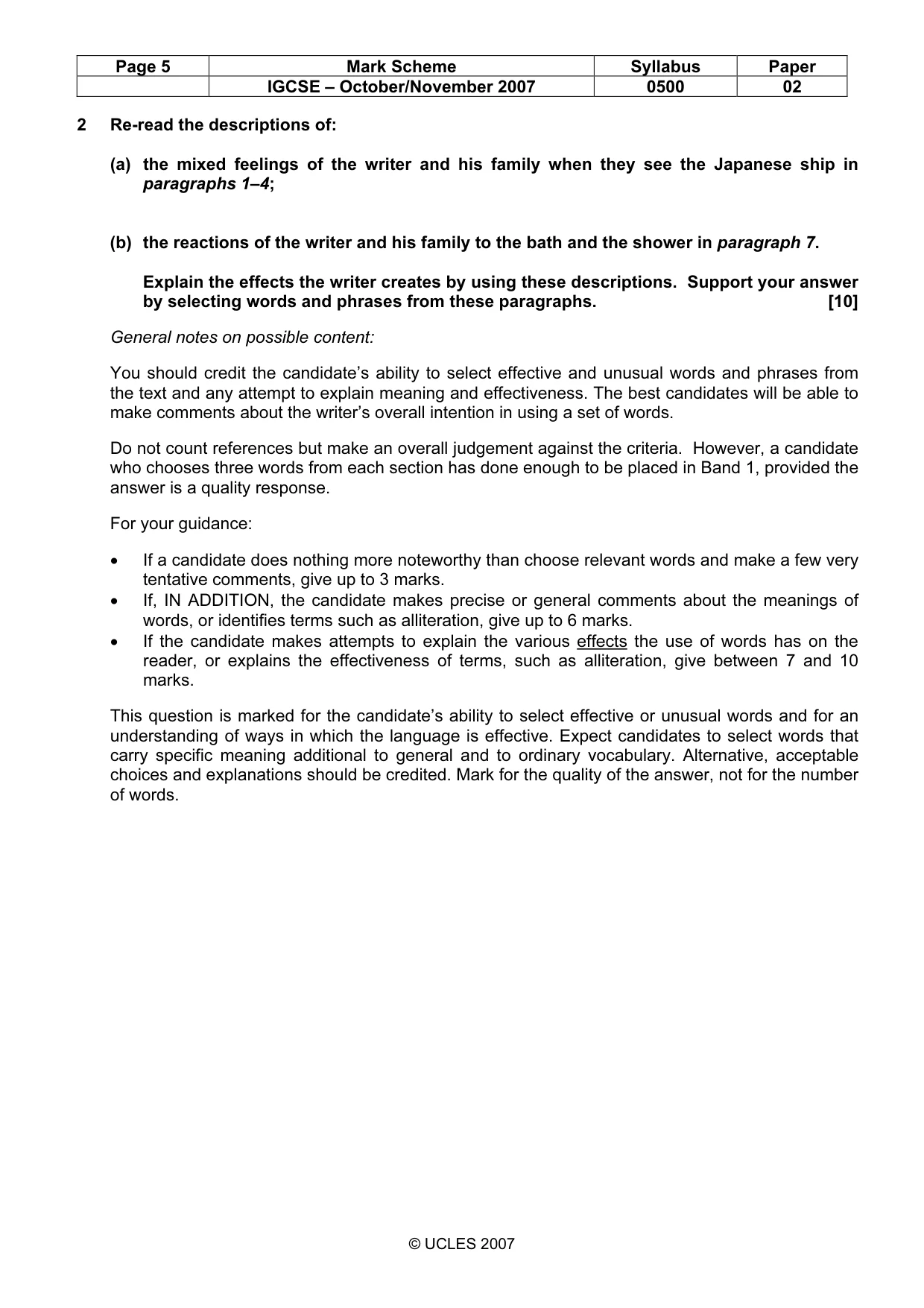
Page 5 Mark Scheme Syllabus Paper IGCSE – October/November 2007 0500 02 © UCLES 2007 2 Re-read the descriptions of: (a) the mixed feelings of the writer and his family when they see the Japanese ship in paragraphs 1–4; (b) the reactions of the writer and his family to the bath and the shower in paragraph 7. Explain the effects the writer creates by using these descriptions. Support your answer by selecting words and phrases from these paragraphs. [10] General notes on possible content: You should credit the candidate’s ability to select effective and unusual words and phrases from the text and any attempt to explain meaning and effectiveness. The best candidates will be able to make comments about the writer’s overall intention in using a set of words. Do not count references but make an overall judgement against the criteria. However, a candidate who chooses three words from each section has done enough to be placed in Band 1, provided the answer is a quality response. For your guidance: • If a candidate does nothing more noteworthy than choose relevant words and make a few very tentative comments, give up to 3 marks. • If, IN ADDITION, the candidate makes precise or general comments about the meanings of words, or identifies terms such as alliteration, give up to 6 marks. • If the candidate makes attempts to explain the various effects the use of words has on the reader, or explains the effectiveness of terms, such as alliteration, give between 7 and 10 marks. This question is marked for the candidate’s ability to select effective or unusual words and for an understanding of ways in which the language is effective. Expect candidates to select words that carry specific meaning additional to general and to ordinary vocabulary. Alternative, acceptable choices and explanations should be credited. Mark for the quality of the answer, not for the number of words.
Mark scheme, page 6
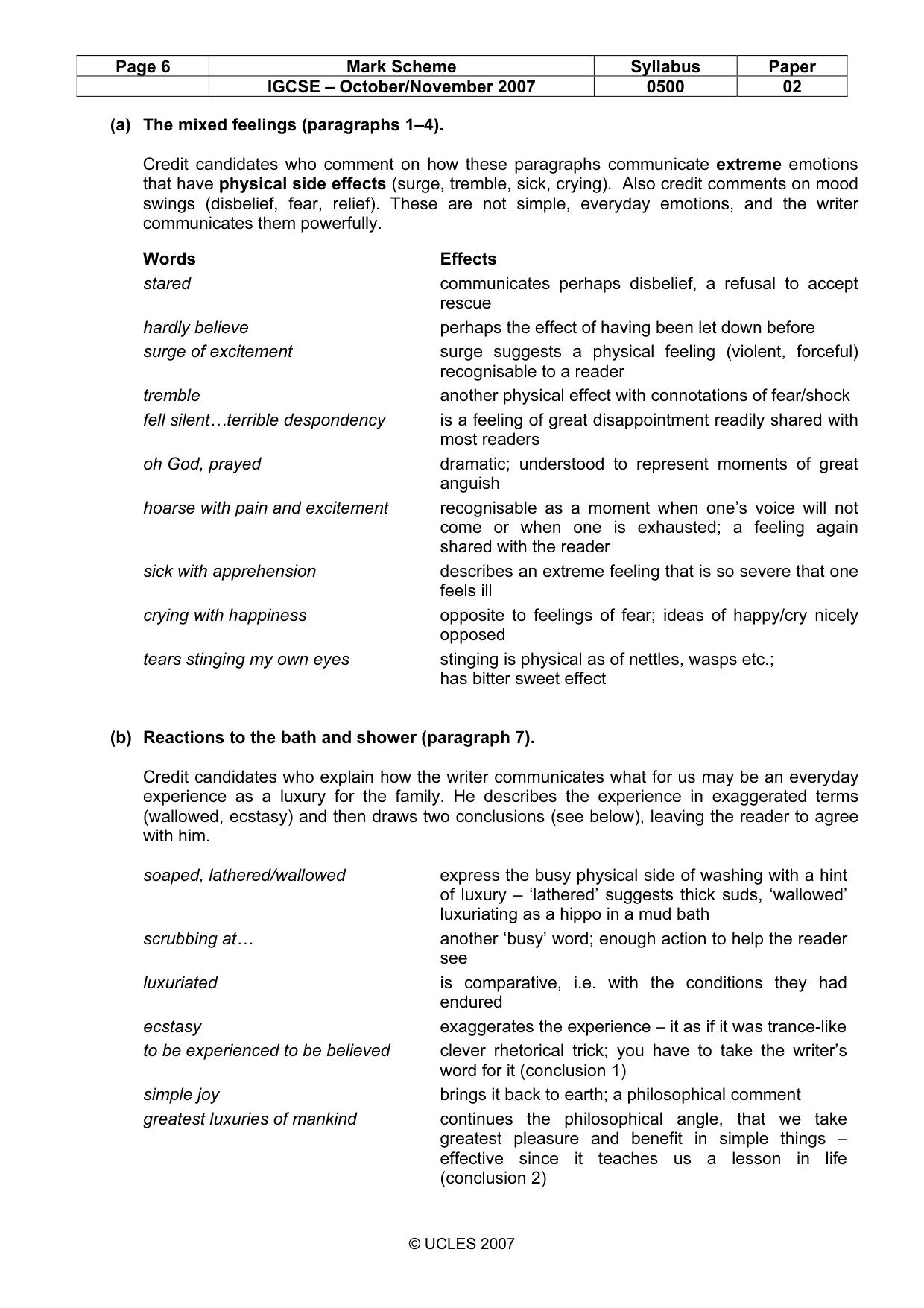
Page 6 Mark Scheme Syllabus Paper IGCSE – October/November 2007 0500 02 © UCLES 2007 (a) The mixed feelings (paragraphs 1–4). Credit candidates who comment on how these paragraphs communicate extreme emotions that have physical side effects (surge, tremble, sick, crying). Also credit comments on mood swings (disbelief, fear, relief). These are not simple, everyday emotions, and the writer communicates them powerfully. Words Effects stared communicates perhaps disbelief, a refusal to accept rescue hardly believe perhaps the effect of having been let down before surge of excitement surge suggests a physical feeling (violent, forceful) recognisable to a reader tremble another physical effect with connotations of fear/shock fell silent…terrible despondency is a feeling of great disappointment readily shared with most readers oh God, prayed dramatic; understood to represent moments of great anguish hoarse with pain and excitement recognisable as a moment when one’s voice will not come or when one is exhausted; a feeling again shared with the reader sick with apprehension describes an extreme feeling that is so severe that one feels ill crying with happiness opposite to feelings of fear; ideas of happy/cry nicely opposed tears stinging my own eyes stinging is physical as of nettles, wasps etc.; has bitter sweet effect (b) Reactions to the bath and shower (paragraph 7). Credit candidates who explain how the writer communicates what for us may be an everyday experience as a luxury for the family. He describes the experience in exaggerated terms (wallowed, ecstasy) and then draws two conclusions (see below), leaving the reader to agree with him. soaped, lathered/wallowed express the busy physical side of washing with a hint of luxury – ‘lathered’ suggests thick suds, ‘wallowed’ luxuriating as a hippo in a mud bath scrubbing at… another ‘busy’ word; enough action to help the reader see luxuriated is comparative, i.e. with the conditions they had endured ecstasy exaggerates the experience – it as if it was trance-like to be experienced to be believed clever rhetorical trick; you have to take the writer’s word for it (conclusion 1) simple joy brings it back to earth; a philosophical comment greatest luxuries of mankind continues the philosophical angle, that we take greatest pleasure and benefit in simple things – effective since it teaches us a lesson in life (conclusion 2)
Mark scheme, page 7
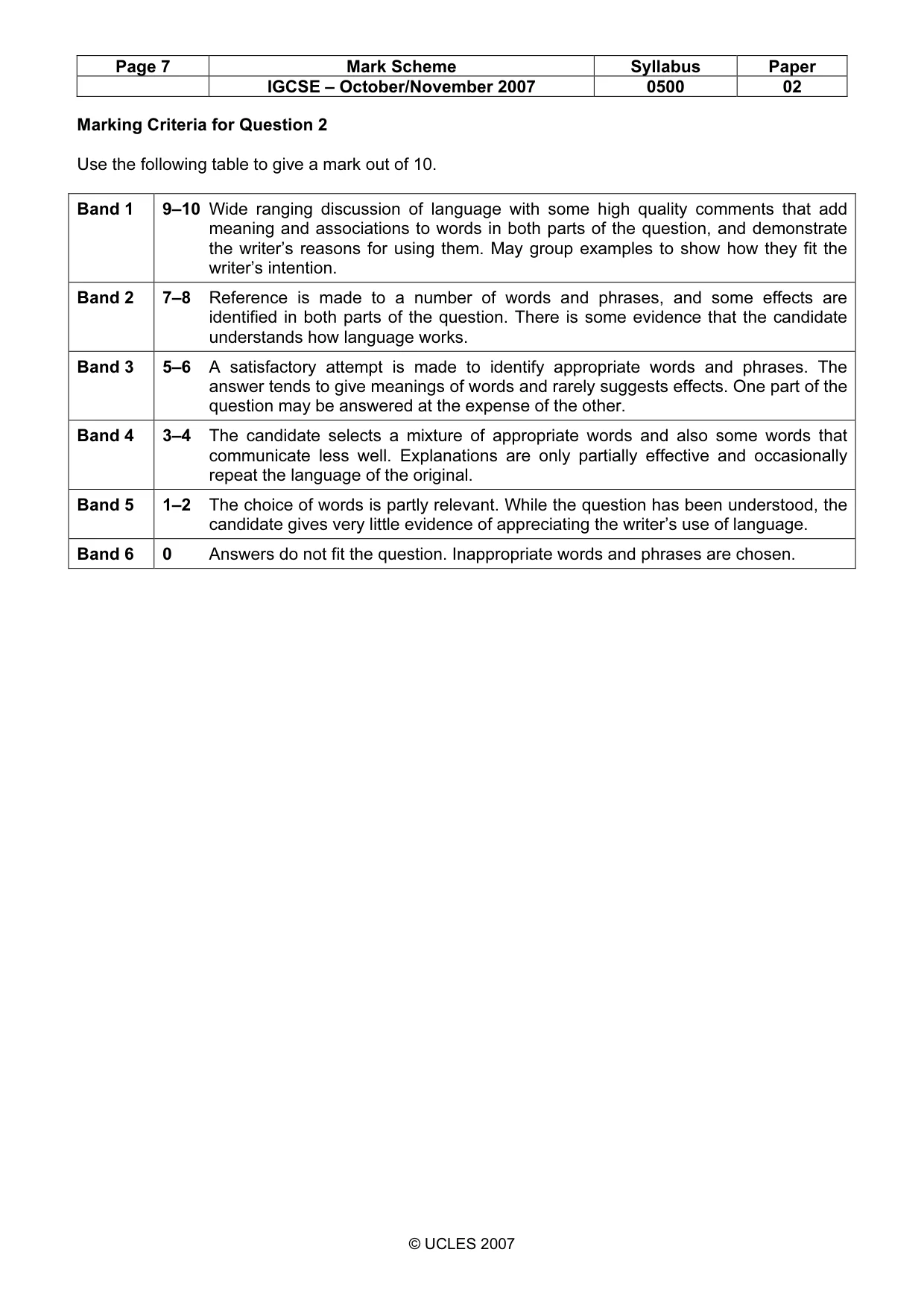
Page 7 Mark Scheme Syllabus Paper IGCSE – October/November 2007 0500 02 © UCLES 2007 Marking Criteria for Question 2 Use the following table to give a mark out of 10. Band 1 9–10 Wide ranging discussion of language with some high quality comments that add meaning and associations to words in both parts of the question, and demonstrate the writer’s reasons for using them. May group examples to show how they fit the writer’s intention. Band 2 7–8 Reference is made to a number of words and phrases, and some effects are identified in both parts of the question. There is some evidence that the candidate understands how language works. Band 3 5–6 A satisfactory attempt is made to identify appropriate words and phrases. The answer tends to give meanings of words and rarely suggests effects. One part of the question may be answered at the expense of the other. Band 4 3–4 The candidate selects a mixture of appropriate words and also some words that communicate less well. Explanations are only partially effective and occasionally repeat the language of the original. Band 5 1–2 The choice of words is partly relevant. While the question has been understood, the candidate gives very little evidence of appreciating the writer’s use of language. Band 6 0 Answers do not fit the question. Inappropriate words and phrases are chosen.
Mark scheme, page 8
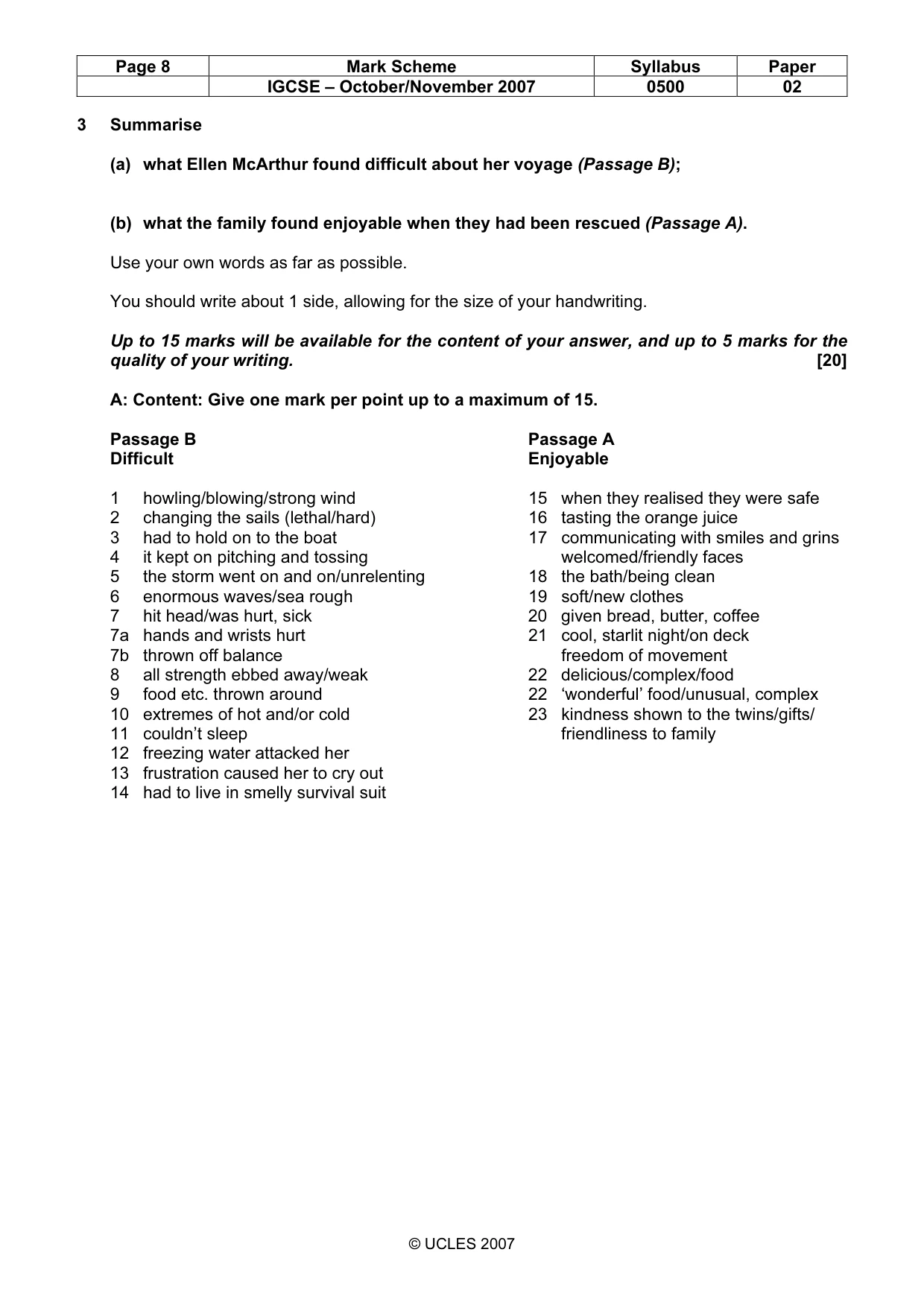
Page 8 Mark Scheme Syllabus Paper IGCSE – October/November 2007 0500 02 © UCLES 2007 3 Summarise (a) what Ellen McArthur found difficult about her voyage (Passage B); (b) what the family found enjoyable when they had been rescued (Passage A). Use your own words as far as possible. You should write about 1 side, allowing for the size of your handwriting. Up to 15 marks will be available for the content of your answer, and up to 5 marks for the quality of your writing. [20] A: Content: Give one mark per point up to a maximum of 15. Passage B Passage A Difficult Enjoyable 1 howling/blowing/strong wind 15 when they realised they were safe 2 changing the sails (lethal/hard) 16 tasting the orange juice 3 had to hold on to the boat 17 communicating with smiles and grins 4 it kept on pitching and tossing welcomed/friendly faces 5 the storm went on and on/unrelenting 18 the bath/being clean 6 enormous waves/sea rough 19 soft/new clothes 7 hit head/was hurt, sick 20 given bread, butter, coffee 7a hands and wrists hurt 21 cool, starlit night/on deck 7b thrown off balance freedom of movement 8 all strength ebbed away/weak 22 delicious/complex/food 9 food etc. thrown around 22 ‘wonderful’ food/unusual, complex 10 extremes of hot and/or cold 23 kindness shown to the twins/gifts/ 11 couldn’t sleep friendliness to family 12 freezing water attacked her 13 frustration caused her to cry out 14 had to live in smelly survival suit
Mark scheme, page 9
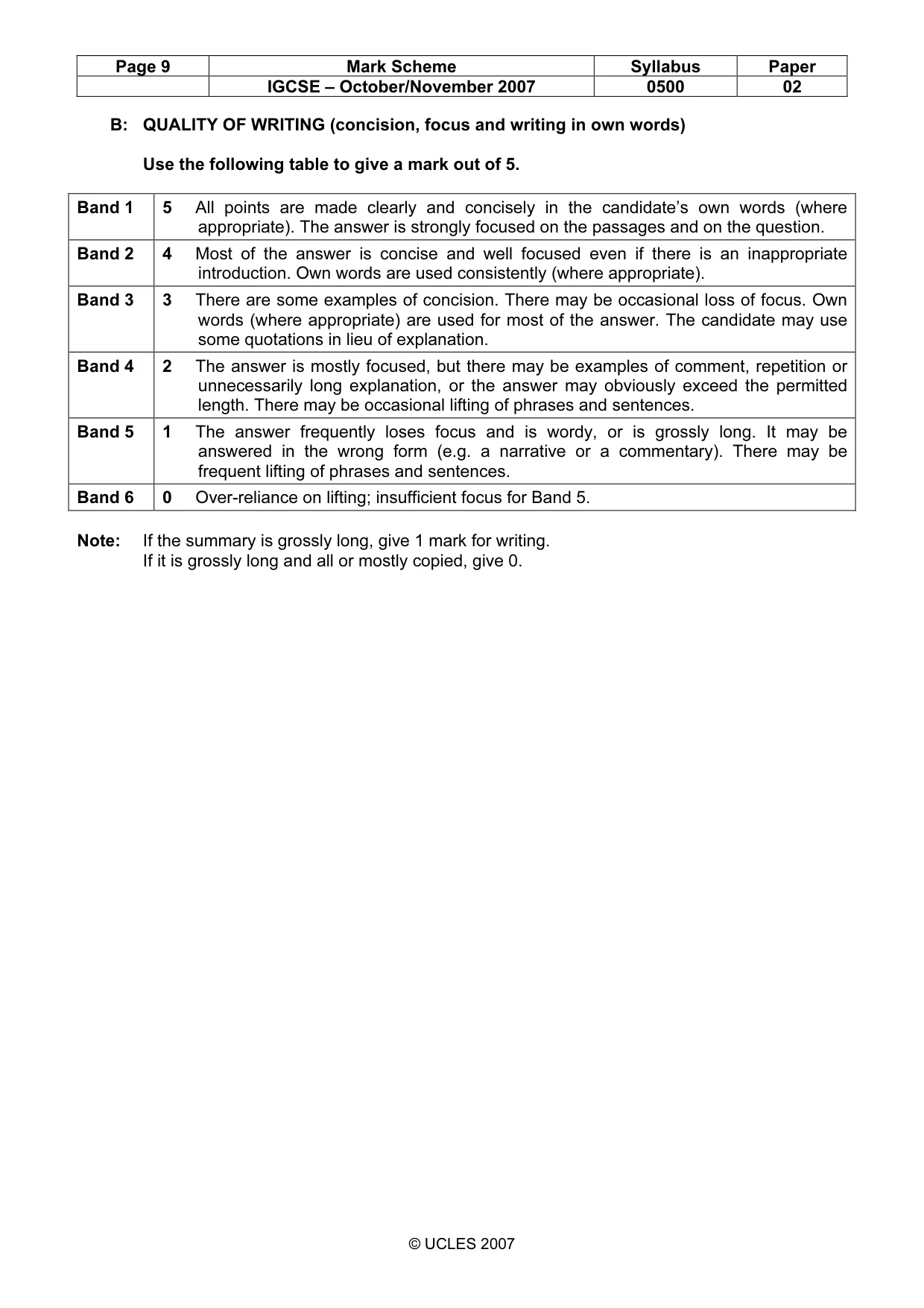
Page 9 Mark Scheme Syllabus Paper IGCSE – October/November 2007 0500 02 © UCLES 2007 B: QUALITY OF WRITING (concision, focus and writing in own words) Use the following table to give a mark out of 5. Band 1 5 All points are made clearly and concisely in the candidate’s own words (where appropriate). The answer is strongly focused on the passages and on the question. Band 2 4 Most of the answer is concise and well focused even if there is an inappropriate introduction. Own words are used consistently (where appropriate). Band 3 3 There are some examples of concision. There may be occasional loss of focus. Own words (where appropriate) are used for most of the answer. The candidate may use some quotations in lieu of explanation. Band 4 2 The answer is mostly focused, but there may be examples of comment, repetition or unnecessarily long explanation, or the answer may obviously exceed the permitted length. There may be occasional lifting of phrases and sentences. Band 5 1 The answer frequently loses focus and is wordy, or is grossly long. It may be answered in the wrong form (e.g. a narrative or a commentary). There may be frequent lifting of phrases and sentences. Band 6 0 Over-reliance on lifting; insufficient focus for Band 5. Note: If the summary is grossly long, give 1 mark for writing. If it is grossly long and all or mostly copied, give 0.
What you needed in this session
Cambridge’s own grade thresholds for 2007 Oct/Nov, Paper 2 · Variant 1. A higher threshold means an easier paper — the bar moves with how the cohort did.