Cambridge IGCSE English - First Language 0500 — 2007 Oct/Nov Paper 1 · Variant 1
0500/11/O/N/07 · 50 marks · ≈56 min
The question paper and its mark scheme, free to read here and free to download. This is Cambridge’s own paper, exactly as it was sat.
Question paper4 pages

Mark scheme5 pages
Answers below. Sit the paper first if you are practising.
Paper as text
Question paper, page 1
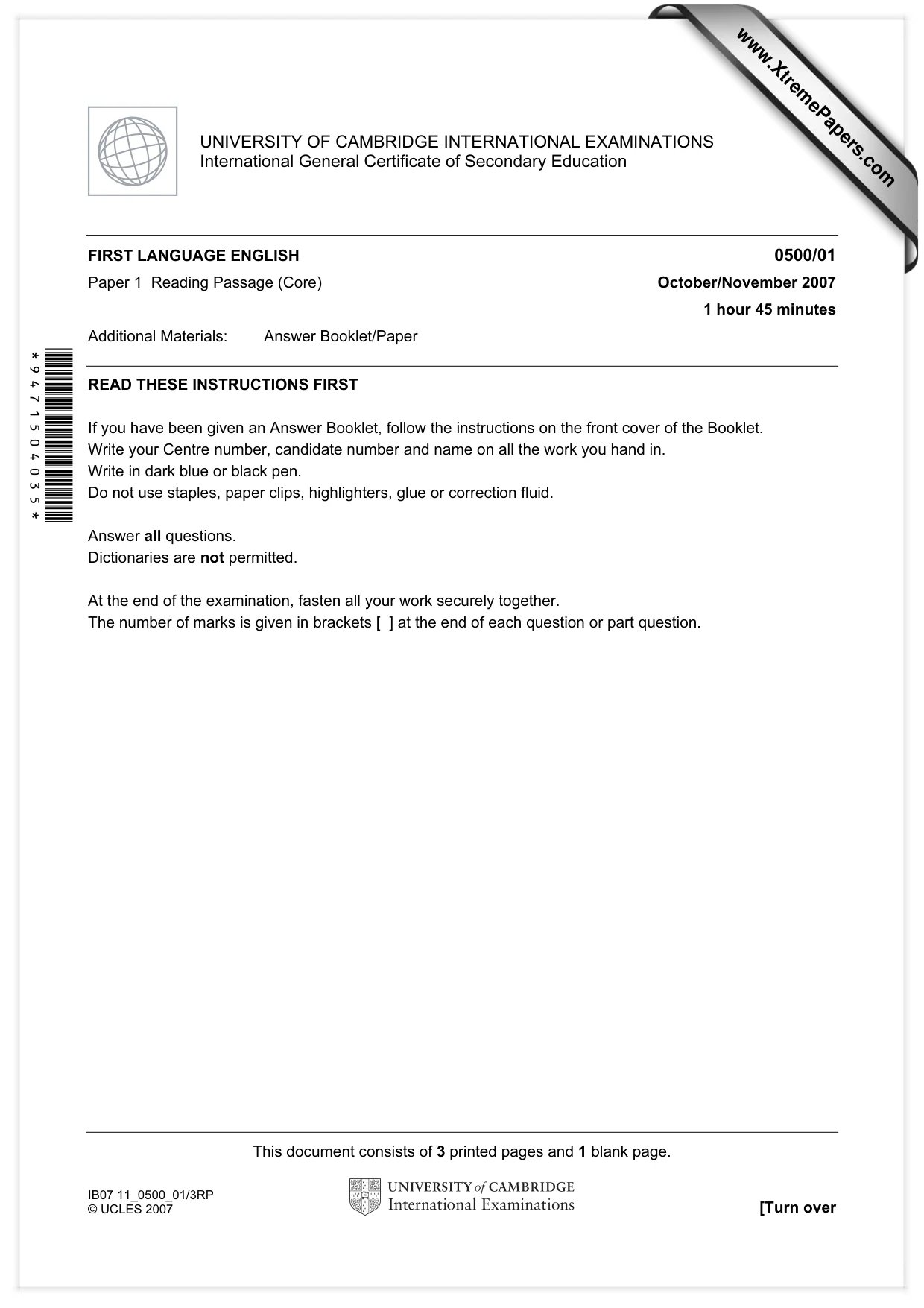
This document consists of 3 printed pages and 1 blank page. IB07 11_0500_01/3RP © UCLES 2007 [Turn over *9471504035* UNIVERSITY OF CAMBRIDGE INTERNATIONAL EXAMINATIONS International General Certificate of Secondary Education FIRST LANGUAGE ENGLISH 0500/01 Paper 1 Reading Passage (Core) October/November 2007 1 hour 45 minutes Additional Materials: Answer Booklet/Paper READ THESE INSTRUCTIONS FIRST If you have been given an Answer Booklet, follow the instructions on the front cover of the Booklet. Write your Centre number, candidate number and name on all the work you hand in. Write in dark blue or black pen. Do not use staples, paper clips, highlighters, glue or correction fluid. Answer all questions. Dictionaries are not permitted. At the end of the examination, fasten all your work securely together. The number of marks is given in brackets [ ] at the end of each question or part question. www.XtremePapers.com
Question paper, page 2
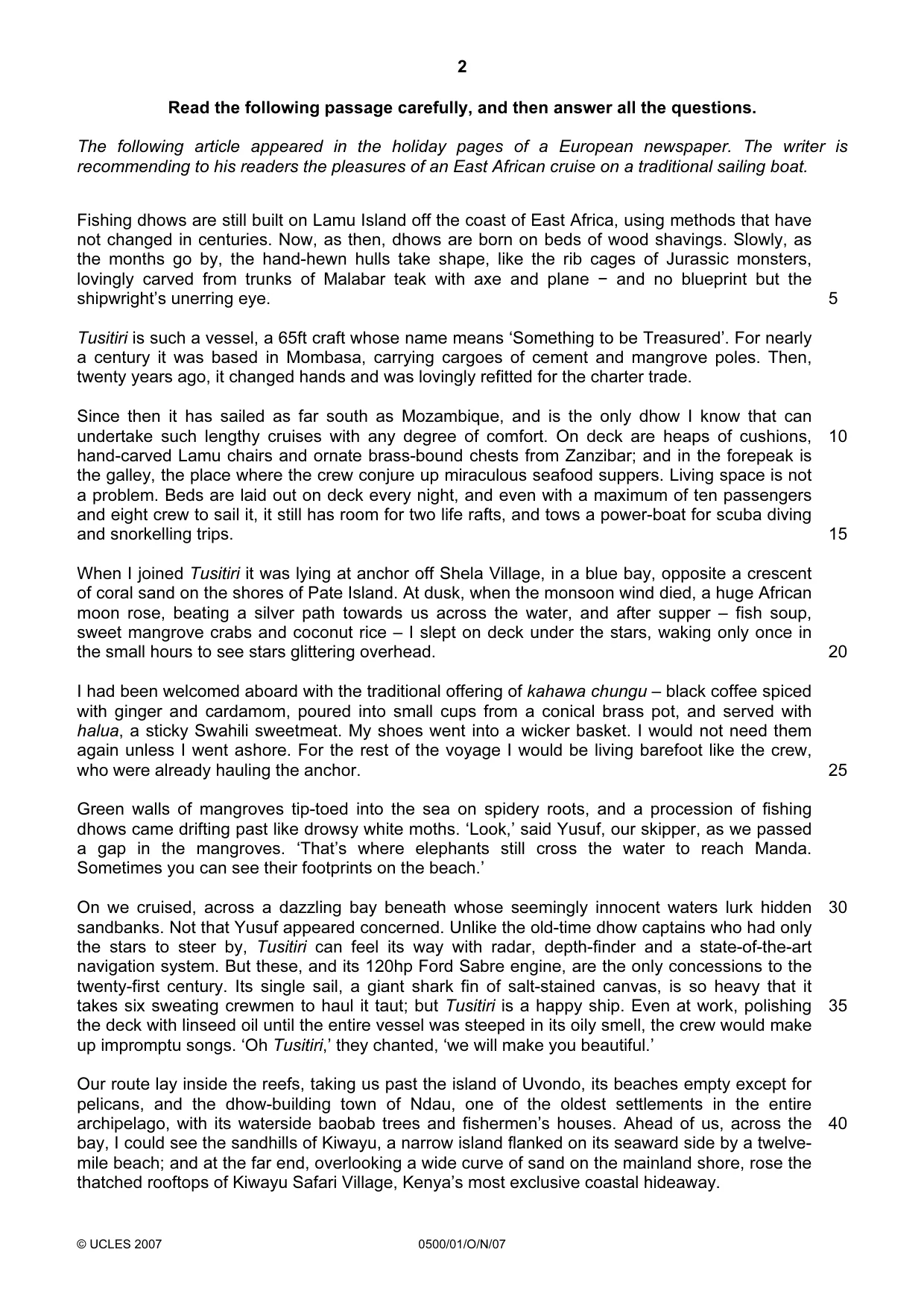
2 © UCLES 2007 0500/01/O/N/07 Read the following passage carefully, and then answer all the questions. The following article appeared in the holiday pages of a European newspaper. The writer is recommending to his readers the pleasures of an East African cruise on a traditional sailing boat. Fishing dhows are still built on Lamu Island off the coast of East Africa, using methods that have not changed in centuries. Now, as then, dhows are born on beds of wood shavings. Slowly, as the months go by, the hand-hewn hulls take shape, like the rib cages of Jurassic monsters, lovingly carved from trunks of Malabar teak with axe and plane − and no blueprint but the shipwright’s unerring eye. Tusitiri is such a vessel, a 65ft craft whose name means ‘Something to be Treasured’. For nearly a century it was based in Mombasa, carrying cargoes of cement and mangrove poles. Then, twenty years ago, it changed hands and was lovingly refitted for the charter trade. Since then it has sailed as far south as Mozambique, and is the only dhow I know that can undertake such lengthy cruises with any degree of comfort. On deck are heaps of cushions, hand-carved Lamu chairs and ornate brass-bound chests from Zanzibar; and in the forepeak is the galley, the place where the crew conjure up miraculous seafood suppers. Living space is not a problem. Beds are laid out on deck every night, and even with a maximum of ten passengers and eight crew to sail it, it still has room for two life rafts, and tows a power-boat for scuba diving and snorkelling trips. When I joined Tusitiri it was lying at anchor off Shela Village, in a blue bay, opposite a crescent of coral sand on the shores of Pate Island. At dusk, when the monsoon wind died, a huge African moon rose, beating a silver path towards us across the water, and after supper – fish soup, sweet mangrove crabs and coconut rice – I slept on deck under the stars, waking only once in the small hours to see stars glittering overhead. I had been welcomed aboard with the traditional offering of kahawa chungu – black coffee spiced with ginger and cardamom, poured into small cups from a conical brass pot, and served with halua, a sticky Swahili sweetmeat. My shoes went into a wicker basket. I would not need them again unless I went ashore. For the rest of the voyage I would be living barefoot like the crew, who were already hauling the anchor. Green walls of mangroves tip-toed into the sea on spidery roots, and a procession of fishing dhows came drifting past like drowsy white moths. ‘Look,’ said Yusuf, our skipper, as we passed a gap in the mangroves. ‘That’s where elephants still cross the water to reach Manda. Sometimes you can see their footprints on the beach.’ On we cruised, across a dazzling bay beneath whose seemingly innocent waters lurk hidden sandbanks. Not that Yusuf appeared concerned. Unlike the old-time dhow captains who had only the stars to steer by, Tusitiri can feel its way with radar, depth-finder and a state-of-the-art navigation system. But these, and its 120hp Ford Sabre engine, are the only concessions to the twenty-first century. Its single sail, a giant shark fin of salt-stained canvas, is so heavy that it takes six sweating crewmen to haul it taut; but Tusitiri is a happy ship. Even at work, polishing the deck with linseed oil until the entire vessel was steeped in its oily smell, the crew would make up impromptu songs. ‘Oh Tusitiri,’ they chanted, ‘we will make you beautiful.’ Our route lay inside the reefs, taking us past the island of Uvondo, its beaches empty except for pelicans, and the dhow-building town of Ndau, one of the oldest settlements in the entire archipelago, with its waterside baobab trees and fishermen’s houses. Ahead of us, across the bay, I could see the sandhills of Kiwayu, a narrow island flanked on its seaward side by a twelve- mile beach; and at the far end, overlooking a wide curve of sand on the mainland shore, rose the thatched rooftops of Kiwayu Safari Village, Kenya’s most exclusive coastal hideaway. 5 10 15 20 25 30 35 40
Question paper, page 3
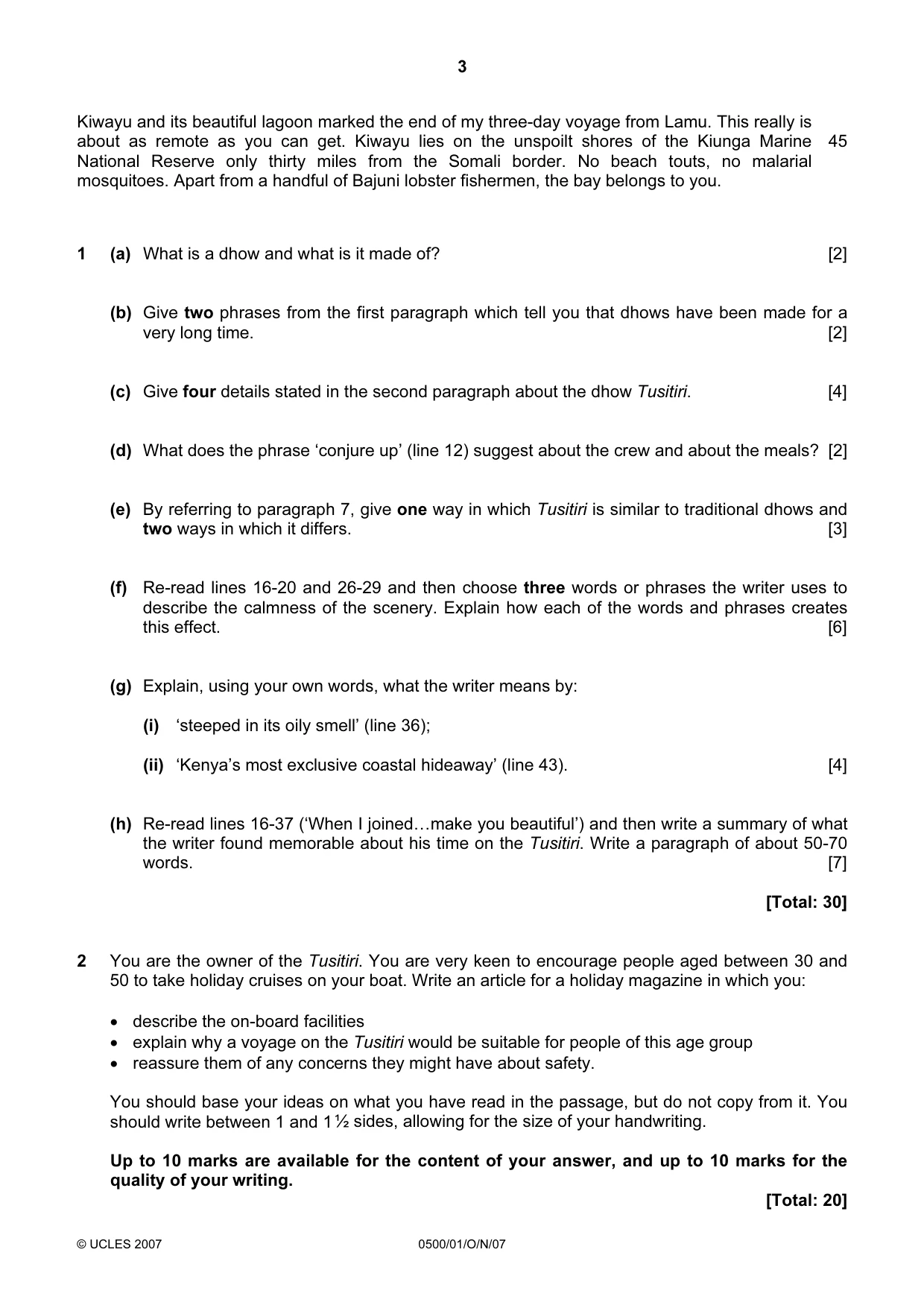
3 © UCLES 2007 0500/01/O/N/07 Kiwayu and its beautiful lagoon marked the end of my three-day voyage from Lamu. This really is about as remote as you can get. Kiwayu lies on the unspoilt shores of the Kiunga Marine National Reserve only thirty miles from the Somali border. No beach touts, no malarial mosquitoes. Apart from a handful of Bajuni lobster fishermen, the bay belongs to you. 45 1 (a) What is a dhow and what is it made of? [2] (b) Give two phrases from the first paragraph which tell you that dhows have been made for a very long time. [2] (c) Give four details stated in the second paragraph about the dhow Tusitiri. [4] (d) What does the phrase ‘conjure up’ (line 12) suggest about the crew and about the meals? [2] (e) By referring to paragraph 7, give one way in which Tusitiri is similar to traditional dhows and two ways in which it differs. [3] (f) Re-read lines 16-20 and 26-29 and then choose three words or phrases the writer uses to describe the calmness of the scenery. Explain how each of the words and phrases creates this effect. [6] (g) Explain, using your own words, what the writer means by: (i) ‘steeped in its oily smell’ (line 36); (ii) ‘Kenya’s most exclusive coastal hideaway’ (line 43). [4] (h) Re-read lines 16-37 (‘When I joined…make you beautiful’) and then write a summary of what the writer found memorable about his time on the Tusitiri. Write a paragraph of about 50-70 words. [7] [Total: 30] 2 You are the owner of the Tusitiri. You are very keen to encourage people aged between 30 and 50 to take holiday cruises on your boat. Write an article for a holiday magazine in which you: • describe the on-board facilities • explain why a voyage on the Tusitiri would be suitable for people of this age group • reassure them of any concerns they might have about safety. You should base your ideas on what you have read in the passage, but do not copy from it. You should write between 1 and 1 ½ sides, allowing for the size of your handwriting. Up to 10 marks are available for the content of your answer, and up to 10 marks for the quality of your writing. [Total: 20]
Question paper, page 4
4 Copyright Acknowledgements: Question 1 © The Daily Telegraph, 10 May 2003. Permission to reproduce items where third-party owned material protected by copyright is included has been sought and cleared where possible. Every reasonable effort has been made by the publisher (UCLES) to trace copyright holders, but if any items requiring clearance have unwittingly been included, the publisher will be pleased to make amends at the earliest possible opportunity. University of Cambridge International Examinations is part of the Cambridge Assessment Group. Cambridge Assessment is the brand name of University of Cambridge Local Examinations Syndicate (UCLES), which is itself a department of the University of Cambridge. 0500/01/O/N/07 BLANK PAGE
Mark scheme, page 1
UNIVERSITY OF CAMBRIDGE INTERNATIONAL EXAMINATIONS International General Certificate of Secondary Education MARK SCHEME for the October/November 2007 question paper 0500 FIRST LANGUAGE ENGLISH 0500/01 Paper 1 (Reading Passage – Core), maximum raw mark 50 This mark scheme is published as an aid to teachers and candidates, to indicate the requirements of the examination. It shows the basis on which Examiners were instructed to award marks. It does not indicate the details of the discussions that took place at an Examiners’ meeting before marking began. All Examiners are instructed that alternative correct answers and unexpected approaches in candidates’ scripts must be given marks that fairly reflect the relevant knowledge and skills demonstrated. Mark schemes must be read in conjunction with the question papers and the report on the examination. • CIE will not enter into discussions or correspondence in connection with these mark schemes. CIE is publishing the mark schemes for the October/November 2007 question papers for most IGCSE, GCE Advanced Level and Advanced Subsidiary Level syllabuses and some Ordinary Level syllabuses. www.XtremePapers.com
Mark scheme, page 2
Page 2 Mark Scheme Syllabus Paper IGCSE – October/November 2007 0500 01 © UCLES 2007 1 (a) What is a dhow and what is it made of? • a (traditional sailing) boat/vessel/ship • made out of wood (teak) 1 mark for each point [2] (b) Give two phrases from the first paragraph which tell you that dhows have been made for a very long time. • methods that have not changed in centuries • still built • now, as then Give 1 mark each for any two of the above [2] (c) Give four details stated in the second paragraph about the dhow Tusitiri. • 65 ft long • name means ‘Something to be Treasured’ • was based in Mombasa • used to carry cargo • changed hands 20 years ago • now refitted for charter trade Give 1 mark for each of these to a maximum of 4 [4] (d) What does the phrase, ‘conjure up’ (line 12) suggest about the crew and about the meals? • The meals were prepared in such a small space with limited equipment/the crew worked in such a limited space. • The cooks behaved like magicians/worked magic/(the process/food was) miraculous. • The quality of the food was outstanding. Award 2 marks for a clear explanation referring to some of the points above or one mark for a glimmer. [2] (e) By referring to paragraph 7, give one way in which Tusitiri is similar to traditional dhows and two ways in which it differs. Similar: • it has a sail • it is made of wood Credit only one of the above Different: • it steers using radar etc. • it has an engine Give one mark for each of the points above, clearly made. [3]
Mark scheme, page 3
Page 3 Mark Scheme Syllabus Paper IGCSE – October/November 2007 0500 01 © UCLES 2007 (f) Re-read lines 16-20 and 26-29 and then choose three words or phrases the writer uses to describe the calmness of the scenery. Explain how each of the words and phrases creates this effect. • in a blue bay, opposite a crescent of coral sand • when the monsoon wind died • a huge African moon rose, beating a silver path • stars glittering overhead • green walls of mangroves tip-toed into the sea on spidery roots • drifting past like drowsy white moths Give 1 mark for each of any 3 of the above and 1 mark for an adequate explanation of it. N.B. If the same explanation is given for more than one example, reward that explanation once only. [6] (g) Explain, using your own words, what the writer means by: (i) ‘steeped in its oily smell’ (line 36); (ii) ‘Kenya's most exclusive coastal hideaway’ (line 43). • The smell of oil was deeply engrained/it was suffused with the smell of oil. • A very expensive place (on the coast)/somewhere to escape from the crowds/it is secluded/private. Give up to two marks for an explanation in own words of each of the two phrases. [4] (h) Re-read lines 16-37(‘When I joined…make you beautiful’) and then write a summary of what the writer found memorable about his time on the Tusitiri. Write a paragraph of about 50-70 words. 1 the rising/reflected moon/stars 2 the first supper/the food 3 sleeping on deck (under the stars) 4 the welcome aboard and the drink/sweetmeat 5 living the barefoot life 6 the views (of the mangroves)/scenery 7 the passing dhows 8 the smell of the oiled deck 9 the sail 10 the singing of the crew Give 1 mark for each of these points up to a maximum of 7 [7] [Total: 30]
Mark scheme, page 4
Page 4 Mark Scheme Syllabus Paper IGCSE – October/November 2007 0500 01 © UCLES 2007 2 You are the owner of the Tusitiri. You are very keen to encourage people aged between 30 and 50 to take holiday cruises on your boat. Write an article for a holiday magazine in which you: • describe the on-board facilities • explain why a voyage on the Tusitiri would be suitable for people of this age group. • reassure them of any concerns they may have about safety. You should base your ideas on what you have read in the passage, but do not copy from it. You should write between 1 and 1 ½ sides, allowing for the size of your handwriting. Up to 10 marks are available for the content of your answer, and up to 10 marks for the quality of your writing. General notes on task The most successful responses are likely to select details from the passage appropriate to both the age group and then produce a convincing article which elaborates persuasively on them. Less successful responses are likely to rely on lifting large amounts of the original and lose focus on the requirements of the task. Look for and credit an attempt to write in an appropriate register. Marking criteria for Question 2: (a) READING (Using and understanding the material) Use the following table to give a mark out of 10. Band 1 9–10 Uses and develops several ideas, both factual and inferential, from the passage. Elaborates on and develops details in a consistently persuasive article. Band 2 7–8 Refers to several details from the passage and makes some attempt at elaboration. There is a conscious but not always consistent attempt to write persuasively. Band 3 5–6 Repeats some details from the passage in a descriptive approach. Focuses on the question and on the passage, but persuasion gives way to description and narrative. Band 4 3–4 There is some relevance to the question but lifting from the original tends to be indiscriminate and there is little awareness of the need to persuade. Band 5 1–2 May retell the passage or give occasional relevant facts. There may be examples of misunderstanding or lack of clarity in attempting to use the passage. 0 Very little/no relevance. General misunderstanding of task and passage.
Mark scheme, page 5
Page 5 Mark Scheme Syllabus Paper IGCSE – October/November 2007 0500 01 © UCLES 2007 (b) WRITING (Core tier) Use the following table to give a mark out of 10. Band 1 9–10 Sentences are fluent and there is a fairly wide range of vocabulary. Overall structure is good and sentences generally follow in sequence. Most full stops are correct and errors are infrequent and minor. An appropriate register is established. Band 2 7–8 Sentences are correct, though relatively simple. Vocabulary is adequate and correctly used. There are some sentence separation errors and quite frequent other errors, although minor. There are some hints of an appropriate register. Band 3 5–6 Sentence structures and vocabulary are simple, but meaning is never in doubt. The order is reasonable. Error may be frequent, but it does not blur meaning. There may be an inconsistent attempt at an appropriate register. Band 4 3–4 The answer is very simply written and there are occasional examples of blurred meaning. The structure can usually be followed. Some error is serious, affecting meaning. Band 5 1–2 The answer is difficult to understand. The extent of grammatical error seriously impedes meaning. 0 The answer cannot be understood. Add the marks for Reading and Writing to give a total mark out of 20 for Question 2. [Total: 20]
What you needed in this session
Cambridge’s own grade thresholds for 2007 Oct/Nov, Paper 1 · Variant 1. A higher threshold means an easier paper — the bar moves with how the cohort did.