Cambridge IGCSE English - First Language 0500 — 2007 May/June Paper 3 · Variant 1
0500/31/M/J/07 · 50 marks · ≈56 min
The question paper and its mark scheme, free to read here and free to download. This is Cambridge’s own paper, exactly as it was sat.
Question paper4 pages
Mark scheme8 pages
Answers below. Sit the paper first if you are practising.
Paper as text
Question paper, page 1
This document consists of 4 printed pages. IB07 06_0500_03/5RP © UCLES 2007 [Turn over *0121394994* UNIVERSITY OF CAMBRIDGE INTERNATIONAL EXAMINATIONS International General Certificate of Secondary Education FIRST LANGUAGE ENGLISH 0500/03 Paper 3 Directed Writing and Composition May/June 2007 2 hours Additional Materials: Answer Booklet/Paper READ THESE INSTRUCTIONS FIRST If you have been given an Answer Booklet, follow the instructions on the front cover of the Booklet. Write your Centre number, candidate number and name on all the work you hand in. Write in dark blue or black pen. Do not use staples, paper clips, highlighters, glue or correction fluid. Answer two questions: Question 1 (Section One) and one question from Section Two. Dictionaries are not permitted. At the end of the examination, fasten all your work securely together. All questions in this paper carry equal marks. www.XtremePapers.com
Question paper, page 2
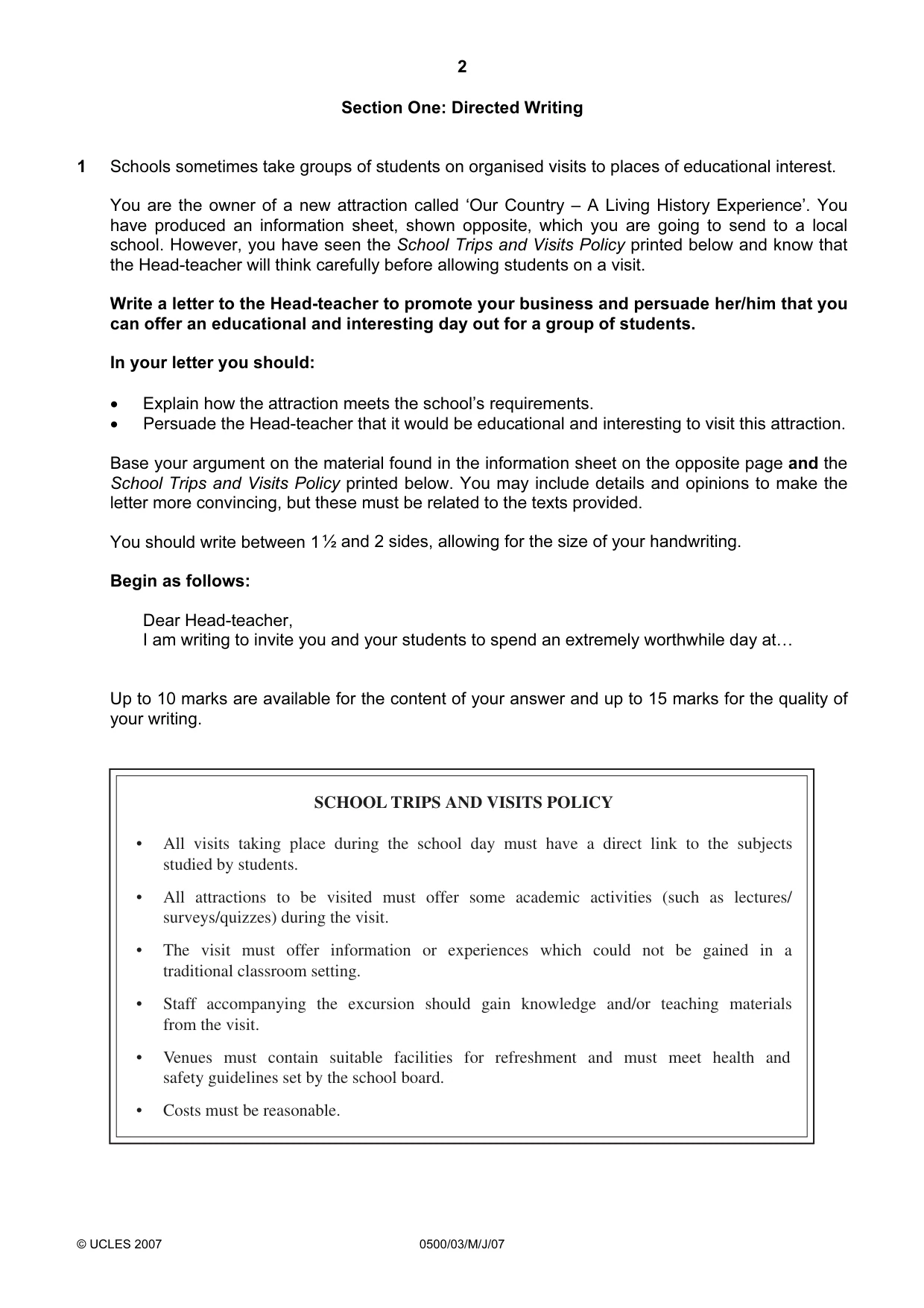
2 © UCLES 2007 0500/03/M/J/07 Section One: Directed Writing 1 Schools sometimes take groups of students on organised visits to places of educational interest. You are the owner of a new attraction called ‘Our Country – A Living History Experience’. You have produced an information sheet, shown opposite, which you are going to send to a local school. However, you have seen the School Trips and Visits Policy printed below and know that the Head-teacher will think carefully before allowing students on a visit. Write a letter to the Head-teacher to promote your business and persuade her/him that you can offer an educational and interesting day out for a group of students. In your letter you should: • Explain how the attraction meets the school’s requirements. • Persuade the Head-teacher that it would be educational and interesting to visit this attraction. Base your argument on the material found in the information sheet on the opposite page and the School Trips and Visits Policy printed below. You may include details and opinions to make the letter more convincing, but these must be related to the texts provided. You should write between 1 ½ and 2 sides, allowing for the size of your handwriting. Begin as follows: Dear Head-teacher, I am writing to invite you and your students to spend an extremely worthwhile day at… Up to 10 marks are available for the content of your answer and up to 15 marks for the quality of your writing. SCHOOL TRIPS AND VISITS POLICY • All visits taking place during the school day must have a direct link to the subjects studied by students. • All attractions to be visited must offer some academic activities (such as lectures/ surveys/quizzes) during the visit. • The visit must offer information or experiences which could not be gained in a traditional classroom setting. • Staff accompanying the excursion should gain knowledge and/or teaching materials from the visit. • Venues must contain suitable facilities for refreshment and must meet health and safety guidelines set by the school board. • Costs must be reasonable.
Question paper, page 3
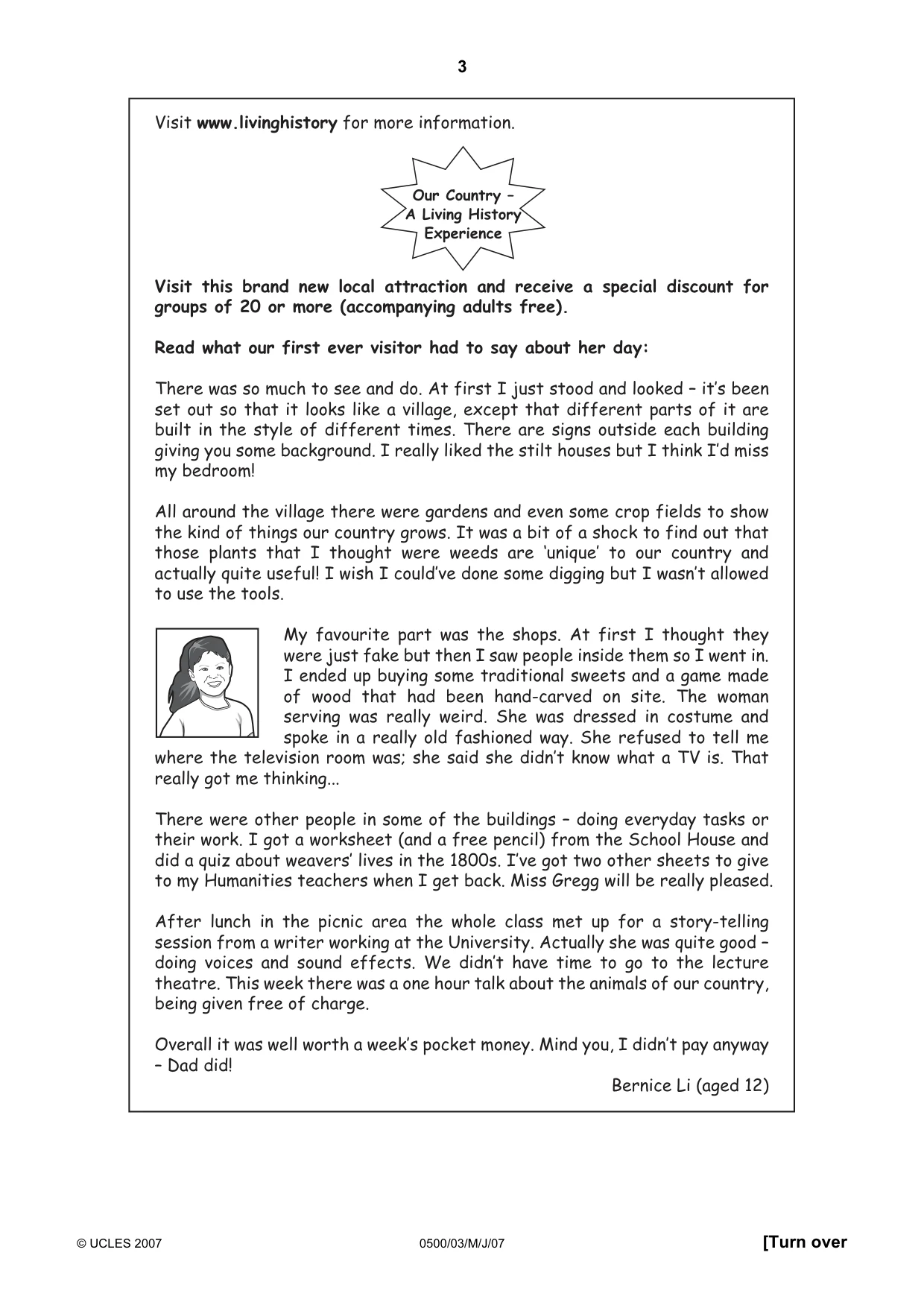
3 © UCLES 2007 0500/03/M/J/07 [Turn over Visit www.livinghistory for more information. Visit this brand new local attraction and receive a special discount for groups of 20 or more (accompanying adults free). Read what our first ever visitor had to say about her day: There was so much to see and do. At first I just stood and looked – it‛s been set out so that it looks like a village, except that different parts of it are built in the style of different times. There are signs outside each building giving you some background. I really liked the stilt houses but I think I‛d miss my bedroom! All around the village there were gardens and even some crop fields to show the kind of things our country grows. It was a bit of a shock to find out that those plants that I thought were weeds are ‘unique‛ to our country and actually quite useful! I wish I could‛ve done some digging but I wasn‛t allowed to use the tools. My favourite part was the shops. At first I thought they were just fake but then I saw people inside them so I went in. I ended up buying some traditional sweets and a game made of wood that had been hand-carved on site. The woman serving was really weird. She was dressed in costume and spoke in a really old fashioned way. She refused to tell me where the television room was; she said she didn‛t know what a TV is. That really got me thinking... There were other people in some of the buildings – doing everyday tasks or their work. I got a worksheet (and a free pencil) from the School House and did a quiz about weavers‛ lives in the 1800s. I‛ve got two other sheets to give to my Humanities teachers when I get back. Miss Gregg will be really pleased. After lunch in the picnic area the whole class met up for a story-telling session from a writer working at the University. Actually she was quite good – doing voices and sound effects. We didn‛t have time to go to the lecture theatre. This week there was a one hour talk about the animals of our country, being given free of charge. Overall it was well worth a week‛s pocket money. Mind you, I didn‛t pay anyway – Dad did! Bernice Li (aged 12) Our Country – A Living History Experience
Question paper, page 4
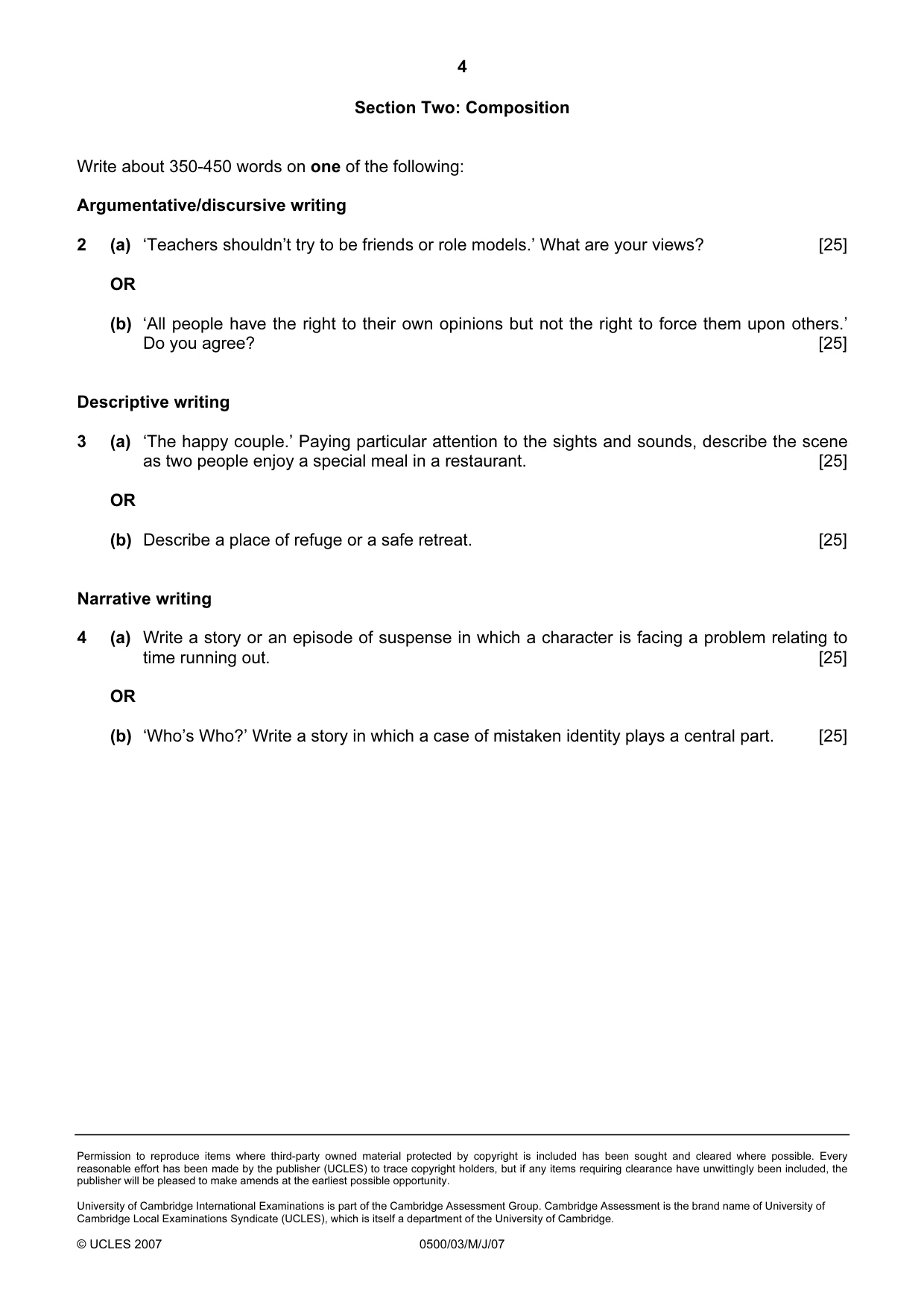
4 Permission to reproduce items where third-party owned material protected by copyright is included has been sought and cleared where possible. Every reasonable effort has been made by the publisher (UCLES) to trace copyright holders, but if any items requiring clearance have unwittingly been included, the publisher will be pleased to make amends at the earliest possible opportunity. University of Cambridge International Examinations is part of the Cambridge Assessment Group. Cambridge Assessment is the brand name of University of Cambridge Local Examinations Syndicate (UCLES), which is itself a department of the University of Cambridge. © UCLES 2007 0500/03/M/J/07 Section Two: Composition Write about 350-450 words on one of the following: Argumentative/discursive writing 2 (a) ‘Teachers shouldn’t try to be friends or role models.’ What are your views? [25] OR (b) ‘All people have the right to their own opinions but not the right to force them upon others.’ Do you agree? [25] Descriptive writing 3 (a) ‘The happy couple.’ Paying particular attention to the sights and sounds, describe the scene as two people enjoy a special meal in a restaurant. [25] OR (b) Describe a place of refuge or a safe retreat. [25] Narrative writing 4 (a) Write a story or an episode of suspense in which a character is facing a problem relating to time running out. [25] OR (b) ‘Who’s Who?’ Write a story in which a case of mistaken identity plays a central part. [25]
Mark scheme, page 1
UNIVERSITY OF CAMBRIDGE INTERNATIONAL EXAMINATIONS International General Certificate of Secondary Education MARK SCHEME for the May/June 2007 question paper 0500 FIRST LANGUAGE ENGLISH 0500/03 Paper 3 (Directed Writing and Composition), maximum raw mark 50 This mark scheme is published as an aid to teachers and candidates, to indicate the requirements of the examination. It shows the basis on which Examiners were instructed to award marks. It does not indicate the details of the discussions that took place at an Examiners’ meeting before marking began. All Examiners are instructed that alternative correct answers and unexpected approaches in candidates’ scripts must be given marks that fairly reflect the relevant knowledge and skills demonstrated. Mark schemes must be read in conjunction with the question papers and the report on the examination. • CIE will not enter into discussions or correspondence in connection with these mark schemes. CIE is publishing the mark schemes for the May/June 2007 question papers for most IGCSE, GCE Advanced Level and Advanced Subsidiary Level syllabuses and some Ordinary Level syllabuses. www.XtremePapers.com
Mark scheme, page 2
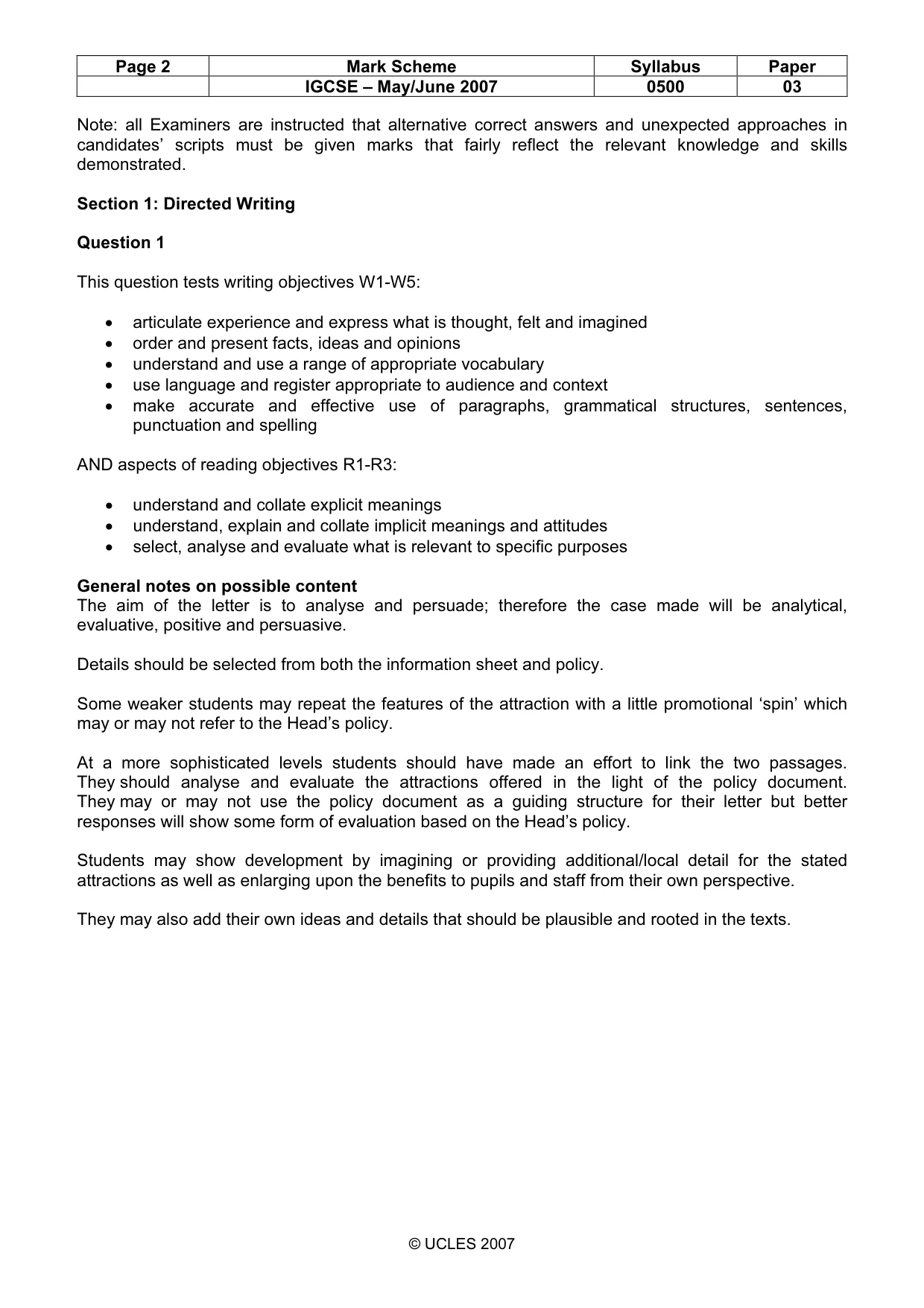
Page 2 Mark Scheme Syllabus Paper IGCSE – May/June 2007 0500 03 © UCLES 2007 Note: all Examiners are instructed that alternative correct answers and unexpected approaches in candidates’ scripts must be given marks that fairly reflect the relevant knowledge and skills demonstrated. Section 1: Directed Writing Question 1 This question tests writing objectives W1-W5: • articulate experience and express what is thought, felt and imagined • order and present facts, ideas and opinions • understand and use a range of appropriate vocabulary • use language and register appropriate to audience and context • make accurate and effective use of paragraphs, grammatical structures, sentences, punctuation and spelling AND aspects of reading objectives R1-R3: • understand and collate explicit meanings • understand, explain and collate implicit meanings and attitudes • select, analyse and evaluate what is relevant to specific purposes General notes on possible content The aim of the letter is to analyse and persuade; therefore the case made will be analytical, evaluative, positive and persuasive. Details should be selected from both the information sheet and policy. Some weaker students may repeat the features of the attraction with a little promotional ‘spin’ which may or may not refer to the Head’s policy. At a more sophisticated levels students should have made an effort to link the two passages. They should analyse and evaluate the attractions offered in the light of the policy document. They may or may not use the policy document as a guiding structure for their letter but better responses will show some form of evaluation based on the Head’s policy. Students may show development by imagining or providing additional/local detail for the stated attractions as well as enlarging upon the benefits to pupils and staff from their own perspective. They may also add their own ideas and details that should be plausible and rooted in the texts.
Mark scheme, page 3
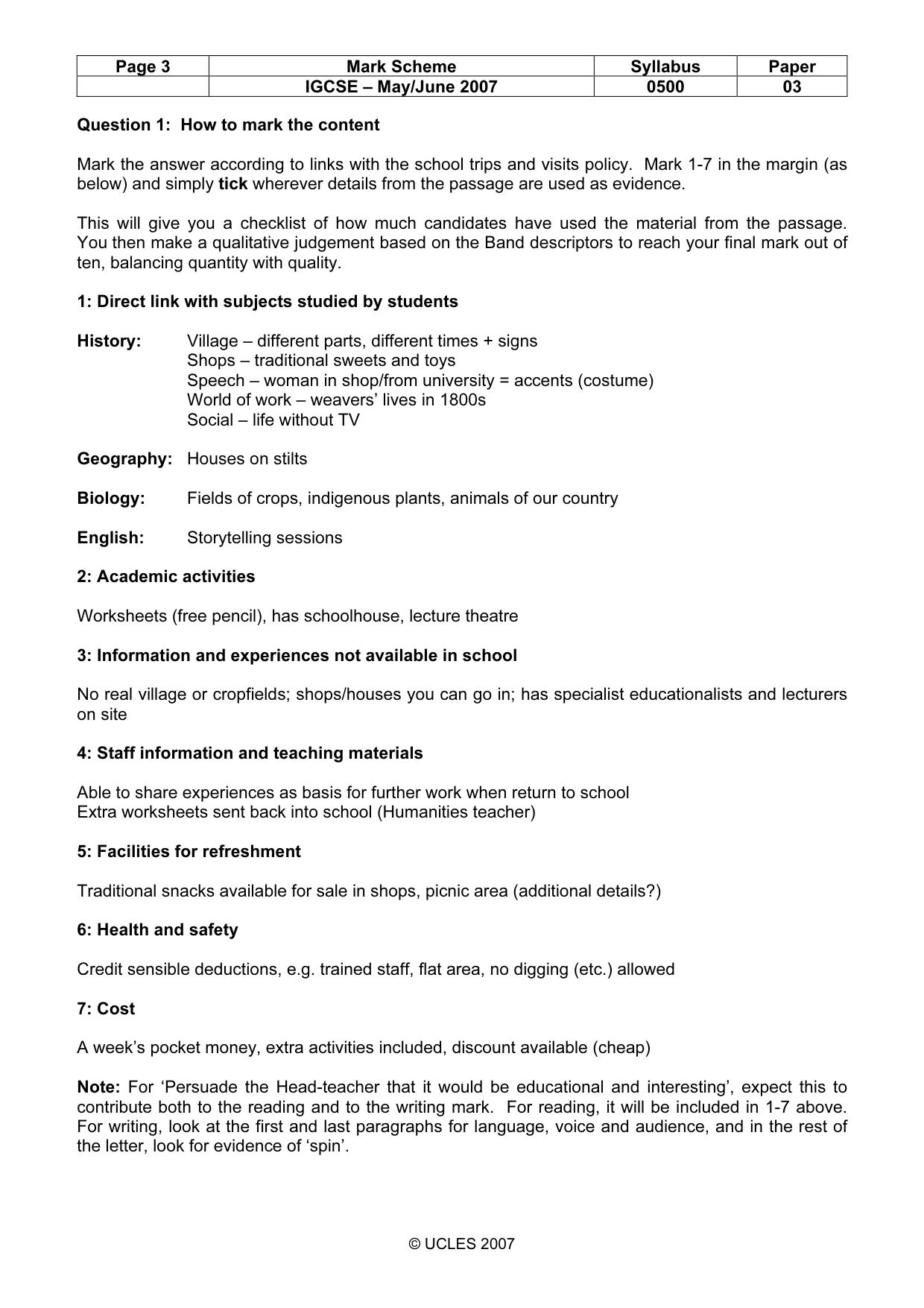
Page 3 Mark Scheme Syllabus Paper IGCSE – May/June 2007 0500 03 © UCLES 2007 Question 1: How to mark the content Mark the answer according to links with the school trips and visits policy. Mark 1-7 in the margin (as below) and simply tick wherever details from the passage are used as evidence. This will give you a checklist of how much candidates have used the material from the passage. You then make a qualitative judgement based on the Band descriptors to reach your final mark out of ten, balancing quantity with quality. 1: Direct link with subjects studied by students History: Village – different parts, different times + signs Shops – traditional sweets and toys Speech – woman in shop/from university = accents (costume) World of work – weavers’ lives in 1800s Social – life without TV Geography: Houses on stilts Biology: Fields of crops, indigenous plants, animals of our country English: Storytelling sessions 2: Academic activities Worksheets (free pencil), has schoolhouse, lecture theatre 3: Information and experiences not available in school No real village or cropfields; shops/houses you can go in; has specialist educationalists and lecturers on site 4: Staff information and teaching materials Able to share experiences as basis for further work when return to school Extra worksheets sent back into school (Humanities teacher) 5: Facilities for refreshment Traditional snacks available for sale in shops, picnic area (additional details?) 6: Health and safety Credit sensible deductions, e.g. trained staff, flat area, no digging (etc.) allowed 7: Cost A week’s pocket money, extra activities included, discount available (cheap) Note: For ‘Persuade the Head-teacher that it would be educational and interesting’, expect this to contribute both to the reading and to the writing mark. For reading, it will be included in 1-7 above. For writing, look at the first and last paragraphs for language, voice and audience, and in the rest of the letter, look for evidence of ‘spin’.
Mark scheme, page 4
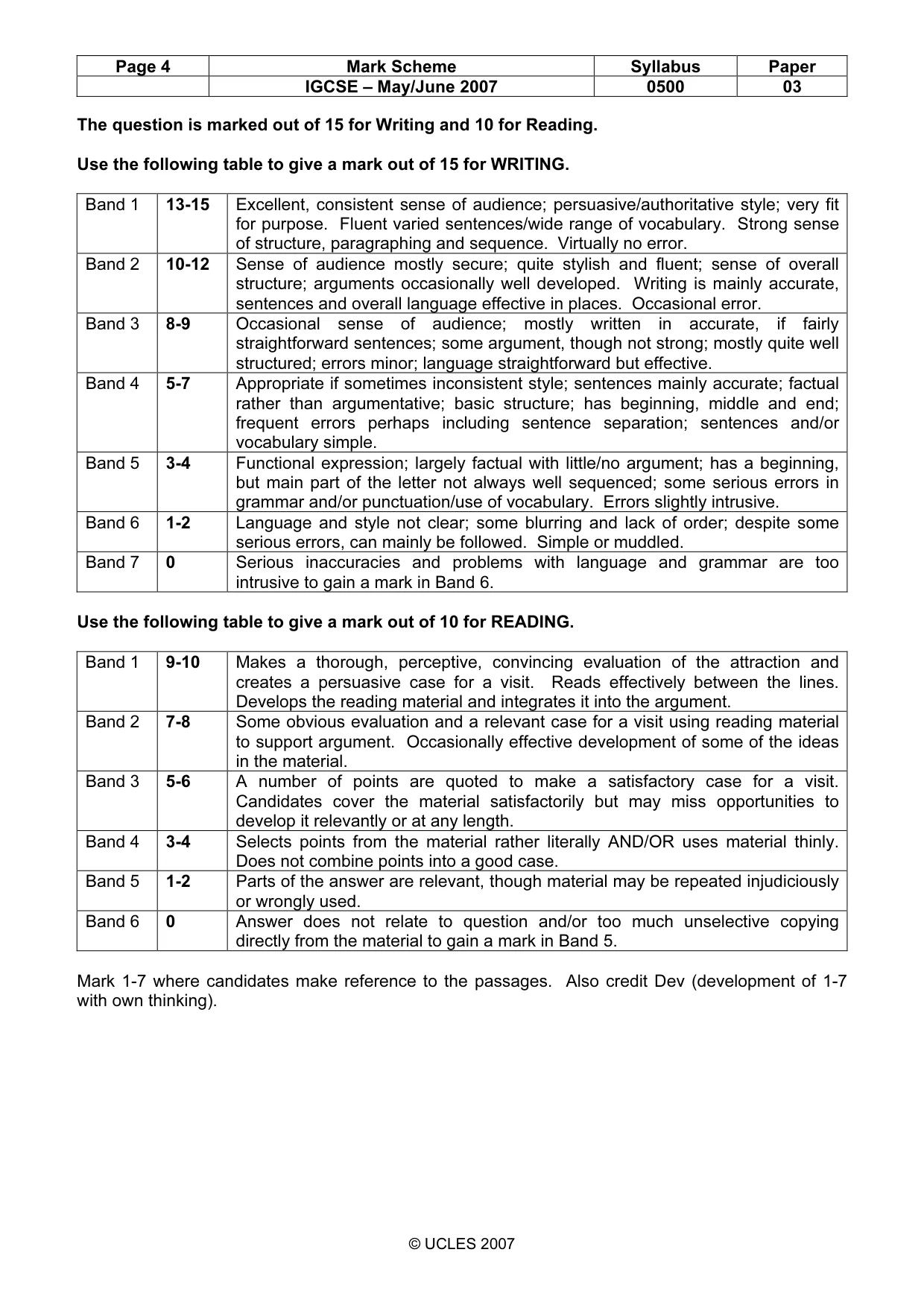
Page 4 Mark Scheme Syllabus Paper IGCSE – May/June 2007 0500 03 © UCLES 2007 The question is marked out of 15 for Writing and 10 for Reading. Use the following table to give a mark out of 15 for WRITING. Band 1 13-15 Excellent, consistent sense of audience; persuasive/authoritative style; very fit for purpose. Fluent varied sentences/wide range of vocabulary. Strong sense of structure, paragraphing and sequence. Virtually no error. Band 2 10-12 Sense of audience mostly secure; quite stylish and fluent; sense of overall structure; arguments occasionally well developed. Writing is mainly accurate, sentences and overall language effective in places. Occasional error. Band 3 8-9 Occasional sense of audience; mostly written in accurate, if fairly straightforward sentences; some argument, though not strong; mostly quite well structured; errors minor; language straightforward but effective. Band 4 5-7 Appropriate if sometimes inconsistent style; sentences mainly accurate; factual rather than argumentative; basic structure; has beginning, middle and end; frequent errors perhaps including sentence separation; sentences and/or vocabulary simple. Band 5 3-4 Functional expression; largely factual with little/no argument; has a beginning, but main part of the letter not always well sequenced; some serious errors in grammar and/or punctuation/use of vocabulary. Errors slightly intrusive. Band 6 1-2 Language and style not clear; some blurring and lack of order; despite some serious errors, can mainly be followed. Simple or muddled. Band 7 0 Serious inaccuracies and problems with language and grammar are too intrusive to gain a mark in Band 6. Use the following table to give a mark out of 10 for READING. Band 1 9-10 Makes a thorough, perceptive, convincing evaluation of the attraction and creates a persuasive case for a visit. Reads effectively between the lines. Develops the reading material and integrates it into the argument. Band 2 7-8 Some obvious evaluation and a relevant case for a visit using reading material to support argument. Occasionally effective development of some of the ideas in the material. Band 3 5-6 A number of points are quoted to make a satisfactory case for a visit. Candidates cover the material satisfactorily but may miss opportunities to develop it relevantly or at any length. Band 4 3-4 Selects points from the material rather literally AND/OR uses material thinly. Does not combine points into a good case. Band 5 1-2 Parts of the answer are relevant, though material may be repeated injudiciously or wrongly used. Band 6 0 Answer does not relate to question and/or too much unselective copying directly from the material to gain a mark in Band 5. Mark 1-7 where candidates make reference to the passages. Also credit Dev (development of 1-7 with own thinking).
Mark scheme, page 5
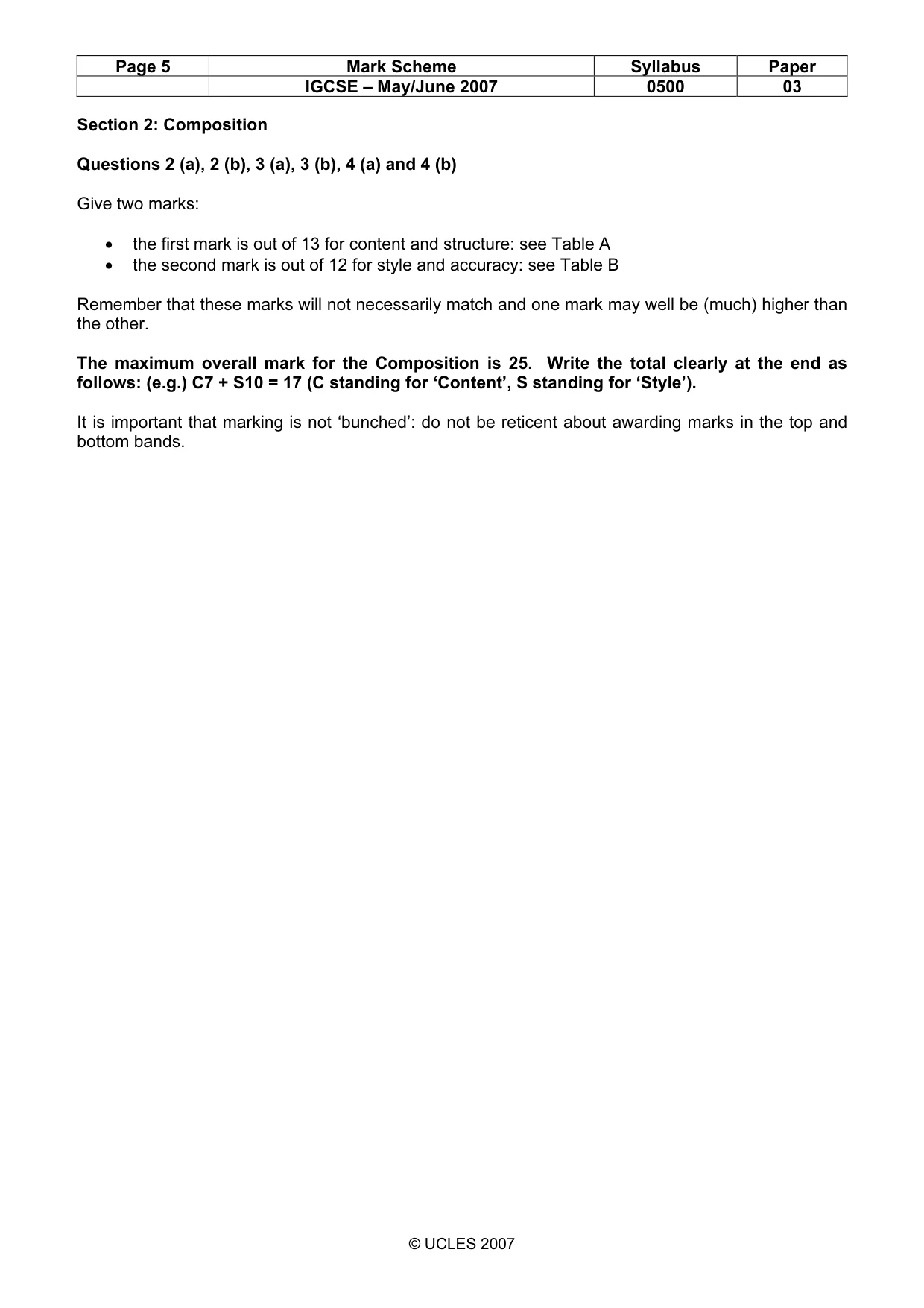
Page 5 Mark Scheme Syllabus Paper IGCSE – May/June 2007 0500 03 © UCLES 2007 Section 2: Composition Questions 2 (a), 2 (b), 3 (a), 3 (b), 4 (a) and 4 (b) Give two marks: • the first mark is out of 13 for content and structure: see Table A • the second mark is out of 12 for style and accuracy: see Table B Remember that these marks will not necessarily match and one mark may well be (much) higher than the other. The maximum overall mark for the Composition is 25. Write the total clearly at the end as follows: (e.g.) C7 + S10 = 17 (C standing for ‘Content’, S standing for ‘Style’). It is important that marking is not ‘bunched’: do not be reticent about awarding marks in the top and bottom bands.
Mark scheme, page 6
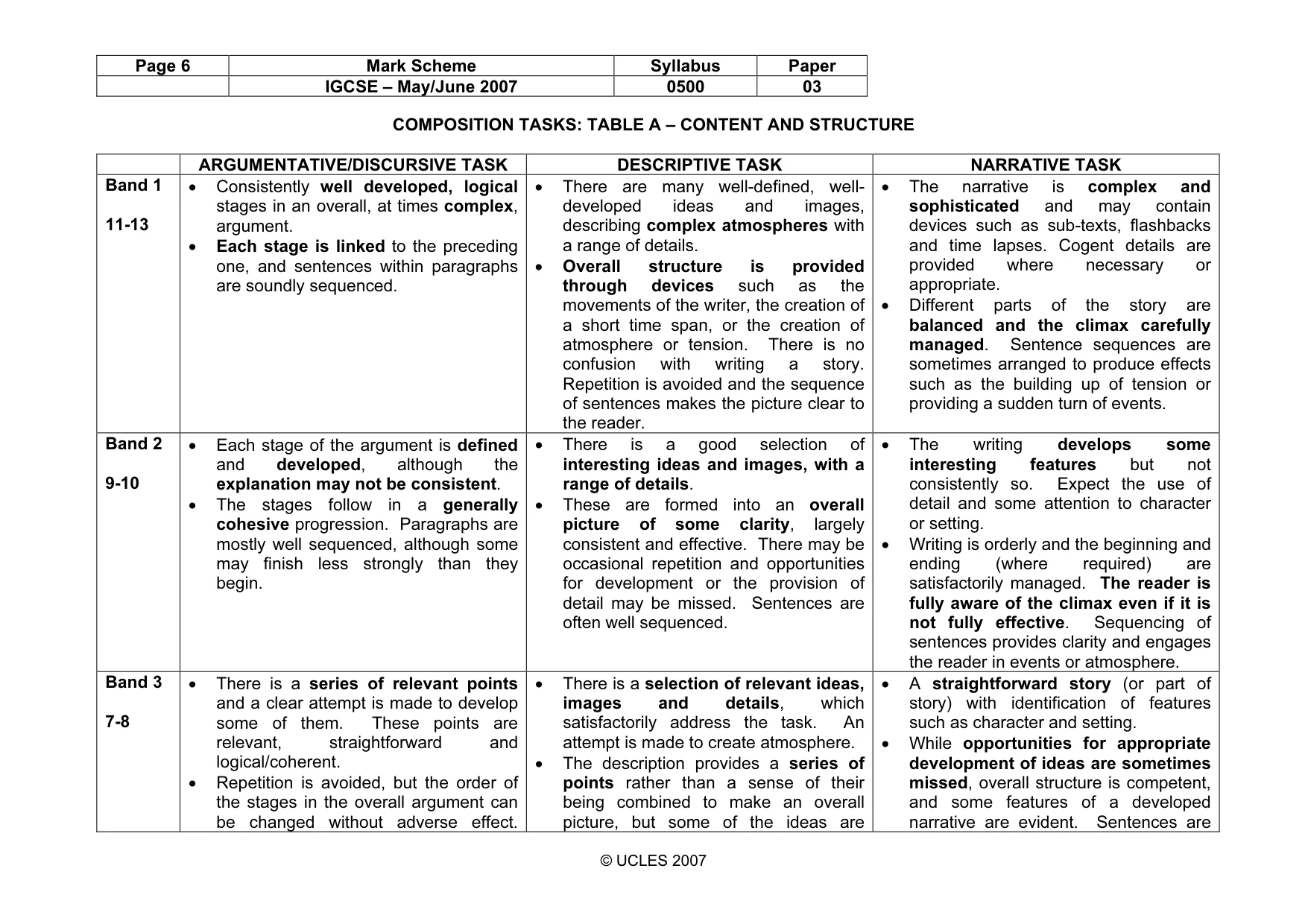
Page 6 Mark Scheme Syllabus Paper IGCSE – May/June 2007 0500 03 © UCLES 2007 COMPOSITION TASKS: TABLE A – CONTENT AND STRUCTURE ARGUMENTATIVE/DISCURSIVE TASK DESCRIPTIVE TASK NARRATIVE TASK Band 1 11-13 • Consistently well developed, logical stages in an overall, at times complex, argument. • Each stage is linked to the preceding one, and sentences within paragraphs are soundly sequenced. • There are many well-defined, well- developed ideas and images, describing complex atmospheres with a range of details. • Overall structure is provided through devices such as the movements of the writer, the creation of a short time span, or the creation of atmosphere or tension. There is no confusion with writing a story. Repetition is avoided and the sequence of sentences makes the picture clear to the reader. • The narrative is complex and sophisticated and may contain devices such as sub-texts, flashbacks and time lapses. Cogent details are provided where necessary or appropriate. • Different parts of the story are balanced and the climax carefully managed. Sentence sequences are sometimes arranged to produce effects such as the building up of tension or providing a sudden turn of events. Band 2 9-10 • Each stage of the argument is defined and developed, although the explanation may not be consistent. • The stages follow in a generally cohesive progression. Paragraphs are mostly well sequenced, although some may finish less strongly than they begin. • There is a good selection of interesting ideas and images, with a range of details. • These are formed into an overall picture of some clarity, largely consistent and effective. There may be occasional repetition and opportunities for development or the provision of detail may be missed. Sentences are often well sequenced. • The writing develops some interesting features but not consistently so. Expect the use of detail and some attention to character or setting. • Writing is orderly and the beginning and ending (where required) are satisfactorily managed. The reader is fully aware of the climax even if it is not fully effective. Sequencing of sentences provides clarity and engages the reader in events or atmosphere. Band 3 7-8 • There is a series of relevant points and a clear attempt is made to develop some of them. These points are relevant, straightforward and logical/coherent. • Repetition is avoided, but the order of the stages in the overall argument can be changed without adverse effect. • There is a selection of relevant ideas, images and details, which satisfactorily address the task. An attempt is made to create atmosphere. • The description provides a series of points rather than a sense of their being combined to make an overall picture, but some of the ideas are • A straightforward story (or part of story) with identification of features such as character and setting. • While opportunities for appropriate development of ideas are sometimes missed, overall structure is competent, and some features of a developed narrative are evident. Sentences are
Mark scheme, page 7
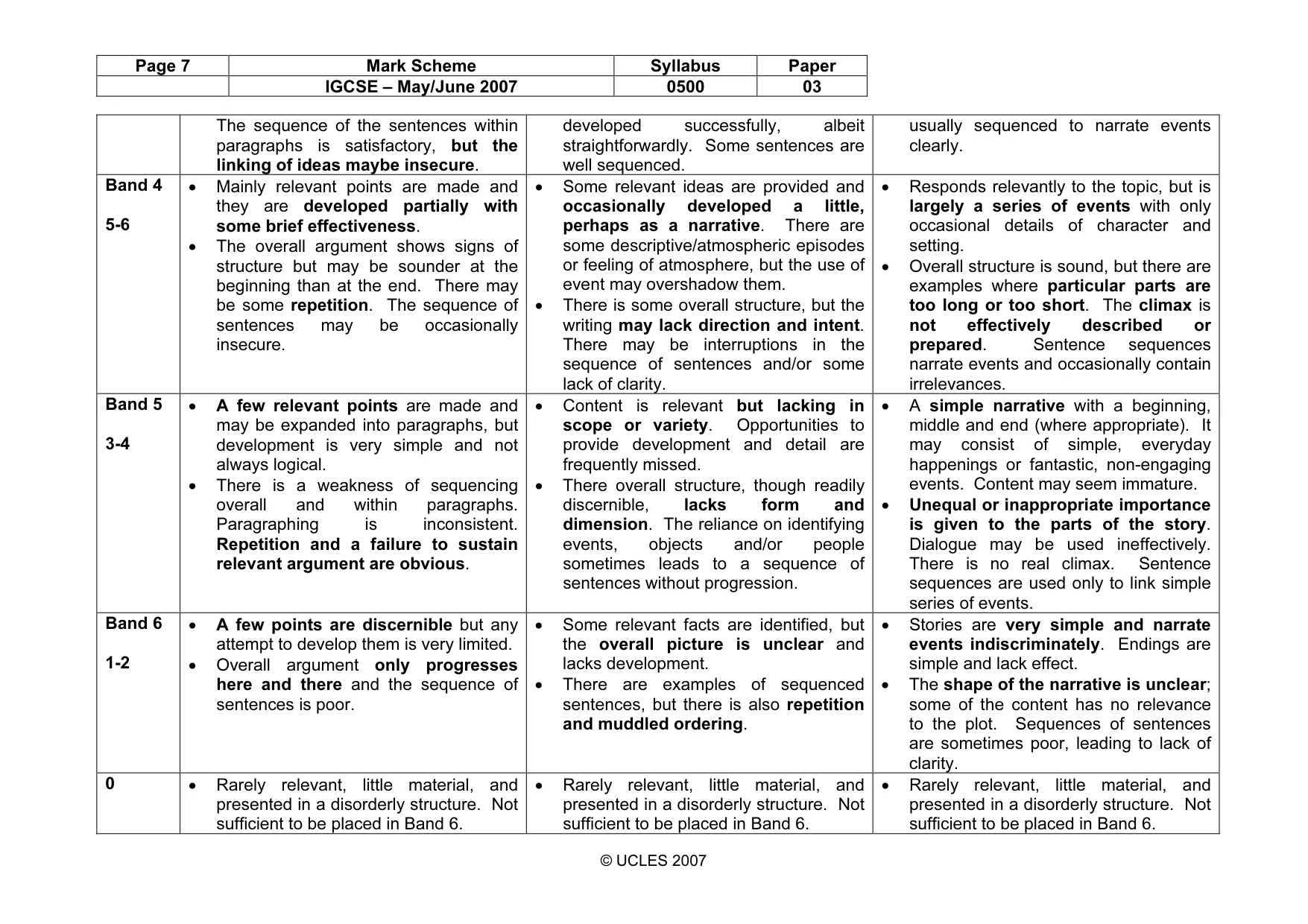
Page 7 Mark Scheme Syllabus Paper IGCSE – May/June 2007 0500 03 © UCLES 2007 The sequence of the sentences within paragraphs is satisfactory, but the linking of ideas maybe insecure. developed successfully, albeit straightforwardly. Some sentences are well sequenced. usually sequenced to narrate events clearly. Band 4 5-6 • Mainly relevant points are made and they are developed partially with some brief effectiveness. • The overall argument shows signs of structure but may be sounder at the beginning than at the end. There may be some repetition. The sequence of sentences may be occasionally insecure. • Some relevant ideas are provided and occasionally developed a little, perhaps as a narrative. There are some descriptive/atmospheric episodes or feeling of atmosphere, but the use of event may overshadow them. • There is some overall structure, but the writing may lack direction and intent. There may be interruptions in the sequence of sentences and/or some lack of clarity. • Responds relevantly to the topic, but is largely a series of events with only occasional details of character and setting. • Overall structure is sound, but there are examples where particular parts are too long or too short. The climax is not effectively described or prepared. Sentence sequences narrate events and occasionally contain irrelevances. Band 5 3-4 • A few relevant points are made and may be expanded into paragraphs, but development is very simple and not always logical. • There is a weakness of sequencing overall and within paragraphs. Paragraphing is inconsistent. Repetition and a failure to sustain relevant argument are obvious. • Content is relevant but lacking in scope or variety. Opportunities to provide development and detail are frequently missed. • There overall structure, though readily discernible, lacks form and dimension. The reliance on identifying events, objects and/or people sometimes leads to a sequence of sentences without progression. • A simple narrative with a beginning, middle and end (where appropriate). It may consist of simple, everyday happenings or fantastic, non-engaging events. Content may seem immature. • Unequal or inappropriate importance is given to the parts of the story. Dialogue may be used ineffectively. There is no real climax. Sentence sequences are used only to link simple series of events. Band 6 1-2 • A few points are discernible but any attempt to develop them is very limited. • Overall argument only progresses here and there and the sequence of sentences is poor. • Some relevant facts are identified, but the overall picture is unclear and lacks development. • There are examples of sequenced sentences, but there is also repetition and muddled ordering. • Stories are very simple and narrate events indiscriminately. Endings are simple and lack effect. • The shape of the narrative is unclear; some of the content has no relevance to the plot. Sequences of sentences are sometimes poor, leading to lack of clarity. 0 • Rarely relevant, little material, and presented in a disorderly structure. Not sufficient to be placed in Band 6. • Rarely relevant, little material, and presented in a disorderly structure. Not sufficient to be placed in Band 6. • Rarely relevant, little material, and presented in a disorderly structure. Not sufficient to be placed in Band 6.
Mark scheme, page 8
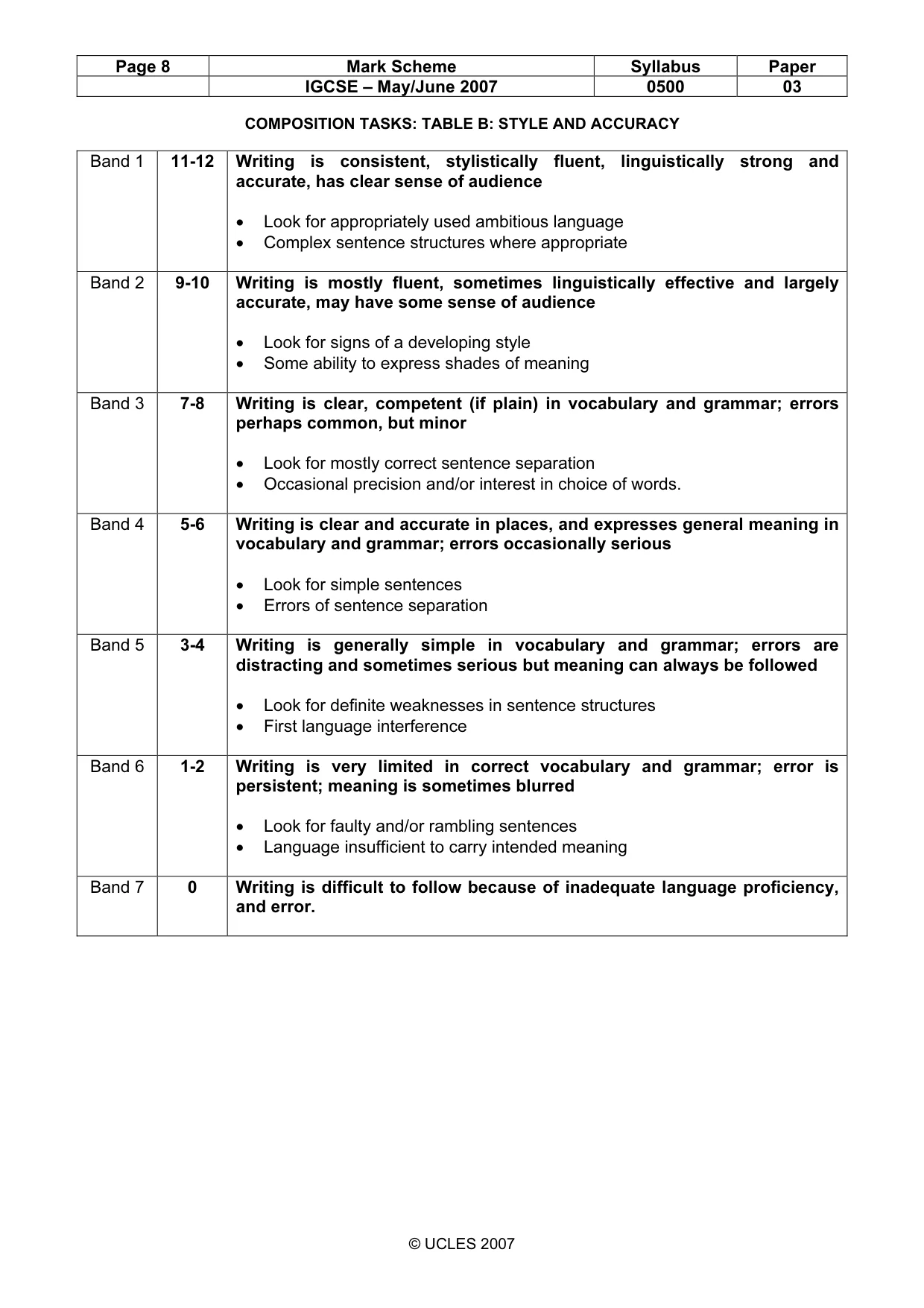
Page 8 Mark Scheme Syllabus Paper IGCSE – May/June 2007 0500 03 © UCLES 2007 COMPOSITION TASKS: TABLE B: STYLE AND ACCURACY Band 1 11-12 Writing is consistent, stylistically fluent, linguistically strong and accurate, has clear sense of audience • Look for appropriately used ambitious language • Complex sentence structures where appropriate Band 2 9-10 Writing is mostly fluent, sometimes linguistically effective and largely accurate, may have some sense of audience • Look for signs of a developing style • Some ability to express shades of meaning Band 3 7-8 Writing is clear, competent (if plain) in vocabulary and grammar; errors perhaps common, but minor • Look for mostly correct sentence separation • Occasional precision and/or interest in choice of words. Band 4 5-6 Writing is clear and accurate in places, and expresses general meaning in vocabulary and grammar; errors occasionally serious • Look for simple sentences • Errors of sentence separation Band 5 3-4 Writing is generally simple in vocabulary and grammar; errors are distracting and sometimes serious but meaning can always be followed • Look for definite weaknesses in sentence structures • First language interference Band 6 1-2 Writing is very limited in correct vocabulary and grammar; error is persistent; meaning is sometimes blurred • Look for faulty and/or rambling sentences • Language insufficient to carry intended meaning Band 7 0 Writing is difficult to follow because of inadequate language proficiency, and error.
What you needed in this session
Cambridge’s own grade thresholds for 2007 May/June, Paper 3 · Variant 1. A higher threshold means an easier paper — the bar moves with how the cohort did.