Cambridge IGCSE English - First Language 0500 — 2007 May/June Paper 2 · Variant 1
0500/21/M/J/07 · 50 marks · ≈56 min
The question paper and its mark scheme, free to read here and free to download. This is Cambridge’s own paper, exactly as it was sat.
Question paper8 pages


Mark scheme6 pages
Answers below. Sit the paper first if you are practising.
Paper as text
Question paper, page 1
This document consists of 5 printed pages and 3 blank pages. IB07 06_0500_02/3RP © UCLES 2007 [Turn over *7393771241* UNIVERSITY OF CAMBRIDGE INTERNATIONAL EXAMINATIONS International General Certificate of Secondary Education FIRST LANGUAGE ENGLISH 0500/02 Paper 2 Reading Passages May/June 2007 2 hours Additional Materials: Answer Booklet/Paper READ THESE INSTRUCTIONS FIRST If you have been given an Answer Booklet, follow the instructions on the front cover of the Booklet. Write your Centre number, candidate number and name on all the work you hand in. Write in dark blue or black pen. Do not use staples, paper clips, highlighters, glue or correction fluid. Answer all questions. Dictionaries are not permitted. At the end of the examination, fasten all your work securely together. The number of marks is given in brackets [ ] at the end of each question or part question. www.XtremePapers.com
Question paper, page 2
2 © UCLES 2007 0500/02/M/J/07 Part 1 Read Passage A carefully, and then answer Questions 1 and 2. Passage A This is a description of a most peculiar public speaker and the ways in which he attempts to influence his audience. Dr. Zinc My friends had advised me, if I was at a loose end and required entertainment, to wander down to the public gardens to see Dr. Zinc in action. When I got there I saw a bizarre, cadaverous figure, gesticulating wildly at a small audience that had gathered around him. He behaved in a theatrical manner, intoning some well-prepared soliloquy and throwing himself around like a tree in a gale. He wore a melancholy expression and his straggly hair hung down untidily. I joined the crowd to hear what this eccentric fellow had to say. ‘Be sure, that at half past three on some day in the near future, the world will come to a sorry end. The sun will burn us up and behold, at this very moment, oh, horrible to relate, a fiery asteroid is bearing down upon us. In the great continents there will be interminable droughts, and the people will perish for lack of water. We can do nothing, for this process has already started.’ At this point, Dr. Zinc paused and gasped noisily, before gulping down some of the earth’s last water supply. When he started again, he seemed to have lost his thread as well as his voice as, with some hoarseness, he described the deadly illnesses that would cover the earth, and he treated his audience to lurid descriptions of new and peculiar diseases. He shed several tears to communicate his great love for the animals which were the origin of these frightening diseases, and which would, no doubt, be experimented upon and tortured by scientists in white coats. ‘But worst of all, oh terrible, terrible,’ he resumed, ‘will be the wars that will consume us all with nuclear destruction. In the hands of evil people, whole nations will be eradicated and the lands rendered infertile and inhospitable.’ I was beginning to find this man the very opposite of entertaining, and certainly his audience was not laughing. I suddenly realised that they believed what he said. Most of them were deathly pale and some clasped their hands together. The woman next to me twitched uncontrollably. So this was the magic of rhetoric, and I saw how easily one person could influence a group of gullible citizens. As he continued to describe the activities of unspeakable criminals, his audience appeared to lean towards him as if he might be their protector. Every now and again they moaned and sobbed like pet dogs left at home too long by their owners. It seemed that their predicament might be eased by making a handsome contribution to Dr. Zinc’s funds. Cheerful givers were always loved by those who controlled things like the rainstorms and thunderbolts which, he observed, were likely to happen over the public gardens later that afternoon. At this point, some untidy and threatening individuals appeared with plastic buckets and started to demand donations. ‘Friends,’ he continued, ‘it is with a heavy heart that I make these predictions. I am a lover of green fields and the happy, innocent families that pass through them.’ Here he paused to shed more tears and to mumble something incomprehensible about the subversive evils of the media that poisoned all honest minds. His picture of ultimate destruction was, as he had hoped, too much for the audience who wailed and lifted their hands to the not-so-blue skies. Some clasped their cell phones to their ears and made final calls to their loved ones. An elderly woman in the crowd suddenly jumped up in anger and shouted at the top of her voice, ‘Rubbish, you are talking absolute nonsense!’ But it was a waste of breath. In the panic that ensued, no one could hear a word she said.
Question paper, page 3
3 © UCLES 2007 0500/02/M/J/07 [Turn over 1 Your school or college has a group for older students, which debates matters of general interest and current affairs. Imagine that you are a member of this group and have been asked to attend Dr. Zinc’s talk in the public gardens. Write a report to the committee that organises the group. In your report give your reasons whether or not Dr. Zinc should be invited to speak at one of the debates. Use ideas and details from the passage to support your views. Write between 1 ½ and 2 sides, allowing for the size of your handwriting. Up to 15 marks will be available for the content of your answer, and up to 5 marks for the quality of your writing. [Total: 20] 2 Re-read the descriptions of: (a) Dr. Zinc in paragraph 1; (b) his audience in paragraphs 5 and 6. Explain the effects the writer creates by using these descriptions. Support your answer by selecting words and phrases from these paragraphs. [Total: 10]
Question paper, page 4
4 © UCLES 2007 0500/02/M/J/07 Part 2 Question 3 is based on Passage A and Passage B. Read Passage B carefully and re-read Passage A. Passage B In this short essay, the writer argues against always thinking that the worst will happen. Doom and Gloom It has always been fashionable to predict doom and gloom. After all, it attracts more attention than good news. Many have feared the wrath to come from anything from angry deities to asteroids. While some of these predictions may have come true, many of the world’s problems have actually been solved by human ingenuity. The trouble is that dangers suddenly emerge without warning and fill the media with news that spreads unease. At the present time, many of these dangers occur because our world appears to have grown much smaller. Yet it is precisely because of this that so many good things have happened. Take transport, for example. Nowadays it takes so little time to visit relatives in another country, and, for many people, it is comparatively cheap. Students can spend time in new places, learning to live with new friends all over the globe. They can share each other’s cultures and benefit from education and the undertaking of important projects. On a larger scale, politicians are beginning to face their responsibilities towards the world as a whole. No longer can they turn their backs on poverty wherever it may occur. They are slowly realising that one country’s pollution is another’s poison and that emissions of greenhouse gas are linked to their economies and affect all of us. This process of facing up to reality may be frustratingly slow, but it marks a small step forward in human progress. We also hear daily of new cures for diseases. Yes, it is true that as we find easy ways of controlling diseases like polio, new viruses and bacteria break out, but with our rapidly increasing knowledge of medical science, exciting forms of treatment are just around the corner. In a generation’s time, we can look forward to cures for cancer and diabetes. So we muddle our way towards some sort of progress. We are a vast anthill of tribes all struggling to live on a tiny planet. We have marvellous inventions such as television to help us share our knowledge of each other, and to prevent the isolation that builds barriers between us. The internet allows us to communicate quickly and efficiently with each other. It provides us with a vast encyclopaedia of knowledge and the means to buy and sell goods in an electronic market. International sport reaches more countries whose people share the pride of competition and victory. Think how many people now have the opportunity to ‘attend’ concerts where before they were too isolated ever to have heard and seen a live performance. With all these good things to help us, the best news is that it lies within all of us to further solutions to the world’s problems and to cooperate in making life acceptable for everyone. With increasing knowledge and education we can, if we have the will, oblige our leaders to move forward, not to stagnate in a world of pessimism and fear.
Question paper, page 5
5 © UCLES 2007 0500/02/M/J/07 3 Summarise: (a) the encouraging aspects of life in the 21st century, according to the writer of Passage B; (b) the warnings about the future of the world as given by Dr. Zinc in Passage A. Use your own words as far as possible. You should write about 1 side in total, allowing for the size of your handwriting. Up to 15 marks will be available for the content of your answer, and up to 5 marks for the quality of your writing. [Total: 20]
Question paper, page 8
8 Permission to reproduce items where third-party owned material protected by copyright is included has been sought and cleared where possible. Every reasonable effort has been made by the publisher (UCLES) to trace copyright holders, but if any items requiring clearance have unwittingly been included, the publisher will be pleased to make amends at the earliest possible opportunity. University of Cambridge International Examinations is part of the Cambridge Assessment Group. Cambridge Assessment is the brand name of University of Cambridge Local Examinations Syndicate (UCLES), which is itself a department of the University of Cambridge. 0500/02/M/J/07 BLANK PAGE
Mark scheme, page 1
UNIVERSITY OF CAMBRIDGE INTERNATIONAL EXAMINATIONS International General Certificate of Secondary Education MARK SCHEME for the May/June 2007 question paper 0500 FIRST LANGUAGE ENGLISH 0500/02 Paper 2 (Reading Passages – Extended, maximum raw mark 50 This mark scheme is published as an aid to teachers and candidates, to indicate the requirements of the examination. It shows the basis on which Examiners were instructed to award marks. It does not indicate the details of the discussions that took place at an Examiners’ meeting before marking began. All Examiners are instructed that alternative correct answers and unexpected approaches in candidates’ scripts must be given marks that fairly reflect the relevant knowledge and skills demonstrated. Mark schemes must be read in conjunction with the question papers and the report on the examination. • CIE will not enter into discussions or correspondence in connection with these mark schemes. CIE is publishing the mark schemes for the May/June 2007 question papers for most IGCSE, GCE Advanced Level and Advanced Subsidiary Level syllabuses and some Ordinary Level syllabuses. www.XtremePapers.com
Mark scheme, page 2
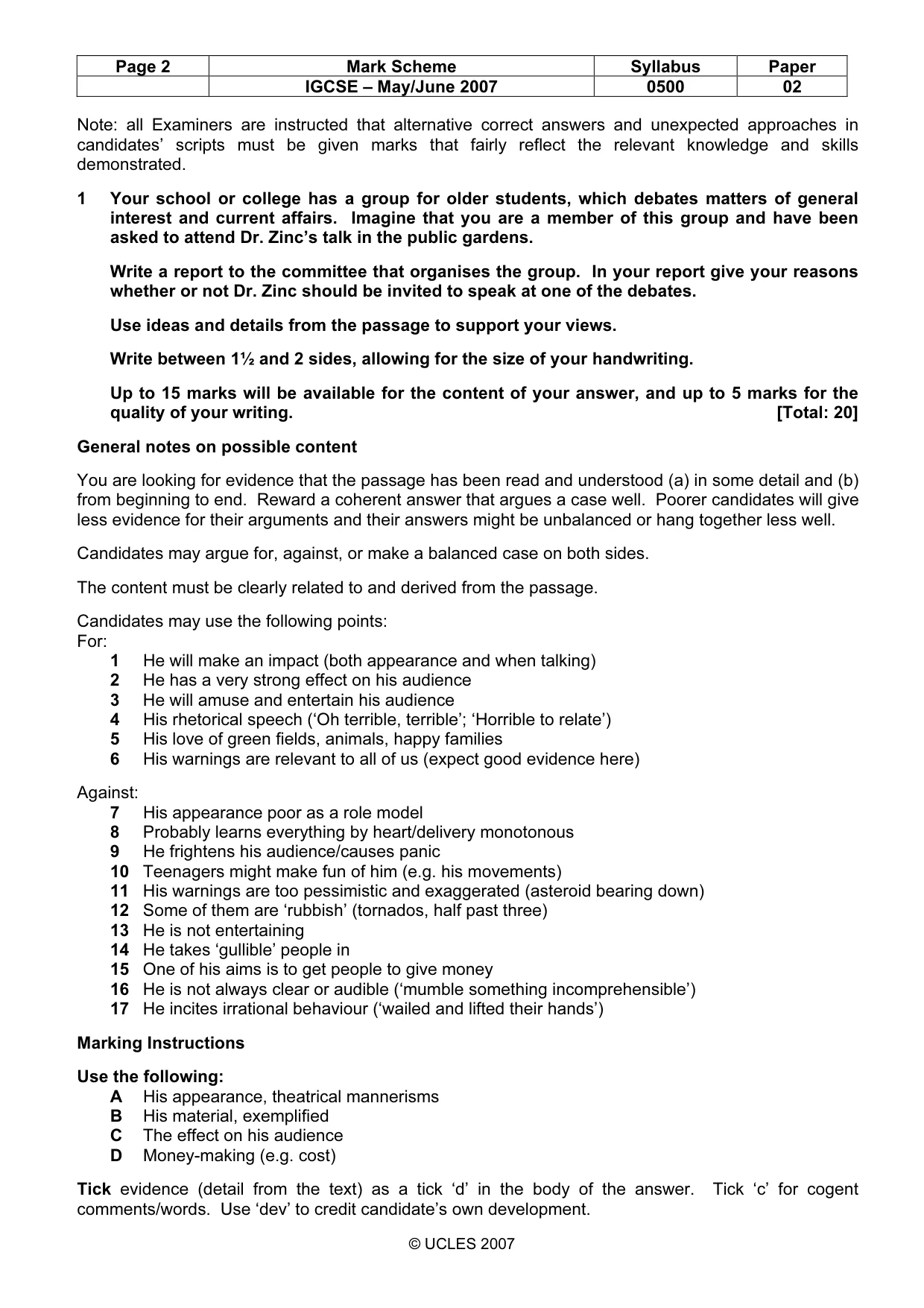
Page 2 Mark Scheme Syllabus Paper IGCSE – May/June 2007 0500 02 © UCLES 2007 Note: all Examiners are instructed that alternative correct answers and unexpected approaches in candidates’ scripts must be given marks that fairly reflect the relevant knowledge and skills demonstrated. 1 Your school or college has a group for older students, which debates matters of general interest and current affairs. Imagine that you are a member of this group and have been asked to attend Dr. Zinc’s talk in the public gardens. Write a report to the committee that organises the group. In your report give your reasons whether or not Dr. Zinc should be invited to speak at one of the debates. Use ideas and details from the passage to support your views. Write between 1½ and 2 sides, allowing for the size of your handwriting. Up to 15 marks will be available for the content of your answer, and up to 5 marks for the quality of your writing. [Total: 20] General notes on possible content You are looking for evidence that the passage has been read and understood (a) in some detail and (b) from beginning to end. Reward a coherent answer that argues a case well. Poorer candidates will give less evidence for their arguments and their answers might be unbalanced or hang together less well. Candidates may argue for, against, or make a balanced case on both sides. The content must be clearly related to and derived from the passage. Candidates may use the following points: For: 1 He will make an impact (both appearance and when talking) 2 He has a very strong effect on his audience 3 He will amuse and entertain his audience 4 His rhetorical speech (‘Oh terrible, terrible’; ‘Horrible to relate’) 5 His love of green fields, animals, happy families 6 His warnings are relevant to all of us (expect good evidence here) Against: 7 His appearance poor as a role model 8 Probably learns everything by heart/delivery monotonous 9 He frightens his audience/causes panic 10 Teenagers might make fun of him (e.g. his movements) 11 His warnings are too pessimistic and exaggerated (asteroid bearing down) 12 Some of them are ‘rubbish’ (tornados, half past three) 13 He is not entertaining 14 He takes ‘gullible’ people in 15 One of his aims is to get people to give money 16 He is not always clear or audible (‘mumble something incomprehensible’) 17 He incites irrational behaviour (‘wailed and lifted their hands’) Marking Instructions Use the following: A His appearance, theatrical mannerisms B His material, exemplified C The effect on his audience D Money-making (e.g. cost) Tick evidence (detail from the text) as a tick ‘d’ in the body of the answer. Tick ‘c’ for cogent comments/words. Use ‘dev’ to credit candidate’s own development.
Mark scheme, page 3
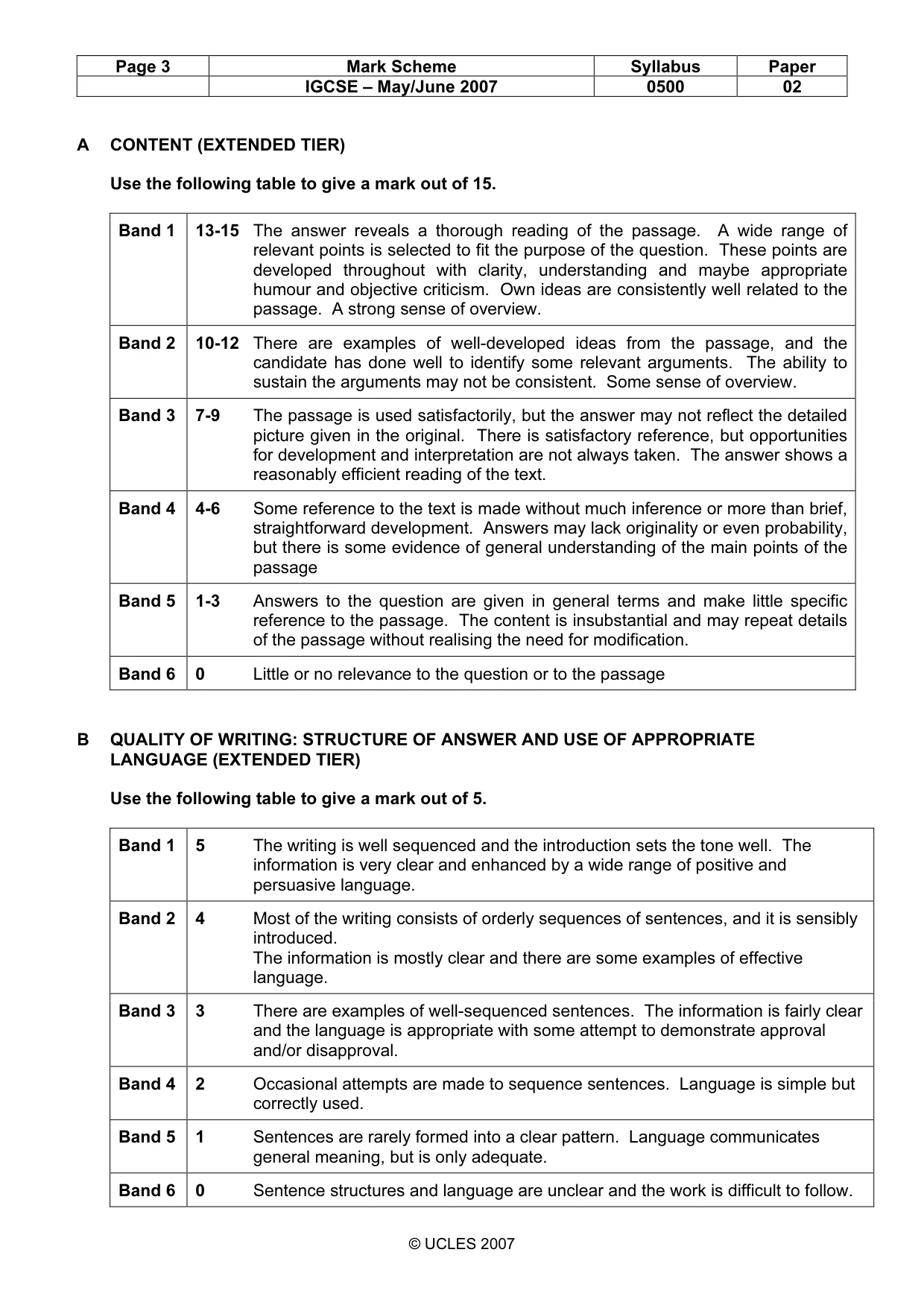
Page 3 Mark Scheme Syllabus Paper IGCSE – May/June 2007 0500 02 © UCLES 2007 A CONTENT (EXTENDED TIER) Use the following table to give a mark out of 15. Band 1 13-15 The answer reveals a thorough reading of the passage. A wide range of relevant points is selected to fit the purpose of the question. These points are developed throughout with clarity, understanding and maybe appropriate humour and objective criticism. Own ideas are consistently well related to the passage. A strong sense of overview. Band 2 10-12 There are examples of well-developed ideas from the passage, and the candidate has done well to identify some relevant arguments. The ability to sustain the arguments may not be consistent. Some sense of overview. Band 3 7-9 The passage is used satisfactorily, but the answer may not reflect the detailed picture given in the original. There is satisfactory reference, but opportunities for development and interpretation are not always taken. The answer shows a reasonably efficient reading of the text. Band 4 4-6 Some reference to the text is made without much inference or more than brief, straightforward development. Answers may lack originality or even probability, but there is some evidence of general understanding of the main points of the passage Band 5 1-3 Answers to the question are given in general terms and make little specific reference to the passage. The content is insubstantial and may repeat details of the passage without realising the need for modification. Band 6 0 Little or no relevance to the question or to the passage B QUALITY OF WRITING: STRUCTURE OF ANSWER AND USE OF APPROPRIATE LANGUAGE (EXTENDED TIER) Use the following table to give a mark out of 5. Band 1 5 The writing is well sequenced and the introduction sets the tone well. The information is very clear and enhanced by a wide range of positive and persuasive language. Band 2 4 Most of the writing consists of orderly sequences of sentences, and it is sensibly introduced. The information is mostly clear and there are some examples of effective language. Band 3 3 There are examples of well-sequenced sentences. The information is fairly clear and the language is appropriate with some attempt to demonstrate approval and/or disapproval. Band 4 2 Occasional attempts are made to sequence sentences. Language is simple but correctly used. Band 5 1 Sentences are rarely formed into a clear pattern. Language communicates general meaning, but is only adequate. Band 6 0 Sentence structures and language are unclear and the work is difficult to follow.
Mark scheme, page 4
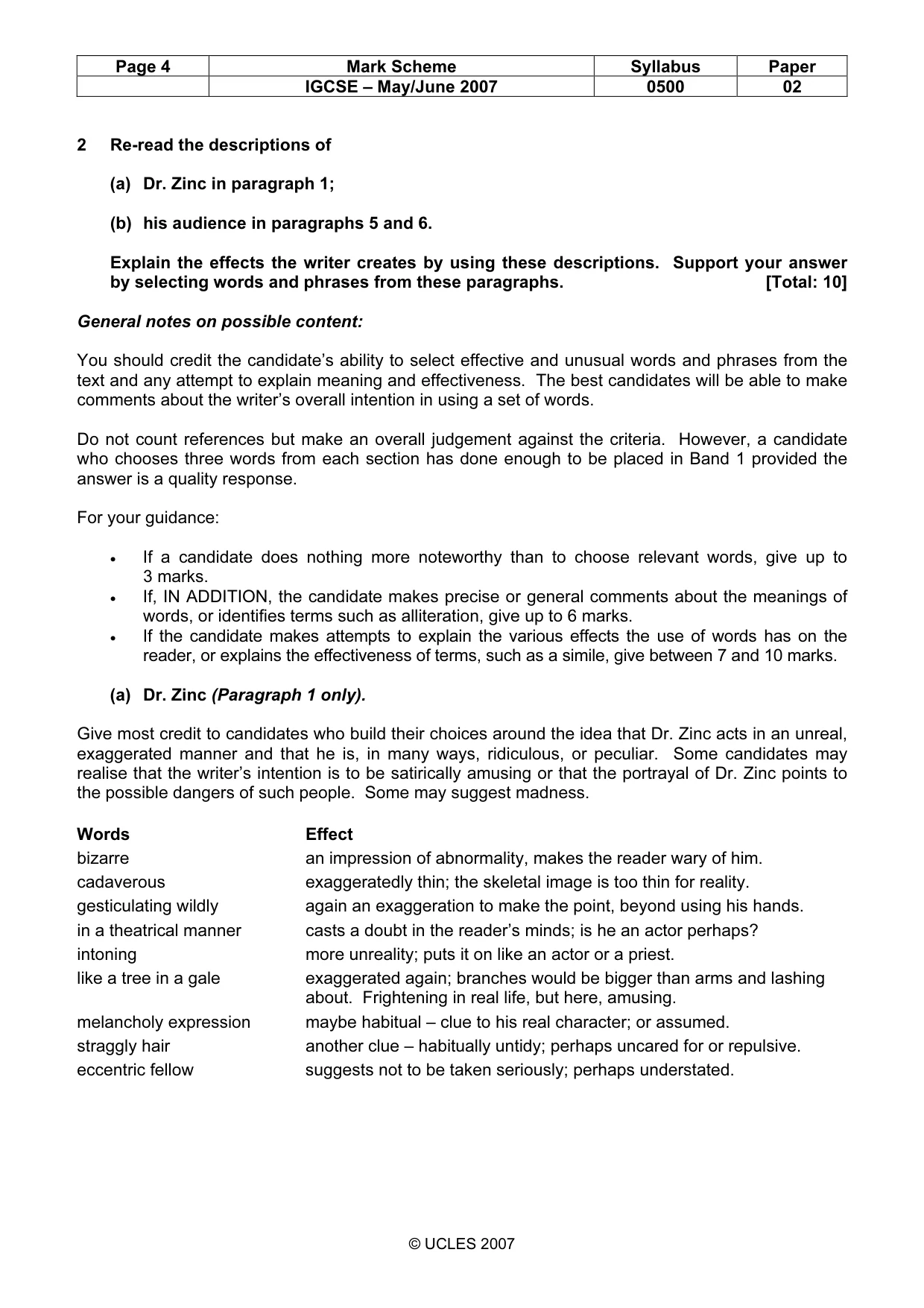
Page 4 Mark Scheme Syllabus Paper IGCSE – May/June 2007 0500 02 © UCLES 2007 2 Re-read the descriptions of (a) Dr. Zinc in paragraph 1; (b) his audience in paragraphs 5 and 6. Explain the effects the writer creates by using these descriptions. Support your answer by selecting words and phrases from these paragraphs. [Total: 10] General notes on possible content: You should credit the candidate’s ability to select effective and unusual words and phrases from the text and any attempt to explain meaning and effectiveness. The best candidates will be able to make comments about the writer’s overall intention in using a set of words. Do not count references but make an overall judgement against the criteria. However, a candidate who chooses three words from each section has done enough to be placed in Band 1 provided the answer is a quality response. For your guidance: • If a candidate does nothing more noteworthy than to choose relevant words, give up to 3 marks. • If, IN ADDITION, the candidate makes precise or general comments about the meanings of words, or identifies terms such as alliteration, give up to 6 marks. • If the candidate makes attempts to explain the various effects the use of words has on the reader, or explains the effectiveness of terms, such as a simile, give between 7 and 10 marks. (a) Dr. Zinc (Paragraph 1 only). Give most credit to candidates who build their choices around the idea that Dr. Zinc acts in an unreal, exaggerated manner and that he is, in many ways, ridiculous, or peculiar. Some candidates may realise that the writer’s intention is to be satirically amusing or that the portrayal of Dr. Zinc points to the possible dangers of such people. Some may suggest madness. Words Effect bizarre an impression of abnormality, makes the reader wary of him. cadaverous exaggeratedly thin; the skeletal image is too thin for reality. gesticulating wildly again an exaggeration to make the point, beyond using his hands. in a theatrical manner casts a doubt in the reader’s minds; is he an actor perhaps? intoning more unreality; puts it on like an actor or a priest. like a tree in a gale exaggerated again; branches would be bigger than arms and lashing about. Frightening in real life, but here, amusing. melancholy expression maybe habitual – clue to his real character; or assumed. straggly hair another clue – habitually untidy; perhaps uncared for or repulsive. eccentric fellow suggests not to be taken seriously; perhaps understated.
Mark scheme, page 5
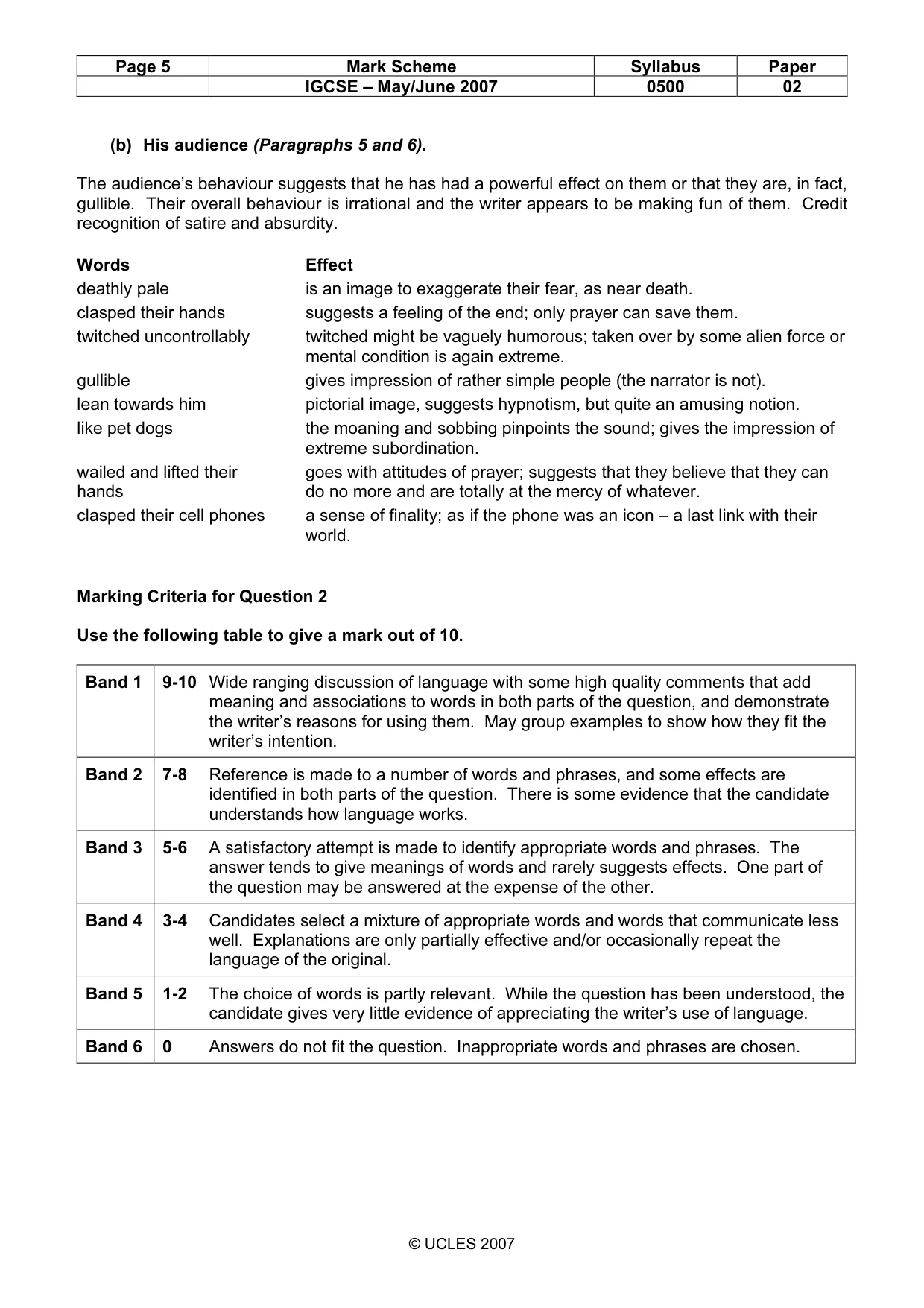
Page 5 Mark Scheme Syllabus Paper IGCSE – May/June 2007 0500 02 © UCLES 2007 (b) His audience (Paragraphs 5 and 6). The audience’s behaviour suggests that he has had a powerful effect on them or that they are, in fact, gullible. Their overall behaviour is irrational and the writer appears to be making fun of them. Credit recognition of satire and absurdity. Words Effect deathly pale is an image to exaggerate their fear, as near death. clasped their hands suggests a feeling of the end; only prayer can save them. twitched uncontrollably twitched might be vaguely humorous; taken over by some alien force or mental condition is again extreme. gullible gives impression of rather simple people (the narrator is not). lean towards him pictorial image, suggests hypnotism, but quite an amusing notion. like pet dogs the moaning and sobbing pinpoints the sound; gives the impression of extreme subordination. wailed and lifted their hands goes with attitudes of prayer; suggests that they believe that they can do no more and are totally at the mercy of whatever. clasped their cell phones a sense of finality; as if the phone was an icon – a last link with their world. Marking Criteria for Question 2 Use the following table to give a mark out of 10. Band 1 9-10 Wide ranging discussion of language with some high quality comments that add meaning and associations to words in both parts of the question, and demonstrate the writer’s reasons for using them. May group examples to show how they fit the writer’s intention. Band 2 7-8 Reference is made to a number of words and phrases, and some effects are identified in both parts of the question. There is some evidence that the candidate understands how language works. Band 3 5-6 A satisfactory attempt is made to identify appropriate words and phrases. The answer tends to give meanings of words and rarely suggests effects. One part of the question may be answered at the expense of the other. Band 4 3-4 Candidates select a mixture of appropriate words and words that communicate less well. Explanations are only partially effective and/or occasionally repeat the language of the original. Band 5 1-2 The choice of words is partly relevant. While the question has been understood, the candidate gives very little evidence of appreciating the writer’s use of language. Band 6 0 Answers do not fit the question. Inappropriate words and phrases are chosen.
Mark scheme, page 6
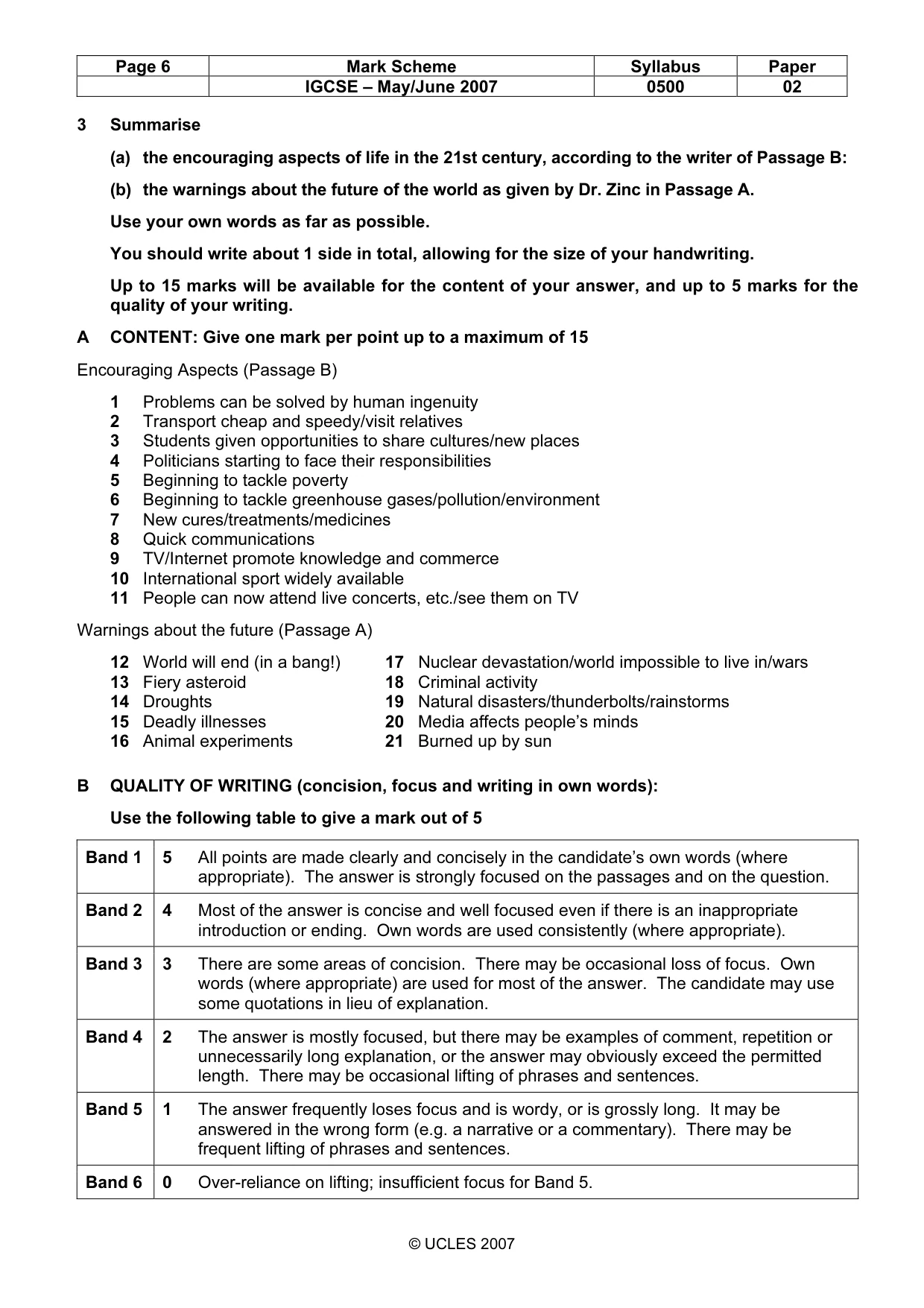
Page 6 Mark Scheme Syllabus Paper IGCSE – May/June 2007 0500 02 © UCLES 2007 3 Summarise (a) the encouraging aspects of life in the 21st century, according to the writer of Passage B: (b) the warnings about the future of the world as given by Dr. Zinc in Passage A. Use your own words as far as possible. You should write about 1 side in total, allowing for the size of your handwriting. Up to 15 marks will be available for the content of your answer, and up to 5 marks for the quality of your writing. A CONTENT: Give one mark per point up to a maximum of 15 Encouraging Aspects (Passage B) 1 Problems can be solved by human ingenuity 2 Transport cheap and speedy/visit relatives 3 Students given opportunities to share cultures/new places 4 Politicians starting to face their responsibilities 5 Beginning to tackle poverty 6 Beginning to tackle greenhouse gases/pollution/environment 7 New cures/treatments/medicines 8 Quick communications 9 TV/Internet promote knowledge and commerce 10 International sport widely available 11 People can now attend live concerts, etc./see them on TV Warnings about the future (Passage A) 12 World will end (in a bang!) 17 Nuclear devastation/world impossible to live in/wars 13 Fiery asteroid 18 Criminal activity 14 Droughts 19 Natural disasters/thunderbolts/rainstorms 15 Deadly illnesses 20 Media affects people’s minds 16 Animal experiments 21 Burned up by sun B QUALITY OF WRITING (concision, focus and writing in own words): Use the following table to give a mark out of 5 Band 1 5 All points are made clearly and concisely in the candidate’s own words (where appropriate). The answer is strongly focused on the passages and on the question. Band 2 4 Most of the answer is concise and well focused even if there is an inappropriate introduction or ending. Own words are used consistently (where appropriate). Band 3 3 There are some areas of concision. There may be occasional loss of focus. Own words (where appropriate) are used for most of the answer. The candidate may use some quotations in lieu of explanation. Band 4 2 The answer is mostly focused, but there may be examples of comment, repetition or unnecessarily long explanation, or the answer may obviously exceed the permitted length. There may be occasional lifting of phrases and sentences. Band 5 1 The answer frequently loses focus and is wordy, or is grossly long. It may be answered in the wrong form (e.g. a narrative or a commentary). There may be frequent lifting of phrases and sentences. Band 6 0 Over-reliance on lifting; insufficient focus for Band 5.
What you needed in this session
Cambridge’s own grade thresholds for 2007 May/June, Paper 2 · Variant 1. A higher threshold means an easier paper — the bar moves with how the cohort did.