Cambridge IGCSE English - First Language 0500 — 2007 May/June Paper 1 · Variant 1
0500/11/M/J/07 · 50 marks · ≈56 min
The question paper and its mark scheme, free to read here and free to download. This is Cambridge’s own paper, exactly as it was sat.
Question paper4 pages
Mark scheme5 pages
Answers below. Sit the paper first if you are practising.
Paper as text
Question paper, page 1
This document consists of 3 printed pages and 1 blank page. IB07 06_0500_01/2RP © UCLES 2007 [Turn over *4724238163* UNIVERSITY OF CAMBRIDGE INTERNATIONAL EXAMINATIONS International General Certificate of Secondary Education FIRST LANGUAGE ENGLISH 0500/01 Paper 1 Reading Passage May/June 2007 1 hour 45 minutes Additional Materials: Answer Booklet/Paper READ THESE INSTRUCTIONS FIRST If you have been given an Answer Booklet, follow the instructions on the front cover of the Booklet. Write your Centre number, candidate number and name on all the work you hand in. Write in dark blue or black pen. Do not use staples, paper clips, highlighters, glue or correction fluid. Answer all questions. Dictionaries are not permitted. At the end of the examination, fasten all your work securely together. The number of marks is given in brackets [ ] at the end of each question or part question. www.XtremePapers.com
Question paper, page 2
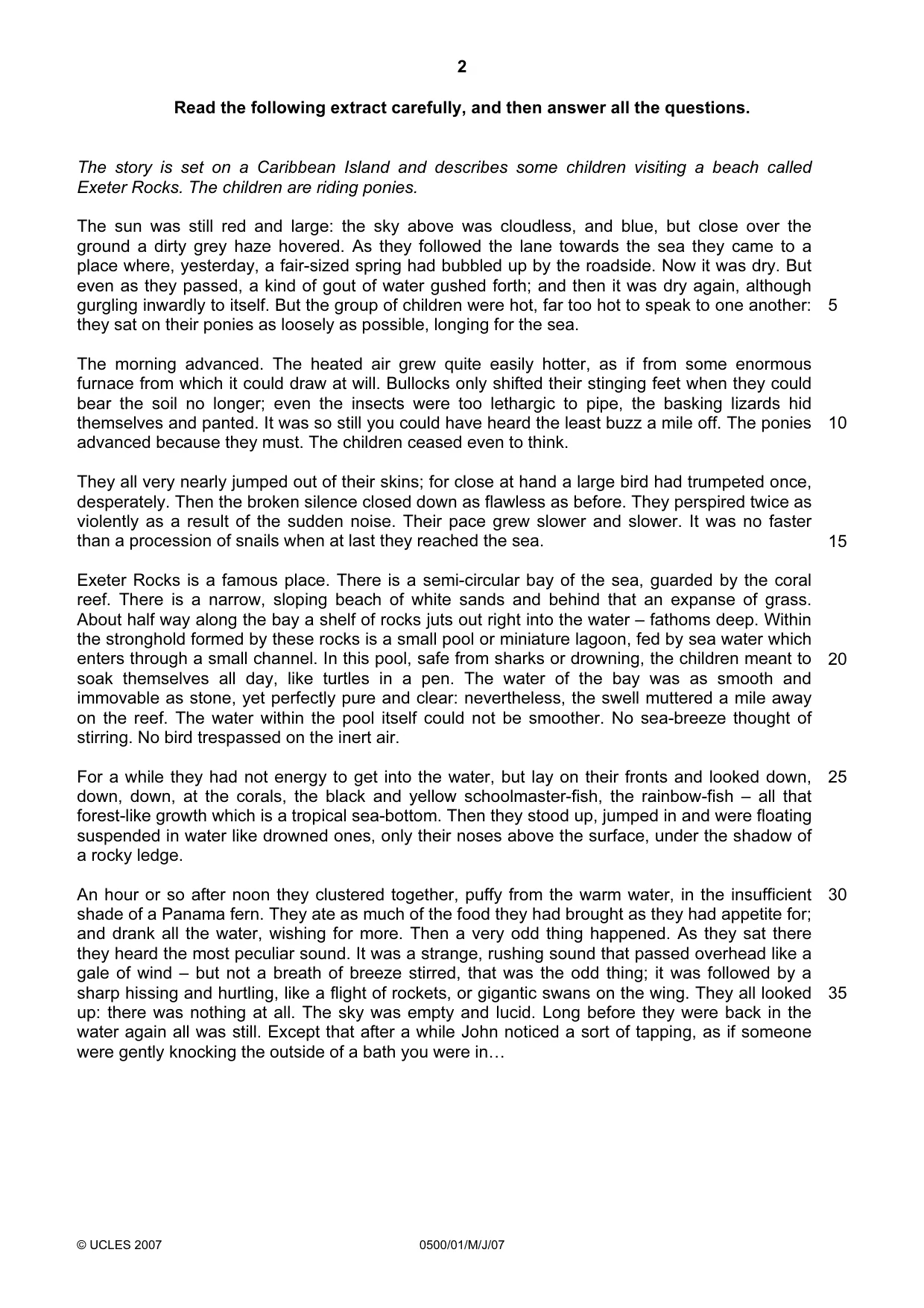
2 © UCLES 2007 0500/01/M/J/07 Read the following extract carefully, and then answer all the questions. The story is set on a Caribbean Island and describes some children visiting a beach called Exeter Rocks. The children are riding ponies. The sun was still red and large: the sky above was cloudless, and blue, but close over the ground a dirty grey haze hovered. As they followed the lane towards the sea they came to a place where, yesterday, a fair-sized spring had bubbled up by the roadside. Now it was dry. But even as they passed, a kind of gout of water gushed forth; and then it was dry again, although gurgling inwardly to itself. But the group of children were hot, far too hot to speak to one another: they sat on their ponies as loosely as possible, longing for the sea. The morning advanced. The heated air grew quite easily hotter, as if from some enormous furnace from which it could draw at will. Bullocks only shifted their stinging feet when they could bear the soil no longer; even the insects were too lethargic to pipe, the basking lizards hid themselves and panted. It was so still you could have heard the least buzz a mile off. The ponies advanced because they must. The children ceased even to think. They all very nearly jumped out of their skins; for close at hand a large bird had trumpeted once, desperately. Then the broken silence closed down as flawless as before. They perspired twice as violently as a result of the sudden noise. Their pace grew slower and slower. It was no faster than a procession of snails when at last they reached the sea. Exeter Rocks is a famous place. There is a semi-circular bay of the sea, guarded by the coral reef. There is a narrow, sloping beach of white sands and behind that an expanse of grass. About half way along the bay a shelf of rocks juts out right into the water – fathoms deep. Within the stronghold formed by these rocks is a small pool or miniature lagoon, fed by sea water which enters through a small channel. In this pool, safe from sharks or drowning, the children meant to soak themselves all day, like turtles in a pen. The water of the bay was as smooth and immovable as stone, yet perfectly pure and clear: nevertheless, the swell muttered a mile away on the reef. The water within the pool itself could not be smoother. No sea-breeze thought of stirring. No bird trespassed on the inert air. For a while they had not energy to get into the water, but lay on their fronts and looked down, down, down, at the corals, the black and yellow schoolmaster-fish, the rainbow-fish – all that forest-like growth which is a tropical sea-bottom. Then they stood up, jumped in and were floating suspended in water like drowned ones, only their noses above the surface, under the shadow of a rocky ledge. An hour or so after noon they clustered together, puffy from the warm water, in the insufficient shade of a Panama fern. They ate as much of the food they had brought as they had appetite for; and drank all the water, wishing for more. Then a very odd thing happened. As they sat there they heard the most peculiar sound. It was a strange, rushing sound that passed overhead like a gale of wind – but not a breath of breeze stirred, that was the odd thing; it was followed by a sharp hissing and hurtling, like a flight of rockets, or gigantic swans on the wing. They all looked up: there was nothing at all. The sky was empty and lucid. Long before they were back in the water again all was still. Except that after a while John noticed a sort of tapping, as if someone were gently knocking the outside of a bath you were in… 5 10 15 20 25 30 35
Question paper, page 3
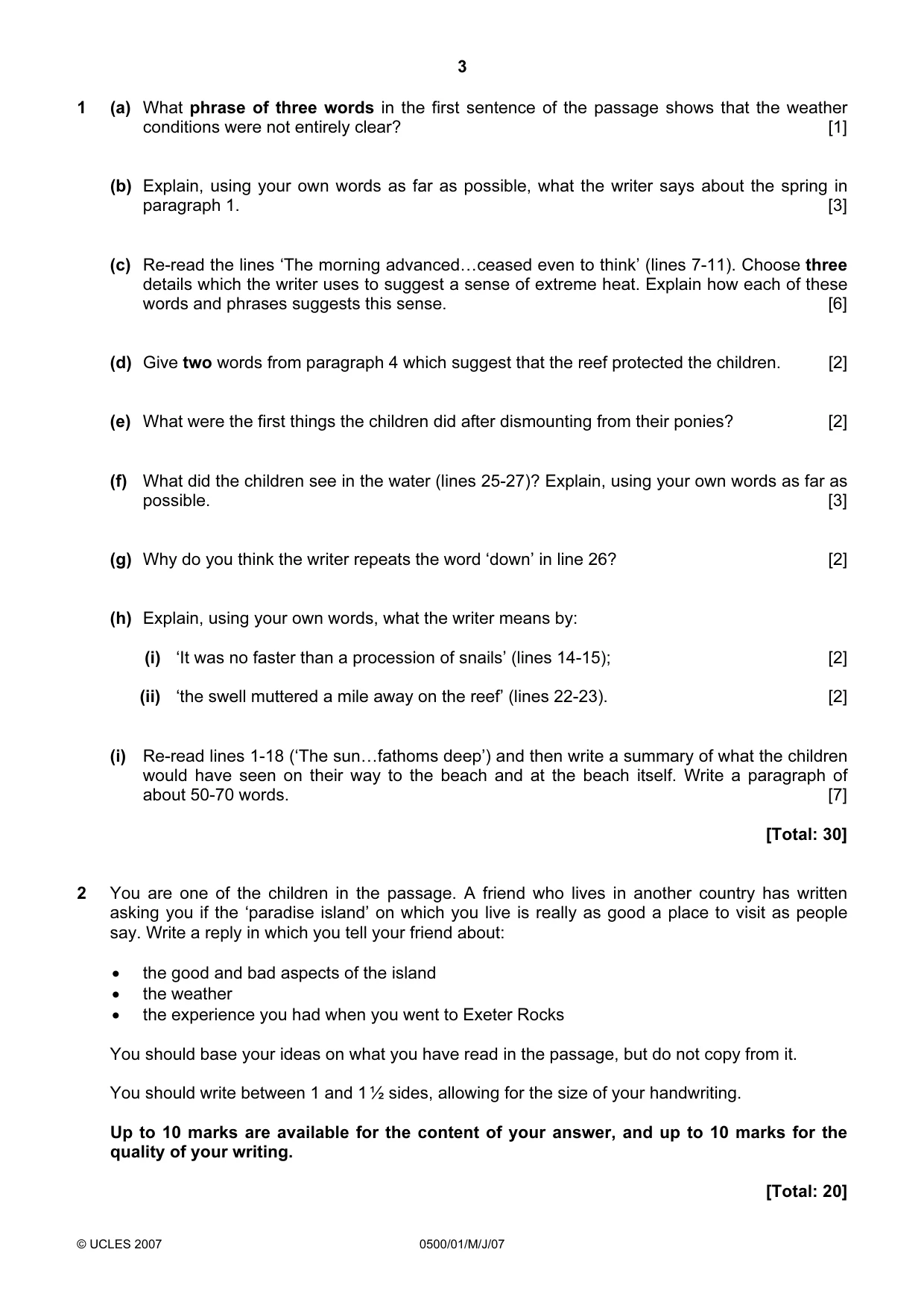
3 © UCLES 2007 0500/01/M/J/07 1 (a) What phrase of three words in the first sentence of the passage shows that the weather conditions were not entirely clear? [1] (b) Explain, using your own words as far as possible, what the writer says about the spring in paragraph 1. [3] (c) Re-read the lines ‘The morning advanced…ceased even to think’ (lines 7-11). Choose three details which the writer uses to suggest a sense of extreme heat. Explain how each of these words and phrases suggests this sense. [6] (d) Give two words from paragraph 4 which suggest that the reef protected the children. [2] (e) What were the first things the children did after dismounting from their ponies? [2] (f) What did the children see in the water (lines 25-27)? Explain, using your own words as far as possible. [3] (g) Why do you think the writer repeats the word ‘down’ in line 26? [2] (h) Explain, using your own words, what the writer means by: (i) ‘It was no faster than a procession of snails’ (lines 14-15); [2] (ii) ‘the swell muttered a mile away on the reef’ (lines 22-23). [2] (i) Re-read lines 1-18 (‘The sun…fathoms deep’) and then write a summary of what the children would have seen on their way to the beach and at the beach itself. Write a paragraph of about 50-70 words. [7] [Total: 30] 2 You are one of the children in the passage. A friend who lives in another country has written asking you if the ‘paradise island’ on which you live is really as good a place to visit as people say. Write a reply in which you tell your friend about: • the good and bad aspects of the island • the weather • the experience you had when you went to Exeter Rocks You should base your ideas on what you have read in the passage, but do not copy from it. You should write between 1 and 1 ½ sides, allowing for the size of your handwriting. Up to 10 marks are available for the content of your answer, and up to 10 marks for the quality of your writing. [Total: 20]
Question paper, page 4
4 Copyright Acknowledgements: Question 1 © Richard Hughes; A High Wind in Jamaica; Vintage; 1976. Permission to reproduce items where third-party owned material protected by copyright is included has been sought and cleared where possible. Every reasonable effort has been made by the publisher (UCLES) to trace copyright holders, but if any items requiring clearance have unwittingly been included, the publisher will be pleased to make amends at the earliest possible opportunity. University of Cambridge International Examinations is part of the Cambridge Assessment Group. Cambridge Assessment is the brand name of University of Cambridge Local Examinations Syndicate (UCLES), which is itself a department of the University of Cambridge. 0500/01/M/J/07 BLANK PAGE
Mark scheme, page 1
UNIVERSITY OF CAMBRIDGE INTERNATIONAL EXAMINATIONS International General Certificate of Secondary Education MARK SCHEME for the May/June 2007 question paper 0500 FIRST LANGUAGE ENGLISH 0500/01 Paper 1 (Reading Passage – Core), maximum raw mark 50 This mark scheme is published as an aid to teachers and candidates, to indicate the requirements of the examination. It shows the basis on which Examiners were instructed to award marks. It does not indicate the details of the discussions that took place at an Examiners’ meeting before marking began. All Examiners are instructed that alternative correct answers and unexpected approaches in candidates’ scripts must be given marks that fairly reflect the relevant knowledge and skills demonstrated. Mark schemes must be read in conjunction with the question papers and the report on the examination. • CIE will not enter into discussions or correspondence in connection with these mark schemes. CIE is publishing the mark schemes for the May/June 2007 question papers for most IGCSE, GCE Advanced Level and Advanced Subsidiary Level syllabuses and some Ordinary Level syllabuses. www.XtremePapers.com
Mark scheme, page 2
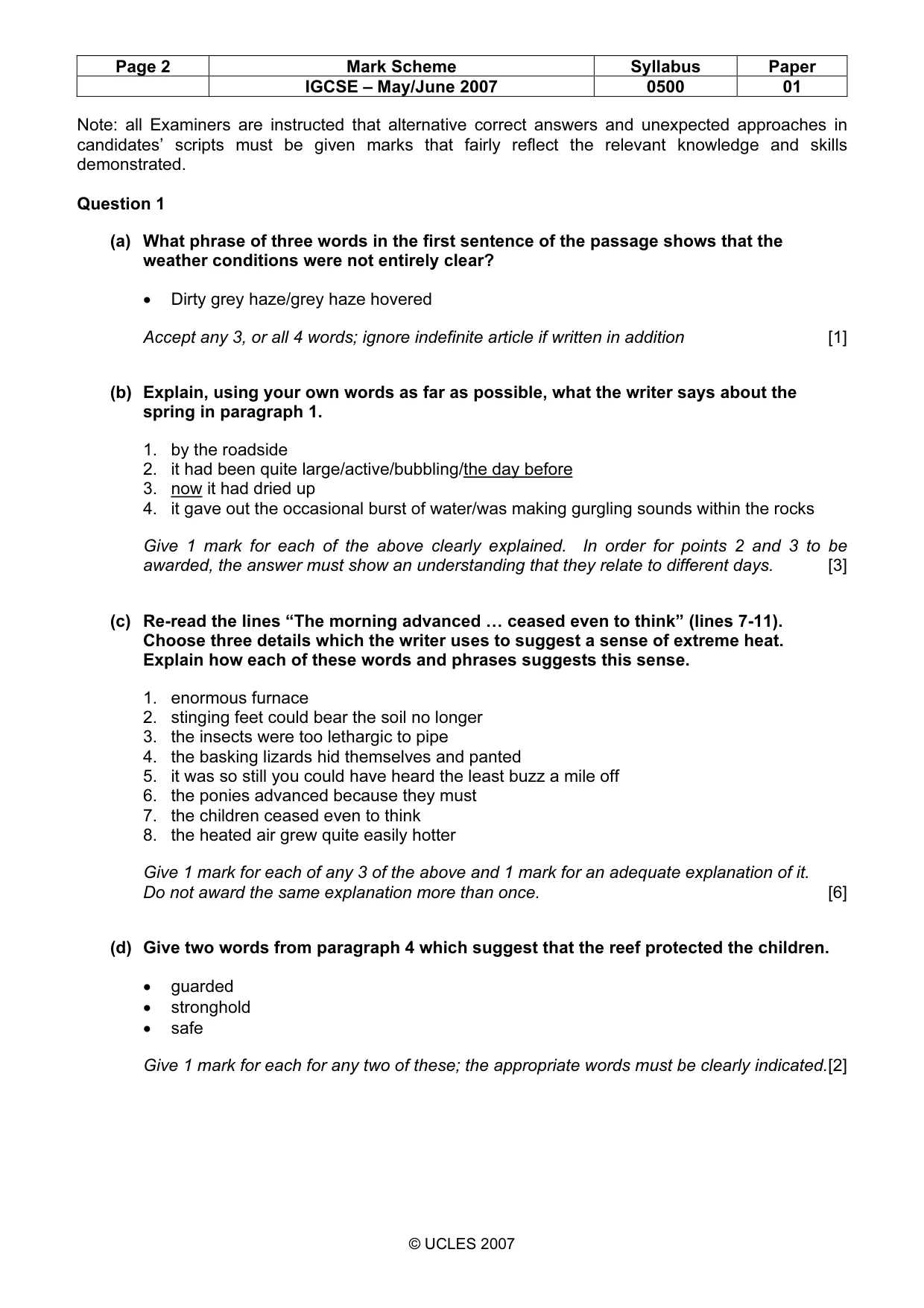
Page 2 Mark Scheme Syllabus Paper IGCSE – May/June 2007 0500 01 © UCLES 2007 Note: all Examiners are instructed that alternative correct answers and unexpected approaches in candidates’ scripts must be given marks that fairly reflect the relevant knowledge and skills demonstrated. Question 1 (a) What phrase of three words in the first sentence of the passage shows that the weather conditions were not entirely clear? • Dirty grey haze/grey haze hovered Accept any 3, or all 4 words; ignore indefinite article if written in addition [1] (b) Explain, using your own words as far as possible, what the writer says about the spring in paragraph 1. 1. by the roadside 2. it had been quite large/active/bubbling/the day before 3. now it had dried up 4. it gave out the occasional burst of water/was making gurgling sounds within the rocks Give 1 mark for each of the above clearly explained. In order for points 2 and 3 to be awarded, the answer must show an understanding that they relate to different days. [3] (c) Re-read the lines “The morning advanced … ceased even to think” (lines 7-11). Choose three details which the writer uses to suggest a sense of extreme heat. Explain how each of these words and phrases suggests this sense. 1. enormous furnace 2. stinging feet could bear the soil no longer 3. the insects were too lethargic to pipe 4. the basking lizards hid themselves and panted 5. it was so still you could have heard the least buzz a mile off 6. the ponies advanced because they must 7. the children ceased even to think 8. the heated air grew quite easily hotter Give 1 mark for each of any 3 of the above and 1 mark for an adequate explanation of it. Do not award the same explanation more than once. [6] (d) Give two words from paragraph 4 which suggest that the reef protected the children. • guarded • stronghold • safe Give 1 mark for each for any two of these; the appropriate words must be clearly indicated. [2]
Mark scheme, page 3
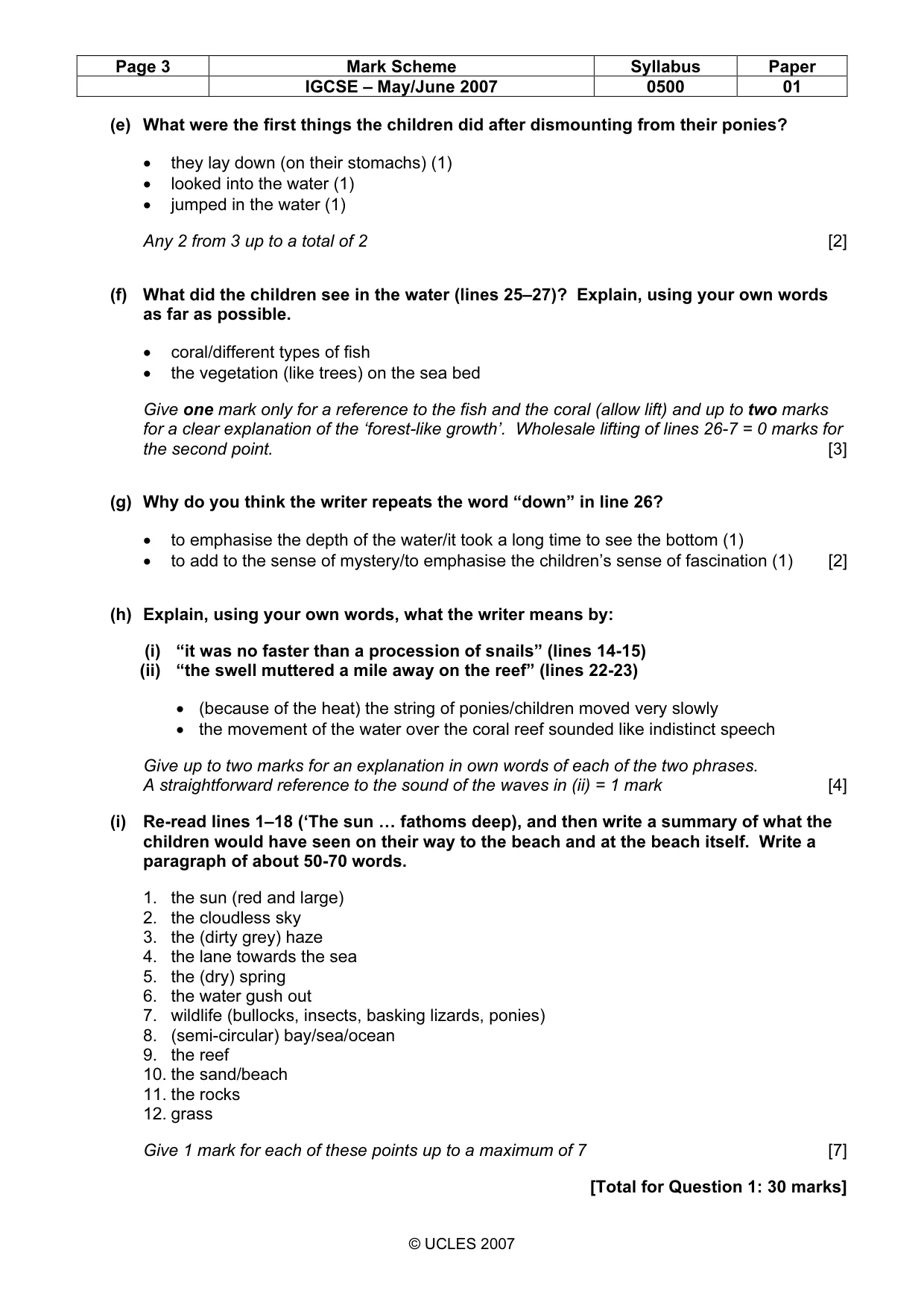
Page 3 Mark Scheme Syllabus Paper IGCSE – May/June 2007 0500 01 © UCLES 2007 (e) What were the first things the children did after dismounting from their ponies? • they lay down (on their stomachs) (1) • looked into the water (1) • jumped in the water (1) Any 2 from 3 up to a total of 2 [2] (f) What did the children see in the water (lines 25–27)? Explain, using your own words as far as possible. • coral/different types of fish • the vegetation (like trees) on the sea bed Give one mark only for a reference to the fish and the coral (allow lift) and up to two marks for a clear explanation of the ‘forest-like growth’. Wholesale lifting of lines 26-7 = 0 marks for the second point. [3] (g) Why do you think the writer repeats the word “down” in line 26? • to emphasise the depth of the water/it took a long time to see the bottom (1) • to add to the sense of mystery/to emphasise the children’s sense of fascination (1) [2] (h) Explain, using your own words, what the writer means by: (i) “it was no faster than a procession of snails” (lines 14-15) (ii) “the swell muttered a mile away on the reef” (lines 22-23) • (because of the heat) the string of ponies/children moved very slowly • the movement of the water over the coral reef sounded like indistinct speech Give up to two marks for an explanation in own words of each of the two phrases. A straightforward reference to the sound of the waves in (ii) = 1 mark [4] (i) Re-read lines 1–18 (‘The sun … fathoms deep), and then write a summary of what the children would have seen on their way to the beach and at the beach itself. Write a paragraph of about 50-70 words. 1. the sun (red and large) 2. the cloudless sky 3. the (dirty grey) haze 4. the lane towards the sea 5. the (dry) spring 6. the water gush out 7. wildlife (bullocks, insects, basking lizards, ponies) 8. (semi-circular) bay/sea/ocean 9. the reef 10. the sand/beach 11. the rocks 12. grass Give 1 mark for each of these points up to a maximum of 7 [7] [Total for Question 1: 30 marks]
Mark scheme, page 4
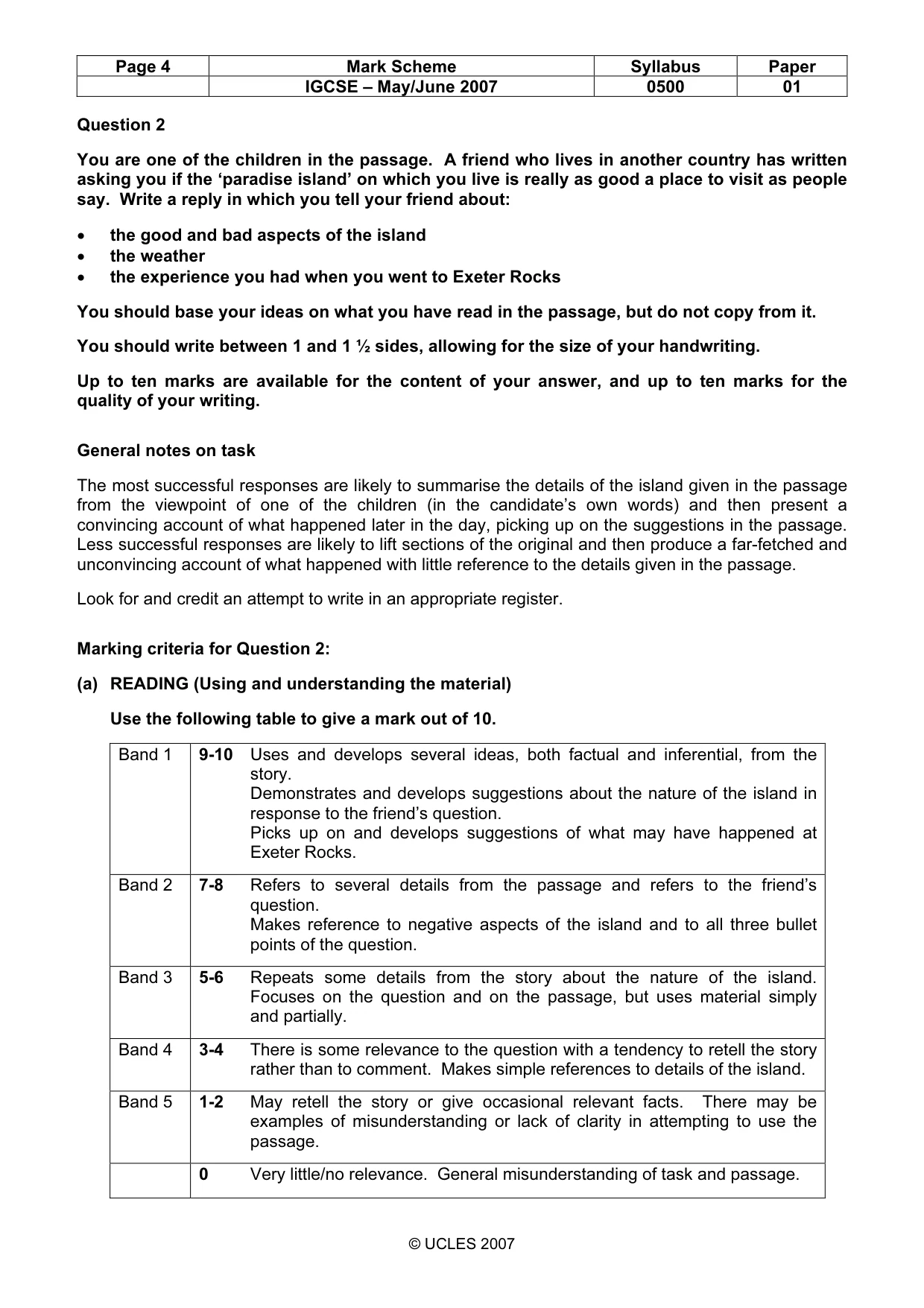
Page 4 Mark Scheme Syllabus Paper IGCSE – May/June 2007 0500 01 © UCLES 2007 Question 2 You are one of the children in the passage. A friend who lives in another country has written asking you if the ‘paradise island’ on which you live is really as good a place to visit as people say. Write a reply in which you tell your friend about: • the good and bad aspects of the island • the weather • the experience you had when you went to Exeter Rocks You should base your ideas on what you have read in the passage, but do not copy from it. You should write between 1 and 1 ½ sides, allowing for the size of your handwriting. Up to ten marks are available for the content of your answer, and up to ten marks for the quality of your writing. General notes on task The most successful responses are likely to summarise the details of the island given in the passage from the viewpoint of one of the children (in the candidate’s own words) and then present a convincing account of what happened later in the day, picking up on the suggestions in the passage. Less successful responses are likely to lift sections of the original and then produce a far-fetched and unconvincing account of what happened with little reference to the details given in the passage. Look for and credit an attempt to write in an appropriate register. Marking criteria for Question 2: (a) READING (Using and understanding the material) Use the following table to give a mark out of 10. Band 1 9-10 Uses and develops several ideas, both factual and inferential, from the story. Demonstrates and develops suggestions about the nature of the island in response to the friend’s question. Picks up on and develops suggestions of what may have happened at Exeter Rocks. Band 2 7-8 Refers to several details from the passage and refers to the friend’s question. Makes reference to negative aspects of the island and to all three bullet points of the question. Band 3 5-6 Repeats some details from the story about the nature of the island. Focuses on the question and on the passage, but uses material simply and partially. Band 4 3-4 There is some relevance to the question with a tendency to retell the story rather than to comment. Makes simple references to details of the island. Band 5 1-2 May retell the story or give occasional relevant facts. There may be examples of misunderstanding or lack of clarity in attempting to use the passage. 0 Very little/no relevance. General misunderstanding of task and passage.
Mark scheme, page 5
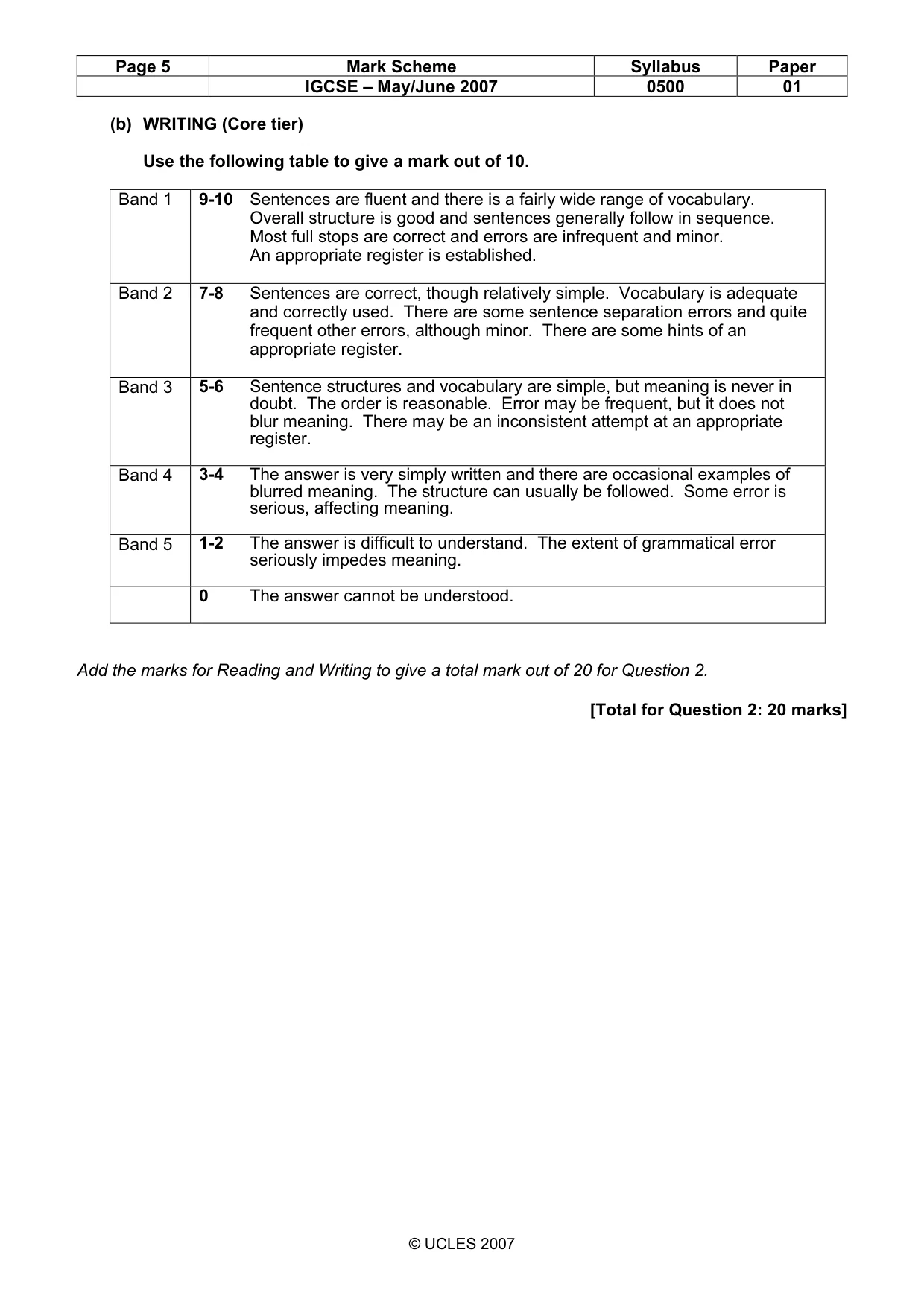
Page 5 Mark Scheme Syllabus Paper IGCSE – May/June 2007 0500 01 © UCLES 2007 (b) WRITING (Core tier) Use the following table to give a mark out of 10. Band 1 9-10 Sentences are fluent and there is a fairly wide range of vocabulary. Overall structure is good and sentences generally follow in sequence. Most full stops are correct and errors are infrequent and minor. An appropriate register is established. Band 2 7-8 Sentences are correct, though relatively simple. Vocabulary is adequate and correctly used. There are some sentence separation errors and quite frequent other errors, although minor. There are some hints of an appropriate register. Band 3 5-6 Sentence structures and vocabulary are simple, but meaning is never in doubt. The order is reasonable. Error may be frequent, but it does not blur meaning. There may be an inconsistent attempt at an appropriate register. Band 4 3-4 The answer is very simply written and there are occasional examples of blurred meaning. The structure can usually be followed. Some error is serious, affecting meaning. Band 5 1-2 The answer is difficult to understand. The extent of grammatical error seriously impedes meaning. 0 The answer cannot be understood. Add the marks for Reading and Writing to give a total mark out of 20 for Question 2. [Total for Question 2: 20 marks]
What you needed in this session
Cambridge’s own grade thresholds for 2007 May/June, Paper 1 · Variant 1. A higher threshold means an easier paper — the bar moves with how the cohort did.