Cambridge IGCSE English - First Language 0500 — 2006 Oct/Nov Paper 3 · Variant 1
0500/31/O/N/06 · 50 marks · ≈56 min
The question paper and its mark scheme, free to read here and free to download. This is Cambridge’s own paper, exactly as it was sat.
Question paper4 pages
Mark scheme8 pages
Answers below. Sit the paper first if you are practising.
Paper as text
Question paper, page 1
UNIVERSITY OF CAMBRIDGE INTERNATIONAL EXAMINATIONS International General Certificate of Secondary Education FIRST LANGUAGE ENGLISH 0500/03 Paper 3 Directed Writing and Composition October/November 2006 2 hours Additional Materials: Answer Booklet/Paper READ THESE INSTRUCTIONS FIRST If you have been given an Answer Booklet, follow the instructions on the front cover of the Booklet. Write your Centre number, candidate number and name on all the work you hand in. Write in dark blue or black pen. Do not use staples, paper clips, highlighters, glue or correction fluid. Answer two questions: Question 1 (Section 1) and one question from Section 2. Dictionaries are not permitted. At the end of the examination, fasten all your work securely together. All questions in this paper carry equal marks. This document consists of 4 printed pages. IB06 11_0500_03/2RP © UCLES 2006 [Turn over www.XtremePapers.com
Question paper, page 2
2 © UCLES 2006 0500/03/O/N/06 Section One: Directed Writing 1 Many schools arrange a celebration of some kind for students at the end of their examination year. Your teachers are organising a celebration at your school and have suggested three possible types of celebration. Your classmates have selected one of these as their favourite (you may choose which option this is) and ask you to represent them at a meeting with the teachers. Write what you would say to the teachers to persuade them that the students’ choice would be the most successful celebration. You should • Persuade the teachers that the option that the students have chosen is the most likely to succeed. • Explain how the problems which have spoilt previous events can be overcome. Base your ideas on the material found in the school magazine article and the poster printed opposite. You may include details and opinions to make the speech more convincing, but these must be related to the texts provided. You should write between 1 ½ and 2 sides, allowing for the size of your handwriting. Begin as follows: I am here as a representative of my fellow students to explain our views. (Up to 10 marks will be given for the content of your answer and up to 15 marks for the quality of your writing.) [25]
Question paper, page 3
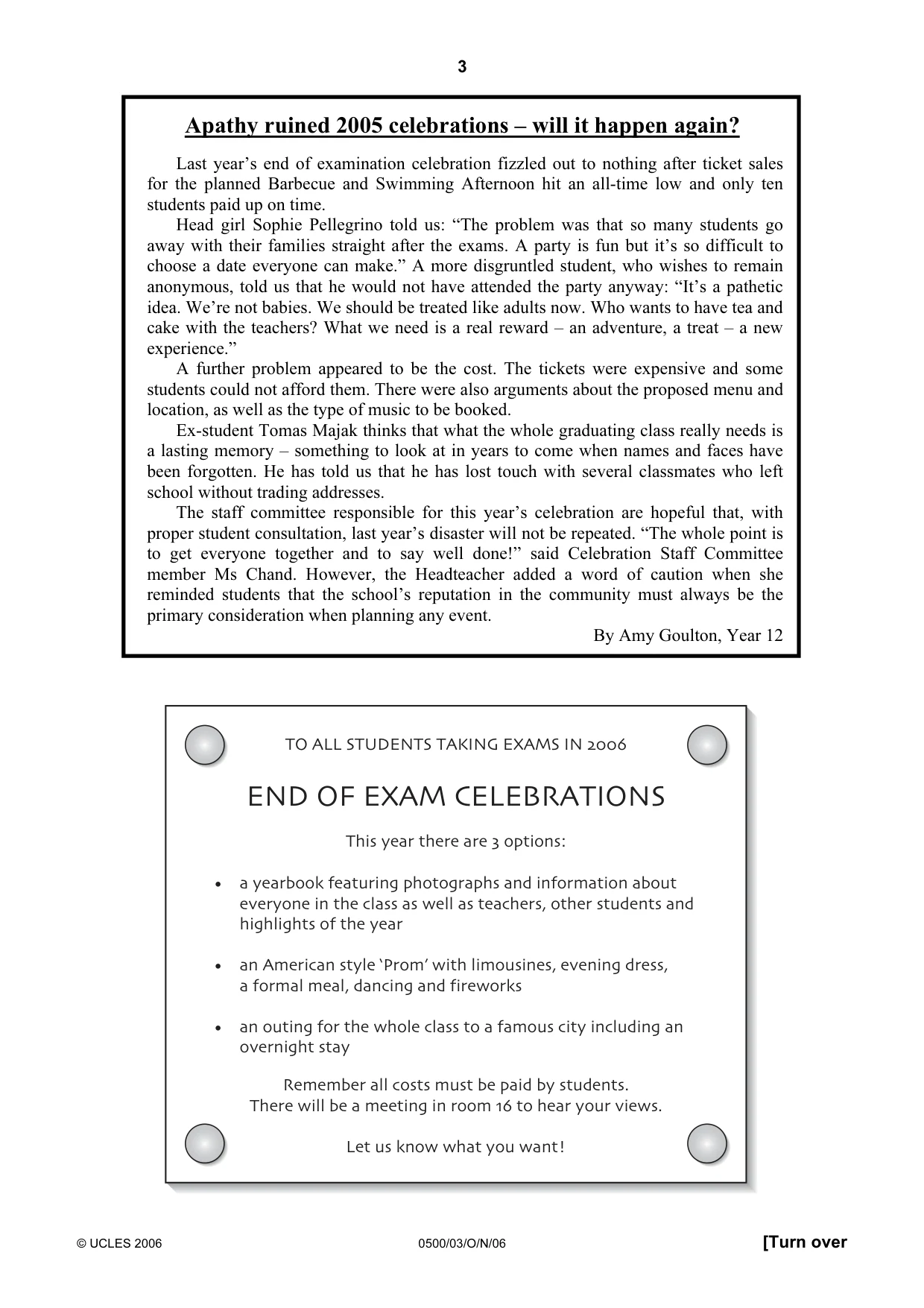
3 © UCLES 2006 0500/03/O/N/06 [Turn over Apathy ruined 2005 celebrations – will it happen again? Last year’s end of examination celebration fizzled out to nothing after ticket sales for the planned Barbecue and Swimming Afternoon hit an all-time low and only ten students paid up on time. Head girl Sophie Pellegrino told us: “The problem was that so many students go away with their families straight after the exams. A party is fun but it’s so difficult to choose a date everyone can make.” A more disgruntled student, who wishes to remain anonymous, told us that he would not have attended the party anyway: “It’s a pathetic idea. We’re not babies. We should be treated like adults now. Who wants to have tea and cake with the teachers? What we need is a real reward – an adventure, a treat – a new experience.” A further problem appeared to be the cost. The tickets were expensive and some students could not afford them. There were also arguments about the proposed menu and location, as well as the type of music to be booked. Ex-student Tomas Majak thinks that what the whole graduating class really needs is a lasting memory – something to look at in years to come when names and faces have been forgotten. He has told us that he has lost touch with several classmates who left school without trading addresses. The staff committee responsible for this year’s celebration are hopeful that, with proper student consultation, last year’s disaster will not be repeated. “The whole point is to get everyone together and to say well done!” said Celebration Staff Committee member Ms Chand. However, the Headteacher added a word of caution when she reminded students that the school’s reputation in the community must always be the primary consideration when planning any event. By Amy Goulton, Year 12 • a yearbook featuring photographs and information about everyone in the class as well as teachers, other students and highlights of the year • an American style ‘Prom’ with limousines, evening dress, a formal meal, dancing and fireworks • an outing for the whole class to a famous city including an overnight stay TO ALL STUDENTS TAKING EXAMS IN 2006 END OF EXAM CELEBRATIONS This year there are 3 options: Remember all costs must be paid by students. There will be a meeting in room 16 to hear your views. Let us know what you want!
Question paper, page 4
4 Permission to reproduce items where third-party owned material protected by copyright is included has been sought and cleared where possible. Every reasonable effort has been made by the publisher (UCLES) to trace copyright holders, but if any items requiring clearance have unwittingly been included, the publisher will be pleased to make amends at the earliest possible opportunity. University of Cambridge International Examinations is part of the University of Cambridge Local Examinations Syndicate (UCLES), which is itself a department of the University of Cambridge. © UCLES 2006 0500/03/O/N/06 Section 2: Composition Write about 350-450 words on one of the following: 2 Argumentative/discursive writing Either (a) ‘Advertising aimed at children and young teenagers under 16 should be banned.’ What do you think? [25] or (b) ‘Competitive sports should be a compulsory part of the school curriculum because they teach lessons about life which all children need to learn.’ What do you think? [25] 3 Descriptive writing Either (a) ‘The Reunion.’ Describe a moment when two people meet each other after a long time apart. [25] or (b) ‘My favourite time of day.’ Describe what you see and/or hear and/or feel that makes you enjoy this time the most. [25] 4 Narrative writing Either (a) ‘The Short Cut.’ You are very late and you need to get home quickly. Up ahead is a short cut, but you’ve been warned not to use it. If you don’t get home soon there’ll be serious trouble… Write a story about what happens next. [25] or (b) Write a story in which missing a chance or missing an opportunity is central to the plot. [25]
Mark scheme, page 1
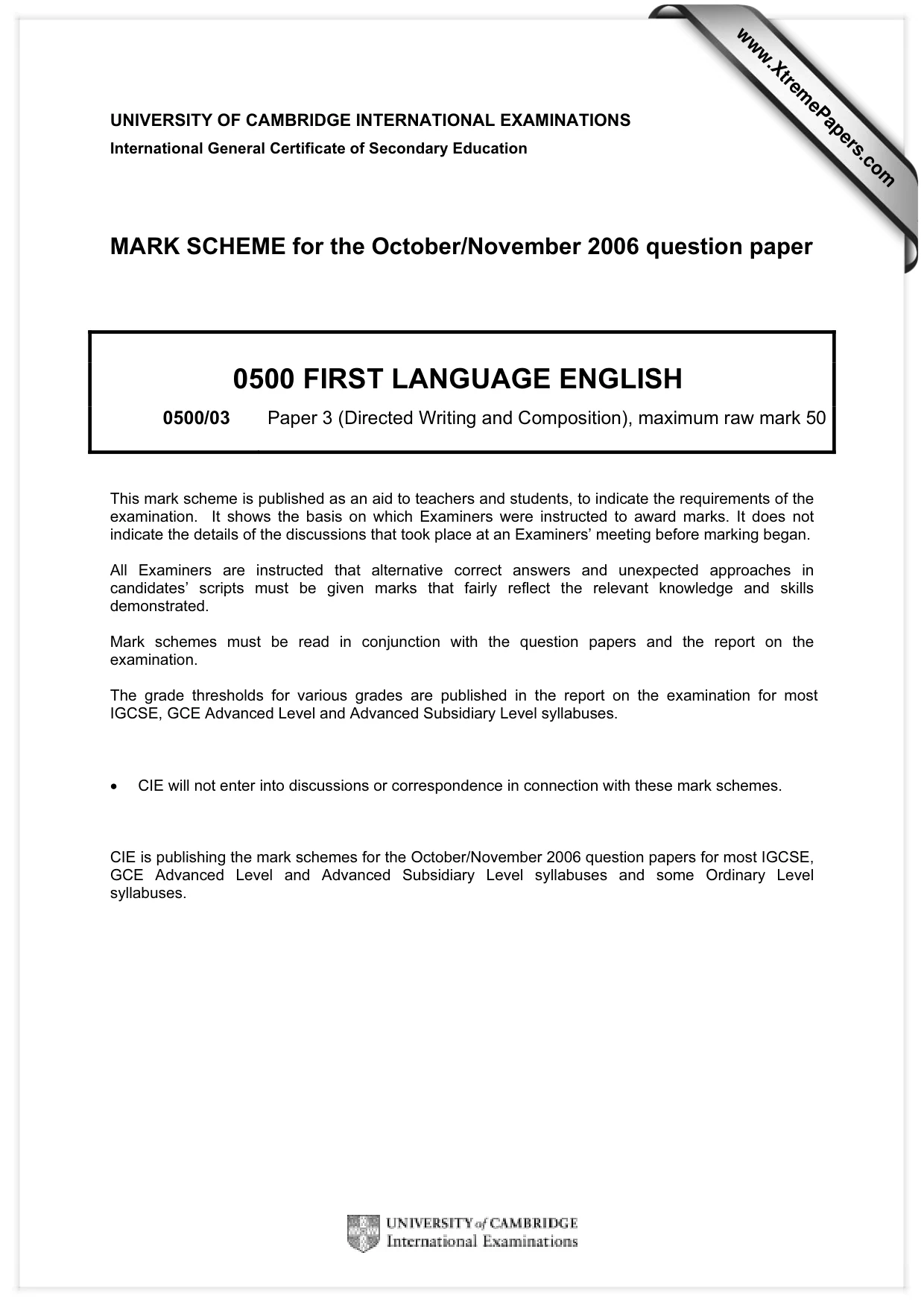
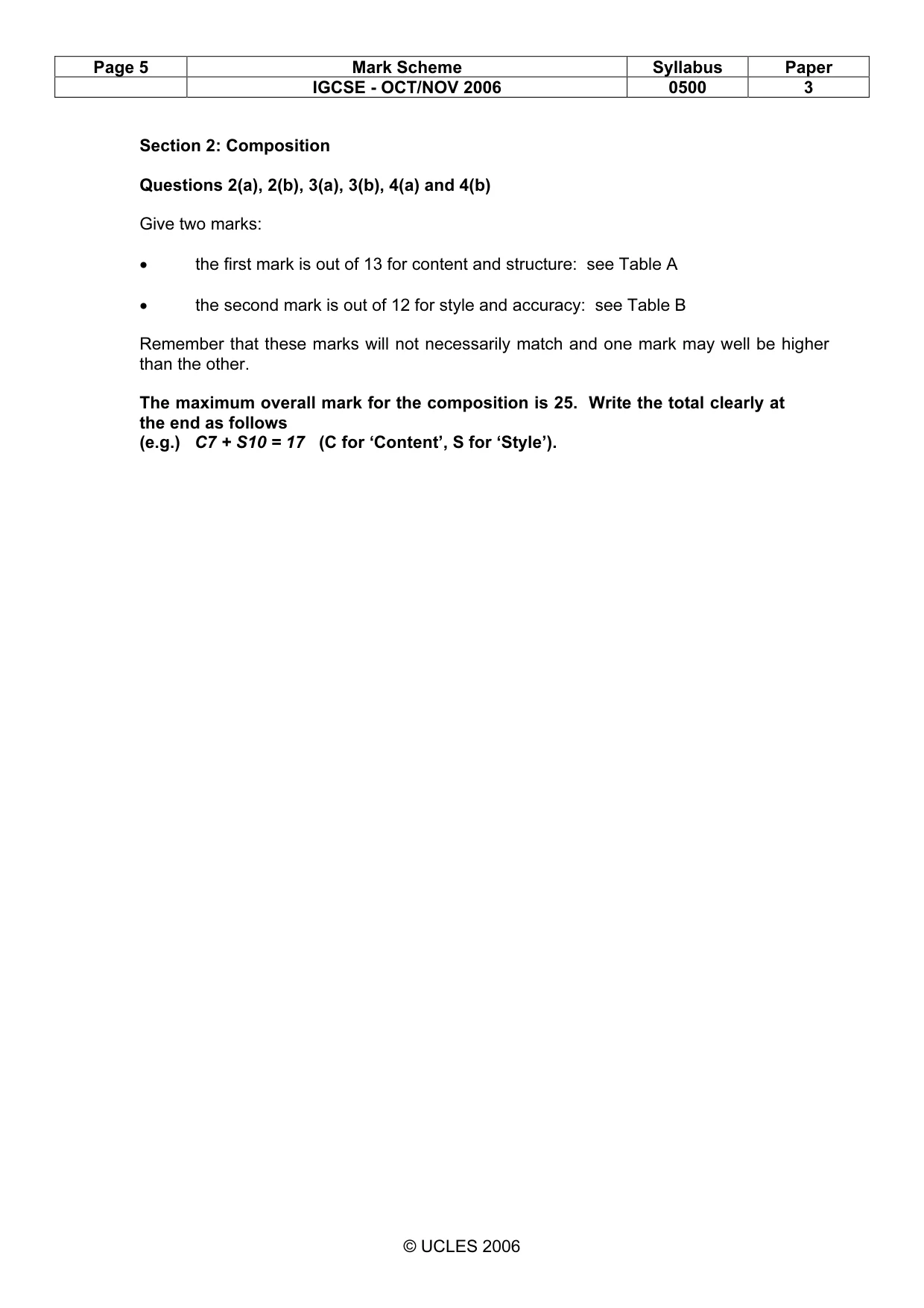
UNIVERSITY OF CAMBRIDGE INTERNATIONAL EXAMINATIONS International General Certificate of Secondary Education MARK SCHEME for the October/November 2006 question paper 0500 FIRST LANGUAGE ENGLISH 0500/03 Paper 3 (Directed Writing and Composition), maximum raw mark 50 This mark scheme is published as an aid to teachers and students, to indicate the requirements of the examination. It shows the basis on which Examiners were instructed to award marks. It does not indicate the details of the discussions that took place at an Examiners’ meeting before marking began. All Examiners are instructed that alternative correct answers and unexpected approaches in candidates’ scripts must be given marks that fairly reflect the relevant knowledge and skills demonstrated. Mark schemes must be read in conjunction with the question papers and the report on the examination. The grade thresholds for various grades are published in the report on the examination for most IGCSE, GCE Advanced Level and Advanced Subsidiary Level syllabuses. • CIE will not enter into discussions or correspondence in connection with these mark schemes. CIE is publishing the mark schemes for the October/November 2006 question papers for most IGCSE, GCE Advanced Level and Advanced Subsidiary Level syllabuses and some Ordinary Level syllabuses. www.XtremePapers.com
Mark scheme, page 2
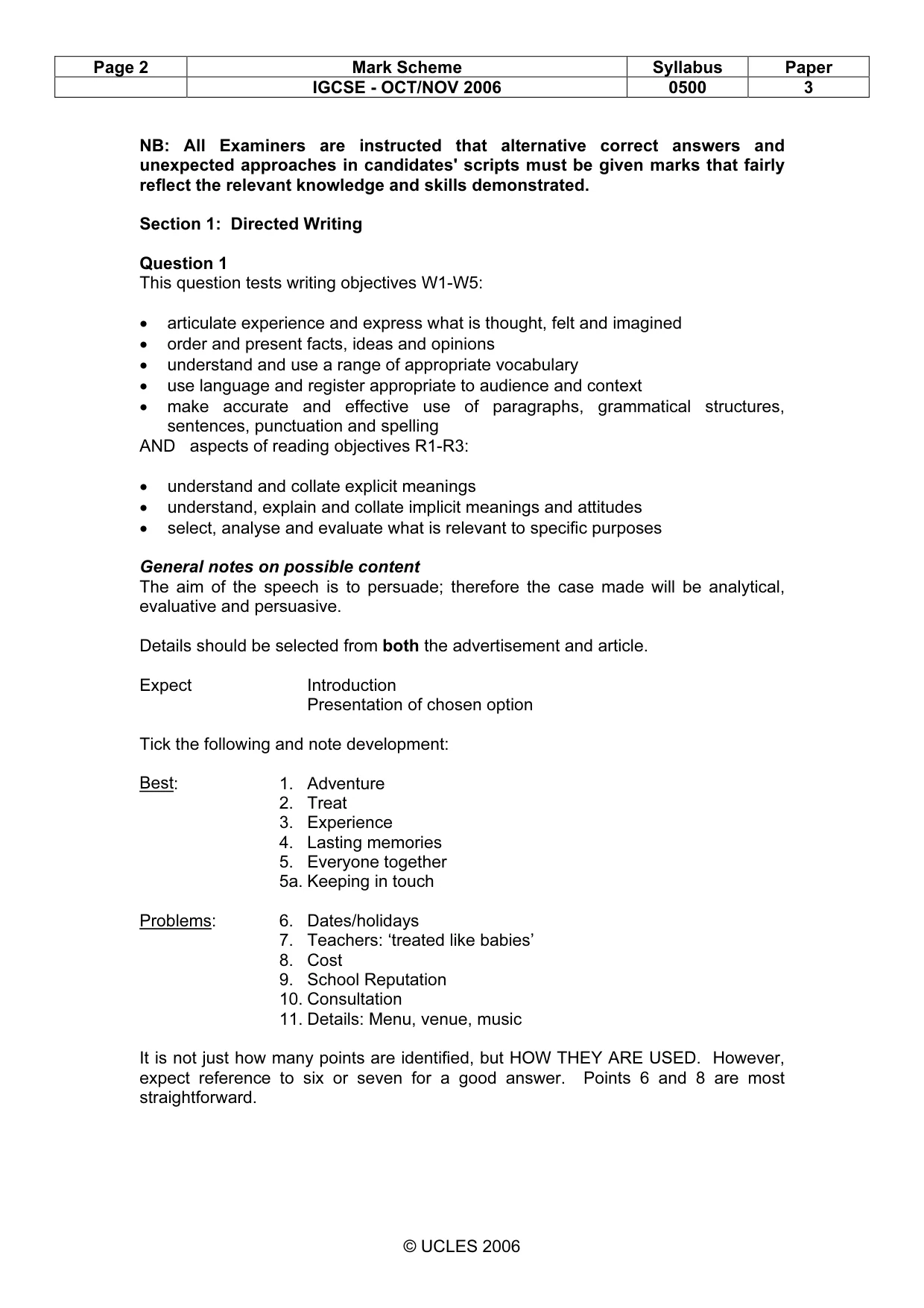
Page 2 Mark Scheme Syllabus Paper IGCSE - OCT/NOV 2006 0500 3 © UCLES 2006 NB: All Examiners are instructed that alternative correct answers and unexpected approaches in candidates' scripts must be given marks that fairly reflect the relevant knowledge and skills demonstrated. Section 1: Directed Writing Question 1 This question tests writing objectives W1-W5: • articulate experience and express what is thought, felt and imagined • order and present facts, ideas and opinions • understand and use a range of appropriate vocabulary • use language and register appropriate to audience and context • make accurate and effective use of paragraphs, grammatical structures, sentences, punctuation and spelling AND aspects of reading objectives R1-R3: • understand and collate explicit meanings • understand, explain and collate implicit meanings and attitudes • select, analyse and evaluate what is relevant to specific purposes General notes on possible content The aim of the speech is to persuade; therefore the case made will be analytical, evaluative and persuasive. Details should be selected from both the advertisement and article. Expect Introduction Presentation of chosen option Tick the following and note development: Best: 1. Adventure 2. Treat 3. Experience 4. Lasting memories 5. Everyone together 5a. Keeping in touch Problems: 6. Dates/holidays 7. Teachers: ‘treated like babies’ 8. Cost 9. School Reputation 10. Consultation 11. Details: Menu, venue, music It is not just how many points are identified, but HOW THEY ARE USED. However, expect reference to six or seven for a good answer. Points 6 and 8 are most straightforward.
Mark scheme, page 3
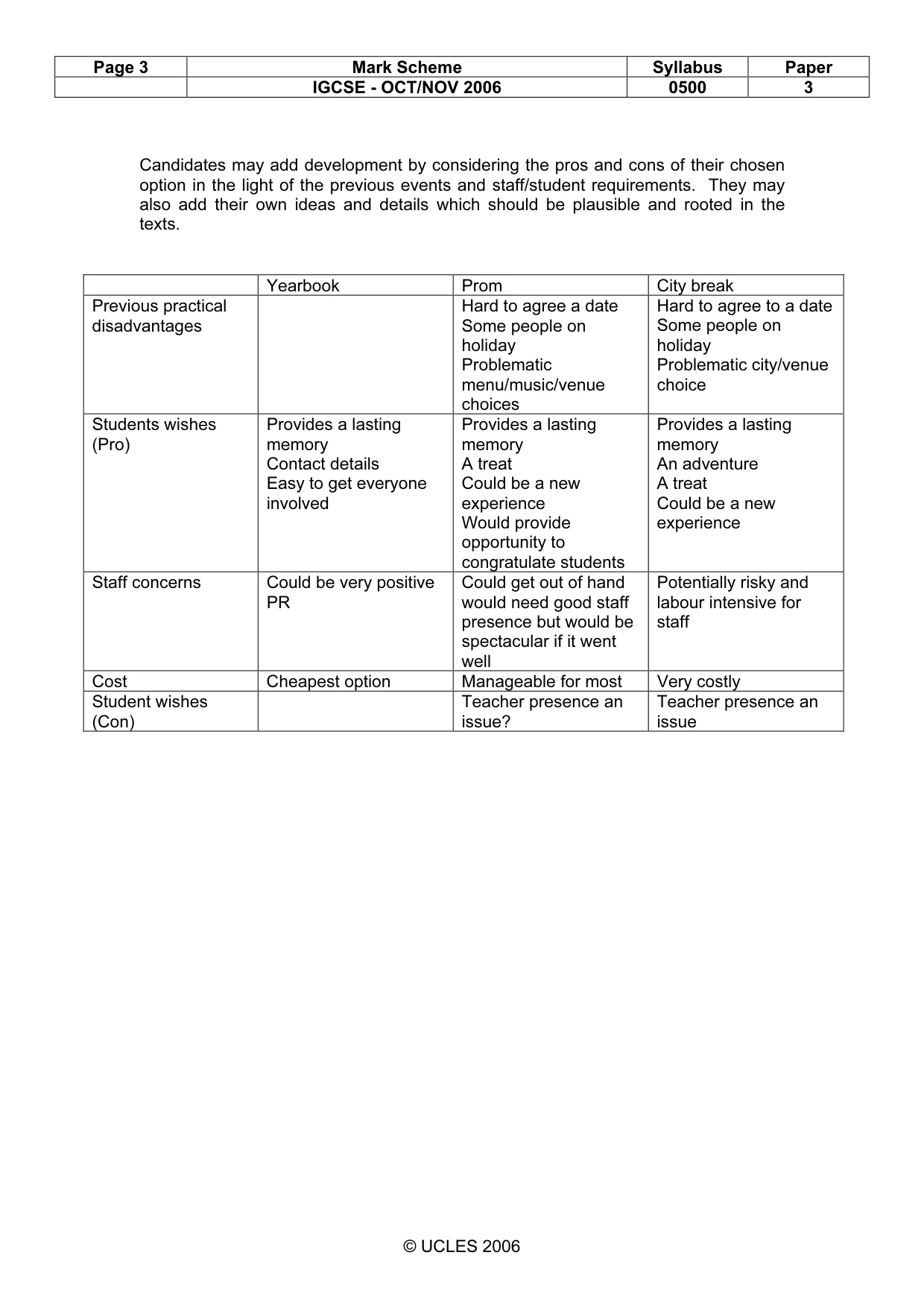
Page 3 Mark Scheme Syllabus Paper IGCSE - OCT/NOV 2006 0500 3 © UCLES 2006 Candidates may add development by considering the pros and cons of their chosen option in the light of the previous events and staff/student requirements. They may also add their own ideas and details which should be plausible and rooted in the texts. Yearbook Prom City break Previous practical disadvantages Hard to agree a date Some people on holiday Problematic menu/music/venue choices Hard to agree to a date Some people on holiday Problematic city/venue choice Students wishes (Pro) Provides a lasting memory Contact details Easy to get everyone involved Provides a lasting memory A treat Could be a new experience Would provide opportunity to congratulate students Provides a lasting memory An adventure A treat Could be a new experience Staff concerns Could be very positive PR Could get out of hand would need good staff presence but would be spectacular if it went well Potentially risky and labour intensive for staff Cost Cheapest option Manageable for most Very costly Student wishes (Con) Teacher presence an issue? Teacher presence an issue
Mark scheme, page 4
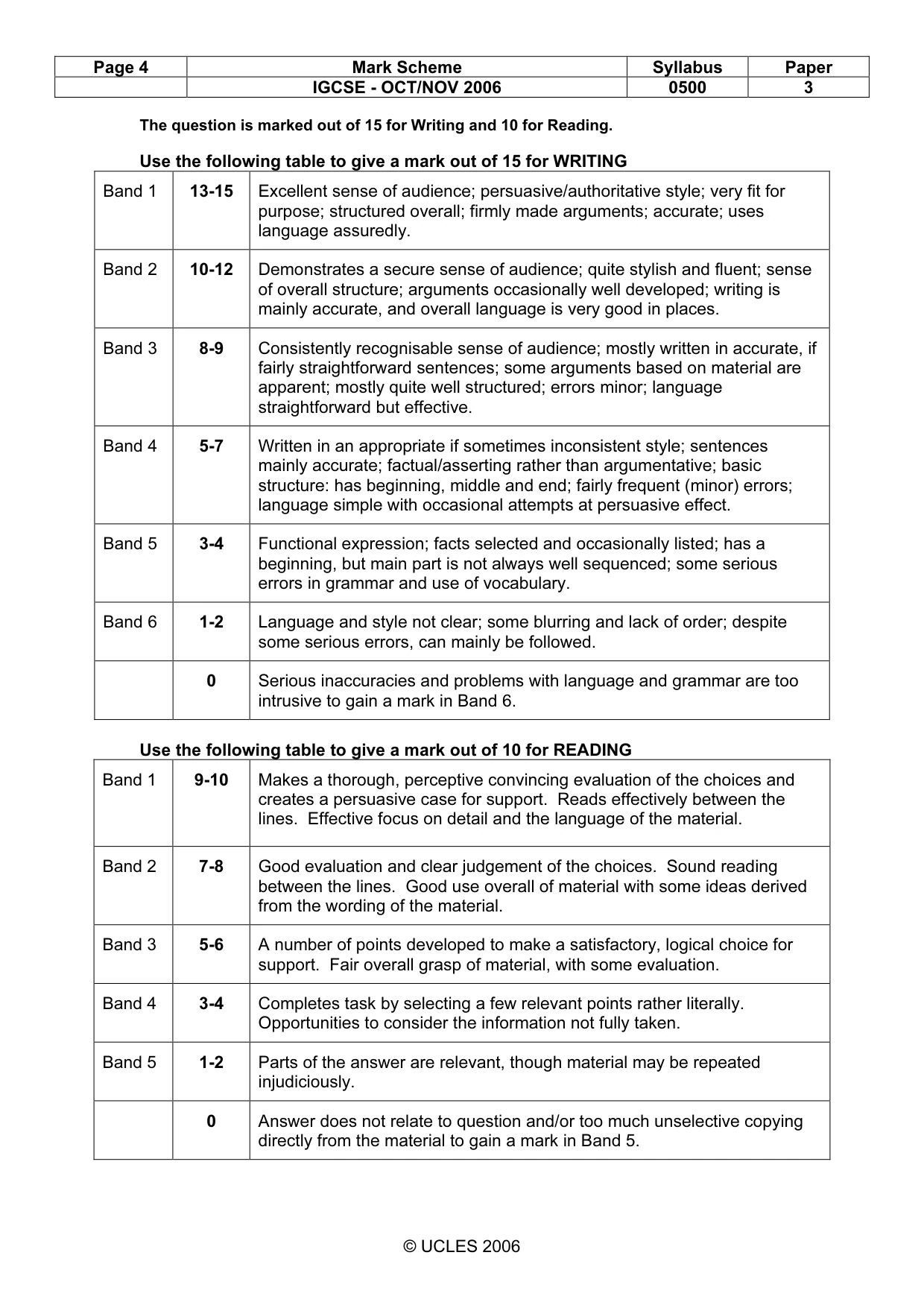
Page 4 Mark Scheme Syllabus Paper IGCSE - OCT/NOV 2006 0500 3 © UCLES 2006 The question is marked out of 15 for Writing and 10 for Reading. Use the following table to give a mark out of 15 for WRITING Band 1 13-15 Excellent sense of audience; persuasive/authoritative style; very fit for purpose; structured overall; firmly made arguments; accurate; uses language assuredly. Band 2 10-12 Demonstrates a secure sense of audience; quite stylish and fluent; sense of overall structure; arguments occasionally well developed; writing is mainly accurate, and overall language is very good in places. Band 3 8-9 Consistently recognisable sense of audience; mostly written in accurate, if fairly straightforward sentences; some arguments based on material are apparent; mostly quite well structured; errors minor; language straightforward but effective. Band 4 5-7 Written in an appropriate if sometimes inconsistent style; sentences mainly accurate; factual/asserting rather than argumentative; basic structure: has beginning, middle and end; fairly frequent (minor) errors; language simple with occasional attempts at persuasive effect. Band 5 3-4 Functional expression; facts selected and occasionally listed; has a beginning, but main part is not always well sequenced; some serious errors in grammar and use of vocabulary. Band 6 1-2 Language and style not clear; some blurring and lack of order; despite some serious errors, can mainly be followed. 0 Serious inaccuracies and problems with language and grammar are too intrusive to gain a mark in Band 6. Use the following table to give a mark out of 10 for READING Band 1 9-10 Makes a thorough, perceptive convincing evaluation of the choices and creates a persuasive case for support. Reads effectively between the lines. Effective focus on detail and the language of the material. Band 2 7-8 Good evaluation and clear judgement of the choices. Sound reading between the lines. Good use overall of material with some ideas derived from the wording of the material. Band 3 5-6 A number of points developed to make a satisfactory, logical choice for support. Fair overall grasp of material, with some evaluation. Band 4 3-4 Completes task by selecting a few relevant points rather literally. Opportunities to consider the information not fully taken. Band 5 1-2 Parts of the answer are relevant, though material may be repeated injudiciously. 0 Answer does not relate to question and/or too much unselective copying directly from the material to gain a mark in Band 5.
Mark scheme, page 5
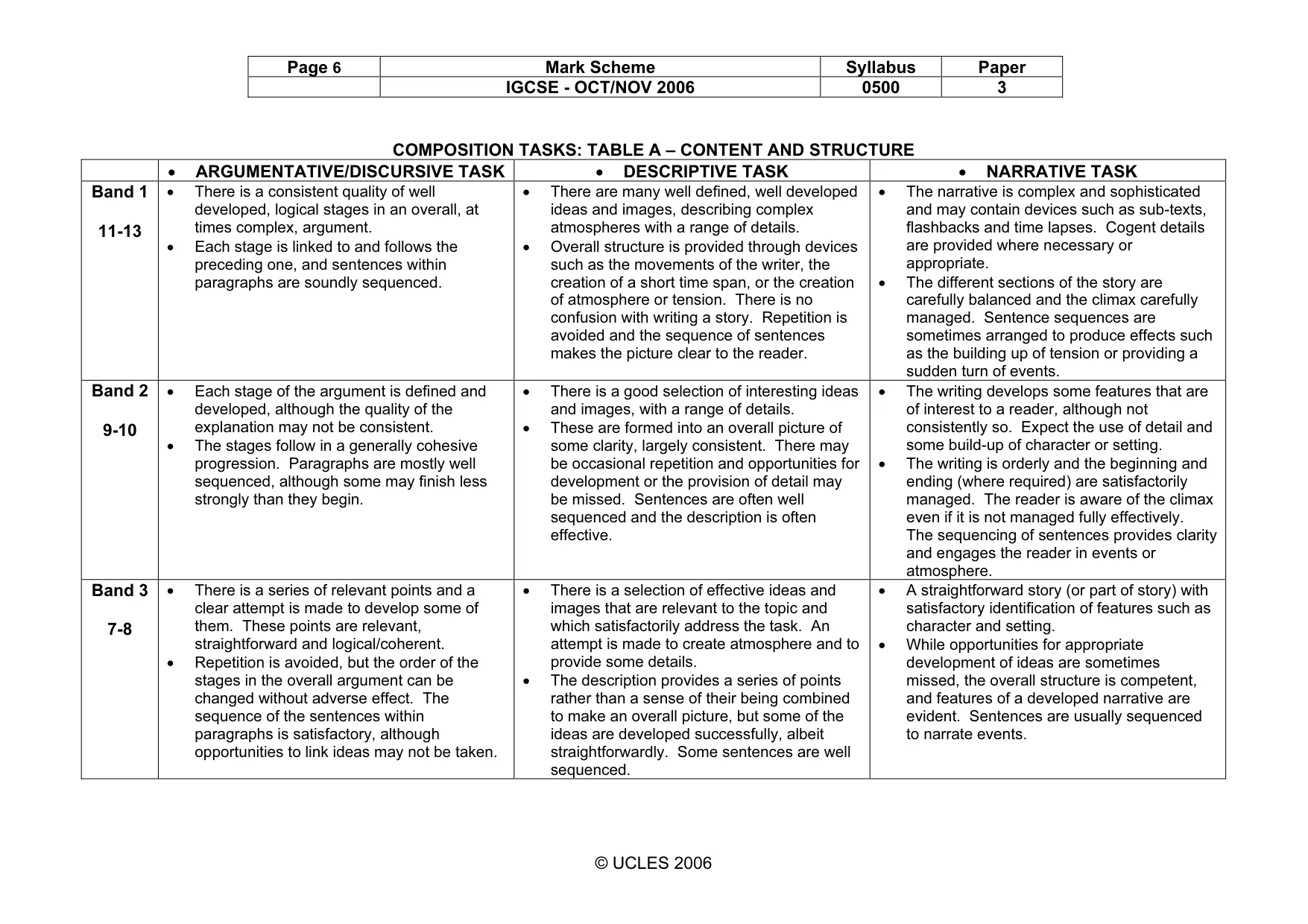
Page 5 Mark Scheme Syllabus Paper IGCSE - OCT/NOV 2006 0500 3 © UCLES 2006 Section 2: Composition Questions 2(a), 2(b), 3(a), 3(b), 4(a) and 4(b) Give two marks: • the first mark is out of 13 for content and structure: see Table A • the second mark is out of 12 for style and accuracy: see Table B Remember that these marks will not necessarily match and one mark may well be higher than the other. The maximum overall mark for the composition is 25. Write the total clearly at the end as follows (e.g.) C7 + S10 = 17 (C for ‘Content’, S for ‘Style’).
Mark scheme, page 6
Page 6 Mark Scheme Syllabus Paper IGCSE - OCT/NOV 2006 0500 3 © UCLES 2006 COMPOSITION TASKS: TABLE A – CONTENT AND STRUCTURE • ARGUMENTATIVE/DISCURSIVE TASK • DESCRIPTIVE TASK • NARRATIVE TASK Band 1 11-13 • There is a consistent quality of well developed, logical stages in an overall, at times complex, argument. • Each stage is linked to and follows the preceding one, and sentences within paragraphs are soundly sequenced. • There are many well defined, well developed ideas and images, describing complex atmospheres with a range of details. • Overall structure is provided through devices such as the movements of the writer, the creation of a short time span, or the creation of atmosphere or tension. There is no confusion with writing a story. Repetition is avoided and the sequence of sentences makes the picture clear to the reader. • The narrative is complex and sophisticated and may contain devices such as sub-texts, flashbacks and time lapses. Cogent details are provided where necessary or appropriate. • The different sections of the story are carefully balanced and the climax carefully managed. Sentence sequences are sometimes arranged to produce effects such as the building up of tension or providing a sudden turn of events. Band 2 9-10 • Each stage of the argument is defined and developed, although the quality of the explanation may not be consistent. • The stages follow in a generally cohesive progression. Paragraphs are mostly well sequenced, although some may finish less strongly than they begin. • There is a good selection of interesting ideas and images, with a range of details. • These are formed into an overall picture of some clarity, largely consistent. There may be occasional repetition and opportunities for development or the provision of detail may be missed. Sentences are often well sequenced and the description is often effective. • The writing develops some features that are of interest to a reader, although not consistently so. Expect the use of detail and some build-up of character or setting. • The writing is orderly and the beginning and ending (where required) are satisfactorily managed. The reader is aware of the climax even if it is not managed fully effectively. The sequencing of sentences provides clarity and engages the reader in events or atmosphere. Band 3 7-8 • There is a series of relevant points and a clear attempt is made to develop some of them. These points are relevant, straightforward and logical/coherent. • Repetition is avoided, but the order of the stages in the overall argument can be changed without adverse effect. The sequence of the sentences within paragraphs is satisfactory, although opportunities to link ideas may not be taken. • There is a selection of effective ideas and images that are relevant to the topic and which satisfactorily address the task. An attempt is made to create atmosphere and to provide some details. • The description provides a series of points rather than a sense of their being combined to make an overall picture, but some of the ideas are developed successfully, albeit straightforwardly. Some sentences are well sequenced. • A straightforward story (or part of story) with satisfactory identification of features such as character and setting. • While opportunities for appropriate development of ideas are sometimes missed, the overall structure is competent, and features of a developed narrative are evident. Sentences are usually sequenced to narrate events.
Mark scheme, page 7
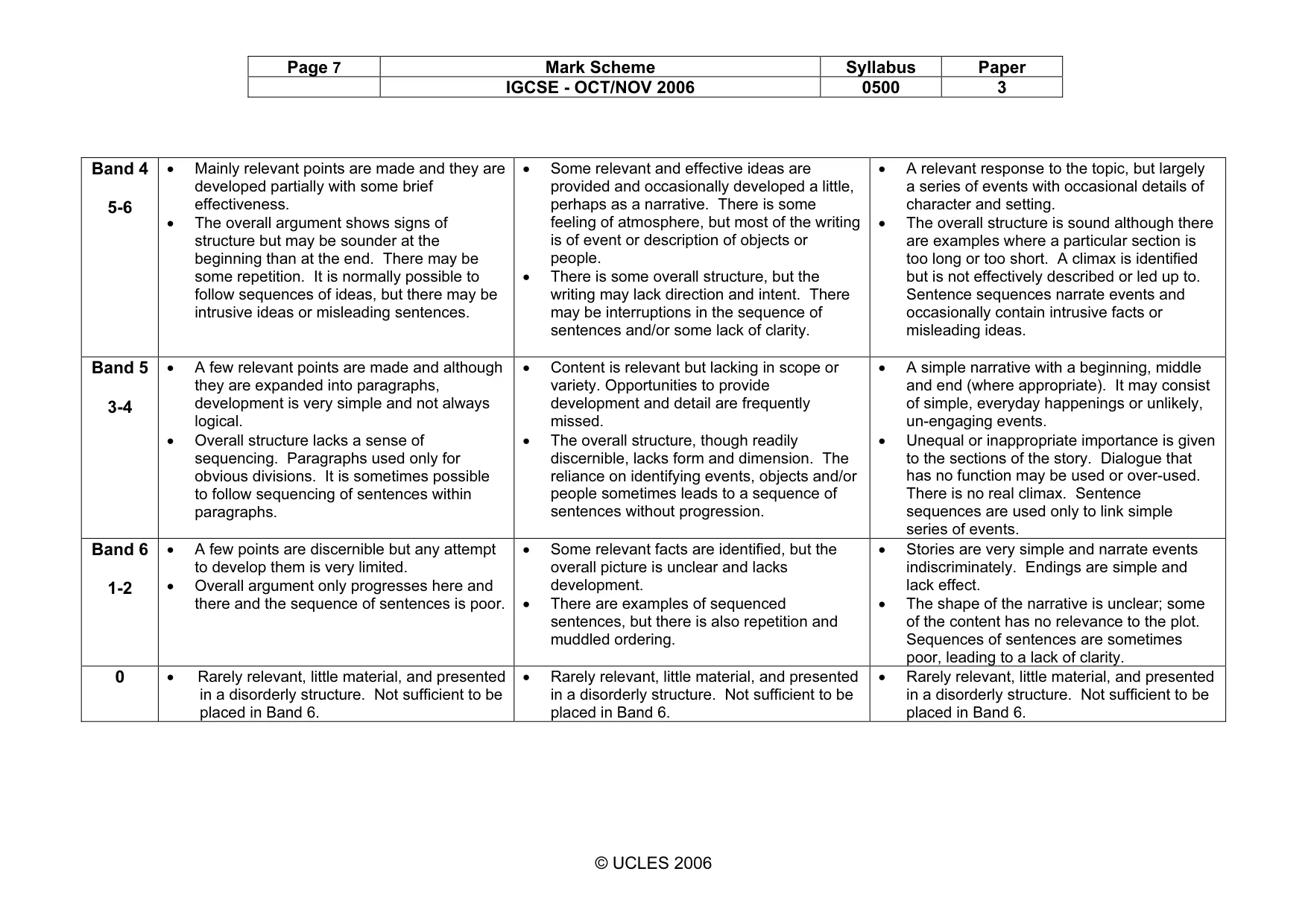
Page 7 Mark Scheme Syllabus Paper IGCSE - OCT/NOV 2006 0500 3 © UCLES 2006 Band 4 5-6 • Mainly relevant points are made and they are developed partially with some brief effectiveness. • The overall argument shows signs of structure but may be sounder at the beginning than at the end. There may be some repetition. It is normally possible to follow sequences of ideas, but there may be intrusive ideas or misleading sentences. • Some relevant and effective ideas are provided and occasionally developed a little, perhaps as a narrative. There is some feeling of atmosphere, but most of the writing is of event or description of objects or people. • There is some overall structure, but the writing may lack direction and intent. There may be interruptions in the sequence of sentences and/or some lack of clarity. • A relevant response to the topic, but largely a series of events with occasional details of character and setting. • The overall structure is sound although there are examples where a particular section is too long or too short. A climax is identified but is not effectively described or led up to. Sentence sequences narrate events and occasionally contain intrusive facts or misleading ideas. Band 5 3-4 • A few relevant points are made and although they are expanded into paragraphs, development is very simple and not always logical. • Overall structure lacks a sense of sequencing. Paragraphs used only for obvious divisions. It is sometimes possible to follow sequencing of sentences within paragraphs. • Content is relevant but lacking in scope or variety. Opportunities to provide development and detail are frequently missed. • The overall structure, though readily discernible, lacks form and dimension. The reliance on identifying events, objects and/or people sometimes leads to a sequence of sentences without progression. • A simple narrative with a beginning, middle and end (where appropriate). It may consist of simple, everyday happenings or unlikely, un-engaging events. • Unequal or inappropriate importance is given to the sections of the story. Dialogue that has no function may be used or over-used. There is no real climax. Sentence sequences are used only to link simple series of events. Band 6 1-2 • A few points are discernible but any attempt to develop them is very limited. • Overall argument only progresses here and there and the sequence of sentences is poor. • Some relevant facts are identified, but the overall picture is unclear and lacks development. • There are examples of sequenced sentences, but there is also repetition and muddled ordering. • Stories are very simple and narrate events indiscriminately. Endings are simple and lack effect. • The shape of the narrative is unclear; some of the content has no relevance to the plot. Sequences of sentences are sometimes poor, leading to a lack of clarity. 0 • Rarely relevant, little material, and presented in a disorderly structure. Not sufficient to be placed in Band 6. • Rarely relevant, little material, and presented in a disorderly structure. Not sufficient to be placed in Band 6. • Rarely relevant, little material, and presented in a disorderly structure. Not sufficient to be placed in Band 6.
Mark scheme, page 8
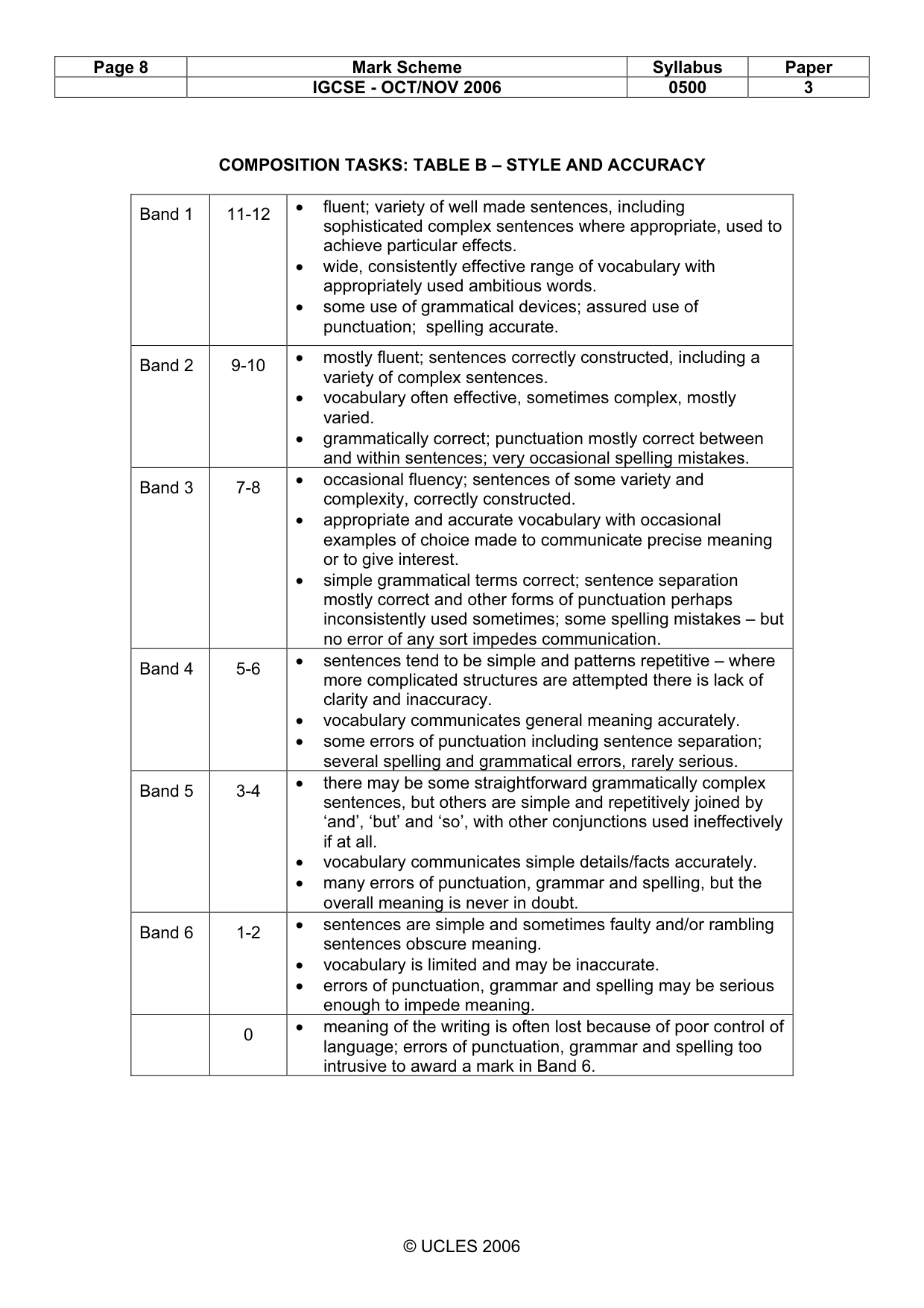
Page 8 Mark Scheme Syllabus Paper IGCSE - OCT/NOV 2006 0500 3 © UCLES 2006 COMPOSITION TASKS: TABLE B – STYLE AND ACCURACY Band 1 11-12 • fluent; variety of well made sentences, including sophisticated complex sentences where appropriate, used to achieve particular effects. • wide, consistently effective range of vocabulary with appropriately used ambitious words. • some use of grammatical devices; assured use of punctuation; spelling accurate. Band 2 9-10 • mostly fluent; sentences correctly constructed, including a variety of complex sentences. • vocabulary often effective, sometimes complex, mostly varied. • grammatically correct; punctuation mostly correct between and within sentences; very occasional spelling mistakes. Band 3 7-8 • occasional fluency; sentences of some variety and complexity, correctly constructed. • appropriate and accurate vocabulary with occasional examples of choice made to communicate precise meaning or to give interest. • simple grammatical terms correct; sentence separation mostly correct and other forms of punctuation perhaps inconsistently used sometimes; some spelling mistakes – but no error of any sort impedes communication. Band 4 5-6 • sentences tend to be simple and patterns repetitive – where more complicated structures are attempted there is lack of clarity and inaccuracy. • vocabulary communicates general meaning accurately. • some errors of punctuation including sentence separation; several spelling and grammatical errors, rarely serious. Band 5 3-4 • there may be some straightforward grammatically complex sentences, but others are simple and repetitively joined by ‘and’, ‘but’ and ‘so’, with other conjunctions used ineffectively if at all. • vocabulary communicates simple details/facts accurately. • many errors of punctuation, grammar and spelling, but the overall meaning is never in doubt. Band 6 1-2 • sentences are simple and sometimes faulty and/or rambling sentences obscure meaning. • vocabulary is limited and may be inaccurate. • errors of punctuation, grammar and spelling may be serious enough to impede meaning. 0 • meaning of the writing is often lost because of poor control of language; errors of punctuation, grammar and spelling too intrusive to award a mark in Band 6.
What you needed in this session
Cambridge’s own grade thresholds for 2006 Oct/Nov, Paper 3 · Variant 1. A higher threshold means an easier paper — the bar moves with how the cohort did.