Cambridge IGCSE English - First Language 0500 — 2006 Oct/Nov Paper 2 · Variant 1
0500/21/O/N/06 · 50 marks · ≈56 min
The question paper and its mark scheme, free to read here and free to download. This is Cambridge’s own paper, exactly as it was sat.
Question paper8 pages


Mark scheme8 pages
Answers below. Sit the paper first if you are practising.
Paper as text
Question paper, page 1
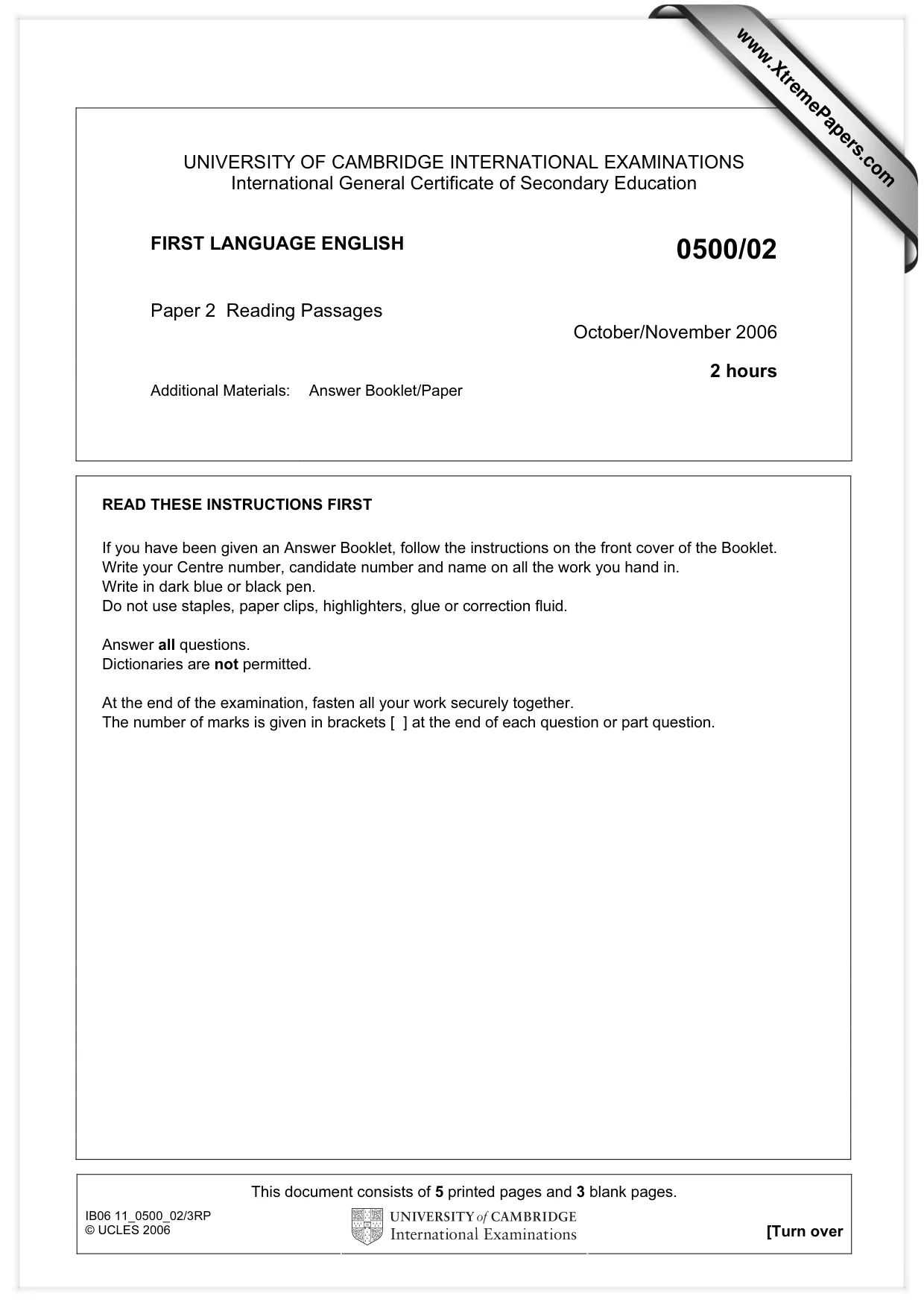
UNIVERSITY OF CAMBRIDGE INTERNATIONAL EXAMINATIONS International General Certificate of Secondary Education FIRST LANGUAGE ENGLISH 0500/02 Paper 2 Reading Passages October/November 2006 2 hours Additional Materials: Answer Booklet/Paper READ THESE INSTRUCTIONS FIRST If you have been given an Answer Booklet, follow the instructions on the front cover of the Booklet. Write your Centre number, candidate number and name on all the work you hand in. Write in dark blue or black pen. Do not use staples, paper clips, highlighters, glue or correction fluid. Answer all questions. Dictionaries are not permitted. At the end of the examination, fasten all your work securely together. The number of marks is given in brackets [ ] at the end of each question or part question. This document consists of 5 printed pages and 3 blank pages. IB06 11_0500_02/3RP © UCLES 2006 [Turn over www.XtremePapers.com
Question paper, page 2
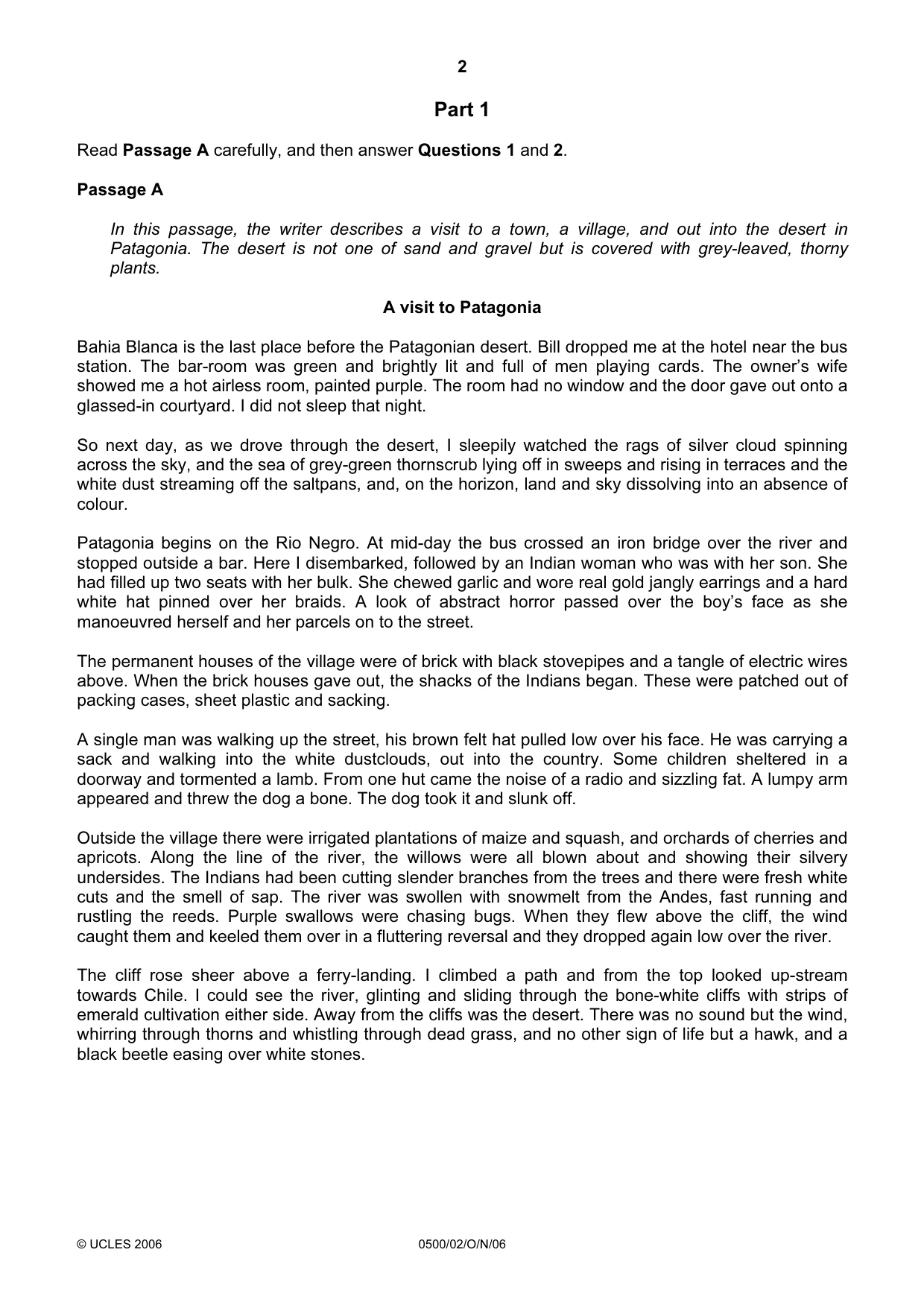
2 © UCLES 2006 0500/02/O/N/06 Part 1 Read Passage A carefully, and then answer Questions 1 and 2. Passage A In this passage, the writer describes a visit to a town, a village, and out into the desert in Patagonia. The desert is not one of sand and gravel but is covered with grey-leaved, thorny plants. A visit to Patagonia Bahia Blanca is the last place before the Patagonian desert. Bill dropped me at the hotel near the bus station. The bar-room was green and brightly lit and full of men playing cards. The owner’s wife showed me a hot airless room, painted purple. The room had no window and the door gave out onto a glassed-in courtyard. I did not sleep that night. So next day, as we drove through the desert, I sleepily watched the rags of silver cloud spinning across the sky, and the sea of grey-green thornscrub lying off in sweeps and rising in terraces and the white dust streaming off the saltpans, and, on the horizon, land and sky dissolving into an absence of colour. Patagonia begins on the Rio Negro. At mid-day the bus crossed an iron bridge over the river and stopped outside a bar. Here I disembarked, followed by an Indian woman who was with her son. She had filled up two seats with her bulk. She chewed garlic and wore real gold jangly earrings and a hard white hat pinned over her braids. A look of abstract horror passed over the boy’s face as she manoeuvred herself and her parcels on to the street. The permanent houses of the village were of brick with black stovepipes and a tangle of electric wires above. When the brick houses gave out, the shacks of the Indians began. These were patched out of packing cases, sheet plastic and sacking. A single man was walking up the street, his brown felt hat pulled low over his face. He was carrying a sack and walking into the white dustclouds, out into the country. Some children sheltered in a doorway and tormented a lamb. From one hut came the noise of a radio and sizzling fat. A lumpy arm appeared and threw the dog a bone. The dog took it and slunk off. Outside the village there were irrigated plantations of maize and squash, and orchards of cherries and apricots. Along the line of the river, the willows were all blown about and showing their silvery undersides. The Indians had been cutting slender branches from the trees and there were fresh white cuts and the smell of sap. The river was swollen with snowmelt from the Andes, fast running and rustling the reeds. Purple swallows were chasing bugs. When they flew above the cliff, the wind caught them and keeled them over in a fluttering reversal and they dropped again low over the river. The cliff rose sheer above a ferry-landing. I climbed a path and from the top looked up-stream towards Chile. I could see the river, glinting and sliding through the bone-white cliffs with strips of emerald cultivation either side. Away from the cliffs was the desert. There was no sound but the wind, whirring through thorns and whistling through dead grass, and no other sign of life but a hawk, and a black beetle easing over white stones.
Question paper, page 3
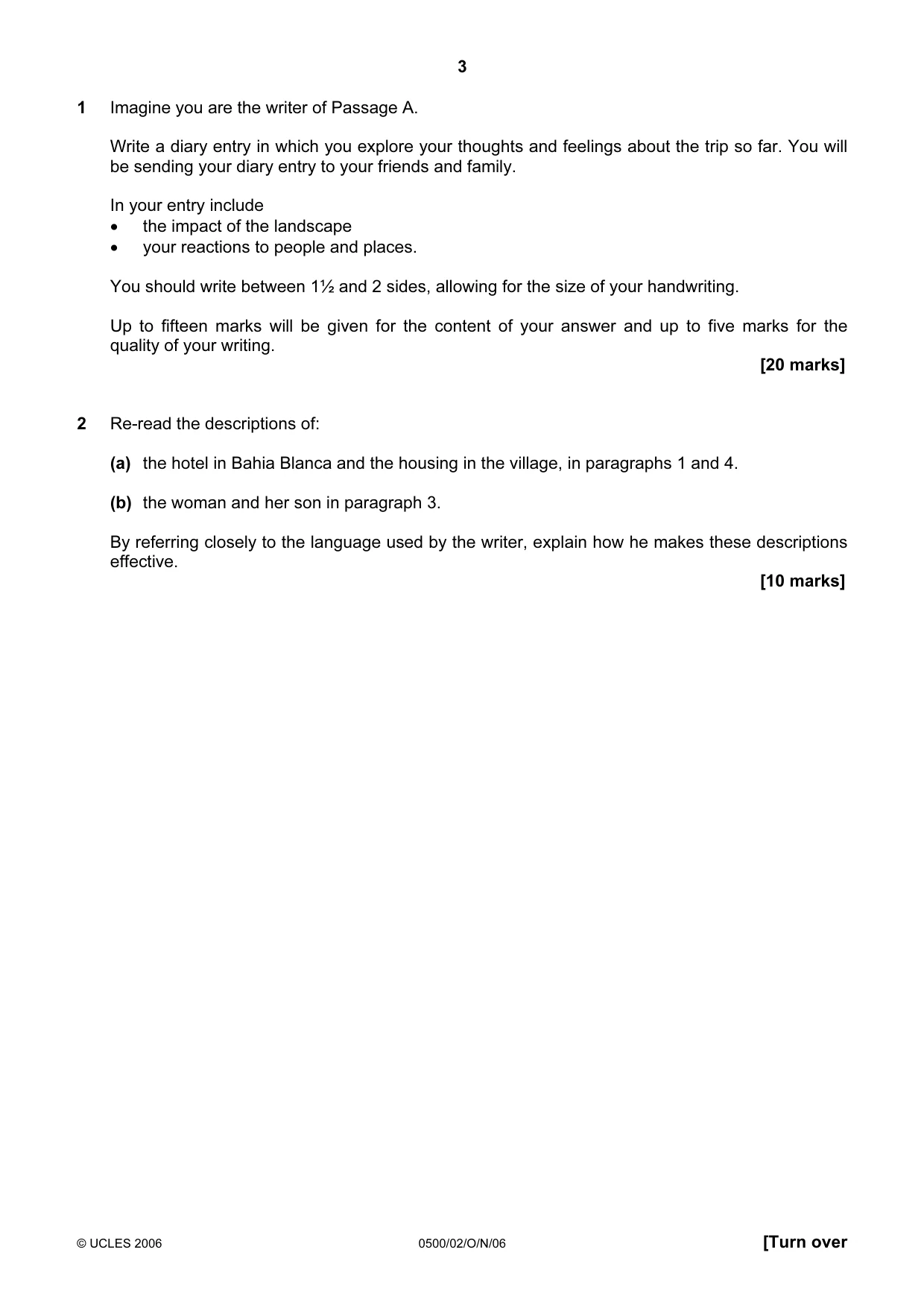
3 © UCLES 2006 0500/02/O/N/06 [Turn over 1 Imagine you are the writer of Passage A. Write a diary entry in which you explore your thoughts and feelings about the trip so far. You will be sending your diary entry to your friends and family. In your entry include • the impact of the landscape • your reactions to people and places. You should write between 1½ and 2 sides, allowing for the size of your handwriting. Up to fifteen marks will be given for the content of your answer and up to five marks for the quality of your writing. [20 marks] 2 Re-read the descriptions of: (a) the hotel in Bahia Blanca and the housing in the village, in paragraphs 1 and 4. (b) the woman and her son in paragraph 3. By referring closely to the language used by the writer, explain how he makes these descriptions effective. [10 marks]
Question paper, page 4
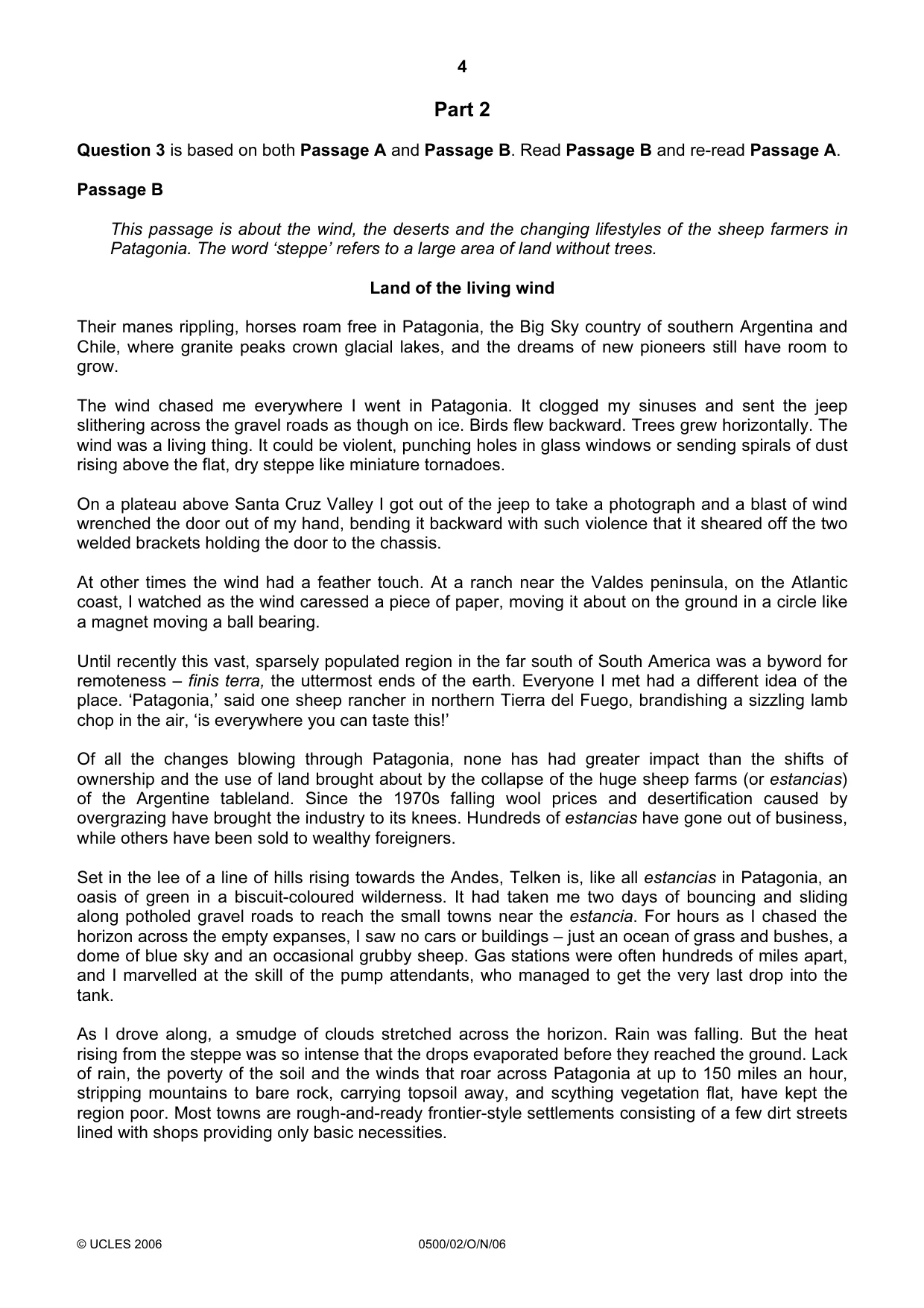
4 © UCLES 2006 0500/02/O/N/06 Part 2 Question 3 is based on both Passage A and Passage B. Read Passage B and re-read Passage A. Passage B This passage is about the wind, the deserts and the changing lifestyles of the sheep farmers in Patagonia. The word ‘steppe’ refers to a large area of land without trees. Land of the living wind Their manes rippling, horses roam free in Patagonia, the Big Sky country of southern Argentina and Chile, where granite peaks crown glacial lakes, and the dreams of new pioneers still have room to grow. The wind chased me everywhere I went in Patagonia. It clogged my sinuses and sent the jeep slithering across the gravel roads as though on ice. Birds flew backward. Trees grew horizontally. The wind was a living thing. It could be violent, punching holes in glass windows or sending spirals of dust rising above the flat, dry steppe like miniature tornadoes. On a plateau above Santa Cruz Valley I got out of the jeep to take a photograph and a blast of wind wrenched the door out of my hand, bending it backward with such violence that it sheared off the two welded brackets holding the door to the chassis. At other times the wind had a feather touch. At a ranch near the Valdes peninsula, on the Atlantic coast, I watched as the wind caressed a piece of paper, moving it about on the ground in a circle like a magnet moving a ball bearing. Until recently this vast, sparsely populated region in the far south of South America was a byword for remoteness – finis terra, the uttermost ends of the earth. Everyone I met had a different idea of the place. ‘Patagonia,’ said one sheep rancher in northern Tierra del Fuego, brandishing a sizzling lamb chop in the air, ‘is everywhere you can taste this!’ Of all the changes blowing through Patagonia, none has had greater impact than the shifts of ownership and the use of land brought about by the collapse of the huge sheep farms (or estancias) of the Argentine tableland. Since the 1970s falling wool prices and desertification caused by overgrazing have brought the industry to its knees. Hundreds of estancias have gone out of business, while others have been sold to wealthy foreigners. Set in the lee of a line of hills rising towards the Andes, Telken is, like all estancias in Patagonia, an oasis of green in a biscuit-coloured wilderness. It had taken me two days of bouncing and sliding along potholed gravel roads to reach the small towns near the estancia. For hours as I chased the horizon across the empty expanses, I saw no cars or buildings – just an ocean of grass and bushes, a dome of blue sky and an occasional grubby sheep. Gas stations were often hundreds of miles apart, and I marvelled at the skill of the pump attendants, who managed to get the very last drop into the tank. As I drove along, a smudge of clouds stretched across the horizon. Rain was falling. But the heat rising from the steppe was so intense that the drops evaporated before they reached the ground. Lack of rain, the poverty of the soil and the winds that roar across Patagonia at up to 150 miles an hour, stripping mountains to bare rock, carrying topsoil away, and scything vegetation flat, have kept the region poor. Most towns are rough-and-ready frontier-style settlements consisting of a few dirt streets lined with shops providing only basic necessities.
Question paper, page 5
5 © UCLES 2006 0500/02/O/N/06 The townspeople of San Julian do their best to make the place look good. Every morning a tanker drives down the central avenue watering the rosebushes, protected from the wind by a lattice screen. But there is no disguising the fact that the town has been battered by the decline in sheep farming. ‘The estancias in this region used to employ 3000 people,’ said Pablo Walker, the director of tourism, as we passed an abandoned three-storey building with elegant wrought iron balconies and classical columns, once San Julian’s biggest department store. ‘Now there are cowboys sweeping the streets or cleaning toilets.’ 3 Summarise the features of the desert areas beyond the village areas and the cultivated plantations described in: (a) Passage A (b) Passage B You should write about 1 side in total, allowing for the size of your handwriting. Up to fifteen marks will be given for the content of your answer and up to five marks for the quality of your writing. [20 marks]
Question paper, page 8
8 Copyright Acknowledgements: Passage A From Patagonia by Bruce Chatwin, published by Jonathon Cape. Reprinted by permission of The Random House Group Ltd. Passage B © Simon Worrall; Patagonia, Land of the Living Wind @ National Geographic Magazine, January 2004. © National Geographic Society, 2003. Permission to reproduce items where third-party owned material protected by copyright is included has been sought and cleared where possible. Every reasonable effort has been made by the publisher (UCLES) to trace copyright holders, but if any items requiring clearance have unwittingly been included, the publisher will be pleased to make amends at the earliest possible opportunity. University of Cambridge International Examinations is part of the University of Cambridge Local Examinations Syndicate (UCLES), which is itself a department of the University of Cambridge. 0500/02/O/N/06 BLANK PAGE
Mark scheme, page 1
UNIVERSITY OF CAMBRIDGE INTERNATIONAL EXAMINATIONS International General Certificate of Secondary Education MARK SCHEME for the October/November 2006 question paper 0500 FIRST LANGUAGE ENGLISH 0500/02 Paper 2 (Reading Passages - Extended), maximum raw mark 50 This mark scheme is published as an aid to teachers and students, to indicate the requirements of the examination. It shows the basis on which Examiners were instructed to award marks. It does not indicate the details of the discussions that took place at an Examiners’ meeting before marking began. All Examiners are instructed that alternative correct answers and unexpected approaches in candidates’ scripts must be given marks that fairly reflect the relevant knowledge and skills demonstrated. Mark schemes must be read in conjunction with the question papers and the report on the examination. The grade thresholds for various grades are published in the report on the examination for most IGCSE, GCE Advanced Level and Advanced Subsidiary Level syllabuses. • CIE will not enter into discussions or correspondence in connection with these mark schemes. CIE is publishing the mark schemes for the October/November 2006 question papers for most IGCSE, GCE Advanced Level and Advanced Subsidiary Level syllabuses and some Ordinary Level syllabuses. www.XtremePapers.com
Mark scheme, page 2
Page 2 Mark Scheme Syllabus Paper IGCSE - OCT/NOV 2006 0500 2 © UCLES 2006 NB: All Examiners are instructed that alternative correct answers and unexpected approaches in candidates' scripts must be given marks that fairly reflect the relevant knowledge and skills demonstrated. Question 1: Imagine you are the writer of Passage A. Write a diary entry in which you explore your thoughts and feelings about the trip so far. You will be sending your diary to your friends and family. In your entry include • the impact of the landscape • your reactions to people and places. You should write between 1½ and 2 sides, allowing for the size of your handwriting. Up to fifteen marks will be given for the content of your answer and up to five marks for the quality of your writing. [20 marks] General notes on possible content The important thing about the task is the focus on thoughts and feelings, which are noticeable by their absence in the original and are worth exploring. It is too easy to repeat the main points of the passage, in which case it becomes another summary and gains few marks for content. Candidates should develop their feelings about the hotel, its décor and its stifling heat (what are the implications of 'no window', and the 'glassed-in courtyard?') Candidates should explain the negative images of the description of the village and contrast them with the beauty and freshness of the scene by the river. Lastly there should be a reaction to the atmosphere of the desert. In a good answer, there are four things to look for; a possible overview of the amazing variety of this most unusual and quite difficult journey. Separate overviews may be made of the people and/or the landscape. Candidates may refer to: Using the buses: The writer describes details of interest in the views that can be seen on this journey. The hotels: The torture of sleepless nights; reactions to the heat and to the garishness. The desert landscape of skies and thornscrub: The best diary entries may refer to the vastness and the atmosphere. The village people and their houses: These appear to have made an impression on the writer. There is a strong feeling of movement and colour but a reaction to the poverty and the dullness of life. The farming along the river: There is plenty of detail that again suggests beauty, goodness and natural life at its simplest and best. The wind: Not much detail, but enough to suggest that it might cause discomfort Marking instructions: Identify main ideas (landscape, people, places) in margin; mark ‘tf’ in margin for relevant thoughts and feelings and write dev where they are developed. Tick and mark ‘d’ in the text where supporting detail is used.
Mark scheme, page 3
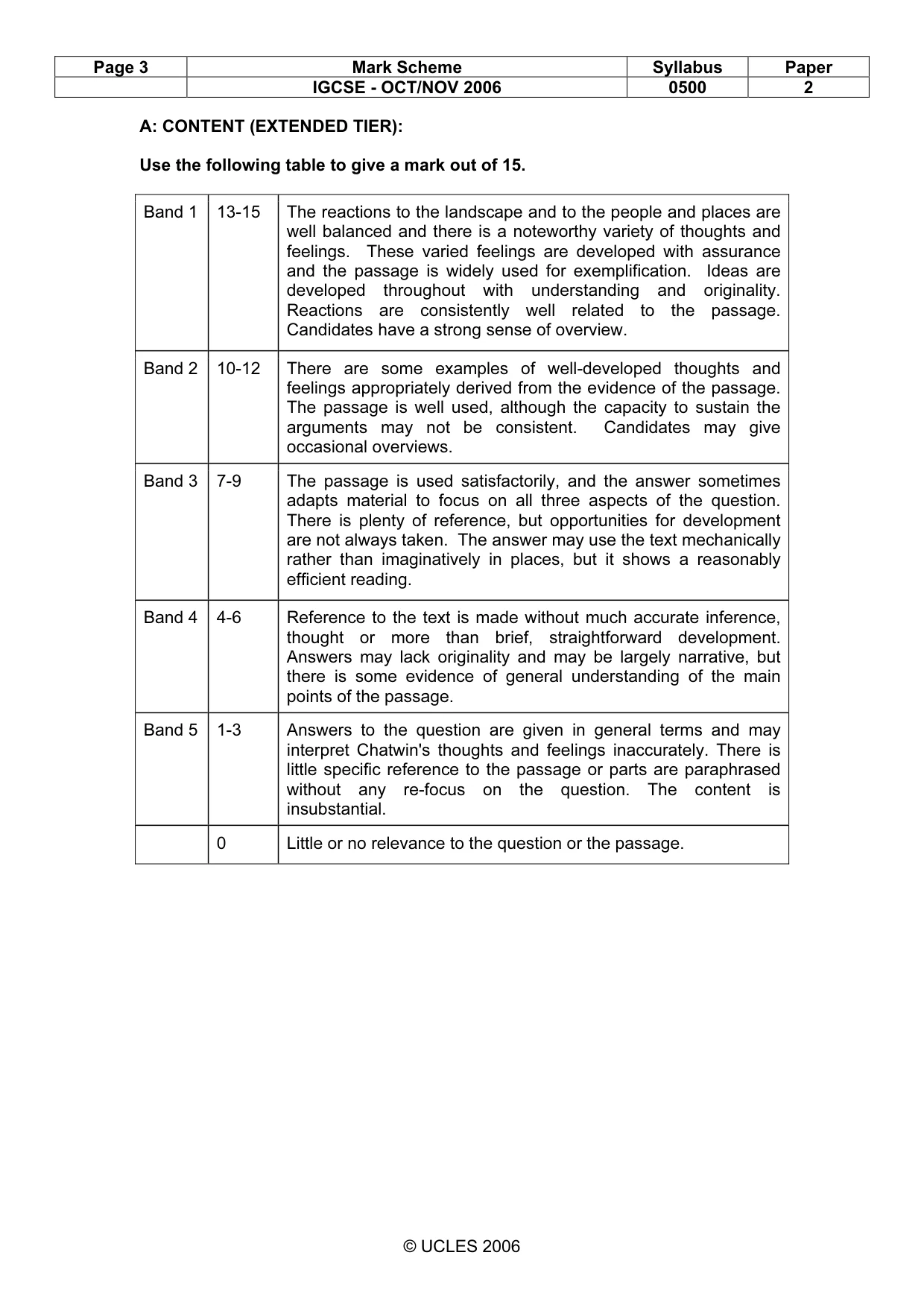
Page 3 Mark Scheme Syllabus Paper IGCSE - OCT/NOV 2006 0500 2 © UCLES 2006 A: CONTENT (EXTENDED TIER): Use the following table to give a mark out of 15. Band 1 13-15 The reactions to the landscape and to the people and places are well balanced and there is a noteworthy variety of thoughts and feelings. These varied feelings are developed with assurance and the passage is widely used for exemplification. Ideas are developed throughout with understanding and originality. Reactions are consistently well related to the passage. Candidates have a strong sense of overview. Band 2 10-12 There are some examples of well-developed thoughts and feelings appropriately derived from the evidence of the passage. The passage is well used, although the capacity to sustain the arguments may not be consistent. Candidates may give occasional overviews. Band 3 7-9 The passage is used satisfactorily, and the answer sometimes adapts material to focus on all three aspects of the question. There is plenty of reference, but opportunities for development are not always taken. The answer may use the text mechanically rather than imaginatively in places, but it shows a reasonably efficient reading. Band 4 4-6 Reference to the text is made without much accurate inference, thought or more than brief, straightforward development. Answers may lack originality and may be largely narrative, but there is some evidence of general understanding of the main points of the passage. Band 5 1-3 Answers to the question are given in general terms and may interpret Chatwin's thoughts and feelings inaccurately. There is little specific reference to the passage or parts are paraphrased without any re-focus on the question. The content is insubstantial. 0 Little or no relevance to the question or the passage.
Mark scheme, page 4
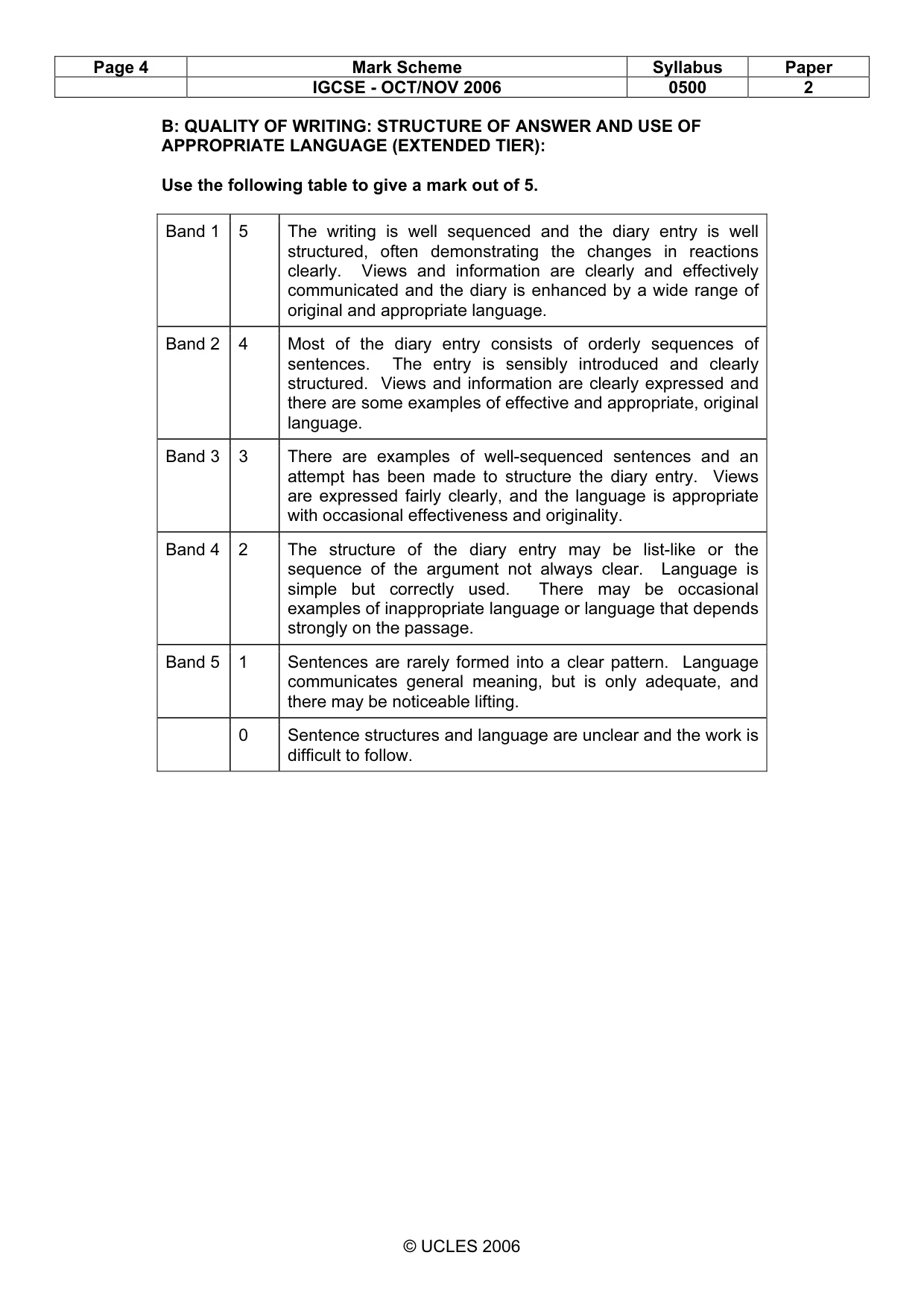
Page 4 Mark Scheme Syllabus Paper IGCSE - OCT/NOV 2006 0500 2 © UCLES 2006 B: QUALITY OF WRITING: STRUCTURE OF ANSWER AND USE OF APPROPRIATE LANGUAGE (EXTENDED TIER): Use the following table to give a mark out of 5. Band 1 5 The writing is well sequenced and the diary entry is well structured, often demonstrating the changes in reactions clearly. Views and information are clearly and effectively communicated and the diary is enhanced by a wide range of original and appropriate language. Band 2 4 Most of the diary entry consists of orderly sequences of sentences. The entry is sensibly introduced and clearly structured. Views and information are clearly expressed and there are some examples of effective and appropriate, original language. Band 3 3 There are examples of well-sequenced sentences and an attempt has been made to structure the diary entry. Views are expressed fairly clearly, and the language is appropriate with occasional effectiveness and originality. Band 4 2 The structure of the diary entry may be list-like or the sequence of the argument not always clear. Language is simple but correctly used. There may be occasional examples of inappropriate language or language that depends strongly on the passage. Band 5 1 Sentences are rarely formed into a clear pattern. Language communicates general meaning, but is only adequate, and there may be noticeable lifting. 0 Sentence structures and language are unclear and the work is difficult to follow.
Mark scheme, page 5
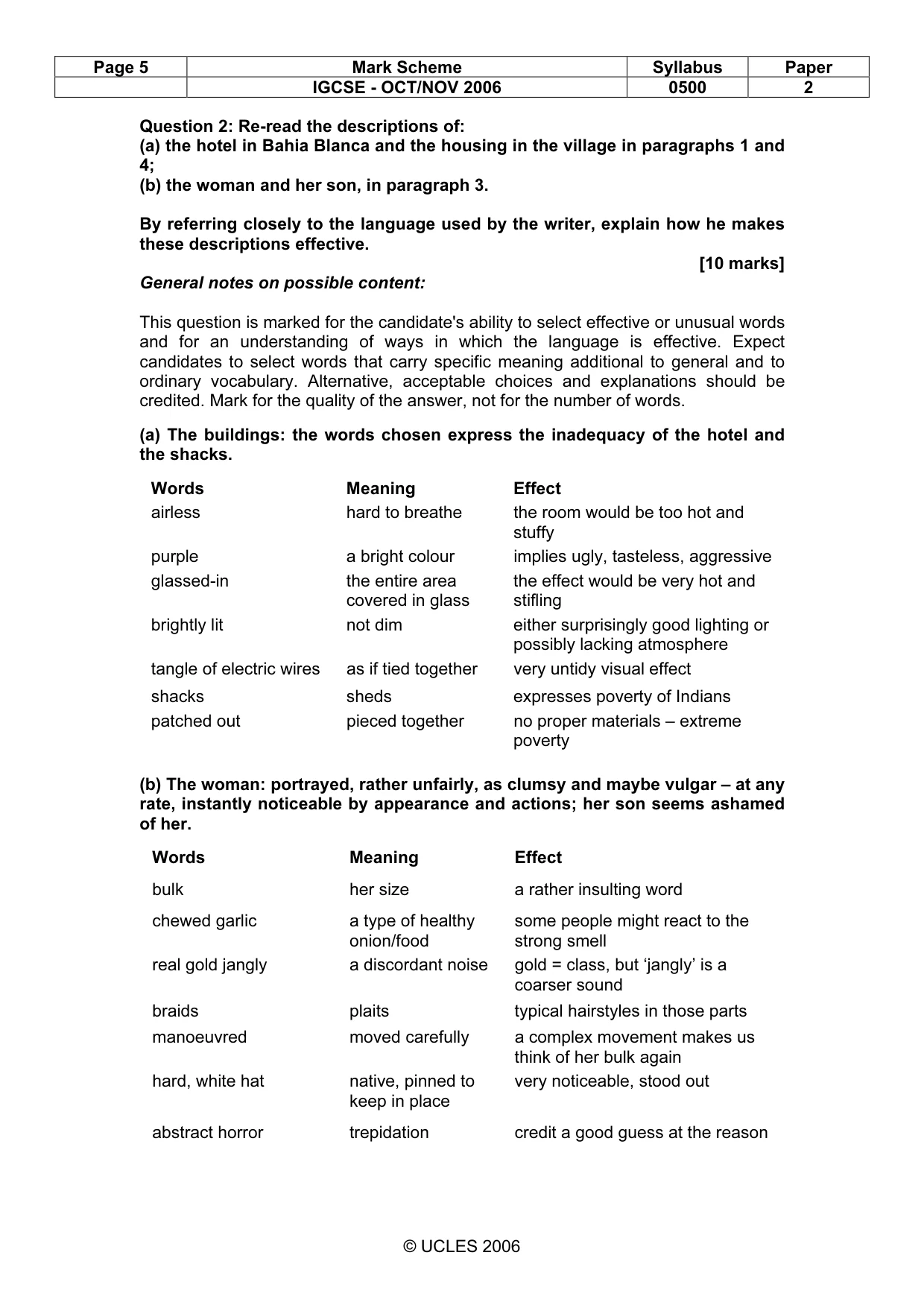
Page 5 Mark Scheme Syllabus Paper IGCSE - OCT/NOV 2006 0500 2 © UCLES 2006 Question 2: Re-read the descriptions of: (a) the hotel in Bahia Blanca and the housing in the village in paragraphs 1 and 4; (b) the woman and her son, in paragraph 3. By referring closely to the language used by the writer, explain how he makes these descriptions effective. [10 marks] General notes on possible content: This question is marked for the candidate's ability to select effective or unusual words and for an understanding of ways in which the language is effective. Expect candidates to select words that carry specific meaning additional to general and to ordinary vocabulary. Alternative, acceptable choices and explanations should be credited. Mark for the quality of the answer, not for the number of words. (a) The buildings: the words chosen express the inadequacy of the hotel and the shacks. Words Meaning Effect airless hard to breathe the room would be too hot and stuffy purple a bright colour implies ugly, tasteless, aggressive glassed-in the entire area covered in glass the effect would be very hot and stifling brightly lit not dim either surprisingly good lighting or possibly lacking atmosphere tangle of electric wires as if tied together very untidy visual effect shacks sheds expresses poverty of Indians patched out pieced together no proper materials – extreme poverty (b) The woman: portrayed, rather unfairly, as clumsy and maybe vulgar – at any rate, instantly noticeable by appearance and actions; her son seems ashamed of her. Words Meaning Effect bulk her size a rather insulting word chewed garlic a type of healthy onion/food some people might react to the strong smell real gold jangly a discordant noise gold = class, but ‘jangly’ is a coarser sound braids plaits typical hairstyles in those parts manoeuvred moved carefully a complex movement makes us think of her bulk again hard, white hat native, pinned to keep in place very noticeable, stood out abstract horror trepidation credit a good guess at the reason
Mark scheme, page 6
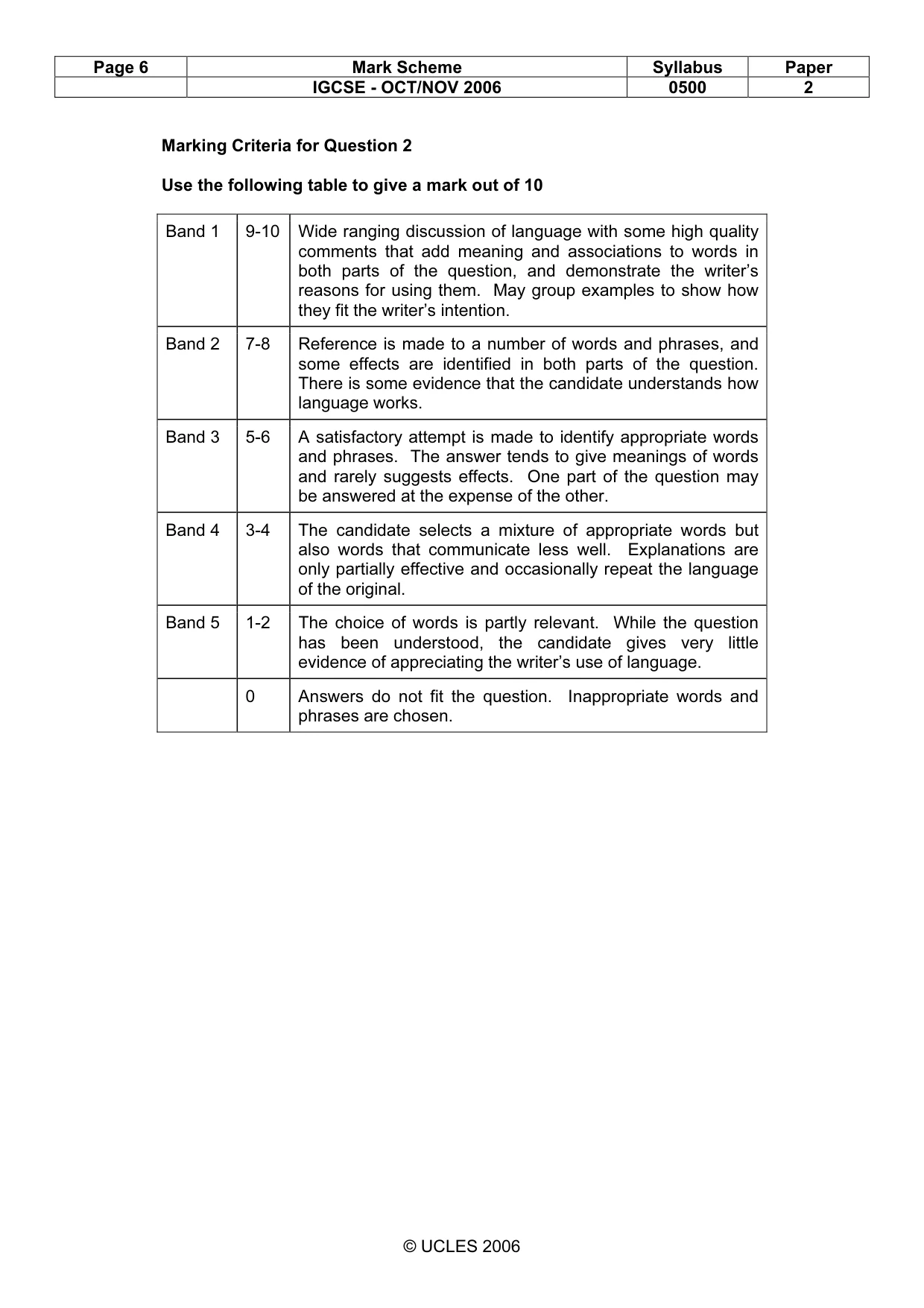
Page 6 Mark Scheme Syllabus Paper IGCSE - OCT/NOV 2006 0500 2 © UCLES 2006 Marking Criteria for Question 2 Use the following table to give a mark out of 10 Band 1 9-10 Wide ranging discussion of language with some high quality comments that add meaning and associations to words in both parts of the question, and demonstrate the writer’s reasons for using them. May group examples to show how they fit the writer’s intention. Band 2 7-8 Reference is made to a number of words and phrases, and some effects are identified in both parts of the question. There is some evidence that the candidate understands how language works. Band 3 5-6 A satisfactory attempt is made to identify appropriate words and phrases. The answer tends to give meanings of words and rarely suggests effects. One part of the question may be answered at the expense of the other. Band 4 3-4 The candidate selects a mixture of appropriate words but also words that communicate less well. Explanations are only partially effective and occasionally repeat the language of the original. Band 5 1-2 The choice of words is partly relevant. While the question has been understood, the candidate gives very little evidence of appreciating the writer’s use of language. 0 Answers do not fit the question. Inappropriate words and phrases are chosen.
Mark scheme, page 7
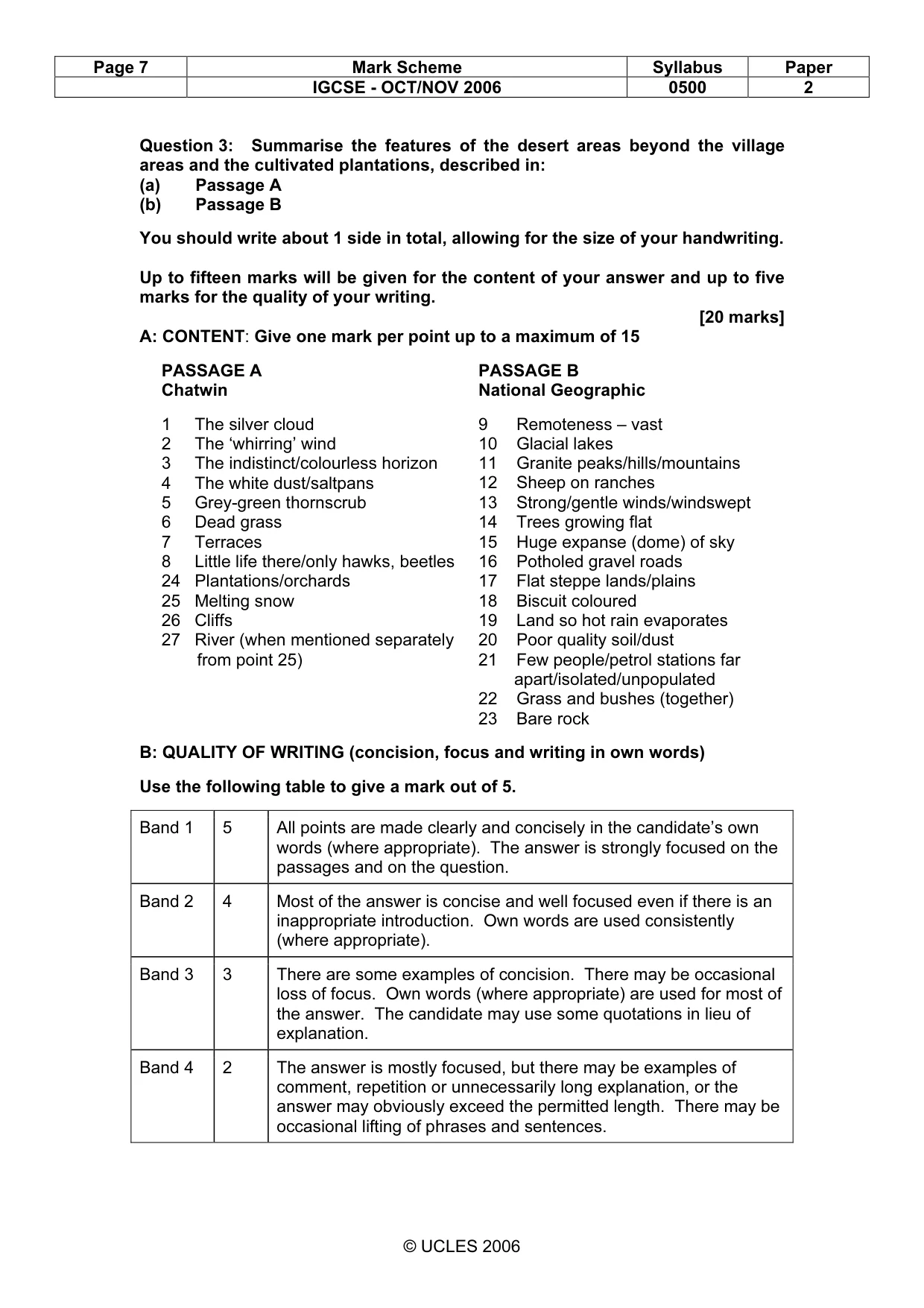
Page 7 Mark Scheme Syllabus Paper IGCSE - OCT/NOV 2006 0500 2 © UCLES 2006 Question 3: Summarise the features of the desert areas beyond the village areas and the cultivated plantations, described in: (a) Passage A (b) Passage B You should write about 1 side in total, allowing for the size of your handwriting. Up to fifteen marks will be given for the content of your answer and up to five marks for the quality of your writing. [20 marks] A: CONTENT: Give one mark per point up to a maximum of 15 PASSAGE A Chatwin PASSAGE B National Geographic 1 The silver cloud 2 The ‘whirring’ wind 3 The indistinct/colourless horizon 4 The white dust/saltpans 5 Grey-green thornscrub 6 Dead grass 7 Terraces 8 Little life there/only hawks, beetles 24 Plantations/orchards 25 Melting snow 26 Cliffs 27 River (when mentioned separately from point 25) 9 Remoteness – vast 10 Glacial lakes 11 Granite peaks/hills/mountains 12 Sheep on ranches 13 Strong/gentle winds/windswept 14 Trees growing flat 15 Huge expanse (dome) of sky 16 Potholed gravel roads 17 Flat steppe lands/plains 18 Biscuit coloured 19 Land so hot rain evaporates 20 Poor quality soil/dust 21 Few people/petrol stations far apart/isolated/unpopulated 22 Grass and bushes (together) 23 Bare rock B: QUALITY OF WRITING (concision, focus and writing in own words) Use the following table to give a mark out of 5. Band 1 5 All points are made clearly and concisely in the candidate’s own words (where appropriate). The answer is strongly focused on the passages and on the question. Band 2 4 Most of the answer is concise and well focused even if there is an inappropriate introduction. Own words are used consistently (where appropriate). Band 3 3 There are some examples of concision. There may be occasional loss of focus. Own words (where appropriate) are used for most of the answer. The candidate may use some quotations in lieu of explanation. Band 4 2 The answer is mostly focused, but there may be examples of comment, repetition or unnecessarily long explanation, or the answer may obviously exceed the permitted length. There may be occasional lifting of phrases and sentences.
Mark scheme, page 8
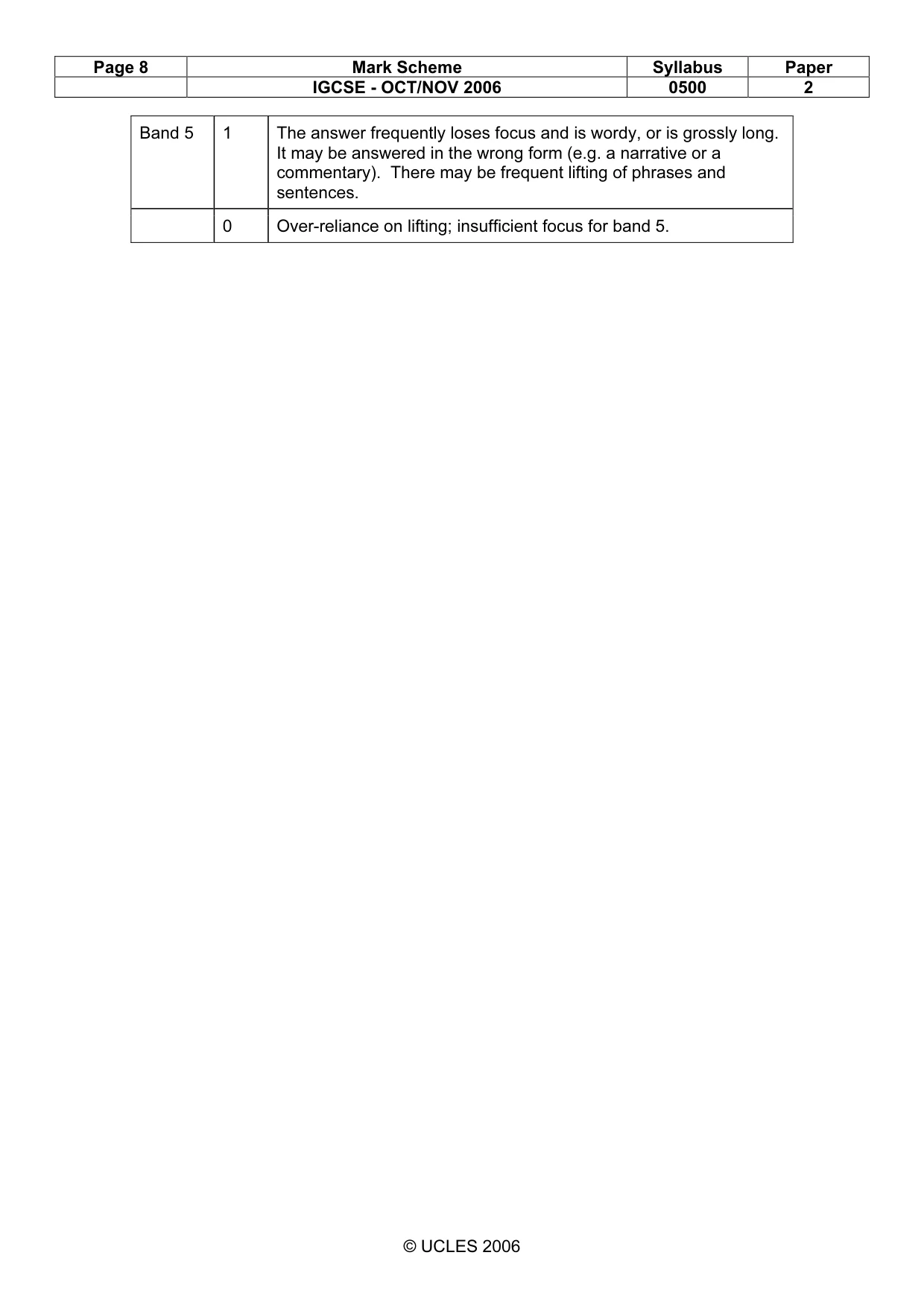
Page 8 Mark Scheme Syllabus Paper IGCSE - OCT/NOV 2006 0500 2 © UCLES 2006 Band 5 1 The answer frequently loses focus and is wordy, or is grossly long. It may be answered in the wrong form (e.g. a narrative or a commentary). There may be frequent lifting of phrases and sentences. 0 Over-reliance on lifting; insufficient focus for band 5.
What you needed in this session
Cambridge’s own grade thresholds for 2006 Oct/Nov, Paper 2 · Variant 1. A higher threshold means an easier paper — the bar moves with how the cohort did.