Cambridge IGCSE English - First Language 0500 — 2006 May/June Paper 3 · Variant 1
0500/31/M/J/06 · 50 marks · ≈56 min
The question paper and its mark scheme, free to read here and free to download. This is Cambridge’s own paper, exactly as it was sat.
Question paper4 pages
Mark scheme8 pages
Answers below. Sit the paper first if you are practising.
Paper as text
Question paper, page 1
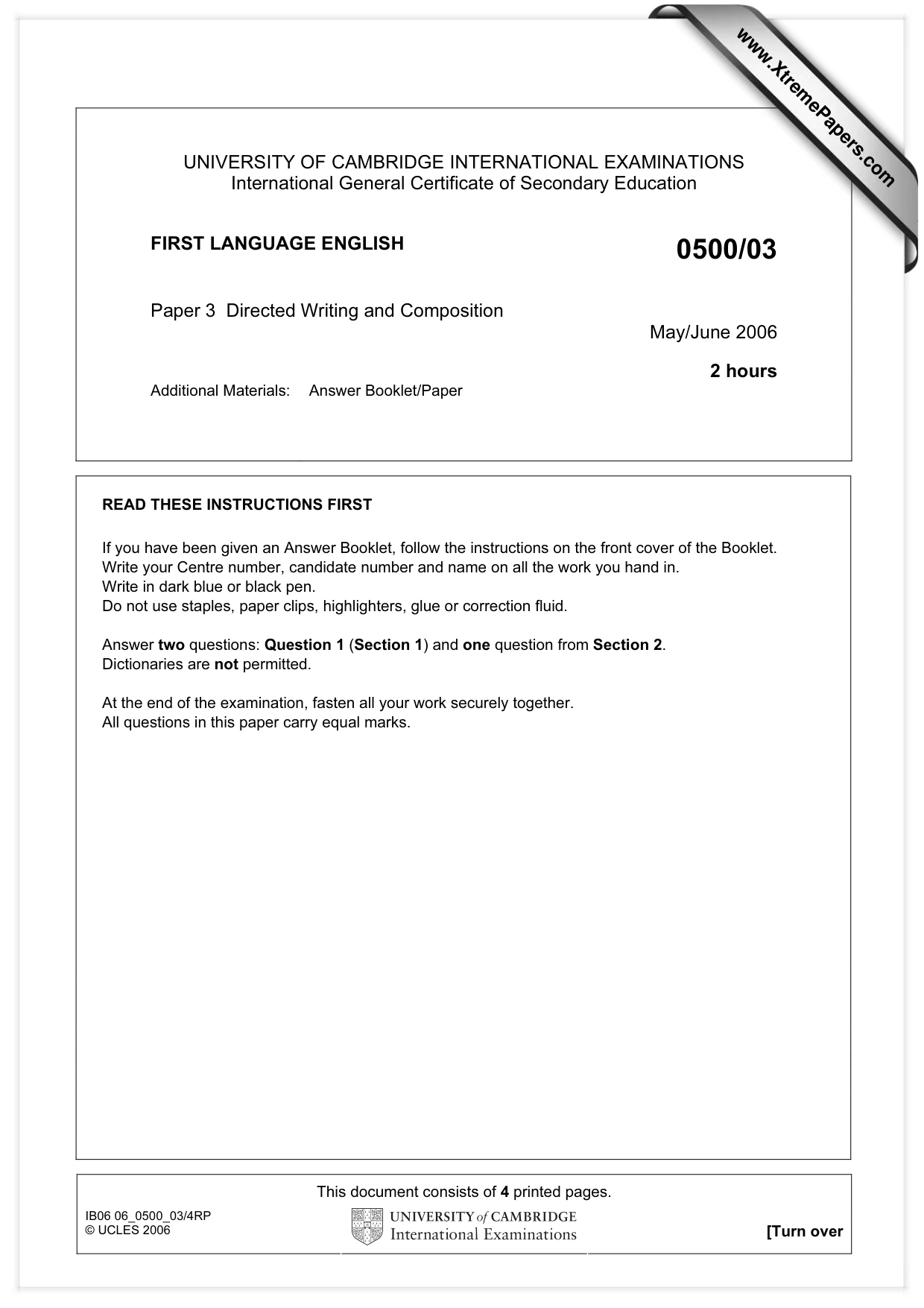
UNIVERSITY OF CAMBRIDGE INTERNATIONAL EXAMINATIONS International General Certificate of Secondary Education FIRST LANGUAGE ENGLISH 0500/03 Paper 3 Directed Writing and Composition May/June 2006 2 hours Additional Materials: Answer Booklet/Paper READ THESE INSTRUCTIONS FIRST If you have been given an Answer Booklet, follow the instructions on the front cover of the Booklet. Write your Centre number, candidate number and name on all the work you hand in. Write in dark blue or black pen. Do not use staples, paper clips, highlighters, glue or correction fluid. Answer two questions: Question 1 (Section 1) and one question from Section 2. Dictionaries are not permitted. At the end of the examination, fasten all your work securely together. All questions in this paper carry equal marks. This document consists of 4 printed pages. IB06 06_0500_03/4RP © UCLES 2006 [Turn over www.XtremePapers.com
Question paper, page 2
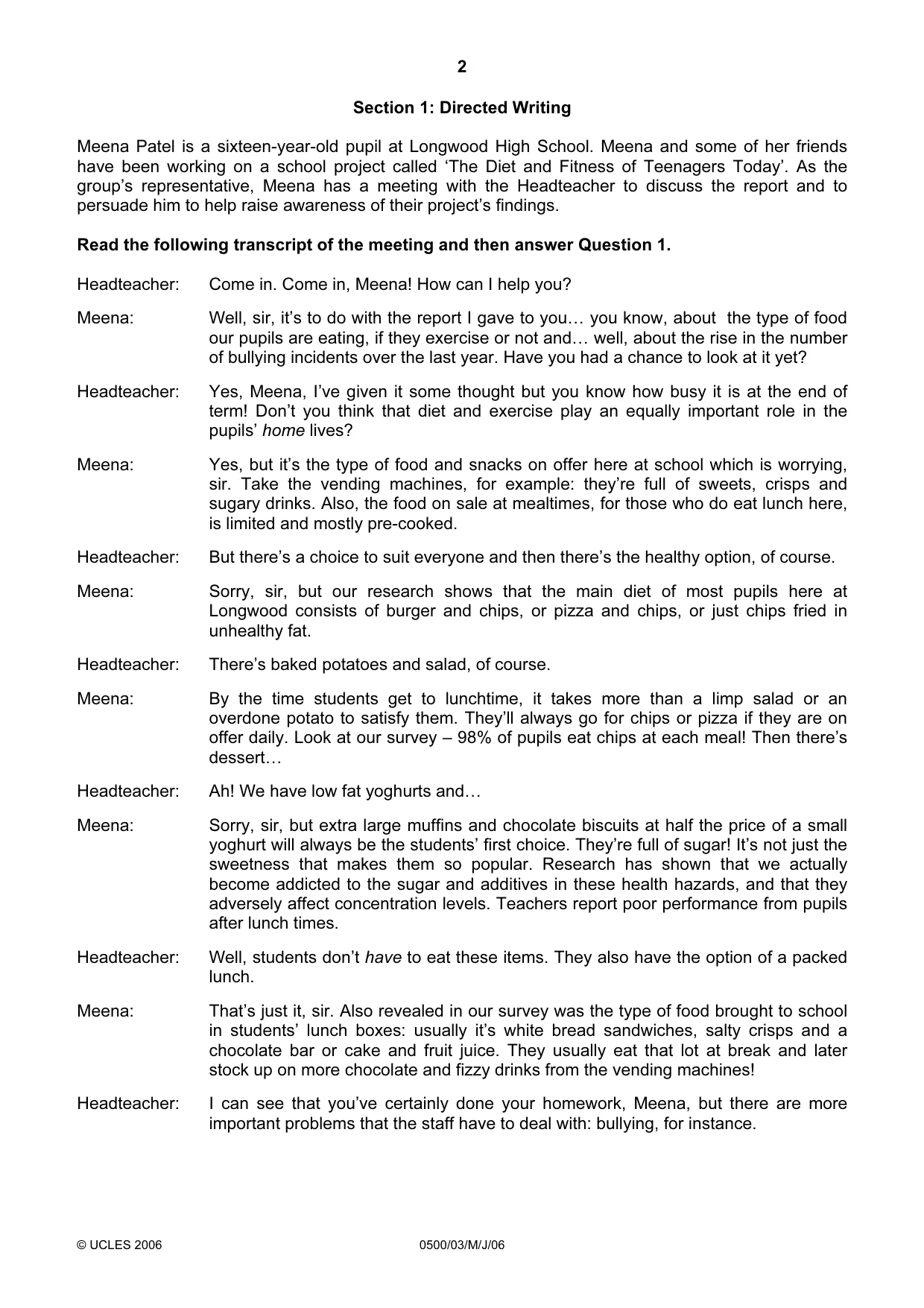
2 © UCLES 2006 0500/03/M/J/06 Section 1: Directed Writing Meena Patel is a sixteen-year-old pupil at Longwood High School. Meena and some of her friends have been working on a school project called ‘The Diet and Fitness of Teenagers Today’. As the group’s representative, Meena has a meeting with the Headteacher to discuss the report and to persuade him to help raise awareness of their project’s findings. Read the following transcript of the meeting and then answer Question 1. Headteacher: Come in. Come in, Meena! How can I help you? Meena: Well, sir, it’s to do with the report I gave to you… you know, about the type of food our pupils are eating, if they exercise or not and… well, about the rise in the number of bullying incidents over the last year. Have you had a chance to look at it yet? Headteacher: Yes, Meena, I’ve given it some thought but you know how busy it is at the end of term! Don’t you think that diet and exercise play an equally important role in the pupils’ home lives? Meena: Yes, but it’s the type of food and snacks on offer here at school which is worrying, sir. Take the vending machines, for example: they’re full of sweets, crisps and sugary drinks. Also, the food on sale at mealtimes, for those who do eat lunch here, is limited and mostly pre-cooked. Headteacher: But there’s a choice to suit everyone and then there’s the healthy option, of course. Meena: Sorry, sir, but our research shows that the main diet of most pupils here at Longwood consists of burger and chips, or pizza and chips, or just chips fried in unhealthy fat. Headteacher: There’s baked potatoes and salad, of course. Meena: By the time students get to lunchtime, it takes more than a limp salad or an overdone potato to satisfy them. They’ll always go for chips or pizza if they are on offer daily. Look at our survey – 98% of pupils eat chips at each meal! Then there’s dessert… Headteacher: Ah! We have low fat yoghurts and… Meena: Sorry, sir, but extra large muffins and chocolate biscuits at half the price of a small yoghurt will always be the students’ first choice. They’re full of sugar! It’s not just the sweetness that makes them so popular. Research has shown that we actually become addicted to the sugar and additives in these health hazards, and that they adversely affect concentration levels. Teachers report poor performance from pupils after lunch times. Headteacher: Well, students don’t have to eat these items. They also have the option of a packed lunch. Meena: That’s just it, sir. Also revealed in our survey was the type of food brought to school in students’ lunch boxes: usually it’s white bread sandwiches, salty crisps and a chocolate bar or cake and fruit juice. They usually eat that lot at break and later stock up on more chocolate and fizzy drinks from the vending machines! Headteacher: I can see that you’ve certainly done your homework, Meena, but there are more important problems that the staff have to deal with: bullying, for instance.
Question paper, page 3
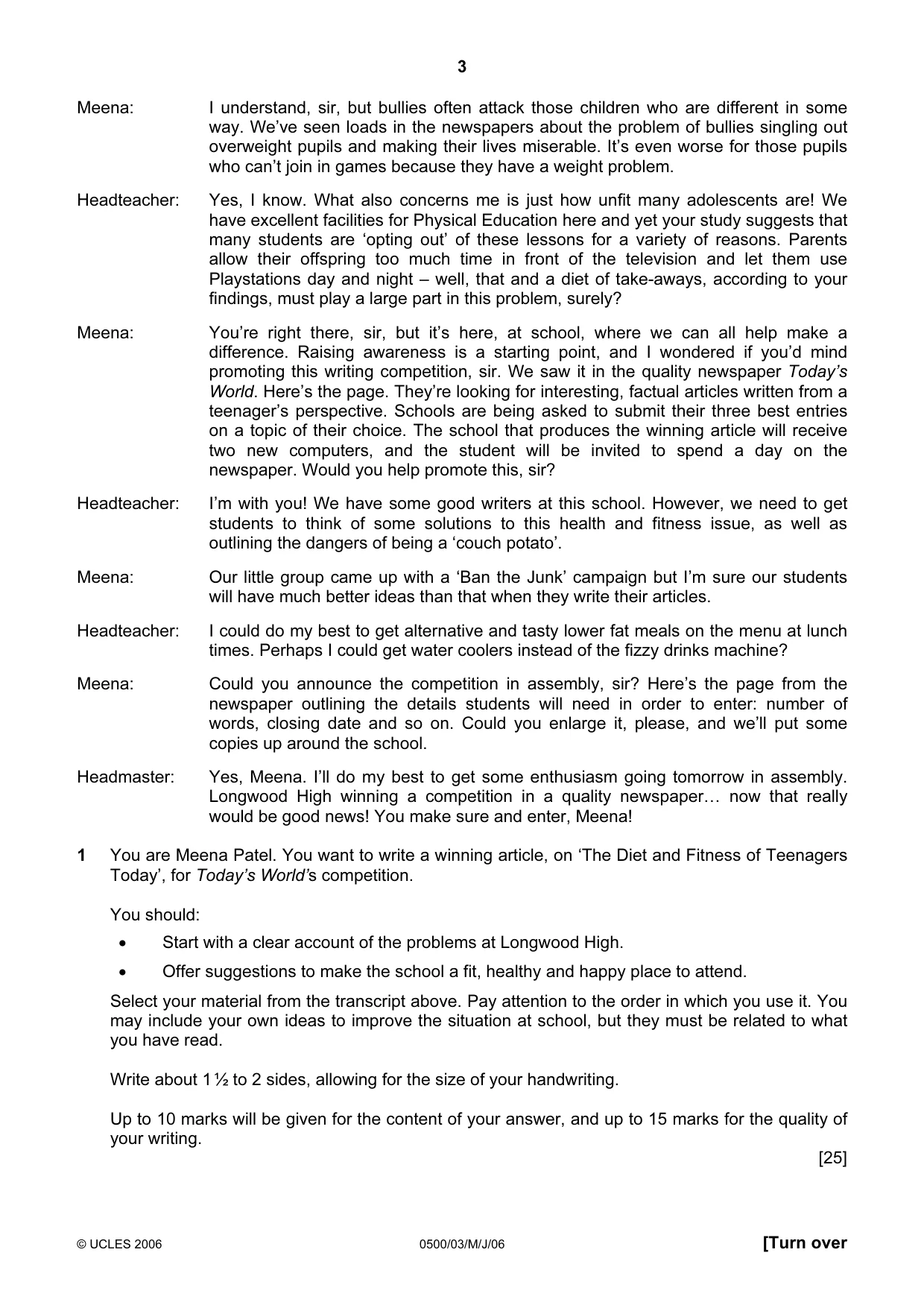
3 © UCLES 2006 0500/03/M/J/06 [Turn over Meena: I understand, sir, but bullies often attack those children who are different in some way. We’ve seen loads in the newspapers about the problem of bullies singling out overweight pupils and making their lives miserable. It’s even worse for those pupils who can’t join in games because they have a weight problem. Headteacher: Yes, I know. What also concerns me is just how unfit many adolescents are! We have excellent facilities for Physical Education here and yet your study suggests that many students are ‘opting out’ of these lessons for a variety of reasons. Parents allow their offspring too much time in front of the television and let them use Playstations day and night – well, that and a diet of take-aways, according to your findings, must play a large part in this problem, surely? Meena: You’re right there, sir, but it’s here, at school, where we can all help make a difference. Raising awareness is a starting point, and I wondered if you’d mind promoting this writing competition, sir. We saw it in the quality newspaper Today’s World. Here’s the page. They’re looking for interesting, factual articles written from a teenager’s perspective. Schools are being asked to submit their three best entries on a topic of their choice. The school that produces the winning article will receive two new computers, and the student will be invited to spend a day on the newspaper. Would you help promote this, sir? Headteacher: I’m with you! We have some good writers at this school. However, we need to get students to think of some solutions to this health and fitness issue, as well as outlining the dangers of being a ‘couch potato’. Meena: Our little group came up with a ‘Ban the Junk’ campaign but I’m sure our students will have much better ideas than that when they write their articles. Headteacher: I could do my best to get alternative and tasty lower fat meals on the menu at lunch times. Perhaps I could get water coolers instead of the fizzy drinks machine? Meena: Could you announce the competition in assembly, sir? Here’s the page from the newspaper outlining the details students will need in order to enter: number of words, closing date and so on. Could you enlarge it, please, and we’ll put some copies up around the school. Headmaster: Yes, Meena. I’ll do my best to get some enthusiasm going tomorrow in assembly. Longwood High winning a competition in a quality newspaper… now that really would be good news! You make sure and enter, Meena! 1 You are Meena Patel. You want to write a winning article, on ‘The Diet and Fitness of Teenagers Today’, for Today’s World’s competition. You should: • Start with a clear account of the problems at Longwood High. • Offer suggestions to make the school a fit, healthy and happy place to attend. Select your material from the transcript above. Pay attention to the order in which you use it. You may include your own ideas to improve the situation at school, but they must be related to what you have read. Write about 1 ½ to 2 sides, allowing for the size of your handwriting. Up to 10 marks will be given for the content of your answer, and up to 15 marks for the quality of your writing. [25]
Question paper, page 4
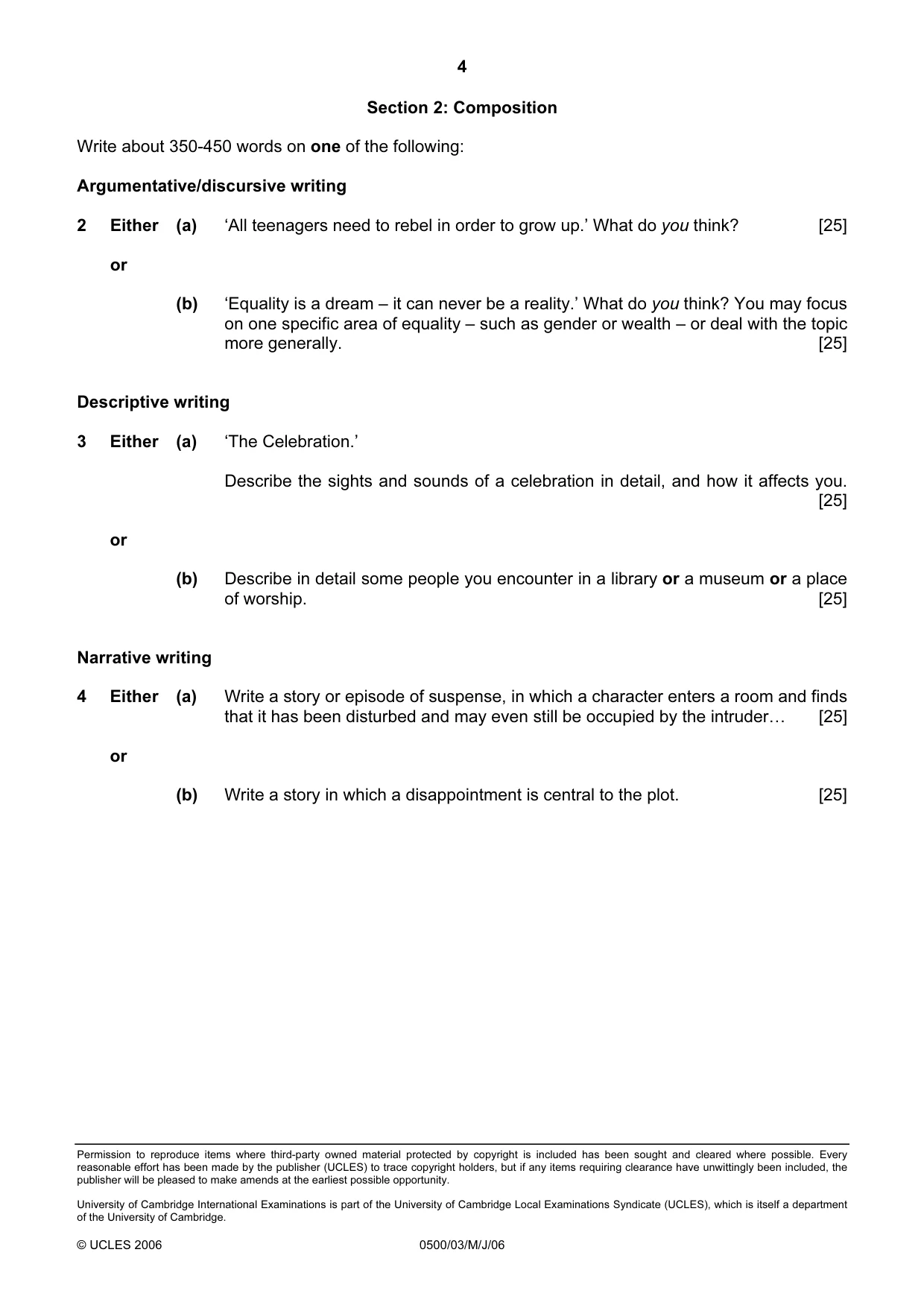
4 Permission to reproduce items where third-party owned material protected by copyright is included has been sought and cleared where possible. Every reasonable effort has been made by the publisher (UCLES) to trace copyright holders, but if any items requiring clearance have unwittingly been included, the publisher will be pleased to make amends at the earliest possible opportunity. University of Cambridge International Examinations is part of the University of Cambridge Local Examinations Syndicate (UCLES), which is itself a department of the University of Cambridge. © UCLES 2006 0500/03/M/J/06 Section 2: Composition Write about 350-450 words on one of the following: Argumentative/discursive writing 2 Either (a) ‘All teenagers need to rebel in order to grow up.’ What do you think? [25] or (b) ‘Equality is a dream – it can never be a reality.’ What do you think? You may focus on one specific area of equality – such as gender or wealth – or deal with the topic more generally. [25] Descriptive writing 3 Either (a) ‘The Celebration.’ Describe the sights and sounds of a celebration in detail, and how it affects you. [25] or (b) Describe in detail some people you encounter in a library or a museum or a place of worship. [25] Narrative writing 4 Either (a) Write a story or episode of suspense, in which a character enters a room and finds that it has been disturbed and may even still be occupied by the intruder… [25] or (b) Write a story in which a disappointment is central to the plot. [25]
Mark scheme, page 1
UNIVERSITY OF CAMBRIDGE INTERNATIONAL EXAMINATIONS International General Certificate of Secondary Education MARK SCHEME for the May/June 2006 question paper 0500 FIRST LANGUAGE ENGLISH 0500/03 Paper 3 (Directed Writing and Composition) Maximum raw mark 50 These mark schemes are published as an aid to teachers and students, to indicate the requirements of the examination. They show the basis on which Examiners were initially instructed to award marks. They do not indicate the details of the discussions that took place at an Examiners’ meeting before marking began. Any substantial changes to the mark scheme that arose from these discussions will be recorded in the published Report on the Examination. All Examiners are instructed that alternative correct answers and unexpected approaches in candidates’ scripts must be given marks that fairly reflect the relevant knowledge and skills demonstrated. Mark schemes must be read in conjunction with the question papers and the Report on the Examination. The minimum marks in these components needed for various grades were previously published with these mark schemes, but are now instead included in the Report on the Examination for this session. • CIE will not enter into discussion or correspondence in connection with these mark schemes. CIE is publishing the mark schemes for the May/June 2006 question papers for most IGCSE and GCE Advanced Level and Advanced Subsidiary Level syllabuses and some Ordinary Level syllabuses. www.XtremePapers.com
Mark scheme, page 2
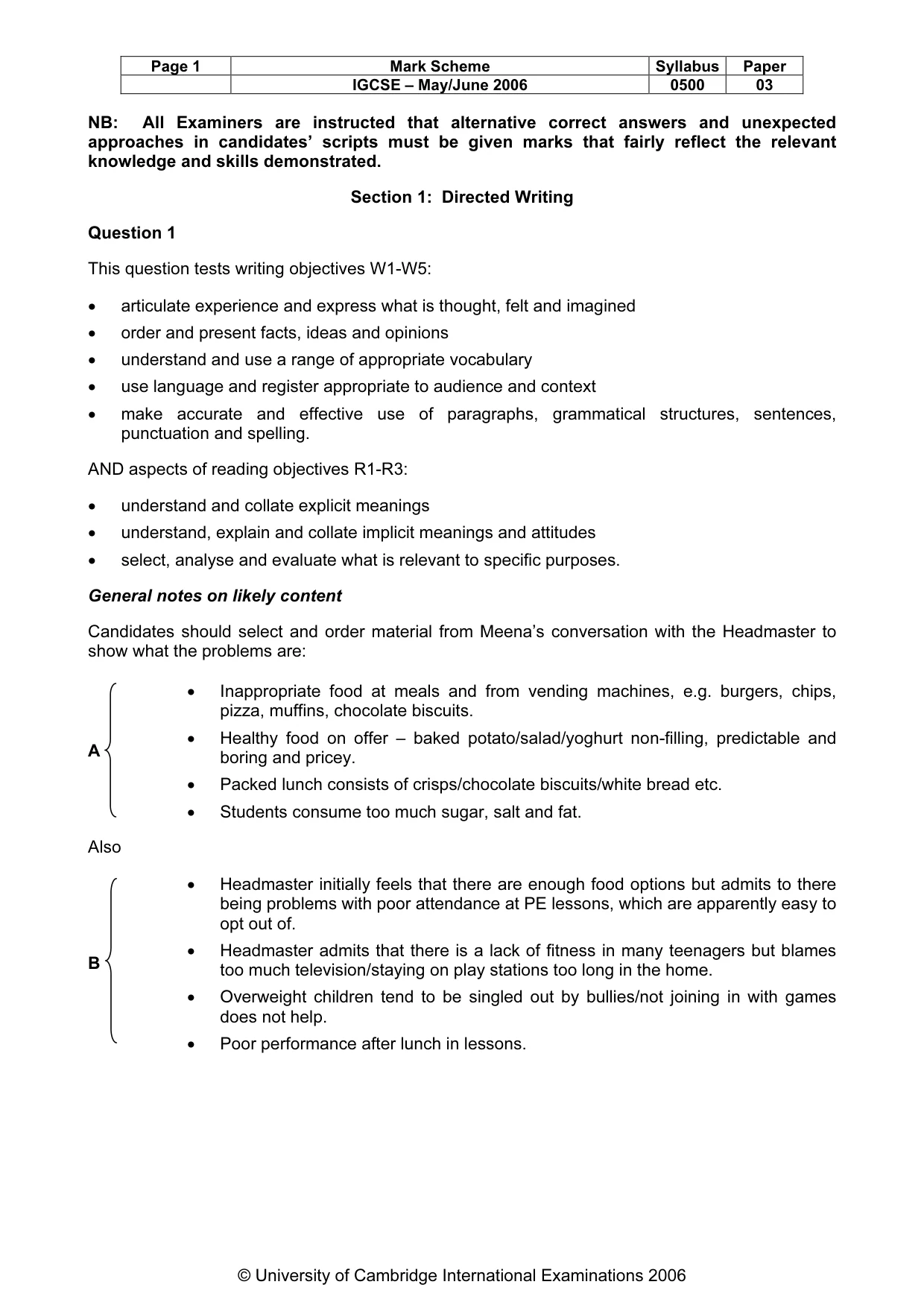
Page 1 Mark Scheme Syllabus Paper IGCSE – May/June 2006 0500 03 © University of Cambridge International Examinations 2006 NB: All Examiners are instructed that alternative correct answers and unexpected approaches in candidates’ scripts must be given marks that fairly reflect the relevant knowledge and skills demonstrated. Section 1: Directed Writing Question 1 This question tests writing objectives W1-W5: • articulate experience and express what is thought, felt and imagined • order and present facts, ideas and opinions • understand and use a range of appropriate vocabulary • use language and register appropriate to audience and context • make accurate and effective use of paragraphs, grammatical structures, sentences, punctuation and spelling. AND aspects of reading objectives R1-R3: • understand and collate explicit meanings • understand, explain and collate implicit meanings and attitudes • select, analyse and evaluate what is relevant to specific purposes. General notes on likely content Candidates should select and order material from Meena’s conversation with the Headmaster to show what the problems are: A • Inappropriate food at meals and from vending machines, e.g. burgers, chips, pizza, muffins, chocolate biscuits. • Healthy food on offer – baked potato/salad/yoghurt non-filling, predictable and boring and pricey. • Packed lunch consists of crisps/chocolate biscuits/white bread etc. • Students consume too much sugar, salt and fat. Also B • Headmaster initially feels that there are enough food options but admits to there being problems with poor attendance at PE lessons, which are apparently easy to opt out of. • Headmaster admits that there is a lack of fitness in many teenagers but blames too much television/staying on play stations too long in the home. • Overweight children tend to be singled out by bullies/not joining in with games does not help. • Poor performance after lunch in lessons.
Mark scheme, page 3
Page 2 Mark Scheme Syllabus Paper IGCSE – May/June 2006 0500 03 © University of Cambridge International Examinations 2006 Reasonable Suggestions on improving matters at Longwood Candidates are free to make their own suggestions. They could mention: S • After school ‘fit n’fun’ classes to their own music/moves • Counsellors/mentoring system • Mountain bike/skateboarding/dance or other popular, healthy after-school clubs • Suggestion box/Ban the junk campaign • Publicity/posters/letters to parents These should be clearly related to the problems of diet and exercise (and preventing bullying).
Mark scheme, page 4
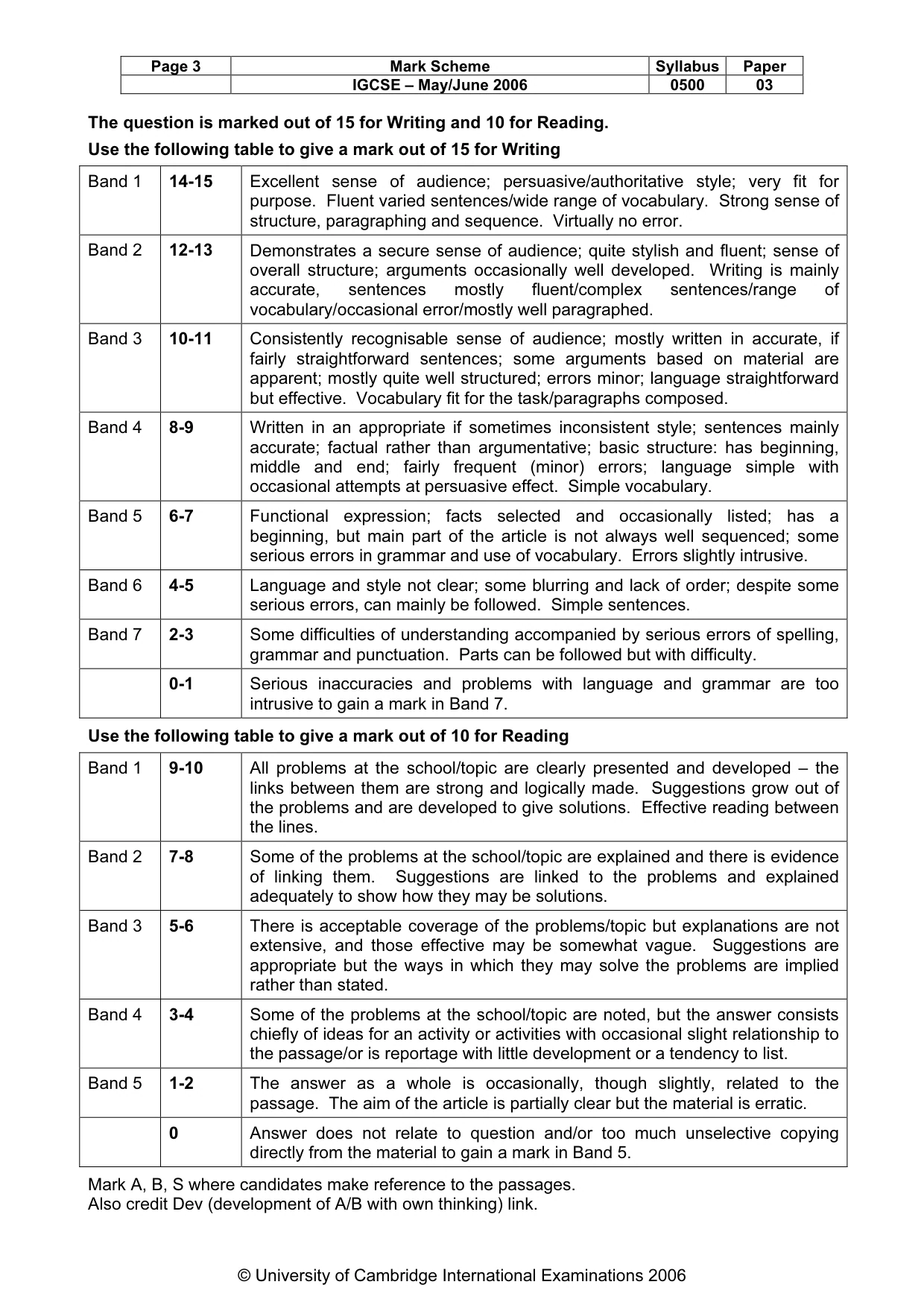
Page 3 Mark Scheme Syllabus Paper IGCSE – May/June 2006 0500 03 © University of Cambridge International Examinations 2006 The question is marked out of 15 for Writing and 10 for Reading. Use the following table to give a mark out of 15 for Writing Band 1 14-15 Excellent sense of audience; persuasive/authoritative style; very fit for purpose. Fluent varied sentences/wide range of vocabulary. Strong sense of structure, paragraphing and sequence. Virtually no error. Band 2 12-13 Demonstrates a secure sense of audience; quite stylish and fluent; sense of overall structure; arguments occasionally well developed. Writing is mainly accurate, sentences mostly fluent/complex sentences/range of vocabulary/occasional error/mostly well paragraphed. Band 3 10-11 Consistently recognisable sense of audience; mostly written in accurate, if fairly straightforward sentences; some arguments based on material are apparent; mostly quite well structured; errors minor; language straightforward but effective. Vocabulary fit for the task/paragraphs composed. Band 4 8-9 Written in an appropriate if sometimes inconsistent style; sentences mainly accurate; factual rather than argumentative; basic structure: has beginning, middle and end; fairly frequent (minor) errors; language simple with occasional attempts at persuasive effect. Simple vocabulary. Band 5 6-7 Functional expression; facts selected and occasionally listed; has a beginning, but main part of the article is not always well sequenced; some serious errors in grammar and use of vocabulary. Errors slightly intrusive. Band 6 4-5 Language and style not clear; some blurring and lack of order; despite some serious errors, can mainly be followed. Simple sentences. Band 7 2-3 Some difficulties of understanding accompanied by serious errors of spelling, grammar and punctuation. Parts can be followed but with difficulty. 0-1 Serious inaccuracies and problems with language and grammar are too intrusive to gain a mark in Band 7. Use the following table to give a mark out of 10 for Reading Band 1 9-10 All problems at the school/topic are clearly presented and developed – the links between them are strong and logically made. Suggestions grow out of the problems and are developed to give solutions. Effective reading between the lines. Band 2 7-8 Some of the problems at the school/topic are explained and there is evidence of linking them. Suggestions are linked to the problems and explained adequately to show how they may be solutions. Band 3 5-6 There is acceptable coverage of the problems/topic but explanations are not extensive, and those effective may be somewhat vague. Suggestions are appropriate but the ways in which they may solve the problems are implied rather than stated. Band 4 3-4 Some of the problems at the school/topic are noted, but the answer consists chiefly of ideas for an activity or activities with occasional slight relationship to the passage/or is reportage with little development or a tendency to list. Band 5 1-2 The answer as a whole is occasionally, though slightly, related to the passage. The aim of the article is partially clear but the material is erratic. 0 Answer does not relate to question and/or too much unselective copying directly from the material to gain a mark in Band 5. Mark A, B, S where candidates make reference to the passages. Also credit Dev (development of A/B with own thinking) link.
Mark scheme, page 5
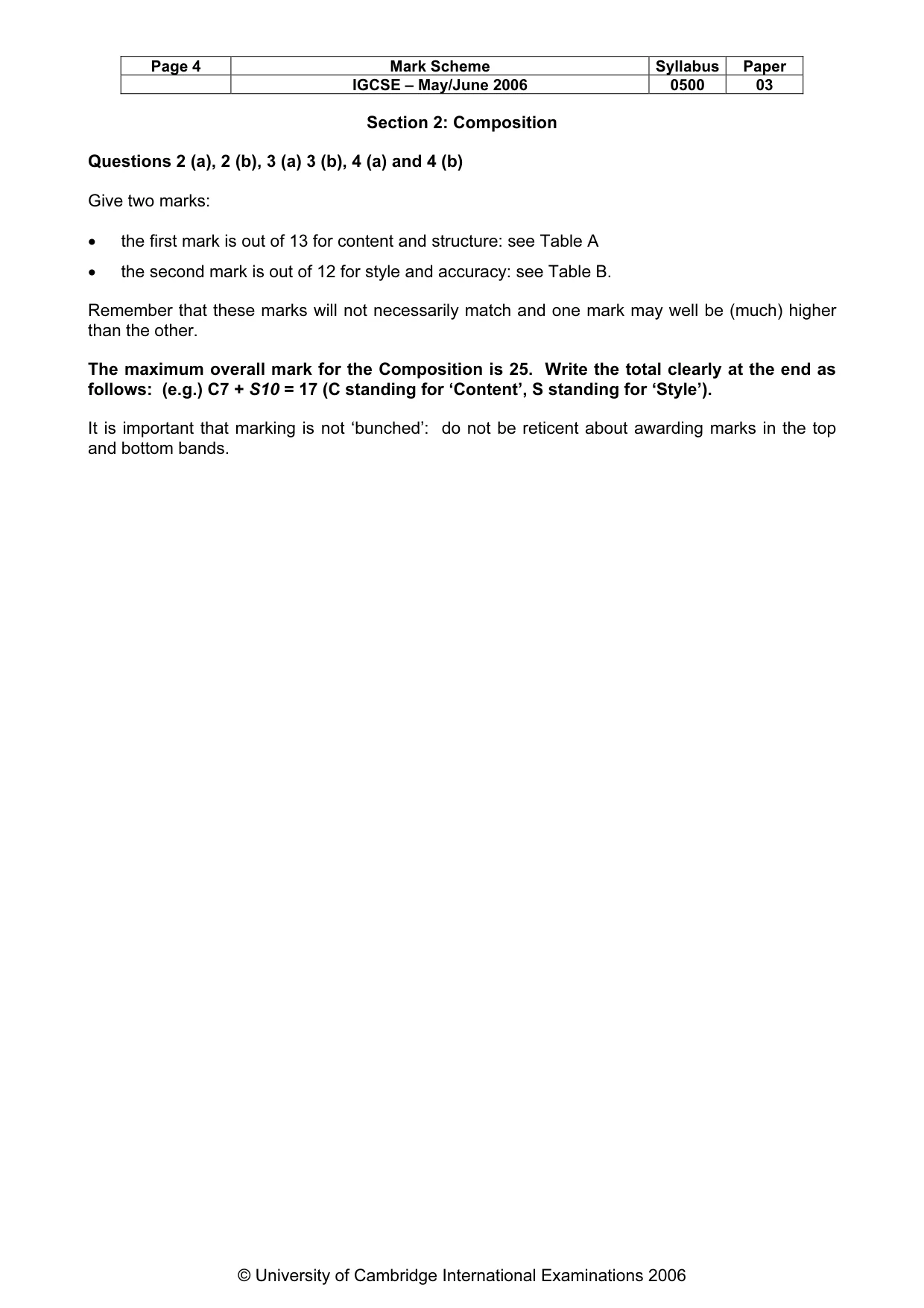
Page 4 Mark Scheme Syllabus Paper IGCSE – May/June 2006 0500 03 © University of Cambridge International Examinations 2006 Section 2: Composition Questions 2 (a), 2 (b), 3 (a) 3 (b), 4 (a) and 4 (b) Give two marks: • the first mark is out of 13 for content and structure: see Table A • the second mark is out of 12 for style and accuracy: see Table B. Remember that these marks will not necessarily match and one mark may well be (much) higher than the other. The maximum overall mark for the Composition is 25. Write the total clearly at the end as follows: (e.g.) C7 + S10 = 17 (C standing for ‘Content’, S standing for ‘Style’). It is important that marking is not ‘bunched’: do not be reticent about awarding marks in the top and bottom bands.
Mark scheme, page 6
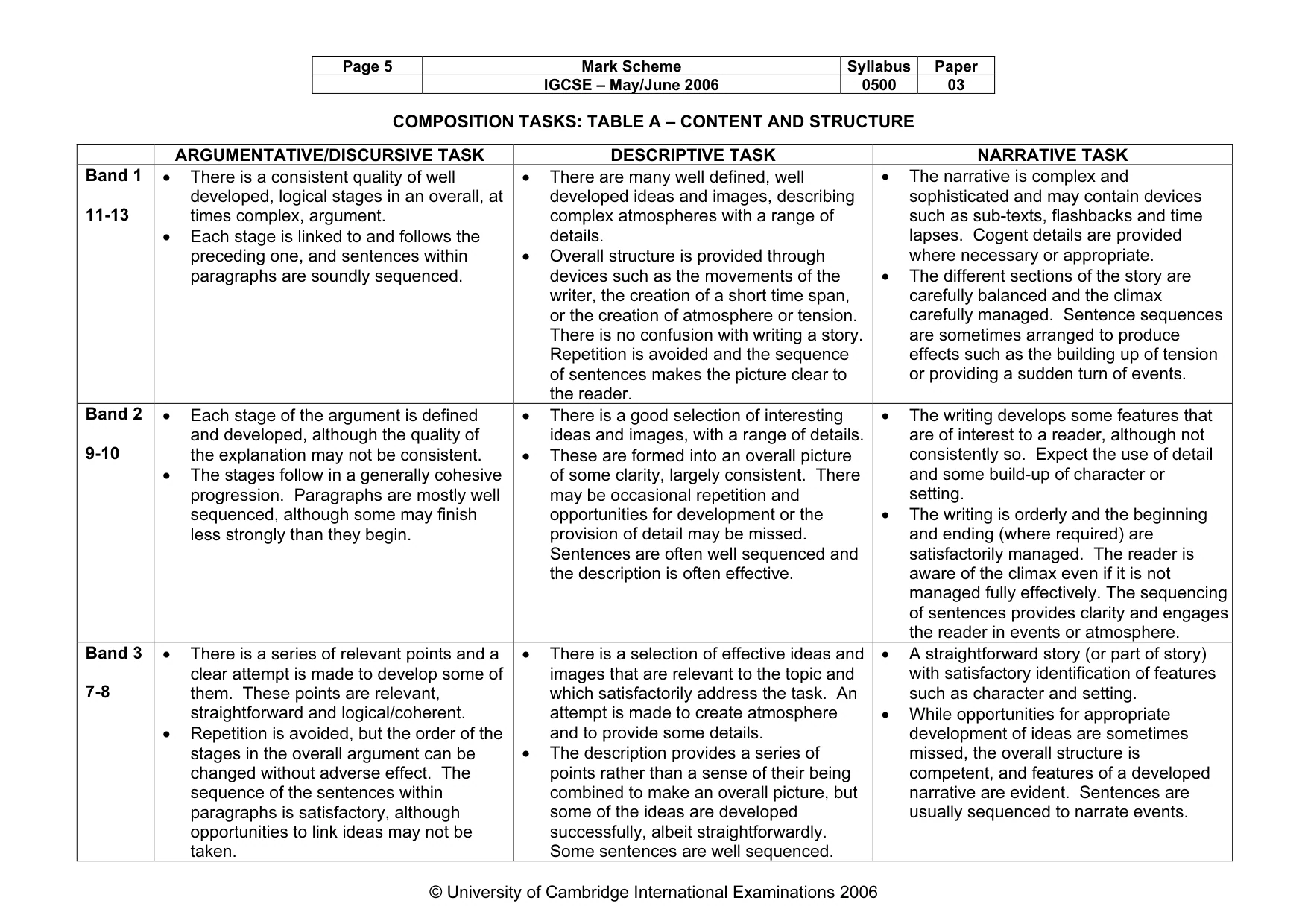
Page 5 Mark Scheme Syllabus Paper IGCSE – May/June 2006 0500 03 © University of Cambridge International Examinations 2006 COMPOSITION TASKS: TABLE A – CONTENT AND STRUCTURE ARGUMENTATIVE/DISCURSIVE TASK DESCRIPTIVE TASK NARRATIVE TASK Band 1 11-13 • There is a consistent quality of well developed, logical stages in an overall, at times complex, argument. • Each stage is linked to and follows the preceding one, and sentences within paragraphs are soundly sequenced. • There are many well defined, well developed ideas and images, describing complex atmospheres with a range of details. • Overall structure is provided through devices such as the movements of the writer, the creation of a short time span, or the creation of atmosphere or tension. There is no confusion with writing a story. Repetition is avoided and the sequence of sentences makes the picture clear to the reader. • The narrative is complex and sophisticated and may contain devices such as sub-texts, flashbacks and time lapses. Cogent details are provided where necessary or appropriate. • The different sections of the story are carefully balanced and the climax carefully managed. Sentence sequences are sometimes arranged to produce effects such as the building up of tension or providing a sudden turn of events. Band 2 9-10 • Each stage of the argument is defined and developed, although the quality of the explanation may not be consistent. • The stages follow in a generally cohesive progression. Paragraphs are mostly well sequenced, although some may finish less strongly than they begin. • There is a good selection of interesting ideas and images, with a range of details. • These are formed into an overall picture of some clarity, largely consistent. There may be occasional repetition and opportunities for development or the provision of detail may be missed. Sentences are often well sequenced and the description is often effective. • The writing develops some features that are of interest to a reader, although not consistently so. Expect the use of detail and some build-up of character or setting. • The writing is orderly and the beginning and ending (where required) are satisfactorily managed. The reader is aware of the climax even if it is not managed fully effectively. The sequencing of sentences provides clarity and engages the reader in events or atmosphere. Band 3 7-8 • There is a series of relevant points and a clear attempt is made to develop some of them. These points are relevant, straightforward and logical/coherent. • Repetition is avoided, but the order of the stages in the overall argument can be changed without adverse effect. The sequence of the sentences within paragraphs is satisfactory, although opportunities to link ideas may not be taken. • There is a selection of effective ideas and images that are relevant to the topic and which satisfactorily address the task. An attempt is made to create atmosphere and to provide some details. • The description provides a series of points rather than a sense of their being combined to make an overall picture, but some of the ideas are developed successfully, albeit straightforwardly. Some sentences are well sequenced. • A straightforward story (or part of story) with satisfactory identification of features such as character and setting. • While opportunities for appropriate development of ideas are sometimes missed, the overall structure is competent, and features of a developed narrative are evident. Sentences are usually sequenced to narrate events.
Mark scheme, page 7
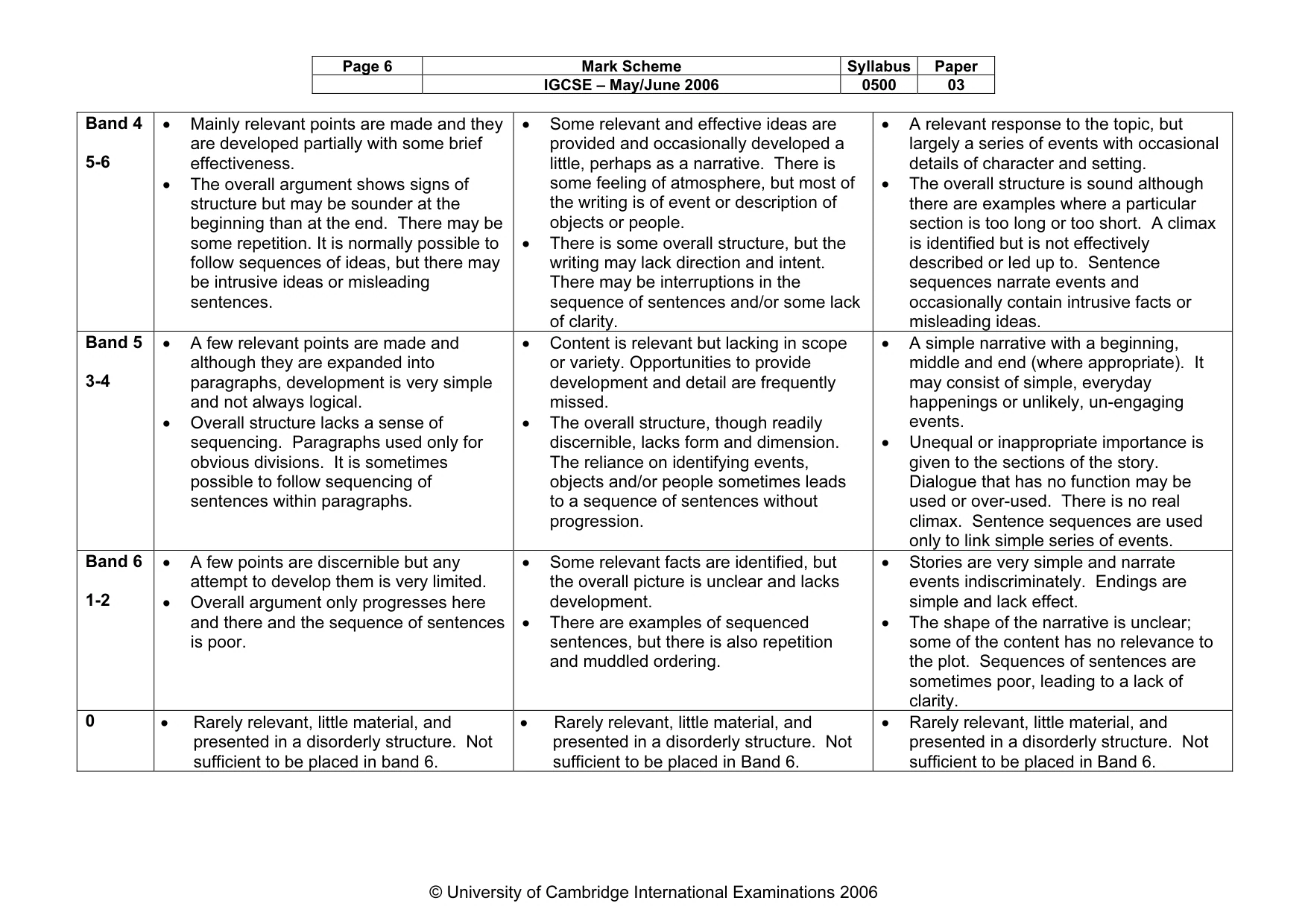
Page 6 Mark Scheme Syllabus Paper IGCSE – May/June 2006 0500 03 © University of Cambridge International Examinations 2006 Band 4 5-6 • Mainly relevant points are made and they are developed partially with some brief effectiveness. • The overall argument shows signs of structure but may be sounder at the beginning than at the end. There may be some repetition. It is normally possible to follow sequences of ideas, but there may be intrusive ideas or misleading sentences. • Some relevant and effective ideas are provided and occasionally developed a little, perhaps as a narrative. There is some feeling of atmosphere, but most of the writing is of event or description of objects or people. • There is some overall structure, but the writing may lack direction and intent. There may be interruptions in the sequence of sentences and/or some lack of clarity. • A relevant response to the topic, but largely a series of events with occasional details of character and setting. • The overall structure is sound although there are examples where a particular section is too long or too short. A climax is identified but is not effectively described or led up to. Sentence sequences narrate events and occasionally contain intrusive facts or misleading ideas. Band 5 3-4 • A few relevant points are made and although they are expanded into paragraphs, development is very simple and not always logical. • Overall structure lacks a sense of sequencing. Paragraphs used only for obvious divisions. It is sometimes possible to follow sequencing of sentences within paragraphs. • Content is relevant but lacking in scope or variety. Opportunities to provide development and detail are frequently missed. • The overall structure, though readily discernible, lacks form and dimension. The reliance on identifying events, objects and/or people sometimes leads to a sequence of sentences without progression. • A simple narrative with a beginning, middle and end (where appropriate). It may consist of simple, everyday happenings or unlikely, un-engaging events. • Unequal or inappropriate importance is given to the sections of the story. Dialogue that has no function may be used or over-used. There is no real climax. Sentence sequences are used only to link simple series of events. Band 6 1-2 • A few points are discernible but any attempt to develop them is very limited. • Overall argument only progresses here and there and the sequence of sentences is poor. • Some relevant facts are identified, but the overall picture is unclear and lacks development. • There are examples of sequenced sentences, but there is also repetition and muddled ordering. • Stories are very simple and narrate events indiscriminately. Endings are simple and lack effect. • The shape of the narrative is unclear; some of the content has no relevance to the plot. Sequences of sentences are sometimes poor, leading to a lack of clarity. 0 • Rarely relevant, little material, and presented in a disorderly structure. Not sufficient to be placed in band 6. • Rarely relevant, little material, and presented in a disorderly structure. Not sufficient to be placed in Band 6. • Rarely relevant, little material, and presented in a disorderly structure. Not sufficient to be placed in Band 6.
Mark scheme, page 8
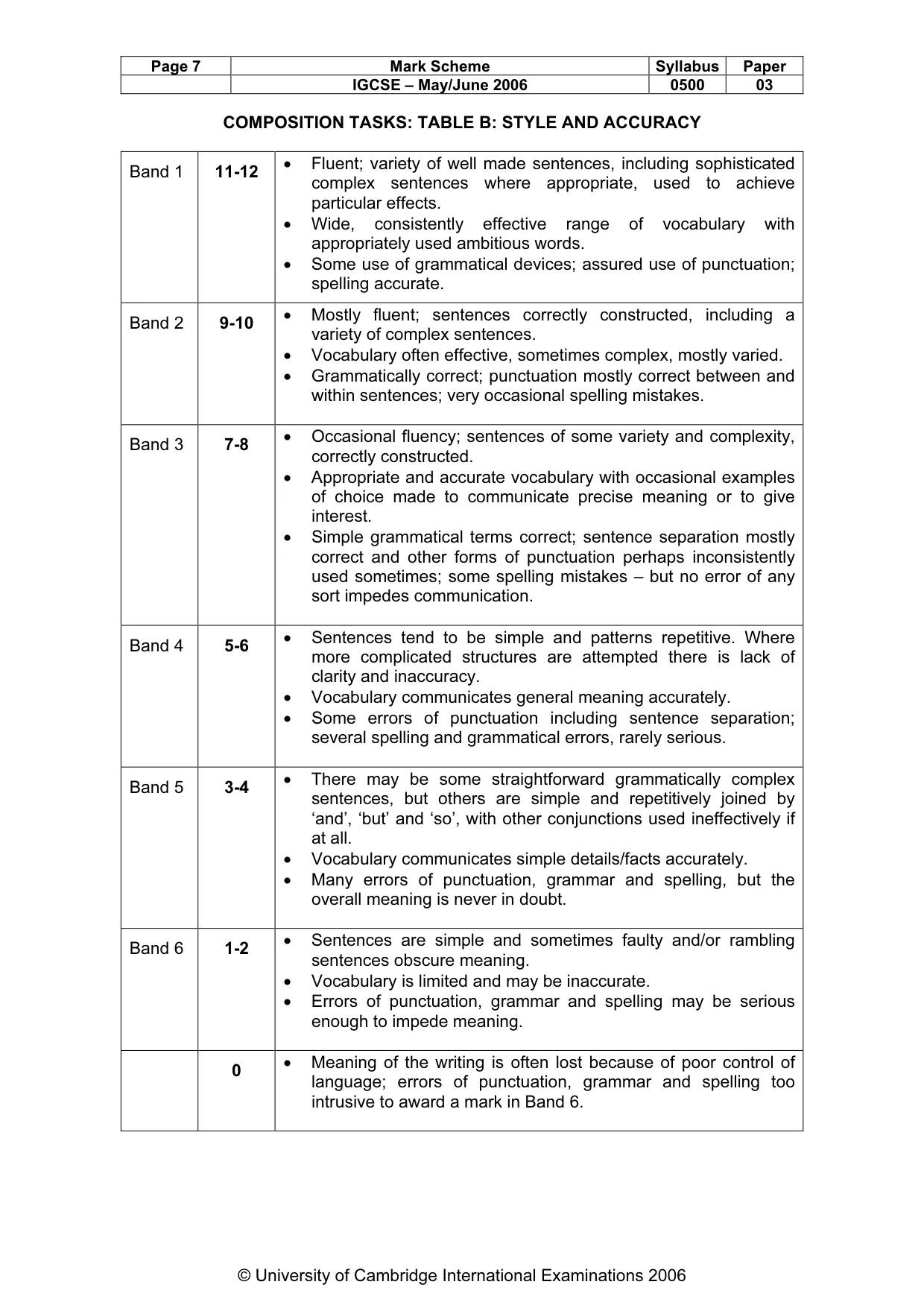
Page 7 Mark Scheme Syllabus Paper IGCSE – May/June 2006 0500 03 © University of Cambridge International Examinations 2006 COMPOSITION TASKS: TABLE B: STYLE AND ACCURACY Band 1 11-12 • Fluent; variety of well made sentences, including sophisticated complex sentences where appropriate, used to achieve particular effects. • Wide, consistently effective range of vocabulary with appropriately used ambitious words. • Some use of grammatical devices; assured use of punctuation; spelling accurate. Band 2 9-10 • Mostly fluent; sentences correctly constructed, including a variety of complex sentences. • Vocabulary often effective, sometimes complex, mostly varied. • Grammatically correct; punctuation mostly correct between and within sentences; very occasional spelling mistakes. Band 3 7-8 • Occasional fluency; sentences of some variety and complexity, correctly constructed. • Appropriate and accurate vocabulary with occasional examples of choice made to communicate precise meaning or to give interest. • Simple grammatical terms correct; sentence separation mostly correct and other forms of punctuation perhaps inconsistently used sometimes; some spelling mistakes – but no error of any sort impedes communication. Band 4 5-6 • Sentences tend to be simple and patterns repetitive. Where more complicated structures are attempted there is lack of clarity and inaccuracy. • Vocabulary communicates general meaning accurately. • Some errors of punctuation including sentence separation; several spelling and grammatical errors, rarely serious. Band 5 3-4 • There may be some straightforward grammatically complex sentences, but others are simple and repetitively joined by ‘and’, ‘but’ and ‘so’, with other conjunctions used ineffectively if at all. • Vocabulary communicates simple details/facts accurately. • Many errors of punctuation, grammar and spelling, but the overall meaning is never in doubt. Band 6 1-2 • Sentences are simple and sometimes faulty and/or rambling sentences obscure meaning. • Vocabulary is limited and may be inaccurate. • Errors of punctuation, grammar and spelling may be serious enough to impede meaning. 0 • Meaning of the writing is often lost because of poor control of language; errors of punctuation, grammar and spelling too intrusive to award a mark in Band 6.
What you needed in this session
Cambridge’s own grade thresholds for 2006 May/June, Paper 3 · Variant 1. A higher threshold means an easier paper — the bar moves with how the cohort did.