Cambridge IGCSE English - First Language 0500 — 2006 May/June Paper 2 · Variant 1
0500/21/M/J/06 · 50 marks · ≈56 min
The question paper and its mark scheme, free to read here and free to download. This is Cambridge’s own paper, exactly as it was sat.
Question paper8 pages


Mark scheme7 pages
Answers below. Sit the paper first if you are practising.
Paper as text
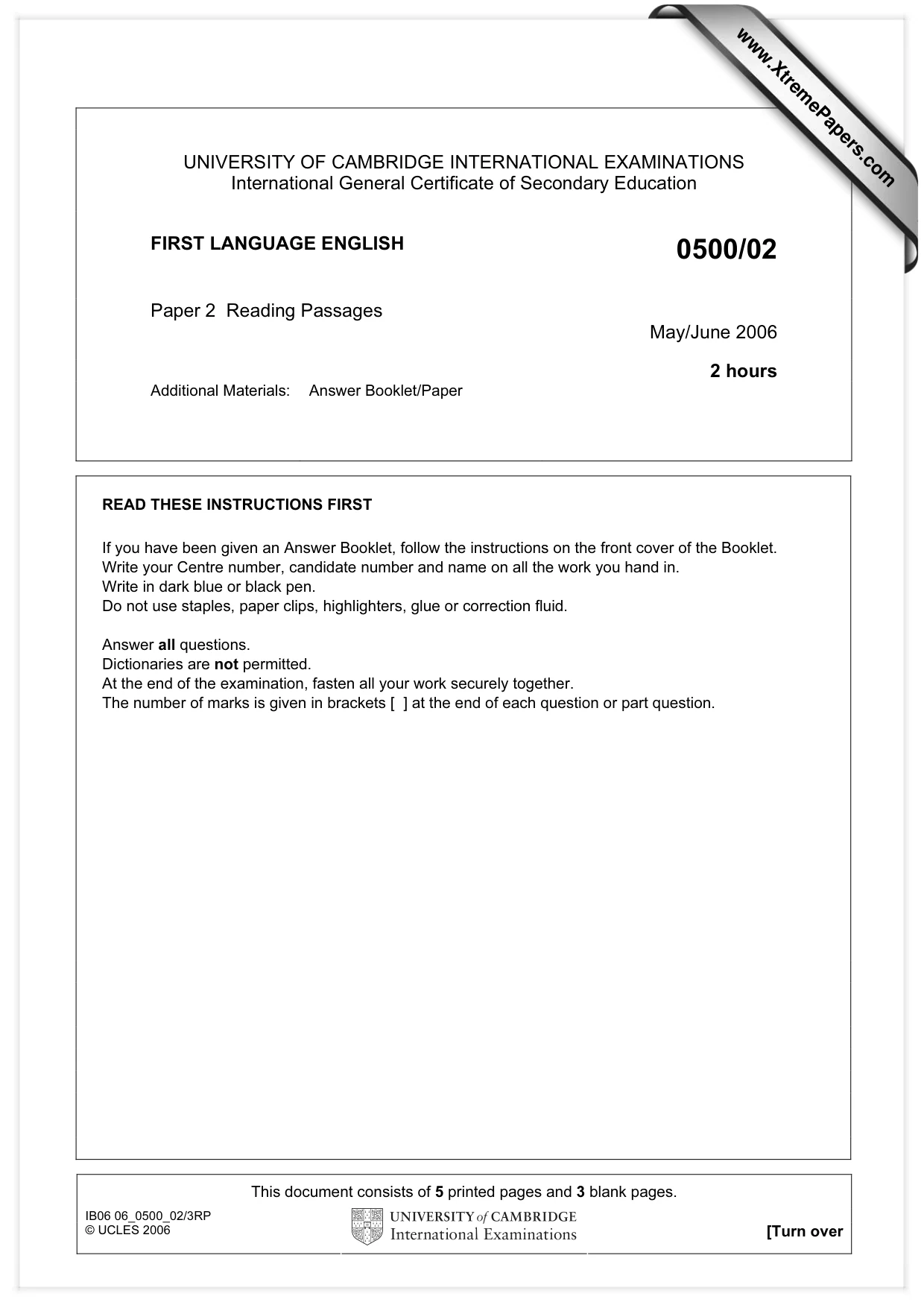
Question paper, page 1
UNIVERSITY OF CAMBRIDGE INTERNATIONAL EXAMINATIONS International General Certificate of Secondary Education FIRST LANGUAGE ENGLISH 0500/02 Paper 2 Reading Passages May/June 2006 2 hours Additional Materials: Answer Booklet/Paper READ THESE INSTRUCTIONS FIRST If you have been given an Answer Booklet, follow the instructions on the front cover of the Booklet. Write your Centre number, candidate number and name on all the work you hand in. Write in dark blue or black pen. Do not use staples, paper clips, highlighters, glue or correction fluid. Answer all questions. Dictionaries are not permitted. At the end of the examination, fasten all your work securely together. The number of marks is given in brackets [ ] at the end of each question or part question. This document consists of 5 printed pages and 3 blank pages. IB06 06_0500_02/3RP © UCLES 2006 [Turn over www.XtremePapers.com
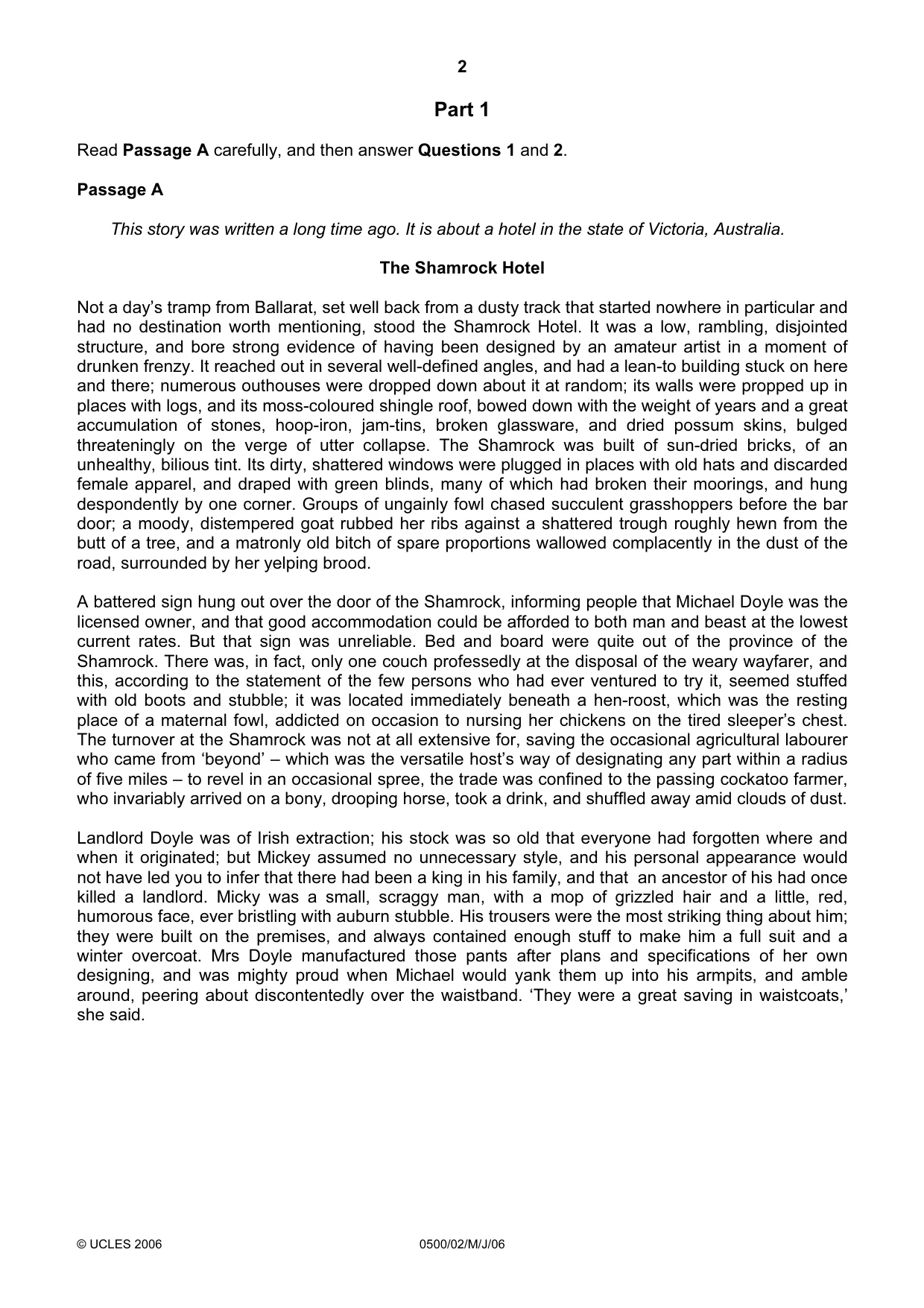
Question paper, page 2
2 © UCLES 2006 0500/02/M/J/06 Part 1 Read Passage A carefully, and then answer Questions 1 and 2. Passage A This story was written a long time ago. It is about a hotel in the state of Victoria, Australia. The Shamrock Hotel Not a day’s tramp from Ballarat, set well back from a dusty track that started nowhere in particular and had no destination worth mentioning, stood the Shamrock Hotel. It was a low, rambling, disjointed structure, and bore strong evidence of having been designed by an amateur artist in a moment of drunken frenzy. It reached out in several well-defined angles, and had a lean-to building stuck on here and there; numerous outhouses were dropped down about it at random; its walls were propped up in places with logs, and its moss-coloured shingle roof, bowed down with the weight of years and a great accumulation of stones, hoop-iron, jam-tins, broken glassware, and dried possum skins, bulged threateningly on the verge of utter collapse. The Shamrock was built of sun-dried bricks, of an unhealthy, bilious tint. Its dirty, shattered windows were plugged in places with old hats and discarded female apparel, and draped with green blinds, many of which had broken their moorings, and hung despondently by one corner. Groups of ungainly fowl chased succulent grasshoppers before the bar door; a moody, distempered goat rubbed her ribs against a shattered trough roughly hewn from the butt of a tree, and a matronly old bitch of spare proportions wallowed complacently in the dust of the road, surrounded by her yelping brood. A battered sign hung out over the door of the Shamrock, informing people that Michael Doyle was the licensed owner, and that good accommodation could be afforded to both man and beast at the lowest current rates. But that sign was unreliable. Bed and board were quite out of the province of the Shamrock. There was, in fact, only one couch professedly at the disposal of the weary wayfarer, and this, according to the statement of the few persons who had ever ventured to try it, seemed stuffed with old boots and stubble; it was located immediately beneath a hen-roost, which was the resting place of a maternal fowl, addicted on occasion to nursing her chickens on the tired sleeper’s chest. The turnover at the Shamrock was not at all extensive for, saving the occasional agricultural labourer who came from ‘beyond’ – which was the versatile host’s way of designating any part within a radius of five miles – to revel in an occasional spree, the trade was confined to the passing cockatoo farmer, who invariably arrived on a bony, drooping horse, took a drink, and shuffled away amid clouds of dust. Landlord Doyle was of Irish extraction; his stock was so old that everyone had forgotten where and when it originated; but Mickey assumed no unnecessary style, and his personal appearance would not have led you to infer that there had been a king in his family, and that an ancestor of his had once killed a landlord. Micky was a small, scraggy man, with a mop of grizzled hair and a little, red, humorous face, ever bristling with auburn stubble. His trousers were the most striking thing about him; they were built on the premises, and always contained enough stuff to make him a full suit and a winter overcoat. Mrs Doyle manufactured those pants after plans and specifications of her own designing, and was mighty proud when Michael would yank them up into his armpits, and amble around, peering about discontentedly over the waistband. ‘They were a great saving in waistcoats,’ she said.
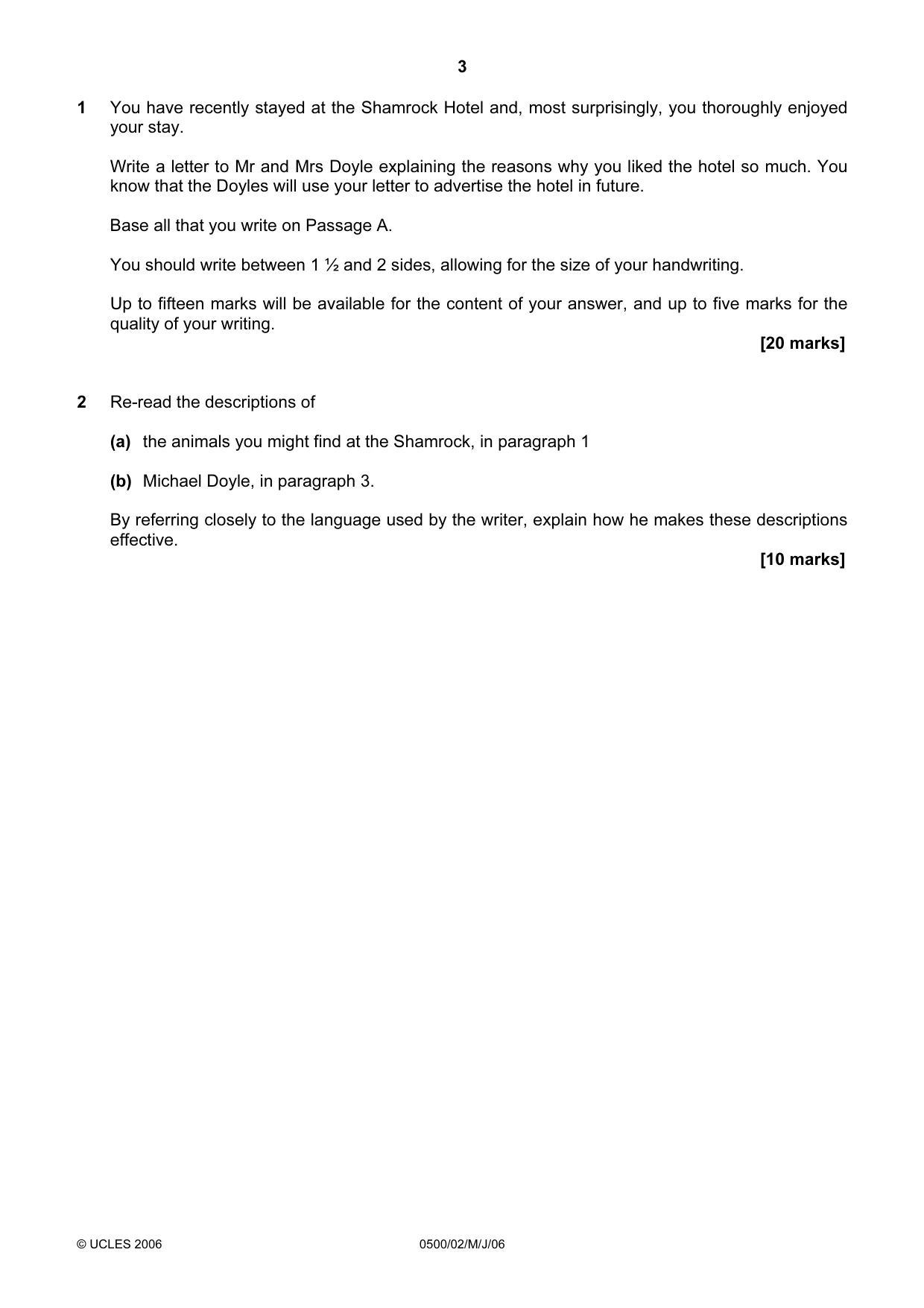
Question paper, page 3
3 © UCLES 2006 0500/02/M/J/06 1 You have recently stayed at the Shamrock Hotel and, most surprisingly, you thoroughly enjoyed your stay. Write a letter to Mr and Mrs Doyle explaining the reasons why you liked the hotel so much. You know that the Doyles will use your letter to advertise the hotel in future. Base all that you write on Passage A. You should write between 1 ½ and 2 sides, allowing for the size of your handwriting. Up to fifteen marks will be available for the content of your answer, and up to five marks for the quality of your writing. [20 marks] 2 Re-read the descriptions of (a) the animals you might find at the Shamrock, in paragraph 1 (b) Michael Doyle, in paragraph 3. By referring closely to the language used by the writer, explain how he makes these descriptions effective. [10 marks]
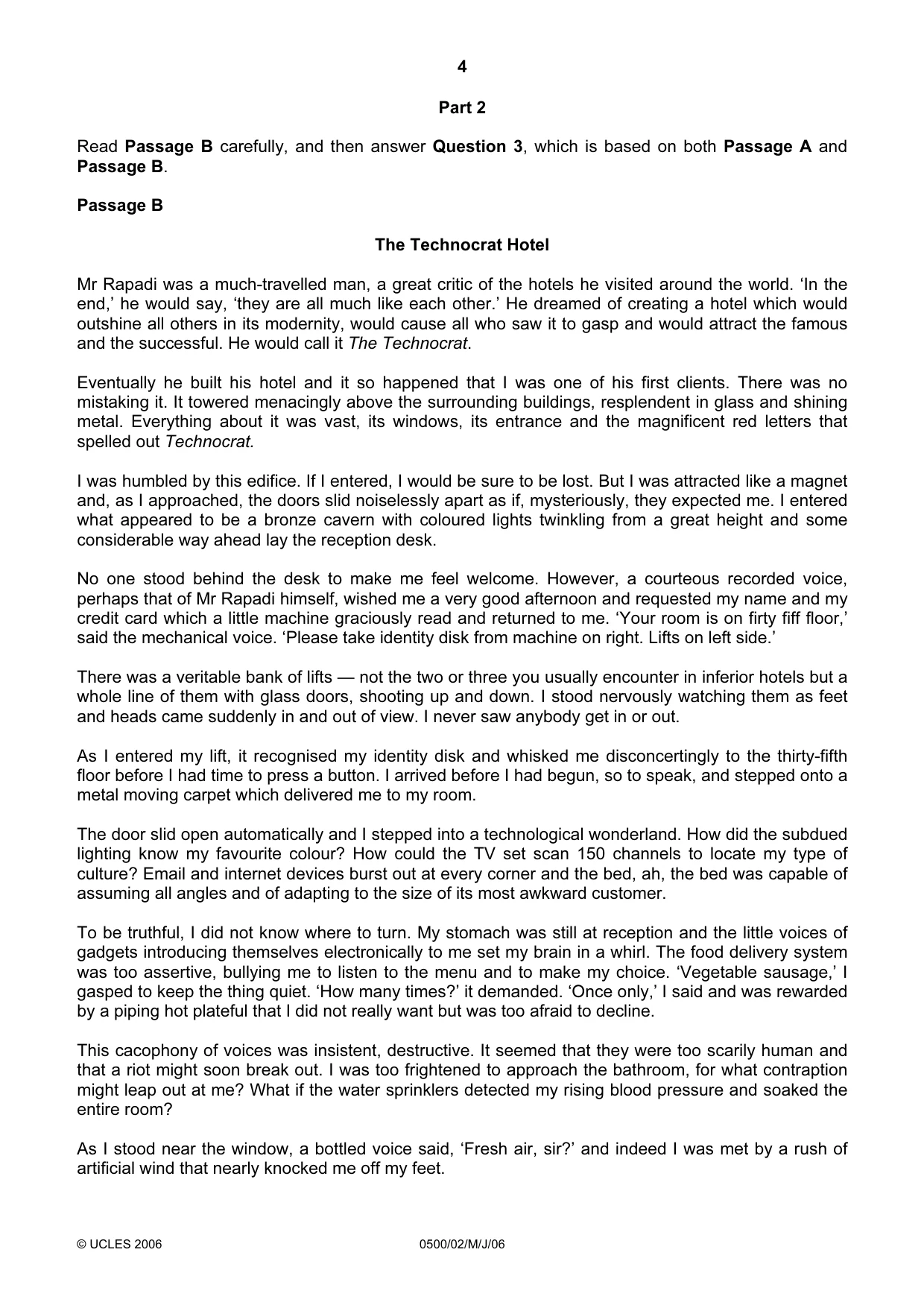
Question paper, page 4
4 © UCLES 2006 0500/02/M/J/06 Part 2 Read Passage B carefully, and then answer Question 3, which is based on both Passage A and Passage B. Passage B The Technocrat Hotel Mr Rapadi was a much-travelled man, a great critic of the hotels he visited around the world. ‘In the end,’ he would say, ‘they are all much like each other.’ He dreamed of creating a hotel which would outshine all others in its modernity, would cause all who saw it to gasp and would attract the famous and the successful. He would call it The Technocrat. Eventually he built his hotel and it so happened that I was one of his first clients. There was no mistaking it. It towered menacingly above the surrounding buildings, resplendent in glass and shining metal. Everything about it was vast, its windows, its entrance and the magnificent red letters that spelled out Technocrat. I was humbled by this edifice. If I entered, I would be sure to be lost. But I was attracted like a magnet and, as I approached, the doors slid noiselessly apart as if, mysteriously, they expected me. I entered what appeared to be a bronze cavern with coloured lights twinkling from a great height and some considerable way ahead lay the reception desk. No one stood behind the desk to make me feel welcome. However, a courteous recorded voice, perhaps that of Mr Rapadi himself, wished me a very good afternoon and requested my name and my credit card which a little machine graciously read and returned to me. ‘Your room is on firty fiff floor,’ said the mechanical voice. ‘Please take identity disk from machine on right. Lifts on left side.’ There was a veritable bank of lifts — not the two or three you usually encounter in inferior hotels but a whole line of them with glass doors, shooting up and down. I stood nervously watching them as feet and heads came suddenly in and out of view. I never saw anybody get in or out. As I entered my lift, it recognised my identity disk and whisked me disconcertingly to the thirty-fifth floor before I had time to press a button. I arrived before I had begun, so to speak, and stepped onto a metal moving carpet which delivered me to my room. The door slid open automatically and I stepped into a technological wonderland. How did the subdued lighting know my favourite colour? How could the TV set scan 150 channels to locate my type of culture? Email and internet devices burst out at every corner and the bed, ah, the bed was capable of assuming all angles and of adapting to the size of its most awkward customer. To be truthful, I did not know where to turn. My stomach was still at reception and the little voices of gadgets introducing themselves electronically to me set my brain in a whirl. The food delivery system was too assertive, bullying me to listen to the menu and to make my choice. ‘Vegetable sausage,’ I gasped to keep the thing quiet. ‘How many times?’ it demanded. ‘Once only,’ I said and was rewarded by a piping hot plateful that I did not really want but was too afraid to decline. This cacophony of voices was insistent, destructive. It seemed that they were too scarily human and that a riot might soon break out. I was too frightened to approach the bathroom, for what contraption might leap out at me? What if the water sprinklers detected my rising blood pressure and soaked the entire room? As I stood near the window, a bottled voice said, ‘Fresh air, sir?’ and indeed I was met by a rush of artificial wind that nearly knocked me off my feet.
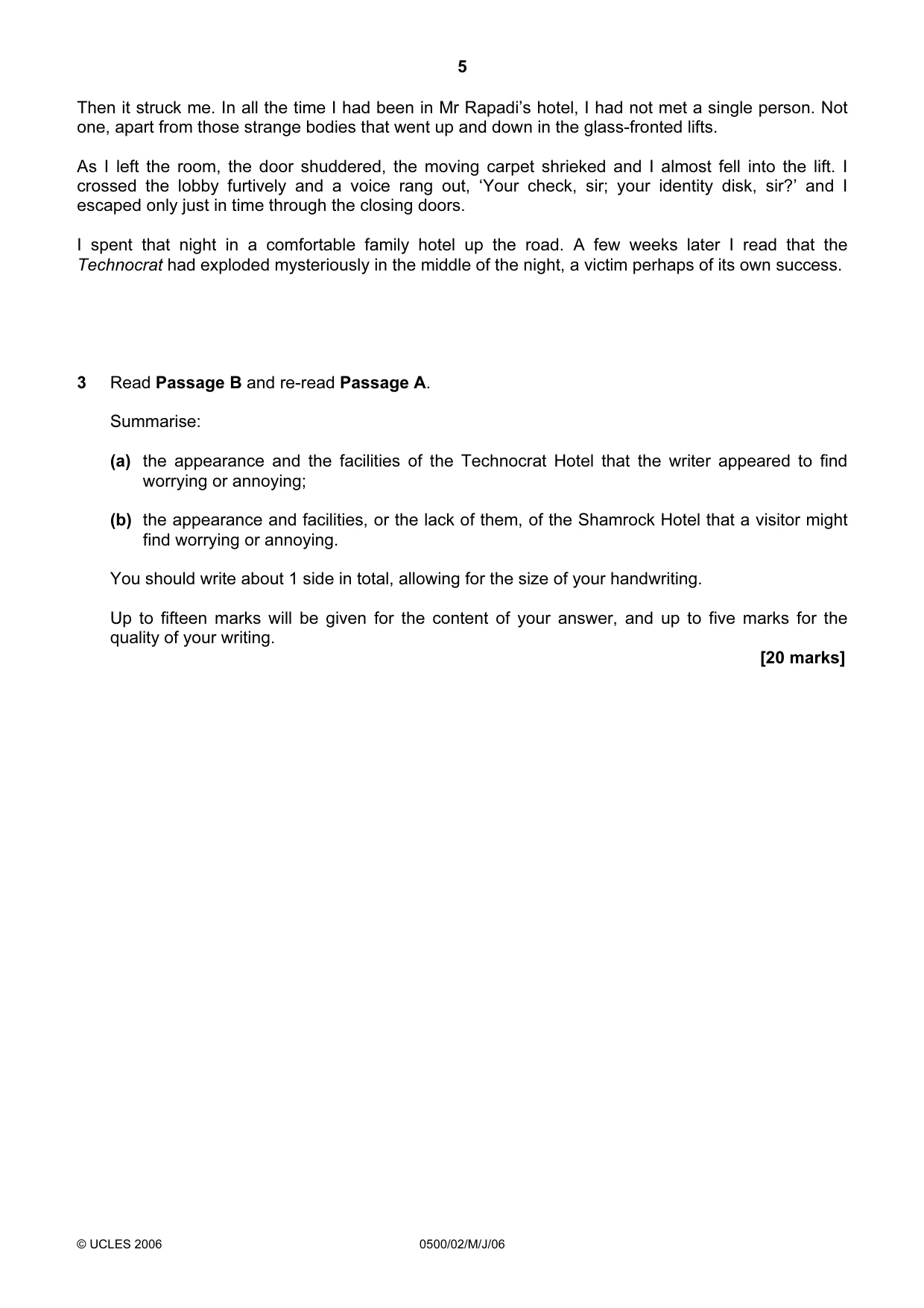
Question paper, page 5
5 © UCLES 2006 0500/02/M/J/06 Then it struck me. In all the time I had been in Mr Rapadi’s hotel, I had not met a single person. Not one, apart from those strange bodies that went up and down in the glass-fronted lifts. As I left the room, the door shuddered, the moving carpet shrieked and I almost fell into the lift. I crossed the lobby furtively and a voice rang out, ‘Your check, sir; your identity disk, sir?’ and I escaped only just in time through the closing doors. I spent that night in a comfortable family hotel up the road. A few weeks later I read that the Technocrat had exploded mysteriously in the middle of the night, a victim perhaps of its own success. 3 Read Passage B and re-read Passage A. Summarise: (a) the appearance and the facilities of the Technocrat Hotel that the writer appeared to find worrying or annoying; (b) the appearance and facilities, or the lack of them, of the Shamrock Hotel that a visitor might find worrying or annoying. You should write about 1 side in total, allowing for the size of your handwriting. Up to fifteen marks will be given for the content of your answer, and up to five marks for the quality of your writing. [20 marks]
Question paper, page 8
8 Copyright Acknowledgements: Passage A A Golden Shanty by Edward Dyson. From an anthology published by Longman Australia Pty Ltd, 1995 Permission to reproduce items where third-party owned material protected by copyright is included has been sought and cleared where possible. Every reasonable effort has been made by the publisher (UCLES) to trace copyright holders, but if any items requiring clearance have unwittingly been included, the publisher will be pleased to make amends at the earliest possible opportunity. University of Cambridge International Examinations is part of the University of Cambridge Local Examinations Syndicate (UCLES), which is itself a department of the University of Cambridge. 0500/02/M/J/06 BLANK PAGE
Mark scheme, page 1
UNIVERSITY OF CAMBRIDGE INTERNATIONAL EXAMINATIONS International General Certificate of Secondary Education MARK SCHEME for the May/June 2006 question paper 0500 FIRST LANGUAGE ENGLISH 0500/02 Paper 2, maximum raw mark 50 These mark schemes are published as an aid to teachers and students, to indicate the requirements of the examination. They show the basis on which Examiners were initially instructed to award marks. They do not indicate the details of the discussions that took place at an Examiners’ meeting before marking began. Any substantial changes to the mark scheme that arose from these discussions will be recorded in the published Report on the Examination. All Examiners are instructed that alternative correct answers and unexpected approaches in candidates’ scripts must be given marks that fairly reflect the relevant knowledge and skills demonstrated. Mark schemes must be read in conjunction with the question papers and the Report on the Examination. The minimum marks in these components needed for various grades were previously published with these mark schemes, but are now instead included in the Report on the Examination for this session. • CIE will not enter into discussion or correspondence in connection with these mark schemes. CIE is publishing the mark schemes for the May/June 2006 question papers for most IGCSE and GCE Advanced Level and Advanced Subsidiary Level syllabuses and some Ordinary Level syllabuses. www.XtremePapers.com
Mark scheme, page 2
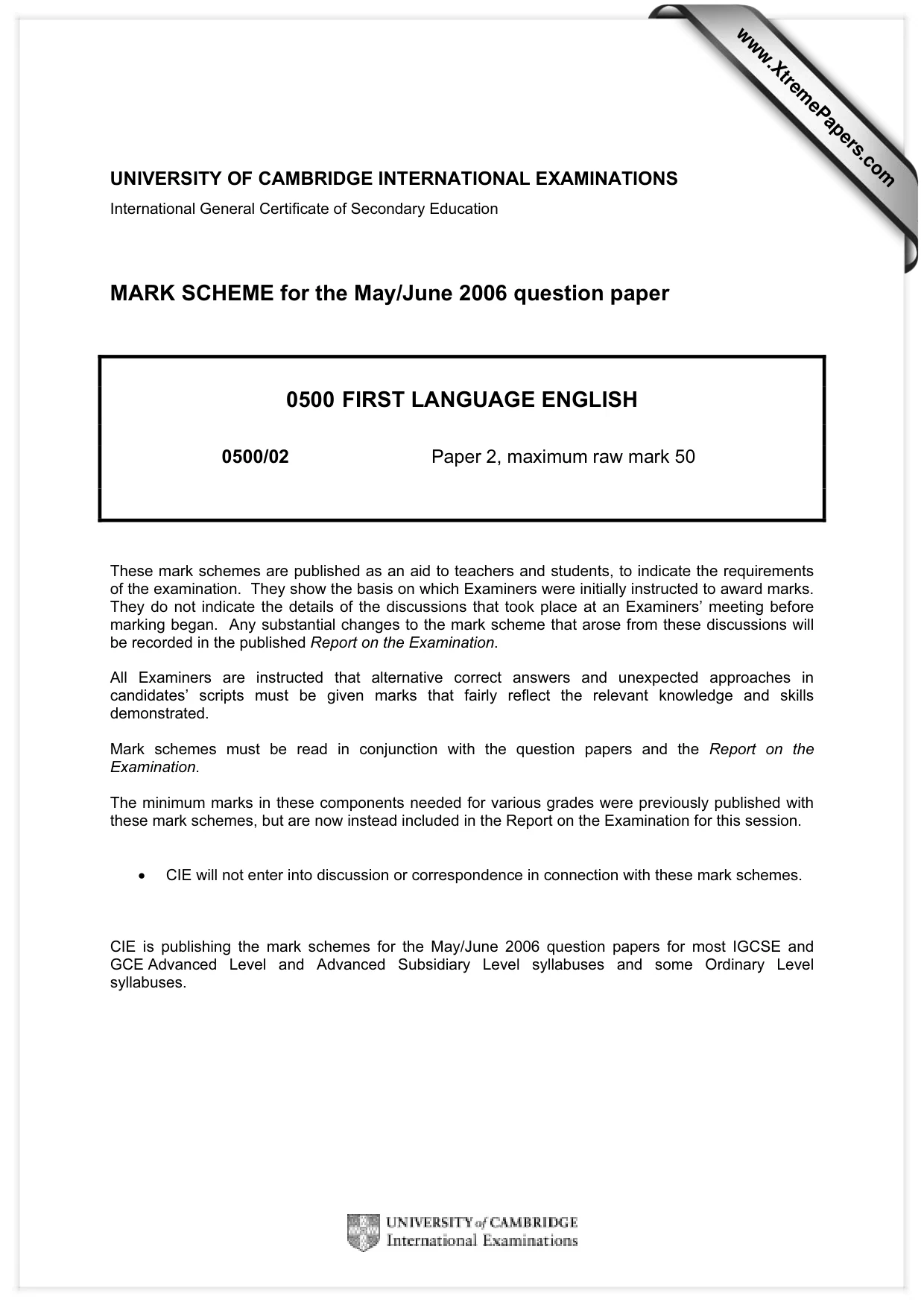
Page 1 Mark Scheme Syllabus Paper IGCSE – May/June 2006 0500 02 © University of Cambridge International Examinations 2006 Question 1: You have recently stayed at the Shamrock Hotel and, most surprisingly, you thoroughly enjoyed your stay. Write a letter to Mr and Mrs Doyle explaining the reasons why you liked the hotel so much. You know that the Doyles will use your letter to advertise the hotel in future. Base all that you say on the passage you have read. Write between one and a half and two sides, allowing for the size of your handwriting. (For this question, 15 marks are allocated to assessment of Reading Objectives R1-R3 (see syllabus); 5 marks are allocated to assessment of Writing Objectives W1-W5 (see syllabus).) General notes on possible content Candidates should find some features from the passage that can be used as reasons for enjoying a visit to the Shamrock and should develop reasons for their appeal. Mark A for attraction and Dev for development (in margin). Be aware of tongue-in-cheek answers, which are just as valid. Look for a neatly thought out answer that recognises a range of opportunities from a thorough reading of the passage. Alternative answers and unexpected approaches in candidates' scripts must be given marks that fairly reflect the relevant knowledge and skills demonstrated. The content must be clearly related to and derived from the passage. Candidates may use the following: 1 The hotel is isolated, therefore a peaceful atmosphere / laid-back / informal 2 (a) The architecture could be interpreted as original, unspoilt, even historic or 'charmingly naive' /’ reference to architects, artists etc. (b) The colouring might be interpreted as attractive shades of yellow brick with a green roof and shutters (not 'bilious'). 3 (a) The presence of animals; rural atmosphere, good for children. (b) Free range hens produce eggs for breakfast; home-cooking. (c) Pets allowed 4 Cost: as stated, 'lowest current rates'. 5 Bed (testing!): maybe comment on soothing farmyard sounds, most likely 'newly refurbished'. 6 People (i) cockatoo farmer: provides company or a reference; interesting local characters (ii) Mr Doyle: humorous (company); good for a 'spree'; comes from a good family; exotic history (iii) Mrs Doyle: kindly? Good with trousers, perhaps repairs to clothing. 7 Close to the road; convenient on a long journey. 8 Reference to rubbish left ‘artistically’ lying about.
Mark scheme, page 3
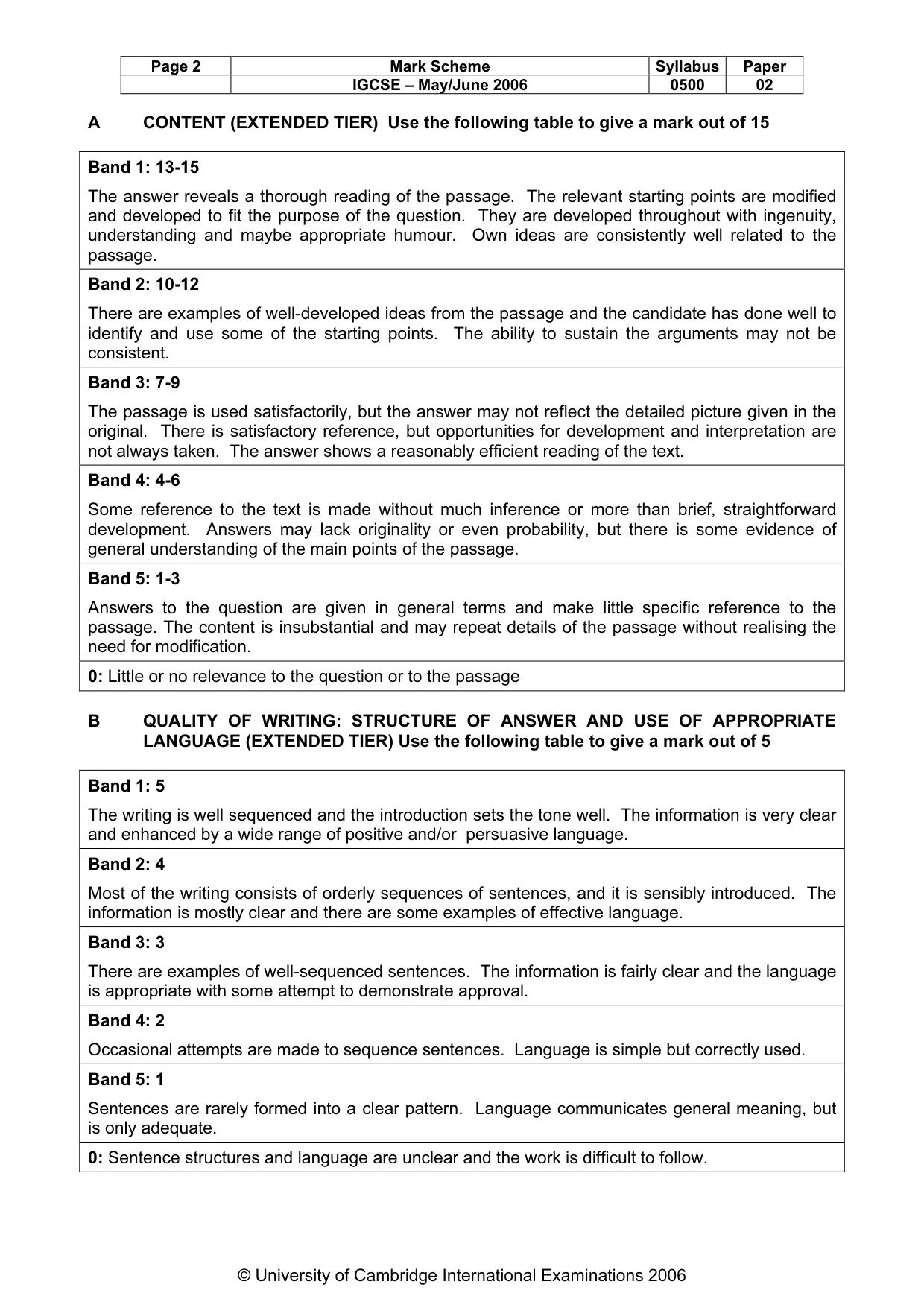
Page 2 Mark Scheme Syllabus Paper IGCSE – May/June 2006 0500 02 © University of Cambridge International Examinations 2006 A CONTENT (EXTENDED TIER) Use the following table to give a mark out of 15 Band 1: 13-15 The answer reveals a thorough reading of the passage. The relevant starting points are modified and developed to fit the purpose of the question. They are developed throughout with ingenuity, understanding and maybe appropriate humour. Own ideas are consistently well related to the passage. Band 2: 10-12 There are examples of well-developed ideas from the passage and the candidate has done well to identify and use some of the starting points. The ability to sustain the arguments may not be consistent. Band 3: 7-9 The passage is used satisfactorily, but the answer may not reflect the detailed picture given in the original. There is satisfactory reference, but opportunities for development and interpretation are not always taken. The answer shows a reasonably efficient reading of the text. Band 4: 4-6 Some reference to the text is made without much inference or more than brief, straightforward development. Answers may lack originality or even probability, but there is some evidence of general understanding of the main points of the passage. Band 5: 1-3 Answers to the question are given in general terms and make little specific reference to the passage. The content is insubstantial and may repeat details of the passage without realising the need for modification. 0: Little or no relevance to the question or to the passage B QUALITY OF WRITING: STRUCTURE OF ANSWER AND USE OF APPROPRIATE LANGUAGE (EXTENDED TIER) Use the following table to give a mark out of 5 Band 1: 5 The writing is well sequenced and the introduction sets the tone well. The information is very clear and enhanced by a wide range of positive and/or persuasive language. Band 2: 4 Most of the writing consists of orderly sequences of sentences, and it is sensibly introduced. The information is mostly clear and there are some examples of effective language. Band 3: 3 There are examples of well-sequenced sentences. The information is fairly clear and the language is appropriate with some attempt to demonstrate approval. Band 4: 2 Occasional attempts are made to sequence sentences. Language is simple but correctly used. Band 5: 1 Sentences are rarely formed into a clear pattern. Language communicates general meaning, but is only adequate. 0: Sentence structures and language are unclear and the work is difficult to follow.
Mark scheme, page 4
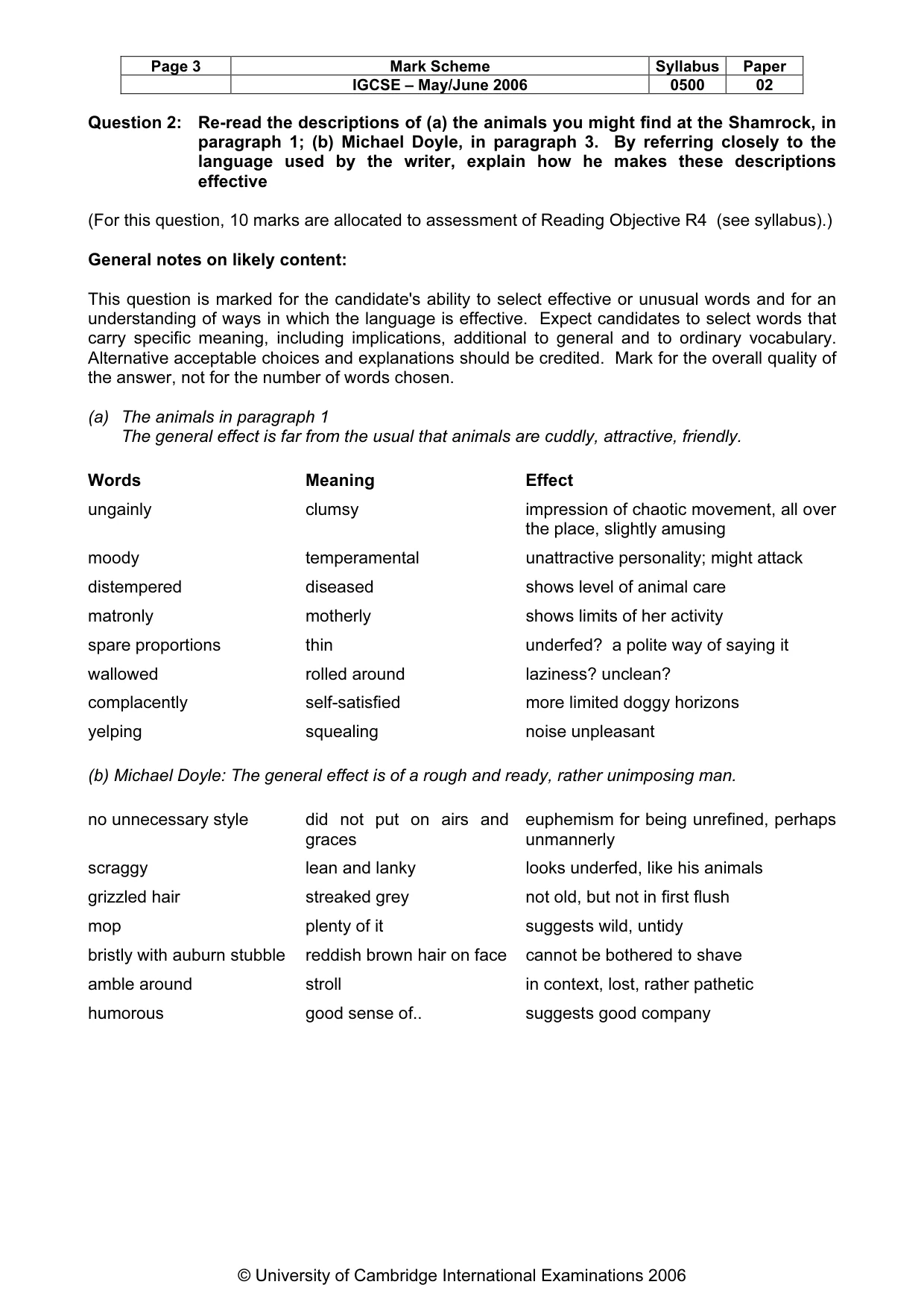
Page 3 Mark Scheme Syllabus Paper IGCSE – May/June 2006 0500 02 © University of Cambridge International Examinations 2006 Question 2: Re-read the descriptions of (a) the animals you might find at the Shamrock, in paragraph 1; (b) Michael Doyle, in paragraph 3. By referring closely to the language used by the writer, explain how he makes these descriptions effective (For this question, 10 marks are allocated to assessment of Reading Objective R4 (see syllabus).) General notes on likely content: This question is marked for the candidate's ability to select effective or unusual words and for an understanding of ways in which the language is effective. Expect candidates to select words that carry specific meaning, including implications, additional to general and to ordinary vocabulary. Alternative acceptable choices and explanations should be credited. Mark for the overall quality of the answer, not for the number of words chosen. (a) The animals in paragraph 1 The general effect is far from the usual that animals are cuddly, attractive, friendly. Words Meaning Effect ungainly clumsy impression of chaotic movement, all over the place, slightly amusing moody temperamental unattractive personality; might attack distempered diseased shows level of animal care matronly motherly shows limits of her activity spare proportions thin underfed? a polite way of saying it wallowed rolled around laziness? unclean? complacently self-satisfied more limited doggy horizons yelping squealing noise unpleasant (b) Michael Doyle: The general effect is of a rough and ready, rather unimposing man. no unnecessary style did not put on airs and graces euphemism for being unrefined, perhaps unmannerly scraggy lean and lanky looks underfed, like his animals grizzled hair streaked grey not old, but not in first flush mop plenty of it suggests wild, untidy bristly with auburn stubble reddish brown hair on face cannot be bothered to shave amble around stroll in context, lost, rather pathetic humorous good sense of.. suggests good company
Mark scheme, page 5
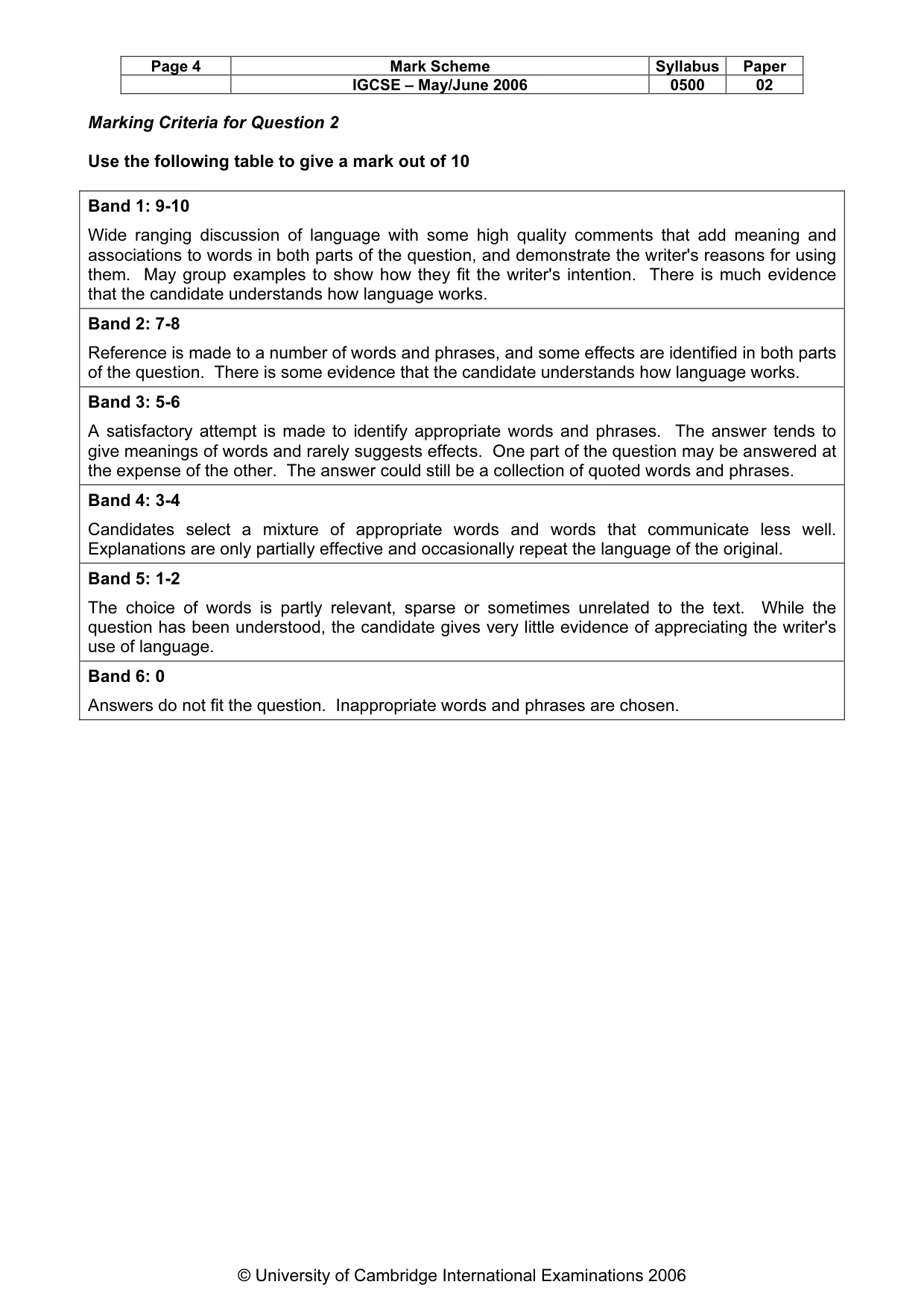
Page 4 Mark Scheme Syllabus Paper IGCSE – May/June 2006 0500 02 © University of Cambridge International Examinations 2006 Marking Criteria for Question 2 Use the following table to give a mark out of 10 Band 1: 9-10 Wide ranging discussion of language with some high quality comments that add meaning and associations to words in both parts of the question, and demonstrate the writer's reasons for using them. May group examples to show how they fit the writer's intention. There is much evidence that the candidate understands how language works. Band 2: 7-8 Reference is made to a number of words and phrases, and some effects are identified in both parts of the question. There is some evidence that the candidate understands how language works. Band 3: 5-6 A satisfactory attempt is made to identify appropriate words and phrases. The answer tends to give meanings of words and rarely suggests effects. One part of the question may be answered at the expense of the other. The answer could still be a collection of quoted words and phrases. Band 4: 3-4 Candidates select a mixture of appropriate words and words that communicate less well. Explanations are only partially effective and occasionally repeat the language of the original. Band 5: 1-2 The choice of words is partly relevant, sparse or sometimes unrelated to the text. While the question has been understood, the candidate gives very little evidence of appreciating the writer's use of language. Band 6: 0 Answers do not fit the question. Inappropriate words and phrases are chosen.
Mark scheme, page 6
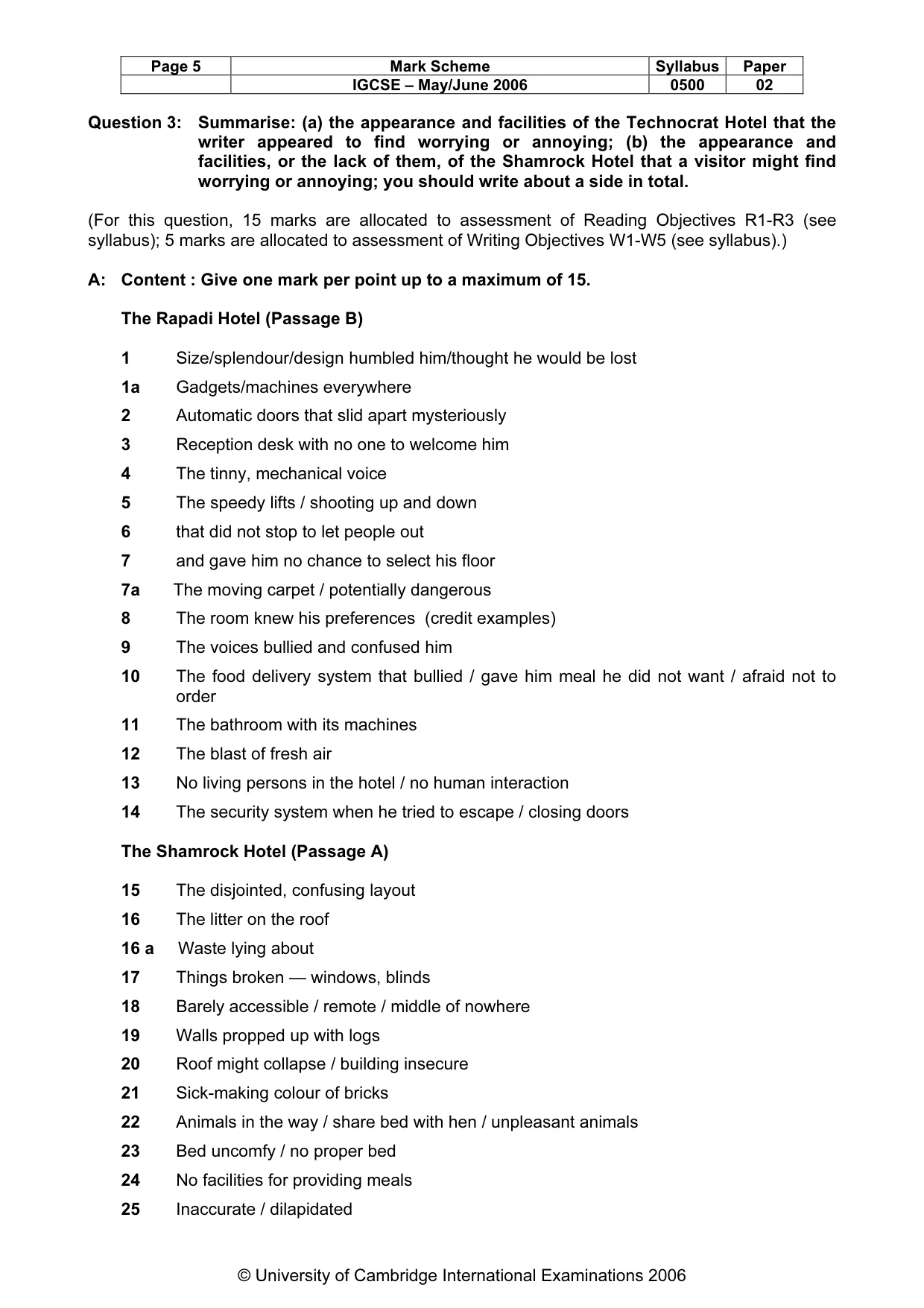
Page 5 Mark Scheme Syllabus Paper IGCSE – May/June 2006 0500 02 © University of Cambridge International Examinations 2006 Question 3: Summarise: (a) the appearance and facilities of the Technocrat Hotel that the writer appeared to find worrying or annoying; (b) the appearance and facilities, or the lack of them, of the Shamrock Hotel that a visitor might find worrying or annoying; you should write about a side in total. (For this question, 15 marks are allocated to assessment of Reading Objectives R1-R3 (see syllabus); 5 marks are allocated to assessment of Writing Objectives W1-W5 (see syllabus).) A: Content : Give one mark per point up to a maximum of 15. The Rapadi Hotel (Passage B) 1 Size/splendour/design humbled him/thought he would be lost 1a Gadgets/machines everywhere 2 Automatic doors that slid apart mysteriously 3 Reception desk with no one to welcome him 4 The tinny, mechanical voice 5 The speedy lifts / shooting up and down 6 that did not stop to let people out 7 and gave him no chance to select his floor 7a The moving carpet / potentially dangerous 8 The room knew his preferences (credit examples) 9 The voices bullied and confused him 10 The food delivery system that bullied / gave him meal he did not want / afraid not to order 11 The bathroom with its machines 12 The blast of fresh air 13 No living persons in the hotel / no human interaction 14 The security system when he tried to escape / closing doors The Shamrock Hotel (Passage A) 15 The disjointed, confusing layout 16 The litter on the roof 16 a Waste lying about 17 Things broken — windows, blinds 18 Barely accessible / remote / middle of nowhere 19 Walls propped up with logs 20 Roof might collapse / building insecure 21 Sick-making colour of bricks 22 Animals in the way / share bed with hen / unpleasant animals 23 Bed uncomfy / no proper bed 24 No facilities for providing meals 25 Inaccurate / dilapidated
Mark scheme, page 7
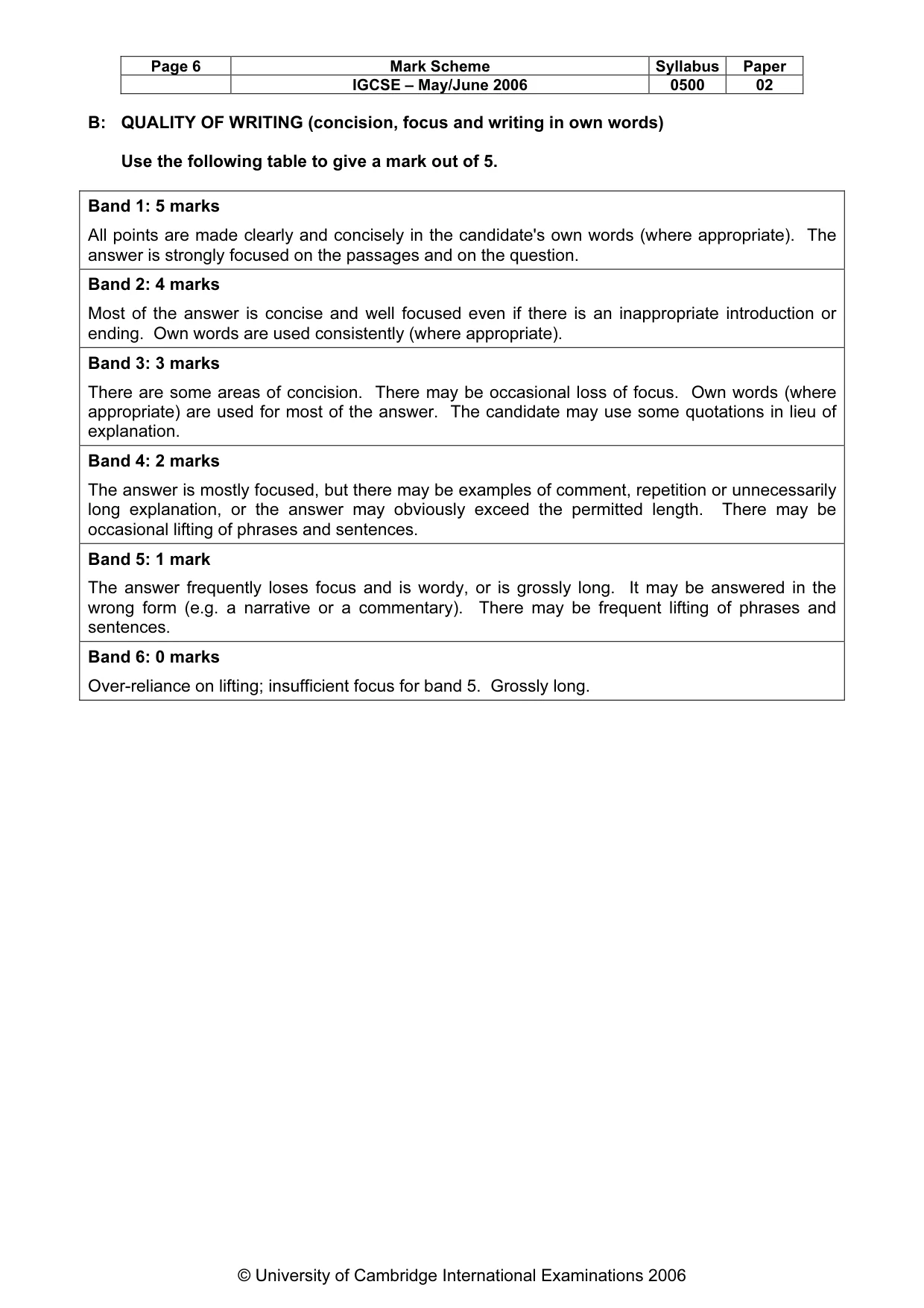
Page 6 Mark Scheme Syllabus Paper IGCSE – May/June 2006 0500 02 © University of Cambridge International Examinations 2006 B: QUALITY OF WRITING (concision, focus and writing in own words) Use the following table to give a mark out of 5. Band 1: 5 marks All points are made clearly and concisely in the candidate's own words (where appropriate). The answer is strongly focused on the passages and on the question. Band 2: 4 marks Most of the answer is concise and well focused even if there is an inappropriate introduction or ending. Own words are used consistently (where appropriate). Band 3: 3 marks There are some areas of concision. There may be occasional loss of focus. Own words (where appropriate) are used for most of the answer. The candidate may use some quotations in lieu of explanation. Band 4: 2 marks The answer is mostly focused, but there may be examples of comment, repetition or unnecessarily long explanation, or the answer may obviously exceed the permitted length. There may be occasional lifting of phrases and sentences. Band 5: 1 mark The answer frequently loses focus and is wordy, or is grossly long. It may be answered in the wrong form (e.g. a narrative or a commentary). There may be frequent lifting of phrases and sentences. Band 6: 0 marks Over-reliance on lifting; insufficient focus for band 5. Grossly long.
What you needed in this session
Cambridge’s own grade thresholds for 2006 May/June, Paper 2 · Variant 1. A higher threshold means an easier paper — the bar moves with how the cohort did.