Cambridge IGCSE English - First Language 0500 — 2006 May/June Paper 1 · Variant 1
0500/11/M/J/06 · 50 marks · ≈56 min
The question paper and its mark scheme, free to read here and free to download. This is Cambridge’s own paper, exactly as it was sat.
Question paper4 pages
Mark scheme6 pages
Answers below. Sit the paper first if you are practising.
Paper as text
Question paper, page 1
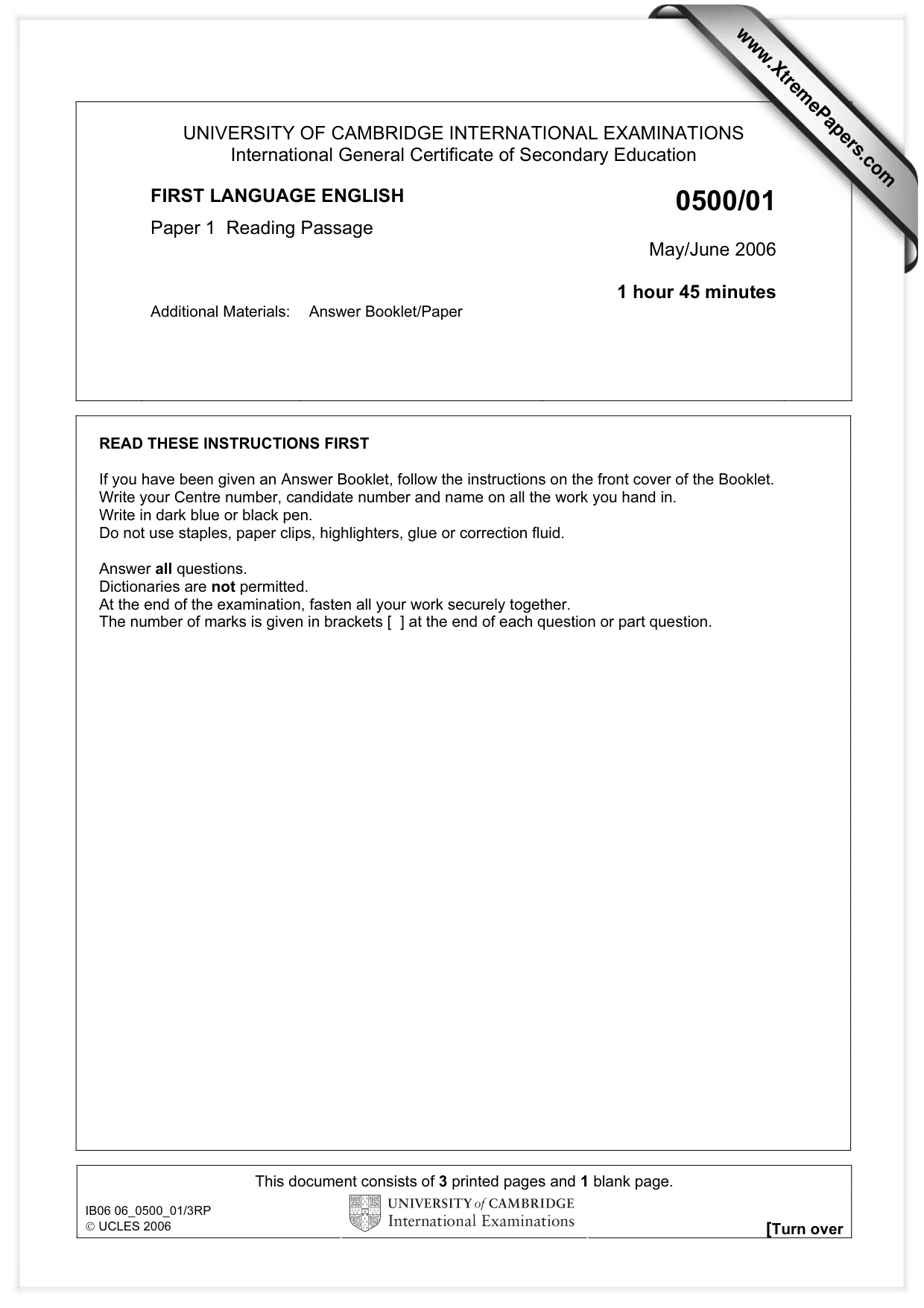
UNIVERSITY OF CAMBRIDGE INTERNATIONAL EXAMINATIONS International General Certificate of Secondary Education FIRST LANGUAGE ENGLISH 0500/01 Paper 1 Reading Passage May/June 2006 1 hour 45 minutes Additional Materials: Answer Booklet/Paper READ THESE INSTRUCTIONS FIRST If you have been given an Answer Booklet, follow the instructions on the front cover of the Booklet. Write your Centre number, candidate number and name on all the work you hand in. Write in dark blue or black pen. Do not use staples, paper clips, highlighters, glue or correction fluid. Answer all questions. Dictionaries are not permitted. At the end of the examination, fasten all your work securely together. The number of marks is given in brackets [ ] at the end of each question or part question. This document consists of 3 printed pages and 1 blank page. IB06 06_0500_01/3RP UCLES 2006 [Turn over www.XtremePapers.com
Question paper, page 2
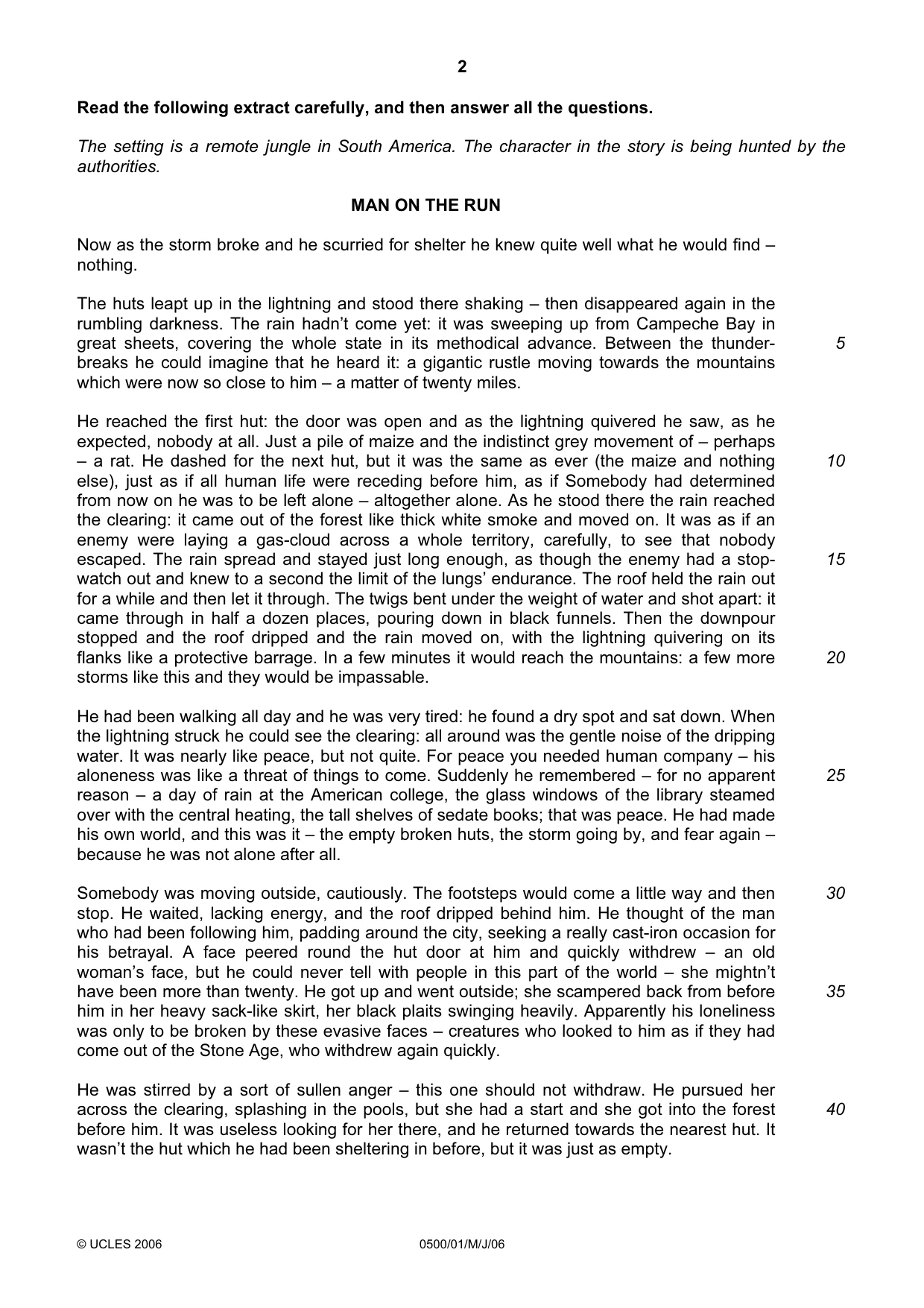
2 © UCLES 2006 0500/01/M/J/06 Read the following extract carefully, and then answer all the questions. The setting is a remote jungle in South America. The character in the story is being hunted by the authorities. MAN ON THE RUN Now as the storm broke and he scurried for shelter he knew quite well what he would find – nothing. The huts leapt up in the lightning and stood there shaking – then disappeared again in the rumbling darkness. The rain hadn’t come yet: it was sweeping up from Campeche Bay in great sheets, covering the whole state in its methodical advance. Between the thunder- breaks he could imagine that he heard it: a gigantic rustle moving towards the mountains which were now so close to him – a matter of twenty miles. 5 He reached the first hut: the door was open and as the lightning quivered he saw, as he expected, nobody at all. Just a pile of maize and the indistinct grey movement of – perhaps – a rat. He dashed for the next hut, but it was the same as ever (the maize and nothing else), just as if all human life were receding before him, as if Somebody had determined from now on he was to be left alone – altogether alone. As he stood there the rain reached the clearing: it came out of the forest like thick white smoke and moved on. It was as if an enemy were laying a gas-cloud across a whole territory, carefully, to see that nobody escaped. The rain spread and stayed just long enough, as though the enemy had a stop- watch out and knew to a second the limit of the lungs’ endurance. The roof held the rain out for a while and then let it through. The twigs bent under the weight of water and shot apart: it came through in half a dozen places, pouring down in black funnels. Then the downpour stopped and the roof dripped and the rain moved on, with the lightning quivering on its flanks like a protective barrage. In a few minutes it would reach the mountains: a few more storms like this and they would be impassable. 10 15 20 He had been walking all day and he was very tired: he found a dry spot and sat down. When the lightning struck he could see the clearing: all around was the gentle noise of the dripping water. It was nearly like peace, but not quite. For peace you needed human company – his aloneness was like a threat of things to come. Suddenly he remembered – for no apparent reason – a day of rain at the American college, the glass windows of the library steamed over with the central heating, the tall shelves of sedate books; that was peace. He had made his own world, and this was it – the empty broken huts, the storm going by, and fear again – because he was not alone after all. 25 Somebody was moving outside, cautiously. The footsteps would come a little way and then stop. He waited, lacking energy, and the roof dripped behind him. He thought of the man who had been following him, padding around the city, seeking a really cast-iron occasion for his betrayal. A face peered round the hut door at him and quickly withdrew – an old woman’s face, but he could never tell with people in this part of the world – she mightn’t have been more than twenty. He got up and went outside; she scampered back from before him in her heavy sack-like skirt, her black plaits swinging heavily. Apparently his loneliness was only to be broken by these evasive faces – creatures who looked to him as if they had come out of the Stone Age, who withdrew again quickly. 30 35 He was stirred by a sort of sullen anger – this one should not withdraw. He pursued her across the clearing, splashing in the pools, but she had a start and she got into the forest before him. It was useless looking for her there, and he returned towards the nearest hut. It wasn’t the hut which he had been sheltering in before, but it was just as empty. 40
Question paper, page 3
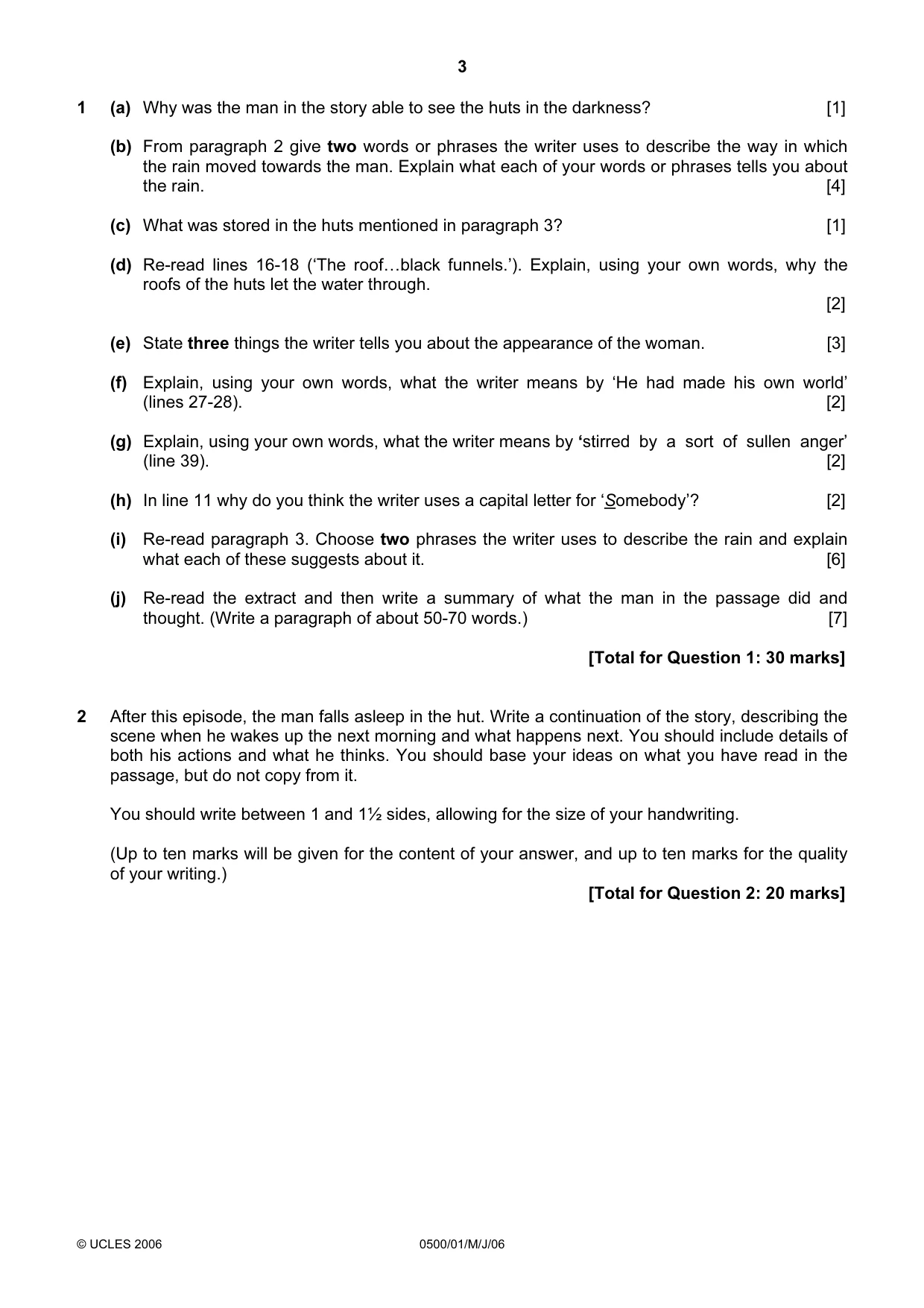
3 © UCLES 2006 0500/01/M/J/06 1 (a) Why was the man in the story able to see the huts in the darkness? [1] (b) From paragraph 2 give two words or phrases the writer uses to describe the way in which the rain moved towards the man. Explain what each of your words or phrases tells you about the rain. [4] (c) What was stored in the huts mentioned in paragraph 3? [1] (d) Re-read lines 16-18 (‘The roof…black funnels.’). Explain, using your own words, why the roofs of the huts let the water through. [2] (e) State three things the writer tells you about the appearance of the woman. [3] (f) Explain, using your own words, what the writer means by ‘He had made his own world’ (lines 27-28). [2] (g) Explain, using your own words, what the writer means by ‘stirred by a sort of sullen anger’ (line 39). [2] (h) In line 11 why do you think the writer uses a capital letter for ‘Somebody’? [2] (i) Re-read paragraph 3. Choose two phrases the writer uses to describe the rain and explain what each of these suggests about it. [6] (j) Re-read the extract and then write a summary of what the man in the passage did and thought. (Write a paragraph of about 50-70 words.) [7] [Total for Question 1: 30 marks] 2 After this episode, the man falls asleep in the hut. Write a continuation of the story, describing the scene when he wakes up the next morning and what happens next. You should include details of both his actions and what he thinks. You should base your ideas on what you have read in the passage, but do not copy from it. You should write between 1 and 1½ sides, allowing for the size of your handwriting. (Up to ten marks will be given for the content of your answer, and up to ten marks for the quality of your writing.) [Total for Question 2: 20 marks]
Question paper, page 4
4 0500/01/M/J/06 BLANK PAGE Copyright Acknowledgements: Passage From THE POWER AND THE GLORY by Graham Greene, copyright 1940, renewed © 1968 by Graham Greene. Used by permission of Viking Penguin, a division of Penguin Group (USA) Inc. Permission to reproduce items where third-party owned material protected by copyright is included has been sought and cleared where possible. Every reasonable effort has been made by the publisher (UCLES) to trace copyright holders, but if any items requiring clearance have unwittingly been included, the publisher will be pleased to make amends at the earliest possible opportunity. University of Cambridge International Examinations is part of the University of Cambridge Local Examinations Syndicate (UCLES), which is itself a department of the University of Cambridge.
Mark scheme, page 1
UNIVERSITY OF CAMBRIDGE INTERNATIONAL EXAMINATIONS International General Certificate of Secondary Education MARK SCHEME for the May/June 2006 question paper 0500 FIRST LANGUAGE ENGLISH 0500/01 Paper 1, maximum raw mark 50 These mark schemes are published as an aid to teachers and students, to indicate the requirements of the examination. They show the basis on which Examiners were initially instructed to award marks. They do not indicate the details of the discussions that took place at an Examiners’ meeting before marking began. Any substantial changes to the mark scheme that arose from these discussions will be recorded in the published Report on the Examination. All Examiners are instructed that alternative correct answers and unexpected approaches in candidates’ scripts must be given marks that fairly reflect the relevant knowledge and skills demonstrated. Mark schemes must be read in conjunction with the question papers and the Report on the Examination. The minimum marks in these components needed for various grades were previously published with these mark schemes, but are now instead included in the Report on the Examination for this session. • CIE will not enter into discussion or correspondence in connection with these mark schemes. CIE is publishing the mark schemes for the May/June 2006 question papers for most IGCSE and GCE Advanced Level and Advanced Subsidiary Level syllabuses and some Ordinary Level syllabuses. www.XtremePapers.com
Mark scheme, page 2
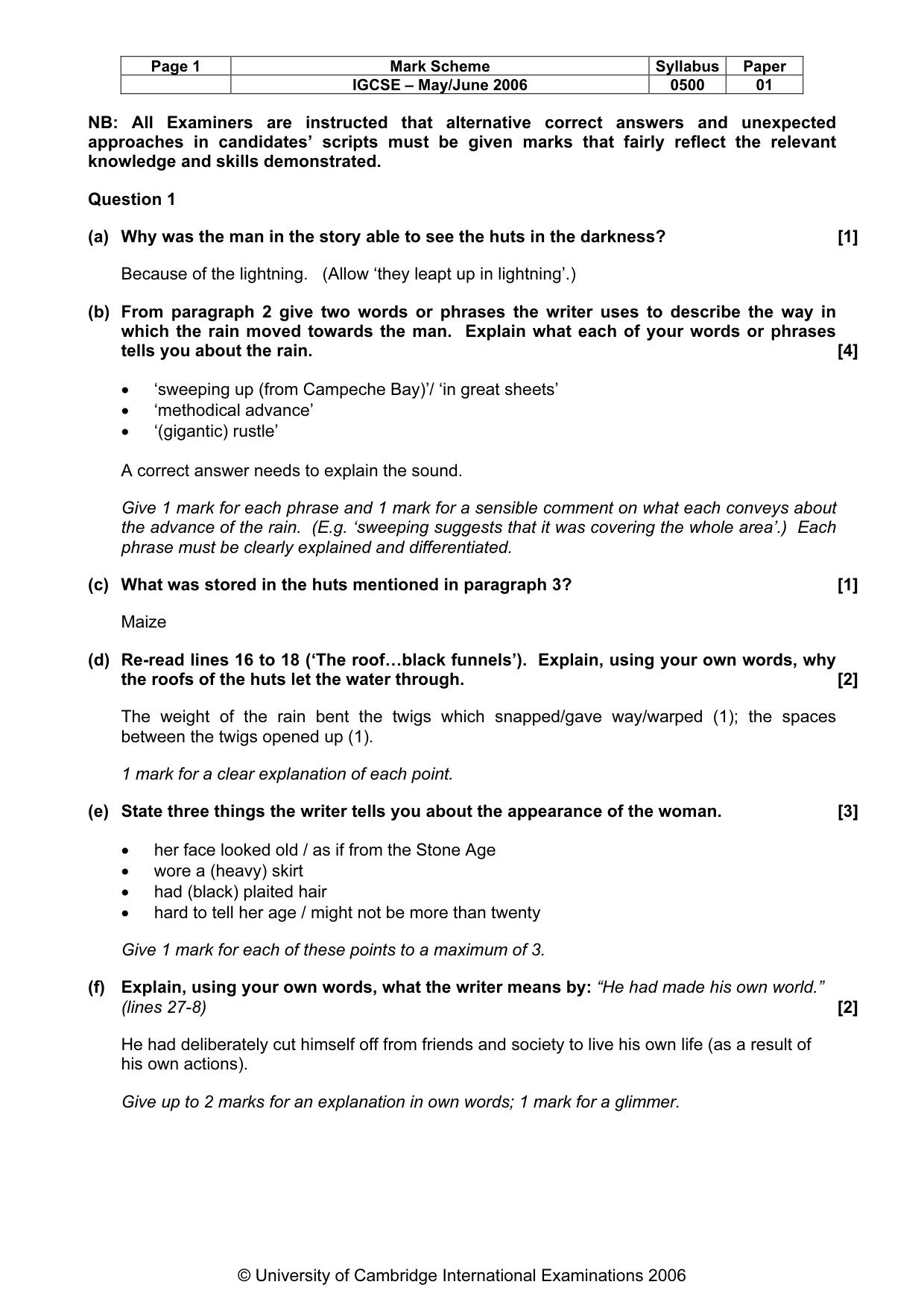
Page 1 Mark Scheme Syllabus Paper IGCSE – May/June 2006 0500 01 © University of Cambridge International Examinations 2006 NB: All Examiners are instructed that alternative correct answers and unexpected approaches in candidates’ scripts must be given marks that fairly reflect the relevant knowledge and skills demonstrated. Question 1 (a) Why was the man in the story able to see the huts in the darkness? [1] Because of the lightning. (Allow ‘they leapt up in lightning’.) (b) From paragraph 2 give two words or phrases the writer uses to describe the way in which the rain moved towards the man. Explain what each of your words or phrases tells you about the rain. [4] • ‘sweeping up (from Campeche Bay)’/ ‘in great sheets’ • ‘methodical advance’ • ‘(gigantic) rustle’ A correct answer needs to explain the sound. Give 1 mark for each phrase and 1 mark for a sensible comment on what each conveys about the advance of the rain. (E.g. ‘sweeping suggests that it was covering the whole area’.) Each phrase must be clearly explained and differentiated. (c) What was stored in the huts mentioned in paragraph 3? [1] Maize (d) Re-read lines 16 to 18 (‘The roof…black funnels’). Explain, using your own words, why the roofs of the huts let the water through. [2] The weight of the rain bent the twigs which snapped/gave way/warped (1); the spaces between the twigs opened up (1). 1 mark for a clear explanation of each point. (e) State three things the writer tells you about the appearance of the woman. [3] • her face looked old / as if from the Stone Age • wore a (heavy) skirt • had (black) plaited hair • hard to tell her age / might not be more than twenty Give 1 mark for each of these points to a maximum of 3. (f) Explain, using your own words, what the writer means by: “He had made his own world.” (lines 27-8) [2] He had deliberately cut himself off from friends and society to live his own life (as a result of his own actions). Give up to 2 marks for an explanation in own words; 1 mark for a glimmer.
Mark scheme, page 3
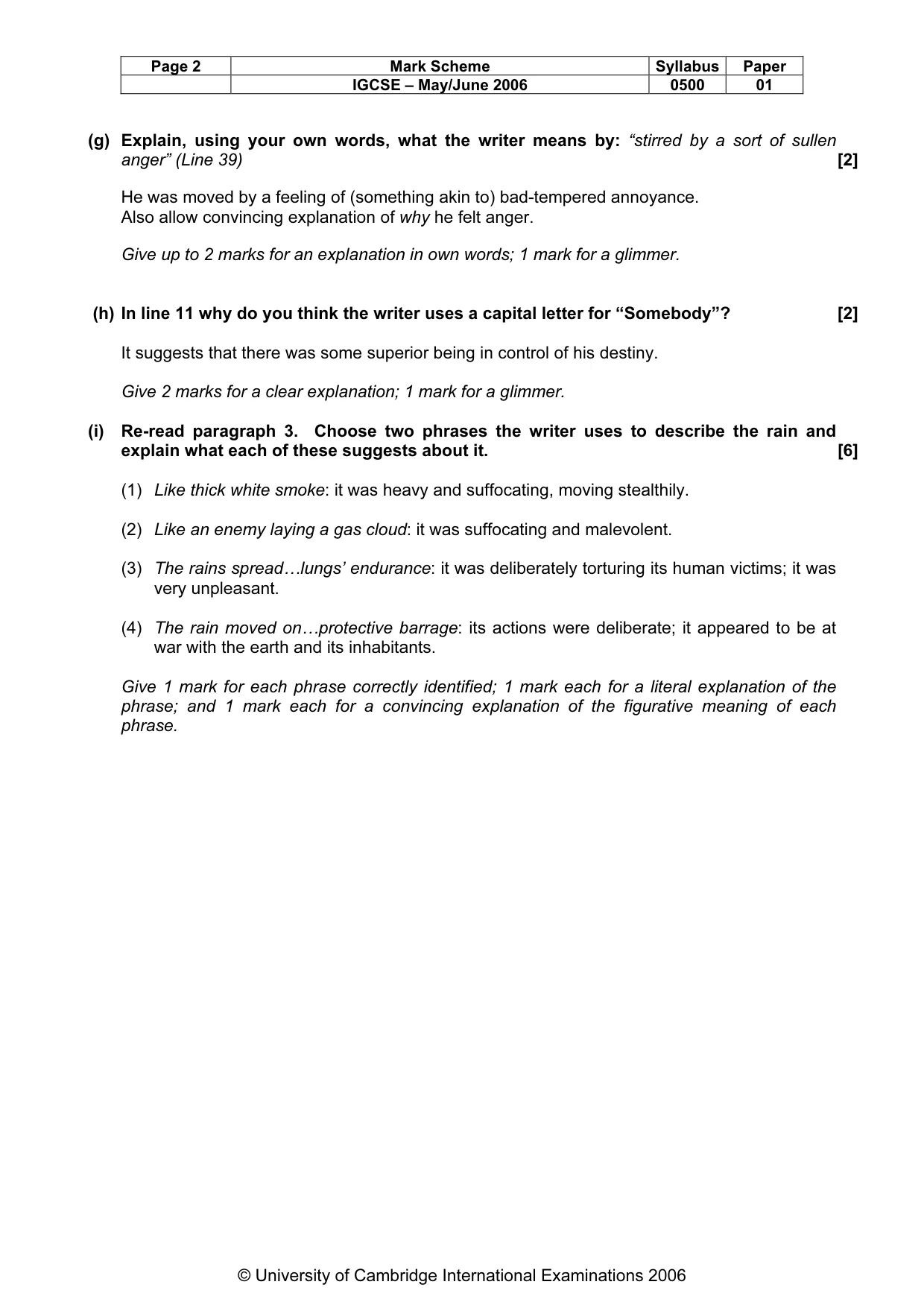
Page 2 Mark Scheme Syllabus Paper IGCSE – May/June 2006 0500 01 © University of Cambridge International Examinations 2006 (g) Explain, using your own words, what the writer means by: “stirred by a sort of sullen anger” (Line 39) [2] He was moved by a feeling of (something akin to) bad-tempered annoyance. Also allow convincing explanation of why he felt anger. Give up to 2 marks for an explanation in own words; 1 mark for a glimmer. (h) In line 11 why do you think the writer uses a capital letter for “Somebody”? [2] It suggests that there was some superior being in control of his destiny. Give 2 marks for a clear explanation; 1 mark for a glimmer. (i) Re-read paragraph 3. Choose two phrases the writer uses to describe the rain and explain what each of these suggests about it. [6] (1) Like thick white smoke: it was heavy and suffocating, moving stealthily. (2) Like an enemy laying a gas cloud: it was suffocating and malevolent. (3) The rains spread…lungs’ endurance: it was deliberately torturing its human victims; it was very unpleasant. (4) The rain moved on…protective barrage: its actions were deliberate; it appeared to be at war with the earth and its inhabitants. Give 1 mark for each phrase correctly identified; 1 mark each for a literal explanation of the phrase; and 1 mark each for a convincing explanation of the figurative meaning of each phrase.
Mark scheme, page 4
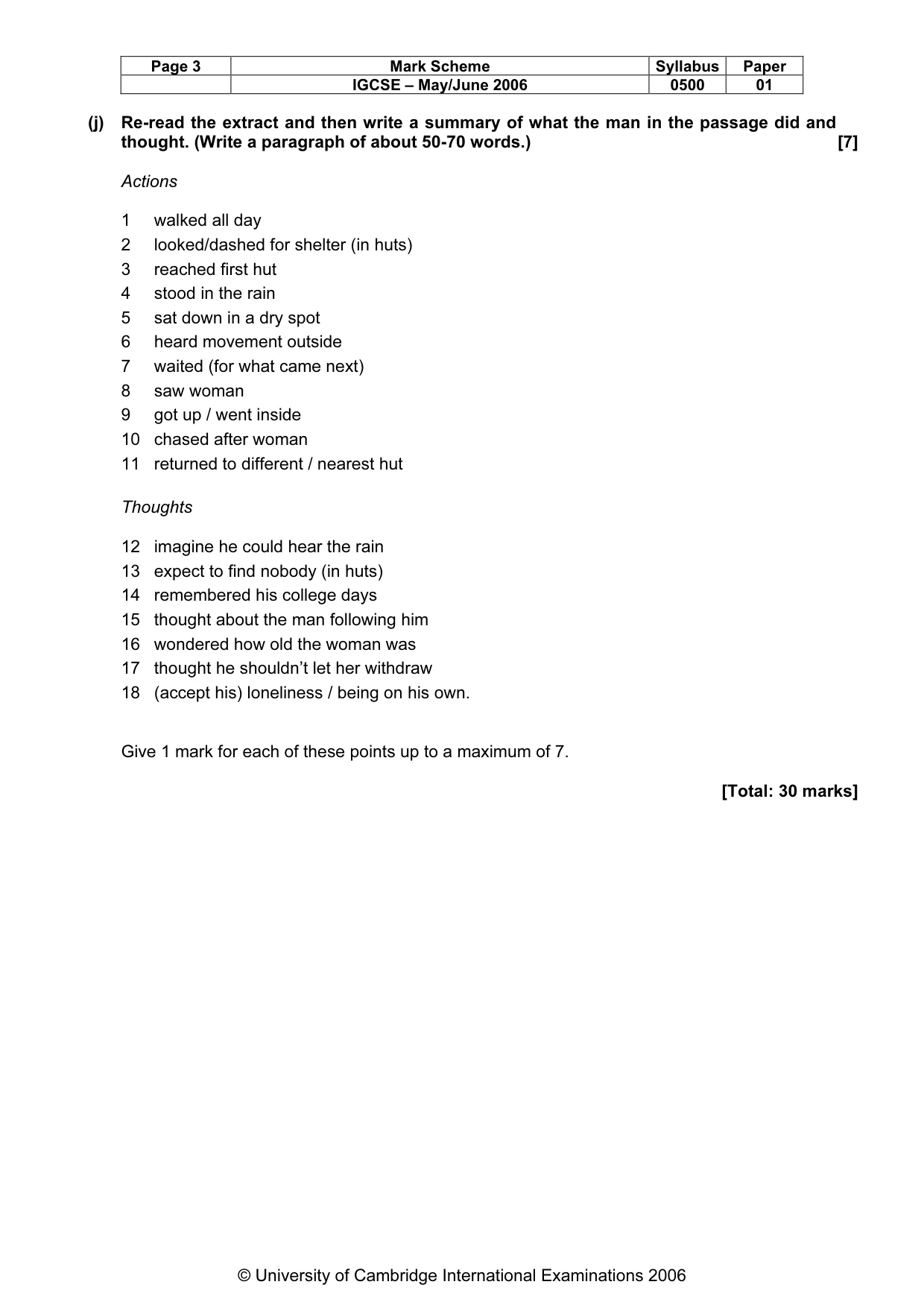
Page 3 Mark Scheme Syllabus Paper IGCSE – May/June 2006 0500 01 © University of Cambridge International Examinations 2006 (j) Re-read the extract and then write a summary of what the man in the passage did and thought. (Write a paragraph of about 50-70 words.) [7] Actions 1 walked all day 2 looked/dashed for shelter (in huts) 3 reached first hut 4 stood in the rain 5 sat down in a dry spot 6 heard movement outside 7 waited (for what came next) 8 saw woman 9 got up / went inside 10 chased after woman 11 returned to different / nearest hut Thoughts 12 imagine he could hear the rain 13 expect to find nobody (in huts) 14 remembered his college days 15 thought about the man following him 16 wondered how old the woman was 17 thought he shouldn’t let her withdraw 18 (accept his) loneliness / being on his own. Give 1 mark for each of these points up to a maximum of 7. [Total: 30 marks]
Mark scheme, page 5
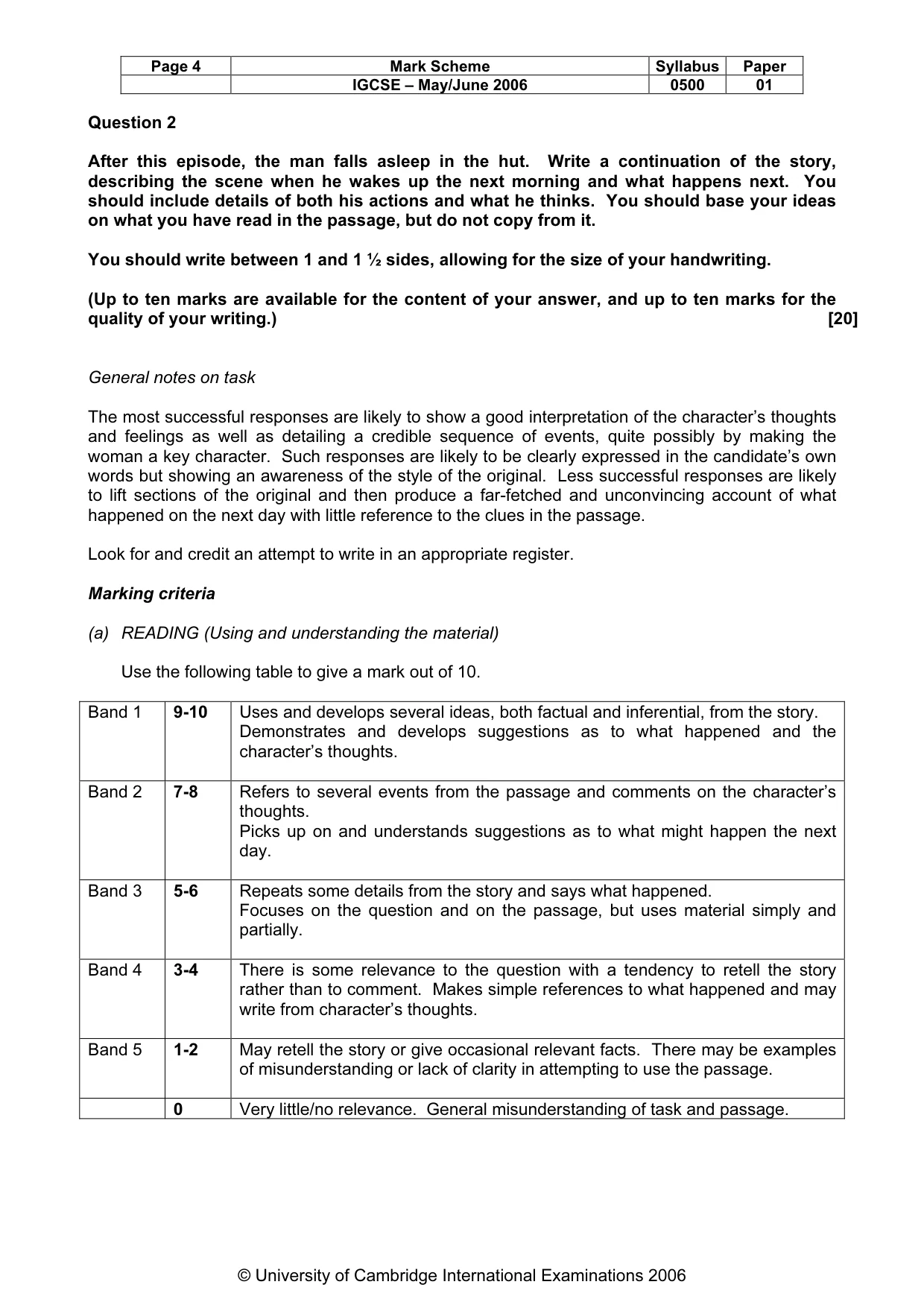
Page 4 Mark Scheme Syllabus Paper IGCSE – May/June 2006 0500 01 © University of Cambridge International Examinations 2006 Question 2 After this episode, the man falls asleep in the hut. Write a continuation of the story, describing the scene when he wakes up the next morning and what happens next. You should include details of both his actions and what he thinks. You should base your ideas on what you have read in the passage, but do not copy from it. You should write between 1 and 1 ½ sides, allowing for the size of your handwriting. (Up to ten marks are available for the content of your answer, and up to ten marks for the quality of your writing.) [20] General notes on task The most successful responses are likely to show a good interpretation of the character’s thoughts and feelings as well as detailing a credible sequence of events, quite possibly by making the woman a key character. Such responses are likely to be clearly expressed in the candidate’s own words but showing an awareness of the style of the original. Less successful responses are likely to lift sections of the original and then produce a far-fetched and unconvincing account of what happened on the next day with little reference to the clues in the passage. Look for and credit an attempt to write in an appropriate register. Marking criteria (a) READING (Using and understanding the material) Use the following table to give a mark out of 10. Band 1 9-10 Uses and develops several ideas, both factual and inferential, from the story. Demonstrates and develops suggestions as to what happened and the character’s thoughts. Band 2 7-8 Refers to several events from the passage and comments on the character’s thoughts. Picks up on and understands suggestions as to what might happen the next day. Band 3 5-6 Repeats some details from the story and says what happened. Focuses on the question and on the passage, but uses material simply and partially. Band 4 3-4 There is some relevance to the question with a tendency to retell the story rather than to comment. Makes simple references to what happened and may write from character’s thoughts. Band 5 1-2 May retell the story or give occasional relevant facts. There may be examples of misunderstanding or lack of clarity in attempting to use the passage. 0 Very little/no relevance. General misunderstanding of task and passage.
Mark scheme, page 6
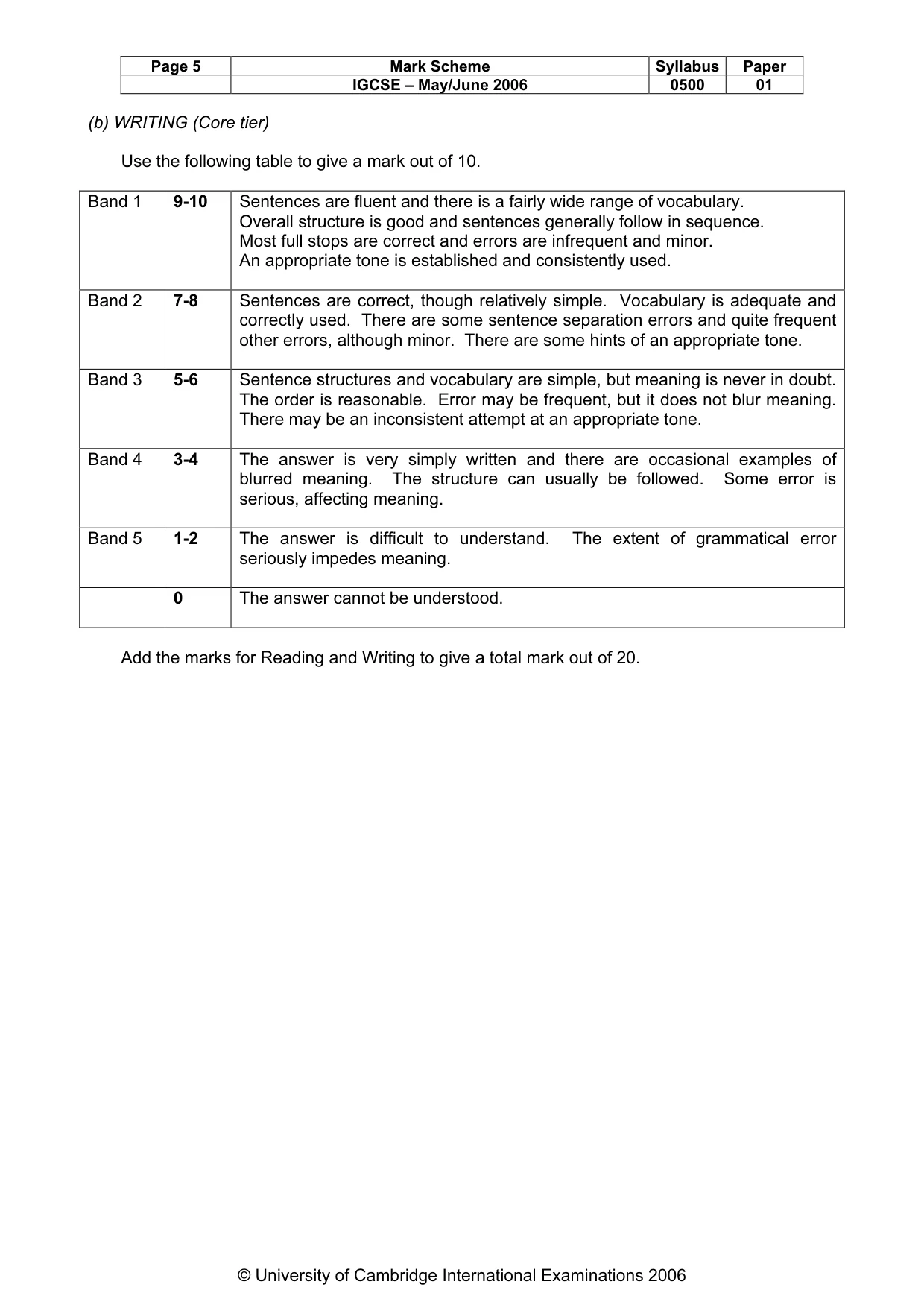
Page 5 Mark Scheme Syllabus Paper IGCSE – May/June 2006 0500 01 © University of Cambridge International Examinations 2006 (b) WRITING (Core tier) Use the following table to give a mark out of 10. Band 1 9-10 Sentences are fluent and there is a fairly wide range of vocabulary. Overall structure is good and sentences generally follow in sequence. Most full stops are correct and errors are infrequent and minor. An appropriate tone is established and consistently used. Band 2 7-8 Sentences are correct, though relatively simple. Vocabulary is adequate and correctly used. There are some sentence separation errors and quite frequent other errors, although minor. There are some hints of an appropriate tone. Band 3 5-6 Sentence structures and vocabulary are simple, but meaning is never in doubt. The order is reasonable. Error may be frequent, but it does not blur meaning. There may be an inconsistent attempt at an appropriate tone. Band 4 3-4 The answer is very simply written and there are occasional examples of blurred meaning. The structure can usually be followed. Some error is serious, affecting meaning. Band 5 1-2 The answer is difficult to understand. The extent of grammatical error seriously impedes meaning. 0 The answer cannot be understood. Add the marks for Reading and Writing to give a total mark out of 20.
What you needed in this session
Cambridge’s own grade thresholds for 2006 May/June, Paper 1 · Variant 1. A higher threshold means an easier paper — the bar moves with how the cohort did.