Cambridge IGCSE English - First Language 0500 — 2005 Oct/Nov Paper 2 · Variant 1
0500/21/O/N/05
The question paper and its mark scheme, free to read here and free to download. This is Cambridge’s own paper, exactly as it was sat.
Question paper8 pages


Mark scheme7 pages
Answers below. Sit the paper first if you are practising.
Paper as text
Question paper, page 1
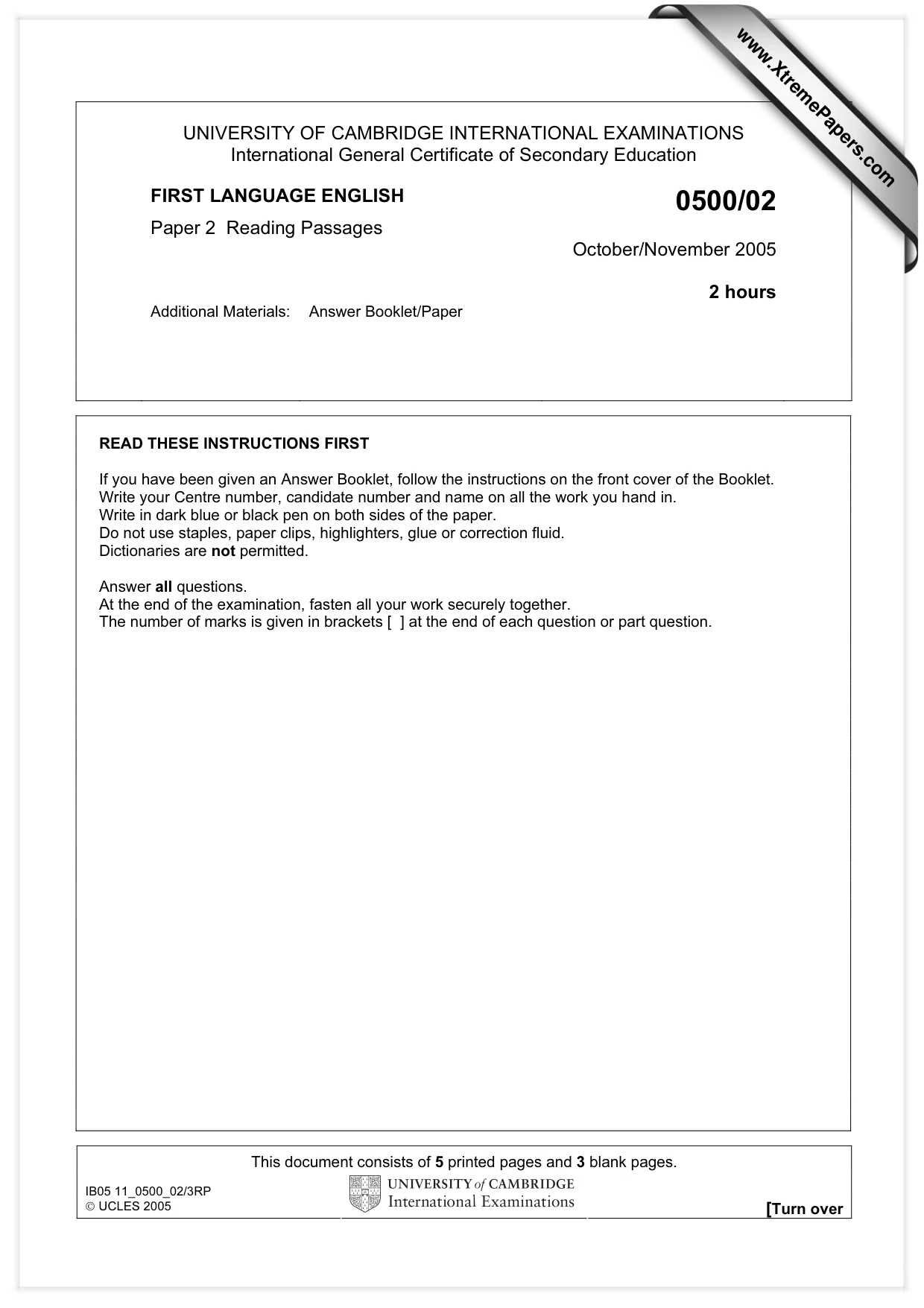
UNIVERSITY OF CAMBRIDGE INTERNATIONAL EXAMINATIONS International General Certificate of Secondary Education FIRST LANGUAGE ENGLISH 0500/02 Paper 2 Reading Passages October/November 2005 2 hours Additional Materials: Answer Booklet/Paper READ THESE INSTRUCTIONS FIRST If you have been given an Answer Booklet, follow the instructions on the front cover of the Booklet. Write your Centre number, candidate number and name on all the work you hand in. Write in dark blue or black pen on both sides of the paper. Do not use staples, paper clips, highlighters, glue or correction fluid. Dictionaries are not permitted. Answer all questions. At the end of the examination, fasten all your work securely together. The number of marks is given in brackets [ ] at the end of each question or part question. This document consists of 5 printed pages and 3 blank pages. IB05 11_0500_02/3RP UCLES 2005 [Turn over www.XtremePapers.com
Question paper, page 2
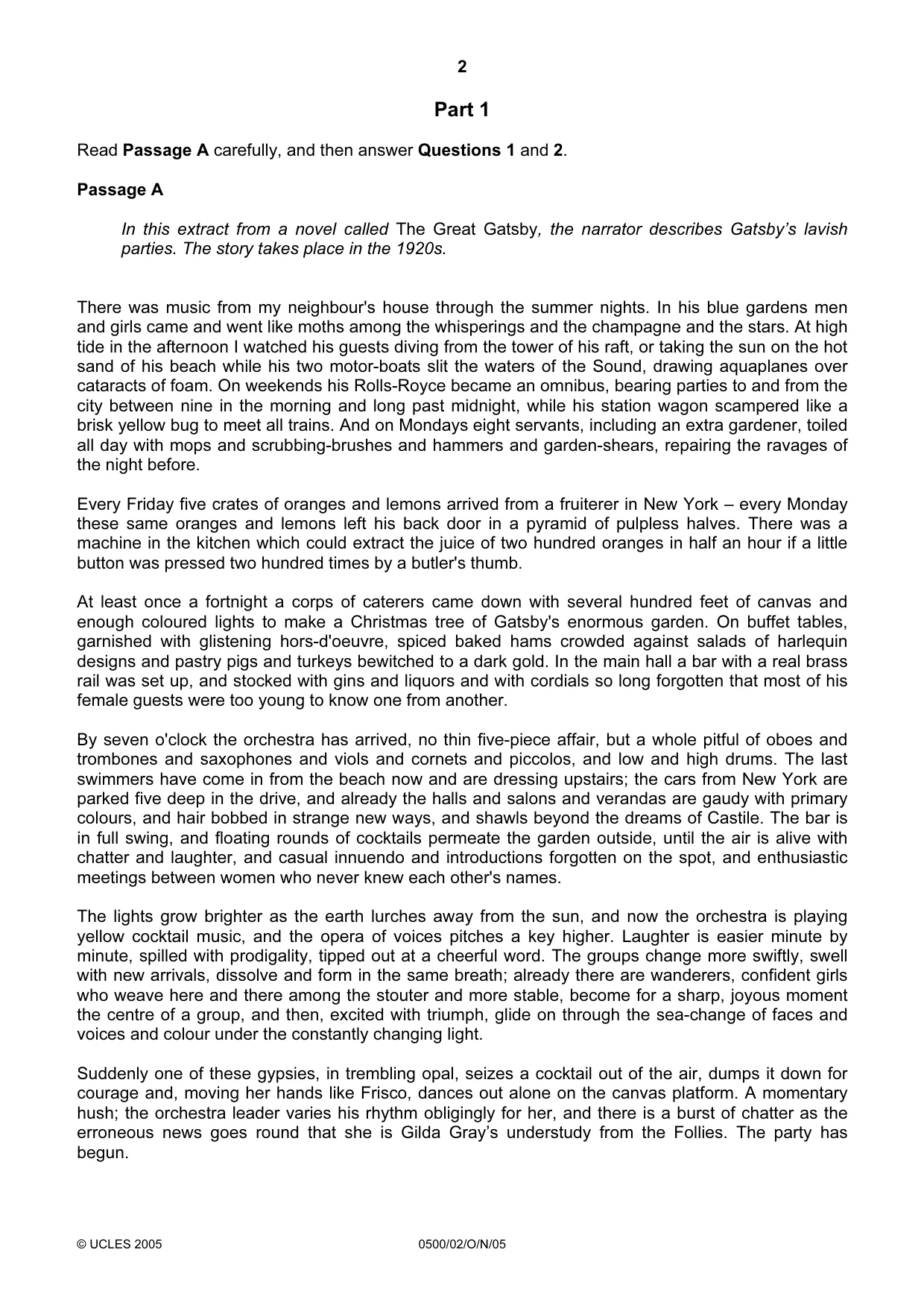
2 © UCLES 2005 0500/02/O/N/05 Part 1 Read Passage A carefully, and then answer Questions 1 and 2. Passage A In this extract from a novel called The Great Gatsby, the narrator describes Gatsby’s lavish parties. The story takes place in the 1920s. There was music from my neighbour's house through the summer nights. In his blue gardens men and girls came and went like moths among the whisperings and the champagne and the stars. At high tide in the afternoon I watched his guests diving from the tower of his raft, or taking the sun on the hot sand of his beach while his two motor-boats slit the waters of the Sound, drawing aquaplanes over cataracts of foam. On weekends his Rolls-Royce became an omnibus, bearing parties to and from the city between nine in the morning and long past midnight, while his station wagon scampered like a brisk yellow bug to meet all trains. And on Mondays eight servants, including an extra gardener, toiled all day with mops and scrubbing-brushes and hammers and garden-shears, repairing the ravages of the night before. Every Friday five crates of oranges and lemons arrived from a fruiterer in New York – every Monday these same oranges and lemons left his back door in a pyramid of pulpless halves. There was a machine in the kitchen which could extract the juice of two hundred oranges in half an hour if a little button was pressed two hundred times by a butler's thumb. At least once a fortnight a corps of caterers came down with several hundred feet of canvas and enough coloured lights to make a Christmas tree of Gatsby's enormous garden. On buffet tables, garnished with glistening hors-d'oeuvre, spiced baked hams crowded against salads of harlequin designs and pastry pigs and turkeys bewitched to a dark gold. In the main hall a bar with a real brass rail was set up, and stocked with gins and liquors and with cordials so long forgotten that most of his female guests were too young to know one from another. By seven o'clock the orchestra has arrived, no thin five-piece affair, but a whole pitful of oboes and trombones and saxophones and viols and cornets and piccolos, and low and high drums. The last swimmers have come in from the beach now and are dressing upstairs; the cars from New York are parked five deep in the drive, and already the halls and salons and verandas are gaudy with primary colours, and hair bobbed in strange new ways, and shawls beyond the dreams of Castile. The bar is in full swing, and floating rounds of cocktails permeate the garden outside, until the air is alive with chatter and laughter, and casual innuendo and introductions forgotten on the spot, and enthusiastic meetings between women who never knew each other's names. The lights grow brighter as the earth lurches away from the sun, and now the orchestra is playing yellow cocktail music, and the opera of voices pitches a key higher. Laughter is easier minute by minute, spilled with prodigality, tipped out at a cheerful word. The groups change more swiftly, swell with new arrivals, dissolve and form in the same breath; already there are wanderers, confident girls who weave here and there among the stouter and more stable, become for a sharp, joyous moment the centre of a group, and then, excited with triumph, glide on through the sea-change of faces and voices and colour under the constantly changing light. Suddenly one of these gypsies, in trembling opal, seizes a cocktail out of the air, dumps it down for courage and, moving her hands like Frisco, dances out alone on the canvas platform. A momentary hush; the orchestra leader varies his rhythm obligingly for her, and there is a burst of chatter as the erroneous news goes round that she is Gilda Gray’s understudy from the Follies. The party has begun.
Question paper, page 3
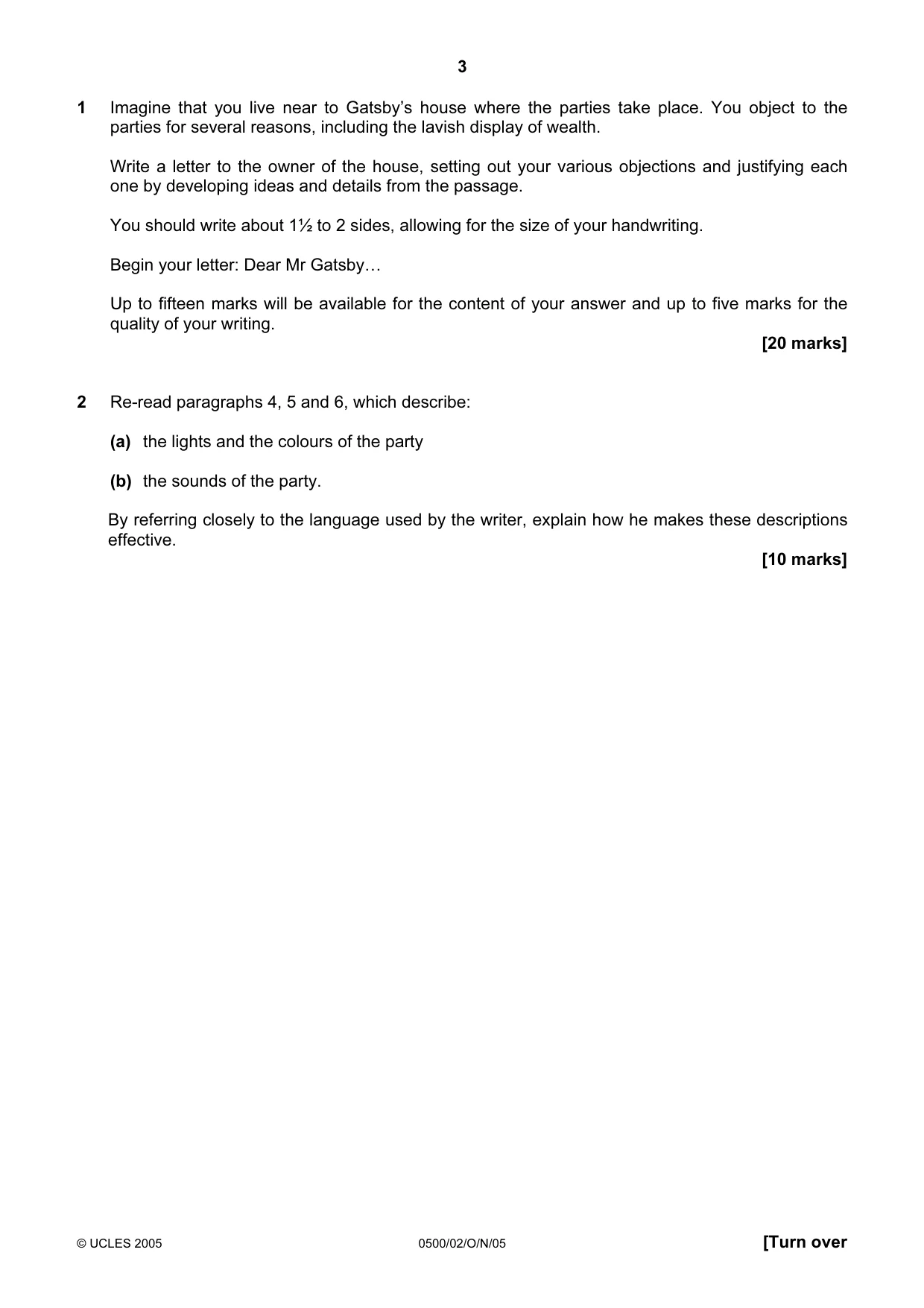
3 © UCLES 2005 0500/02/O/N/05 [Turn over 1 Imagine that you live near to Gatsby’s house where the parties take place. You object to the parties for several reasons, including the lavish display of wealth. Write a letter to the owner of the house, setting out your various objections and justifying each one by developing ideas and details from the passage. You should write about 1½ to 2 sides, allowing for the size of your handwriting. Begin your letter: Dear Mr Gatsby… Up to fifteen marks will be available for the content of your answer and up to five marks for the quality of your writing. [20 marks] 2 Re-read paragraphs 4, 5 and 6, which describe: (a) the lights and the colours of the party (b) the sounds of the party. By referring closely to the language used by the writer, explain how he makes these descriptions effective. [10 marks]
Question paper, page 4
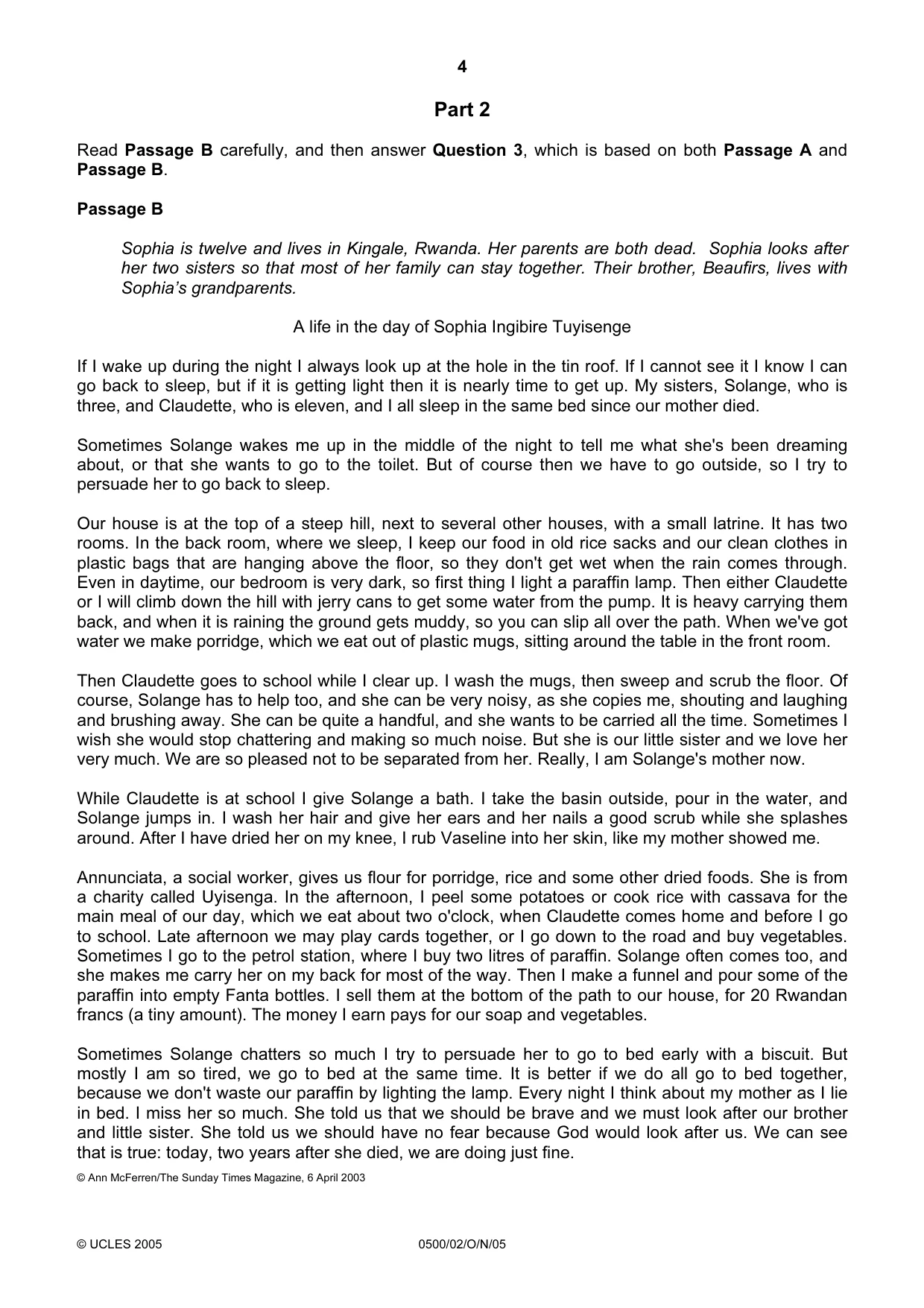
4 © UCLES 2005 0500/02/O/N/05 Part 2 Read Passage B carefully, and then answer Question 3, which is based on both Passage A and Passage B. Passage B Sophia is twelve and lives in Kingale, Rwanda. Her parents are both dead. Sophia looks after her two sisters so that most of her family can stay together. Their brother, Beaufirs, lives with Sophia’s grandparents. A life in the day of Sophia Ingibire Tuyisenge If I wake up during the night I always look up at the hole in the tin roof. If I cannot see it I know I can go back to sleep, but if it is getting light then it is nearly time to get up. My sisters, Solange, who is three, and Claudette, who is eleven, and I all sleep in the same bed since our mother died. Sometimes Solange wakes me up in the middle of the night to tell me what she's been dreaming about, or that she wants to go to the toilet. But of course then we have to go outside, so I try to persuade her to go back to sleep. Our house is at the top of a steep hill, next to several other houses, with a small latrine. It has two rooms. In the back room, where we sleep, I keep our food in old rice sacks and our clean clothes in plastic bags that are hanging above the floor, so they don't get wet when the rain comes through. Even in daytime, our bedroom is very dark, so first thing I light a paraffin lamp. Then either Claudette or I will climb down the hill with jerry cans to get some water from the pump. It is heavy carrying them back, and when it is raining the ground gets muddy, so you can slip all over the path. When we've got water we make porridge, which we eat out of plastic mugs, sitting around the table in the front room. Then Claudette goes to school while I clear up. I wash the mugs, then sweep and scrub the floor. Of course, Solange has to help too, and she can be very noisy, as she copies me, shouting and laughing and brushing away. She can be quite a handful, and she wants to be carried all the time. Sometimes I wish she would stop chattering and making so much noise. But she is our little sister and we love her very much. We are so pleased not to be separated from her. Really, I am Solange's mother now. While Claudette is at school I give Solange a bath. I take the basin outside, pour in the water, and Solange jumps in. I wash her hair and give her ears and her nails a good scrub while she splashes around. After I have dried her on my knee, I rub Vaseline into her skin, like my mother showed me. Annunciata, a social worker, gives us flour for porridge, rice and some other dried foods. She is from a charity called Uyisenga. In the afternoon, I peel some potatoes or cook rice with cassava for the main meal of our day, which we eat about two o'clock, when Claudette comes home and before I go to school. Late afternoon we may play cards together, or I go down to the road and buy vegetables. Sometimes I go to the petrol station, where I buy two litres of paraffin. Solange often comes too, and she makes me carry her on my back for most of the way. Then I make a funnel and pour some of the paraffin into empty Fanta bottles. I sell them at the bottom of the path to our house, for 20 Rwandan francs (a tiny amount). The money I earn pays for our soap and vegetables. Sometimes Solange chatters so much I try to persuade her to go to bed early with a biscuit. But mostly I am so tired, we go to bed at the same time. It is better if we do all go to bed together, because we don't waste our paraffin by lighting the lamp. Every night I think about my mother as I lie in bed. I miss her so much. She told us that we should be brave and we must look after our brother and little sister. She told us we should have no fear because God would look after us. We can see that is true: today, two years after she died, we are doing just fine. © Ann McFerren/The Sunday Times Magazine, 6 April 2003
Question paper, page 5
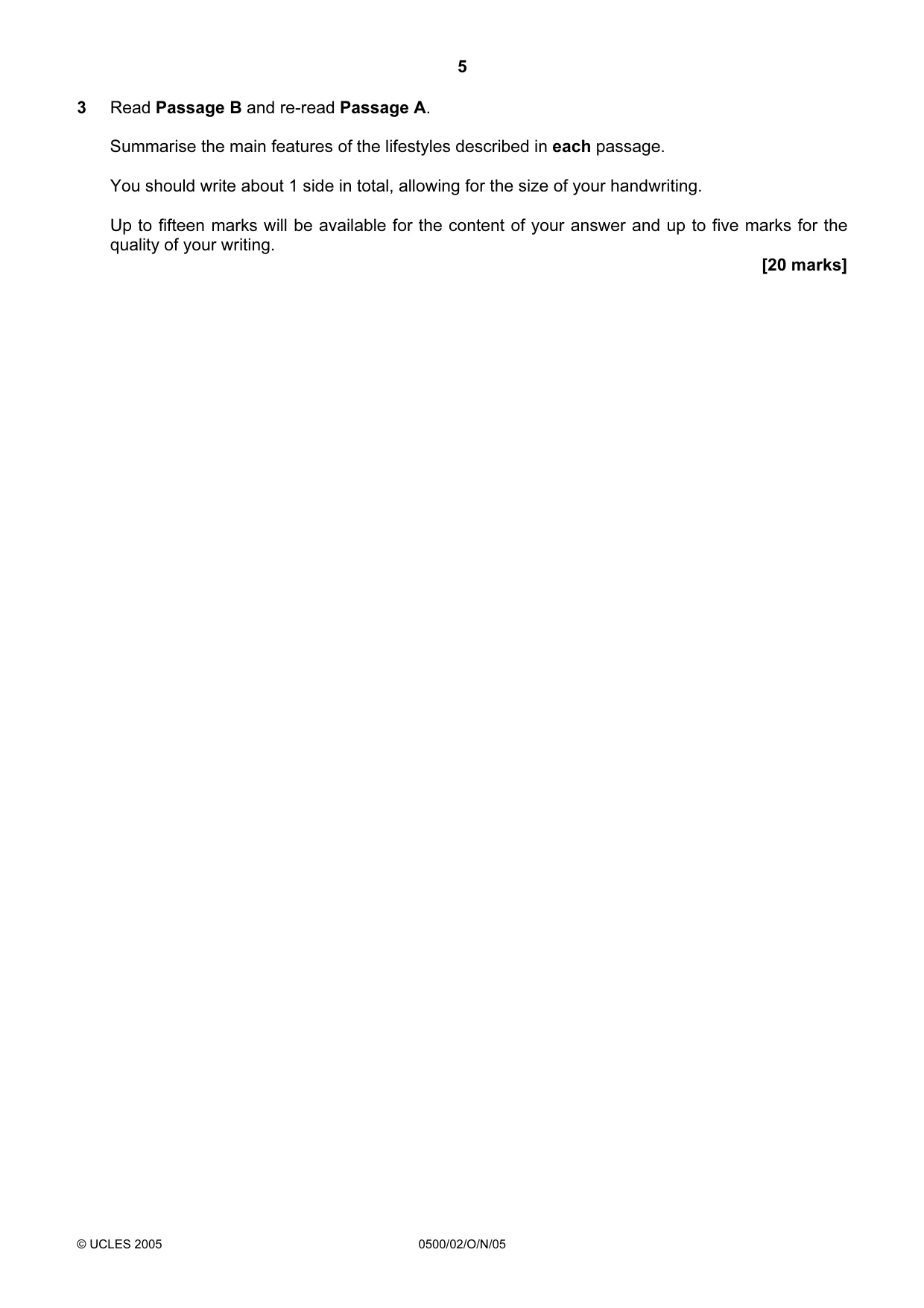
5 © UCLES 2005 0500/02/O/N/05 3 Read Passage B and re-read Passage A. Summarise the main features of the lifestyles described in each passage. You should write about 1 side in total, allowing for the size of your handwriting. Up to fifteen marks will be available for the content of your answer and up to five marks for the quality of your writing. [20 marks]
Question paper, page 8
8 Copyright Acknowledgements: Questions 1 and 2 F. Scott Fitzgerald; extract from The Great Gatsby. Published by Penguin pp 45 - 47. © David Higham Associates Limited. Question 3 © Ann McFerren /The Sunday Times Magazine, A Life in the Day, 6 April 2003. Permission to reproduce items where third-party owned material protected by copyright is included has been sought and cleared where possible. Every reasonable effort has been made by the publisher (UCLES) to trace copyright holders, but if any items requiring clearance have unwittingly been included, the publisher will be pleased to make amends at the earliest possible opportunity. University of Cambridge International Examinations is part of the University of Cambridge Local Examinations Syndicate (UCLES), which is itself a department of the University of Cambridge. 0500/02/O/N/05 BLANK PAGE
Mark scheme, page 1
UNIVERSITY OF CAMBRIDGE INTERNATIONAL EXAMINATIONS International General Certificate of Secondary Education MARK SCHEME for the November 2005 question paper 0500 FIRST LANGUAGE ENGLISH 0500/02 Paper 2 Maximum mark 50 This mark scheme is published as an aid to teachers and students, to indicate the requirements of the examination. It shows the basis on which Examiners were initially instructed to award marks. It does not indicate the details of the discussions that took place at an Examiners’ meeting before marking began. Any substantial changes to the mark scheme that arose from these discussions will be recorded in the published Report on the Examination. All Examiners are instructed that alternative correct answers and unexpected approaches in candidates’ scripts must be given marks that fairly reflect the relevant knowledge and skills demonstrated. Mark schemes must be read in conjunction with the question papers and the Report on the Examination. The minimum marks in these components needed for various grades were previously published with these mark schemes, but are now instead included in the Report on the Examination for this session. • CIE will not enter into discussion or correspondence in connection with these mark schemes. CIE is publishing the mark schemes for the November 2005 question papers for most IGCSE and GCE Advanced Level and Advanced Subsidiary Level syllabuses and some Ordinary Level syllabuses. www.XtremePapers.com
Mark scheme, page 2
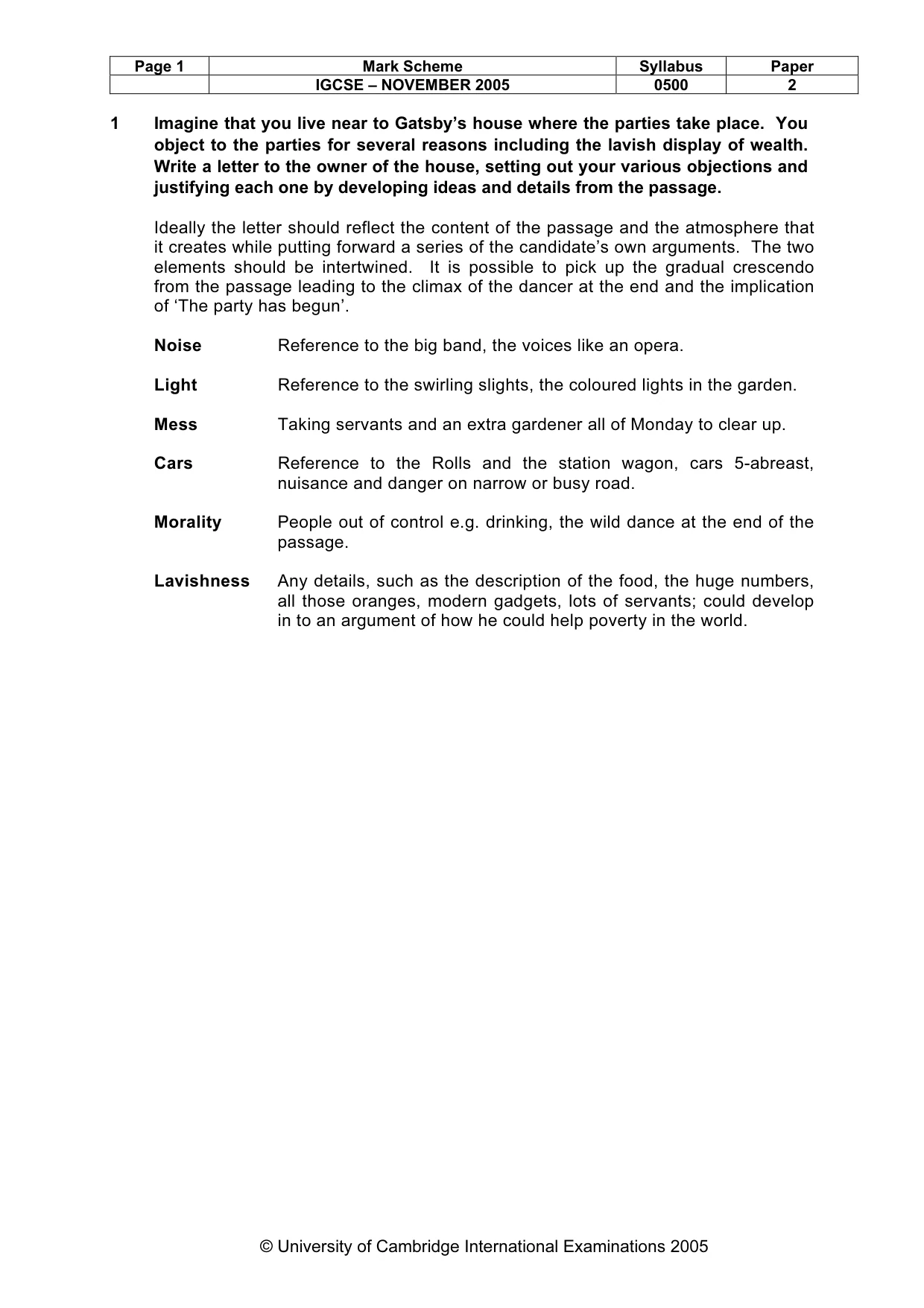
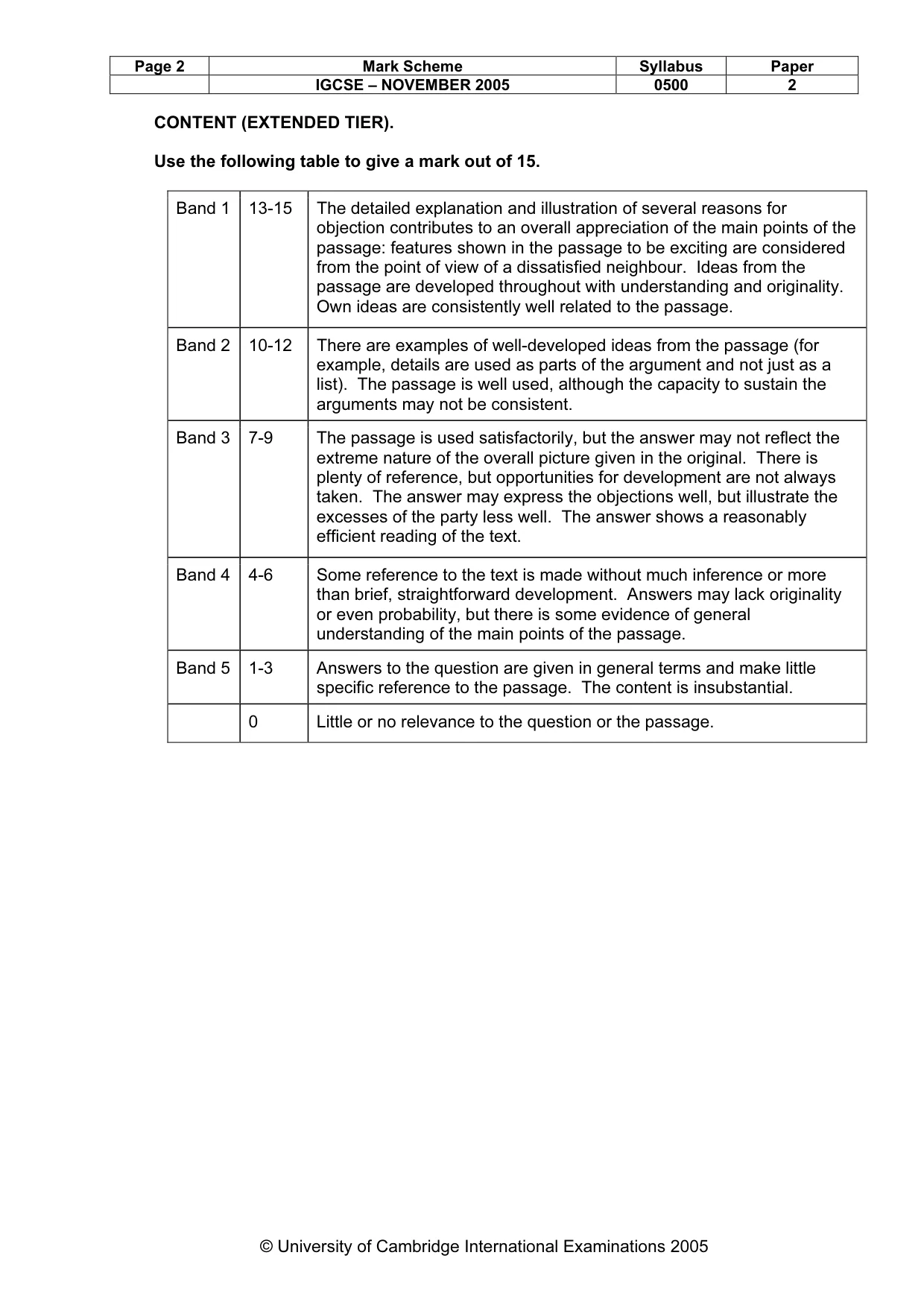
Page 1 Mark Scheme Syllabus Paper IGCSE – NOVEMBER 2005 0500 2 © University of Cambridge International Examinations 2005 1 Imagine that you live near to Gatsby’s house where the parties take place. You object to the parties for several reasons including the lavish display of wealth. Write a letter to the owner of the house, setting out your various objections and justifying each one by developing ideas and details from the passage. Ideally the letter should reflect the content of the passage and the atmosphere that it creates while putting forward a series of the candidate’s own arguments. The two elements should be intertwined. It is possible to pick up the gradual crescendo from the passage leading to the climax of the dancer at the end and the implication of ‘The party has begun’. Noise Reference to the big band, the voices like an opera. Light Reference to the swirling slights, the coloured lights in the garden. Mess Taking servants and an extra gardener all of Monday to clear up. Cars Reference to the Rolls and the station wagon, cars 5-abreast, nuisance and danger on narrow or busy road. Morality People out of control e.g. drinking, the wild dance at the end of the passage. Lavishness Any details, such as the description of the food, the huge numbers, all those oranges, modern gadgets, lots of servants; could develop in to an argument of how he could help poverty in the world.
Mark scheme, page 3
Page 2 Mark Scheme Syllabus Paper IGCSE – NOVEMBER 2005 0500 2 © University of Cambridge International Examinations 2005 CONTENT (EXTENDED TIER). Use the following table to give a mark out of 15. Band 1 13-15 The detailed explanation and illustration of several reasons for objection contributes to an overall appreciation of the main points of the passage: features shown in the passage to be exciting are considered from the point of view of a dissatisfied neighbour. Ideas from the passage are developed throughout with understanding and originality. Own ideas are consistently well related to the passage. Band 2 10-12 There are examples of well-developed ideas from the passage (for example, details are used as parts of the argument and not just as a list). The passage is well used, although the capacity to sustain the arguments may not be consistent. Band 3 7-9 The passage is used satisfactorily, but the answer may not reflect the extreme nature of the overall picture given in the original. There is plenty of reference, but opportunities for development are not always taken. The answer may express the objections well, but illustrate the excesses of the party less well. The answer shows a reasonably efficient reading of the text. Band 4 4-6 Some reference to the text is made without much inference or more than brief, straightforward development. Answers may lack originality or even probability, but there is some evidence of general understanding of the main points of the passage. Band 5 1-3 Answers to the question are given in general terms and make little specific reference to the passage. The content is insubstantial. 0 Little or no relevance to the question or the passage.
Mark scheme, page 4
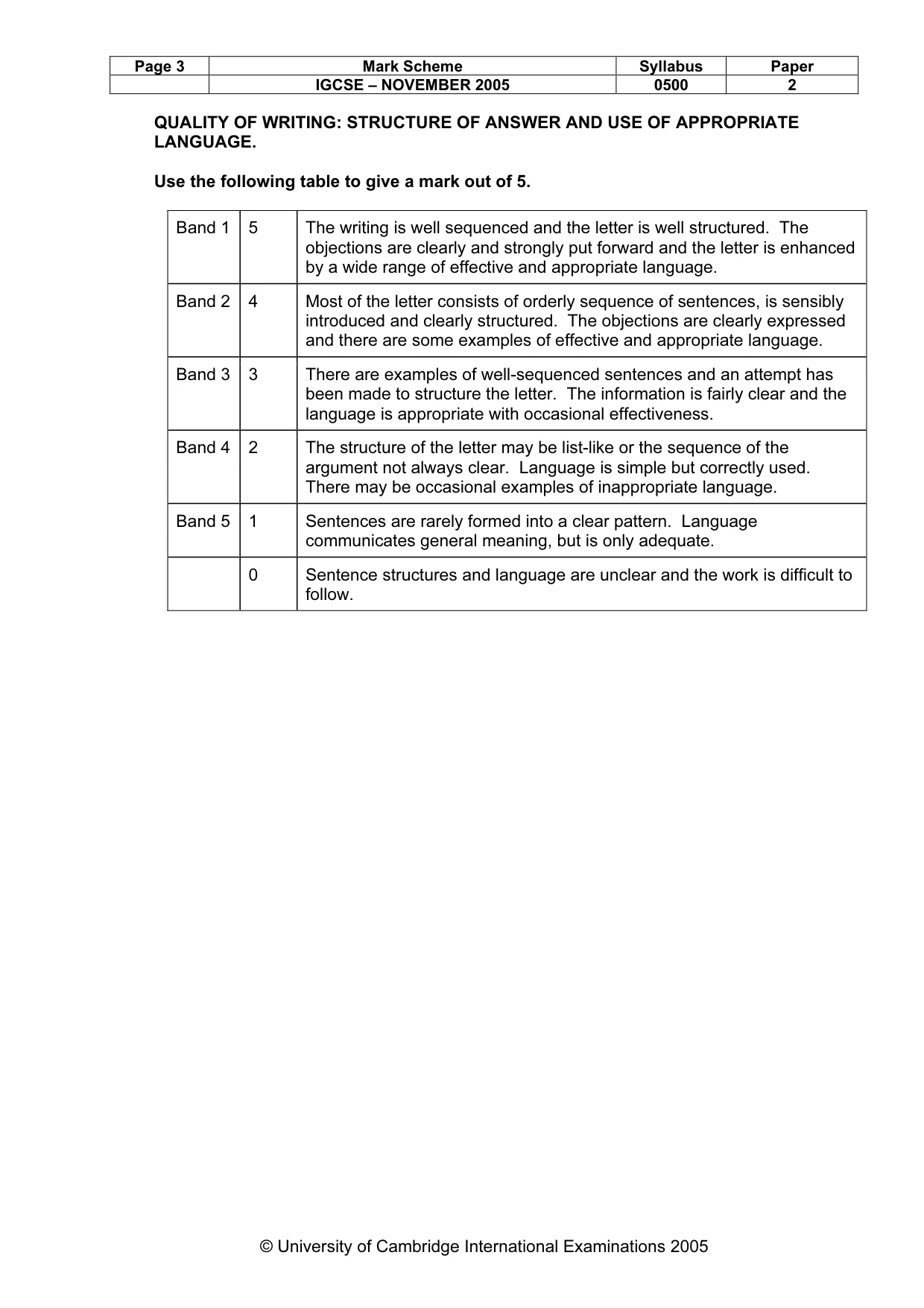
Page 3 Mark Scheme Syllabus Paper IGCSE – NOVEMBER 2005 0500 2 © University of Cambridge International Examinations 2005 QUALITY OF WRITING: STRUCTURE OF ANSWER AND USE OF APPROPRIATE LANGUAGE. Use the following table to give a mark out of 5. Band 1 5 The writing is well sequenced and the letter is well structured. The objections are clearly and strongly put forward and the letter is enhanced by a wide range of effective and appropriate language. Band 2 4 Most of the letter consists of orderly sequence of sentences, is sensibly introduced and clearly structured. The objections are clearly expressed and there are some examples of effective and appropriate language. Band 3 3 There are examples of well-sequenced sentences and an attempt has been made to structure the letter. The information is fairly clear and the language is appropriate with occasional effectiveness. Band 4 2 The structure of the letter may be list-like or the sequence of the argument not always clear. Language is simple but correctly used. There may be occasional examples of inappropriate language. Band 5 1 Sentences are rarely formed into a clear pattern. Language communicates general meaning, but is only adequate. 0 Sentence structures and language are unclear and the work is difficult to follow.
Mark scheme, page 5
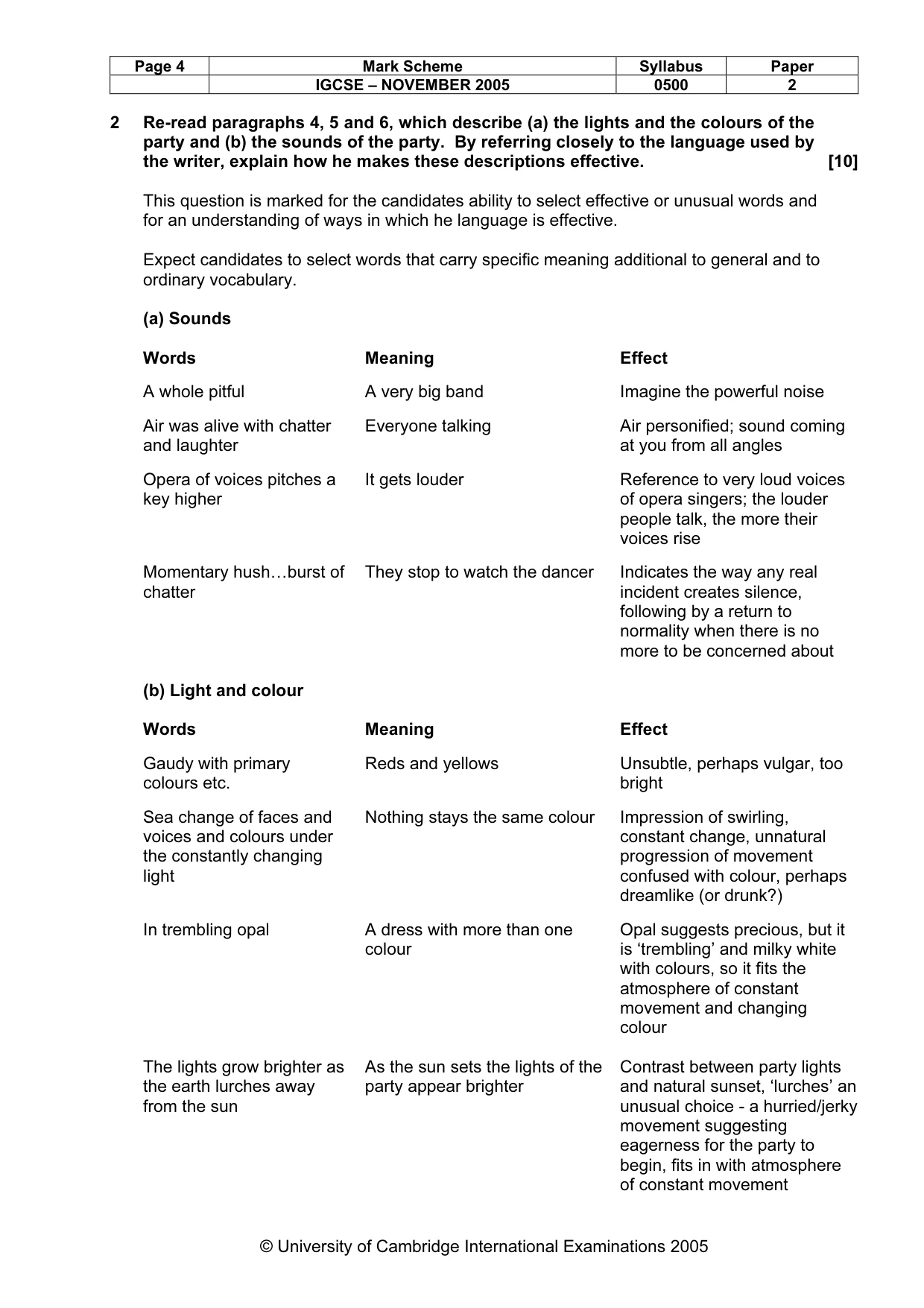
Page 4 Mark Scheme Syllabus Paper IGCSE – NOVEMBER 2005 0500 2 © University of Cambridge International Examinations 2005 2 Re-read paragraphs 4, 5 and 6, which describe (a) the lights and the colours of the party and (b) the sounds of the party. By referring closely to the language used by the writer, explain how he makes these descriptions effective. [10] This question is marked for the candidates ability to select effective or unusual words and for an understanding of ways in which he language is effective. Expect candidates to select words that carry specific meaning additional to general and to ordinary vocabulary. (a) Sounds Words Meaning Effect A whole pitful A very big band Imagine the powerful noise Air was alive with chatter and laughter Everyone talking Air personified; sound coming at you from all angles Opera of voices pitches a key higher It gets louder Reference to very loud voices of opera singers; the louder people talk, the more their voices rise Momentary hush…burst of chatter They stop to watch the dancer Indicates the way any real incident creates silence, following by a return to normality when there is no more to be concerned about (b) Light and colour Words Meaning Effect Gaudy with primary colours etc. Reds and yellows Unsubtle, perhaps vulgar, too bright Sea change of faces and voices and colours under the constantly changing light Nothing stays the same colour Impression of swirling, constant change, unnatural progression of movement confused with colour, perhaps dreamlike (or drunk?) In trembling opal A dress with more than one colour Opal suggests precious, but it is ‘trembling’ and milky white with colours, so it fits the atmosphere of constant movement and changing colour The lights grow brighter as the earth lurches away from the sun As the sun sets the lights of the party appear brighter Contrast between party lights and natural sunset, ‘lurches’ an unusual choice - a hurried/jerky movement suggesting eagerness for the party to begin, fits in with atmosphere of constant movement
Mark scheme, page 6
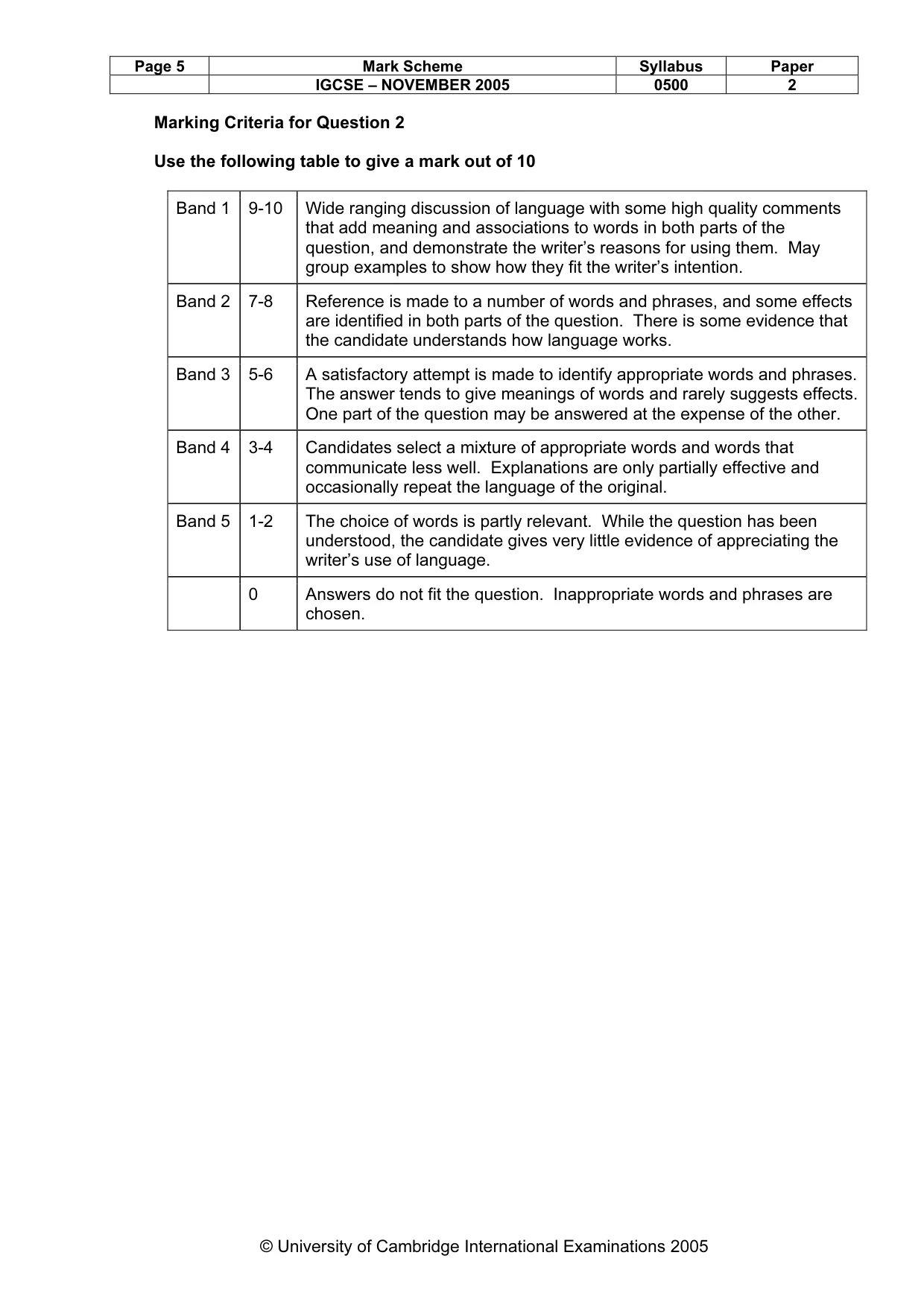
Page 5 Mark Scheme Syllabus Paper IGCSE – NOVEMBER 2005 0500 2 © University of Cambridge International Examinations 2005 Marking Criteria for Question 2 Use the following table to give a mark out of 10 Band 1 9-10 Wide ranging discussion of language with some high quality comments that add meaning and associations to words in both parts of the question, and demonstrate the writer’s reasons for using them. May group examples to show how they fit the writer’s intention. Band 2 7-8 Reference is made to a number of words and phrases, and some effects are identified in both parts of the question. There is some evidence that the candidate understands how language works. Band 3 5-6 A satisfactory attempt is made to identify appropriate words and phrases. The answer tends to give meanings of words and rarely suggests effects. One part of the question may be answered at the expense of the other. Band 4 3-4 Candidates select a mixture of appropriate words and words that communicate less well. Explanations are only partially effective and occasionally repeat the language of the original. Band 5 1-2 The choice of words is partly relevant. While the question has been understood, the candidate gives very little evidence of appreciating the writer’s use of language. 0 Answers do not fit the question. Inappropriate words and phrases are chosen.
Mark scheme, page 7
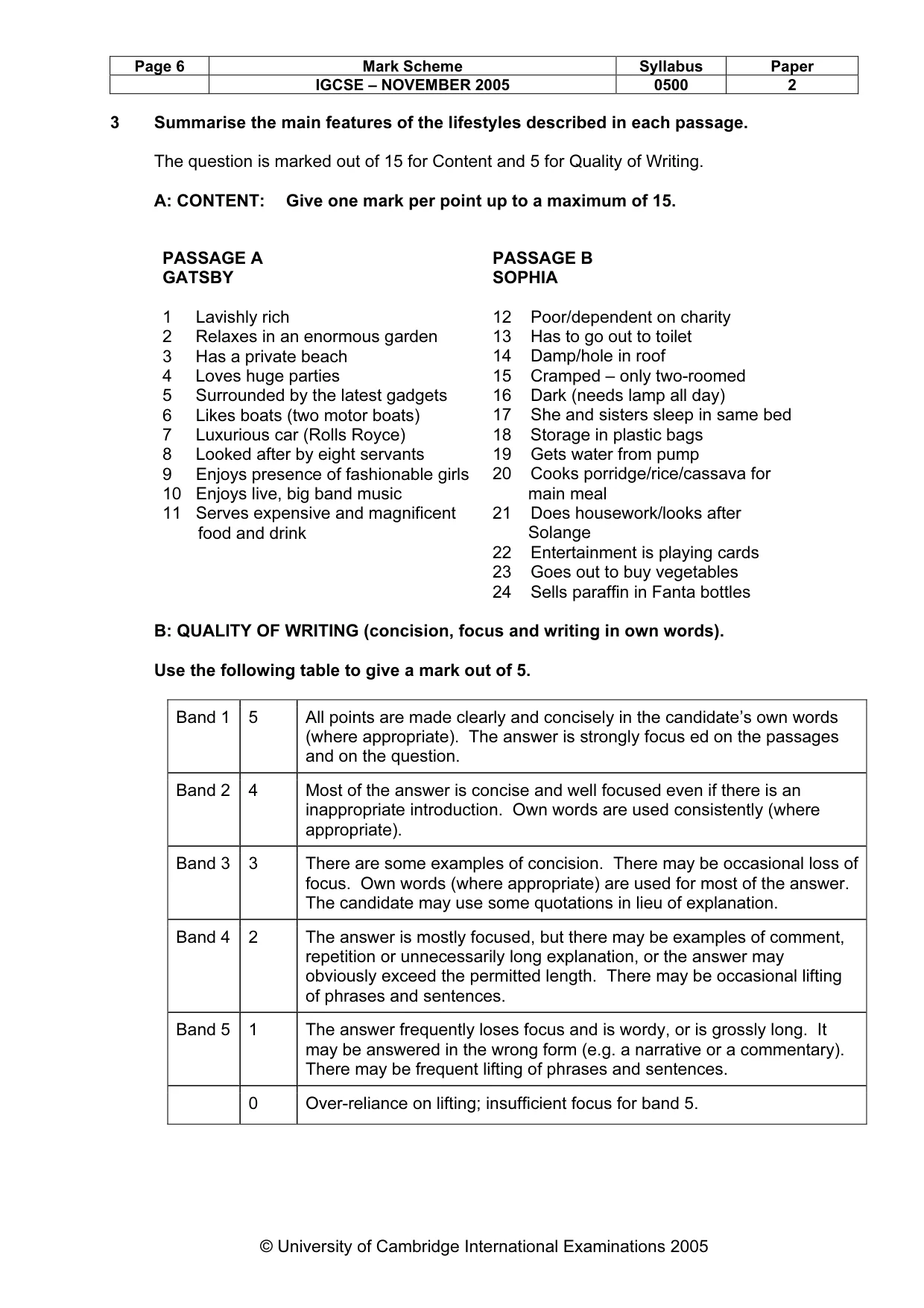
Page 6 Mark Scheme Syllabus Paper IGCSE – NOVEMBER 2005 0500 2 © University of Cambridge International Examinations 2005 3 Summarise the main features of the lifestyles described in each passage. The question is marked out of 15 for Content and 5 for Quality of Writing. A: CONTENT: Give one mark per point up to a maximum of 15. PASSAGE A GATSBY PASSAGE B SOPHIA 1 Lavishly rich 2 Relaxes in an enormous garden 3 Has a private beach 4 Loves huge parties 5 Surrounded by the latest gadgets 6 Likes boats (two motor boats) 7 Luxurious car (Rolls Royce) 8 Looked after by eight servants 9 Enjoys presence of fashionable girls 10 Enjoys live, big band music 11 Serves expensive and magnificent food and drink 12 Poor/dependent on charity 13 Has to go out to toilet 14 Damp/hole in roof 15 Cramped – only two-roomed 16 Dark (needs lamp all day) 17 She and sisters sleep in same bed 18 Storage in plastic bags 19 Gets water from pump 20 Cooks porridge/rice/cassava for main meal 21 Does housework/looks after Solange 22 Entertainment is playing cards 23 Goes out to buy vegetables 24 Sells paraffin in Fanta bottles B: QUALITY OF WRITING (concision, focus and writing in own words). Use the following table to give a mark out of 5. Band 1 5 All points are made clearly and concisely in the candidate’s own words (where appropriate). The answer is strongly focus ed on the passages and on the question. Band 2 4 Most of the answer is concise and well focused even if there is an inappropriate introduction. Own words are used consistently (where appropriate). Band 3 3 There are some examples of concision. There may be occasional loss of focus. Own words (where appropriate) are used for most of the answer. The candidate may use some quotations in lieu of explanation. Band 4 2 The answer is mostly focused, but there may be examples of comment, repetition or unnecessarily long explanation, or the answer may obviously exceed the permitted length. There may be occasional lifting of phrases and sentences. Band 5 1 The answer frequently loses focus and is wordy, or is grossly long. It may be answered in the wrong form (e.g. a narrative or a commentary). There may be frequent lifting of phrases and sentences. 0 Over-reliance on lifting; insufficient focus for band 5.