Cambridge IGCSE English - First Language 0500 — 2005 Oct/Nov Paper 1 · Variant 1
0500/11/O/N/05
The question paper and its mark scheme, free to read here and free to download. This is Cambridge’s own paper, exactly as it was sat.
Question paper4 pages
Mark scheme5 pages
Answers below. Sit the paper first if you are practising.
Paper as text
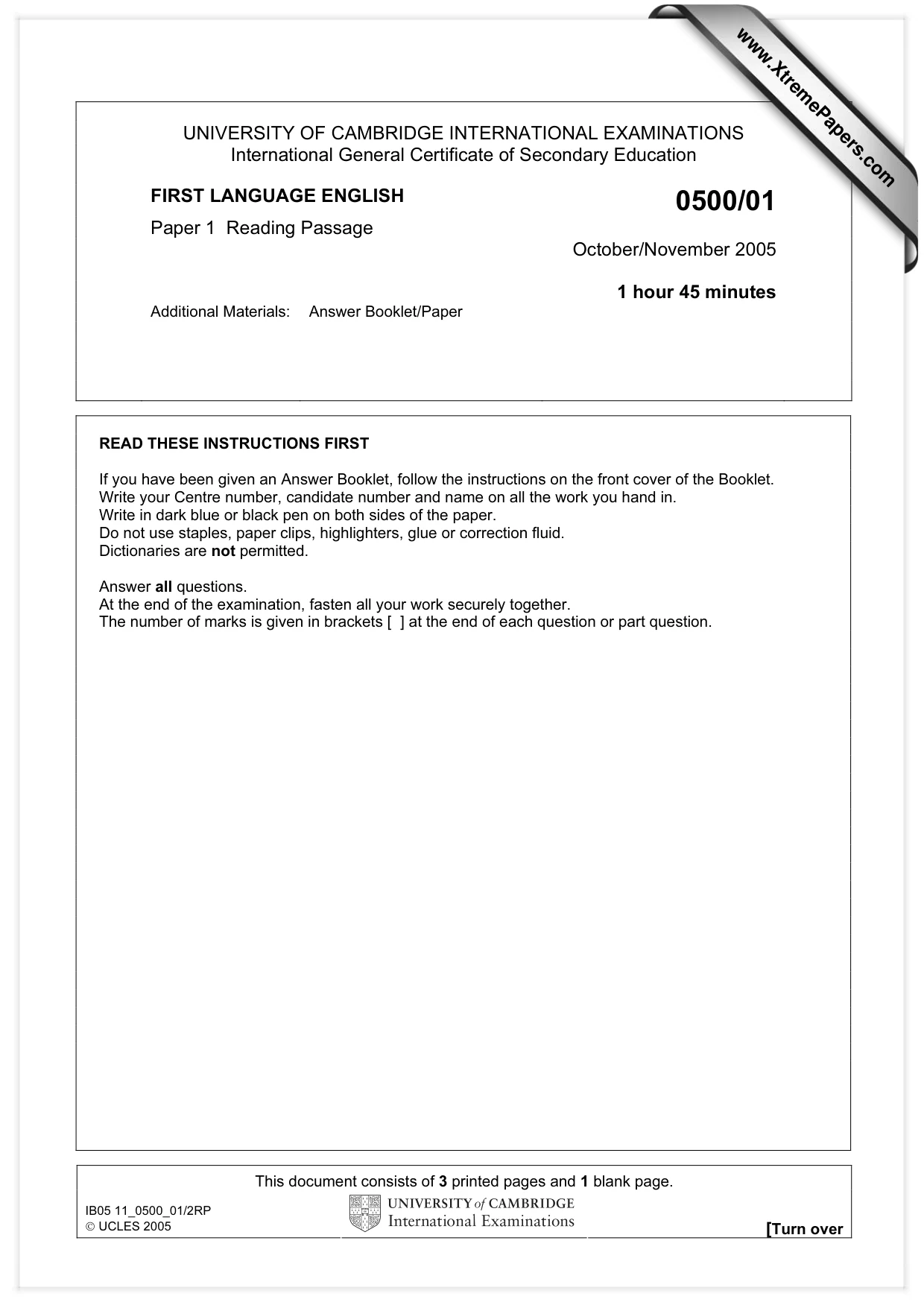
Question paper, page 1
UNIVERSITY OF CAMBRIDGE INTERNATIONAL EXAMINATIONS International General Certificate of Secondary Education FIRST LANGUAGE ENGLISH 0500/01 Paper 1 Reading Passage October/November 2005 1 hour 45 minutes Additional Materials: Answer Booklet/Paper READ THESE INSTRUCTIONS FIRST If you have been given an Answer Booklet, follow the instructions on the front cover of the Booklet. Write your Centre number, candidate number and name on all the work you hand in. Write in dark blue or black pen on both sides of the paper. Do not use staples, paper clips, highlighters, glue or correction fluid. Dictionaries are not permitted. Answer all questions. At the end of the examination, fasten all your work securely together. The number of marks is given in brackets [ ] at the end of each question or part question. This document consists of 3 printed pages and 1 blank page. IB05 11_0500_01/2RP UCLES 2005 [Turn over www.XtremePapers.com
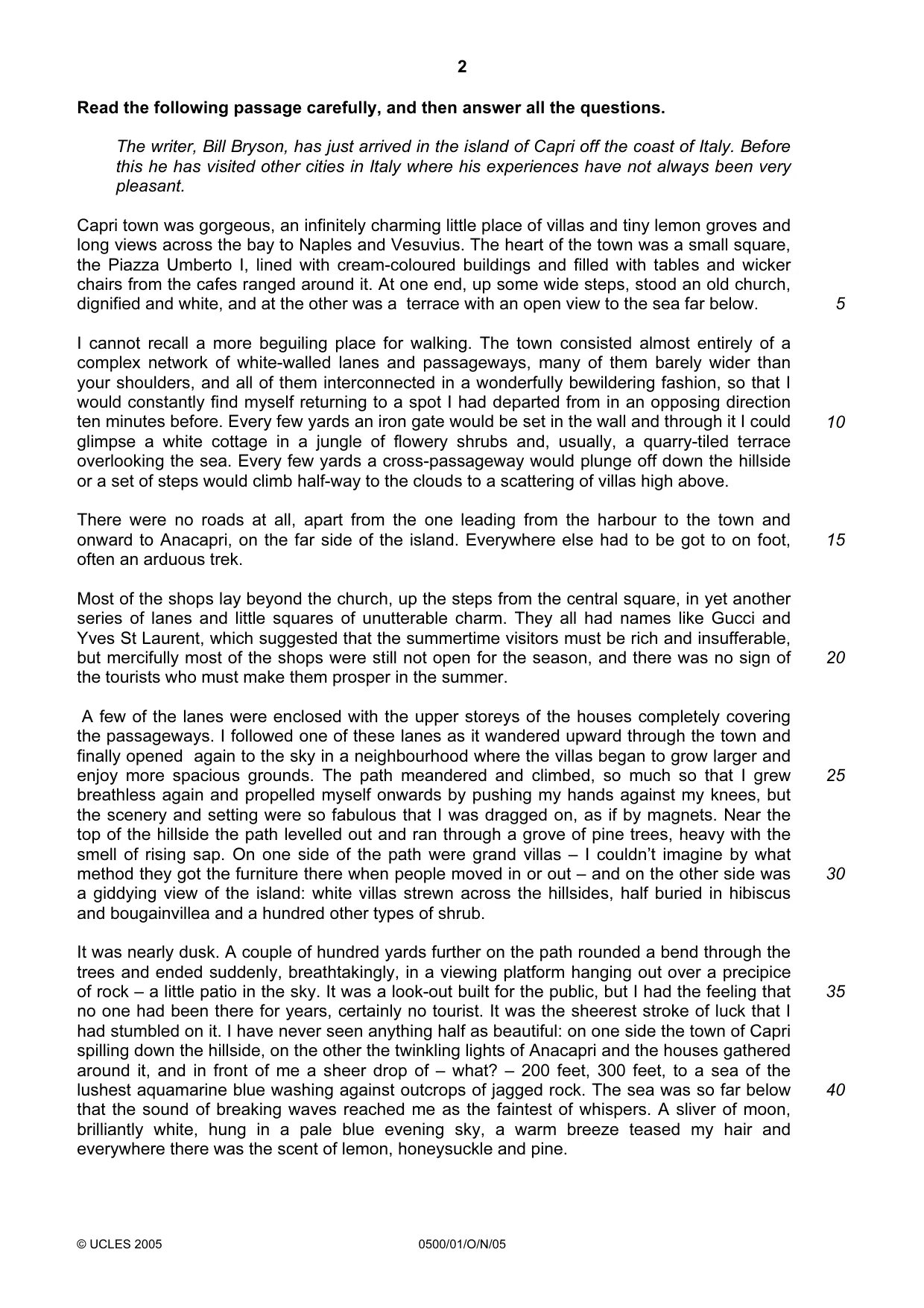
Question paper, page 2
2 © UCLES 2005 0500/01/O/N/05 Read the following passage carefully, and then answer all the questions. The writer, Bill Bryson, has just arrived in the island of Capri off the coast of Italy. Before this he has visited other cities in Italy where his experiences have not always been very pleasant. Capri town was gorgeous, an infinitely charming little place of villas and tiny lemon groves and long views across the bay to Naples and Vesuvius. The heart of the town was a small square, the Piazza Umberto I, lined with cream-coloured buildings and filled with tables and wicker chairs from the cafes ranged around it. At one end, up some wide steps, stood an old church, dignified and white, and at the other was a terrace with an open view to the sea far below. 5 I cannot recall a more beguiling place for walking. The town consisted almost entirely of a complex network of white-walled lanes and passageways, many of them barely wider than your shoulders, and all of them interconnected in a wonderfully bewildering fashion, so that I would constantly find myself returning to a spot I had departed from in an opposing direction ten minutes before. Every few yards an iron gate would be set in the wall and through it I could glimpse a white cottage in a jungle of flowery shrubs and, usually, a quarry-tiled terrace overlooking the sea. Every few yards a cross-passageway would plunge off down the hillside or a set of steps would climb half-way to the clouds to a scattering of villas high above. 10 There were no roads at all, apart from the one leading from the harbour to the town and onward to Anacapri, on the far side of the island. Everywhere else had to be got to on foot, often an arduous trek. 15 Most of the shops lay beyond the church, up the steps from the central square, in yet another series of lanes and little squares of unutterable charm. They all had names like Gucci and Yves St Laurent, which suggested that the summertime visitors must be rich and insufferable, but mercifully most of the shops were still not open for the season, and there was no sign of the tourists who must make them prosper in the summer. 20 A few of the lanes were enclosed with the upper storeys of the houses completely covering the passageways. I followed one of these lanes as it wandered upward through the town and finally opened again to the sky in a neighbourhood where the villas began to grow larger and enjoy more spacious grounds. The path meandered and climbed, so much so that I grew breathless again and propelled myself onwards by pushing my hands against my knees, but the scenery and setting were so fabulous that I was dragged on, as if by magnets. Near the top of the hillside the path levelled out and ran through a grove of pine trees, heavy with the smell of rising sap. On one side of the path were grand villas – I couldn’t imagine by what method they got the furniture there when people moved in or out – and on the other side was a giddying view of the island: white villas strewn across the hillsides, half buried in hibiscus and bougainvillea and a hundred other types of shrub. 25 30 It was nearly dusk. A couple of hundred yards further on the path rounded a bend through the trees and ended suddenly, breathtakingly, in a viewing platform hanging out over a precipice of rock – a little patio in the sky. It was a look-out built for the public, but I had the feeling that no one had been there for years, certainly no tourist. It was the sheerest stroke of luck that I had stumbled on it. I have never seen anything half as beautiful: on one side the town of Capri spilling down the hillside, on the other the twinkling lights of Anacapri and the houses gathered around it, and in front of me a sheer drop of – what? – 200 feet, 300 feet, to a sea of the lushest aquamarine blue washing against outcrops of jagged rock. The sea was so far below that the sound of breaking waves reached me as the faintest of whispers. A sliver of moon, brilliantly white, hung in a pale blue evening sky, a warm breeze teased my hair and everywhere there was the scent of lemon, honeysuckle and pine. 35 40
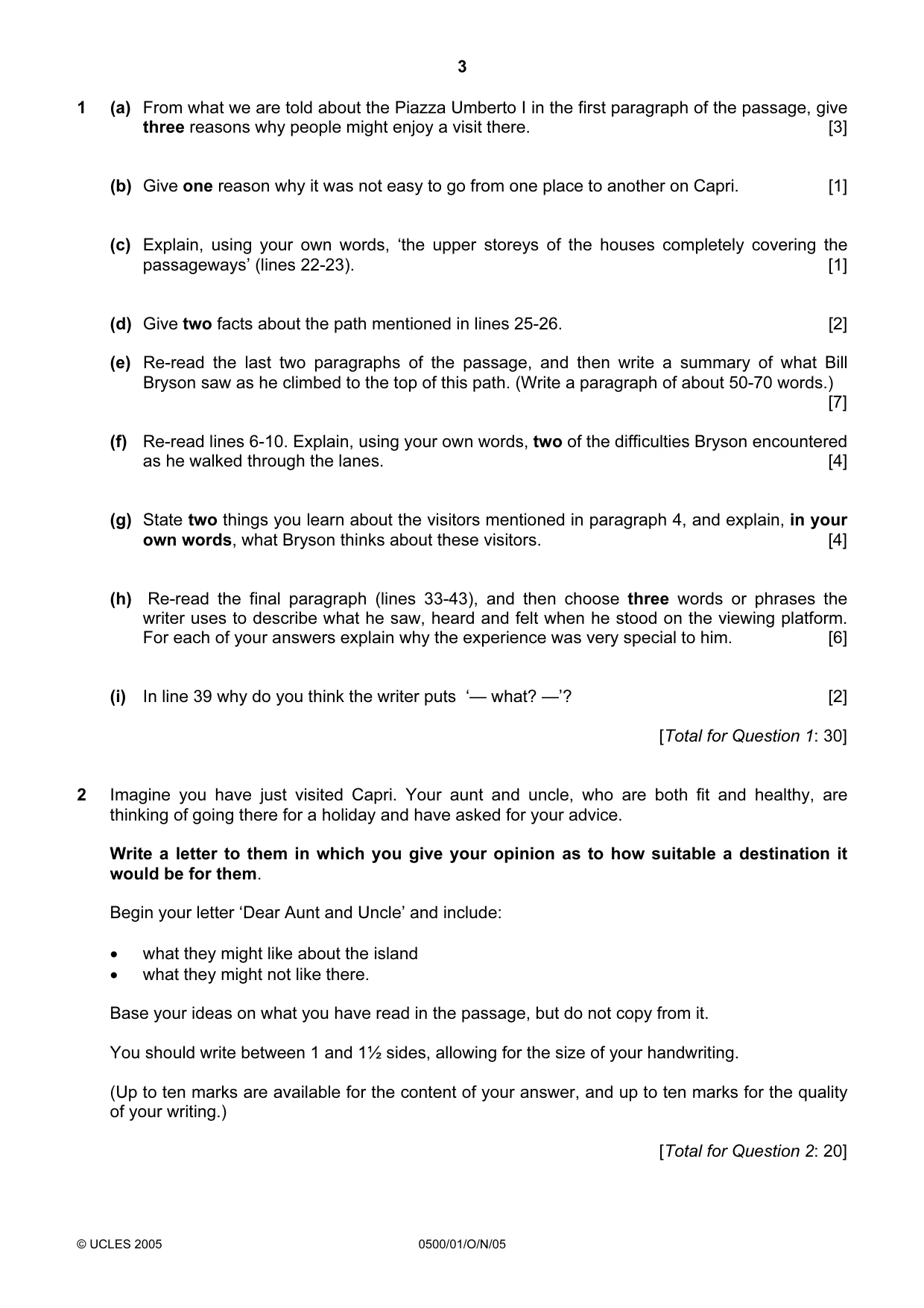
Question paper, page 3
3 © UCLES 2005 0500/01/O/N/05 1 (a) From what we are told about the Piazza Umberto I in the first paragraph of the passage, give three reasons why people might enjoy a visit there. [3] (b) Give one reason why it was not easy to go from one place to another on Capri. [1] (c) Explain, using your own words, ‘the upper storeys of the houses completely covering the passageways’ (lines 22-23). [1] (d) Give two facts about the path mentioned in lines 25-26. [2] (e) Re-read the last two paragraphs of the passage, and then write a summary of what Bill Bryson saw as he climbed to the top of this path. (Write a paragraph of about 50-70 words.) [7] (f) Re-read lines 6-10. Explain, using your own words, two of the difficulties Bryson encountered as he walked through the lanes. [4] (g) State two things you learn about the visitors mentioned in paragraph 4, and explain, in your own words, what Bryson thinks about these visitors. [4] (h) Re-read the final paragraph (lines 33-43), and then choose three words or phrases the writer uses to describe what he saw, heard and felt when he stood on the viewing platform. For each of your answers explain why the experience was very special to him. [6] (i) In line 39 why do you think the writer puts ‘— what? —’? [2] [Total for Question 1: 30] 2 Imagine you have just visited Capri. Your aunt and uncle, who are both fit and healthy, are thinking of going there for a holiday and have asked for your advice. Write a letter to them in which you give your opinion as to how suitable a destination it would be for them. Begin your letter ‘Dear Aunt and Uncle’ and include: • what they might like about the island • what they might not like there. Base your ideas on what you have read in the passage, but do not copy from it. You should write between 1 and 1½ sides, allowing for the size of your handwriting. (Up to ten marks are available for the content of your answer, and up to ten marks for the quality of your writing.) [Total for Question 2: 20]
Question paper, page 4
4 Copyright Acknowledgements: Passage © Bill Bryson; Neither Here nor There; Black Swan 1998. Permission to reproduce items where third-party owned material protected by copyright is included has been sought and cleared where possible. Every reasonable effort has been made by the publisher (UCLES) to trace copyright holders, but if any items requiring clearance have unwittingly been included, the publisher will be pleased to make amends at the earliest possible opportunity. University of Cambridge International Examinations is part of the University of Cambridge Local Examinations Syndicate (UCLES), which is itself a department of the University of Cambridge. 0500/01/O/N/05 BLANK PAGE
Mark scheme, page 1
UNIVERSITY OF CAMBRIDGE INTERNATIONAL EXAMINATIONS International General Certificate of Secondary Education MARK SCHEME for the November 2005 question paper 0500 FIRST LANGUAGE ENGLISH 0500/01 Paper 1 (Reading Passage - Core) Maximum mark 60 This mark scheme is published as an aid to teachers and students, to indicate the requirements of the examination. It shows the basis on which Examiners were initially instructed to award marks. It does not indicate the details of the discussions that took place at an Examiners’ meeting before marking began. Any substantial changes to the mark scheme that arose from these discussions will be recorded in the published Report on the Examination. All Examiners are instructed that alternative correct answers and unexpected approaches in candidates’ scripts must be given marks that fairly reflect the relevant knowledge and skills demonstrated. Mark schemes must be read in conjunction with the question papers and the Report on the Examination. The minimum marks in these components needed for various grades were previously published with these mark schemes, but are now instead included in the Report on the Examination for this session. • CIE will not enter into discussion or correspondence in connection with these mark schemes. CIE is publishing the mark schemes for the November 2005 question papers for most IGCSE and GCE Advanced Level and Advanced Subsidiary Level syllabuses and some Ordinary Level syllabuses. www.XtremePapers.com
Mark scheme, page 2
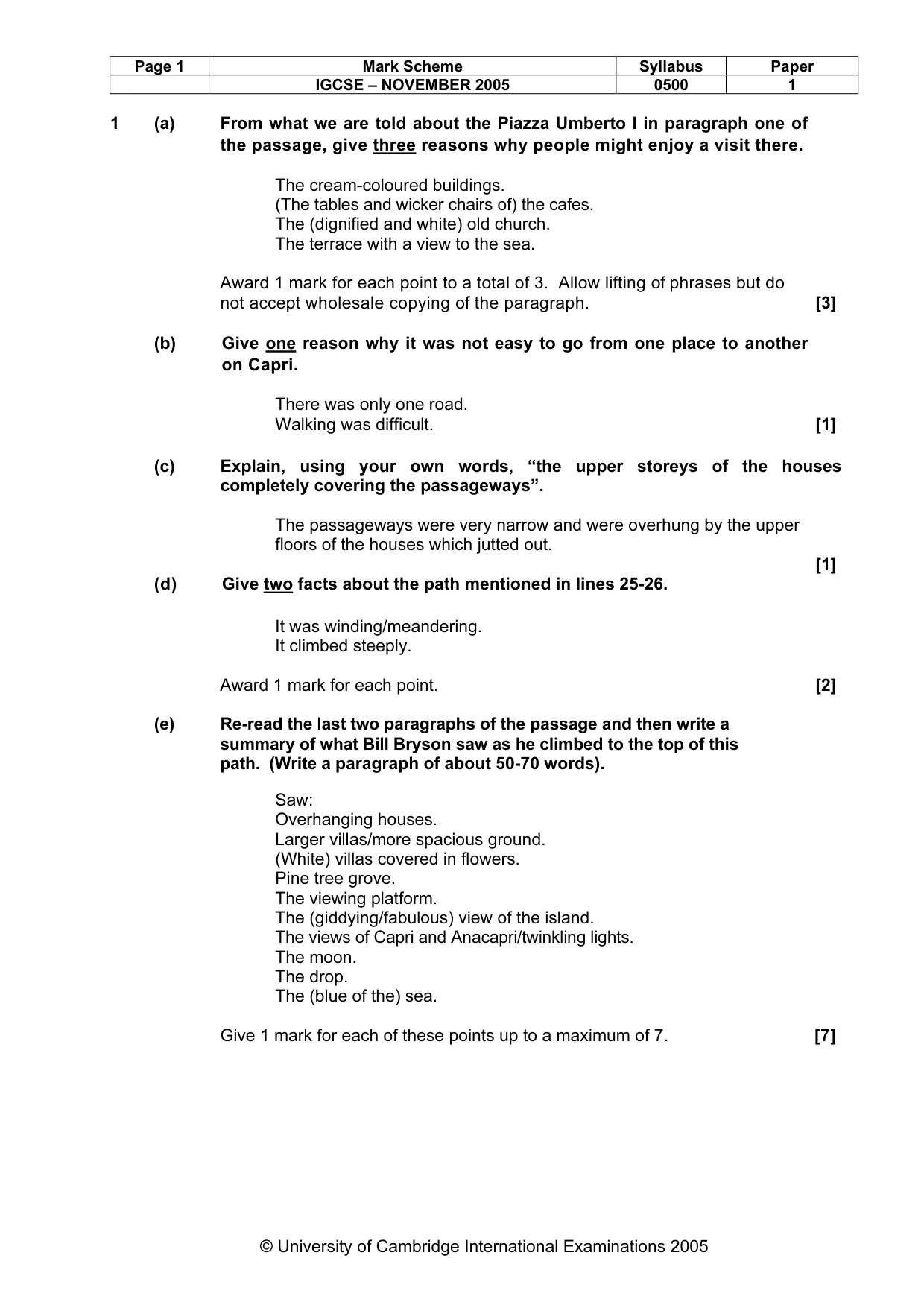
Page 1 Mark Scheme Syllabus Paper IGCSE – NOVEMBER 2005 0500 1 © University of Cambridge International Examinations 2005 1 (a) From what we are told about the Piazza Umberto I in paragraph one of the passage, give three reasons why people might enjoy a visit there. The cream-coloured buildings. (The tables and wicker chairs of) the cafes. The (dignified and white) old church. The terrace with a view to the sea. Award 1 mark for each point to a total of 3. Allow lifting of phrases but do not accept wholesale copying of the paragraph. [3] (b) Give one reason why it was not easy to go from one place to another on Capri. There was only one road. Walking was difficult. [1] (c) Explain, using your own words, “the upper storeys of the houses completely covering the passageways”. The passageways were very narrow and were overhung by the upper floors of the houses which jutted out. [1] (d) Give two facts about the path mentioned in lines 25-26. It was winding/meandering. It climbed steeply. Award 1 mark for each point. [2] (e) Re-read the last two paragraphs of the passage and then write a summary of what Bill Bryson saw as he climbed to the top of this path. (Write a paragraph of about 50-70 words). Saw: Overhanging houses. Larger villas/more spacious ground. (White) villas covered in flowers. Pine tree grove. The viewing platform. The (giddying/fabulous) view of the island. The views of Capri and Anacapri/twinkling lights. The moon. The drop. The (blue of the) sea. Give 1 mark for each of these points up to a maximum of 7. [7]
Mark scheme, page 3
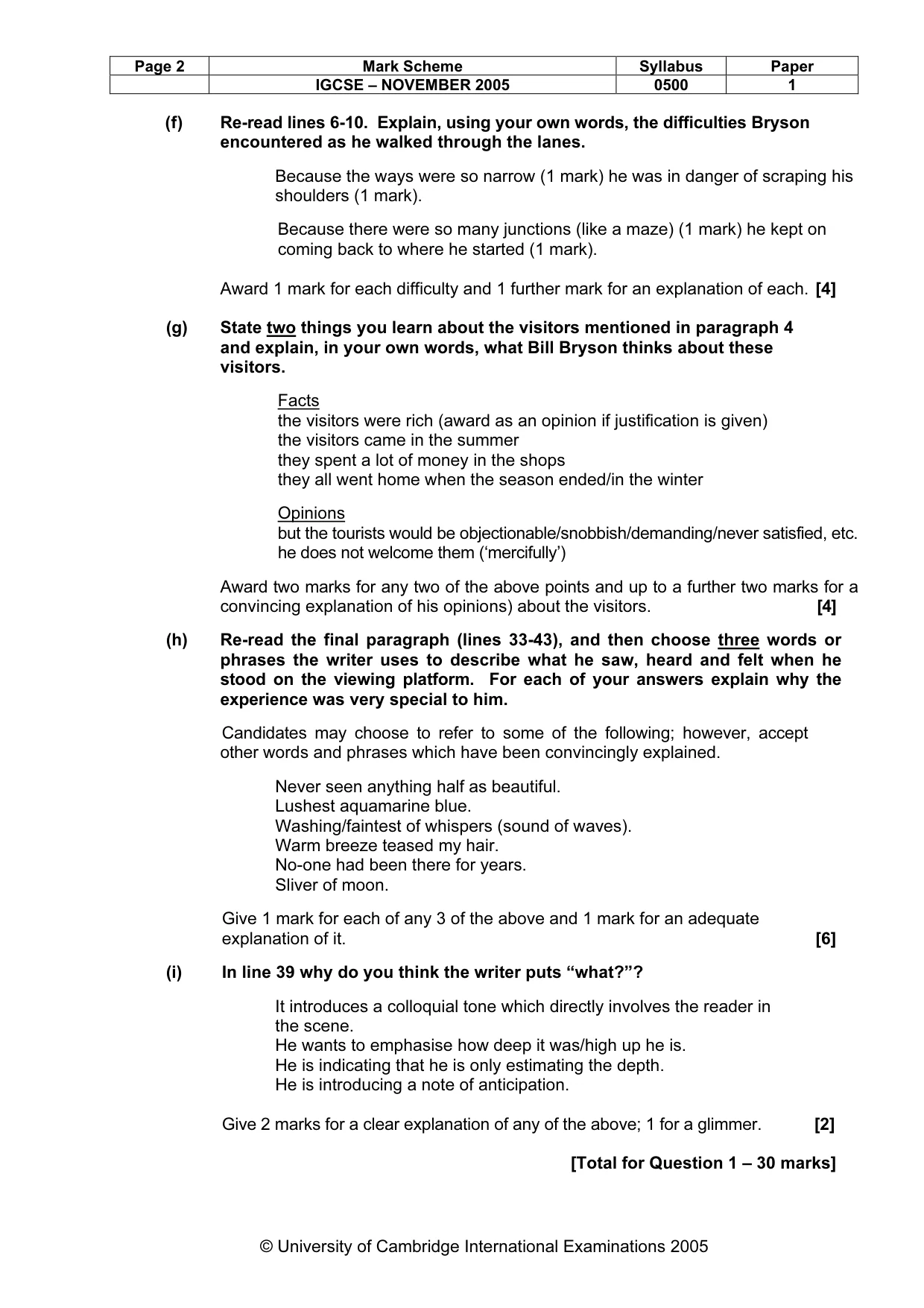
Page 2 Mark Scheme Syllabus Paper IGCSE – NOVEMBER 2005 0500 1 © University of Cambridge International Examinations 2005 (f) Re-read lines 6-10. Explain, using your own words, the difficulties Bryson encountered as he walked through the lanes. Because the ways were so narrow (1 mark) he was in danger of scraping his shoulders (1 mark). Because there were so many junctions (like a maze) (1 mark) he kept on coming back to where he started (1 mark). Award 1 mark for each difficulty and 1 further mark for an explanation of each. [4] (g) State two things you learn about the visitors mentioned in paragraph 4 and explain, in your own words, what Bill Bryson thinks about these visitors. Facts the visitors were rich (award as an opinion if justification is given) the visitors came in the summer they spent a lot of money in the shops they all went home when the season ended/in the winter Opinions but the tourists would be objectionable/snobbish/demanding/never satisfied, etc. he does not welcome them (‘mercifully’) Award two marks for any two of the above points and up to a further two marks for a convincing explanation of his opinions) about the visitors. [4] (h) Re-read the final paragraph (lines 33-43), and then choose three words or phrases the writer uses to describe what he saw, heard and felt when he stood on the viewing platform. For each of your answers explain why the experience was very special to him. Candidates may choose to refer to some of the following; however, accept other words and phrases which have been convincingly explained. Never seen anything half as beautiful. Lushest aquamarine blue. Washing/faintest of whispers (sound of waves). Warm breeze teased my hair. No-one had been there for years. Sliver of moon. Give 1 mark for each of any 3 of the above and 1 mark for an adequate explanation of it. [6] (i) In line 39 why do you think the writer puts “what?”? It introduces a colloquial tone which directly involves the reader in the scene. He wants to emphasise how deep it was/high up he is. He is indicating that he is only estimating the depth. He is introducing a note of anticipation. Give 2 marks for a clear explanation of any of the above; 1 for a glimmer. [2] [Total for Question 1 – 30 marks]
Mark scheme, page 4
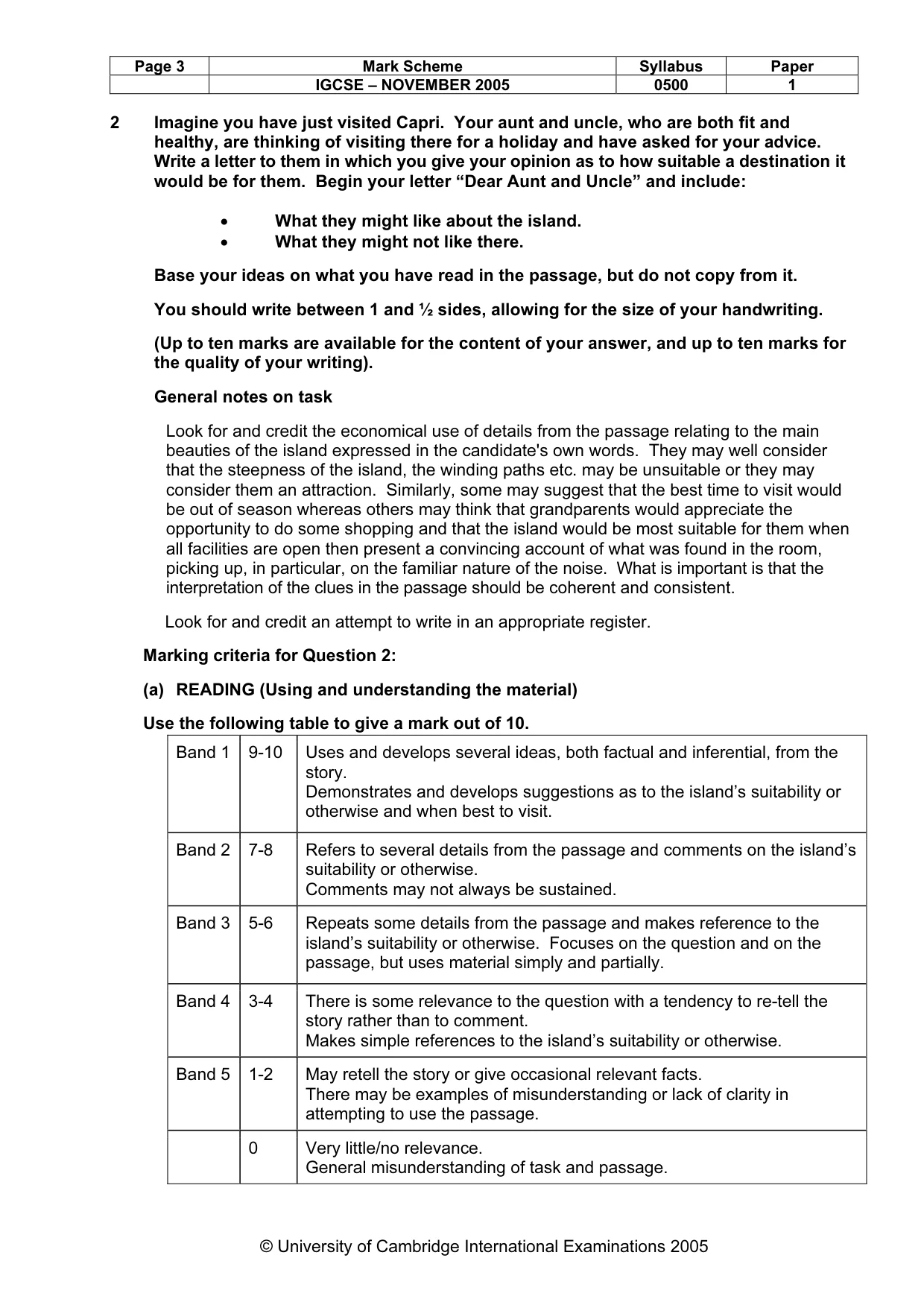
Page 3 Mark Scheme Syllabus Paper IGCSE – NOVEMBER 2005 0500 1 © University of Cambridge International Examinations 2005 2 Imagine you have just visited Capri. Your aunt and uncle, who are both fit and healthy, are thinking of visiting there for a holiday and have asked for your advice. Write a letter to them in which you give your opinion as to how suitable a destination it would be for them. Begin your letter “Dear Aunt and Uncle” and include: • What they might like about the island. • What they might not like there. Base your ideas on what you have read in the passage, but do not copy from it. You should write between 1 and ½ sides, allowing for the size of your handwriting. (Up to ten marks are available for the content of your answer, and up to ten marks for the quality of your writing). General notes on task Look for and credit the economical use of details from the passage relating to the main beauties of the island expressed in the candidate's own words. They may well consider that the steepness of the island, the winding paths etc. may be unsuitable or they may consider them an attraction. Similarly, some may suggest that the best time to visit would be out of season whereas others may think that grandparents would appreciate the opportunity to do some shopping and that the island would be most suitable for them when all facilities are open then present a convincing account of what was found in the room, picking up, in particular, on the familiar nature of the noise. What is important is that the interpretation of the clues in the passage should be coherent and consistent. Look for and credit an attempt to write in an appropriate register. Marking criteria for Question 2: (a) READING (Using and understanding the material) Use the following table to give a mark out of 10. Band 1 9-10 Uses and develops several ideas, both factual and inferential, from the story. Demonstrates and develops suggestions as to the island’s suitability or otherwise and when best to visit. Band 2 7-8 Refers to several details from the passage and comments on the island’s suitability or otherwise. Comments may not always be sustained. Band 3 5-6 Repeats some details from the passage and makes reference to the island’s suitability or otherwise. Focuses on the question and on the passage, but uses material simply and partially. Band 4 3-4 There is some relevance to the question with a tendency to re-tell the story rather than to comment. Makes simple references to the island’s suitability or otherwise. Band 5 1-2 May retell the story or give occasional relevant facts. There may be examples of misunderstanding or lack of clarity in attempting to use the passage. 0 Very little/no relevance. General misunderstanding of task and passage.
Mark scheme, page 5
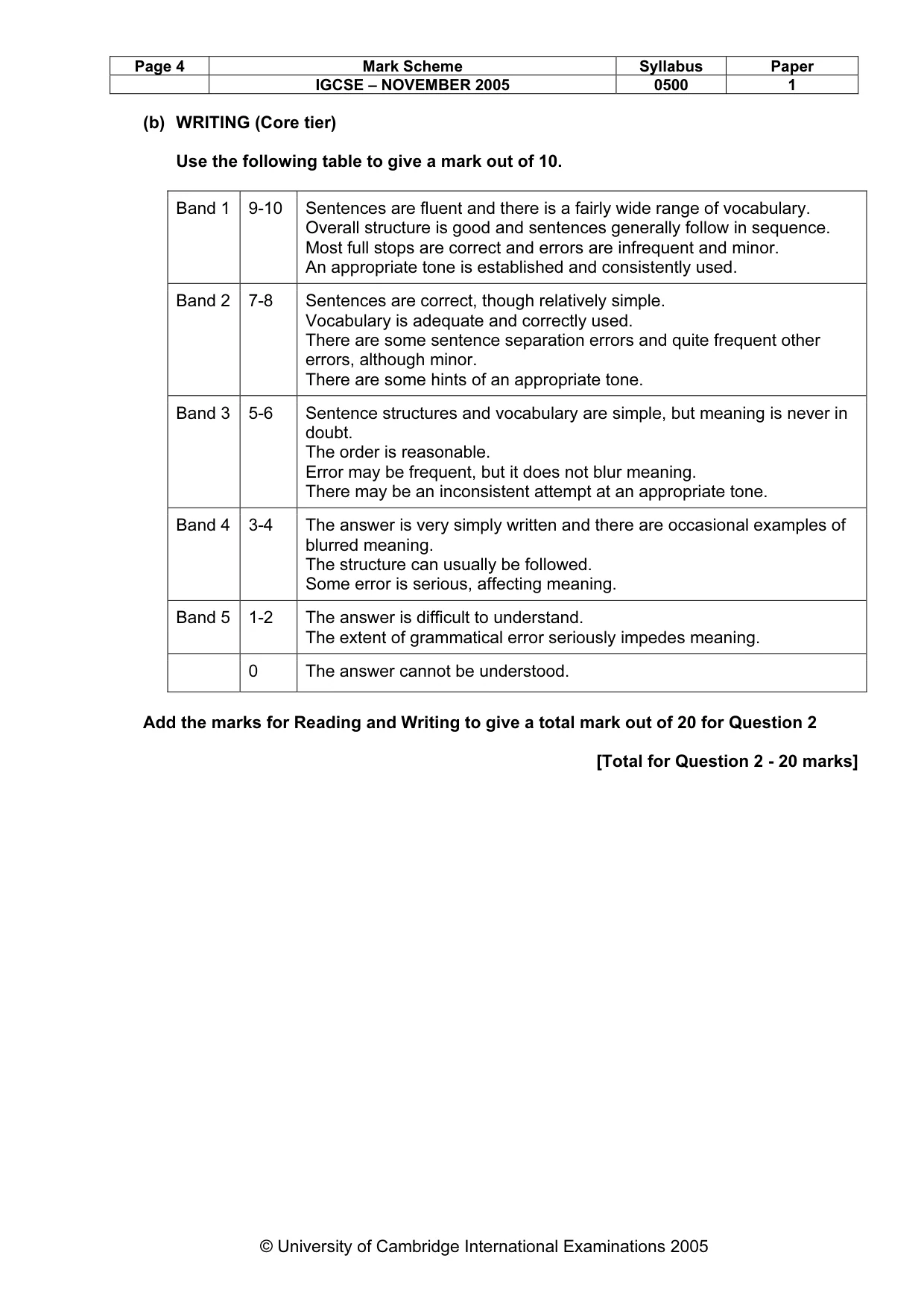
Page 4 Mark Scheme Syllabus Paper IGCSE – NOVEMBER 2005 0500 1 © University of Cambridge International Examinations 2005 (b) WRITING (Core tier) Use the following table to give a mark out of 10. Band 1 9-10 Sentences are fluent and there is a fairly wide range of vocabulary. Overall structure is good and sentences generally follow in sequence. Most full stops are correct and errors are infrequent and minor. An appropriate tone is established and consistently used. Band 2 7-8 Sentences are correct, though relatively simple. Vocabulary is adequate and correctly used. There are some sentence separation errors and quite frequent other errors, although minor. There are some hints of an appropriate tone. Band 3 5-6 Sentence structures and vocabulary are simple, but meaning is never in doubt. The order is reasonable. Error may be frequent, but it does not blur meaning. There may be an inconsistent attempt at an appropriate tone. Band 4 3-4 The answer is very simply written and there are occasional examples of blurred meaning. The structure can usually be followed. Some error is serious, affecting meaning. Band 5 1-2 The answer is difficult to understand. The extent of grammatical error seriously impedes meaning. 0 The answer cannot be understood. Add the marks for Reading and Writing to give a total mark out of 20 for Question 2 [Total for Question 2 - 20 marks]