Cambridge IGCSE English - First Language 0500 — 2005 May/June Paper 2 · Variant 1
0500/21/M/J/05
The question paper and its mark scheme, free to read here and free to download. This is Cambridge’s own paper, exactly as it was sat.
Question paper8 pages


Mark scheme8 pages
Answers below. Sit the paper first if you are practising.
Paper as text
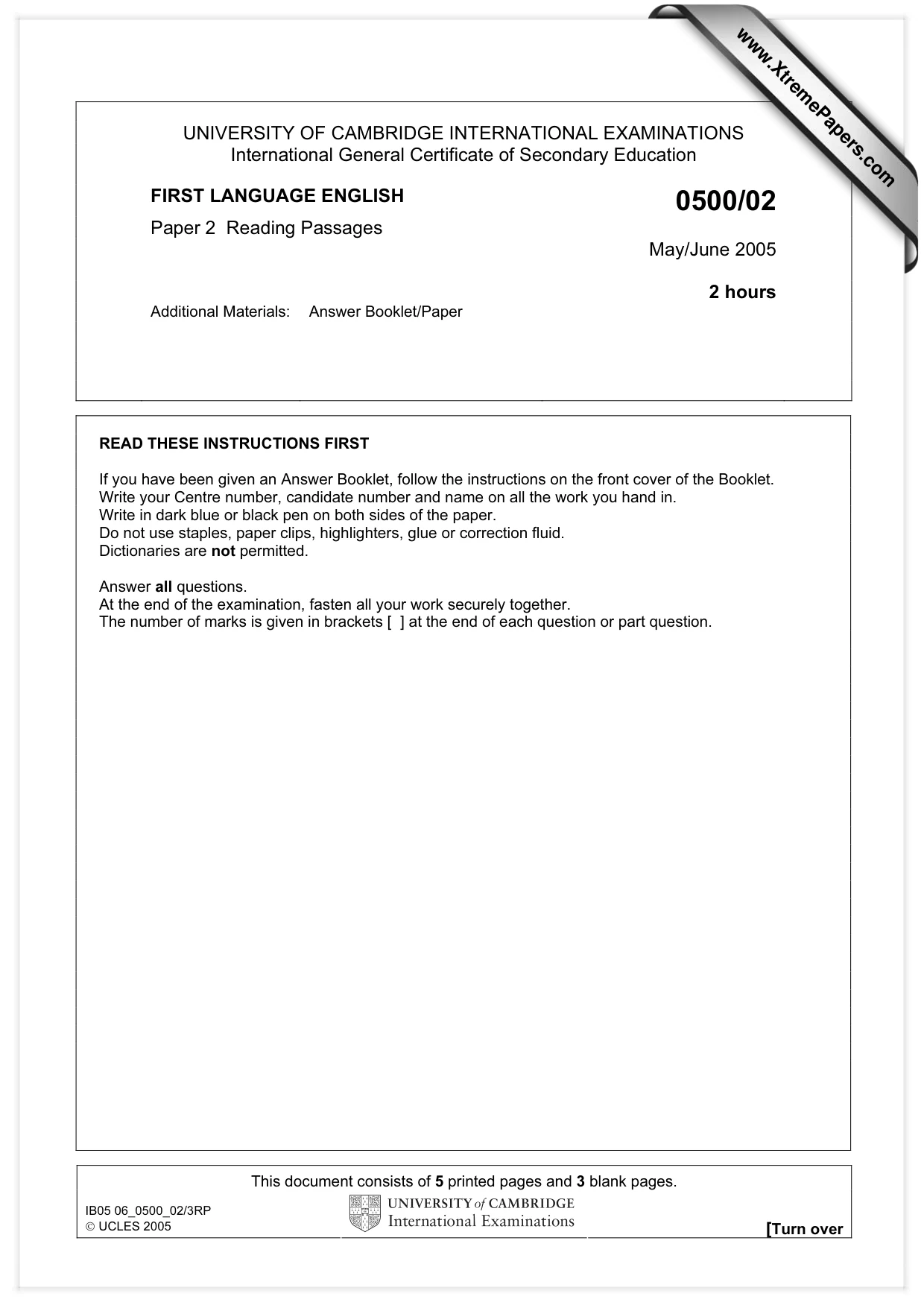
Question paper, page 1
UNIVERSITY OF CAMBRIDGE INTERNATIONAL EXAMINATIONS International General Certificate of Secondary Education FIRST LANGUAGE ENGLISH 0500/02 Paper 2 Reading Passages May/June 2005 2 hours Additional Materials: Answer Booklet/Paper READ THESE INSTRUCTIONS FIRST If you have been given an Answer Booklet, follow the instructions on the front cover of the Booklet. Write your Centre number, candidate number and name on all the work you hand in. Write in dark blue or black pen on both sides of the paper. Do not use staples, paper clips, highlighters, glue or correction fluid. Dictionaries are not permitted. Answer all questions. At the end of the examination, fasten all your work securely together. The number of marks is given in brackets [ ] at the end of each question or part question. This document consists of 5 printed pages and 3 blank pages. IB05 06_0500_02/3RP UCLES 2005 [Turn over www.XtremePapers.com
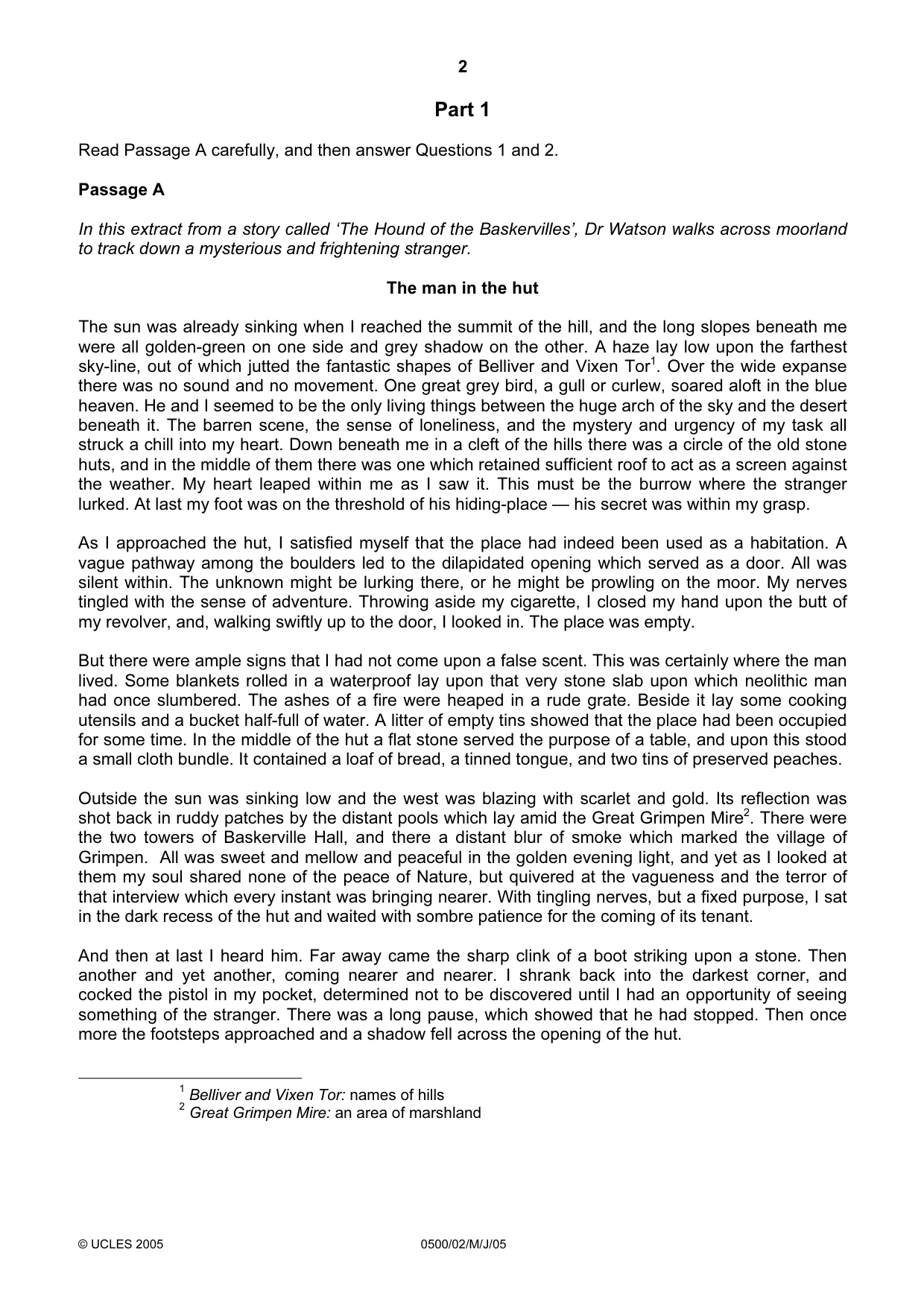
Question paper, page 2
2 © UCLES 2005 0500/02/M/J/05 Part 1 Read Passage A carefully, and then answer Questions 1 and 2. Passage A In this extract from a story called ‘The Hound of the Baskervilles’, Dr Watson walks across moorland to track down a mysterious and frightening stranger. The man in the hut The sun was already sinking when I reached the summit of the hill, and the long slopes beneath me were all golden-green on one side and grey shadow on the other. A haze lay low upon the farthest sky-line, out of which jutted the fantastic shapes of Belliver and Vixen Tor1. Over the wide expanse there was no sound and no movement. One great grey bird, a gull or curlew, soared aloft in the blue heaven. He and I seemed to be the only living things between the huge arch of the sky and the desert beneath it. The barren scene, the sense of loneliness, and the mystery and urgency of my task all struck a chill into my heart. Down beneath me in a cleft of the hills there was a circle of the old stone huts, and in the middle of them there was one which retained sufficient roof to act as a screen against the weather. My heart leaped within me as I saw it. This must be the burrow where the stranger lurked. At last my foot was on the threshold of his hiding-place — his secret was within my grasp. As I approached the hut, I satisfied myself that the place had indeed been used as a habitation. A vague pathway among the boulders led to the dilapidated opening which served as a door. All was silent within. The unknown might be lurking there, or he might be prowling on the moor. My nerves tingled with the sense of adventure. Throwing aside my cigarette, I closed my hand upon the butt of my revolver, and, walking swiftly up to the door, I looked in. The place was empty. But there were ample signs that I had not come upon a false scent. This was certainly where the man lived. Some blankets rolled in a waterproof lay upon that very stone slab upon which neolithic man had once slumbered. The ashes of a fire were heaped in a rude grate. Beside it lay some cooking utensils and a bucket half-full of water. A litter of empty tins showed that the place had been occupied for some time. In the middle of the hut a flat stone served the purpose of a table, and upon this stood a small cloth bundle. It contained a loaf of bread, a tinned tongue, and two tins of preserved peaches. Outside the sun was sinking low and the west was blazing with scarlet and gold. Its reflection was shot back in ruddy patches by the distant pools which lay amid the Great Grimpen Mire2. There were the two towers of Baskerville Hall, and there a distant blur of smoke which marked the village of Grimpen. All was sweet and mellow and peaceful in the golden evening light, and yet as I looked at them my soul shared none of the peace of Nature, but quivered at the vagueness and the terror of that interview which every instant was bringing nearer. With tingling nerves, but a fixed purpose, I sat in the dark recess of the hut and waited with sombre patience for the coming of its tenant. And then at last I heard him. Far away came the sharp clink of a boot striking upon a stone. Then another and yet another, coming nearer and nearer. I shrank back into the darkest corner, and cocked the pistol in my pocket, determined not to be discovered until I had an opportunity of seeing something of the stranger. There was a long pause, which showed that he had stopped. Then once more the footsteps approached and a shadow fell across the opening of the hut. 1 Belliver and Vixen Tor: names of hills 2 Great Grimpen Mire: an area of marshland
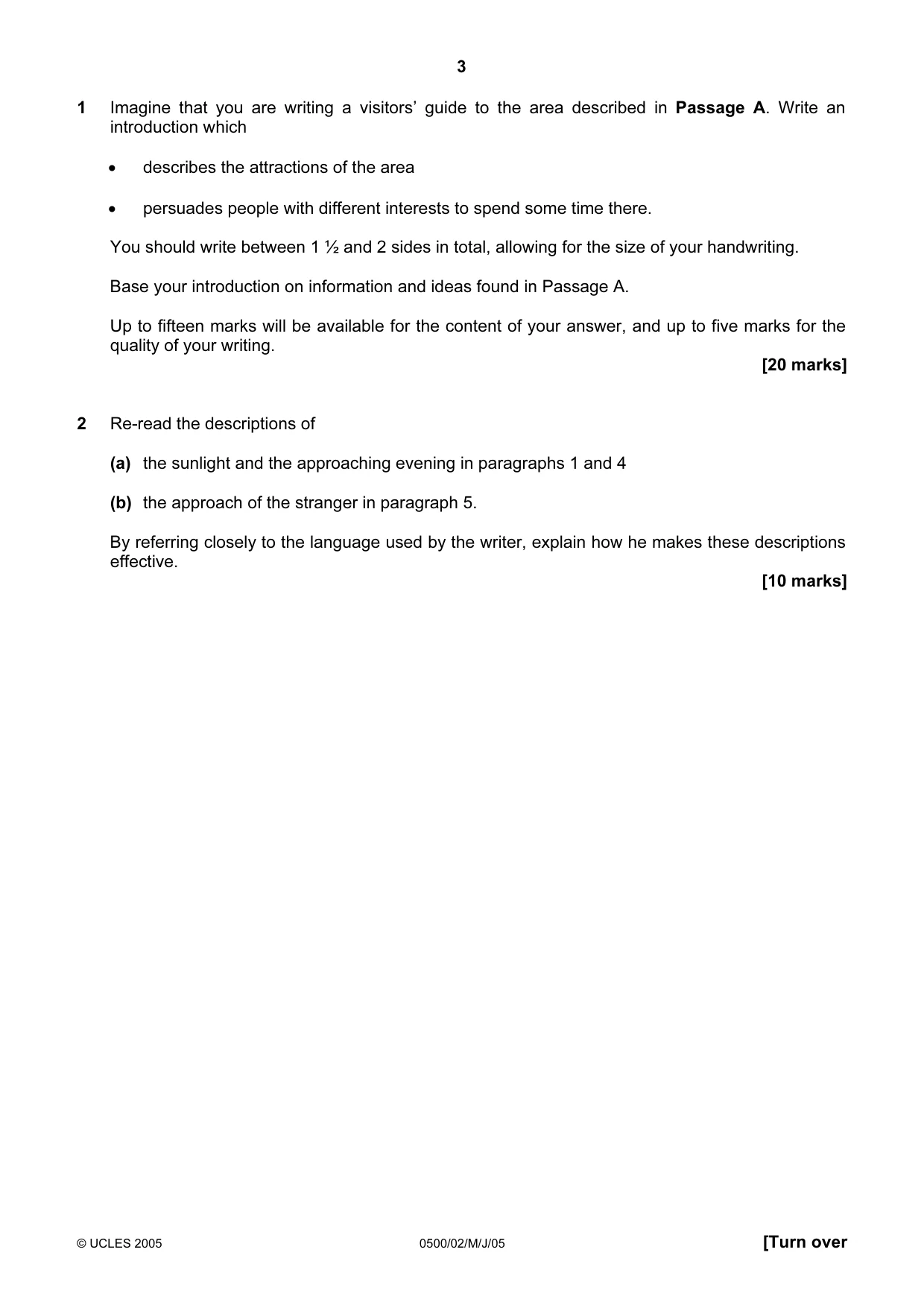
Question paper, page 3
3 © UCLES 2005 0500/02/M/J/05 [Turn over 1 Imagine that you are writing a visitors’ guide to the area described in Passage A. Write an introduction which • describes the attractions of the area • persuades people with different interests to spend some time there. You should write between 1 ½ and 2 sides in total, allowing for the size of your handwriting. Base your introduction on information and ideas found in Passage A. Up to fifteen marks will be available for the content of your answer, and up to five marks for the quality of your writing. [20 marks] 2 Re-read the descriptions of (a) the sunlight and the approaching evening in paragraphs 1 and 4 (b) the approach of the stranger in paragraph 5. By referring closely to the language used by the writer, explain how he makes these descriptions effective. [10 marks]
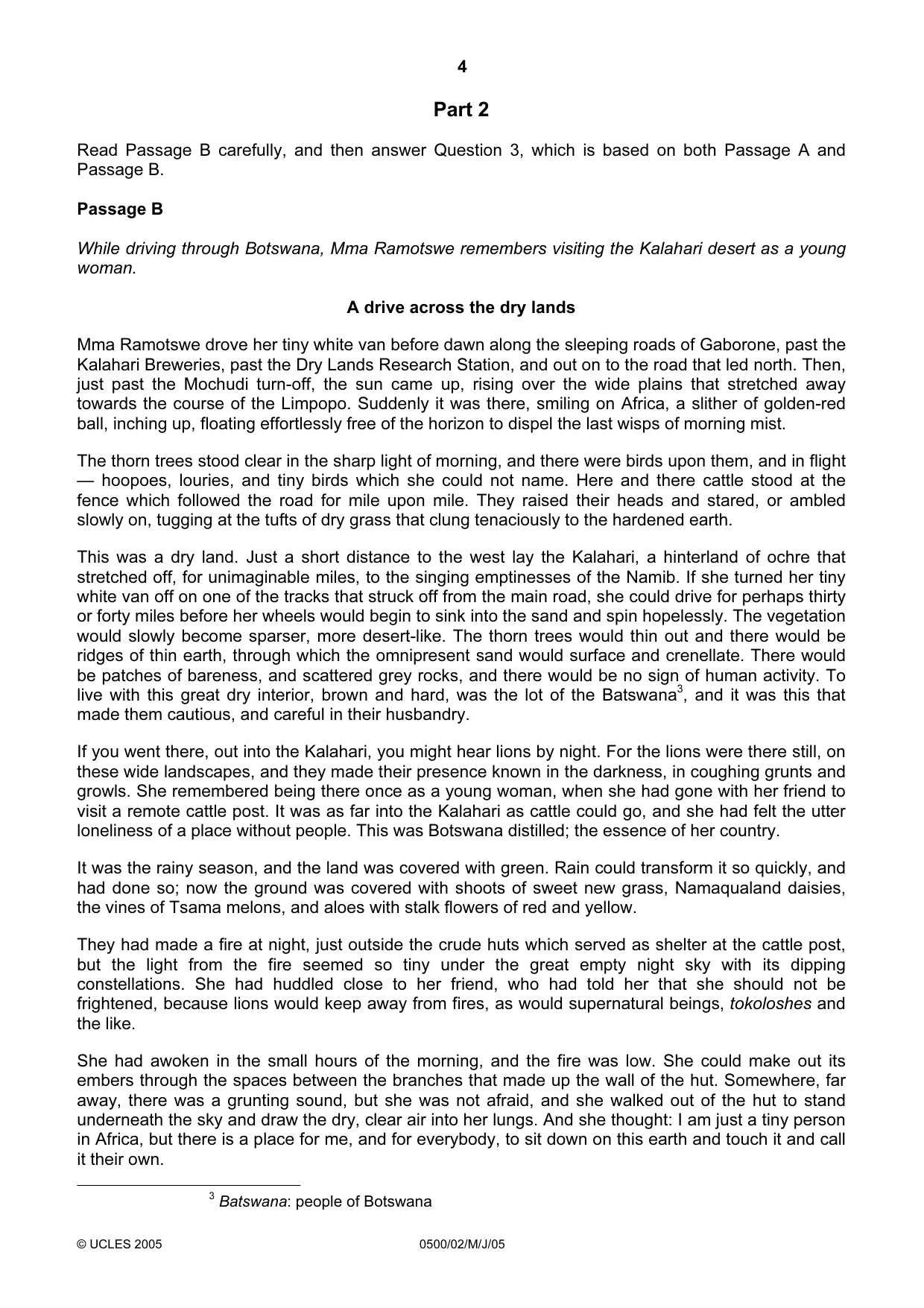
Question paper, page 4
4 © UCLES 2005 0500/02/M/J/05 Part 2 Read Passage B carefully, and then answer Question 3, which is based on both Passage A and Passage B. Passage B While driving through Botswana, Mma Ramotswe remembers visiting the Kalahari desert as a young woman. A drive across the dry lands Mma Ramotswe drove her tiny white van before dawn along the sleeping roads of Gaborone, past the Kalahari Breweries, past the Dry Lands Research Station, and out on to the road that led north. Then, just past the Mochudi turn-off, the sun came up, rising over the wide plains that stretched away towards the course of the Limpopo. Suddenly it was there, smiling on Africa, a slither of golden-red ball, inching up, floating effortlessly free of the horizon to dispel the last wisps of morning mist. The thorn trees stood clear in the sharp light of morning, and there were birds upon them, and in flight — hoopoes, louries, and tiny birds which she could not name. Here and there cattle stood at the fence which followed the road for mile upon mile. They raised their heads and stared, or ambled slowly on, tugging at the tufts of dry grass that clung tenaciously to the hardened earth. This was a dry land. Just a short distance to the west lay the Kalahari, a hinterland of ochre that stretched off, for unimaginable miles, to the singing emptinesses of the Namib. If she turned her tiny white van off on one of the tracks that struck off from the main road, she could drive for perhaps thirty or forty miles before her wheels would begin to sink into the sand and spin hopelessly. The vegetation would slowly become sparser, more desert-like. The thorn trees would thin out and there would be ridges of thin earth, through which the omnipresent sand would surface and crenellate. There would be patches of bareness, and scattered grey rocks, and there would be no sign of human activity. To live with this great dry interior, brown and hard, was the lot of the Batswana3, and it was this that made them cautious, and careful in their husbandry. If you went there, out into the Kalahari, you might hear lions by night. For the lions were there still, on these wide landscapes, and they made their presence known in the darkness, in coughing grunts and growls. She remembered being there once as a young woman, when she had gone with her friend to visit a remote cattle post. It was as far into the Kalahari as cattle could go, and she had felt the utter loneliness of a place without people. This was Botswana distilled; the essence of her country. It was the rainy season, and the land was covered with green. Rain could transform it so quickly, and had done so; now the ground was covered with shoots of sweet new grass, Namaqualand daisies, the vines of Tsama melons, and aloes with stalk flowers of red and yellow. They had made a fire at night, just outside the crude huts which served as shelter at the cattle post, but the light from the fire seemed so tiny under the great empty night sky with its dipping constellations. She had huddled close to her friend, who had told her that she should not be frightened, because lions would keep away from fires, as would supernatural beings, tokoloshes and the like. She had awoken in the small hours of the morning, and the fire was low. She could make out its embers through the spaces between the branches that made up the wall of the hut. Somewhere, far away, there was a grunting sound, but she was not afraid, and she walked out of the hut to stand underneath the sky and draw the dry, clear air into her lungs. And she thought: I am just a tiny person in Africa, but there is a place for me, and for everybody, to sit down on this earth and touch it and call it their own. 3 Batswana: people of Botswana
Question paper, page 5
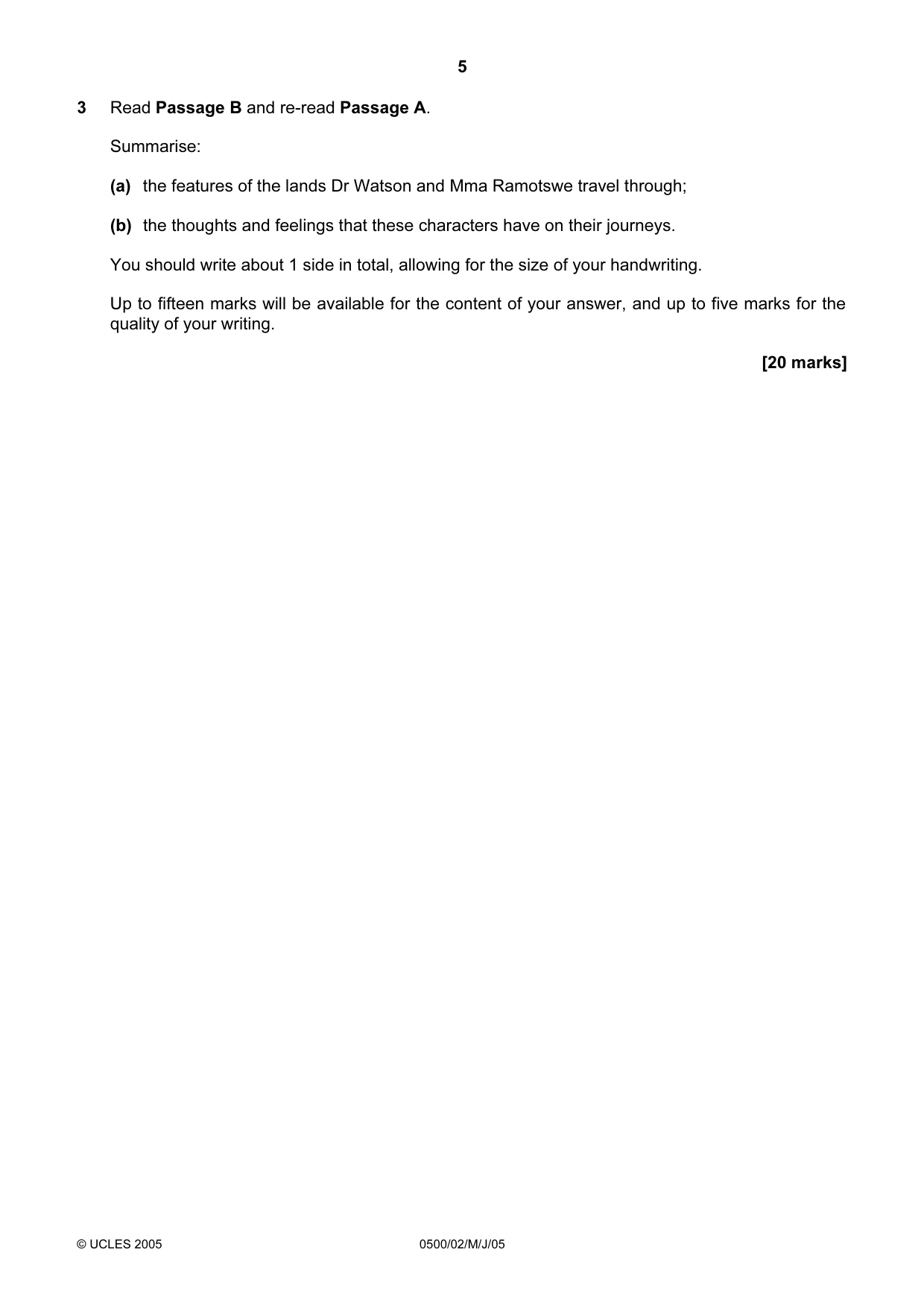
5 © UCLES 2005 0500/02/M/J/05 3 Read Passage B and re-read Passage A. Summarise: (a) the features of the lands Dr Watson and Mma Ramotswe travel through; (b) the thoughts and feelings that these characters have on their journeys. You should write about 1 side in total, allowing for the size of your handwriting. Up to fifteen marks will be available for the content of your answer, and up to five marks for the quality of your writing. [20 marks]
Question paper, page 8
8 Copyright Acknowledgements: Question 3 © Alexander McCall Smith; The No.1 Ladies Detective Agency; Polygon; 1998. Permission to reproduce items where third-party owned material protected by copyright is included has been sought and cleared where possible. Every reasonable effort has been made by the publisher (UCLES) to trace copyright holders, but if any items requiring clearance have unwittingly been included, the publisher will be pleased to make amends at the earliest possible opportunity. University of Cambridge International Examinations is part of the University of Cambridge Local Examinations Syndicate (UCLES), which is itself a department of the University of Cambridge. 0500/02/M/J/05 BLANK PAGE
Mark scheme, page 1
UNIVERSITY OF CAMBRIDGE INTERNATIONAL EXAMINATIONS International General Certificate of Secondary Education MARK SCHEME for the June 2005 question paper 0500 FIRST LANGUAGE ENGLISH 0500/02 Paper 2 (Reading Passages - Extended), maximum mark 50 This mark scheme is published as an aid to teachers and students, to indicate the requirements of the examination. It shows the basis on which Examiners were initially instructed to award marks. It does not indicate the details of the discussions that took place at an Examiners’ meeting before marking began. Any substantial changes to the mark scheme that arose from these discussions will be recorded in the published Report on the Examination. All Examiners are instructed that alternative correct answers and unexpected approaches in candidates’ scripts must be given marks that fairly reflect the relevant knowledge and skills demonstrated. Mark schemes must be read in conjunction with the question papers and the Report on the Examination. • CIE will not enter into discussion or correspondence in connection with these mark schemes. CIE is publishing the mark schemes for the June 2005 question papers for most IGCSE and GCE Advanced Level and Advanced Subsidiary Level syllabuses and some Ordinary Level syllabuses. www.XtremePapers.com
Mark scheme, page 2
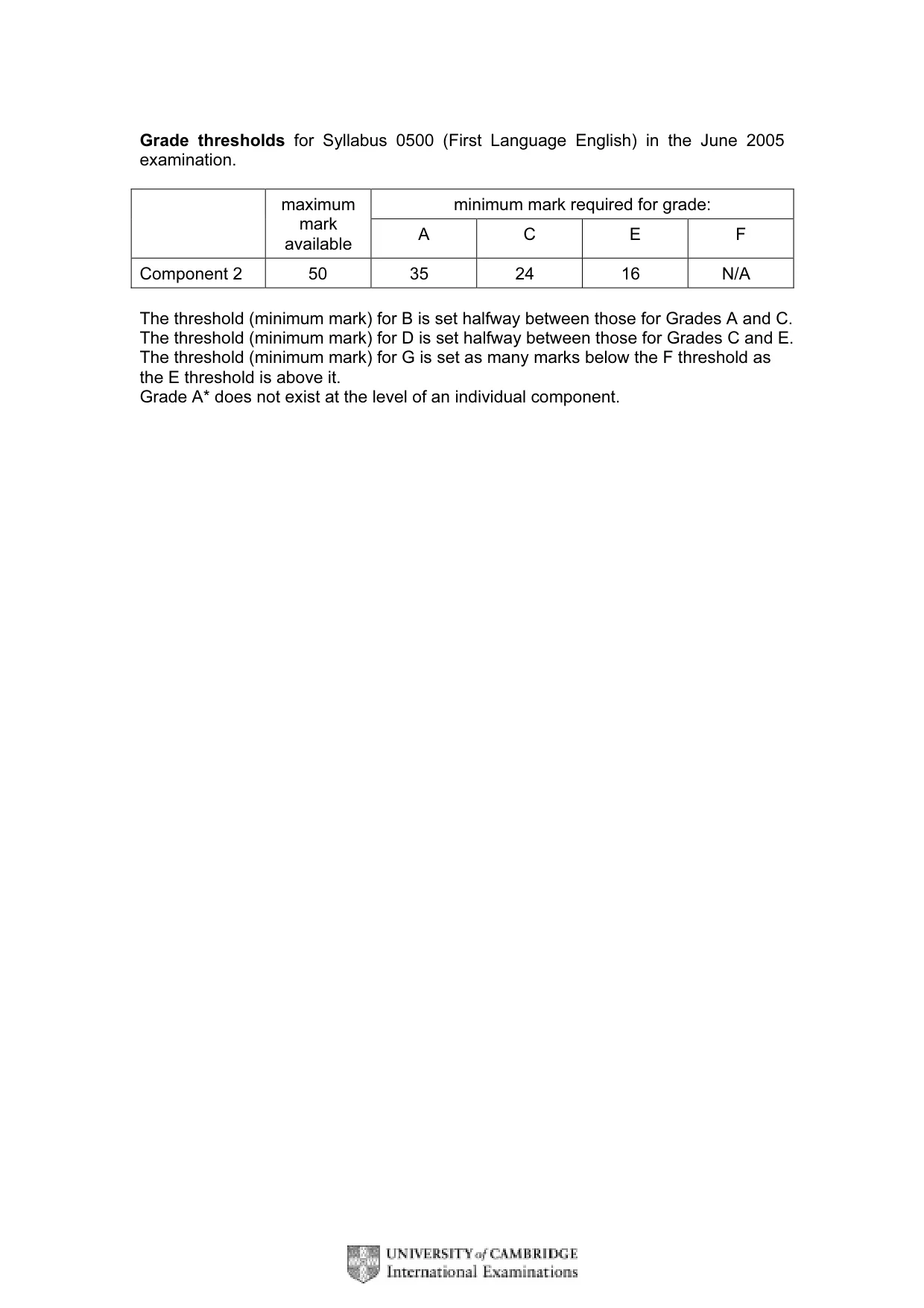
Grade thresholds for Syllabus 0500 (First Language English) in the June 2005 examination. minimum mark required for grade: maximum mark available A C E F Component 2 50 35 24 16 N/A The threshold (minimum mark) for B is set halfway between those for Grades A and C. The threshold (minimum mark) for D is set halfway between those for Grades C and E. The threshold (minimum mark) for G is set as many marks below the F threshold as the E threshold is above it. Grade A* does not exist at the level of an individual component.
Mark scheme, page 3
June 2005 IGCSE MARK SCHEME MAXIMUM MARK: 50 SYLLABUS/COMPONENT: 0500/02 FIRST LANGUAGE ENGLISH Paper 2 (Reading Passages - Extended)
Mark scheme, page 4
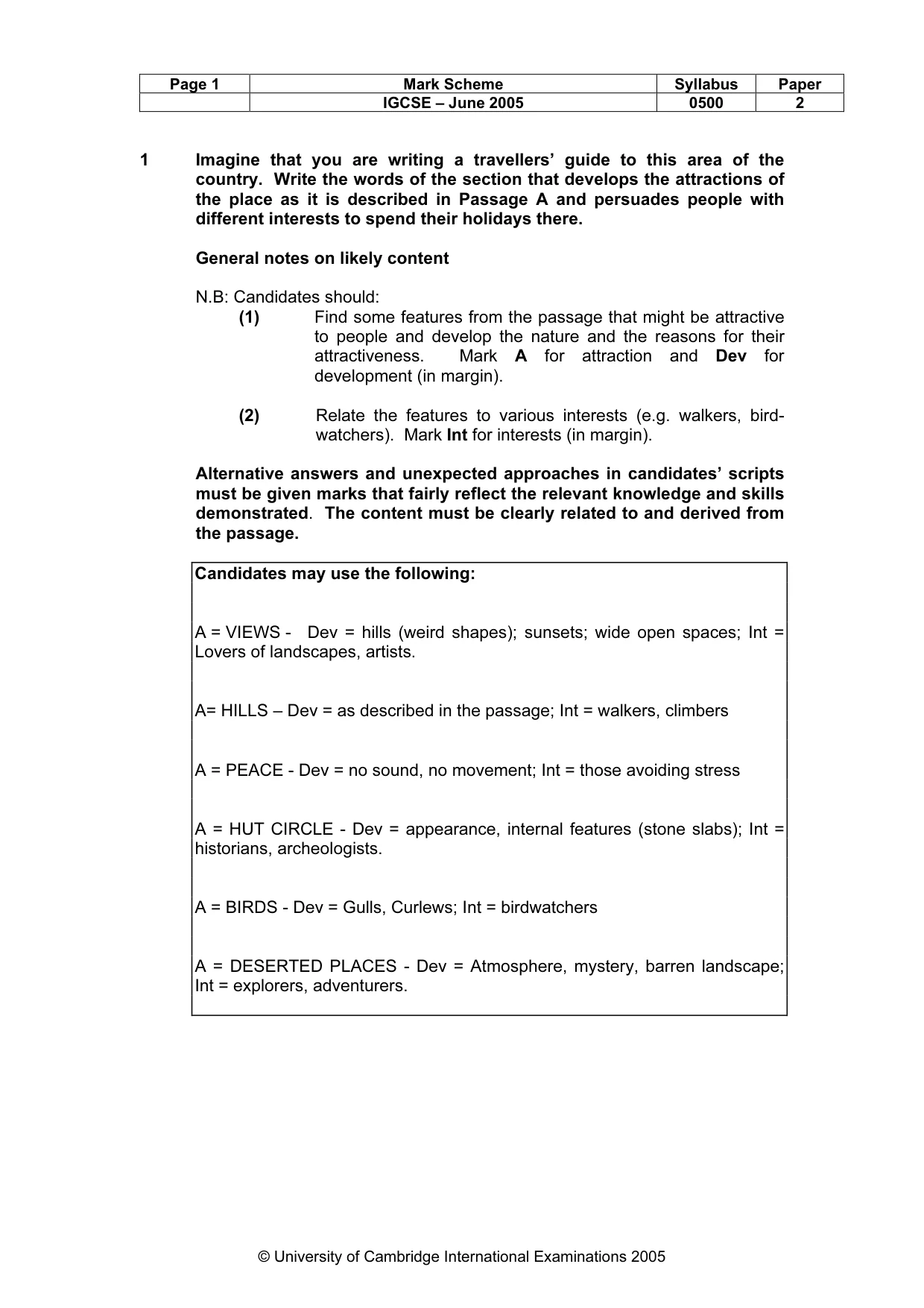
Page 1 Mark Scheme Syllabus Paper IGCSE – June 2005 0500 2 © University of Cambridge International Examinations 2005 1 Imagine that you are writing a travellers’ guide to this area of the country. Write the words of the section that develops the attractions of the place as it is described in Passage A and persuades people with different interests to spend their holidays there. General notes on likely content N.B: Candidates should: (1) Find some features from the passage that might be attractive to people and develop the nature and the reasons for their attractiveness. Mark A for attraction and Dev for development (in margin). (2) Relate the features to various interests (e.g. walkers, bird- watchers). Mark Int for interests (in margin). Alternative answers and unexpected approaches in candidates’ scripts must be given marks that fairly reflect the relevant knowledge and skills demonstrated. The content must be clearly related to and derived from the passage. Candidates may use the following: A = VIEWS - Dev = hills (weird shapes); sunsets; wide open spaces; Int = Lovers of landscapes, artists. A= HILLS – Dev = as described in the passage; Int = walkers, climbers A = PEACE - Dev = no sound, no movement; Int = those avoiding stress A = HUT CIRCLE - Dev = appearance, internal features (stone slabs); Int = historians, archeologists. A = BIRDS - Dev = Gulls, Curlews; Int = birdwatchers A = DESERTED PLACES - Dev = Atmosphere, mystery, barren landscape; Int = explorers, adventurers.
Mark scheme, page 5
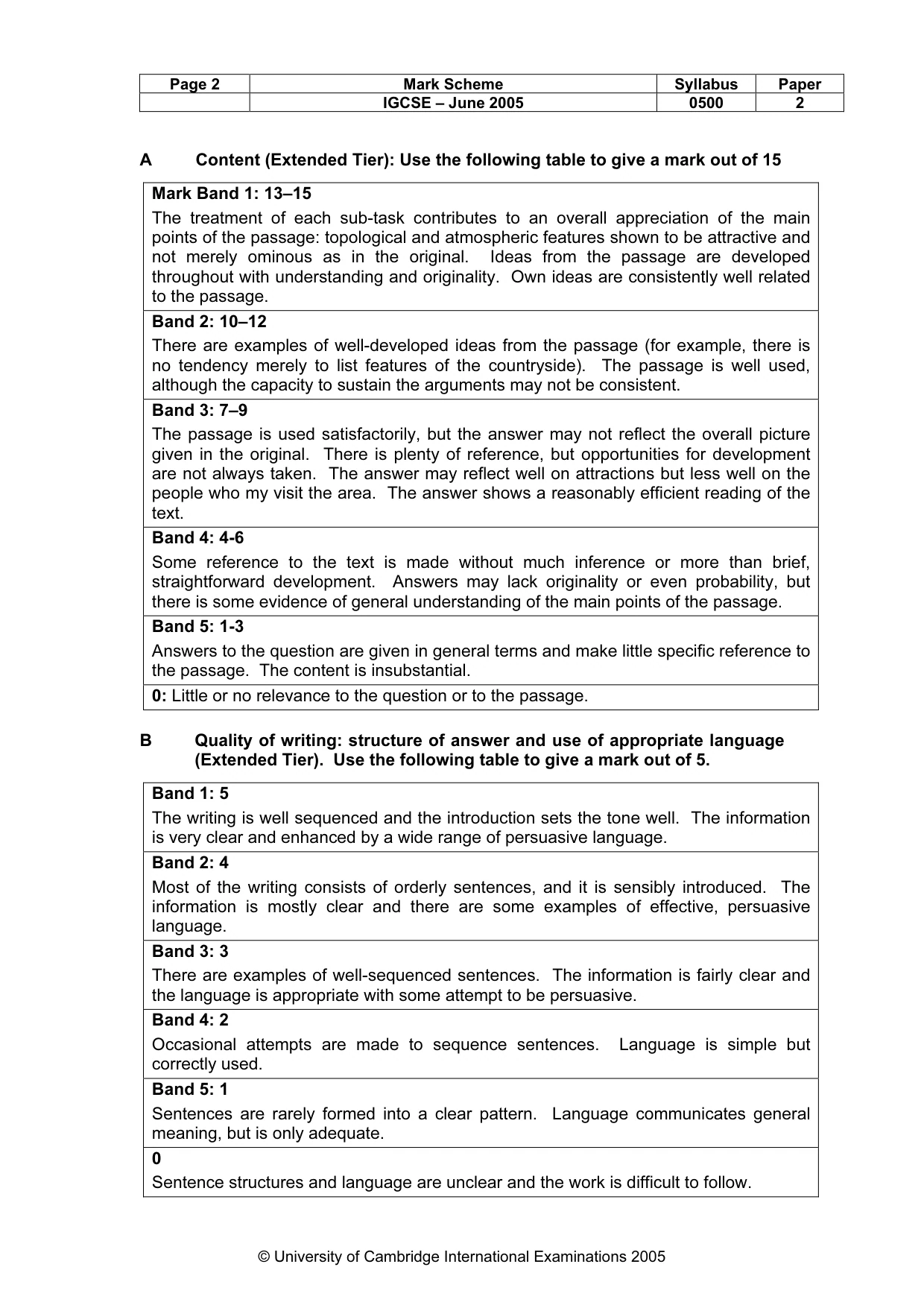
Page 2 Mark Scheme Syllabus Paper IGCSE – June 2005 0500 2 © University of Cambridge International Examinations 2005 A Content (Extended Tier): Use the following table to give a mark out of 15 B Quality of writing: structure of answer and use of appropriate language (Extended Tier). Use the following table to give a mark out of 5. Mark Band 1: 13–15 The treatment of each sub-task contributes to an overall appreciation of the main points of the passage: topological and atmospheric features shown to be attractive and not merely ominous as in the original. Ideas from the passage are developed throughout with understanding and originality. Own ideas are consistently well related to the passage. Band 2: 10–12 There are examples of well-developed ideas from the passage (for example, there is no tendency merely to list features of the countryside). The passage is well used, although the capacity to sustain the arguments may not be consistent. Band 3: 7–9 The passage is used satisfactorily, but the answer may not reflect the overall picture given in the original. There is plenty of reference, but opportunities for development are not always taken. The answer may reflect well on attractions but less well on the people who my visit the area. The answer shows a reasonably efficient reading of the text. Band 4: 4-6 Some reference to the text is made without much inference or more than brief, straightforward development. Answers may lack originality or even probability, but there is some evidence of general understanding of the main points of the passage. Band 5: 1-3 Answers to the question are given in general terms and make little specific reference to the passage. The content is insubstantial. 0: Little or no relevance to the question or to the passage. Band 1: 5 The writing is well sequenced and the introduction sets the tone well. The information is very clear and enhanced by a wide range of persuasive language. Band 2: 4 Most of the writing consists of orderly sentences, and it is sensibly introduced. The information is mostly clear and there are some examples of effective, persuasive language. Band 3: 3 There are examples of well-sequenced sentences. The information is fairly clear and the language is appropriate with some attempt to be persuasive. Band 4: 2 Occasional attempts are made to sequence sentences. Language is simple but correctly used. Band 5: 1 Sentences are rarely formed into a clear pattern. Language communicates general meaning, but is only adequate. 0 Sentence structures and language are unclear and the work is difficult to follow.
Mark scheme, page 6
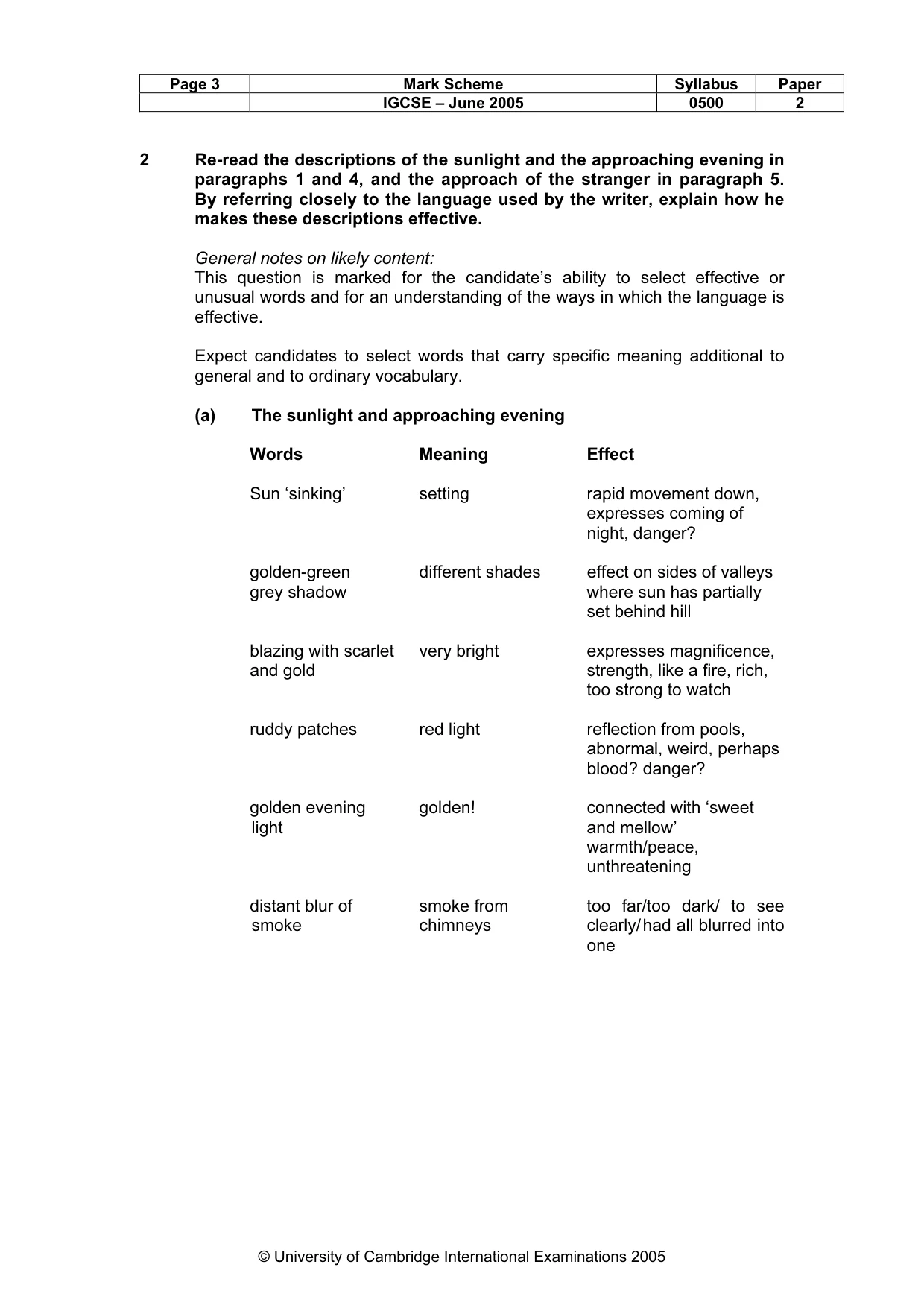
Page 3 Mark Scheme Syllabus Paper IGCSE – June 2005 0500 2 © University of Cambridge International Examinations 2005 2 Re-read the descriptions of the sunlight and the approaching evening in paragraphs 1 and 4, and the approach of the stranger in paragraph 5. By referring closely to the language used by the writer, explain how he makes these descriptions effective. General notes on likely content: This question is marked for the candidate’s ability to select effective or unusual words and for an understanding of the ways in which the language is effective. Expect candidates to select words that carry specific meaning additional to general and to ordinary vocabulary. (a) The sunlight and approaching evening Words Meaning Effect Sun ‘sinking’ setting rapid movement down, expresses coming of night, danger? golden-green different shades effect on sides of valleys grey shadow where sun has partially set behind hill blazing with scarlet very bright expresses magnificence, and gold strength, like a fire, rich, too strong to watch ruddy patches red light reflection from pools, abnormal, weird, perhaps blood? danger? golden evening golden! connected with ‘sweet light and mellow’ warmth/peace, unthreatening distant blur of smoke from too far/too dark/ to see smoke chimneys clearly/ had all blurred into one
Mark scheme, page 7
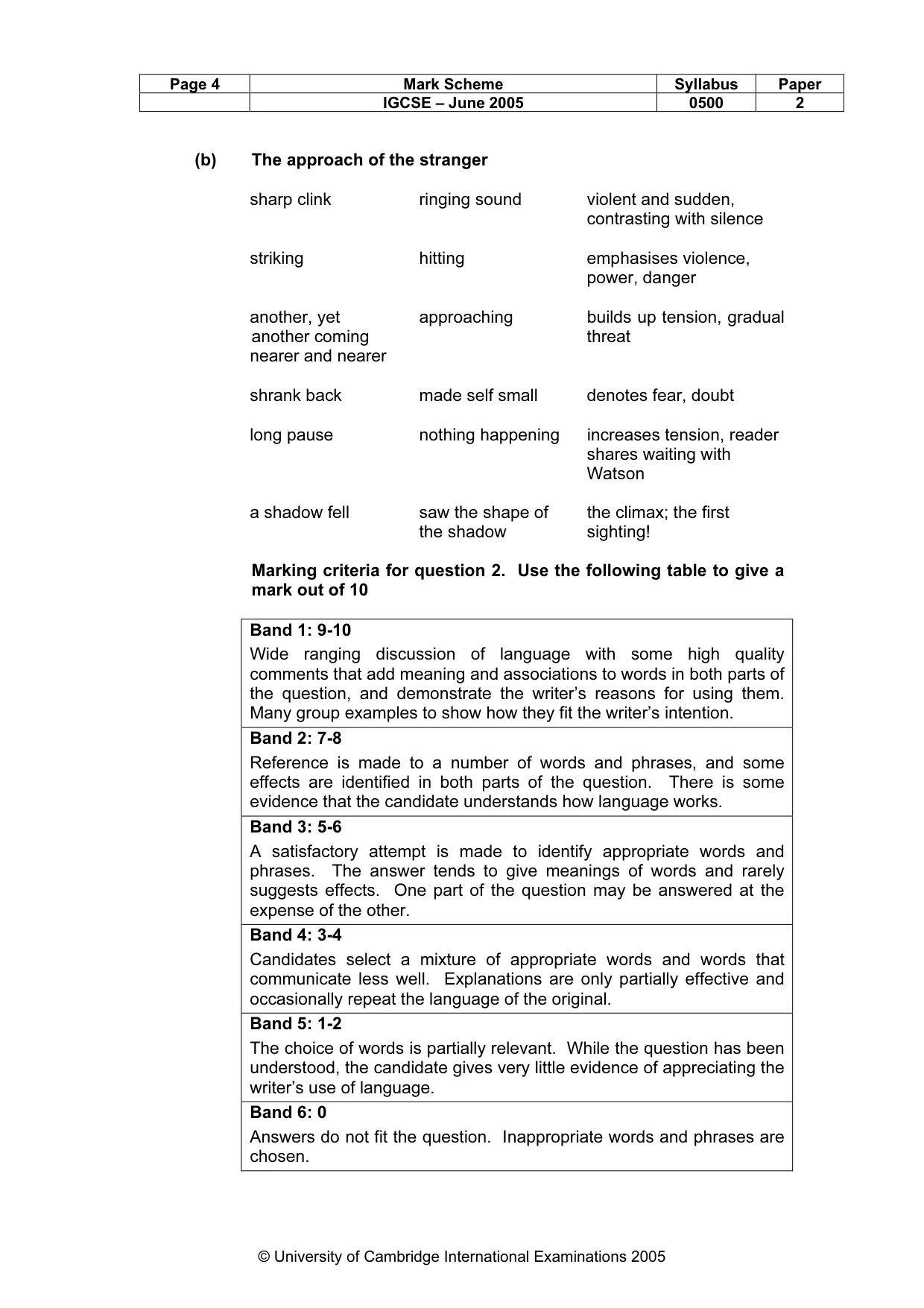
Page 4 Mark Scheme Syllabus Paper IGCSE – June 2005 0500 2 © University of Cambridge International Examinations 2005 (b) The approach of the stranger sharp clink ringing sound violent and sudden, contrasting with silence striking hitting emphasises violence, power, danger another, yet approaching builds up tension, gradual another coming threat nearer and nearer shrank back made self small denotes fear, doubt long pause nothing happening increases tension, reader shares waiting with Watson a shadow fell saw the shape of the climax; the first the shadow sighting! Marking criteria for question 2. Use the following table to give a mark out of 10 Band 1: 9-10 Wide ranging discussion of language with some high quality comments that add meaning and associations to words in both parts of the question, and demonstrate the writer’s reasons for using them. Many group examples to show how they fit the writer’s intention. Band 2: 7-8 Reference is made to a number of words and phrases, and some effects are identified in both parts of the question. There is some evidence that the candidate understands how language works. Band 3: 5-6 A satisfactory attempt is made to identify appropriate words and phrases. The answer tends to give meanings of words and rarely suggests effects. One part of the question may be answered at the expense of the other. Band 4: 3-4 Candidates select a mixture of appropriate words and words that communicate less well. Explanations are only partially effective and occasionally repeat the language of the original. Band 5: 1-2 The choice of words is partially relevant. While the question has been understood, the candidate gives very little evidence of appreciating the writer’s use of language. Band 6: 0 Answers do not fit the question. Inappropriate words and phrases are chosen.
Mark scheme, page 8
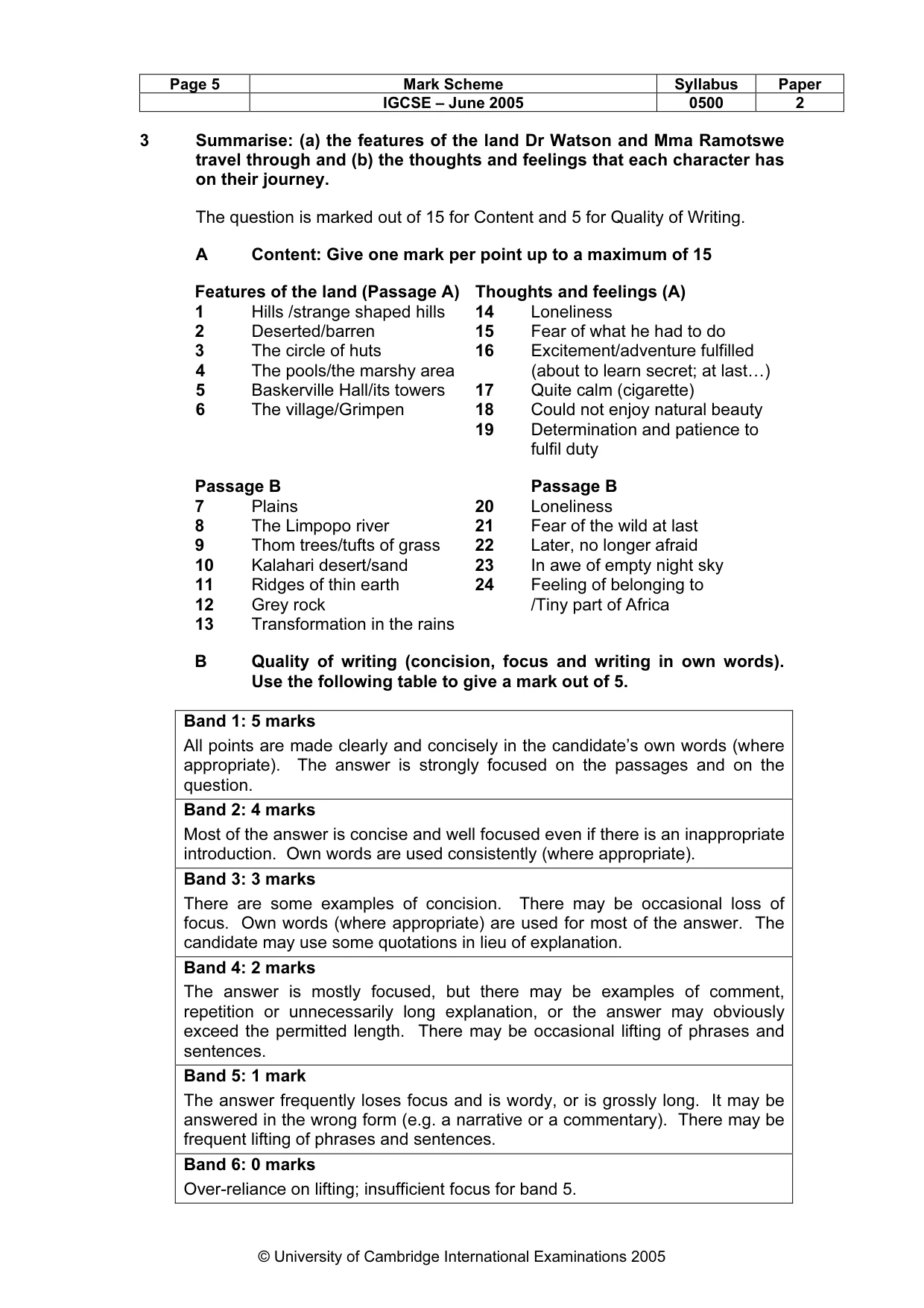
Page 5 Mark Scheme Syllabus Paper IGCSE – June 2005 0500 2 © University of Cambridge International Examinations 2005 3 Summarise: (a) the features of the land Dr Watson and Mma Ramotswe travel through and (b) the thoughts and feelings that each character has on their journey. The question is marked out of 15 for Content and 5 for Quality of Writing. A Content: Give one mark per point up to a maximum of 15 Features of the land (Passage A) Thoughts and feelings (A) 1 Hills /strange shaped hills 14 Loneliness 2 Deserted/barren 15 Fear of what he had to do 3 The circle of huts 16 Excitement/adventure fulfilled 4 The pools/the marshy area (about to learn secret; at last…) 5 Baskerville Hall/its towers 17 Quite calm (cigarette) 6 The village/Grimpen 18 Could not enjoy natural beauty 19 Determination and patience to fulfil duty Passage B Passage B 7 Plains 20 Loneliness 8 The Limpopo river 21 Fear of the wild at last 9 Thom trees/tufts of grass 22 Later, no longer afraid 10 Kalahari desert/sand 23 In awe of empty night sky 11 Ridges of thin earth 24 Feeling of belonging to 12 Grey rock /Tiny part of Africa 13 Transformation in the rains B Quality of writing (concision, focus and writing in own words). Use the following table to give a mark out of 5. Band 1: 5 marks All points are made clearly and concisely in the candidate’s own words (where appropriate). The answer is strongly focused on the passages and on the question. Band 2: 4 marks Most of the answer is concise and well focused even if there is an inappropriate introduction. Own words are used consistently (where appropriate). Band 3: 3 marks There are some examples of concision. There may be occasional loss of focus. Own words (where appropriate) are used for most of the answer. The candidate may use some quotations in lieu of explanation. Band 4: 2 marks The answer is mostly focused, but there may be examples of comment, repetition or unnecessarily long explanation, or the answer may obviously exceed the permitted length. There may be occasional lifting of phrases and sentences. Band 5: 1 mark The answer frequently loses focus and is wordy, or is grossly long. It may be answered in the wrong form (e.g. a narrative or a commentary). There may be frequent lifting of phrases and sentences. Band 6: 0 marks Over-reliance on lifting; insufficient focus for band 5.