Cambridge IGCSE English - First Language 0500 — 2005 May/June Paper 1 · Variant 1
0500/11/M/J/05
The question paper and its mark scheme, free to read here and free to download. This is Cambridge’s own paper, exactly as it was sat.
Question paper4 pages
Mark scheme7 pages
Answers below. Sit the paper first if you are practising.
Paper as text
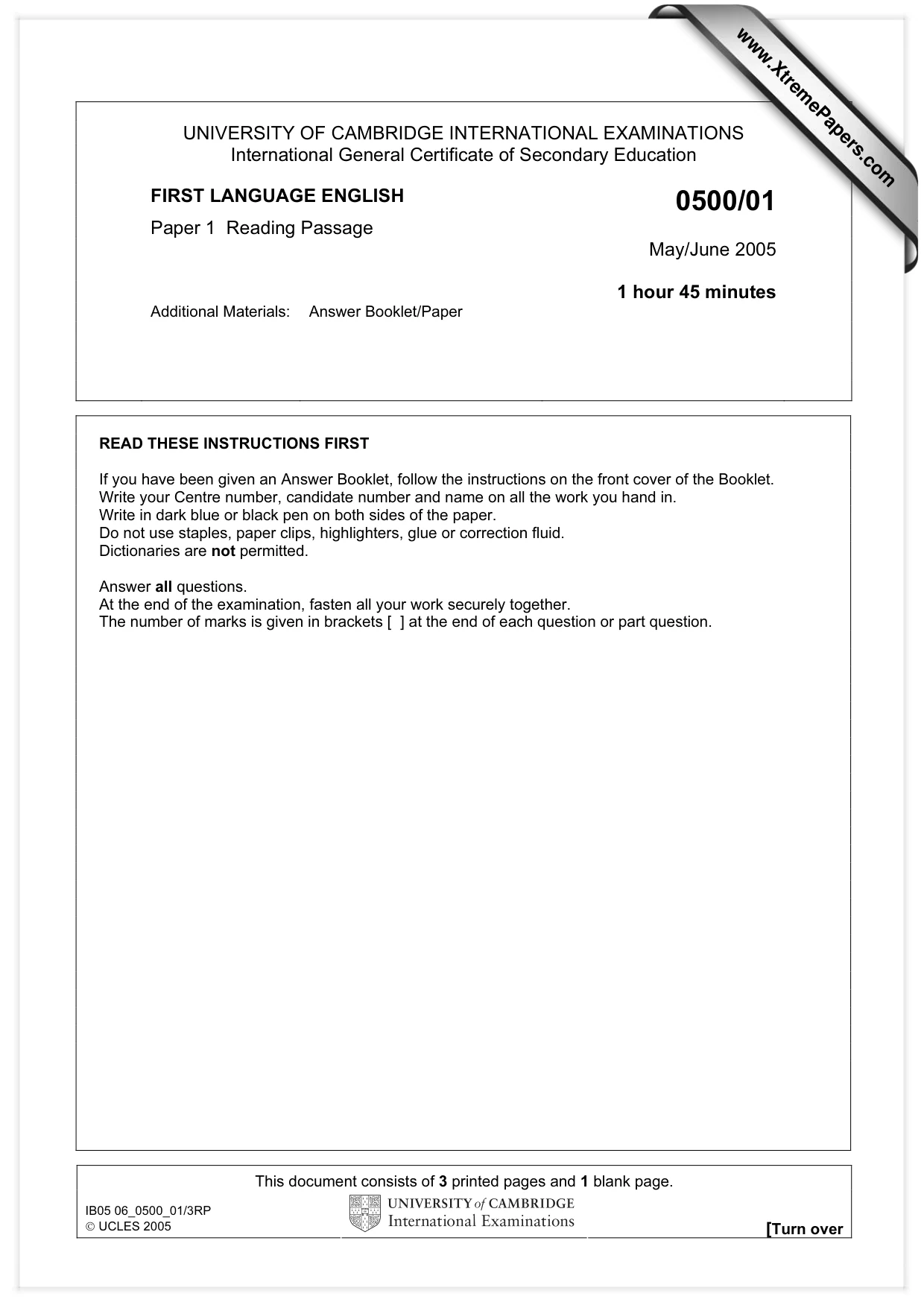
Question paper, page 1
UNIVERSITY OF CAMBRIDGE INTERNATIONAL EXAMINATIONS International General Certificate of Secondary Education FIRST LANGUAGE ENGLISH 0500/01 Paper 1 Reading Passage May/June 2005 1 hour 45 minutes Additional Materials: Answer Booklet/Paper READ THESE INSTRUCTIONS FIRST If you have been given an Answer Booklet, follow the instructions on the front cover of the Booklet. Write your Centre number, candidate number and name on all the work you hand in. Write in dark blue or black pen on both sides of the paper. Do not use staples, paper clips, highlighters, glue or correction fluid. Dictionaries are not permitted. Answer all questions. At the end of the examination, fasten all your work securely together. The number of marks is given in brackets [ ] at the end of each question or part question. This document consists of 3 printed pages and 1 blank page. IB05 06_0500_01/3RP UCLES 2005 [Turn over www.XtremePapers.com
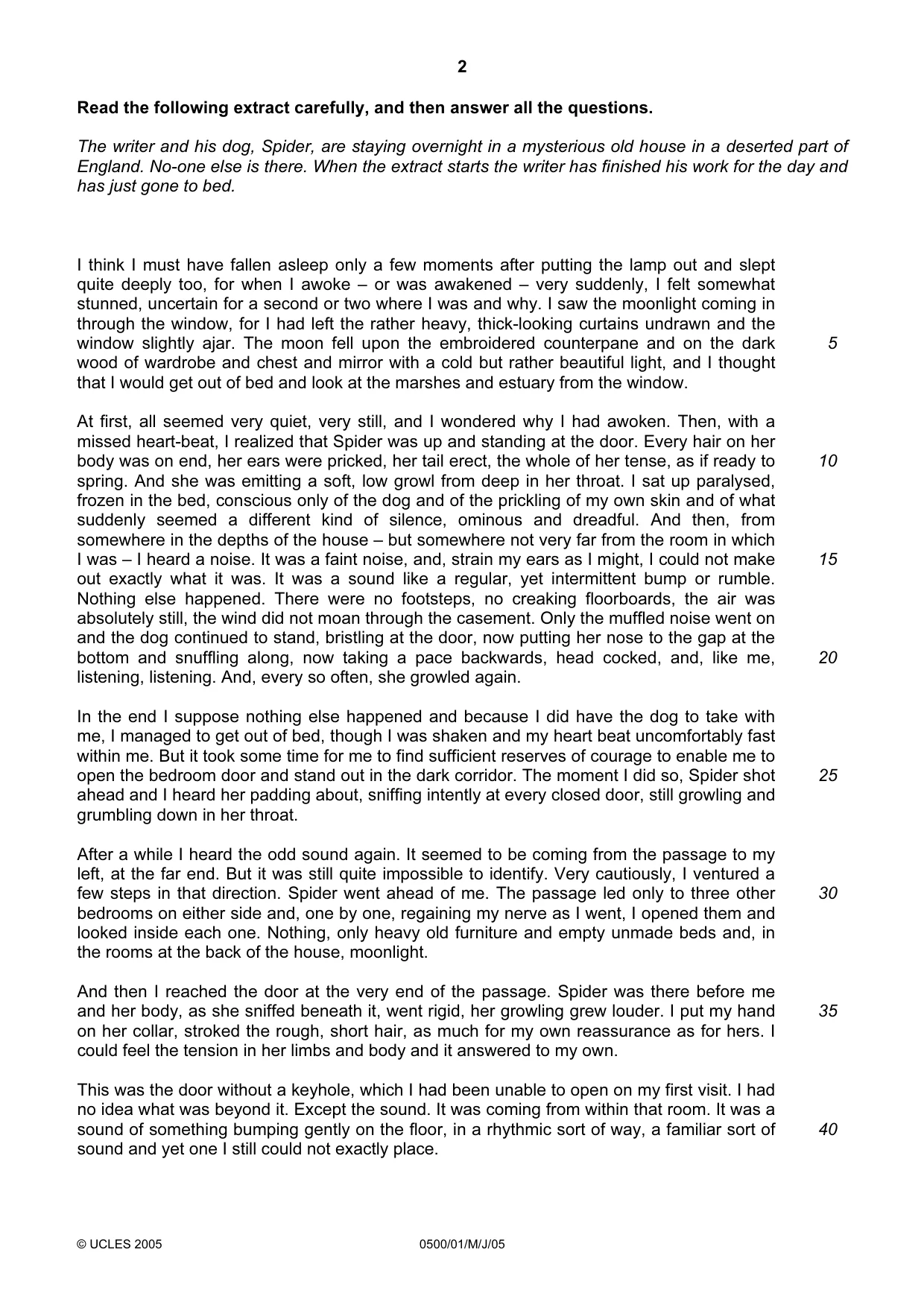
Question paper, page 2
2 © UCLES 2005 0500/01/M/J/05 Read the following extract carefully, and then answer all the questions. The writer and his dog, Spider, are staying overnight in a mysterious old house in a deserted part of England. No-one else is there. When the extract starts the writer has finished his work for the day and has just gone to bed. I think I must have fallen asleep only a few moments after putting the lamp out and slept quite deeply too, for when I awoke – or was awakened – very suddenly, I felt somewhat stunned, uncertain for a second or two where I was and why. I saw the moonlight coming in through the window, for I had left the rather heavy, thick-looking curtains undrawn and the window slightly ajar. The moon fell upon the embroidered counterpane and on the dark wood of wardrobe and chest and mirror with a cold but rather beautiful light, and I thought that I would get out of bed and look at the marshes and estuary from the window. 5 At first, all seemed very quiet, very still, and I wondered why I had awoken. Then, with a missed heart-beat, I realized that Spider was up and standing at the door. Every hair on her body was on end, her ears were pricked, her tail erect, the whole of her tense, as if ready to spring. And she was emitting a soft, low growl from deep in her throat. I sat up paralysed, frozen in the bed, conscious only of the dog and of the prickling of my own skin and of what suddenly seemed a different kind of silence, ominous and dreadful. And then, from somewhere in the depths of the house – but somewhere not very far from the room in which I was – I heard a noise. It was a faint noise, and, strain my ears as I might, I could not make out exactly what it was. It was a sound like a regular, yet intermittent bump or rumble. Nothing else happened. There were no footsteps, no creaking floorboards, the air was absolutely still, the wind did not moan through the casement. Only the muffled noise went on and the dog continued to stand, bristling at the door, now putting her nose to the gap at the bottom and snuffling along, now taking a pace backwards, head cocked, and, like me, listening, listening. And, every so often, she growled again. 10 15 20 In the end I suppose nothing else happened and because I did have the dog to take with me, I managed to get out of bed, though I was shaken and my heart beat uncomfortably fast within me. But it took some time for me to find sufficient reserves of courage to enable me to open the bedroom door and stand out in the dark corridor. The moment I did so, Spider shot ahead and I heard her padding about, sniffing intently at every closed door, still growling and grumbling down in her throat. 25 After a while I heard the odd sound again. It seemed to be coming from the passage to my left, at the far end. But it was still quite impossible to identify. Very cautiously, I ventured a few steps in that direction. Spider went ahead of me. The passage led only to three other bedrooms on either side and, one by one, regaining my nerve as I went, I opened them and looked inside each one. Nothing, only heavy old furniture and empty unmade beds and, in the rooms at the back of the house, moonlight. 30 And then I reached the door at the very end of the passage. Spider was there before me and her body, as she sniffed beneath it, went rigid, her growling grew louder. I put my hand on her collar, stroked the rough, short hair, as much for my own reassurance as for hers. I could feel the tension in her limbs and body and it answered to my own. 35 This was the door without a keyhole, which I had been unable to open on my first visit. I had no idea what was beyond it. Except the sound. It was coming from within that room. It was a sound of something bumping gently on the floor, in a rhythmic sort of way, a familiar sort of sound and yet one I still could not exactly place. 40
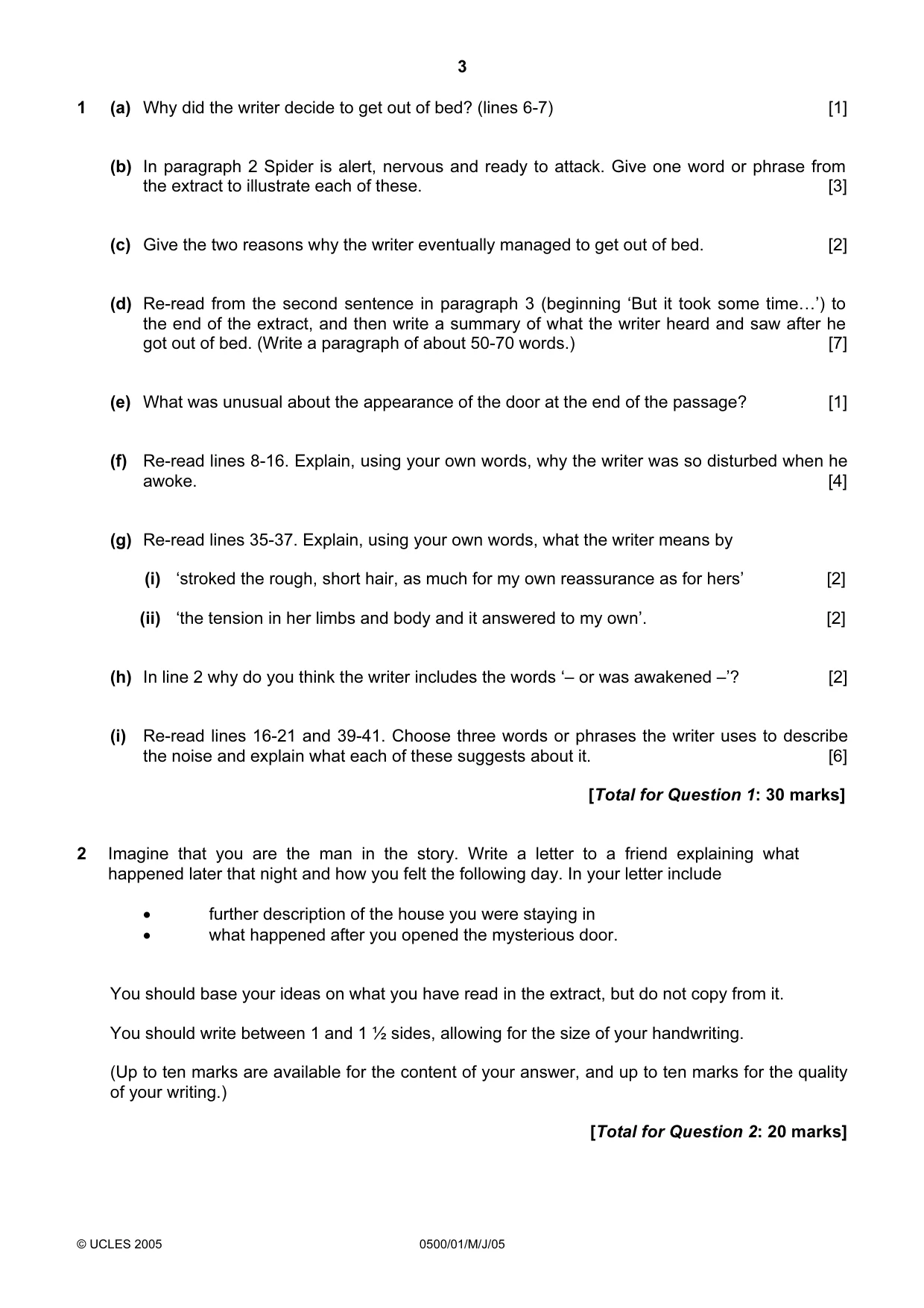
Question paper, page 3
3 © UCLES 2005 0500/01/M/J/05 1 (a) Why did the writer decide to get out of bed? (lines 6-7) [1] (b) In paragraph 2 Spider is alert, nervous and ready to attack. Give one word or phrase from the extract to illustrate each of these. [3] (c) Give the two reasons why the writer eventually managed to get out of bed. [2] (d) Re-read from the second sentence in paragraph 3 (beginning ‘But it took some time…’) to the end of the extract, and then write a summary of what the writer heard and saw after he got out of bed. (Write a paragraph of about 50-70 words.) [7] (e) What was unusual about the appearance of the door at the end of the passage? [1] (f) Re-read lines 8-16. Explain, using your own words, why the writer was so disturbed when he awoke. [4] (g) Re-read lines 35-37. Explain, using your own words, what the writer means by (i) ‘stroked the rough, short hair, as much for my own reassurance as for hers’ [2] (ii) ‘the tension in her limbs and body and it answered to my own’. [2] (h) In line 2 why do you think the writer includes the words ‘– or was awakened –’? [2] (i) Re-read lines 16-21 and 39-41. Choose three words or phrases the writer uses to describe the noise and explain what each of these suggests about it. [6] [Total for Question 1: 30 marks] 2 Imagine that you are the man in the story. Write a letter to a friend explaining what happened later that night and how you felt the following day. In your letter include • further description of the house you were staying in • what happened after you opened the mysterious door. You should base your ideas on what you have read in the extract, but do not copy from it. You should write between 1 and 1 ½ sides, allowing for the size of your handwriting. (Up to ten marks are available for the content of your answer, and up to ten marks for the quality of your writing.) [Total for Question 2: 20 marks]
Question paper, page 4
4 Copyright Acknowledgements: Extract A © Susan Hill; The Woman in Black; Vintage; Random House; © Susan Hill 1983 Permission to reproduce items where third-party owned material protected by copyright is included has been sought and cleared where possible. Every reasonable effort has been made by the publisher (UCLES) to trace copyright holders, but if any items requiring clearance have unwittingly been included, the publisher will be pleased to make amends at the earliest possible opportunity. University of Cambridge International Examinations is part of the University of Cambridge Local Examinations Syndicate (UCLES), which is itself a department of the University of Cambridge. 0500/01/M/J/05 BLANK PAGE
Mark scheme, page 1
UNIVERSITY OF CAMBRIDGE INTERNATIONAL EXAMINATIONS International General Certificate of Secondary Education MARK SCHEME for the June 2005 question paper 0500 FIRST LANGUAGE ENGLISH 0500/01 Paper 1 (Reading Passage - Core), maximum mark 60 This mark scheme is published as an aid to teachers and students, to indicate the requirements of the examination. It shows the basis on which Examiners were initially instructed to award marks. It does not indicate the details of the discussions that took place at an Examiners’ meeting before marking began. Any substantial changes to the mark scheme that arose from these discussions will be recorded in the published Report on the Examination. All Examiners are instructed that alternative correct answers and unexpected approaches in candidates’ scripts must be given marks that fairly reflect the relevant knowledge and skills demonstrated. Mark schemes must be read in conjunction with the question papers and the Report on the Examination. • CIE will not enter into discussion or correspondence in connection with these mark schemes. CIE is publishing the mark schemes for the June 2005 question papers for most IGCSE and GCE Advanced Level and Advanced Subsidiary Level syllabuses and some Ordinary Level syllabuses. www.XtremePapers.com
Mark scheme, page 2
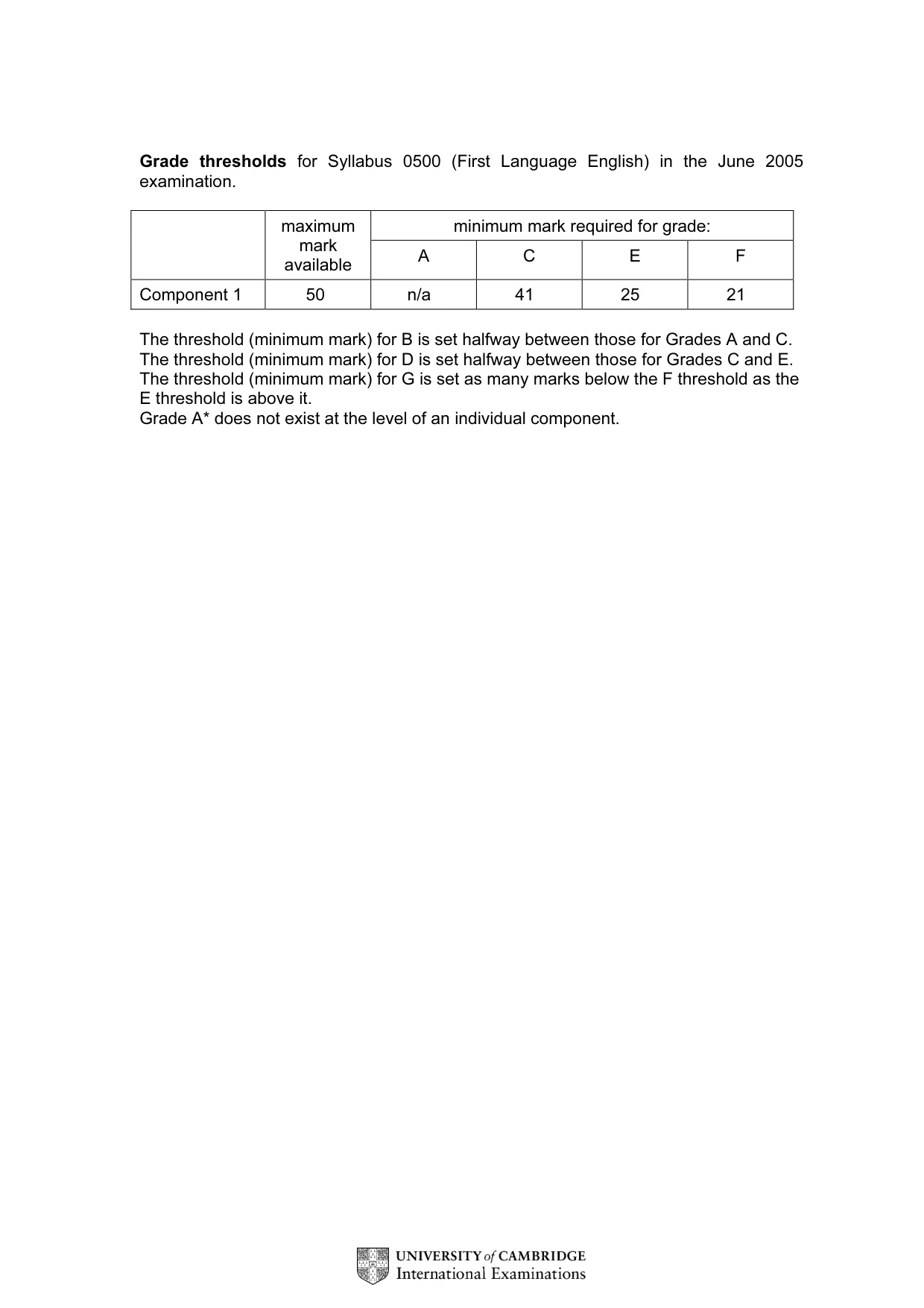
Grade thresholds for Syllabus 0500 (First Language English) in the June 2005 examination. minimum mark required for grade: maximum mark available A C E F Component 1 50 n/a 41 25 21 The threshold (minimum mark) for B is set halfway between those for Grades A and C. The threshold (minimum mark) for D is set halfway between those for Grades C and E. The threshold (minimum mark) for G is set as many marks below the F threshold as the E threshold is above it. Grade A* does not exist at the level of an individual component.
Mark scheme, page 3
June 2005 IGCSE MARK SCHEME MAXIMUM MARK: 50 SYLLABUS/COMPONENT: 0500/01 FIRST LANGUAGE ENGLISH (Reading Passage - Core)
Mark scheme, page 4
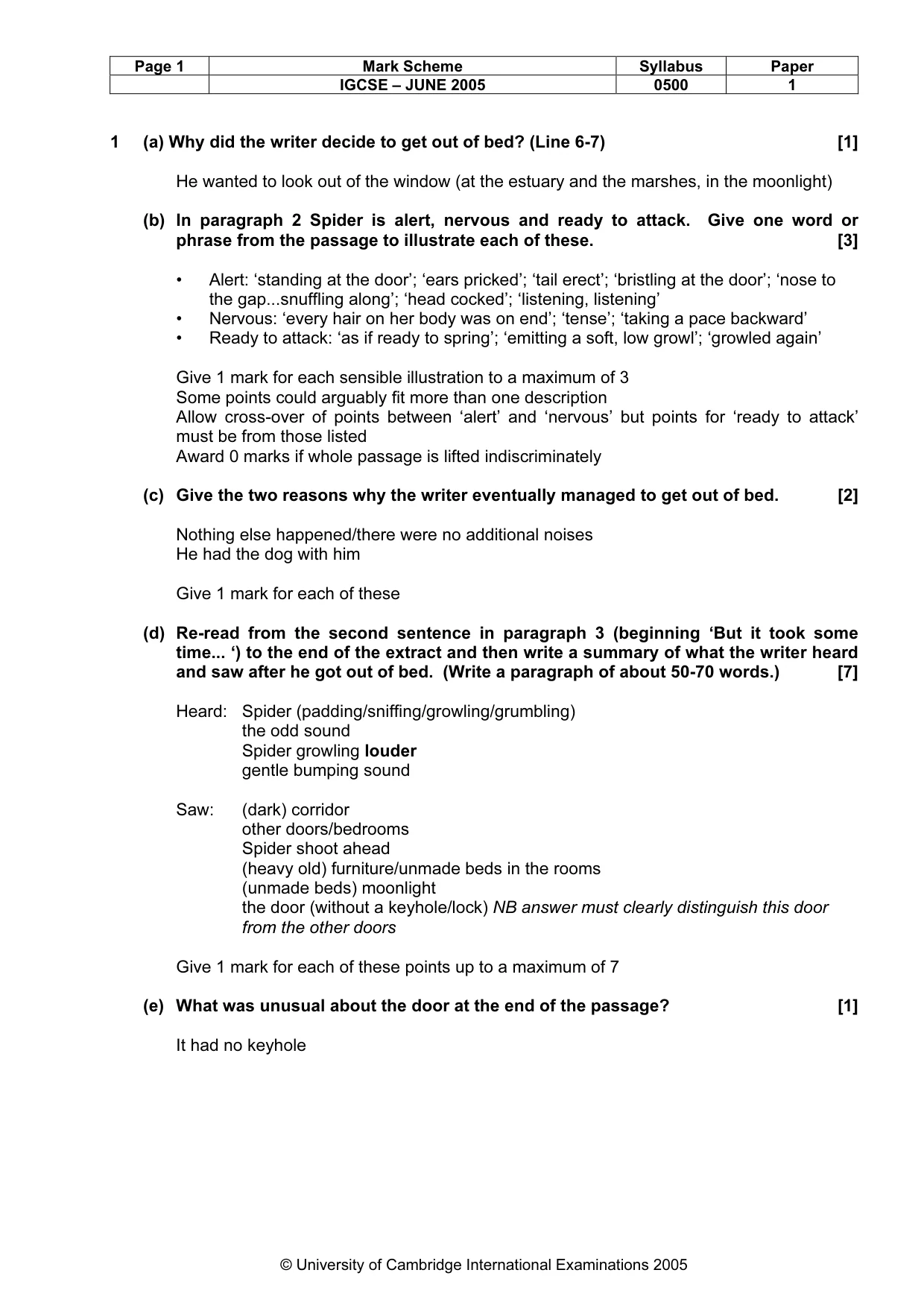
Page 1 Mark Scheme Syllabus Paper IGCSE – JUNE 2005 0500 1 © University of Cambridge International Examinations 2005 1 (a) Why did the writer decide to get out of bed? (Line 6-7) [1] He wanted to look out of the window (at the estuary and the marshes, in the moonlight) (b) In paragraph 2 Spider is alert, nervous and ready to attack. Give one word or phrase from the passage to illustrate each of these. [3] • Alert: ‘standing at the door’; ‘ears pricked’; ‘tail erect’; ‘bristling at the door’; ‘nose to the gap...snuffling along’; ‘head cocked’; ‘listening, listening’ • Nervous: ‘every hair on her body was on end’; ‘tense’; ‘taking a pace backward’ • Ready to attack: ‘as if ready to spring’; ‘emitting a soft, low growl’; ‘growled again’ Give 1 mark for each sensible illustration to a maximum of 3 Some points could arguably fit more than one description Allow cross-over of points between ‘alert’ and ‘nervous’ but points for ‘ready to attack’ must be from those listed Award 0 marks if whole passage is lifted indiscriminately (c) Give the two reasons why the writer eventually managed to get out of bed. [2] Nothing else happened/there were no additional noises He had the dog with him Give 1 mark for each of these (d) Re-read from the second sentence in paragraph 3 (beginning ‘But it took some time... ‘) to the end of the extract and then write a summary of what the writer heard and saw after he got out of bed. (Write a paragraph of about 50-70 words.) [7] Heard: Spider (padding/sniffing/growling/grumbling) the odd sound Spider growling louder gentle bumping sound Saw: (dark) corridor other doors/bedrooms Spider shoot ahead (heavy old) furniture/unmade beds in the rooms (unmade beds) moonlight the door (without a keyhole/lock) NB answer must clearly distinguish this door from the other doors Give 1 mark for each of these points up to a maximum of 7 (e) What was unusual about the door at the end of the passage? [1] It had no keyhole
Mark scheme, page 5
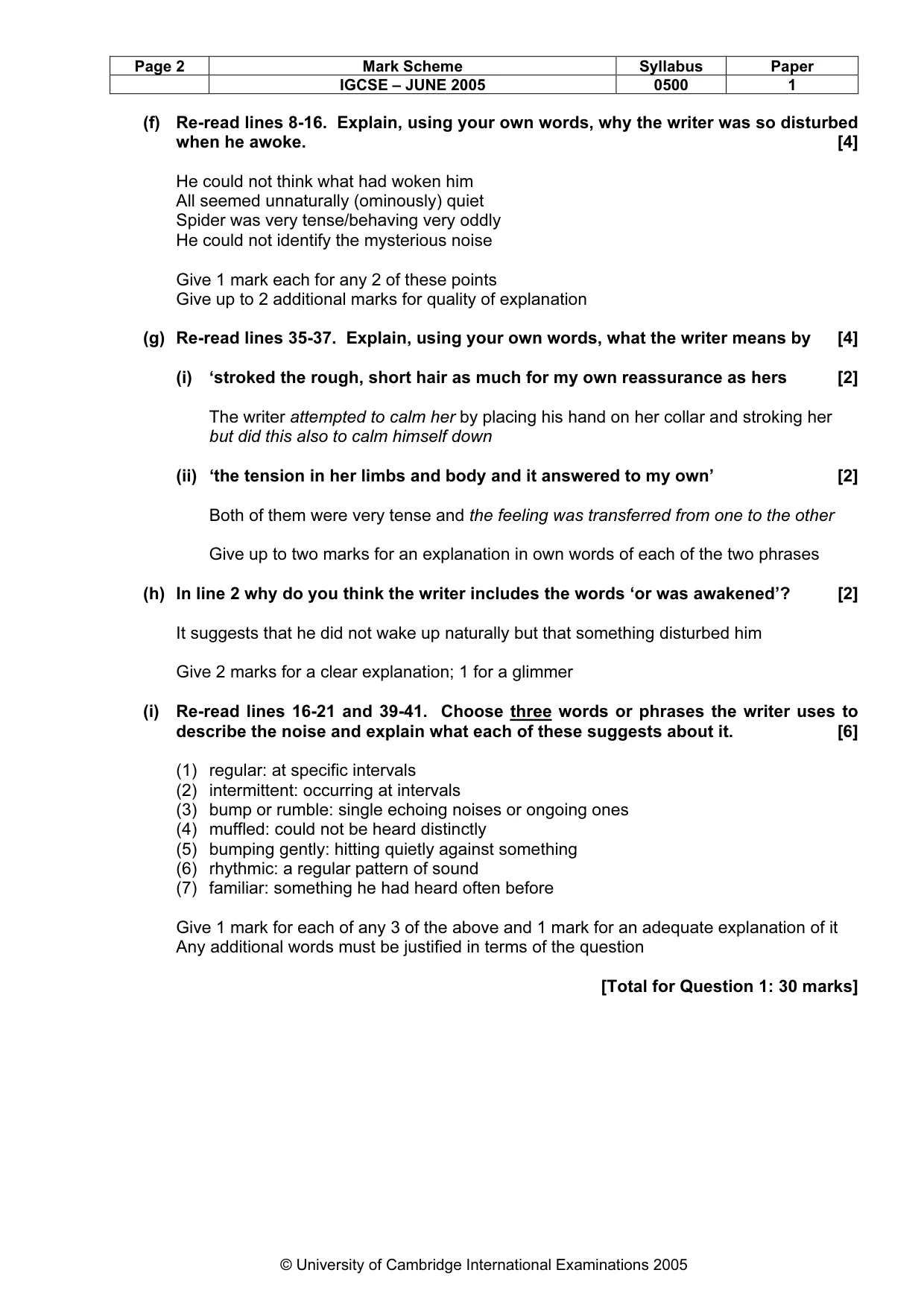
Page 2 Mark Scheme Syllabus Paper IGCSE – JUNE 2005 0500 1 © University of Cambridge International Examinations 2005 (f) Re-read lines 8-16. Explain, using your own words, why the writer was so disturbed when he awoke. [4] He could not think what had woken him All seemed unnaturally (ominously) quiet Spider was very tense/behaving very oddly He could not identify the mysterious noise Give 1 mark each for any 2 of these points Give up to 2 additional marks for quality of explanation (g) Re-read lines 35-37. Explain, using your own words, what the writer means by [4] (i) ‘stroked the rough, short hair as much for my own reassurance as hers [2] The writer attempted to calm her by placing his hand on her collar and stroking her but did this also to calm himself down (ii) ‘the tension in her limbs and body and it answered to my own’ [2] Both of them were very tense and the feeling was transferred from one to the other Give up to two marks for an explanation in own words of each of the two phrases (h) In line 2 why do you think the writer includes the words ‘or was awakened’? [2] It suggests that he did not wake up naturally but that something disturbed him Give 2 marks for a clear explanation; 1 for a glimmer (i) Re-read lines 16-21 and 39-41. Choose three words or phrases the writer uses to describe the noise and explain what each of these suggests about it. [6] (1) regular: at specific intervals (2) intermittent: occurring at intervals (3) bump or rumble: single echoing noises or ongoing ones (4) muffled: could not be heard distinctly (5) bumping gently: hitting quietly against something (6) rhythmic: a regular pattern of sound (7) familiar: something he had heard often before Give 1 mark for each of any 3 of the above and 1 mark for an adequate explanation of it Any additional words must be justified in terms of the question [Total for Question 1: 30 marks]
Mark scheme, page 6
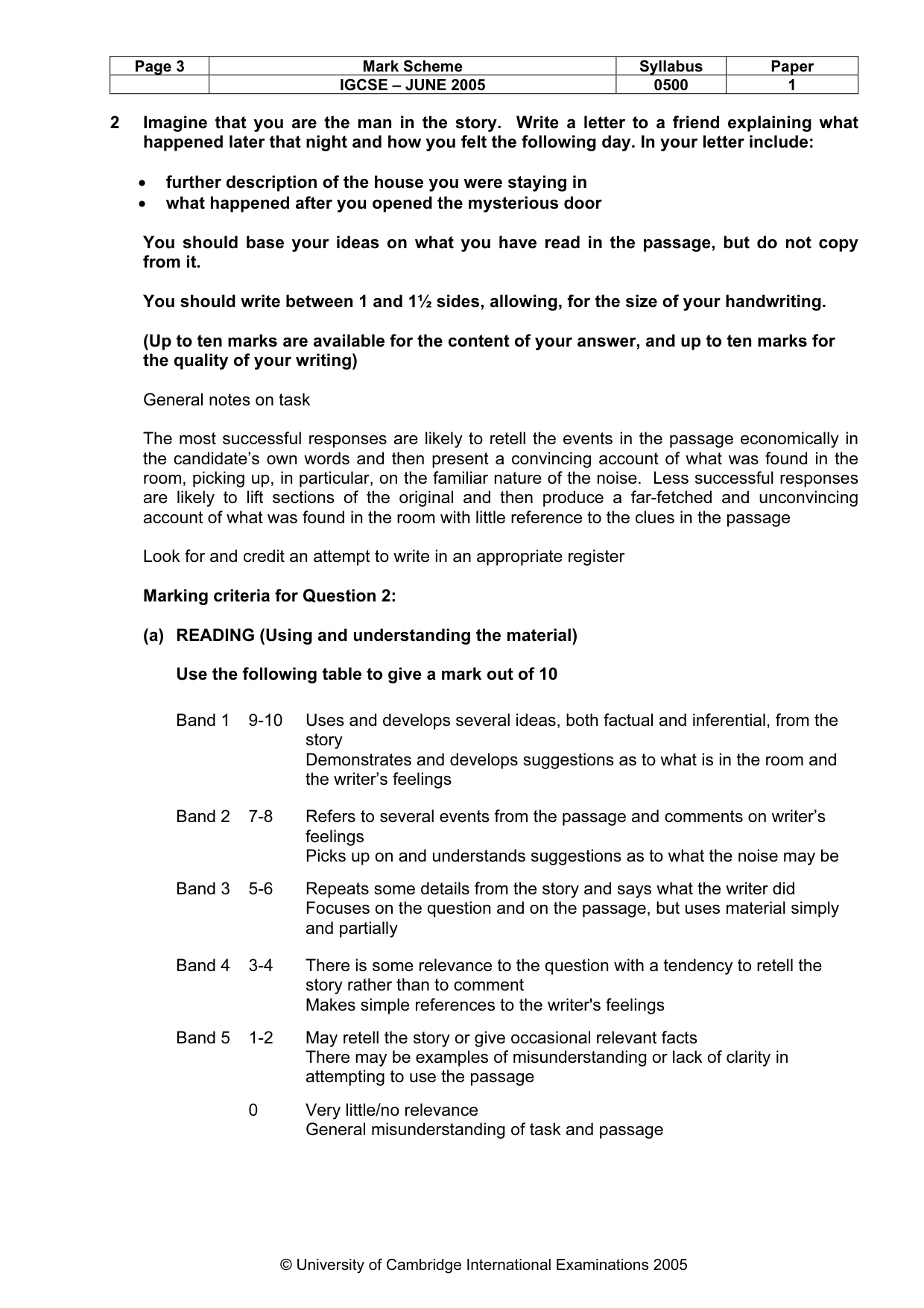
Page 3 Mark Scheme Syllabus Paper IGCSE – JUNE 2005 0500 1 © University of Cambridge International Examinations 2005 2 Imagine that you are the man in the story. Write a letter to a friend explaining what happened later that night and how you felt the following day. In your letter include: • further description of the house you were staying in • what happened after you opened the mysterious door You should base your ideas on what you have read in the passage, but do not copy from it. You should write between 1 and 1½ sides, allowing, for the size of your handwriting. (Up to ten marks are available for the content of your answer, and up to ten marks for the quality of your writing) General notes on task The most successful responses are likely to retell the events in the passage economically in the candidate’s own words and then present a convincing account of what was found in the room, picking up, in particular, on the familiar nature of the noise. Less successful responses are likely to lift sections of the original and then produce a far-fetched and unconvincing account of what was found in the room with little reference to the clues in the passage Look for and credit an attempt to write in an appropriate register Marking criteria for Question 2: (a) READING (Using and understanding the material) Use the following table to give a mark out of 10 Band 1 9-10 Uses and develops several ideas, both factual and inferential, from the story Demonstrates and develops suggestions as to what is in the room and the writer’s feelings Band 2 7-8 Refers to several events from the passage and comments on writer’s feelings Picks up on and understands suggestions as to what the noise may be Band 3 5-6 Repeats some details from the story and says what the writer did Focuses on the question and on the passage, but uses material simply and partially Band 4 3-4 There is some relevance to the question with a tendency to retell the story rather than to comment Makes simple references to the writer's feelings Band 5 1-2 May retell the story or give occasional relevant facts There may be examples of misunderstanding or lack of clarity in attempting to use the passage 0 Very little/no relevance General misunderstanding of task and passage
Mark scheme, page 7
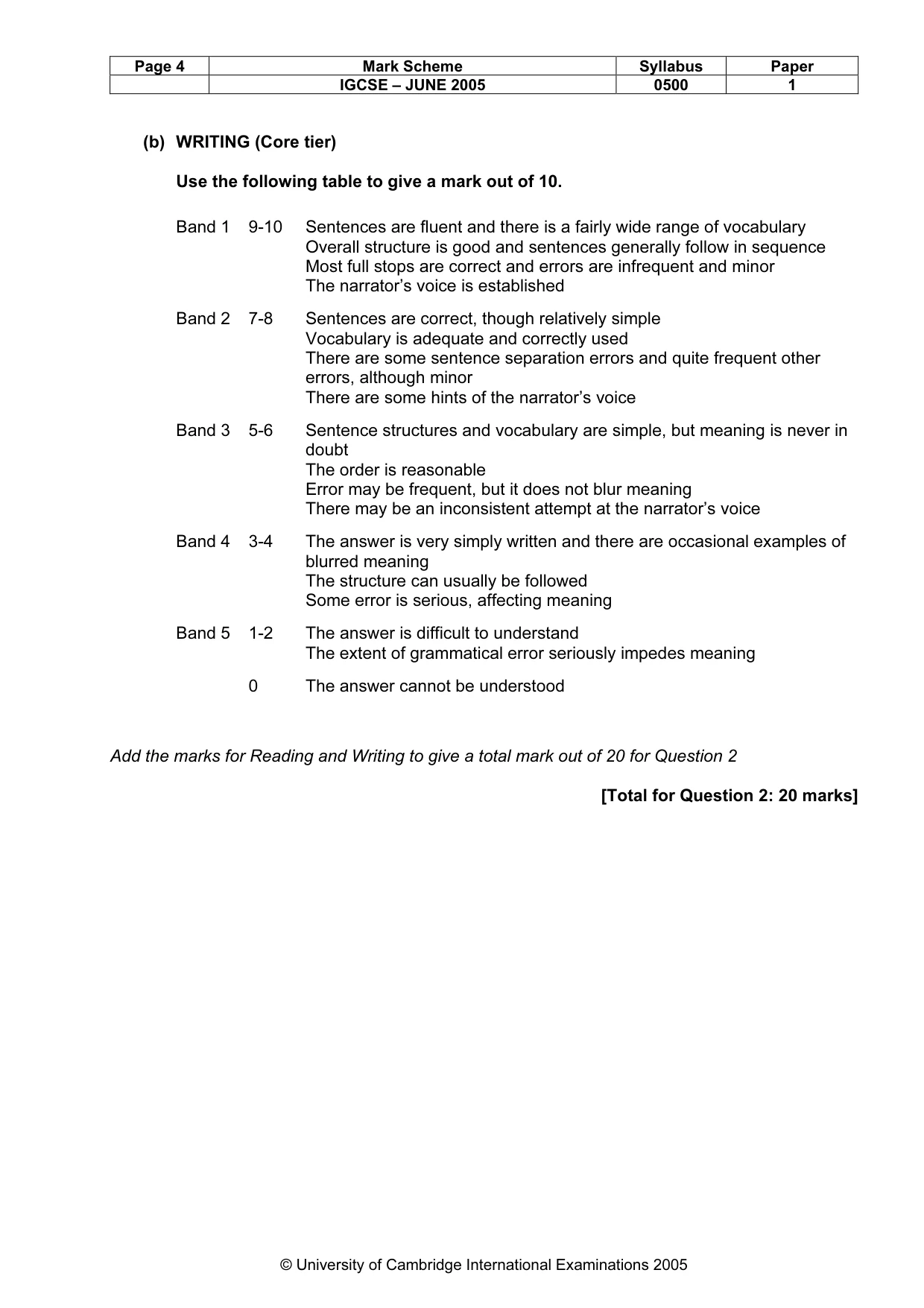
Page 4 Mark Scheme Syllabus Paper IGCSE – JUNE 2005 0500 1 © University of Cambridge International Examinations 2005 (b) WRITING (Core tier) Use the following table to give a mark out of 10. Band 1 9-10 Sentences are fluent and there is a fairly wide range of vocabulary Overall structure is good and sentences generally follow in sequence Most full stops are correct and errors are infrequent and minor The narrator’s voice is established Band 2 7-8 Sentences are correct, though relatively simple Vocabulary is adequate and correctly used There are some sentence separation errors and quite frequent other errors, although minor There are some hints of the narrator’s voice Band 3 5-6 Sentence structures and vocabulary are simple, but meaning is never in doubt The order is reasonable Error may be frequent, but it does not blur meaning There may be an inconsistent attempt at the narrator’s voice Band 4 3-4 The answer is very simply written and there are occasional examples of blurred meaning The structure can usually be followed Some error is serious, affecting meaning Band 5 1-2 The answer is difficult to understand The extent of grammatical error seriously impedes meaning 0 The answer cannot be understood Add the marks for Reading and Writing to give a total mark out of 20 for Question 2 [Total for Question 2: 20 marks]