Cambridge IGCSE English - First Language 0500 — 2004 Oct/Nov Paper 3 · Variant 1
0500/31/O/N/04
The question paper and its mark scheme, free to read here and free to download. This is Cambridge’s own paper, exactly as it was sat.
Question paper4 pages
Mark scheme5 pages
Answers below. Sit the paper first if you are practising.
Paper as text
Question paper, page 1
This document consists of 3 printed pages and 1 blank page. SP (SC) S63856/2 © UCLES 2004 [Turn over UNIVERSITY OF CAMBRIDGE INTERNATIONAL EXAMINATIONS International General Certificate of Secondary Education FIRST LANGUAGE ENGLISH 0500/03 Paper 3 Continuous Writing October/November 2004 1 hour 15 minutes Additional Materials: Answer Booklet/Paper READ THESE INSTRUCTIONS FIRST If you have been given an Answer Booklet, follow the instructions on the front cover of the Booklet. Write your Centre number, candidate number and name on all the work you hand in. Write in dark blue or black pen on both sides of the paper. Do not use staples, paper clips, highlighters, glue or correction fluid. Dictionaries are not permitted. Write a composition based on one of the topics overleaf. At the end of the examination, fasten all your work securely together. All questions carry equal marks. www.XtremePapers.com
Question paper, page 2
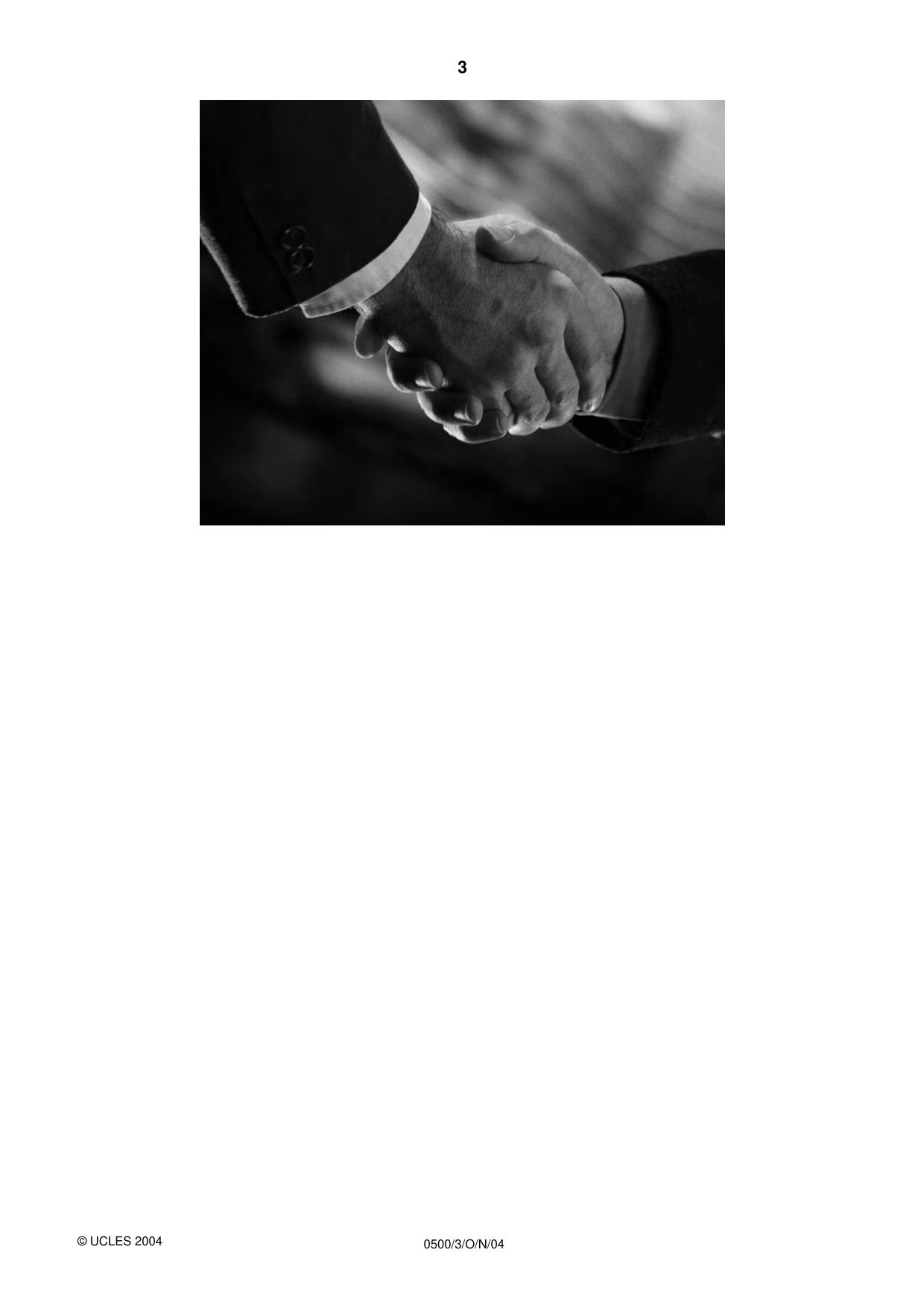
2 0500/3/O/N/04 Write a composition on one of the following topics. You should write between 350 and 500 words. You should pay attention to punctuation, spelling and handwriting. 1 Describe a time when you felt special. 2 Which do you feel you could live without – love or money? 3 Write a story entitled ‘The Gift.’ 4 Imagine a film of your life so far. Describe two scenes: the images you would see of yourself and the images of those around you. 5 ‘I came on a great house in the middle of the night, Its open lighted doorway and its windows all alight, And all my friends were there and made me welcome too; But I woke on an old ruin that the winds howled through.’ Write in any way you choose in response to these lines of poetry. 6 Killing animals for sport is no different to killing them for food.’ Give your views on this topic. 7 ‘As he sketched three faces on the back page of the tattered notebook, he swore that he would find them, no matter what …’ Continue the story. 8 Is it unfair to criticise people who smoke? 9 Use the photograph opposite as an idea for a story or a description. © UCLES 2004
Question paper, page 4
4 0500/3/O/N/04 BLANK PAGE Copyright Acknowledgements: Question 5. W. B. Yeats; ‘The curse of Cromwell’; Collected poems of W. B. Yeats © A P Watt Ltd on behalf of Michael B Yeats. Question 9. Brendan Byrne: Digitalvision. Every reasonable effort has been made to trace all copyright holders where the publishers (i.e UCLES) are aware that third-party material has been reproduced. The publishers would be pleased to hear from anyone whose rights we have unwittingly infringed. University of Cambridge International Examinations is part of the University of Cambridge Local Examinations Syndicate (UCLES), which is itself a department of the University of Cambridge.
Mark scheme, page 1
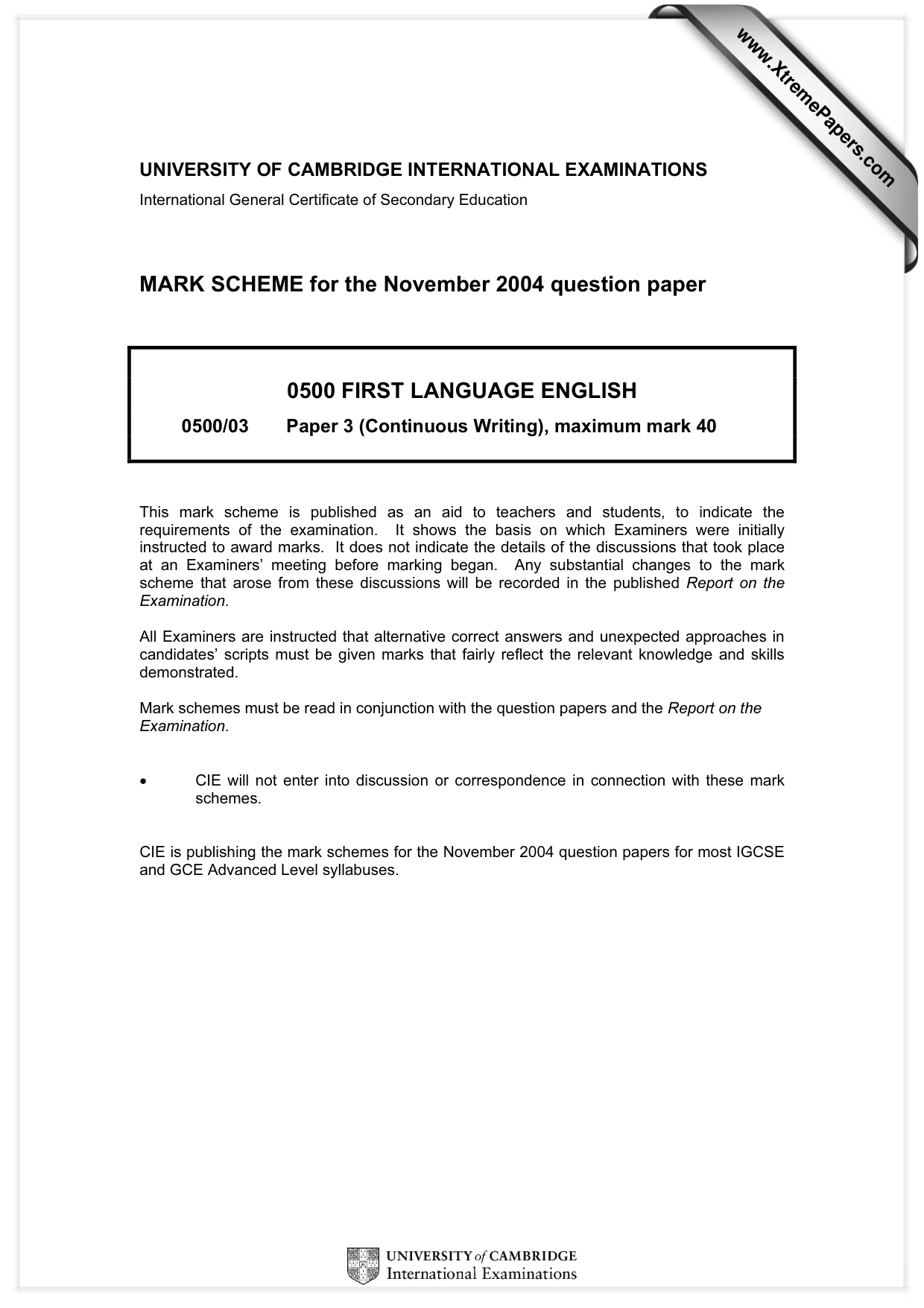
UNIVERSITY OF CAMBRIDGE INTERNATIONAL EXAMINATIONS International General Certificate of Secondary Education MARK SCHEME for the November 2004 question paper 0500 FIRST LANGUAGE ENGLISH 0500/03 Paper 3 (Continuous Writing), maximum mark 40 This mark scheme is published as an aid to teachers and students, to indicate the requirements of the examination. It shows the basis on which Examiners were initially instructed to award marks. It does not indicate the details of the discussions that took place at an Examiners’ meeting before marking began. Any substantial changes to the mark scheme that arose from these discussions will be recorded in the published Report on the Examination. All Examiners are instructed that alternative correct answers and unexpected approaches in candidates’ scripts must be given marks that fairly reflect the relevant knowledge and skills demonstrated. Mark schemes must be read in conjunction with the question papers and the Report on the Examination. • CIE will not enter into discussion or correspondence in connection with these mark schemes. CIE is publishing the mark schemes for the November 2004 question papers for most IGCSE and GCE Advanced Level syllabuses. www.XtremePapers.com
Mark scheme, page 2
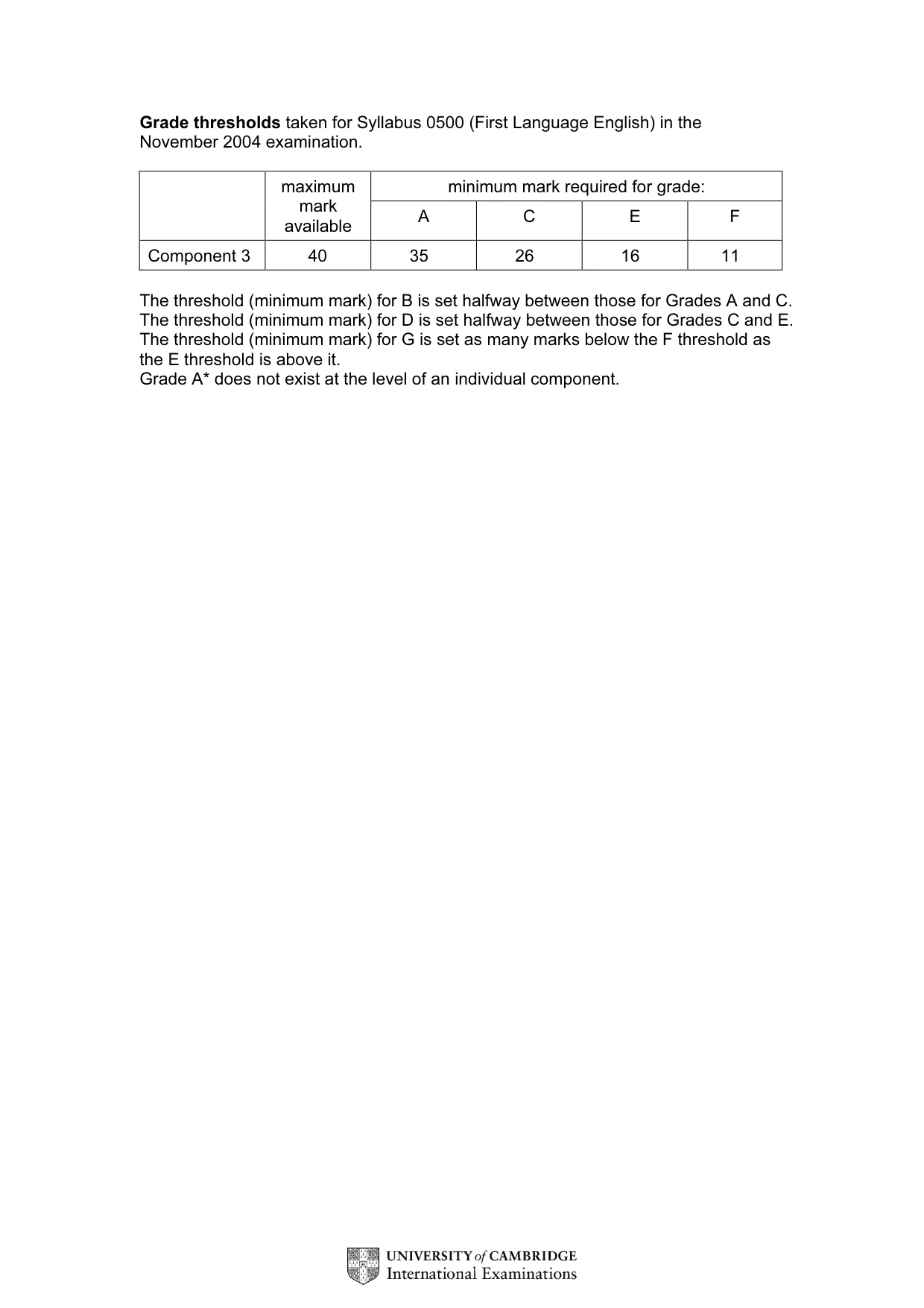
Grade thresholds taken for Syllabus 0500 (First Language English) in the November 2004 examination. minimum mark required for grade: maximum mark available A C E F Component 3 40 35 26 16 11 The threshold (minimum mark) for B is set halfway between those for Grades A and C. The threshold (minimum mark) for D is set halfway between those for Grades C and E. The threshold (minimum mark) for G is set as many marks below the F threshold as the E threshold is above it. Grade A* does not exist at the level of an individual component.
Mark scheme, page 3
November 2004 INTERNATIONAL GCSE MARK SCHEME MAXIMUM MARK: 40 SYLLABUS/COMPONENT: 0500/03 FIRST LANGUAGE ENGLISH Paper 3 (Continuous Writing)
Mark scheme, page 4
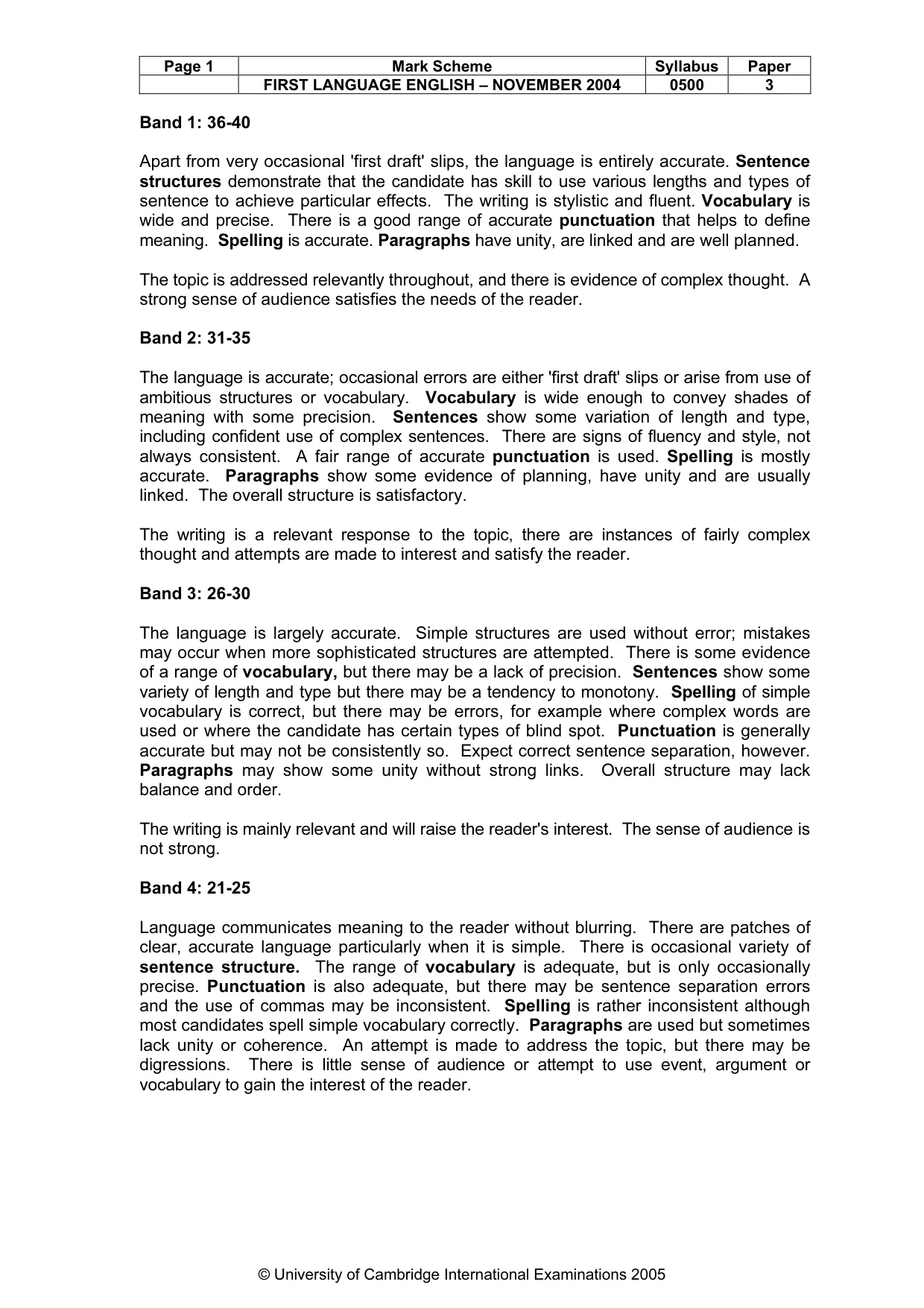
Page 1 Mark Scheme Syllabus Paper FIRST LANGUAGE ENGLISH – NOVEMBER 2004 0500 3 © University of Cambridge International Examinations 2005 Band 1: 36-40 Apart from very occasional 'first draft' slips, the language is entirely accurate. Sentence structures demonstrate that the candidate has skill to use various lengths and types of sentence to achieve particular effects. The writing is stylistic and fluent. Vocabulary is wide and precise. There is a good range of accurate punctuation that helps to define meaning. Spelling is accurate. Paragraphs have unity, are linked and are well planned. The topic is addressed relevantly throughout, and there is evidence of complex thought. A strong sense of audience satisfies the needs of the reader. Band 2: 31-35 The language is accurate; occasional errors are either 'first draft' slips or arise from use of ambitious structures or vocabulary. Vocabulary is wide enough to convey shades of meaning with some precision. Sentences show some variation of length and type, including confident use of complex sentences. There are signs of fluency and style, not always consistent. A fair range of accurate punctuation is used. Spelling is mostly accurate. Paragraphs show some evidence of planning, have unity and are usually linked. The overall structure is satisfactory. The writing is a relevant response to the topic, there are instances of fairly complex thought and attempts are made to interest and satisfy the reader. Band 3: 26-30 The language is largely accurate. Simple structures are used without error; mistakes may occur when more sophisticated structures are attempted. There is some evidence of a range of vocabulary, but there may be a lack of precision. Sentences show some variety of length and type but there may be a tendency to monotony. Spelling of simple vocabulary is correct, but there may be errors, for example where complex words are used or where the candidate has certain types of blind spot. Punctuation is generally accurate but may not be consistently so. Expect correct sentence separation, however. Paragraphs may show some unity without strong links. Overall structure may lack balance and order. The writing is mainly relevant and will raise the reader's interest. The sense of audience is not strong. Band 4: 21-25 Language communicates meaning to the reader without blurring. There are patches of clear, accurate language particularly when it is simple. There is occasional variety of sentence structure. The range of vocabulary is adequate, but is only occasionally precise. Punctuation is also adequate, but there may be sentence separation errors and the use of commas may be inconsistent. Spelling is rather inconsistent although most candidates spell simple vocabulary correctly. Paragraphs are used but sometimes lack unity or coherence. An attempt is made to address the topic, but there may be digressions. There is little sense of audience or attempt to use event, argument or vocabulary to gain the interest of the reader.
Mark scheme, page 5
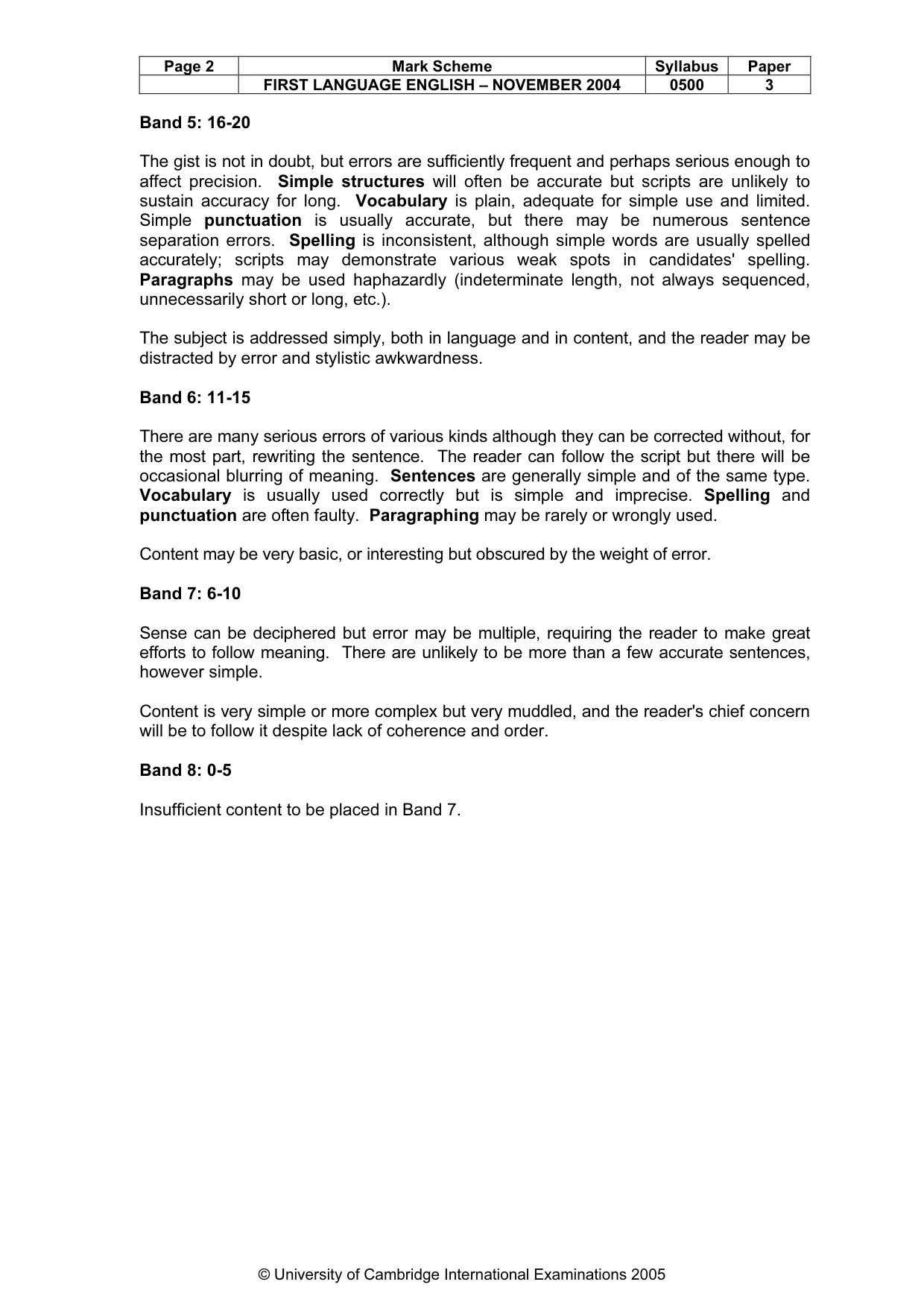
Page 2 Mark Scheme Syllabus Paper FIRST LANGUAGE ENGLISH – NOVEMBER 2004 0500 3 © University of Cambridge International Examinations 2005 Band 5: 16-20 The gist is not in doubt, but errors are sufficiently frequent and perhaps serious enough to affect precision. Simple structures will often be accurate but scripts are unlikely to sustain accuracy for long. Vocabulary is plain, adequate for simple use and limited. Simple punctuation is usually accurate, but there may be numerous sentence separation errors. Spelling is inconsistent, although simple words are usually spelled accurately; scripts may demonstrate various weak spots in candidates' spelling. Paragraphs may be used haphazardly (indeterminate length, not always sequenced, unnecessarily short or long, etc.). The subject is addressed simply, both in language and in content, and the reader may be distracted by error and stylistic awkwardness. Band 6: 11-15 There are many serious errors of various kinds although they can be corrected without, for the most part, rewriting the sentence. The reader can follow the script but there will be occasional blurring of meaning. Sentences are generally simple and of the same type. Vocabulary is usually used correctly but is simple and imprecise. Spelling and punctuation are often faulty. Paragraphing may be rarely or wrongly used. Content may be very basic, or interesting but obscured by the weight of error. Band 7: 6-10 Sense can be deciphered but error may be multiple, requiring the reader to make great efforts to follow meaning. There are unlikely to be more than a few accurate sentences, however simple. Content is very simple or more complex but very muddled, and the reader's chief concern will be to follow it despite lack of coherence and order. Band 8: 0-5 Insufficient content to be placed in Band 7.