Cambridge IGCSE English - First Language 0500 — 2002 Oct/Nov Paper 3 · Variant 1
0500/31/O/N/02
The question paper and its mark scheme, free to read here and free to download. This is Cambridge’s own paper, exactly as it was sat.
Question paper4 pages
Mark scheme3 pages
Answers below. Sit the paper first if you are practising.
Paper as text
Question paper, page 1
TIME 1 hour 15 minutes INSTRUCTIONS TO CANDIDATES Write your name, Centre number and candidate number in the spaces provided on the answer paper/ answer booklet. Write a composition based on one of the topics overleaf. Write your answer on the separate answer paper provided. If you use more than one sheet of paper, fasten the sheets together. INFORMATION FOR CANDIDATES You should write between 350 and 500 words. You should pay attention to punctuation, spelling and handwriting. Dictionaries are not permitted. International General Certificate of Secondary Education CAMBRIDGE INTERNATIONAL EXAMINATIONS FIRST LANGUAGE ENGLISH 0500/3 PAPER 3 Continuous Writing OCTOBER/NOVEMBER SESSION 2002 1 hour 15 minutes Additional materials: Answer paper This question paper consists of 4 printed pages. SP (CW) S18551/3 © CIE 2002 [Turn over www.XtremePapers.com
Question paper, page 2
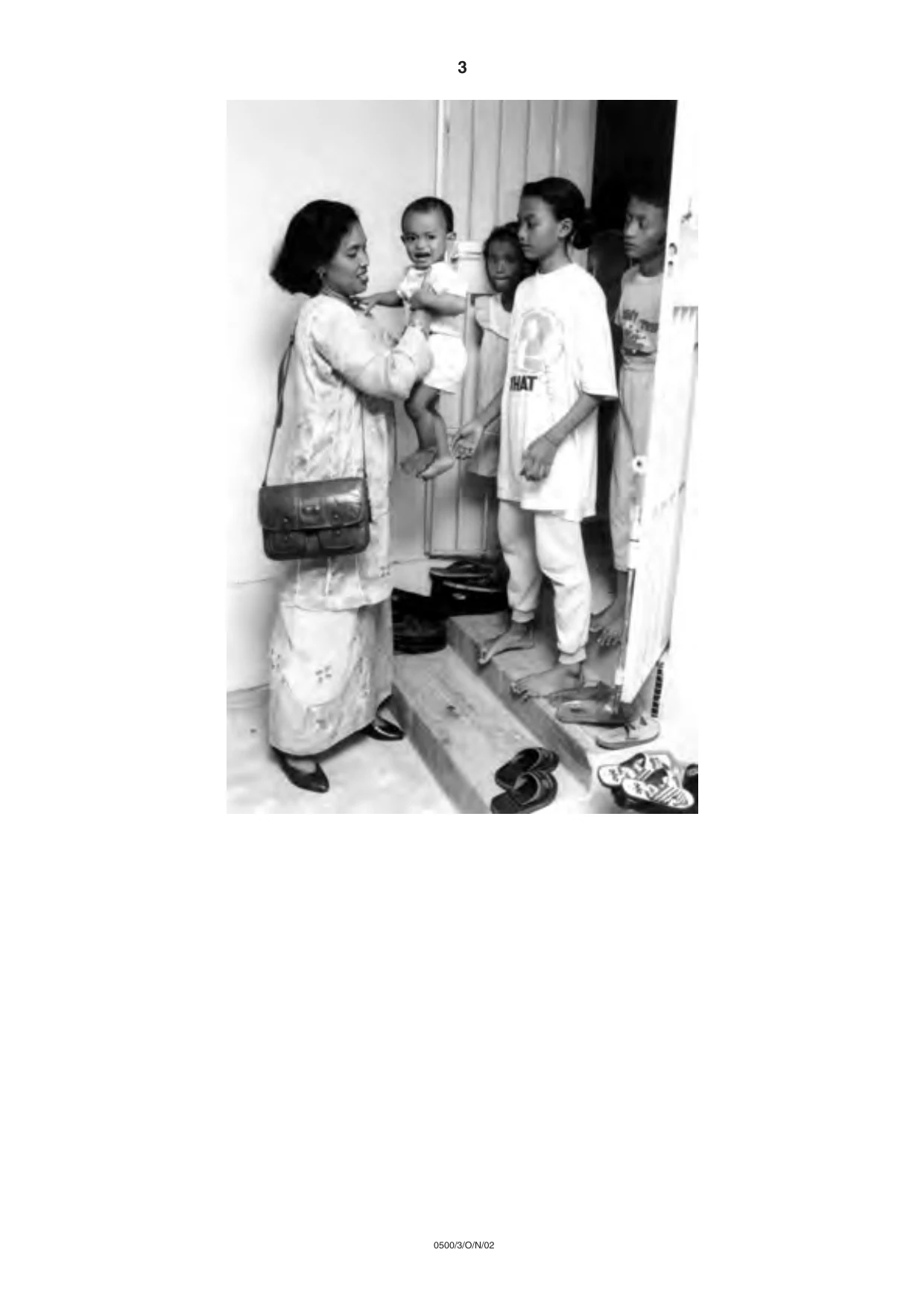
2 0500/3/O/N/02 Write a composition on one of the following topics. You should write between 350 and 500 words. You should pay attention to punctuation, spelling and handwriting. 1 The best teacher I ever had. 2 ‘The richer you are, the happier you are.’ How far do you think this is true? 3 Time stood still. 4 ‘Honesty is the best policy.’ Is this always true? Give your views. 5 Write a story which begins: She looked at the car as it disappeared in a cloud of dust, and knew that things would never be the same again… . 6 ‘Everywhere they are waiting. In silence. In boredom. Staring into space.’ Using the ideas in these lines of poetry as your starting point, develop your own description of the scene. 7 ‘Sport is an essential part of life.’ How far do you agree? 8 Shopping. 9 Write a story in which one of the people in the photograph opposite is the central character.
Question paper, page 4
4 0500/3/O/N/02 Copyright Acknowledgements: Cambridge International Examinations has made every effort to trace copyright holders, but if we have inadvertently overlooked any we will be pleased to make the necessary arrangements at the first opportunity.
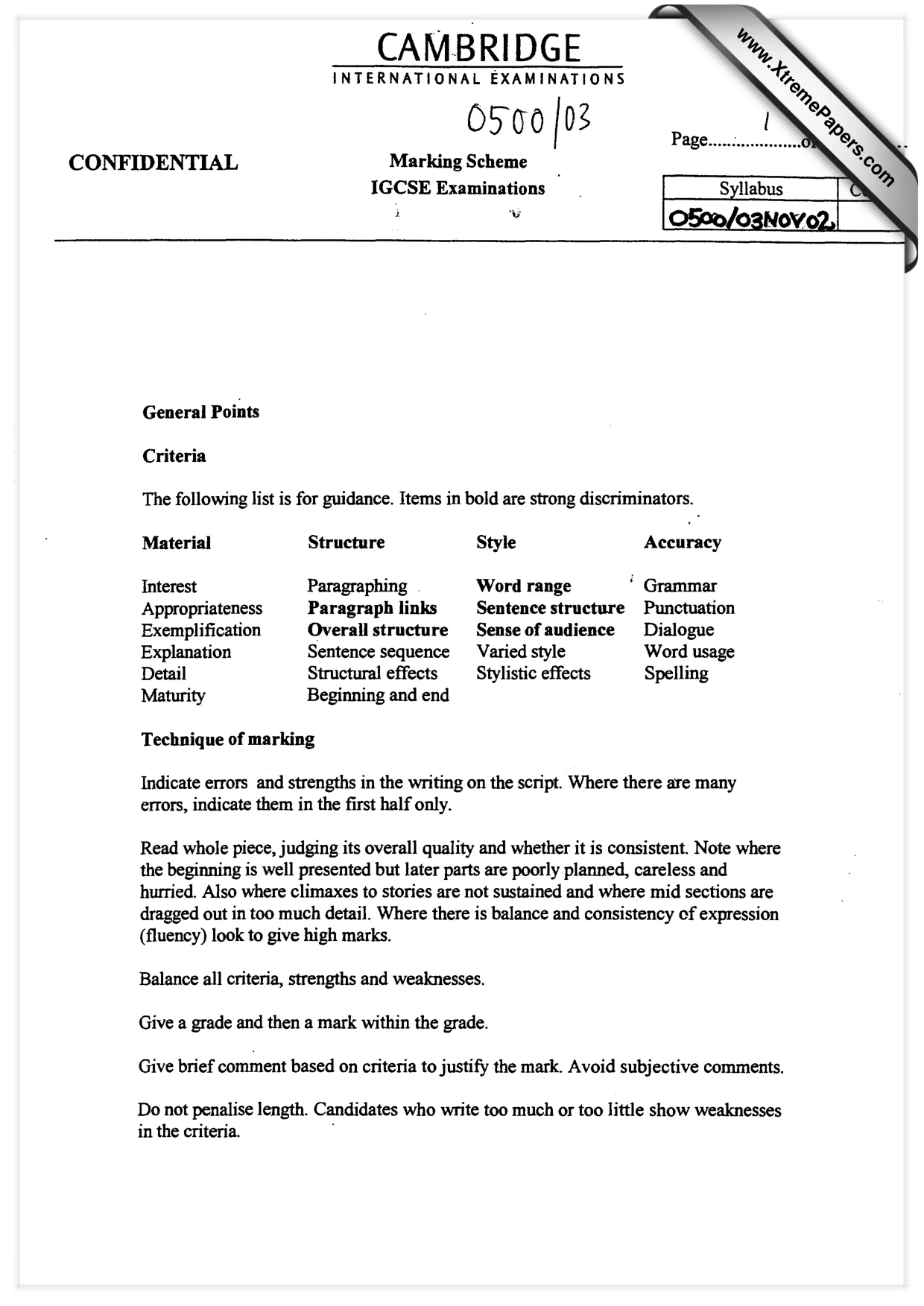
Mark scheme, page 1
CAMBRIDGE INTERNATIONAL EXAMINATIONS 0500 [03 CONFIDENTIAL Marking Scheme _ IGCSE Examinations General Points Criteria The following list is for guidance. Items in bold are strong discriminators. Material Structure Style Accuracy Interest Paragraphing Word range * Grammar Appropriateness Paragraph links Sentence structure Punctuation Exemplification Overall structure Senseofaudience Dialogue Explanation Sentence sequence _ Varied style Word usage Detail Structural effects Stylistic effects Spelling Maturity Beginning and end Technique of marking Indicate errors and strengths in the writing on the script. Where there are many errors, indicate them in the first half only. Read whole piece, judging its overall quality and whether it is consistent. Note where the beginning is well presented but later parts are poorly planned, careless and hurried. Also where climaxes to stories are not sustained and where mid sections are dragged out in too much detail. Where there is balance and consistency cf expression (fluency) look to give high marks. Balance all criteria, strengths and weaknesses. Give a grade and then a mark within the grade. Give brief comment based on criteria to justify the mark. Avoid subjective comments. Do not penalise length. Candidates who write too much or too little show weaknesses in the criteria. ,
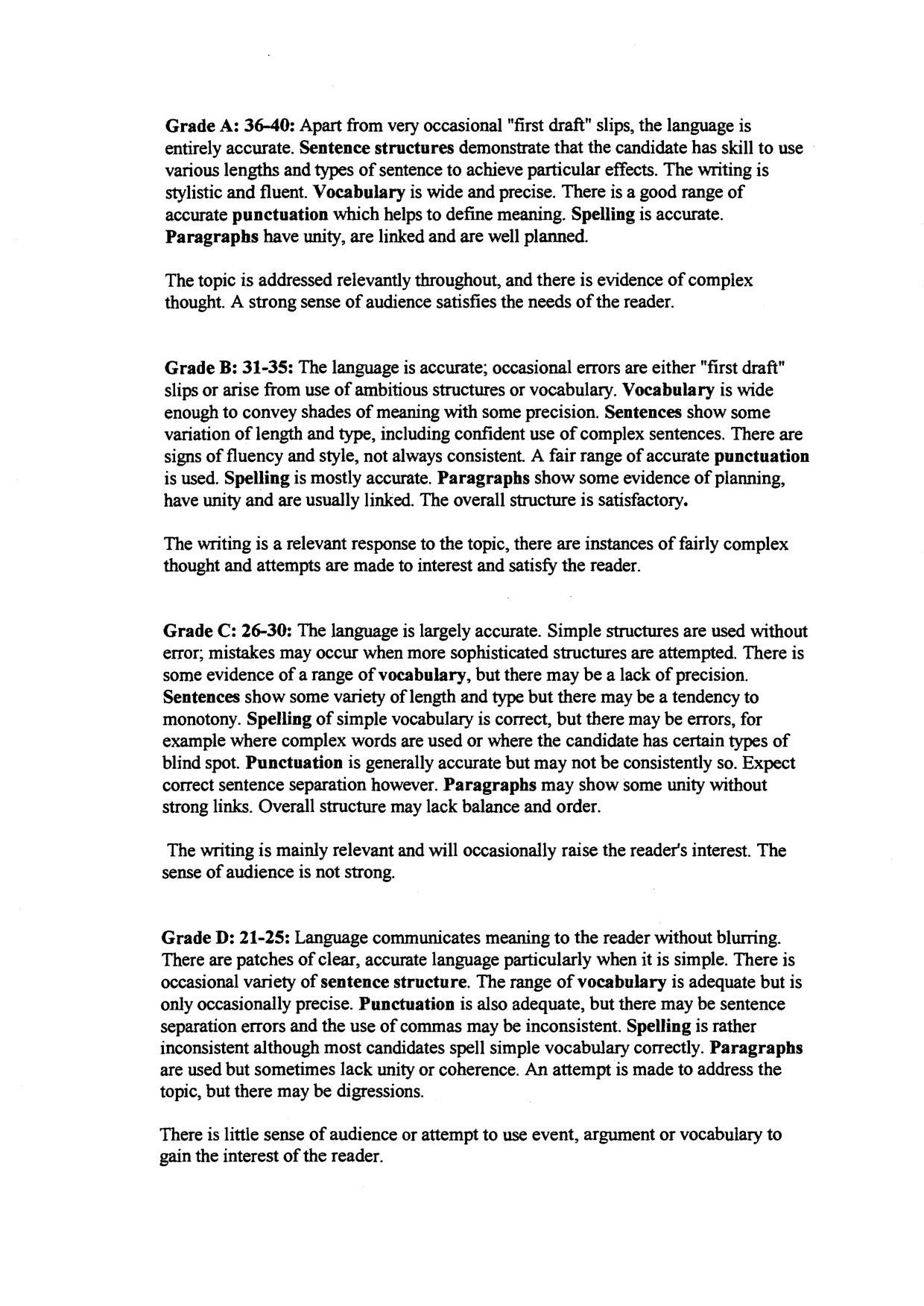
Mark scheme, page 2
Grade A: 36-40: Apart from very occasional "first draft" slips, the language is entirely accurate. Sentence structures demonstrate that the candidate has skill to use various lengths and types of sentence to achieve particular effects. The writing is stylistic and fluent. Vocabulary is wide and precise. There is a good range of accurate punctuation which helps to define meaning. Spelling is accurate. Paragraphs have unity, are linked and are well planned. The topic is addressed relevantly throughout, and there is evidence of complex thought. A strong sense of audience satisfies the needs of the reader. Grade B: 31-35: The language is accurate; occasional errors are either "first draft" slips or arise from use of ambitious structures or vocabulary. Vocabulary is wide enough to convey shades of meaning with some precision. Sentences show some variation of length and type, including confident use of complex sentences. There are signs of fluency and style, not always consistent. A fair range of accurate punctuation is used. Spelling is mostly accurate. Paragraphs show some evidence of planning, have unity and are usually linked. The overall structure is satisfactory. The writing is a relevant response to the topic, there are instances of fairly complex thought and attempts are made to interest and satisfy the reader. Grade C: 26-30: The language is largely accurate. Simple structures are used without error; mistakes may occur when more sophisticated structures are attempted. There is some evidence of a range of vocabulary, but there may be a lack of precision. Sentences show some variety of length and type but there may be a tendency to monotony. Spelling of simple vocabulary is correct, but there may be errors, for example where complex words are used or where the candidate has certain types of blind spot. Punctuation is generally accurate but may not be consistently so. Expect correct sentence separation however. Paragraphs may show some unity without strong links. Overall structure may lack balance and order. The writing is mainly relevant and will occasionally raise the reader's interest. The sense of audience is not strong. Grade D: 21-25: Language communicates meaning to the reader without blurring. There are patches of clear, accurate language particularly when it is simple. There is occasional variety of sentence structure. The range of vocabulary is adequate but is only occasionally precise. Punctuation is also adequate, but there may be sentence separation errors and the use of commas may be inconsistent. Spelling is rather inconsistent although most candidates spell simple vocabulary correctly. Paragraphs are used but sometimes lack unity or coherence. An attempt is made to address the topic, but there may be digressions. There is little sense of audience or attempt to use event, argument or vocabulary to gain the interest of the reader.
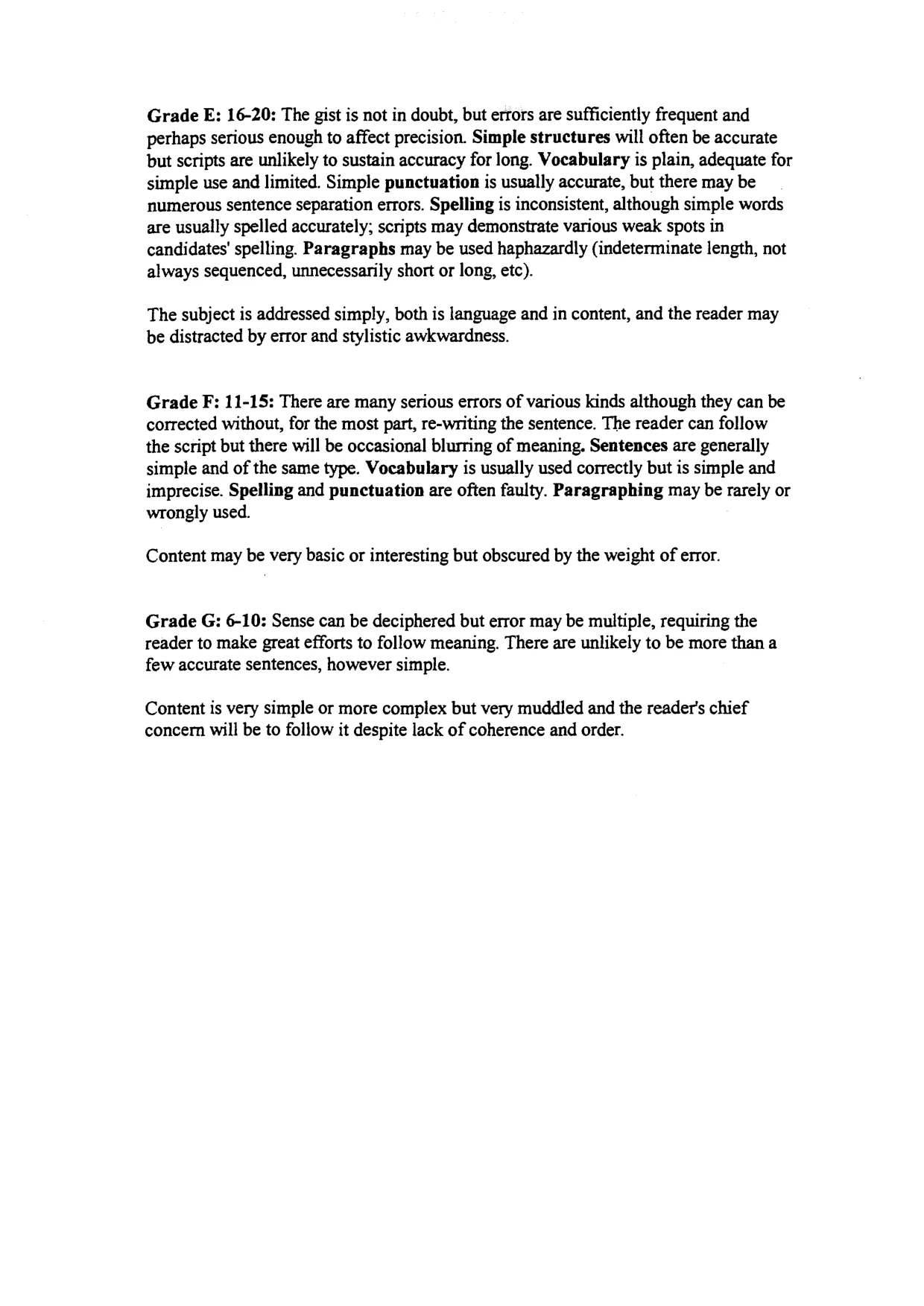
Mark scheme, page 3
Grade E: 16-20: The gist is not in doubt, but errors are sufficiently frequent and perhaps serious enough to affect precision. Simple structures will often be accurate but scripts are unlikely to sustain accuracy for long. Vocabulary is plain, adequate for simple use and limited. Simple punctuation is usually accurate, but there may be numerous sentence separation errors. Spelling is inconsistent, although simple words are usually spelled accurately; scripts may demonstrate various weak spots in candidates’ spelling. Paragraphs may be used haphazardly (indeterminate length, not always sequenced, unnecessarily short or long, etc). The subject is addressed simply, both is language and in content, and the reader may be distracted by error and stylistic awkwardness. Grade F: 11-15: There are many serious errors of various kinds although they can be corrected without, for the most part, re-writing the sentence. The reader can follow the script but there will be occasional blurring of meaning. Sentences are generally simple and of the same type. Vocabulary is usually used correctly but is simple and imprecise. Spelling and punctuation are often faulty. Paragraphing may be rarely or wrongly used. Content may be very basic or interesting but obscured by the weight of error. Grade G: 6-10: Sense can be deciphered but error may be multiple, requiring the reader to make great efforts to follow meaning. There are unlikely to be more than a few accurate sentences, however simple. Content is very simple or more complex but very muddled and the reader's chief concern will be to follow it despite lack of coherence and order.