Cambridge IGCSE English - First Language 0500 — 2002 Oct/Nov Paper 2 · Variant 1
0500/21/O/N/02
The question paper and its mark scheme, free to read here and free to download. This is Cambridge’s own paper, exactly as it was sat.
Question paper8 pages



Mark scheme4 pages
Answers below. Sit the paper first if you are practising.
Paper as text
Question paper, page 1
This question paper consists of 7 printed pages and 1 blank page. SP (SLC) S09695/3 © CIE 2002 [Turn over International General Certificate of Secondary Education CAMBRIDGE INTERNATIONAL EXAMINATIONS FIRST LANGUAGE ENGLISH 0500/2 PAPER 2 Reading and Directed Writing OCTOBER/NOVEMBER SESSION 2002 2 hours 15 minutes Additional materials: Answer paper TIME 2 hours 15 minutes INSTRUCTIONS TO CANDIDATES Write your name, Centre number and candidate number in the spaces provided on the answer paper/answer booklet. Answer all questions. Write your answers on the separate answer paper provided. If you use more than one sheet of paper, fasten the sheets together. INFORMATION FOR CANDIDATES All questions in this paper carry equal marks. Dictionaries are not permitted. www.XtremePapers.com
Question paper, page 3
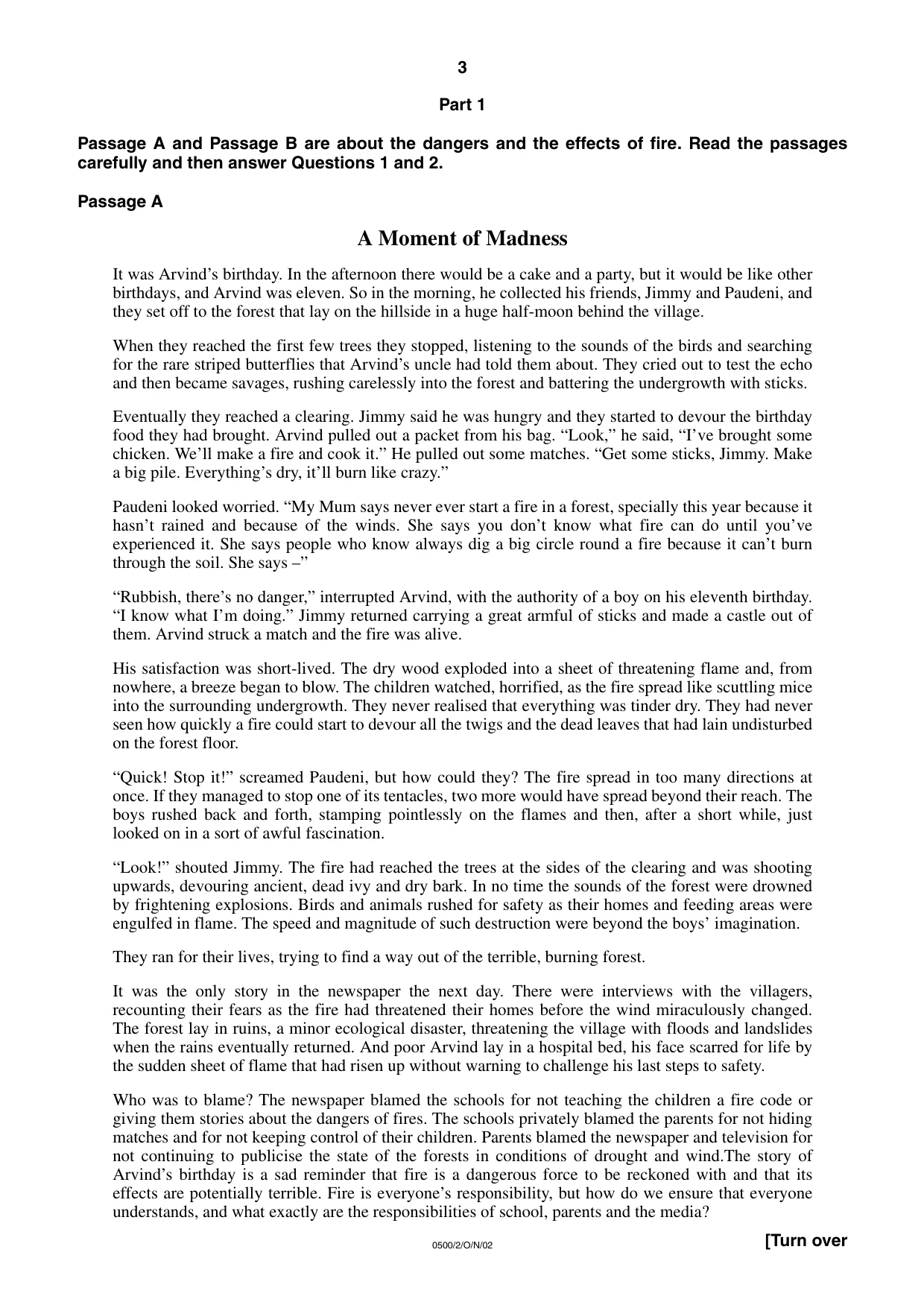
3 0500/2/O/N/02 [Turn over Part 1 Passage A and Passage B are about the dangers and the effects of fire. Read the passages carefully and then answer Questions 1 and 2. Passage A A Moment of Madness It was Arvind’s birthday. In the afternoon there would be a cake and a party, but it would be like other birthdays, and Arvind was eleven. So in the morning, he collected his friends, Jimmy and Paudeni, and they set off to the forest that lay on the hillside in a huge half-moon behind the village. When they reached the first few trees they stopped, listening to the sounds of the birds and searching for the rare striped butterflies that Arvind’s uncle had told them about. They cried out to test the echo and then became savages, rushing carelessly into the forest and battering the undergrowth with sticks. Eventually they reached a clearing. Jimmy said he was hungry and they started to devour the birthday food they had brought. Arvind pulled out a packet from his bag. “Look,” he said, “I’ve brought some chicken. We’ll make a fire and cook it.” He pulled out some matches. “Get some sticks, Jimmy. Make a big pile. Everything’s dry, it’ll burn like crazy.” Paudeni looked worried. “My Mum says never ever start a fire in a forest, specially this year because it hasn’t rained and because of the winds. She says you don’t know what fire can do until you’ve experienced it. She says people who know always dig a big circle round a fire because it can’t burn through the soil. She says –” “Rubbish, there’s no danger,” interrupted Arvind, with the authority of a boy on his eleventh birthday. “I know what I’m doing.” Jimmy returned carrying a great armful of sticks and made a castle out of them. Arvind struck a match and the fire was alive. His satisfaction was short-lived. The dry wood exploded into a sheet of threatening flame and, from nowhere, a breeze began to blow. The children watched, horrified, as the fire spread like scuttling mice into the surrounding undergrowth. They never realised that everything was tinder dry. They had never seen how quickly a fire could start to devour all the twigs and the dead leaves that had lain undisturbed on the forest floor. “Quick! Stop it!” screamed Paudeni, but how could they? The fire spread in too many directions at once. If they managed to stop one of its tentacles, two more would have spread beyond their reach. The boys rushed back and forth, stamping pointlessly on the flames and then, after a short while, just looked on in a sort of awful fascination. “Look!” shouted Jimmy. The fire had reached the trees at the sides of the clearing and was shooting upwards, devouring ancient, dead ivy and dry bark. In no time the sounds of the forest were drowned by frightening explosions. Birds and animals rushed for safety as their homes and feeding areas were engulfed in flame. The speed and magnitude of such destruction were beyond the boys’ imagination. They ran for their lives, trying to find a way out of the terrible, burning forest. It was the only story in the newspaper the next day. There were interviews with the villagers, recounting their fears as the fire had threatened their homes before the wind miraculously changed. The forest lay in ruins, a minor ecological disaster, threatening the village with floods and landslides when the rains eventually returned. And poor Arvind lay in a hospital bed, his face scarred for life by the sudden sheet of flame that had risen up without warning to challenge his last steps to safety. Who was to blame? The newspaper blamed the schools for not teaching the children a fire code or giving them stories about the dangers of fires. The schools privately blamed the parents for not hiding matches and for not keeping control of their children. Parents blamed the newspaper and television for not continuing to publicise the state of the forests in conditions of drought and wind.The story of Arvind’s birthday is a sad reminder that fire is a dangerous force to be reckoned with and that its effects are potentially terrible. Fire is everyone’s responsibility, but how do we ensure that everyone understands, and what exactly are the responsibilities of school, parents and the media?
Question paper, page 4
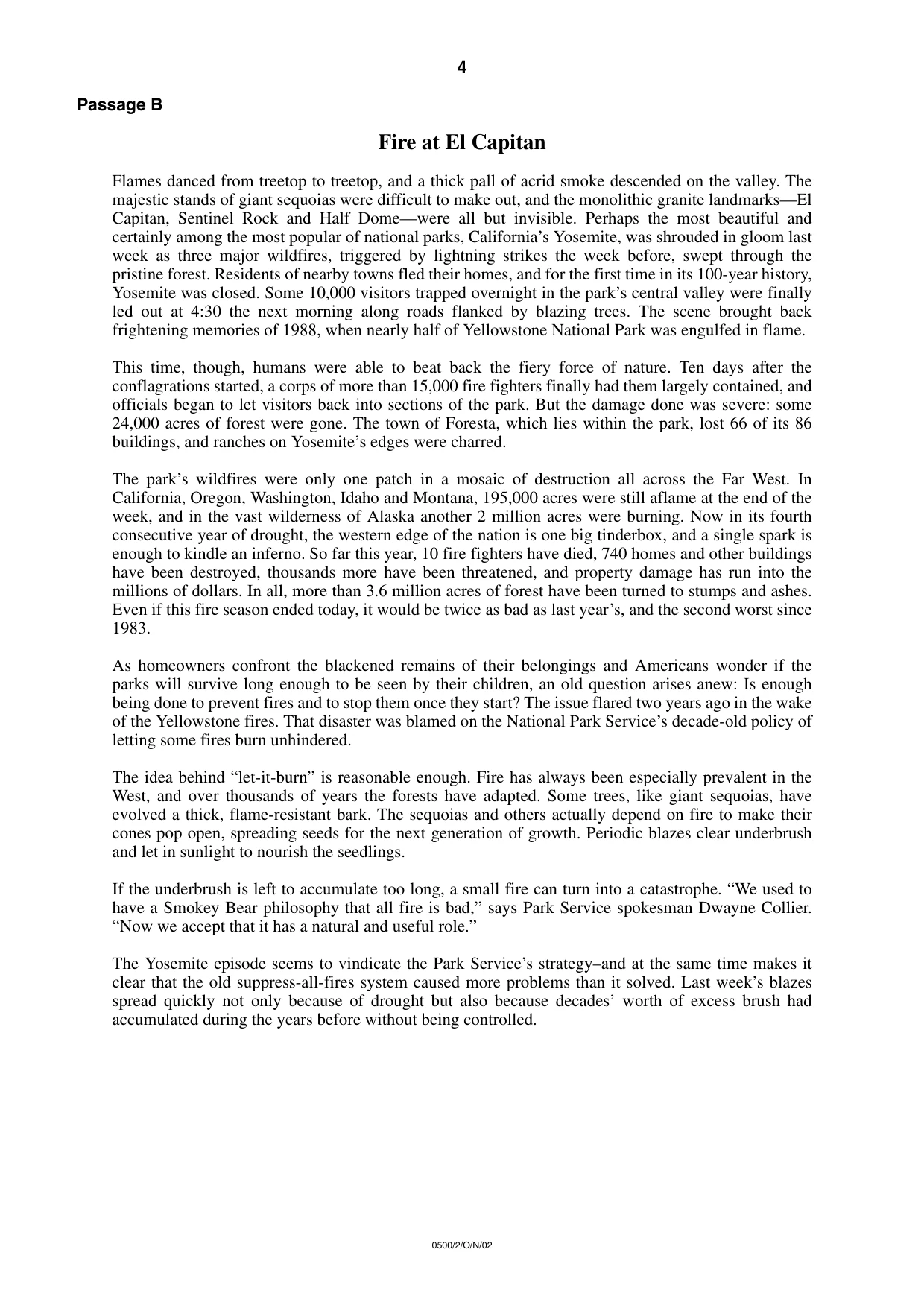
4 0500/2/O/N/02 Passage B Fire at El Capitan Flames danced from treetop to treetop, and a thick pall of acrid smoke descended on the valley. The majestic stands of giant sequoias were difficult to make out, and the monolithic granite landmarks—El Capitan, Sentinel Rock and Half Dome—were all but invisible. Perhaps the most beautiful and certainly among the most popular of national parks, California’s Yosemite, was shrouded in gloom last week as three major wildfires, triggered by lightning strikes the week before, swept through the pristine forest. Residents of nearby towns fled their homes, and for the first time in its 100-year history, Yosemite was closed. Some 10,000 visitors trapped overnight in the park’s central valley were finally led out at 4:30 the next morning along roads flanked by blazing trees. The scene brought back frightening memories of 1988, when nearly half of Yellowstone National Park was engulfed in flame. This time, though, humans were able to beat back the fiery force of nature. Ten days after the conflagrations started, a corps of more than 15,000 fire fighters finally had them largely contained, and officials began to let visitors back into sections of the park. But the damage done was severe: some 24,000 acres of forest were gone. The town of Foresta, which lies within the park, lost 66 of its 86 buildings, and ranches on Yosemite’s edges were charred. The park’s wildfires were only one patch in a mosaic of destruction all across the Far West. In California, Oregon, Washington, Idaho and Montana, 195,000 acres were still aflame at the end of the week, and in the vast wilderness of Alaska another 2 million acres were burning. Now in its fourth consecutive year of drought, the western edge of the nation is one big tinderbox, and a single spark is enough to kindle an inferno. So far this year, 10 fire fighters have died, 740 homes and other buildings have been destroyed, thousands more have been threatened, and property damage has run into the millions of dollars. In all, more than 3.6 million acres of forest have been turned to stumps and ashes. Even if this fire season ended today, it would be twice as bad as last year’s, and the second worst since 1983. As homeowners confront the blackened remains of their belongings and Americans wonder if the parks will survive long enough to be seen by their children, an old question arises anew: Is enough being done to prevent fires and to stop them once they start? The issue flared two years ago in the wake of the Yellowstone fires. That disaster was blamed on the National Park Service’s decade-old policy of letting some fires burn unhindered. The idea behind “let-it-burn” is reasonable enough. Fire has always been especially prevalent in the West, and over thousands of years the forests have adapted. Some trees, like giant sequoias, have evolved a thick, flame-resistant bark. The sequoias and others actually depend on fire to make their cones pop open, spreading seeds for the next generation of growth. Periodic blazes clear underbrush and let in sunlight to nourish the seedlings. If the underbrush is left to accumulate too long, a small fire can turn into a catastrophe. “We used to have a Smokey Bear philosophy that all fire is bad,” says Park Service spokesman Dwayne Collier. “Now we accept that it has a natural and useful role.” The Yosemite episode seems to vindicate the Park Service’s strategy–and at the same time makes it clear that the old suppress-all-fires system caused more problems than it solved. Last week’s blazes spread quickly not only because of drought but also because decades’ worth of excess brush had accumulated during the years before without being controlled.
Question paper, page 5
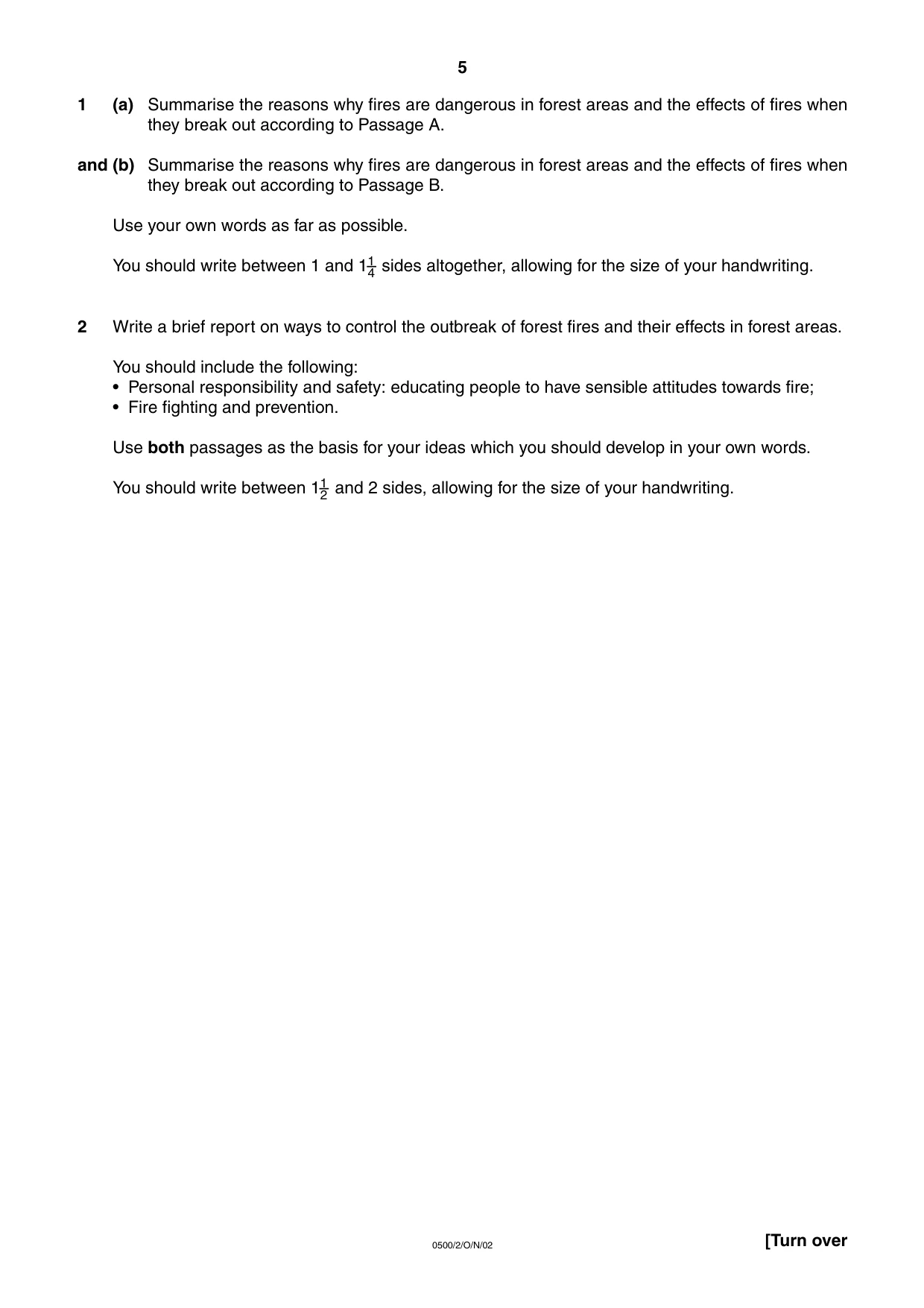
5 0500/2/O/N/02 [Turn over 1 (a) Summarise the reasons why fires are dangerous in forest areas and the effects of fires when they break out according to Passage A. and (b) Summarise the reasons why fires are dangerous in forest areas and the effects of fires when they break out according to Passage B. Use your own words as far as possible. You should write between 1 and 11–4 sides altogether, allowing for the size of your handwriting. 2 Write a brief report on ways to control the outbreak of forest fires and their effects in forest areas. You should include the following: • Personal responsibility and safety: educating people to have sensible attitudes towards fire; • Fire fighting and prevention. Use both passages as the basis for your ideas which you should develop in your own words. You should write between 11–2 and 2 sides, allowing for the size of your handwriting.
Question paper, page 6
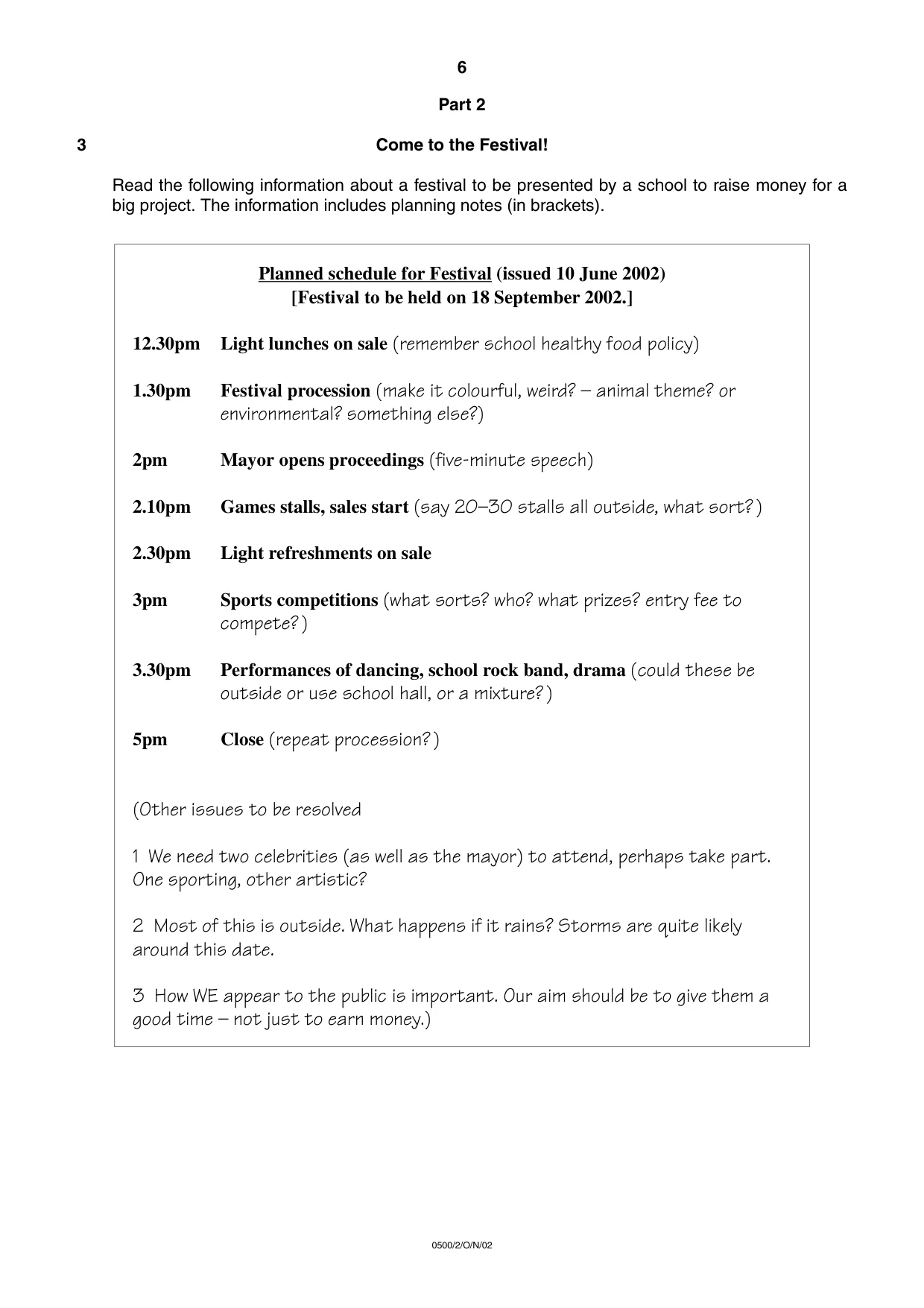
6 0500/2/O/N/02 Part 2 3 Come to the Festival! Read the following information about a festival to be presented by a school to raise money for a big project. The information includes planning notes (in brackets). Planned schedule for Festival (issued 10 June 2002) [Festival to be held on 18 September 2002.] 12.30pm Light lunches on sale (remember school healthy food policy) 1.30pm Festival procession (make it colourful, weird? – animal theme? or environmental? something else?) 2pm Mayor opens proceedings (five-minute speech) 2.10pm Games stalls, sales start (say 20–30 stalls all outside, what sort?) 2.30pm Light refreshments on sale 3pm Sports competitions (what sorts? who? what prizes? entry fee to compete?) 3.30pm Performances of dancing, school rock band, drama (could these be outside or use school hall, or a mixture?) 5pm Close (repeat procession?) (Other issues to be resolved 1 We need two celebrities (as well as the mayor) to attend, perhaps take part. One sporting, other artistic? 2 Most of this is outside. What happens if it rains? Storms are quite likely around this date. 3 How WE appear to the public is important. Our aim should be to give them a good time – not just to earn money.)
Question paper, page 7
7 0500/2/O/N/02 The day after the festival, the following headline appeared in a local newspaper: HEAVY RAIN FAILS TO DAMPEN SPIRITS AT LOCAL SCHOOL: MAYOR PRAISES STUDENT ENTERPRISE Write the report that followed the headline. Base all of your report on the information, but do not try to use all of it. Add your own details and extracts from interviews with key people to make your report more interesting. You should write between 11–2 and 2 sides, allowing for the size of your handwriting.
Question paper, page 8
8 0500/2/O/N/02 Copyright Acknowledgements: Passage B. © 1990 Time Inc. Reprinted by permission.
Mark scheme, page 1
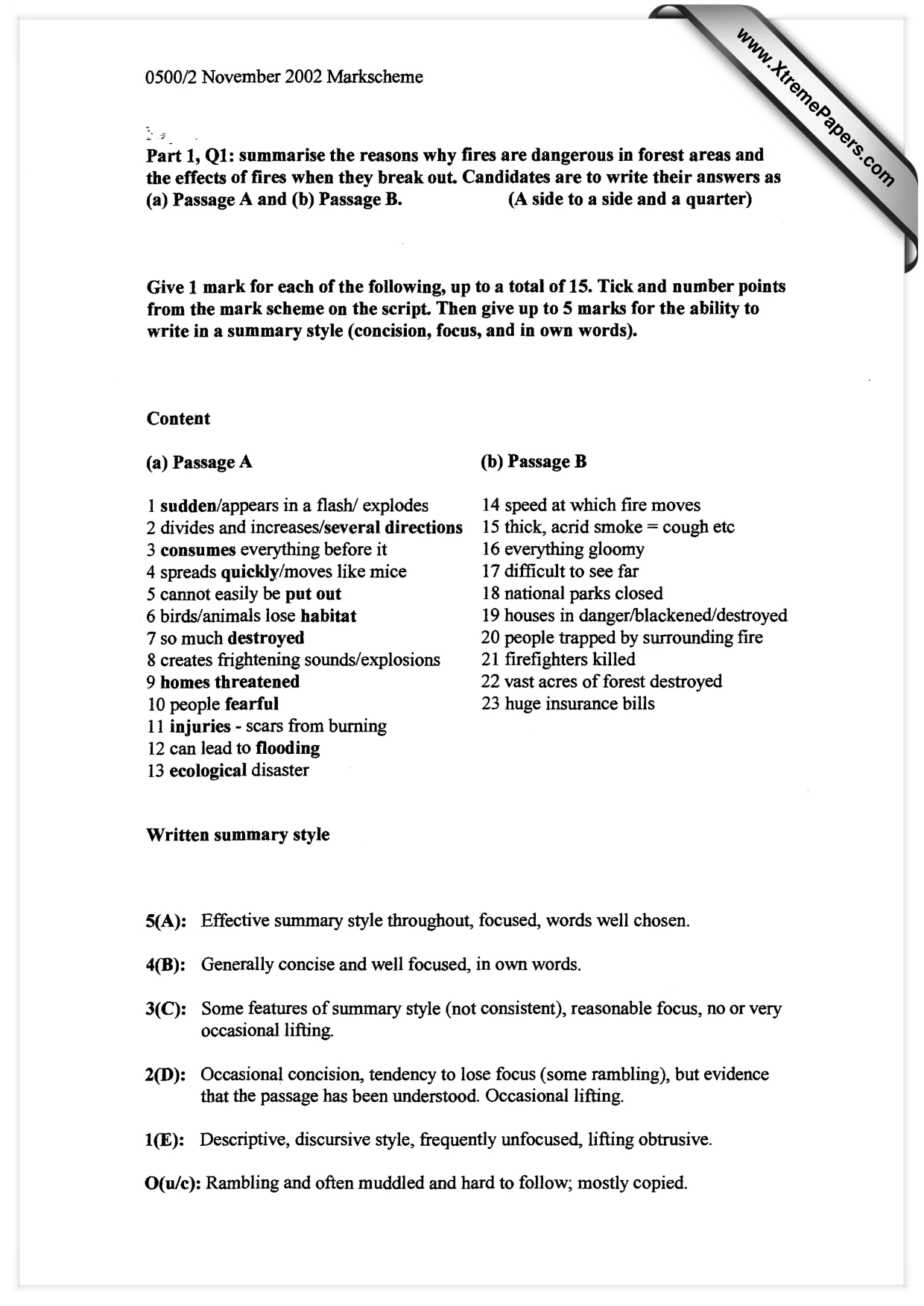
0500/2 November 2002 Markscheme Part 1, Q1: summarise the reasons why fires are dangerous in forest areas and the effects of fires when they break out. Candidates are to write their answers as (a) Passage A and (b) Passage B. (A side to a side and a quarter) Give 1 mark for each of the following, up to a total of 15. Tick and number points from the mark scheme on the script. Then give up to 5 marks for the ability to write in a summary style (concision, focus, and in own words). Content (a) Passage A (b) Passage B 1 sudden/appears in a flash/ explodes 14 speed at which fire moves 2 divides and increases/several directions 15 thick, acrid smoke = cough etc 3 consumes everything before it 16 everything gloomy 4 spreads quickly/moves like mice 17 difficult to see far 5 cannot easily be put out 18 national parks closed 6 birds/animals lose habitat 19 houses in danger/blackened/destroyed 7 so much destroyed 20 people trapped by surrounding fire 8 creates frightening sounds/explosions 21 firefighters killed 9 homes threatened 22 vast acres of forest destroyed 10 people fearful 23 huge insurance bills 11 injuries - scars from burning 12 can lead to flooding 13 ecological disaster Written summary style 5(A): Effective summary style throughout, focused, words well chosen. 4(B): Generally concise and well focused, in own words. 3(C): Some features of summary style (not consistent), reasonable focus, no or very occasional lifting. 2(@D): Occasional concision, tendency to lose focus (some rambling), but evidence that the passage has been understood. Occasional lifting. 1): Descriptive, discursive style, frequently unfocused, lifting obtrusive. O(u/c): Rambling and often muddled and hard to follow; mostly copied.
Mark scheme, page 2
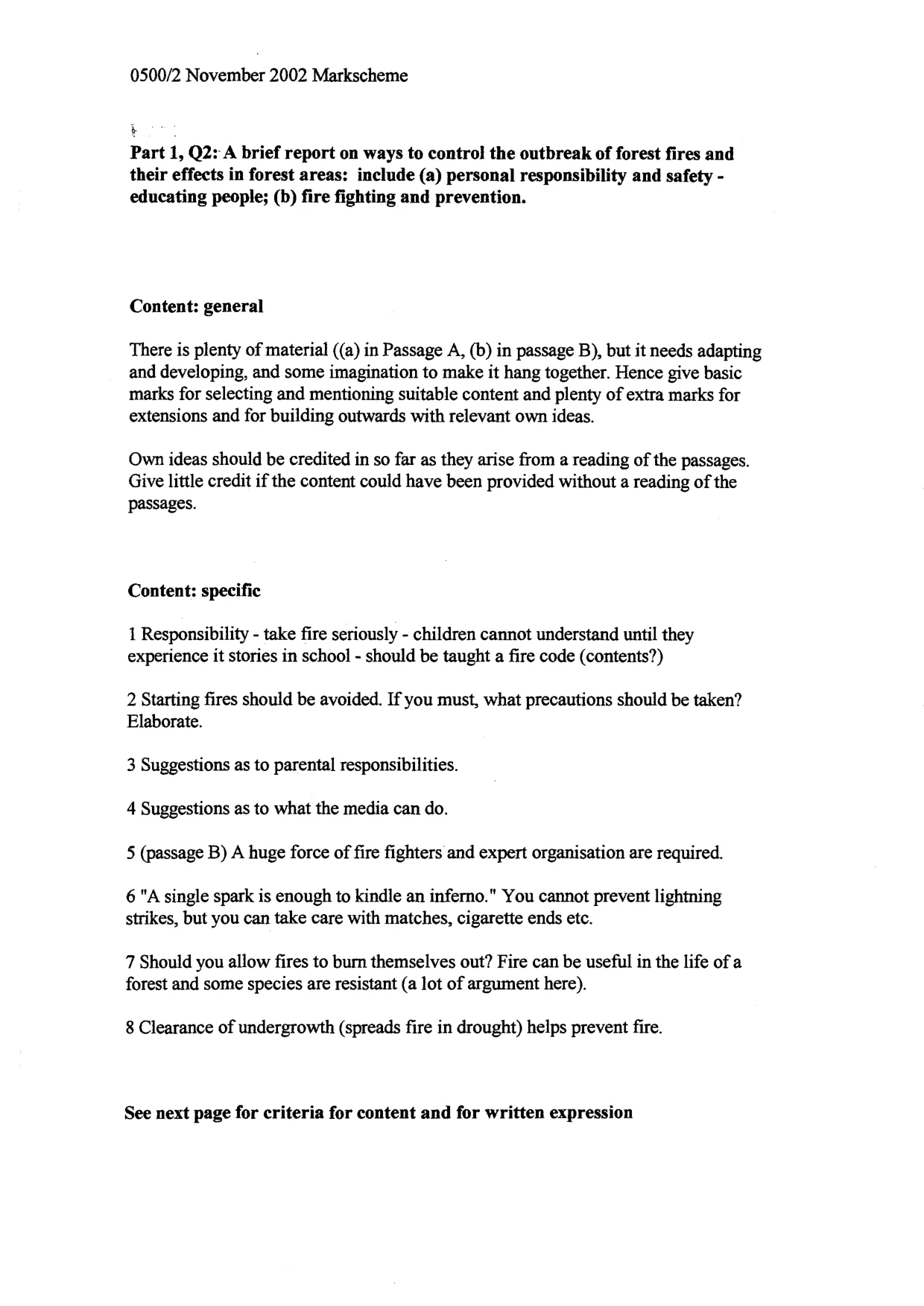
0500/2 November 2002 Markscheme - Part 1, Q2: A brief report on ways to control the outbreak of forest fires and their effects in forest areas: include (a) personal responsibility and safety - educating people; (b) fire fighting and prevention. Content: general There is plenty of material ((a) in Passage A, (b) in passage B), but it needs adapting and developing, and some imagination to make it hang together. Hence give basic marks for selecting and mentioning suitable content and plenty of extra marks for extensions and for building outwards with relevant own ideas. Own ideas should be credited in so far as they arise from a reading of the passages. Give little credit if the content could have been provided without a reading of the passages. Content: specific 1 Responsibility - take fire seriously - children cannot understand until they experience it stories in school - should be taught a fire code (contents?) 2 Starting fires should be avoided. If you must, what precautions should be taken? Elaborate. 3 Suggestions as to parental responsibilities. 4 Suggestions as to what the media can do. 5 (passage B) A huge force of fire fighters and expert organisation are required. 6 "A single spark is enough to kindle an inferno." You cannot prevent lightning strikes, but you can take care with matches, cigarette ends etc. 7 Should you allow fires to bum themselves out? Fire can be useful in the life of a forest and some species are resistant (a lot of argument here). 8 Clearance of undergrowth (spreads fire in drought) helps prevent fire. See next page for criteria for content and for written expression
Mark scheme, page 3
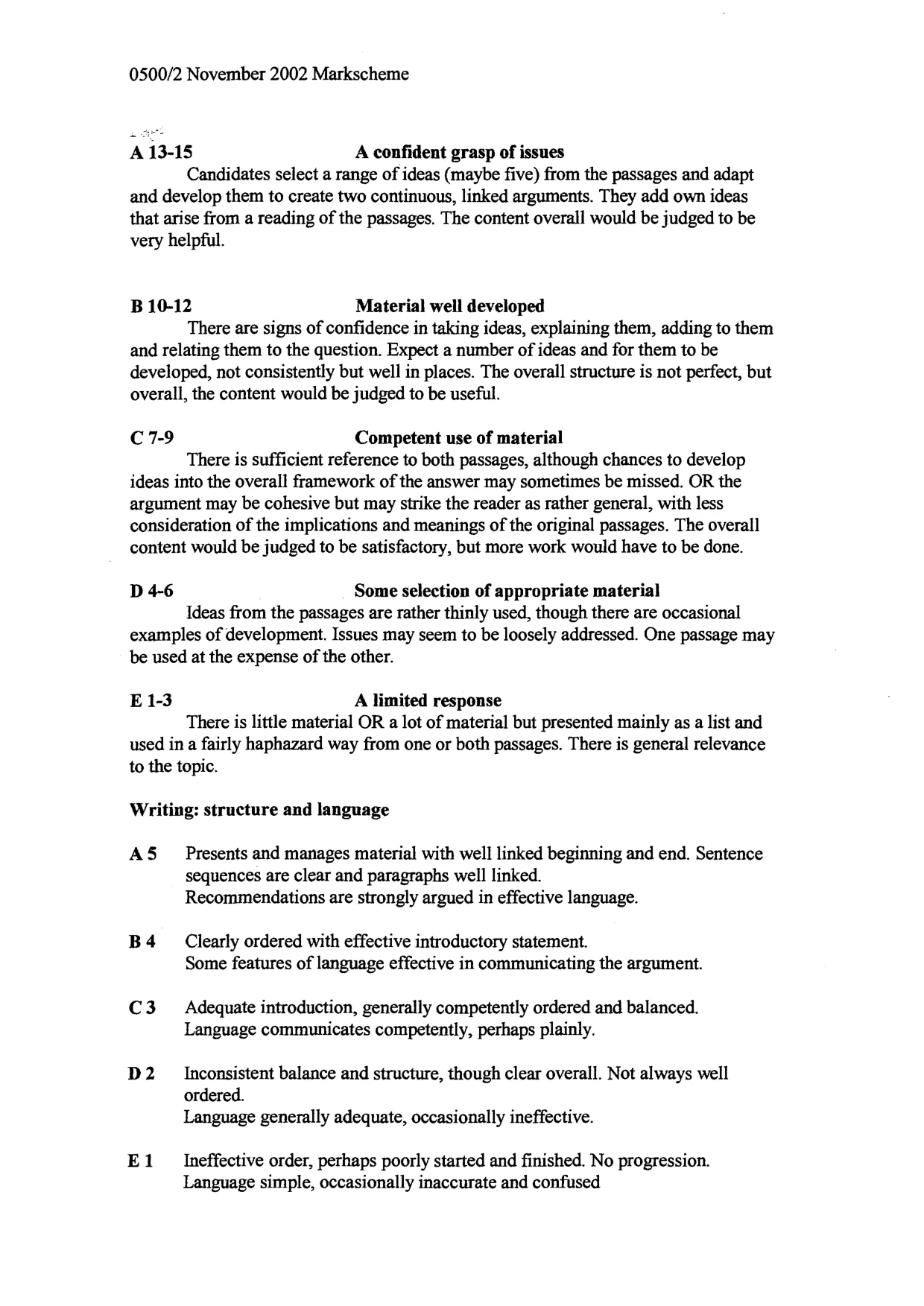
0500/2 November 2002 Markscheme A 13-15 A confident grasp of issues Candidates select a range of ideas (maybe five) from the passages and adapt and develop them to create two continuous, linked arguments. They add own ideas that arise from a reading of the passages. The content overall would be judged to be very helpful. B 10-12 Material well developed There are signs of confidence in taking ideas, explaining them, adding to them and relating them to the question. Expect a number of ideas and for them to be developed, not consistently but well in places. The overall structure is not perfect, but overall, the content would be judged to be useful. C7-9 Competent use of material There is sufficient reference to both passages, although chances to develop ideas into the overall framework of the answer may sometimes be missed. OR the argument may be cohesive but may strike the reader as rather general, with less consideration of the implications and meanings of the original passages. The overall content would be judged to be satisfactory, but more work would have to be done. D4-6 Some selection of appropriate material Ideas from the passages are rather thinly used, though there are occasional examples of development. Issues may seem to be loosely addressed. One passage may be used at the expense of the other. E13 A limited response There is little material OR a lot of material but presented mainly as a list and used in a fairly haphazard way from one or both passages. There is general relevance to the topic. Writing: structure and language A5 __ Presents and manages material with well linked beginning and end. Sentence sequences are clear and paragraphs well linked. Recommendations are strongly argued in effective language. B4 _— Clearly ordered with effective introductory statement. Some features of language effective in communicating the argument. C3 Adequate introduction, generally competently ordered and balanced. Language communicates competently, perhaps plainly. D2 __ Inconsistent balance and structure, though clear overall. Not always well ordered. Language generally adequate, occasionally ineffective. E1 __ Ineffective order, perhaps poorly started and finished. No progression. Language simple, occasionally inaccurate and confused
Mark scheme, page 4
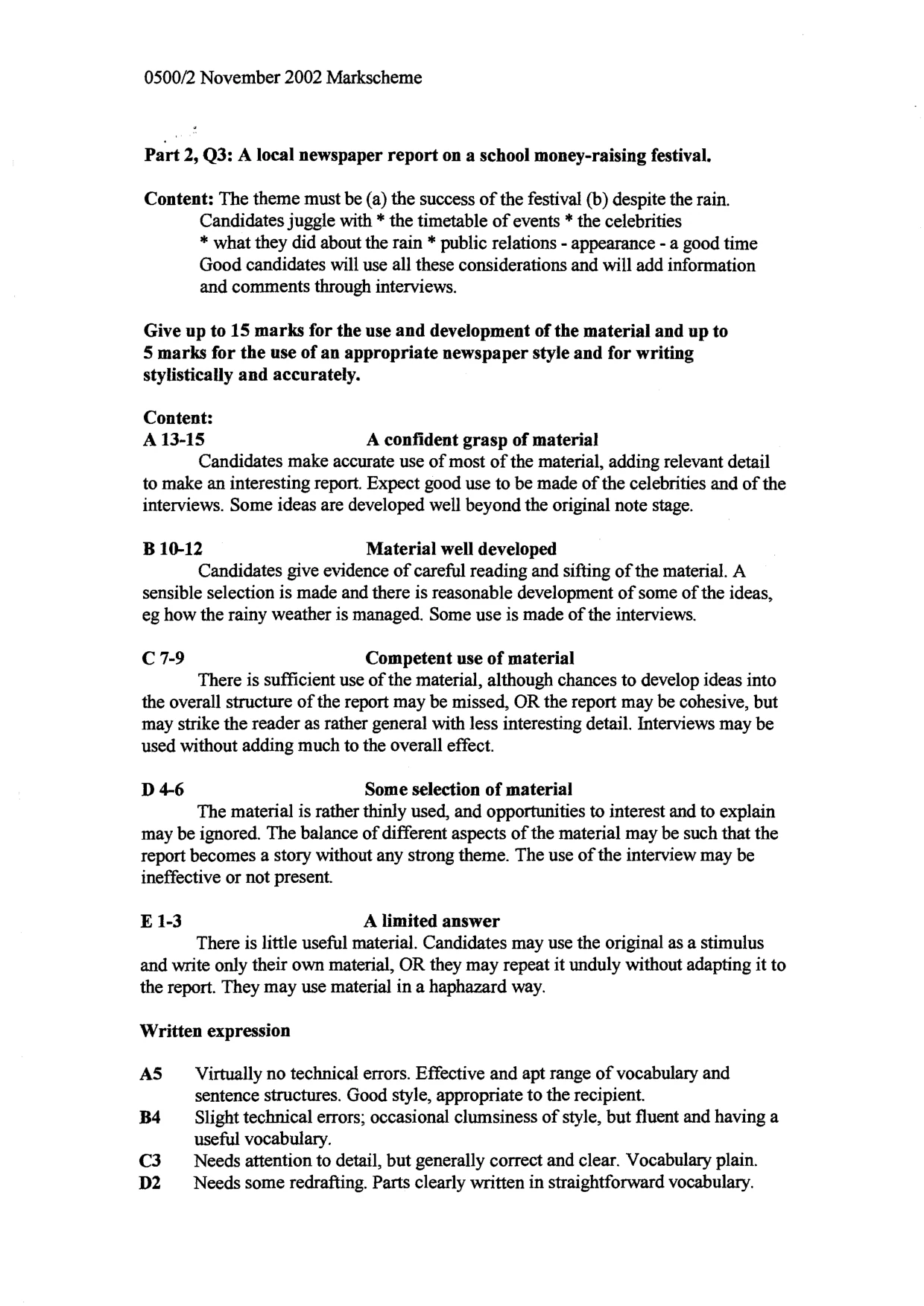
0500/2 November 2002 Markscheme Part 2, Q3: A local newspaper report on a school money-raising festival. Content: The theme must be (a) the success of the festival (b) despite the rain. Candidates juggle with * the timetable of events * the celebrities * what they did about the rain * public relations - appearance - a good time Good candidates will use all these considerations and will add information and comments through interviews. Give up to 15 marks for the use and development of the material and up to 5 marks for the use of an appropriate newspaper style and for writing stylistically and accurately. Content: A 13-15 A confident grasp of material Candidates make accurate use of most of the material, adding relevant detail to make an interesting report. Expect good use to be made of the celebrities and of the interviews. Some ideas are developed well beyond the original note stage. B 10-12 Material well developed Candidates give evidence of careful reading and sifting of the material. A sensible selection is made and there is reasonable development of some of the ideas, eg how the rainy weather is managed. Some use is made of the interviews. C7-9 Competent use of material There is sufficient use of the material, although chances to develop ideas into the overall structure of the report may be missed, OR the report may be cohesive, but may strike the reader as rather general with less interesting detail. Interviews may be used without adding much to the overall effect. D46 Some selection of material The material is rather thinly used, and opportunities to interest and to explain may be ignored. The balance of different aspects of the material may be such that the report becomes a story without any strong theme. The use of the interview may be ineffective or not present. E1-3 A limited answer There is little useful material. Candidates may use the original as a stimulus and write only their own material, OR they may repeat it unduly without adapting it to the report. They may use material in a haphazard way. Written expression AS Virtually no technical errors. Effective and apt range of vocabulary and sentence structures. Good style, appropriate to the recipient. B4 _ Slight technical errors; occasional clumsiness of style, but fluent and having a useful vocabulary. C3 _—_— Needs attention to detail, but generally correct and clear. Vocabulary plain. D2 ~—— Needs some redrafting. Parts clearly written in straightforward vocabulary.