Cambridge IGCSE Dutch - Foreign Language 0515 — 2019 May/June Paper 4 · Variant 1
0515/41/M/J/19 · 50 marks · ≈56 min
The question paper and its mark scheme, free to read here and free to download. This is Cambridge’s own paper, exactly as it was sat.
Question paper8 pages



Mark scheme21 pages
Answers below. Sit the paper first if you are practising.
Paper as text
Question paper, page 1
This document consists of 5 printed pages and 3 blank pages. DC (LK/TP) 176420/1 © UCLES 2019 [Turn over * 5 3 7 3 3 5 9 3 0 9 * DUTCH 0515/04 Paper 4 Writing May/June 2019 1 hour Candidates answer on the Question Paper. No Additional Materials are required. READ THESE INSTRUCTIONS FIRST Write your centre number, candidate number and name in the spaces at the top of this page. Write in dark blue or black pen. Do not use staples, paper clips, glue or correction fluid. DO NOT WRITE IN ANY BARCODES. Answer three questions: Question 1, Question 2 and Question 3(a) or Question 3(b) or Question 3(c). The number of marks is given in brackets [ ] at the end of each question or part question. Cambridge Assessment International Education Cambridge International General Certificate of Secondary Education
Question paper, page 2
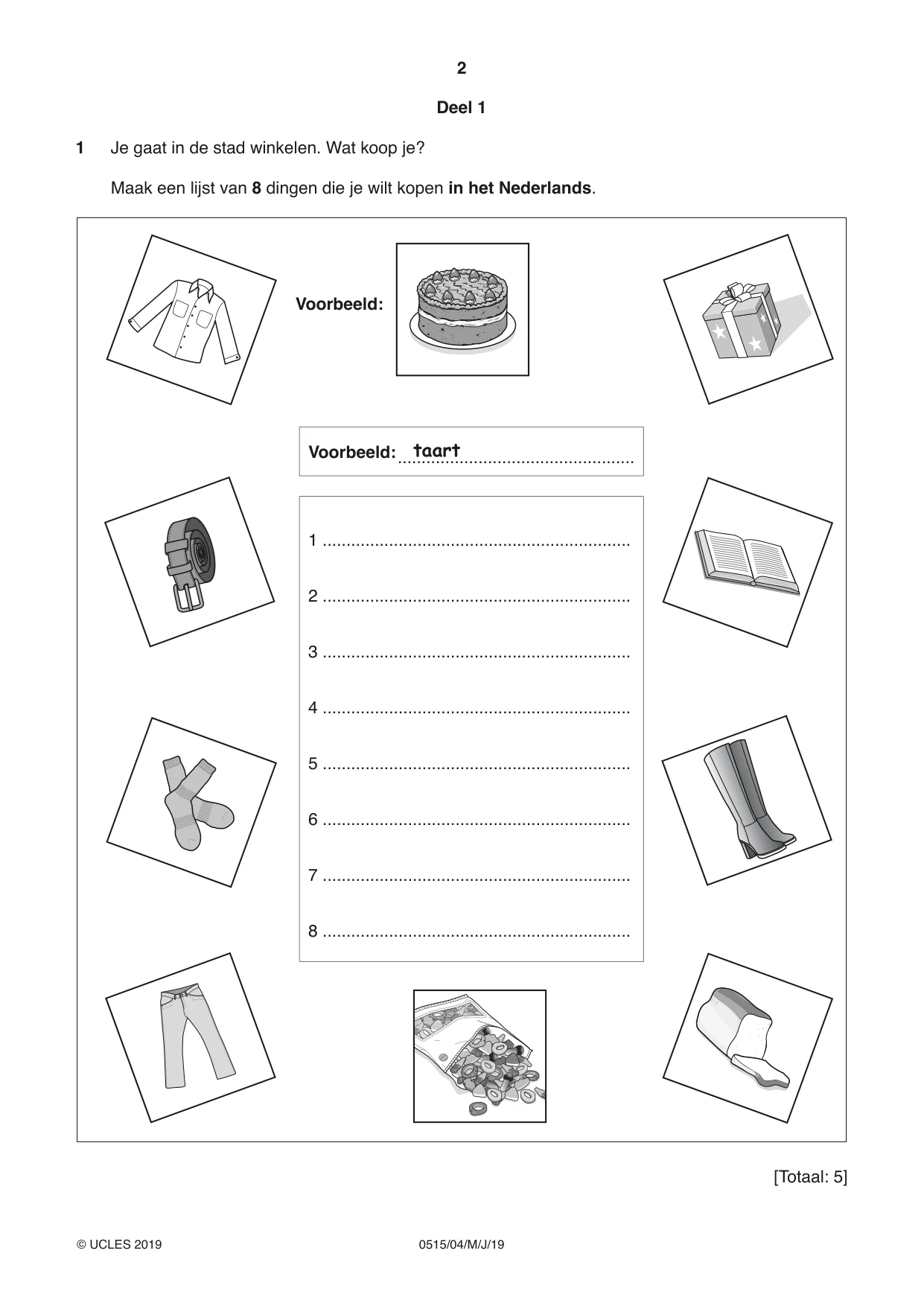
2 0515/04/M/J/19 © UCLES 2019 Deel 1 1 Je gaat in de stad winkelen. Wat koop je? Maak een lijst van 8 dingen die je wilt kopen in het Nederlands. Voorbeeld: Voorbeeld: taart … 1 … 2 … 3 … 4 … 5 … 6 … 7 … 8 … [Totaal: 5]
Question paper, page 3
3 0515/04/M/J/19 © UCLES 2019 [Turn over 2 Je woont in een nieuw huis. • Vertel waar je nieuwe huis is en met wie je er woont. • Beschrijf je huis en vertel wat je in de buurt kunt doen. • Vertel wat je wel en wat je niet leuk vindt aan je nieuwe huis. • Vertel waar je graag zou willen wonen als je ouder bent en waarom. Schrijf ongeveer 80–90 woorden in het Nederlands. … … … … … … … … … … … … … … … [Totaal: 15]
Question paper, page 4
4 0515/04/M/J/19 © UCLES 2019 Deel 2 3 Kies één van de volgende onderwerpen. Schrijf 130–140 woorden in het Nederlands. (a) Stage lopen Je hebt stage gelopen bij het bedrijf van jouw oom en tante. Schrijf erover in jouw blog. • Vertel wat voor werk je tijdens je stage hebt gedaan. • Noem twee dingen die je geleerd hebt. • Vertel over iets grappigs dat er tijdens jouw stage is gebeurd. • Vond je het werk interessant? Leg uit waarom wel of niet. • Wat voor werk wil je in de toekomst gaan doen? Vertel waarom. ÓF (b) Sporttoernooi Je hebt samen met je klasgenoten een sporttoernooi voor scholen georganiseerd. • Vertel welke sporten jullie hebben gekozen. • Vertel waarom jullie deze sporten hebben gekozen. • Vertel wat er tijdens het sporttoernooi goed en fout is gegaan. • Vertel wat de andere scholen van het sporttoernooi vonden. • Zou je weer zo’n sporttoernooi willen organiseren? Waarom wel of niet? ÓF (c) Slecht weer op vakantie Je was met jouw familie aan het kamperen. ’s Avonds begon het opeens heel hard te waaien en regenen. Vertel wat er daarna gebeurde. • Wat hadden jullie die dag gedaan? • Wat deden jullie toen het weer veranderde? • Wat gebeurde er met jullie spullen? • Vertel wat je van deze ervaring vond. • Ga je nog eens kamperen? Waarom wel of niet?
Question paper, page 5
5 0515/04/M/J/19 © UCLES 2019 SCHRIJF HIER JE ANTWOORD OP VRAAG 3: … … … … … … … … … … … … … … … … … … … … … … … … … … … [Totaal: 30]
Question paper, page 6
6 0515/04/M/J/19 © UCLES 2019 BLANK PAGE
Question paper, page 7
7 0515/04/M/J/19 © UCLES 2019 BLANK PAGE
Question paper, page 8
8 0515/04/M/J/19 © UCLES 2019 Permission to reproduce items where third-party owned material protected by copyright is included has been sought and cleared where possible. Every reasonable effort has been made by the publisher (UCLES) to trace copyright holders, but if any items requiring clearance have unwittingly been included, the publisher will be pleased to make amends at the earliest possible opportunity. To avoid the issue of disclosure of answer-related information to candidates, all copyright acknowledgements are reproduced online in the Cambridge Assessment International Education Copyright Acknowledgements Booklet. This is produced for each series of examinations and is freely available to download at www.cambridgeinternational.org after the live examination series. Cambridge Assessment International Education is part of the Cambridge Assessment Group. Cambridge Assessment is the brand name of the University of Cambridge Local Examinations Syndicate (UCLES), which itself is a department of the University of Cambridge. BLANK PAGE
Mark scheme, page 1
This document consists of 21 printed pages. © UCLES 2019 [Turn over Cambridge Assessment International Education Cambridge International General Certificate of Secondary Education DUTCH 0515/04 Paper 4 Writing May/June 2019 MARK SCHEME Maximum Mark: 50 Published This mark scheme is published as an aid to teachers and candidates, to indicate the requirements of the examination. It shows the basis on which Examiners were instructed to award marks. It does not indicate the details of the discussions that took place at an Examiners’ meeting before marking began, which would have considered the acceptability of alternative answers. Mark schemes should be read in conjunction with the question paper and the Principal Examiner Report for Teachers. Cambridge International will not enter into discussions about these mark schemes. Cambridge International is publishing the mark schemes for the May/June 2019 series for most Cambridge IGCSE™, Cambridge International A and AS Level and Cambridge Pre-U components, and some Cambridge O Level components.
Mark scheme, page 2
0515/04 Cambridge IGCSE – Mark Scheme PUBLISHED May/June 2019 © UCLES 2019 Page 2 of 21 Generic Marking Principles These general marking principles must be applied by all examiners when marking candidate answers. They should be applied alongside the specific content of the mark scheme or generic level descriptors for a question. Each question paper and mark scheme will also comply with these marking principles. GENERIC MARKING PRINCIPLE 1: Marks must be awarded in line with: • the specific content of the mark scheme or the generic level descriptors for the question • the specific skills defined in the mark scheme or in the generic level descriptors for the question • the standard of response required by a candidate as exemplified by the standardisation scripts. GENERIC MARKING PRINCIPLE 2: Marks awarded are always whole marks (not half marks, or other fractions). GENERIC MARKING PRINCIPLE 3: Marks must be awarded positively: • marks are awarded for correct/valid answers, as defined in the mark scheme. However, credit is given for valid answers which go beyond the scope of the syllabus and mark scheme, referring to your Team Leader as appropriate • marks are awarded when candidates clearly demonstrate what they know and can do • marks are not deducted for errors • marks are not deducted for omissions • answers should only be judged on the quality of spelling, punctuation and grammar when these features are specifically assessed by the question as indicated by the mark scheme. The meaning, however, should be unambiguous. GENERIC MARKING PRINCIPLE 4: Rules must be applied consistently e.g. in situations where candidates have not followed instructions or in the application of generic level descriptors.
Mark scheme, page 3
0515/04 Cambridge IGCSE – Mark Scheme PUBLISHED May/June 2019 © UCLES 2019 Page 3 of 21 GENERIC MARKING PRINCIPLE 5: Marks should be awarded using the full range of marks defined in the mark scheme for the question (however; the use of the full mark range may be limited according to the quality of the candidate responses seen). GENERIC MARKING PRINCIPLE 6: Marks awarded are based solely on the requirements as defined in the mark scheme. Marks should not be awarded with grade thresholds or grade descriptors in mind.
Mark scheme, page 4
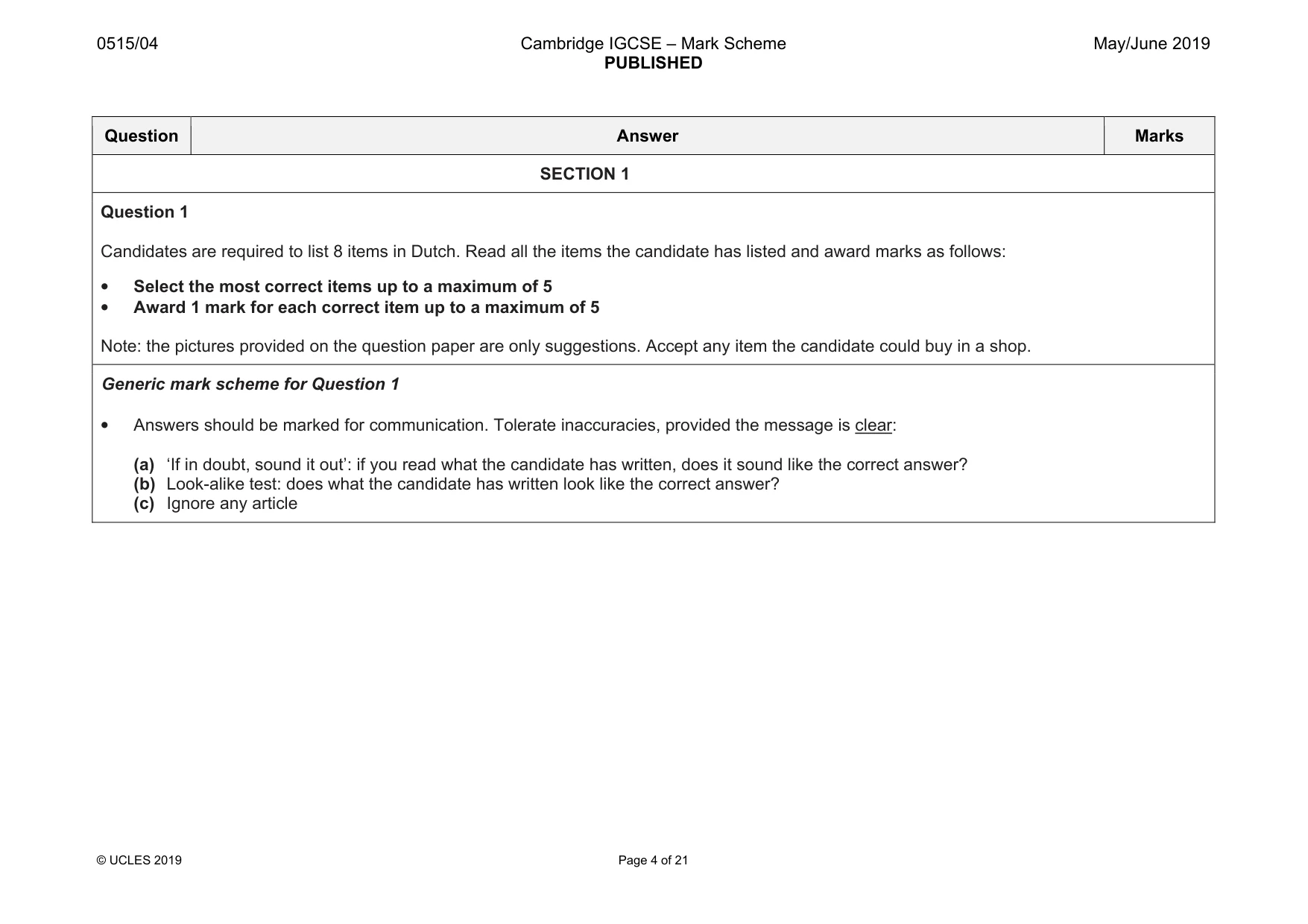
0515/04 Cambridge IGCSE – Mark Scheme PUBLISHED May/June 2019 © UCLES 2019 Page 4 of 21 Question Answer Marks SECTION 1 Question 1 Candidates are required to list 8 items in Dutch. Read all the items the candidate has listed and award marks as follows: • Select the most correct items up to a maximum of 5 • Award 1 mark for each correct item up to a maximum of 5 Note: the pictures provided on the question paper are only suggestions. Accept any item the candidate could buy in a shop. Generic mark scheme for Question 1 • Answers should be marked for communication. Tolerate inaccuracies, provided the message is clear: (a) ‘If in doubt, sound it out’: if you read what the candidate has written, does it sound like the correct answer? (b) Look-alike test: does what the candidate has written look like the correct answer? (c) Ignore any article
Mark scheme, page 5
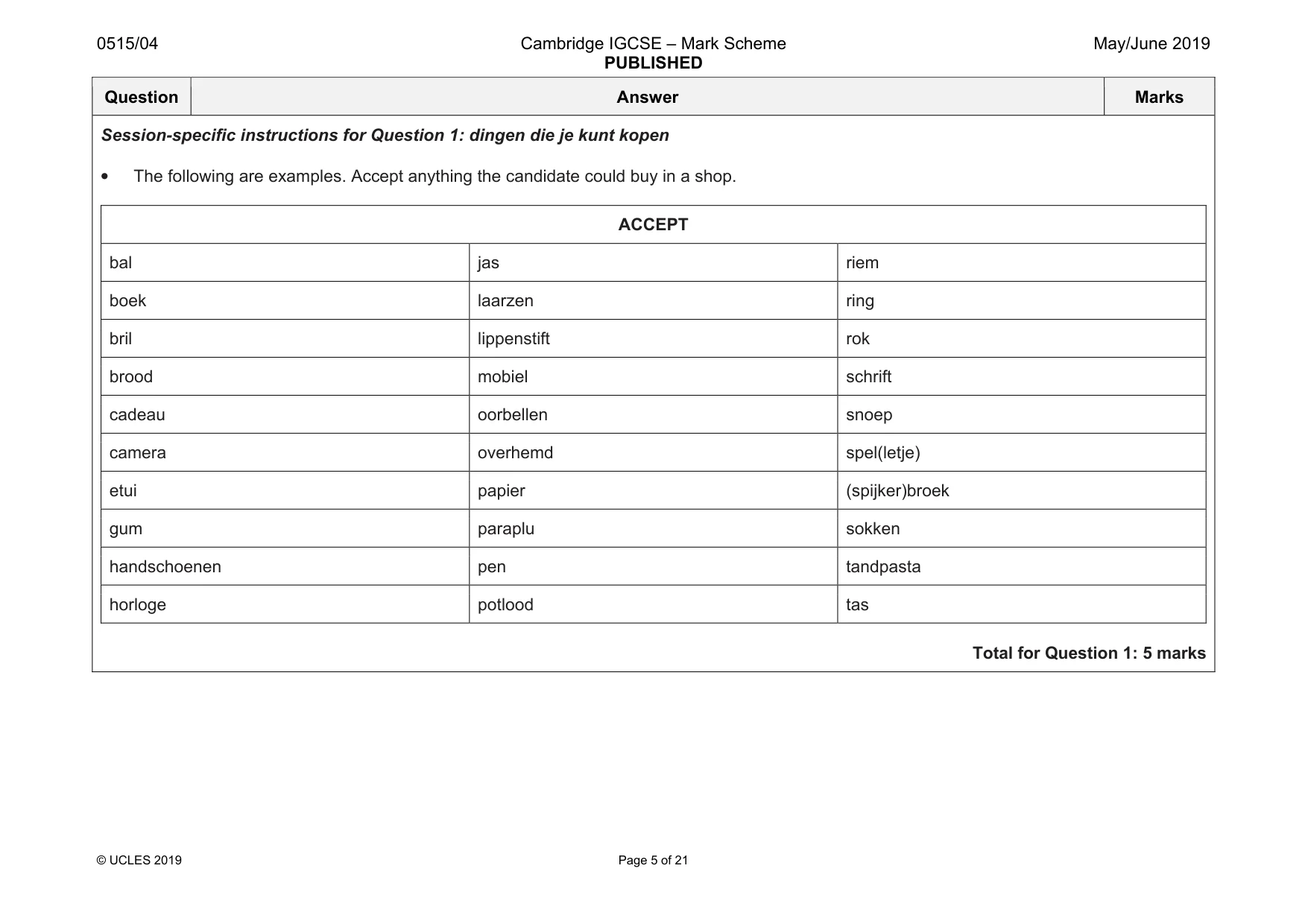
0515/04 Cambridge IGCSE – Mark Scheme PUBLISHED May/June 2019 © UCLES 2019 Page 5 of 21 Question Answer Marks Session-specific instructions for Question 1: dingen die je kunt kopen • The following are examples. Accept anything the candidate could buy in a shop. ACCEPT bal jas riem boek laarzen ring bril lippenstift rok brood mobiel schrift cadeau oorbellen snoep camera overhemd spel(letje) etui papier (spijker)broek gum paraplu sokken handschoenen pen tandpasta horloge potlood tas Total for Question 1: 5 marks
Mark scheme, page 6
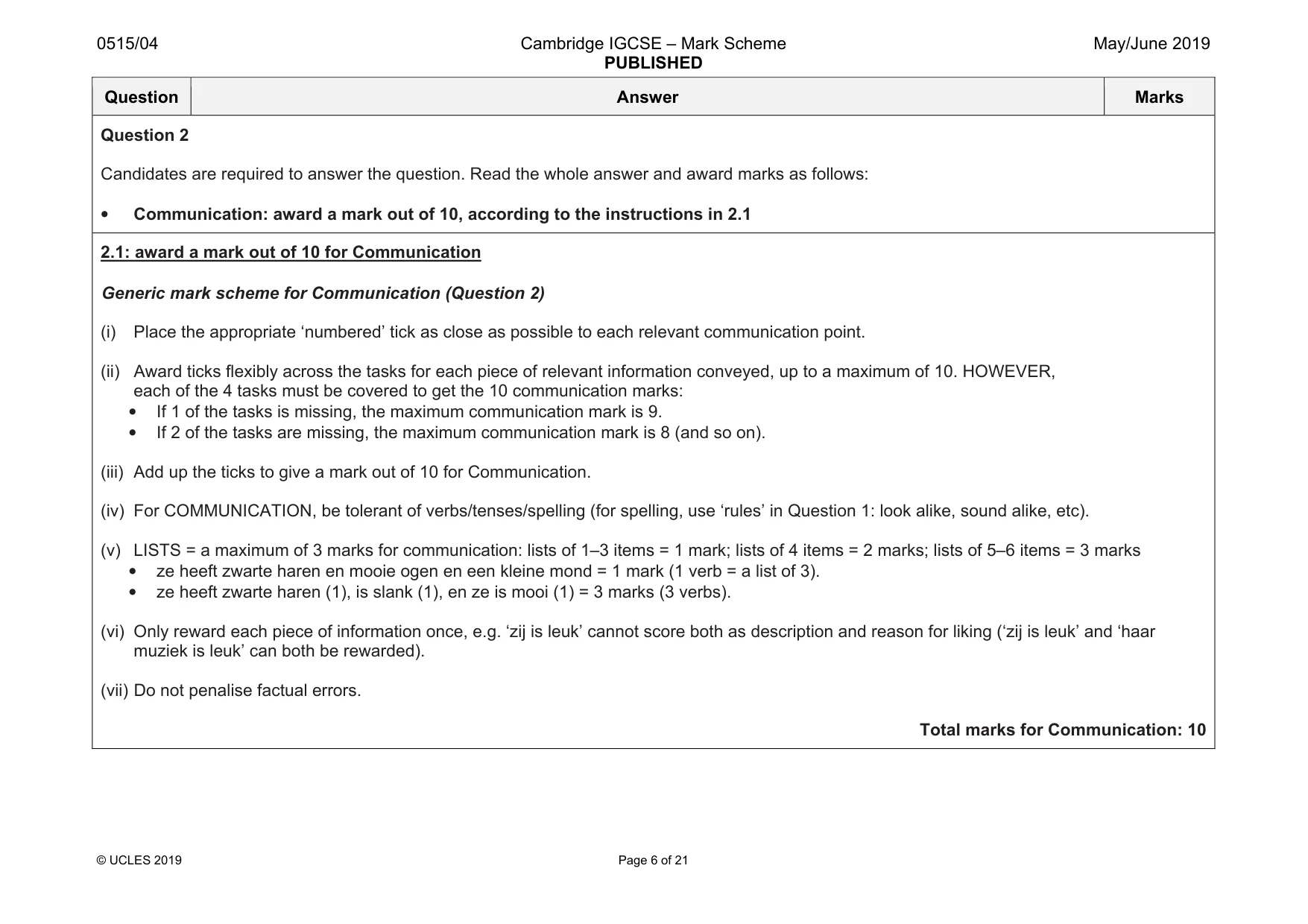
0515/04 Cambridge IGCSE – Mark Scheme PUBLISHED May/June 2019 © UCLES 2019 Page 6 of 21 Question Answer Marks Question 2 Candidates are required to answer the question. Read the whole answer and award marks as follows: • Communication: award a mark out of 10, according to the instructions in 2.1 2.1: award a mark out of 10 for Communication Generic mark scheme for Communication (Question 2) (i) Place the appropriate ‘numbered’ tick as close as possible to each relevant communication point. (ii) Award ticks flexibly across the tasks for each piece of relevant information conveyed, up to a maximum of 10. HOWEVER, each of the 4 tasks must be covered to get the 10 communication marks: • If 1 of the tasks is missing, the maximum communication mark is 9. • If 2 of the tasks are missing, the maximum communication mark is 8 (and so on). (iii) Add up the ticks to give a mark out of 10 for Communication. (iv) For COMMUNICATION, be tolerant of verbs/tenses/spelling (for spelling, use ‘rules’ in Question 1: look alike, sound alike, etc). (v) LISTS = a maximum of 3 marks for communication: lists of 1–3 items = 1 mark; lists of 4 items = 2 marks; lists of 5–6 items = 3 marks • ze heeft zwarte haren en mooie ogen en een kleine mond = 1 mark (1 verb = a list of 3). • ze heeft zwarte haren (1), is slank (1), en ze is mooi (1) = 3 marks (3 verbs). (vi) Only reward each piece of information once, e.g. ‘zij is leuk’ cannot score both as description and reason for liking (‘zij is leuk’ and ‘haar muziek is leuk’ can both be rewarded). (vii) Do not penalise factual errors. Total marks for Communication: 10
Mark scheme, page 7
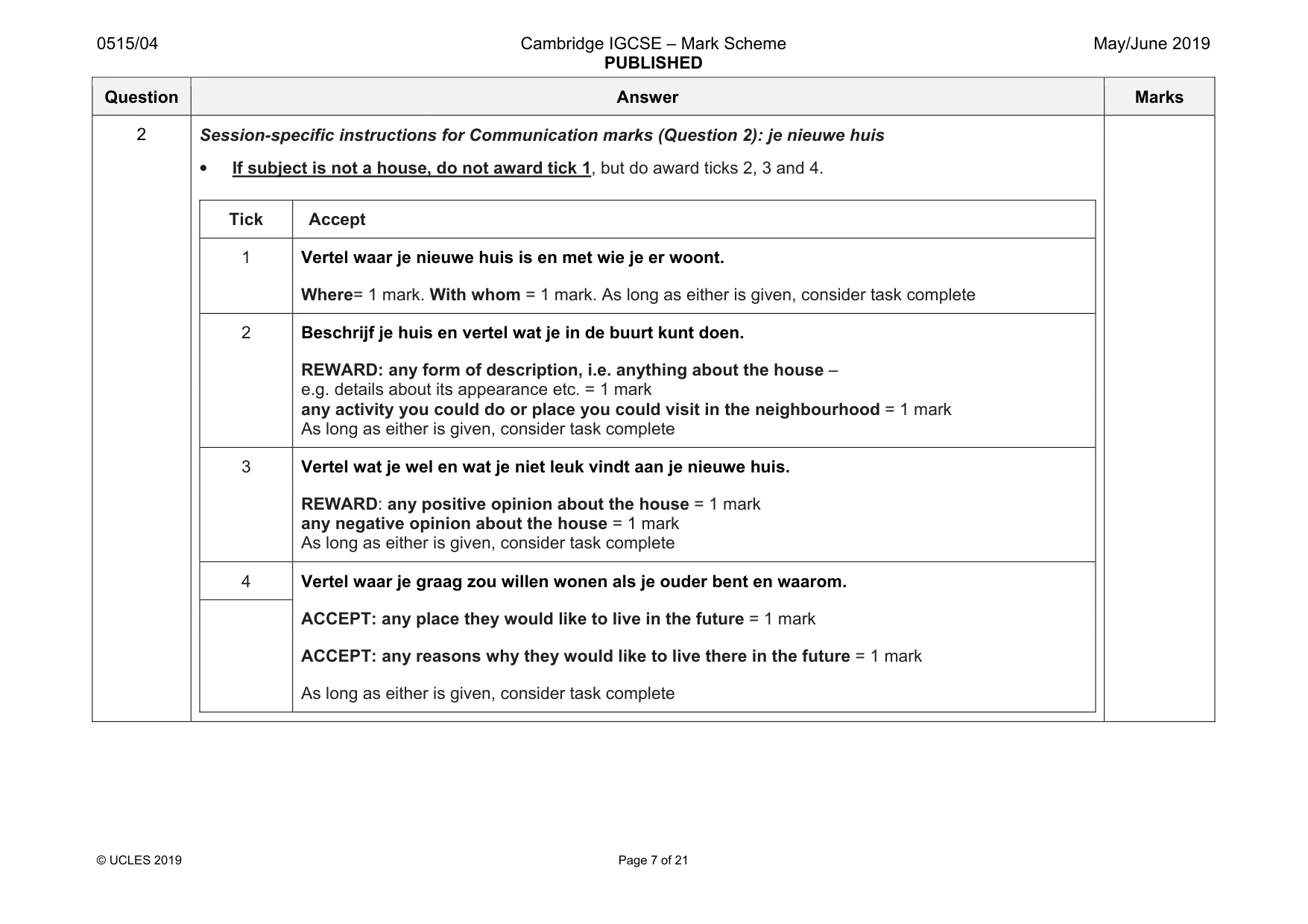
0515/04 Cambridge IGCSE – Mark Scheme PUBLISHED May/June 2019 © UCLES 2019 Page 7 of 21 Question Answer Marks 2 Session-specific instructions for Communication marks (Question 2): je nieuwe huis • If subject is not a house, do not award tick 1, but do award ticks 2, 3 and 4. Tick Accept 1 Vertel waar je nieuwe huis is en met wie je er woont. Where= 1 mark. With whom = 1 mark. As long as either is given, consider task complete 2 Beschrijf je huis en vertel wat je in de buurt kunt doen. REWARD: any form of description, i.e. anything about the house – e.g. details about its appearance etc. = 1 mark any activity you could do or place you could visit in the neighbourhood = 1 mark As long as either is given, consider task complete 3 Vertel wat je wel en wat je niet leuk vindt aan je nieuwe huis. REWARD: any positive opinion about the house = 1 mark any negative opinion about the house = 1 mark As long as either is given, consider task complete 4 Vertel waar je graag zou willen wonen als je ouder bent en waarom. ACCEPT: any place they would like to live in the future = 1 mark ACCEPT: any reasons why they would like to live there in the future = 1 mark As long as either is given, consider task complete
Mark scheme, page 8
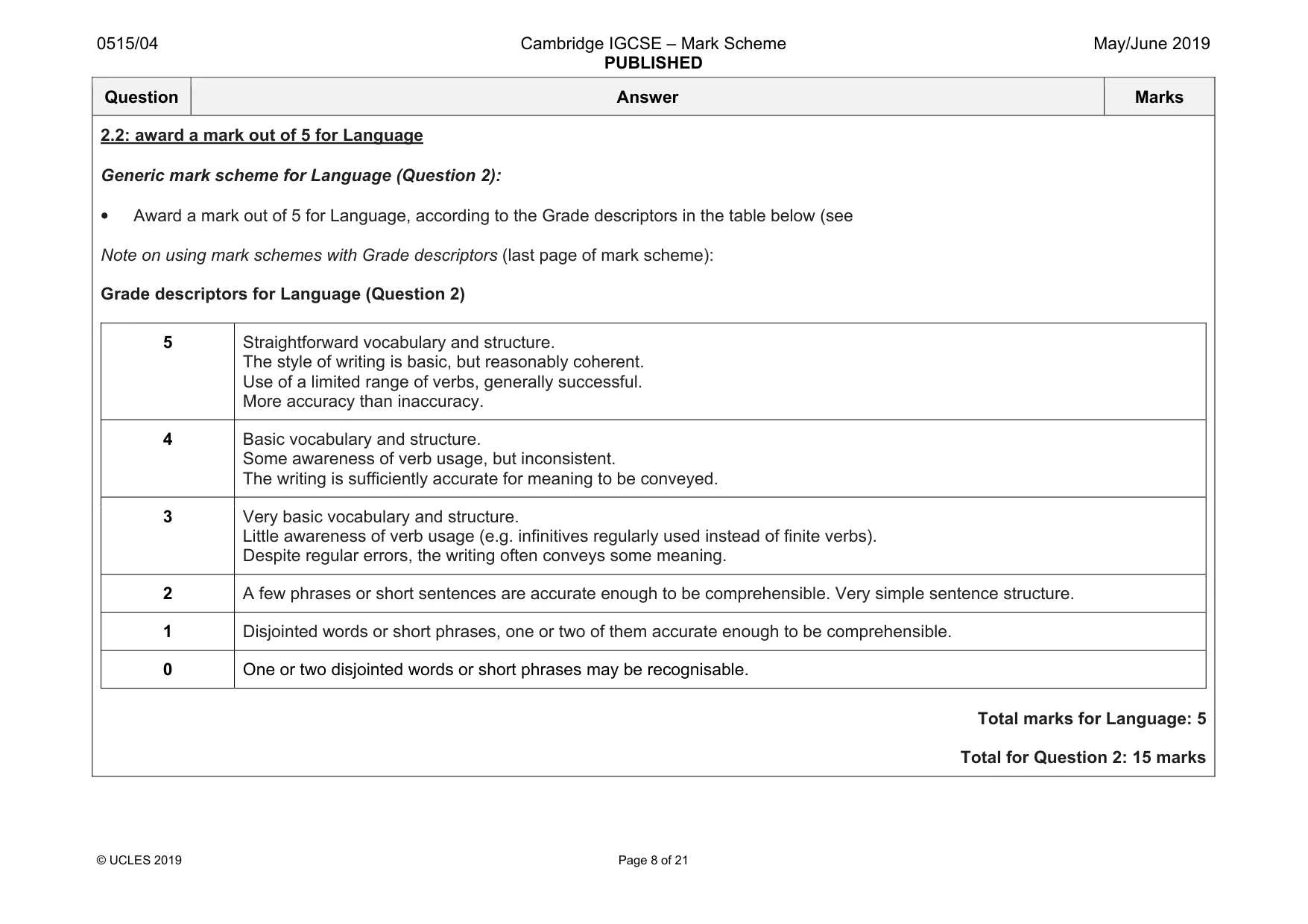
0515/04 Cambridge IGCSE – Mark Scheme PUBLISHED May/June 2019 © UCLES 2019 Page 8 of 21 Question Answer Marks 2.2: award a mark out of 5 for Language Generic mark scheme for Language (Question 2): • Award a mark out of 5 for Language, according to the Grade descriptors in the table below (see Note on using mark schemes with Grade descriptors (last page of mark scheme): Grade descriptors for Language (Question 2) 5 Straightforward vocabulary and structure. The style of writing is basic, but reasonably coherent. Use of a limited range of verbs, generally successful. More accuracy than inaccuracy. 4 Basic vocabulary and structure. Some awareness of verb usage, but inconsistent. The writing is sufficiently accurate for meaning to be conveyed. 3 Very basic vocabulary and structure. Little awareness of verb usage (e.g. infinitives regularly used instead of finite verbs). Despite regular errors, the writing often conveys some meaning. 2 A few phrases or short sentences are accurate enough to be comprehensible. Very simple sentence structure. 1 Disjointed words or short phrases, one or two of them accurate enough to be comprehensible. 0 One or two disjointed words or short phrases may be recognisable. Total marks for Language: 5 Total for Question 2: 15 marks
Mark scheme, page 9
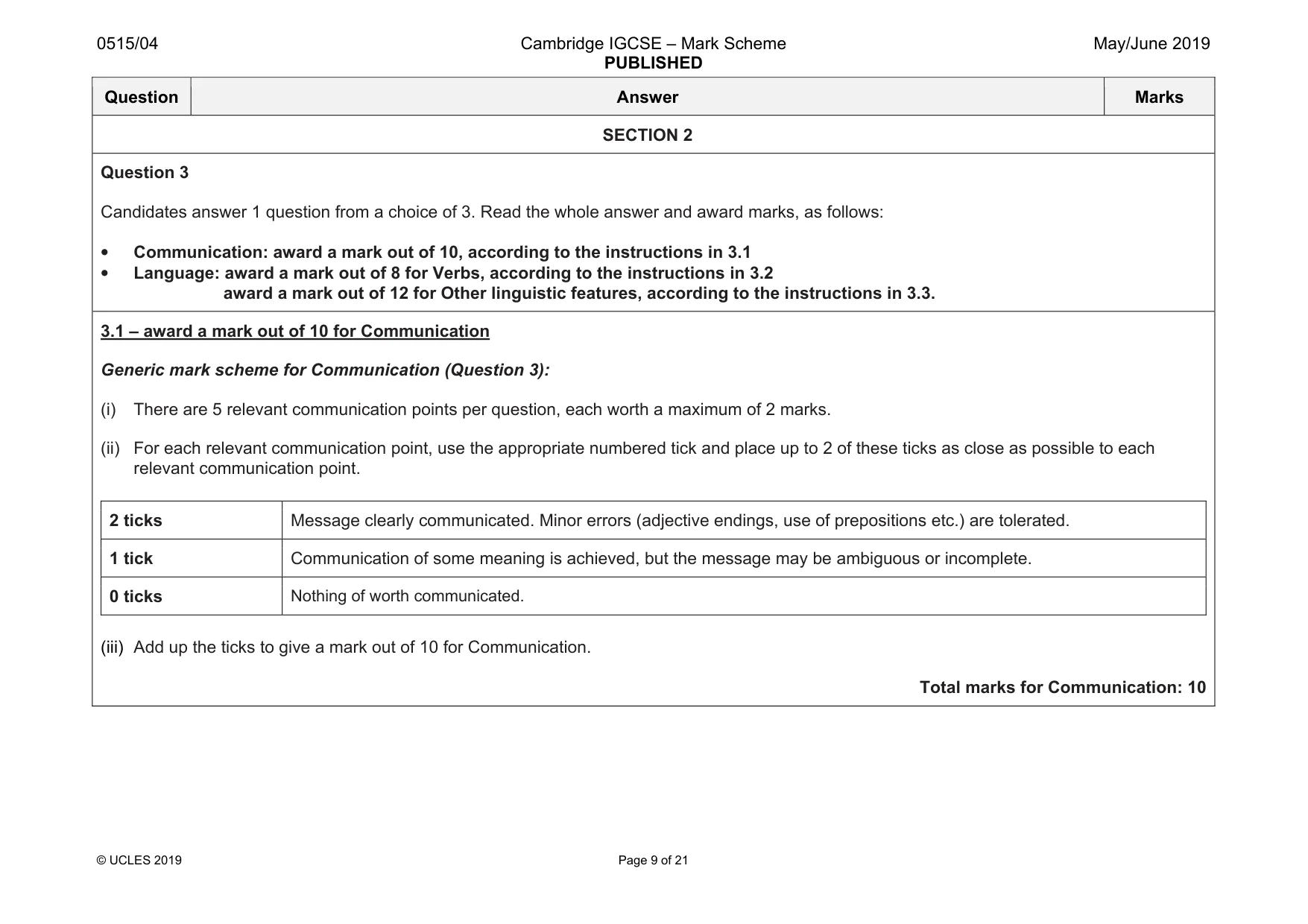
0515/04 Cambridge IGCSE – Mark Scheme PUBLISHED May/June 2019 © UCLES 2019 Page 9 of 21 Question Answer Marks SECTION 2 Question 3 Candidates answer 1 question from a choice of 3. Read the whole answer and award marks, as follows: • Communication: award a mark out of 10, according to the instructions in 3.1 • Language: award a mark out of 8 for Verbs, according to the instructions in 3.2 award a mark out of 12 for Other linguistic features, according to the instructions in 3.3. 3.1 – award a mark out of 10 for Communication Generic mark scheme for Communication (Question 3): (i) There are 5 relevant communication points per question, each worth a maximum of 2 marks. (ii) For each relevant communication point, use the appropriate numbered tick and place up to 2 of these ticks as close as possible to each relevant communication point. 2 ticks Message clearly communicated. Minor errors (adjective endings, use of prepositions etc.) are tolerated. 1 tick Communication of some meaning is achieved, but the message may be ambiguous or incomplete. 0 ticks Nothing of worth communicated. (iii) Add up the ticks to give a mark out of 10 for Communication. Total marks for Communication: 10
Mark scheme, page 10
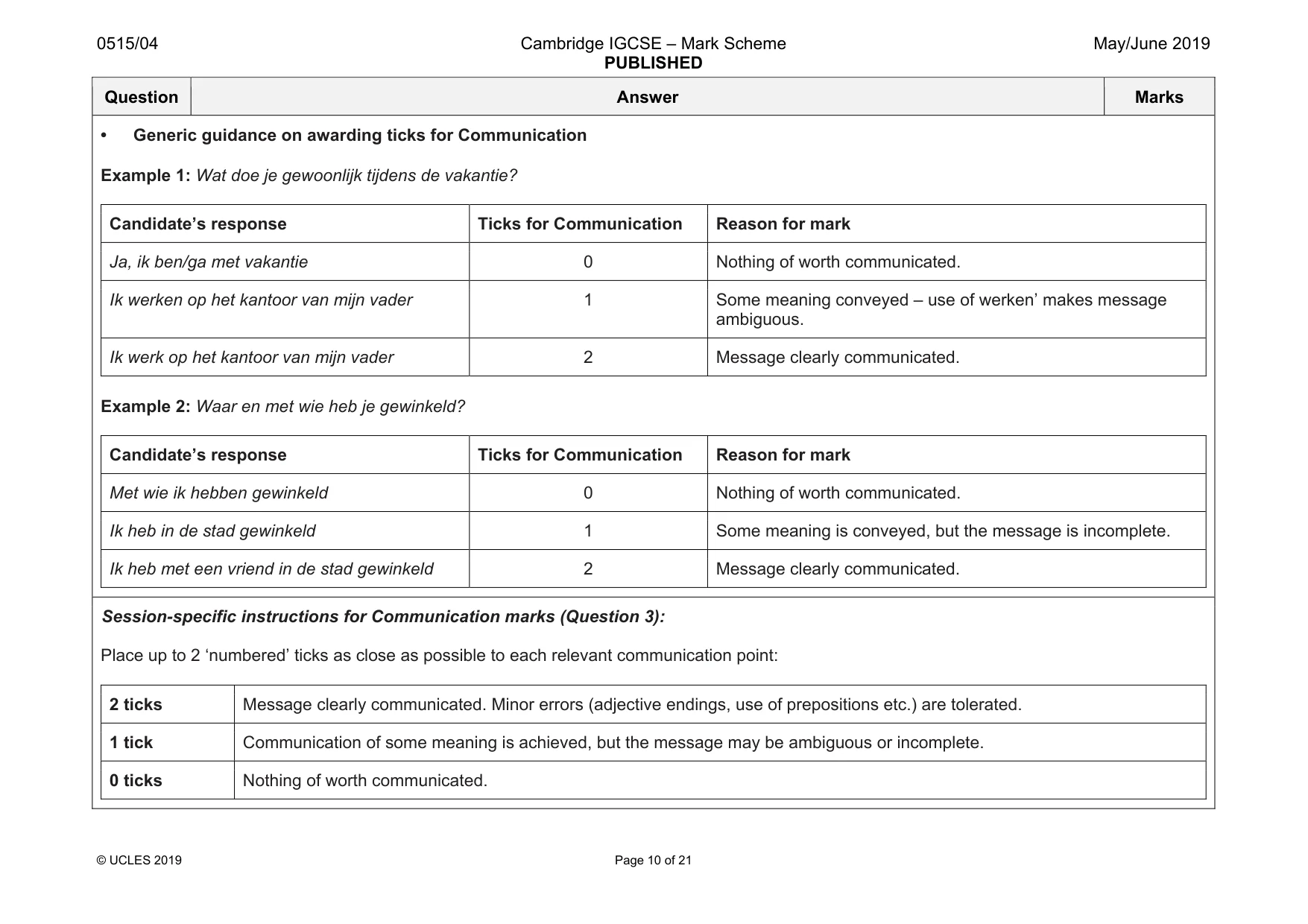
0515/04 Cambridge IGCSE – Mark Scheme PUBLISHED May/June 2019 © UCLES 2019 Page 10 of 21 Question Answer Marks • Generic guidance on awarding ticks for Communication Example 1: Wat doe je gewoonlijk tijdens de vakantie? Candidate’s response Ticks for Communication Reason for mark Ja, ik ben/ga met vakantie 0 Nothing of worth communicated. Ik werken op het kantoor van mijn vader 1 Some meaning conveyed – use of werken’ makes message ambiguous. Ik werk op het kantoor van mijn vader 2 Message clearly communicated. Example 2: Waar en met wie heb je gewinkeld? Candidate’s response Ticks for Communication Reason for mark Met wie ik hebben gewinkeld 0 Nothing of worth communicated. Ik heb in de stad gewinkeld 1 Some meaning is conveyed, but the message is incomplete. Ik heb met een vriend in de stad gewinkeld 2 Message clearly communicated. Session-specific instructions for Communication marks (Question 3): Place up to 2 ‘numbered’ ticks as close as possible to each relevant communication point: 2 ticks Message clearly communicated. Minor errors (adjective endings, use of prepositions etc.) are tolerated. 1 tick Communication of some meaning is achieved, but the message may be ambiguous or incomplete. 0 ticks Nothing of worth communicated.
Mark scheme, page 11
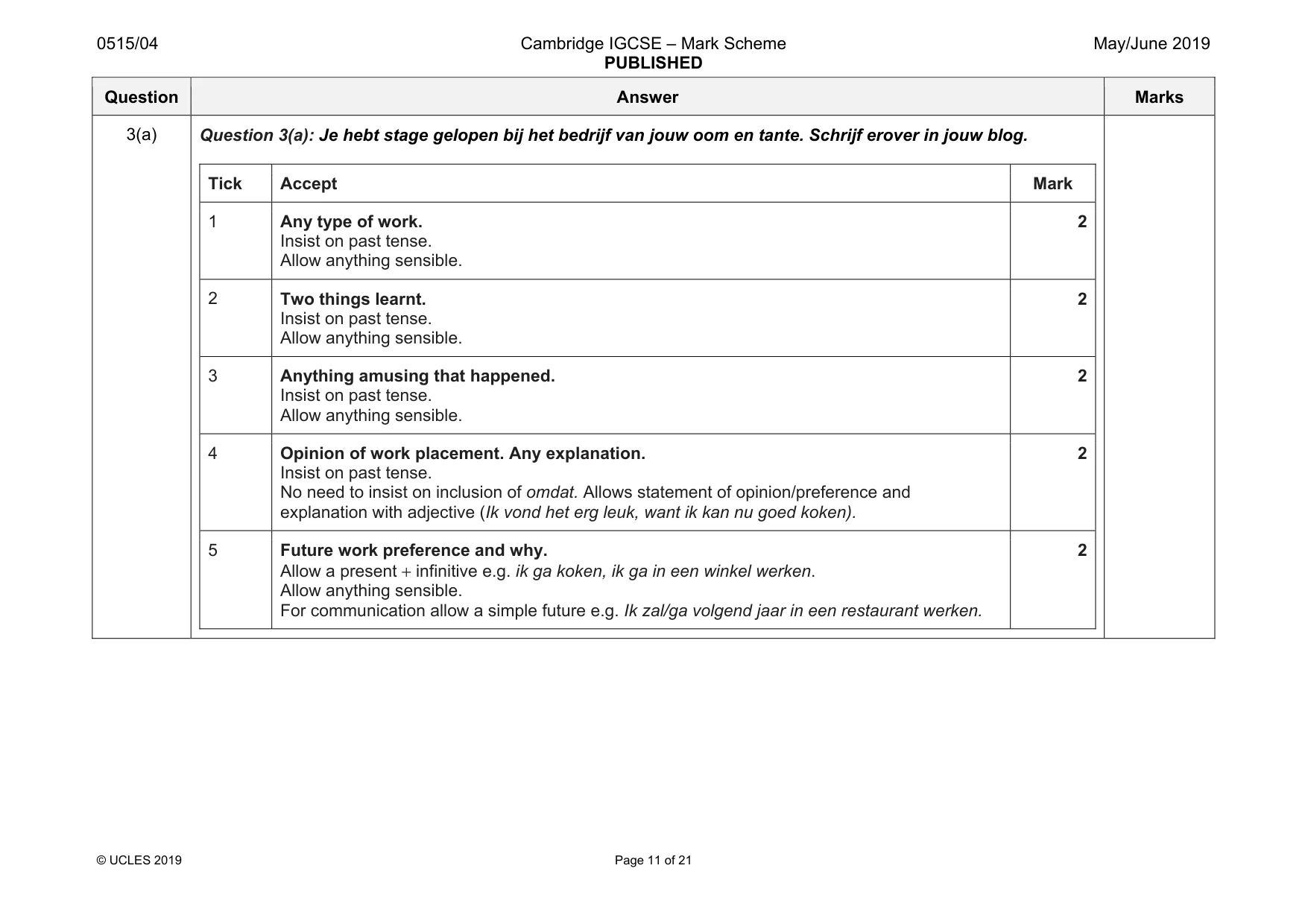
0515/04 Cambridge IGCSE – Mark Scheme PUBLISHED May/June 2019 © UCLES 2019 Page 11 of 21 Question Answer Marks 3(a) Question 3(a): Je hebt stage gelopen bij het bedrijf van jouw oom en tante. Schrijf erover in jouw blog. Tick Accept Mark 1 Any type of work. Insist on past tense. Allow anything sensible. 2 2 Two things learnt. Insist on past tense. Allow anything sensible. 2 3 Anything amusing that happened. Insist on past tense. Allow anything sensible. 2 4 Opinion of work placement. Any explanation. Insist on past tense. No need to insist on inclusion of omdat. Allows statement of opinion/preference and explanation with adjective (Ik vond het erg leuk, want ik kan nu goed koken). 2 5 Future work preference and why. Allow a present + infinitive e.g. ik ga koken, ik ga in een winkel werken. Allow anything sensible. For communication allow a simple future e.g. Ik zal/ga volgend jaar in een restaurant werken. 2
Mark scheme, page 12
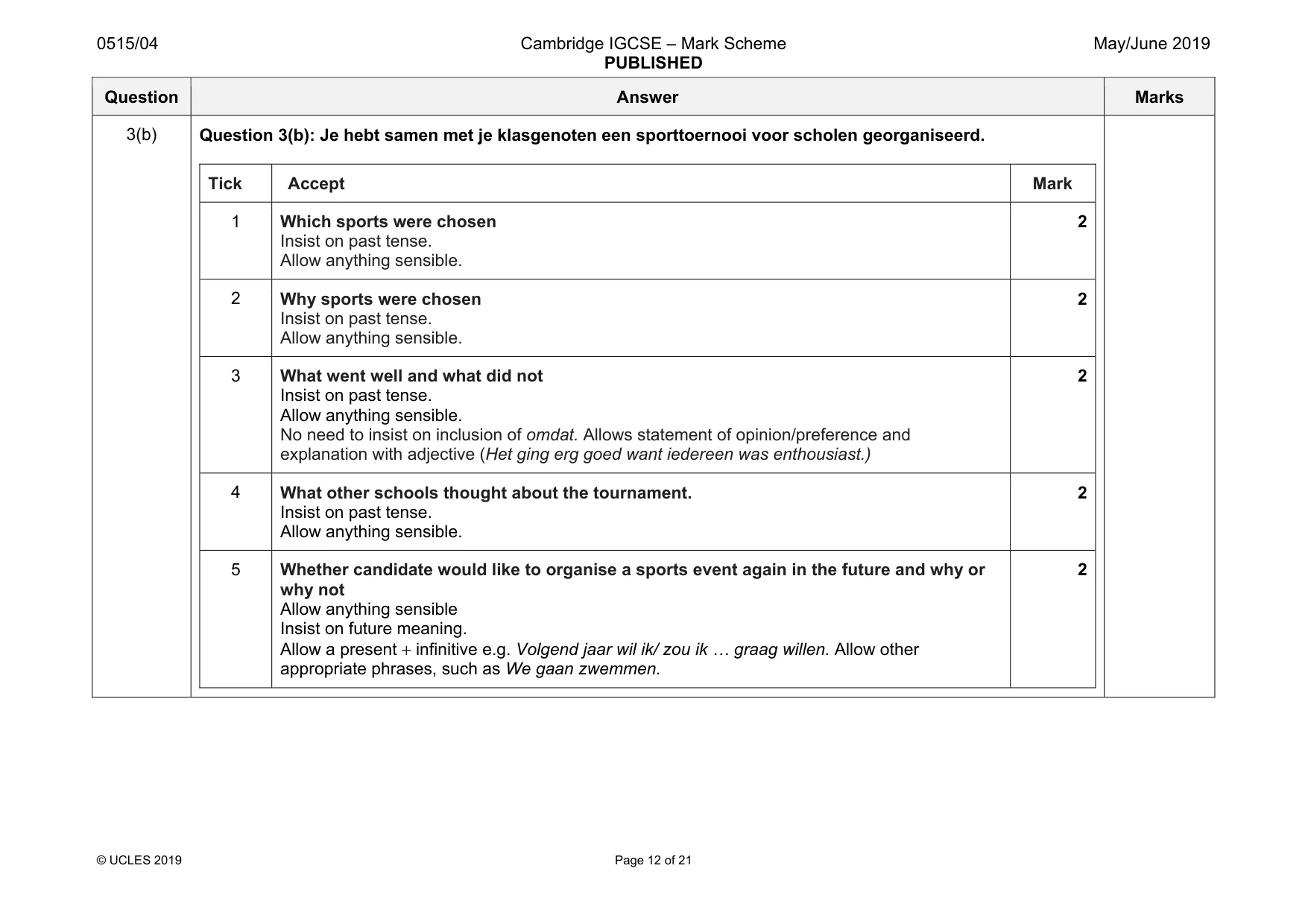
0515/04 Cambridge IGCSE – Mark Scheme PUBLISHED May/June 2019 © UCLES 2019 Page 12 of 21 Question Answer Marks 3(b) Question 3(b): Je hebt samen met je klasgenoten een sporttoernooi voor scholen georganiseerd. Tick Accept Mark 1 Which sports were chosen Insist on past tense. Allow anything sensible. 2 2 Why sports were chosen Insist on past tense. Allow anything sensible. 2 3 What went well and what did not Insist on past tense. Allow anything sensible. No need to insist on inclusion of omdat. Allows statement of opinion/preference and explanation with adjective (Het ging erg goed want iedereen was enthousiast.) 2 4 What other schools thought about the tournament. Insist on past tense. Allow anything sensible. 2 5 Whether candidate would like to organise a sports event again in the future and why or why not Allow anything sensible Insist on future meaning. Allow a present + infinitive e.g. Volgend jaar wil ik/ zou ik « graag willen. Allow other appropriate phrases, such as We gaan zwemmen. 2
Mark scheme, page 13
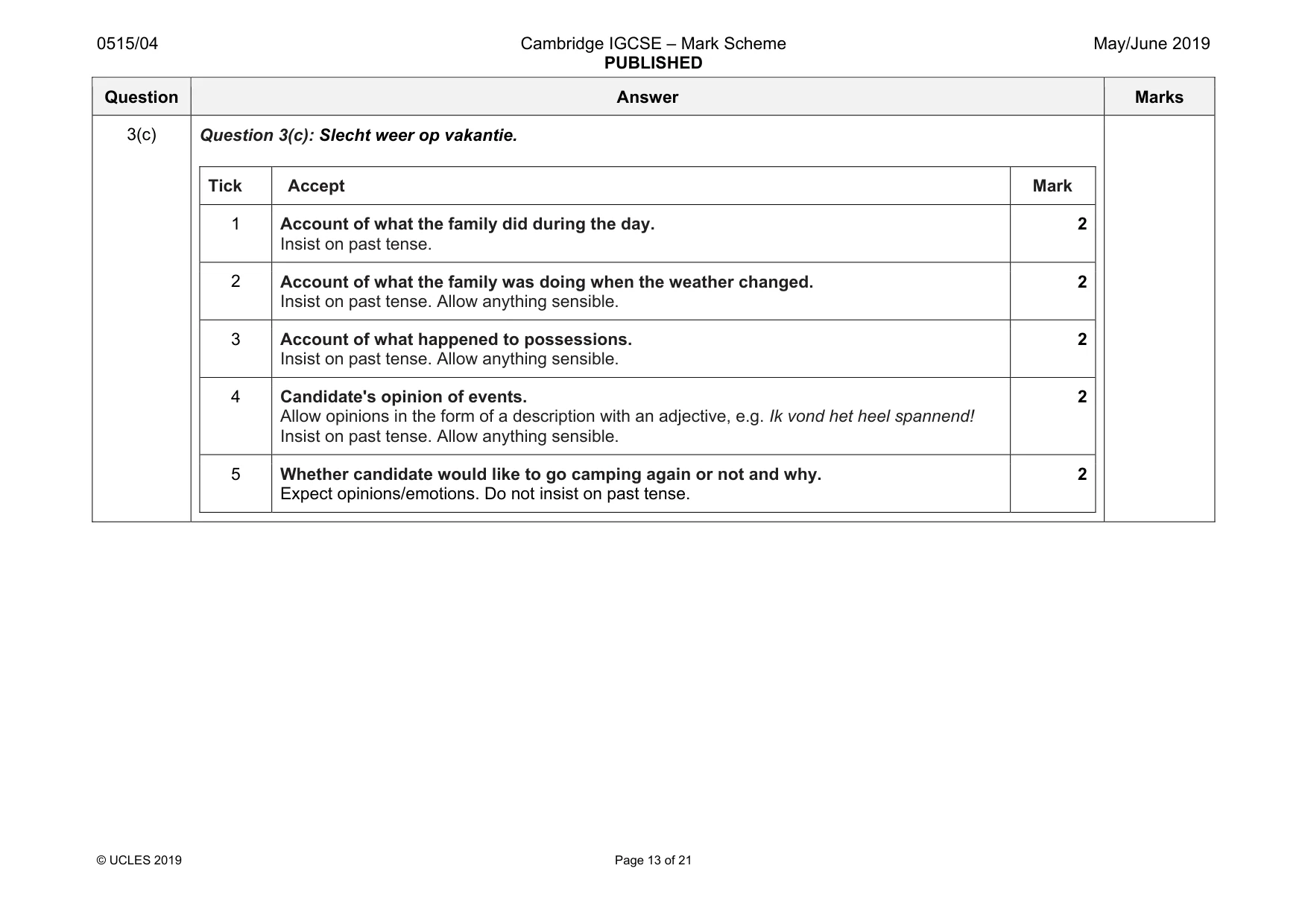
0515/04 Cambridge IGCSE – Mark Scheme PUBLISHED May/June 2019 © UCLES 2019 Page 13 of 21 Question Answer Marks 3(c) Question 3(c): Slecht weer op vakantie. Tick Accept Mark 1 Account of what the family did during the day. Insist on past tense. 2 2 Account of what the family was doing when the weather changed. Insist on past tense. Allow anything sensible. 2 3 Account of what happened to possessions. Insist on past tense. Allow anything sensible. 2 4 Candidate's opinion of events. Allow opinions in the form of a description with an adjective, e.g. Ik vond het heel spannend! Insist on past tense. Allow anything sensible. 2 5 Whether candidate would like to go camping again or not and why. Expect opinions/emotions. Do not insist on past tense. 2
Mark scheme, page 14
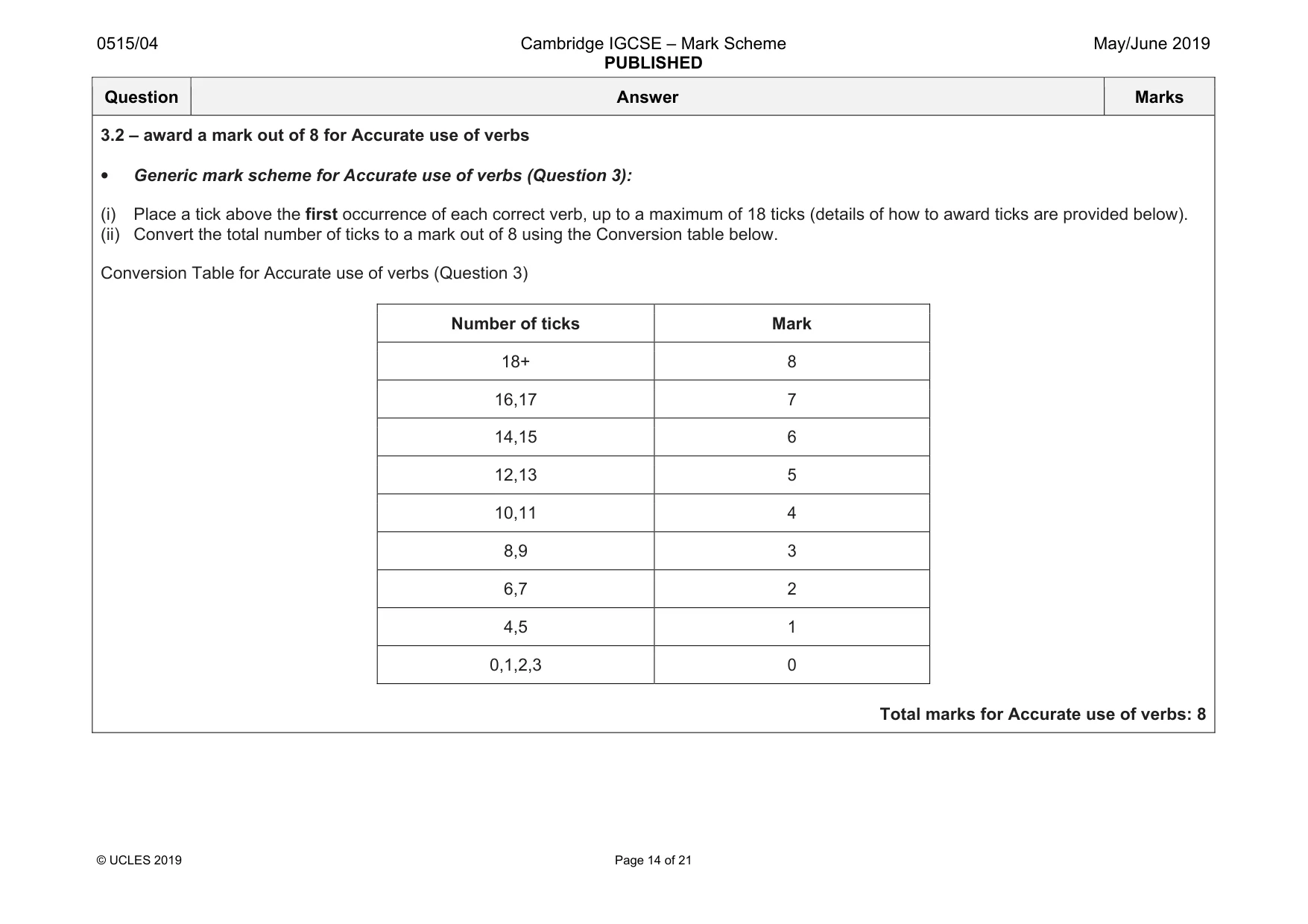
0515/04 Cambridge IGCSE – Mark Scheme PUBLISHED May/June 2019 © UCLES 2019 Page 14 of 21 Question Answer Marks 3.2 – award a mark out of 8 for Accurate use of verbs • Generic mark scheme for Accurate use of verbs (Question 3): (i) Place a tick above the first occurrence of each correct verb, up to a maximum of 18 ticks (details of how to award ticks are provided below). (ii) Convert the total number of ticks to a mark out of 8 using the Conversion table below. Conversion Table for Accurate use of verbs (Question 3) Number of ticks Mark 18+ 8 16,17 7 14,15 6 12,13 5 10,11 4 8,9 3 6,7 2 4,5 1 0,1,2,3 0 Total marks for Accurate use of verbs: 8
Mark scheme, page 15
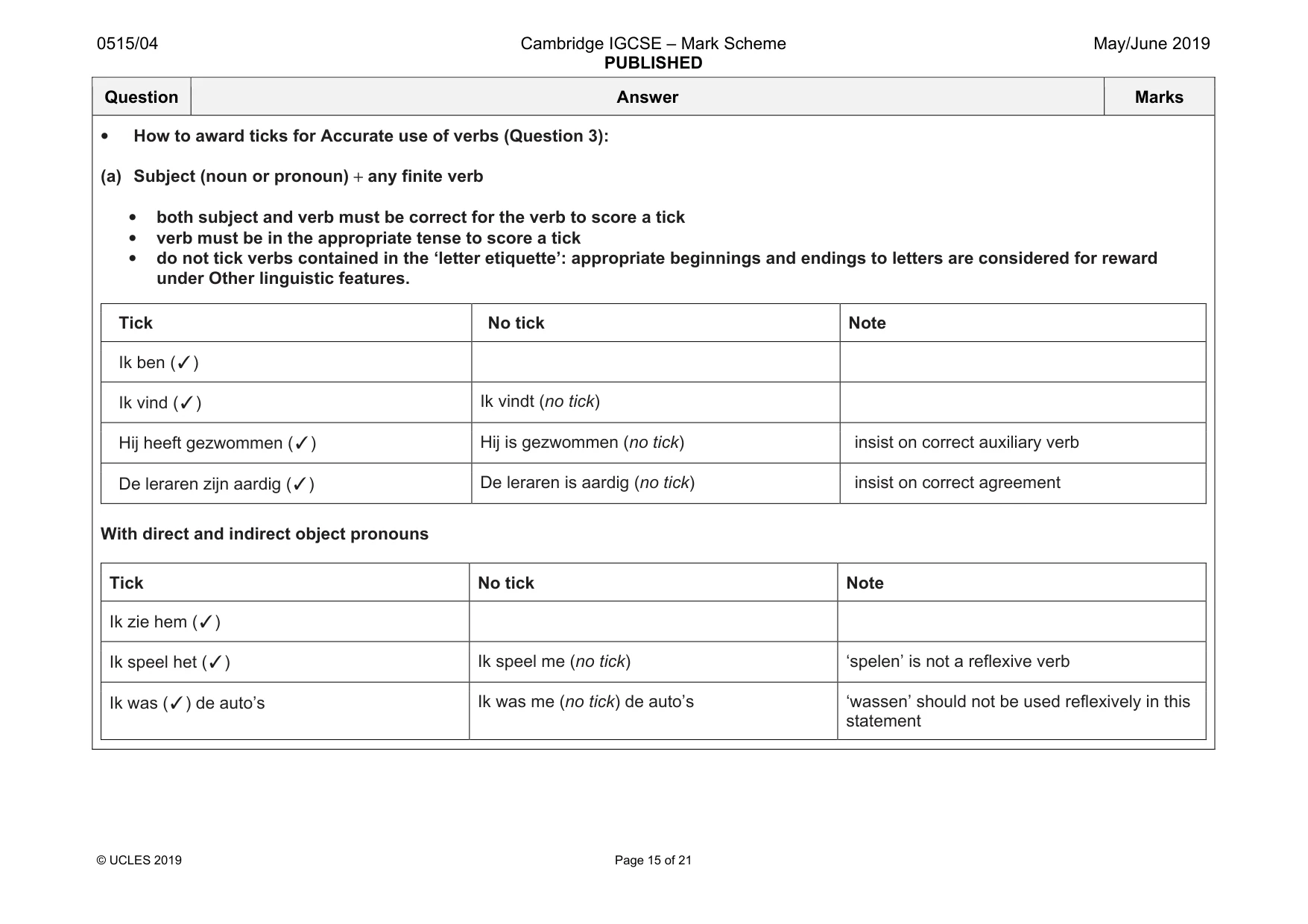
0515/04 Cambridge IGCSE – Mark Scheme PUBLISHED May/June 2019 © UCLES 2019 Page 15 of 21 Question Answer Marks • How to award ticks for Accurate use of verbs (Question 3): (a) Subject (noun or pronoun) + any finite verb • both subject and verb must be correct for the verb to score a tick • verb must be in the appropriate tense to score a tick • do not tick verbs contained in the ‘letter etiquette’: appropriate beginnings and endings to letters are considered for reward under Other linguistic features. Tick No tick Note Ik ben (✓) Ik vind (✓) Ik vindt (no tick) Hij heeft gezwommen (✓) Hij is gezwommen (no tick) insist on correct auxiliary verb De leraren zijn aardig (✓) De leraren is aardig (no tick) insist on correct agreement With direct and indirect object pronouns Tick No tick Note Ik zie hem (✓) Ik speel het (✓) Ik speel me (no tick) ‘spelen’ is not a reflexive verb Ik was (✓) de auto’s Ik was me (no tick) de auto’s ‘wassen’ should not be used reflexively in this statement
Mark scheme, page 16
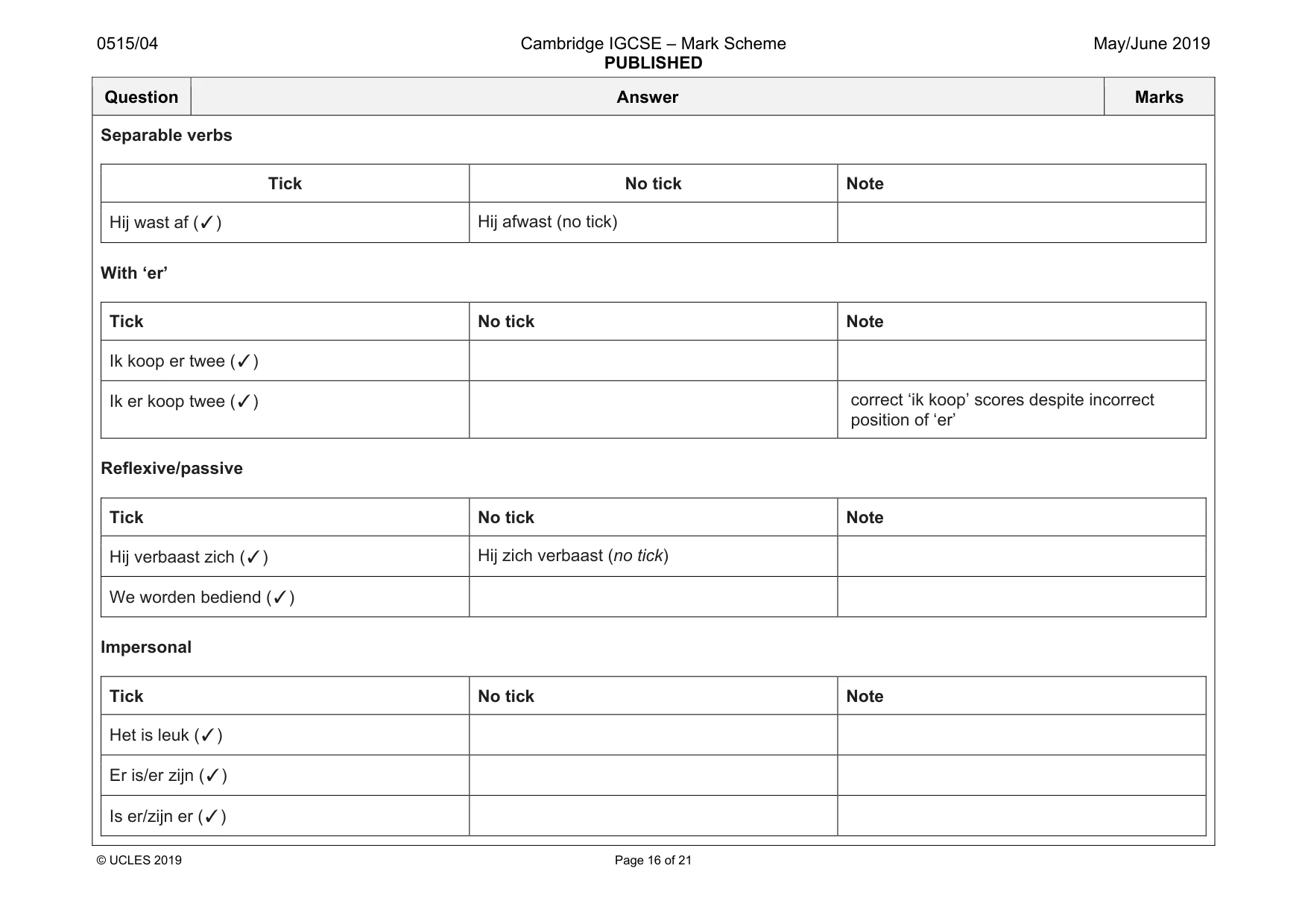
0515/04 Cambridge IGCSE – Mark Scheme PUBLISHED May/June 2019 © UCLES 2019 Page 16 of 21 Question Answer Marks Separable verbs Tick No tick Note Hij wast af (✓) Hij afwast (no tick) With ‘er’ Tick No tick Note Ik koop er twee (✓) Ik er koop twee (✓) correct ‘ik koop’ scores despite incorrect position of ‘er’ Reflexive/passive Tick No tick Note Hij verbaast zich (✓) Hij zich verbaast (no tick) We worden bediend (✓) Impersonal Tick No tick Note Het is leuk (✓) Er is/er zijn (✓) Is er/zijn er (✓)
Mark scheme, page 17
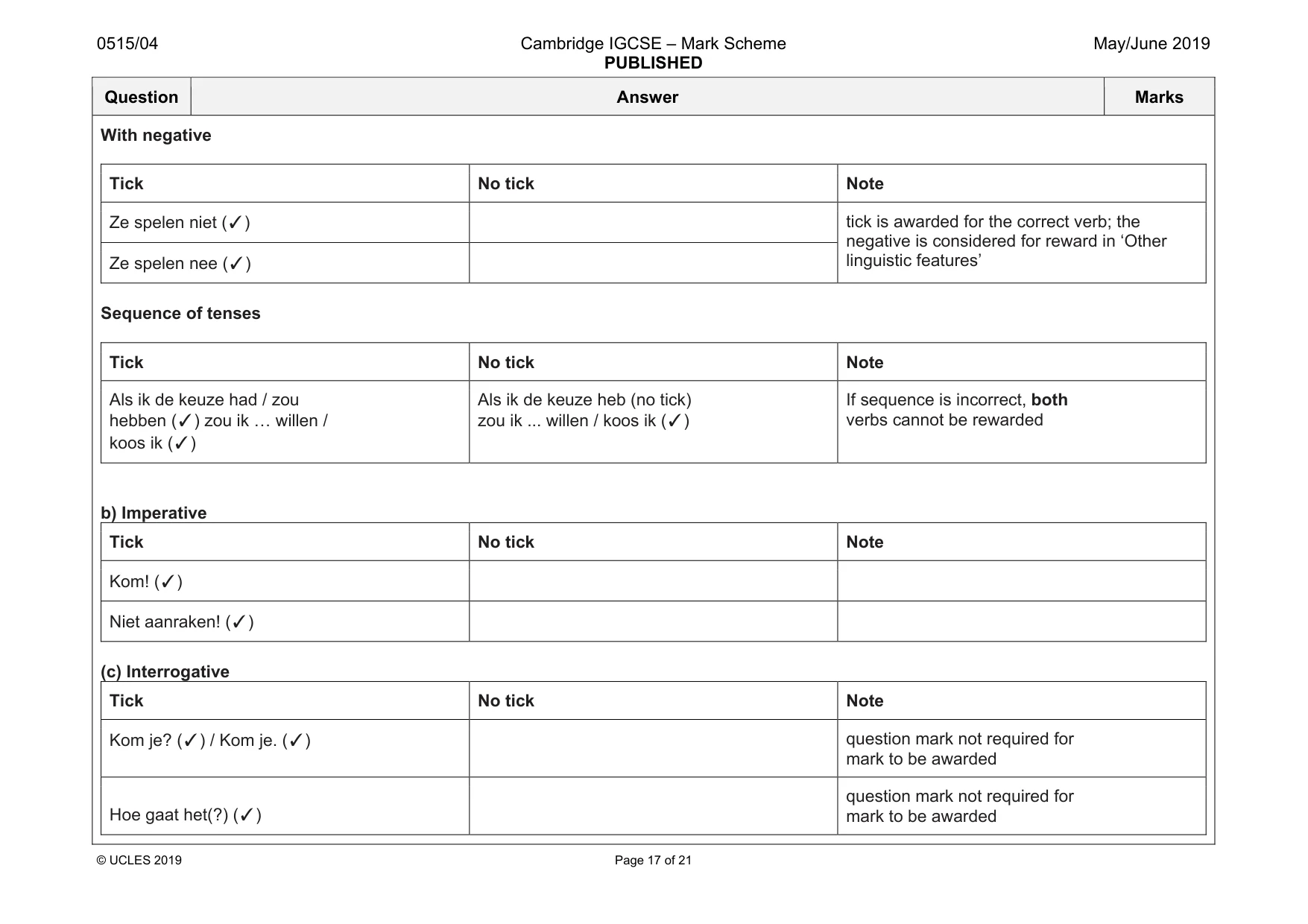
0515/04 Cambridge IGCSE – Mark Scheme PUBLISHED May/June 2019 © UCLES 2019 Page 17 of 21 Question Answer Marks With negative Tick No tick Note Ze spelen niet (✓) tick is awarded for the correct verb; the negative is considered for reward in ‘Other linguistic features’ Ze spelen nee (✓) Sequence of tenses Tick No tick Note Als ik de keuze had / zou hebben (✓) zou ik « willen / koos ik (✓) Als ik de keuze heb (no tick) zou ik ... willen / koos ik (✓) If sequence is incorrect, both verbs cannot be rewarded b) Imperative Tick No tick Note Kom! (✓) Niet aanraken! (✓) (c) Interrogative Tick No tick Note Kom je? (✓) / Kom je. (✓) question mark not required for mark to be awarded Hoe gaat het(?) (✓) question mark not required for mark to be awarded
Mark scheme, page 18
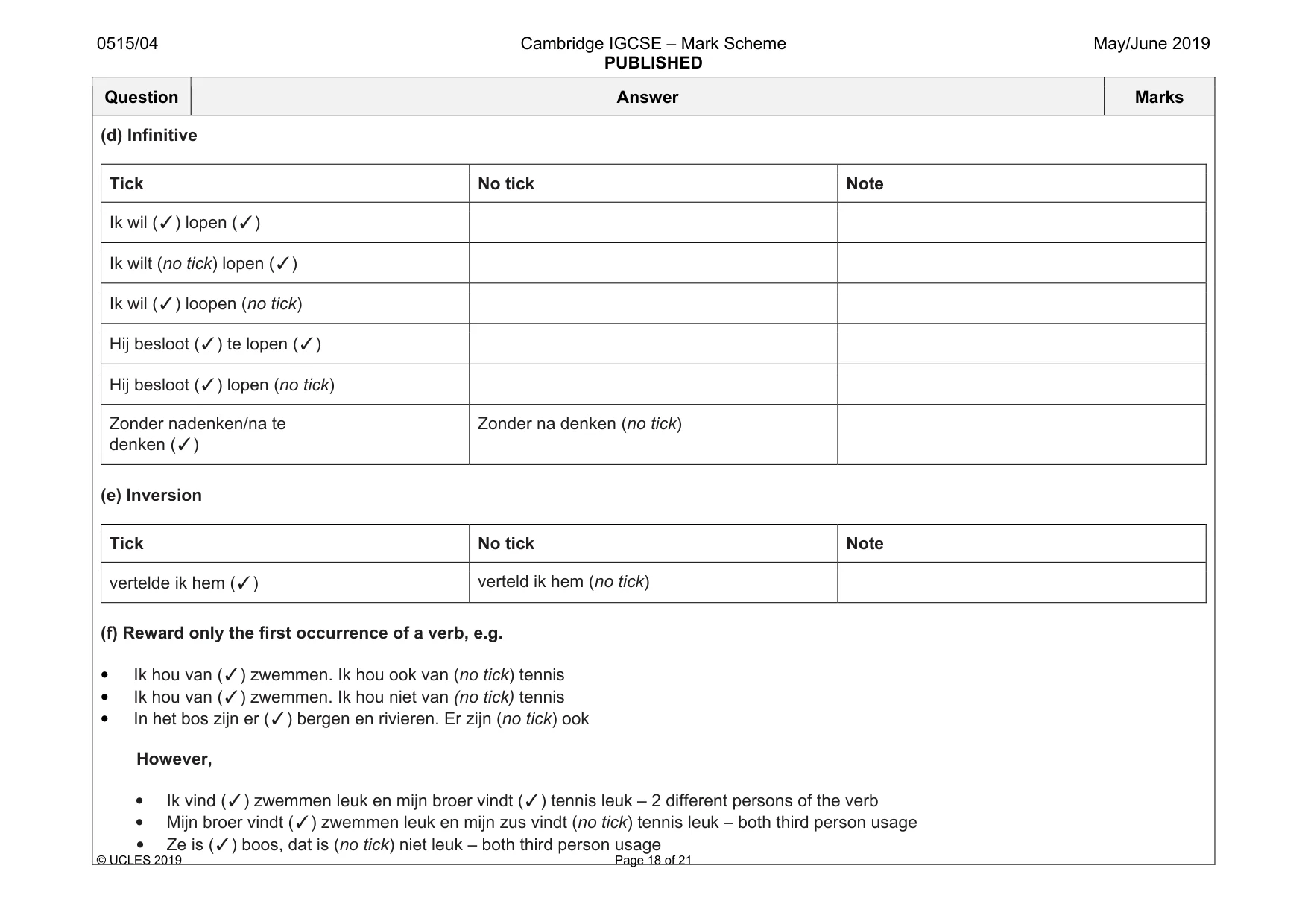
0515/04 Cambridge IGCSE – Mark Scheme PUBLISHED May/June 2019 © UCLES 2019 Page 18 of 21 Question Answer Marks (d) Infinitive Tick No tick Note Ik wil (✓) lopen (✓) Ik wilt (no tick) lopen (✓) Ik wil (✓) loopen (no tick) Hij besloot (✓) te lopen (✓) Hij besloot (✓) lopen (no tick) Zonder nadenken/na te denken (✓) Zonder na denken (no tick) (e) Inversion Tick No tick Note vertelde ik hem (✓) verteld ik hem (no tick) (f) Reward only the first occurrence of a verb, e.g. • Ik hou van (✓) zwemmen. Ik hou ook van (no tick) tennis • Ik hou van (✓) zwemmen. Ik hou niet van (no tick) tennis • In het bos zijn er (✓) bergen en rivieren. Er zijn (no tick) ook However, • Ik vind (✓) zwemmen leuk en mijn broer vindt (✓) tennis leuk – 2 different persons of the verb • Mijn broer vindt (✓) zwemmen leuk en mijn zus vindt (no tick) tennis leuk – both third person usage • Ze is (✓) boos, dat is (no tick) niet leuk – both third person usage
Mark scheme, page 19
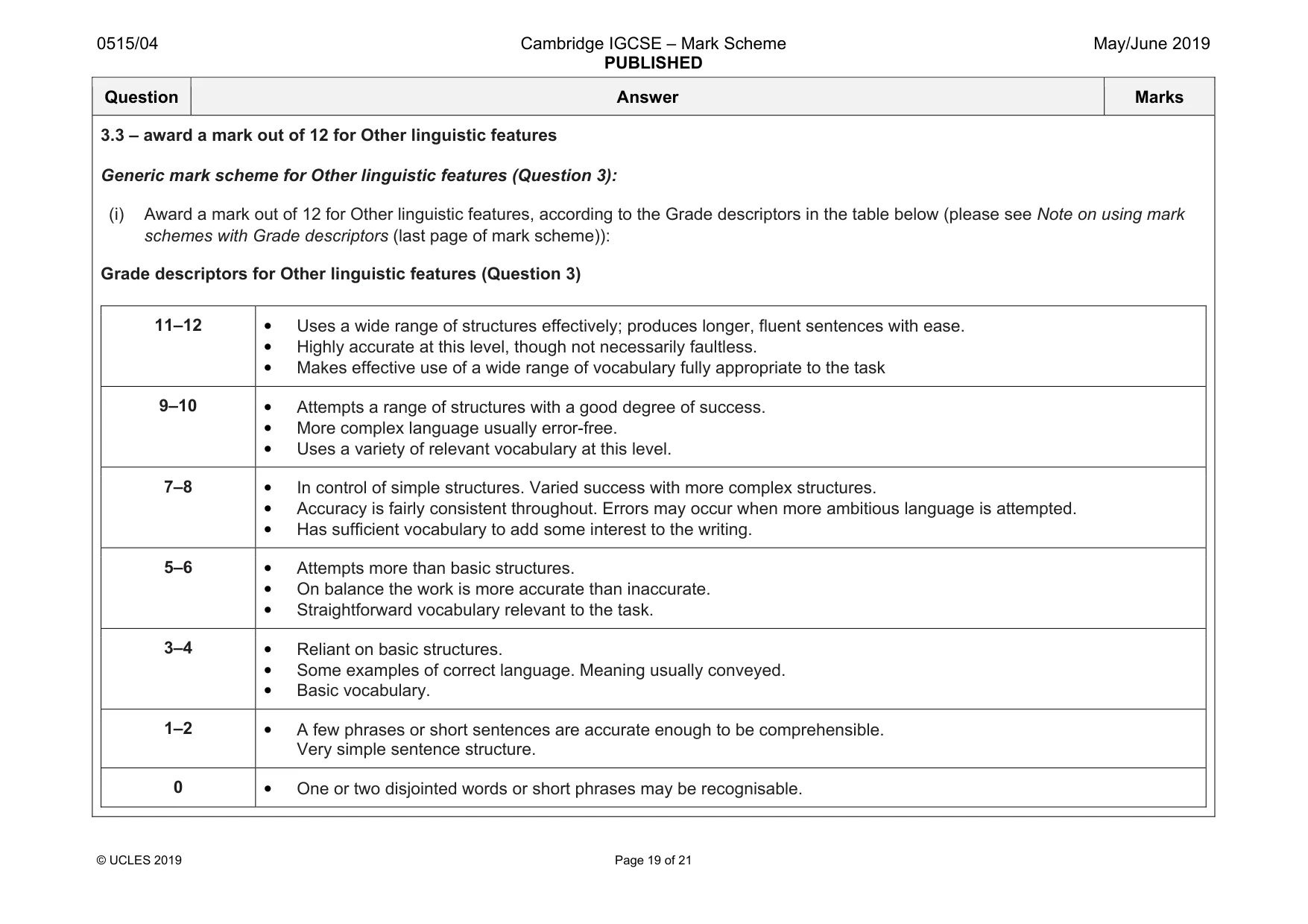
0515/04 Cambridge IGCSE – Mark Scheme PUBLISHED May/June 2019 © UCLES 2019 Page 19 of 21 Question Answer Marks 3.3 – award a mark out of 12 for Other linguistic features Generic mark scheme for Other linguistic features (Question 3): (i) Award a mark out of 12 for Other linguistic features, according to the Grade descriptors in the table below (please see Note on using mark schemes with Grade descriptors (last page of mark scheme)): Grade descriptors for Other linguistic features (Question 3) 11–12 • Uses a wide range of structures effectively; produces longer, fluent sentences with ease. • Highly accurate at this level, though not necessarily faultless. • Makes effective use of a wide range of vocabulary fully appropriate to the task 9–10 • Attempts a range of structures with a good degree of success. • More complex language usually error-free. • Uses a variety of relevant vocabulary at this level. 7–8 • In control of simple structures. Varied success with more complex structures. • Accuracy is fairly consistent throughout. Errors may occur when more ambitious language is attempted. • Has sufficient vocabulary to add some interest to the writing. 5–6 • Attempts more than basic structures. • On balance the work is more accurate than inaccurate. • Straightforward vocabulary relevant to the task. 3–4 • Reliant on basic structures. • Some examples of correct language. Meaning usually conveyed. • Basic vocabulary. 1–2 • A few phrases or short sentences are accurate enough to be comprehensible. Very simple sentence structure. 0 • One or two disjointed words or short phrases may be recognisable.
Mark scheme, page 20
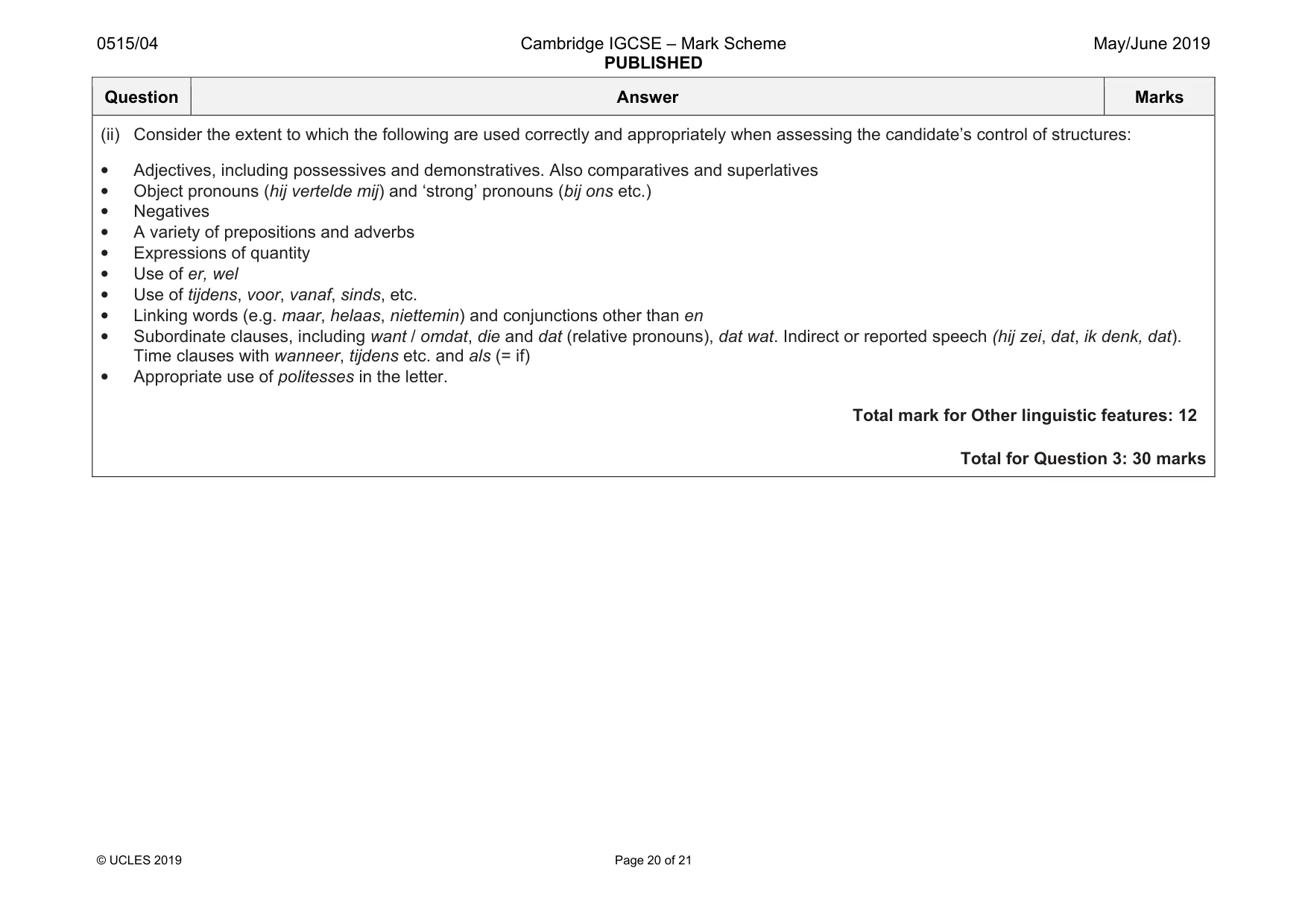
0515/04 Cambridge IGCSE – Mark Scheme PUBLISHED May/June 2019 © UCLES 2019 Page 20 of 21 Question Answer Marks (ii) Consider the extent to which the following are used correctly and appropriately when assessing the candidate’s control of structures: • Adjectives, including possessives and demonstratives. Also comparatives and superlatives • Object pronouns (hij vertelde mij) and ‘strong’ pronouns (bij ons etc.) • Negatives • A variety of prepositions and adverbs • Expressions of quantity • Use of er, wel • Use of tijdens, voor, vanaf, sinds, etc. • Linking words (e.g. maar, helaas, niettemin) and conjunctions other than en • Subordinate clauses, including want / omdat, die and dat (relative pronouns), dat wat. Indirect or reported speech (hij zei, dat, ik denk, dat). Time clauses with wanneer, tijdens etc. and als (= if) • Appropriate use of politesses in the letter. Total mark for Other linguistic features: 12 Total for Question 3: 30 marks
Mark scheme, page 21
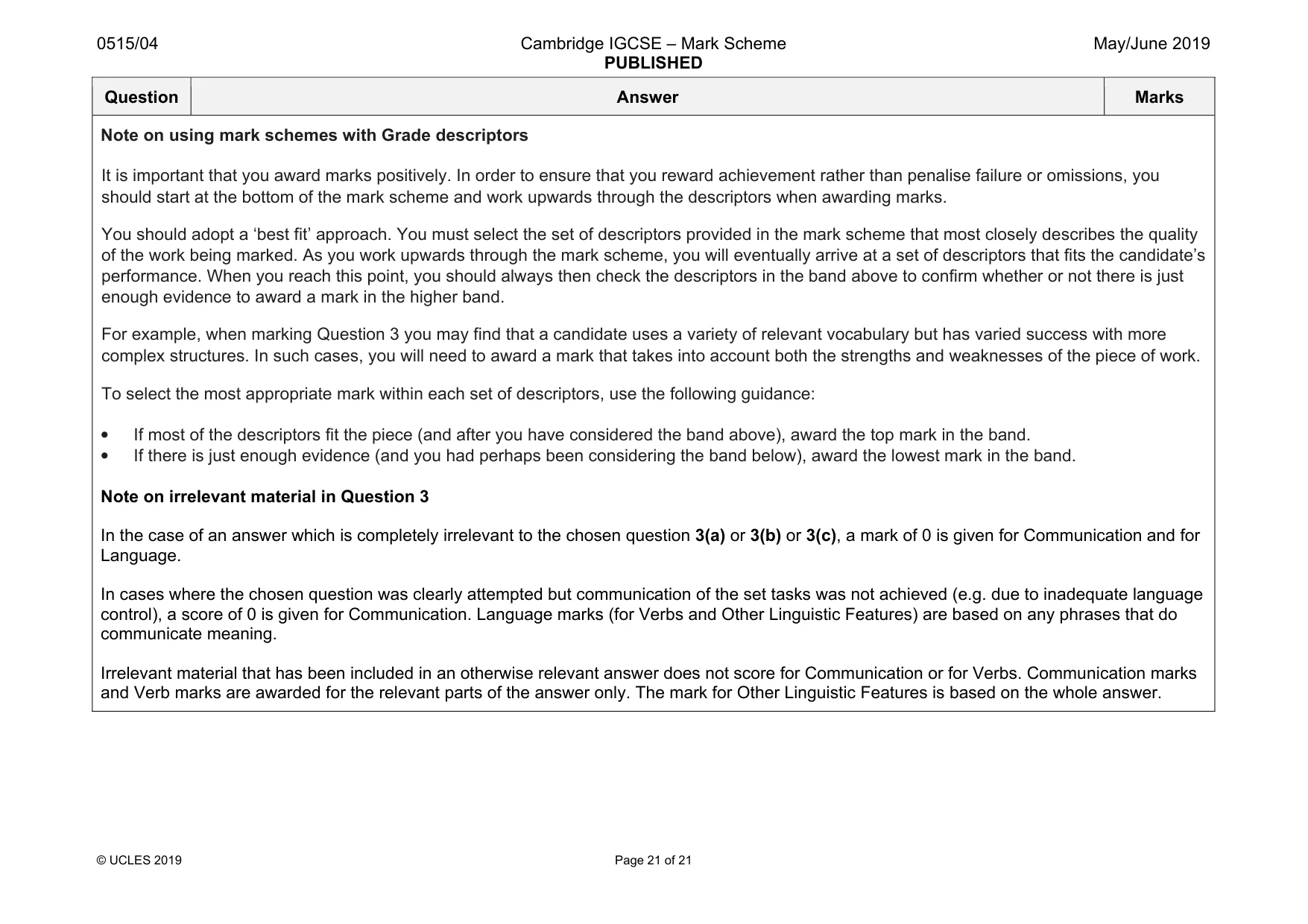
0515/04 Cambridge IGCSE – Mark Scheme PUBLISHED May/June 2019 © UCLES 2019 Page 21 of 21 Question Answer Marks Note on using mark schemes with Grade descriptors It is important that you award marks positively. In order to ensure that you reward achievement rather than penalise failure or omissions, you should start at the bottom of the mark scheme and work upwards through the descriptors when awarding marks. You should adopt a ‘best fit’ approach. You must select the set of descriptors provided in the mark scheme that most closely describes the quality of the work being marked. As you work upwards through the mark scheme, you will eventually arrive at a set of descriptors that fits the candidate’s performance. When you reach this point, you should always then check the descriptors in the band above to confirm whether or not there is just enough evidence to award a mark in the higher band. For example, when marking Question 3 you may find that a candidate uses a variety of relevant vocabulary but has varied success with more complex structures. In such cases, you will need to award a mark that takes into account both the strengths and weaknesses of the piece of work. To select the most appropriate mark within each set of descriptors, use the following guidance: • If most of the descriptors fit the piece (and after you have considered the band above), award the top mark in the band. • If there is just enough evidence (and you had perhaps been considering the band below), award the lowest mark in the band. Note on irrelevant material in Question 3 In the case of an answer which is completely irrelevant to the chosen question 3(a) or 3(b) or 3(c), a mark of 0 is given for Communication and for Language. In cases where the chosen question was clearly attempted but communication of the set tasks was not achieved (e.g. due to inadequate language control), a score of 0 is given for Communication. Language marks (for Verbs and Other Linguistic Features) are based on any phrases that do communicate meaning. Irrelevant material that has been included in an otherwise relevant answer does not score for Communication or for Verbs. Communication marks and Verb marks are awarded for the relevant parts of the answer only. The mark for Other Linguistic Features is based on the whole answer.
What you needed in this session
Cambridge’s own grade thresholds for 2019 May/June, Paper 4 · Variant 1. A higher threshold means an easier paper — the bar moves with how the cohort did.