Cambridge IGCSE Drama (9-1) 0994 — 2024 May/June Paper 1 · Variant 2
0994/12/M/J/24 · 80 marks · ≈90 min
The question paper and its mark scheme, free to read here and free to download. This is Cambridge’s own paper, exactly as it was sat.
Question paper12 pages



Mark scheme12 pages
Answers below. Sit the paper first if you are practising.
Paper as text
Question paper, page 1
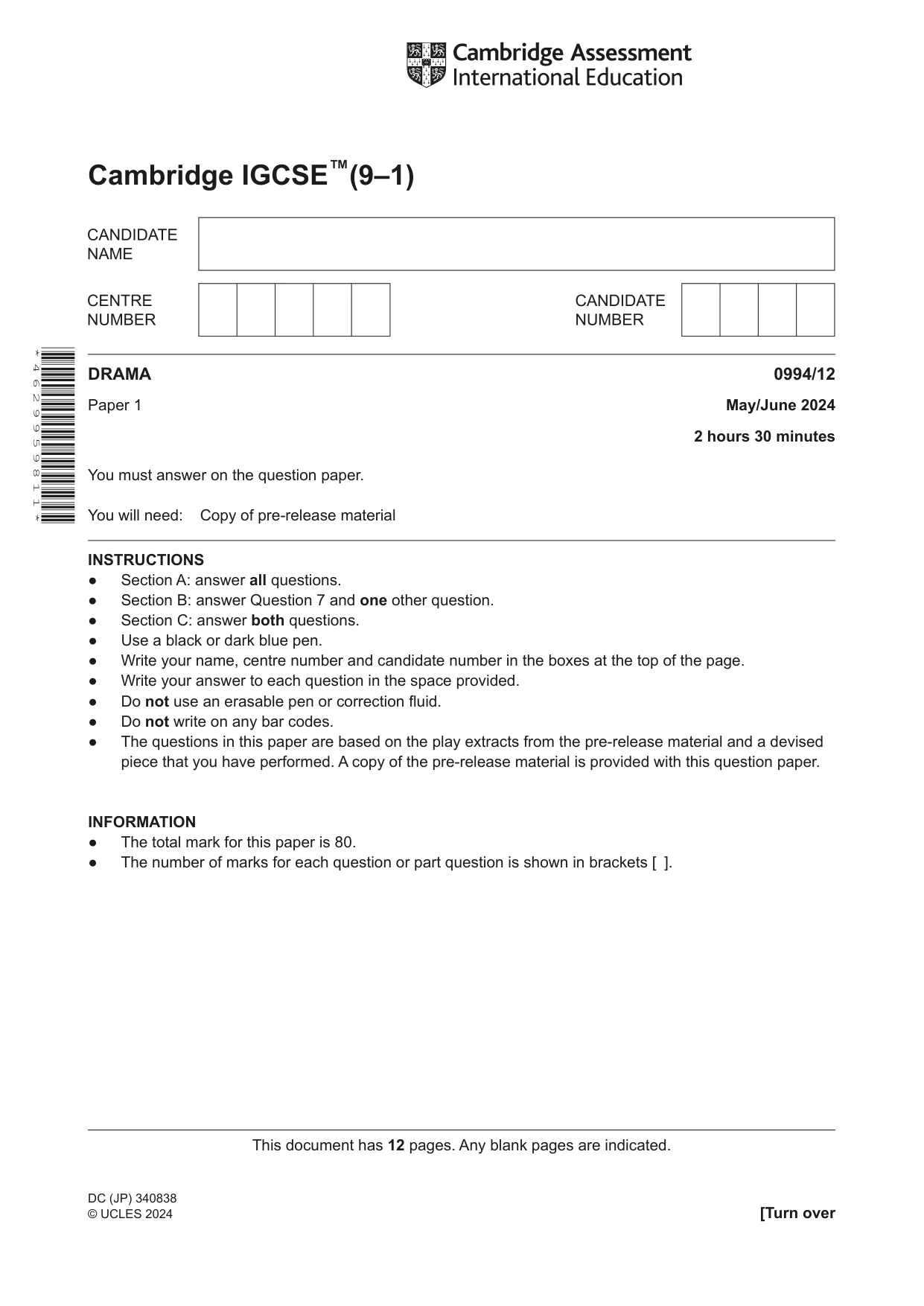
This document has 12 pages. Any blank pages are indicated. [Turn over Cambridge IGCSE™(9–1) * 4 6 2 9 9 5 9 8 1 1 * DC (JP) 340838 © UCLES 2024 DRAMA 0994/12 Paper 1 May/June 2024 2 hours 30 minutes You must answer on the question paper. You will need: Copy of pre-release material INSTRUCTIONS ● Section A: answer all questions. ● Section B: answer Question 7 and one other question. ● Section C: answer both questions. ● Use a black or dark blue pen. ● Write your name, centre number and candidate number in the boxes at the top of the page. ● Write your answer to each question in the space provided. ● Do not use an erasable pen or correction fluid. ● Do not write on any bar codes. ● The questions in this paper are based on the play extracts from the pre-release material and a devised piece that you have performed. A copy of the pre-release material is provided with this question paper. INFORMATION ● The total mark for this paper is 80. ● The number of marks for each question or part question is shown in brackets [ ].
Question paper, page 2
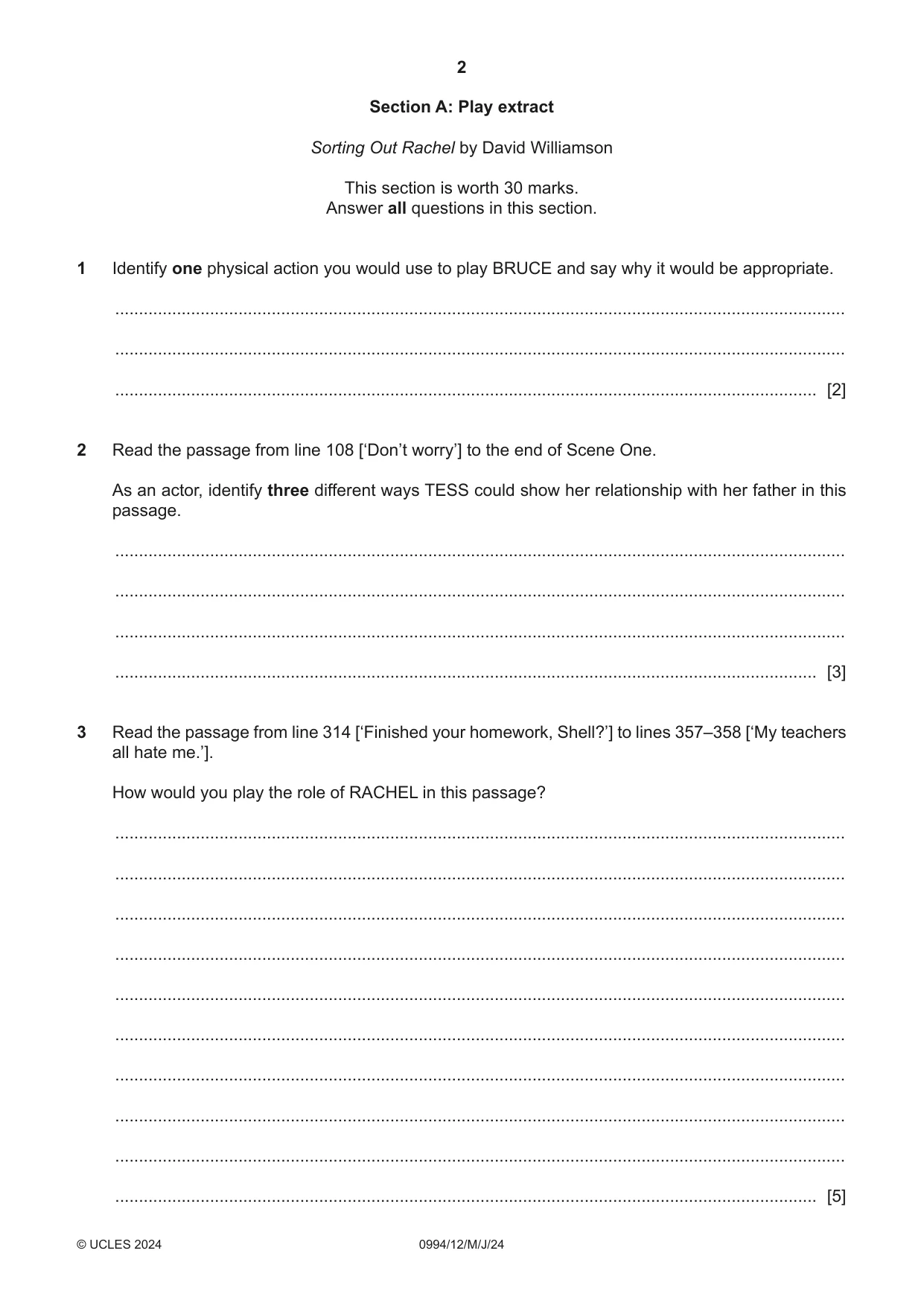
2 0994/12/M/J/24 © UCLES 2024 Section A: Play extract Sorting Out Rachel by David Williamson This section is worth 30 marks. Answer all questions in this section. 1 Identify one physical action you would use to play BRUCE and say why it would be appropriate. … … … [2] 2 Read the passage from line 108 [‘Don’t worry’] to the end of Scene One. As an actor, identify three different ways TESS could show her relationship with her father in this passage. … … … … [3] 3 Read the passage from line 314 [‘Finished your homework, Shell?’] to lines 357–358 [‘My teachers all hate me.’]. How would you play the role of RACHEL in this passage? … … … … … … … … … … [5]
Question paper, page 3
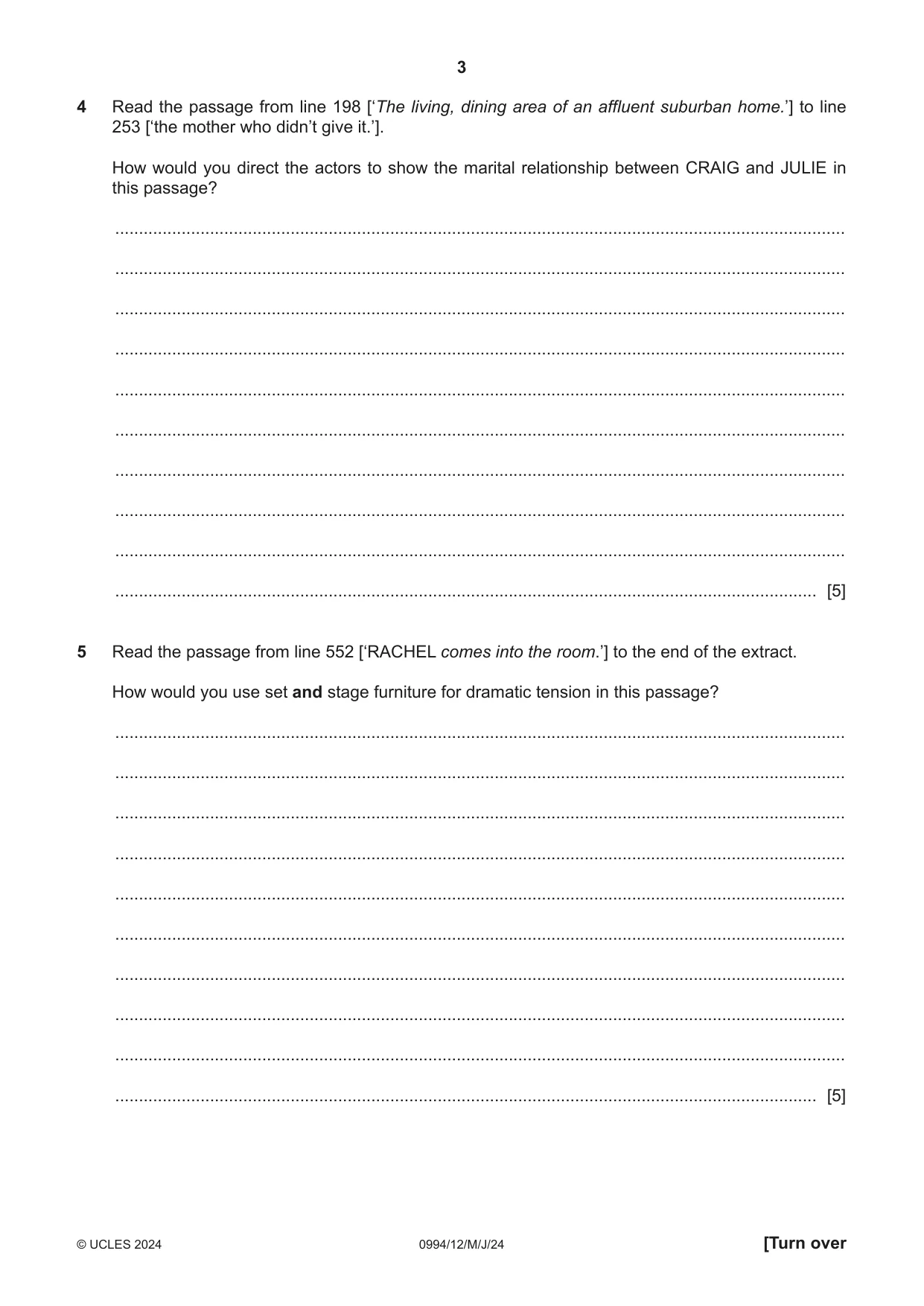
3 0994/12/M/J/24 © UCLES 2024 [Turn over 4 Read the passage from line 198 [‘The living, dining area of an affluent suburban home.’] to line 253 [‘the mother who didn’t give it.’]. How would you direct the actors to show the marital relationship between CRAIG and JULIE in this passage? … … … … … … … … … … [5] 5 Read the passage from line 552 [‘RACHEL comes into the room.’] to the end of the extract. How would you use set and stage furniture for dramatic tension in this passage? … … … … … … … … … … [5]
Question paper, page 4
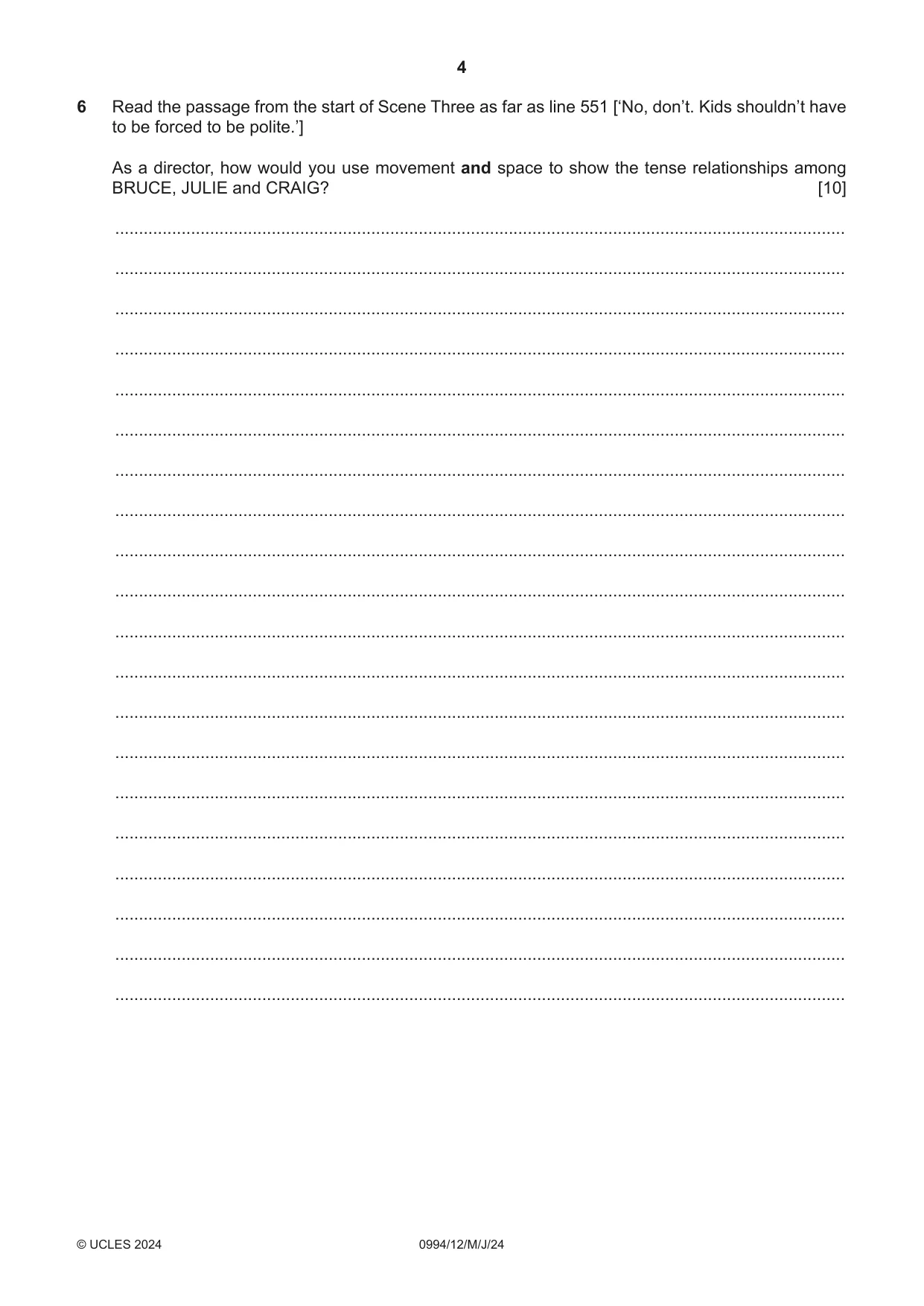
4 0994/12/M/J/24 © UCLES 2024 6 Read the passage from the start of Scene Three as far as line 551 [‘No, don’t. Kids shouldn’t have to be forced to be polite.’] As a director, how would you use movement and space to show the tense relationships among BRUCE, JULIE and CRAIG? [10] … … … … … … … … … … … … … … … … … … … …
Question paper, page 5
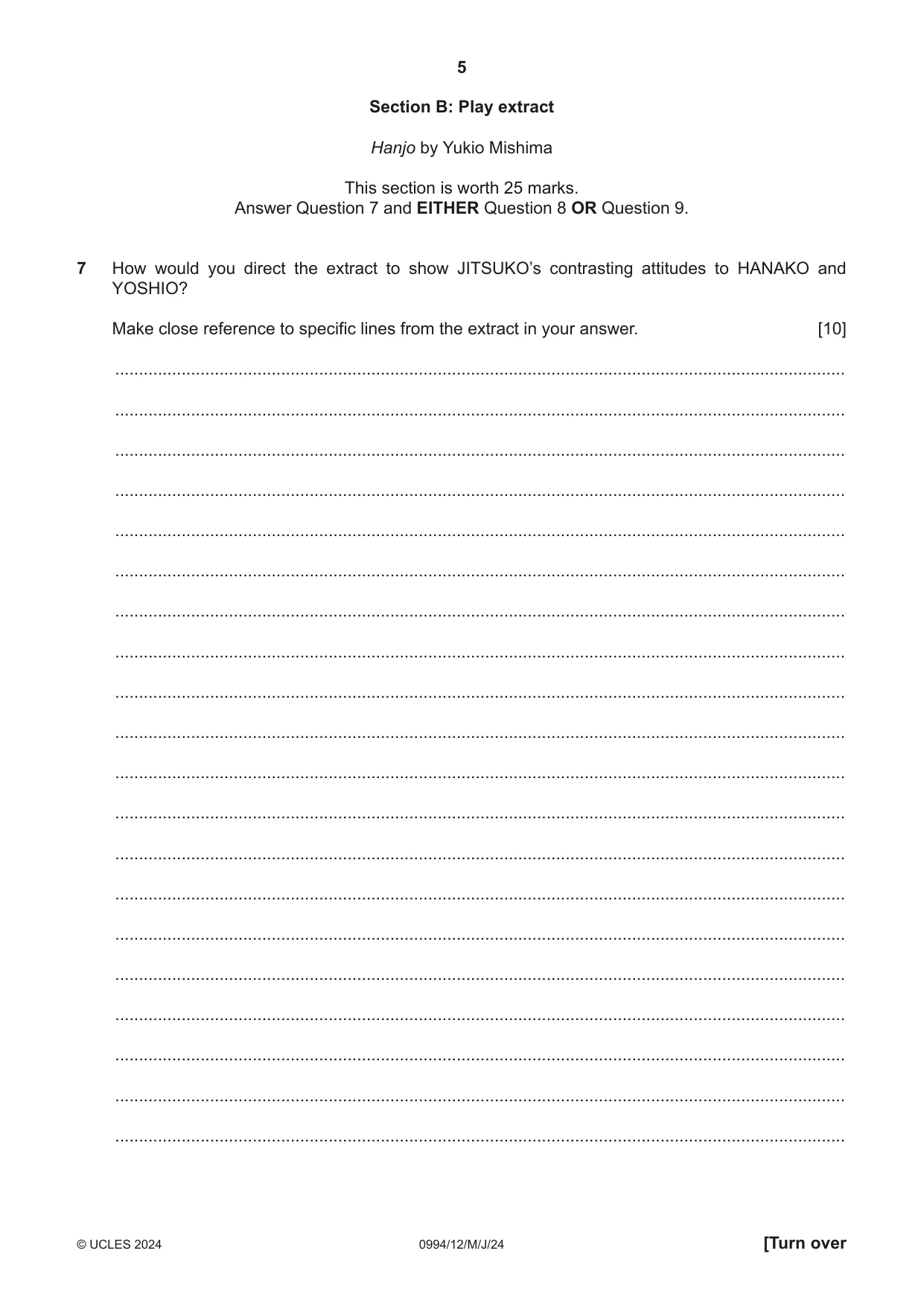
5 0994/12/M/J/24 © UCLES 2024 [Turn over Section B: Play extract Hanjo by Yukio Mishima This section is worth 25 marks. Answer Question 7 and EITHER Question 8 OR Question 9. 7 How would you direct the extract to show JITSUKO’s contrasting attitudes to HANAKO and YOSHIO? Make close reference to specific lines from the extract in your answer. [10] … … … … … … … … … … … … … … … … … … … …
Question paper, page 6
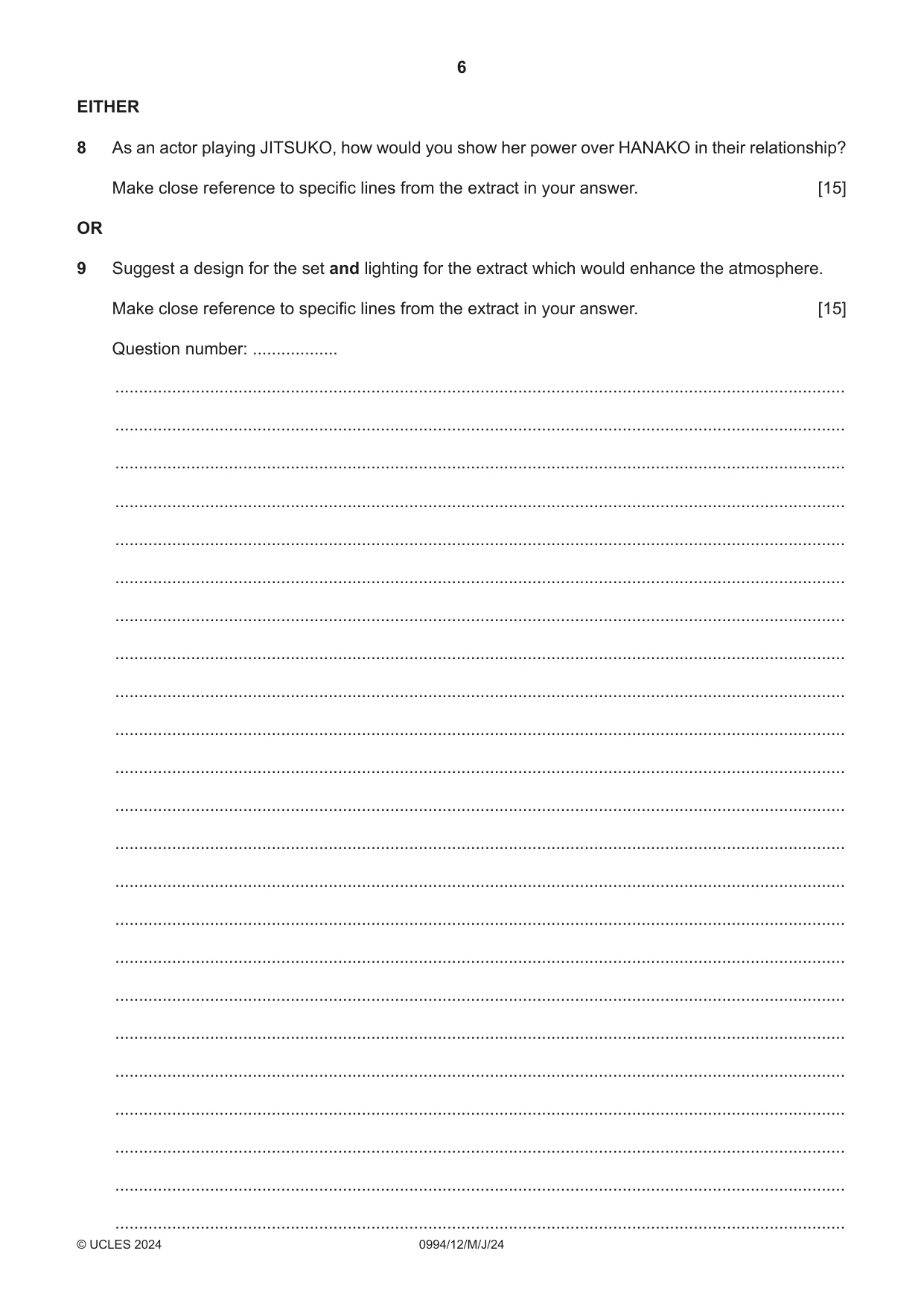
6 0994/12/M/J/24 © UCLES 2024 EITHER 8 As an actor playing JITSUKO, how would you show her power over HANAKO in their relationship? Make close reference to specific lines from the extract in your answer. [15] OR 9 Suggest a design for the set and lighting for the extract which would enhance the atmosphere. Make close reference to specific lines from the extract in your answer. [15] Question number: … … … … … … … … … … … … … … … … … … … … … … … …
Question paper, page 7
7 0994/12/M/J/24 © UCLES 2024 [Turn over … … … … … … … … … … … … … … … … … … … … … … … … … … … …
Question paper, page 8
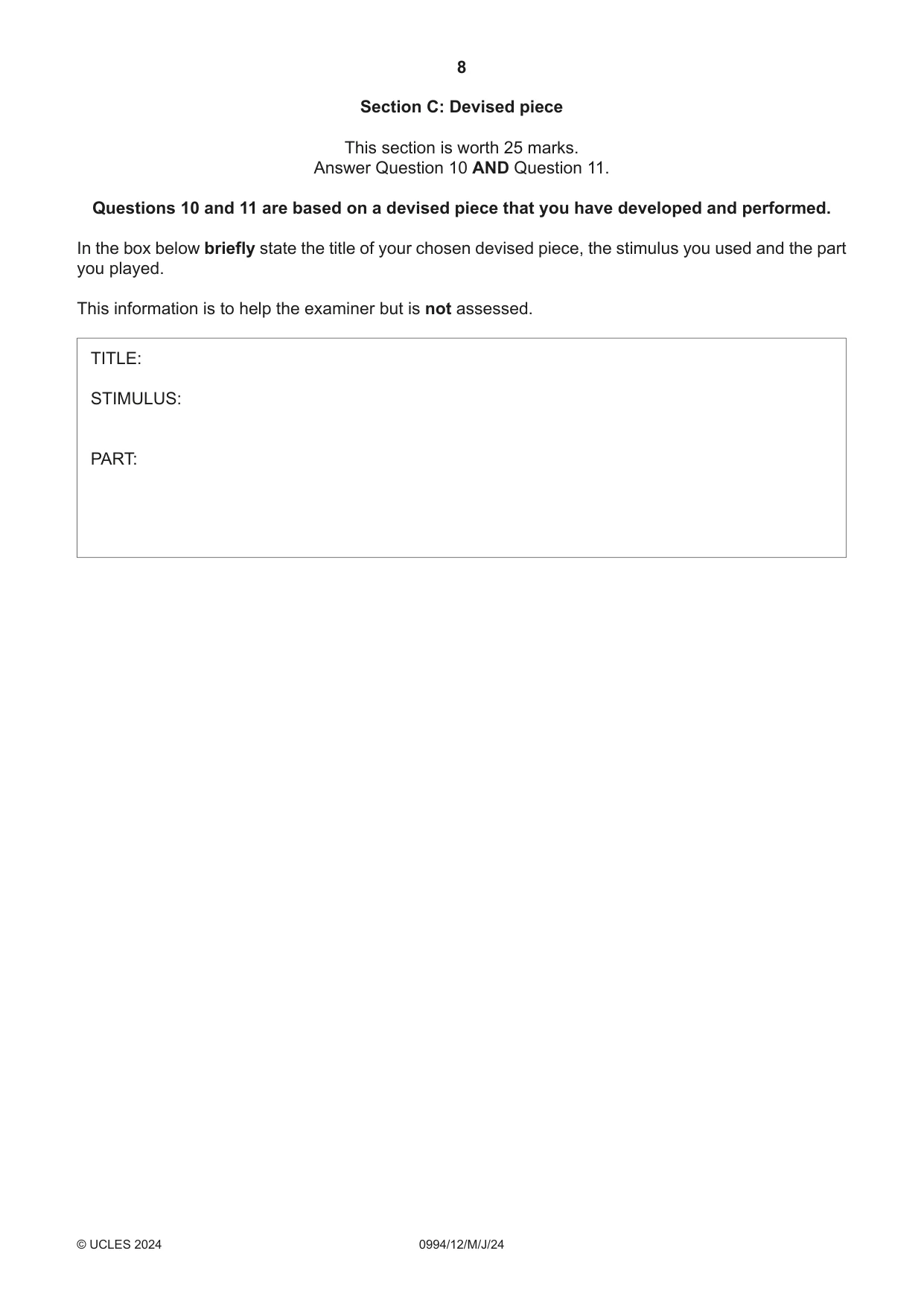
8 0994/12/M/J/24 © UCLES 2024 Section C: Devised piece This section is worth 25 marks. Answer Question 10 AND Question 11. Questions 10 and 11 are based on a devised piece that you have developed and performed. In the box below briefly state the title of your chosen devised piece, the stimulus you used and the part you played. This information is to help the examiner but is not assessed. TITLE: STIMULUS: PART:
Question paper, page 9
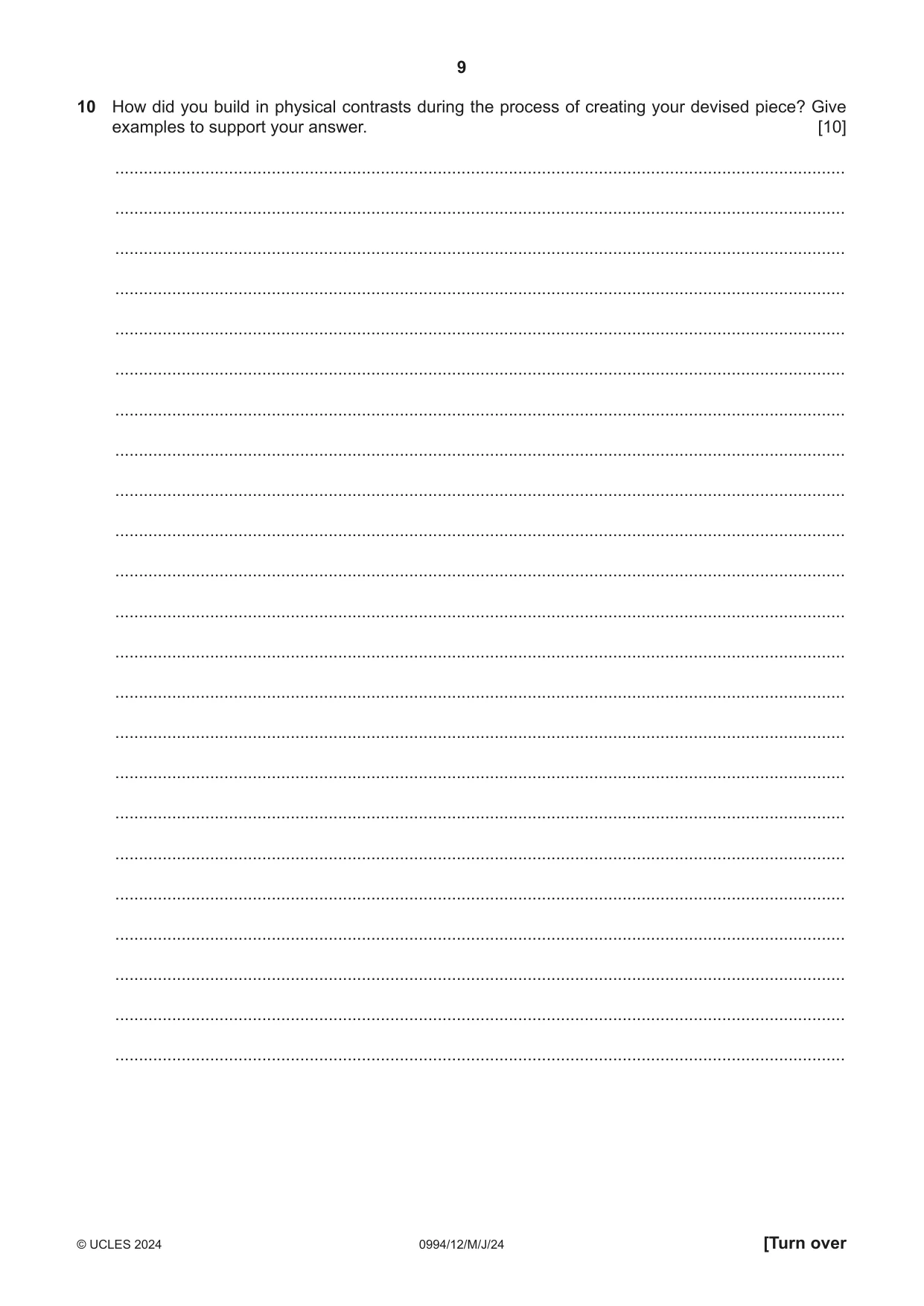
9 0994/12/M/J/24 © UCLES 2024 [Turn over 10 How did you build in physical contrasts during the process of creating your devised piece? Give examples to support your answer. [10] … … … … … … … … … … … … … … … … … … … … … … …
Question paper, page 10
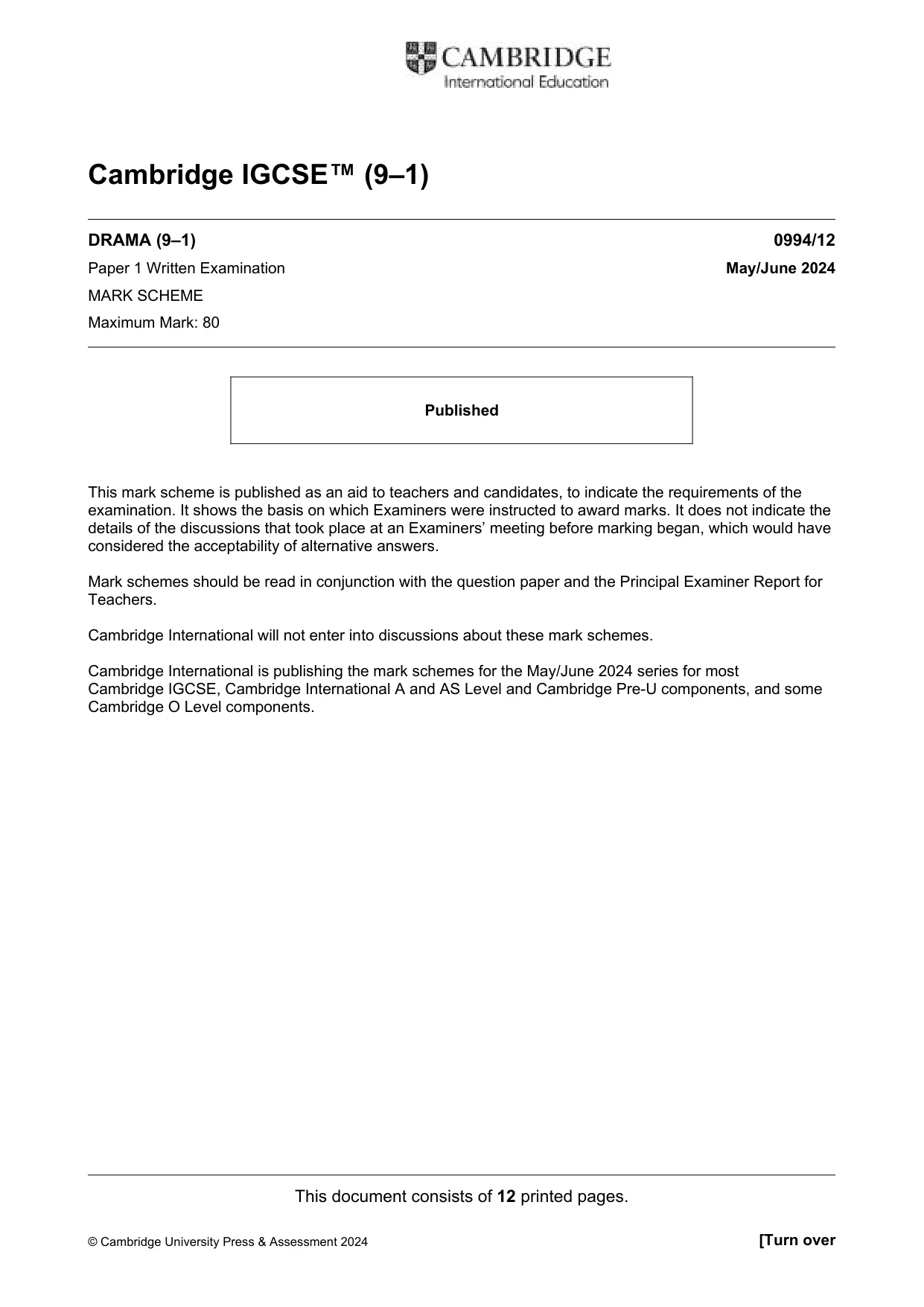
10 0994/12/M/J/24 © UCLES 2024 11 Evaluate the effectiveness of design elements (for example sound, light, set, costume) in the performance of your devised piece. Make close reference to your piece to support your evaluation. [15] … … … … … … … … … … … … … … … … … … … … … … … … … … …
Question paper, page 11
11 0994/12/M/J/24 © UCLES 2024 … … … … … … … … … … … … … … … … … … … … … … … … … … … …
Question paper, page 12
12 0994/12/M/J/24 © UCLES 2024 Permission to reproduce items where third-party owned material protected by copyright is included has been sought and cleared where possible. Every reasonable effort has been made by the publisher (UCLES) to trace copyright holders, but if any items requiring clearance have unwittingly been included, the publisher will be pleased to make amends at the earliest possible opportunity. To avoid the issue of disclosure of answer-related information to candidates, all copyright acknowledgements are reproduced online in the Cambridge Assessment International Education Copyright Acknowledgements Booklet. This is produced for each series of examinations and is freely available to download at www.cambridgeinternational.org after the live examination series. Cambridge Assessment International Education is part of Cambridge Assessment. Cambridge Assessment is the brand name of the University of Cambridge Local Examinations Syndicate (UCLES), which is a department of the University of Cambridge. BLANK PAGE
Mark scheme, page 1
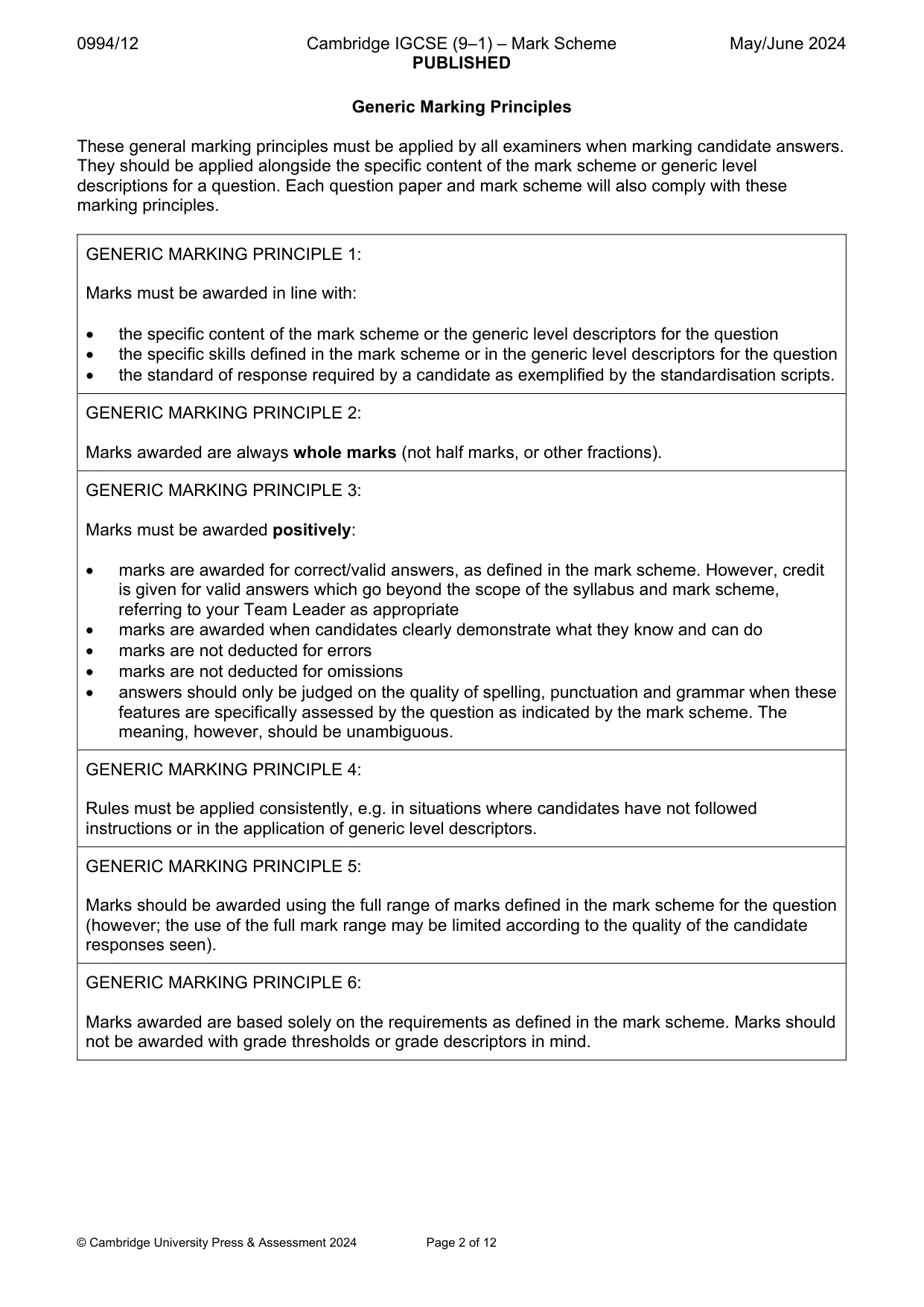
This document consists of 12 printed pages. © Cambridge University Press & Assessment 2024 [Turn over Cambridge IGCSE™ (9–1) DRAMA (9–1) 0994/12 Paper 1 Written Examination May/June 2024 MARK SCHEME Maximum Mark: 80 Published This mark scheme is published as an aid to teachers and candidates, to indicate the requirements of the examination. It shows the basis on which Examiners were instructed to award marks. It does not indicate the details of the discussions that took place at an Examiners’ meeting before marking began, which would have considered the acceptability of alternative answers. Mark schemes should be read in conjunction with the question paper and the Principal Examiner Report for Teachers. Cambridge International will not enter into discussions about these mark schemes. Cambridge International is publishing the mark schemes for the May/June 2024 series for most Cambridge IGCSE, Cambridge International A and AS Level and Cambridge Pre-U components, and some Cambridge O Level components.
Mark scheme, page 2
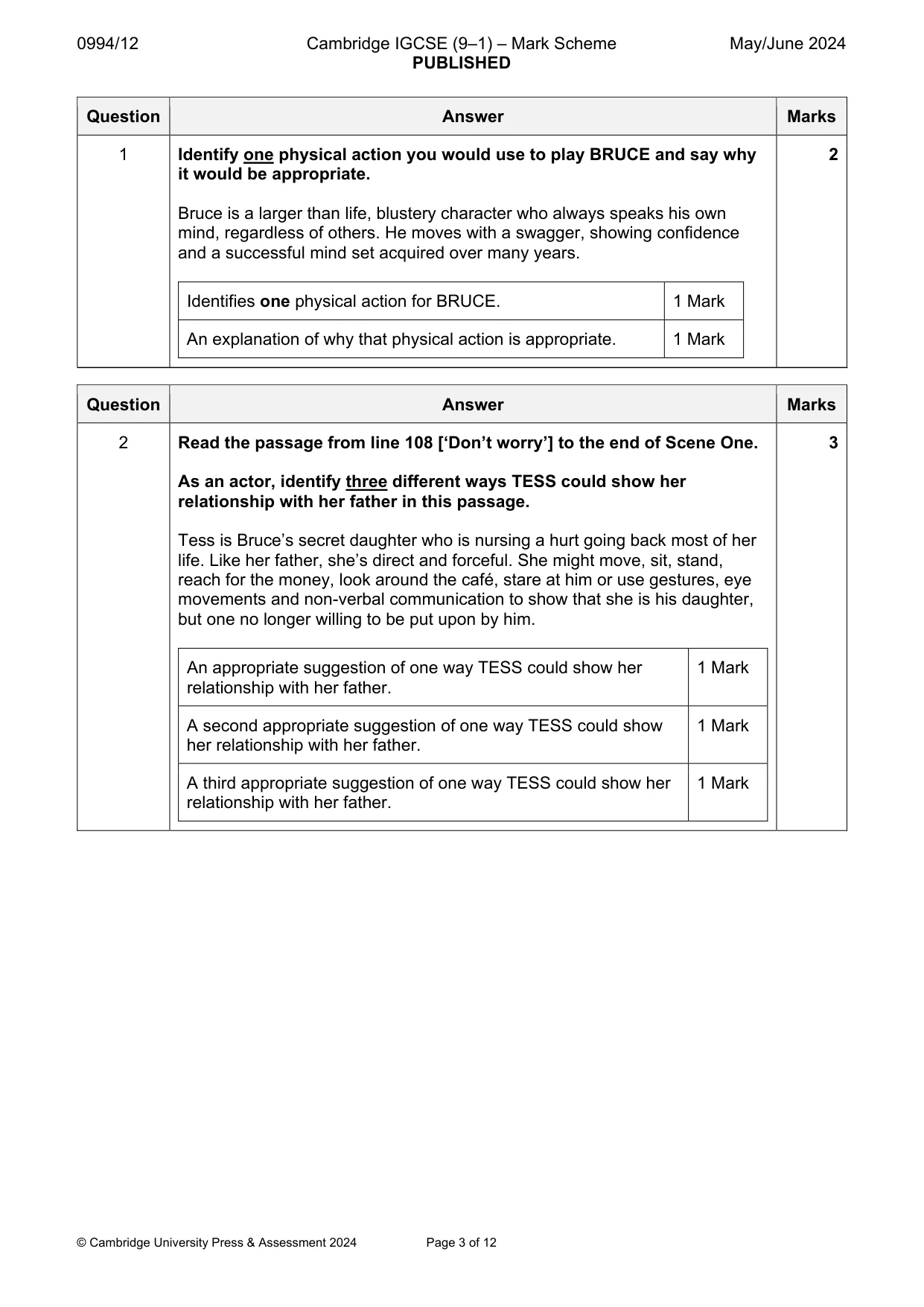
0994/12 Cambridge IGCSE (9–1) – Mark Scheme PUBLISHED May/June 2024 © Cambridge University Press & Assessment 2024 Page 2 of 12 Generic Marking Principles These general marking principles must be applied by all examiners when marking candidate answers. They should be applied alongside the specific content of the mark scheme or generic level descriptions for a question. Each question paper and mark scheme will also comply with these marking principles. GENERIC MARKING PRINCIPLE 1: Marks must be awarded in line with: the specific content of the mark scheme or the generic level descriptors for the question the specific skills defined in the mark scheme or in the generic level descriptors for the question the standard of response required by a candidate as exemplified by the standardisation scripts. GENERIC MARKING PRINCIPLE 2: Marks awarded are always whole marks (not half marks, or other fractions). GENERIC MARKING PRINCIPLE 3: Marks must be awarded positively: marks are awarded for correct/valid answers, as defined in the mark scheme. However, credit is given for valid answers which go beyond the scope of the syllabus and mark scheme, referring to your Team Leader as appropriate marks are awarded when candidates clearly demonstrate what they know and can do marks are not deducted for errors marks are not deducted for omissions answers should only be judged on the quality of spelling, punctuation and grammar when these features are specifically assessed by the question as indicated by the mark scheme. The meaning, however, should be unambiguous. GENERIC MARKING PRINCIPLE 4: Rules must be applied consistently, e.g. in situations where candidates have not followed instructions or in the application of generic level descriptors. GENERIC MARKING PRINCIPLE 5: Marks should be awarded using the full range of marks defined in the mark scheme for the question (however; the use of the full mark range may be limited according to the quality of the candidate responses seen). GENERIC MARKING PRINCIPLE 6: Marks awarded are based solely on the requirements as defined in the mark scheme. Marks should not be awarded with grade thresholds or grade descriptors in mind.
Mark scheme, page 3
0994/12 Cambridge IGCSE (9–1) – Mark Scheme PUBLISHED May/June 2024 © Cambridge University Press & Assessment 2024 Page 3 of 12 Question Answer Marks 1 Identify one physical action you would use to play BRUCE and say why it would be appropriate. Bruce is a larger than life, blustery character who always speaks his own mind, regardless of others. He moves with a swagger, showing confidence and a successful mind set acquired over many years. Identifies one physical action for BRUCE. 1 Mark An explanation of why that physical action is appropriate. 1 Mark 2 Question Answer Marks 2 Read the passage from line 108 [‘Don’t worry’] to the end of Scene One. As an actor, identify three different ways TESS could show her relationship with her father in this passage. Tess is Bruce’s secret daughter who is nursing a hurt going back most of her life. Like her father, she’s direct and forceful. She might move, sit, stand, reach for the money, look around the café, stare at him or use gestures, eye movements and non-verbal communication to show that she is his daughter, but one no longer willing to be put upon by him. An appropriate suggestion of one way TESS could show her relationship with her father. 1 Mark A second appropriate suggestion of one way TESS could show her relationship with her father. 1 Mark A third appropriate suggestion of one way TESS could show her relationship with her father. 1 Mark 3
Mark scheme, page 4
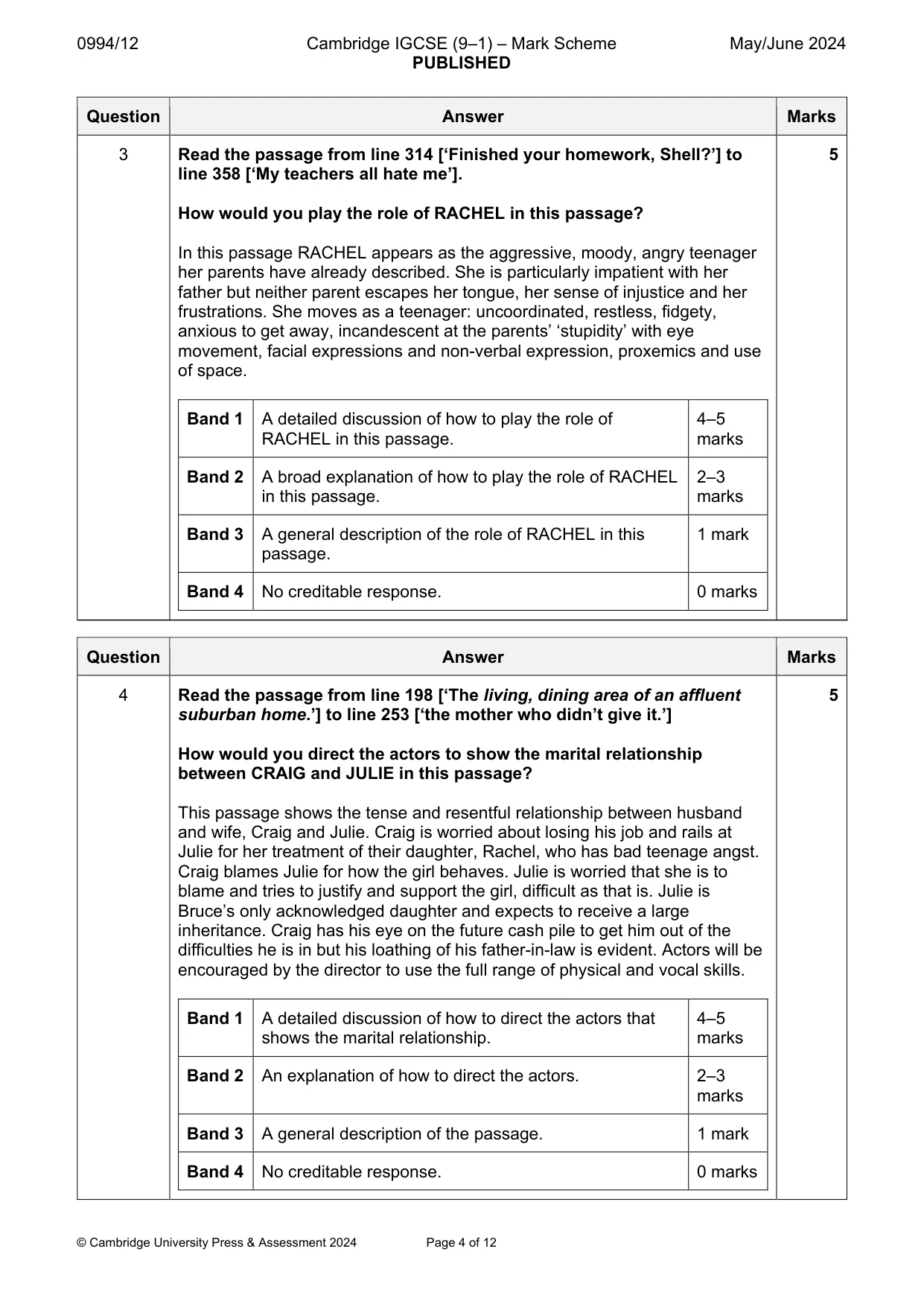
0994/12 Cambridge IGCSE (9–1) – Mark Scheme PUBLISHED May/June 2024 © Cambridge University Press & Assessment 2024 Page 4 of 12 Question Answer Marks 3 Read the passage from line 314 [‘Finished your homework, Shell?’] to line 358 [‘My teachers all hate me’]. How would you play the role of RACHEL in this passage? In this passage RACHEL appears as the aggressive, moody, angry teenager her parents have already described. She is particularly impatient with her father but neither parent escapes her tongue, her sense of injustice and her frustrations. She moves as a teenager: uncoordinated, restless, fidgety, anxious to get away, incandescent at the parents’ ‘stupidity’ with eye movement, facial expressions and non-verbal expression, proxemics and use of space. Band 1 A detailed discussion of how to play the role of RACHEL in this passage. 4–5 marks Band 2 A broad explanation of how to play the role of RACHEL in this passage. 2–3 marks Band 3 A general description of the role of RACHEL in this passage. 1 mark Band 4 No creditable response. 0 marks 5 Question Answer Marks 4 Read the passage from line 198 [‘The living, dining area of an affluent suburban home.’] to line 253 [‘the mother who didn’t give it.’] How would you direct the actors to show the marital relationship between CRAIG and JULIE in this passage? This passage shows the tense and resentful relationship between husband and wife, Craig and Julie. Craig is worried about losing his job and rails at Julie for her treatment of their daughter, Rachel, who has bad teenage angst. Craig blames Julie for how the girl behaves. Julie is worried that she is to blame and tries to justify and support the girl, difficult as that is. Julie is Bruce’s only acknowledged daughter and expects to receive a large inheritance. Craig has his eye on the future cash pile to get him out of the difficulties he is in but his loathing of his father-in-law is evident. Actors will be encouraged by the director to use the full range of physical and vocal skills. Band 1 A detailed discussion of how to direct the actors that shows the marital relationship. 4–5 marks Band 2 An explanation of how to direct the actors. 2–3 marks Band 3 A general description of the passage. 1 mark Band 4 No creditable response. 0 marks 5
Mark scheme, page 5
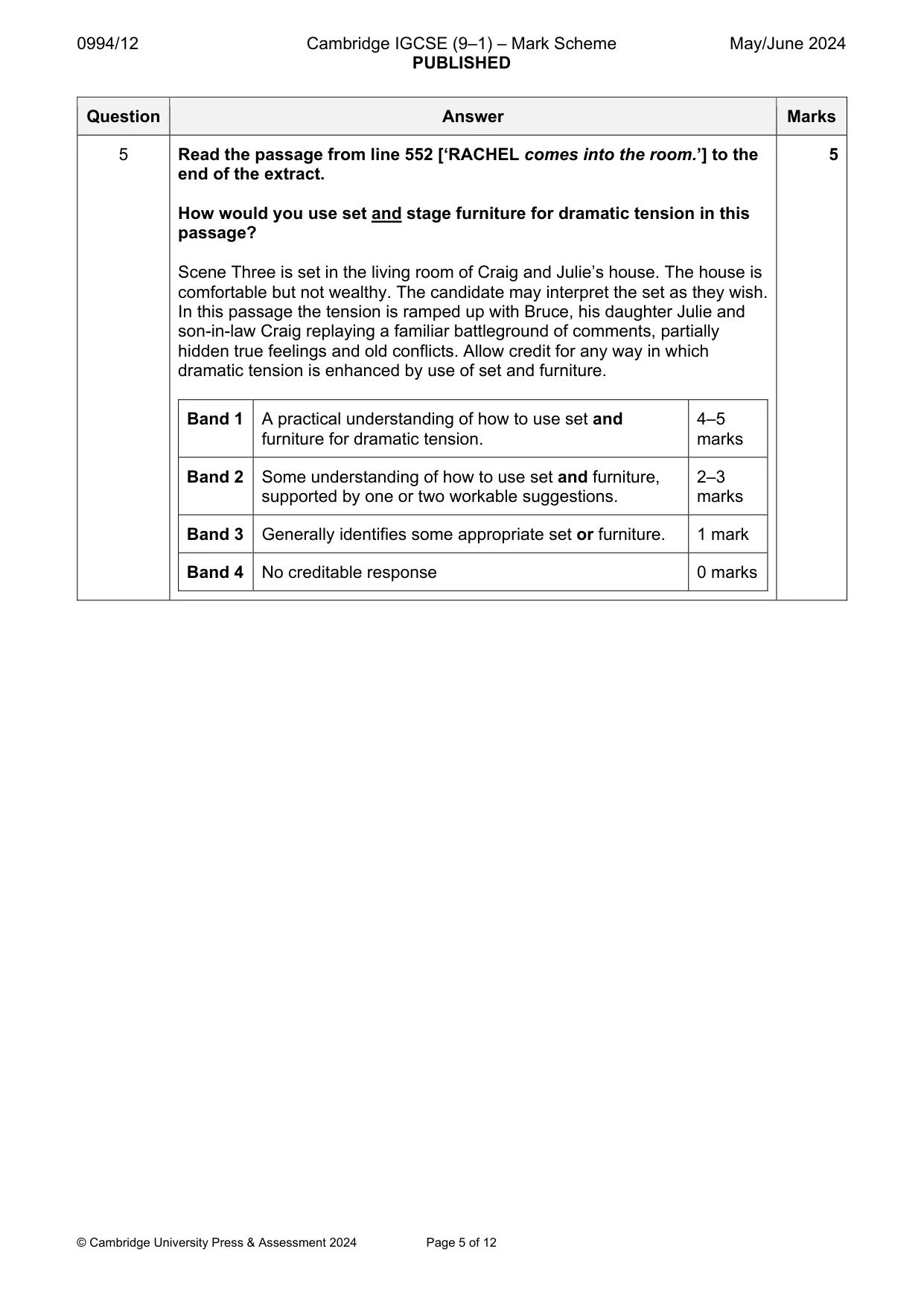
0994/12 Cambridge IGCSE (9–1) – Mark Scheme PUBLISHED May/June 2024 © Cambridge University Press & Assessment 2024 Page 5 of 12 Question Answer Marks 5 Read the passage from line 552 [‘RACHEL comes into the room.’] to the end of the extract. How would you use set and stage furniture for dramatic tension in this passage? Scene Three is set in the living room of Craig and Julie’s house. The house is comfortable but not wealthy. The candidate may interpret the set as they wish. In this passage the tension is ramped up with Bruce, his daughter Julie and son-in-law Craig replaying a familiar battleground of comments, partially hidden true feelings and old conflicts. Allow credit for any way in which dramatic tension is enhanced by use of set and furniture. Band 1 A practical understanding of how to use set and furniture for dramatic tension. 4–5 marks Band 2 Some understanding of how to use set and furniture, supported by one or two workable suggestions. 2–3 marks Band 3 Generally identifies some appropriate set or furniture. 1 mark Band 4 No creditable response 0 marks 5
Mark scheme, page 6
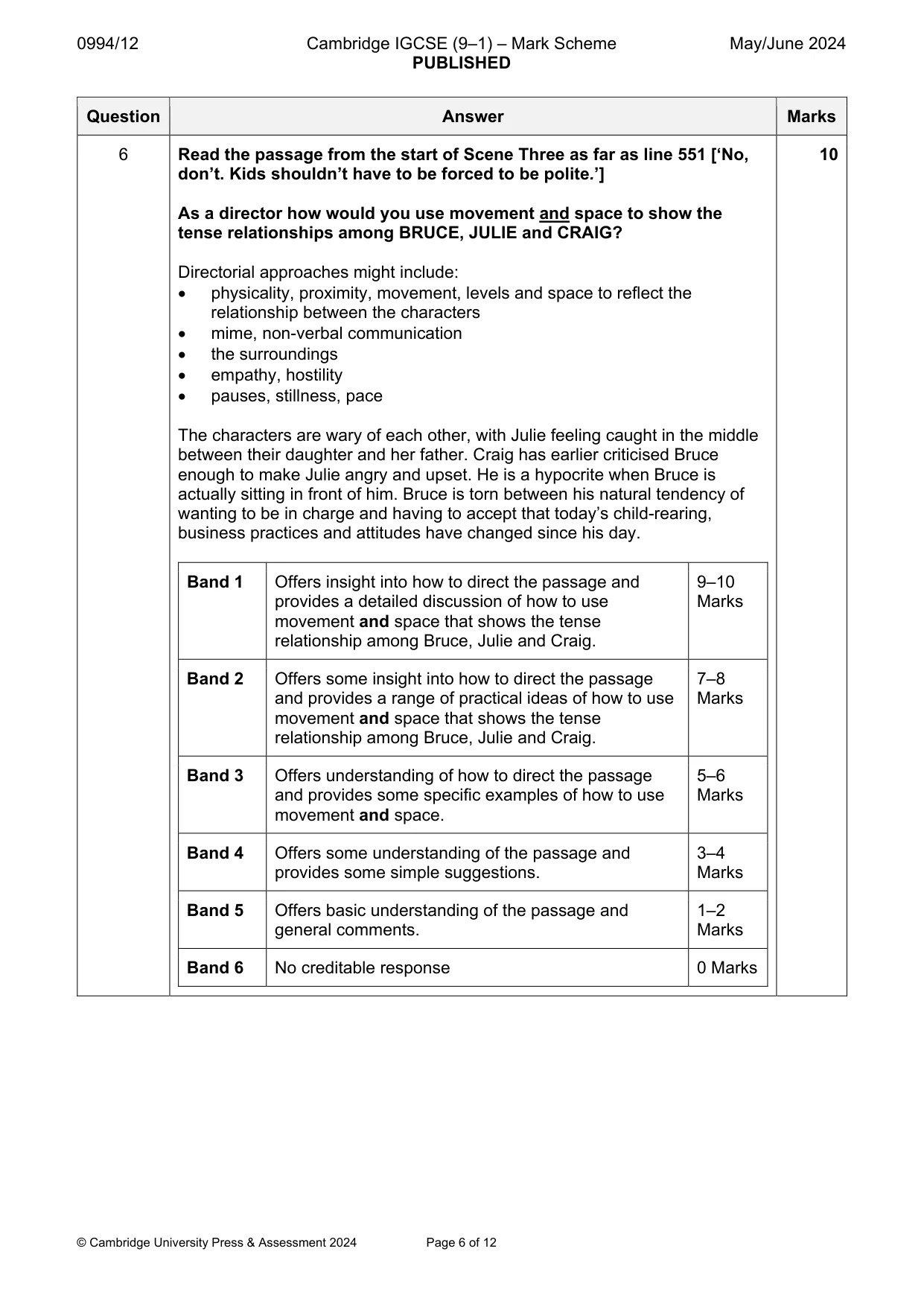
0994/12 Cambridge IGCSE (9–1) – Mark Scheme PUBLISHED May/June 2024 © Cambridge University Press & Assessment 2024 Page 6 of 12 Question Answer Marks 6 Read the passage from the start of Scene Three as far as line 551 [‘No, don’t. Kids shouldn’t have to be forced to be polite.’] As a director how would you use movement and space to show the tense relationships among BRUCE, JULIE and CRAIG? Directorial approaches might include: physicality, proximity, movement, levels and space to reflect the relationship between the characters mime, non-verbal communication the surroundings empathy, hostility pauses, stillness, pace The characters are wary of each other, with Julie feeling caught in the middle between their daughter and her father. Craig has earlier criticised Bruce enough to make Julie angry and upset. He is a hypocrite when Bruce is actually sitting in front of him. Bruce is torn between his natural tendency of wanting to be in charge and having to accept that today’s child-rearing, business practices and attitudes have changed since his day. Band 1 Offers insight into how to direct the passage and provides a detailed discussion of how to use movement and space that shows the tense relationship among Bruce, Julie and Craig. 9–10 Marks Band 2 Offers some insight into how to direct the passage and provides a range of practical ideas of how to use movement and space that shows the tense relationship among Bruce, Julie and Craig. 7–8 Marks Band 3 Offers understanding of how to direct the passage and provides some specific examples of how to use movement and space. 5–6 Marks Band 4 Offers some understanding of the passage and provides some simple suggestions. 3–4 Marks Band 5 Offers basic understanding of the passage and general comments. 1–2 Marks Band 6 No creditable response 0 Marks 10
Mark scheme, page 7
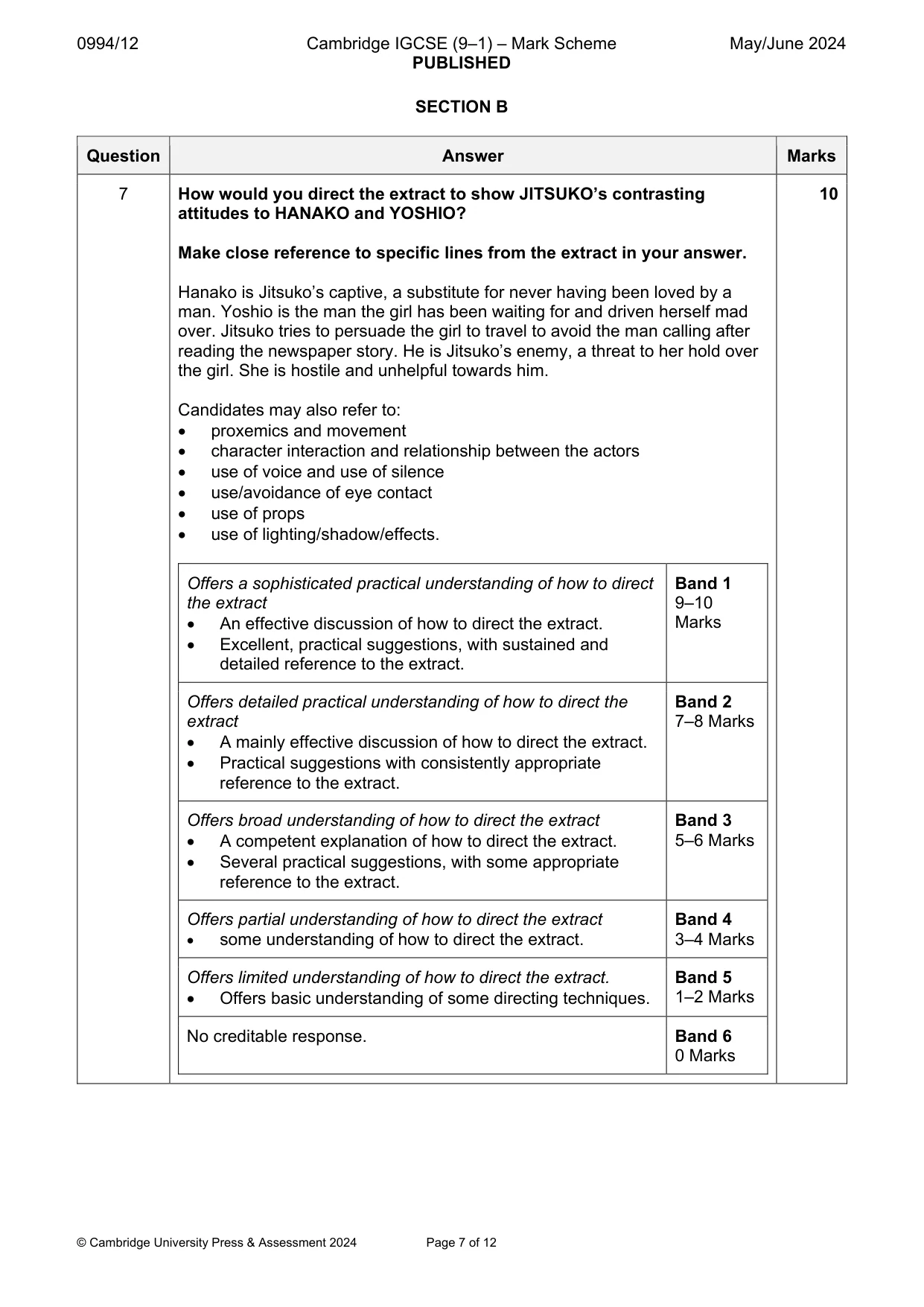
0994/12 Cambridge IGCSE (9–1) – Mark Scheme PUBLISHED May/June 2024 © Cambridge University Press & Assessment 2024 Page 7 of 12 SECTION B Question Answer Marks 7 How would you direct the extract to show JITSUKO’s contrasting attitudes to HANAKO and YOSHIO? Make close reference to specific lines from the extract in your answer. Hanako is Jitsuko’s captive, a substitute for never having been loved by a man. Yoshio is the man the girl has been waiting for and driven herself mad over. Jitsuko tries to persuade the girl to travel to avoid the man calling after reading the newspaper story. He is Jitsuko’s enemy, a threat to her hold over the girl. She is hostile and unhelpful towards him. Candidates may also refer to: proxemics and movement character interaction and relationship between the actors use of voice and use of silence use/avoidance of eye contact use of props use of lighting/shadow/effects. Offers a sophisticated practical understanding of how to direct the extract An effective discussion of how to direct the extract. Excellent, practical suggestions, with sustained and detailed reference to the extract. Band 1 9–10 Marks Offers detailed practical understanding of how to direct the extract A mainly effective discussion of how to direct the extract. Practical suggestions with consistently appropriate reference to the extract. Band 2 7–8 Marks Offers broad understanding of how to direct the extract A competent explanation of how to direct the extract. Several practical suggestions, with some appropriate reference to the extract. Band 3 5–6 Marks Offers partial understanding of how to direct the extract some understanding of how to direct the extract. Band 4 3–4 Marks Offers limited understanding of how to direct the extract. Offers basic understanding of some directing techniques. Band 5 1–2 Marks No creditable response. Band 6 0 Marks 10
Mark scheme, page 8
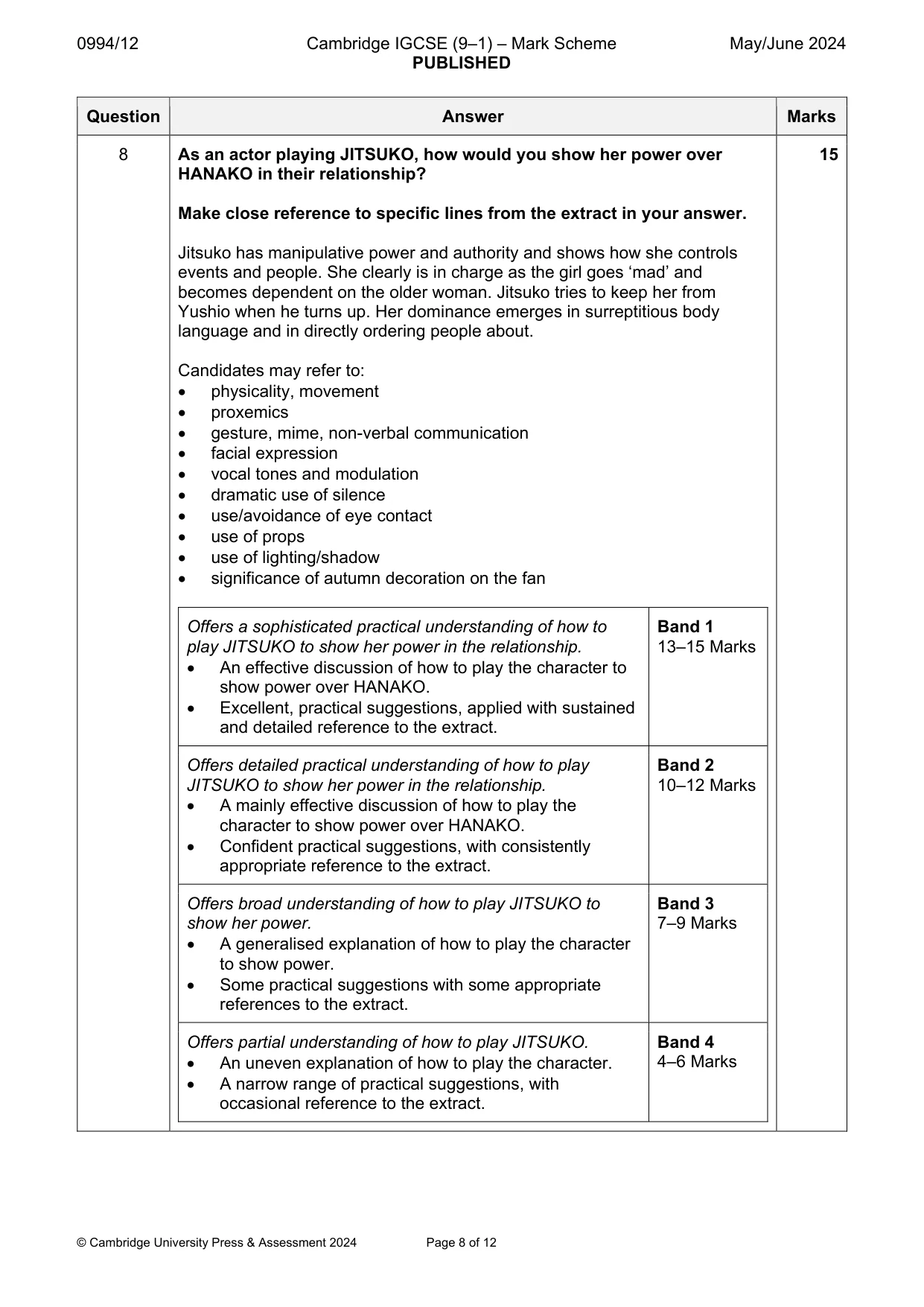
0994/12 Cambridge IGCSE (9–1) – Mark Scheme PUBLISHED May/June 2024 © Cambridge University Press & Assessment 2024 Page 8 of 12 Question Answer Marks 8 As an actor playing JITSUKO, how would you show her power over HANAKO in their relationship? Make close reference to specific lines from the extract in your answer. Jitsuko has manipulative power and authority and shows how she controls events and people. She clearly is in charge as the girl goes ‘mad’ and becomes dependent on the older woman. Jitsuko tries to keep her from Yushio when he turns up. Her dominance emerges in surreptitious body language and in directly ordering people about. Candidates may refer to: physicality, movement proxemics gesture, mime, non-verbal communication facial expression vocal tones and modulation dramatic use of silence use/avoidance of eye contact use of props use of lighting/shadow significance of autumn decoration on the fan Offers a sophisticated practical understanding of how to play JITSUKO to show her power in the relationship. An effective discussion of how to play the character to show power over HANAKO. Excellent, practical suggestions, applied with sustained and detailed reference to the extract. Band 1 13–15 Marks Offers detailed practical understanding of how to play JITSUKO to show her power in the relationship. A mainly effective discussion of how to play the character to show power over HANAKO. Confident practical suggestions, with consistently appropriate reference to the extract. Band 2 10–12 Marks Offers broad understanding of how to play JITSUKO to show her power. A generalised explanation of how to play the character to show power. Some practical suggestions with some appropriate references to the extract. Band 3 7–9 Marks Offers partial understanding of how to play JITSUKO. An uneven explanation of how to play the character. A narrow range of practical suggestions, with occasional reference to the extract. Band 4 4–6 Marks 15
Mark scheme, page 9
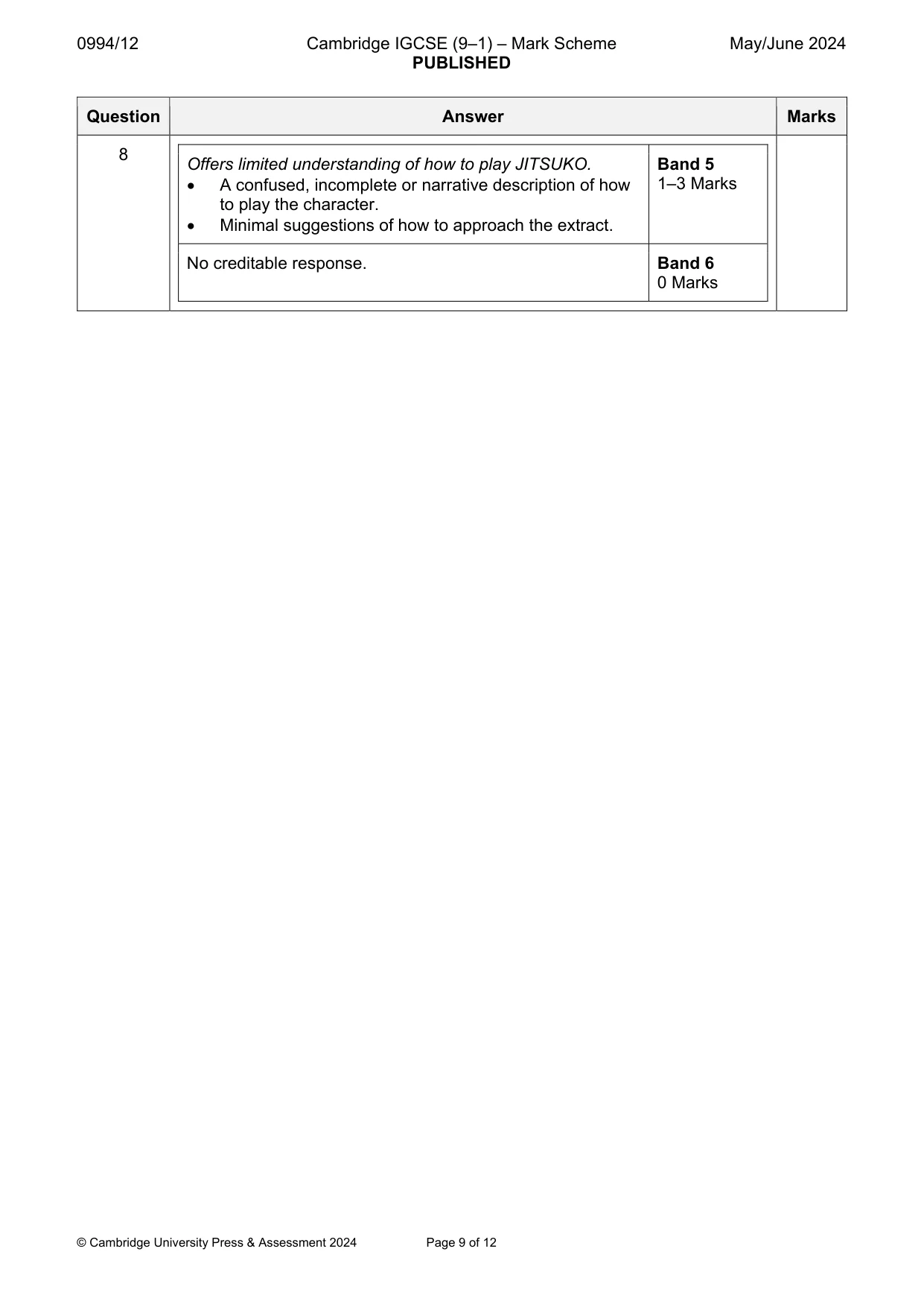
0994/12 Cambridge IGCSE (9–1) – Mark Scheme PUBLISHED May/June 2024 © Cambridge University Press & Assessment 2024 Page 9 of 12 Question Answer Marks 8 Offers limited understanding of how to play JITSUKO. A confused, incomplete or narrative description of how to play the character. Minimal suggestions of how to approach the extract. Band 5 1–3 Marks No creditable response. Band 6 0 Marks
Mark scheme, page 10
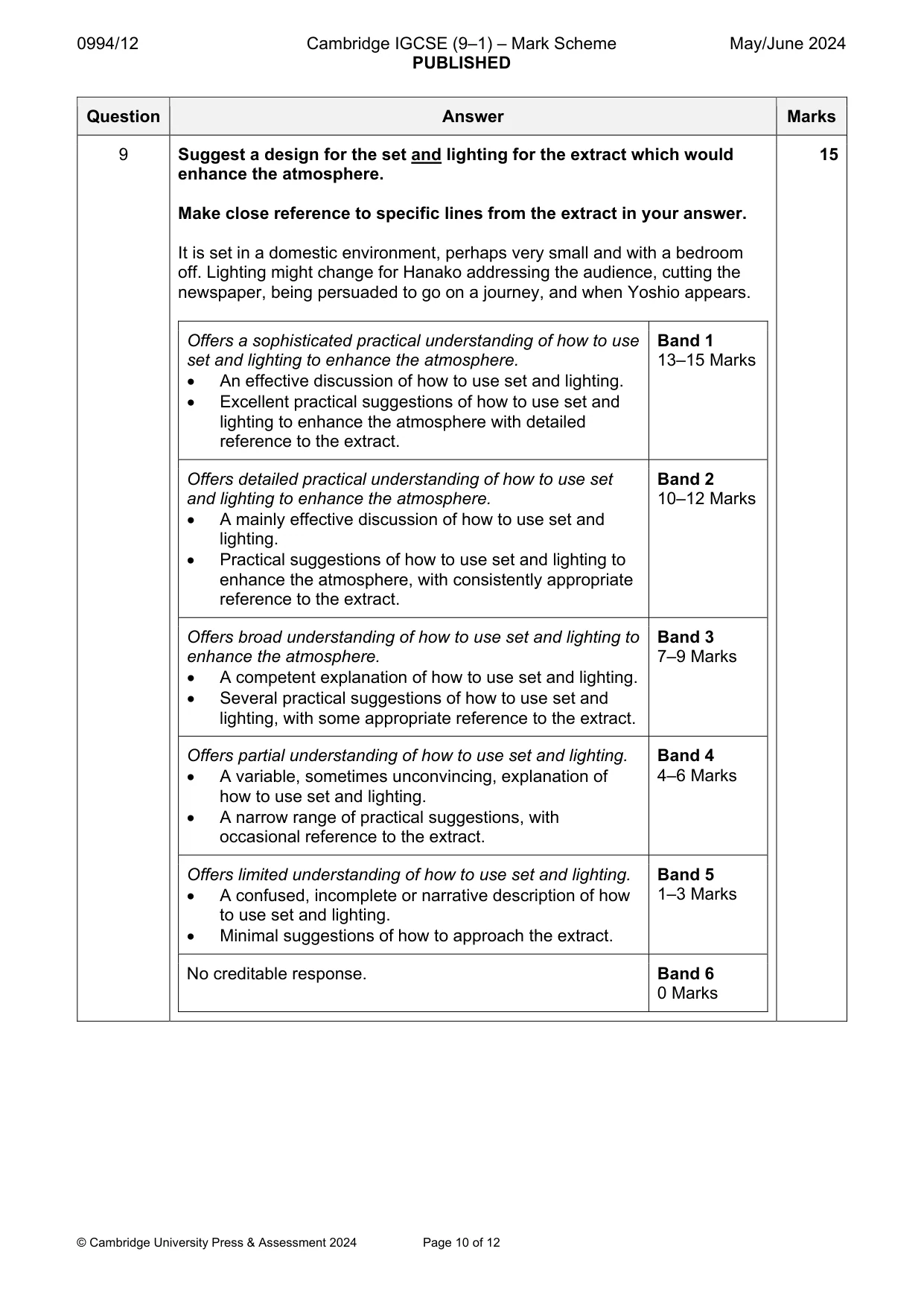
0994/12 Cambridge IGCSE (9–1) – Mark Scheme PUBLISHED May/June 2024 © Cambridge University Press & Assessment 2024 Page 10 of 12 Question Answer Marks 9 Suggest a design for the set and lighting for the extract which would enhance the atmosphere. Make close reference to specific lines from the extract in your answer. It is set in a domestic environment, perhaps very small and with a bedroom off. Lighting might change for Hanako addressing the audience, cutting the newspaper, being persuaded to go on a journey, and when Yoshio appears. Offers a sophisticated practical understanding of how to use set and lighting to enhance the atmosphere. An effective discussion of how to use set and lighting. Excellent practical suggestions of how to use set and lighting to enhance the atmosphere with detailed reference to the extract. Band 1 13–15 Marks Offers detailed practical understanding of how to use set and lighting to enhance the atmosphere. A mainly effective discussion of how to use set and lighting. Practical suggestions of how to use set and lighting to enhance the atmosphere, with consistently appropriate reference to the extract. Band 2 10–12 Marks Offers broad understanding of how to use set and lighting to enhance the atmosphere. A competent explanation of how to use set and lighting. Several practical suggestions of how to use set and lighting, with some appropriate reference to the extract. Band 3 7–9 Marks Offers partial understanding of how to use set and lighting. A variable, sometimes unconvincing, explanation of how to use set and lighting. A narrow range of practical suggestions, with occasional reference to the extract. Band 4 4–6 Marks Offers limited understanding of how to use set and lighting. A confused, incomplete or narrative description of how to use set and lighting. Minimal suggestions of how to approach the extract. Band 5 1–3 Marks No creditable response. Band 6 0 Marks 15
Mark scheme, page 11
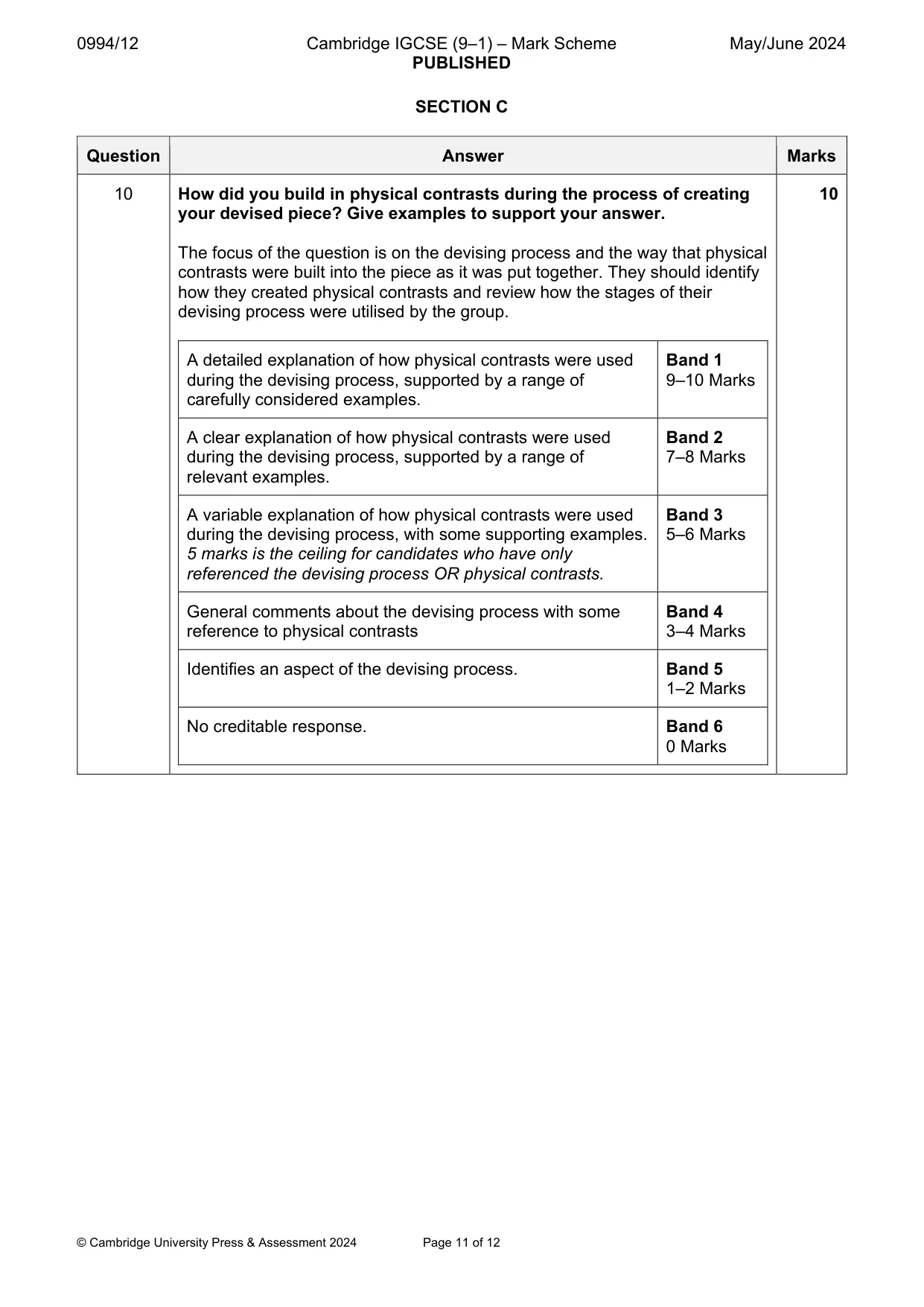
0994/12 Cambridge IGCSE (9–1) – Mark Scheme PUBLISHED May/June 2024 © Cambridge University Press & Assessment 2024 Page 11 of 12 SECTION C Question Answer Marks 10 How did you build in physical contrasts during the process of creating your devised piece? Give examples to support your answer. The focus of the question is on the devising process and the way that physical contrasts were built into the piece as it was put together. They should identify how they created physical contrasts and review how the stages of their devising process were utilised by the group. A detailed explanation of how physical contrasts were used during the devising process, supported by a range of carefully considered examples. Band 1 9–10 Marks A clear explanation of how physical contrasts were used during the devising process, supported by a range of relevant examples. Band 2 7–8 Marks A variable explanation of how physical contrasts were used during the devising process, with some supporting examples. 5 marks is the ceiling for candidates who have only referenced the devising process OR physical contrasts. Band 3 5–6 Marks General comments about the devising process with some reference to physical contrasts Band 4 3–4 Marks Identifies an aspect of the devising process. Band 5 1–2 Marks No creditable response. Band 6 0 Marks 10
Mark scheme, page 12
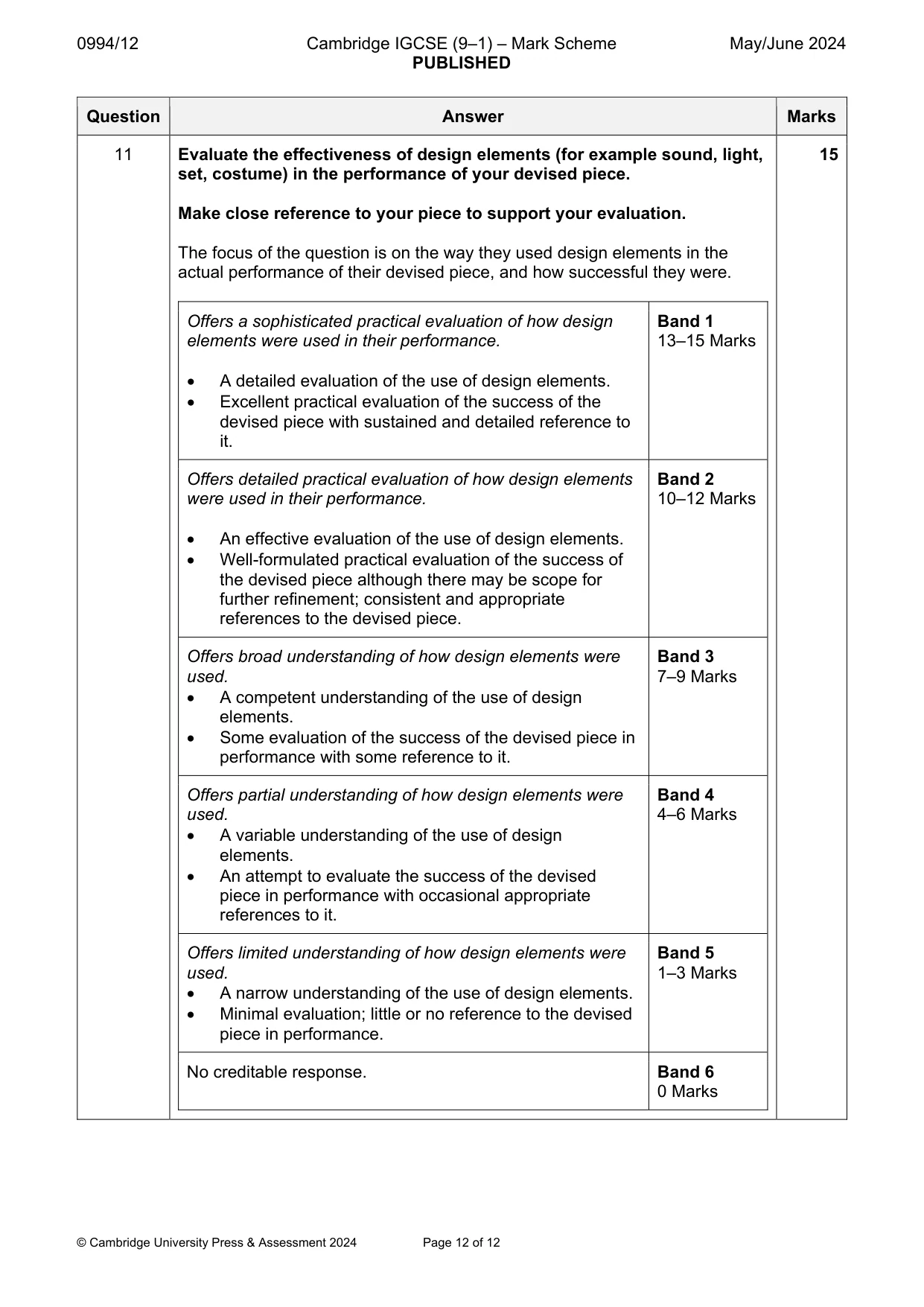
0994/12 Cambridge IGCSE (9–1) – Mark Scheme PUBLISHED May/June 2024 © Cambridge University Press & Assessment 2024 Page 12 of 12 Question Answer Marks 11 Evaluate the effectiveness of design elements (for example sound, light, set, costume) in the performance of your devised piece. Make close reference to your piece to support your evaluation. The focus of the question is on the way they used design elements in the actual performance of their devised piece, and how successful they were. Offers a sophisticated practical evaluation of how design elements were used in their performance. A detailed evaluation of the use of design elements. Excellent practical evaluation of the success of the devised piece with sustained and detailed reference to it. Band 1 13–15 Marks Offers detailed practical evaluation of how design elements were used in their performance. An effective evaluation of the use of design elements. Well-formulated practical evaluation of the success of the devised piece although there may be scope for further refinement; consistent and appropriate references to the devised piece. Band 2 10–12 Marks Offers broad understanding of how design elements were used. A competent understanding of the use of design elements. Some evaluation of the success of the devised piece in performance with some reference to it. Band 3 7–9 Marks Offers partial understanding of how design elements were used. A variable understanding of the use of design elements. An attempt to evaluate the success of the devised piece in performance with occasional appropriate references to it. Band 4 4–6 Marks Offers limited understanding of how design elements were used. A narrow understanding of the use of design elements. Minimal evaluation; little or no reference to the devised piece in performance. Band 5 1–3 Marks No creditable response. Band 6 0 Marks 15
What you needed in this session
Cambridge’s own grade thresholds for 2024 May/June, Paper 1 · Variant 2. A higher threshold means an easier paper — the bar moves with how the cohort did.