Cambridge IGCSE Drama 0411 — 2021 May/June Paper 1 · Variant 3
0411/13/M/J/21 · 80 marks · ≈90 min
The question paper and its mark scheme, free to read here and free to download. This is Cambridge’s own paper, exactly as it was sat.
Question paper4 pages

Mark scheme18 pages
Answers below. Sit the paper first if you are practising.
Paper as text
Question paper, page 1
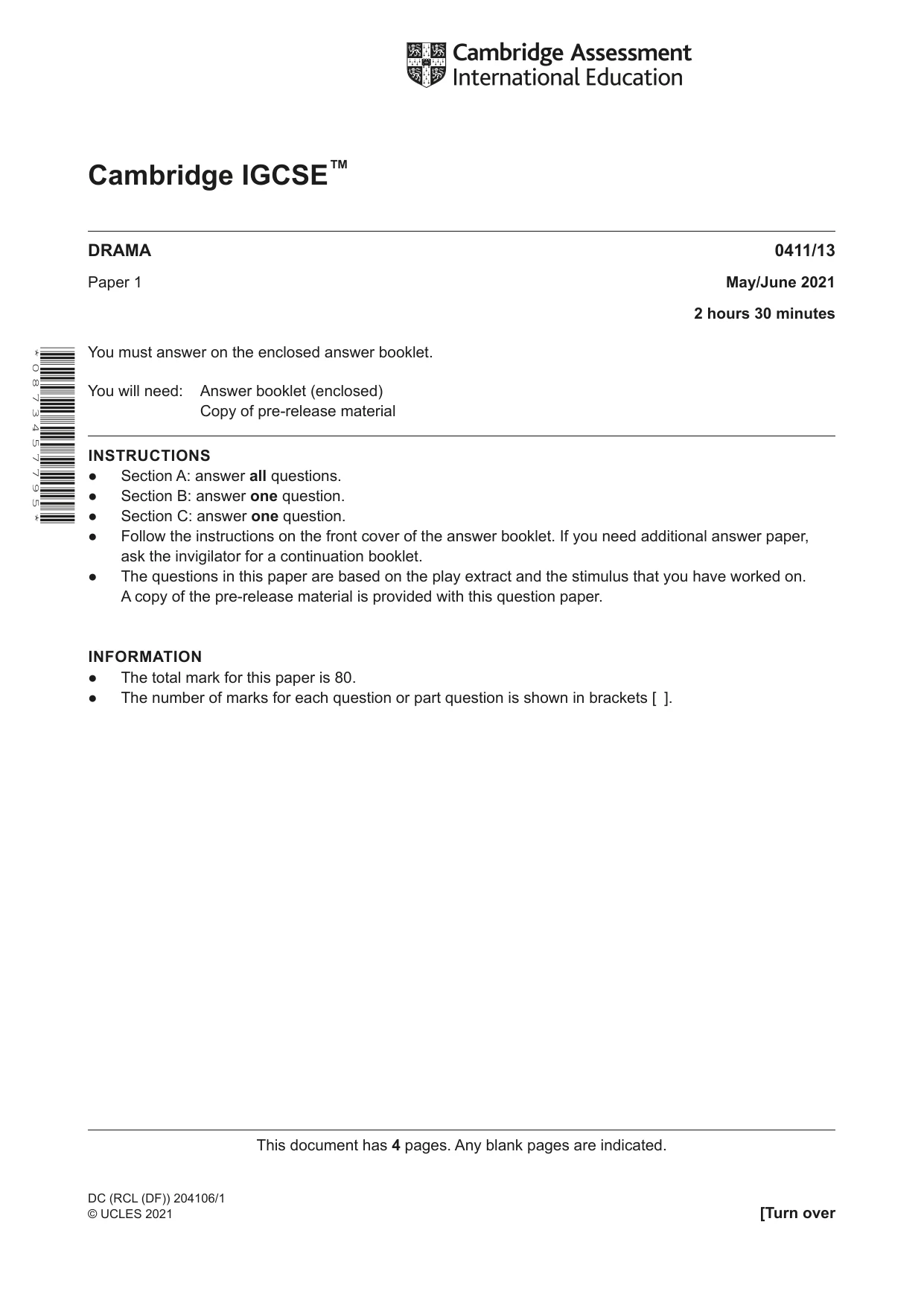
This document has 4 pages. Any blank pages are indicated. * 0 8 7 3 4 5 7 7 9 5 * Cambridge IGCSE™ DRAMA 0411/13 Paper 1 May/June 2021 2 hours 30 minutes You must answer on the enclosed answer booklet. You will need: Answer booklet (enclosed) Copy of pre-release material INSTRUCTIONS ● Section A: answer all questions. ● Section B: answer one question. ● Section C: answer one question. ● Follow the instructions on the front cover of the answer booklet. If you need additional answer paper, ask the invigilator for a continuation booklet. ● The questions in this paper are based on the play extract and the stimulus that you have worked on. A copy of the pre-release material is provided with this question paper. INFORMATION ● The total mark for this paper is 80. ● The number of marks for each question or part question is shown in brackets [ ]. DC (RCL (DF)) 204106/1 © UCLES 2021 [Turn over
Question paper, page 2
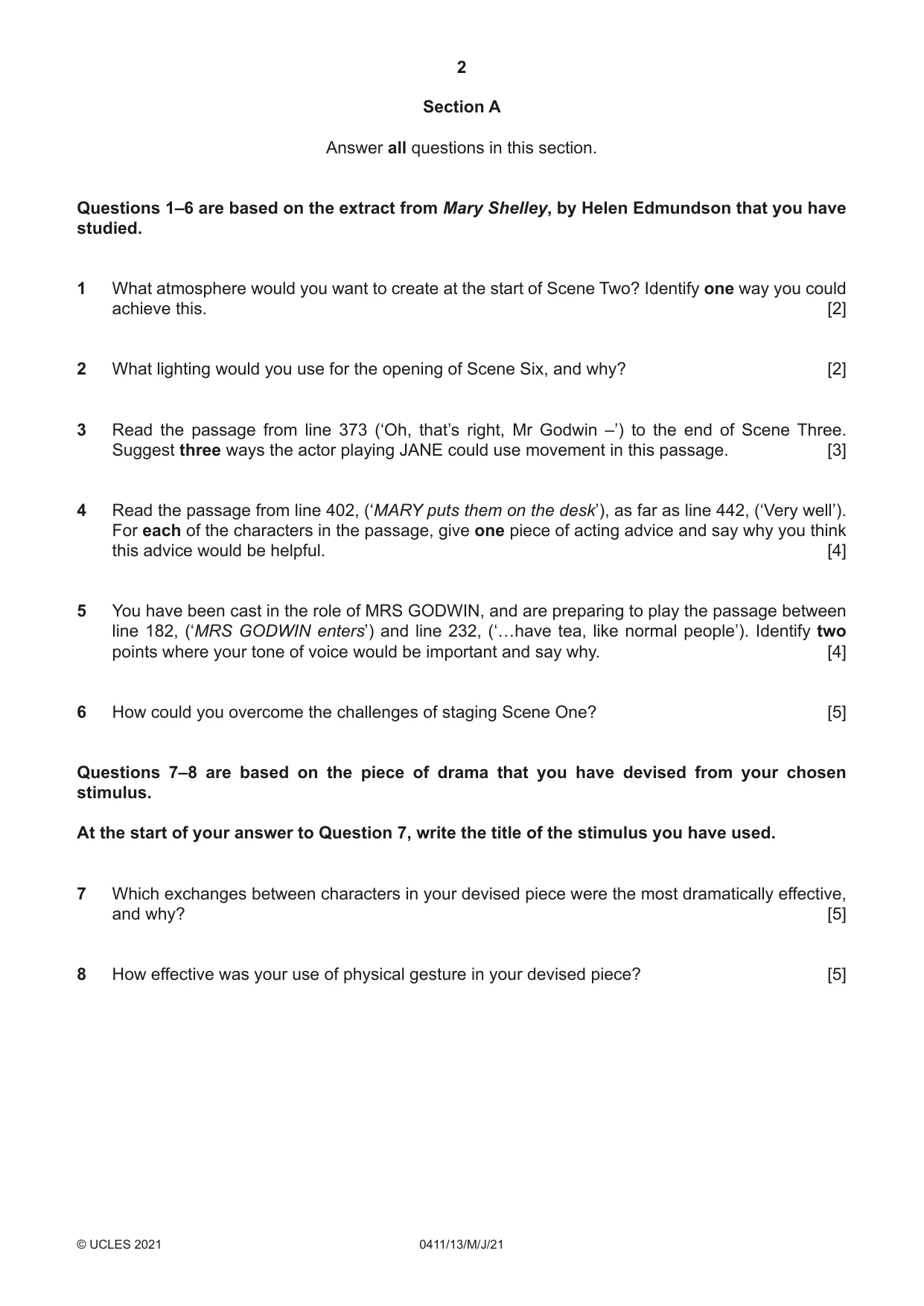
2 0411/13/M/J/21 © UCLES 2021 Section A Answer all questions in this section. Questions 1–6 are based on the extract from Mary Shelley, by Helen Edmundson that you have studied. 1 What atmosphere would you want to create at the start of Scene Two? Identify one way you could achieve this. [2] 2 What lighting would you use for the opening of Scene Six, and why? [2] 3 Read the passage from line 373 (‘Oh, that’s right, Mr Godwin –’) to the end of Scene Three. Suggest three ways the actor playing JANE could use movement in this passage. [3] 4 Read the passage from line 402, (‘MARY puts them on the desk’), as far as line 442, (‘Very well’). For each of the characters in the passage, give one piece of acting advice and say why you think this advice would be helpful. [4] 5 You have been cast in the role of MRS GODWIN, and are preparing to play the passage between line 182, (‘MRS GODWIN enters’) and line 232, (‘…have tea, like normal people’). Identify two points where your tone of voice would be important and say why. [4] 6 How could you overcome the challenges of staging Scene One? [5] Questions 7–8 are based on the piece of drama that you have devised from your chosen stimulus. At the start of your answer to Question 7, write the title of the stimulus you have used. 7 Which exchanges between characters in your devised piece were the most dramatically effective, and why? [5] 8 How effective was your use of physical gesture in your devised piece? [5]
Question paper, page 3
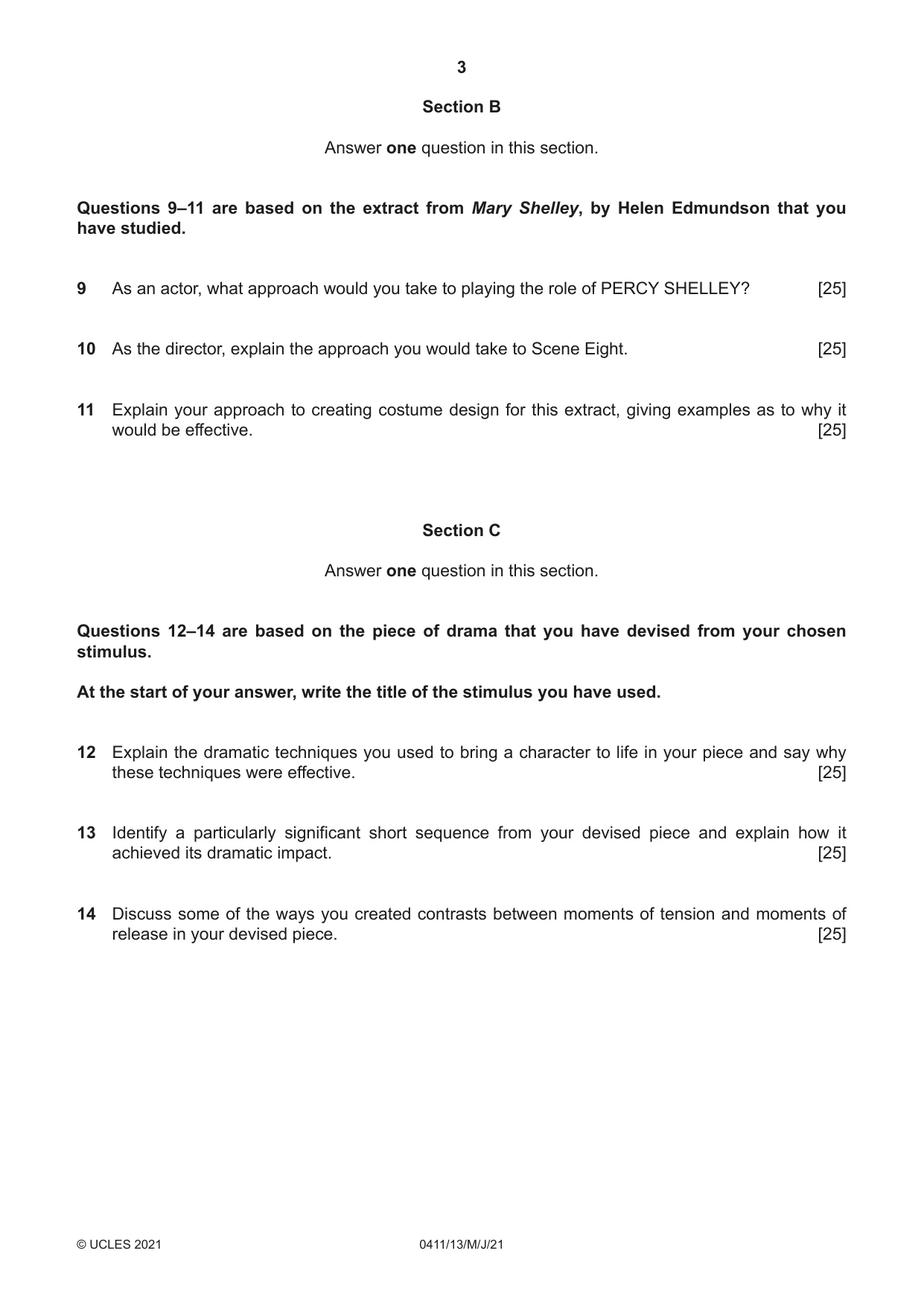
3 0411/13/M/J/21 © UCLES 2021 Section B Answer one question in this section. Questions 9–11 are based on the extract from Mary Shelley, by Helen Edmundson that you have studied. 9 As an actor, what approach would you take to playing the role of PERCY SHELLEY? [25] 10 As the director, explain the approach you would take to Scene Eight. [25] 11 Explain your approach to creating costume design for this extract, giving examples as to why it would be effective. [25] Section C Answer one question in this section. Questions 12–14 are based on the piece of drama that you have devised from your chosen stimulus. At the start of your answer, write the title of the stimulus you have used. 12 Explain the dramatic techniques you used to bring a character to life in your piece and say why these techniques were effective. [25] 13 Identify a particularly significant short sequence from your devised piece and explain how it achieved its dramatic impact. [25] 14 Discuss some of the ways you created contrasts between moments of tension and moments of release in your devised piece. [25]
Question paper, page 4
4 0411/13/M/J/21 © UCLES 2021 Permission to reproduce items where third-party owned material protected by copyright is included has been sought and cleared where possible. Every reasonable effort has been made by the publisher (UCLES) to trace copyright holders, but if any items requiring clearance have unwittingly been included, the publisher will be pleased to make amends at the earliest possible opportunity. To avoid the issue of disclosure of answer-related information to candidates, all copyright acknowledgements are reproduced online in the Cambridge Assessment International Education Copyright Acknowledgements Booklet. This is produced for each series of examinations and is freely available to download at www.cambridgeinternational.org after the live examination series. Cambridge Assessment International Education is part of the Cambridge Assessment Group. Cambridge Assessment is the brand name of the University of Cambridge Local Examinations Syndicate (UCLES), which itself is a department of the University of Cambridge. BLANK PAGE
Mark scheme, page 1
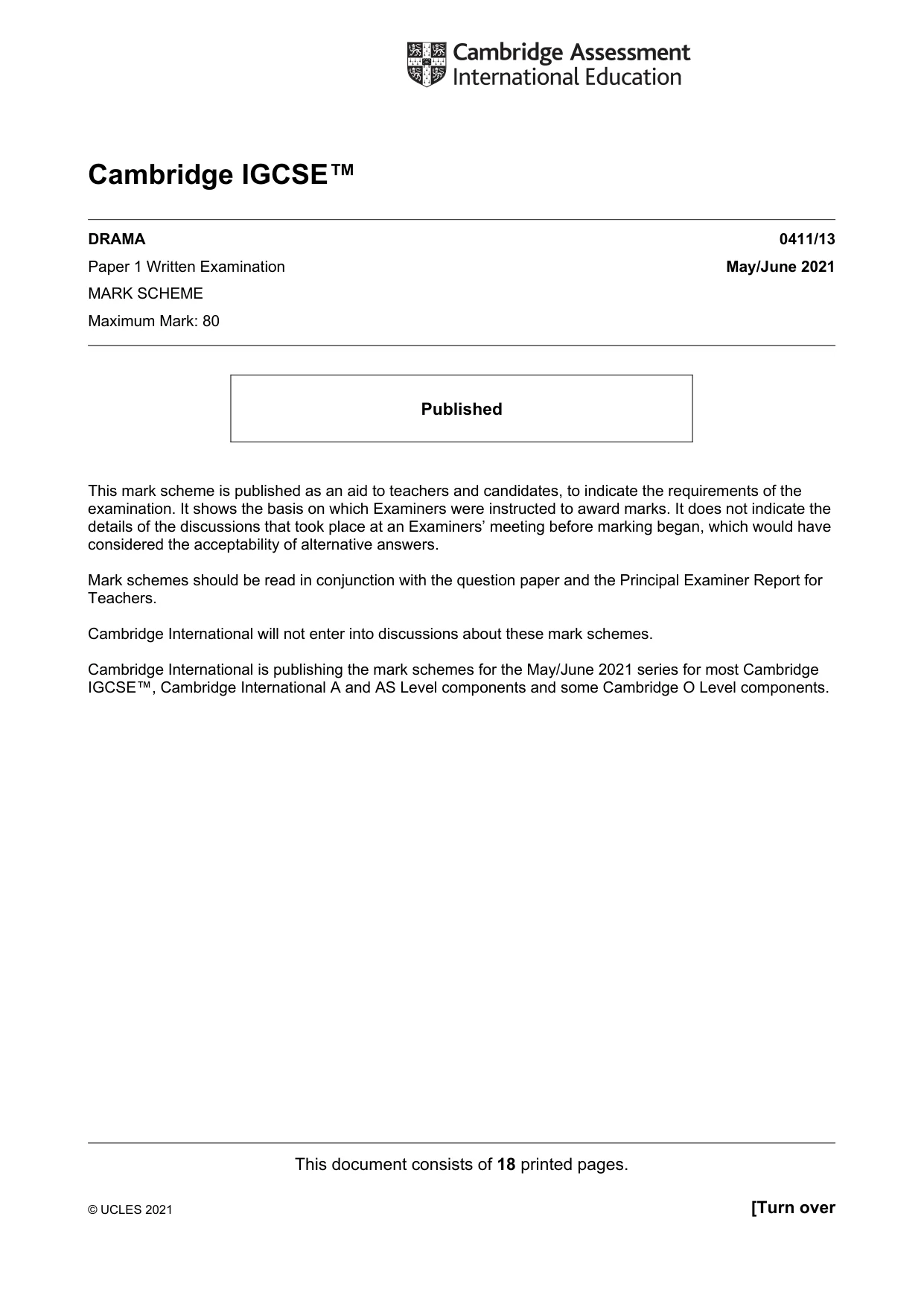
This document consists of 18 printed pages. © UCLES 2021 [Turn over Cambridge IGCSE™ DRAMA 0411/13 Paper 1 Written Examination May/June 2021 MARK SCHEME Maximum Mark: 80 Published This mark scheme is published as an aid to teachers and candidates, to indicate the requirements of the examination. It shows the basis on which Examiners were instructed to award marks. It does not indicate the details of the discussions that took place at an Examiners’ meeting before marking began, which would have considered the acceptability of alternative answers. Mark schemes should be read in conjunction with the question paper and the Principal Examiner Report for Teachers. Cambridge International will not enter into discussions about these mark schemes. Cambridge International is publishing the mark schemes for the May/June 2021 series for most Cambridge IGCSE™, Cambridge International A and AS Level components and some Cambridge O Level components.
Mark scheme, page 2
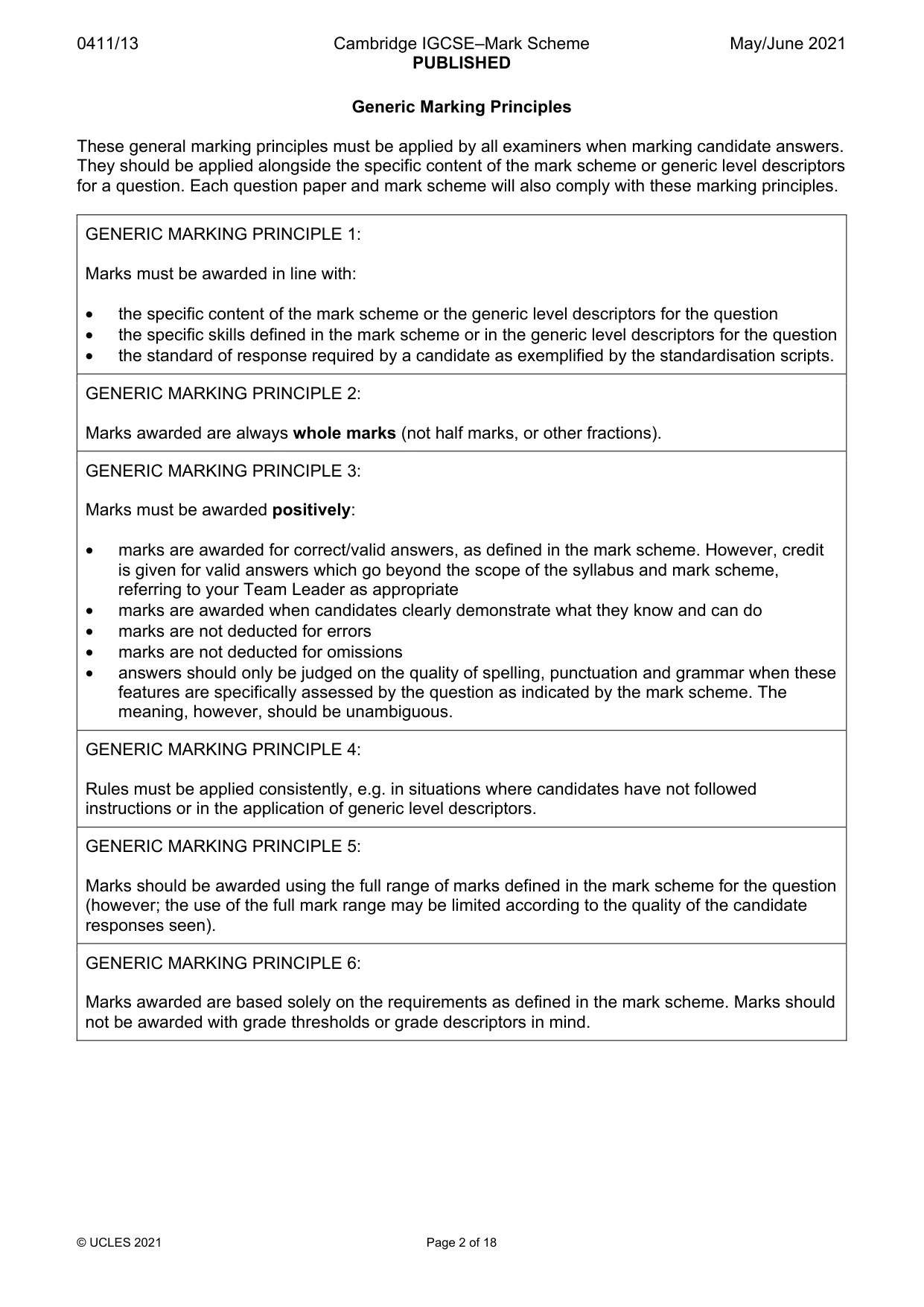
0411/13 Cambridge IGCSE–Mark Scheme PUBLISHED May/June 2021 © UCLES 2021 Page 2 of 18 Generic Marking Principles These general marking principles must be applied by all examiners when marking candidate answers. They should be applied alongside the specific content of the mark scheme or generic level descriptors for a question. Each question paper and mark scheme will also comply with these marking principles. GENERIC MARKING PRINCIPLE 1: Marks must be awarded in line with: • the specific content of the mark scheme or the generic level descriptors for the question • the specific skills defined in the mark scheme or in the generic level descriptors for the question • the standard of response required by a candidate as exemplified by the standardisation scripts. GENERIC MARKING PRINCIPLE 2: Marks awarded are always whole marks (not half marks, or other fractions). GENERIC MARKING PRINCIPLE 3: Marks must be awarded positively: • marks are awarded for correct/valid answers, as defined in the mark scheme. However, credit is given for valid answers which go beyond the scope of the syllabus and mark scheme, referring to your Team Leader as appropriate • marks are awarded when candidates clearly demonstrate what they know and can do • marks are not deducted for errors • marks are not deducted for omissions • answers should only be judged on the quality of spelling, punctuation and grammar when these features are specifically assessed by the question as indicated by the mark scheme. The meaning, however, should be unambiguous. GENERIC MARKING PRINCIPLE 4: Rules must be applied consistently, e.g. in situations where candidates have not followed instructions or in the application of generic level descriptors. GENERIC MARKING PRINCIPLE 5: Marks should be awarded using the full range of marks defined in the mark scheme for the question (however; the use of the full mark range may be limited according to the quality of the candidate responses seen). GENERIC MARKING PRINCIPLE 6: Marks awarded are based solely on the requirements as defined in the mark scheme. Marks should not be awarded with grade thresholds or grade descriptors in mind.
Mark scheme, page 3
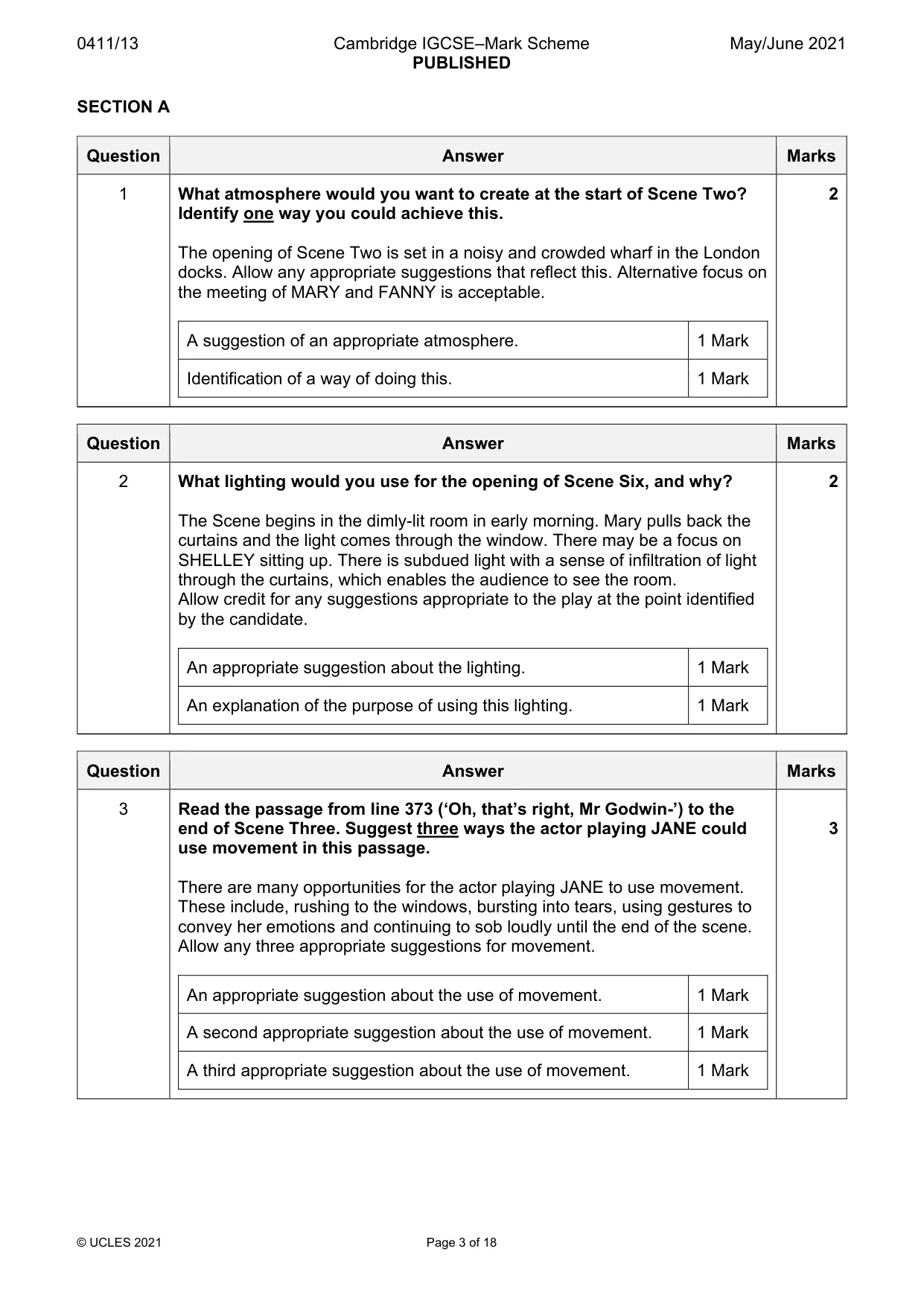
0411/13 Cambridge IGCSE–Mark Scheme PUBLISHED May/June 2021 © UCLES 2021 Page 3 of 18 SECTION A Question Answer Marks 1 What atmosphere would you want to create at the start of Scene Two? Identify one way you could achieve this. The opening of Scene Two is set in a noisy and crowded wharf in the London docks. Allow any appropriate suggestions that reflect this. Alternative focus on the meeting of MARY and FANNY is acceptable. A suggestion of an appropriate atmosphere. 1 Mark Identification of a way of doing this. 1 Mark 2 Question Answer Marks 2 What lighting would you use for the opening of Scene Six, and why? The Scene begins in the dimly-lit room in early morning. Mary pulls back the curtains and the light comes through the window. There may be a focus on SHELLEY sitting up. There is subdued light with a sense of infiltration of light through the curtains, which enables the audience to see the room. Allow credit for any suggestions appropriate to the play at the point identified by the candidate. An appropriate suggestion about the lighting. 1 Mark An explanation of the purpose of using this lighting. 1 Mark 2 Question Answer Marks 3 Read the passage from line 373 (‘Oh, that’s right, Mr Godwin-’) to the end of Scene Three. Suggest three ways the actor playing JANE could use movement in this passage. There are many opportunities for the actor playing JANE to use movement. These include, rushing to the windows, bursting into tears, using gestures to convey her emotions and continuing to sob loudly until the end of the scene. Allow any three appropriate suggestions for movement. An appropriate suggestion about the use of movement. 1 Mark A second appropriate suggestion about the use of movement. 1 Mark A third appropriate suggestion about the use of movement. 1 Mark 3
Mark scheme, page 4
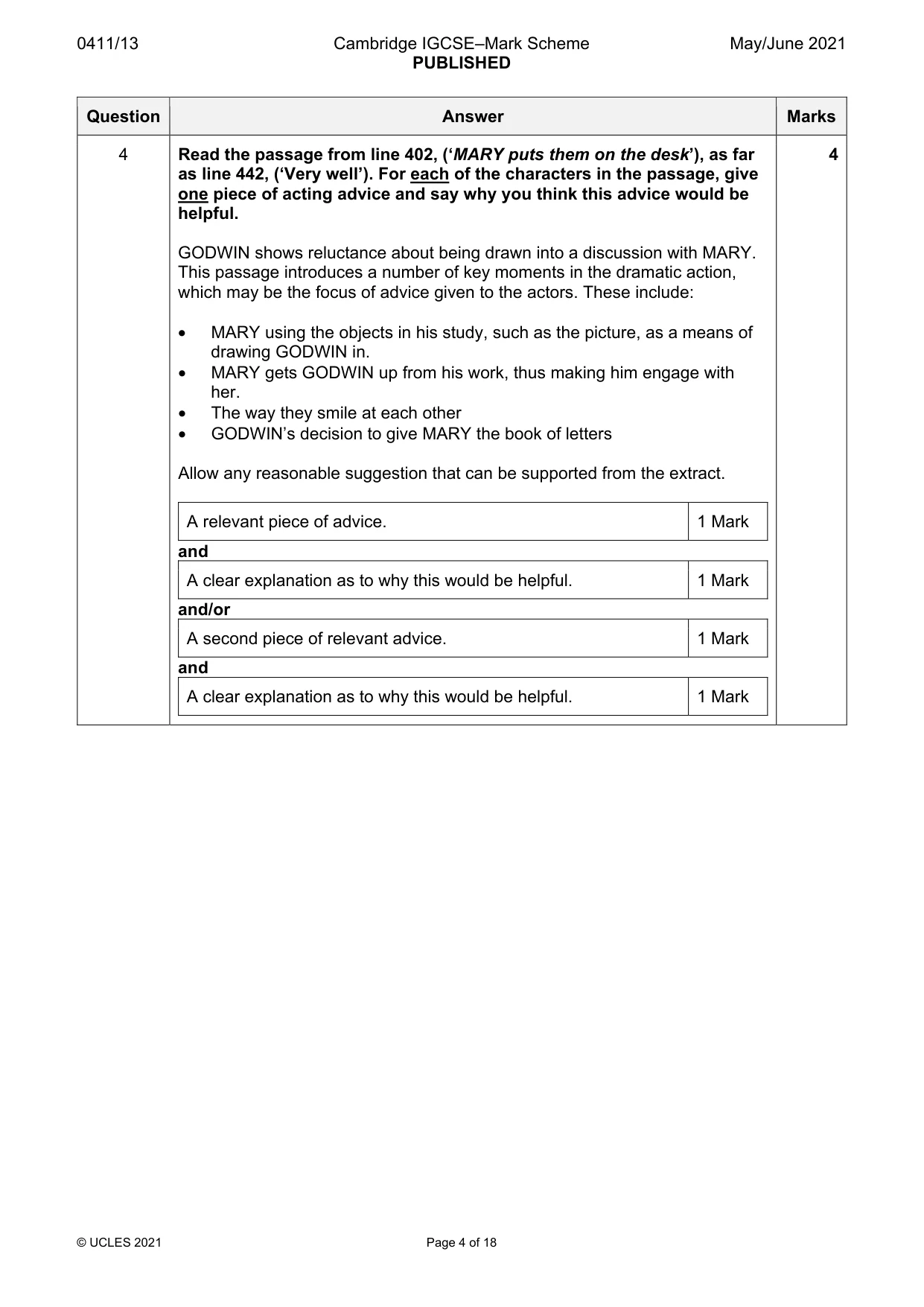
0411/13 Cambridge IGCSE–Mark Scheme PUBLISHED May/June 2021 © UCLES 2021 Page 4 of 18 Question Answer Marks 4 Read the passage from line 402, (‘MARY puts them on the desk’), as far as line 442, (‘Very well’). For each of the characters in the passage, give one piece of acting advice and say why you think this advice would be helpful. GODWIN shows reluctance about being drawn into a discussion with MARY. This passage introduces a number of key moments in the dramatic action, which may be the focus of advice given to the actors. These include: • MARY using the objects in his study, such as the picture, as a means of drawing GODWIN in. • MARY gets GODWIN up from his work, thus making him engage with her. • The way they smile at each other • GODWIN’s decision to give MARY the book of letters Allow any reasonable suggestion that can be supported from the extract. A relevant piece of advice. 1 Mark and A clear explanation as to why this would be helpful. 1 Mark and/or A second piece of relevant advice. 1 Mark and A clear explanation as to why this would be helpful. 1 Mark 4
Mark scheme, page 5
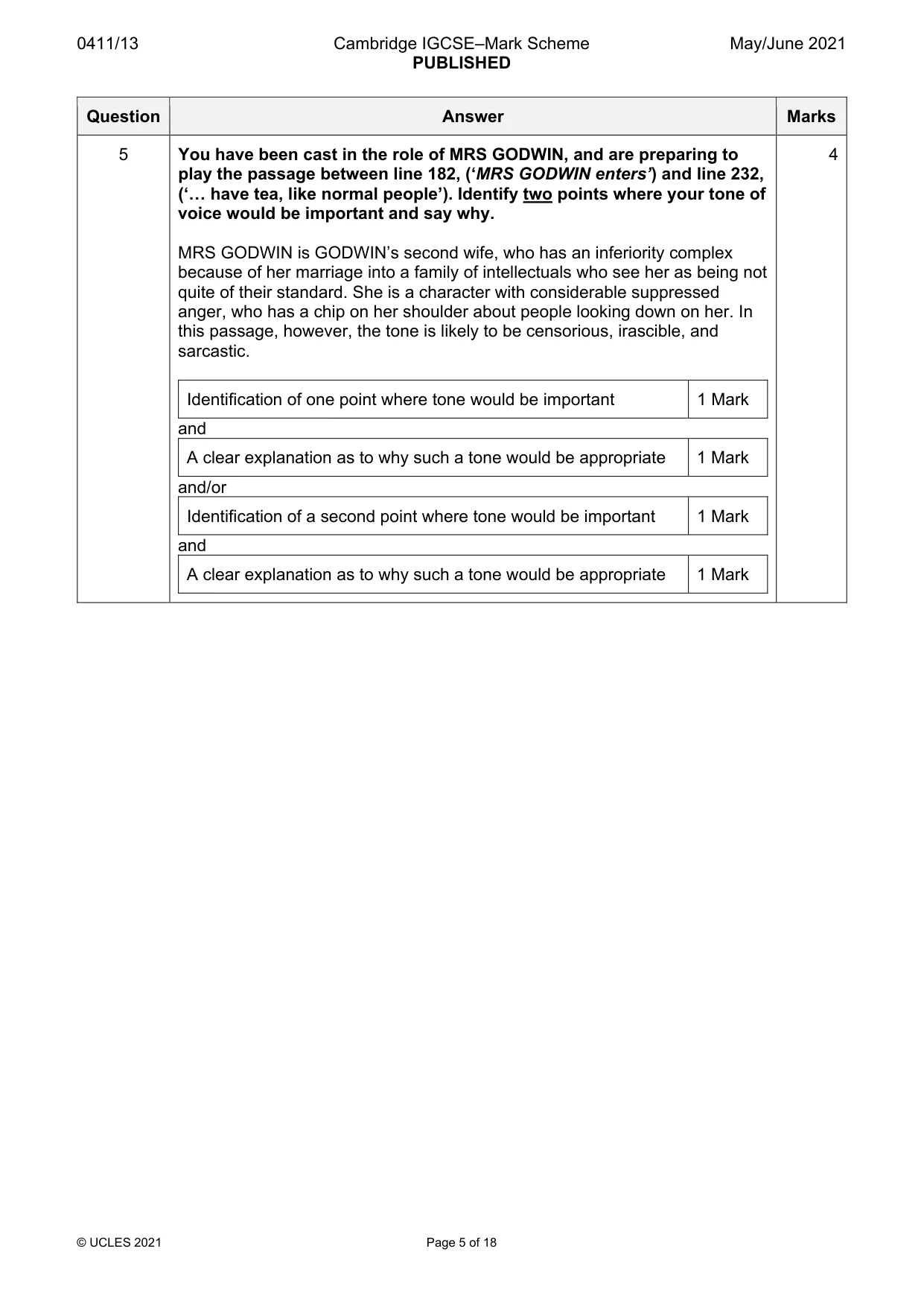
0411/13 Cambridge IGCSE–Mark Scheme PUBLISHED May/June 2021 © UCLES 2021 Page 5 of 18 Question Answer Marks 5 You have been cast in the role of MRS GODWIN, and are preparing to play the passage between line 182, (‘MRS GODWIN enters’) and line 232, (‘… have tea, like normal people’). Identify two points where your tone of voice would be important and say why. MRS GODWIN is GODWIN’s second wife, who has an inferiority complex because of her marriage into a family of intellectuals who see her as being not quite of their standard. She is a character with considerable suppressed anger, who has a chip on her shoulder about people looking down on her. In this passage, however, the tone is likely to be censorious, irascible, and sarcastic. Identification of one point where tone would be important 1 Mark and A clear explanation as to why such a tone would be appropriate 1 Mark and/or Identification of a second point where tone would be important 1 Mark and A clear explanation as to why such a tone would be appropriate 1 Mark 4
Mark scheme, page 6
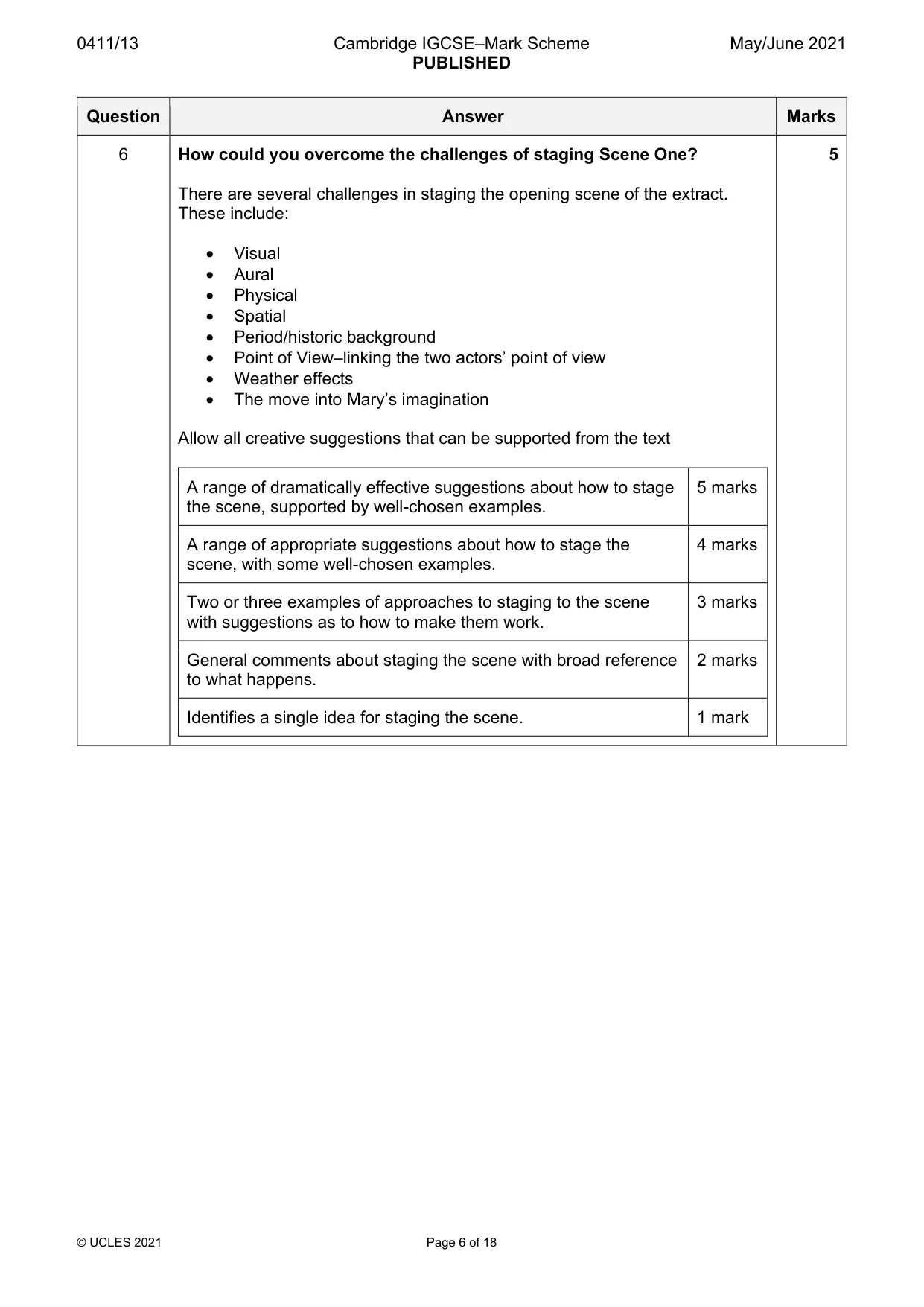
0411/13 Cambridge IGCSE–Mark Scheme PUBLISHED May/June 2021 © UCLES 2021 Page 6 of 18 Question Answer Marks 6 How could you overcome the challenges of staging Scene One? There are several challenges in staging the opening scene of the extract. These include: • Visual • Aural • Physical • Spatial • Period/historic background • Point of View–linking the two actors’ point of view • Weather effects • The move into Mary’s imagination Allow all creative suggestions that can be supported from the text A range of dramatically effective suggestions about how to stage the scene, supported by well-chosen examples. 5 marks A range of appropriate suggestions about how to stage the scene, with some well-chosen examples. 4 marks Two or three examples of approaches to staging to the scene with suggestions as to how to make them work. 3 marks General comments about staging the scene with broad reference to what happens. 2 marks Identifies a single idea for staging the scene. 1 mark 5
Mark scheme, page 7
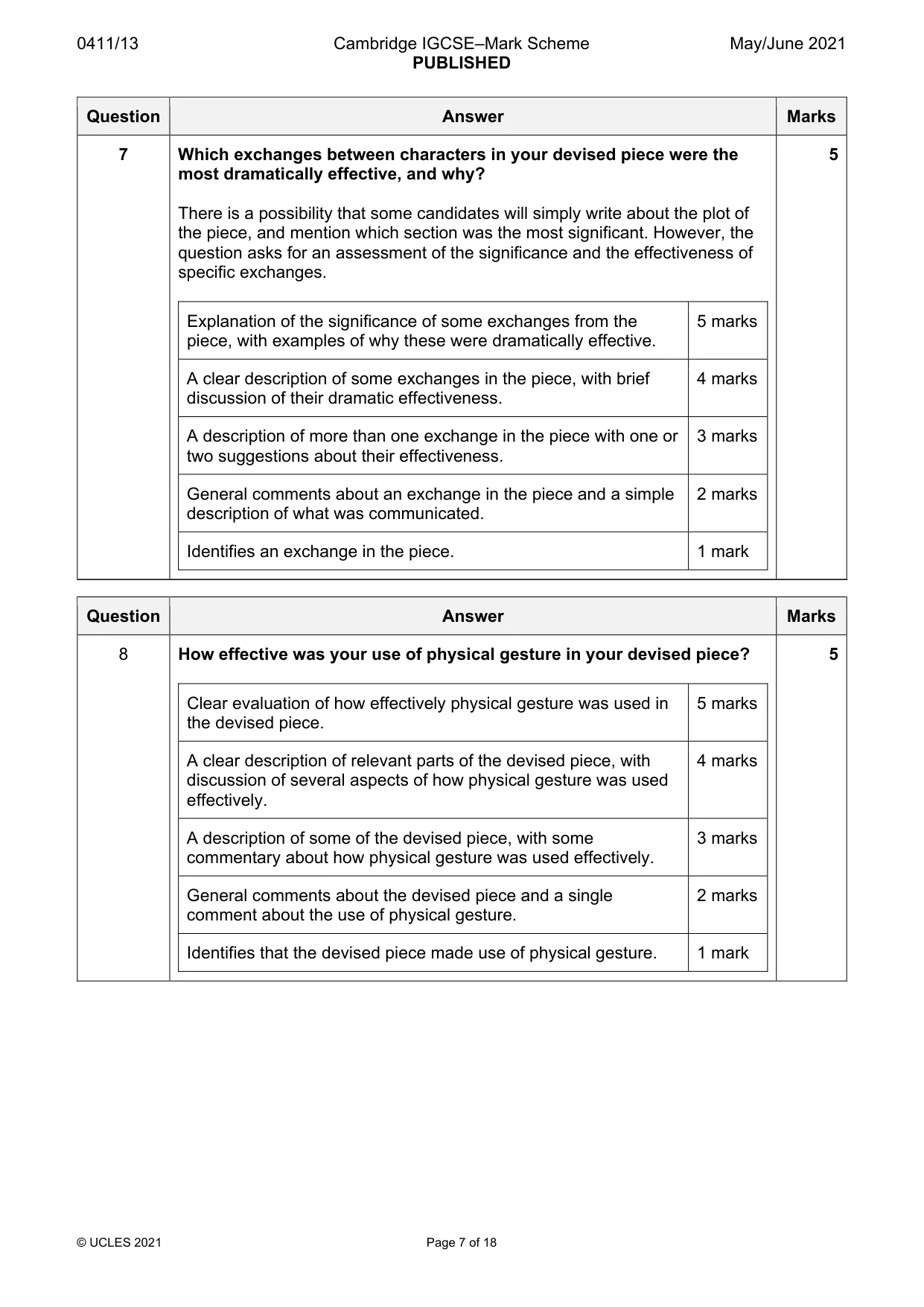
0411/13 Cambridge IGCSE–Mark Scheme PUBLISHED May/June 2021 © UCLES 2021 Page 7 of 18 Question Answer Marks 7 Which exchanges between characters in your devised piece were the most dramatically effective, and why? There is a possibility that some candidates will simply write about the plot of the piece, and mention which section was the most significant. However, the question asks for an assessment of the significance and the effectiveness of specific exchanges. Explanation of the significance of some exchanges from the piece, with examples of why these were dramatically effective. 5 marks A clear description of some exchanges in the piece, with brief discussion of their dramatic effectiveness. 4 marks A description of more than one exchange in the piece with one or two suggestions about their effectiveness. 3 marks General comments about an exchange in the piece and a simple description of what was communicated. 2 marks Identifies an exchange in the piece. 1 mark 5 Question Answer Marks 8 How effective was your use of physical gesture in your devised piece? Clear evaluation of how effectively physical gesture was used in the devised piece. 5 marks A clear description of relevant parts of the devised piece, with discussion of several aspects of how physical gesture was used effectively. 4 marks A description of some of the devised piece, with some commentary about how physical gesture was used effectively. 3 marks General comments about the devised piece and a single comment about the use of physical gesture. 2 marks Identifies that the devised piece made use of physical gesture. 1 mark 5
Mark scheme, page 8
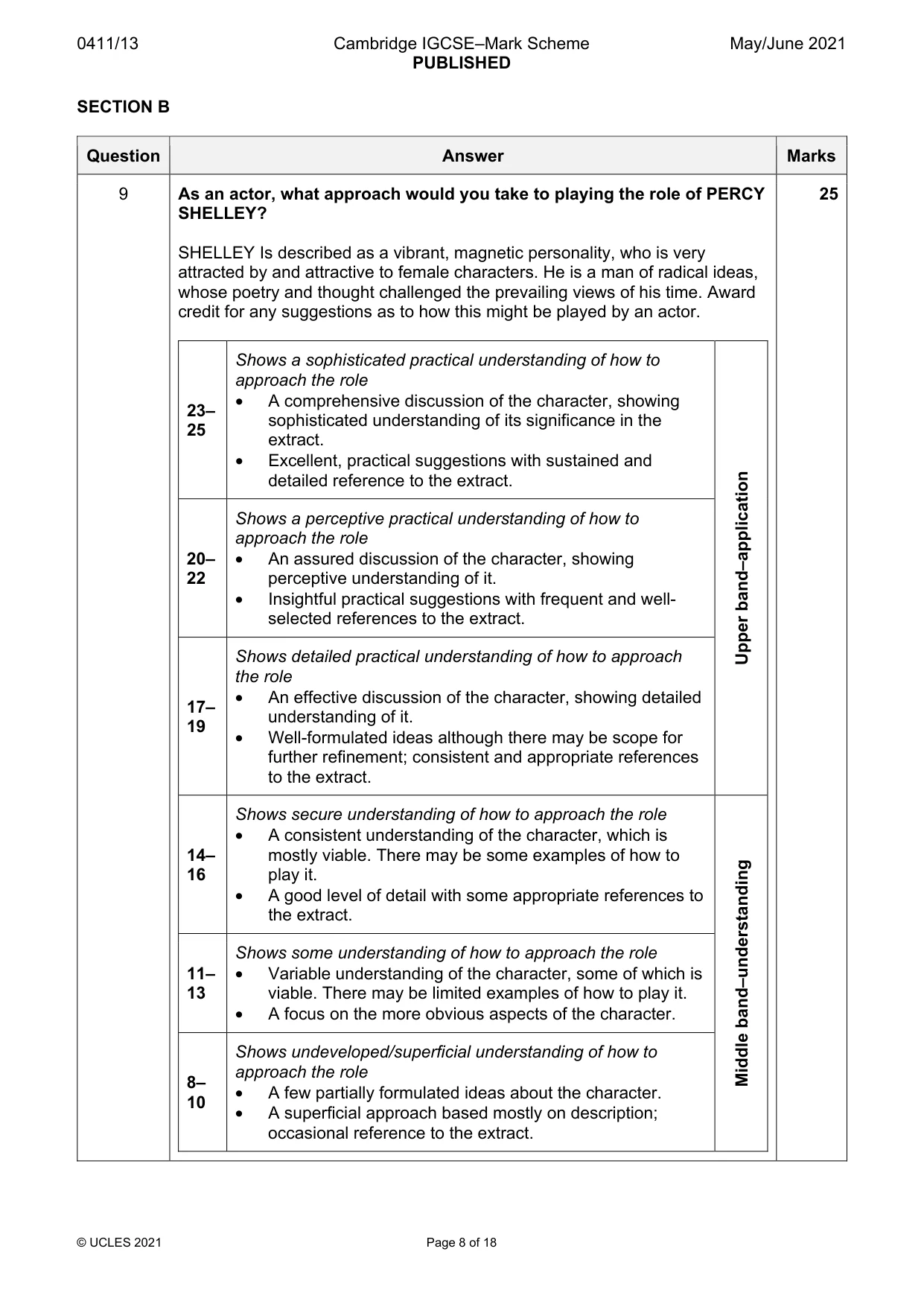
0411/13 Cambridge IGCSE–Mark Scheme PUBLISHED May/June 2021 © UCLES 2021 Page 8 of 18 SECTION B Question Answer Marks 9 As an actor, what approach would you take to playing the role of PERCY SHELLEY? SHELLEY Is described as a vibrant, magnetic personality, who is very attracted by and attractive to female characters. He is a man of radical ideas, whose poetry and thought challenged the prevailing views of his time. Award credit for any suggestions as to how this might be played by an actor. 23– 25 Shows a sophisticated practical understanding of how to approach the role • A comprehensive discussion of the character, showing sophisticated understanding of its significance in the extract. • Excellent, practical suggestions with sustained and detailed reference to the extract. Upper band–application 20– 22 Shows a perceptive practical understanding of how to approach the role • An assured discussion of the character, showing perceptive understanding of it. • Insightful practical suggestions with frequent and well- selected references to the extract. 17– 19 Shows detailed practical understanding of how to approach the role • An effective discussion of the character, showing detailed understanding of it. • Well-formulated ideas although there may be scope for further refinement; consistent and appropriate references to the extract. 14– 16 Shows secure understanding of how to approach the role • A consistent understanding of the character, which is mostly viable. There may be some examples of how to play it. • A good level of detail with some appropriate references to the extract. Middle band–understanding 11– 13 Shows some understanding of how to approach the role • Variable understanding of the character, some of which is viable. There may be limited examples of how to play it. • A focus on the more obvious aspects of the character. 8– 10 Shows undeveloped/superficial understanding of how to approach the role • A few partially formulated ideas about the character. • A superficial approach based mostly on description; occasional reference to the extract. 25
Mark scheme, page 9
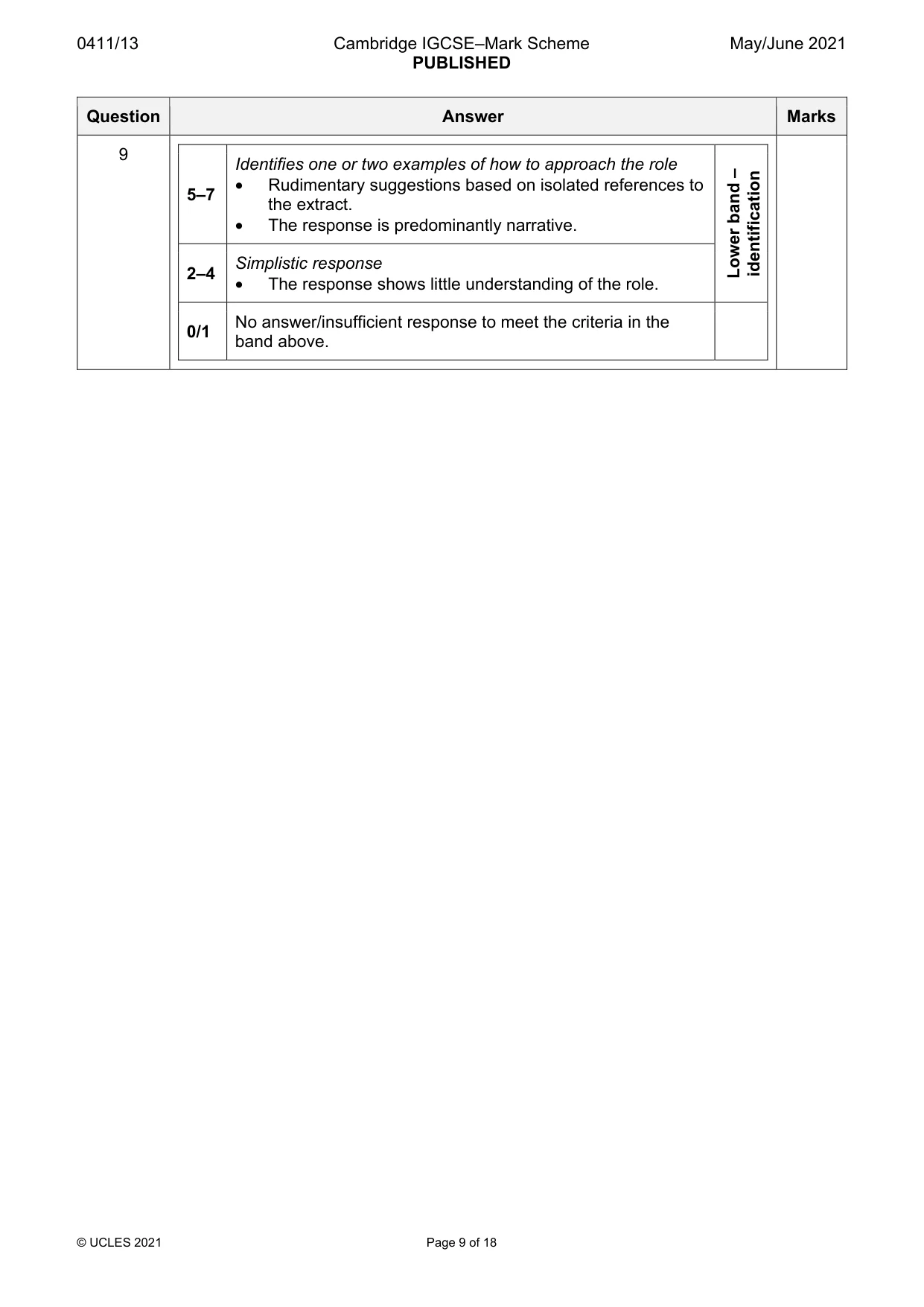
0411/13 Cambridge IGCSE–Mark Scheme PUBLISHED May/June 2021 © UCLES 2021 Page 9 of 18 Question Answer Marks 9 5–7 Identifies one or two examples of how to approach the role • Rudimentary suggestions based on isolated references to the extract. • The response is predominantly narrative. Lower band – identification 2–4 Simplistic response • The response shows little understanding of the role. 0/1 No answer/insufficient response to meet the criteria in the band above.
Mark scheme, page 10
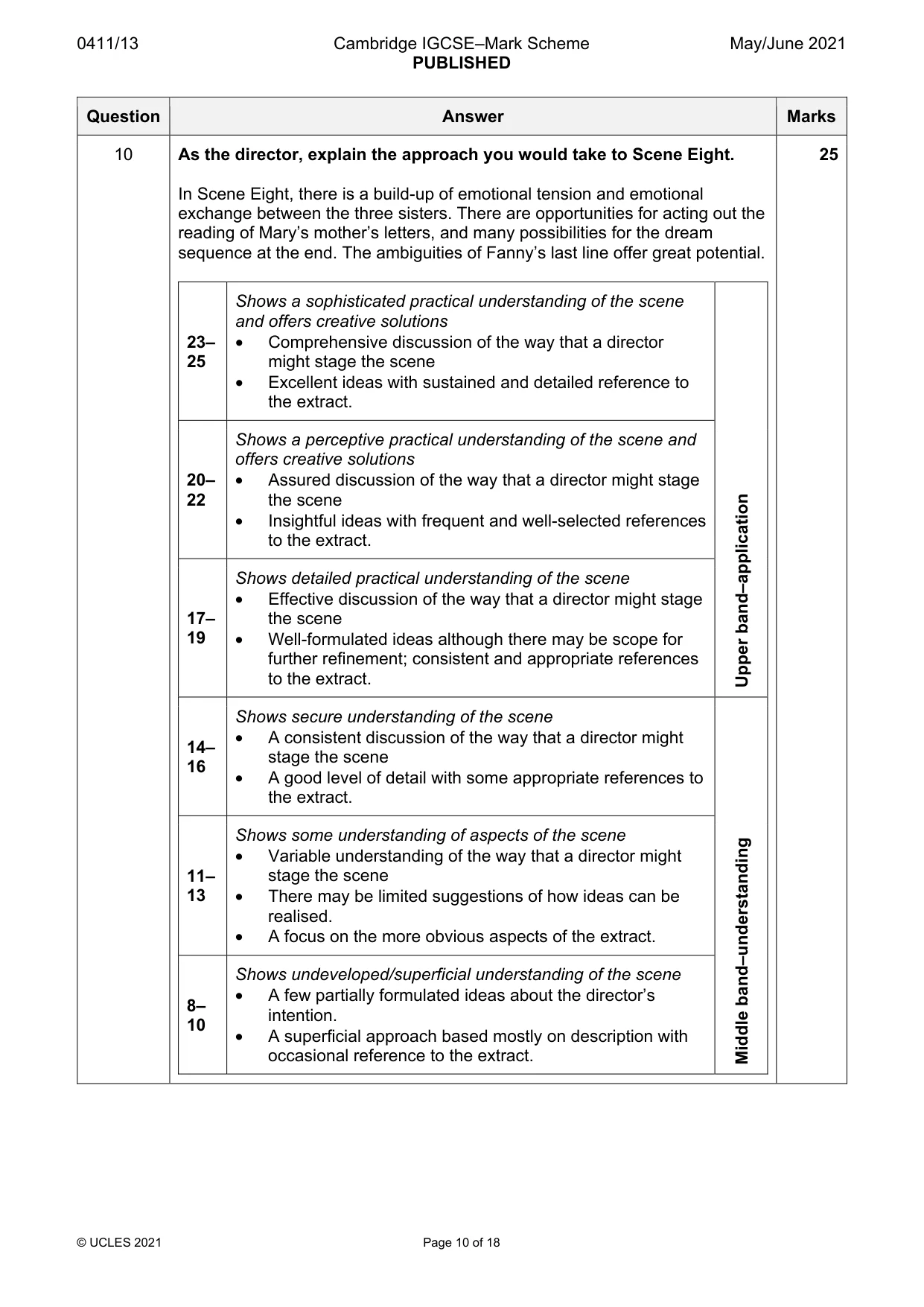
0411/13 Cambridge IGCSE–Mark Scheme PUBLISHED May/June 2021 © UCLES 2021 Page 10 of 18 Question Answer Marks 10 As the director, explain the approach you would take to Scene Eight. In Scene Eight, there is a build-up of emotional tension and emotional exchange between the three sisters. There are opportunities for acting out the reading of Mary’s mother’s letters, and many possibilities for the dream sequence at the end. The ambiguities of Fanny’s last line offer great potential. 23– 25 Shows a sophisticated practical understanding of the scene and offers creative solutions • Comprehensive discussion of the way that a director might stage the scene • Excellent ideas with sustained and detailed reference to the extract. Upper band–application 20– 22 Shows a perceptive practical understanding of the scene and offers creative solutions • Assured discussion of the way that a director might stage the scene • Insightful ideas with frequent and well-selected references to the extract. 17– 19 Shows detailed practical understanding of the scene • Effective discussion of the way that a director might stage the scene • Well-formulated ideas although there may be scope for further refinement; consistent and appropriate references to the extract. 14– 16 Shows secure understanding of the scene • A consistent discussion of the way that a director might stage the scene • A good level of detail with some appropriate references to the extract. Middle band–understanding 11– 13 Shows some understanding of aspects of the scene • Variable understanding of the way that a director might stage the scene • There may be limited suggestions of how ideas can be realised. • A focus on the more obvious aspects of the extract. 8– 10 Shows undeveloped/superficial understanding of the scene • A few partially formulated ideas about the director’s intention. • A superficial approach based mostly on description with occasional reference to the extract. 25
Mark scheme, page 11
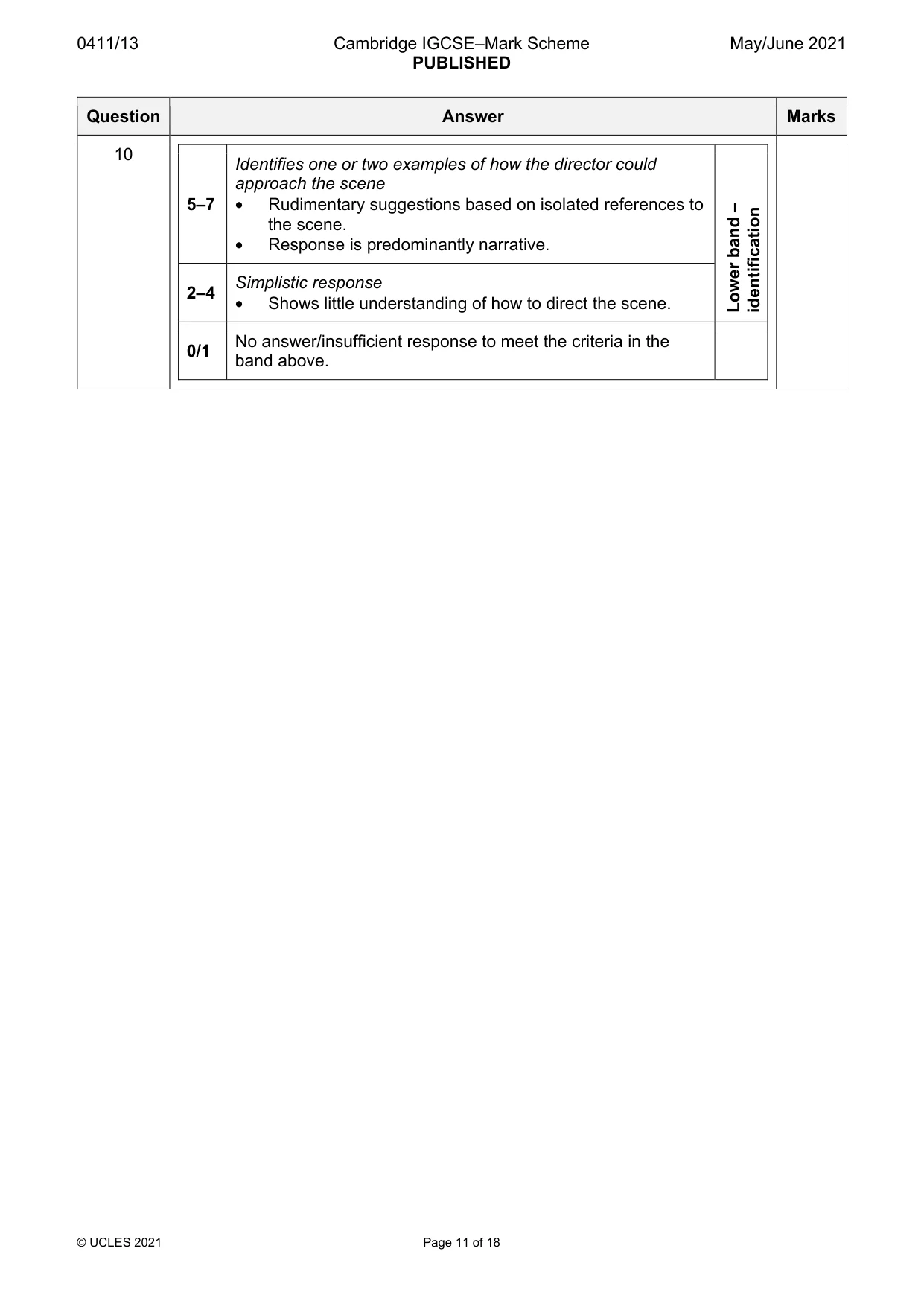
0411/13 Cambridge IGCSE–Mark Scheme PUBLISHED May/June 2021 © UCLES 2021 Page 11 of 18 Question Answer Marks 10 5–7 Identifies one or two examples of how the director could approach the scene • Rudimentary suggestions based on isolated references to the scene. • Response is predominantly narrative. Lower band – identification 2–4 Simplistic response • Shows little understanding of how to direct the scene. 0/1 No answer/insufficient response to meet the criteria in the band above.
Mark scheme, page 12
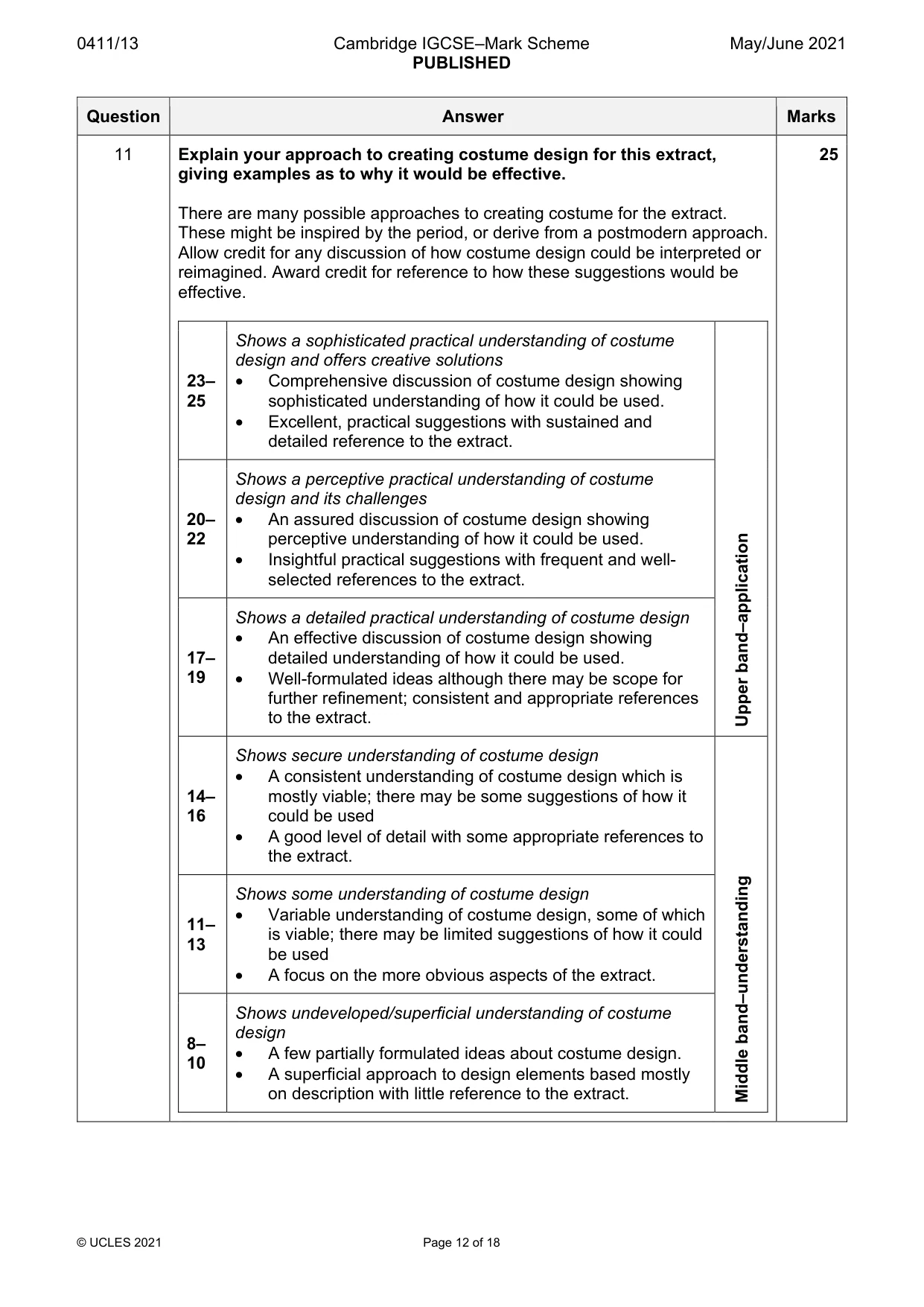
0411/13 Cambridge IGCSE–Mark Scheme PUBLISHED May/June 2021 © UCLES 2021 Page 12 of 18 Question Answer Marks 11 Explain your approach to creating costume design for this extract, giving examples as to why it would be effective. There are many possible approaches to creating costume for the extract. These might be inspired by the period, or derive from a postmodern approach. Allow credit for any discussion of how costume design could be interpreted or reimagined. Award credit for reference to how these suggestions would be effective. 23– 25 Shows a sophisticated practical understanding of costume design and offers creative solutions • Comprehensive discussion of costume design showing sophisticated understanding of how it could be used. • Excellent, practical suggestions with sustained and detailed reference to the extract. Upper band–application 20– 22 Shows a perceptive practical understanding of costume design and its challenges • An assured discussion of costume design showing perceptive understanding of how it could be used. • Insightful practical suggestions with frequent and well- selected references to the extract. 17– 19 Shows a detailed practical understanding of costume design • An effective discussion of costume design showing detailed understanding of how it could be used. • Well-formulated ideas although there may be scope for further refinement; consistent and appropriate references to the extract. 14– 16 Shows secure understanding of costume design • A consistent understanding of costume design which is mostly viable; there may be some suggestions of how it could be used • A good level of detail with some appropriate references to the extract. Middle band–understanding 11– 13 Shows some understanding of costume design • Variable understanding of costume design, some of which is viable; there may be limited suggestions of how it could be used • A focus on the more obvious aspects of the extract. 8– 10 Shows undeveloped/superficial understanding of costume design • A few partially formulated ideas about costume design. • A superficial approach to design elements based mostly on description with little reference to the extract. 25
Mark scheme, page 13
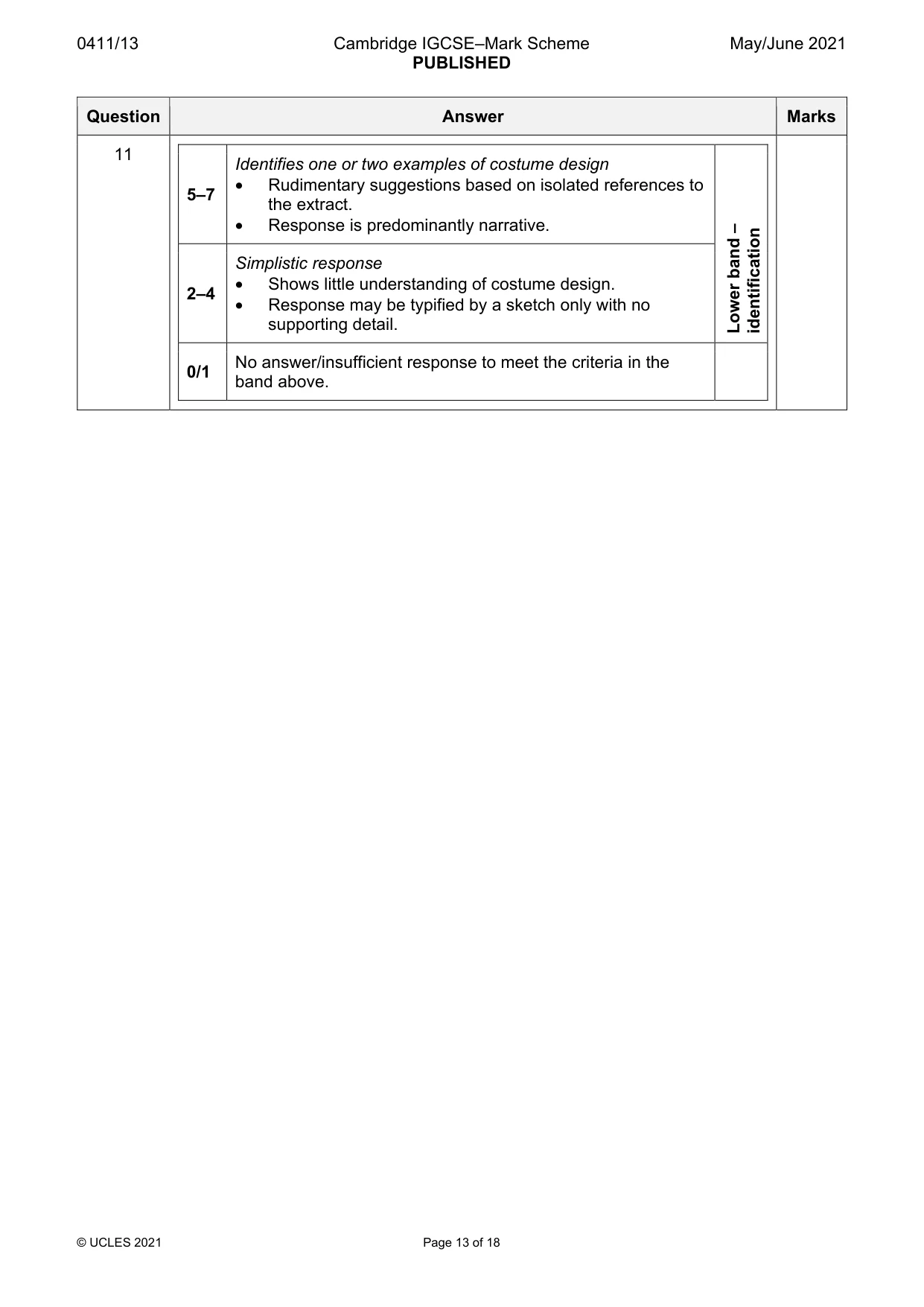
0411/13 Cambridge IGCSE–Mark Scheme PUBLISHED May/June 2021 © UCLES 2021 Page 13 of 18 Question Answer Marks 11 5–7 Identifies one or two examples of costume design • Rudimentary suggestions based on isolated references to the extract. • Response is predominantly narrative. Lower band – identification 2–4 Simplistic response • Shows little understanding of costume design. • Response may be typified by a sketch only with no supporting detail. 0/1 No answer/insufficient response to meet the criteria in the band above.
Mark scheme, page 14
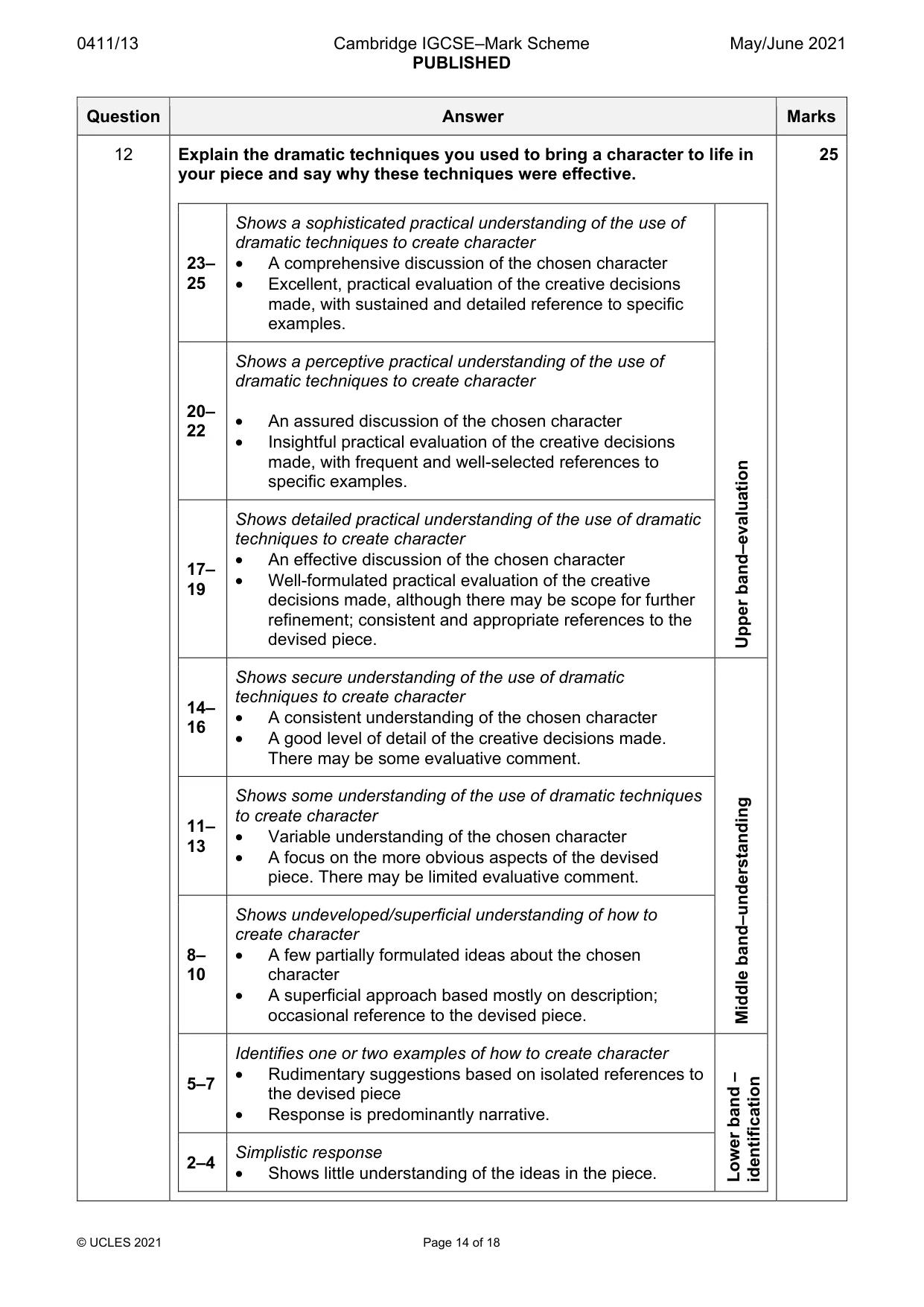
0411/13 Cambridge IGCSE–Mark Scheme PUBLISHED May/June 2021 © UCLES 2021 Page 14 of 18 Question Answer Marks 12 Explain the dramatic techniques you used to bring a character to life in your piece and say why these techniques were effective. 23– 25 Shows a sophisticated practical understanding of the use of dramatic techniques to create character • A comprehensive discussion of the chosen character • Excellent, practical evaluation of the creative decisions made, with sustained and detailed reference to specific examples. Upper band–evaluation 20– 22 Shows a perceptive practical understanding of the use of dramatic techniques to create character • An assured discussion of the chosen character • Insightful practical evaluation of the creative decisions made, with frequent and well-selected references to specific examples. 17– 19 Shows detailed practical understanding of the use of dramatic techniques to create character • An effective discussion of the chosen character • Well-formulated practical evaluation of the creative decisions made, although there may be scope for further refinement; consistent and appropriate references to the devised piece. 14– 16 Shows secure understanding of the use of dramatic techniques to create character • A consistent understanding of the chosen character • A good level of detail of the creative decisions made. There may be some evaluative comment. Middle band–understanding 11– 13 Shows some understanding of the use of dramatic techniques to create character • Variable understanding of the chosen character • A focus on the more obvious aspects of the devised piece. There may be limited evaluative comment. 8– 10 Shows undeveloped/superficial understanding of how to create character • A few partially formulated ideas about the chosen character • A superficial approach based mostly on description; occasional reference to the devised piece. 5–7 Identifies one or two examples of how to create character • Rudimentary suggestions based on isolated references to the devised piece • Response is predominantly narrative. Lower band – identification 2–4 Simplistic response • Shows little understanding of the ideas in the piece. 25
Mark scheme, page 15
0411/13 Cambridge IGCSE–Mark Scheme PUBLISHED May/June 2021 © UCLES 2021 Page 15 of 18 Question Answer Marks 12 0/1 No answer/insufficient response to meet the criteria in the band above.
Mark scheme, page 16
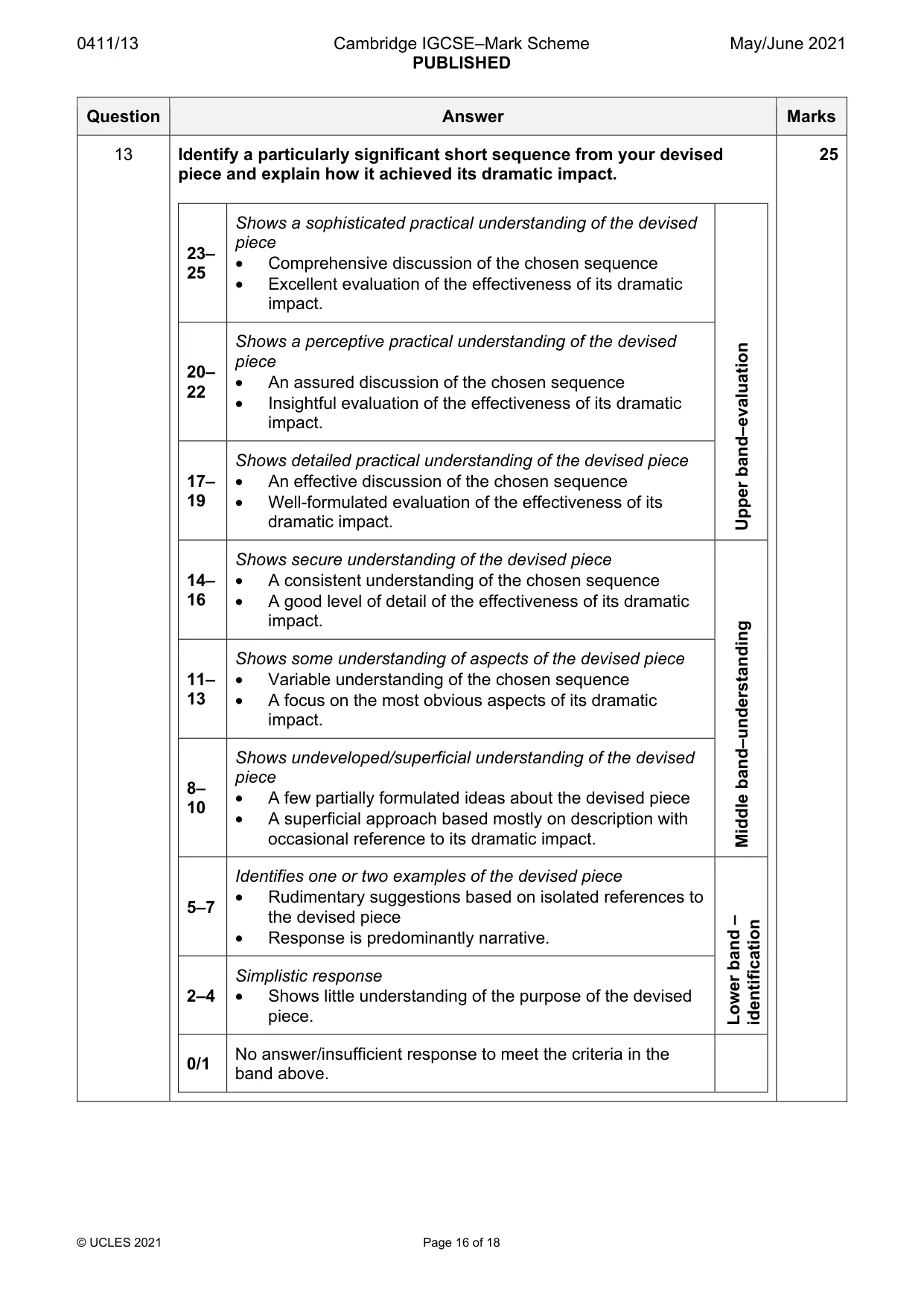
0411/13 Cambridge IGCSE–Mark Scheme PUBLISHED May/June 2021 © UCLES 2021 Page 16 of 18 Question Answer Marks 13 Identify a particularly significant short sequence from your devised piece and explain how it achieved its dramatic impact. 23– 25 Shows a sophisticated practical understanding of the devised piece • Comprehensive discussion of the chosen sequence • Excellent evaluation of the effectiveness of its dramatic impact. Upper band–evaluation 20– 22 Shows a perceptive practical understanding of the devised piece • An assured discussion of the chosen sequence • Insightful evaluation of the effectiveness of its dramatic impact. 17– 19 Shows detailed practical understanding of the devised piece • An effective discussion of the chosen sequence • Well-formulated evaluation of the effectiveness of its dramatic impact. 14– 16 Shows secure understanding of the devised piece • A consistent understanding of the chosen sequence • A good level of detail of the effectiveness of its dramatic impact. Middle band–understanding 11– 13 Shows some understanding of aspects of the devised piece • Variable understanding of the chosen sequence • A focus on the most obvious aspects of its dramatic impact. 8– 10 Shows undeveloped/superficial understanding of the devised piece • A few partially formulated ideas about the devised piece • A superficial approach based mostly on description with occasional reference to its dramatic impact. 5–7 Identifies one or two examples of the devised piece • Rudimentary suggestions based on isolated references to the devised piece • Response is predominantly narrative. Lower band – identification 2–4 Simplistic response • Shows little understanding of the purpose of the devised piece. 0/1 No answer/insufficient response to meet the criteria in the band above. 25
Mark scheme, page 17
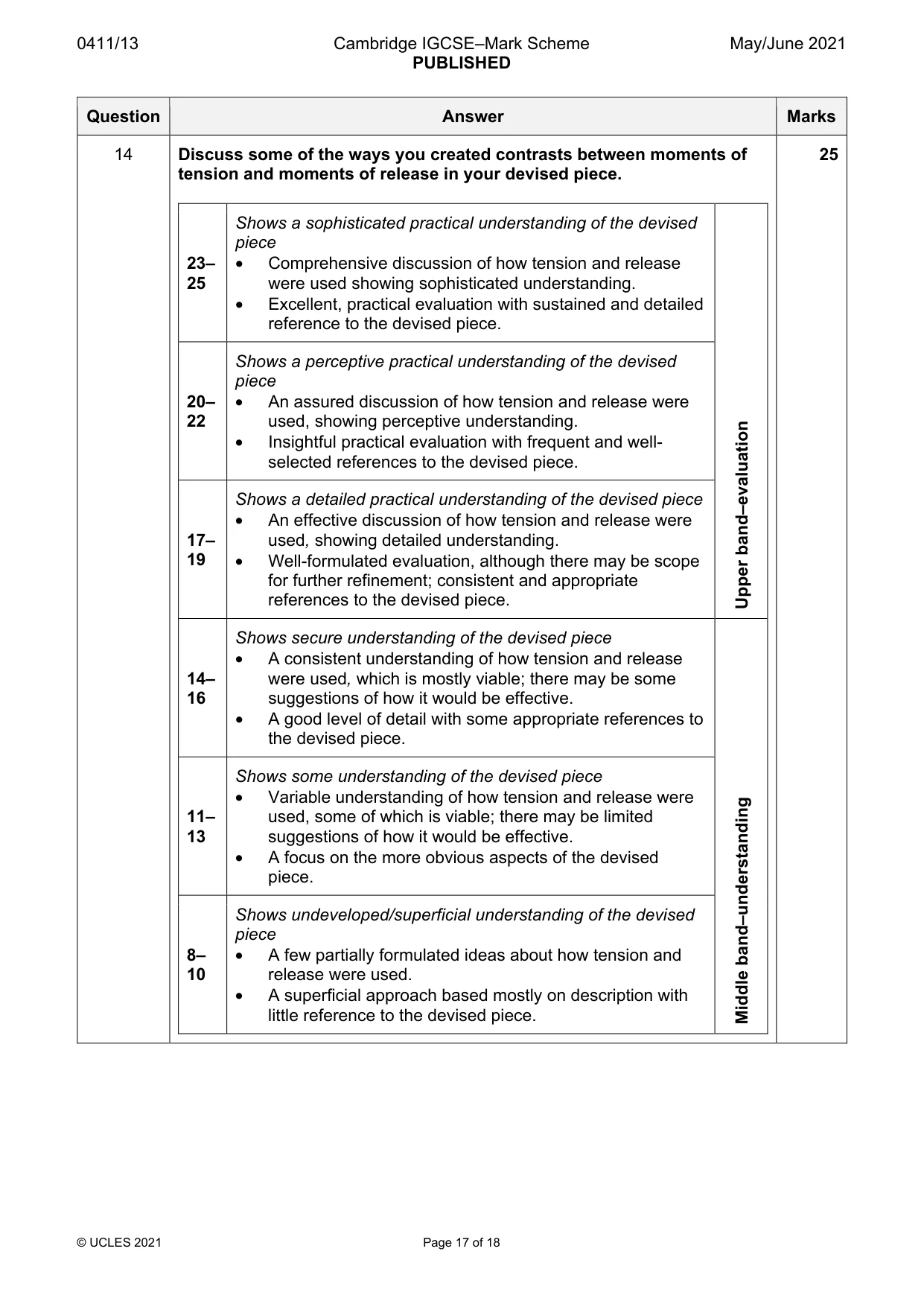
0411/13 Cambridge IGCSE–Mark Scheme PUBLISHED May/June 2021 © UCLES 2021 Page 17 of 18 Question Answer Marks 14 Discuss some of the ways you created contrasts between moments of tension and moments of release in your devised piece. 23– 25 Shows a sophisticated practical understanding of the devised piece • Comprehensive discussion of how tension and release were used showing sophisticated understanding. • Excellent, practical evaluation with sustained and detailed reference to the devised piece. Upper band–evaluation 20– 22 Shows a perceptive practical understanding of the devised piece • An assured discussion of how tension and release were used, showing perceptive understanding. • Insightful practical evaluation with frequent and well- selected references to the devised piece. 17– 19 Shows a detailed practical understanding of the devised piece • An effective discussion of how tension and release were used, showing detailed understanding. • Well-formulated evaluation, although there may be scope for further refinement; consistent and appropriate references to the devised piece. 14– 16 Shows secure understanding of the devised piece • A consistent understanding of how tension and release were used, which is mostly viable; there may be some suggestions of how it would be effective. • A good level of detail with some appropriate references to the devised piece. Middle band–understanding 11– 13 Shows some understanding of the devised piece • Variable understanding of how tension and release were used, some of which is viable; there may be limited suggestions of how it would be effective. • A focus on the more obvious aspects of the devised piece. 8– 10 Shows undeveloped/superficial understanding of the devised piece • A few partially formulated ideas about how tension and release were used. • A superficial approach based mostly on description with little reference to the devised piece. 25
Mark scheme, page 18
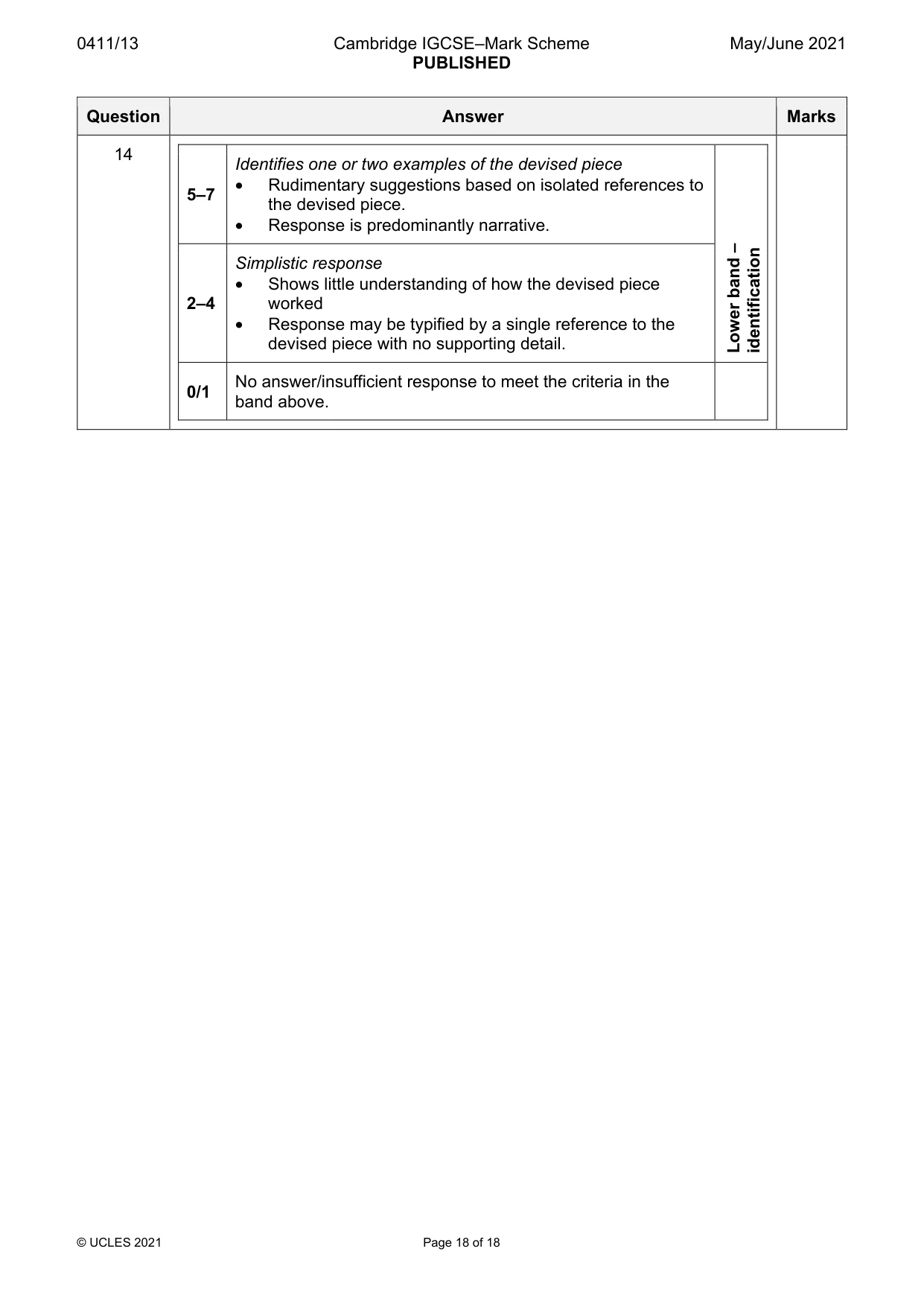
0411/13 Cambridge IGCSE–Mark Scheme PUBLISHED May/June 2021 © UCLES 2021 Page 18 of 18 Question Answer Marks 14 5–7 Identifies one or two examples of the devised piece • Rudimentary suggestions based on isolated references to the devised piece. • Response is predominantly narrative. Lower band – identification 2–4 Simplistic response • Shows little understanding of how the devised piece worked • Response may be typified by a single reference to the devised piece with no supporting detail. 0/1 No answer/insufficient response to meet the criteria in the band above.
What you needed in this session
Cambridge’s own grade thresholds for 2021 May/June, Paper 1 · Variant 3. A higher threshold means an easier paper — the bar moves with how the cohort did.