Cambridge IGCSE Drama 0411 — 2019 May/June Paper 1 · Variant 3
0411/13/M/J/19 · 80 marks · ≈90 min
The question paper and its mark scheme, free to read here and free to download. This is Cambridge’s own paper, exactly as it was sat.
Question paper4 pages

Mark scheme19 pages
Answers below. Sit the paper first if you are practising.
Paper as text
Question paper, page 1
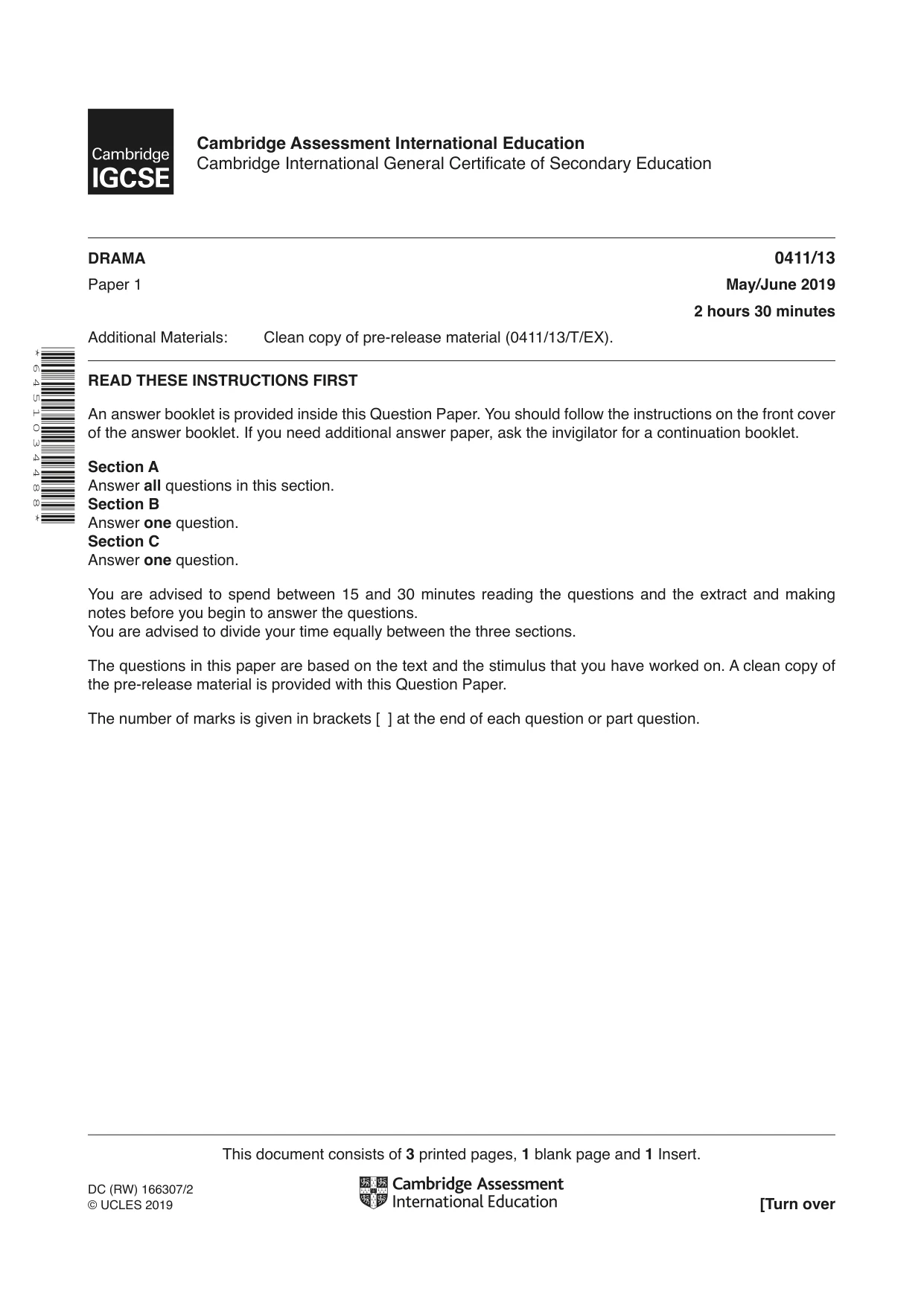
This document consists of 3 printed pages, 1 blank page and 1 Insert. DC (RW) 166307/2 © UCLES 2019 [Turn over Cambridge Assessment International Education Cambridge International General Certificate of Secondary Education * 6 4 5 1 0 3 4 4 8 8 * DRAMA 0411/13 Paper 1 May/June 2019 2 hours 30 minutes Additional Materials: Clean copy of pre-release material (0411/13/T/EX). READ THESE INSTRUCTIONS FIRST An answer booklet is provided inside this Question Paper. You should follow the instructions on the front cover of the answer booklet. If you need additional answer paper, ask the invigilator for a continuation booklet. Section A Answer all questions in this section. Section B Answer one question. Section C Answer one question. You are advised to spend between 15 and 30 minutes reading the questions and the extract and making notes before you begin to answer the questions. You are advised to divide your time equally between the three sections. The questions in this paper are based on the text and the stimulus that you have worked on. A clean copy of the pre-release material is provided with this Question Paper. The number of marks is given in brackets [ ] at the end of each question or part question.
Question paper, page 2
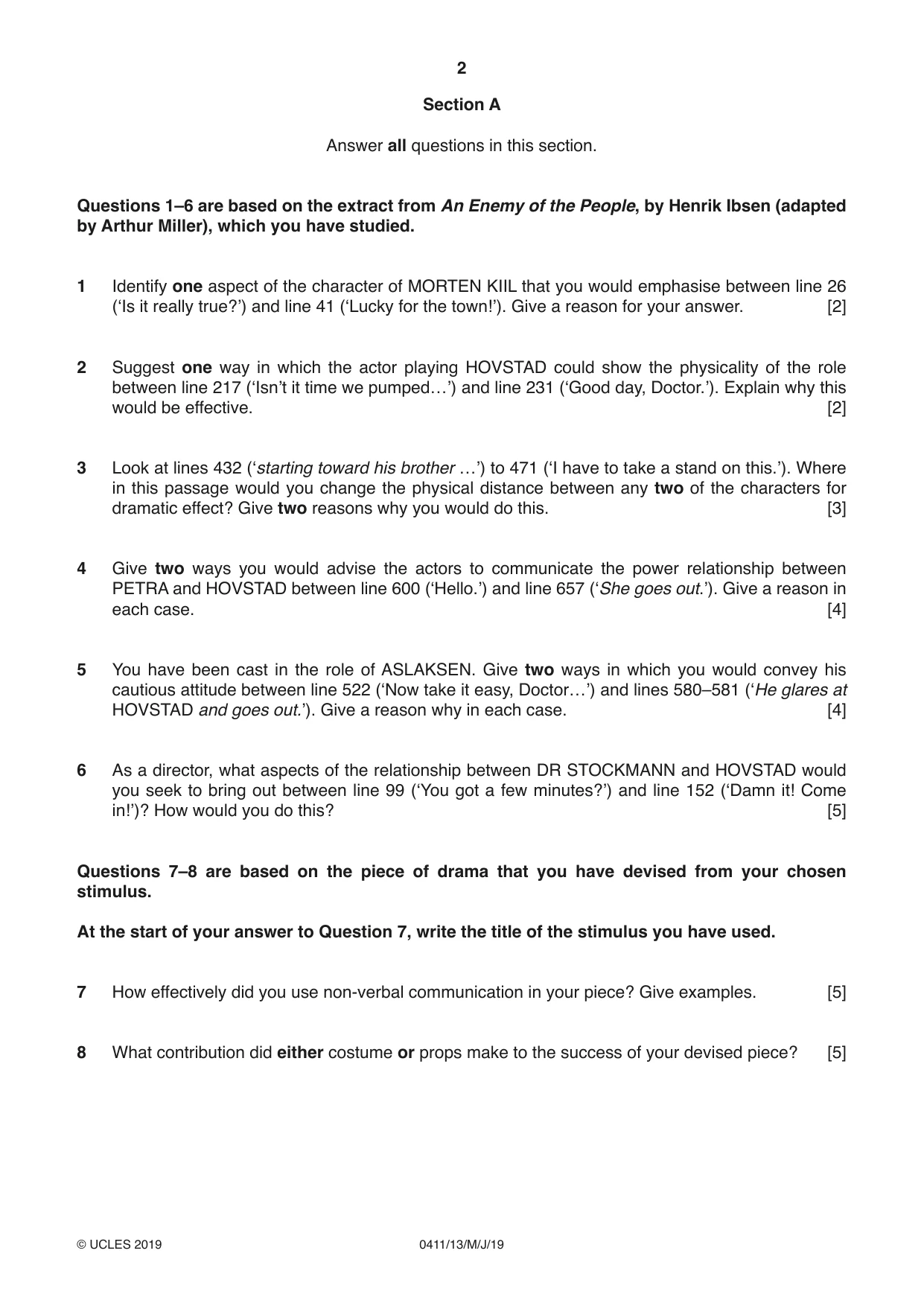
2 0411/13/M/J/19 © UCLES 2019 Section A Answer all questions in this section. Questions 1–6 are based on the extract from An Enemy of the People, by Henrik Ibsen (adapted by Arthur Miller), which you have studied. 1 Identify one aspect of the character of MORTEN KIIL that you would emphasise between line 26 (‘Is it really true?’) and line 41 (‘Lucky for the town!’). Give a reason for your answer. [2] 2 Suggest one way in which the actor playing HOVSTAD could show the physicality of the role between line 217 (‘Isn’t it time we pumped…’) and line 231 (‘Good day, Doctor.’). Explain why this would be effective. [2] 3 Look at lines 432 (‘starting toward his brother …’) to 471 (‘I have to take a stand on this.’). Where in this passage would you change the physical distance between any two of the characters for dramatic effect? Give two reasons why you would do this. [3] 4 Give two ways you would advise the actors to communicate the power relationship between PETRA and HOVSTAD between line 600 (‘Hello.’) and line 657 (‘She goes out.’). Give a reason in each case. [4] 5 You have been cast in the role of ASLAKSEN. Give two ways in which you would convey his cautious attitude between line 522 (‘Now take it easy, Doctor…’) and lines 580–581 (‘He glares at HOVSTAD and goes out.’). Give a reason why in each case. [4] 6 As a director, what aspects of the relationship between DR STOCKMANN and HOVSTAD would you seek to bring out between line 99 (‘You got a few minutes?’) and line 152 (‘Damn it! Come in!’)? How would you do this? [5] Questions 7–8 are based on the piece of drama that you have devised from your chosen stimulus. At the start of your answer to Question 7, write the title of the stimulus you have used. 7 How effectively did you use non-verbal communication in your piece? Give examples. [5] 8 What contribution did either costume or props make to the success of your devised piece? [5]
Question paper, page 3
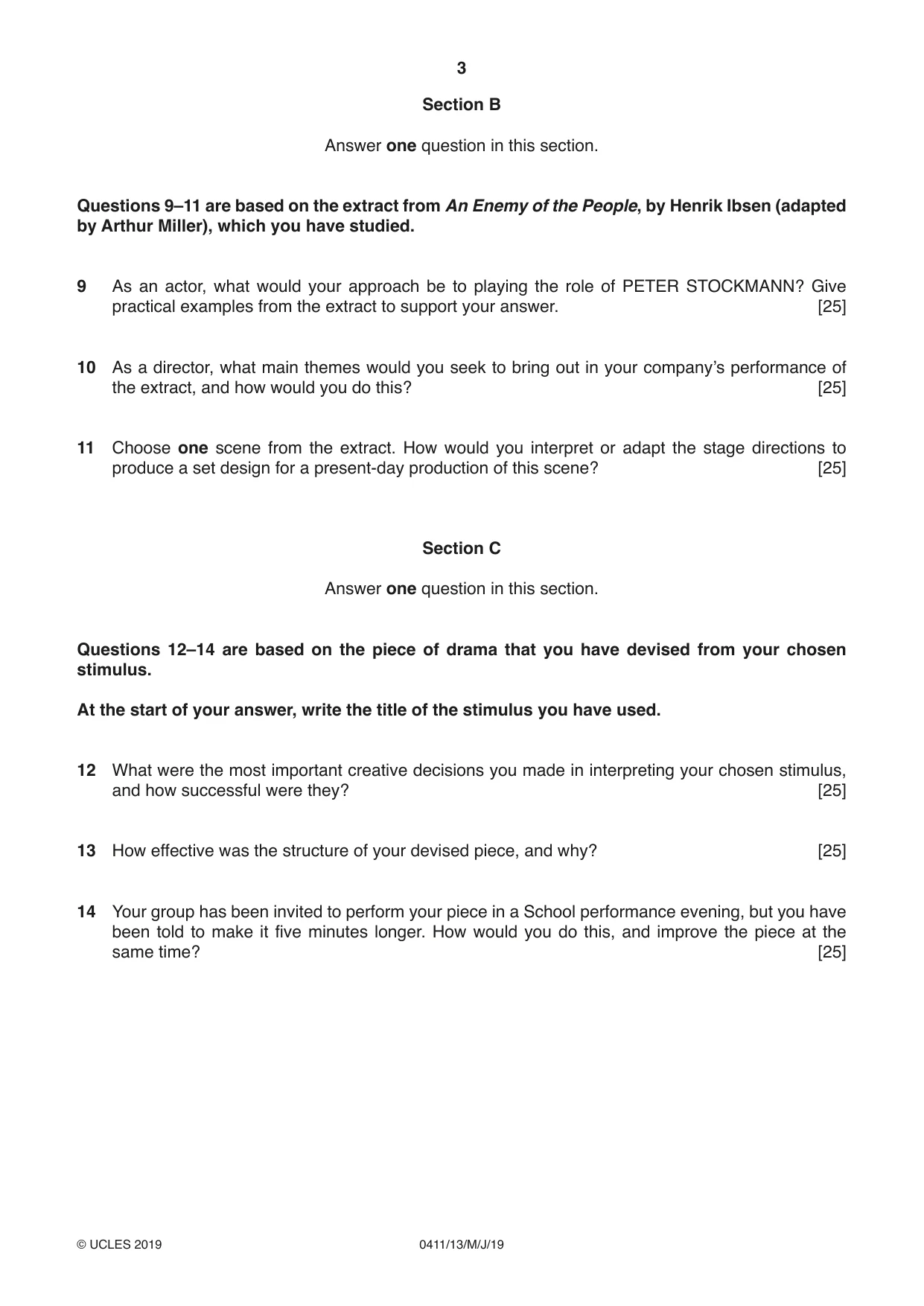
3 0411/13/M/J/19 © UCLES 2019 Section B Answer one question in this section. Questions 9–11 are based on the extract from An Enemy of the People, by Henrik Ibsen (adapted by Arthur Miller), which you have studied. 9 As an actor, what would your approach be to playing the role of PETER STOCKMANN? Give practical examples from the extract to support your answer. [25] 10 As a director, what main themes would you seek to bring out in your company’s performance of the extract, and how would you do this? [25] 11 Choose one scene from the extract. How would you interpret or adapt the stage directions to produce a set design for a present-day production of this scene? [25] Section C Answer one question in this section. Questions 12–14 are based on the piece of drama that you have devised from your chosen stimulus. At the start of your answer, write the title of the stimulus you have used. 12 What were the most important creative decisions you made in interpreting your chosen stimulus, and how successful were they? [25] 13 How effective was the structure of your devised piece, and why? [25] 14 Your group has been invited to perform your piece in a School performance evening, but you have been told to make it five minutes longer. How would you do this, and improve the piece at the same time? [25]
Question paper, page 4
4 0411/13/M/J/19 © UCLES 2019 BLANK PAGE Permission to reproduce items where third-party owned material protected by copyright is included has been sought and cleared where possible. Every reasonable effort has been made by the publisher (UCLES) to trace copyright holders, but if any items requiring clearance have unwittingly been included, the publisher will be pleased to make amends at the earliest possible opportunity. To avoid the issue of disclosure of answer-related information to candidates, all copyright acknowledgements are reproduced online in the Cambridge Assessment International Education Copyright Acknowledgements Booklet. This is produced for each series of examinations and is freely available to download at www.cambridgeinternational.org after the live examination series. Cambridge Assessment International Education is part of the Cambridge Assessment Group. Cambridge Assessment is the brand name of the University of Cambridge Local Examinations Syndicate (UCLES), which itself is a department of the University of Cambridge.
Mark scheme, page 1
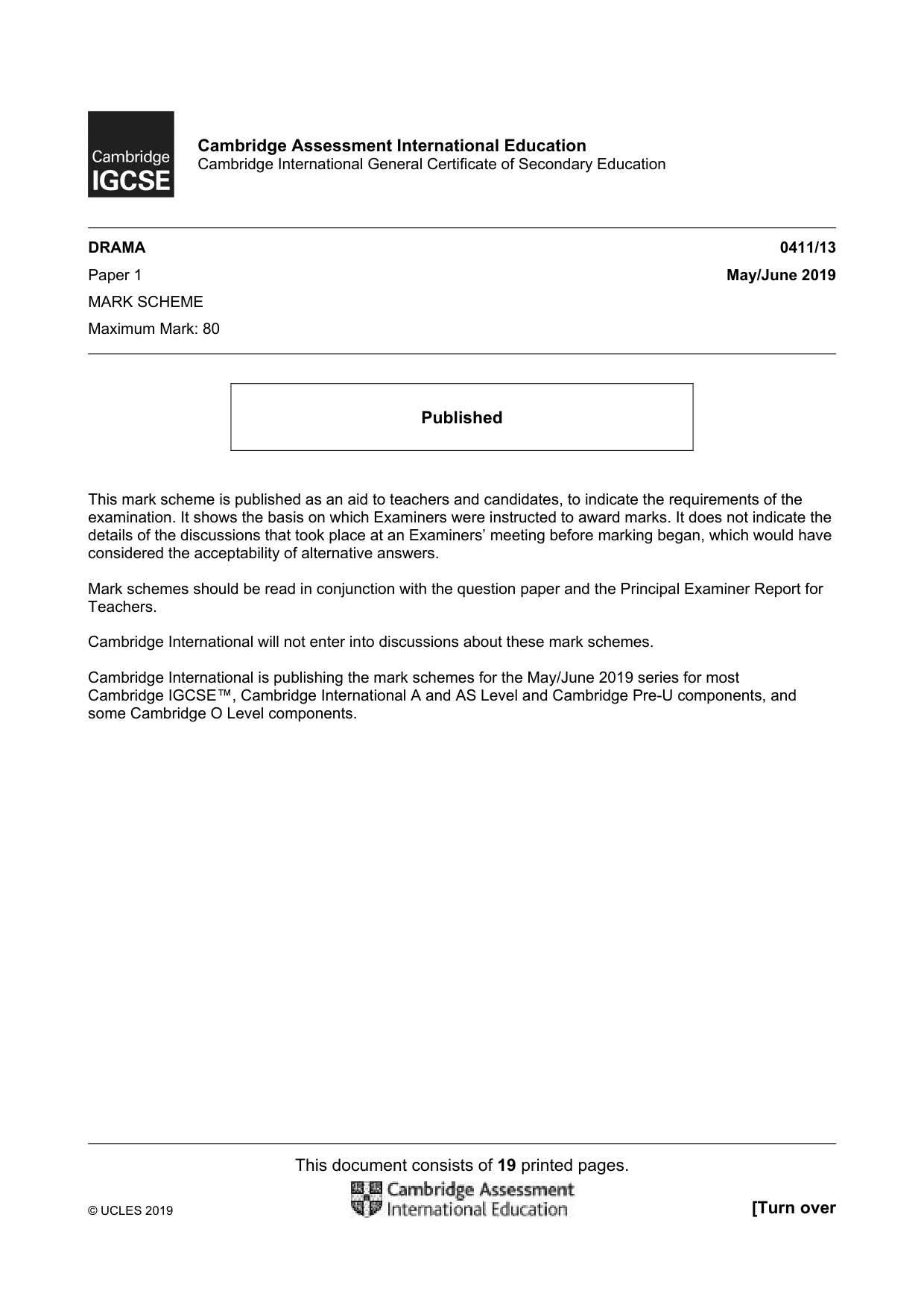
This document consists of 19 printed pages. © UCLES 2019 [Turn over Cambridge Assessment International Education Cambridge International General Certificate of Secondary Education DRAMA 0411/13 Paper 1 May/June 2019 MARK SCHEME Maximum Mark: 80 Published This mark scheme is published as an aid to teachers and candidates, to indicate the requirements of the examination. It shows the basis on which Examiners were instructed to award marks. It does not indicate the details of the discussions that took place at an Examiners’ meeting before marking began, which would have considered the acceptability of alternative answers. Mark schemes should be read in conjunction with the question paper and the Principal Examiner Report for Teachers. Cambridge International will not enter into discussions about these mark schemes. Cambridge International is publishing the mark schemes for the May/June 2019 series for most Cambridge IGCSE™, Cambridge International A and AS Level and Cambridge Pre-U components, and some Cambridge O Level components.
Mark scheme, page 2
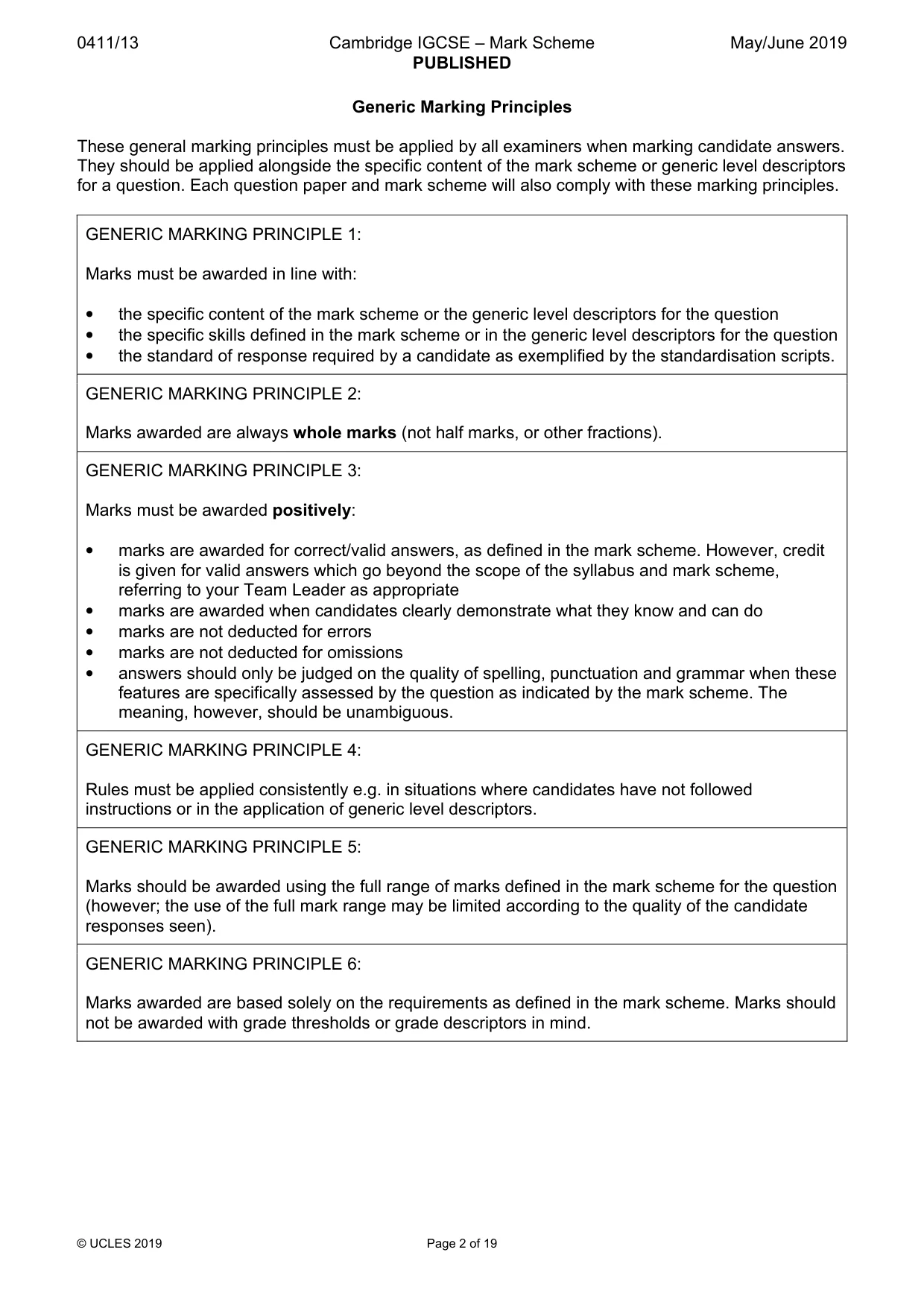
0411/13 Cambridge IGCSE – Mark Scheme PUBLISHED May/June 2019 © UCLES 2019 Page 2 of 19 Generic Marking Principles These general marking principles must be applied by all examiners when marking candidate answers. They should be applied alongside the specific content of the mark scheme or generic level descriptors for a question. Each question paper and mark scheme will also comply with these marking principles. GENERIC MARKING PRINCIPLE 1: Marks must be awarded in line with: • the specific content of the mark scheme or the generic level descriptors for the question • the specific skills defined in the mark scheme or in the generic level descriptors for the question • the standard of response required by a candidate as exemplified by the standardisation scripts. GENERIC MARKING PRINCIPLE 2: Marks awarded are always whole marks (not half marks, or other fractions). GENERIC MARKING PRINCIPLE 3: Marks must be awarded positively: • marks are awarded for correct/valid answers, as defined in the mark scheme. However, credit is given for valid answers which go beyond the scope of the syllabus and mark scheme, referring to your Team Leader as appropriate • marks are awarded when candidates clearly demonstrate what they know and can do • marks are not deducted for errors • marks are not deducted for omissions • answers should only be judged on the quality of spelling, punctuation and grammar when these features are specifically assessed by the question as indicated by the mark scheme. The meaning, however, should be unambiguous. GENERIC MARKING PRINCIPLE 4: Rules must be applied consistently e.g. in situations where candidates have not followed instructions or in the application of generic level descriptors. GENERIC MARKING PRINCIPLE 5: Marks should be awarded using the full range of marks defined in the mark scheme for the question (however; the use of the full mark range may be limited according to the quality of the candidate responses seen). GENERIC MARKING PRINCIPLE 6: Marks awarded are based solely on the requirements as defined in the mark scheme. Marks should not be awarded with grade thresholds or grade descriptors in mind.
Mark scheme, page 3
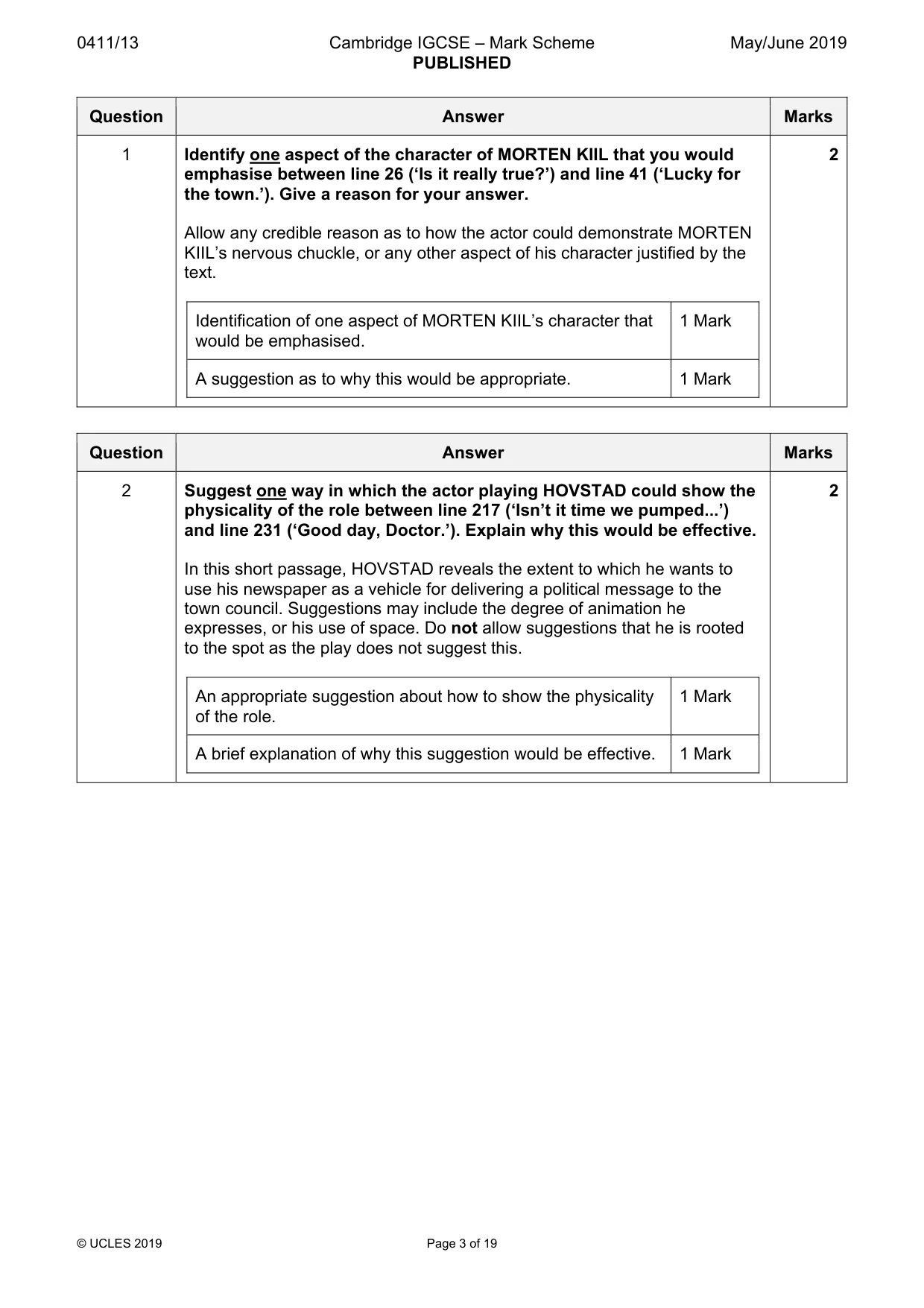
0411/13 Cambridge IGCSE – Mark Scheme PUBLISHED May/June 2019 © UCLES 2019 Page 3 of 19 Question Answer Marks 1 Identify one aspect of the character of MORTEN KIIL that you would emphasise between line 26 (‘Is it really true?’) and line 41 (‘Lucky for the town.’). Give a reason for your answer. Allow any credible reason as to how the actor could demonstrate MORTEN KIIL’s nervous chuckle, or any other aspect of his character justified by the text. Identification of one aspect of MORTEN KIIL’s character that would be emphasised. 1 Mark A suggestion as to why this would be appropriate. 1 Mark 2 Question Answer Marks 2 Suggest one way in which the actor playing HOVSTAD could show the physicality of the role between line 217 (‘Isn’t it time we pumped...’) and line 231 (‘Good day, Doctor.’). Explain why this would be effective. In this short passage, HOVSTAD reveals the extent to which he wants to use his newspaper as a vehicle for delivering a political message to the town council. Suggestions may include the degree of animation he expresses, or his use of space. Do not allow suggestions that he is rooted to the spot as the play does not suggest this. An appropriate suggestion about how to show the physicality of the role. 1 Mark A brief explanation of why this suggestion would be effective. 1 Mark 2
Mark scheme, page 4
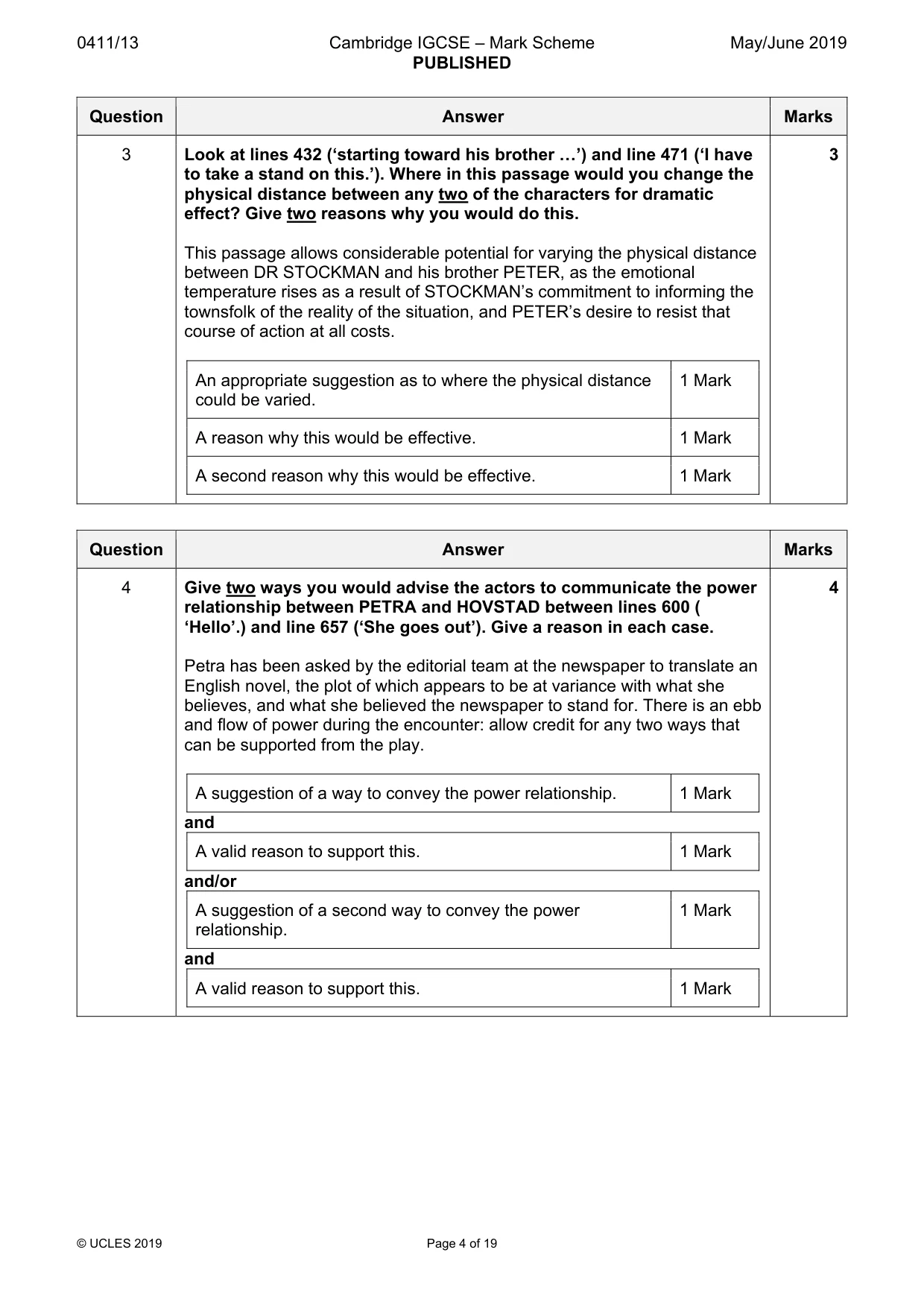
0411/13 Cambridge IGCSE – Mark Scheme PUBLISHED May/June 2019 © UCLES 2019 Page 4 of 19 Question Answer Marks 3 Look at lines 432 (‘starting toward his brother «’) and line 471 (‘I have to take a stand on this.’). Where in this passage would you change the physical distance between any two of the characters for dramatic effect? Give two reasons why you would do this. This passage allows considerable potential for varying the physical distance between DR STOCKMAN and his brother PETER, as the emotional temperature rises as a result of STOCKMAN’s commitment to informing the townsfolk of the reality of the situation, and PETER’s desire to resist that course of action at all costs. An appropriate suggestion as to where the physical distance could be varied. 1 Mark A reason why this would be effective. 1 Mark A second reason why this would be effective. 1 Mark 3 Question Answer Marks 4 Give two ways you would advise the actors to communicate the power relationship between PETRA and HOVSTAD between lines 600 ( ‘Hello’.) and line 657 (‘She goes out’). Give a reason in each case. Petra has been asked by the editorial team at the newspaper to translate an English novel, the plot of which appears to be at variance with what she believes, and what she believed the newspaper to stand for. There is an ebb and flow of power during the encounter: allow credit for any two ways that can be supported from the play. A suggestion of a way to convey the power relationship. 1 Mark and A valid reason to support this. 1 Mark and/or A suggestion of a second way to convey the power relationship. 1 Mark and A valid reason to support this. 1 Mark 4
Mark scheme, page 5
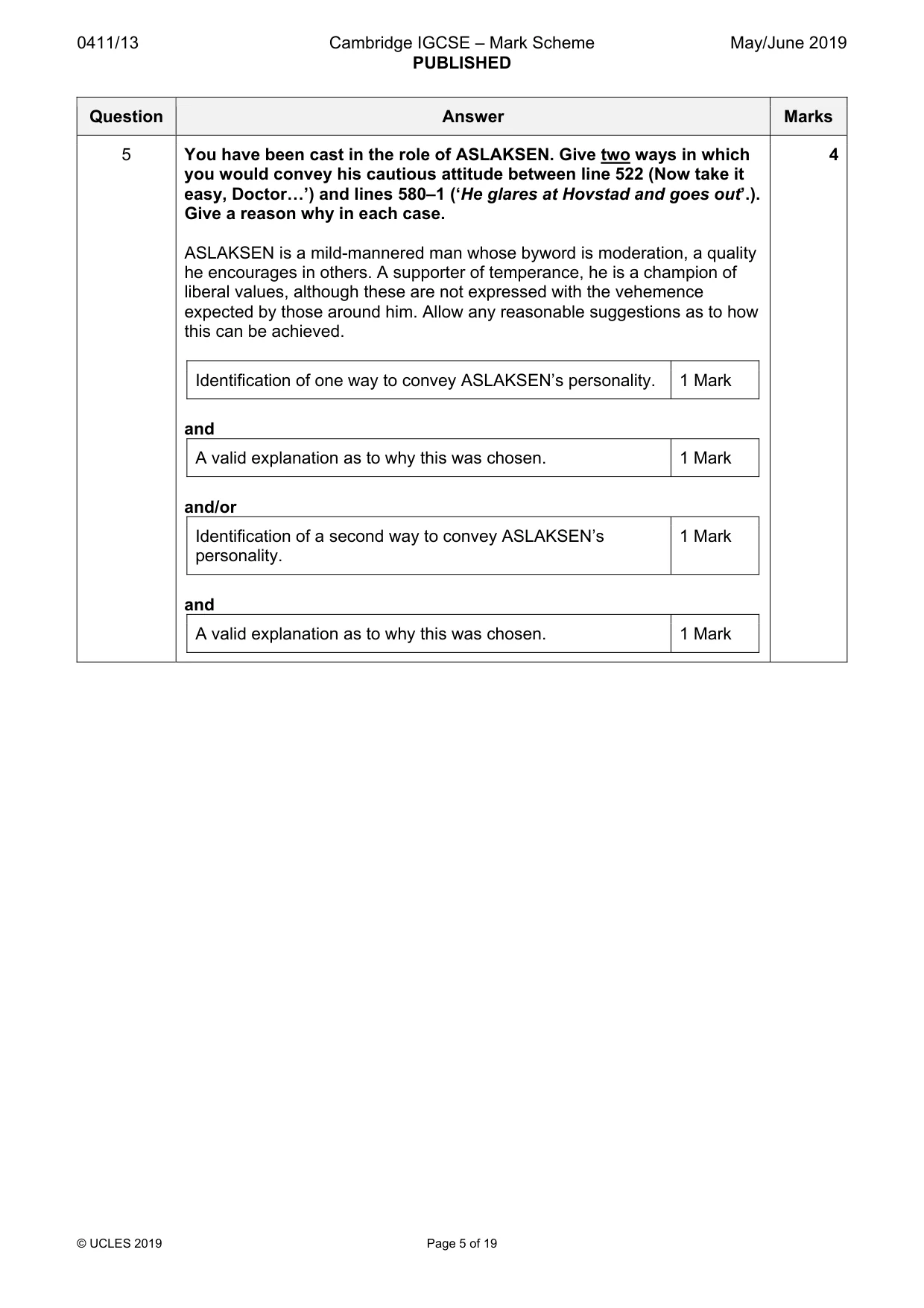
0411/13 Cambridge IGCSE – Mark Scheme PUBLISHED May/June 2019 © UCLES 2019 Page 5 of 19 Question Answer Marks 5 You have been cast in the role of ASLAKSEN. Give two ways in which you would convey his cautious attitude between line 522 (Now take it easy, Doctor«’) and lines 580–1 (‘He glares at Hovstad and goes out’.). Give a reason why in each case. ASLAKSEN is a mild-mannered man whose byword is moderation, a quality he encourages in others. A supporter of temperance, he is a champion of liberal values, although these are not expressed with the vehemence expected by those around him. Allow any reasonable suggestions as to how this can be achieved. Identification of one way to convey ASLAKSEN’s personality. 1 Mark and A valid explanation as to why this was chosen. 1 Mark and/or Identification of a second way to convey ASLAKSEN’s personality. 1 Mark and A valid explanation as to why this was chosen. 1 Mark 4
Mark scheme, page 6
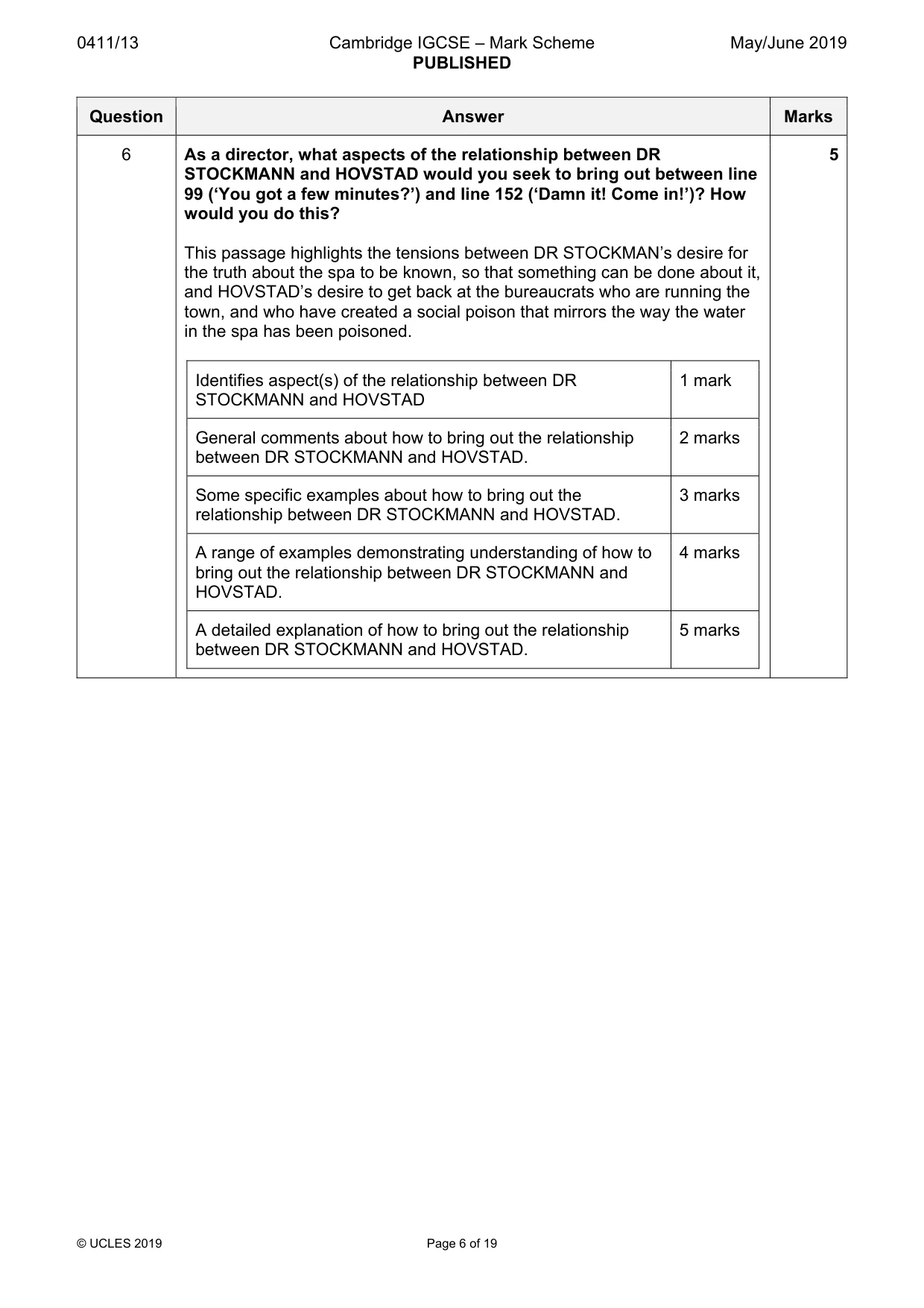
0411/13 Cambridge IGCSE – Mark Scheme PUBLISHED May/June 2019 © UCLES 2019 Page 6 of 19 Question Answer Marks 6 As a director, what aspects of the relationship between DR STOCKMANN and HOVSTAD would you seek to bring out between line 99 (‘You got a few minutes?’) and line 152 (‘Damn it! Come in!’)? How would you do this? This passage highlights the tensions between DR STOCKMAN’s desire for the truth about the spa to be known, so that something can be done about it, and HOVSTAD’s desire to get back at the bureaucrats who are running the town, and who have created a social poison that mirrors the way the water in the spa has been poisoned. Identifies aspect(s) of the relationship between DR STOCKMANN and HOVSTAD 1 mark General comments about how to bring out the relationship between DR STOCKMANN and HOVSTAD. 2 marks Some specific examples about how to bring out the relationship between DR STOCKMANN and HOVSTAD. 3 marks A range of examples demonstrating understanding of how to bring out the relationship between DR STOCKMANN and HOVSTAD. 4 marks A detailed explanation of how to bring out the relationship between DR STOCKMANN and HOVSTAD. 5 marks 5
Mark scheme, page 7
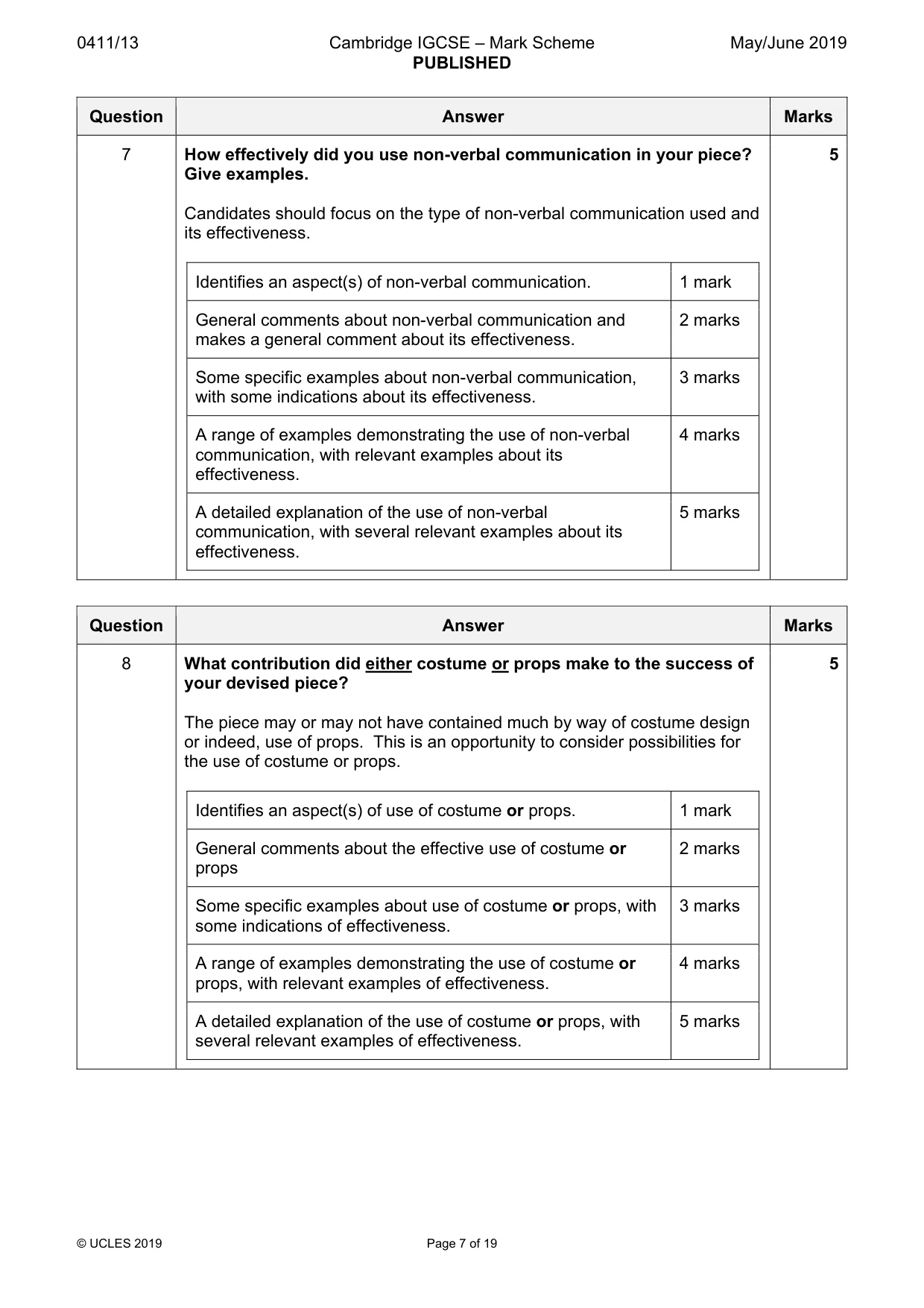
0411/13 Cambridge IGCSE – Mark Scheme PUBLISHED May/June 2019 © UCLES 2019 Page 7 of 19 Question Answer Marks 7 How effectively did you use non-verbal communication in your piece? Give examples. Candidates should focus on the type of non-verbal communication used and its effectiveness. Identifies an aspect(s) of non-verbal communication. 1 mark General comments about non-verbal communication and makes a general comment about its effectiveness. 2 marks Some specific examples about non-verbal communication, with some indications about its effectiveness. 3 marks A range of examples demonstrating the use of non-verbal communication, with relevant examples about its effectiveness. 4 marks A detailed explanation of the use of non-verbal communication, with several relevant examples about its effectiveness. 5 marks 5 Question Answer Marks 8 What contribution did either costume or props make to the success of your devised piece? The piece may or may not have contained much by way of costume design or indeed, use of props. This is an opportunity to consider possibilities for the use of costume or props. Identifies an aspect(s) of use of costume or props. 1 mark General comments about the effective use of costume or props 2 marks Some specific examples about use of costume or props, with some indications of effectiveness. 3 marks A range of examples demonstrating the use of costume or props, with relevant examples of effectiveness. 4 marks A detailed explanation of the use of costume or props, with several relevant examples of effectiveness. 5 marks 5
Mark scheme, page 8
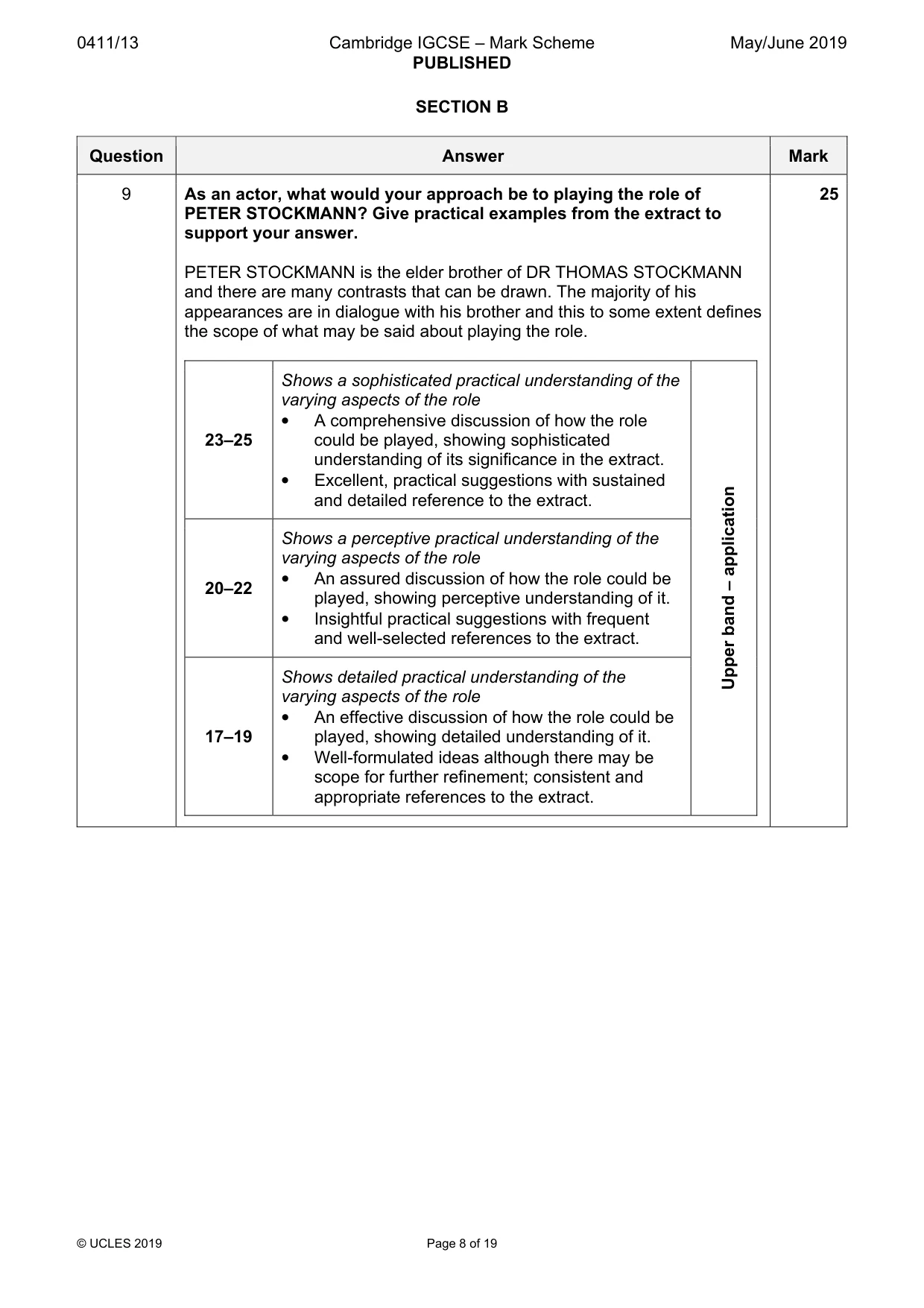
0411/13 Cambridge IGCSE – Mark Scheme PUBLISHED May/June 2019 © UCLES 2019 Page 8 of 19 SECTION B Question Answer Mark 9 As an actor, what would your approach be to playing the role of PETER STOCKMANN? Give practical examples from the extract to support your answer. PETER STOCKMANN is the elder brother of DR THOMAS STOCKMANN and there are many contrasts that can be drawn. The majority of his appearances are in dialogue with his brother and this to some extent defines the scope of what may be said about playing the role. 23–25 Shows a sophisticated practical understanding of the varying aspects of the role • A comprehensive discussion of how the role could be played, showing sophisticated understanding of its significance in the extract. • Excellent, practical suggestions with sustained and detailed reference to the extract. Upper band – application 20–22 Shows a perceptive practical understanding of the varying aspects of the role • An assured discussion of how the role could be played, showing perceptive understanding of it. • Insightful practical suggestions with frequent and well-selected references to the extract. 17–19 Shows detailed practical understanding of the varying aspects of the role • An effective discussion of how the role could be played, showing detailed understanding of it. • Well-formulated ideas although there may be scope for further refinement; consistent and appropriate references to the extract. 25
Mark scheme, page 9
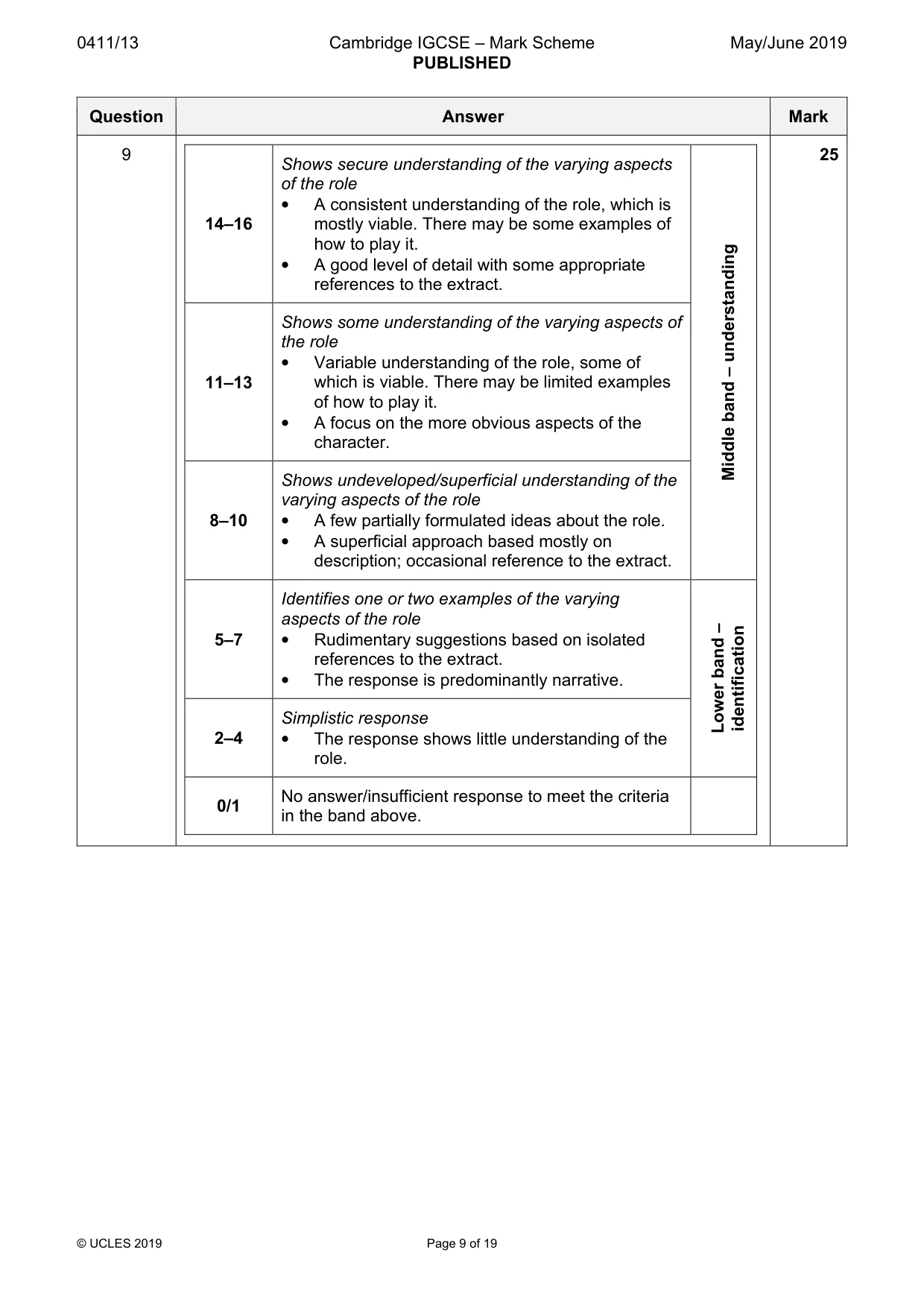
0411/13 Cambridge IGCSE – Mark Scheme PUBLISHED May/June 2019 © UCLES 2019 Page 9 of 19 Question Answer Mark 9 14–16 Shows secure understanding of the varying aspects of the role • A consistent understanding of the role, which is mostly viable. There may be some examples of how to play it. • A good level of detail with some appropriate references to the extract. Middle band – understanding 11–13 Shows some understanding of the varying aspects of the role • Variable understanding of the role, some of which is viable. There may be limited examples of how to play it. • A focus on the more obvious aspects of the character. 8–10 Shows undeveloped/superficial understanding of the varying aspects of the role • A few partially formulated ideas about the role. • A superficial approach based mostly on description; occasional reference to the extract. 5–7 Identifies one or two examples of the varying aspects of the role • Rudimentary suggestions based on isolated references to the extract. • The response is predominantly narrative. Lower band – identification 2–4 Simplistic response • The response shows little understanding of the role. 0/1 No answer/insufficient response to meet the criteria in the band above. 25
Mark scheme, page 10
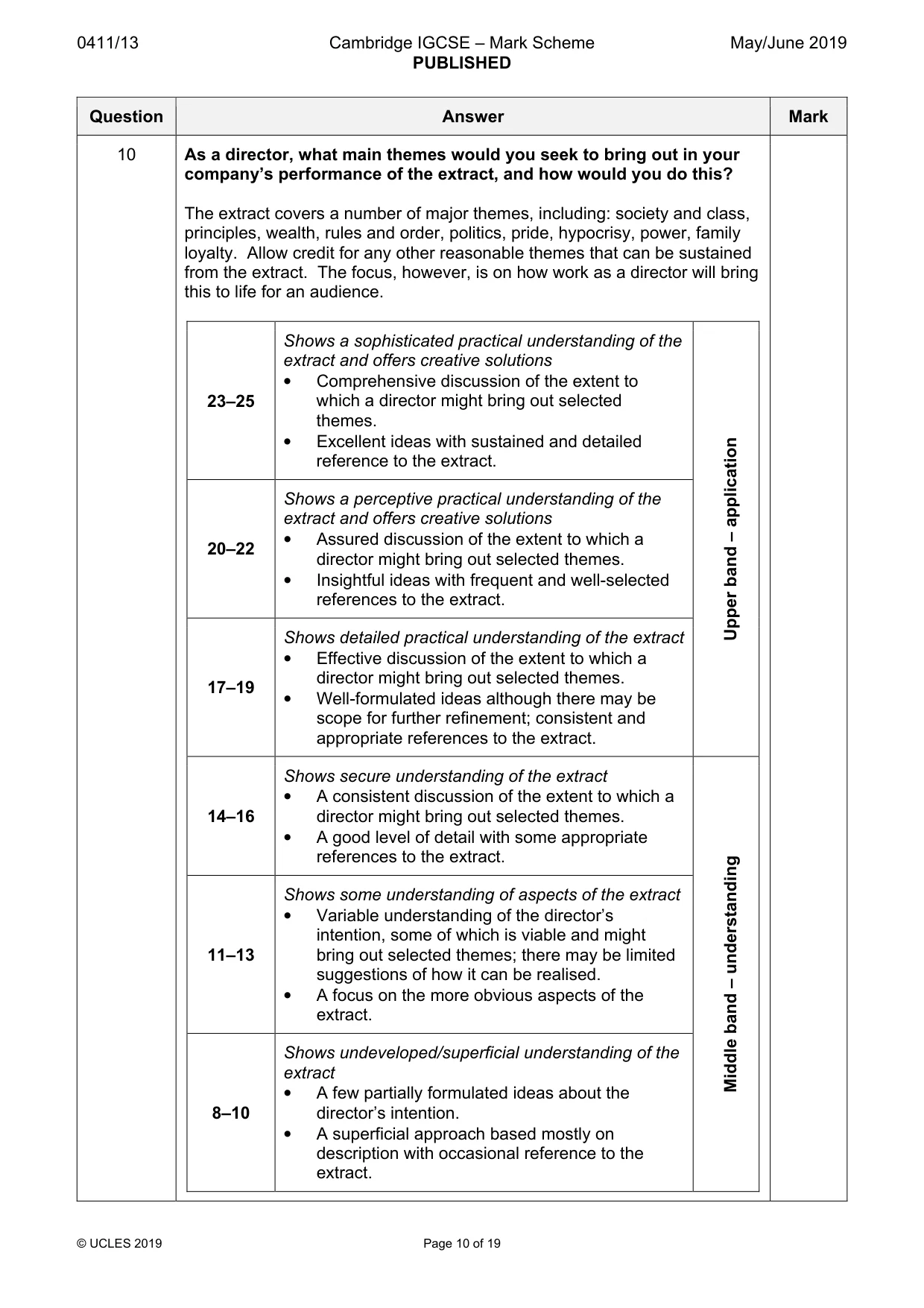
0411/13 Cambridge IGCSE – Mark Scheme PUBLISHED May/June 2019 © UCLES 2019 Page 10 of 19 Question Answer Mark 10 As a director, what main themes would you seek to bring out in your company’s performance of the extract, and how would you do this? The extract covers a number of major themes, including: society and class, principles, wealth, rules and order, politics, pride, hypocrisy, power, family loyalty. Allow credit for any other reasonable themes that can be sustained from the extract. The focus, however, is on how work as a director will bring this to life for an audience. 23–25 Shows a sophisticated practical understanding of the extract and offers creative solutions • Comprehensive discussion of the extent to which a director might bring out selected themes. • Excellent ideas with sustained and detailed reference to the extract. Upper band – application 20–22 Shows a perceptive practical understanding of the extract and offers creative solutions • Assured discussion of the extent to which a director might bring out selected themes. • Insightful ideas with frequent and well-selected references to the extract. 17–19 Shows detailed practical understanding of the extract • Effective discussion of the extent to which a director might bring out selected themes. • Well-formulated ideas although there may be scope for further refinement; consistent and appropriate references to the extract. 14–16 Shows secure understanding of the extract • A consistent discussion of the extent to which a director might bring out selected themes. • A good level of detail with some appropriate references to the extract. Middle band – understanding 11–13 Shows some understanding of aspects of the extract • Variable understanding of the director’s intention, some of which is viable and might bring out selected themes; there may be limited suggestions of how it can be realised. • A focus on the more obvious aspects of the extract. 8–10 Shows undeveloped/superficial understanding of the extract • A few partially formulated ideas about the director’s intention. • A superficial approach based mostly on description with occasional reference to the extract.
Mark scheme, page 11
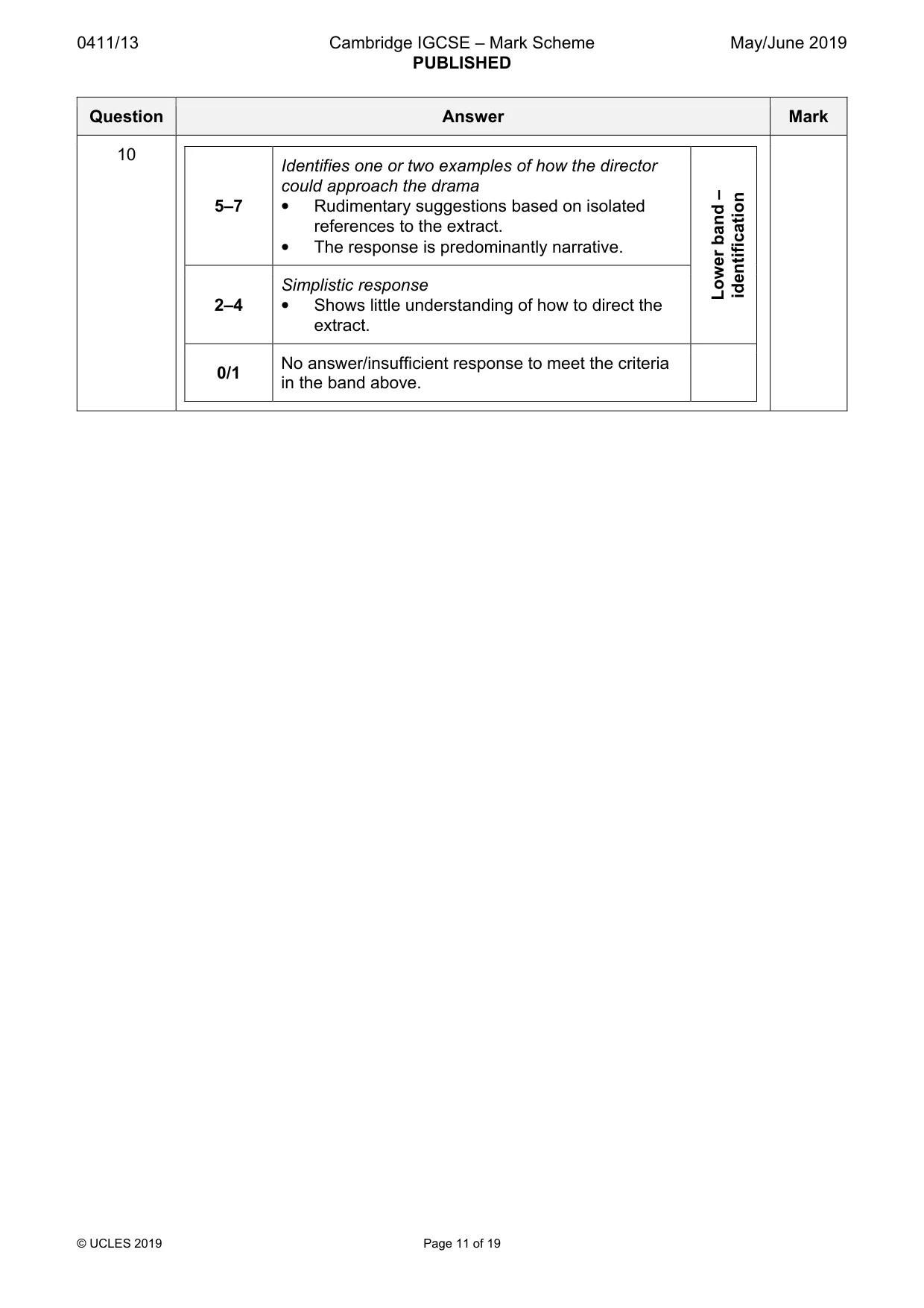
0411/13 Cambridge IGCSE – Mark Scheme PUBLISHED May/June 2019 © UCLES 2019 Page 11 of 19 Question Answer Mark 10 5–7 Identifies one or two examples of how the director could approach the drama • Rudimentary suggestions based on isolated references to the extract. • The response is predominantly narrative. Lower band – identification 2–4 Simplistic response • Shows little understanding of how to direct the extract. 0/1 No answer/insufficient response to meet the criteria in the band above.
Mark scheme, page 12
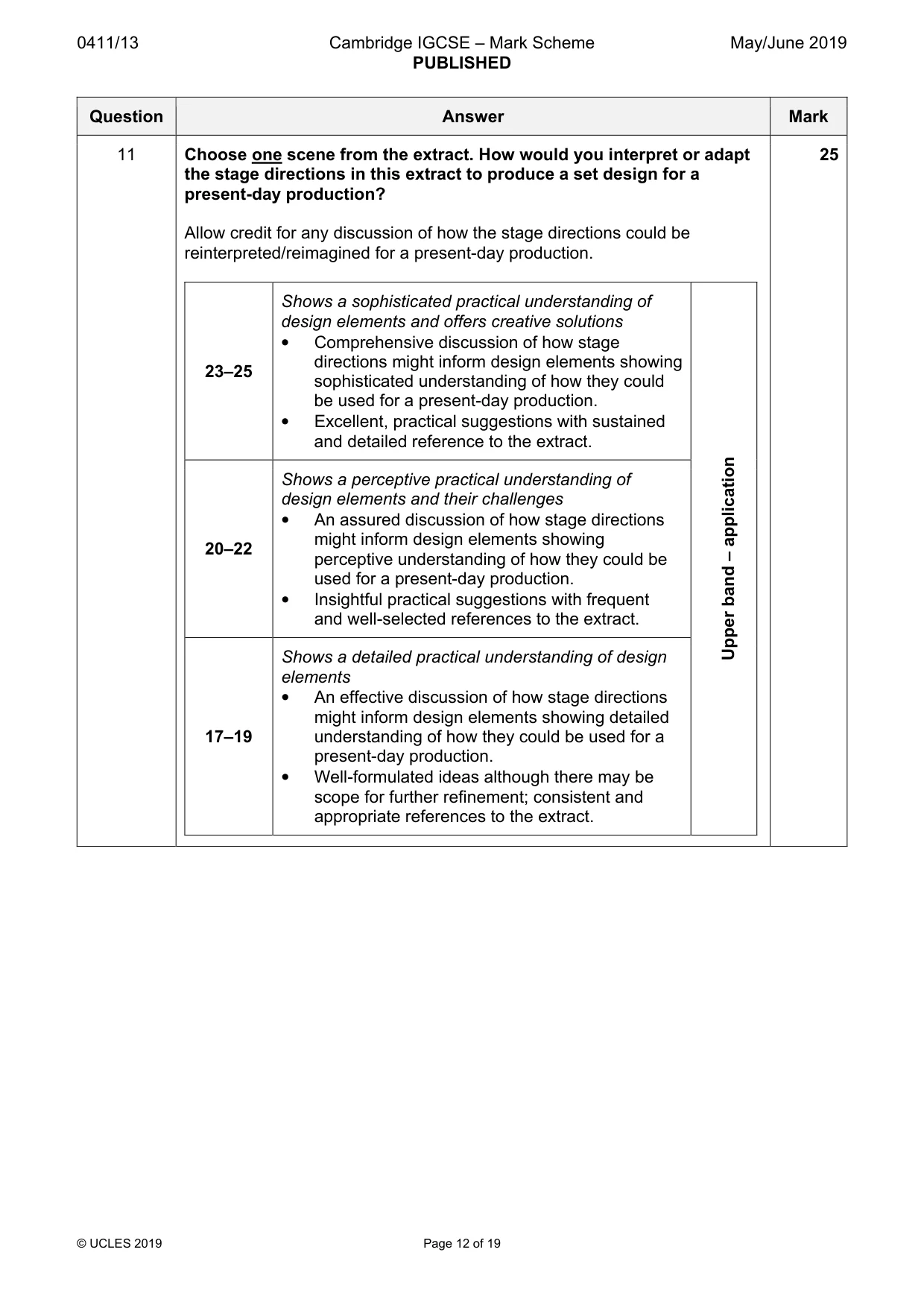
0411/13 Cambridge IGCSE – Mark Scheme PUBLISHED May/June 2019 © UCLES 2019 Page 12 of 19 Question Answer Mark 11 Choose one scene from the extract. How would you interpret or adapt the stage directions in this extract to produce a set design for a present-day production? Allow credit for any discussion of how the stage directions could be reinterpreted/reimagined for a present-day production. 23–25 Shows a sophisticated practical understanding of design elements and offers creative solutions • Comprehensive discussion of how stage directions might inform design elements showing sophisticated understanding of how they could be used for a present-day production. • Excellent, practical suggestions with sustained and detailed reference to the extract. Upper band – application 20–22 Shows a perceptive practical understanding of design elements and their challenges • An assured discussion of how stage directions might inform design elements showing perceptive understanding of how they could be used for a present-day production. • Insightful practical suggestions with frequent and well-selected references to the extract. 17–19 Shows a detailed practical understanding of design elements • An effective discussion of how stage directions might inform design elements showing detailed understanding of how they could be used for a present-day production. • Well-formulated ideas although there may be scope for further refinement; consistent and appropriate references to the extract. 25
Mark scheme, page 13
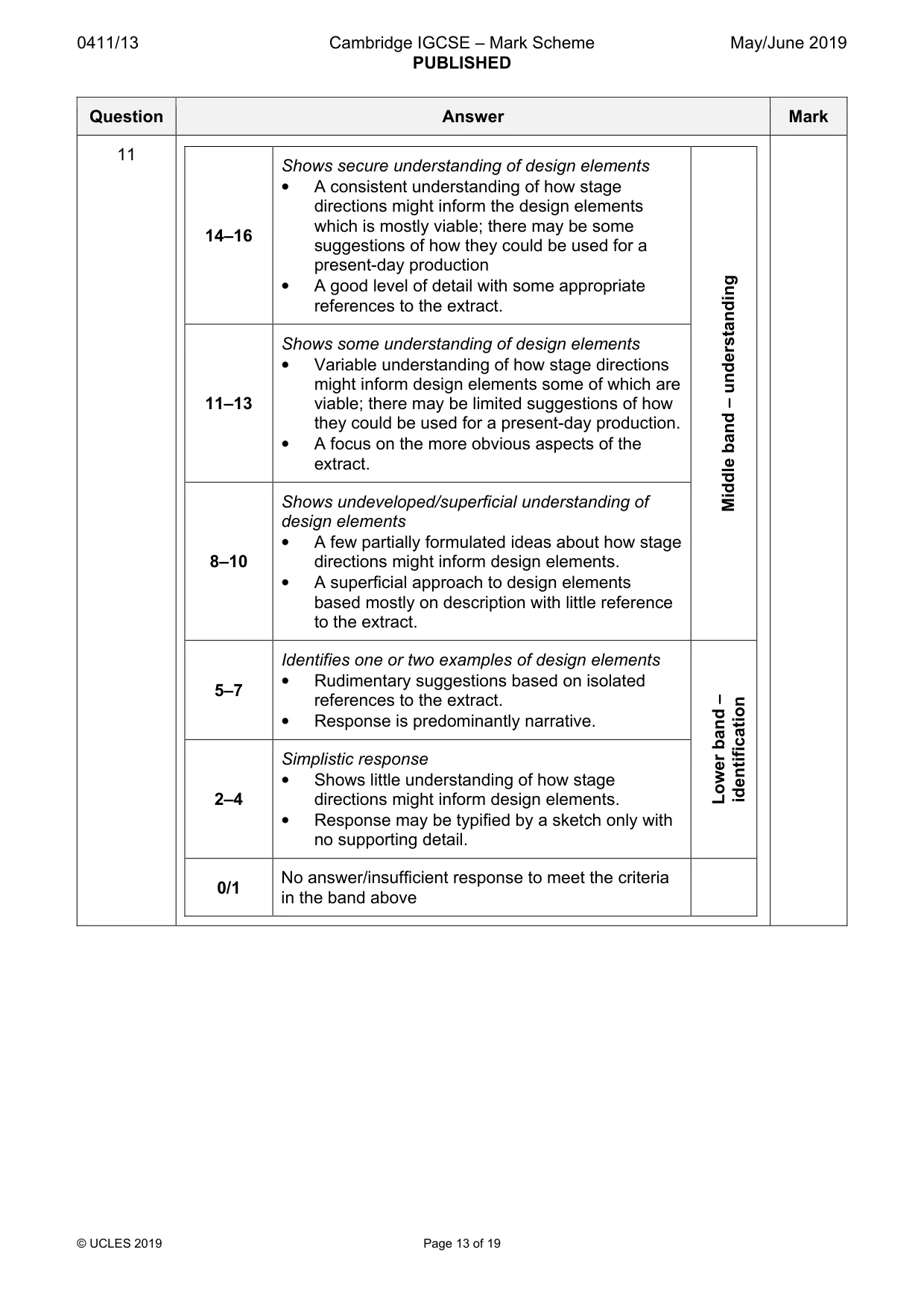
0411/13 Cambridge IGCSE – Mark Scheme PUBLISHED May/June 2019 © UCLES 2019 Page 13 of 19 Question Answer Mark 11 14–16 Shows secure understanding of design elements • A consistent understanding of how stage directions might inform the design elements which is mostly viable; there may be some suggestions of how they could be used for a present-day production • A good level of detail with some appropriate references to the extract. Middle band – understanding 11–13 Shows some understanding of design elements • Variable understanding of how stage directions might inform design elements some of which are viable; there may be limited suggestions of how they could be used for a present-day production. • A focus on the more obvious aspects of the extract. 8–10 Shows undeveloped/superficial understanding of design elements • A few partially formulated ideas about how stage directions might inform design elements. • A superficial approach to design elements based mostly on description with little reference to the extract. 5–7 Identifies one or two examples of design elements • Rudimentary suggestions based on isolated references to the extract. • Response is predominantly narrative. Lower band – identification 2–4 Simplistic response • Shows little understanding of how stage directions might inform design elements. • Response may be typified by a sketch only with no supporting detail. 0/1 No answer/insufficient response to meet the criteria in the band above
Mark scheme, page 14
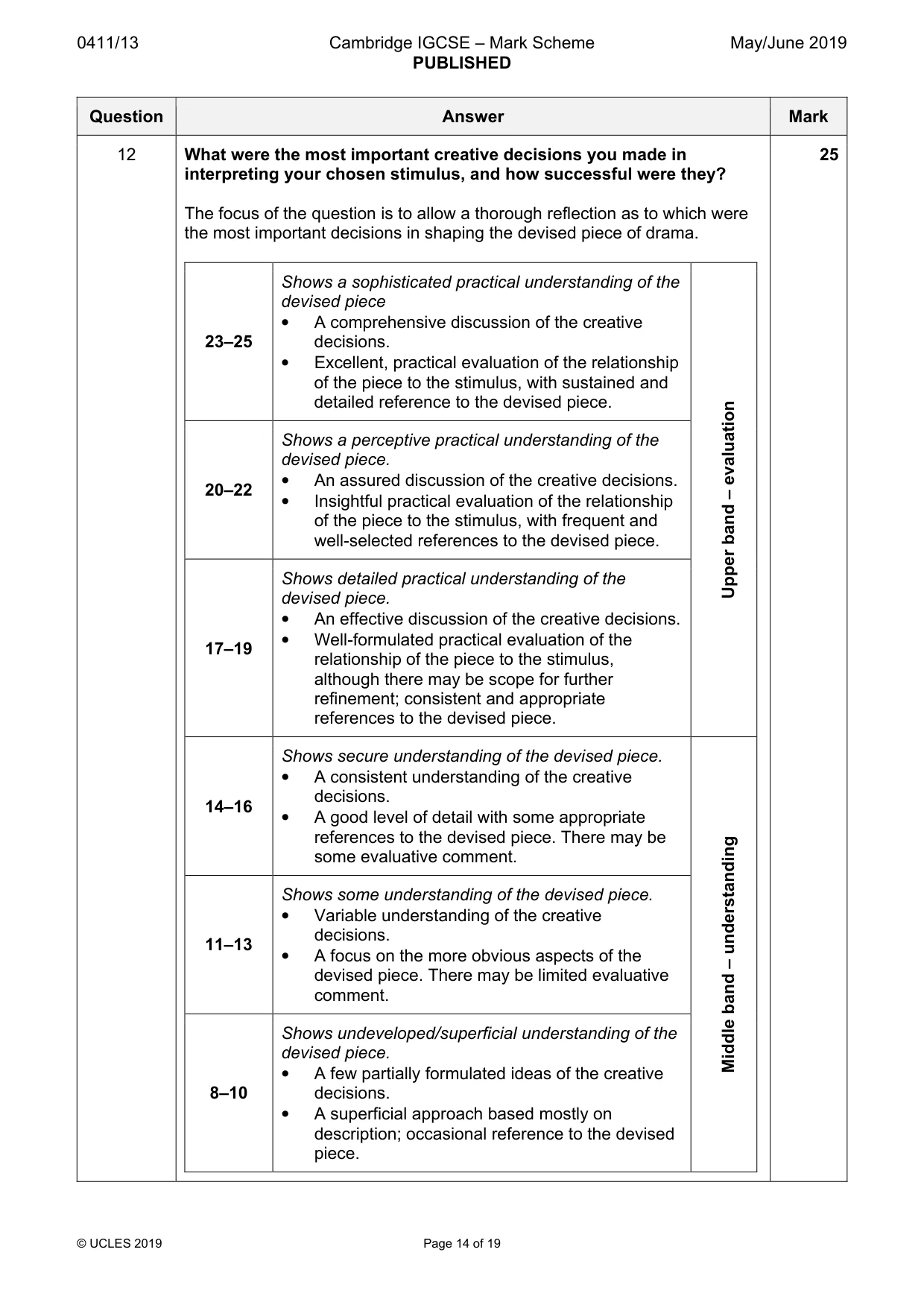
0411/13 Cambridge IGCSE – Mark Scheme PUBLISHED May/June 2019 © UCLES 2019 Page 14 of 19 Question Answer Mark 12 What were the most important creative decisions you made in interpreting your chosen stimulus, and how successful were they? The focus of the question is to allow a thorough reflection as to which were the most important decisions in shaping the devised piece of drama. 23–25 Shows a sophisticated practical understanding of the devised piece • A comprehensive discussion of the creative decisions. • Excellent, practical evaluation of the relationship of the piece to the stimulus, with sustained and detailed reference to the devised piece. Upper band – evaluation 20–22 Shows a perceptive practical understanding of the devised piece. • An assured discussion of the creative decisions. • Insightful practical evaluation of the relationship of the piece to the stimulus, with frequent and well-selected references to the devised piece. 17–19 Shows detailed practical understanding of the devised piece. • An effective discussion of the creative decisions. • Well-formulated practical evaluation of the relationship of the piece to the stimulus, although there may be scope for further refinement; consistent and appropriate references to the devised piece. 14–16 Shows secure understanding of the devised piece. • A consistent understanding of the creative decisions. • A good level of detail with some appropriate references to the devised piece. There may be some evaluative comment. Middle band – understanding 11–13 Shows some understanding of the devised piece. • Variable understanding of the creative decisions. • A focus on the more obvious aspects of the devised piece. There may be limited evaluative comment. 8–10 Shows undeveloped/superficial understanding of the devised piece. • A few partially formulated ideas of the creative decisions. • A superficial approach based mostly on description; occasional reference to the devised piece. 25
Mark scheme, page 15
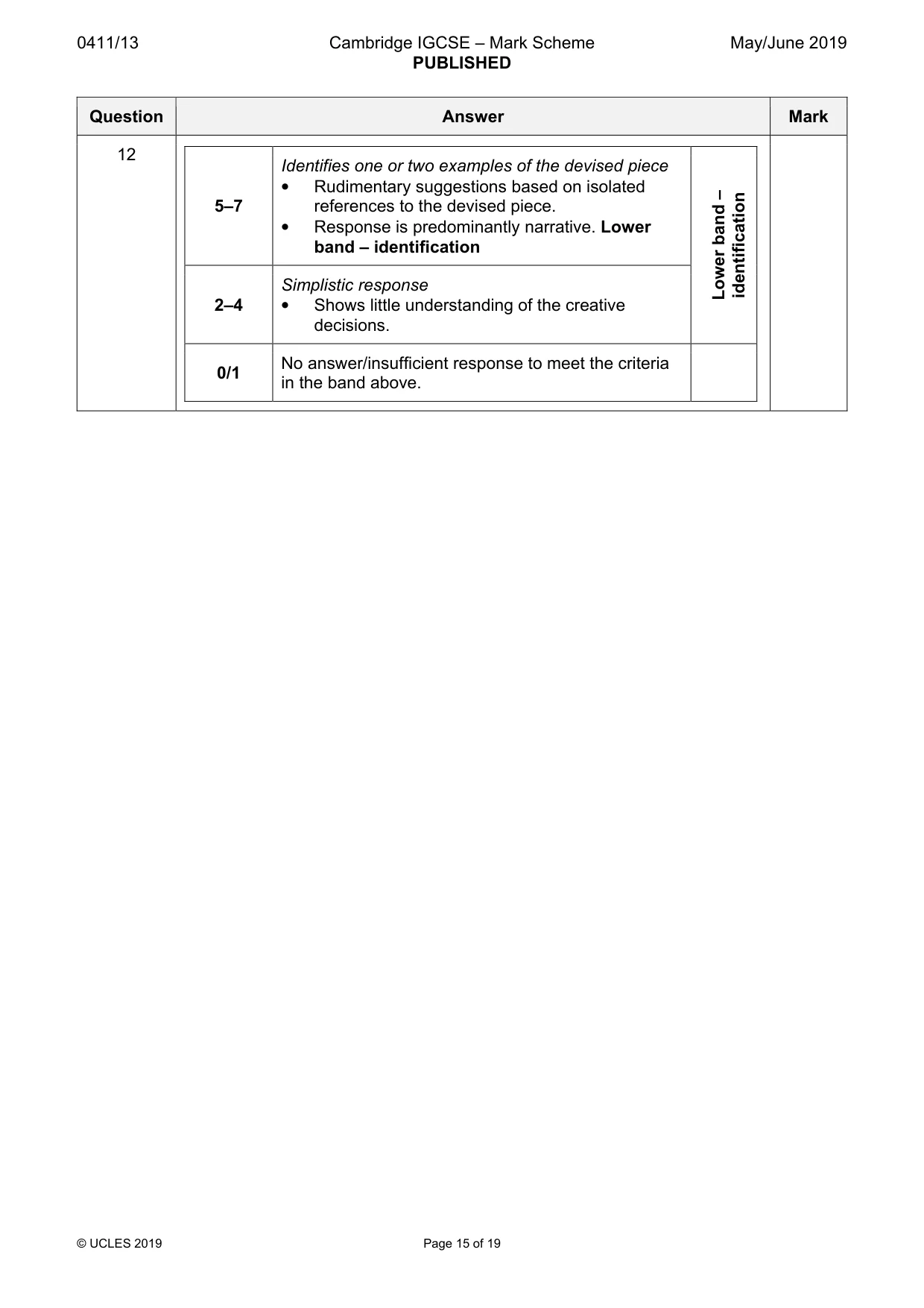
0411/13 Cambridge IGCSE – Mark Scheme PUBLISHED May/June 2019 © UCLES 2019 Page 15 of 19 Question Answer Mark 12 5–7 Identifies one or two examples of the devised piece • Rudimentary suggestions based on isolated references to the devised piece. • Response is predominantly narrative. Lower band – identification Lower band – identification 2–4 Simplistic response • Shows little understanding of the creative decisions. 0/1 No answer/insufficient response to meet the criteria in the band above.
Mark scheme, page 16
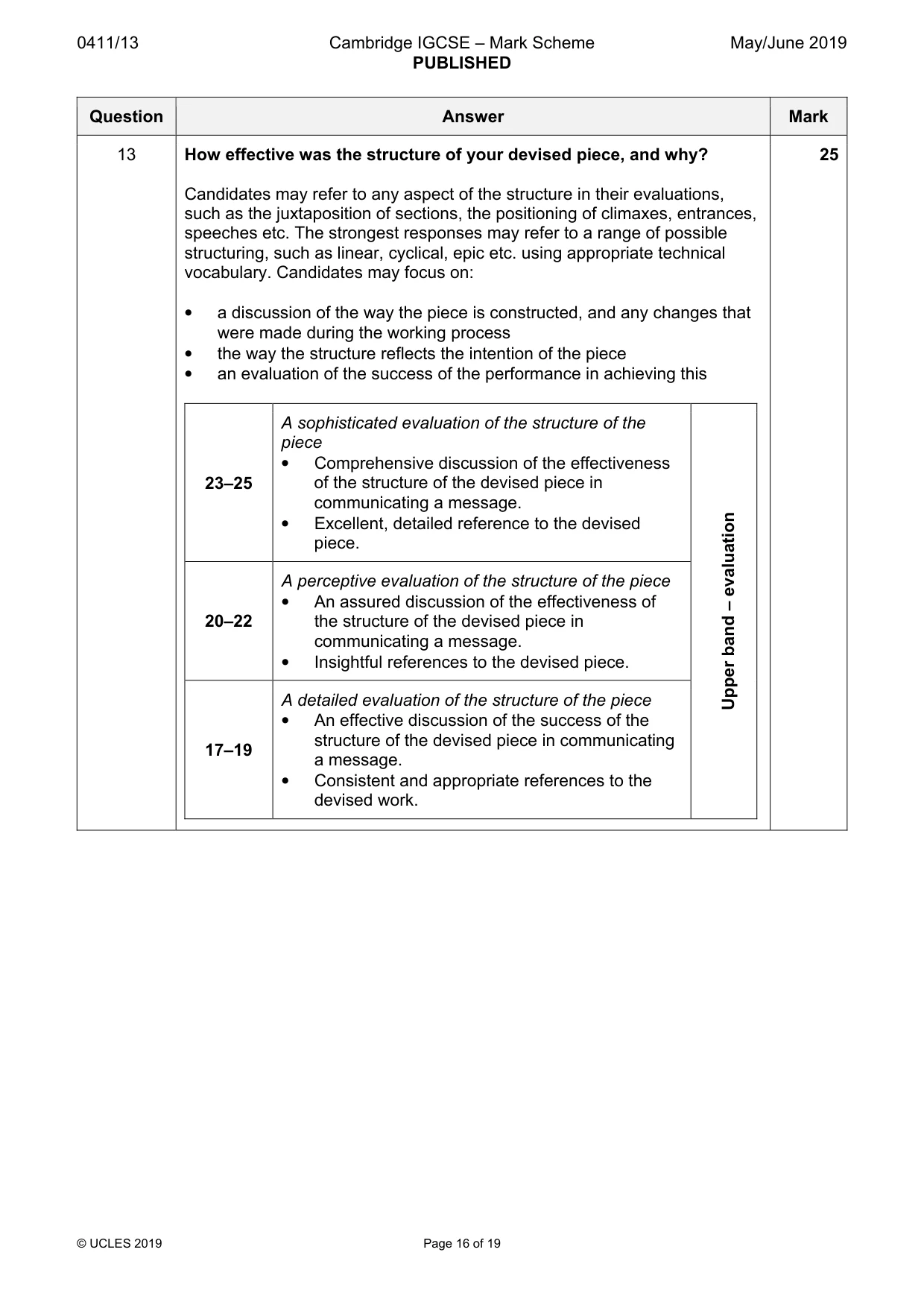
0411/13 Cambridge IGCSE – Mark Scheme PUBLISHED May/June 2019 © UCLES 2019 Page 16 of 19 Question Answer Mark 13 How effective was the structure of your devised piece, and why? Candidates may refer to any aspect of the structure in their evaluations, such as the juxtaposition of sections, the positioning of climaxes, entrances, speeches etc. The strongest responses may refer to a range of possible structuring, such as linear, cyclical, epic etc. using appropriate technical vocabulary. Candidates may focus on: • a discussion of the way the piece is constructed, and any changes that were made during the working process • the way the structure reflects the intention of the piece • an evaluation of the success of the performance in achieving this 23–25 A sophisticated evaluation of the structure of the piece • Comprehensive discussion of the effectiveness of the structure of the devised piece in communicating a message. • Excellent, detailed reference to the devised piece. Upper band – evaluation 20–22 A perceptive evaluation of the structure of the piece • An assured discussion of the effectiveness of the structure of the devised piece in communicating a message. • Insightful references to the devised piece. 17–19 A detailed evaluation of the structure of the piece • An effective discussion of the success of the structure of the devised piece in communicating a message. • Consistent and appropriate references to the devised work. 25
Mark scheme, page 17
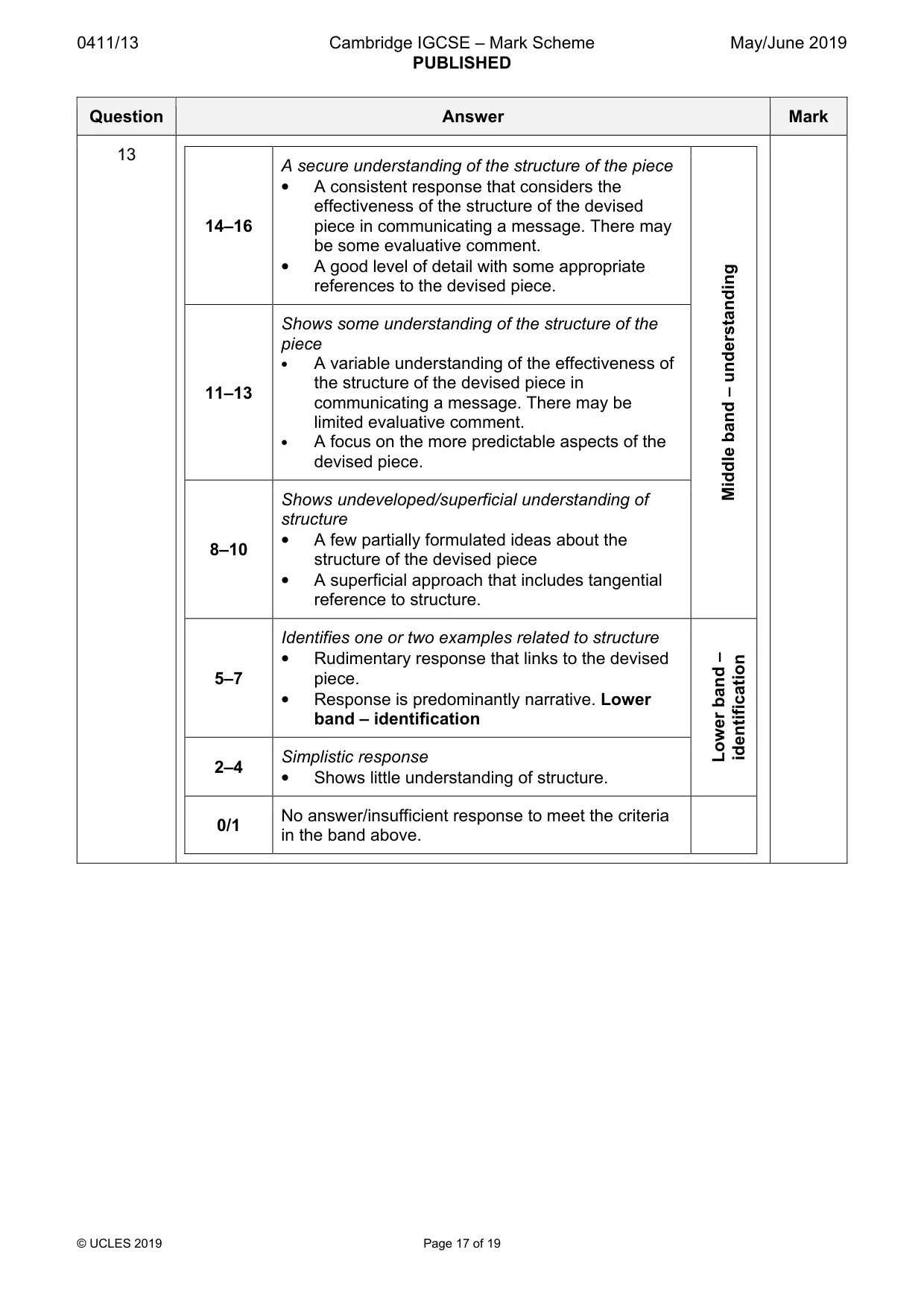
0411/13 Cambridge IGCSE – Mark Scheme PUBLISHED May/June 2019 © UCLES 2019 Page 17 of 19 Question Answer Mark 13 14–16 A secure understanding of the structure of the piece • A consistent response that considers the effectiveness of the structure of the devised piece in communicating a message. There may be some evaluative comment. • A good level of detail with some appropriate references to the devised piece. Middle band – understanding 11–13 Shows some understanding of the structure of the piece • A variable understanding of the effectiveness of the structure of the devised piece in communicating a message. There may be limited evaluative comment. • A focus on the more predictable aspects of the devised piece. 8–10 Shows undeveloped/superficial understanding of structure • A few partially formulated ideas about the structure of the devised piece • A superficial approach that includes tangential reference to structure. 5–7 Identifies one or two examples related to structure • Rudimentary response that links to the devised piece. • Response is predominantly narrative. Lower band – identification Lower band – identification 2–4 Simplistic response • Shows little understanding of structure. 0/1 No answer/insufficient response to meet the criteria in the band above.
Mark scheme, page 18
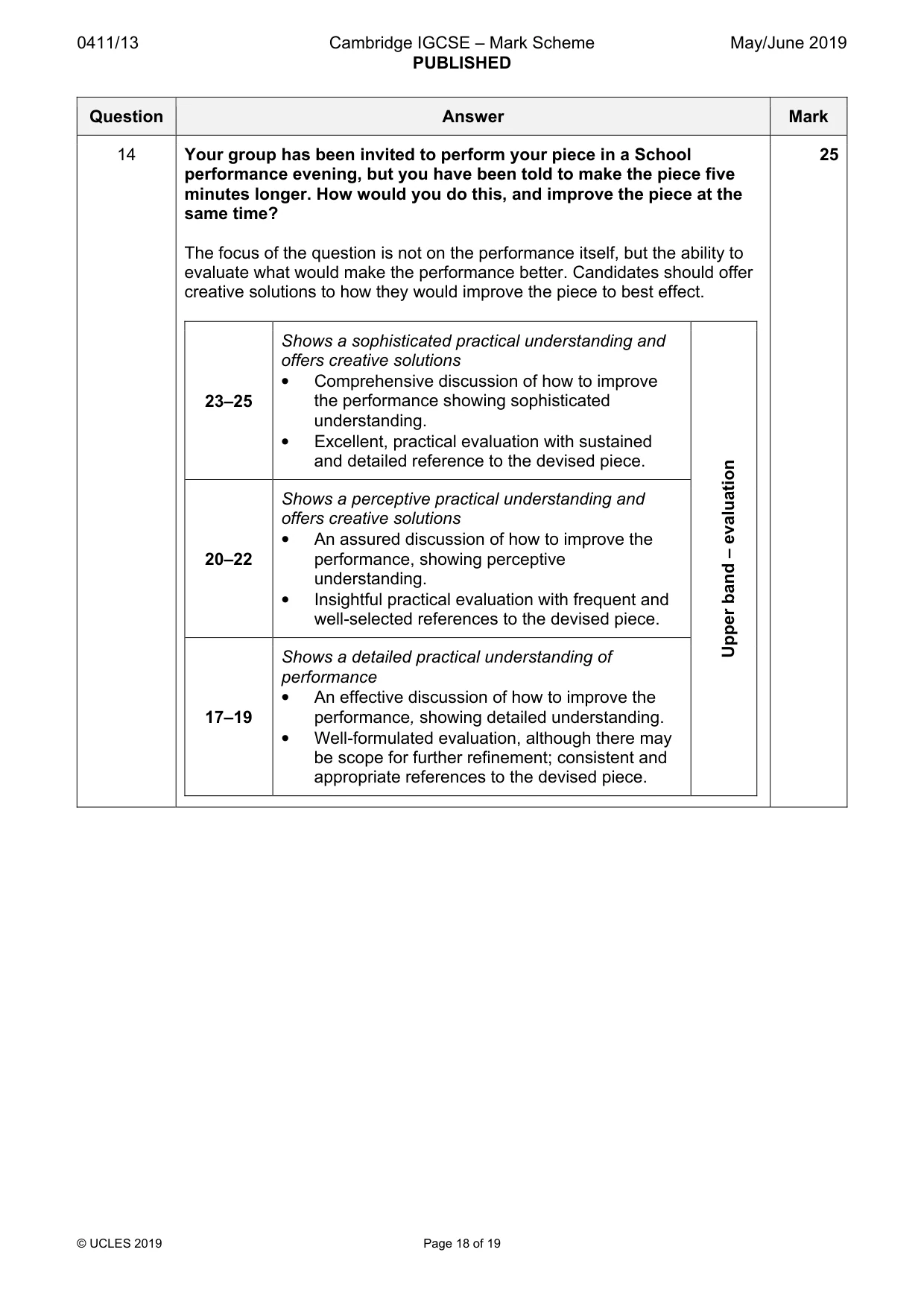
0411/13 Cambridge IGCSE – Mark Scheme PUBLISHED May/June 2019 © UCLES 2019 Page 18 of 19 Question Answer Mark 14 Your group has been invited to perform your piece in a School performance evening, but you have been told to make the piece five minutes longer. How would you do this, and improve the piece at the same time? The focus of the question is not on the performance itself, but the ability to evaluate what would make the performance better. Candidates should offer creative solutions to how they would improve the piece to best effect. 23–25 Shows a sophisticated practical understanding and offers creative solutions • Comprehensive discussion of how to improve the performance showing sophisticated understanding. • Excellent, practical evaluation with sustained and detailed reference to the devised piece. Upper band – evaluation 20–22 Shows a perceptive practical understanding and offers creative solutions • An assured discussion of how to improve the performance, showing perceptive understanding. • Insightful practical evaluation with frequent and well-selected references to the devised piece. 17–19 Shows a detailed practical understanding of performance • An effective discussion of how to improve the performance, showing detailed understanding. • Well-formulated evaluation, although there may be scope for further refinement; consistent and appropriate references to the devised piece. 25
Mark scheme, page 19
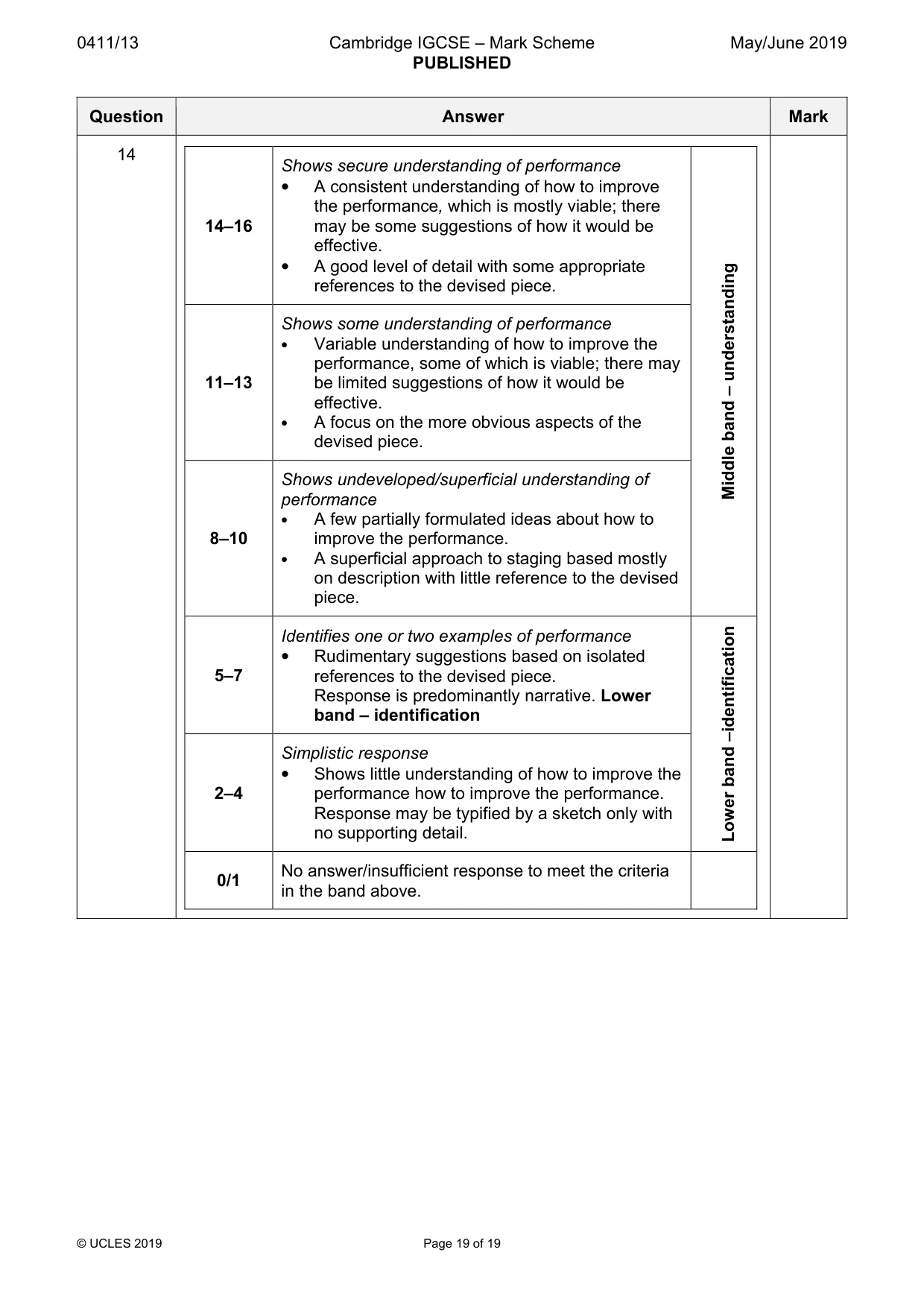
0411/13 Cambridge IGCSE – Mark Scheme PUBLISHED May/June 2019 © UCLES 2019 Page 19 of 19 Question Answer Mark 14 14–16 Shows secure understanding of performance • A consistent understanding of how to improve the performance, which is mostly viable; there may be some suggestions of how it would be effective. • A good level of detail with some appropriate references to the devised piece. Middle band – understanding 11–13 Shows some understanding of performance • Variable understanding of how to improve the performance, some of which is viable; there may be limited suggestions of how it would be effective. • A focus on the more obvious aspects of the devised piece. 8–10 Shows undeveloped/superficial understanding of performance • A few partially formulated ideas about how to improve the performance. • A superficial approach to staging based mostly on description with little reference to the devised piece. 5–7 Identifies one or two examples of performance • Rudimentary suggestions based on isolated references to the devised piece. Response is predominantly narrative. Lower band – identification Lower band –identification 2–4 Simplistic response • Shows little understanding of how to improve the performance how to improve the performance. Response may be typified by a sketch only with no supporting detail. 0/1 No answer/insufficient response to meet the criteria in the band above.
What you needed in this session
Cambridge’s own grade thresholds for 2019 May/June, Paper 1 · Variant 3. A higher threshold means an easier paper — the bar moves with how the cohort did.