Cambridge IGCSE Drama 0411 — 2014 May/June Paper 1 · Variant 1
0411/11/M/J/14 · 80 marks · ≈90 min
The question paper and its mark scheme, free to read here and free to download. This is Cambridge’s own paper, exactly as it was sat.
Question paper4 pages

Mark scheme17 pages
Answers below. Sit the paper first if you are practising.
Paper as text
Question paper, page 1
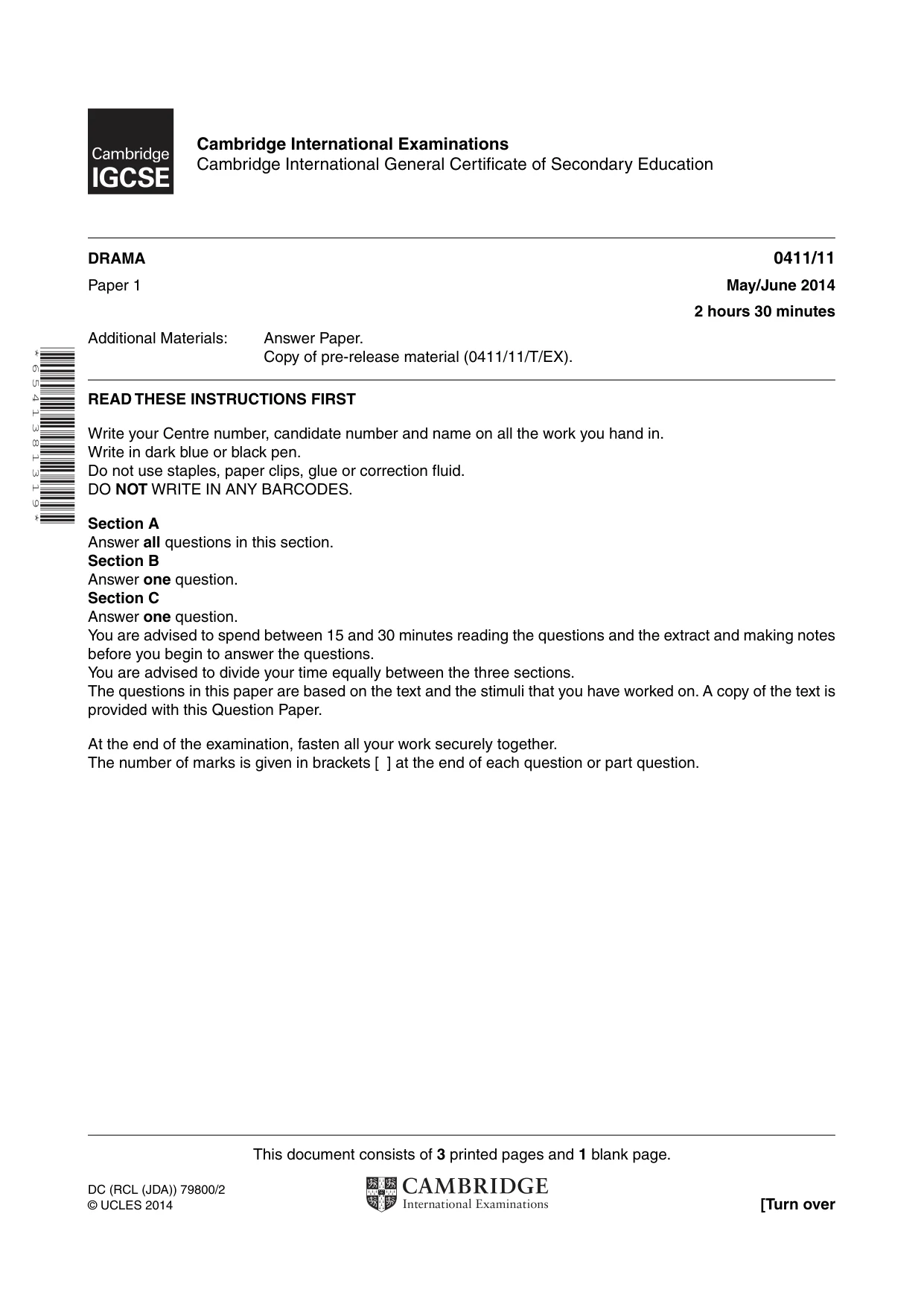
This document consists of 3 printed pages and 1 blank page. DC (RCL (JDA)) 79800/2 © UCLES 2014 [Turn over Cambridge International Examinations Cambridge International General Certificate of Secondary Education * 6 5 4 1 3 8 1 3 1 9 * DRAMA 0411/11 Paper 1 May/June 2014 2 hours 30 minutes Additional Materials: Answer Paper. Copy of pre-release material (0411/11/T/EX). READ THESE INSTRUCTIONS FIRST Write your Centre number, candidate number and name on all the work you hand in. Write in dark blue or black pen. Do not use staples, paper clips, glue or correction fluid. DO NOT WRITE IN ANY BARCODES. Section A Answer all questions in this section. Section B Answer one question. Section C Answer one question. You are advised to spend between 15 and 30 minutes reading the questions and the extract and making notes before you begin to answer the questions. You are advised to divide your time equally between the three sections. The questions in this paper are based on the text and the stimuli that you have worked on. A copy of the text is provided with this Question Paper. At the end of the examination, fasten all your work securely together. The number of marks is given in brackets [ ] at the end of each question or part question.
Question paper, page 2
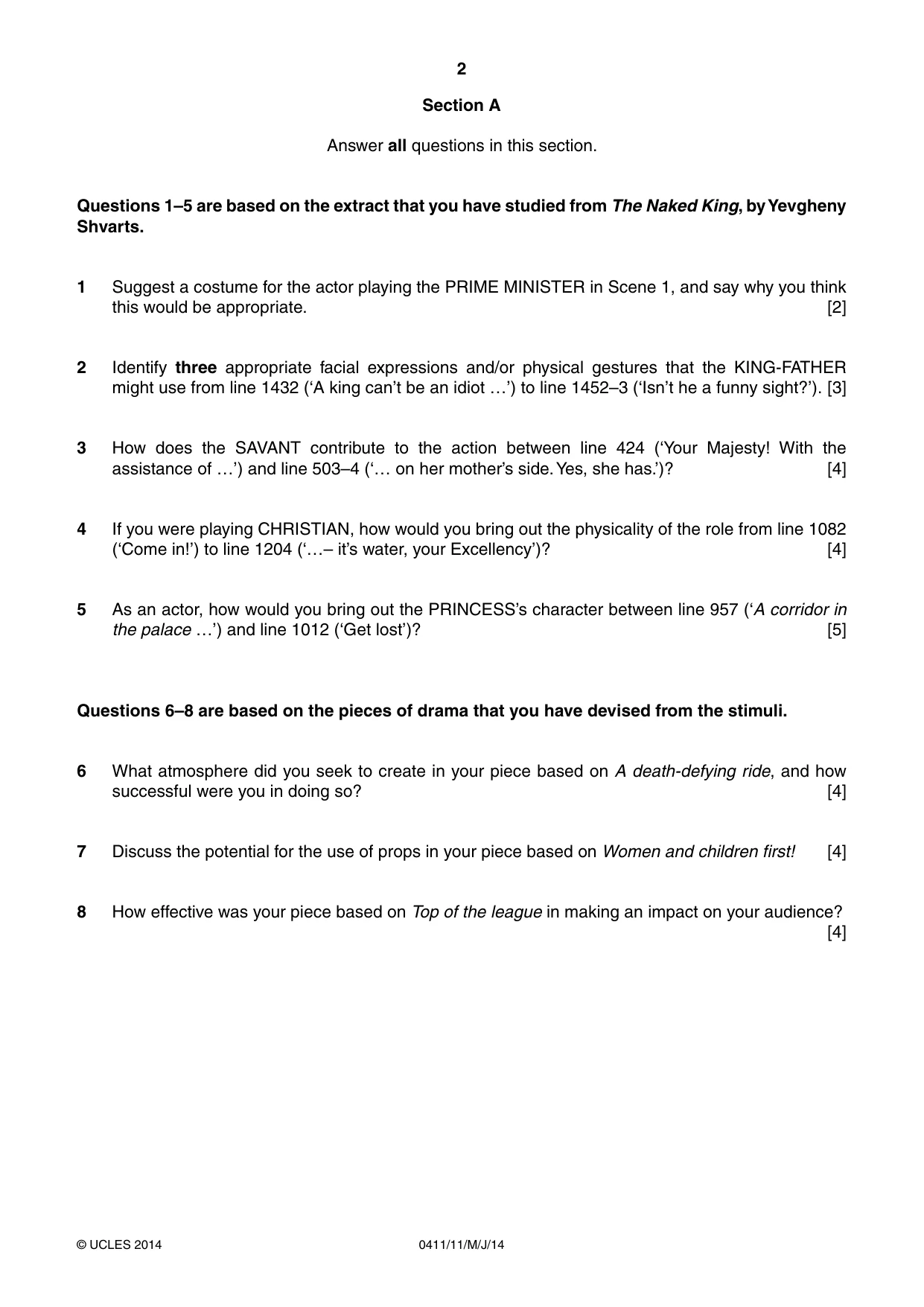
2 0411/11/M/J/14 © UCLES 2014 Section A Answer all questions in this section. Questions 1–5 are based on the extract that you have studied from The Naked King, by Yevgheny Shvarts. 1 Suggest a costume for the actor playing the PRIME MINISTER in Scene 1, and say why you think this would be appropriate. [2] 2 Identify three appropriate facial expressions and/or physical gestures that the KING-FATHER might use from line 1432 (‘A king can’t be an idiot …’) to line 1452–3 (‘Isn’t he a funny sight?’). [3] 3 How does the SAVANT contribute to the action between line 424 (‘Your Majesty! With the assistance of …’) and line 503–4 (‘… on her mother’s side. Yes, she has.’)? [4] 4 If you were playing CHRISTIAN, how would you bring out the physicality of the role from line 1082 (‘Come in!’) to line 1204 (‘…– it’s water, your Excellency’)? [4] 5 As an actor, how would you bring out the PRINCESS’s character between line 957 (‘A corridor in the palace …’) and line 1012 (‘Get lost’)? [5] Questions 6–8 are based on the pieces of drama that you have devised from the stimuli. 6 What atmosphere did you seek to create in your piece based on A death-defying ride, and how successful were you in doing so? [4] 7 Discuss the potential for the use of props in your piece based on Women and children first! [4] 8 How effective was your piece based on Top of the league in making an impact on your audience? [4]
Question paper, page 3
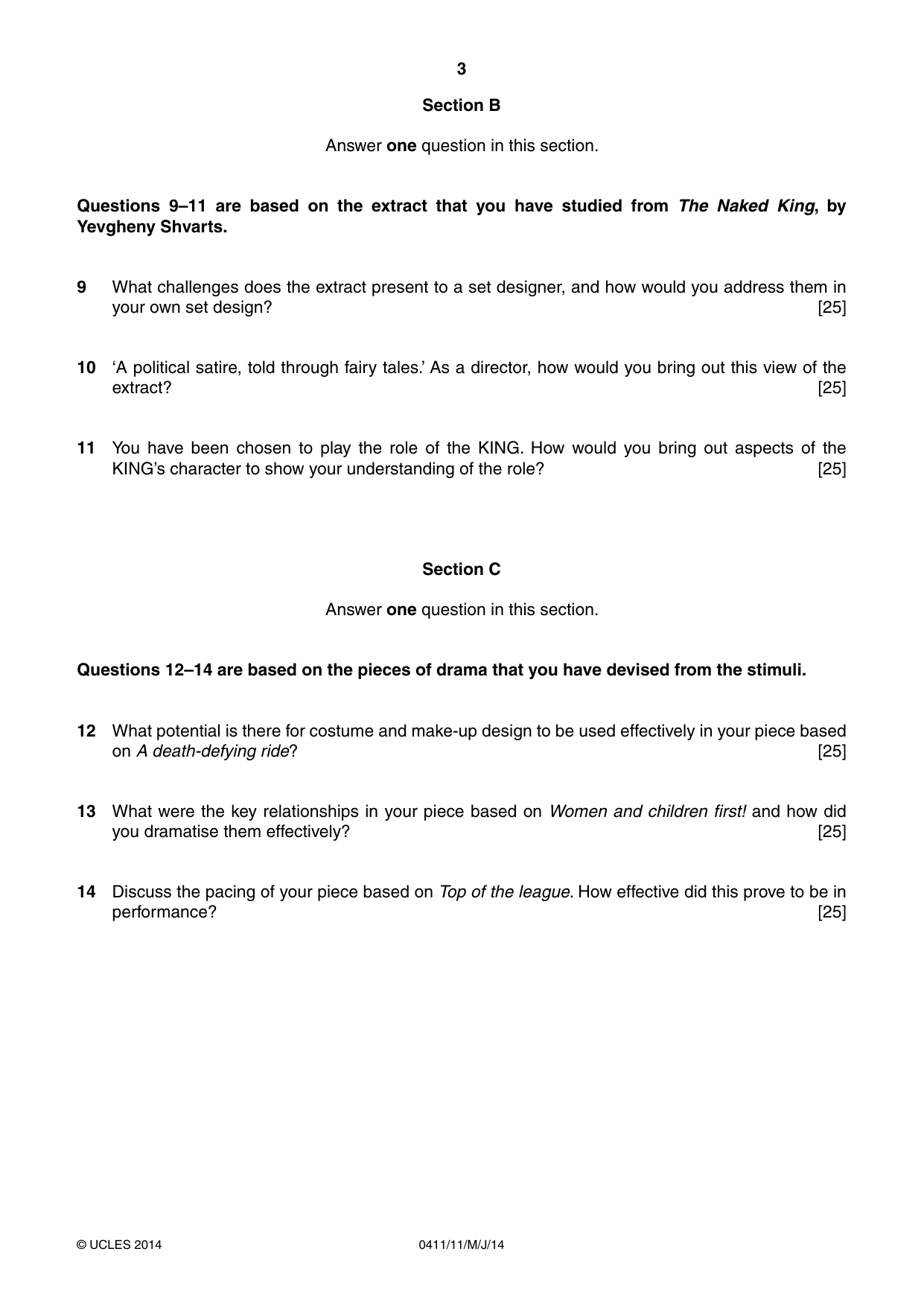
3 0411/11/M/J/14 © UCLES 2014 Section B Answer one question in this section. Questions 9–11 are based on the extract that you have studied from The Naked King, by Yevgheny Shvarts. 9 What challenges does the extract present to a set designer, and how would you address them in your own set design? [25] 10 ‘A political satire, told through fairy tales.’ As a director, how would you bring out this view of the extract? [25] 11 You have been chosen to play the role of the KING. How would you bring out aspects of the KING’s character to show your understanding of the role? [25] Section C Answer one question in this section. Questions 12–14 are based on the pieces of drama that you have devised from the stimuli. 12 What potential is there for costume and make-up design to be used effectively in your piece based on A death-defying ride? [25] 13 What were the key relationships in your piece based on Women and children first! and how did you dramatise them effectively? [25] 14 Discuss the pacing of your piece based on Top of the league. How effective did this prove to be in performance? [25]
Question paper, page 4
4 0411/11/M/J/14 © UCLES 2014 Copyright Acknowledgements: Questions 1-5 © Yevgheny Shvarts; The Naked King; Marion Boyars; 1976. Questions 9-11 © Yevgheny Shvarts; The Naked King; Marion Boyars; 1976. Permission to reproduce items where third-party owned material protected by copyright is included has been sought and cleared where possible. Every reasonable effort has been made by the publisher (UCLES) to trace copyright holders, but if any items requiring clearance have unwittingly been included, the publisher will be pleased to make amends at the earliest possible opportunity. Cambridge International Examinations is part of the Cambridge Assessment Group. Cambridge Assessment is the brand name of University of Cambridge Local Examinations Syndicate (UCLES), which is itself a department of the University of Cambridge. BLANK PAGE
Mark scheme, page 1
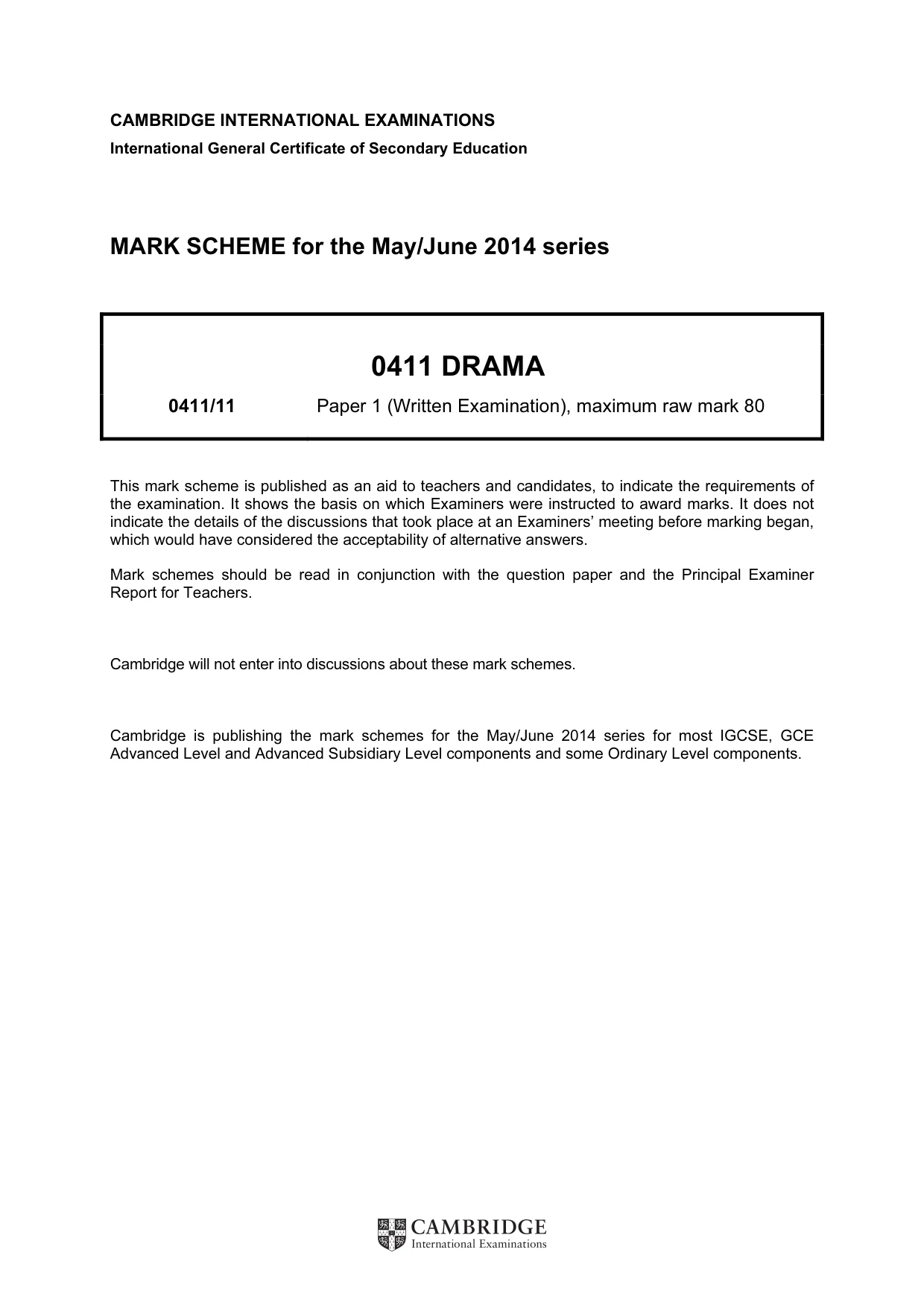
CAMBRIDGE INTERNATIONAL EXAMINATIONS International General Certificate of Secondary Education MARK SCHEME for the May/June 2014 series 0411 DRAMA 0411/11 Paper 1 (Written Examination), maximum raw mark 80 This mark scheme is published as an aid to teachers and candidates, to indicate the requirements of the examination. It shows the basis on which Examiners were instructed to award marks. It does not indicate the details of the discussions that took place at an Examiners’ meeting before marking began, which would have considered the acceptability of alternative answers. Mark schemes should be read in conjunction with the question paper and the Principal Examiner Report for Teachers. Cambridge will not enter into discussions about these mark schemes. Cambridge is publishing the mark schemes for the May/June 2014 series for most IGCSE, GCE Advanced Level and Advanced Subsidiary Level components and some Ordinary Level components.
Mark scheme, page 2
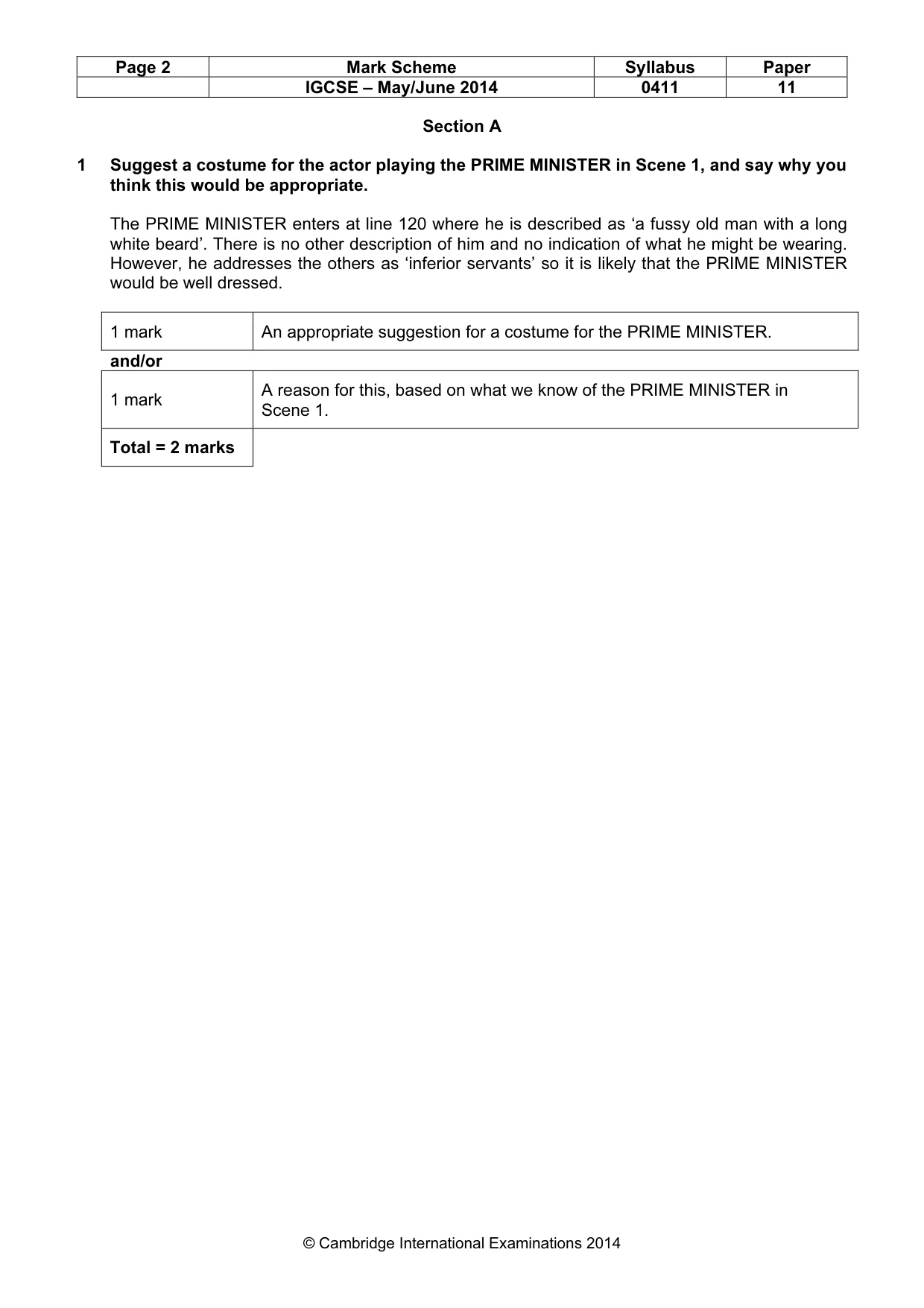
Page 2 Mark Scheme Syllabus Paper IGCSE – May/June 2014 0411 11 © Cambridge International Examinations 2014 Section A 1 Suggest a costume for the actor playing the PRIME MINISTER in Scene 1, and say why you think this would be appropriate. The PRIME MINISTER enters at line 120 where he is described as ‘a fussy old man with a long white beard’. There is no other description of him and no indication of what he might be wearing. However, he addresses the others as ‘inferior servants’ so it is likely that the PRIME MINISTER would be well dressed. 1 mark An appropriate suggestion for a costume for the PRIME MINISTER. and/or 1 mark A reason for this, based on what we know of the PRIME MINISTER in Scene 1. Total = 2 marks
Mark scheme, page 3
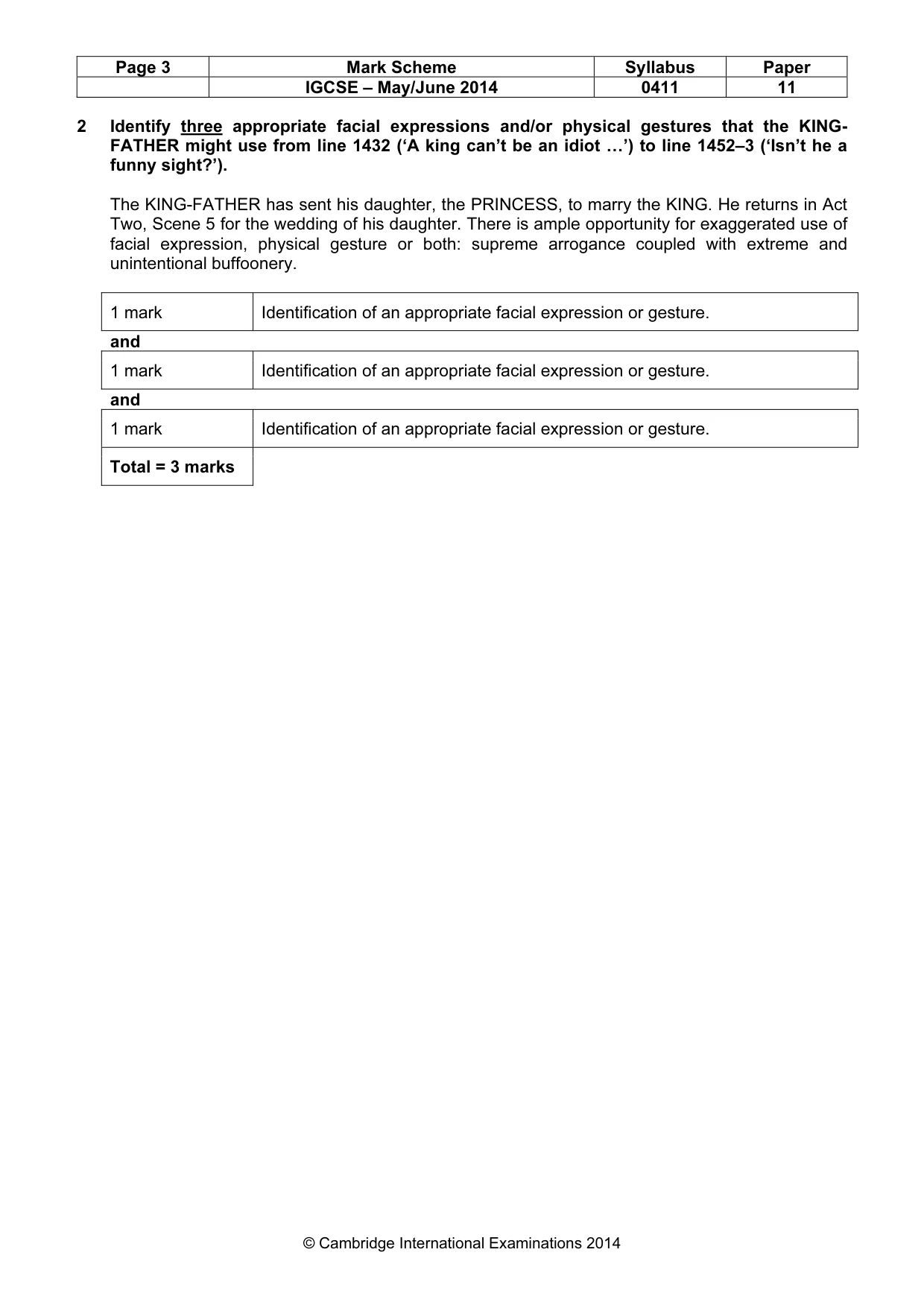
Page 3 Mark Scheme Syllabus Paper IGCSE – May/June 2014 0411 11 © Cambridge International Examinations 2014 2 Identify three appropriate facial expressions and/or physical gestures that the KING- FATHER might use from line 1432 (‘A king can’t be an idiot …’) to line 1452–3 (‘Isn’t he a funny sight?’). The KING-FATHER has sent his daughter, the PRINCESS, to marry the KING. He returns in Act Two, Scene 5 for the wedding of his daughter. There is ample opportunity for exaggerated use of facial expression, physical gesture or both: supreme arrogance coupled with extreme and unintentional buffoonery. 1 mark Identification of an appropriate facial expression or gesture. and 1 mark Identification of an appropriate facial expression or gesture. and 1 mark Identification of an appropriate facial expression or gesture. Total = 3 marks
Mark scheme, page 4
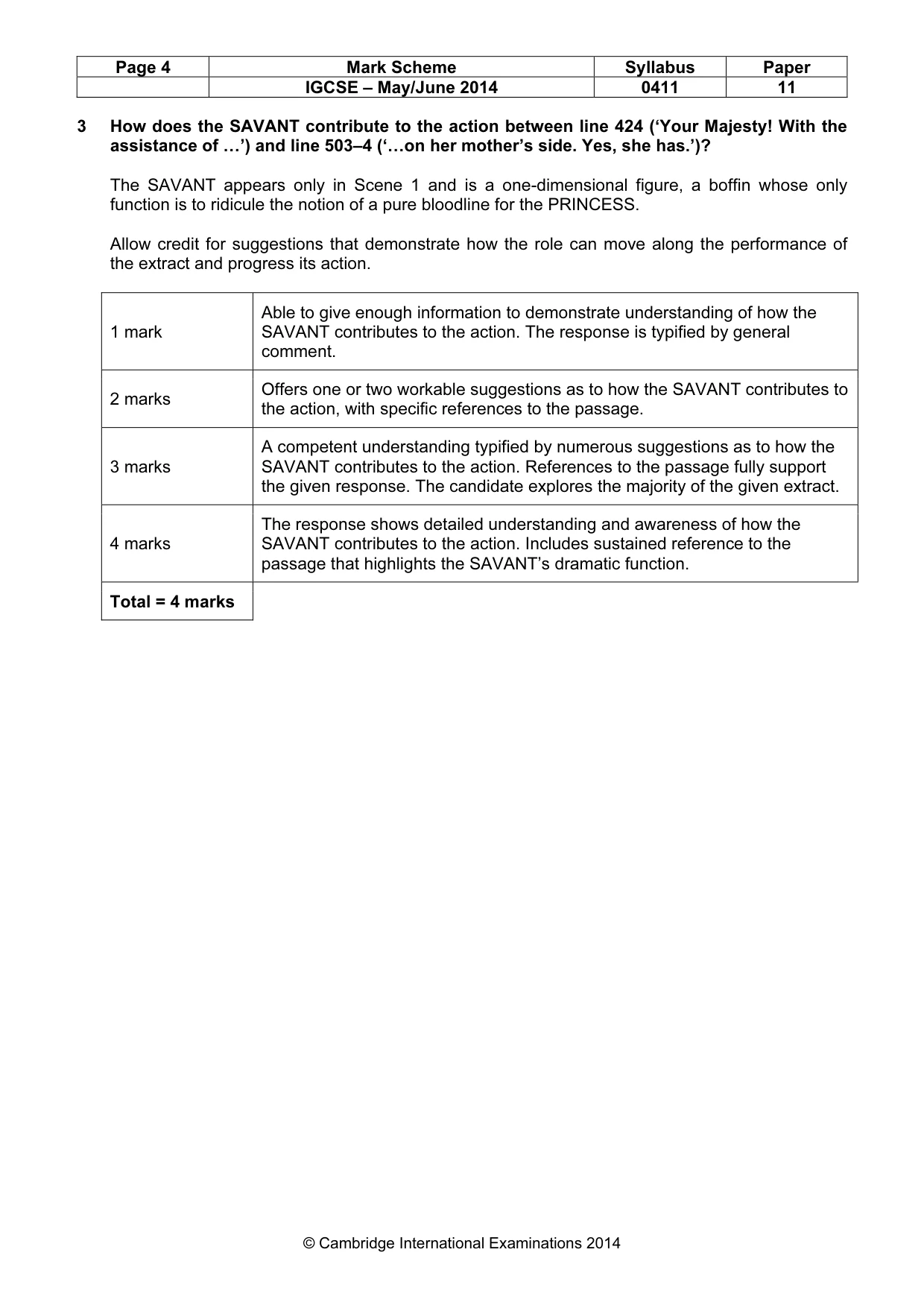
Page 4 Mark Scheme Syllabus Paper IGCSE – May/June 2014 0411 11 © Cambridge International Examinations 2014 3 How does the SAVANT contribute to the action between line 424 (‘Your Majesty! With the assistance of …’) and line 503–4 (‘…on her mother’s side. Yes, she has.’)? The SAVANT appears only in Scene 1 and is a one-dimensional figure, a boffin whose only function is to ridicule the notion of a pure bloodline for the PRINCESS. Allow credit for suggestions that demonstrate how the role can move along the performance of the extract and progress its action. 1 mark Able to give enough information to demonstrate understanding of how the SAVANT contributes to the action. The response is typified by general comment. 2 marks Offers one or two workable suggestions as to how the SAVANT contributes to the action, with specific references to the passage. 3 marks A competent understanding typified by numerous suggestions as to how the SAVANT contributes to the action. References to the passage fully support the given response. The candidate explores the majority of the given extract. 4 marks The response shows detailed understanding and awareness of how the SAVANT contributes to the action. Includes sustained reference to the passage that highlights the SAVANT’s dramatic function. Total = 4 marks
Mark scheme, page 5
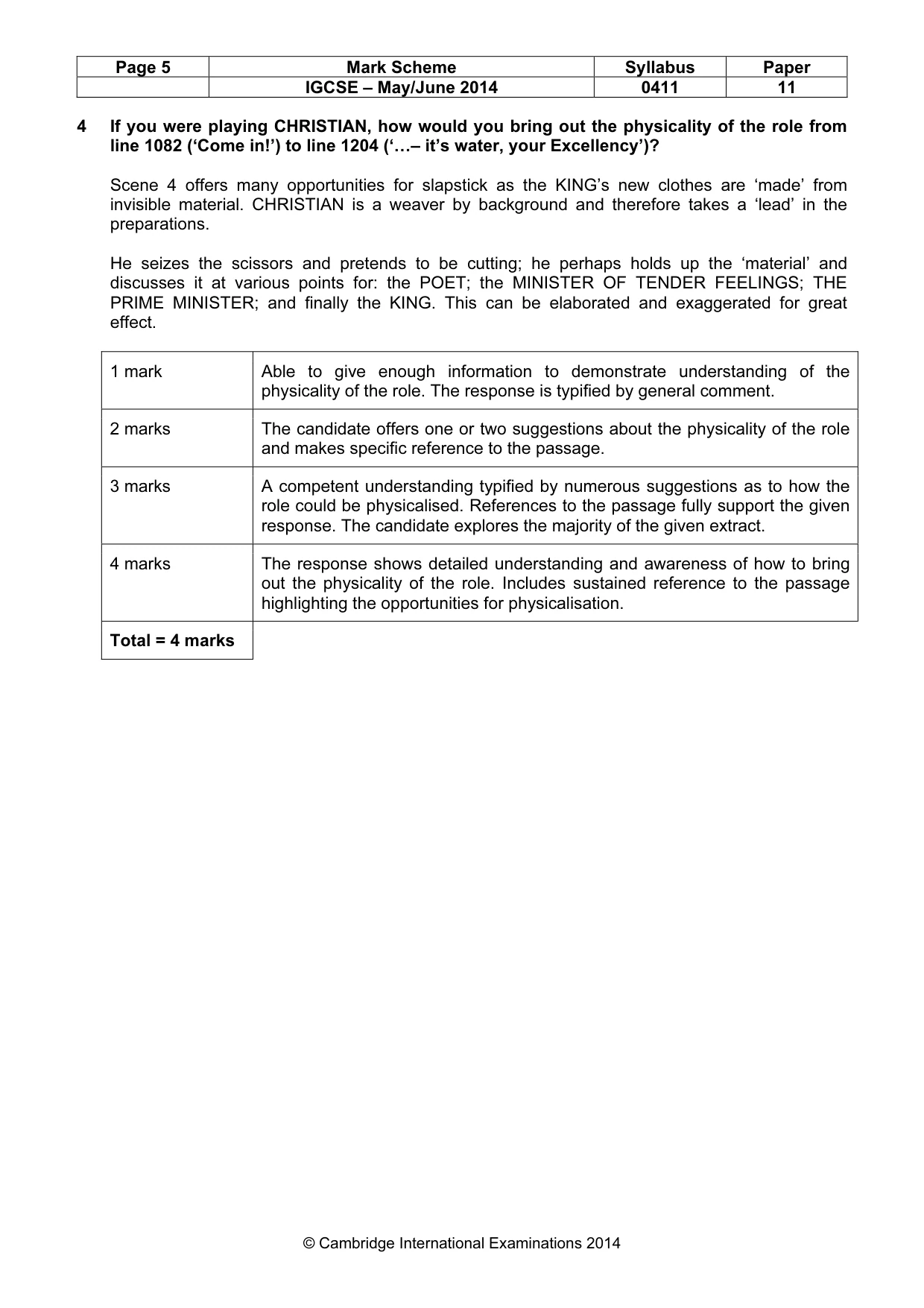
Page 5 Mark Scheme Syllabus Paper IGCSE – May/June 2014 0411 11 © Cambridge International Examinations 2014 4 If you were playing CHRISTIAN, how would you bring out the physicality of the role from line 1082 (‘Come in!’) to line 1204 (‘…– it’s water, your Excellency’)? Scene 4 offers many opportunities for slapstick as the KING’s new clothes are ‘made’ from invisible material. CHRISTIAN is a weaver by background and therefore takes a ‘lead’ in the preparations. He seizes the scissors and pretends to be cutting; he perhaps holds up the ‘material’ and discusses it at various points for: the POET; the MINISTER OF TENDER FEELINGS; THE PRIME MINISTER; and finally the KING. This can be elaborated and exaggerated for great effect. 1 mark Able to give enough information to demonstrate understanding of the physicality of the role. The response is typified by general comment. 2 marks The candidate offers one or two suggestions about the physicality of the role and makes specific reference to the passage. 3 marks A competent understanding typified by numerous suggestions as to how the role could be physicalised. References to the passage fully support the given response. The candidate explores the majority of the given extract. 4 marks The response shows detailed understanding and awareness of how to bring out the physicality of the role. Includes sustained reference to the passage highlighting the opportunities for physicalisation. Total = 4 marks
Mark scheme, page 6
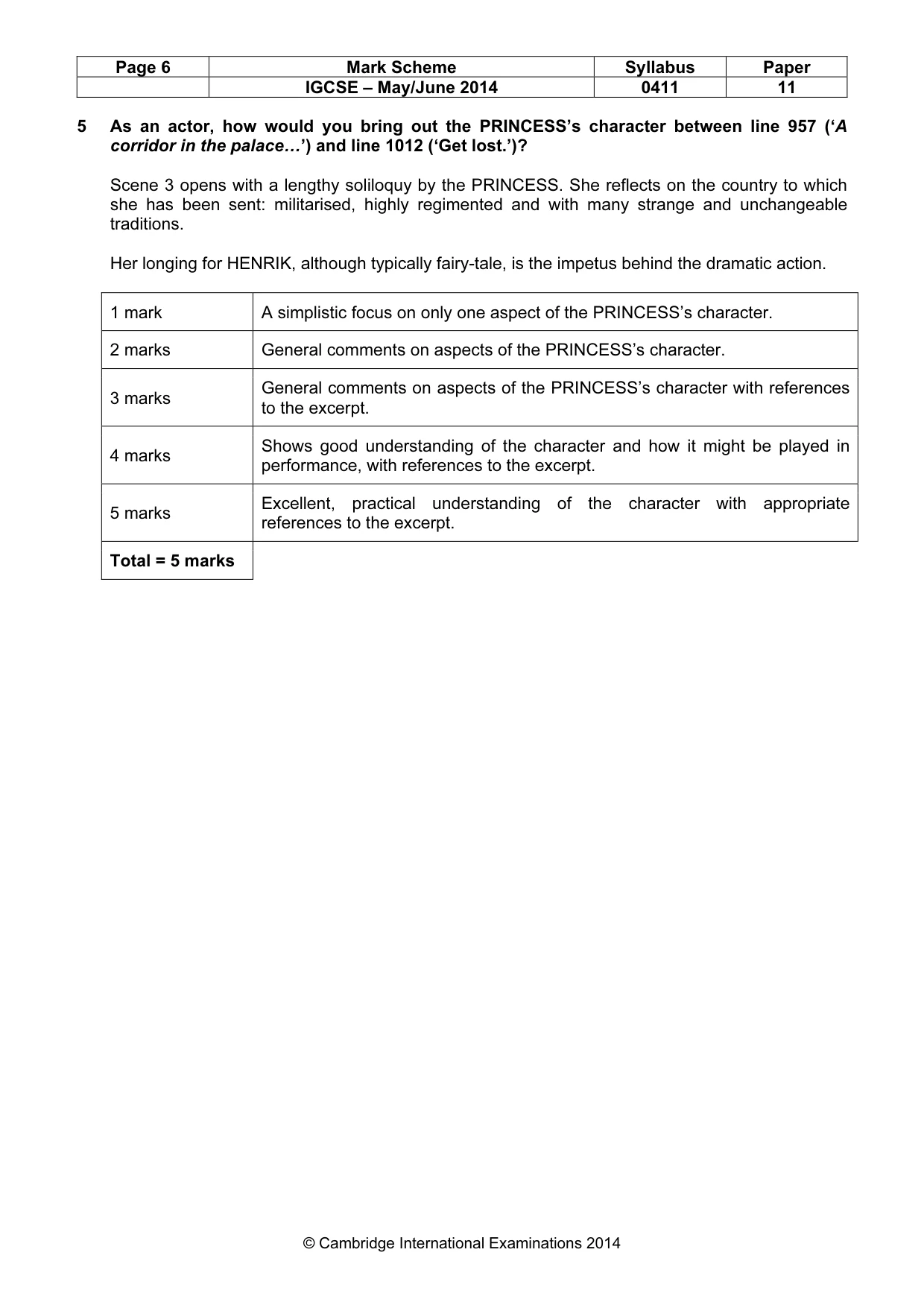
Page 6 Mark Scheme Syllabus Paper IGCSE – May/June 2014 0411 11 © Cambridge International Examinations 2014 5 As an actor, how would you bring out the PRINCESS’s character between line 957 (‘A corridor in the palace…’) and line 1012 (‘Get lost.’)? Scene 3 opens with a lengthy soliloquy by the PRINCESS. She reflects on the country to which she has been sent: militarised, highly regimented and with many strange and unchangeable traditions. Her longing for HENRIK, although typically fairy-tale, is the impetus behind the dramatic action. 1 mark A simplistic focus on only one aspect of the PRINCESS’s character. 2 marks General comments on aspects of the PRINCESS’s character. 3 marks General comments on aspects of the PRINCESS’s character with references to the excerpt. 4 marks Shows good understanding of the character and how it might be played in performance, with references to the excerpt. 5 marks Excellent, practical understanding of the character with appropriate references to the excerpt. Total = 5 marks
Mark scheme, page 7
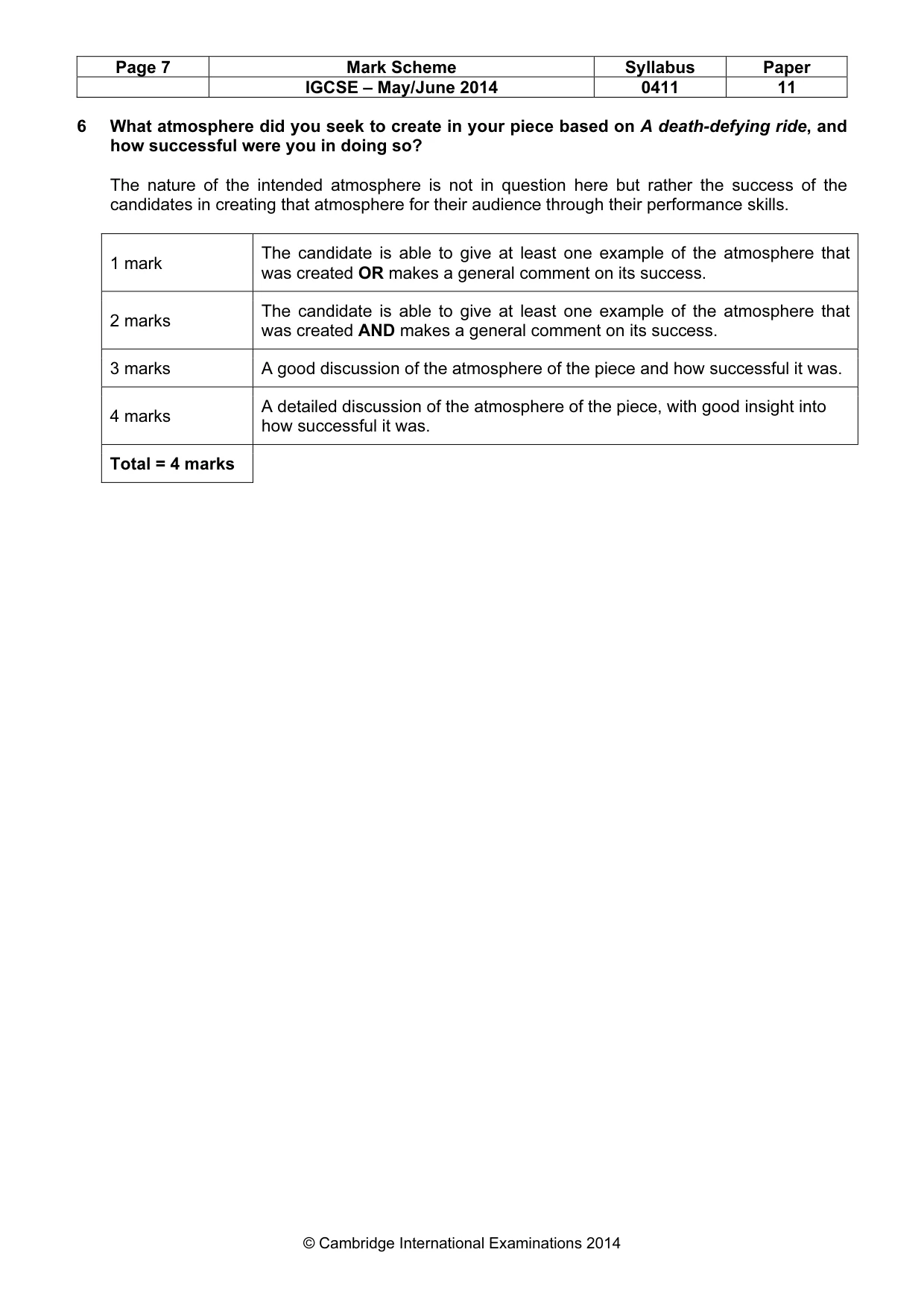
Page 7 Mark Scheme Syllabus Paper IGCSE – May/June 2014 0411 11 © Cambridge International Examinations 2014 6 What atmosphere did you seek to create in your piece based on A death-defying ride, and how successful were you in doing so? The nature of the intended atmosphere is not in question here but rather the success of the candidates in creating that atmosphere for their audience through their performance skills. 1 mark The candidate is able to give at least one example of the atmosphere that was created OR makes a general comment on its success. 2 marks The candidate is able to give at least one example of the atmosphere that was created AND makes a general comment on its success. 3 marks A good discussion of the atmosphere of the piece and how successful it was. 4 marks A detailed discussion of the atmosphere of the piece, with good insight into how successful it was. Total = 4 marks
Mark scheme, page 8
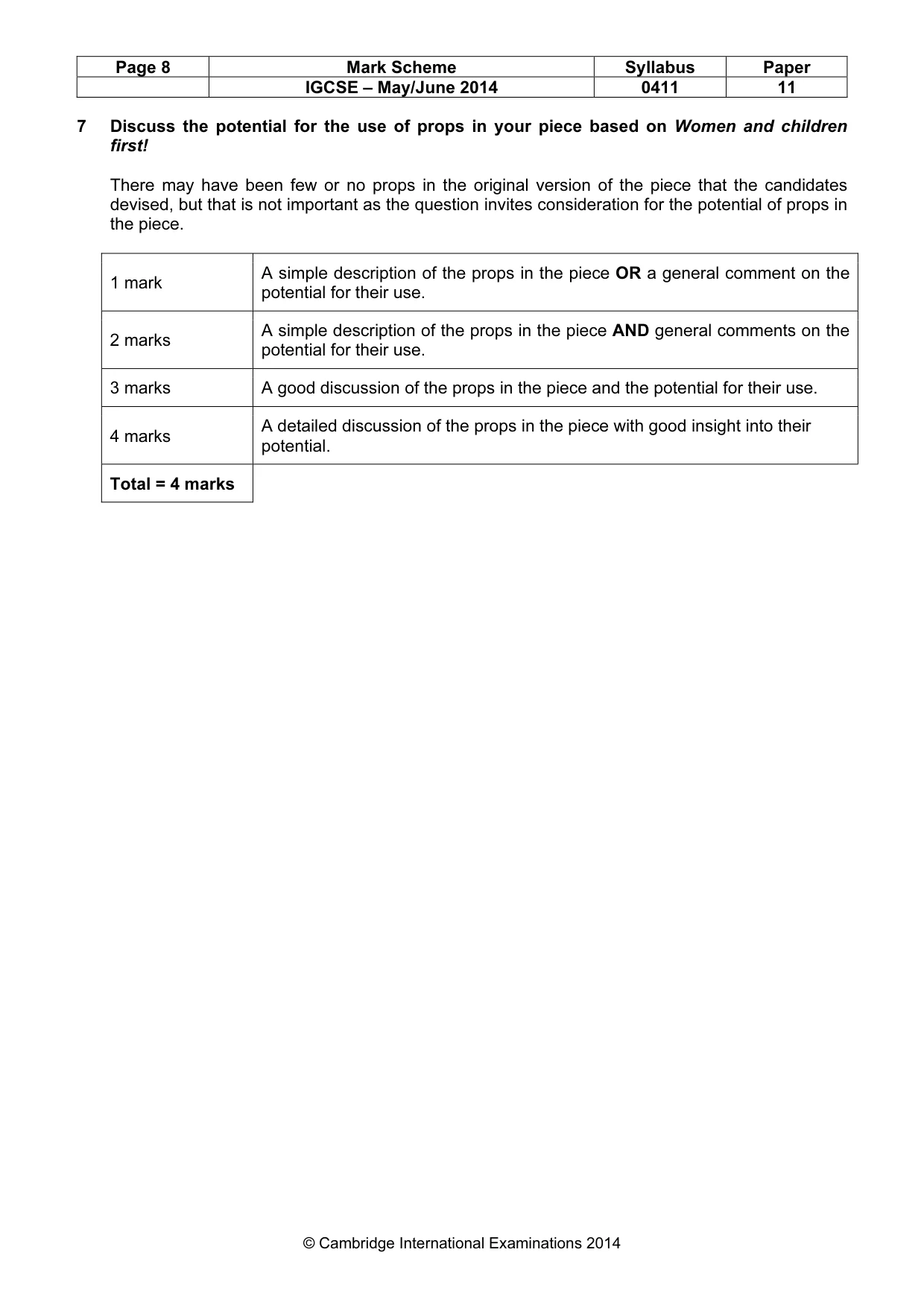
Page 8 Mark Scheme Syllabus Paper IGCSE – May/June 2014 0411 11 © Cambridge International Examinations 2014 7 Discuss the potential for the use of props in your piece based on Women and children first! There may have been few or no props in the original version of the piece that the candidates devised, but that is not important as the question invites consideration for the potential of props in the piece. 1 mark A simple description of the props in the piece OR a general comment on the potential for their use. 2 marks A simple description of the props in the piece AND general comments on the potential for their use. 3 marks A good discussion of the props in the piece and the potential for their use. 4 marks A detailed discussion of the props in the piece with good insight into their potential. Total = 4 marks
Mark scheme, page 9
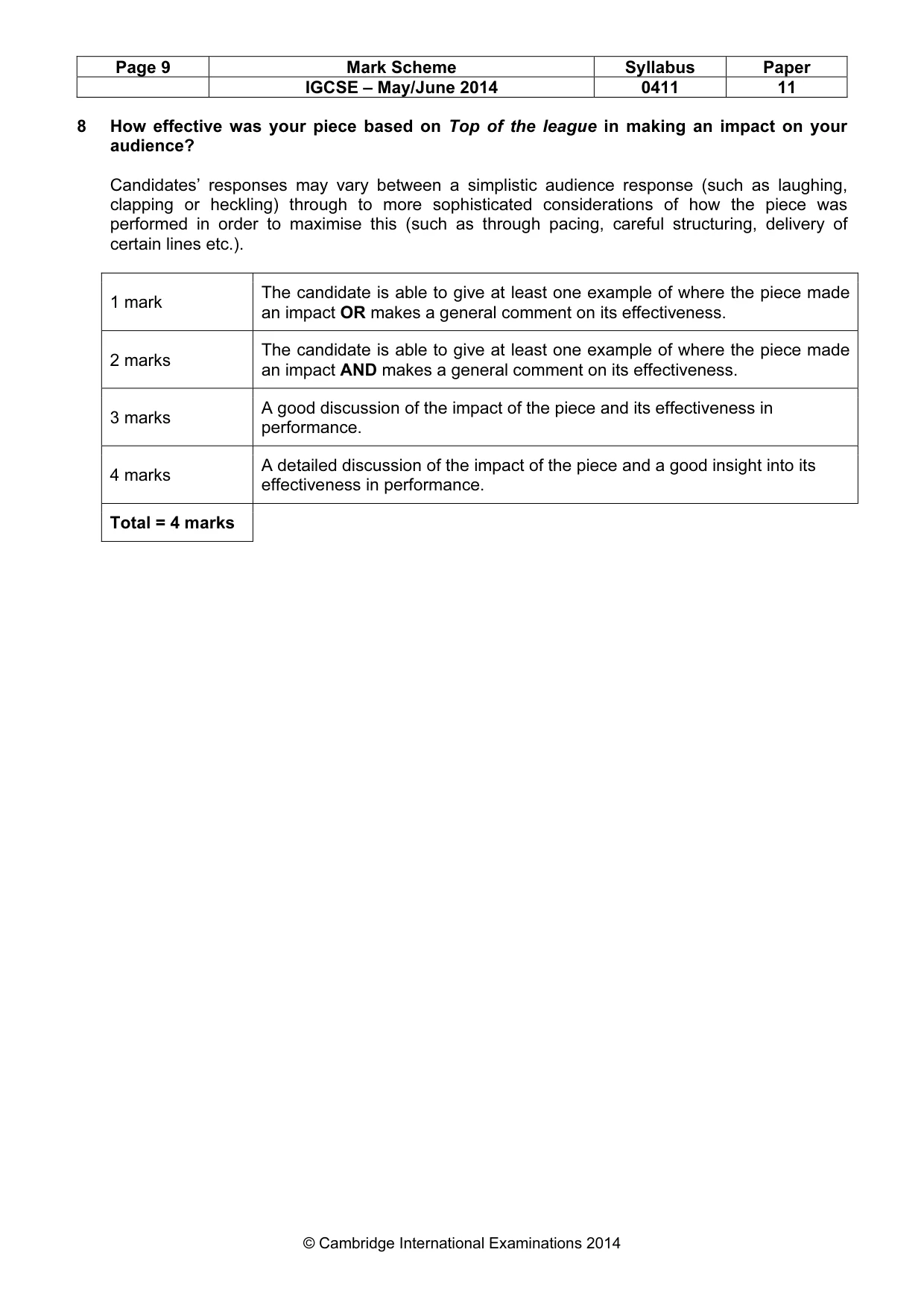
Page 9 Mark Scheme Syllabus Paper IGCSE – May/June 2014 0411 11 © Cambridge International Examinations 2014 8 How effective was your piece based on Top of the league in making an impact on your audience? Candidates’ responses may vary between a simplistic audience response (such as laughing, clapping or heckling) through to more sophisticated considerations of how the piece was performed in order to maximise this (such as through pacing, careful structuring, delivery of certain lines etc.). 1 mark The candidate is able to give at least one example of where the piece made an impact OR makes a general comment on its effectiveness. 2 marks The candidate is able to give at least one example of where the piece made an impact AND makes a general comment on its effectiveness. 3 marks A good discussion of the impact of the piece and its effectiveness in performance. 4 marks A detailed discussion of the impact of the piece and a good insight into its effectiveness in performance. Total = 4 marks
Mark scheme, page 10
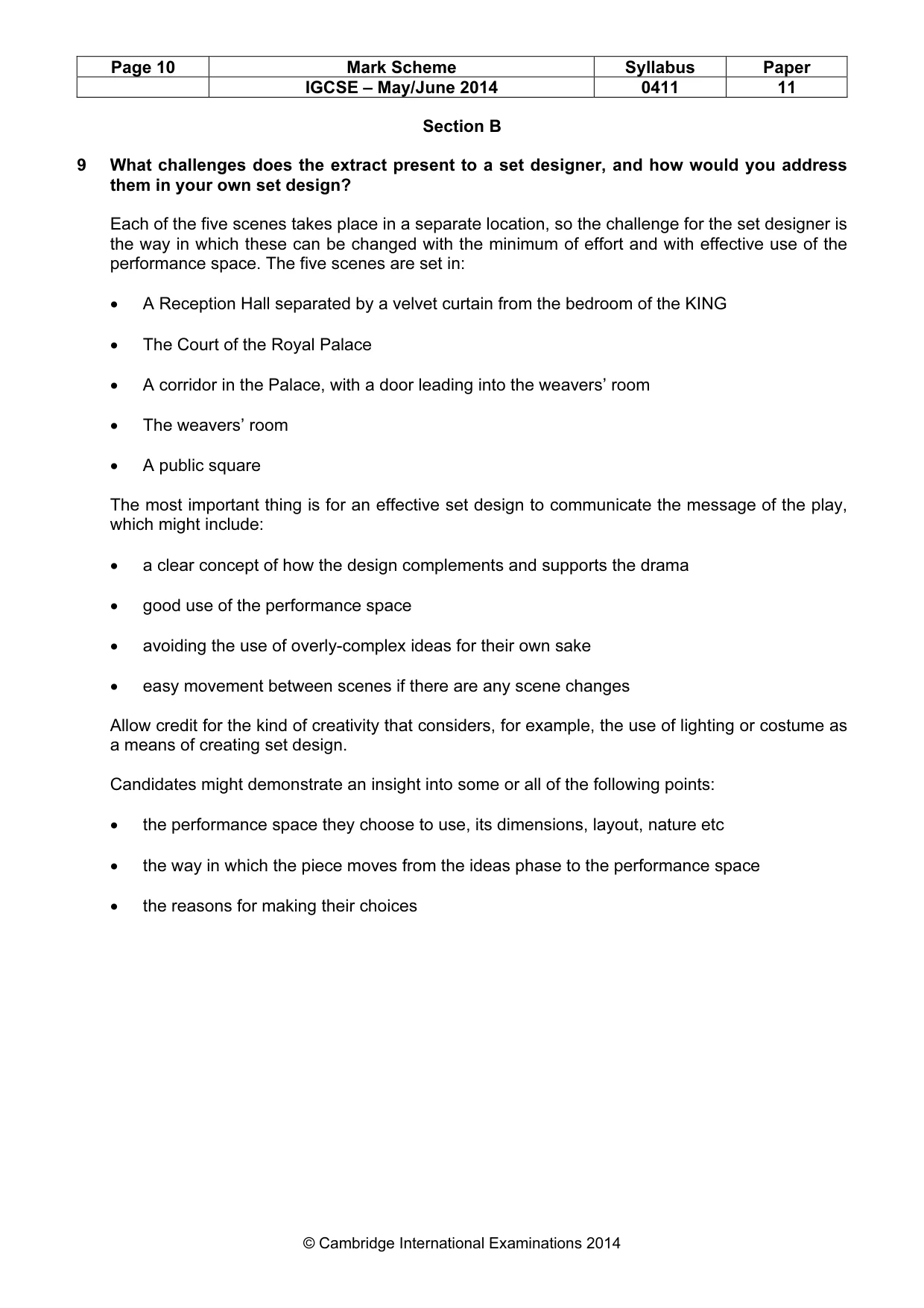
Page 10 Mark Scheme Syllabus Paper IGCSE – May/June 2014 0411 11 © Cambridge International Examinations 2014 Section B 9 What challenges does the extract present to a set designer, and how would you address them in your own set design? Each of the five scenes takes place in a separate location, so the challenge for the set designer is the way in which these can be changed with the minimum of effort and with effective use of the performance space. The five scenes are set in: • A Reception Hall separated by a velvet curtain from the bedroom of the KING • The Court of the Royal Palace • A corridor in the Palace, with a door leading into the weavers’ room • The weavers’ room • A public square The most important thing is for an effective set design to communicate the message of the play, which might include: • a clear concept of how the design complements and supports the drama • good use of the performance space • avoiding the use of overly-complex ideas for their own sake • easy movement between scenes if there are any scene changes Allow credit for the kind of creativity that considers, for example, the use of lighting or costume as a means of creating set design. Candidates might demonstrate an insight into some or all of the following points: • the performance space they choose to use, its dimensions, layout, nature etc • the way in which the piece moves from the ideas phase to the performance space • the reasons for making their choices
Mark scheme, page 11
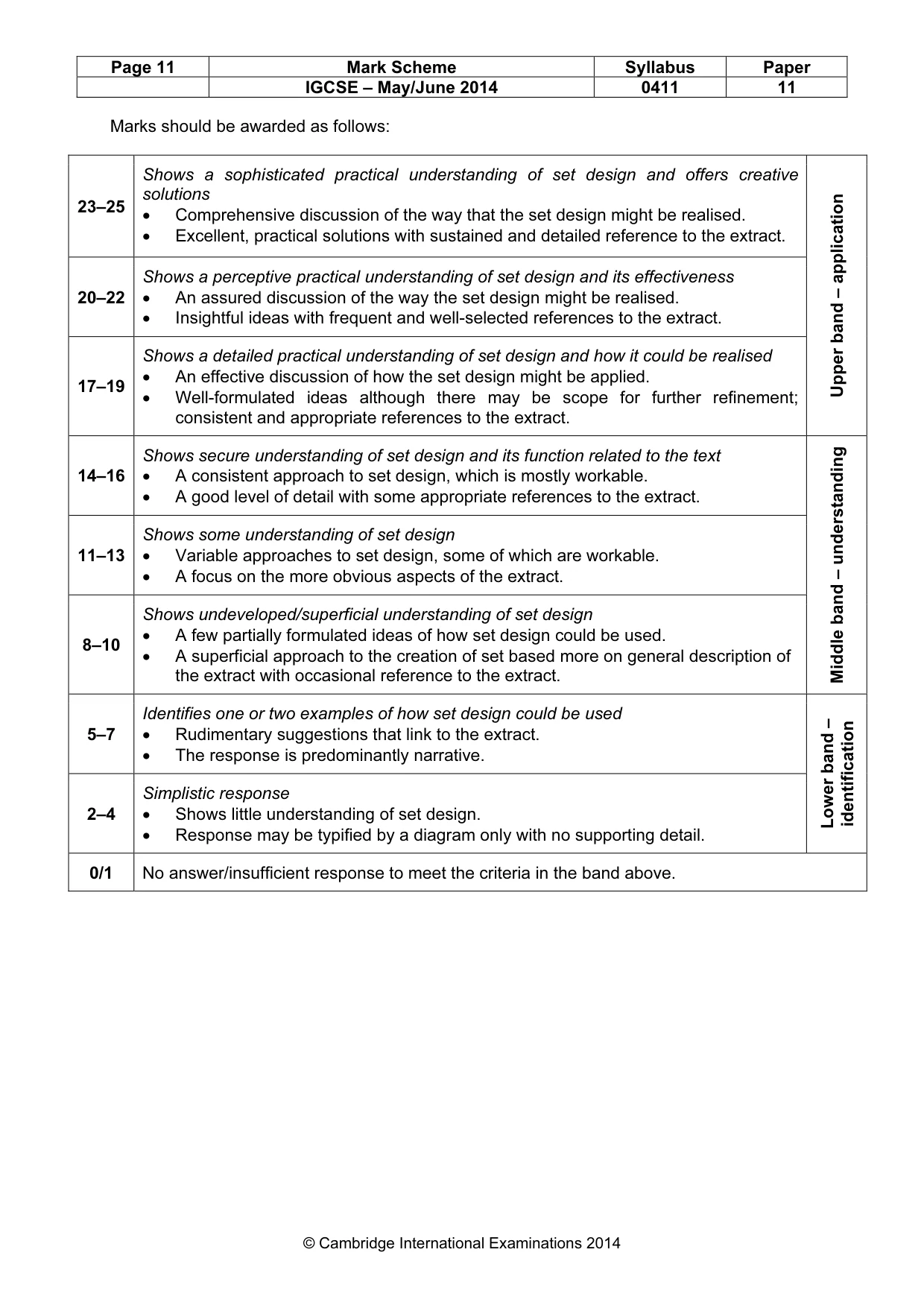
Page 11 Mark Scheme Syllabus Paper IGCSE – May/June 2014 0411 11 © Cambridge International Examinations 2014 Marks should be awarded as follows: 23–25 Shows a sophisticated practical understanding of set design and offers creative solutions • Comprehensive discussion of the way that the set design might be realised. • Excellent, practical solutions with sustained and detailed reference to the extract. Upper band – application 20–22 Shows a perceptive practical understanding of set design and its effectiveness • An assured discussion of the way the set design might be realised. • Insightful ideas with frequent and well-selected references to the extract. 17–19 Shows a detailed practical understanding of set design and how it could be realised • An effective discussion of how the set design might be applied. • Well-formulated ideas although there may be scope for further refinement; consistent and appropriate references to the extract. 14–16 Shows secure understanding of set design and its function related to the text • A consistent approach to set design, which is mostly workable. • A good level of detail with some appropriate references to the extract. Middle band – understanding 11–13 Shows some understanding of set design • Variable approaches to set design, some of which are workable. • A focus on the more obvious aspects of the extract. 8–10 Shows undeveloped/superficial understanding of set design • A few partially formulated ideas of how set design could be used. • A superficial approach to the creation of set based more on general description of the extract with occasional reference to the extract. 5–7 Identifies one or two examples of how set design could be used • Rudimentary suggestions that link to the extract. • The response is predominantly narrative. Lower band – identification 2–4 Simplistic response • Shows little understanding of set design. • Response may be typified by a diagram only with no supporting detail. 0/1 No answer/insufficient response to meet the criteria in the band above.
Mark scheme, page 12
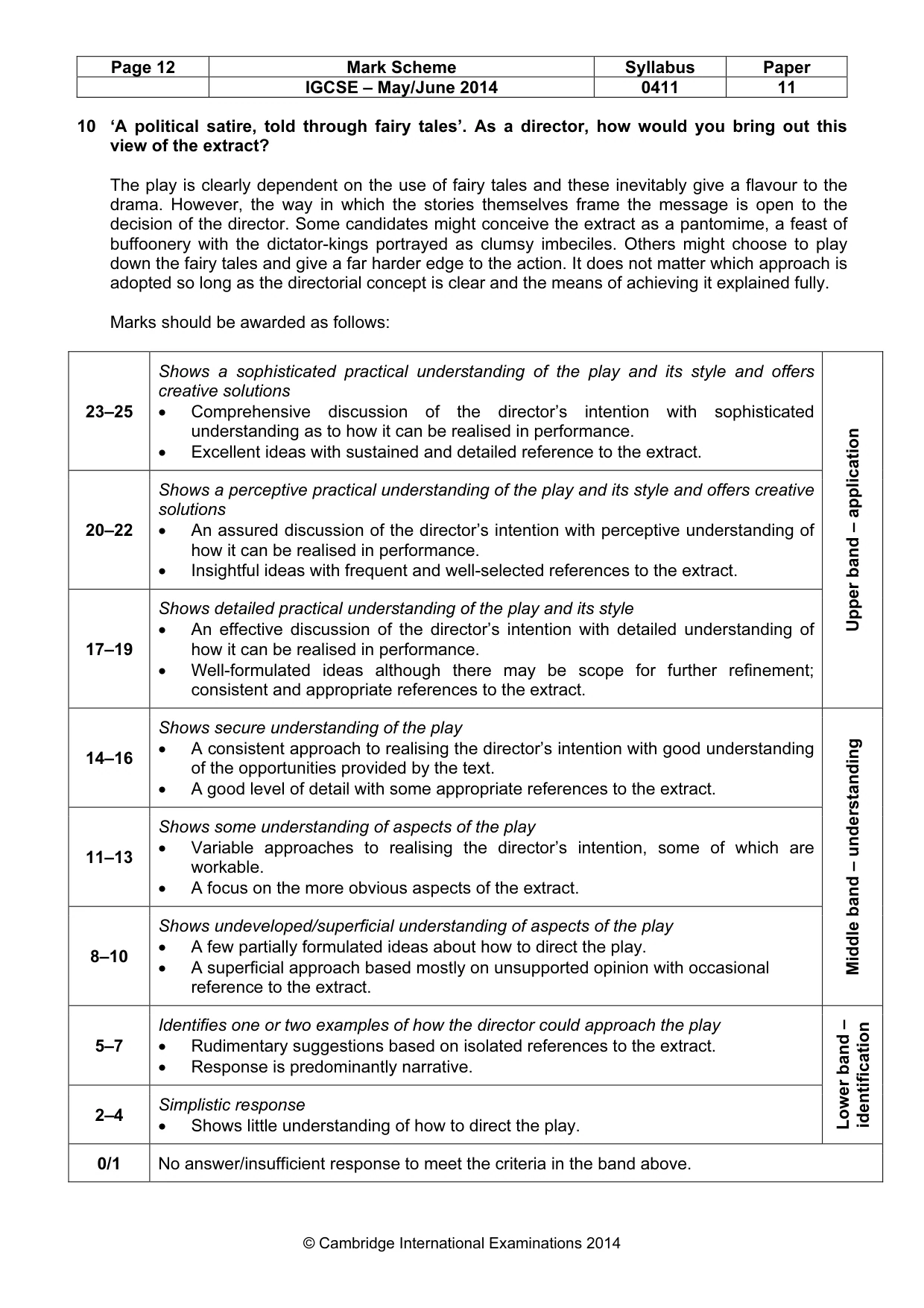
Page 12 Mark Scheme Syllabus Paper IGCSE – May/June 2014 0411 11 © Cambridge International Examinations 2014 10 ‘A political satire, told through fairy tales’. As a director, how would you bring out this view of the extract? The play is clearly dependent on the use of fairy tales and these inevitably give a flavour to the drama. However, the way in which the stories themselves frame the message is open to the decision of the director. Some candidates might conceive the extract as a pantomime, a feast of buffoonery with the dictator-kings portrayed as clumsy imbeciles. Others might choose to play down the fairy tales and give a far harder edge to the action. It does not matter which approach is adopted so long as the directorial concept is clear and the means of achieving it explained fully. Marks should be awarded as follows: 23–25 Shows a sophisticated practical understanding of the play and its style and offers creative solutions • Comprehensive discussion of the director’s intention with sophisticated understanding as to how it can be realised in performance. • Excellent ideas with sustained and detailed reference to the extract. Upper band – application 20–22 Shows a perceptive practical understanding of the play and its style and offers creative solutions • An assured discussion of the director’s intention with perceptive understanding of how it can be realised in performance. • Insightful ideas with frequent and well-selected references to the extract. 17–19 Shows detailed practical understanding of the play and its style • An effective discussion of the director’s intention with detailed understanding of how it can be realised in performance. • Well-formulated ideas although there may be scope for further refinement; consistent and appropriate references to the extract. 14–16 Shows secure understanding of the play • A consistent approach to realising the director’s intention with good understanding of the opportunities provided by the text. • A good level of detail with some appropriate references to the extract. Middle band – understanding 11–13 Shows some understanding of aspects of the play • Variable approaches to realising the director’s intention, some of which are workable. • A focus on the more obvious aspects of the extract. 8–10 Shows undeveloped/superficial understanding of aspects of the play • A few partially formulated ideas about how to direct the play. • A superficial approach based mostly on unsupported opinion with occasional reference to the extract. 5–7 Identifies one or two examples of how the director could approach the play • Rudimentary suggestions based on isolated references to the extract. • Response is predominantly narrative. Lower band – identification 2–4 Simplistic response • Shows little understanding of how to direct the play. 0/1 No answer/insufficient response to meet the criteria in the band above.
Mark scheme, page 13
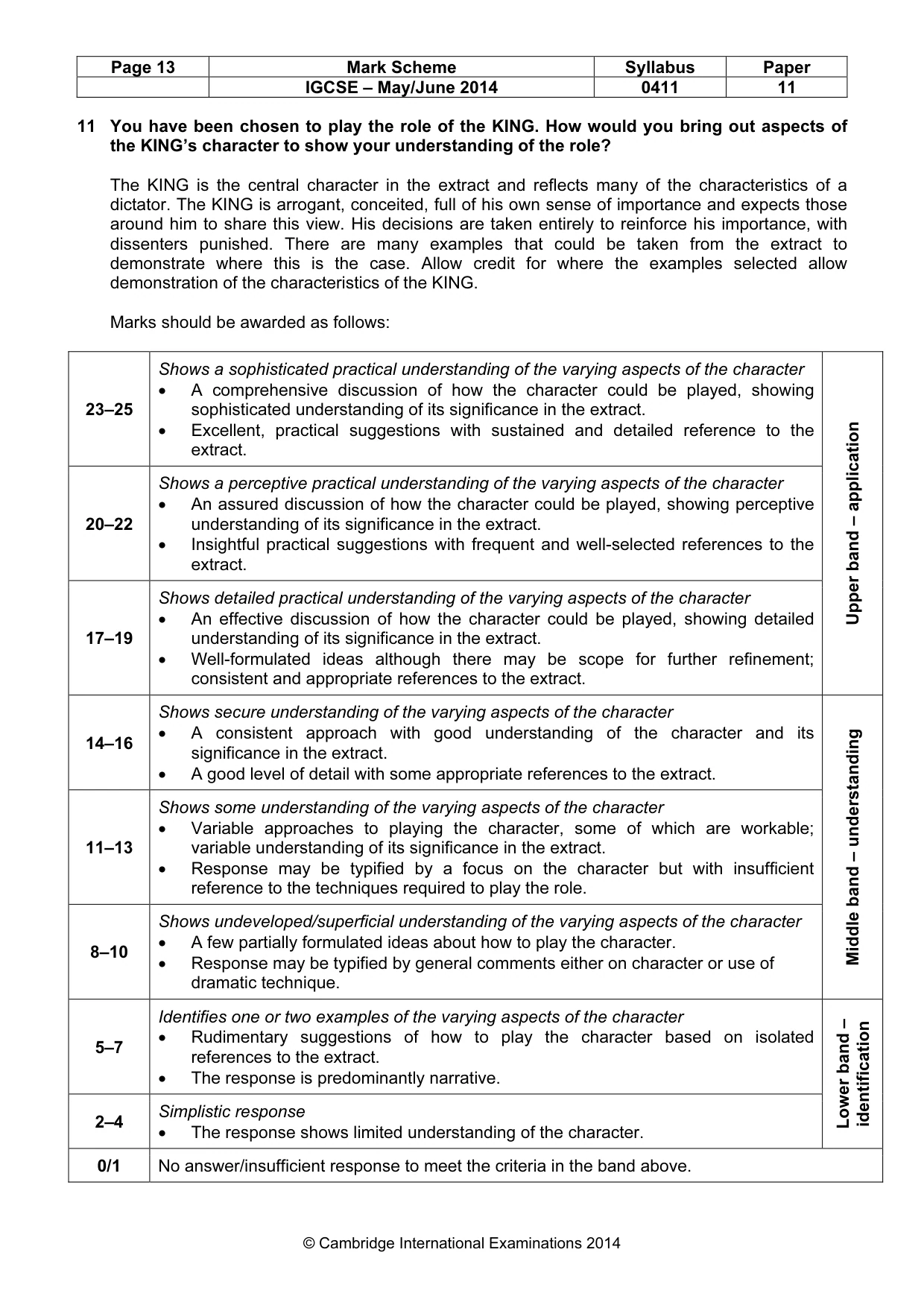
Page 13 Mark Scheme Syllabus Paper IGCSE – May/June 2014 0411 11 © Cambridge International Examinations 2014 11 You have been chosen to play the role of the KING. How would you bring out aspects of the KING’s character to show your understanding of the role? The KING is the central character in the extract and reflects many of the characteristics of a dictator. The KING is arrogant, conceited, full of his own sense of importance and expects those around him to share this view. His decisions are taken entirely to reinforce his importance, with dissenters punished. There are many examples that could be taken from the extract to demonstrate where this is the case. Allow credit for where the examples selected allow demonstration of the characteristics of the KING. Marks should be awarded as follows: 23–25 Shows a sophisticated practical understanding of the varying aspects of the character • A comprehensive discussion of how the character could be played, showing sophisticated understanding of its significance in the extract. • Excellent, practical suggestions with sustained and detailed reference to the extract. Upper band – application 20–22 Shows a perceptive practical understanding of the varying aspects of the character • An assured discussion of how the character could be played, showing perceptive understanding of its significance in the extract. • Insightful practical suggestions with frequent and well-selected references to the extract. 17–19 Shows detailed practical understanding of the varying aspects of the character • An effective discussion of how the character could be played, showing detailed understanding of its significance in the extract. • Well-formulated ideas although there may be scope for further refinement; consistent and appropriate references to the extract. 14–16 Shows secure understanding of the varying aspects of the character • A consistent approach with good understanding of the character and its significance in the extract. • A good level of detail with some appropriate references to the extract. Middle band – understanding 11–13 Shows some understanding of the varying aspects of the character • Variable approaches to playing the character, some of which are workable; variable understanding of its significance in the extract. • Response may be typified by a focus on the character but with insufficient reference to the techniques required to play the role. 8–10 Shows undeveloped/superficial understanding of the varying aspects of the character • A few partially formulated ideas about how to play the character. • Response may be typified by general comments either on character or use of dramatic technique. 5–7 Identifies one or two examples of the varying aspects of the character • Rudimentary suggestions of how to play the character based on isolated references to the extract. • The response is predominantly narrative. Lower band – identification 2–4 Simplistic response • The response shows limited understanding of the character. 0/1 No answer/insufficient response to meet the criteria in the band above.
Mark scheme, page 14
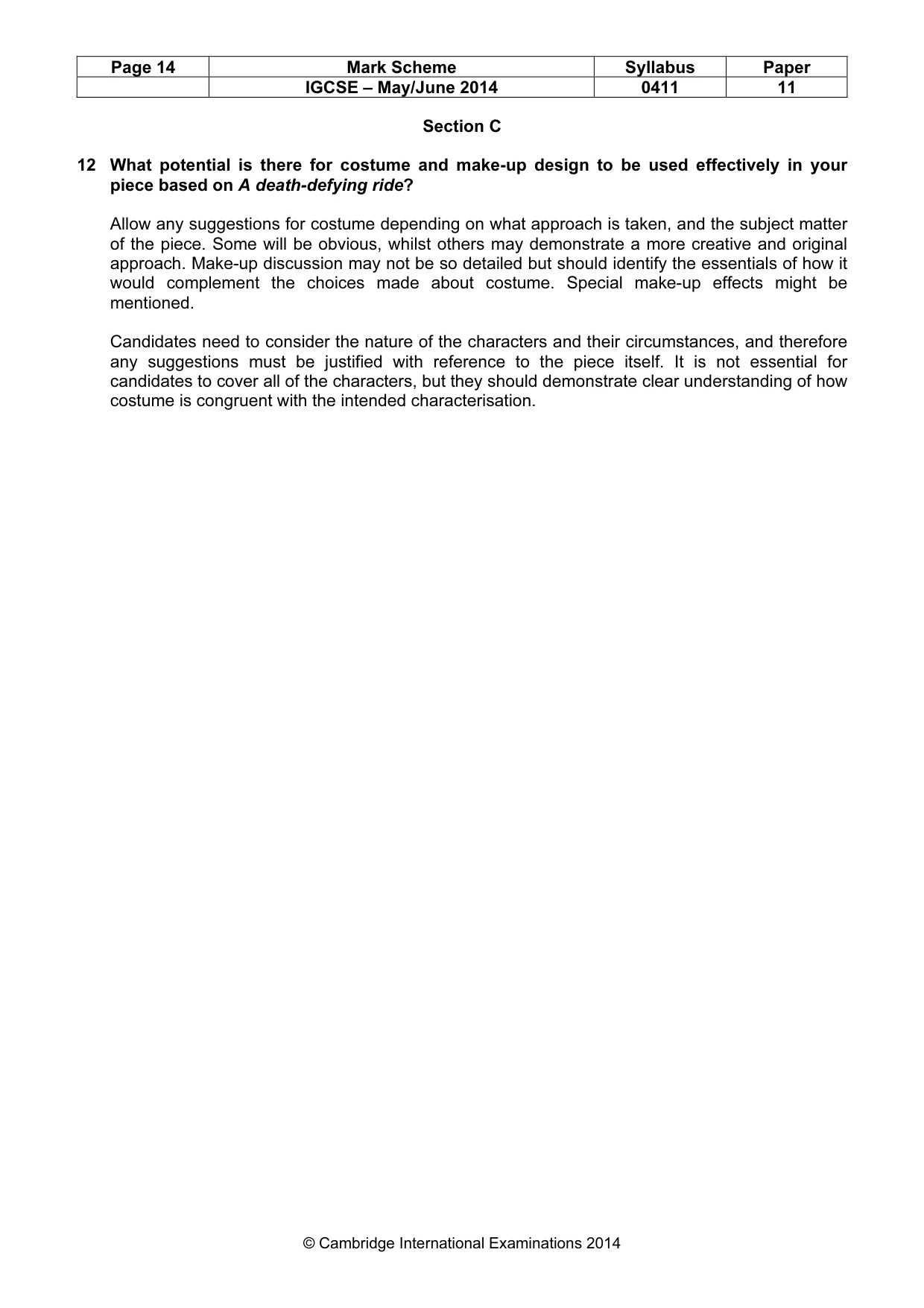
Page 14 Mark Scheme Syllabus Paper IGCSE – May/June 2014 0411 11 © Cambridge International Examinations 2014 Section C 12 What potential is there for costume and make-up design to be used effectively in your piece based on A death-defying ride? Allow any suggestions for costume depending on what approach is taken, and the subject matter of the piece. Some will be obvious, whilst others may demonstrate a more creative and original approach. Make-up discussion may not be so detailed but should identify the essentials of how it would complement the choices made about costume. Special make-up effects might be mentioned. Candidates need to consider the nature of the characters and their circumstances, and therefore any suggestions must be justified with reference to the piece itself. It is not essential for candidates to cover all of the characters, but they should demonstrate clear understanding of how costume is congruent with the intended characterisation.
Mark scheme, page 15
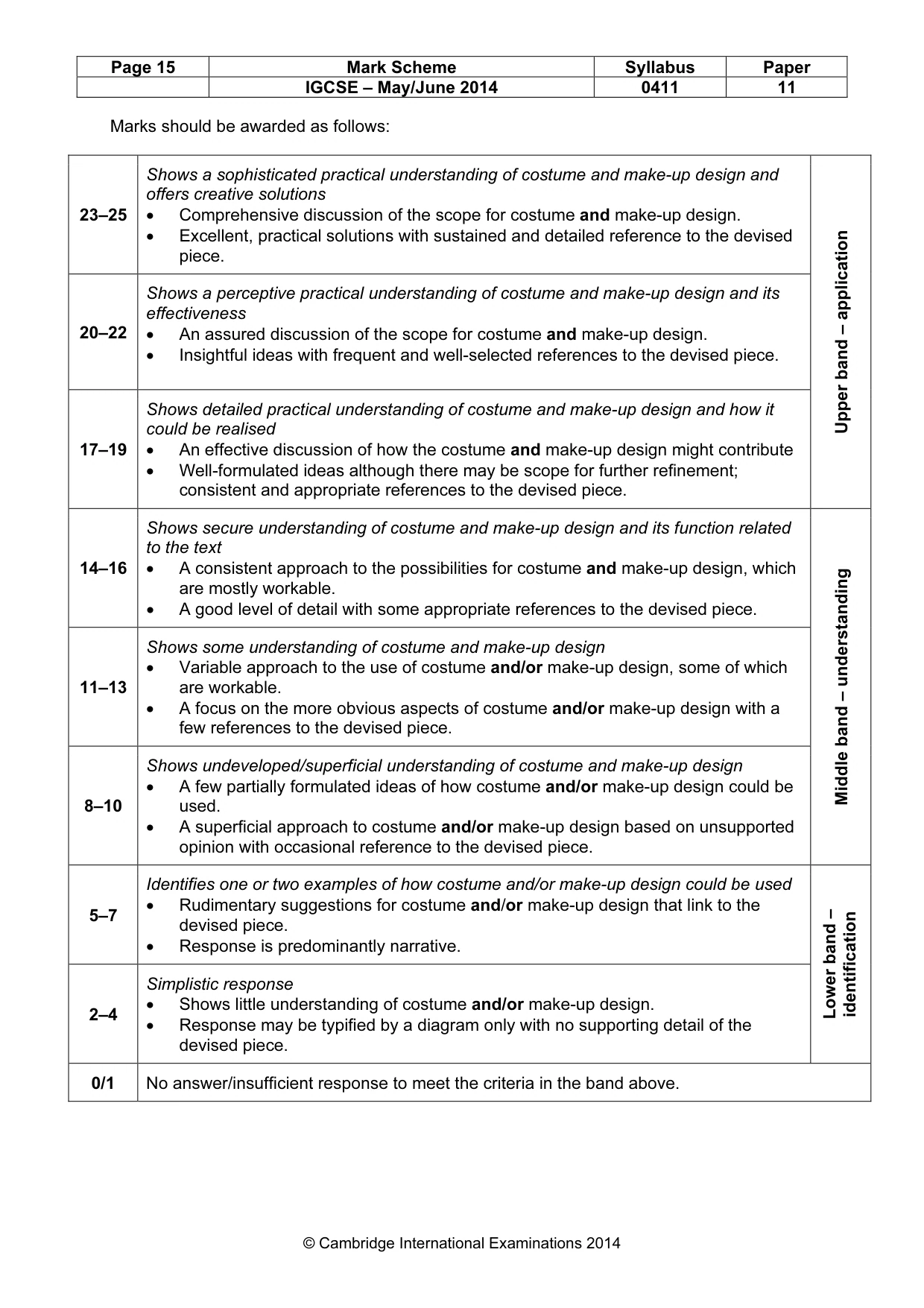
Page 15 Mark Scheme Syllabus Paper IGCSE – May/June 2014 0411 11 © Cambridge International Examinations 2014 Marks should be awarded as follows: 23–25 Shows a sophisticated practical understanding of costume and make-up design and offers creative solutions • Comprehensive discussion of the scope for costume and make-up design. • Excellent, practical solutions with sustained and detailed reference to the devised piece. Upper band – application 20–22 Shows a perceptive practical understanding of costume and make-up design and its effectiveness • An assured discussion of the scope for costume and make-up design. • Insightful ideas with frequent and well-selected references to the devised piece. 17–19 Shows detailed practical understanding of costume and make-up design and how it could be realised • An effective discussion of how the costume and make-up design might contribute • Well-formulated ideas although there may be scope for further refinement; consistent and appropriate references to the devised piece. 14–16 Shows secure understanding of costume and make-up design and its function related to the text • A consistent approach to the possibilities for costume and make-up design, which are mostly workable. • A good level of detail with some appropriate references to the devised piece. Middle band – understanding 11–13 Shows some understanding of costume and make-up design • Variable approach to the use of costume and/or make-up design, some of which are workable. • A focus on the more obvious aspects of costume and/or make-up design with a few references to the devised piece. 8–10 Shows undeveloped/superficial understanding of costume and make-up design • A few partially formulated ideas of how costume and/or make-up design could be used. • A superficial approach to costume and/or make-up design based on unsupported opinion with occasional reference to the devised piece. 5–7 Identifies one or two examples of how costume and/or make-up design could be used • Rudimentary suggestions for costume and/or make-up design that link to the devised piece. • Response is predominantly narrative. Lower band – identification 2–4 Simplistic response • Shows little understanding of costume and/or make-up design. • Response may be typified by a diagram only with no supporting detail of the devised piece. 0/1 No answer/insufficient response to meet the criteria in the band above.
Mark scheme, page 16
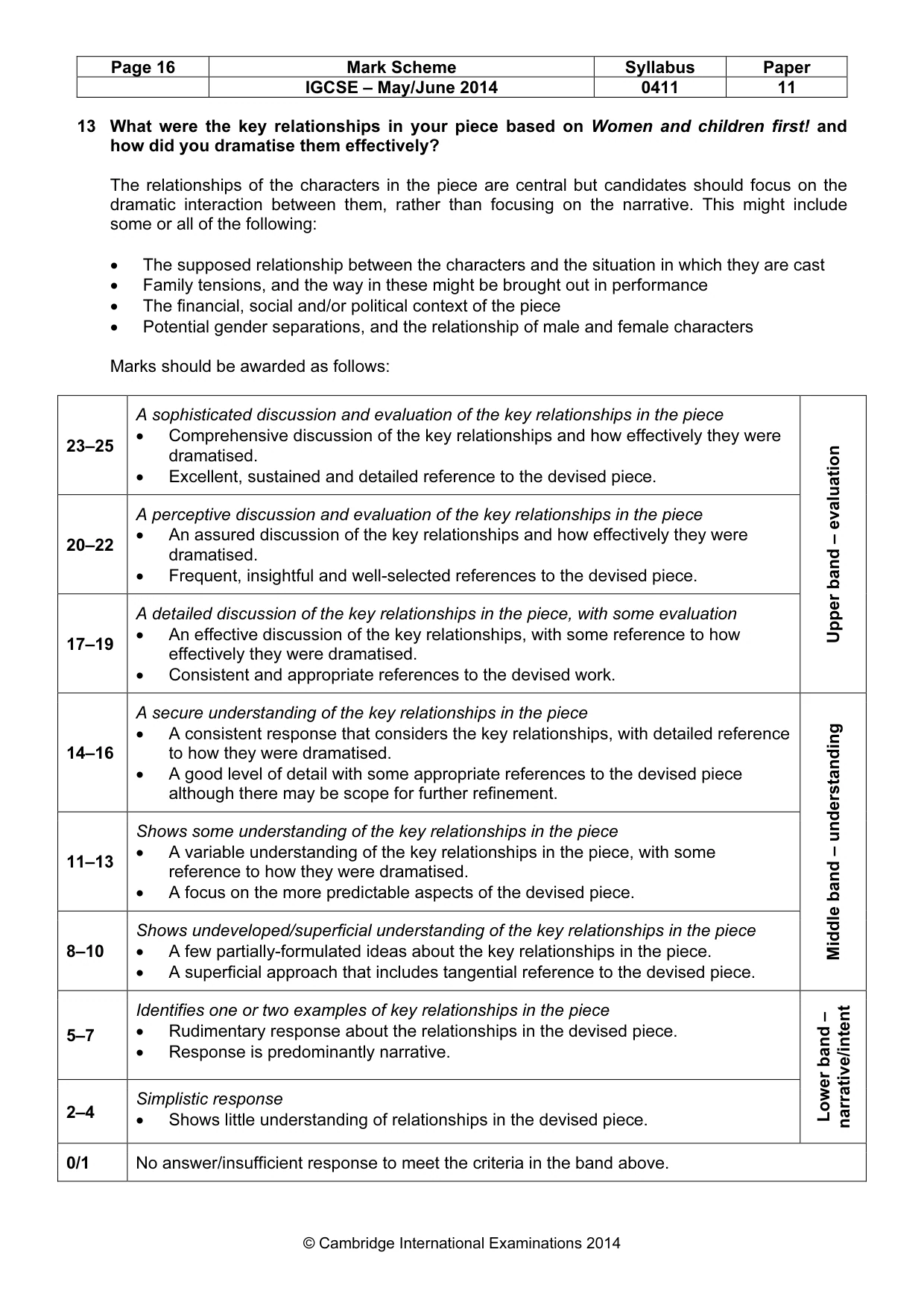
Page 16 Mark Scheme Syllabus Paper IGCSE – May/June 2014 0411 11 © Cambridge International Examinations 2014 13 What were the key relationships in your piece based on Women and children first! and how did you dramatise them effectively? The relationships of the characters in the piece are central but candidates should focus on the dramatic interaction between them, rather than focusing on the narrative. This might include some or all of the following: • The supposed relationship between the characters and the situation in which they are cast • Family tensions, and the way in these might be brought out in performance • The financial, social and/or political context of the piece • Potential gender separations, and the relationship of male and female characters Marks should be awarded as follows: 23–25 A sophisticated discussion and evaluation of the key relationships in the piece • Comprehensive discussion of the key relationships and how effectively they were dramatised. • Excellent, sustained and detailed reference to the devised piece. Upper band – evaluation 20–22 A perceptive discussion and evaluation of the key relationships in the piece • An assured discussion of the key relationships and how effectively they were dramatised. • Frequent, insightful and well-selected references to the devised piece. 17–19 A detailed discussion of the key relationships in the piece, with some evaluation • An effective discussion of the key relationships, with some reference to how effectively they were dramatised. • Consistent and appropriate references to the devised work. 14–16 A secure understanding of the key relationships in the piece • A consistent response that considers the key relationships, with detailed reference to how they were dramatised. • A good level of detail with some appropriate references to the devised piece although there may be scope for further refinement. Middle band – understanding 11–13 Shows some understanding of the key relationships in the piece • A variable understanding of the key relationships in the piece, with some reference to how they were dramatised. • A focus on the more predictable aspects of the devised piece. 8–10 Shows undeveloped/superficial understanding of the key relationships in the piece • A few partially-formulated ideas about the key relationships in the piece. • A superficial approach that includes tangential reference to the devised piece. 5–7 Identifies one or two examples of key relationships in the piece • Rudimentary response about the relationships in the devised piece. • Response is predominantly narrative. Lower band – narrative/intent 2–4 Simplistic response • Shows little understanding of relationships in the devised piece. 0/1 No answer/insufficient response to meet the criteria in the band above.
Mark scheme, page 17
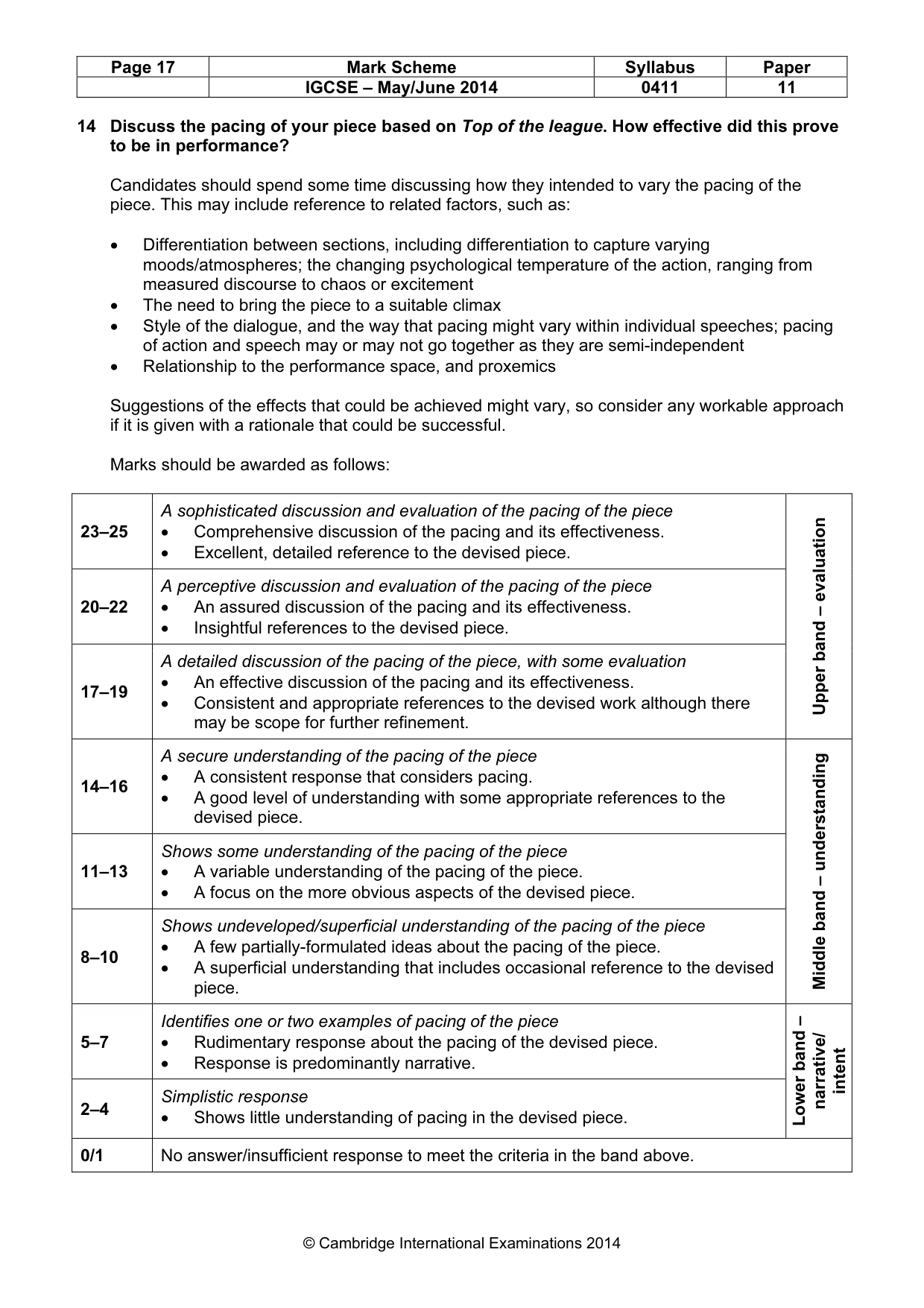
Page 17 Mark Scheme Syllabus Paper IGCSE – May/June 2014 0411 11 © Cambridge International Examinations 2014 14 Discuss the pacing of your piece based on Top of the league. How effective did this prove to be in performance? Candidates should spend some time discussing how they intended to vary the pacing of the piece. This may include reference to related factors, such as: • Differentiation between sections, including differentiation to capture varying moods/atmospheres; the changing psychological temperature of the action, ranging from measured discourse to chaos or excitement • The need to bring the piece to a suitable climax • Style of the dialogue, and the way that pacing might vary within individual speeches; pacing of action and speech may or may not go together as they are semi-independent • Relationship to the performance space, and proxemics Suggestions of the effects that could be achieved might vary, so consider any workable approach if it is given with a rationale that could be successful. Marks should be awarded as follows: 23–25 A sophisticated discussion and evaluation of the pacing of the piece • Comprehensive discussion of the pacing and its effectiveness. • Excellent, detailed reference to the devised piece. Upper band – evaluation 20–22 A perceptive discussion and evaluation of the pacing of the piece • An assured discussion of the pacing and its effectiveness. • Insightful references to the devised piece. 17–19 A detailed discussion of the pacing of the piece, with some evaluation • An effective discussion of the pacing and its effectiveness. • Consistent and appropriate references to the devised work although there may be scope for further refinement. 14–16 A secure understanding of the pacing of the piece • A consistent response that considers pacing. • A good level of understanding with some appropriate references to the devised piece. Middle band – understanding 11–13 Shows some understanding of the pacing of the piece • A variable understanding of the pacing of the piece. • A focus on the more obvious aspects of the devised piece. 8–10 Shows undeveloped/superficial understanding of the pacing of the piece • A few partially-formulated ideas about the pacing of the piece. • A superficial understanding that includes occasional reference to the devised piece. 5–7 Identifies one or two examples of pacing of the piece • Rudimentary response about the pacing of the devised piece. • Response is predominantly narrative. Lower band – narrative/ intent 2–4 Simplistic response • Shows little understanding of pacing in the devised piece. 0/1 No answer/insufficient response to meet the criteria in the band above.
What you needed in this session
Cambridge’s own grade thresholds for 2014 May/June, Paper 1 · Variant 1. A higher threshold means an easier paper — the bar moves with how the cohort did.