Cambridge IGCSE Drama 0411 — 2011 May/June Paper 1 · Variant 3
0411/13/M/J/11 · 80 marks · ≈90 min
The question paper and its mark scheme, free to read here and free to download. This is Cambridge’s own paper, exactly as it was sat.
Question paper4 pages

Mark scheme15 pages
Answers below. Sit the paper first if you are practising.
Paper as text
Question paper, page 1
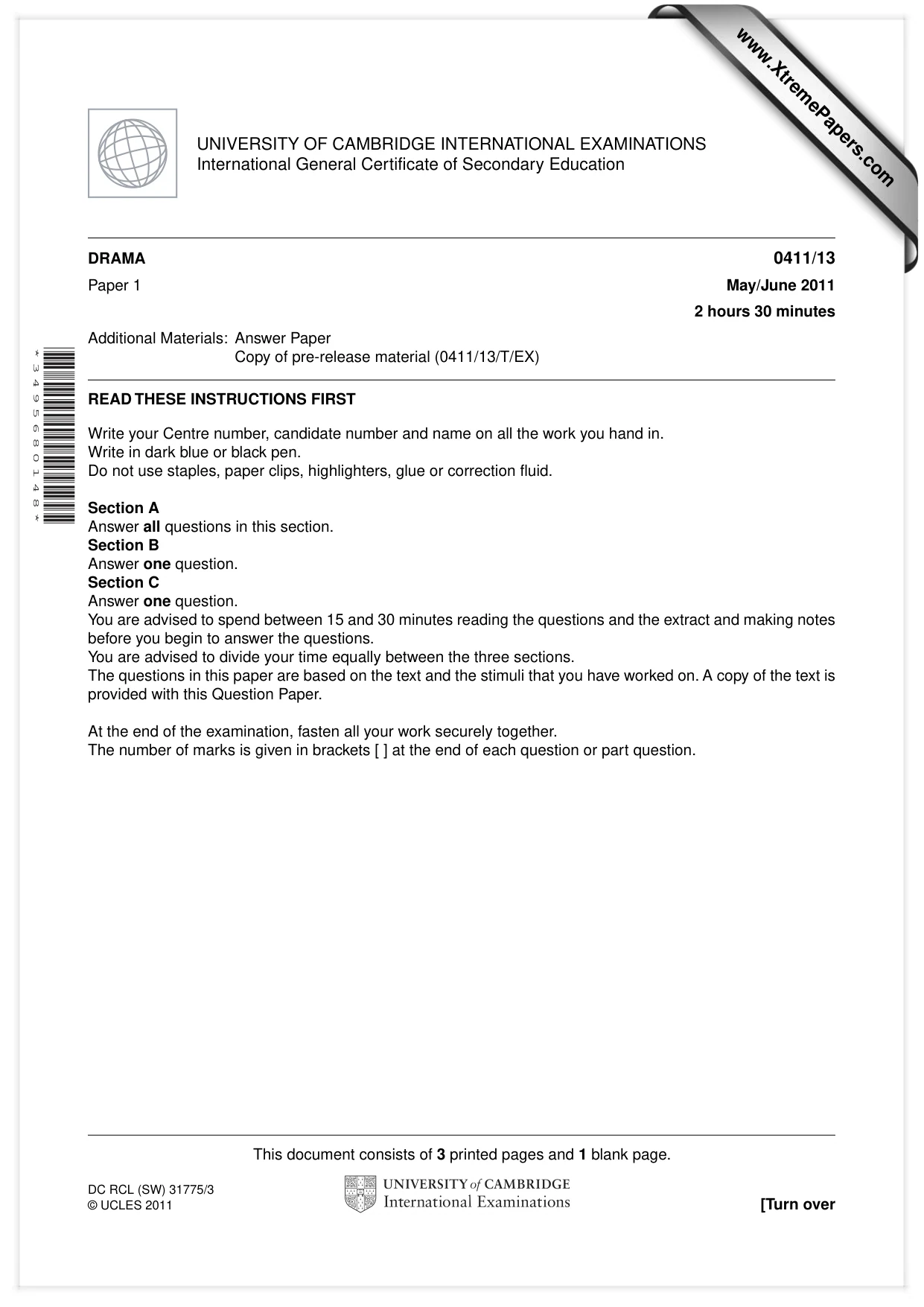
This document consists of 3 printed pages and 1 blank page. DC RCL (SW) 31775/3 © UCLES 2011 [Turn over UNIVERSITY OF CAMBRIDGE INTERNATIONAL EXAMINATIONS International General Certificate of Secondary Education DRAMA 0411/13 Paper 1 May/June 2011 2 hours 30 minutes Additional Materials: Answer Paper Copy of pre-release material (0411/13/T/EX) READ THESE INSTRUCTIONS FIRST Write your Centre number, candidate number and name on all the work you hand in. Write in dark blue or black pen. Do not use staples, paper clips, highlighters, glue or correction fluid. Section A Answer all questions in this section. Section B Answer one question. Section C Answer one question. You are advised to spend between 15 and 30 minutes reading the questions and the extract and making notes before you begin to answer the questions. You are advised to divide your time equally between the three sections. The questions in this paper are based on the text and the stimuli that you have worked on. A copy of the text is provided with this Question Paper. At the end of the examination, fasten all your work securely together. The number of marks is given in brackets [ ] at the end of each question or part question. * 3 4 9 5 6 8 0 1 4 8 * www.XtremePapers.com
Question paper, page 2
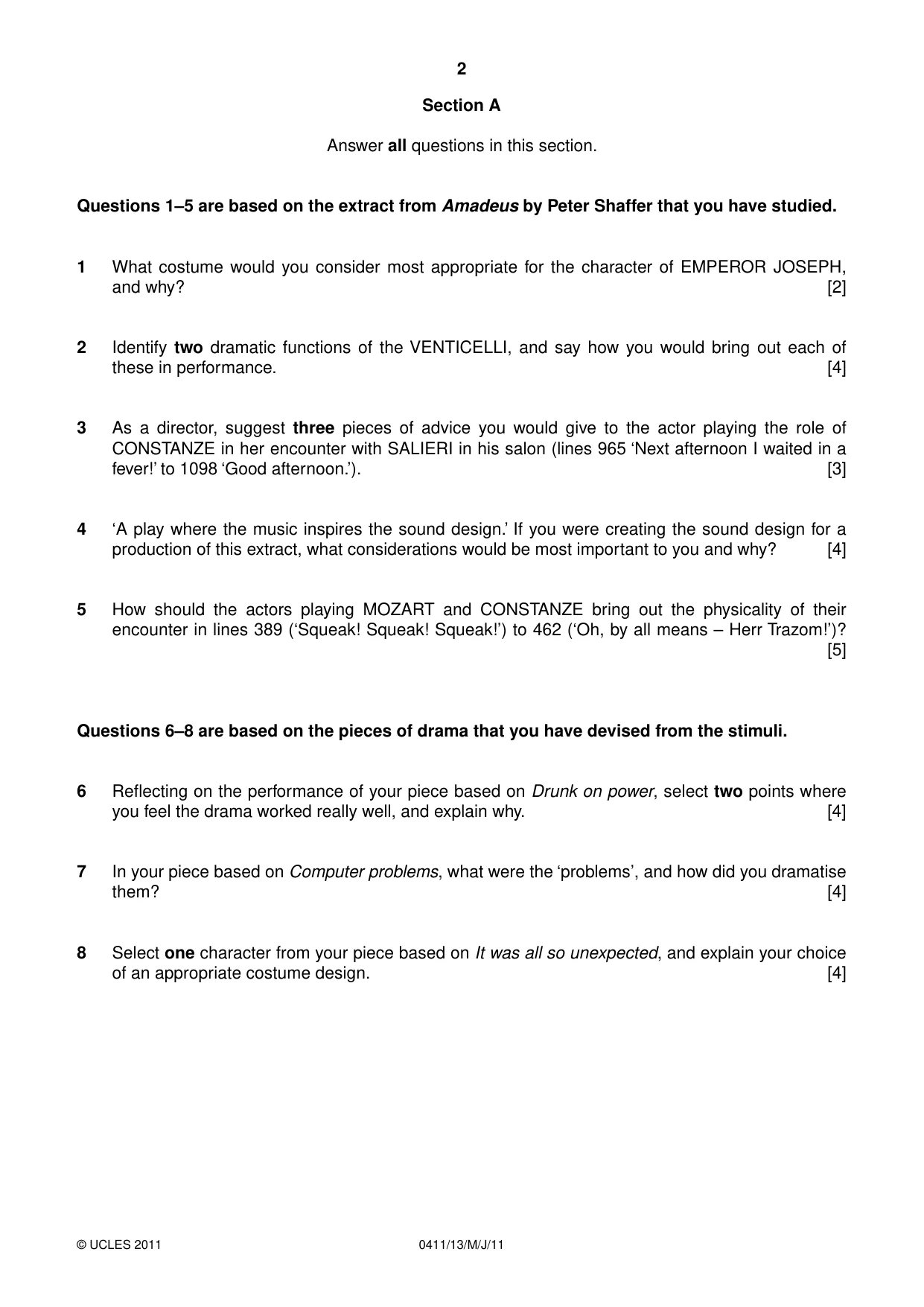
2 0411/13/M/J/11 © UCLES 2011 Section A Answer all questions in this section. Questions 1–5 are based on the extract from Amadeus by Peter Shaffer that you have studied. 1 What costume would you consider most appropriate for the character of EMPEROR JOSEPH, and why? [2] 2 Identify two dramatic functions of the VENTICELLI, and say how you would bring out each of these in performance. [4] 3 As a director, suggest three pieces of advice you would give to the actor playing the role of CONSTANZE in her encounter with SALIERI in his salon (lines 965 ‘Next afternoon I waited in a fever!’ to 1098 ‘Good afternoon.’). [3] 4 ‘A play where the music inspires the sound design.’ If you were creating the sound design for a production of this extract, what considerations would be most important to you and why? [4] 5 How should the actors playing MOZART and CONSTANZE bring out the physicality of their encounter in lines 389 (‘Squeak! Squeak! Squeak!’) to 462 (‘Oh, by all means – Herr Trazom!’)? [5] Questions 6–8 are based on the pieces of drama that you have devised from the stimuli. 6 Reflecting on the performance of your piece based on Drunk on power, select two points where you feel the drama worked really well, and explain why. [4] 7 In your piece based on Computer problems, what were the ‘problems’, and how did you dramatise them? [4] 8 Select one character from your piece based on It was all so unexpected, and explain your choice of an appropriate costume design. [4]
Question paper, page 3
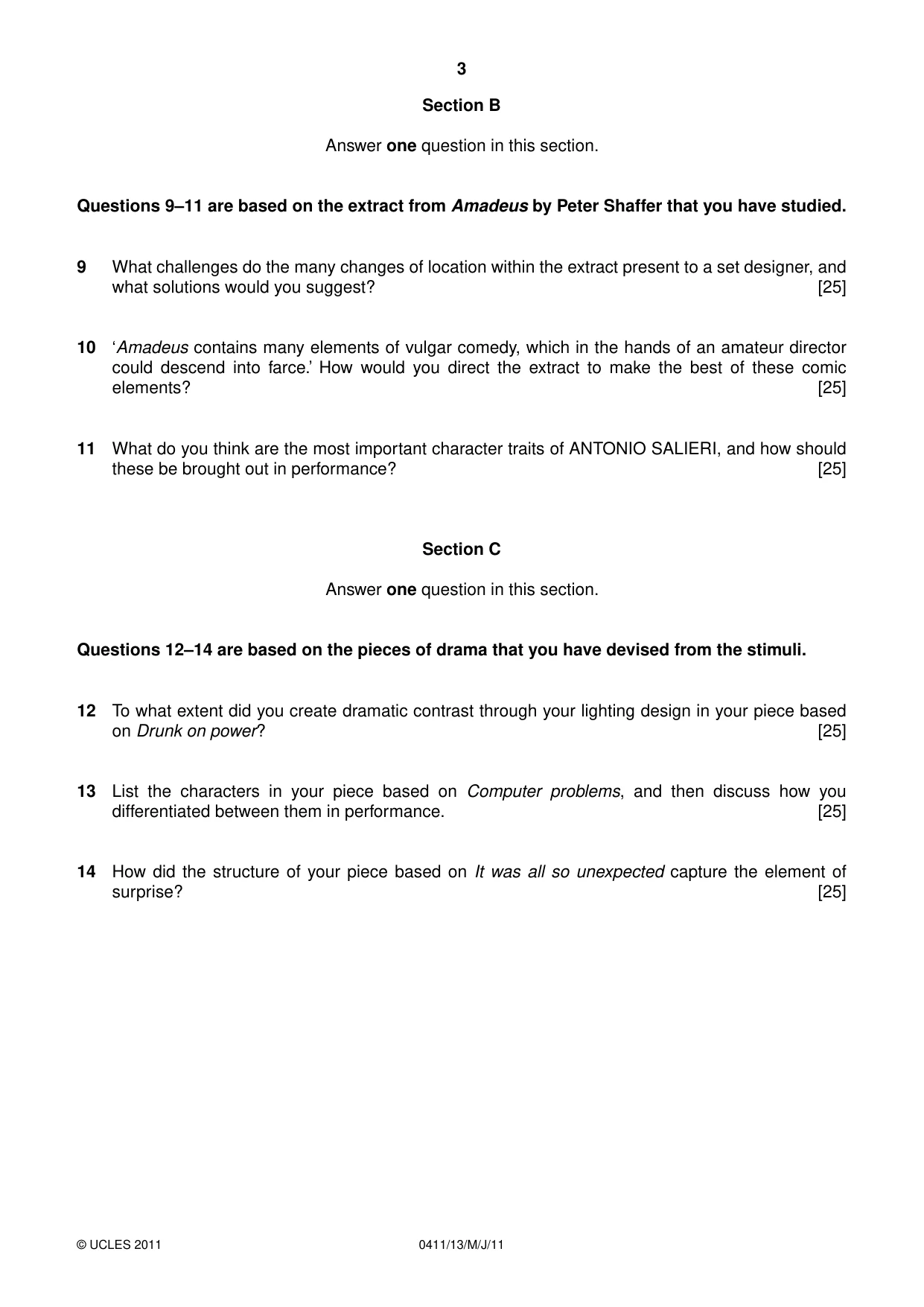
3 0411/13/M/J/11 © UCLES 2011 Section B Answer one question in this section. Questions 9–11 are based on the extract from Amadeus by Peter Shaffer that you have studied. 9 What challenges do the many changes of location within the extract present to a set designer, and what solutions would you suggest? [25] 10 ‘Amadeus contains many elements of vulgar comedy, which in the hands of an amateur director could descend into farce.’ How would you direct the extract to make the best of these comic elements? [25] 11 What do you think are the most important character traits of ANTONIO SALIERI, and how should these be brought out in performance? [25] Section C Answer one question in this section. Questions 12–14 are based on the pieces of drama that you have devised from the stimuli. 12 To what extent did you create dramatic contrast through your lighting design in your piece based on Drunk on power? [25] 13 List the characters in your piece based on Computer problems, and then discuss how you differentiated between them in performance. [25] 14 How did the structure of your piece based on It was all so unexpected capture the element of surprise? [25]
Question paper, page 4
4 0411/13/M/J/11 © UCLES 2011 BLANK PAGE Copyright Acknowledgements: Questions 1–5 and 9–11 © Peter Shaffer; Amadeus; Penguin Modern Classics; 1980. Permission to reproduce items where third-party owned material protected by copyright is included has been sought and cleared where possible. Every reasonable effort has been made by the publisher (UCLES) to trace copyright holders, but if any items requiring clearance have unwittingly been included, the publisher will be pleased to make amends at the earliest possible opportunity. University of Cambridge International Examinations is part of the Cambridge Assessment Group. Cambridge Assessment is the brand name of University of Cambridge Local Examinations Syndicate (UCLES), which is itself a department of the University of Cambridge.
Mark scheme, page 1
UNIVERSITY OF CAMBRIDGE INTERNATIONAL EXAMINATIONS International General Certificate of Secondary Education MARK SCHEME for the May/June 2011 question paper for the guidance of teachers 0411 DRAMA 0411/13 Paper 13 (Written Examination), maximum raw mark 80 This mark scheme is published as an aid to teachers and candidates, to indicate the requirements of the examination. It shows the basis on which Examiners were instructed to award marks. It does not indicate the details of the discussions that took place at an Examiners’ meeting before marking began, which would have considered the acceptability of alternative answers. Mark schemes must be read in conjunction with the question papers and the report on the examination. • Cambridge will not enter into discussions or correspondence in connection with these mark schemes. Cambridge is publishing the mark schemes for the May/June 2011 question papers for most IGCSE, GCE Advanced Level and Advanced Subsidiary Level syllabuses and some Ordinary Level syllabuses. www.XtremePapers.com
Mark scheme, page 2
Page 2 Mark Scheme: Teachers’ version Syllabus Paper IGCSE – May/June 2011 0411 13 © University of Cambridge International Examinations 2011 Introduction All examiners should be thoroughly familiar with the following: • the assessment objectives of the syllabus; • the question paper and its rubric; • the pre-release material on which the candidates have worked • the marking criteria. This Mark Scheme is a working document and needs to be interpreted in the light of the work produced by candidates. The Standardisation meeting will ensure that it covers the range of candidates’ responses and that all examiners understand and apply the marking criteria in the same way. The Mark Scheme will be discussed and amended at the meeting and administrative procedures confirmed. Co-ordination scripts will be issued at the meeting, to exemplify aspects of candidates’ responses and achievements; the co-ordination scripts then become part of this Mark Scheme.
Mark scheme, page 3
Page 3 Mark Scheme: Teachers’ version Syllabus Paper IGCSE – May/June 2011 0411 13 © University of Cambridge International Examinations 2011 Section A 1 What costume would you consider most appropriate for the character of EMPEROR JOSEPH, and why? We are first introduced to Emperor Joseph of Austria at the Palace of Schönbrunn. He is described by Shaffer as ‘a dapper, cheerful figure, aged forty, largely pleased with himself and the world’. He is not a man of deep thought or reason, as becomes clear in his responses to others, but he revels in the grandeur of the role. The costume suggested for him needs to capture this. Credit should also be given for contemporary suggestions if supported with appropriate justification. 1 mark An appropriate suggestion. and/or 1 mark A reason for this, based on what we know of the Emperor Joseph through the extract. Total = 2 marks 2 Identify two dramatic functions of the VENTICELLI, and say how you would bring out each of these in performance. The Venticelli (singular: Venticello) are described by Shaffer as ‘two middle-aged gentlemen … wearing the long cloaks and tall hats of the period.’ They are ‘purveyors of fact, rumour and gossip throughout the play. They speak rapidly … sometimes to each other; sometimes to us – but always with the urgency of men who have ever been first with the news.’ Salieri refers to them as his ‘little winds’ – they blow the news around in his direction so that he is always aware of what is going on. Their dramatic functions include – inter alia – the giving of information, the setting of the scene, highlighting the dramatic function of what is going on, creating an audio framework for the opening, the reiteration of lines for effect; there is also a clear distinction between them and the whisperers as they articulate what is whispered first. Allow other similarities/differences as may be supported by the play. 1 mark A dramatic function of the Venticelli. and/or 1 mark An appropriate indication of how this would be brought out in performance. and/or 1 mark A dramatic function of the Venticelli. and/or 1 mark An appropriate indication of how this would be brought out in performance. Total = 4 marks
Mark scheme, page 4
Page 4 Mark Scheme: Teachers’ version Syllabus Paper IGCSE – May/June 2011 0411 13 © University of Cambridge International Examinations 2011 3 As a director, suggest three pieces of advice you would give to the actor playing the role of CONSTANZE in her encounter with SALIERI in his salon (lines 965 ‘Next afternoon I waited in a fever!’ to 1098 ‘Good afternoon.’). Constanze meets Salieri with a genuine, naïve belief that she is going to help Mozart through obtaining money and position. In order for the actor playing Constanze to understand the role in this encounter, the director would need to make clear Salieri’s motivation in inviting her to his salon. Constanze’s simplicity is defined by her response to Salieri’s complexity and subtlety. These may include direct reference to or imply understanding of: • His guilt at inviting her with the express intention of sleeping with her, despite his vow of faithfulness to his wife • His desire to annihilate Mozart through his wife, through discovering his true situation • His revulsion of Constanze as a silly, trivial girl who disgusts him Allow credit for any other justifiable aspects of the dialogue that might be the focus of the director’s intention. Allow no credit for a simple recounting of the plot. 1 mark A valid piece of advice about how to play the role of Constanze in this passage. and/or 1 mark A valid piece of advice about how to play the role of Constanze in this passage. and/or 1 mark A valid piece of advice about how to play the role of Constanze in this passage. Total = 3 marks
Mark scheme, page 5
Page 5 Mark Scheme: Teachers’ version Syllabus Paper IGCSE – May/June 2011 0411 13 © University of Cambridge International Examinations 2011 4 ‘A play where the music inspires the sound design.’ If you were creating the sound design for a production of this extract, what considerations would be most important to you and why? There is considerable scope for a sound designer to work with the play. Much of the detail of the pieces of music to be used is given in the playwright’s own notes on the play. It is up to the candidate to identify solutions that would be particularly significant in the sound design. Two passages in particular stand out as having potential for the sound designer: • At the Palace of Schönbrunn when Salieri plays his welcome march for Mozart and Mozart then plays it back from memory and it becomes a virtuoso performance • At the end of the Act, where there are several opportunities for something akin to a Coda (tailpiece) to the extract Allow credit for creative and detailed solutions, as well as for a consideration of whether these would involve incidental music, recorded, sampled or ‘live’ performances. 1 mark A general description of some sound/music in the extract or a list of the music to be played. 2 marks A description of some possible aspects of sound/music in the extract, with brief commentary as to their usage. 3 marks A generally effective discussion of the sound design although there may be scope for further refinement in the use of appropriate technical terminology. 4 marks A generally effective discussion of the proposed sound design that comments perceptively on its effectiveness. Total = 4 marks
Mark scheme, page 6
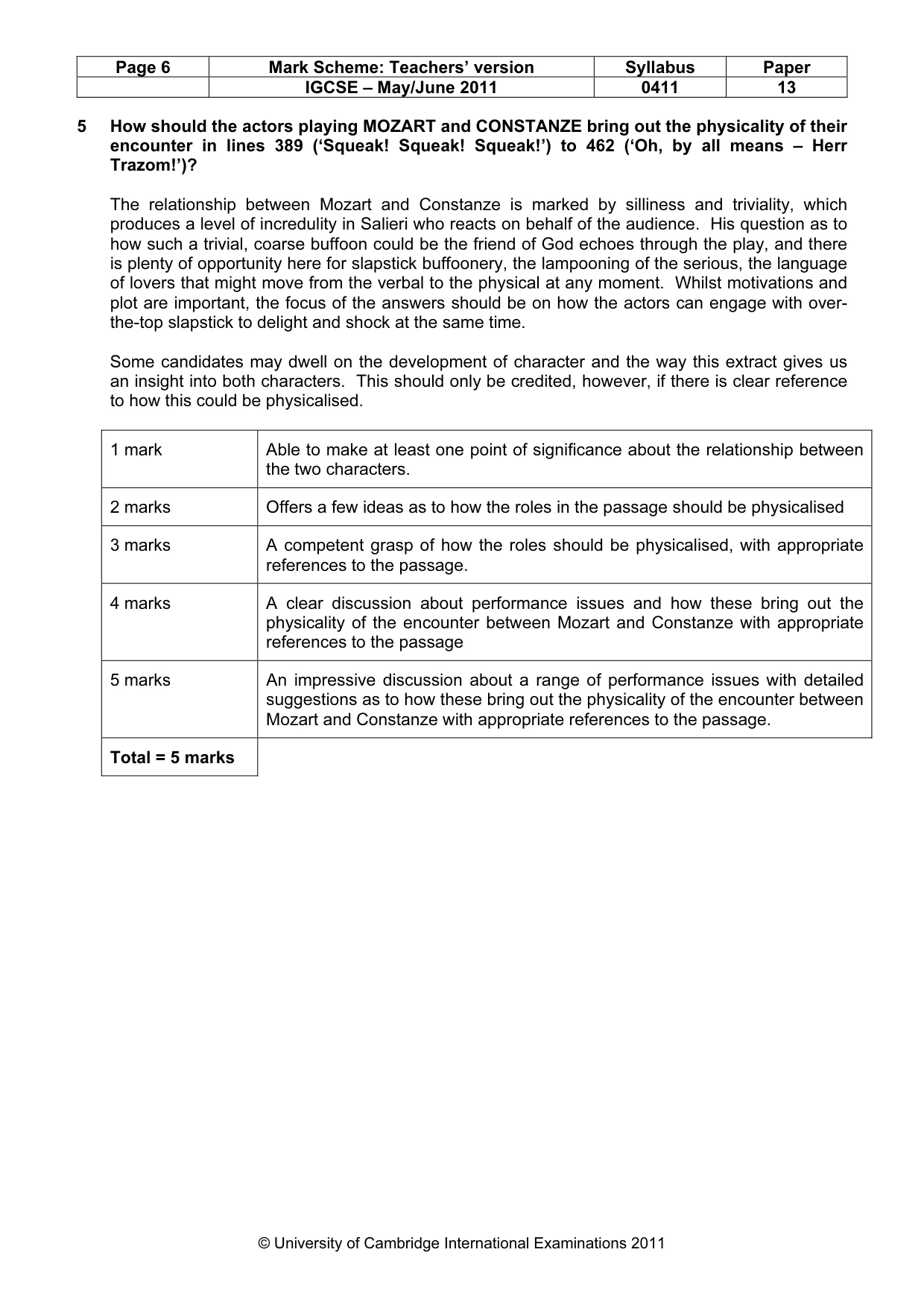
Page 6 Mark Scheme: Teachers’ version Syllabus Paper IGCSE – May/June 2011 0411 13 © University of Cambridge International Examinations 2011 5 How should the actors playing MOZART and CONSTANZE bring out the physicality of their encounter in lines 389 (‘Squeak! Squeak! Squeak!’) to 462 (‘Oh, by all means – Herr Trazom!’)? The relationship between Mozart and Constanze is marked by silliness and triviality, which produces a level of incredulity in Salieri who reacts on behalf of the audience. His question as to how such a trivial, coarse buffoon could be the friend of God echoes through the play, and there is plenty of opportunity here for slapstick buffoonery, the lampooning of the serious, the language of lovers that might move from the verbal to the physical at any moment. Whilst motivations and plot are important, the focus of the answers should be on how the actors can engage with over- the-top slapstick to delight and shock at the same time. Some candidates may dwell on the development of character and the way this extract gives us an insight into both characters. This should only be credited, however, if there is clear reference to how this could be physicalised. 1 mark Able to make at least one point of significance about the relationship between the two characters. 2 marks Offers a few ideas as to how the roles in the passage should be physicalised 3 marks A competent grasp of how the roles should be physicalised, with appropriate references to the passage. 4 marks A clear discussion about performance issues and how these bring out the physicality of the encounter between Mozart and Constanze with appropriate references to the passage 5 marks An impressive discussion about a range of performance issues with detailed suggestions as to how these bring out the physicality of the encounter between Mozart and Constanze with appropriate references to the passage. Total = 5 marks
Mark scheme, page 7
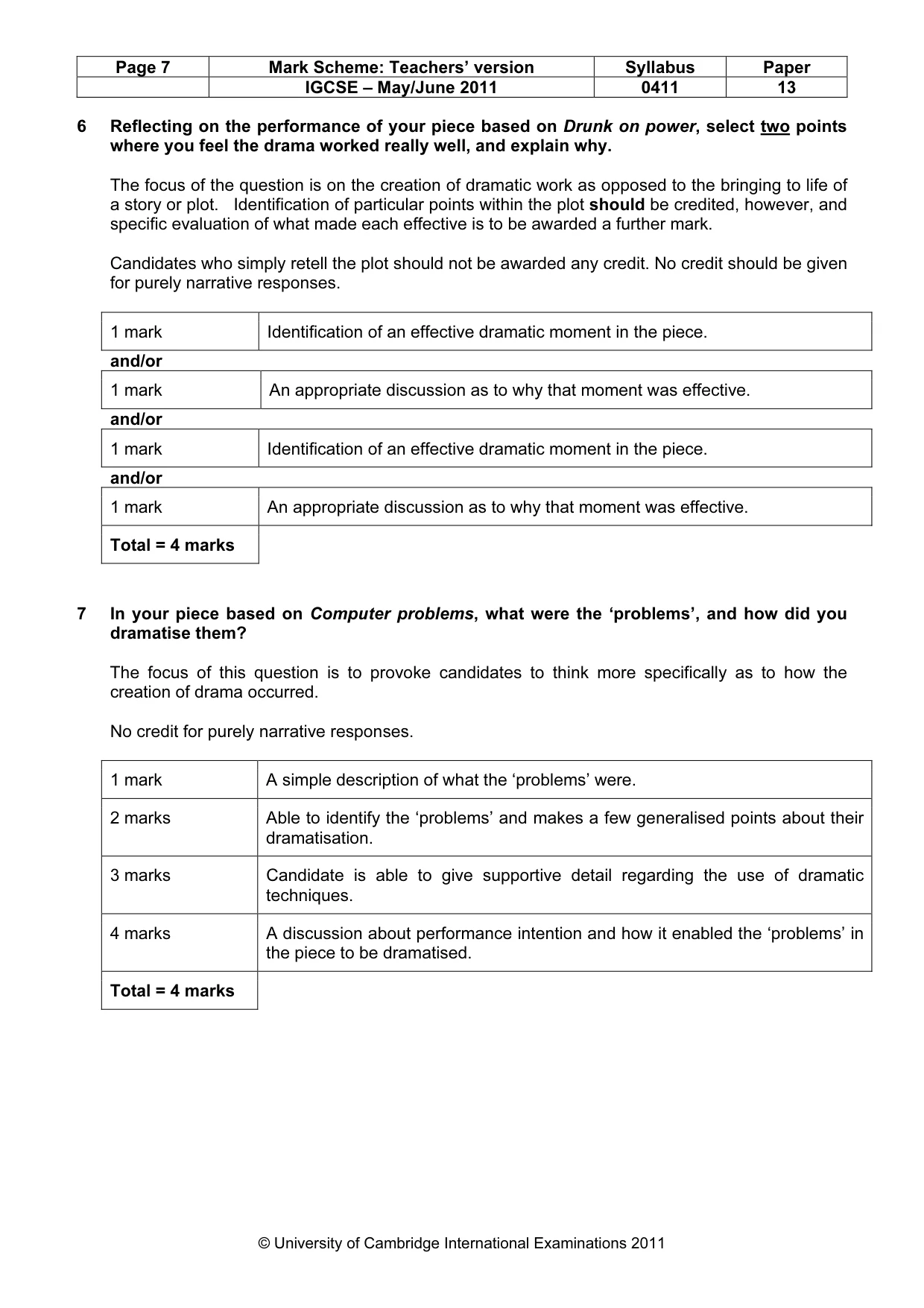
Page 7 Mark Scheme: Teachers’ version Syllabus Paper IGCSE – May/June 2011 0411 13 © University of Cambridge International Examinations 2011 6 Reflecting on the performance of your piece based on Drunk on power, select two points where you feel the drama worked really well, and explain why. The focus of the question is on the creation of dramatic work as opposed to the bringing to life of a story or plot. Identification of particular points within the plot should be credited, however, and specific evaluation of what made each effective is to be awarded a further mark. Candidates who simply retell the plot should not be awarded any credit. No credit should be given for purely narrative responses. 1 mark Identification of an effective dramatic moment in the piece. and/or 1 mark An appropriate discussion as to why that moment was effective. and/or 1 mark Identification of an effective dramatic moment in the piece. and/or 1 mark An appropriate discussion as to why that moment was effective. Total = 4 marks 7 In your piece based on Computer problems, what were the ‘problems’, and how did you dramatise them? The focus of this question is to provoke candidates to think more specifically as to how the creation of drama occurred. No credit for purely narrative responses. 1 mark A simple description of what the ‘problems’ were. 2 marks Able to identify the ‘problems’ and makes a few generalised points about their dramatisation. 3 marks Candidate is able to give supportive detail regarding the use of dramatic techniques. 4 marks A discussion about performance intention and how it enabled the ‘problems’ in the piece to be dramatised. Total = 4 marks
Mark scheme, page 8
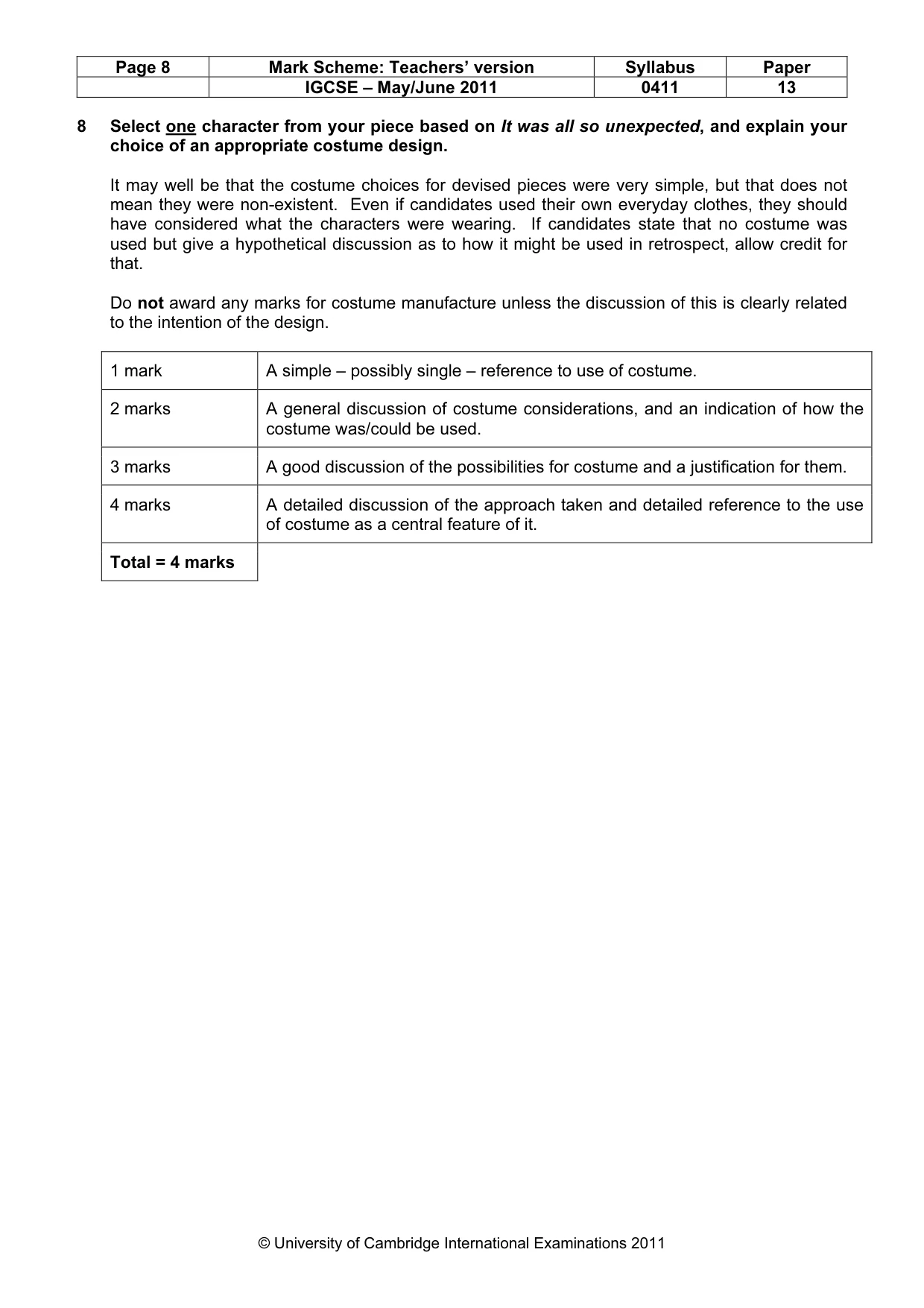
Page 8 Mark Scheme: Teachers’ version Syllabus Paper IGCSE – May/June 2011 0411 13 © University of Cambridge International Examinations 2011 8 Select one character from your piece based on It was all so unexpected, and explain your choice of an appropriate costume design. It may well be that the costume choices for devised pieces were very simple, but that does not mean they were non-existent. Even if candidates used their own everyday clothes, they should have considered what the characters were wearing. If candidates state that no costume was used but give a hypothetical discussion as to how it might be used in retrospect, allow credit for that. Do not award any marks for costume manufacture unless the discussion of this is clearly related to the intention of the design. 1 mark A simple – possibly single – reference to use of costume. 2 marks A general discussion of costume considerations, and an indication of how the costume was/could be used. 3 marks A good discussion of the possibilities for costume and a justification for them. 4 marks A detailed discussion of the approach taken and detailed reference to the use of costume as a central feature of it. Total = 4 marks
Mark scheme, page 9
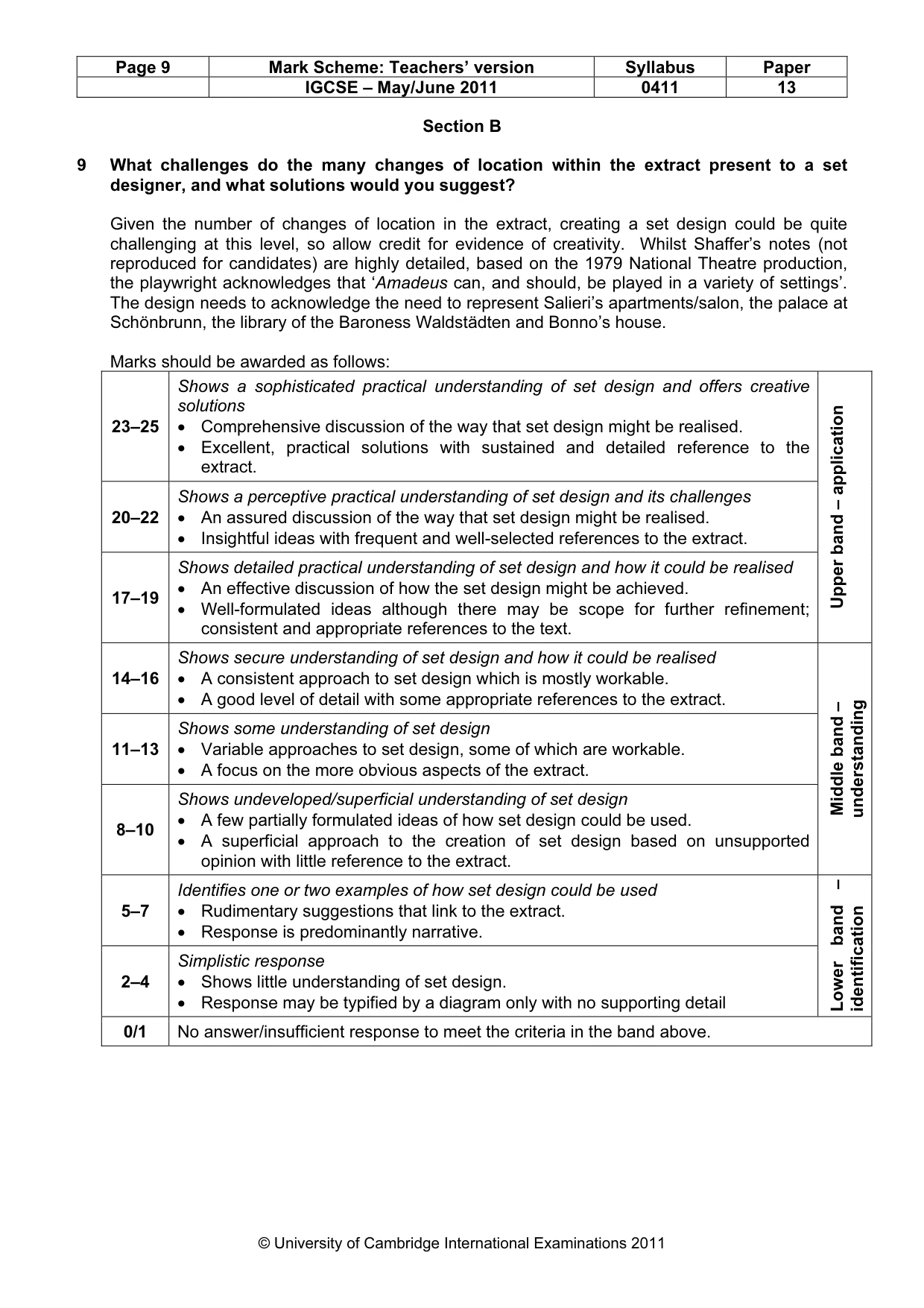
Page 9 Mark Scheme: Teachers’ version Syllabus Paper IGCSE – May/June 2011 0411 13 © University of Cambridge International Examinations 2011 Section B 9 What challenges do the many changes of location within the extract present to a set designer, and what solutions would you suggest? Given the number of changes of location in the extract, creating a set design could be quite challenging at this level, so allow credit for evidence of creativity. Whilst Shaffer’s notes (not reproduced for candidates) are highly detailed, based on the 1979 National Theatre production, the playwright acknowledges that ‘Amadeus can, and should, be played in a variety of settings’. The design needs to acknowledge the need to represent Salieri’s apartments/salon, the palace at Schönbrunn, the library of the Baroness Waldstädten and Bonno’s house. Marks should be awarded as follows: 23–25 Shows a sophisticated practical understanding of set design and offers creative solutions • Comprehensive discussion of the way that set design might be realised. • Excellent, practical solutions with sustained and detailed reference to the extract. 20–22 Shows a perceptive practical understanding of set design and its challenges • An assured discussion of the way that set design might be realised. • Insightful ideas with frequent and well-selected references to the extract. 17–19 Shows detailed practical understanding of set design and how it could be realised • An effective discussion of how the set design might be achieved. • Well-formulated ideas although there may be scope for further refinement; consistent and appropriate references to the text. Upper band – application 14–16 Shows secure understanding of set design and how it could be realised • A consistent approach to set design which is mostly workable. • A good level of detail with some appropriate references to the extract. 11–13 Shows some understanding of set design • Variable approaches to set design, some of which are workable. • A focus on the more obvious aspects of the extract. 8–10 Shows undeveloped/superficial understanding of set design • A few partially formulated ideas of how set design could be used. • A superficial approach to the creation of set design based on unsupported opinion with little reference to the extract. Middle band – understanding 5–7 Identifies one or two examples of how set design could be used • Rudimentary suggestions that link to the extract. • Response is predominantly narrative. 2–4 Simplistic response • Shows little understanding of set design. • Response may be typified by a diagram only with no supporting detail Lower band – identification 0/1 No answer/insufficient response to meet the criteria in the band above.
Mark scheme, page 10
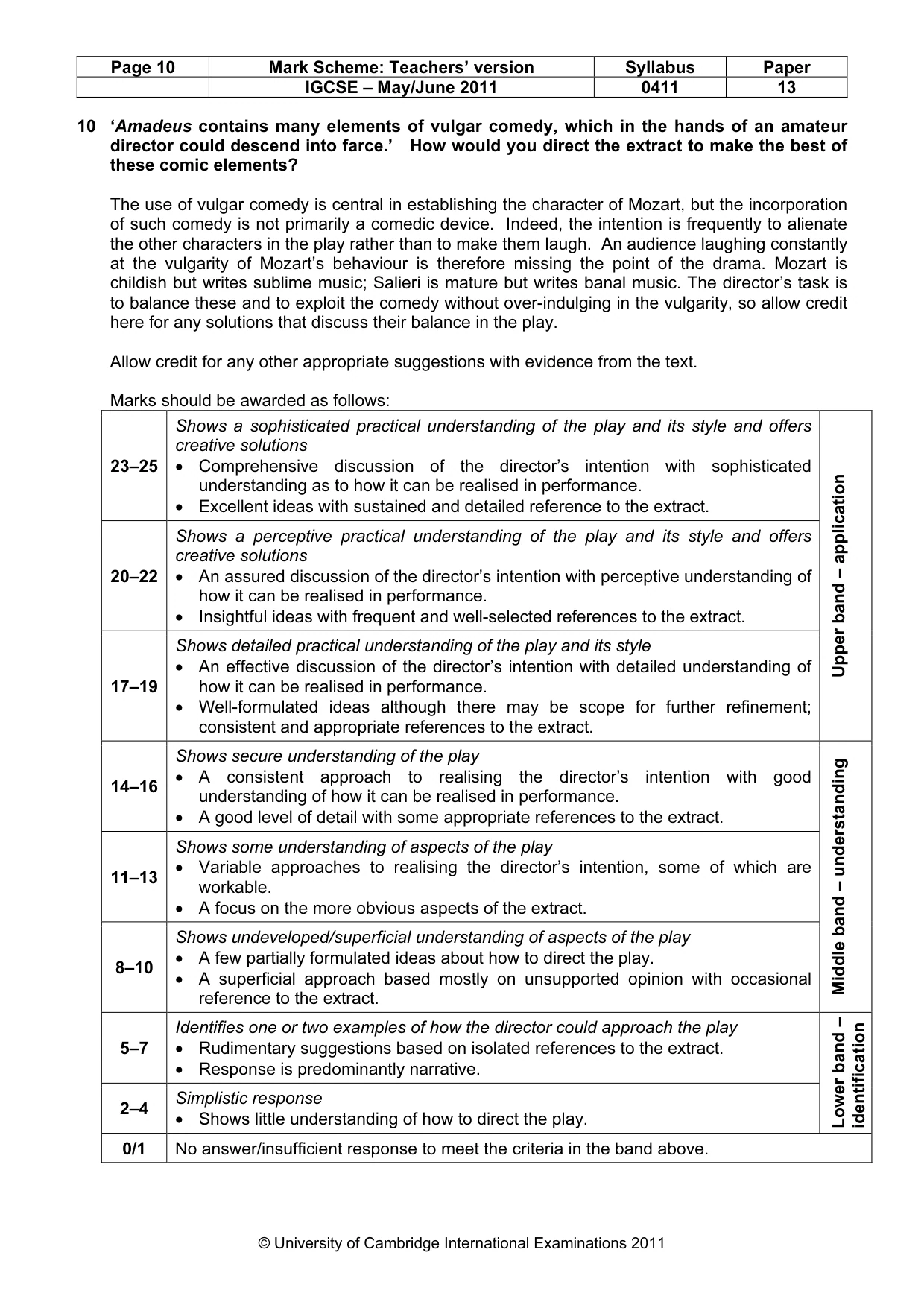
Page 10 Mark Scheme: Teachers’ version Syllabus Paper IGCSE – May/June 2011 0411 13 © University of Cambridge International Examinations 2011 10 ‘Amadeus contains many elements of vulgar comedy, which in the hands of an amateur director could descend into farce.’ How would you direct the extract to make the best of these comic elements? The use of vulgar comedy is central in establishing the character of Mozart, but the incorporation of such comedy is not primarily a comedic device. Indeed, the intention is frequently to alienate the other characters in the play rather than to make them laugh. An audience laughing constantly at the vulgarity of Mozart’s behaviour is therefore missing the point of the drama. Mozart is childish but writes sublime music; Salieri is mature but writes banal music. The director’s task is to balance these and to exploit the comedy without over-indulging in the vulgarity, so allow credit here for any solutions that discuss their balance in the play. Allow credit for any other appropriate suggestions with evidence from the text. Marks should be awarded as follows: 23–25 Shows a sophisticated practical understanding of the play and its style and offers creative solutions • Comprehensive discussion of the director’s intention with sophisticated understanding as to how it can be realised in performance. • Excellent ideas with sustained and detailed reference to the extract. 20–22 Shows a perceptive practical understanding of the play and its style and offers creative solutions • An assured discussion of the director’s intention with perceptive understanding of how it can be realised in performance. • Insightful ideas with frequent and well-selected references to the extract. 17–19 Shows detailed practical understanding of the play and its style • An effective discussion of the director’s intention with detailed understanding of how it can be realised in performance. • Well-formulated ideas although there may be scope for further refinement; consistent and appropriate references to the extract. Upper band – application 14–16 Shows secure understanding of the play • A consistent approach to realising the director’s intention with good understanding of how it can be realised in performance. • A good level of detail with some appropriate references to the extract. 11–13 Shows some understanding of aspects of the play • Variable approaches to realising the director’s intention, some of which are workable. • A focus on the more obvious aspects of the extract. 8–10 Shows undeveloped/superficial understanding of aspects of the play • A few partially formulated ideas about how to direct the play. • A superficial approach based mostly on unsupported opinion with occasional reference to the extract. Middle band – understanding 5–7 Identifies one or two examples of how the director could approach the play • Rudimentary suggestions based on isolated references to the extract. • Response is predominantly narrative. 2–4 Simplistic response • Shows little understanding of how to direct the play. Lower band – identification 0/1 No answer/insufficient response to meet the criteria in the band above.
Mark scheme, page 11
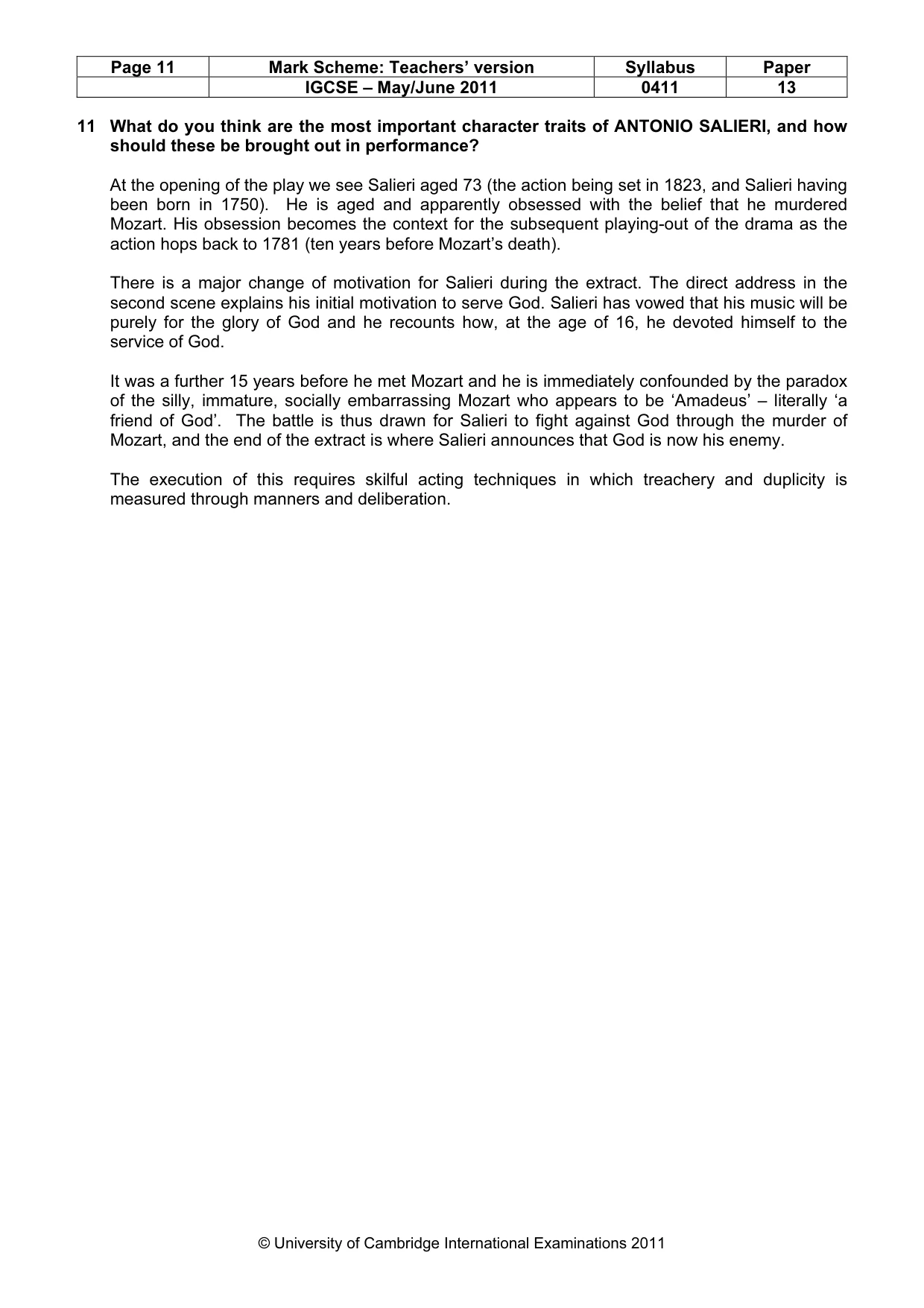
Page 11 Mark Scheme: Teachers’ version Syllabus Paper IGCSE – May/June 2011 0411 13 © University of Cambridge International Examinations 2011 11 What do you think are the most important character traits of ANTONIO SALIERI, and how should these be brought out in performance? At the opening of the play we see Salieri aged 73 (the action being set in 1823, and Salieri having been born in 1750). He is aged and apparently obsessed with the belief that he murdered Mozart. His obsession becomes the context for the subsequent playing-out of the drama as the action hops back to 1781 (ten years before Mozart’s death). There is a major change of motivation for Salieri during the extract. The direct address in the second scene explains his initial motivation to serve God. Salieri has vowed that his music will be purely for the glory of God and he recounts how, at the age of 16, he devoted himself to the service of God. It was a further 15 years before he met Mozart and he is immediately confounded by the paradox of the silly, immature, socially embarrassing Mozart who appears to be ‘Amadeus’ – literally ‘a friend of God’. The battle is thus drawn for Salieri to fight against God through the murder of Mozart, and the end of the extract is where Salieri announces that God is now his enemy. The execution of this requires skilful acting techniques in which treachery and duplicity is measured through manners and deliberation.
Mark scheme, page 12
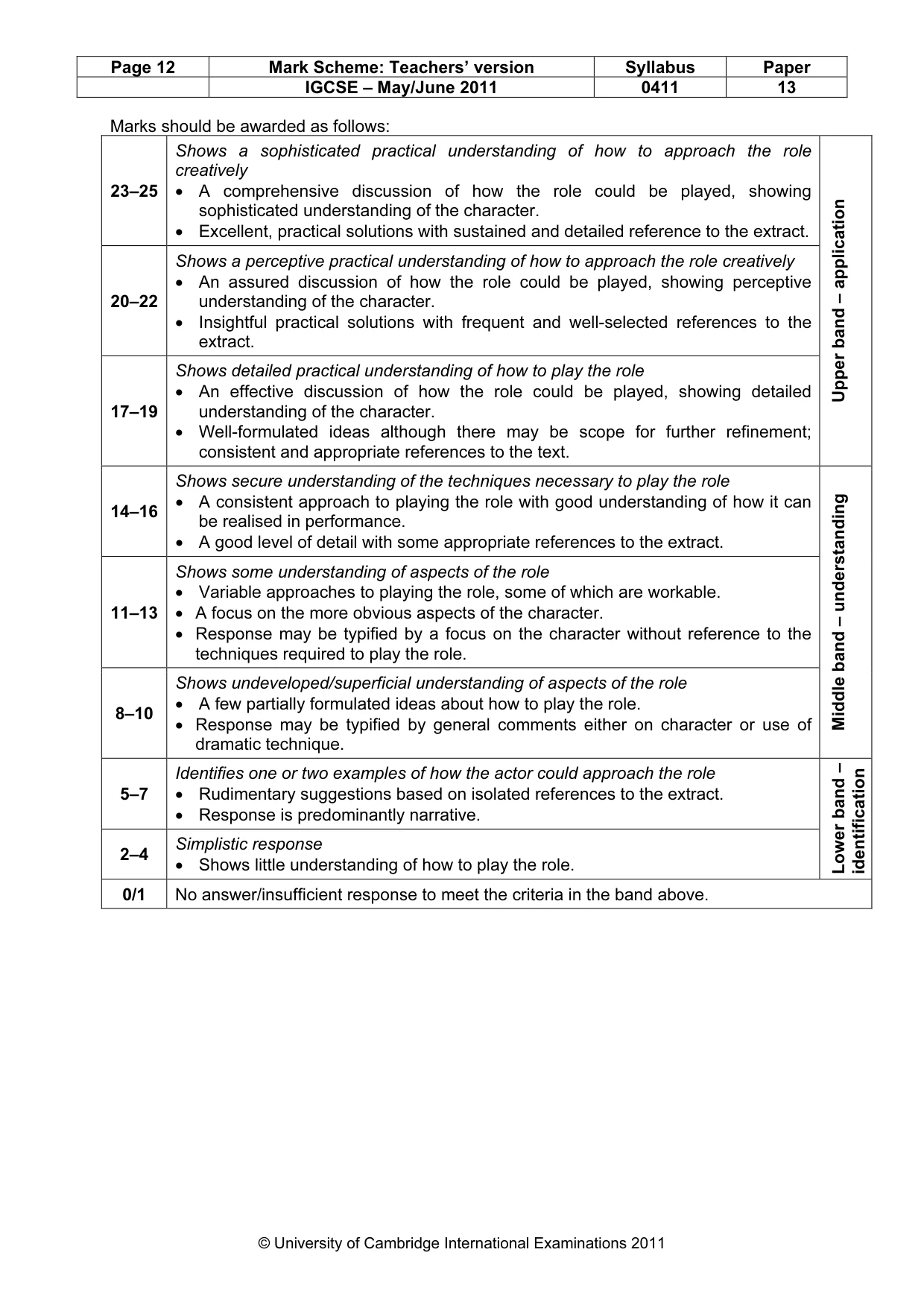
Page 12 Mark Scheme: Teachers’ version Syllabus Paper IGCSE – May/June 2011 0411 13 © University of Cambridge International Examinations 2011 Marks should be awarded as follows: 23–25 Shows a sophisticated practical understanding of how to approach the role creatively • A comprehensive discussion of how the role could be played, showing sophisticated understanding of the character. • Excellent, practical solutions with sustained and detailed reference to the extract. 20–22 Shows a perceptive practical understanding of how to approach the role creatively • An assured discussion of how the role could be played, showing perceptive understanding of the character. • Insightful practical solutions with frequent and well-selected references to the extract. 17–19 Shows detailed practical understanding of how to play the role • An effective discussion of how the role could be played, showing detailed understanding of the character. • Well-formulated ideas although there may be scope for further refinement; consistent and appropriate references to the text. Upper band – application 14–16 Shows secure understanding of the techniques necessary to play the role • A consistent approach to playing the role with good understanding of how it can be realised in performance. • A good level of detail with some appropriate references to the extract. 11–13 Shows some understanding of aspects of the role • Variable approaches to playing the role, some of which are workable. • A focus on the more obvious aspects of the character. • Response may be typified by a focus on the character without reference to the techniques required to play the role. 8–10 Shows undeveloped/superficial understanding of aspects of the role • A few partially formulated ideas about how to play the role. • Response may be typified by general comments either on character or use of dramatic technique. Middle band – understanding 5–7 Identifies one or two examples of how the actor could approach the role • Rudimentary suggestions based on isolated references to the extract. • Response is predominantly narrative. 2–4 Simplistic response • Shows little understanding of how to play the role. Lower band – identification 0/1 No answer/insufficient response to meet the criteria in the band above.
Mark scheme, page 13
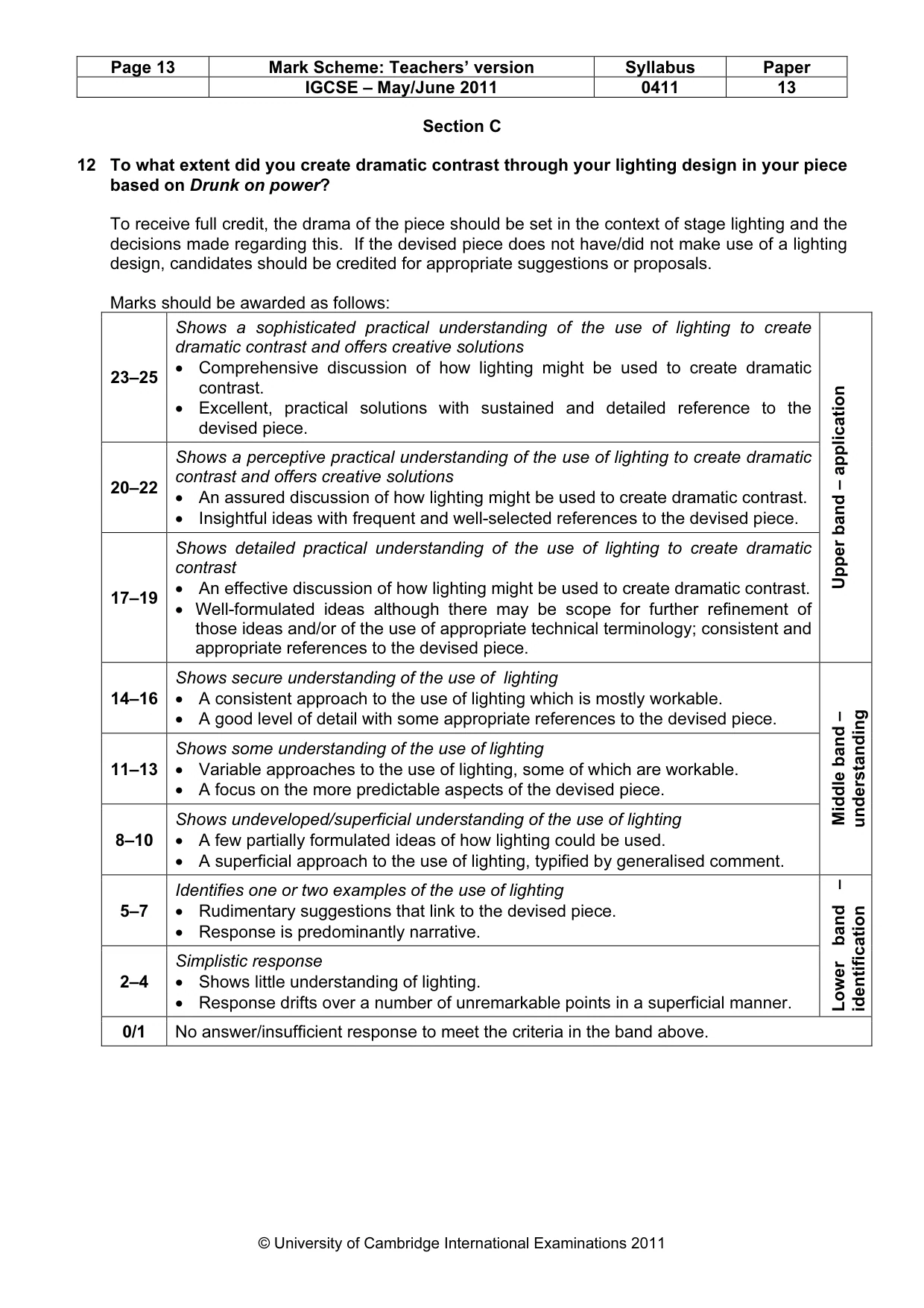
Page 13 Mark Scheme: Teachers’ version Syllabus Paper IGCSE – May/June 2011 0411 13 © University of Cambridge International Examinations 2011 Section C 12 To what extent did you create dramatic contrast through your lighting design in your piece based on Drunk on power? To receive full credit, the drama of the piece should be set in the context of stage lighting and the decisions made regarding this. If the devised piece does not have/did not make use of a lighting design, candidates should be credited for appropriate suggestions or proposals. Marks should be awarded as follows: 23–25 Shows a sophisticated practical understanding of the use of lighting to create dramatic contrast and offers creative solutions • Comprehensive discussion of how lighting might be used to create dramatic contrast. • Excellent, practical solutions with sustained and detailed reference to the devised piece. 20–22 Shows a perceptive practical understanding of the use of lighting to create dramatic contrast and offers creative solutions • An assured discussion of how lighting might be used to create dramatic contrast. • Insightful ideas with frequent and well-selected references to the devised piece. 17–19 Shows detailed practical understanding of the use of lighting to create dramatic contrast • An effective discussion of how lighting might be used to create dramatic contrast. • Well-formulated ideas although there may be scope for further refinement of those ideas and/or of the use of appropriate technical terminology; consistent and appropriate references to the devised piece. Upper band – application 14–16 Shows secure understanding of the use of lighting • A consistent approach to the use of lighting which is mostly workable. • A good level of detail with some appropriate references to the devised piece. 11–13 Shows some understanding of the use of lighting • Variable approaches to the use of lighting, some of which are workable. • A focus on the more predictable aspects of the devised piece. 8–10 Shows undeveloped/superficial understanding of the use of lighting • A few partially formulated ideas of how lighting could be used. • A superficial approach to the use of lighting, typified by generalised comment. Middle band – understanding 5–7 Identifies one or two examples of the use of lighting • Rudimentary suggestions that link to the devised piece. • Response is predominantly narrative. 2–4 Simplistic response • Shows little understanding of lighting. • Response drifts over a number of unremarkable points in a superficial manner. Lower band – identification 0/1 No answer/insufficient response to meet the criteria in the band above.
Mark scheme, page 14
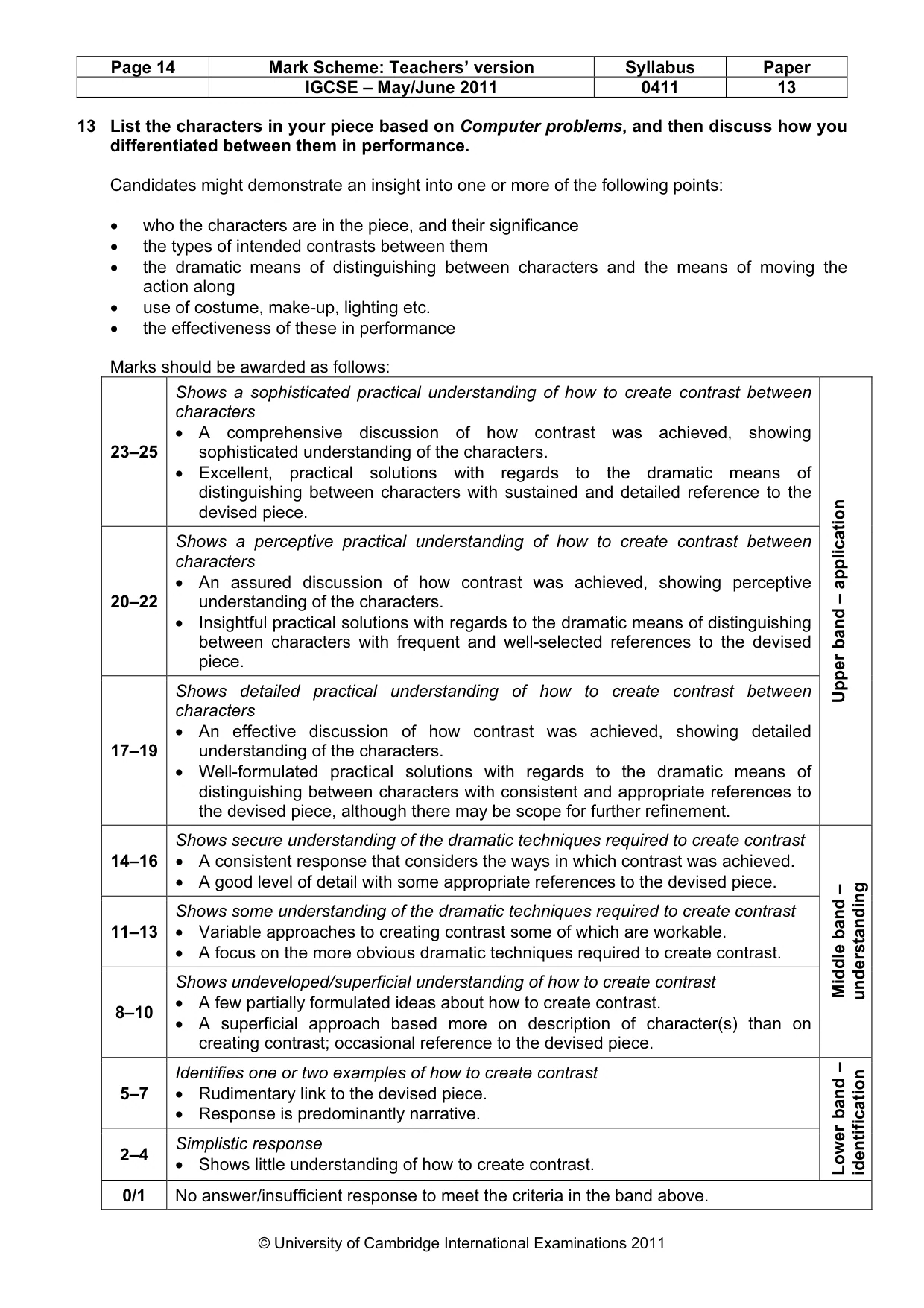
Page 14 Mark Scheme: Teachers’ version Syllabus Paper IGCSE – May/June 2011 0411 13 © University of Cambridge International Examinations 2011 13 List the characters in your piece based on Computer problems, and then discuss how you differentiated between them in performance. Candidates might demonstrate an insight into one or more of the following points: • who the characters are in the piece, and their significance • the types of intended contrasts between them • the dramatic means of distinguishing between characters and the means of moving the action along • use of costume, make-up, lighting etc. • the effectiveness of these in performance Marks should be awarded as follows: 23–25 Shows a sophisticated practical understanding of how to create contrast between characters • A comprehensive discussion of how contrast was achieved, showing sophisticated understanding of the characters. • Excellent, practical solutions with regards to the dramatic means of distinguishing between characters with sustained and detailed reference to the devised piece. 20–22 Shows a perceptive practical understanding of how to create contrast between characters • An assured discussion of how contrast was achieved, showing perceptive understanding of the characters. • Insightful practical solutions with regards to the dramatic means of distinguishing between characters with frequent and well-selected references to the devised piece. 17–19 Shows detailed practical understanding of how to create contrast between characters • An effective discussion of how contrast was achieved, showing detailed understanding of the characters. • Well-formulated practical solutions with regards to the dramatic means of distinguishing between characters with consistent and appropriate references to the devised piece, although there may be scope for further refinement. Upper band – application 14–16 Shows secure understanding of the dramatic techniques required to create contrast • A consistent response that considers the ways in which contrast was achieved. • A good level of detail with some appropriate references to the devised piece. 11–13 Shows some understanding of the dramatic techniques required to create contrast • Variable approaches to creating contrast some of which are workable. • A focus on the more obvious dramatic techniques required to create contrast. 8–10 Shows undeveloped/superficial understanding of how to create contrast • A few partially formulated ideas about how to create contrast. • A superficial approach based more on description of character(s) than on creating contrast; occasional reference to the devised piece. Middle band – understanding 5–7 Identifies one or two examples of how to create contrast • Rudimentary link to the devised piece. • Response is predominantly narrative. 2–4 Simplistic response • Shows little understanding of how to create contrast. Lower band – identification 0/1 No answer/insufficient response to meet the criteria in the band above.
Mark scheme, page 15
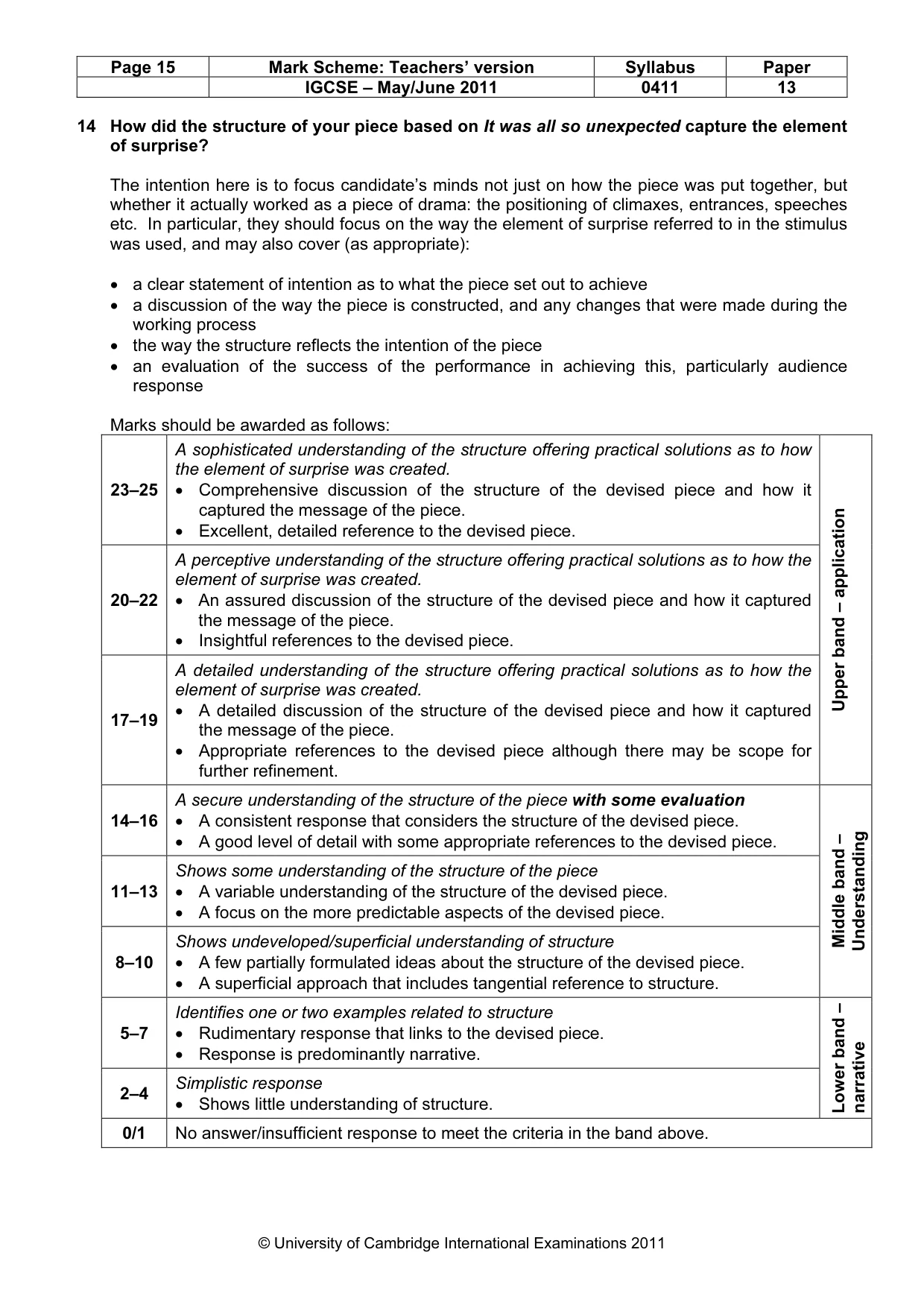
Page 15 Mark Scheme: Teachers’ version Syllabus Paper IGCSE – May/June 2011 0411 13 © University of Cambridge International Examinations 2011 14 How did the structure of your piece based on It was all so unexpected capture the element of surprise? The intention here is to focus candidate’s minds not just on how the piece was put together, but whether it actually worked as a piece of drama: the positioning of climaxes, entrances, speeches etc. In particular, they should focus on the way the element of surprise referred to in the stimulus was used, and may also cover (as appropriate): • a clear statement of intention as to what the piece set out to achieve • a discussion of the way the piece is constructed, and any changes that were made during the working process • the way the structure reflects the intention of the piece • an evaluation of the success of the performance in achieving this, particularly audience response Marks should be awarded as follows: 23–25 A sophisticated understanding of the structure offering practical solutions as to how the element of surprise was created. • Comprehensive discussion of the structure of the devised piece and how it captured the message of the piece. • Excellent, detailed reference to the devised piece. 20–22 A perceptive understanding of the structure offering practical solutions as to how the element of surprise was created. • An assured discussion of the structure of the devised piece and how it captured the message of the piece. • Insightful references to the devised piece. 17–19 A detailed understanding of the structure offering practical solutions as to how the element of surprise was created. • A detailed discussion of the structure of the devised piece and how it captured the message of the piece. • Appropriate references to the devised piece although there may be scope for further refinement. Upper band – application 14–16 A secure understanding of the structure of the piece with some evaluation • A consistent response that considers the structure of the devised piece. • A good level of detail with some appropriate references to the devised piece. 11–13 Shows some understanding of the structure of the piece • A variable understanding of the structure of the devised piece. • A focus on the more predictable aspects of the devised piece. 8–10 Shows undeveloped/superficial understanding of structure • A few partially formulated ideas about the structure of the devised piece. • A superficial approach that includes tangential reference to structure. Middle band – Understanding 5–7 Identifies one or two examples related to structure • Rudimentary response that links to the devised piece. • Response is predominantly narrative. 2–4 Simplistic response • Shows little understanding of structure. Lower band – narrative 0/1 No answer/insufficient response to meet the criteria in the band above.
What you needed in this session
Cambridge’s own grade thresholds for 2011 May/June, Paper 1 · Variant 3. A higher threshold means an easier paper — the bar moves with how the cohort did.