Cambridge IGCSE Design and Technology 0445 — 2021 Oct/Nov Paper 1 · Variant 3
0445/13/O/N/21 · 50 marks · ≈56 min
The question paper and its mark scheme, free to read here and free to download. This is Cambridge’s own paper, exactly as it was sat.
Question paper4 pages
Mark scheme10 pages
Answers below. Sit the paper first if you are practising.
Paper as text
Question paper, page 1
This document has 4 pages. Cambridge IGCSE™ DC (ST/CT) 204263/1 © UCLES 2021 [Turn over DESIGN & TECHNOLOGY 0445/13 Paper 1 Product Design October/November 2021 1 hour 15 minutes You must answer on the two pre-printed A3 answer sheets. You will need: Two A3 pre-printed answer sheets (enclosed) Standard drawing equipment Coloured pencils INSTRUCTIONS ● Answer one question. ● Use an HB pencil for any drawings and a black or dark blue pen for any writing. ● Write your name, centre number and candidate number in the space on both pre-printed answer sheets. ● Answer in the space provided on the answer sheets. ● Do not use an erasable pen, staples, paper clips, glue or correction fluid. ● Do not write on any bar codes. ● You may use a calculator. ● You may use standard drawing equipment, including coloured pencils. ● At the end of the examination, hand in your named A3 answer sheets. Do not fasten them together and do not punch holes in the sheets or tie with string. INFORMATION ● The total mark for this paper is 50. ● The number of marks for each question or part question is shown in brackets [ ]. ● All dimensions are in millimetres. * 3 5 4 6 5 6 8 6 5 1 *
Question paper, page 2
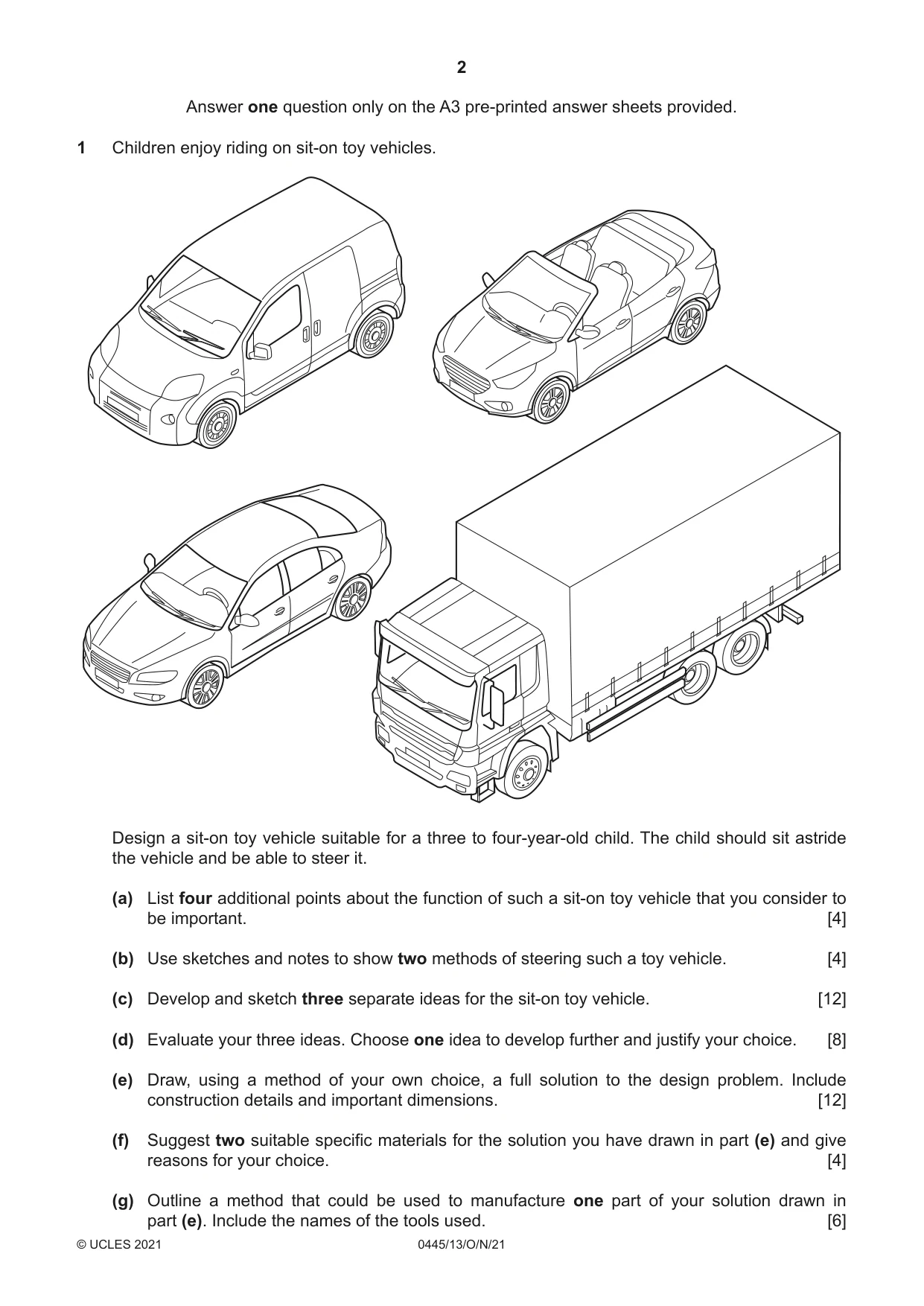
2 0445/13/O/N/21 © UCLES 2021 Answer one question only on the A3 pre-printed answer sheets provided. 1 Children enjoy riding on sit-on toy vehicles. Design a sit-on toy vehicle suitable for a three to four-year-old child. The child should sit astride the vehicle and be able to steer it. (a) List four additional points about the function of such a sit-on toy vehicle that you consider to be important. [4] (b) Use sketches and notes to show two methods of steering such a toy vehicle. [4] (c) Develop and sketch three separate ideas for the sit-on toy vehicle. [12] (d) Evaluate your three ideas. Choose one idea to develop further and justify your choice. [8] (e) Draw, using a method of your own choice, a full solution to the design problem. Include construction details and important dimensions. [12] (f) Suggest two suitable specific materials for the solution you have drawn in part (e) and give reasons for your choice. [4] (g) Outline a method that could be used to manufacture one part of your solution drawn in part (e). Include the names of the tools used. [6]
Question paper, page 3
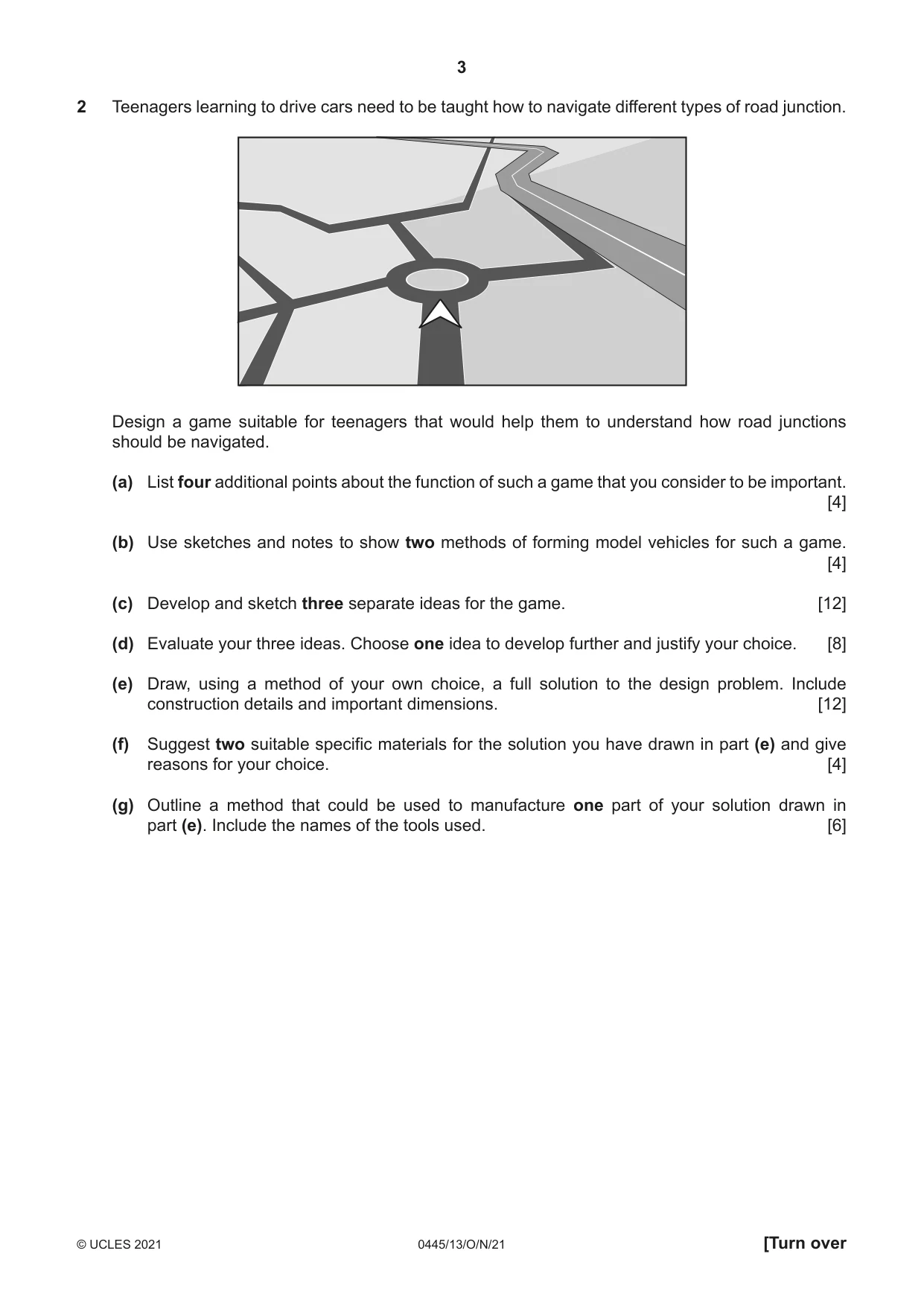
3 0445/13/O/N/21 © UCLES 2021 [Turn over 2 Teenagers learning to drive cars need to be taught how to navigate different types of road junction. Design a game suitable for teenagers that would help them to understand how road junctions should be navigated. (a) List four additional points about the function of such a game that you consider to be important. [4] (b) Use sketches and notes to show two methods of forming model vehicles for such a game. [4] (c) Develop and sketch three separate ideas for the game. [12] (d) Evaluate your three ideas. Choose one idea to develop further and justify your choice. [8] (e) Draw, using a method of your own choice, a full solution to the design problem. Include construction details and important dimensions. [12] (f) Suggest two suitable specific materials for the solution you have drawn in part (e) and give reasons for your choice. [4] (g) Outline a method that could be used to manufacture one part of your solution drawn in part (e). Include the names of the tools used. [6]
Question paper, page 4
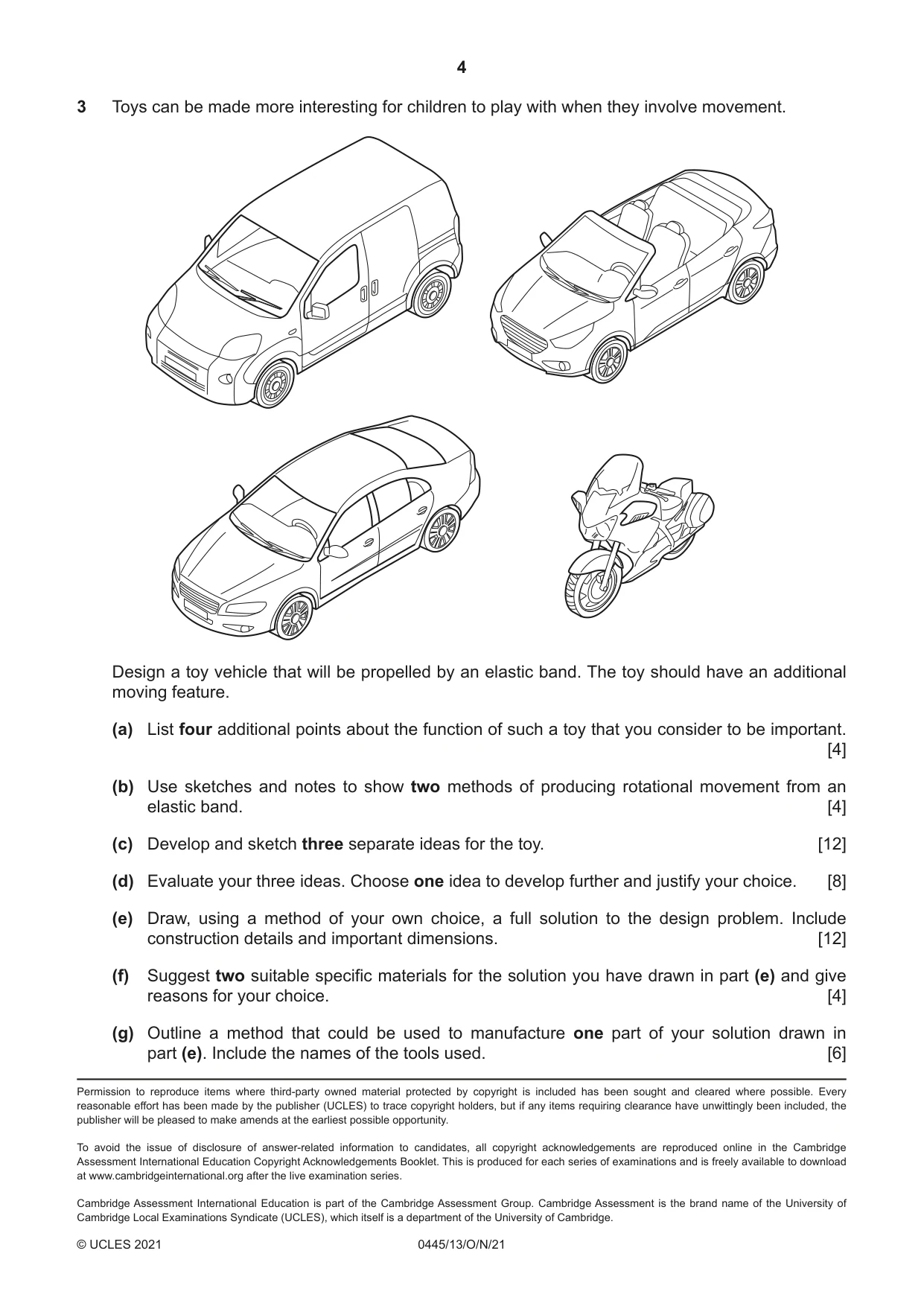
4 0445/13/O/N/21 © UCLES 2021 Permission to reproduce items where third-party owned material protected by copyright is included has been sought and cleared where possible. Every reasonable effort has been made by the publisher (UCLES) to trace copyright holders, but if any items requiring clearance have unwittingly been included, the publisher will be pleased to make amends at the earliest possible opportunity. To avoid the issue of disclosure of answer-related information to candidates, all copyright acknowledgements are reproduced online in the Cambridge Assessment International Education Copyright Acknowledgements Booklet. This is produced for each series of examinations and is freely available to download at www.cambridgeinternational.org after the live examination series. Cambridge Assessment International Education is part of the Cambridge Assessment Group. Cambridge Assessment is the brand name of the University of Cambridge Local Examinations Syndicate (UCLES), which itself is a department of the University of Cambridge. 3 Toys can be made more interesting for children to play with when they involve movement. Design a toy vehicle that will be propelled by an elastic band. The toy should have an additional moving feature. (a) List four additional points about the function of such a toy that you consider to be important. [4] (b) Use sketches and notes to show two methods of producing rotational movement from an elastic band. [4] (c) Develop and sketch three separate ideas for the toy. [12] (d) Evaluate your three ideas. Choose one idea to develop further and justify your choice. [8] (e) Draw, using a method of your own choice, a full solution to the design problem. Include construction details and important dimensions. [12] (f) Suggest two suitable specific materials for the solution you have drawn in part (e) and give reasons for your choice. [4] (g) Outline a method that could be used to manufacture one part of your solution drawn in part (e). Include the names of the tools used. [6]
Mark scheme, page 1
This document consists of 10 printed pages. © UCLES 2021 [Turn over Cambridge IGCSE™ DESIGN & TECHNOLOGY 0445/13 Paper 1 Product Design October/November 2021 MARK SCHEME Maximum Mark: 50 Published This mark scheme is published as an aid to teachers and candidates, to indicate the requirements of the examination. It shows the basis on which Examiners were instructed to award marks. It does not indicate the details of the discussions that took place at an Examiners’ meeting before marking began, which would have considered the acceptability of alternative answers. Mark schemes should be read in conjunction with the question paper and the Principal Examiner Report for Teachers. Cambridge International will not enter into discussions about these mark schemes. Cambridge International is publishing the mark schemes for the October/November 2021 series for most Cambridge IGCSE™, Cambridge International A and AS Level components and some Cambridge O Level components.
Mark scheme, page 2
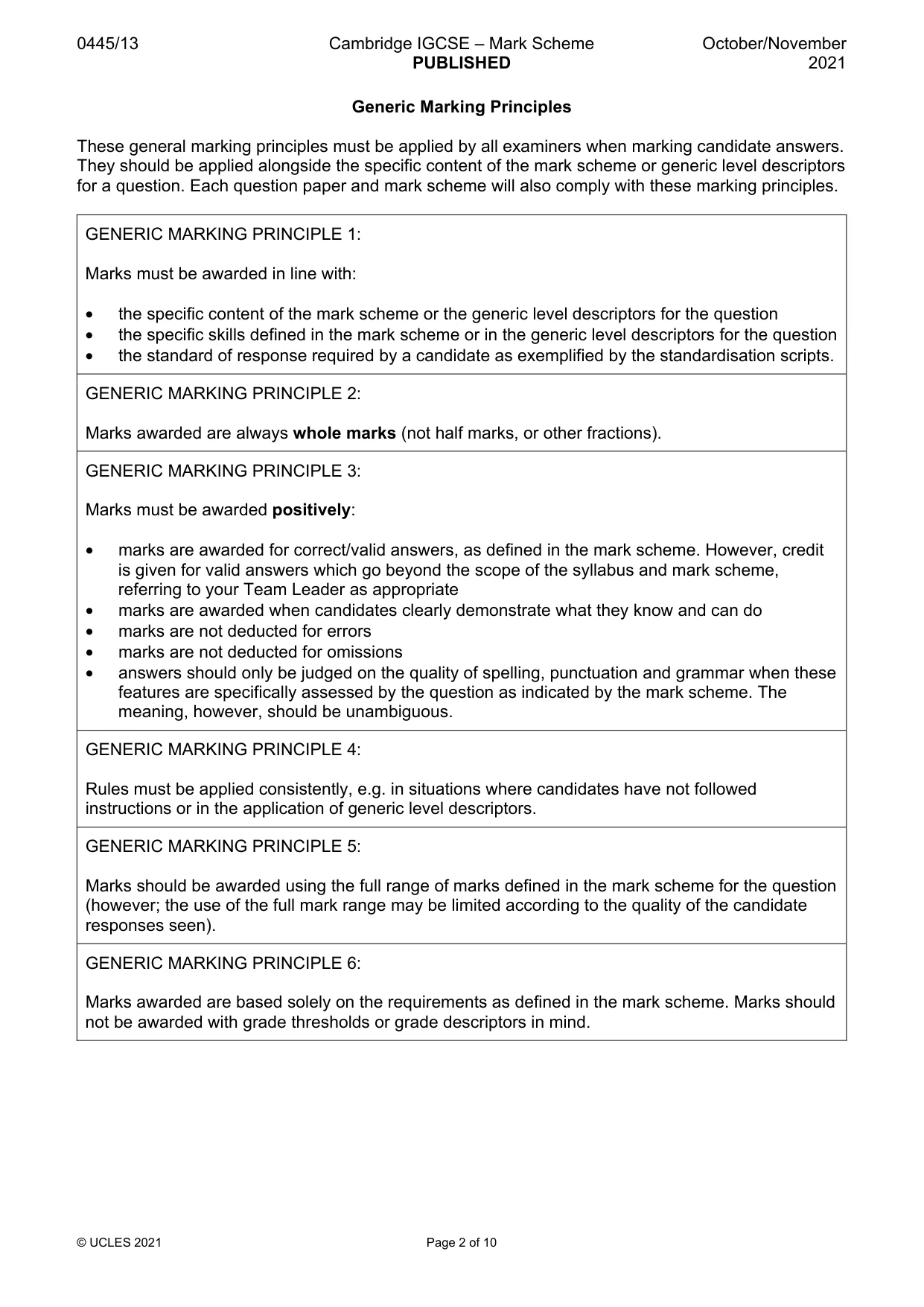
0445/13 Cambridge IGCSE – Mark Scheme PUBLISHED October/November 2021 © UCLES 2021 Page 2 of 10 Generic Marking Principles These general marking principles must be applied by all examiners when marking candidate answers. They should be applied alongside the specific content of the mark scheme or generic level descriptors for a question. Each question paper and mark scheme will also comply with these marking principles. GENERIC MARKING PRINCIPLE 1: Marks must be awarded in line with: • the specific content of the mark scheme or the generic level descriptors for the question • the specific skills defined in the mark scheme or in the generic level descriptors for the question • the standard of response required by a candidate as exemplified by the standardisation scripts. GENERIC MARKING PRINCIPLE 2: Marks awarded are always whole marks (not half marks, or other fractions). GENERIC MARKING PRINCIPLE 3: Marks must be awarded positively: • marks are awarded for correct/valid answers, as defined in the mark scheme. However, credit is given for valid answers which go beyond the scope of the syllabus and mark scheme, referring to your Team Leader as appropriate • marks are awarded when candidates clearly demonstrate what they know and can do • marks are not deducted for errors • marks are not deducted for omissions • answers should only be judged on the quality of spelling, punctuation and grammar when these features are specifically assessed by the question as indicated by the mark scheme. The meaning, however, should be unambiguous. GENERIC MARKING PRINCIPLE 4: Rules must be applied consistently, e.g. in situations where candidates have not followed instructions or in the application of generic level descriptors. GENERIC MARKING PRINCIPLE 5: Marks should be awarded using the full range of marks defined in the mark scheme for the question (however; the use of the full mark range may be limited according to the quality of the candidate responses seen). GENERIC MARKING PRINCIPLE 6: Marks awarded are based solely on the requirements as defined in the mark scheme. Marks should not be awarded with grade thresholds or grade descriptors in mind.
Mark scheme, page 3
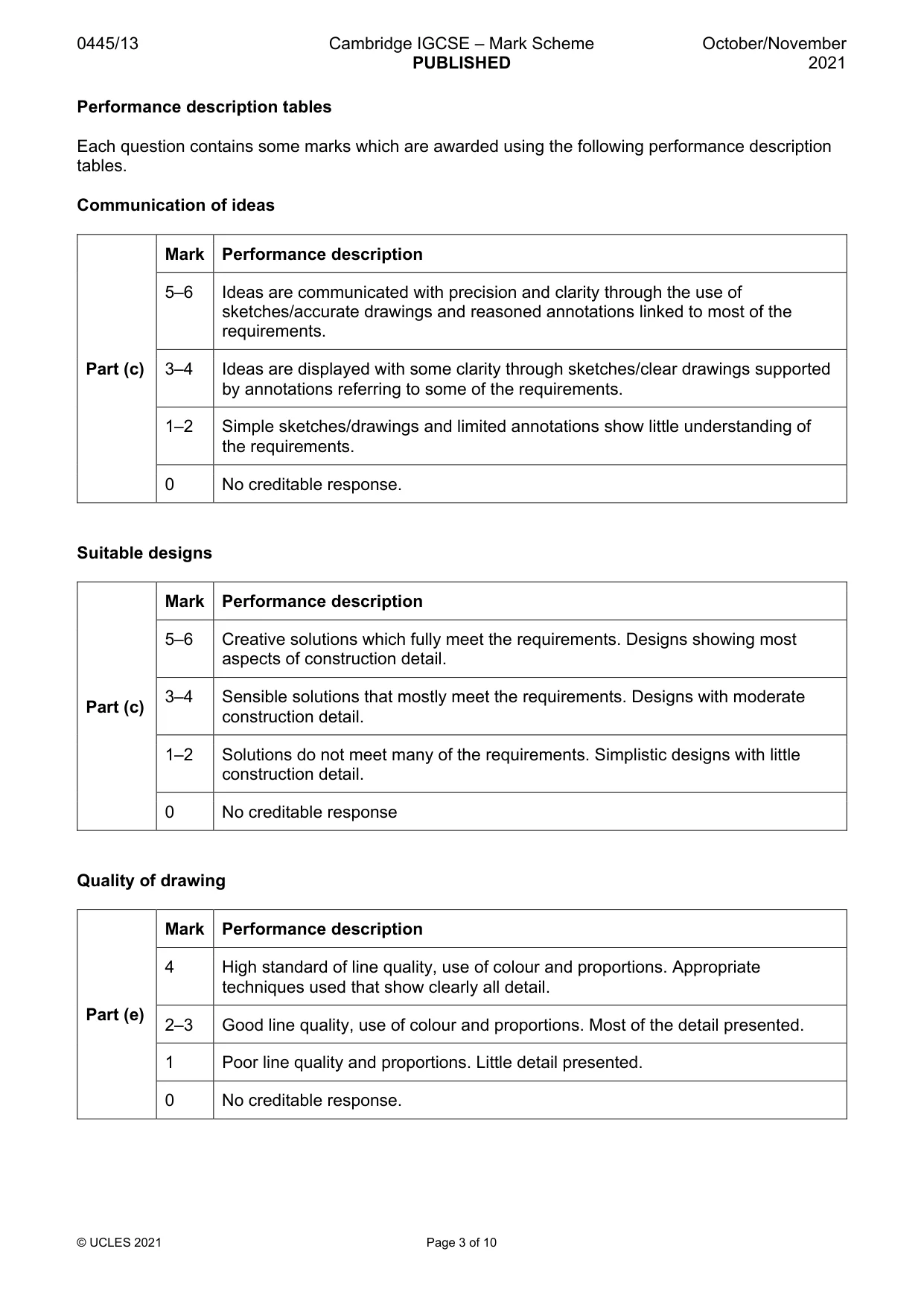
0445/13 Cambridge IGCSE – Mark Scheme PUBLISHED October/November 2021 © UCLES 2021 Page 3 of 10 Performance description tables Each question contains some marks which are awarded using the following performance description tables. Communication of ideas Part (c) Mark Performance description 5–6 Ideas are communicated with precision and clarity through the use of sketches/accurate drawings and reasoned annotations linked to most of the requirements. 3–4 Ideas are displayed with some clarity through sketches/clear drawings supported by annotations referring to some of the requirements. 1–2 Simple sketches/drawings and limited annotations show little understanding of the requirements. 0 No creditable response. Suitable designs Part (c) Mark Performance description 5–6 Creative solutions which fully meet the requirements. Designs showing most aspects of construction detail. 3–4 Sensible solutions that mostly meet the requirements. Designs with moderate construction detail. 1–2 Solutions do not meet many of the requirements. Simplistic designs with little construction detail. 0 No creditable response Quality of drawing Part (e) Mark Performance description 4 High standard of line quality, use of colour and proportions. Appropriate techniques used that show clearly all detail. 2–3 Good line quality, use of colour and proportions. Most of the detail presented. 1 Poor line quality and proportions. Little detail presented. 0 No creditable response.
Mark scheme, page 4
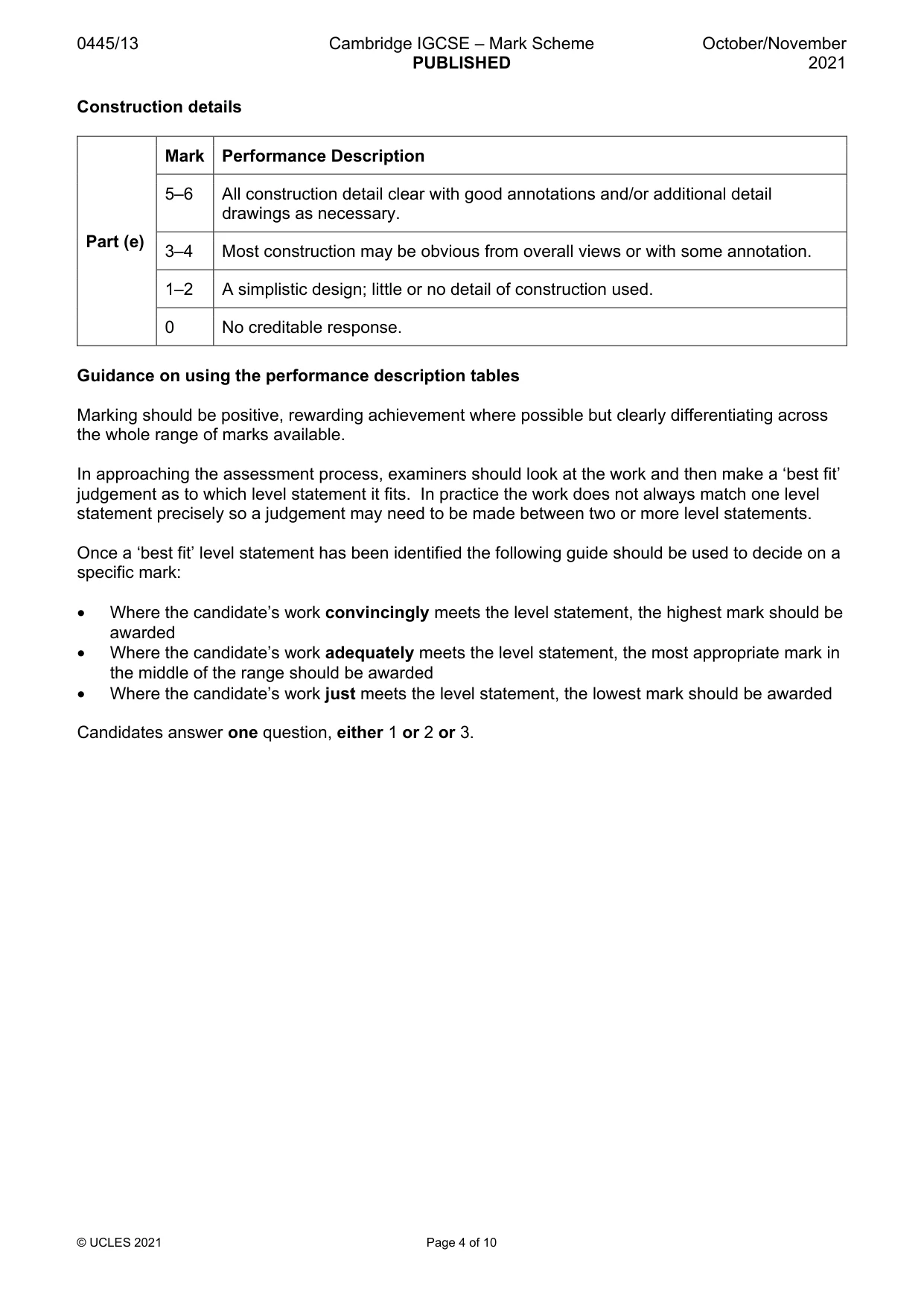
0445/13 Cambridge IGCSE – Mark Scheme PUBLISHED October/November 2021 © UCLES 2021 Page 4 of 10 Construction details Part (e) Mark Performance Description 5–6 All construction detail clear with good annotations and/or additional detail drawings as necessary. 3–4 Most construction may be obvious from overall views or with some annotation. 1–2 A simplistic design; little or no detail of construction used. 0 No creditable response. Guidance on using the performance description tables Marking should be positive, rewarding achievement where possible but clearly differentiating across the whole range of marks available. In approaching the assessment process, examiners should look at the work and then make a ‘best fit’ judgement as to which level statement it fits. In practice the work does not always match one level statement precisely so a judgement may need to be made between two or more level statements. Once a ‘best fit’ level statement has been identified the following guide should be used to decide on a specific mark: • Where the candidate’s work convincingly meets the level statement, the highest mark should be awarded • Where the candidate’s work adequately meets the level statement, the most appropriate mark in the middle of the range should be awarded • Where the candidate’s work just meets the level statement, the lowest mark should be awarded Candidates answer one question, either 1 or 2 or 3.
Mark scheme, page 5
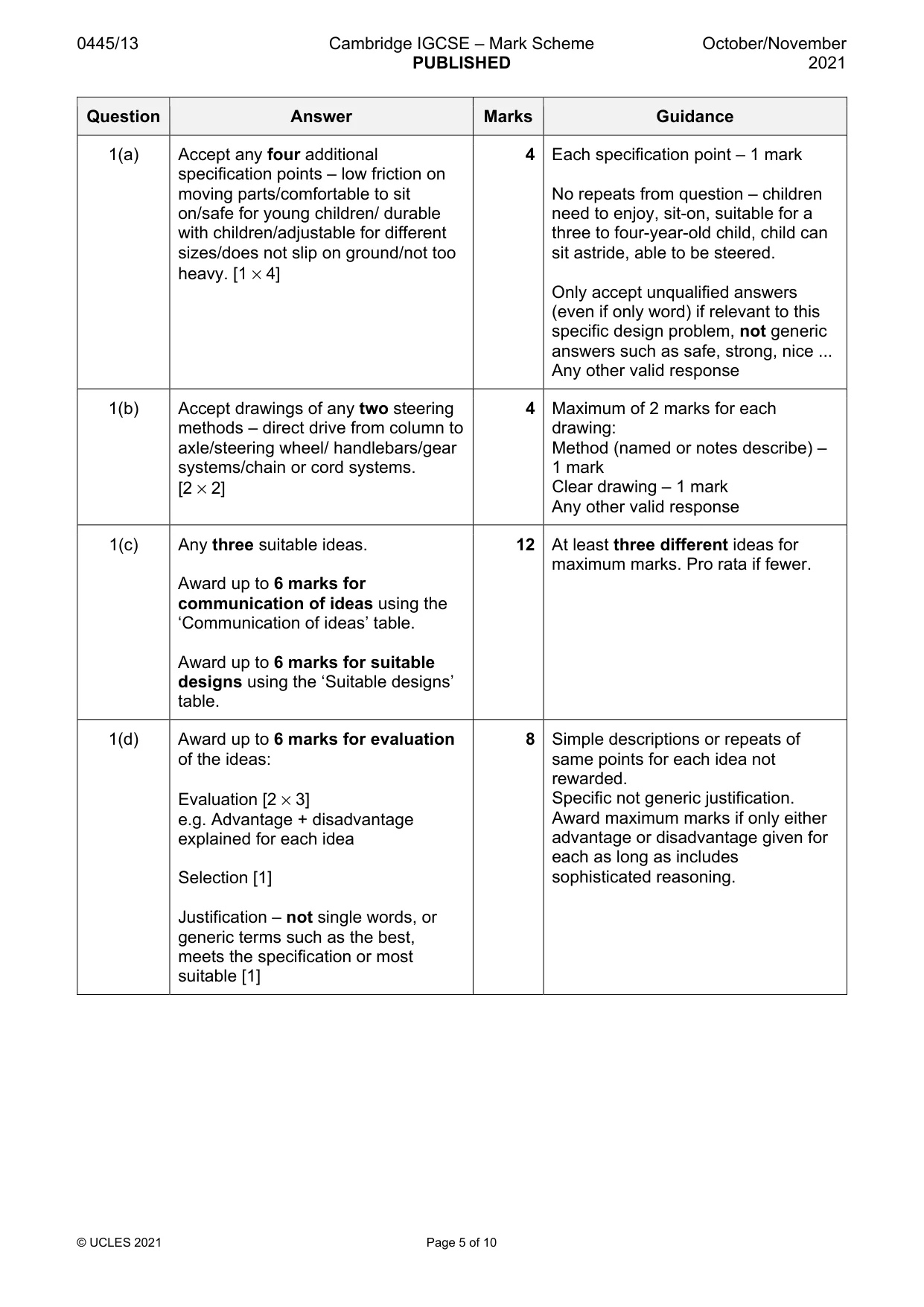
0445/13 Cambridge IGCSE – Mark Scheme PUBLISHED October/November 2021 © UCLES 2021 Page 5 of 10 Question Answer Marks Guidance 1(a) Accept any four additional specification points – low friction on moving parts/comfortable to sit on/safe for young children/ durable with children/adjustable for different sizes/does not slip on ground/not too heavy. [1 × 4] 4 Each specification point – 1 mark No repeats from question – children need to enjoy, sit-on, suitable for a three to four-year-old child, child can sit astride, able to be steered. Only accept unqualified answers (even if only word) if relevant to this specific design problem, not generic answers such as safe, strong, nice ... Any other valid response 1(b) Accept drawings of any two steering methods – direct drive from column to axle/steering wheel/ handlebars/gear systems/chain or cord systems. [2 × 2] 4 Maximum of 2 marks for each drawing: Method (named or notes describe) – 1 mark Clear drawing – 1 mark Any other valid response 1(c) Any three suitable ideas. Award up to 6 marks for communication of ideas using the ‘Communication of ideas’ table. Award up to 6 marks for suitable designs using the ‘Suitable designs’ table. 12 At least three different ideas for maximum marks. Pro rata if fewer. 1(d) Award up to 6 marks for evaluation of the ideas: Evaluation [2 × 3] e.g. Advantage + disadvantage explained for each idea Selection [1] Justification – not single words, or generic terms such as the best, meets the specification or most suitable [1] 8 Simple descriptions or repeats of same points for each idea not rewarded. Specific not generic justification. Award maximum marks if only either advantage or disadvantage given for each as long as includes sophisticated reasoning.
Mark scheme, page 6
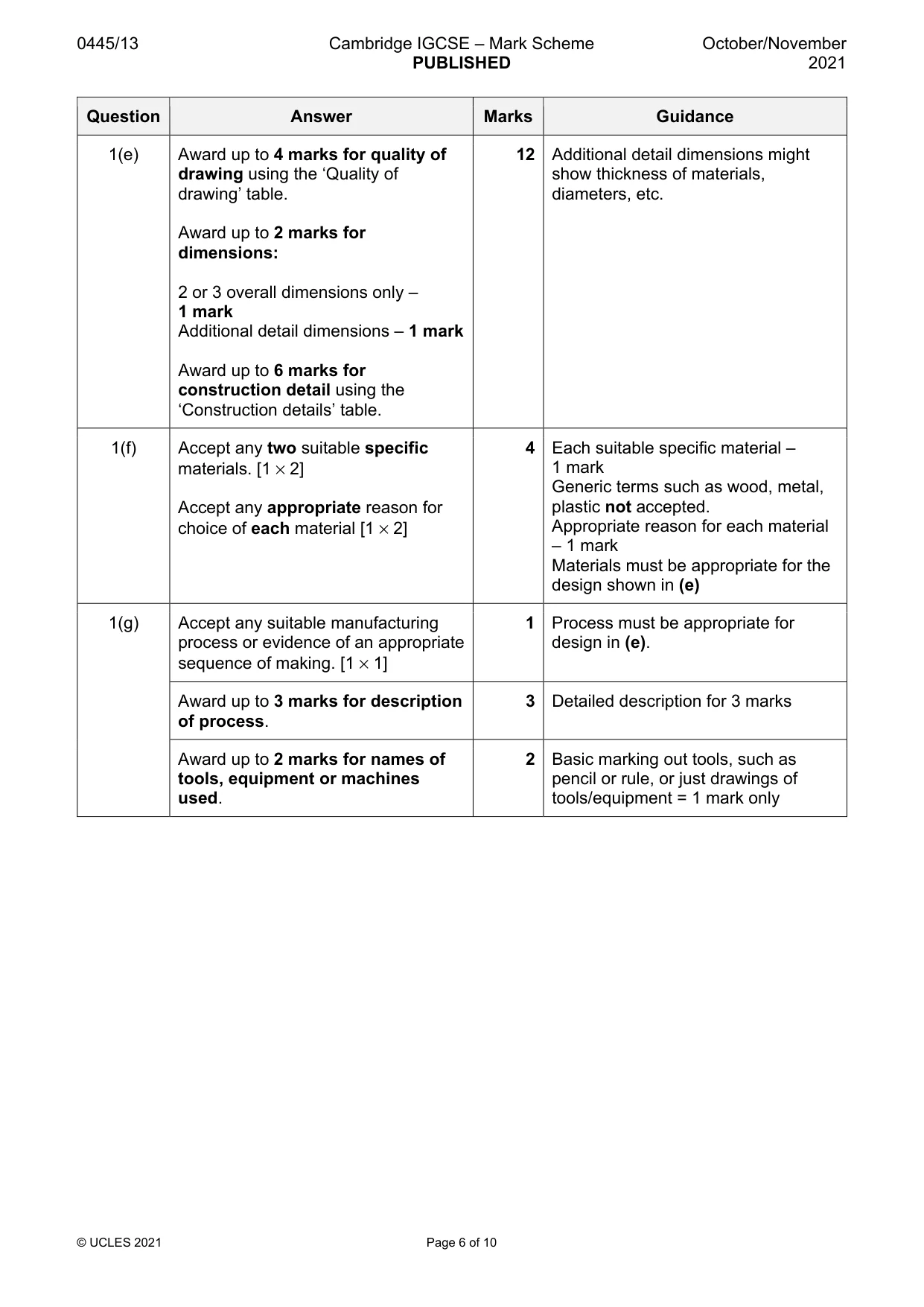
0445/13 Cambridge IGCSE – Mark Scheme PUBLISHED October/November 2021 © UCLES 2021 Page 6 of 10 Question Answer Marks Guidance 1(e) Award up to 4 marks for quality of drawing using the ‘Quality of drawing’ table. Award up to 2 marks for dimensions: 2 or 3 overall dimensions only – 1 mark Additional detail dimensions – 1 mark Award up to 6 marks for construction detail using the ‘Construction details’ table. 12 Additional detail dimensions might show thickness of materials, diameters, etc. 1(f) Accept any two suitable specific materials. [1 × 2] Accept any appropriate reason for choice of each material [1 × 2] 4 Each suitable specific material – 1 mark Generic terms such as wood, metal, plastic not accepted. Appropriate reason for each material – 1 mark Materials must be appropriate for the design shown in (e) 1(g) Accept any suitable manufacturing process or evidence of an appropriate sequence of making. [1 × 1] 1 Process must be appropriate for design in (e). Award up to 3 marks for description of process. 3 Detailed description for 3 marks Award up to 2 marks for names of tools, equipment or machines used. 2 Basic marking out tools, such as pencil or rule, or just drawings of tools/equipment = 1 mark only
Mark scheme, page 7
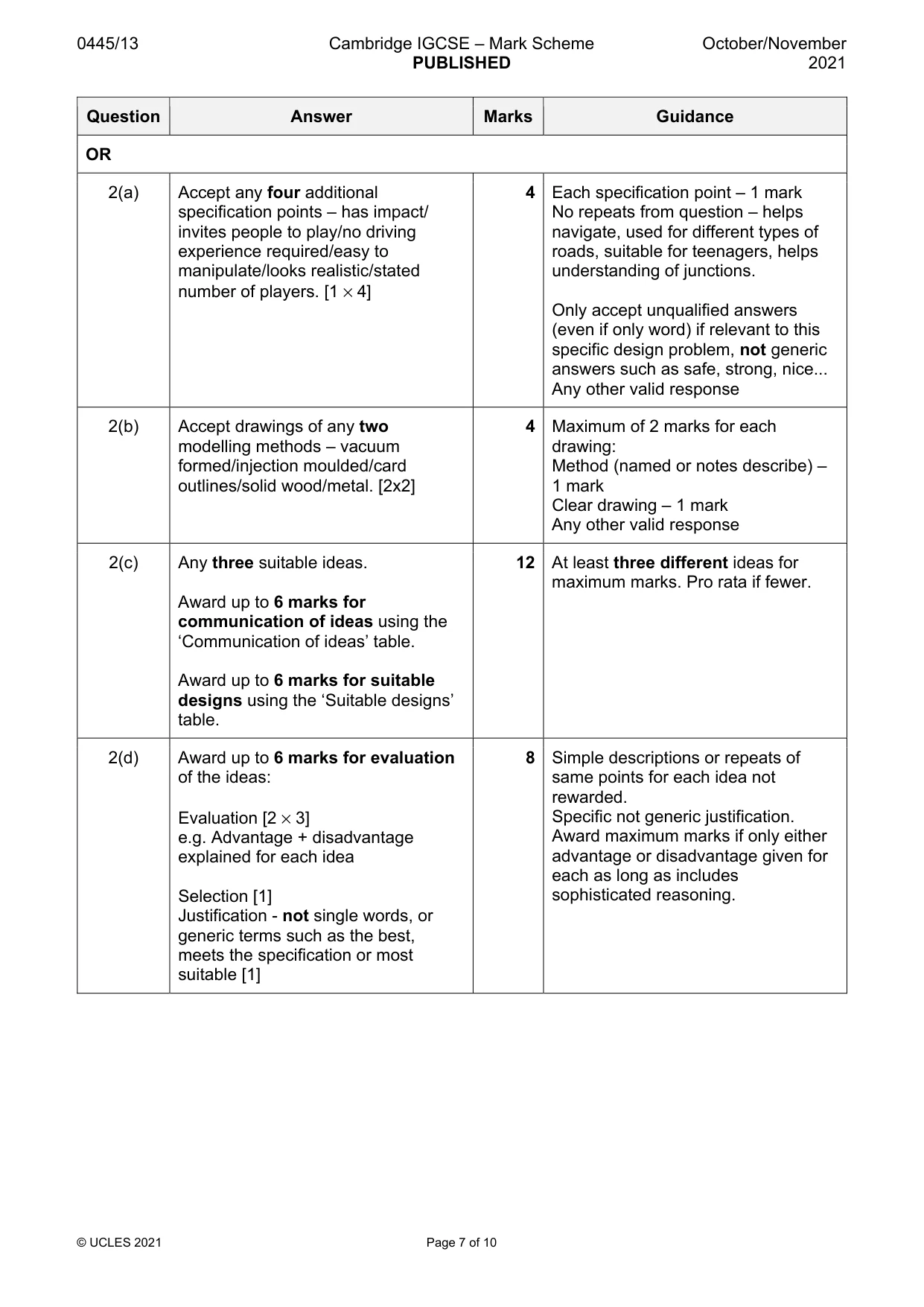
0445/13 Cambridge IGCSE – Mark Scheme PUBLISHED October/November 2021 © UCLES 2021 Page 7 of 10 Question Answer Marks Guidance OR 2(a) Accept any four additional specification points – has impact/ invites people to play/no driving experience required/easy to manipulate/looks realistic/stated number of players. [1 × 4] 4 Each specification point – 1 mark No repeats from question – helps navigate, used for different types of roads, suitable for teenagers, helps understanding of junctions. Only accept unqualified answers (even if only word) if relevant to this specific design problem, not generic answers such as safe, strong, nice... Any other valid response 2(b) Accept drawings of any two modelling methods – vacuum formed/injection moulded/card outlines/solid wood/metal. [2x2] 4 Maximum of 2 marks for each drawing: Method (named or notes describe) – 1 mark Clear drawing – 1 mark Any other valid response 2(c) Any three suitable ideas. Award up to 6 marks for communication of ideas using the ‘Communication of ideas’ table. Award up to 6 marks for suitable designs using the ‘Suitable designs’ table. 12 At least three different ideas for maximum marks. Pro rata if fewer. 2(d) Award up to 6 marks for evaluation of the ideas: Evaluation [2 × 3] e.g. Advantage + disadvantage explained for each idea Selection [1] Justification - not single words, or generic terms such as the best, meets the specification or most suitable [1] 8 Simple descriptions or repeats of same points for each idea not rewarded. Specific not generic justification. Award maximum marks if only either advantage or disadvantage given for each as long as includes sophisticated reasoning.
Mark scheme, page 8
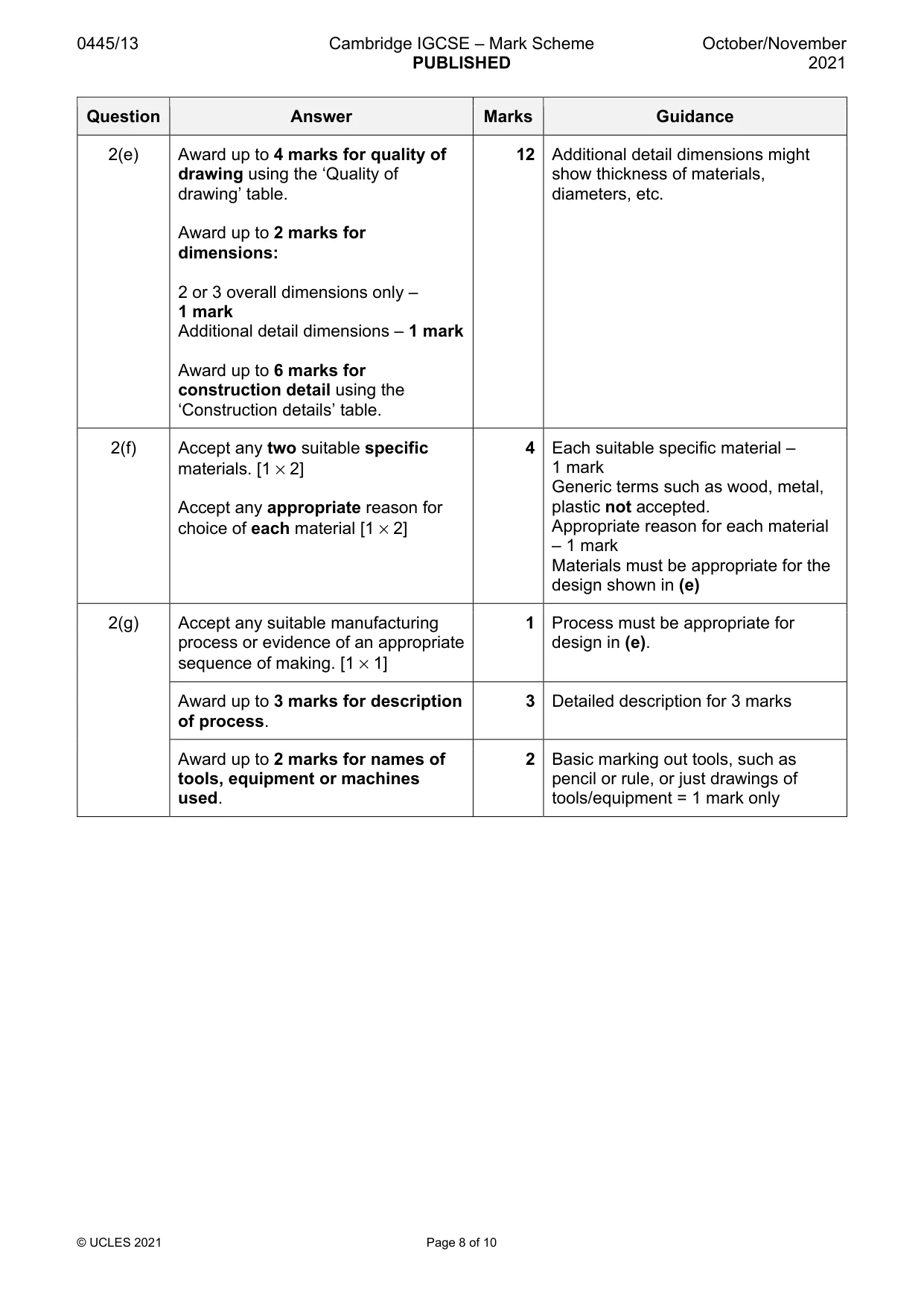
0445/13 Cambridge IGCSE – Mark Scheme PUBLISHED October/November 2021 © UCLES 2021 Page 8 of 10 Question Answer Marks Guidance 2(e) Award up to 4 marks for quality of drawing using the ‘Quality of drawing’ table. Award up to 2 marks for dimensions: 2 or 3 overall dimensions only – 1 mark Additional detail dimensions – 1 mark Award up to 6 marks for construction detail using the ‘Construction details’ table. 12 Additional detail dimensions might show thickness of materials, diameters, etc. 2(f) Accept any two suitable specific materials. [1 × 2] Accept any appropriate reason for choice of each material [1 × 2] 4 Each suitable specific material – 1 mark Generic terms such as wood, metal, plastic not accepted. Appropriate reason for each material – 1 mark Materials must be appropriate for the design shown in (e) 2(g) Accept any suitable manufacturing process or evidence of an appropriate sequence of making. [1 × 1] 1 Process must be appropriate for design in (e). Award up to 3 marks for description of process. 3 Detailed description for 3 marks Award up to 2 marks for names of tools, equipment or machines used. 2 Basic marking out tools, such as pencil or rule, or just drawings of tools/equipment = 1 mark only
Mark scheme, page 9
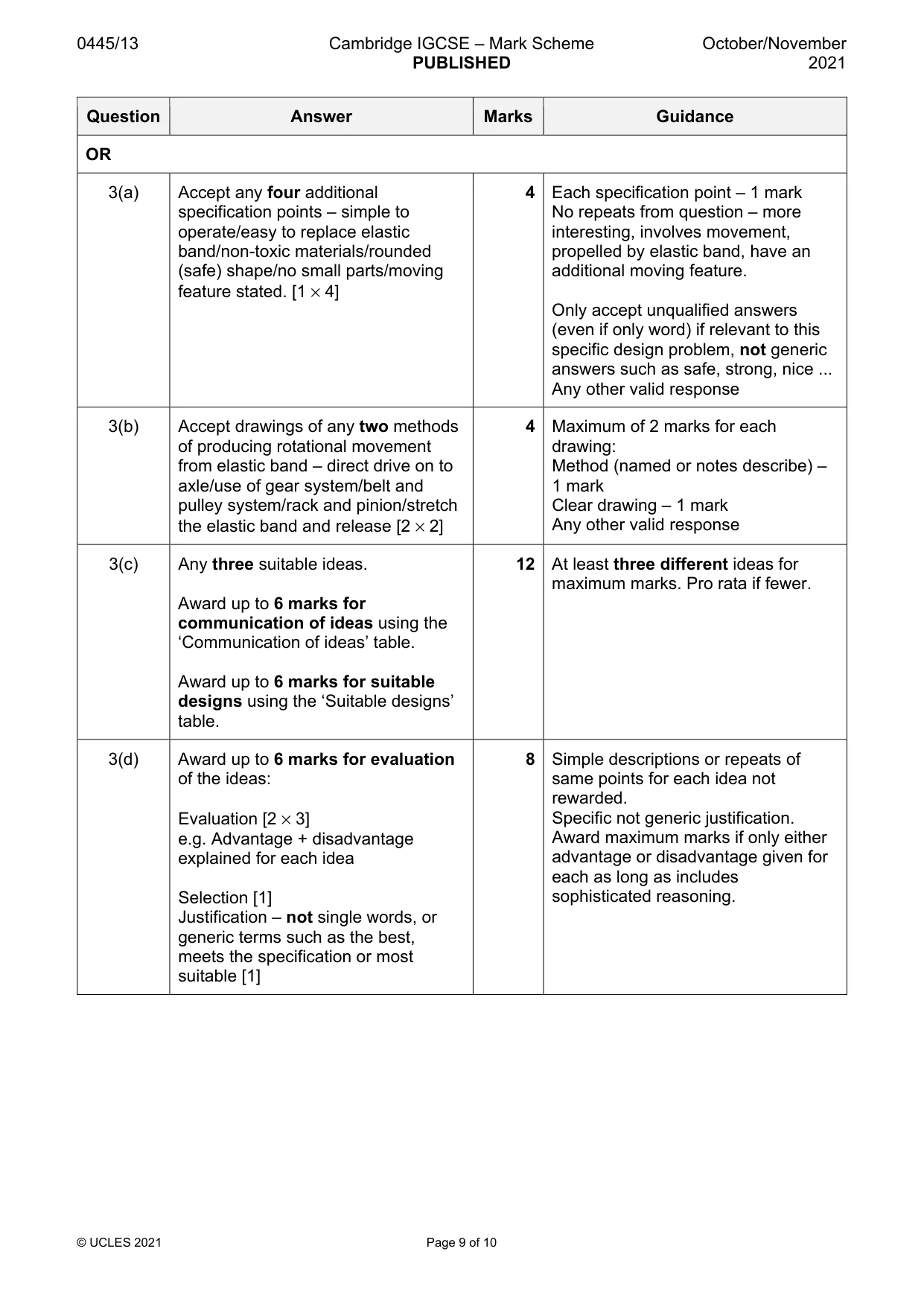
0445/13 Cambridge IGCSE – Mark Scheme PUBLISHED October/November 2021 © UCLES 2021 Page 9 of 10 Question Answer Marks Guidance OR 3(a) Accept any four additional specification points – simple to operate/easy to replace elastic band/non-toxic materials/rounded (safe) shape/no small parts/moving feature stated. [1 × 4] 4 Each specification point – 1 mark No repeats from question – more interesting, involves movement, propelled by elastic band, have an additional moving feature. Only accept unqualified answers (even if only word) if relevant to this specific design problem, not generic answers such as safe, strong, nice ... Any other valid response 3(b) Accept drawings of any two methods of producing rotational movement from elastic band – direct drive on to axle/use of gear system/belt and pulley system/rack and pinion/stretch the elastic band and release [2 × 2] 4 Maximum of 2 marks for each drawing: Method (named or notes describe) – 1 mark Clear drawing – 1 mark Any other valid response 3(c) Any three suitable ideas. Award up to 6 marks for communication of ideas using the ‘Communication of ideas’ table. Award up to 6 marks for suitable designs using the ‘Suitable designs’ table. 12 At least three different ideas for maximum marks. Pro rata if fewer. 3(d) Award up to 6 marks for evaluation of the ideas: Evaluation [2 × 3] e.g. Advantage + disadvantage explained for each idea Selection [1] Justification – not single words, or generic terms such as the best, meets the specification or most suitable [1] 8 Simple descriptions or repeats of same points for each idea not rewarded. Specific not generic justification. Award maximum marks if only either advantage or disadvantage given for each as long as includes sophisticated reasoning.
Mark scheme, page 10
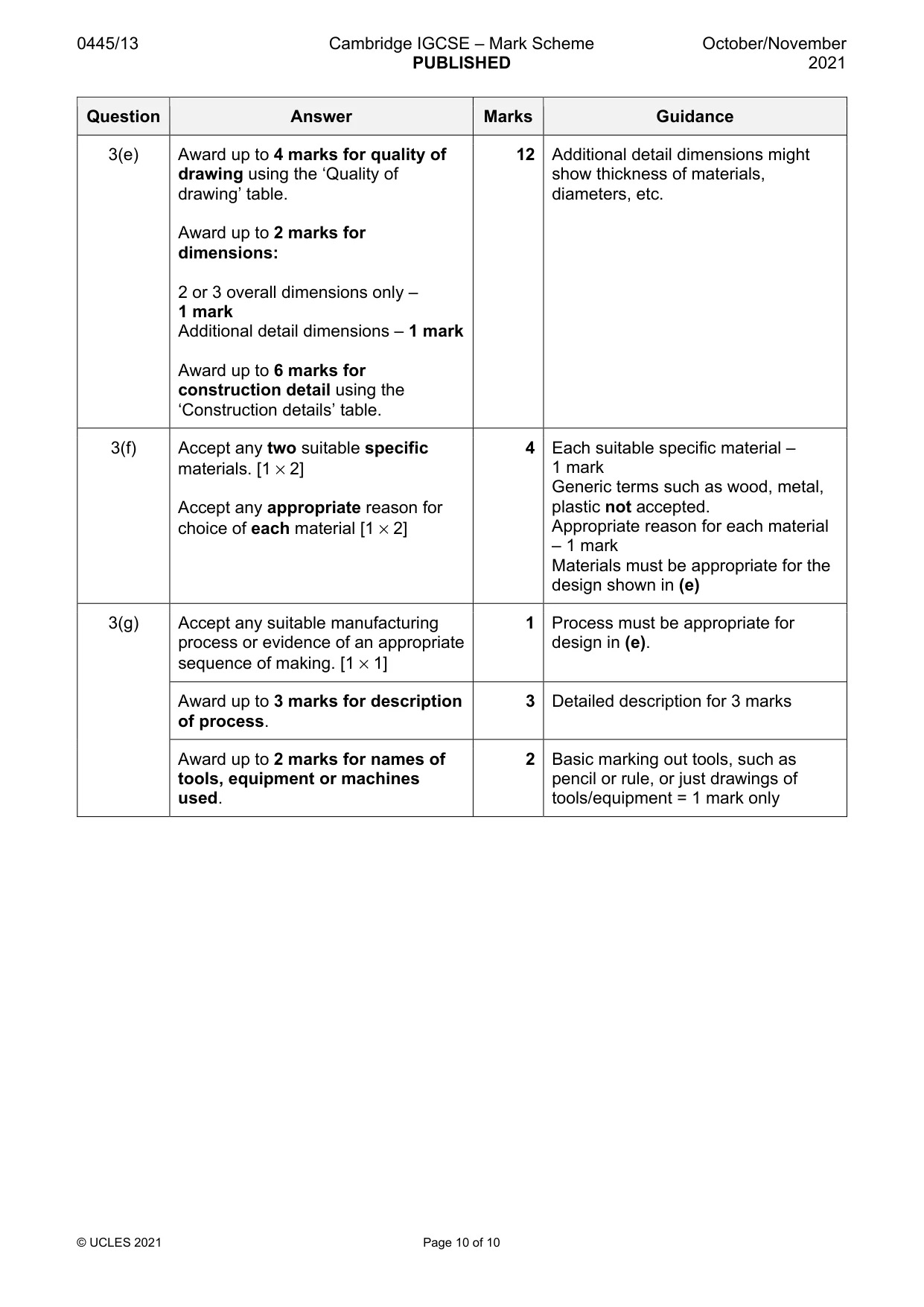
0445/13 Cambridge IGCSE – Mark Scheme PUBLISHED October/November 2021 © UCLES 2021 Page 10 of 10 Question Answer Marks Guidance 3(e) Award up to 4 marks for quality of drawing using the ‘Quality of drawing’ table. Award up to 2 marks for dimensions: 2 or 3 overall dimensions only – 1 mark Additional detail dimensions – 1 mark Award up to 6 marks for construction detail using the ‘Construction details’ table. 12 Additional detail dimensions might show thickness of materials, diameters, etc. 3(f) Accept any two suitable specific materials. [1 × 2] Accept any appropriate reason for choice of each material [1 × 2] 4 Each suitable specific material – 1 mark Generic terms such as wood, metal, plastic not accepted. Appropriate reason for each material – 1 mark Materials must be appropriate for the design shown in (e) 3(g) Accept any suitable manufacturing process or evidence of an appropriate sequence of making. [1 × 1] 1 Process must be appropriate for design in (e). Award up to 3 marks for description of process. 3 Detailed description for 3 marks Award up to 2 marks for names of tools, equipment or machines used. 2 Basic marking out tools, such as pencil or rule, or just drawings of tools/equipment = 1 mark only
What you needed in this session
Cambridge’s own grade thresholds for 2021 Oct/Nov, Paper 1 · Variant 3. A higher threshold means an easier paper — the bar moves with how the cohort did.