Cambridge IGCSE Design and Technology 0445 — 2016 May/June Paper 1 · Variant 2
0445/12/M/J/16 · 50 marks · ≈56 min
The question paper and its mark scheme, free to read here and free to download. This is Cambridge’s own paper, exactly as it was sat.
Question paper4 pages
Mark scheme
No mark scheme is in the library for this paper.
Paper as text
Question paper, page 1
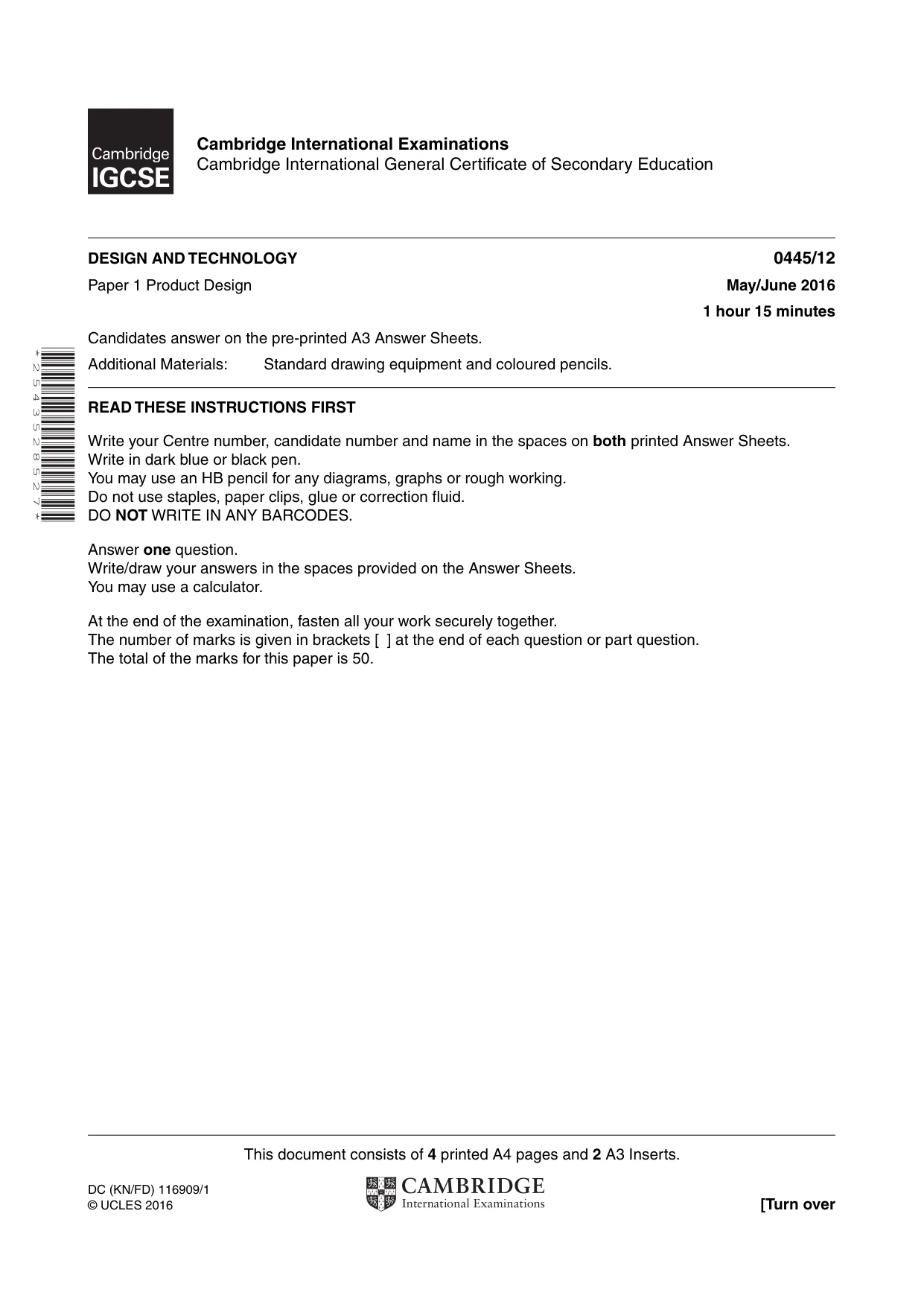
This document consists of 4 printed A4 pages and 2 A3 Inserts. DC (KN/FD) 116909/1 © UCLES 2016 [Turn over Cambridge International Examinations Cambridge International General Certificate of Secondary Education * 2 5 4 3 5 2 8 5 2 7 * DESIGN AND TECHNOLOGY 0445/12 Paper 1 Product Design May/June 2016 1 hour 15 minutes Candidates answer on the pre-printed A3 Answer Sheets. Additional Materials: Standard drawing equipment and coloured pencils. READ THESE INSTRUCTIONS FIRST Write your Centre number, candidate number and name in the spaces on both printed Answer Sheets. Write in dark blue or black pen. You may use an HB pencil for any diagrams, graphs or rough working. Do not use staples, paper clips, glue or correction fluid. DO NOT WRITE IN ANY BARCODES. Answer one question. Write/draw your answers in the spaces provided on the Answer Sheets. You may use a calculator. At the end of the examination, fasten all your work securely together. The number of marks is given in brackets [ ] at the end of each question or part question. The total of the marks for this paper is 50.
Question paper, page 2
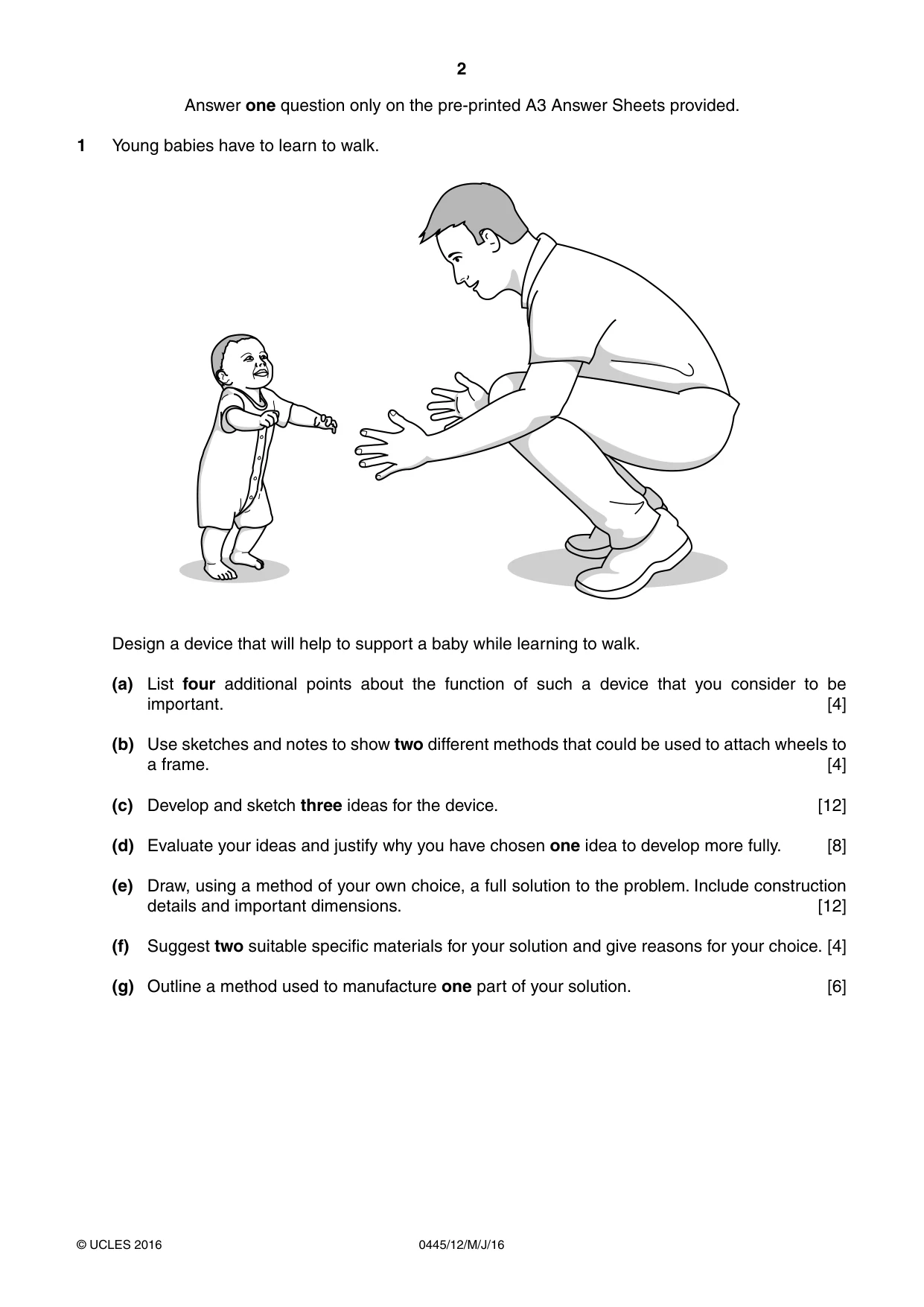
2 0445/12/M/J/16 © UCLES 2016 Answer one question only on the pre-printed A3 Answer Sheets provided. 1 Young babies have to learn to walk. Design a device that will help to support a baby while learning to walk. (a) List four additional points about the function of such a device that you consider to be important. [4] (b) Use sketches and notes to show two different methods that could be used to attach wheels to a frame. [4] (c) Develop and sketch three ideas for the device. [12] (d) Evaluate your ideas and justify why you have chosen one idea to develop more fully. [8] (e) Draw, using a method of your own choice, a full solution to the problem. Include construction details and important dimensions. [12] (f) Suggest two suitable specific materials for your solution and give reasons for your choice. [4] (g) Outline a method used to manufacture one part of your solution. [6]
Question paper, page 3
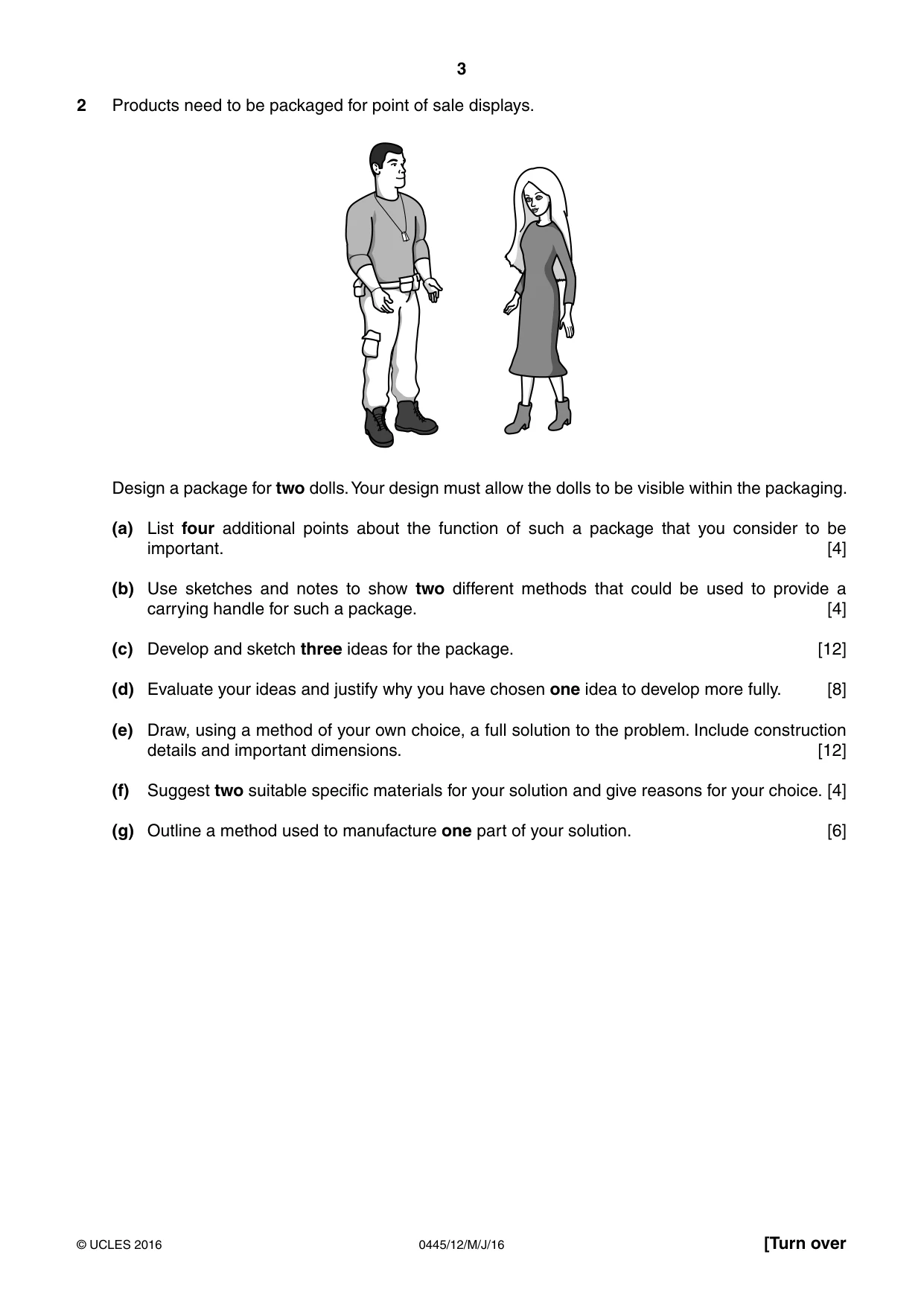
3 0445/12/M/J/16 © UCLES 2016 [Turn over 2 Products need to be packaged for point of sale displays. Design a package for two dolls. Your design must allow the dolls to be visible within the packaging. (a) List four additional points about the function of such a package that you consider to be important. [4] (b) Use sketches and notes to show two different methods that could be used to provide a carrying handle for such a package. [4] (c) Develop and sketch three ideas for the package. [12] (d) Evaluate your ideas and justify why you have chosen one idea to develop more fully. [8] (e) Draw, using a method of your own choice, a full solution to the problem. Include construction details and important dimensions. [12] (f) Suggest two suitable specific materials for your solution and give reasons for your choice. [4] (g) Outline a method used to manufacture one part of your solution. [6]
Question paper, page 4
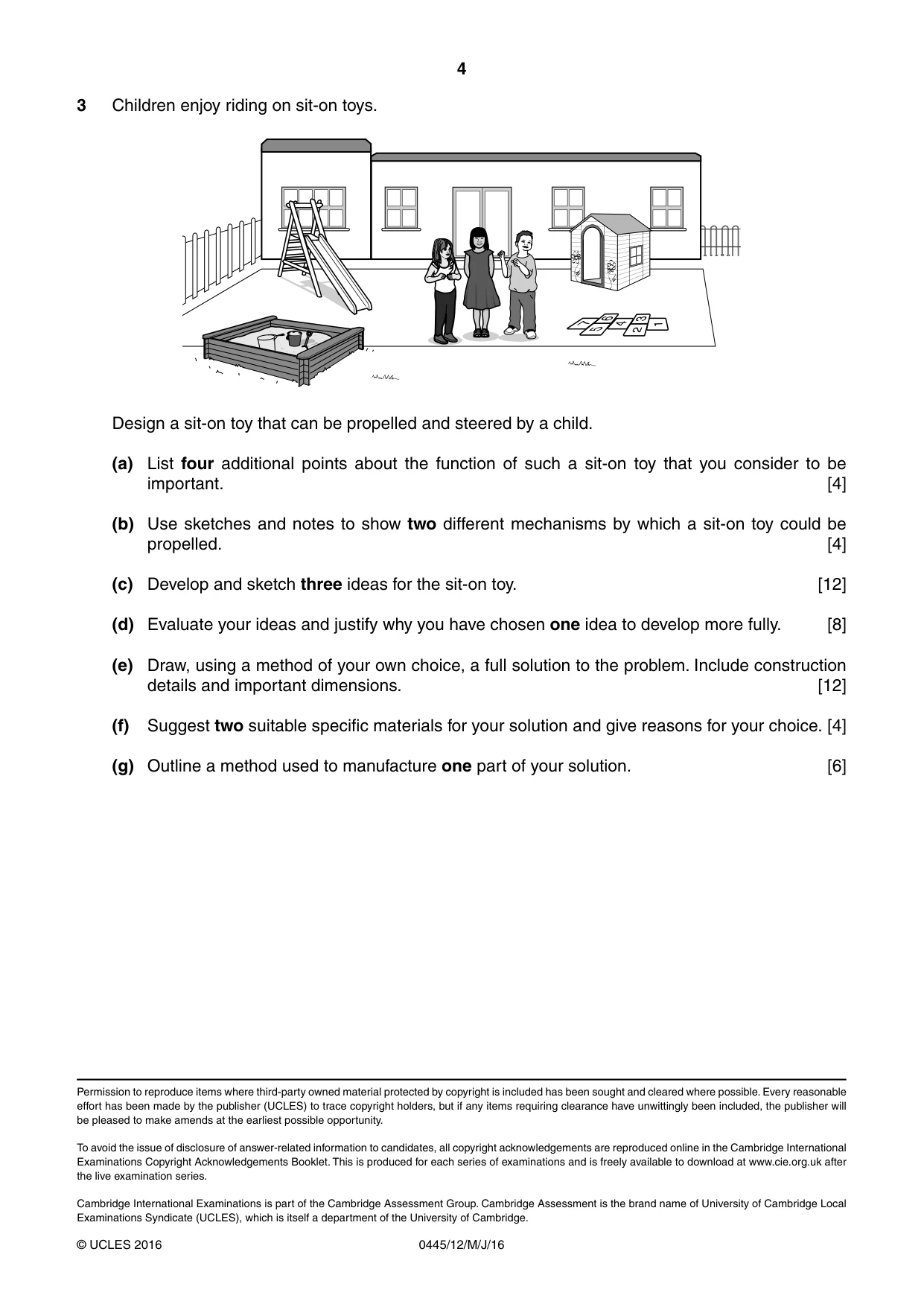
4 0445/12/M/J/16 © UCLES 2016 Permission to reproduce items where third-party owned material protected by copyright is included has been sought and cleared where possible. Every reasonable effort has been made by the publisher (UCLES) to trace copyright holders, but if any items requiring clearance have unwittingly been included, the publisher will be pleased to make amends at the earliest possible opportunity. To avoid the issue of disclosure of answer-related information to candidates, all copyright acknowledgements are reproduced online in the Cambridge International Examinations Copyright Acknowledgements Booklet. This is produced for each series of examinations and is freely available to download at www.cie.org.uk after the live examination series. Cambridge International Examinations is part of the Cambridge Assessment Group. Cambridge Assessment is the brand name of University of Cambridge Local Examinations Syndicate (UCLES), which is itself a department of the University of Cambridge. 3 Children enjoy riding on sit-on toys. Design a sit-on toy that can be propelled and steered by a child. (a) List four additional points about the function of such a sit-on toy that you consider to be important. [4] (b) Use sketches and notes to show two different mechanisms by which a sit-on toy could be propelled. [4] (c) Develop and sketch three ideas for the sit-on toy. [12] (d) Evaluate your ideas and justify why you have chosen one idea to develop more fully. [8] (e) Draw, using a method of your own choice, a full solution to the problem. Include construction details and important dimensions. [12] (f) Suggest two suitable specific materials for your solution and give reasons for your choice. [4] (g) Outline a method used to manufacture one part of your solution. [6]
What you needed in this session
Cambridge’s own grade thresholds for 2016 May/June, Paper 1 · Variant 2. A higher threshold means an easier paper — the bar moves with how the cohort did.