Cambridge IGCSE Design and Technology 0445 — 2011 May/June Paper 1 · Variant 3
0445/13/M/J/11 · 50 marks · ≈56 min
The question paper and its mark scheme, free to read here and free to download. This is Cambridge’s own paper, exactly as it was sat.
Question paper4 pages
Mark scheme4 pages
Answers below. Sit the paper first if you are practising.
Paper as text
Question paper, page 1
This document consists of 4 printed A4 pages and an Insert. DC (NH/JG) 32717/1 © UCLES 2011 [Turn over UNIVERSITY OF CAMBRIDGE INTERNATIONAL EXAMINATIONS International General Certificate of Secondary Education * 7 0 5 6 9 5 0 7 9 0 * DESIGN AND TECHNOLOGY 0445/13 Paper 1 Design May/June 2011 1 hour 15 minutes Candidates answer on the pre-printed A3 Answer Sheets. Additional Materials: Standard drawing equipment To be taken together with the optional paper for which you have been entered in one session of 2 hours and 15 minutes. READ THESE INSTRUCTIONS FIRST Write your Centre number, candidate number and name in the spaces on both printed Answer Sheets. Write in dark blue or black pen. You may use a soft pencil for any diagrams, graphs or rough working. Do not use staples, paper clips, highlighters, glue or correction fluid. Answer one question. Write/draw your answers in the spaces provided on the Answer Sheets. You may use a calculator. At the end of the examination, fasten all your work securely together. The number of marks is given in brackets [ ] at the end of each question or part question. www.XtremePapers.com
Question paper, page 2
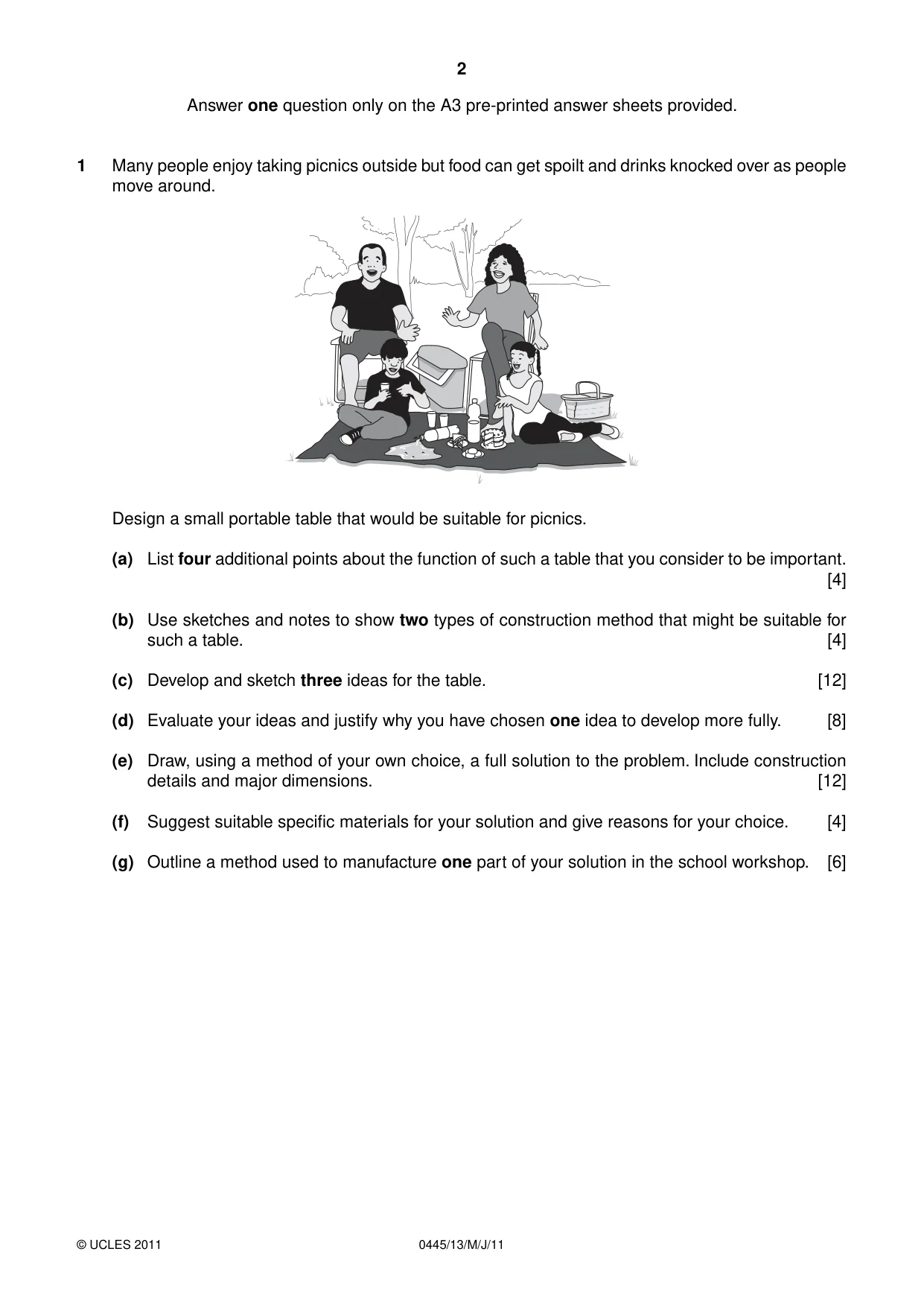
2 0445/13/M/J/11 © UCLES 2011 Answer one question only on the A3 pre-printed answer sheets provided. 1 Many people enjoy taking picnics outside but food can get spoilt and drinks knocked over as people move around. Design a small portable table that would be suitable for picnics. (a) List four additional points about the function of such a table that you consider to be important. [4] (b) Use sketches and notes to show two types of construction method that might be suitable for such a table. [4] (c) Develop and sketch three ideas for the table. [12] (d) Evaluate your ideas and justify why you have chosen one idea to develop more fully. [8] (e) Draw, using a method of your own choice, a full solution to the problem. Include construction details and major dimensions. [12] (f) Suggest suitable specific materials for your solution and give reasons for your choice. [4] (g) Outline a method used to manufacture one part of your solution in the school workshop. [6]
Question paper, page 3
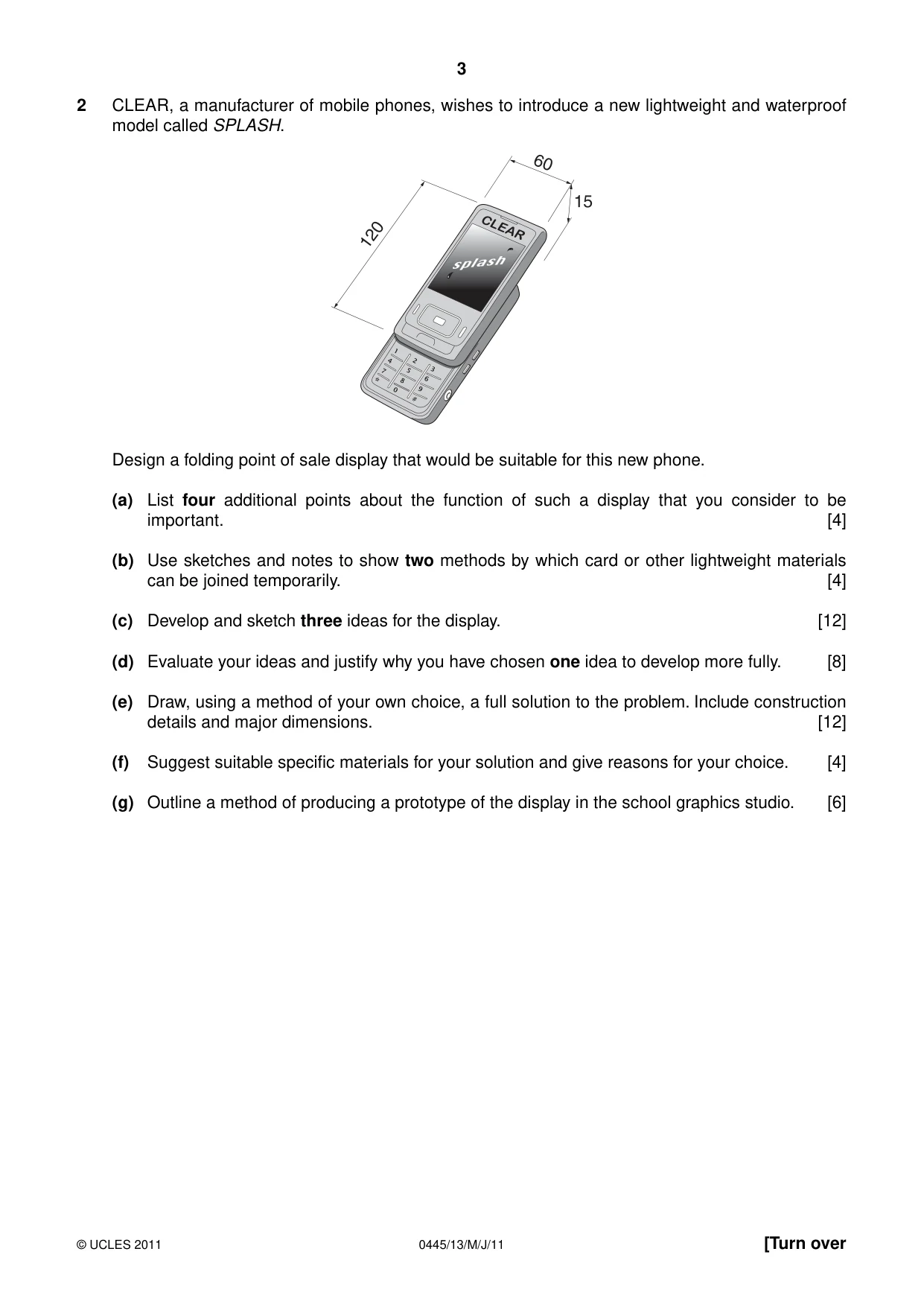
3 0445/13/M/J/11 © UCLES 2011 [Turn over 2 CLEAR, a manufacturer of mobile phones, wishes to introduce a new lightweight and waterproof model called SPLASH. Design a folding point of sale display that would be suitable for this new phone. (a) List four additional points about the function of such a display that you consider to be important. [4] (b) Use sketches and notes to show two methods by which card or other lightweight materials can be joined temporarily. [4] (c) Develop and sketch three ideas for the display. [12] (d) Evaluate your ideas and justify why you have chosen one idea to develop more fully. [8] (e) Draw, using a method of your own choice, a full solution to the problem. Include construction details and major dimensions. [12] (f) Suggest suitable specific materials for your solution and give reasons for your choice. [4] (g) Outline a method of producing a prototype of the display in the school graphics studio. [6]
Question paper, page 4
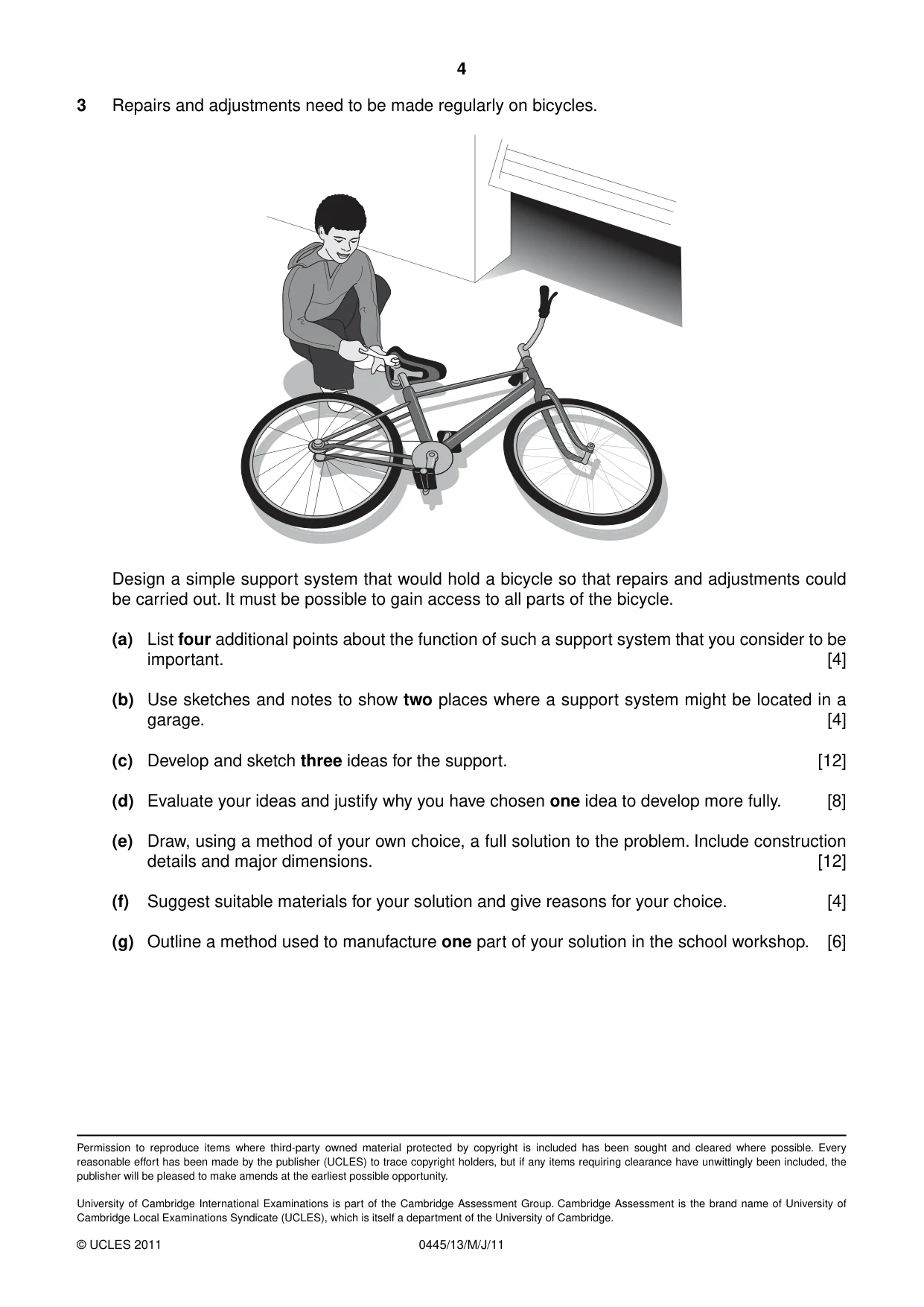
4 0445/13/M/J/11 © UCLES 2011 Permission to reproduce items where third-party owned material protected by copyright is included has been sought and cleared where possible. Every reasonable effort has been made by the publisher (UCLES) to trace copyright holders, but if any items requiring clearance have unwittingly been included, the publisher will be pleased to make amends at the earliest possible opportunity. University of Cambridge International Examinations is part of the Cambridge Assessment Group. Cambridge Assessment is the brand name of University of Cambridge Local Examinations Syndicate (UCLES), which is itself a department of the University of Cambridge. 3 Repairs and adjustments need to be made regularly on bicycles. Design a simple support system that would hold a bicycle so that repairs and adjustments could be carried out. It must be possible to gain access to all parts of the bicycle. (a) List four additional points about the function of such a support system that you consider to be important. [4] (b) Use sketches and notes to show two places where a support system might be located in a garage. [4] (c) Develop and sketch three ideas for the support. [12] (d) Evaluate your ideas and justify why you have chosen one idea to develop more fully. [8] (e) Draw, using a method of your own choice, a full solution to the problem. Include construction details and major dimensions. [12] (f) Suggest suitable materials for your solution and give reasons for your choice. [4] (g) Outline a method used to manufacture one part of your solution in the school workshop. [6]
Mark scheme, page 1
UNIVERSITY OF CAMBRIDGE INTERNATIONAL EXAMINATIONS International General Certificate of Secondary Education MARK SCHEME for the May/June 2011 question paper for the guidance of teachers 0445 DESIGN AND TECHNOLOGY 0445/13 Paper 1 (Design), maximum raw mark 50 This mark scheme is published as an aid to teachers and candidates, to indicate the requirements of the examination. It shows the basis on which Examiners were instructed to award marks. It does not indicate the details of the discussions that took place at an Examiners’ meeting before marking began, which would have considered the acceptability of alternative answers. Mark schemes must be read in conjunction with the question papers and the report on the examination. • Cambridge will not enter into discussions or correspondence in connection with these mark schemes. Cambridge is publishing the mark schemes for the May/June 2011 question papers for most IGCSE, GCE Advanced Level and Advanced Subsidiary Level syllabuses and some Ordinary Level syllabuses. www.XtremePapers.com
Mark scheme, page 2
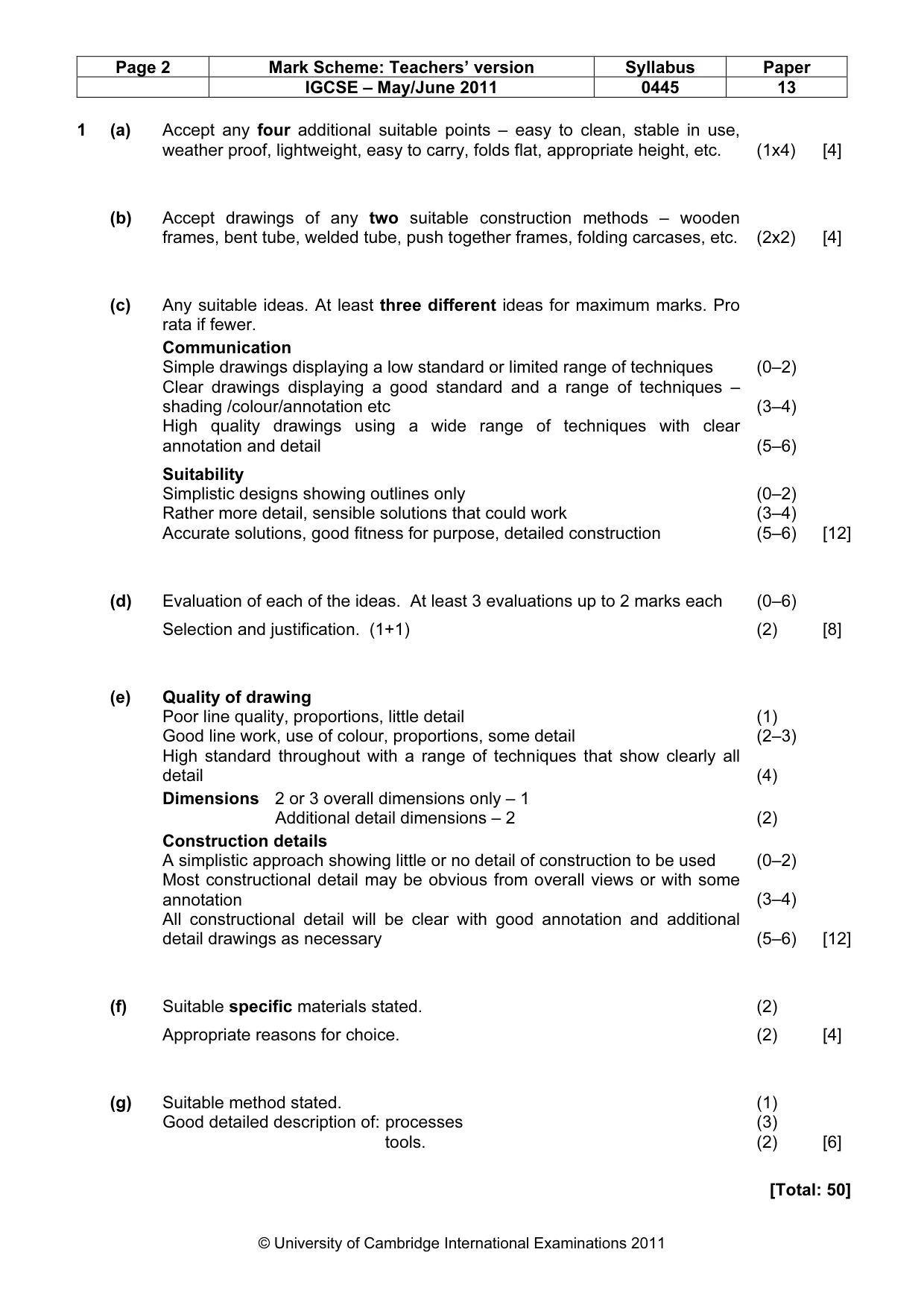
Page 2 Mark Scheme: Teachers’ version Syllabus Paper IGCSE – May/June 2011 0445 13 © University of Cambridge International Examinations 2011 1 (a) Accept any four additional suitable points – easy to clean, stable in use, weather proof, lightweight, easy to carry, folds flat, appropriate height, etc. (1x4) [4] (b) Accept drawings of any two suitable construction methods – wooden frames, bent tube, welded tube, push together frames, folding carcases, etc. (2x2) [4] (c) Any suitable ideas. At least three different ideas for maximum marks. Pro rata if fewer. Communication Simple drawings displaying a low standard or limited range of techniques Clear drawings displaying a good standard and a range of techniques – shading /colour/annotation etc High quality drawings using a wide range of techniques with clear annotation and detail (0–2) (3–4) (5–6) Suitability Simplistic designs showing outlines only Rather more detail, sensible solutions that could work Accurate solutions, good fitness for purpose, detailed construction (0–2) (3–4) (5–6) [12] (d) Evaluation of each of the ideas. At least 3 evaluations up to 2 marks each (0–6) Selection and justification. (1+1) (2) [8] (e) Quality of drawing Poor line quality, proportions, little detail Good line work, use of colour, proportions, some detail High standard throughout with a range of techniques that show clearly all detail Dimensions 2 or 3 overall dimensions only – 1 Additional detail dimensions – 2 Construction details A simplistic approach showing little or no detail of construction to be used Most constructional detail may be obvious from overall views or with some annotation All constructional detail will be clear with good annotation and additional detail drawings as necessary (1) (2–3) (4) (2) (0–2) (3–4) (5–6) [12] (f) Suitable specific materials stated. (2) Appropriate reasons for choice. (2) [4] (g) Suitable method stated. Good detailed description of: processes tools. (1) (3) (2) [6] [Total: 50]
Mark scheme, page 3
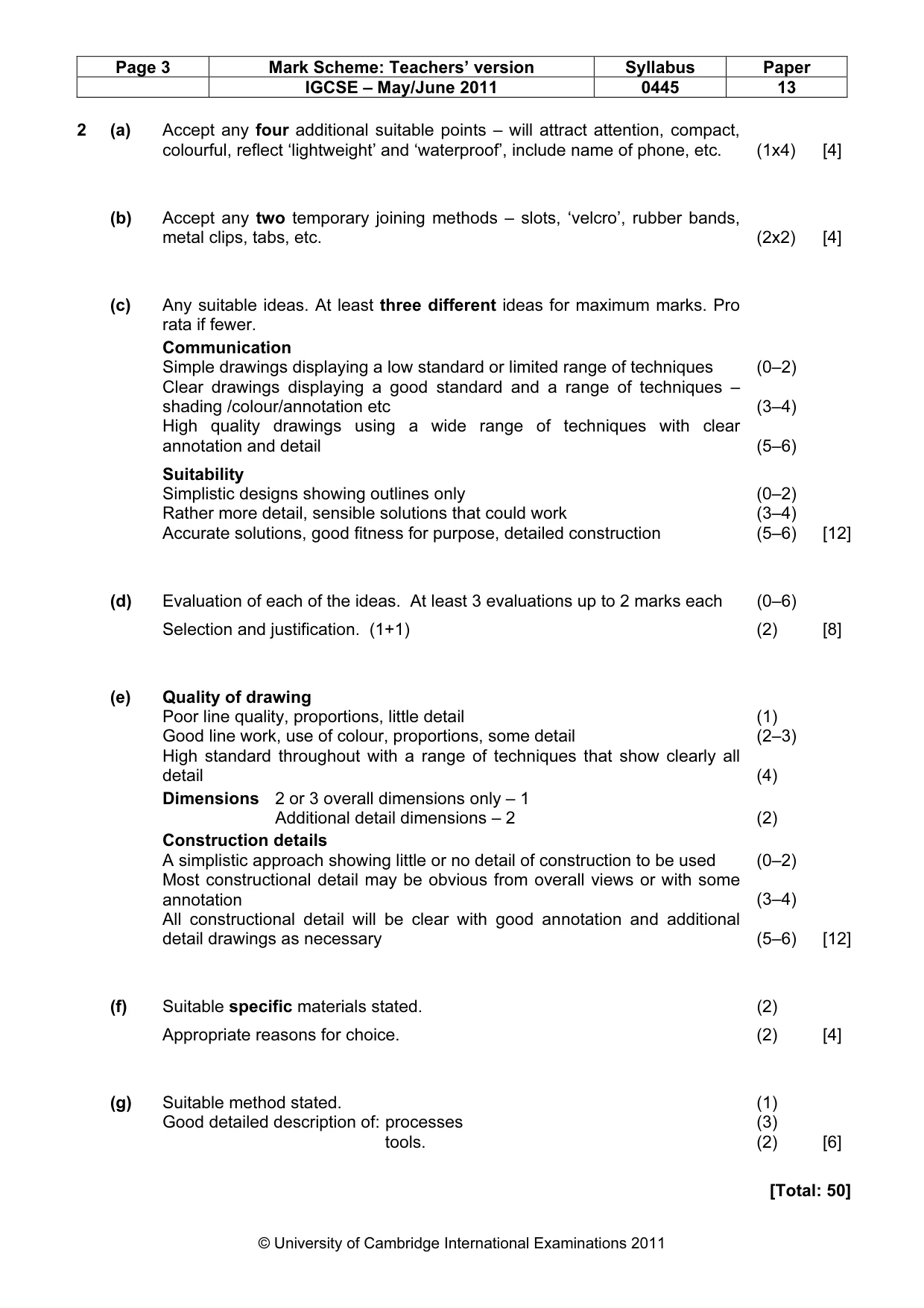
Page 3 Mark Scheme: Teachers’ version Syllabus Paper IGCSE – May/June 2011 0445 13 © University of Cambridge International Examinations 2011 2 (a) Accept any four additional suitable points – will attract attention, compact, colourful, reflect ‘lightweight’ and ‘waterproof’, include name of phone, etc. (1x4) [4] (b) Accept any two temporary joining methods – slots, ‘velcro’, rubber bands, metal clips, tabs, etc. (2x2) [4] (c) Any suitable ideas. At least three different ideas for maximum marks. Pro rata if fewer. Communication Simple drawings displaying a low standard or limited range of techniques Clear drawings displaying a good standard and a range of techniques – shading /colour/annotation etc High quality drawings using a wide range of techniques with clear annotation and detail (0–2) (3–4) (5–6) Suitability Simplistic designs showing outlines only Rather more detail, sensible solutions that could work Accurate solutions, good fitness for purpose, detailed construction (0–2) (3–4) (5–6) [12] (d) Evaluation of each of the ideas. At least 3 evaluations up to 2 marks each (0–6) Selection and justification. (1+1) (2) [8] (e) Quality of drawing Poor line quality, proportions, little detail Good line work, use of colour, proportions, some detail High standard throughout with a range of techniques that show clearly all detail Dimensions 2 or 3 overall dimensions only – 1 Additional detail dimensions – 2 Construction details A simplistic approach showing little or no detail of construction to be used Most constructional detail may be obvious from overall views or with some annotation All constructional detail will be clear with good annotation and additional detail drawings as necessary (1) (2–3) (4) (2) (0–2) (3–4) (5–6) [12] (f) Suitable specific materials stated. (2) Appropriate reasons for choice. (2) [4] (g) Suitable method stated. Good detailed description of: processes tools. (1) (3) (2) [6] [Total: 50]
Mark scheme, page 4
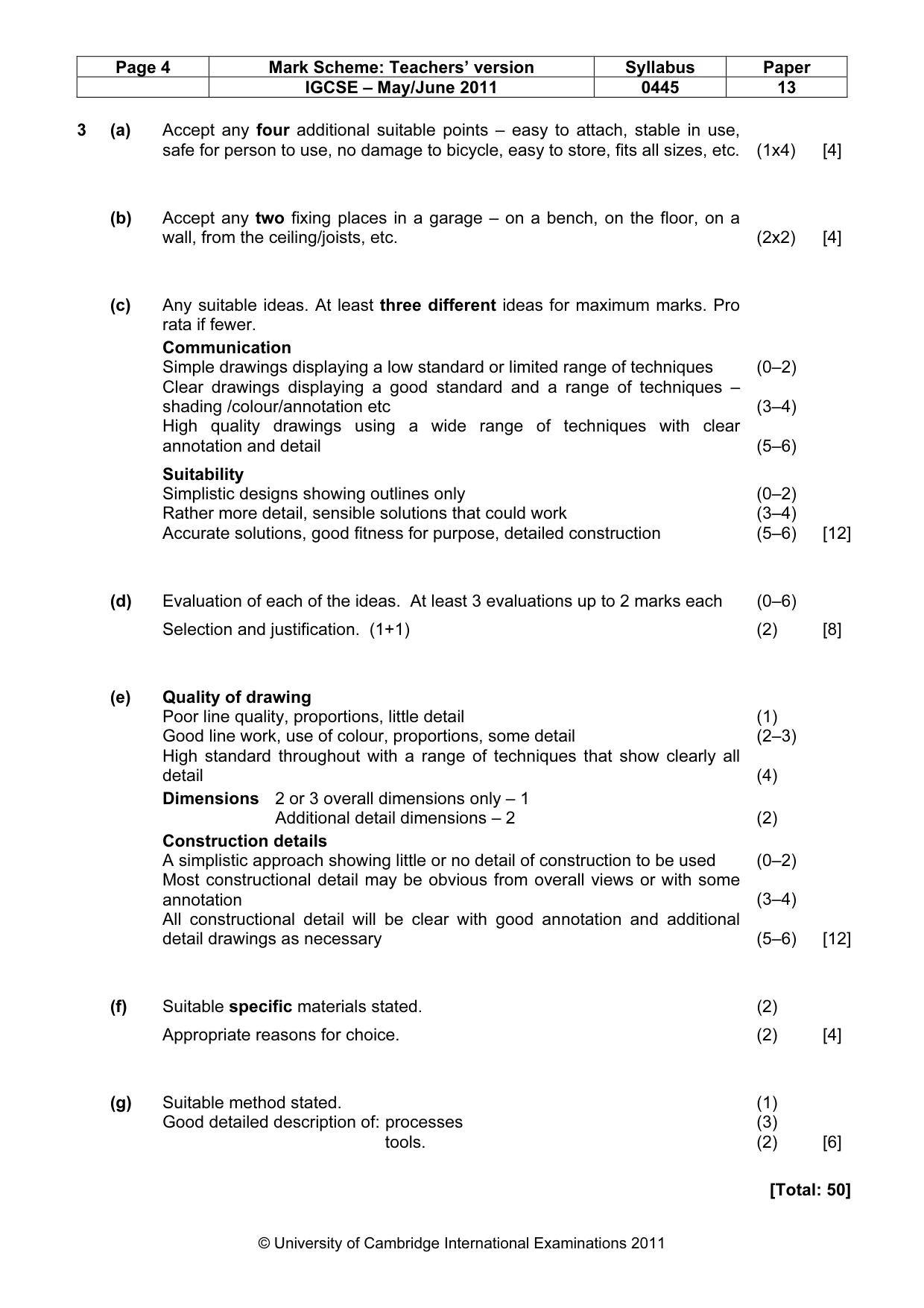
Page 4 Mark Scheme: Teachers’ version Syllabus Paper IGCSE – May/June 2011 0445 13 © University of Cambridge International Examinations 2011 3 (a) Accept any four additional suitable points – easy to attach, stable in use, safe for person to use, no damage to bicycle, easy to store, fits all sizes, etc. (1x4) [4] (b) Accept any two fixing places in a garage – on a bench, on the floor, on a wall, from the ceiling/joists, etc. (2x2) [4] (c) Any suitable ideas. At least three different ideas for maximum marks. Pro rata if fewer. Communication Simple drawings displaying a low standard or limited range of techniques Clear drawings displaying a good standard and a range of techniques – shading /colour/annotation etc High quality drawings using a wide range of techniques with clear annotation and detail (0–2) (3–4) (5–6) Suitability Simplistic designs showing outlines only Rather more detail, sensible solutions that could work Accurate solutions, good fitness for purpose, detailed construction (0–2) (3–4) (5–6) [12] (d) Evaluation of each of the ideas. At least 3 evaluations up to 2 marks each (0–6) Selection and justification. (1+1) (2) [8] (e) Quality of drawing Poor line quality, proportions, little detail Good line work, use of colour, proportions, some detail High standard throughout with a range of techniques that show clearly all detail Dimensions 2 or 3 overall dimensions only – 1 Additional detail dimensions – 2 Construction details A simplistic approach showing little or no detail of construction to be used Most constructional detail may be obvious from overall views or with some annotation All constructional detail will be clear with good annotation and additional detail drawings as necessary (1) (2–3) (4) (2) (0–2) (3–4) (5–6) [12] (f) Suitable specific materials stated. (2) Appropriate reasons for choice. (2) [4] (g) Suitable method stated. Good detailed description of: processes tools. (1) (3) (2) [6] [Total: 50]
What you needed in this session
Cambridge’s own grade thresholds for 2011 May/June, Paper 1 · Variant 3. A higher threshold means an easier paper — the bar moves with how the cohort did.