Cambridge IGCSE Computer Studies 0420 — 2011 May/June Paper 3 · Variant 2
0420/32/M/J/11 · 1 question · 60 marks · ≈68 min
The question paper and its mark scheme, free to read here and free to download. This is Cambridge’s own paper, exactly as it was sat.
Question paper12 pages




Mark scheme6 pages
Answers below. Sit the paper first if you are practising.


Questions as text
Q1 · In this question you are asked to read about: • an existing manual, paper-based stock…
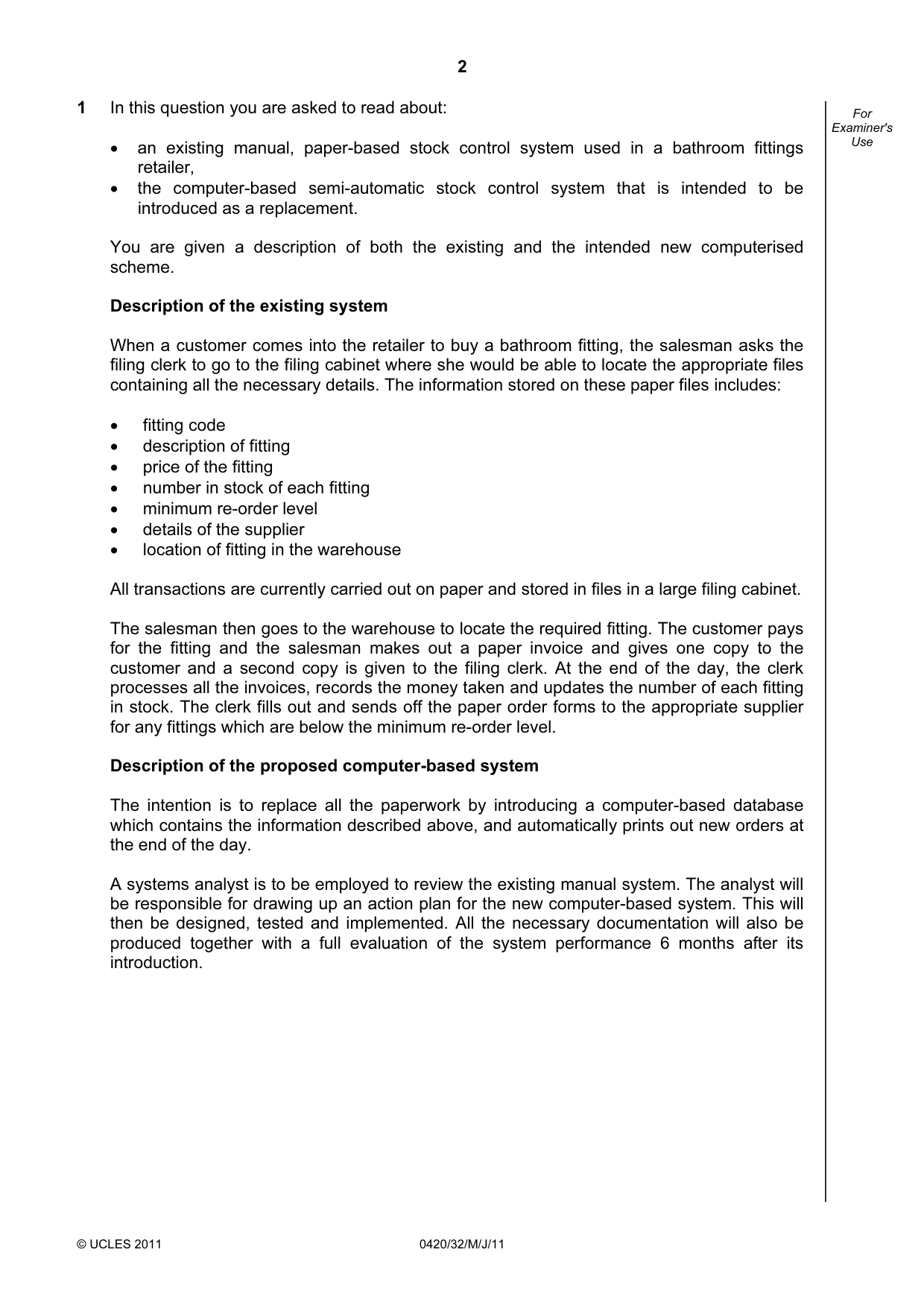
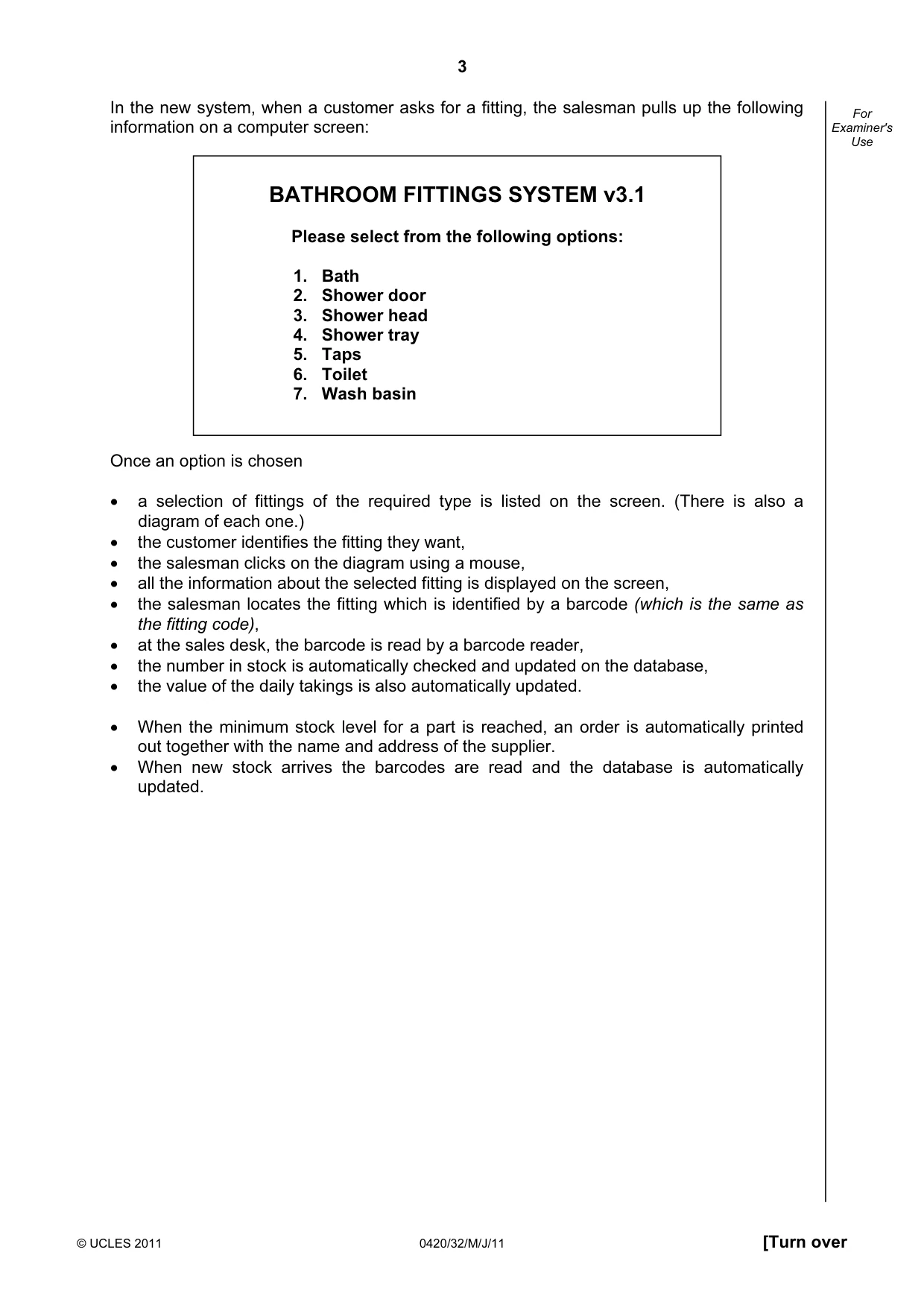
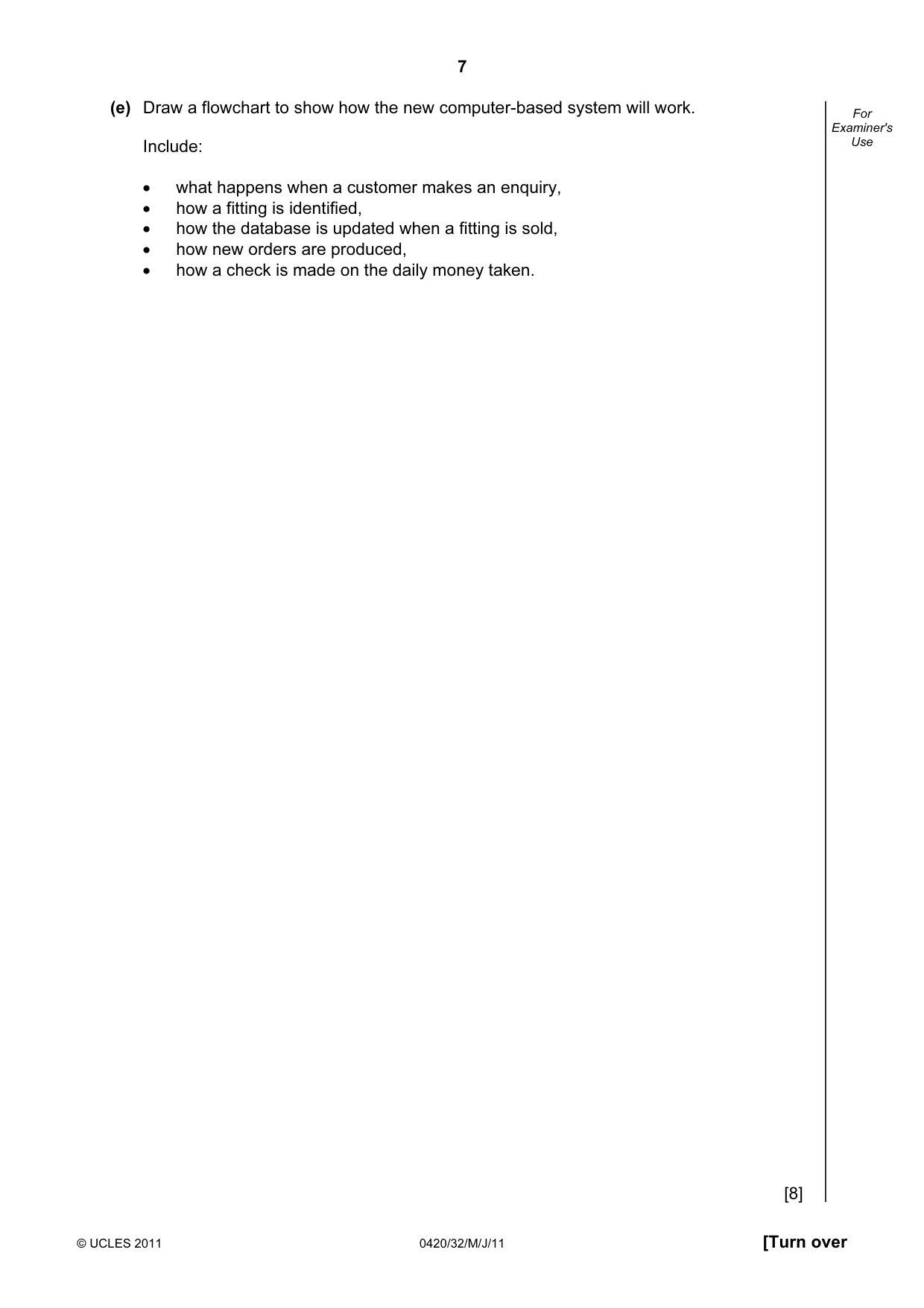
1 In this question you are asked to read about: • an existing manual, paper-based stock control system used in a bathroom fittings retailer, • the computer-based semi-automatic stock control system that is intended to be introduced as a replacement. You are given a description of both the existing and the intended new computerised scheme. Description of the existing system When a customer comes into the retailer to buy a bathroom fitting, the salesman asks the filing clerk to go to the filing cabinet where she would be able to locate the appropriate files containing all the necessary details. The information stored on these paper files includes: • fitting code • description of fitting • price of the fitting • number in stock of each fitting • minimum re-order level • details of the supplier • location of fitting in the warehouse All transactions are currently carried out on paper and stored in files in a large filing cabinet. The salesman then goes to the warehouse to locate the required fitting. The customer pays for the fitting and the salesman makes out a paper invoice and gives one copy to the customer and a second copy is given to the filing clerk. At the end of the day, the clerk processes all the invoices, records the money taken and updates the number of each fitting in stock. The clerk fills out and sends off the paper order forms to the appropriate supplier for any fittings which are below the minimum re-order level. Description of the proposed computer-based system The intention is to replace all the paperwork by introducing a computer-based database which contains the information described above, and automatically prints out new orders at the end of the day. A systems analyst is to be employed to review the existing manual system. The analyst will be responsible for drawing up an action plan for the new computer-based system. This will then be designed, tested and implemented. All the necessary documentation will also be produced together with a full evaluation of the system performance 6 months after its introduction. In the new system, when a customer asks for a fitting, the salesman pulls up the following information on a computer screen: BATHROOM FITTINGS SYSTEM v3.1 Please select from the following options: 1. Bath 2. Shower door 3. Shower head 4. Shower tray 5. Taps 6. Toilet 7. Wash basin Once an option is chosen • a selection of fittings of the required type is listed on the screen. (There is also a diagram of each one.) • the customer identifies the fitting they want, • the salesman clicks on the diagram using a mouse, • all the information about the selected fitting is displayed on the screen, • the salesman locates the fitting which is identified by a barcode (which is the same as the fitting code), • at the sales desk, the barcode is read by a barcode reader, • the number in stock is automatically checked and updated on the database, • the value of the daily takings is also automatically updated. • When the minimum stock level for a part is reached, an order is automatically printed out together with the name and address of the supplier. • When new stock arrives the barcodes are read and the database is automatically updated. The following questions all refer to the above system: (a) Describe the tools that exist to help the analyst draw up an action plan and ensure that the project is completed on time and to budget. [4] (b) Name two methods that the analyst could use to gather information about the existing manual system. Explain how each method would be used to gather information. Method 1: Explanation: Method 2: Explanation: [6]
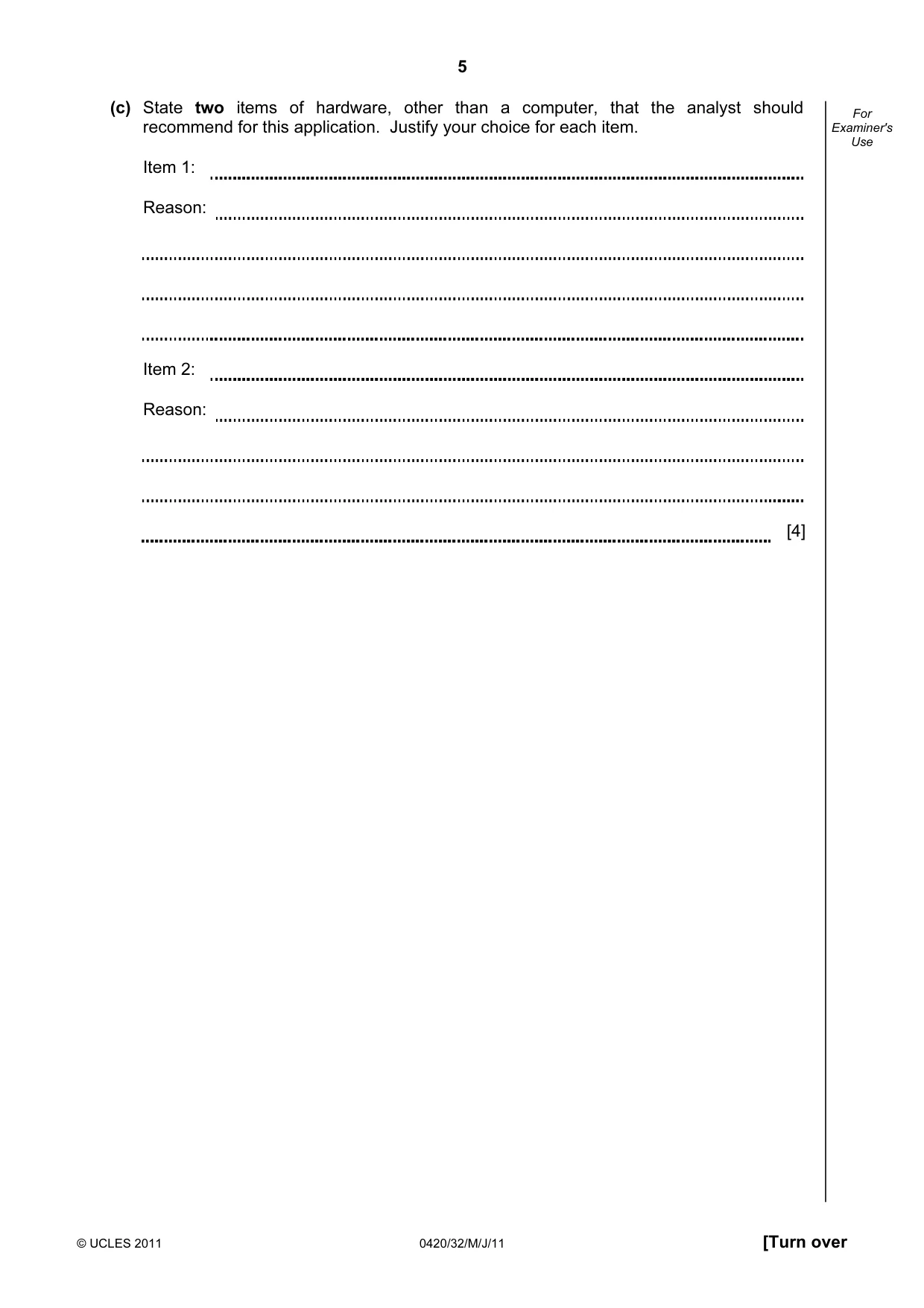
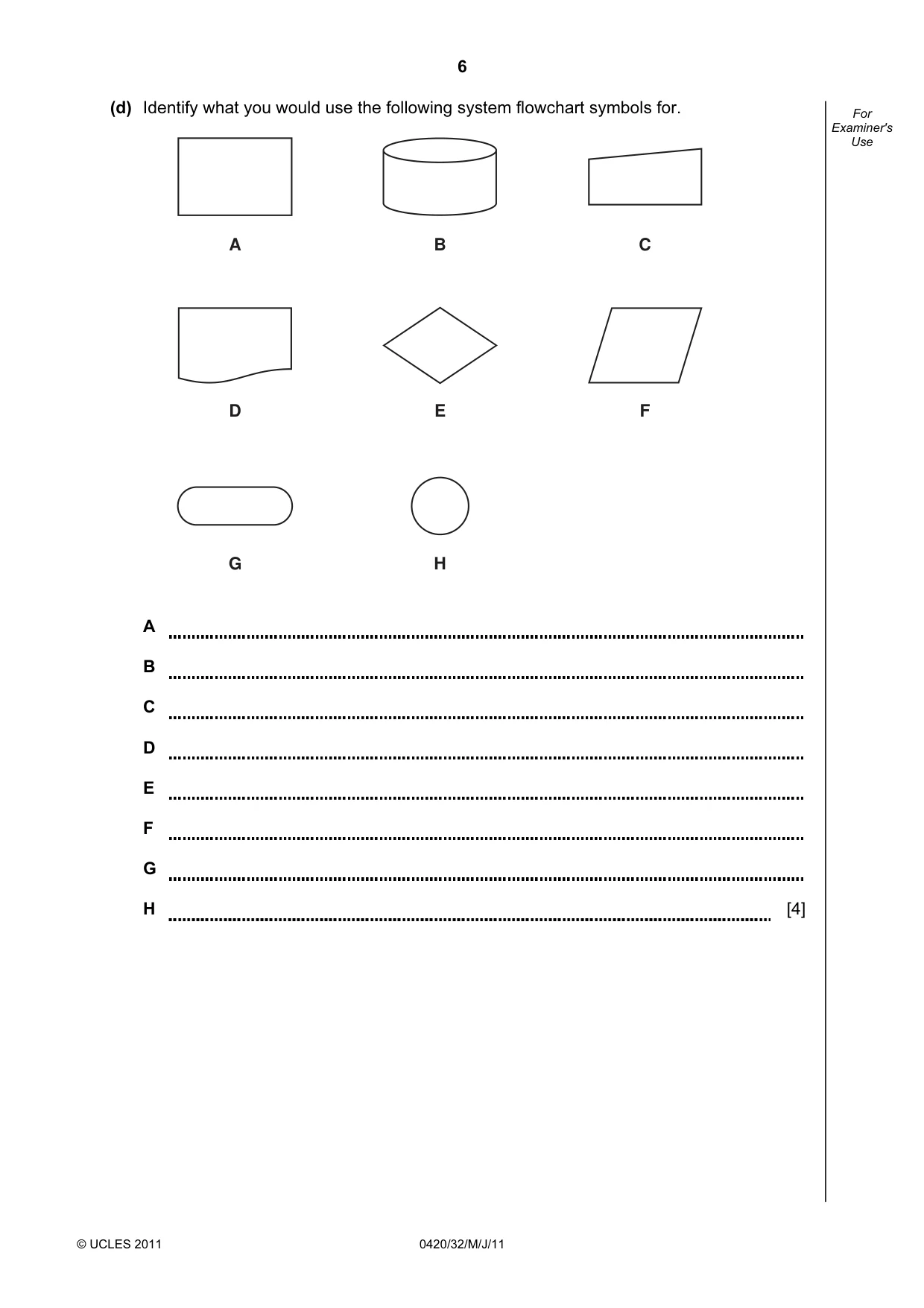
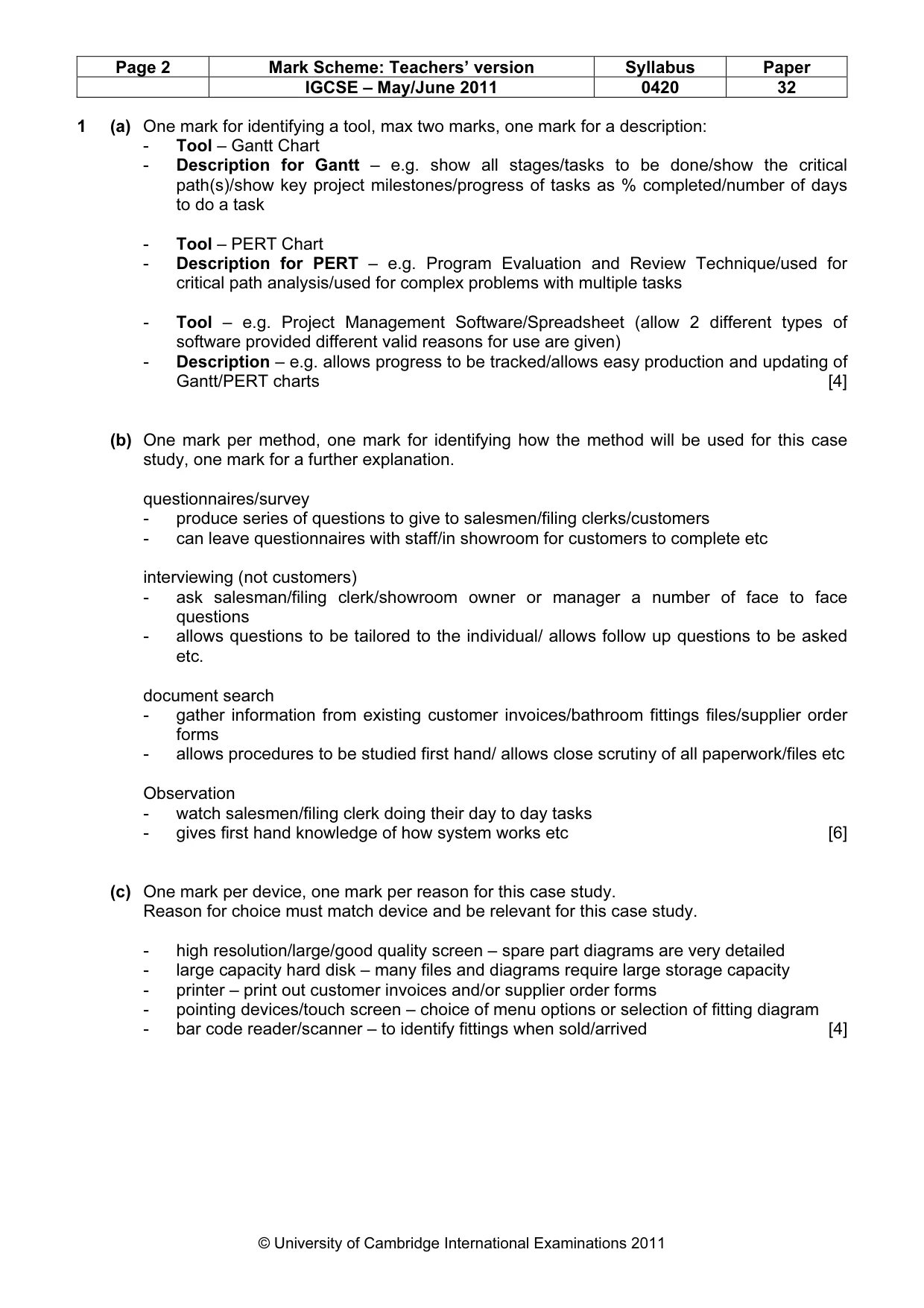
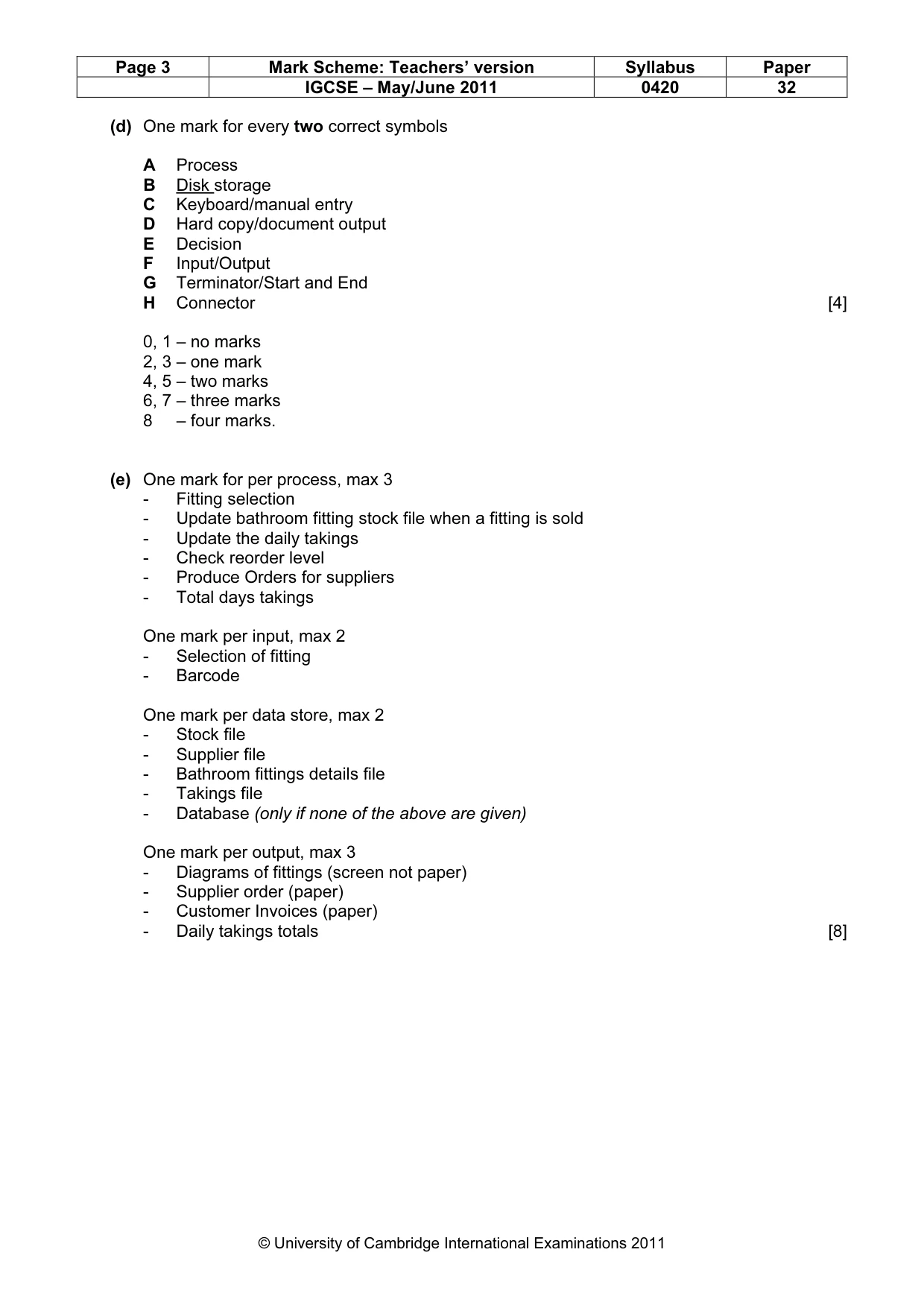
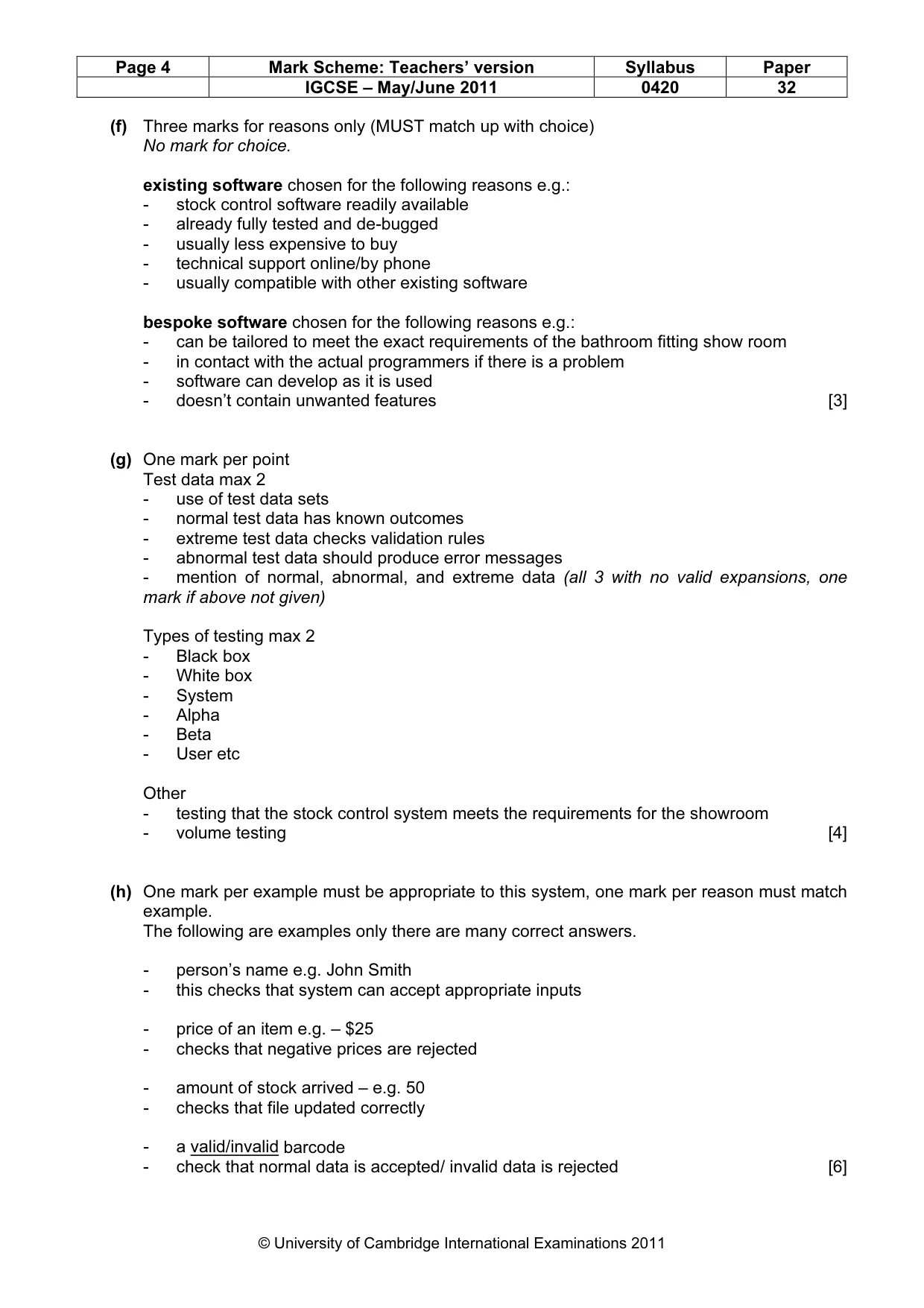
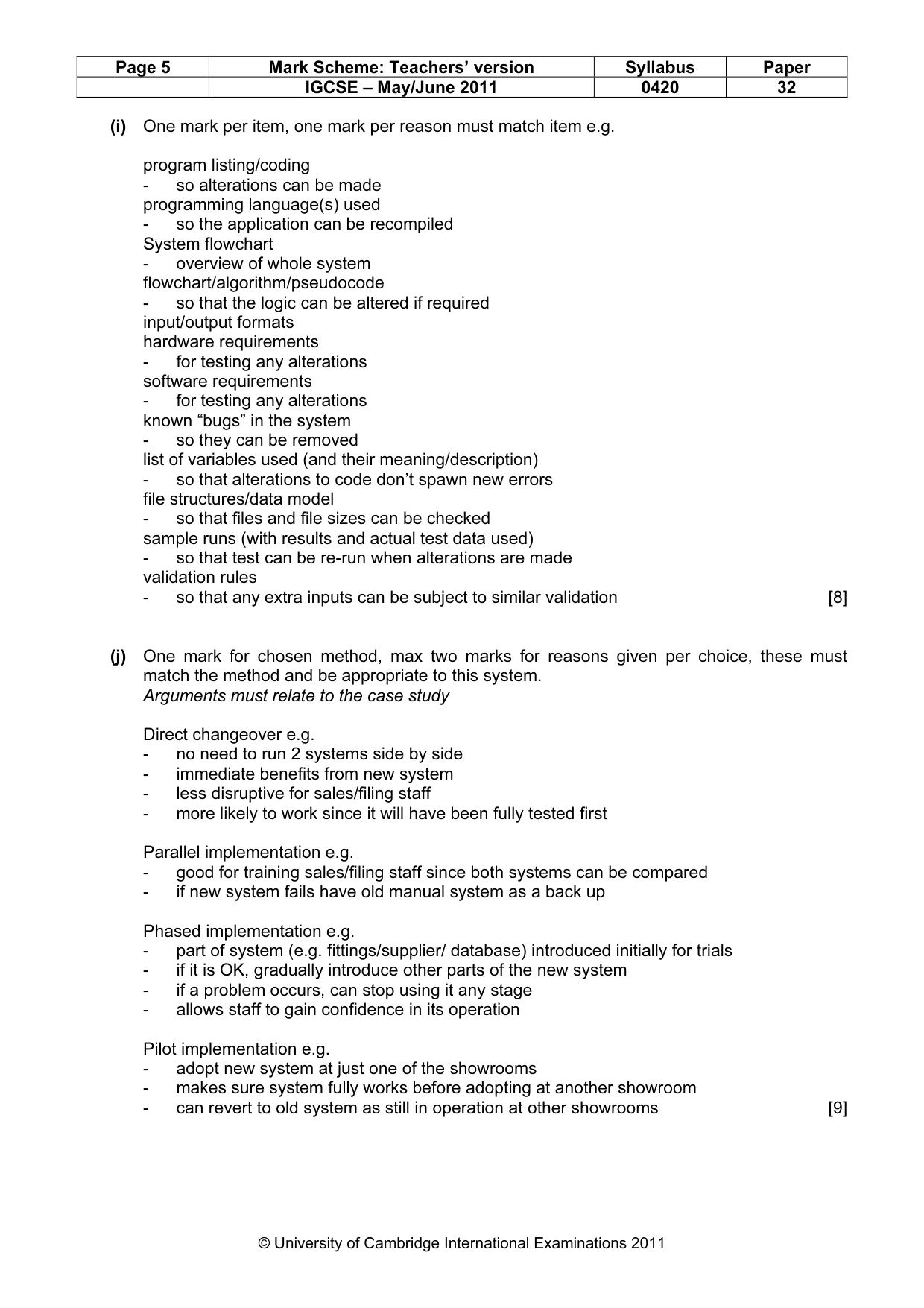
Mark scheme: 1 (a) One mark for identifying a tool, max two marks, one mark for a description: - Tool – Gantt Chart - Description for Gantt – e.g. show all stages/tasks to be done/show the critical path(s)/show key project milestones/progress of tasks as % completed/number of days to do a task - Tool – PERT Chart - Description for PERT – e.g. Program Evaluation and Review Technique/used for critical path analysis/used for complex problems with multiple tasks - Tool – e.g. Project Management Software/Spreadsheet (allow 2 different types of software provided different valid reasons for use are given) - Description – e.g. allows progress to be tracked/allows easy production and updating of Gantt/PERT charts [4] (b) One mark per method, one mark for identifying how the method will be used for this case study, one mark for a further explanation. questionnaires/survey - produce series of questions to give to salesmen/filing clerks/customers - can leave questionnaires with staff/in showroom for customers to complete etc interviewing (not customers) - ask salesman/filing clerk/showroom owner or manager a number of face to face questions - allows questions to be tailored to the individual/ allows follow up questions to be asked etc. document search - gather information from existing customer invoices/bathroom fittings files/supplier order forms - allows procedures to be studied first hand/ allows close scrutiny of all paperwork/files etc Observation - watch salesmen/filing clerk doing their day to day tasks - gives first hand knowledge of how system works etc [6] (c) One mark per device, one mark per reason for this case study. Reason for choice must match device and be relevant for this case study. - high resolution/large/good quality screen – spare part diagrams are very detailed - large capacity hard disk – many files and diagrams require large storage capacity - printer – print out customer invoices and/or supplier order forms - pointing devices/touch screen – choice of menu options or selection of fitting diagram - bar code reader/scanner – to identify fittings when sold/arrived [4] IGCSE – May/June 2011 0420 32 (d) One mark for every two correct symbols A Process B Disk storage C Keyboard/manual entry D Hard copy/document output E Decision F Input/Output G Terminator/Start and End H Connector [4] 0, 1 – no marks 2, 3 – one mark 4, 5 – two marks 6, 7 – three marks 8 – four marks. (e) One mark for per process, max 3 - Fitting selection - Update bathroom fitting stock file when a fitting is sold - Update the daily takings - Check reorder level - Produce Orders for suppliers - Total days takings One mark per input, max 2 - Selection of fitting - Barcode One mark per data store, max 2 - Stock file - Supplier file - Bathroom fittings details file - Takings file - Database (only if none of the above are given) One mark per output, max 3 - Diagrams of fittings (screen not paper) - Supplier order (paper) - Customer Invoices (paper) - Daily takings totals [8] IGCSE – May/June 2011 0420 32 (f) Three marks for reasons only (MUST match up with choice) No mark for choice. existing software chosen for the following reasons e.g.: - stock control software readily available - already fully tested and de-bugged - usually less expensive to buy - technical support online/by phone - usually compatible with other existing software bespoke software chosen for the following reasons e.g.: - can be tailored to meet the exact requirements of the bathroom fitting show room - in contact with the actual programmers if there is a problem - software can develop as it is used - doesn’t contain unwanted features [3] (g) One mark per point Test data max 2 - use of test data sets - normal test data has known outcomes - extreme test data checks validation rules - abnormal test data should produce error messages - mention of normal, abnormal, and extreme data (all 3 with no valid expansions, one mark if above not given) Types of testing max 2 - Black box - White box - System - Alpha - Beta - User etc Other - testing that the stock control system meets the requirements for the showroom - volume testing [4] (h) One mark per example must be appropriate to this system, one mark per reason must match example. The following are examples only there are many correct answers. - person’s name e.g. John Smith - this checks that system can accept appropriate inputs - price of an item e.g. – $25 - checks that negative prices are rejected - amount of stock arrived – e.g. 50 - checks that file updated correctly - a valid/invalid barcode - check that normal data is accepted/ invalid data is rejected [6] IGCSE – May/June 2011 0420 32 (i) One mark per item, one mark per reason must match item e.g. program listing/coding - so alterations can be made programming language(s) used - so the application can be recompiled System flowchart - overview of whole system flowchart/algorithm/pseudocode - so that the logic can be altered if required input/output formats hardware requirements - for testing any alterations software requirements - for testing any alterations known “bugs” in the system - so they can be removed list of variables used (and their meaning/description) - so that alterations to code don’t spawn new errors file structures/data model - so that files and file sizes can be checked sample runs (with results and actual test data used) - so that test can be re-run when alterations are made validation rules - so that any extra inputs can be subject to similar validation [8] (j) One mark for chosen method, max two marks for reasons given per choice, these must match the method and be appropriate to this system. Arguments must relate to the case study Direct changeover e.g. - no need to run 2 systems side by side - immediate benefits from new system - less disruptive for sales/filing staff - more likely to work since it will have been fully tested first Parallel implementation e.g. - good for training sales/filing staff since both systems can be compared - if new system fails have old manual system as a back up Phased implementation e.g. - part of system (e.g. fittings/supplier/ database) introduced initially for trials - if it is OK, gradually introduce other parts of the new system - if a problem occurs, can stop using it any stage - allows staff to gain confidence in its operation Pilot implementation e.g. - adopt new system at just one of the showrooms - makes sure system fully works before adopting at another showroom - can revert to old system as still in operation at other showrooms [9] IGCSE – May/June 2011 0420 32 (k) One mark for each point e.g. points must relate to the case study - discuss with salesman/filing clerk/manager/owner whether or not new system works - discuss with salesman/filing clerk/manager/owner whether or not system was easy to use - consider if objectives of new system have been met - look at results from tests - look at printouts etc. to see if system produced the correct outcomes [4]
What you needed in this session
Cambridge’s own grade thresholds for 2011 May/June, Paper 3 · Variant 2. A higher threshold means an easier paper — the bar moves with how the cohort did.