Cambridge IGCSE Chinese (Mandarin) - Foreign Language 0547 — 2015 May/June Paper 4 · Variant 1
0547/41/M/J/15 · 45 marks · ≈51 min
The question paper and its mark scheme, free to read here and free to download. This is Cambridge’s own paper, exactly as it was sat.
Question paper8 pages
Mark scheme14 pages
Answers below. Sit the paper first if you are practising.
Paper as text
Question paper, page 1
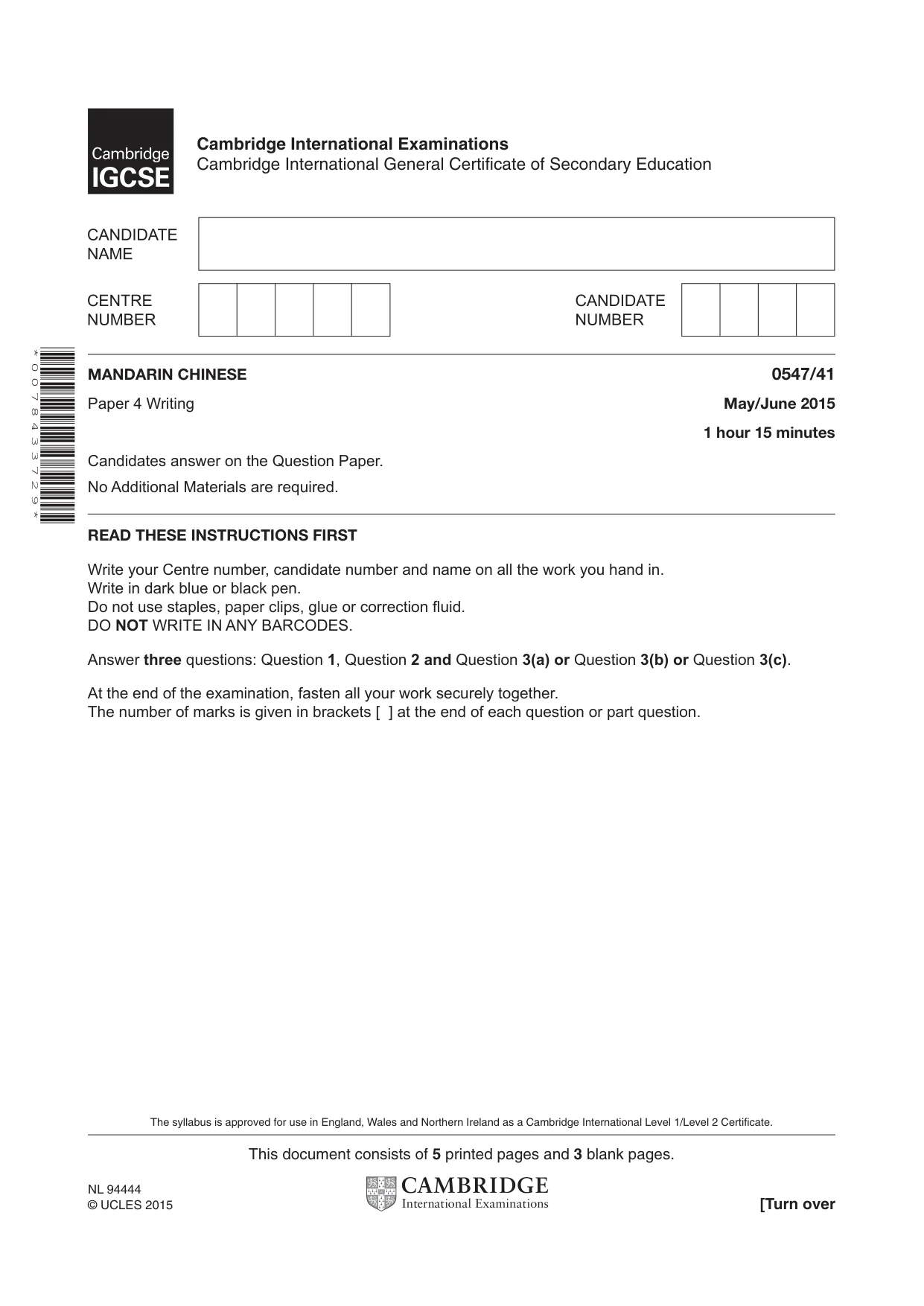
READ THESE INSTRUCTIONS FIRST Write your Centre number, candidate number and name on all the work you hand in. Write in dark blue or black pen. Do not use staples, paper clips, glue or correction fluid. DO NOT WRITE IN ANY BARCODES. Answer three questions: Question 1, Question 2 and Question 3(a) or Question 3(b) or Question 3(c). At the end of the examination, fasten all your work securely together. The number of marks is given in brackets [ ] at the end of each question or part question. MANDARIN CHINESE 0547/41 Paper 4 Writing May/June 2015 1 hour 15 minutes Candidates answer on the Question Paper. No Additional Materials are required. This document consists of 5 printed pages and 3 blank pages. NL 94444 © UCLES 2015 [Turn over Cambridge International Examinations Cambridge International General Certificate of Secondary Education The syllabus is approved for use in England, Wales and Northern Ireland as a Cambridge International Level 1/Level 2 Certificate. * 0 0 7 8 4 3 3 7 2 9 *
Question paper, page 2
2 0547/41/M/J/15 © UCLES 2015 BLANK PAGE
Question paper, page 3
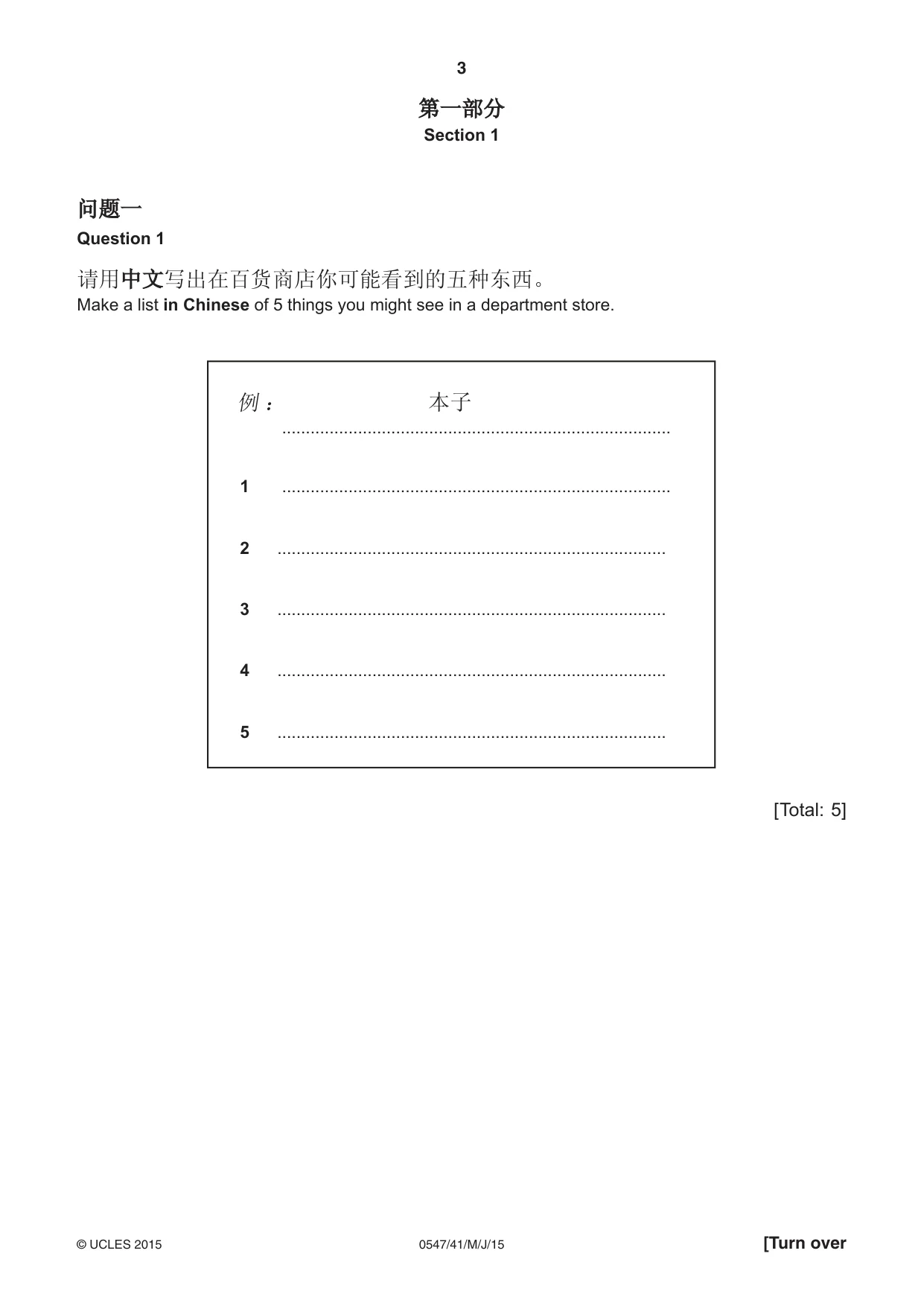
3 [Turn over 0547/41/M/J/15 © UCLES 2015 第一部分 Section 1 问题一 Question 1 请用中文写出在百货商店你可能看到的五种东西。 Make a list in Chinese of 5 things you might see in a department store. 例: 本子 … 1 … 2 … 3 … 4 … 5 … [Total: 5]
Question paper, page 4
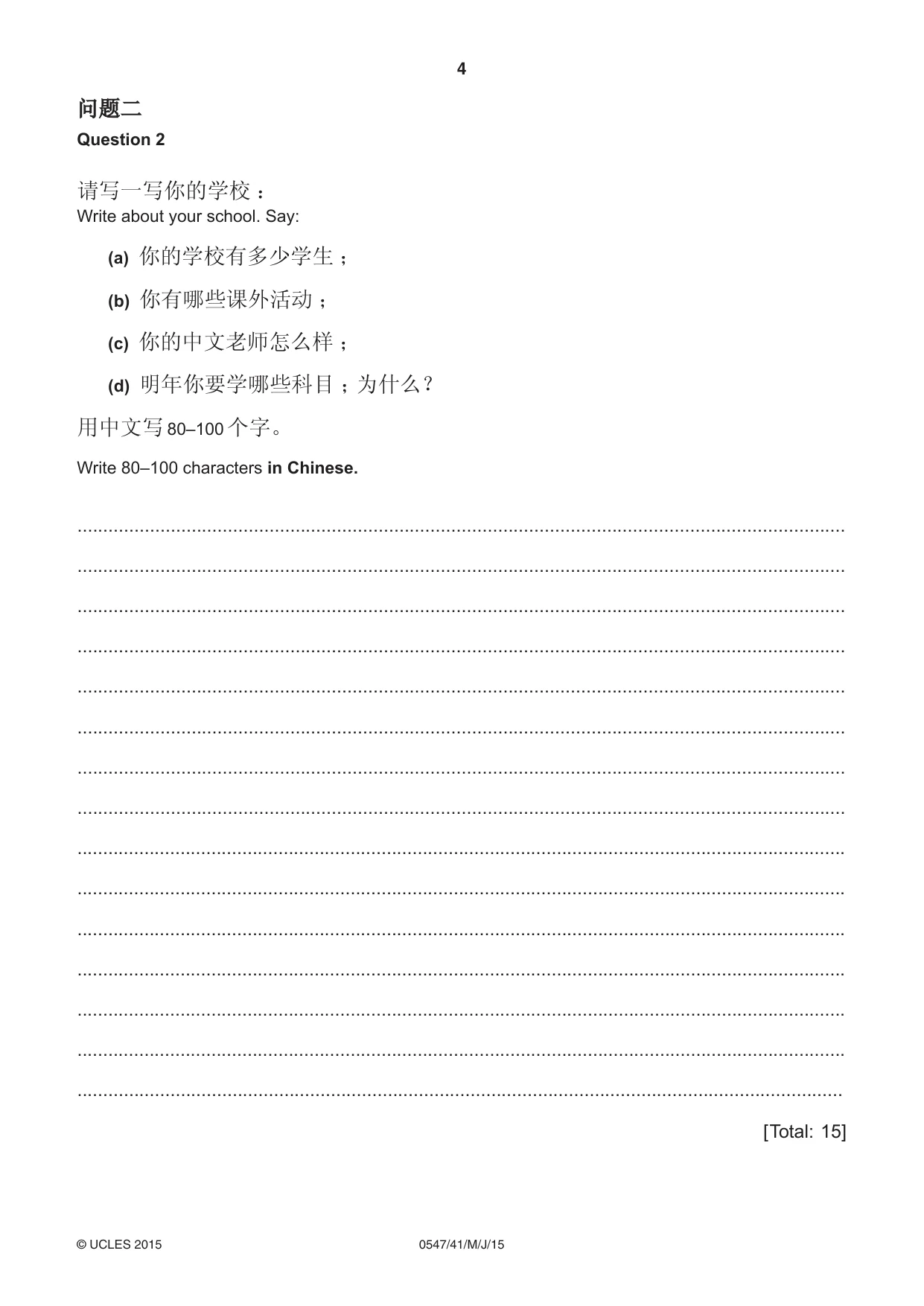
4 0547/41/M/J/15 © UCLES 2015 问题二 Question 2 请写一写你的学校: Write about your school. Say: (a) 你的学校有多少学生; (b) 你有哪些课外活动; (c) 你的中文老师怎么样; (d) 明年你要学哪些科目;为什么? 用中文写80–100 个字。 Write 80–100 characters in Chinese. … … … … … … … … … … … … … … … [Total: 15]
Question paper, page 5
5 0547/41/M/J/15 © UCLES 2015 [Turn over BLANK PAGE
Question paper, page 6
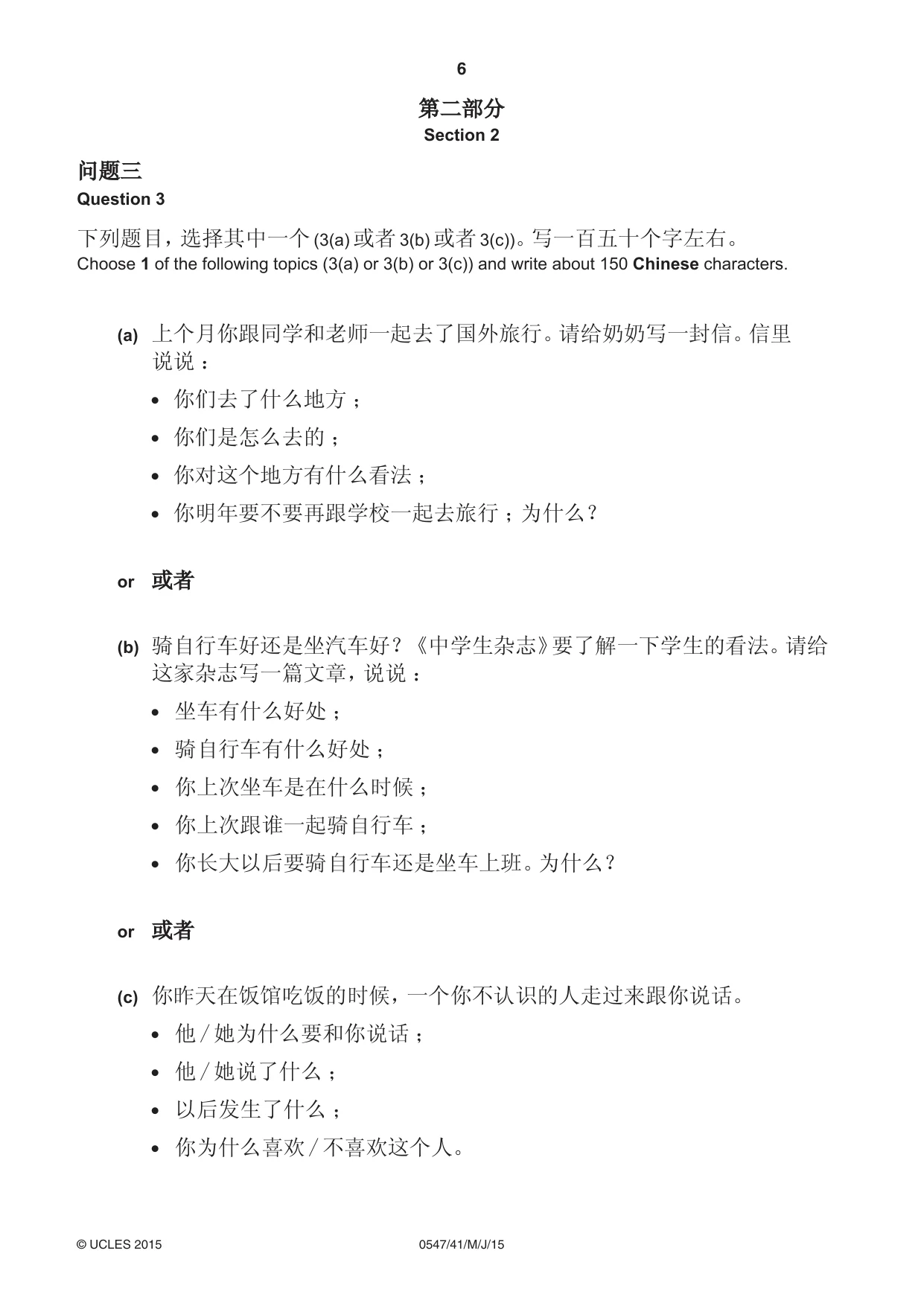
6 0547/41/M/J/15 © UCLES 2015 第二部分 Section 2 问题三 Question 3 下列题目,选择其中一个(3(a) 或者3(b) 或者3(c))。写一百五十个字左右。 Choose 1 of the following topics (3(a) or 3(b) or 3(c)) and write about 150 Chinese characters. (a) 上个月你跟同学和老师一起去了国外旅行。请给奶奶写一封信。信里 说说: ● 你们去了什么地方; ● 你们是怎么去的; ● 你对这个地方有什么看法; ● 你明年要不要再跟学校一起去旅行;为什么? or 或者 (b) 骑自行车好还是坐汽车好?《中学生杂志》要了解一下学生的看法。请给 这家杂志写一篇文章,说说: ● 坐车有什么好处; ● 骑自行车有什么好处; ● 你上次坐车是在什么时候; ● 你上次跟谁一起骑自行车; ● 你长大以后要骑自行车还是坐车上班。为什么? or 或者 (c) 你昨天在饭馆吃饭的时候,一个你不认识的人走过来跟你说话。 ● 他/ 她为什么要和你说话; ● 他/ 她说了什么; ● 以后发生了什么; ● 你为什么喜欢/ 不喜欢这个人。
Question paper, page 7
7 0547/41/M/J/15 © UCLES 2015 请在下面写作文 Write your answer to Question 3 here. … … … … … … … … … … … … … … … … … … … … … … … … … … [Total: 25]
Question paper, page 8
8 0547/41/M/J/15 © UCLES 2015 Permission to reproduce items where third-party owned material protected by copyright is included has been sought and cleared where possible. Every reasonable effort has been made by the publisher (UCLES) to trace copyright holders, but if any items requiring clearance have unwittingly been included, the publisher will be pleased to make amends at the earliest possible opportunity. To avoid the issue of disclosure of answer-related information to candidates, all copyright acknowledgements are reproduced online in the Cambridge International Examinations Copyright Acknowledgements Booklet. This is produced for each series of examinations and is freely available to download at www.cie.org.uk after the live examination series. Cambridge International Examinations is part of the Cambridge Assessment Group. Cambridge Assessment is the brand name of University of Cambridge Local Examinations Syndicate (UCLES), which is itself a department of the University of Cambridge. BLANK PAGE
Mark scheme, page 1
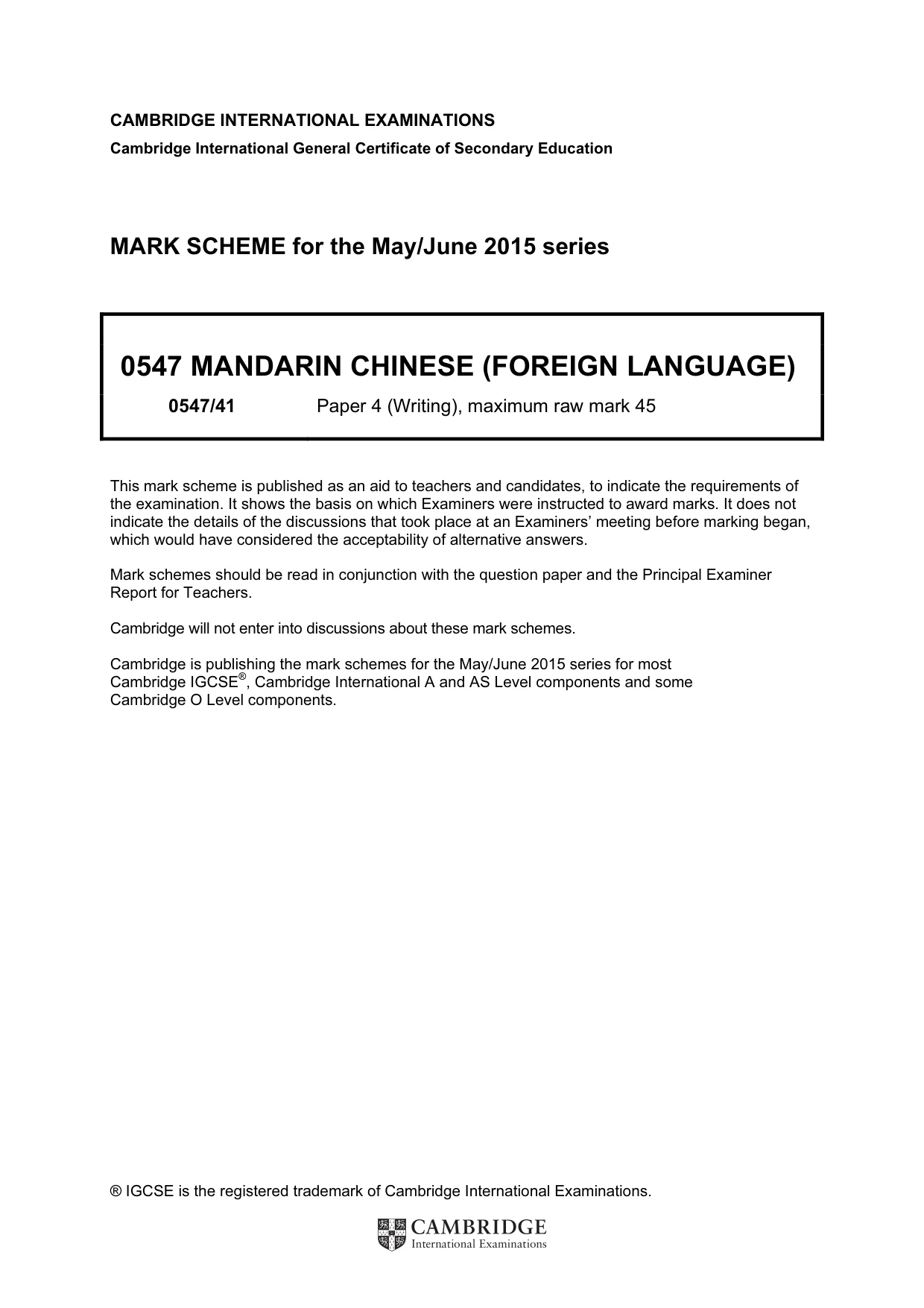
® IGCSE is the registered trademark of Cambridge International Examinations. CAMBRIDGE INTERNATIONAL EXAMINATIONS Cambridge International General Certificate of Secondary Education MARK SCHEME for the May/June 2015 series 0547 MANDARIN CHINESE (FOREIGN LANGUAGE) 0547/41 Paper 4 (Writing), maximum raw mark 45 This mark scheme is published as an aid to teachers and candidates, to indicate the requirements of the examination. It shows the basis on which Examiners were instructed to award marks. It does not indicate the details of the discussions that took place at an Examiners’ meeting before marking began, which would have considered the acceptability of alternative answers. Mark schemes should be read in conjunction with the question paper and the Principal Examiner Report for Teachers. Cambridge will not enter into discussions about these mark schemes. Cambridge is publishing the mark schemes for the May/June 2015 series for most Cambridge IGCSE®, Cambridge International A and AS Level components and some Cambridge O Level components.
Mark scheme, page 2
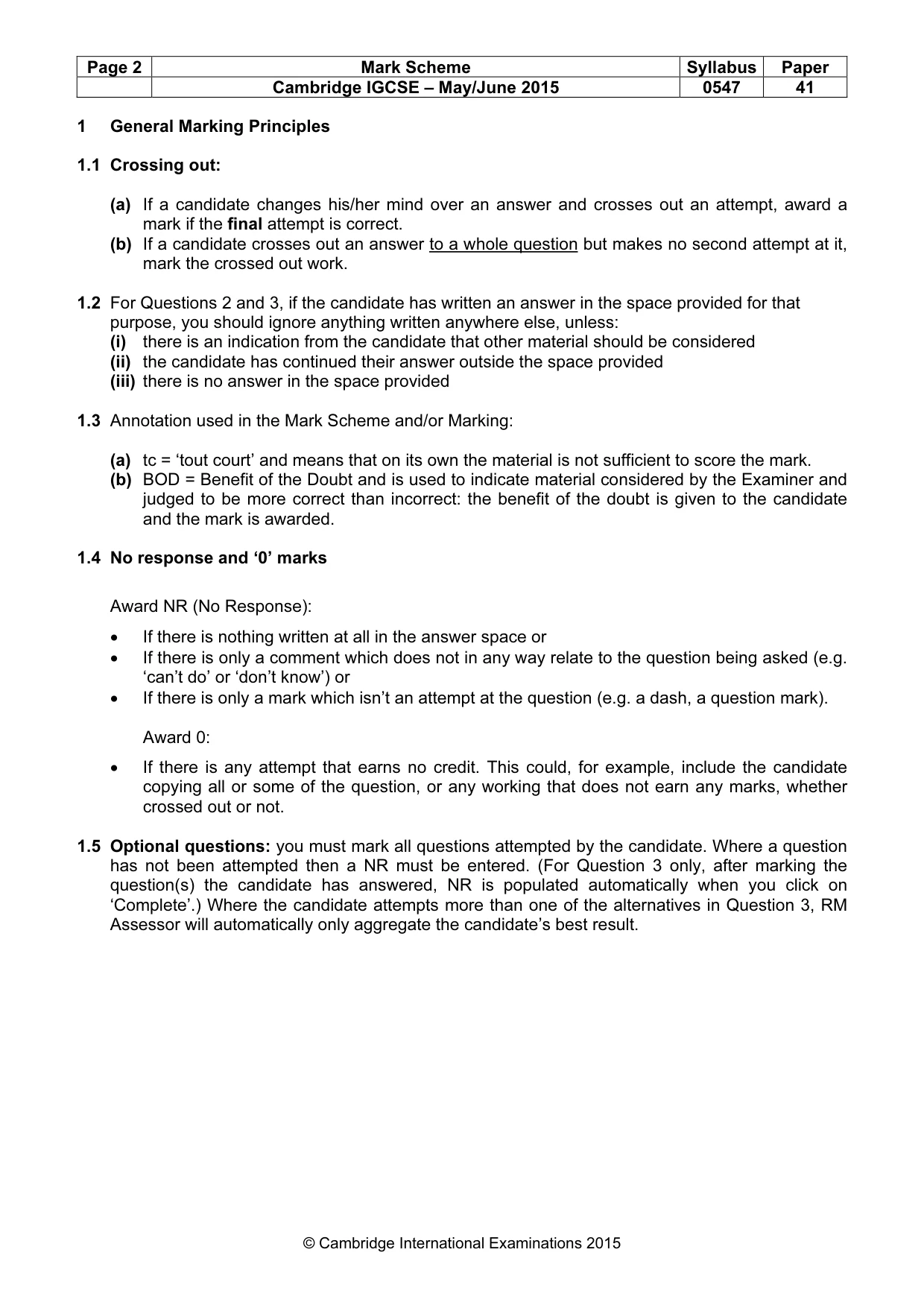
Page 2 Mark Scheme Syllabus Paper Cambridge IGCSE – May/June 2015 0547 41 © Cambridge International Examinations 2015 1 General Marking Principles 1.1 Crossing out: (a) If a candidate changes his/her mind over an answer and crosses out an attempt, award a mark if the final attempt is correct. (b) If a candidate crosses out an answer to a whole question but makes no second attempt at it, mark the crossed out work. 1.2 For Questions 2 and 3, if the candidate has written an answer in the space provided for that purpose, you should ignore anything written anywhere else, unless: (i) there is an indication from the candidate that other material should be considered (ii) the candidate has continued their answer outside the space provided (iii) there is no answer in the space provided 1.3 Annotation used in the Mark Scheme and/or Marking: (a) tc = ‘tout court’ and means that on its own the material is not sufficient to score the mark. (b) BOD = Benefit of the Doubt and is used to indicate material considered by the Examiner and judged to be more correct than incorrect: the benefit of the doubt is given to the candidate and the mark is awarded. 1.4 No response and ‘0’ marks Award NR (No Response): • If there is nothing written at all in the answer space or • If there is only a comment which does not in any way relate to the question being asked (e.g. ‘can’t do’ or ‘don’t know’) or • If there is only a mark which isn’t an attempt at the question (e.g. a dash, a question mark). Award 0: • If there is any attempt that earns no credit. This could, for example, include the candidate copying all or some of the question, or any working that does not earn any marks, whether crossed out or not. 1.5 Optional questions: you must mark all questions attempted by the candidate. Where a question has not been attempted then a NR must be entered. (For Question 3 only, after marking the question(s) the candidate has answered, NR is populated automatically when you click on ‘Complete’.) Where the candidate attempts more than one of the alternatives in Question 3, RM Assessor will automatically only aggregate the candidate’s best result.
Mark scheme, page 3
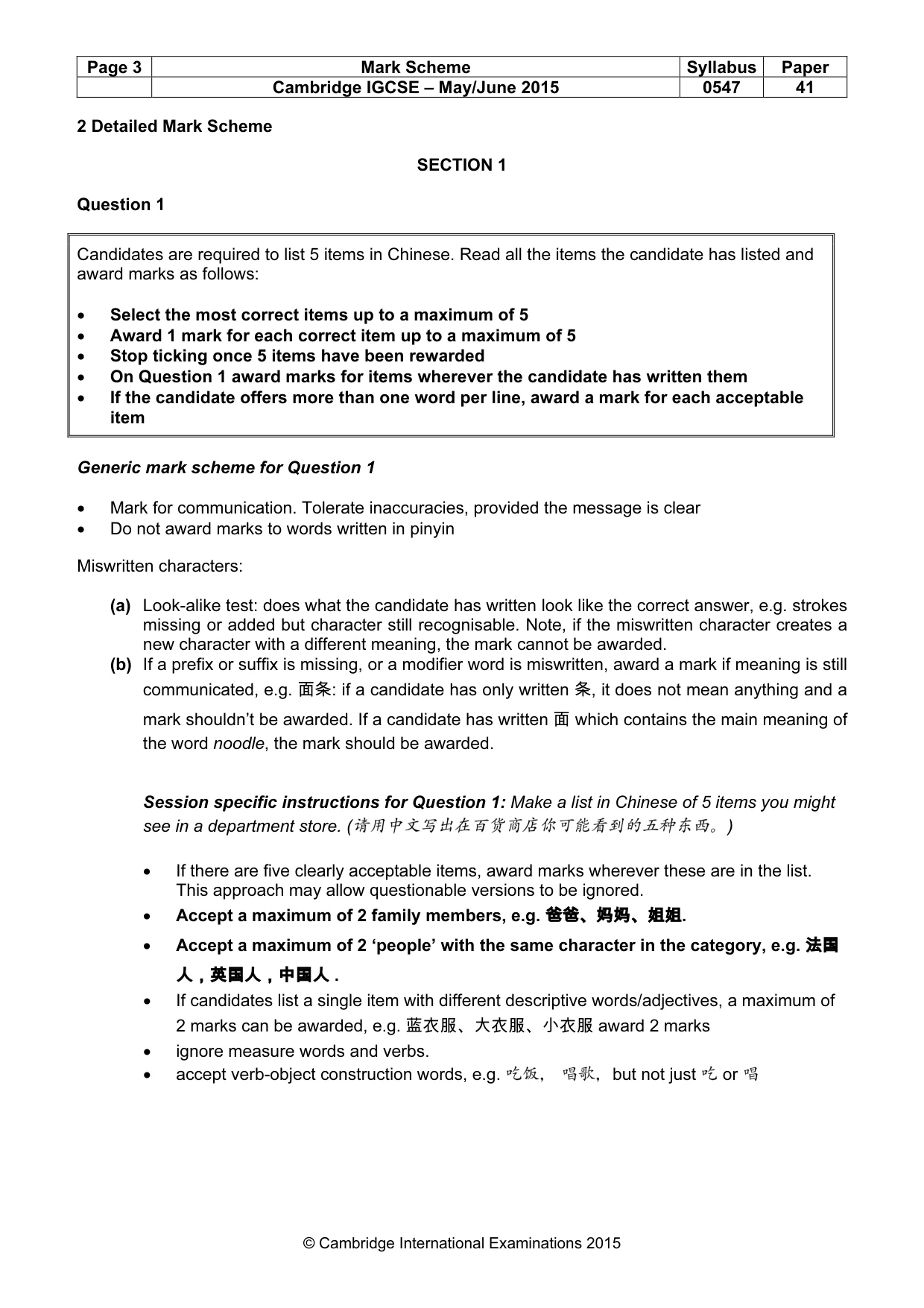
Page 3 Mark Scheme Syllabus Paper Cambridge IGCSE – May/June 2015 0547 41 © Cambridge International Examinations 2015 2 Detailed Mark Scheme SECTION 1 Question 1 Candidates are required to list 5 items in Chinese. Read all the items the candidate has listed and award marks as follows: • Select the most correct items up to a maximum of 5 • Award 1 mark for each correct item up to a maximum of 5 • Stop ticking once 5 items have been rewarded • On Question 1 award marks for items wherever the candidate has written them • If the candidate offers more than one word per line, award a mark for each acceptable item Generic mark scheme for Question 1 • Mark for communication. Tolerate inaccuracies, provided the message is clear • Do not award marks to words written in pinyin Miswritten characters: (a) Look-alike test: does what the candidate has written look like the correct answer, e.g. strokes missing or added but character still recognisable. Note, if the miswritten character creates a new character with a different meaning, the mark cannot be awarded. (b) If a prefix or suffix is missing, or a modifier word is miswritten, award a mark if meaning is still communicated, e.g. 面条: if a candidate has only written 条, it does not mean anything and a mark shouldn’t be awarded. If a candidate has written 面 which contains the main meaning of the word noodle, the mark should be awarded. Session specific instructions for Question 1: Make a list in Chinese of 5 items you might see in a department store. (请用中文写出在百货商店你可能看到的五种东西。) • If there are five clearly acceptable items, award marks wherever these are in the list. This approach may allow questionable versions to be ignored. • Accept a maximum of 2 family members, e.g. 爸爸、妈妈、姐姐. • Accept a maximum of 2 ‘people’ with the same character in the category, e.g. 法国 人,英国人,中国人 . • If candidates list a single item with different descriptive words/adjectives, a maximum of 2 marks can be awarded, e.g. 蓝衣服、大衣服、小衣服 award 2 marks • ignore measure words and verbs. • accept verb-object construction words, e.g. 吃饭, 唱歌,but not just 吃 or 唱
Mark scheme, page 4
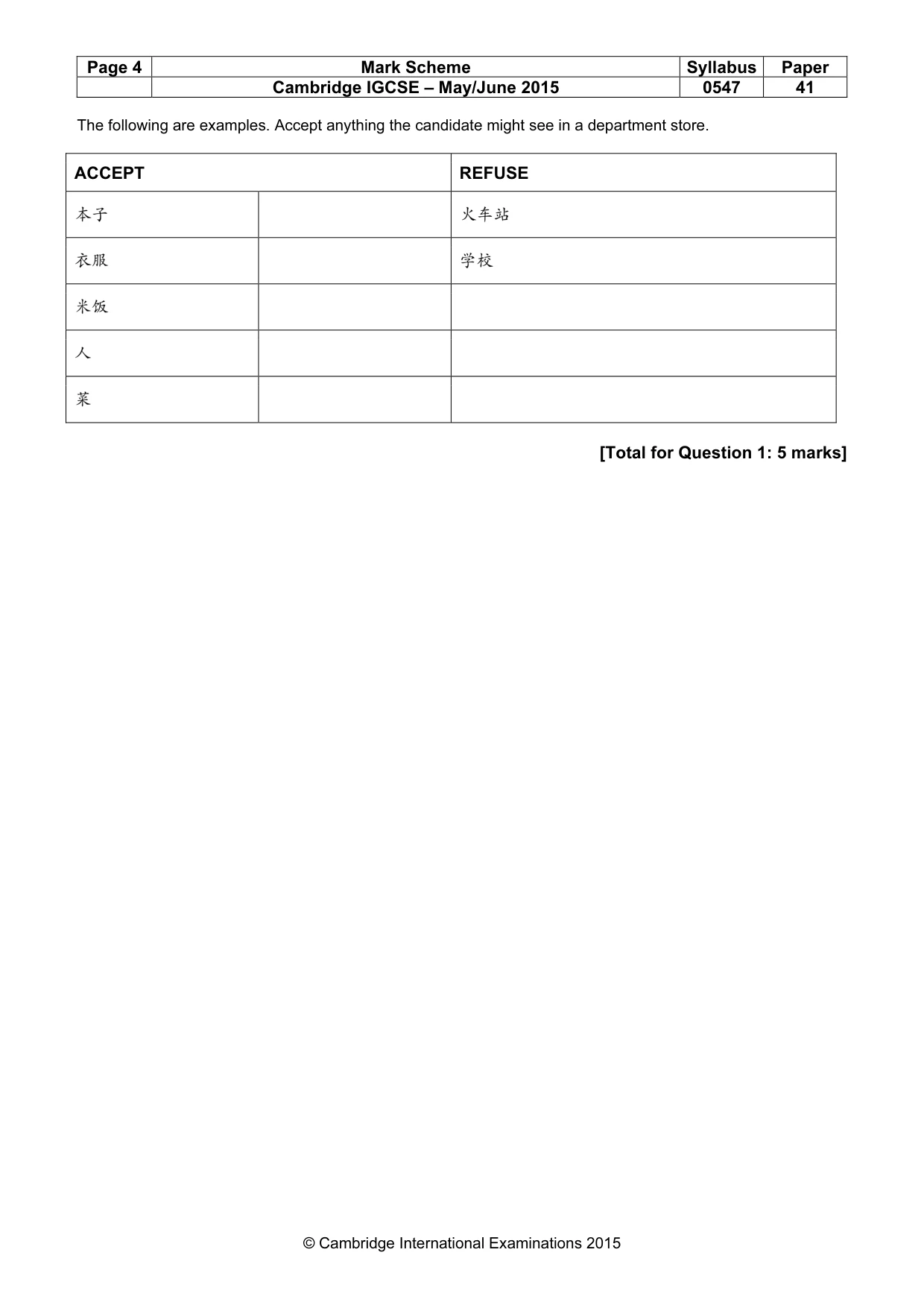
Page 4 Mark Scheme Syllabus Paper Cambridge IGCSE – May/June 2015 0547 41 © Cambridge International Examinations 2015 The following are examples. Accept anything the candidate might see in a department store. ACCEPT REFUSE 本子 火车站 衣服 学校 米饭 人 菜 [Total for Question 1: 5 marks]
Mark scheme, page 5
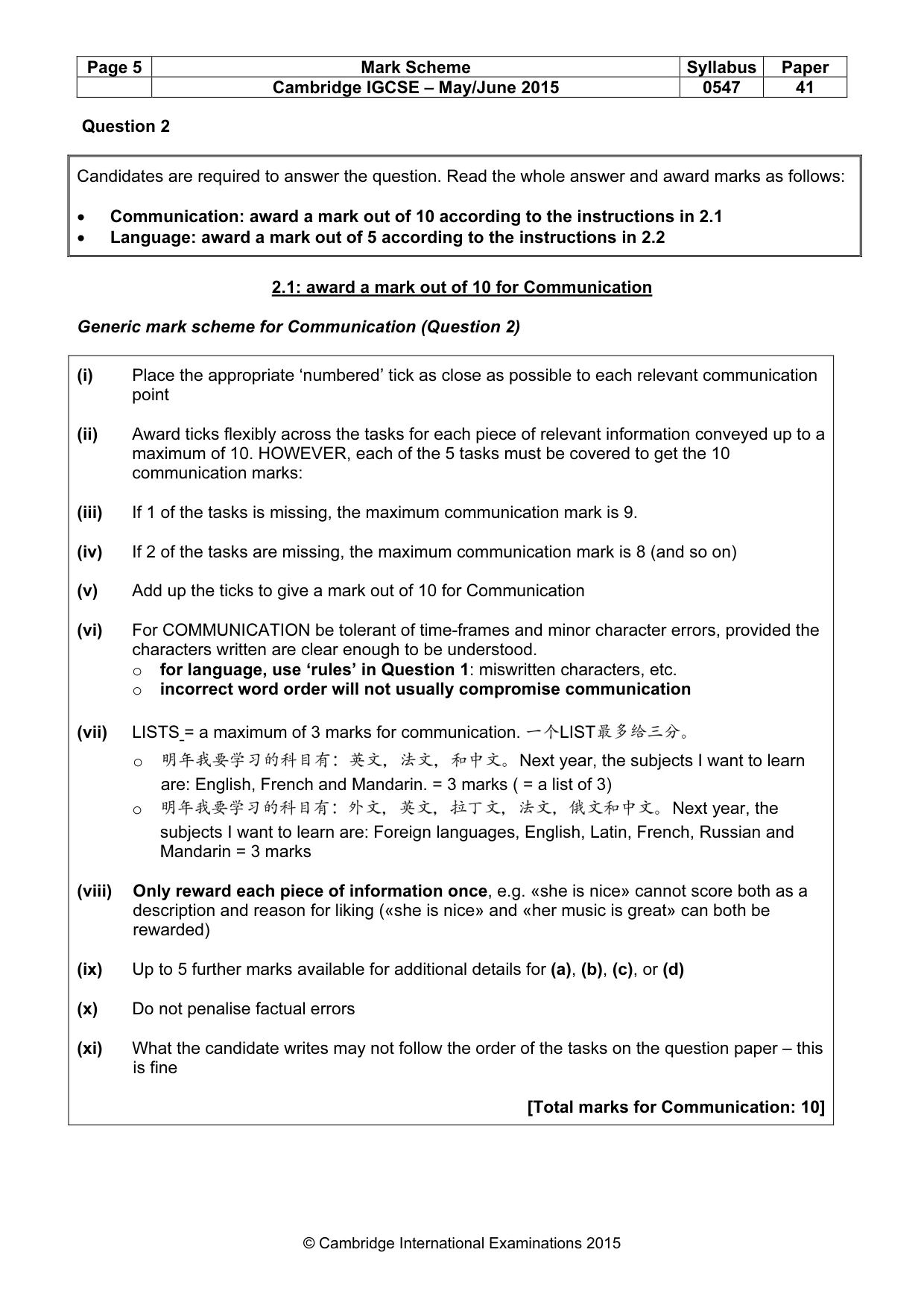
Page 5 Mark Scheme Syllabus Paper Cambridge IGCSE – May/June 2015 0547 41 © Cambridge International Examinations 2015 Question 2 Candidates are required to answer the question. Read the whole answer and award marks as follows: • Communication: award a mark out of 10 according to the instructions in 2.1 • Language: award a mark out of 5 according to the instructions in 2.2 2.1: award a mark out of 10 for Communication Generic mark scheme for Communication (Question 2) (i) Place the appropriate ‘numbered’ tick as close as possible to each relevant communication point (ii) Award ticks flexibly across the tasks for each piece of relevant information conveyed up to a maximum of 10. HOWEVER, each of the 5 tasks must be covered to get the 10 communication marks: (iii) If 1 of the tasks is missing, the maximum communication mark is 9. (iv) If 2 of the tasks are missing, the maximum communication mark is 8 (and so on) (v) Add up the ticks to give a mark out of 10 for Communication (vi) For COMMUNICATION be tolerant of time-frames and minor character errors, provided the characters written are clear enough to be understood. o for language, use ‘rules’ in Question 1: miswritten characters, etc. o incorrect word order will not usually compromise communication (vii) LISTS = a maximum of 3 marks for communication. 一个LIST最多给三分。 o 明年我要学习的科目有:英文,法文,和中文。Next year, the subjects I want to learn are: English, French and Mandarin. = 3 marks ( = a list of 3) o 明年我要学习的科目有:外文,英文,拉丁文,法文,俄文和中文。Next year, the subjects I want to learn are: Foreign languages, English, Latin, French, Russian and Mandarin = 3 marks (viii) Only reward each piece of information once, e.g. «she is nice» cannot score both as a description and reason for liking («she is nice» and «her music is great» can both be rewarded) (ix) Up to 5 further marks available for additional details for (a), (b), (c), or (d) (x) Do not penalise factual errors (xi) What the candidate writes may not follow the order of the tasks on the question paper – this is fine [Total marks for Communication: 10]
Mark scheme, page 6
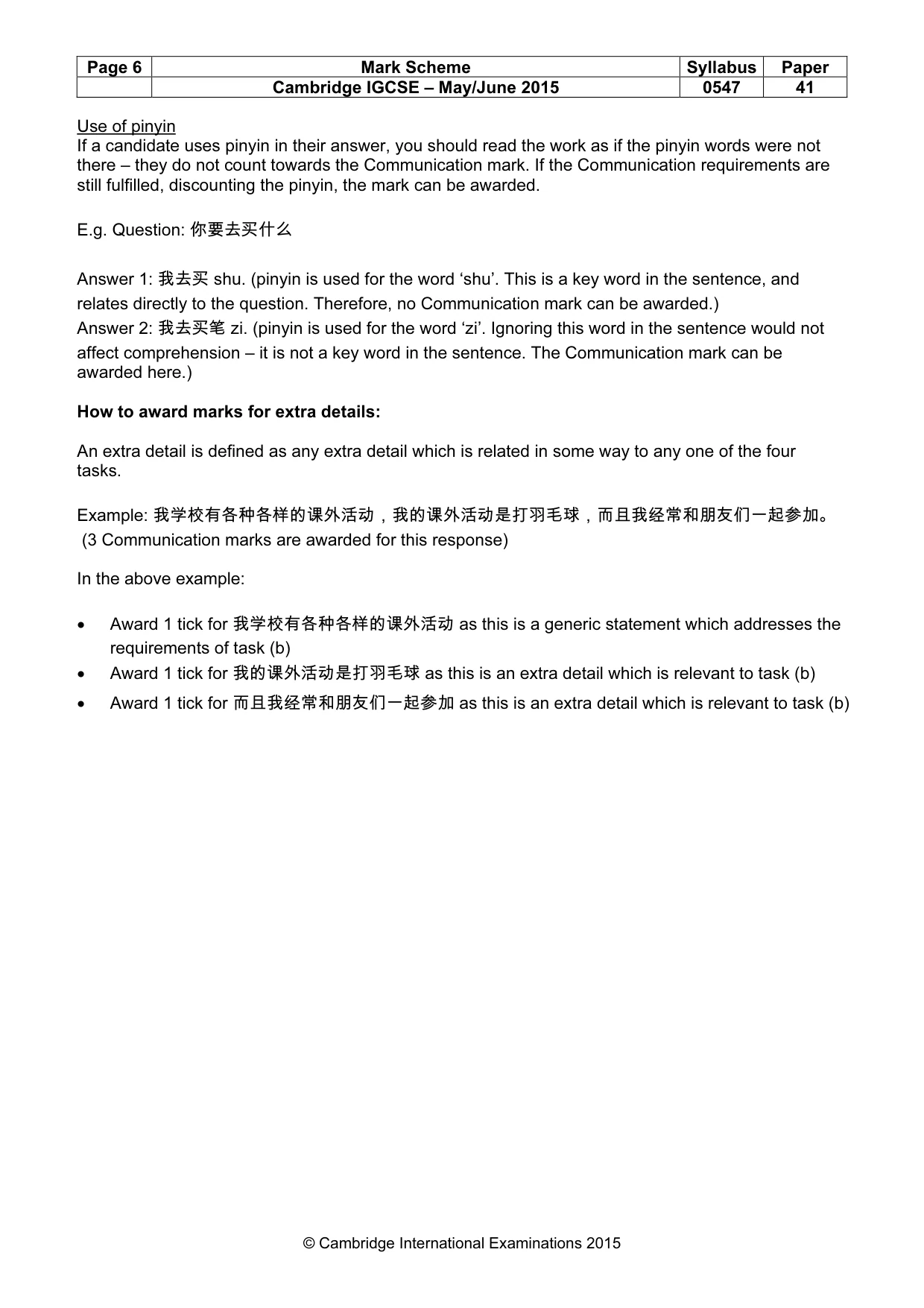
Page 6 Mark Scheme Syllabus Paper Cambridge IGCSE – May/June 2015 0547 41 © Cambridge International Examinations 2015 Use of pinyin If a candidate uses pinyin in their answer, you should read the work as if the pinyin words were not there – they do not count towards the Communication mark. If the Communication requirements are still fulfilled, discounting the pinyin, the mark can be awarded. E.g. Question: 你要去买什么 Answer 1: 我去买 shu. (pinyin is used for the word ‘shu’. This is a key word in the sentence, and relates directly to the question. Therefore, no Communication mark can be awarded.) Answer 2: 我去买笔 zi. (pinyin is used for the word ‘zi’. Ignoring this word in the sentence would not affect comprehension – it is not a key word in the sentence. The Communication mark can be awarded here.) How to award marks for extra details: An extra detail is defined as any extra detail which is related in some way to any one of the four tasks. Example: 我学校有各种各样的课外活动,我的课外活动是打羽毛球,而且我经常和朋友们一起参加。 (3 Communication marks are awarded for this response) In the above example: • Award 1 tick for 我学校有各种各样的课外活动 as this is a generic statement which addresses the requirements of task (b) • Award 1 tick for 我的课外活动是打羽毛球 as this is an extra detail which is relevant to task (b) • Award 1 tick for 而且我经常和朋友们一起参加 as this is an extra detail which is relevant to task (b)
Mark scheme, page 7
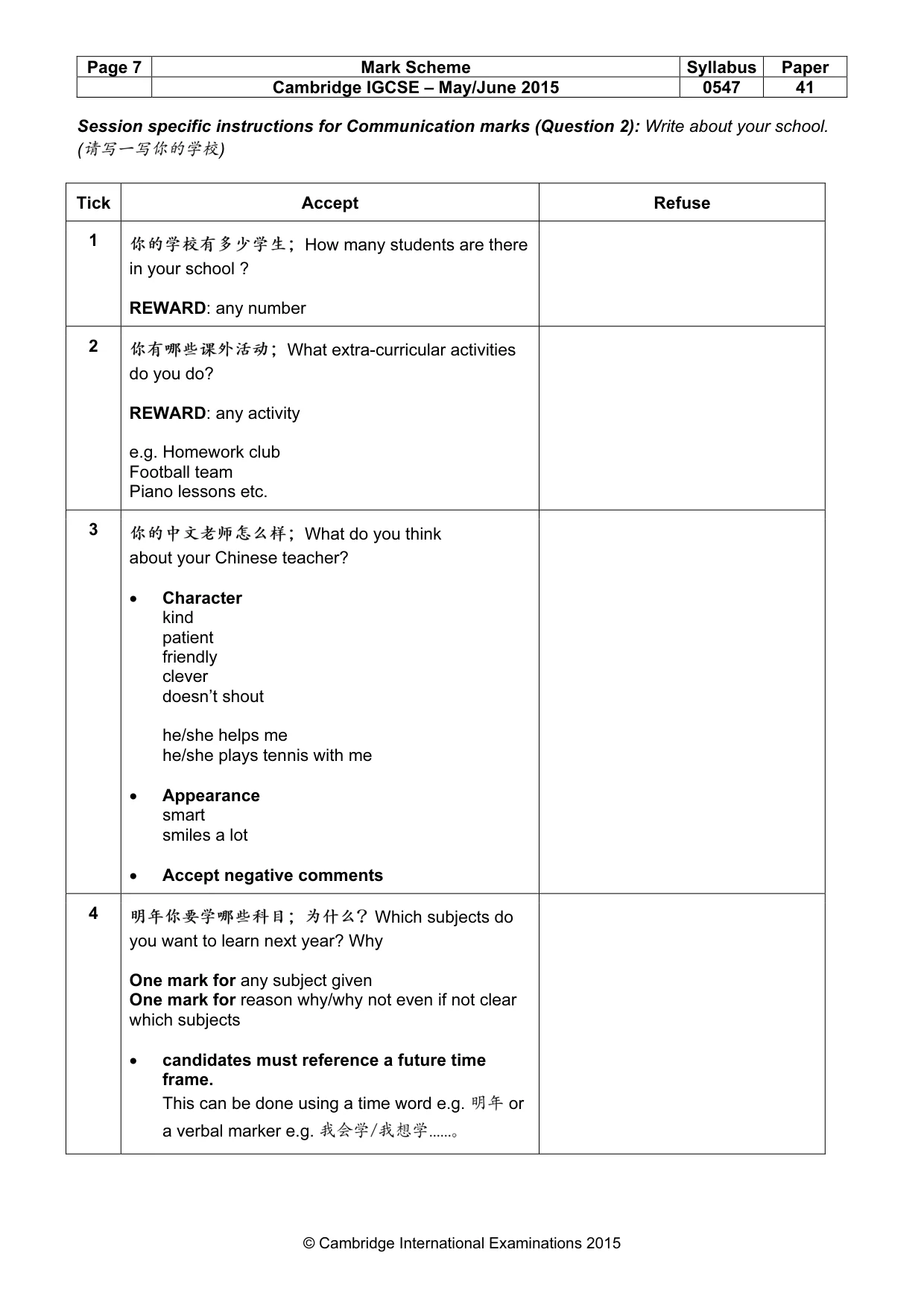
Page 7 Mark Scheme Syllabus Paper Cambridge IGCSE – May/June 2015 0547 41 © Cambridge International Examinations 2015 Session specific instructions for Communication marks (Question 2): Write about your school. (请写一写你的学校) Tick Accept Refuse 1 你的学校有多少学生;How many students are there in your school ? REWARD: any number 2 你有哪些课外活动;What extra-curricular activities do you do? REWARD: any activity e.g. Homework club Football team Piano lessons etc. 3 你的中文老师怎么样;What do you think about your Chinese teacher? • Character kind patient friendly clever doesn’t shout he/she helps me he/she plays tennis with me • Appearance smart smiles a lot • Accept negative comments 4 明年你要学哪些科目;为什么?Which subjects do you want to learn next year? Why One mark for any subject given One mark for reason why/why not even if not clear which subjects • candidates must reference a future time frame. This can be done using a time word e.g. 明年 or a verbal marker e.g. 我会学/我想学…。
Mark scheme, page 8
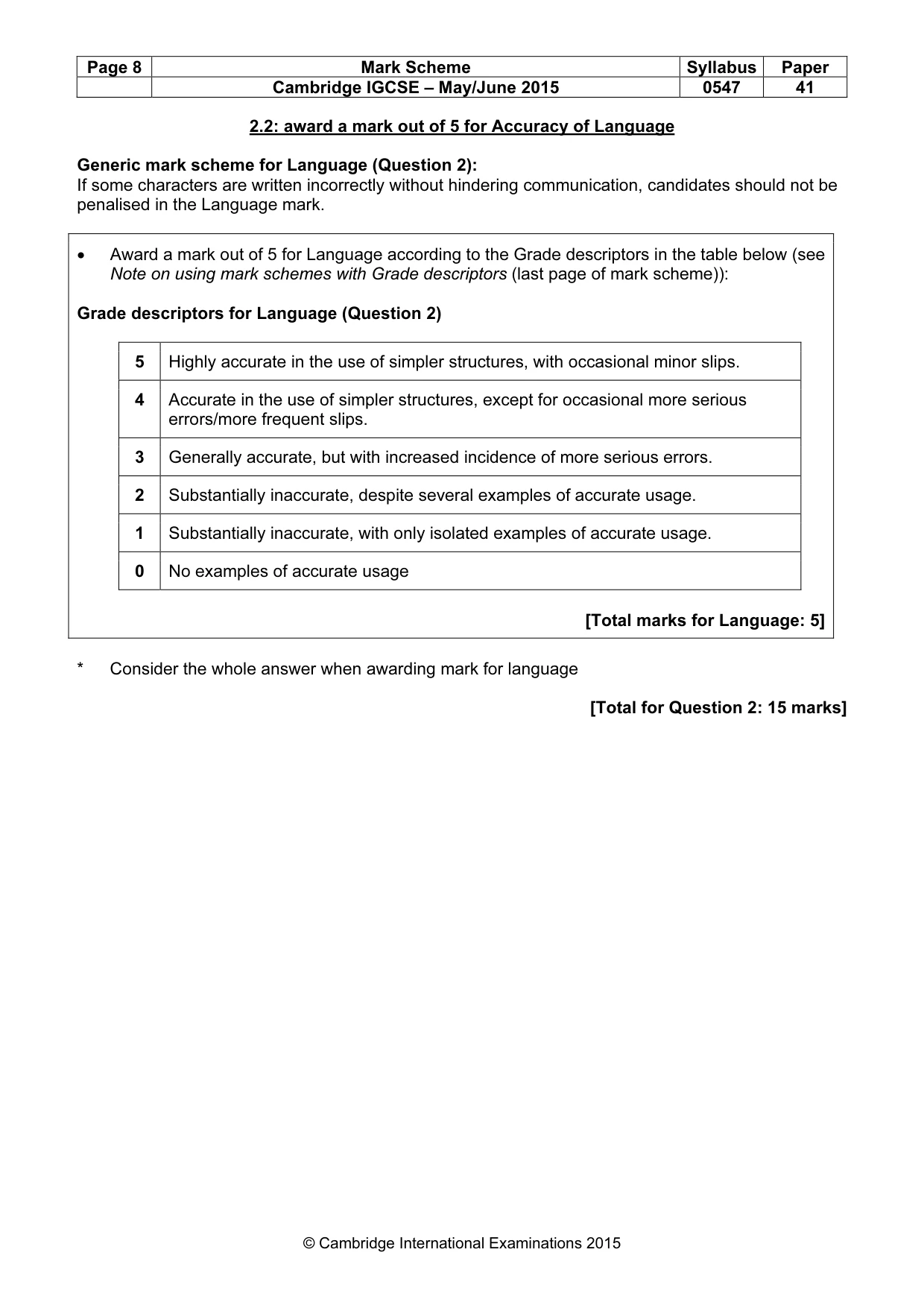
Page 8 Mark Scheme Syllabus Paper Cambridge IGCSE – May/June 2015 0547 41 © Cambridge International Examinations 2015 2.2: award a mark out of 5 for Accuracy of Language Generic mark scheme for Language (Question 2): If some characters are written incorrectly without hindering communication, candidates should not be penalised in the Language mark. • Award a mark out of 5 for Language according to the Grade descriptors in the table below (see Note on using mark schemes with Grade descriptors (last page of mark scheme)): Grade descriptors for Language (Question 2) 5 Highly accurate in the use of simpler structures, with occasional minor slips. 4 Accurate in the use of simpler structures, except for occasional more serious errors/more frequent slips. 3 Generally accurate, but with increased incidence of more serious errors. 2 Substantially inaccurate, despite several examples of accurate usage. 1 Substantially inaccurate, with only isolated examples of accurate usage. 0 No examples of accurate usage [Total marks for Language: 5] * Consider the whole answer when awarding mark for language [Total for Question 2: 15 marks]
Mark scheme, page 9
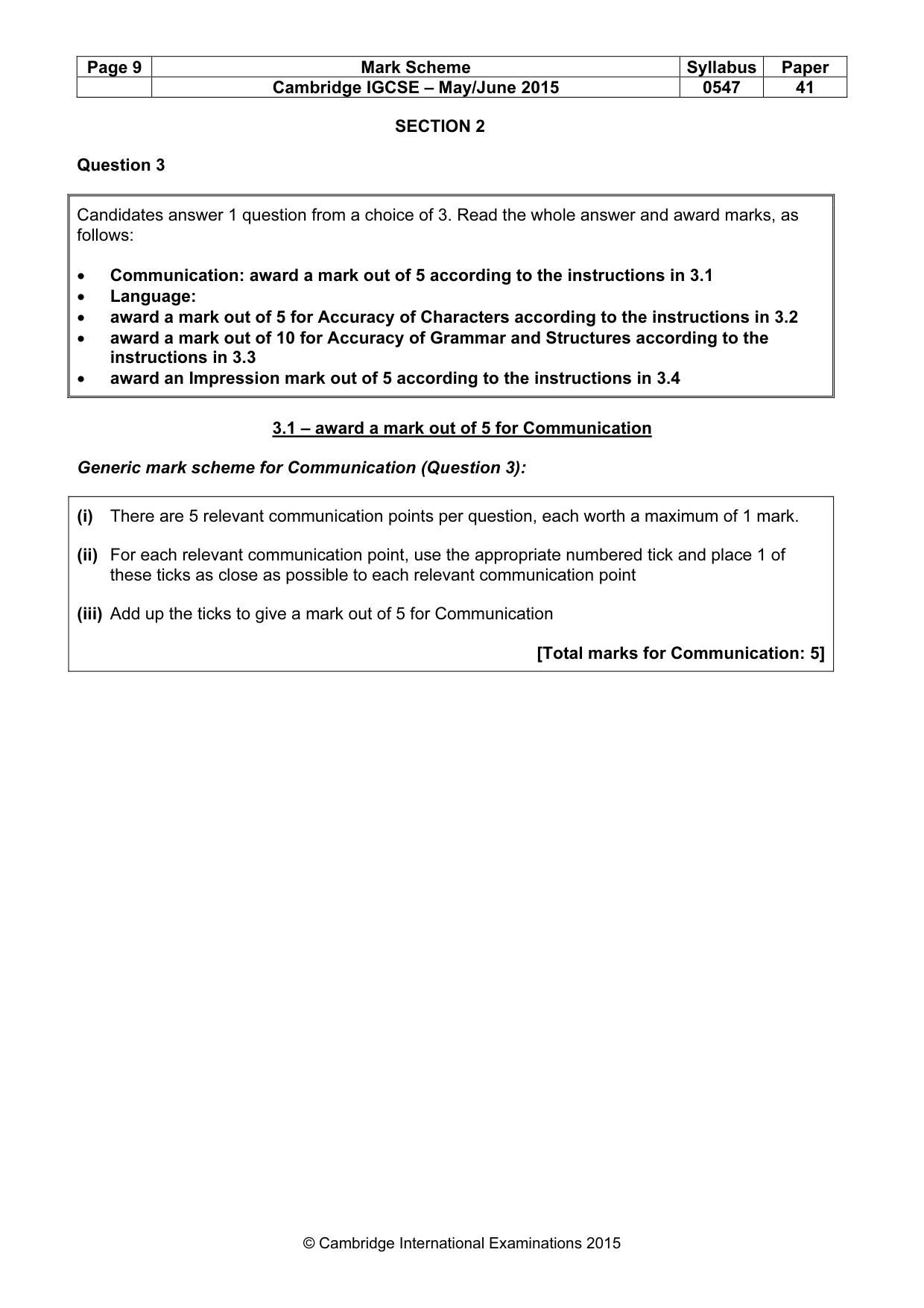
Page 9 Mark Scheme Syllabus Paper Cambridge IGCSE – May/June 2015 0547 41 © Cambridge International Examinations 2015 SECTION 2 Question 3 Candidates answer 1 question from a choice of 3. Read the whole answer and award marks, as follows: • Communication: award a mark out of 5 according to the instructions in 3.1 • Language: • award a mark out of 5 for Accuracy of Characters according to the instructions in 3.2 • award a mark out of 10 for Accuracy of Grammar and Structures according to the instructions in 3.3 • award an Impression mark out of 5 according to the instructions in 3.4 3.1 – award a mark out of 5 for Communication Generic mark scheme for Communication (Question 3): (i) There are 5 relevant communication points per question, each worth a maximum of 1 mark. (ii) For each relevant communication point, use the appropriate numbered tick and place 1 of these ticks as close as possible to each relevant communication point (iii) Add up the ticks to give a mark out of 5 for Communication [Total marks for Communication: 5]
Mark scheme, page 10
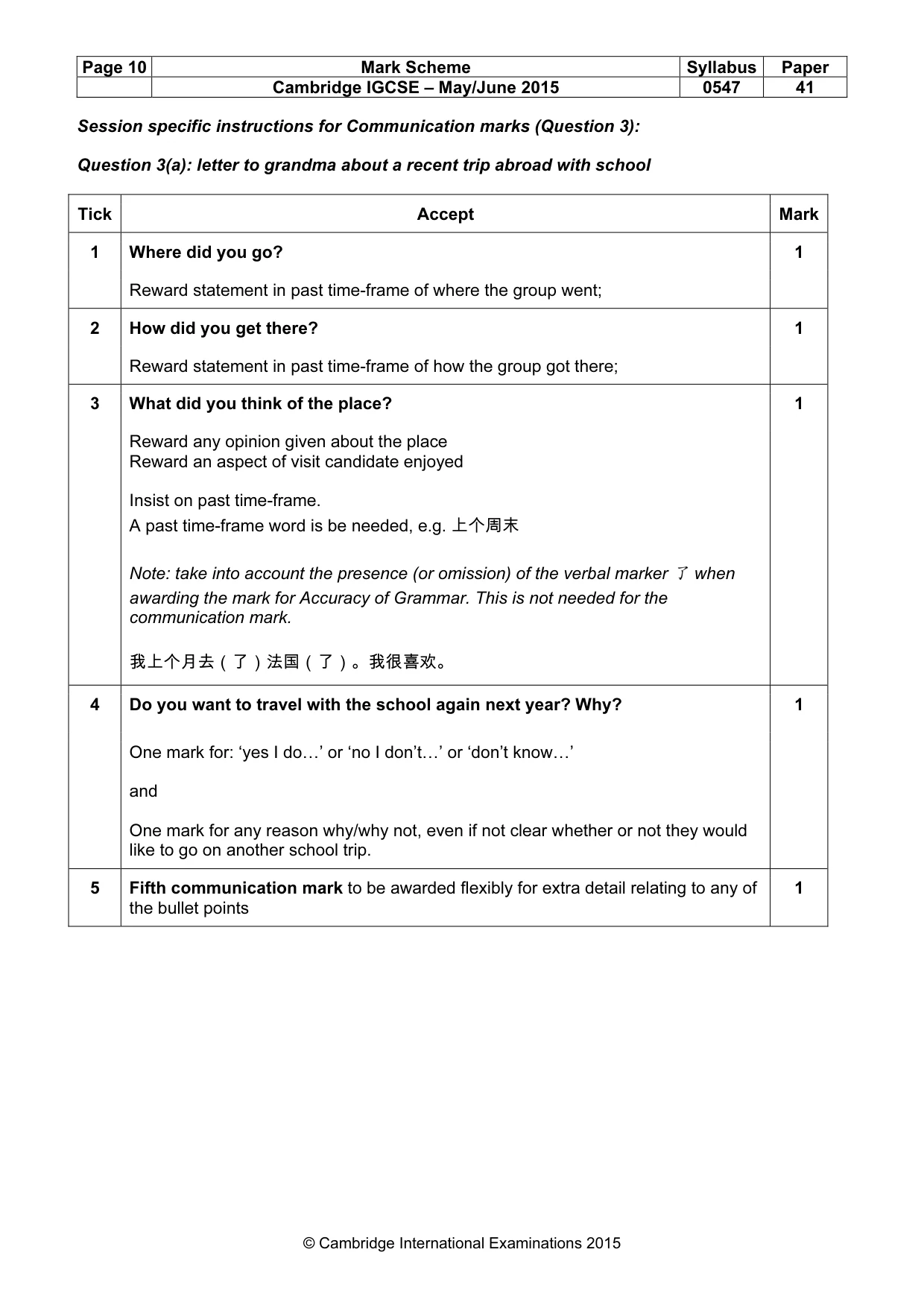
Page 10 Mark Scheme Syllabus Paper Cambridge IGCSE – May/June 2015 0547 41 © Cambridge International Examinations 2015 Session specific instructions for Communication marks (Question 3): Question 3(a): letter to grandma about a recent trip abroad with school Tick Accept Mark 1 Where did you go? 1 Reward statement in past time-frame of where the group went; 2 How did you get there? 1 Reward statement in past time-frame of how the group got there; 3 What did you think of the place? 1 Reward any opinion given about the place Reward an aspect of visit candidate enjoyed Insist on past time-frame. A past time-frame word is be needed, e.g. 上个周末 Note: take into account the presence (or omission) of the verbal marker 了 when awarding the mark for Accuracy of Grammar. This is not needed for the communication mark. 我上个月去(了)法国(了)。我很喜欢。 4 Do you want to travel with the school again next year? Why? 1 One mark for: ‘yes I do…’ or ‘no I don’t…’ or ‘don’t know…’ and One mark for any reason why/why not, even if not clear whether or not they would like to go on another school trip. 5 Fifth communication mark to be awarded flexibly for extra detail relating to any of the bullet points 1
Mark scheme, page 11
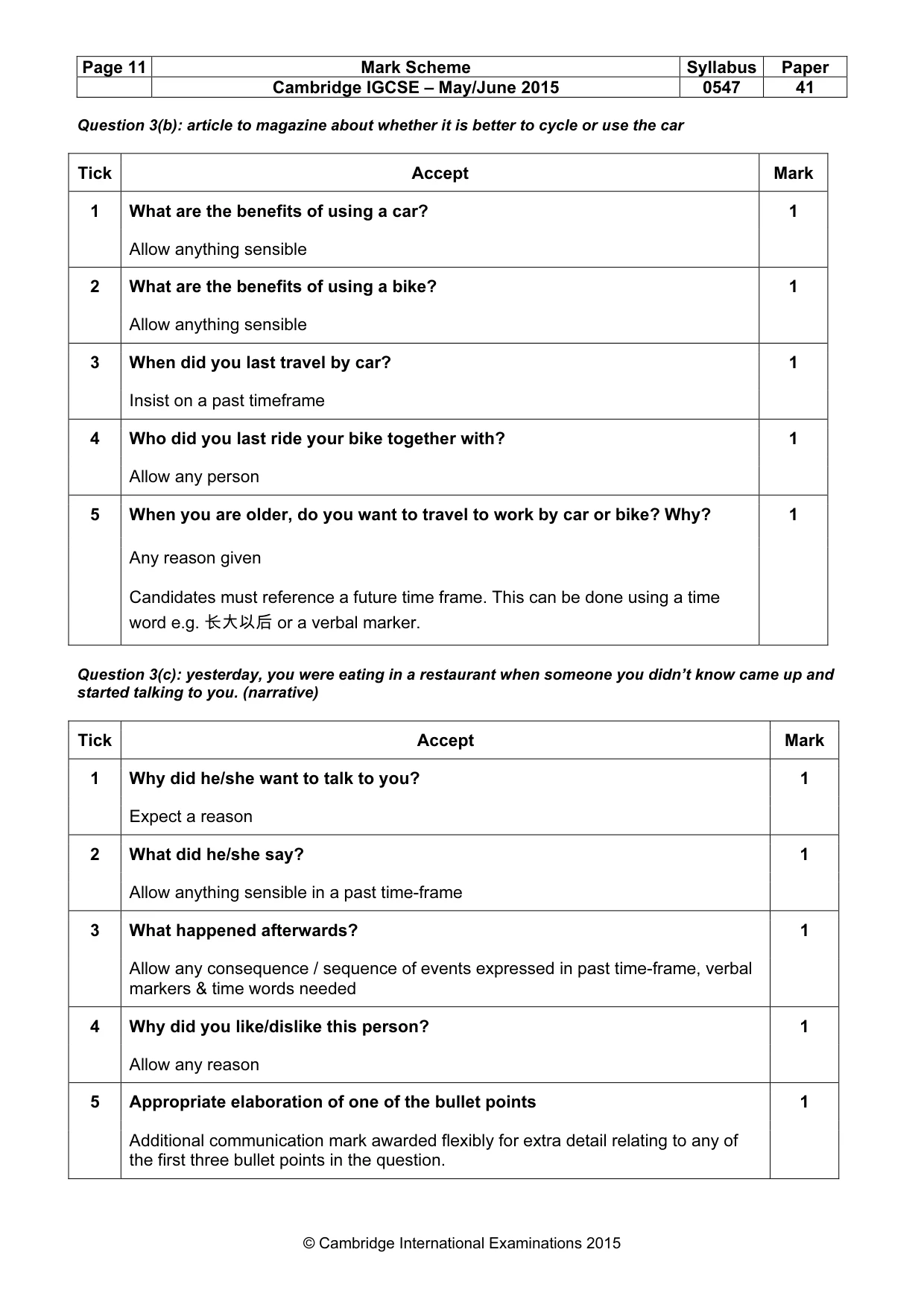
Page 11 Mark Scheme Syllabus Paper Cambridge IGCSE – May/June 2015 0547 41 © Cambridge International Examinations 2015 Question 3(b): article to magazine about whether it is better to cycle or use the car Tick Accept Mark 1 What are the benefits of using a car? 1 Allow anything sensible 2 What are the benefits of using a bike? 1 Allow anything sensible 3 When did you last travel by car? 1 Insist on a past timeframe 4 Who did you last ride your bike together with? 1 Allow any person 5 When you are older, do you want to travel to work by car or bike? Why? 1 Any reason given Candidates must reference a future time frame. This can be done using a time word e.g. 长大以后 or a verbal marker. Question 3(c): yesterday, you were eating in a restaurant when someone you didn’t know came up and started talking to you. (narrative) Tick Accept Mark 1 Why did he/she want to talk to you? 1 Expect a reason 2 What did he/she say? 1 Allow anything sensible in a past time-frame 3 What happened afterwards? 1 Allow any consequence / sequence of events expressed in past time-frame, verbal markers & time words needed 4 Why did you like/dislike this person? 1 Allow any reason 5 Appropriate elaboration of one of the bullet points 1 Additional communication mark awarded flexibly for extra detail relating to any of the first three bullet points in the question.
Mark scheme, page 12
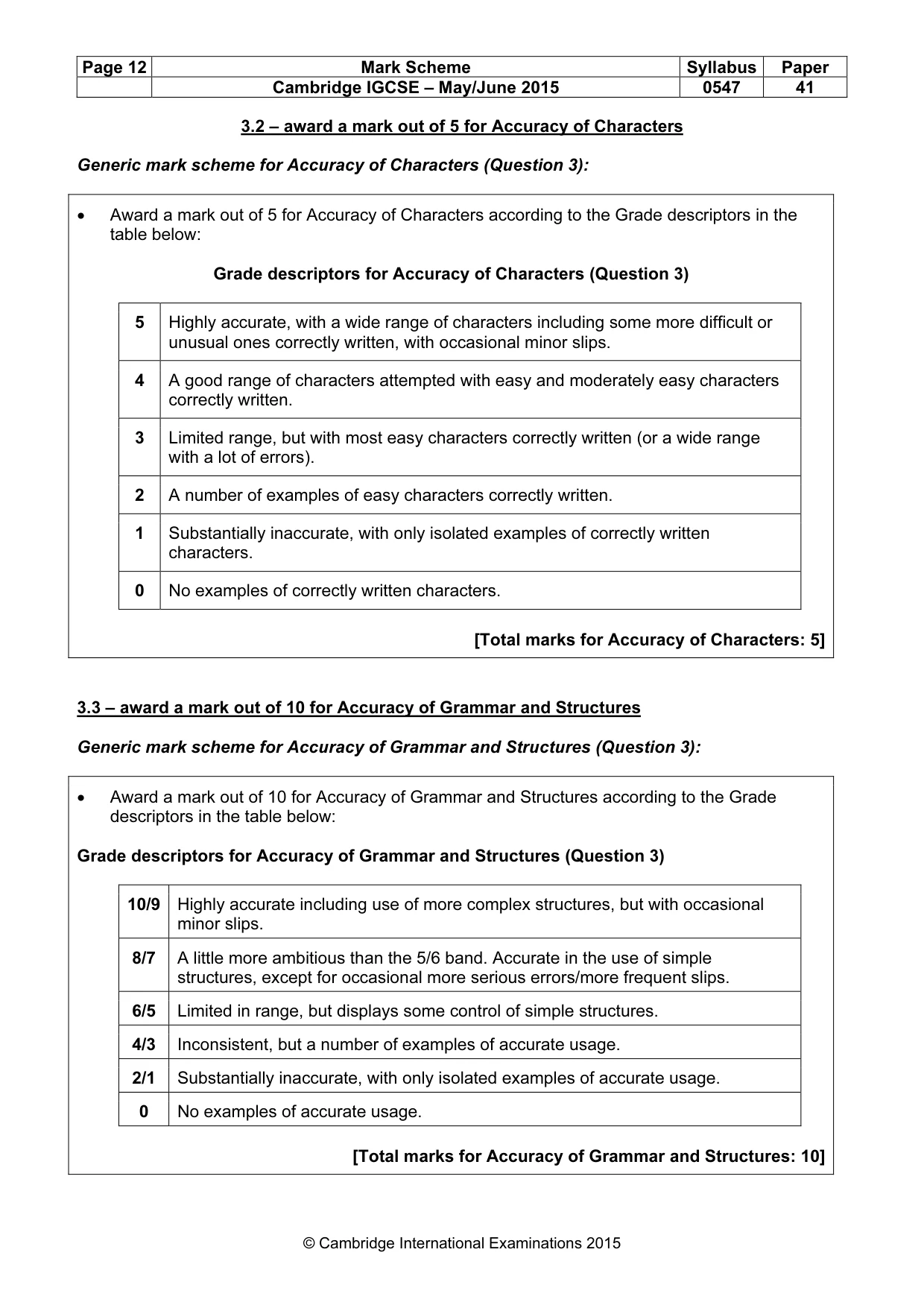
Page 12 Mark Scheme Syllabus Paper Cambridge IGCSE – May/June 2015 0547 41 © Cambridge International Examinations 2015 3.2 – award a mark out of 5 for Accuracy of Characters Generic mark scheme for Accuracy of Characters (Question 3): • Award a mark out of 5 for Accuracy of Characters according to the Grade descriptors in the table below: Grade descriptors for Accuracy of Characters (Question 3) 5 Highly accurate, with a wide range of characters including some more difficult or unusual ones correctly written, with occasional minor slips. 4 A good range of characters attempted with easy and moderately easy characters correctly written. 3 Limited range, but with most easy characters correctly written (or a wide range with a lot of errors). 2 A number of examples of easy characters correctly written. 1 Substantially inaccurate, with only isolated examples of correctly written characters. 0 No examples of correctly written characters. [Total marks for Accuracy of Characters: 5] 3.3 – award a mark out of 10 for Accuracy of Grammar and Structures Generic mark scheme for Accuracy of Grammar and Structures (Question 3): • Award a mark out of 10 for Accuracy of Grammar and Structures according to the Grade descriptors in the table below: Grade descriptors for Accuracy of Grammar and Structures (Question 3) 10/9 Highly accurate including use of more complex structures, but with occasional minor slips. 8/7 A little more ambitious than the 5/6 band. Accurate in the use of simple structures, except for occasional more serious errors/more frequent slips. 6/5 Limited in range, but displays some control of simple structures. 4/3 Inconsistent, but a number of examples of accurate usage. 2/1 Substantially inaccurate, with only isolated examples of accurate usage. 0 No examples of accurate usage. [Total marks for Accuracy of Grammar and Structures: 10]
Mark scheme, page 13
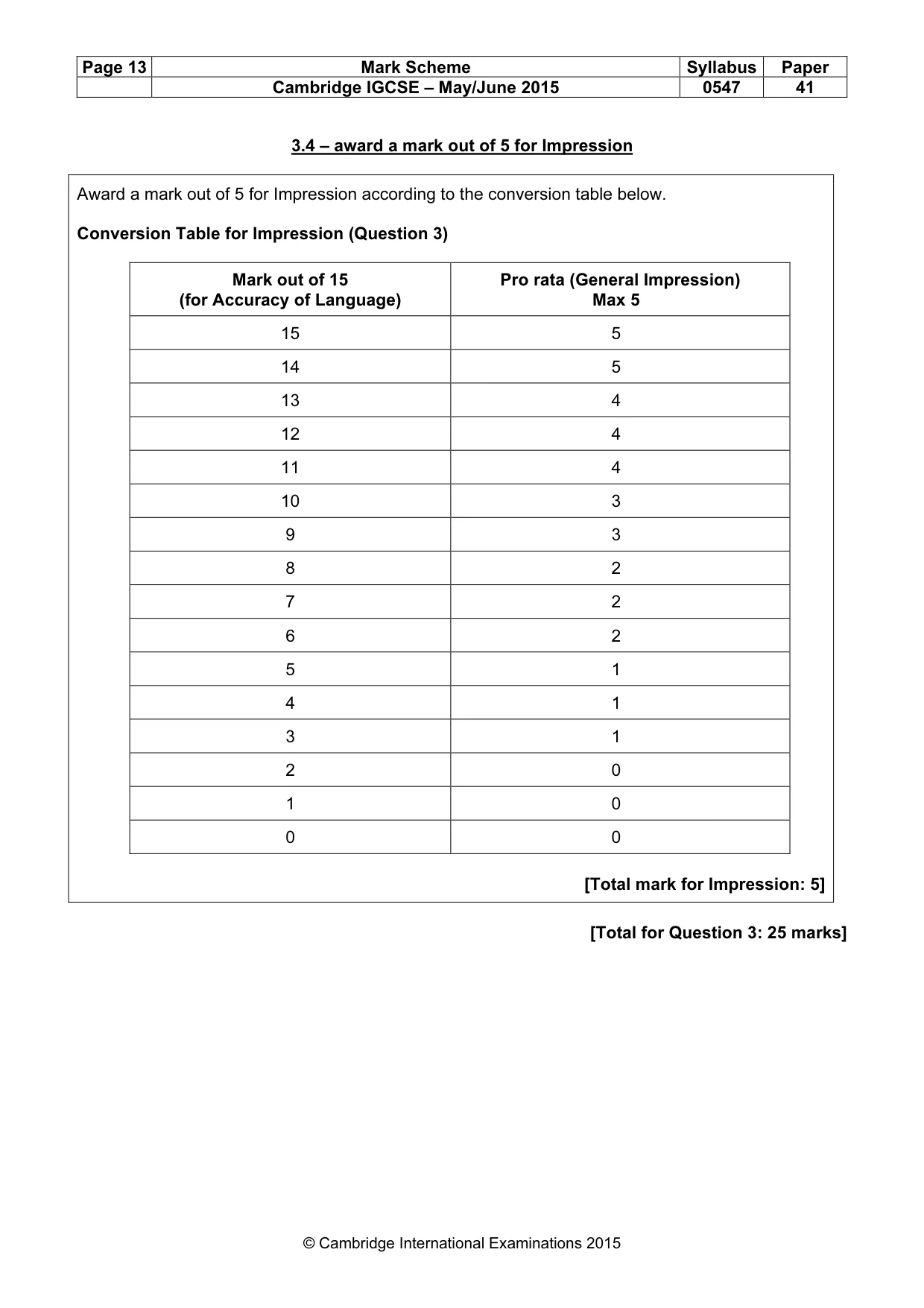
Page 13 Mark Scheme Syllabus Paper Cambridge IGCSE – May/June 2015 0547 41 © Cambridge International Examinations 2015 3.4 – award a mark out of 5 for Impression Award a mark out of 5 for Impression according to the conversion table below. Conversion Table for Impression (Question 3) Mark out of 15 (for Accuracy of Language) Pro rata (General Impression) Max 5 15 5 14 5 13 4 12 4 11 4 10 3 9 3 8 2 7 2 6 2 5 1 4 1 3 1 2 0 1 0 0 0 [Total mark for Impression: 5] [Total for Question 3: 25 marks]
Mark scheme, page 14
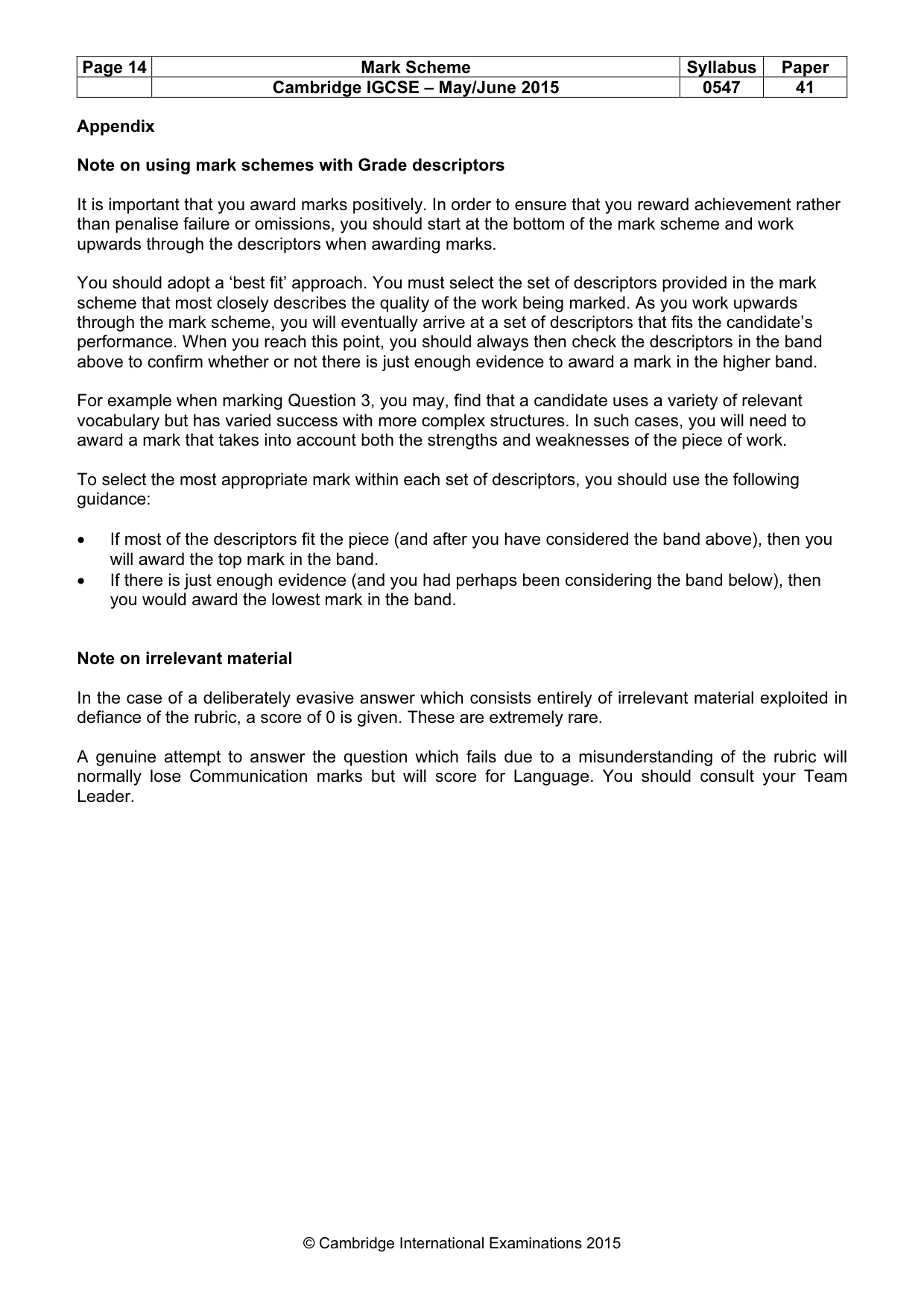
Page 14 Mark Scheme Syllabus Paper Cambridge IGCSE – May/June 2015 0547 41 © Cambridge International Examinations 2015 Appendix Note on using mark schemes with Grade descriptors It is important that you award marks positively. In order to ensure that you reward achievement rather than penalise failure or omissions, you should start at the bottom of the mark scheme and work upwards through the descriptors when awarding marks. You should adopt a ‘best fit’ approach. You must select the set of descriptors provided in the mark scheme that most closely describes the quality of the work being marked. As you work upwards through the mark scheme, you will eventually arrive at a set of descriptors that fits the candidate’s performance. When you reach this point, you should always then check the descriptors in the band above to confirm whether or not there is just enough evidence to award a mark in the higher band. For example when marking Question 3, you may, find that a candidate uses a variety of relevant vocabulary but has varied success with more complex structures. In such cases, you will need to award a mark that takes into account both the strengths and weaknesses of the piece of work. To select the most appropriate mark within each set of descriptors, you should use the following guidance: • If most of the descriptors fit the piece (and after you have considered the band above), then you will award the top mark in the band. • If there is just enough evidence (and you had perhaps been considering the band below), then you would award the lowest mark in the band. Note on irrelevant material In the case of a deliberately evasive answer which consists entirely of irrelevant material exploited in defiance of the rubric, a score of 0 is given. These are extremely rare. A genuine attempt to answer the question which fails due to a misunderstanding of the rubric will normally lose Communication marks but will score for Language. You should consult your Team Leader.
What you needed in this session
Cambridge’s own grade thresholds for 2015 May/June, Paper 4 · Variant 1. A higher threshold means an easier paper — the bar moves with how the cohort did.