Cambridge IGCSE Chinese (Mandarin) - Foreign Language 0547 — 2014 May/June Paper 4 · Variant 1
0547/41/M/J/14
The question paper and its mark scheme, free to read here and free to download. This is Cambridge’s own paper, exactly as it was sat.
Question paper4 pages
Mark scheme8 pages
Answers below. Sit the paper first if you are practising.
Paper as text
Question paper, page 1
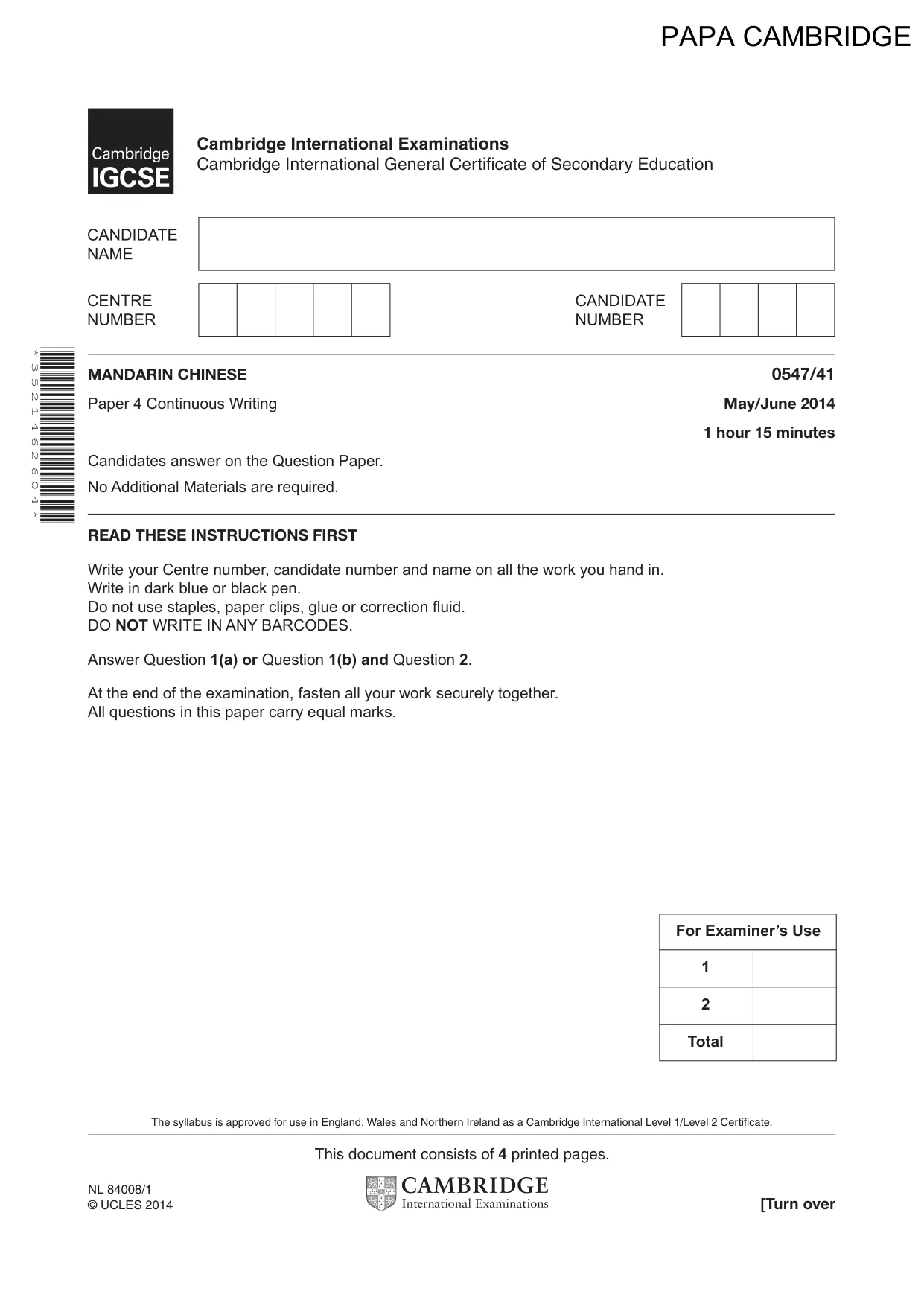
READ THESE INSTRUCTIONS FIRST Write your Centre number, candidate number and name on all the work you hand in. Write in dark blue or black pen. Do not use staples, paper clips, glue or correction fluid. DO NOT WRITE IN ANY BARCODES. Answer Question 1(a) or Question 1(b) and Question 2. At the end of the examination, fasten all your work securely together. All questions in this paper carry equal marks. MANDARIN CHINESE 0547/41 Paper 4 Continuous Writing May/June 2014 1 hour 15 minutes Candidates answer on the Question Paper. No Additional Materials are required. 1 2 Total For Examiner’s Use * 3 5 2 1 4 6 2 6 0 4 * This document consists of 4 printed pages. NL 84008/1 © UCLES 2014 [Turn over Cambridge International Examinations Cambridge International General Certificate of Secondary Education The syllabus is approved for use in England, Wales and Northern Ireland as a Cambridge International Level 1/Level 2 Certificate. PAPA CAMBRIDGE
Question paper, page 2
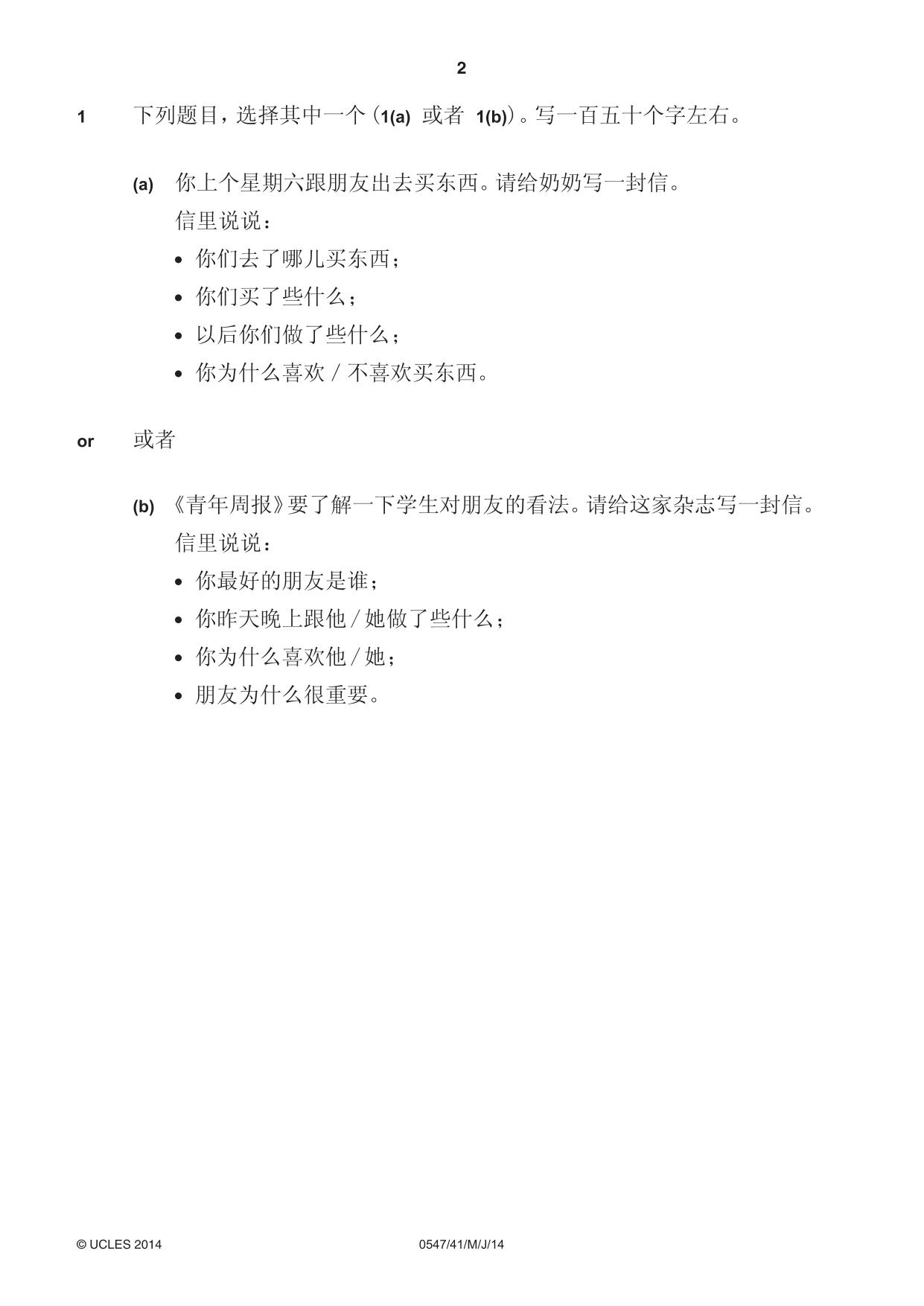
2 1 PRPLA, VERE HAS Cay BR 1b). SG-AA. (a) PK EAMES AC SSE ART. TAA WIS A fa BUDE: © WANS TS ABIL © MANE THETA; © DUR MMT #e vine AR {FAs Er © KAT ARM | REM A or BU (bo) (FEAESAFR) BE TR PAE ACI 0 HRZTIR ARAB TE G —I o i GLUE © WIE AEE © PERIGEE IR A / tte T LEAT © MATAR ME / tt s © WRATAREE. © UCLES 2014 0547/41/M/J/14
Question paper, page 3
3 [Turn over 0547/41/M/J/14 © UCLES 2014 … … … … … … … … … … … … … … … … … … … … … … … … … … Write your answer to Question 1 here.
Question paper, page 4
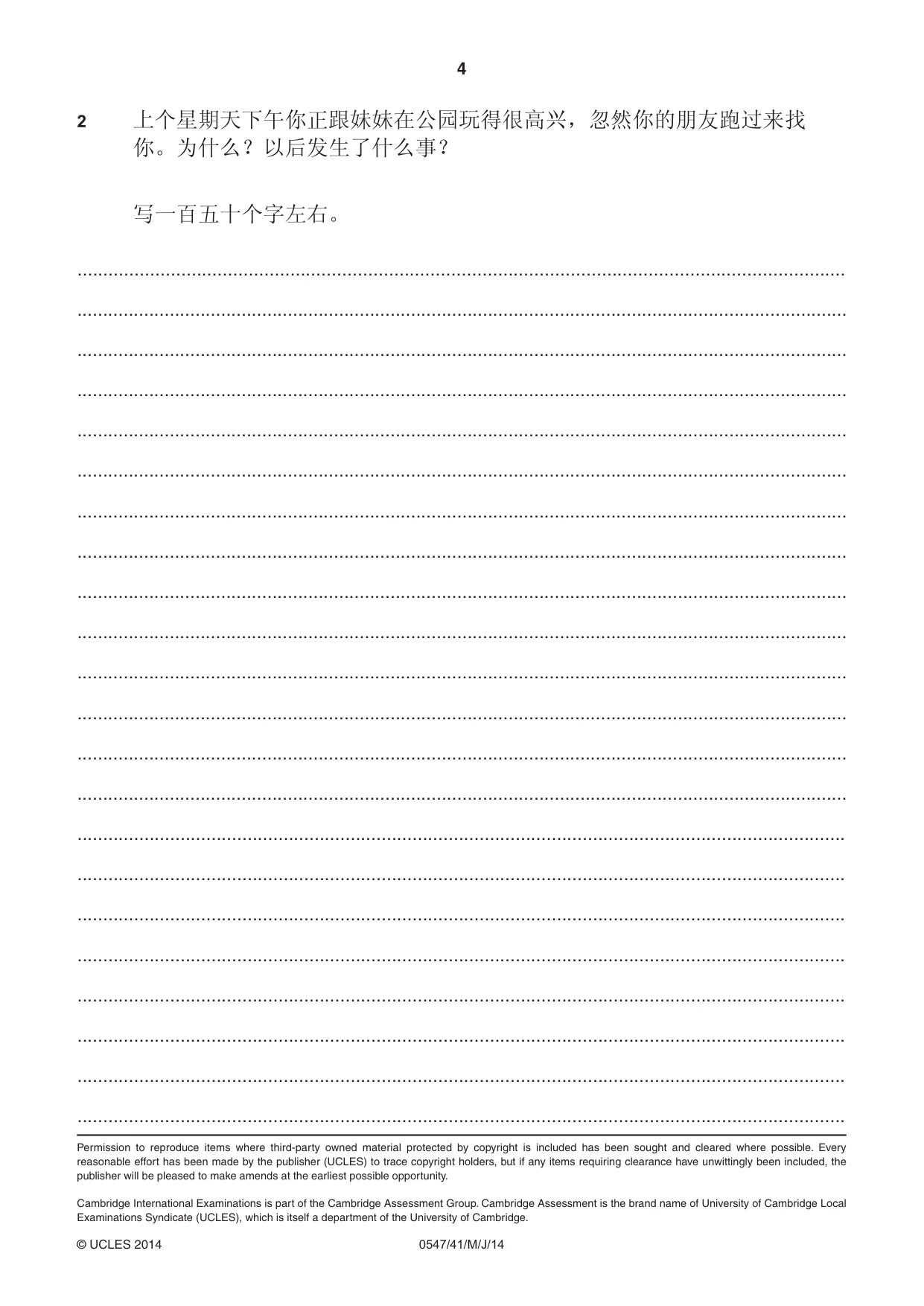
4 0547/41/M/J/14 © UCLES 2014 … … … … … … … … … … … … … … … … … … … … … … Permission to reproduce items where third-party owned material protected by copyright is included has been sought and cleared where possible. Every reasonable effort has been made by the publisher (UCLES) to trace copyright holders, but if any items requiring clearance have unwittingly been included, the publisher will be pleased to make amends at the earliest possible opportunity. Cambridge International Examinations is part of the Cambridge Assessment Group. Cambridge Assessment is the brand name of University of Cambridge Local Examinations Syndicate (UCLES), which is itself a department of the University of Cambridge.
Mark scheme, page 1
CAMBRIDGE INTERNATIONAL EXAMINATIONS International General Certificate of Secondary Education MARK SCHEME for the May/June 2014 series 0547 MANDARIN CHINESE (FOREIGN LANGUAGE) 0547/41 Paper 4 (Continuous Writing), maximum raw mark 50 This mark scheme is published as an aid to teachers and candidates, to indicate the requirements of the examination. It shows the basis on which Examiners were instructed to award marks. It does not indicate the details of the discussions that took place at an Examiners’ meeting before marking began, which would have considered the acceptability of alternative answers. Mark schemes should be read in conjunction with the question paper and the Principal Examiner Report for Teachers. Cambridge will not enter into discussions about these mark schemes. Cambridge is publishing the mark schemes for the May/June 2014 series for most IGCSE, GCE Advanced Level and Advanced Subsidiary Level components and some Ordinary Level components. PAPA CAMBRIDGE
Mark scheme, page 2
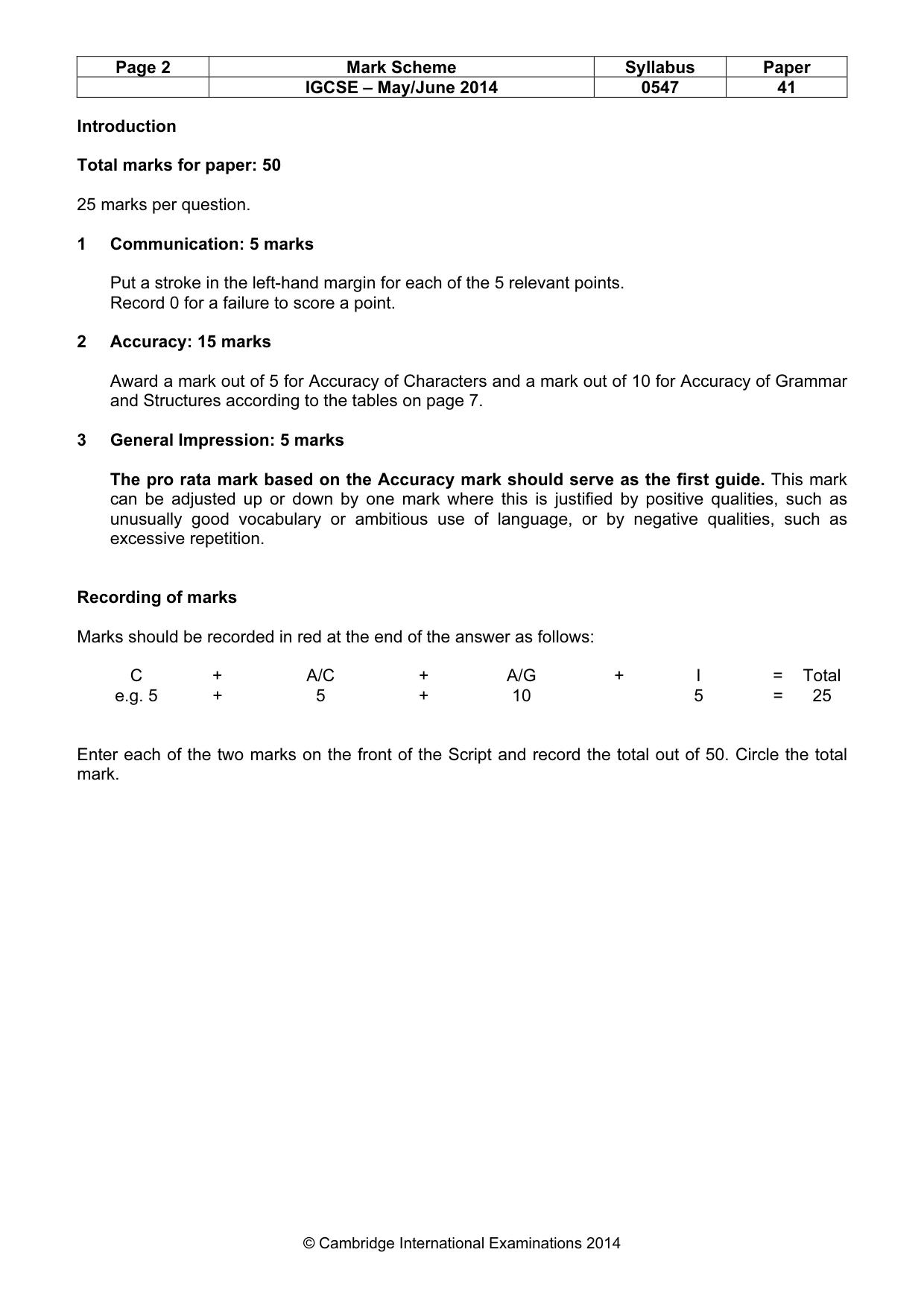
Page 2 Mark Scheme Syllabus Paper IGCSE – May/June 2014 0547 41 © Cambridge International Examinations 2014 Introduction Total marks for paper: 50 25 marks per question. 1 Communication: 5 marks Put a stroke in the left-hand margin for each of the 5 relevant points. Record 0 for a failure to score a point. 2 Accuracy: 15 marks Award a mark out of 5 for Accuracy of Characters and a mark out of 10 for Accuracy of Grammar and Structures according to the tables on page 7. 3 General Impression: 5 marks The pro rata mark based on the Accuracy mark should serve as the first guide. This mark can be adjusted up or down by one mark where this is justified by positive qualities, such as unusually good vocabulary or ambitious use of language, or by negative qualities, such as excessive repetition. Recording of marks Marks should be recorded in red at the end of the answer as follows: C + A/C + A/G + I = Total e.g. 5 + 5 + 10 5 = 25 Enter each of the two marks on the front of the Script and record the total out of 50. Circle the total mark.
Mark scheme, page 3
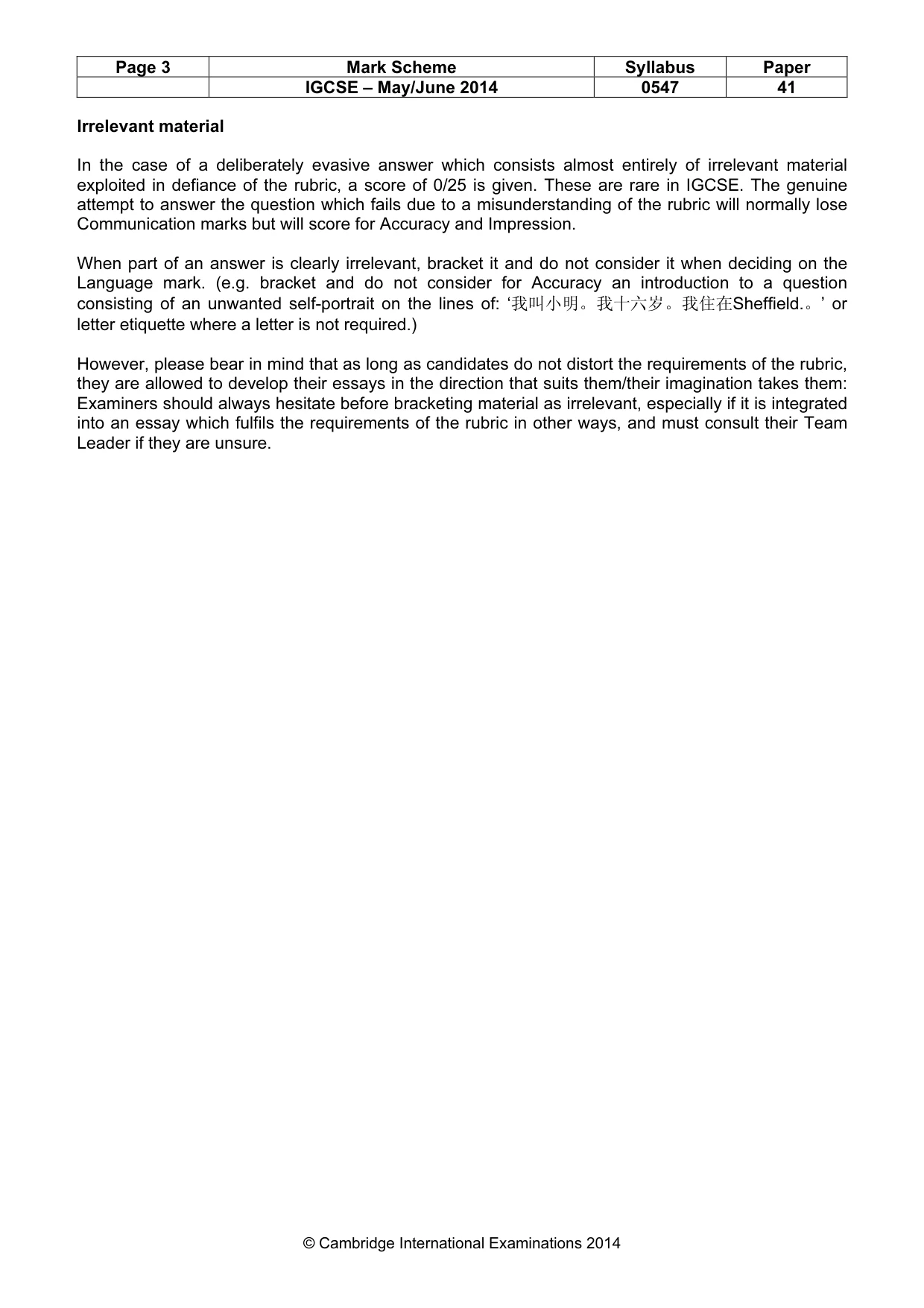
Page 3 Mark Scheme Syllabus Paper IGCSE – May/June 2014 0547 41 © Cambridge International Examinations 2014 Irrelevant material In the case of a deliberately evasive answer which consists almost entirely of irrelevant material exploited in defiance of the rubric, a score of 0/25 is given. These are rare in IGCSE. The genuine attempt to answer the question which fails due to a misunderstanding of the rubric will normally lose Communication marks but will score for Accuracy and Impression. When part of an answer is clearly irrelevant, bracket it and do not consider it when deciding on the Language mark. (e.g. bracket and do not consider for Accuracy an introduction to a question consisting of an unwanted self-portrait on the lines of: ‘我叫小明。我十六岁。我住在Sheffield.。’ or letter etiquette where a letter is not required.) However, please bear in mind that as long as candidates do not distort the requirements of the rubric, they are allowed to develop their essays in the direction that suits them/their imagination takes them: Examiners should always hesitate before bracketing material as irrelevant, especially if it is integrated into an essay which fulfils the requirements of the rubric in other ways, and must consult their Team Leader if they are unsure.
Mark scheme, page 4
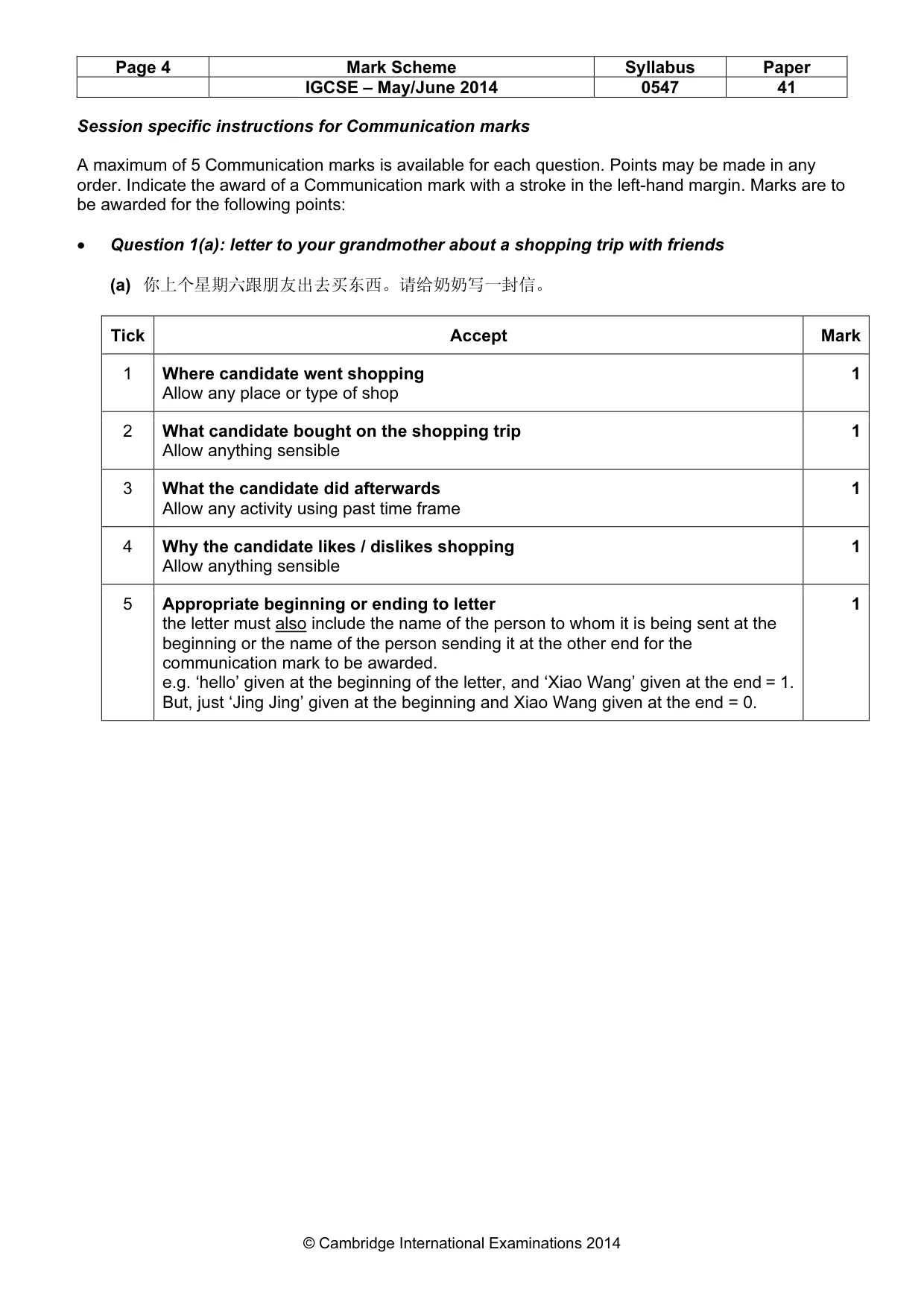
Page 4 Mark Scheme Syllabus Paper IGCSE – May/June 2014 0547 41 © Cambridge International Examinations 2014 Session specific instructions for Communication marks A maximum of 5 Communication marks is available for each question. Points may be made in any order. Indicate the award of a Communication mark with a stroke in the left-hand margin. Marks are to be awarded for the following points: • Question 1(a): letter to your grandmother about a shopping trip with friends (a) 你上个星期六跟朋友出去买东西。请给奶奶写一封信。 Tick Accept Mark 1 Where candidate went shopping Allow any place or type of shop 1 2 What candidate bought on the shopping trip Allow anything sensible 1 3 What the candidate did afterwards Allow any activity using past time frame 1 4 Why the candidate likes / dislikes shopping Allow anything sensible 1 5 Appropriate beginning or ending to letter the letter must also include the name of the person to whom it is being sent at the beginning or the name of the person sending it at the other end for the communication mark to be awarded. e.g. ‘hello’ given at the beginning of the letter, and ‘Xiao Wang’ given at the end = 1. But, just ‘Jing Jing’ given at the beginning and Xiao Wang given at the end = 0. 1
Mark scheme, page 5
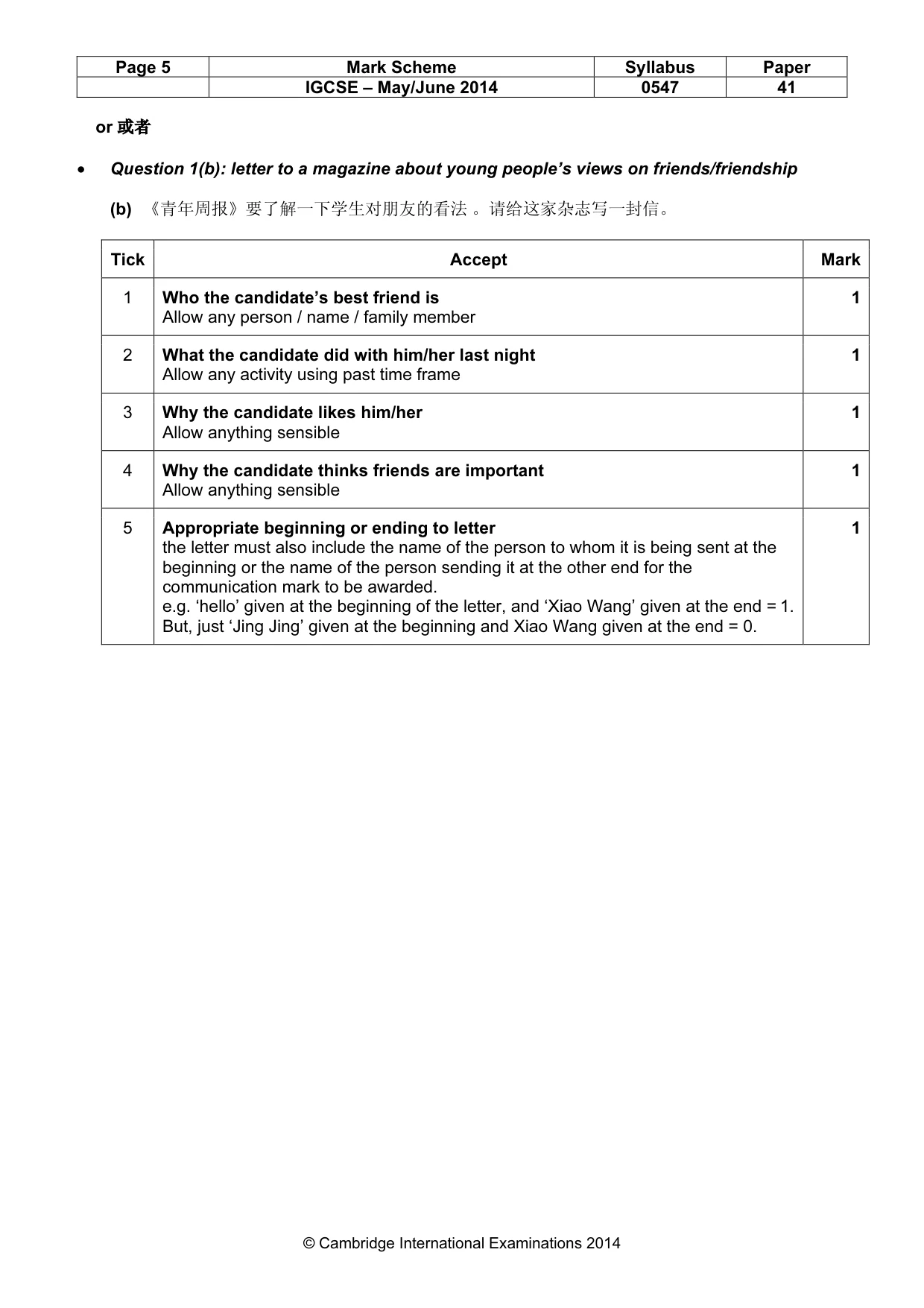
Page 5 Mark Scheme Syllabus Paper IGCSE – May/June 2014 0547 41 © Cambridge International Examinations 2014 or 或者 • Question 1(b): letter to a magazine about young people’s views on friends/friendship (b) 《青年周报》要了解一下学生对朋友的看法 。请给这家杂志写一封信。 Tick Accept Mark 1 Who the candidate’s best friend is Allow any person / name / family member 1 2 What the candidate did with him/her last night Allow any activity using past time frame 1 3 Why the candidate likes him/her Allow anything sensible 1 4 Why the candidate thinks friends are important Allow anything sensible 1 5 Appropriate beginning or ending to letter the letter must also include the name of the person to whom it is being sent at the beginning or the name of the person sending it at the other end for the communication mark to be awarded. e.g. ‘hello’ given at the beginning of the letter, and ‘Xiao Wang’ given at the end = 1. But, just ‘Jing Jing’ given at the beginning and Xiao Wang given at the end = 0. 1
Mark scheme, page 6
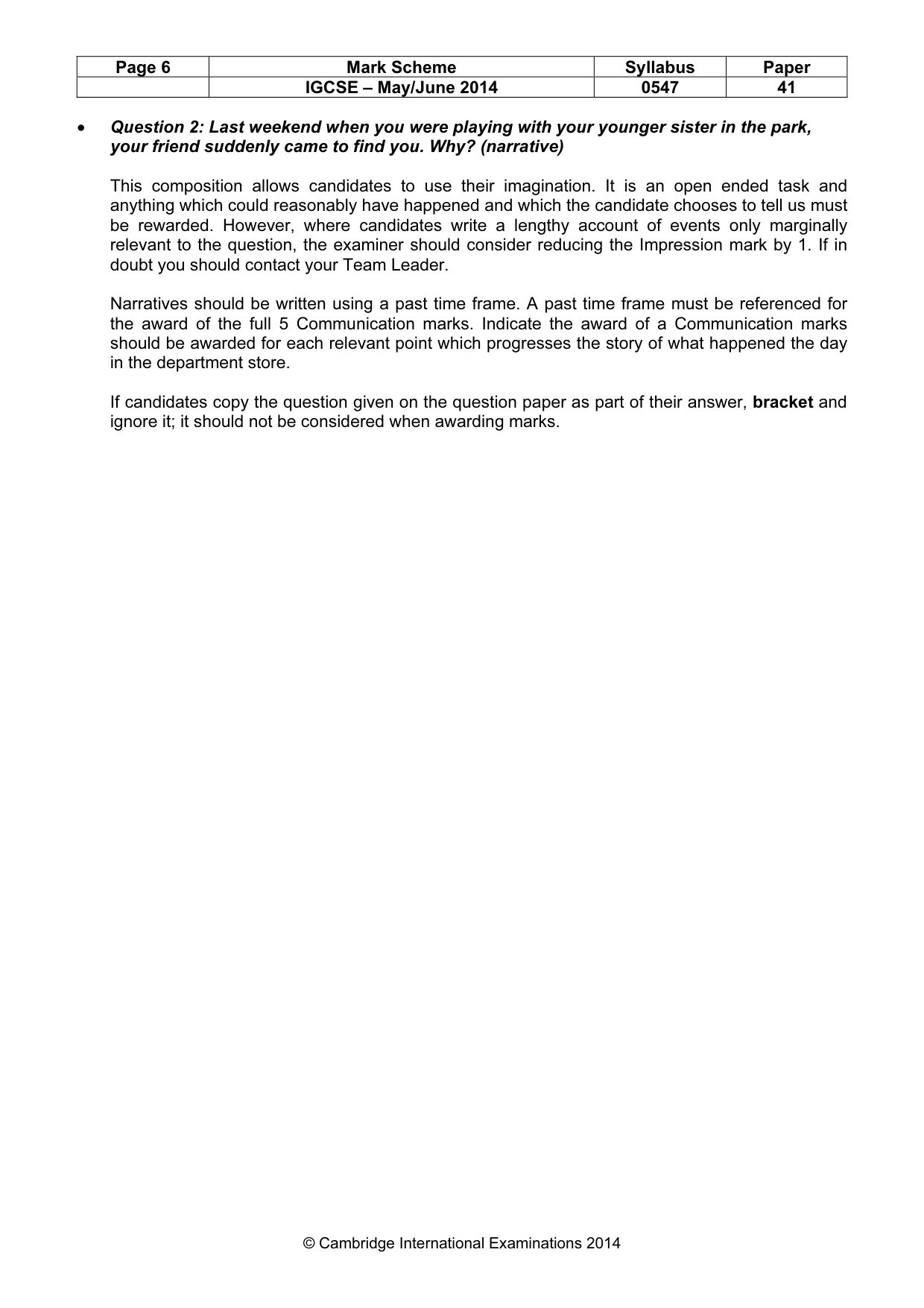
Page 6 Mark Scheme Syllabus Paper IGCSE – May/June 2014 0547 41 © Cambridge International Examinations 2014 • Question 2: Last weekend when you were playing with your younger sister in the park, your friend suddenly came to find you. Why? (narrative) This composition allows candidates to use their imagination. It is an open ended task and anything which could reasonably have happened and which the candidate chooses to tell us must be rewarded. However, where candidates write a lengthy account of events only marginally relevant to the question, the examiner should consider reducing the Impression mark by 1. If in doubt you should contact your Team Leader. Narratives should be written using a past time frame. A past time frame must be referenced for the award of the full 5 Communication marks. Indicate the award of a Communication marks should be awarded for each relevant point which progresses the story of what happened the day in the department store. If candidates copy the question given on the question paper as part of their answer, bracket and ignore it; it should not be considered when awarding marks.
Mark scheme, page 7
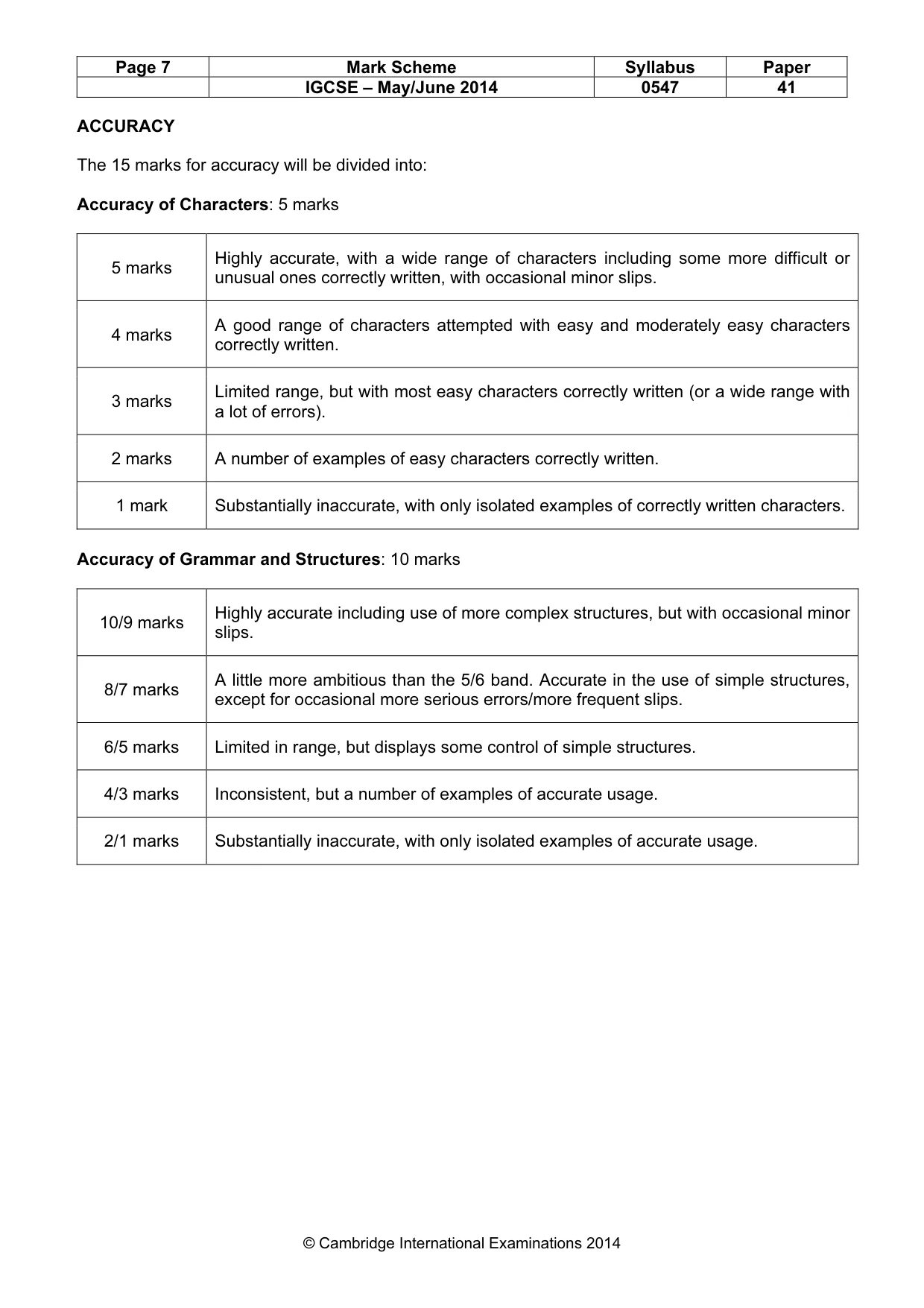
Page 7 Mark Scheme Syllabus Paper IGCSE – May/June 2014 0547 41 © Cambridge International Examinations 2014 ACCURACY The 15 marks for accuracy will be divided into: Accuracy of Characters: 5 marks 5 marks Highly accurate, with a wide range of characters including some more difficult or unusual ones correctly written, with occasional minor slips. 4 marks A good range of characters attempted with easy and moderately easy characters correctly written. 3 marks Limited range, but with most easy characters correctly written (or a wide range with a lot of errors). 2 marks A number of examples of easy characters correctly written. 1 mark Substantially inaccurate, with only isolated examples of correctly written characters. Accuracy of Grammar and Structures: 10 marks 10/9 marks Highly accurate including use of more complex structures, but with occasional minor slips. 8/7 marks A little more ambitious than the 5/6 band. Accurate in the use of simple structures, except for occasional more serious errors/more frequent slips. 6/5 marks Limited in range, but displays some control of simple structures. 4/3 marks Inconsistent, but a number of examples of accurate usage. 2/1 marks Substantially inaccurate, with only isolated examples of accurate usage.
Mark scheme, page 8
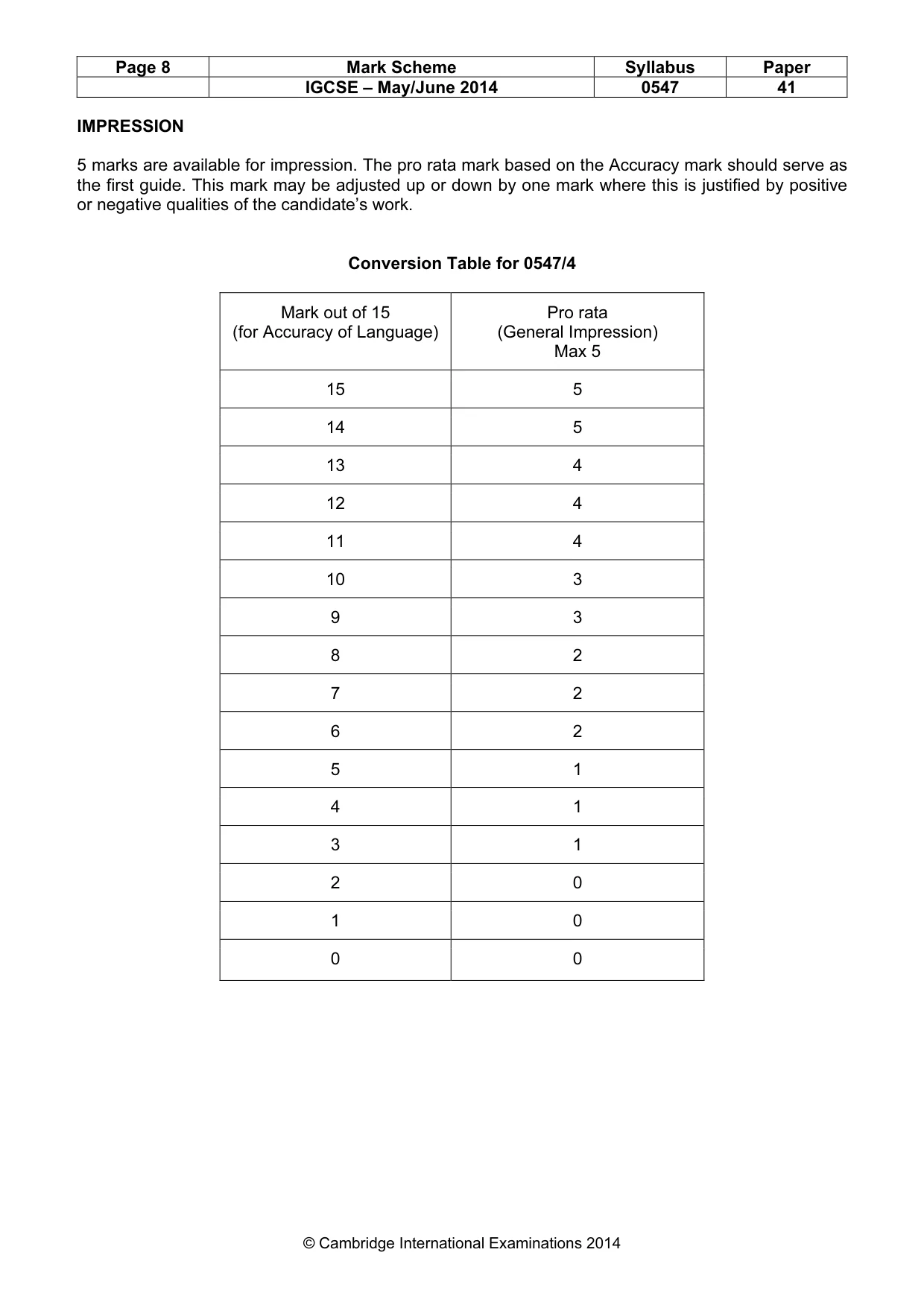
Page 8 Mark Scheme Syllabus Paper IGCSE – May/June 2014 0547 41 © Cambridge International Examinations 2014 IMPRESSION 5 marks are available for impression. The pro rata mark based on the Accuracy mark should serve as the first guide. This mark may be adjusted up or down by one mark where this is justified by positive or negative qualities of the candidate’s work. Conversion Table for 0547/4 Mark out of 15 (for Accuracy of Language) Pro rata (General Impression) Max 5 15 5 14 5 13 4 12 4 11 4 10 3 9 3 8 2 7 2 6 2 5 1 4 1 3 1 2 0 1 0 0 0