Cambridge IGCSE Chinese (Mandarin) - Foreign Language 0547 — 2006 May/June Paper 4 · Variant 1
0547/41/M/J/06 · 50 marks · ≈56 min
The question paper and its mark scheme, free to read here and free to download. This is Cambridge’s own paper, exactly as it was sat.
Question paper4 pages
Mark scheme3 pages
Answers below. Sit the paper first if you are practising.
Paper as text
Question paper, page 1
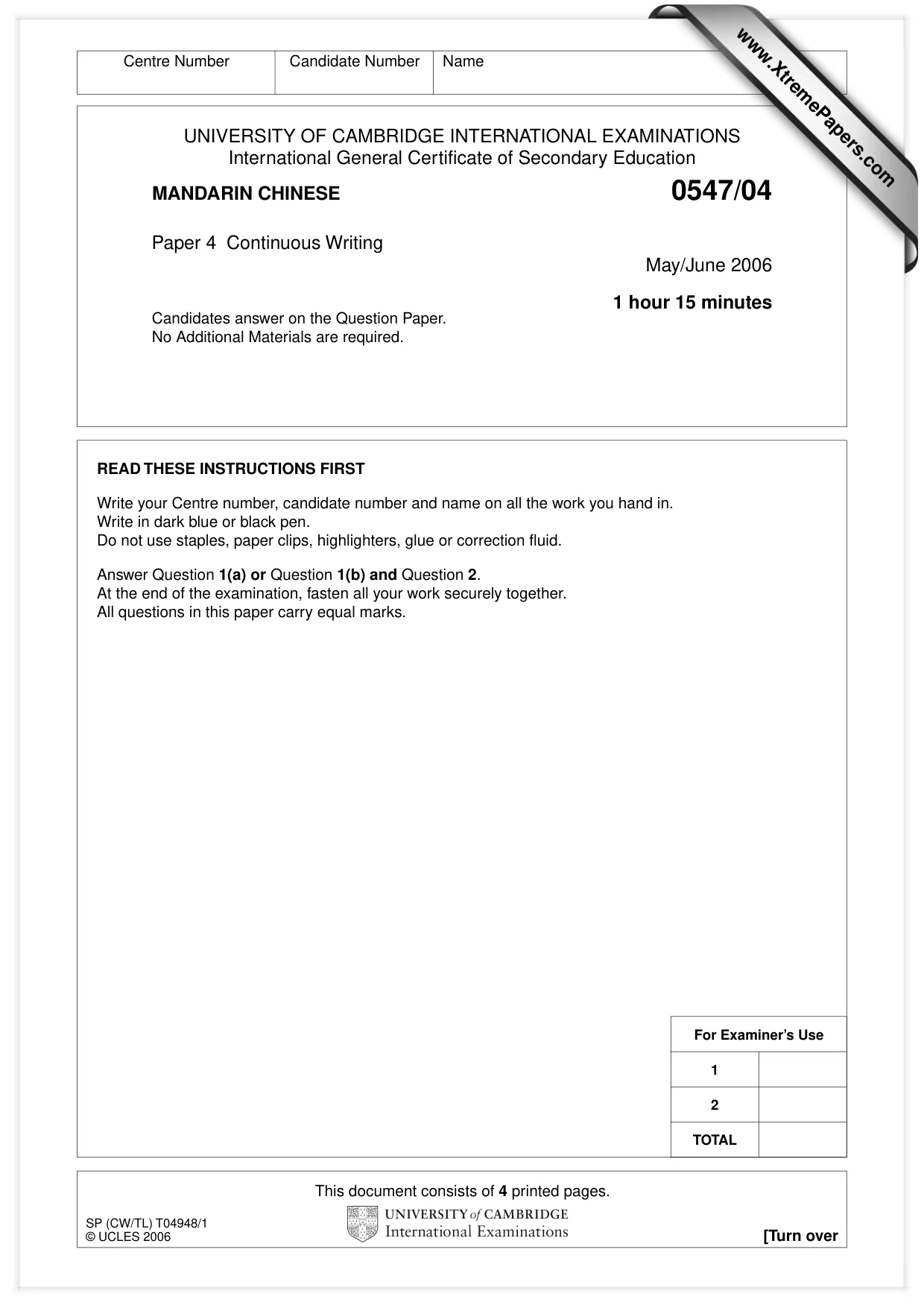
This document consists of 4 printed pages. SP (CW/TL) T04948/1 © UCLES 2006 [Turn over UNIVERSITY OF CAMBRIDGE INTERNATIONAL EXAMINATIONS International General Certificate of Secondary Education MANDARIN CHINESE 0547/04 Paper 4 Continuous Writing May/June 2006 1 hour 15 minutes Candidates answer on the Question Paper. No Additional Materials are required. READ THESE INSTRUCTIONS FIRST Write your Centre number, candidate number and name on all the work you hand in. Write in dark blue or black pen. Do not use staples, paper clips, highlighters, glue or correction fluid. Answer Question 1(a) or Question 1(b) and Question 2. At the end of the examination, fasten all your work securely together. All questions in this paper carry equal marks. Centre Number Candidate Number Name For Examiner’s Use 1 2 TOTAL www.XtremePapers.com
Question paper, page 2
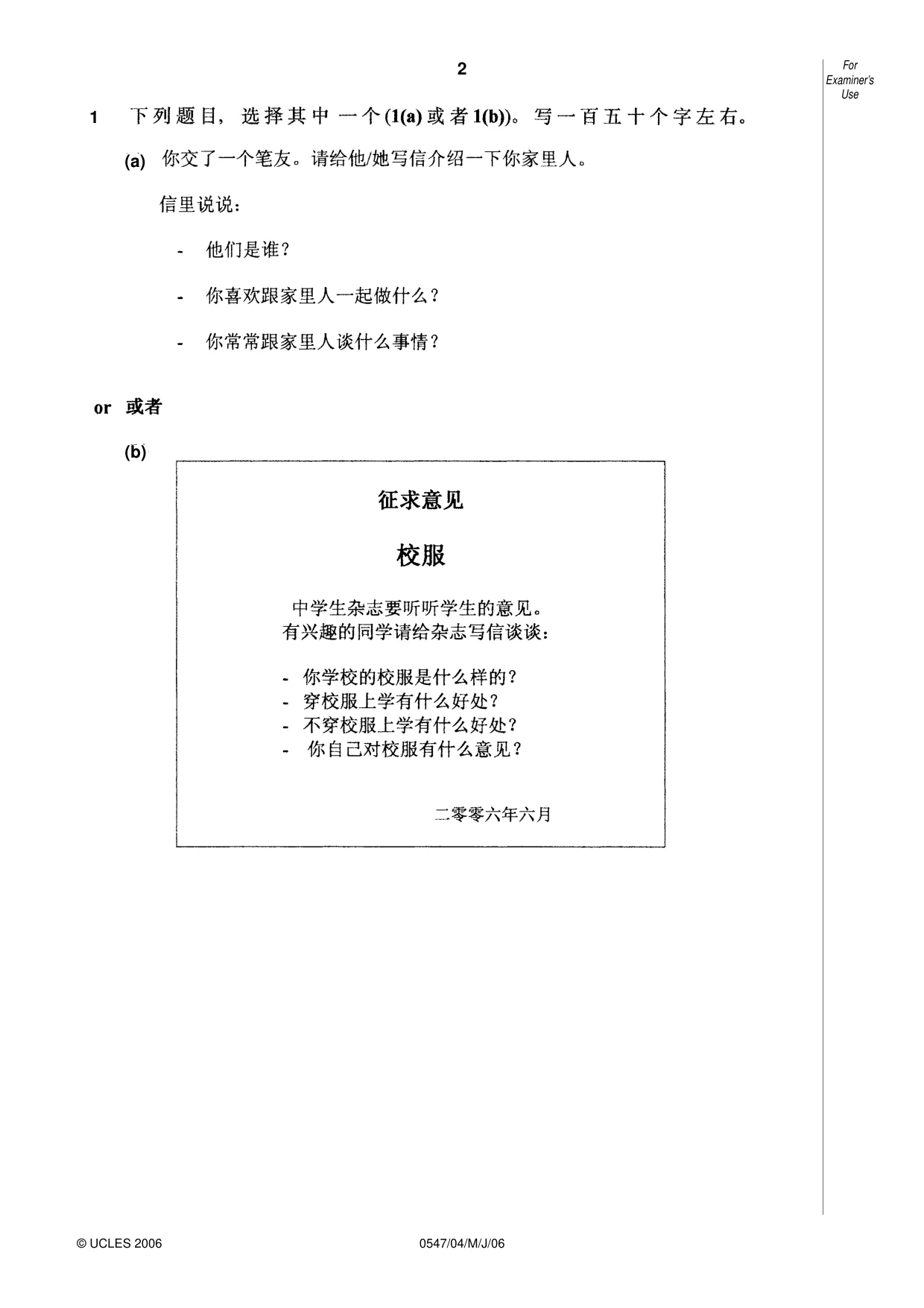
2 0547/04/M/J/06 For Examiner’s Use © UCLES 2006 1 (a) (b)
Question paper, page 3
3 0547/04/M/J/06 [Turn over For Examiner’s Use © UCLES 2006 Write your answer to Question 1 here. … … … … … … … … … … … … … … … … … … … … … … … … … … …
Question paper, page 4
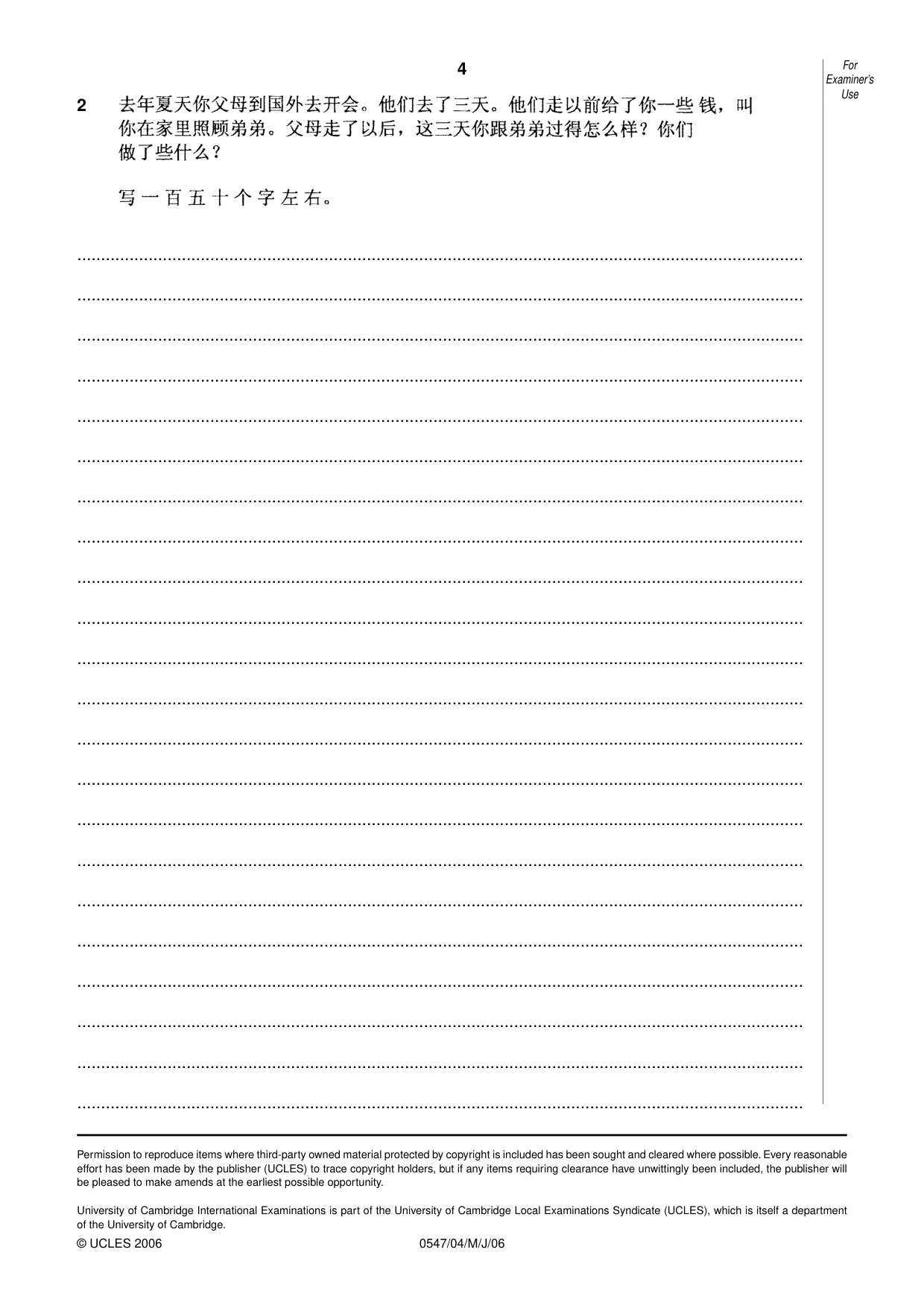
4 0547/04/M/J/06 © UCLES 2006 2 … … … … … … … … … … … … … … … … … … … … … … Permission to reproduce items where third-party owned material protected by copyright is included has been sought and cleared where possible. Every reasonable effort has been made by the publisher (UCLES) to trace copyright holders, but if any items requiring clearance have unwittingly been included, the publisher will be pleased to make amends at the earliest possible opportunity. University of Cambridge International Examinations is part of the University of Cambridge Local Examinations Syndicate (UCLES), which is itself a department of the University of Cambridge. For Examiner’s Use
Mark scheme, page 1
UNIVERSITY OF CAMBRIDGE INTERNATIONAL EXAMINATIONS International General Certificate of Secondary Education MARK SCHEME for the May/June 2006 question paper 0547 MANDARIN CHINESE (FOREIGN LANGUAGE) 0547/04 Paper 4, maximum raw mark 50 These mark schemes are published as an aid to teachers and students, to indicate the requirements of the examination. They show the basis on which Examiners were initially instructed to award marks. They do not indicate the details of the discussions that took place at an Examiners’ meeting before marking began. Any substantial changes to the mark scheme that arose from these discussions will be recorded in the published Report on the Examination. All Examiners are instructed that alternative correct answers and unexpected approaches in candidates’ scripts must be given marks that fairly reflect the relevant knowledge and skills demonstrated. Mark schemes must be read in conjunction with the question papers and the Report on the Examination. The minimum marks in these components needed for various grades were previously published with these mark schemes, but are now instead included in the Report on the Examination for this session. • CIE will not enter into discussion or correspondence in connection with these mark schemes. CIE is publishing the mark schemes for the May/June 2006 question papers for most IGCSE and GCE Advanced Level and Advanced Subsidiary Level syllabuses and some Ordinary Level syllabuses. www.XtremePapers.com
Mark scheme, page 2
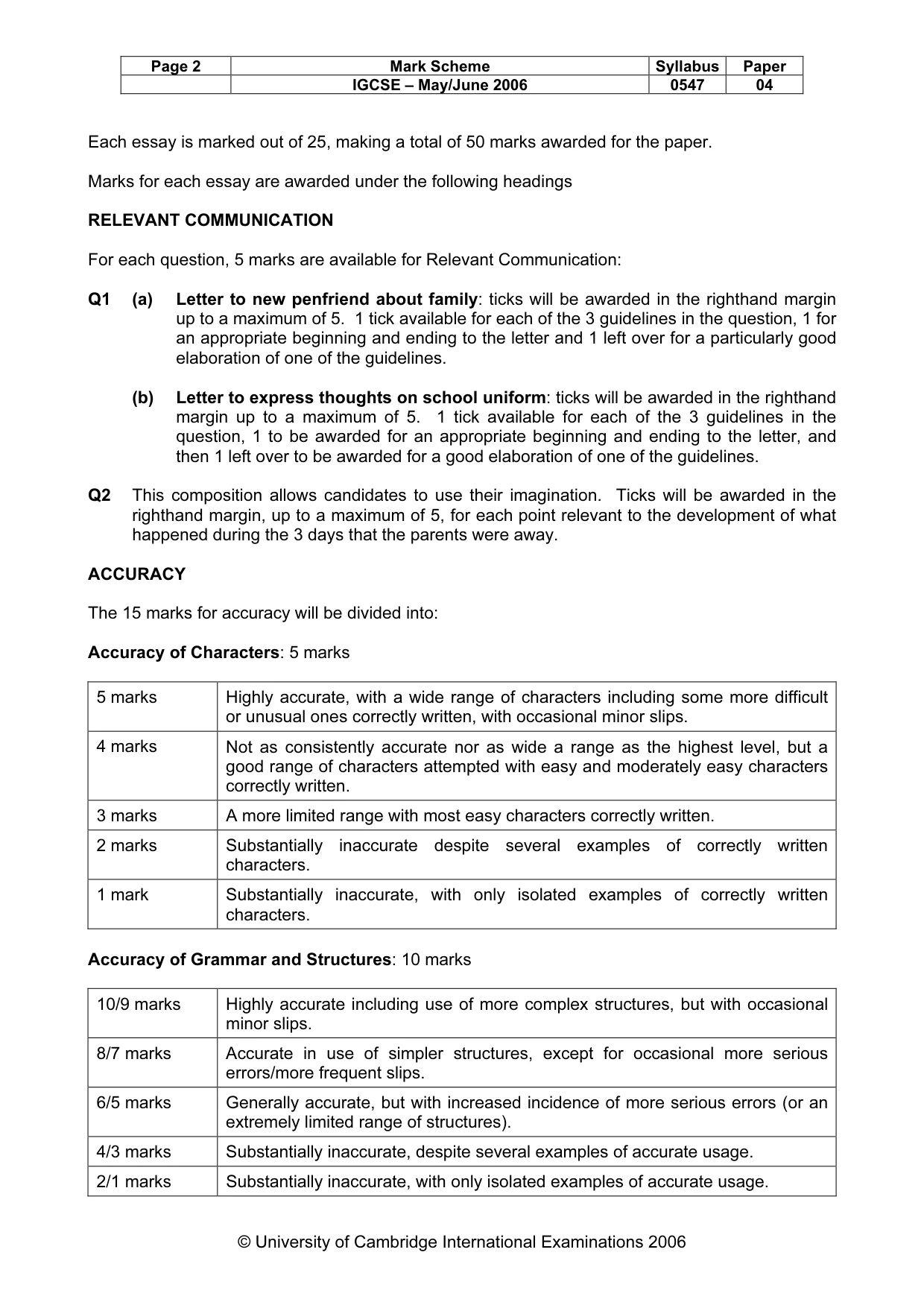
Page 2 Mark Scheme Syllabus Paper IGCSE – May/June 2006 0547 04 © University of Cambridge International Examinations 2006 Each essay is marked out of 25, making a total of 50 marks awarded for the paper. Marks for each essay are awarded under the following headings RELEVANT COMMUNICATION For each question, 5 marks are available for Relevant Communication: Q1 (a) Letter to new penfriend about family: ticks will be awarded in the righthand margin up to a maximum of 5. 1 tick available for each of the 3 guidelines in the question, 1 for an appropriate beginning and ending to the letter and 1 left over for a particularly good elaboration of one of the guidelines. (b) Letter to express thoughts on school uniform: ticks will be awarded in the righthand margin up to a maximum of 5. 1 tick available for each of the 3 guidelines in the question, 1 to be awarded for an appropriate beginning and ending to the letter, and then 1 left over to be awarded for a good elaboration of one of the guidelines. Q2 This composition allows candidates to use their imagination. Ticks will be awarded in the righthand margin, up to a maximum of 5, for each point relevant to the development of what happened during the 3 days that the parents were away. ACCURACY The 15 marks for accuracy will be divided into: Accuracy of Characters: 5 marks 5 marks Highly accurate, with a wide range of characters including some more difficult or unusual ones correctly written, with occasional minor slips. 4 marks Not as consistently accurate nor as wide a range as the highest level, but a good range of characters attempted with easy and moderately easy characters correctly written. 3 marks A more limited range with most easy characters correctly written. 2 marks Substantially inaccurate despite several examples of correctly written characters. 1 mark Substantially inaccurate, with only isolated examples of correctly written characters. Accuracy of Grammar and Structures: 10 marks 10/9 marks Highly accurate including use of more complex structures, but with occasional minor slips. 8/7 marks Accurate in use of simpler structures, except for occasional more serious errors/more frequent slips. 6/5 marks Generally accurate, but with increased incidence of more serious errors (or an extremely limited range of structures). 4/3 marks Substantially inaccurate, despite several examples of accurate usage. 2/1 marks Substantially inaccurate, with only isolated examples of accurate usage.
Mark scheme, page 3
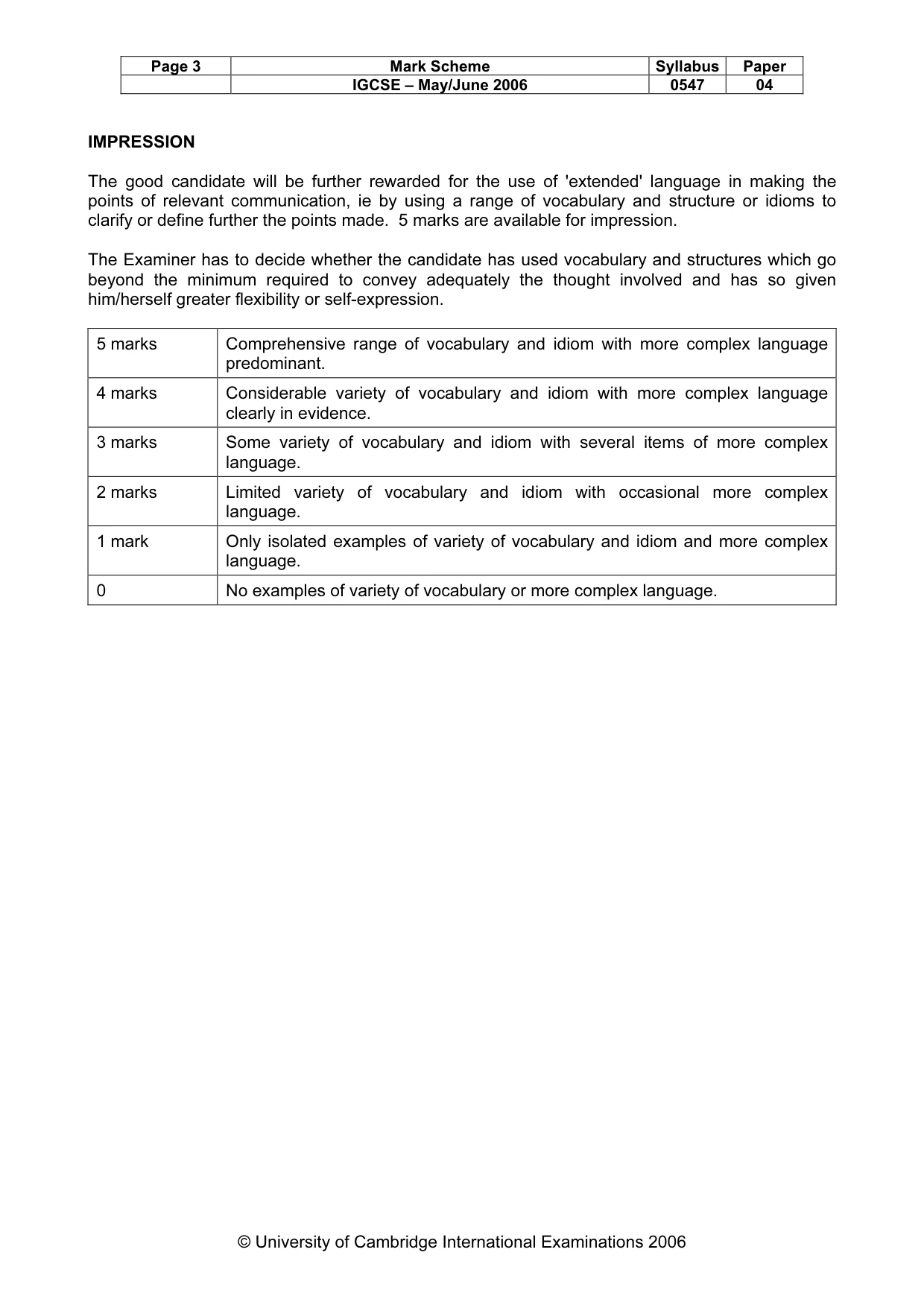
Page 3 Mark Scheme Syllabus Paper IGCSE – May/June 2006 0547 04 © University of Cambridge International Examinations 2006 IMPRESSION The good candidate will be further rewarded for the use of 'extended' language in making the points of relevant communication, ie by using a range of vocabulary and structure or idioms to clarify or define further the points made. 5 marks are available for impression. The Examiner has to decide whether the candidate has used vocabulary and structures which go beyond the minimum required to convey adequately the thought involved and has so given him/herself greater flexibility or self-expression. 5 marks Comprehensive range of vocabulary and idiom with more complex language predominant. 4 marks Considerable variety of vocabulary and idiom with more complex language clearly in evidence. 3 marks Some variety of vocabulary and idiom with several items of more complex language. 2 marks Limited variety of vocabulary and idiom with occasional more complex language. 1 mark Only isolated examples of variety of vocabulary and idiom and more complex language. 0 No examples of variety of vocabulary or more complex language.
What you needed in this session
Cambridge’s own grade thresholds for 2006 May/June, Paper 4 · Variant 1. A higher threshold means an easier paper — the bar moves with how the cohort did.