Cambridge IGCSE Chinese - First Language 0509 — 2023 May/June Paper 2 · Variant 2
0509/22/M/J/23 · 50 marks · ≈56 min
The question paper and its mark scheme, free to read here and free to download. This is Cambridge’s own paper, exactly as it was sat.
Question paper16 pages
Mark scheme10 pages
Answers below. Sit the paper first if you are practising.
Paper as text
Question paper, page 1
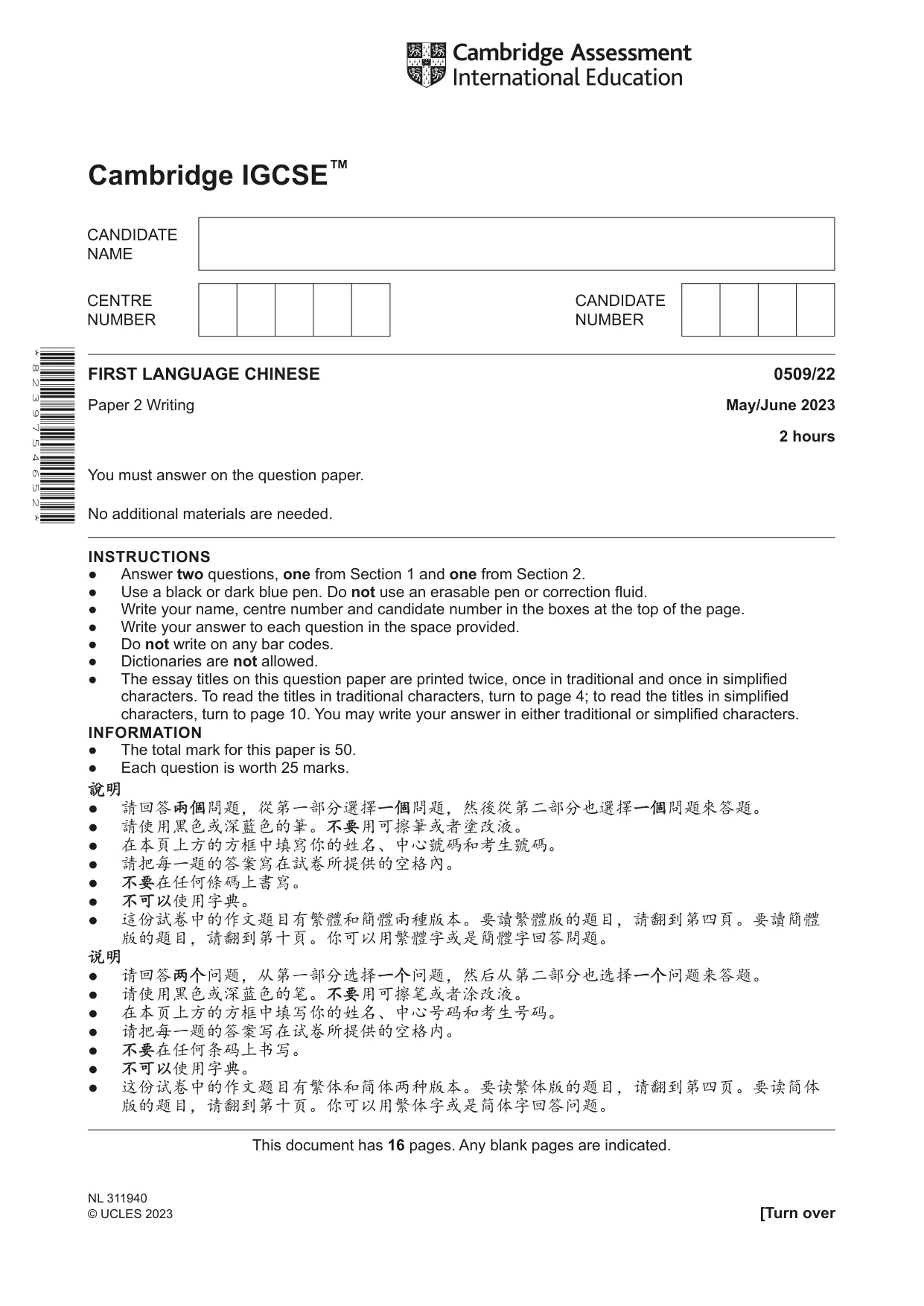
* 8 2 3 9 7 5 4 6 5 2 * This document has 16 pages. Any blank pages are indicated. NL 311940 © UCLES 2023 [Turn over Cambridge IGCSE™ FIRST LANGUAGE CHINESE 0509/22 Paper 2 Writing May/June 2023 2 hours You must answer on the question paper. No additional materials are needed. INSTRUCTIONS ● Answer two questions, one from Section 1 and one from Section 2. ● Use a black or dark blue pen. Do not use an erasable pen or correction fluid. ● Write your name, centre number and candidate number in the boxes at the top of the page. ● Write your answer to each question in the space provided. ● Do not write on any bar codes. ● Dictionaries are not allowed. ● The essay titles on this question paper are printed twice, once in traditional and once in simplified characters. To read the titles in traditional characters, turn to page 4; to read the titles in simplified characters, turn to page 10. You may write your answer in either traditional or simplified characters. INFORMATION ● The total mark for this paper is 50. ● Each question is worth 25 marks. 說明 說明 ● 請回答兩個 兩個問題,從第一部分選擇一個 一個問題,然後從第二部分也選擇一個 一個問題來答題。 ● 請使用黑色或深藍色的筆。不要 不要用可擦筆或者塗改液。 ● 在本頁上方的方框中填寫你的姓名、中心號碼和考生號碼。 ● 請把每一題的答案寫在試卷所提供的空格內。 ● 不要 不要在任何條碼上書寫。 ● 不可以 不可以使用字典。 ● 這份試卷中的作文題目有繁體和簡體兩種版本。要讀繁體版的題目,請翻到第四頁。要讀簡體 版的題目,請翻到第十頁。你可以用繁體字或是簡體字回答問題。 说明 说明 ● 请回答两个 两个问题,从第一部分选择一个 一个问题,然后从第二部分也选择一个 一个问题来答题。 ● 请使用黑色或深蓝色的笔。不要 不要用可擦笔或者涂改液。 ● 在本页上方的方框中填写你的姓名、中心号码和考生号码。 ● 请把每一题的答案写在试卷所提供的空格内。 ● 不要 不要在任何条码上书写。 ● 不可以 不可以使用字典。 ● 这份试卷中的作文题目有繁体和简体两种版本。要读繁体版的题目,请翻到第四页。要读简体 版的题目,请翻到第十页。你可以用繁体字或是简体字回答问题。
Question paper, page 2
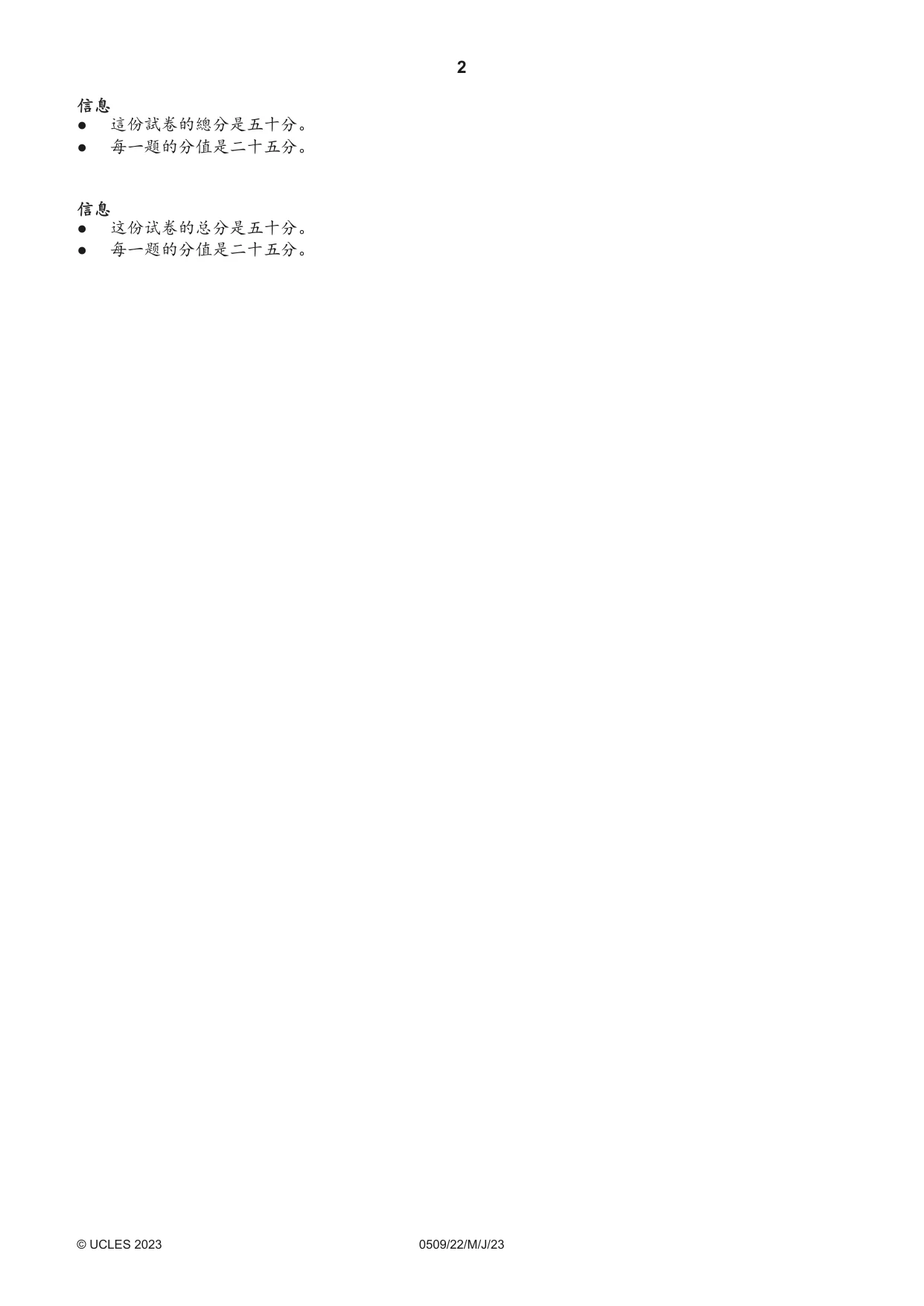
2 0509/22/M/J/23 © UCLES 2023 信息 信息 ● 這份試卷的總分是五十分。 ● 每一題的分值是二十五分。 信息 信息 ● 这份试卷的总分是五十分。 ● 每一题的分值是二十五分。
Question paper, page 3
3 0509/22/M/J/23 © UCLES 2023 [Turn over BLANK PAGE
Question paper, page 4
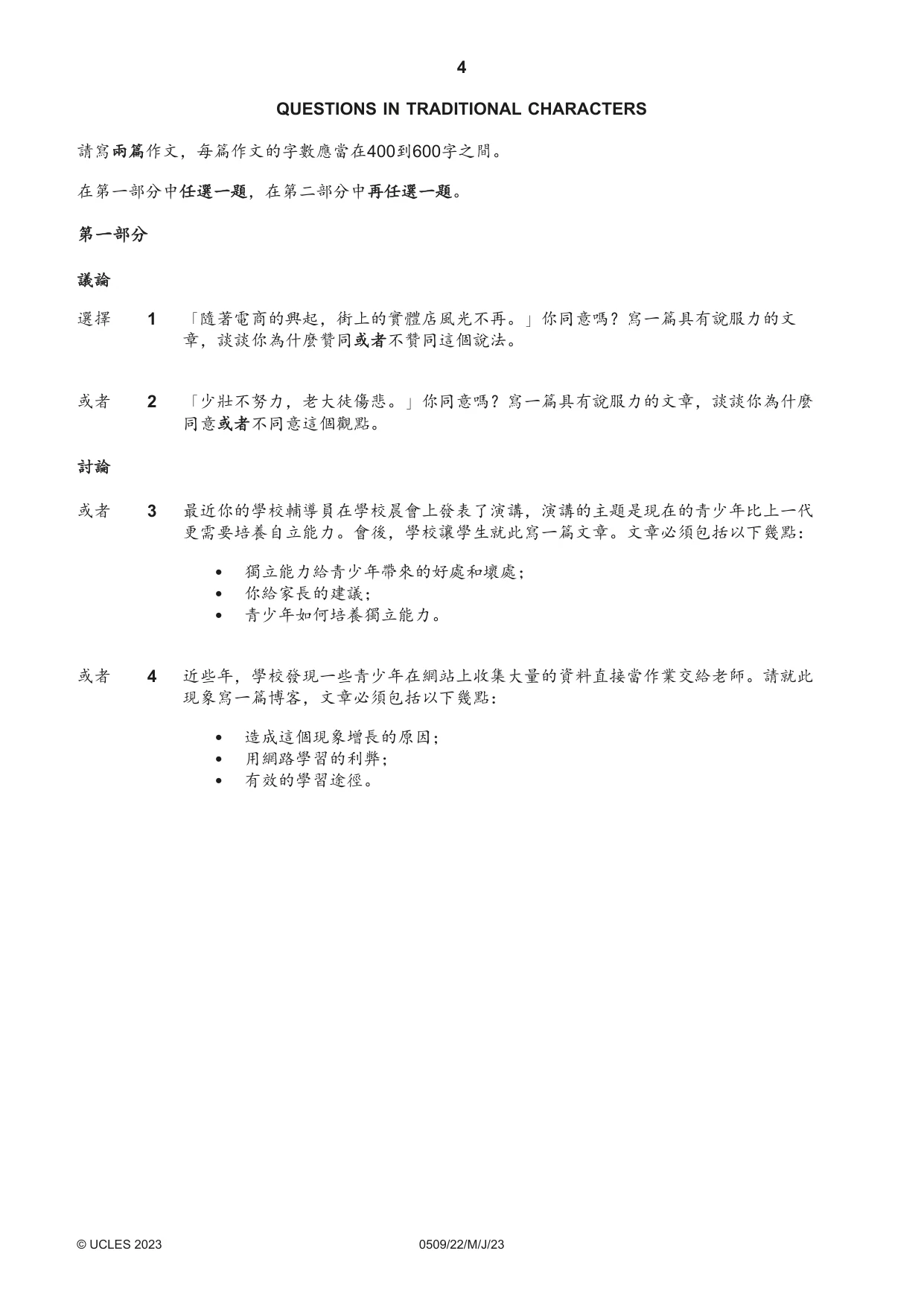
4 0509/22/M/J/23 © UCLES 2023 QUESTIONS IN TRADITIONAL CHARACTERS 請寫兩篇 兩篇作文,每篇作文的字數應當在400到600字之間。 在第一部分中任選一題 任選一題,在第二部分中再任選一題 再任選一題。 第一部分 第一部分 議論 議論 選擇 1 「隨著電商的興起,街上的實體店風光不再。」你同意嗎?寫一篇具有說服力的文 章,談談你為什麼贊同或者 或者不贊同這個說法。 或者 2 「少壯不努力,老大徒傷悲。」你同意嗎?寫一篇具有說服力的文章,談談你為什麼 同意或者 或者不同意這個觀點。 討論 討論 或者 3 最近你的學校輔導員在學校晨會上發表了演講,演講的主題是現在的青少年比上一代 更需要培養自立能力。會後,學校讓學生就此寫一篇文章。文章必須包括以下幾點: • 獨立能力給青少年帶來的好處和壞處; • 你給家長的建議; • 青少年如何培養獨立能力。 或者 4 近些年,學校發現一些青少年在網站上收集大量的資料直接當作業交給老師。請就此 現象寫一篇博客,文章必須包括以下幾點: • 造成這個現象增長的原因; • 用網路學習的利弊; • 有效的學習途徑。
Question paper, page 5
5 0509/22/M/J/23 © UCLES 2023 [Turn over 100 200 300 400 請把所選題號寫在這裡並作答…
Question paper, page 6
6 0509/22/M/J/23 © UCLES 2023 500 600 700 800
Question paper, page 7
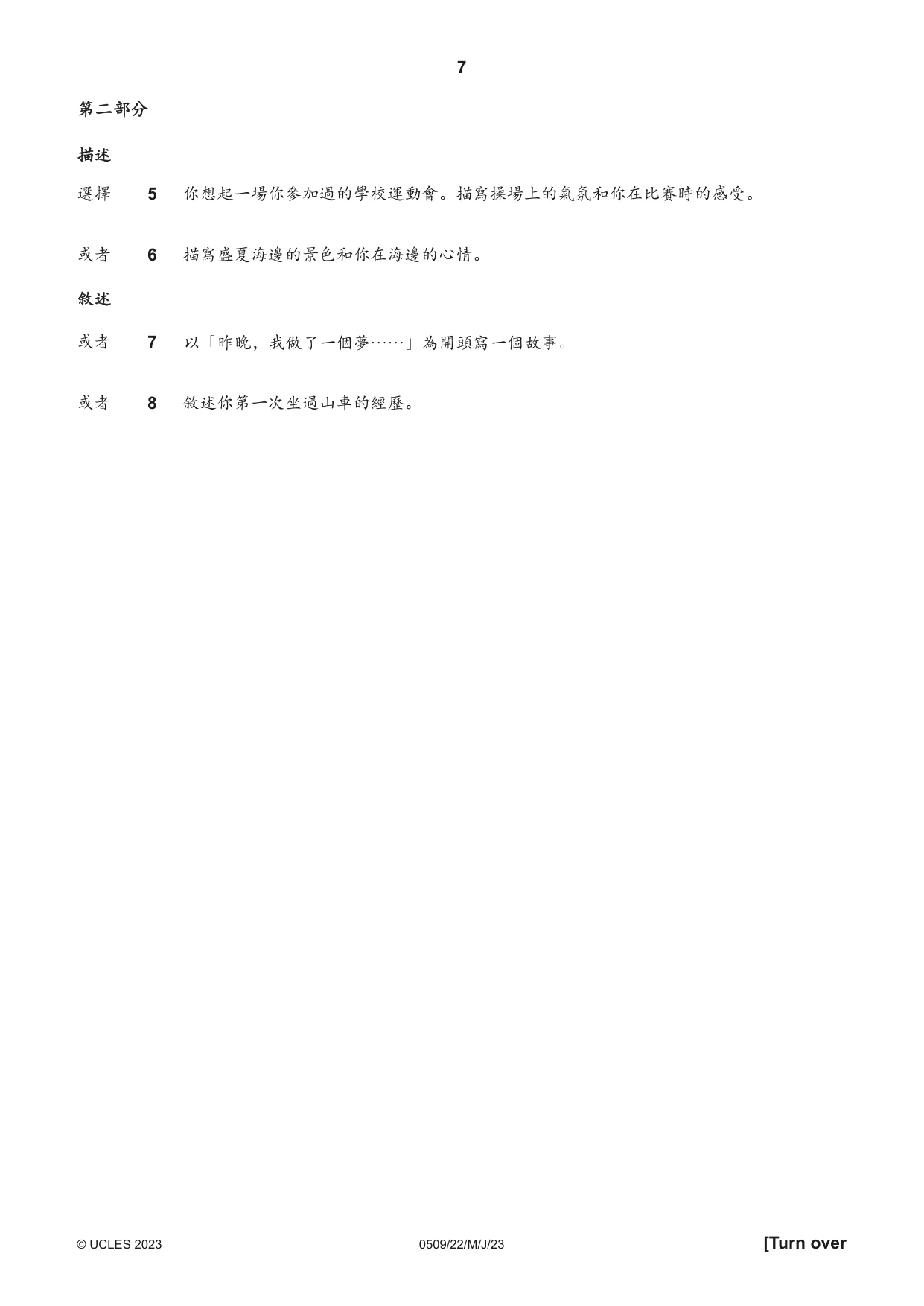
7 0509/22/M/J/23 © UCLES 2023 [Turn over 第二部分 第二部分 描述 描述 選擇 5 你想起一場你參加過的學校運動會。描寫操場上的氣氛和你在比賽時的感受。 或者 6 描寫盛夏海邊的景色和你在海邊的心情。 敘述 敘述 或者 7 以「昨晚,我做了一個夢……」為開頭寫一個故事。 或者 8 敘述你第一次坐過山車的經歷。
Question paper, page 8
8 0509/22/M/J/23 © UCLES 2023 100 200 300 400 請把所選題號寫在這裡並作答…
Question paper, page 9
9 0509/22/M/J/23 © UCLES 2023 [Turn over 500 600 700 800
Question paper, page 10
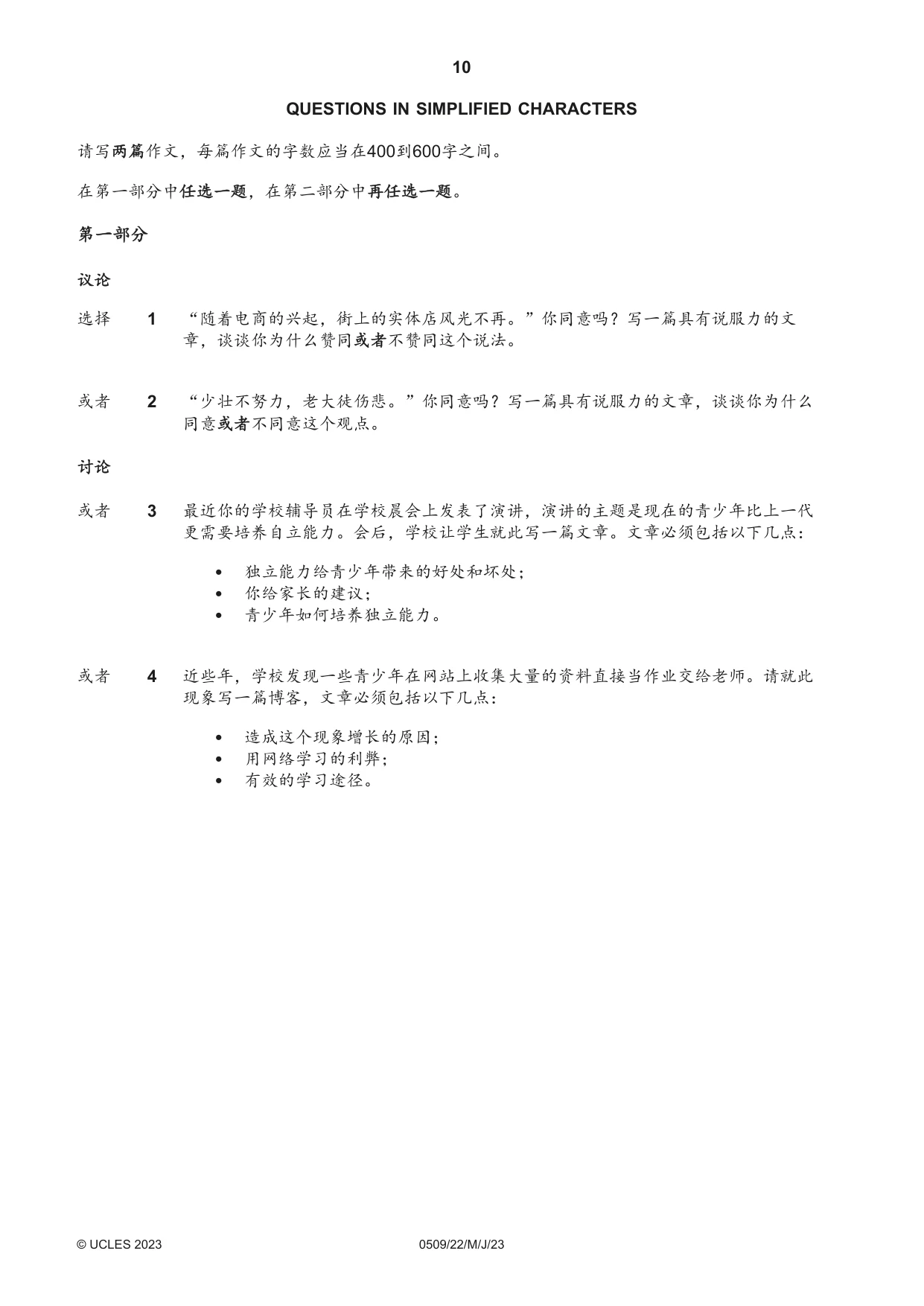
10 0509/22/M/J/23 © UCLES 2023 QUESTIONS IN SIMPLIFIED CHARACTERS 请写两篇 两篇作文,每篇作文的字数应当在400到600字之间。 在第一部分中任选一题 任选一题,在第二部分中再任选一题 再任选一题。 第一部分 第一部分 议论 议论 选择 1 “随着电商的兴起,街上的实体店风光不再。”你同意吗?写一篇具有说服力的文 章,谈谈你为什么赞同或者 或者不赞同这个说法。 或者 2 “少壮不努力,老大徒伤悲。”你同意吗?写一篇具有说服力的文章,谈谈你为什么 同意或者 或者不同意这个观点。 讨论 讨论 或者 3 最近你的学校辅导员在学校晨会上发表了演讲,演讲的主题是现在的青少年比上一代 更需要培养自立能力。会后,学校让学生就此写一篇文章。文章必须包括以下几点: • 独立能力给青少年带来的好处和坏处; • 你给家长的建议; • 青少年如何培养独立能力。 或者 4 近些年,学校发现一些青少年在网站上收集大量的资料直接当作业交给老师。请就此 现象写一篇博客,文章必须包括以下几点: • 造成这个现象增长的原因; • 用网络学习的利弊; • 有效的学习途径。
Question paper, page 11
11 0509/22/M/J/23 © UCLES 2023 [Turn over 100 200 300 400 请把所选题号写在这里并作答…
Question paper, page 12
12 0509/22/M/J/23 © UCLES 2023 500 600 700 800
Question paper, page 13
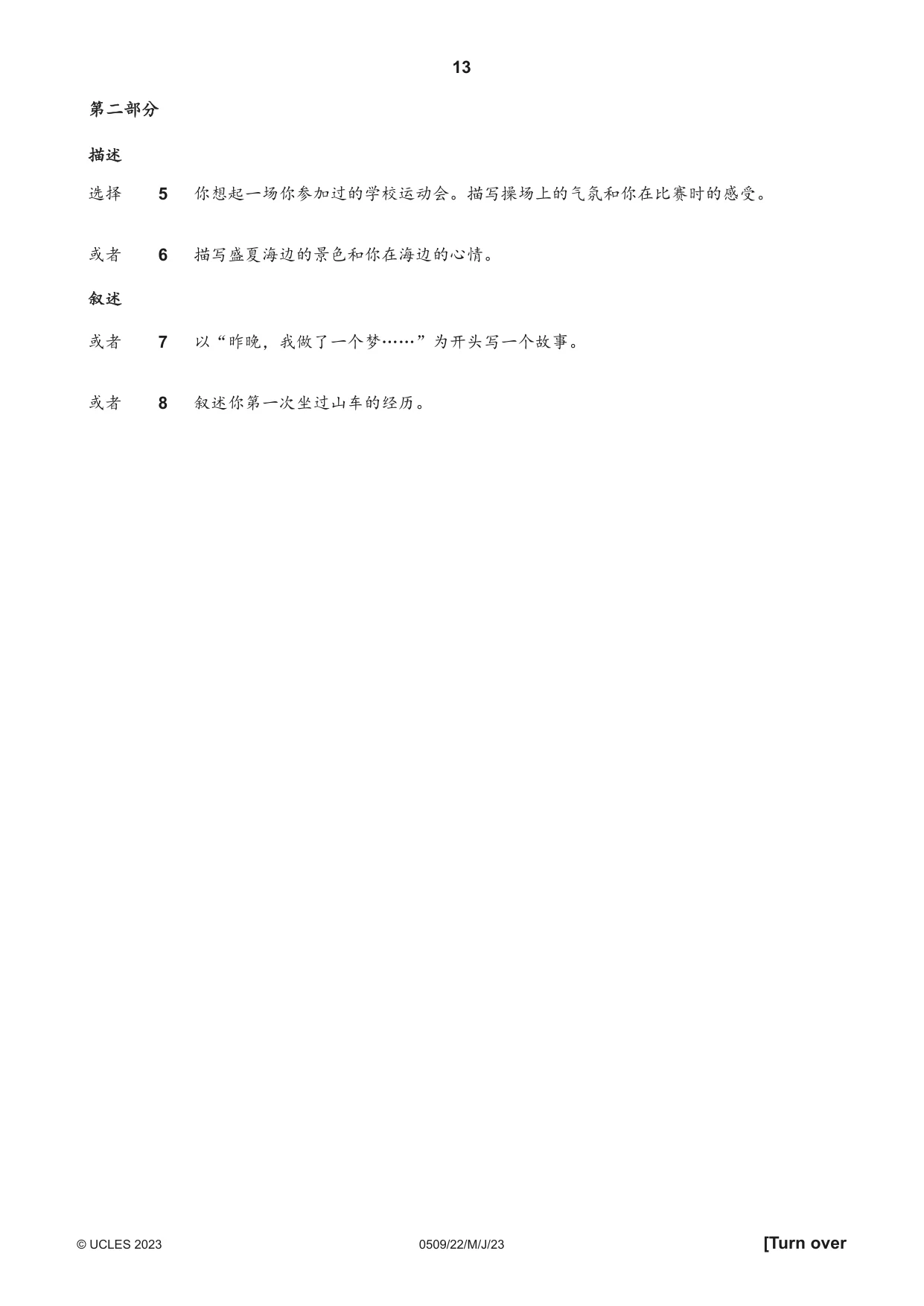
13 0509/22/M/J/23 © UCLES 2023 [Turn over 第二部分 第二部分 描述 描述 选择 5 你想起一场你参加过的学校运动会。描写操场上的气氛和你在比赛时的感受。 或者 6 描写盛夏海边的景色和你在海边的心情。 叙述 叙述 或者 7 以“昨晚,我做了一个梦……”为开头写一个故事。 或者 8 叙述你第一次坐过山车的经历。
Question paper, page 14
14 0509/22/M/J/23 © UCLES 2023 100 200 300 400 请把所选题号写在这里并作答…
Question paper, page 15
15 0509/22/M/J/23 © UCLES 2023 500 600 700 800
Question paper, page 16
16 0509/22/M/J/23 © UCLES 2023 Permission to reproduce items where third-party owned material protected by copyright is included has been sought and cleared where possible. Every reasonable effort has been made by the publisher (UCLES) to trace copyright holders, but if any items requiring clearance have unwittingly been included, the publisher will be pleased to make amends at the earliest possible opportunity. To avoid the issue of disclosure of answer-related information to candidates, all copyright acknowledgements are reproduced online in the Cambridge Assessment International Education Copyright Acknowledgements Booklet. This is produced for each series of examinations and is freely available to download at www.cambridgeinternational.org after the live examination series. Cambridge Assessment International Education is part of Cambridge Assessment. Cambridge Assessment is the brand name of the University of Cambridge Local Examinations Syndicate (UCLES), which is a department of the University of Cambridge. BLANK PAGE
Mark scheme, page 1
This document consists of 10 printed pages. © UCLES 2023 [Turn over Cambridge IGCSE™ FIRST LANGUAGE CHINESE 0509/22 Paper 2 Writing May/June 2023 MARK SCHEME Maximum Mark: 50 Published This mark scheme is published as an aid to teachers and candidates, to indicate the requirements of the examination. It shows the basis on which Examiners were instructed to award marks. It does not indicate the details of the discussions that took place at an Examiners’ meeting before marking began, which would have considered the acceptability of alternative answers. Mark schemes should be read in conjunction with the question paper and the Principal Examiner Report for Teachers. Cambridge International will not enter into discussions about these mark schemes. Cambridge International is publishing the mark schemes for the May/June 2023 series for most Cambridge IGCSE, Cambridge International A and AS Level and Cambridge Pre-U components, and some Cambridge O Level components.
Mark scheme, page 2
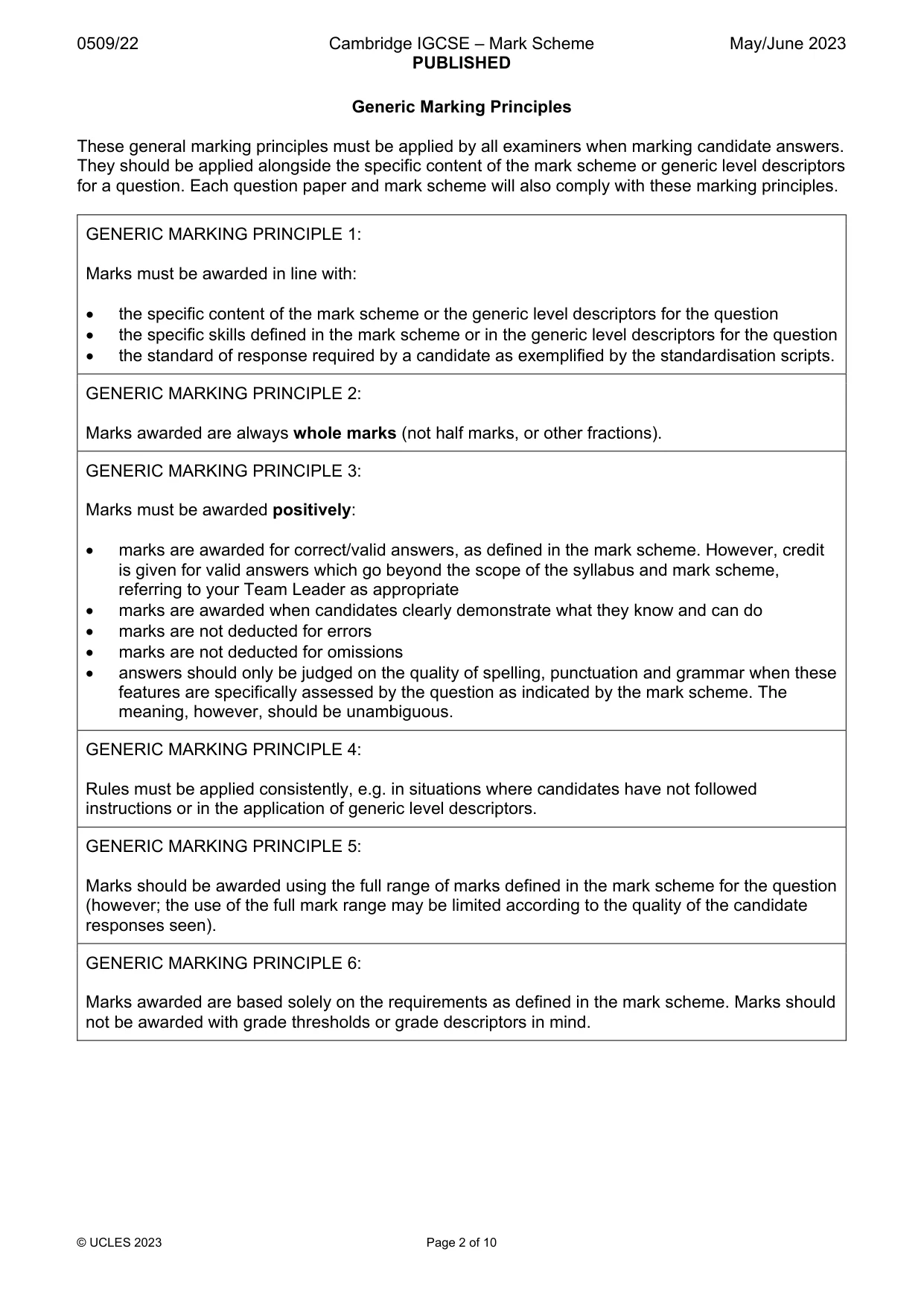
0509/22 Cambridge IGCSE – Mark Scheme PUBLISHED May/June 2023 © UCLES 2023 Page 2 of 10 Generic Marking Principles These general marking principles must be applied by all examiners when marking candidate answers. They should be applied alongside the specific content of the mark scheme or generic level descriptors for a question. Each question paper and mark scheme will also comply with these marking principles. GENERIC MARKING PRINCIPLE 1: Marks must be awarded in line with: the specific content of the mark scheme or the generic level descriptors for the question the specific skills defined in the mark scheme or in the generic level descriptors for the question the standard of response required by a candidate as exemplified by the standardisation scripts. GENERIC MARKING PRINCIPLE 2: Marks awarded are always whole marks (not half marks, or other fractions). GENERIC MARKING PRINCIPLE 3: Marks must be awarded positively: marks are awarded for correct/valid answers, as defined in the mark scheme. However, credit is given for valid answers which go beyond the scope of the syllabus and mark scheme, referring to your Team Leader as appropriate marks are awarded when candidates clearly demonstrate what they know and can do marks are not deducted for errors marks are not deducted for omissions answers should only be judged on the quality of spelling, punctuation and grammar when these features are specifically assessed by the question as indicated by the mark scheme. The meaning, however, should be unambiguous. GENERIC MARKING PRINCIPLE 4: Rules must be applied consistently, e.g. in situations where candidates have not followed instructions or in the application of generic level descriptors. GENERIC MARKING PRINCIPLE 5: Marks should be awarded using the full range of marks defined in the mark scheme for the question (however; the use of the full mark range may be limited according to the quality of the candidate responses seen). GENERIC MARKING PRINCIPLE 6: Marks awarded are based solely on the requirements as defined in the mark scheme. Marks should not be awarded with grade thresholds or grade descriptors in mind.
Mark scheme, page 3
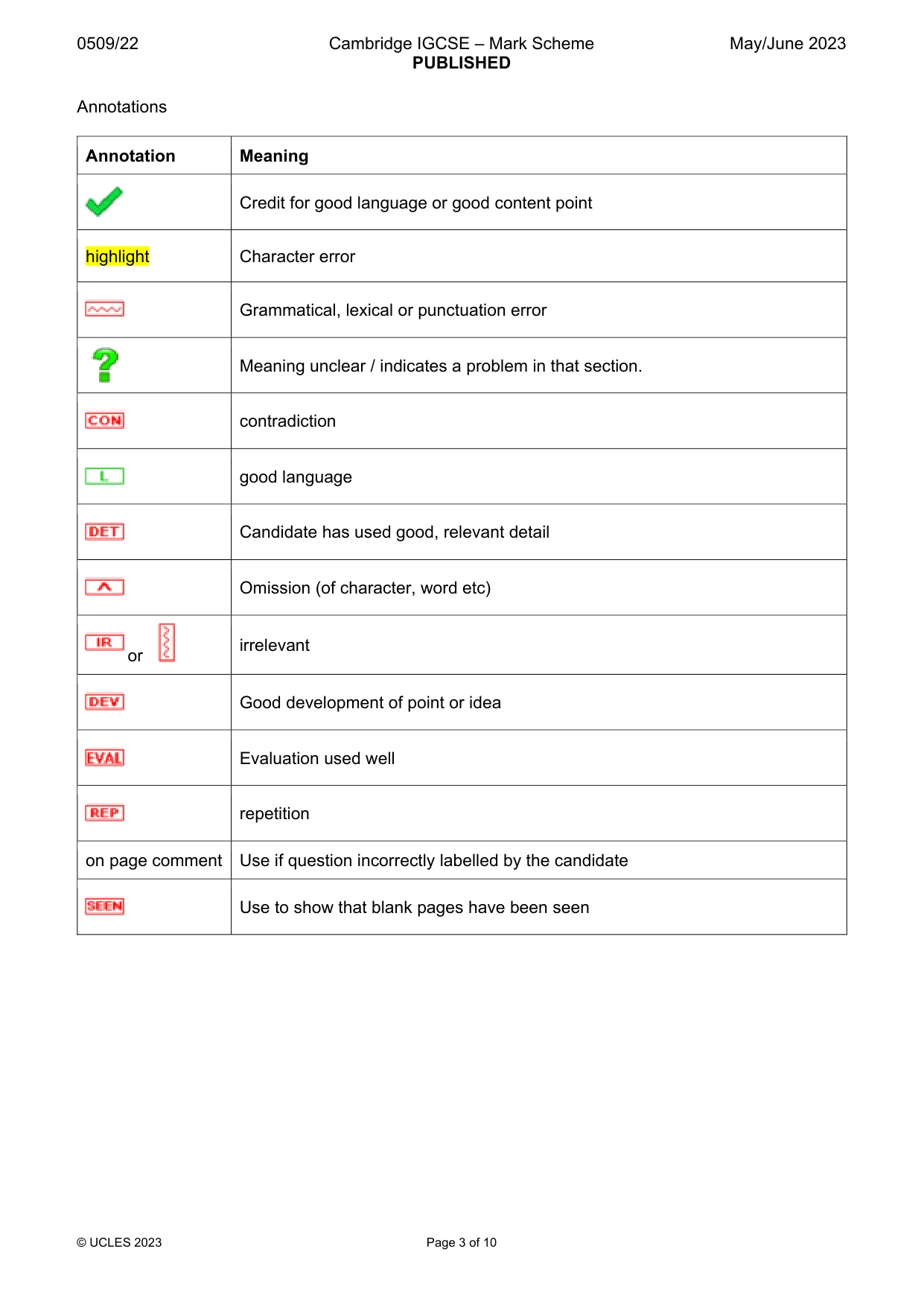
0509/22 Cambridge IGCSE – Mark Scheme PUBLISHED May/June 2023 © UCLES 2023 Page 3 of 10 Annotations Annotation Meaning Credit for good language or good content point highlight Character error Grammatical, lexical or punctuation error Meaning unclear / indicates a problem in that section. contradiction good language Candidate has used good, relevant detail Omission (of character, word etc) or irrelevant Good development of point or idea Evaluation used well repetition on page comment Use if question incorrectly labelled by the candidate Use to show that blank pages have been seen
Mark scheme, page 4
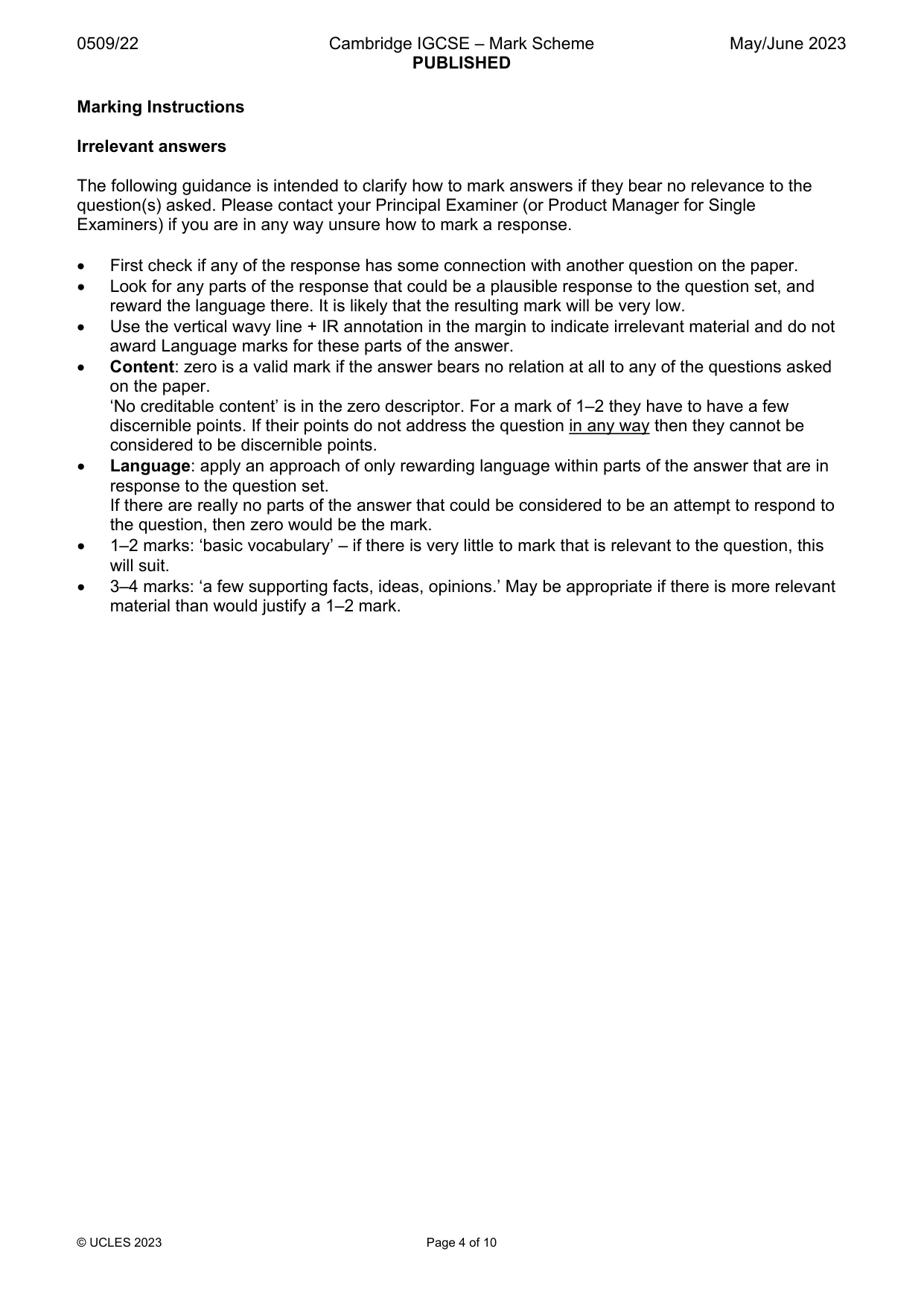
0509/22 Cambridge IGCSE – Mark Scheme PUBLISHED May/June 2023 © UCLES 2023 Page 4 of 10 Marking Instructions Irrelevant answers The following guidance is intended to clarify how to mark answers if they bear no relevance to the question(s) asked. Please contact your Principal Examiner (or Product Manager for Single Examiners) if you are in any way unsure how to mark a response. First check if any of the response has some connection with another question on the paper. Look for any parts of the response that could be a plausible response to the question set, and reward the language there. It is likely that the resulting mark will be very low. Use the vertical wavy line + IR annotation in the margin to indicate irrelevant material and do not award Language marks for these parts of the answer. Content: zero is a valid mark if the answer bears no relation at all to any of the questions asked on the paper. ‘No creditable content’ is in the zero descriptor. For a mark of 1–2 they have to have a few discernible points. If their points do not address the question in any way then they cannot be considered to be discernible points. Language: apply an approach of only rewarding language within parts of the answer that are in response to the question set. If there are really no parts of the answer that could be considered to be an attempt to respond to the question, then zero would be the mark. 1–2 marks: ‘basic vocabulary’ – if there is very little to mark that is relevant to the question, this will suit. 3–4 marks: ‘a few supporting facts, ideas, opinions.’ May be appropriate if there is more relevant material than would justify a 1–2 mark.
Mark scheme, page 5
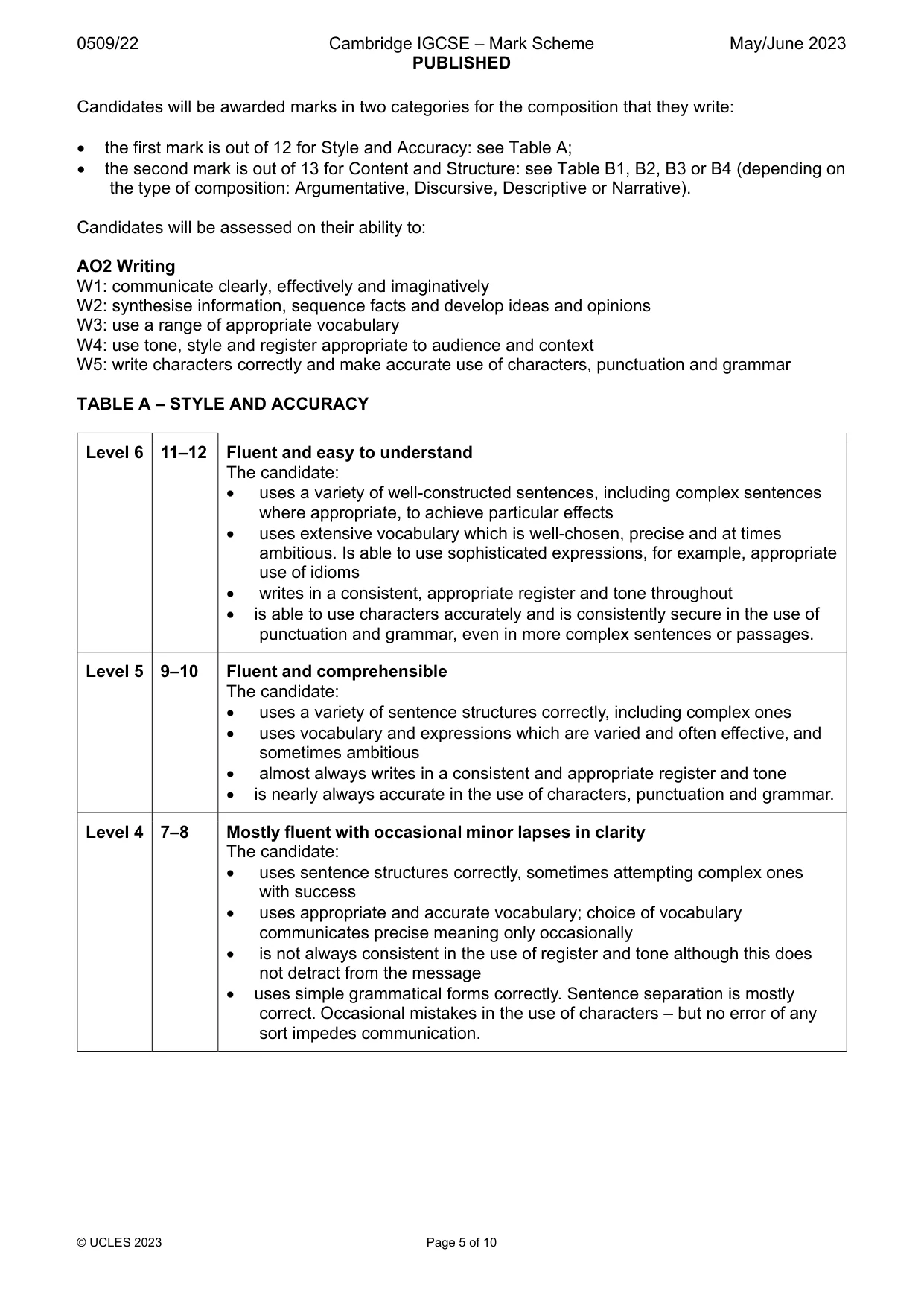
0509/22 Cambridge IGCSE – Mark Scheme PUBLISHED May/June 2023 © UCLES 2023 Page 5 of 10 Candidates will be awarded marks in two categories for the composition that they write: the first mark is out of 12 for Style and Accuracy: see Table A; the second mark is out of 13 for Content and Structure: see Table B1, B2, B3 or B4 (depending on the type of composition: Argumentative, Discursive, Descriptive or Narrative). Candidates will be assessed on their ability to: AO2 Writing W1: communicate clearly, effectively and imaginatively W2: synthesise information, sequence facts and develop ideas and opinions W3: use a range of appropriate vocabulary W4: use tone, style and register appropriate to audience and context W5: write characters correctly and make accurate use of characters, punctuation and grammar TABLE A – STYLE AND ACCURACY Level 6 11–12 Fluent and easy to understand The candidate: uses a variety of well-constructed sentences, including complex sentences where appropriate, to achieve particular effects uses extensive vocabulary which is well-chosen, precise and at times ambitious. Is able to use sophisticated expressions, for example, appropriate use of idioms writes in a consistent, appropriate register and tone throughout is able to use characters accurately and is consistently secure in the use of punctuation and grammar, even in more complex sentences or passages. Level 5 9–10 Fluent and comprehensible The candidate: uses a variety of sentence structures correctly, including complex ones uses vocabulary and expressions which are varied and often effective, and sometimes ambitious almost always writes in a consistent and appropriate register and tone is nearly always accurate in the use of characters, punctuation and grammar. Level 4 7–8 Mostly fluent with occasional minor lapses in clarity The candidate: uses sentence structures correctly, sometimes attempting complex ones with success uses appropriate and accurate vocabulary; choice of vocabulary communicates precise meaning only occasionally is not always consistent in the use of register and tone although this does not detract from the message uses simple grammatical forms correctly. Sentence separation is mostly correct. Occasional mistakes in the use of characters – but no error of any sort impedes communication.
Mark scheme, page 6
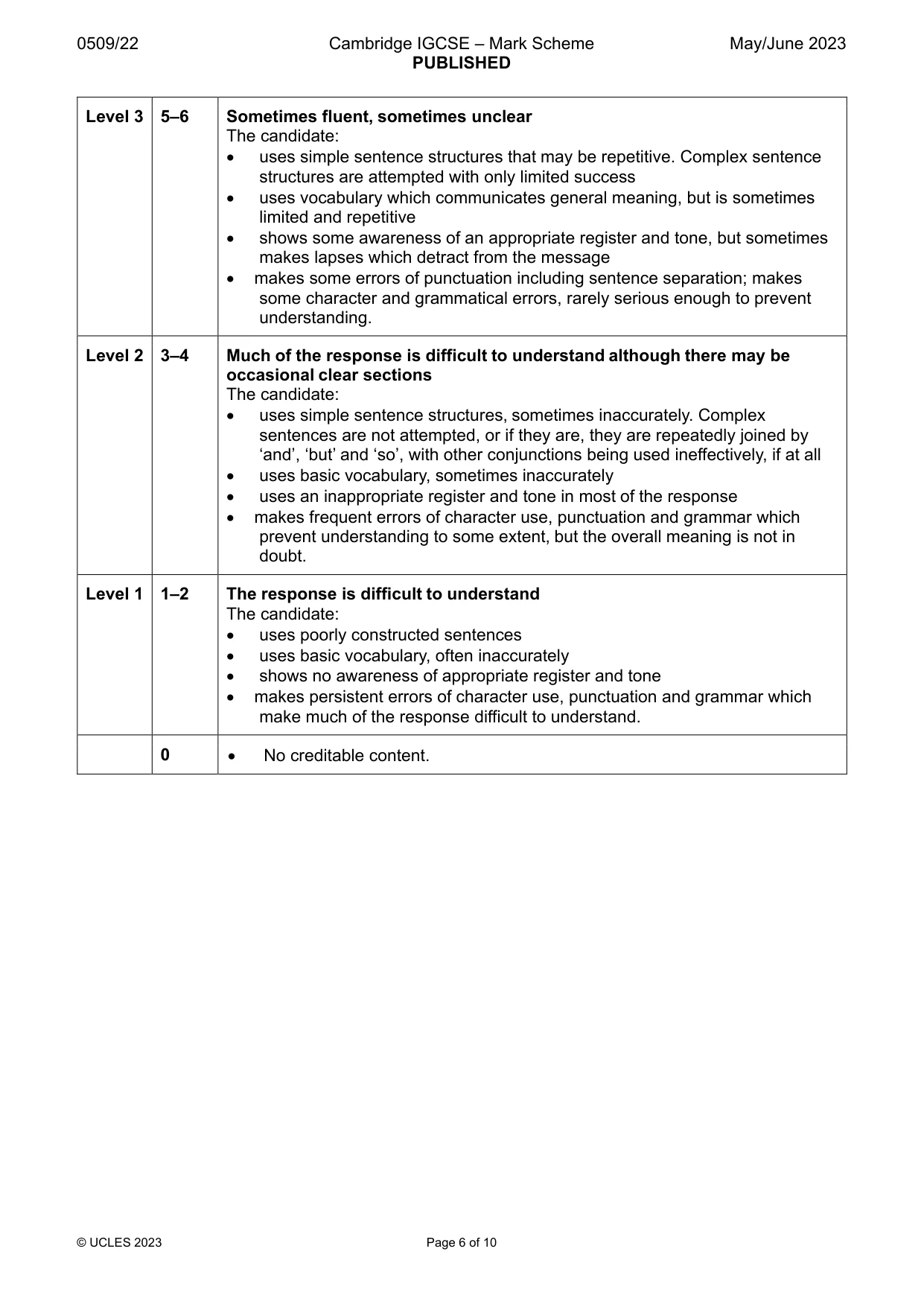
0509/22 Cambridge IGCSE – Mark Scheme PUBLISHED May/June 2023 © UCLES 2023 Page 6 of 10 Level 3 5–6 Sometimes fluent, sometimes unclear The candidate: uses simple sentence structures that may be repetitive. Complex sentence structures are attempted with only limited success uses vocabulary which communicates general meaning, but is sometimes limited and repetitive shows some awareness of an appropriate register and tone, but sometimes makes lapses which detract from the message makes some errors of punctuation including sentence separation; makes some character and grammatical errors, rarely serious enough to prevent understanding. Level 2 3–4 Much of the response is difficult to understand although there may be occasional clear sections The candidate: uses simple sentence structures, sometimes inaccurately. Complex sentences are not attempted, or if they are, they are repeatedly joined by ‘and’, ‘but’ and ‘so’, with other conjunctions being used ineffectively, if at all uses basic vocabulary, sometimes inaccurately uses an inappropriate register and tone in most of the response makes frequent errors of character use, punctuation and grammar which prevent understanding to some extent, but the overall meaning is not in doubt. Level 1 1–2 The response is difficult to understand The candidate: uses poorly constructed sentences uses basic vocabulary, often inaccurately shows no awareness of appropriate register and tone makes persistent errors of character use, punctuation and grammar which make much of the response difficult to understand. 0 No creditable content.
Mark scheme, page 7
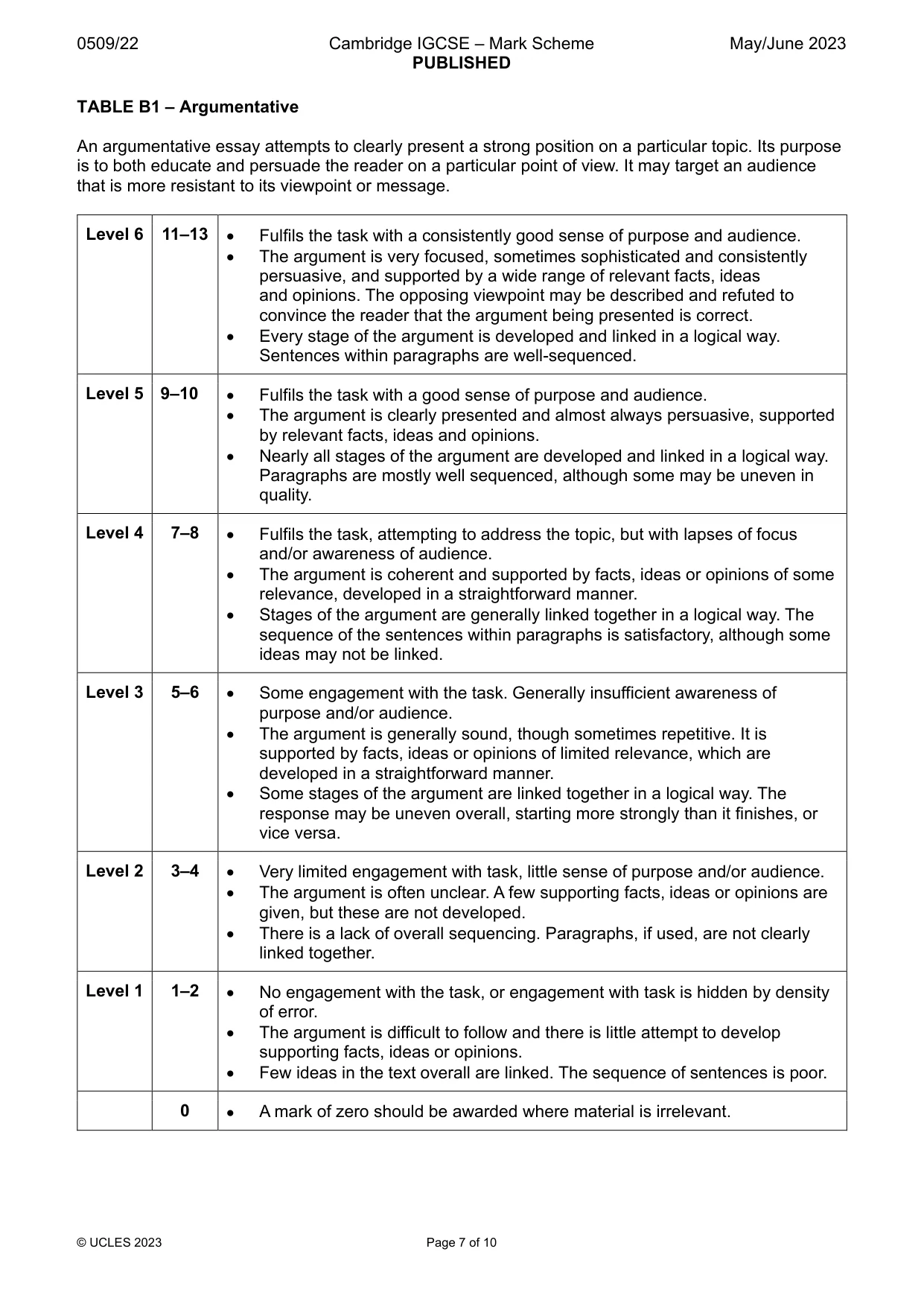
0509/22 Cambridge IGCSE – Mark Scheme PUBLISHED May/June 2023 © UCLES 2023 Page 7 of 10 TABLE B1 – Argumentative An argumentative essay attempts to clearly present a strong position on a particular topic. Its purpose is to both educate and persuade the reader on a particular point of view. It may target an audience that is more resistant to its viewpoint or message. Level 6 11–13 Fulfils the task with a consistently good sense of purpose and audience. The argument is very focused, sometimes sophisticated and consistently persuasive, and supported by a wide range of relevant facts, ideas and opinions. The opposing viewpoint may be described and refuted to convince the reader that the argument being presented is correct. Every stage of the argument is developed and linked in a logical way. Sentences within paragraphs are well-sequenced. Level 5 9–10 Fulfils the task with a good sense of purpose and audience. The argument is clearly presented and almost always persuasive, supported by relevant facts, ideas and opinions. Nearly all stages of the argument are developed and linked in a logical way. Paragraphs are mostly well sequenced, although some may be uneven in quality. Level 4 7–8 Fulfils the task, attempting to address the topic, but with lapses of focus and/or awareness of audience. The argument is coherent and supported by facts, ideas or opinions of some relevance, developed in a straightforward manner. Stages of the argument are generally linked together in a logical way. The sequence of the sentences within paragraphs is satisfactory, although some ideas may not be linked. Level 3 5–6 Some engagement with the task. Generally insufficient awareness of purpose and/or audience. The argument is generally sound, though sometimes repetitive. It is supported by facts, ideas or opinions of limited relevance, which are developed in a straightforward manner. Some stages of the argument are linked together in a logical way. The response may be uneven overall, starting more strongly than it finishes, or vice versa. Level 2 3–4 Very limited engagement with task, little sense of purpose and/or audience. The argument is often unclear. A few supporting facts, ideas or opinions are given, but these are not developed. There is a lack of overall sequencing. Paragraphs, if used, are not clearly linked together. Level 1 1–2 No engagement with the task, or engagement with task is hidden by density of error. The argument is difficult to follow and there is little attempt to develop supporting facts, ideas or opinions. Few ideas in the text overall are linked. The sequence of sentences is poor. 0 A mark of zero should be awarded where material is irrelevant.
Mark scheme, page 8
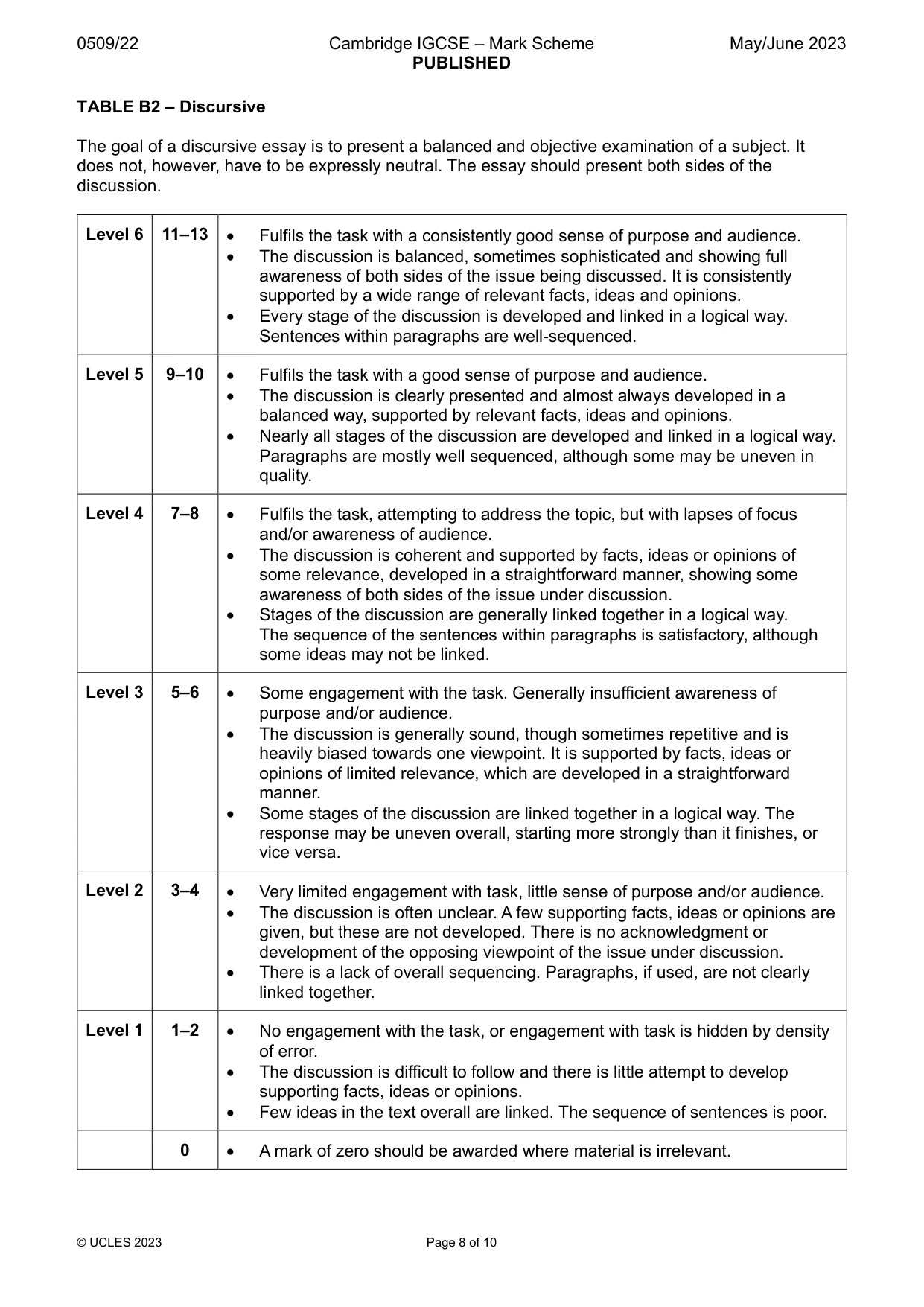
0509/22 Cambridge IGCSE – Mark Scheme PUBLISHED May/June 2023 © UCLES 2023 Page 8 of 10 TABLE B2 – Discursive The goal of a discursive essay is to present a balanced and objective examination of a subject. It does not, however, have to be expressly neutral. The essay should present both sides of the discussion. Level 6 11–13 Fulfils the task with a consistently good sense of purpose and audience. The discussion is balanced, sometimes sophisticated and showing full awareness of both sides of the issue being discussed. It is consistently supported by a wide range of relevant facts, ideas and opinions. Every stage of the discussion is developed and linked in a logical way. Sentences within paragraphs are well-sequenced. Level 5 9–10 Fulfils the task with a good sense of purpose and audience. The discussion is clearly presented and almost always developed in a balanced way, supported by relevant facts, ideas and opinions. Nearly all stages of the discussion are developed and linked in a logical way. Paragraphs are mostly well sequenced, although some may be uneven in quality. Level 4 7–8 Fulfils the task, attempting to address the topic, but with lapses of focus and/or awareness of audience. The discussion is coherent and supported by facts, ideas or opinions of some relevance, developed in a straightforward manner, showing some awareness of both sides of the issue under discussion. Stages of the discussion are generally linked together in a logical way. The sequence of the sentences within paragraphs is satisfactory, although some ideas may not be linked. Level 3 5–6 Some engagement with the task. Generally insufficient awareness of purpose and/or audience. The discussion is generally sound, though sometimes repetitive and is heavily biased towards one viewpoint. It is supported by facts, ideas or opinions of limited relevance, which are developed in a straightforward manner. Some stages of the discussion are linked together in a logical way. The response may be uneven overall, starting more strongly than it finishes, or vice versa. Level 2 3–4 Very limited engagement with task, little sense of purpose and/or audience. The discussion is often unclear. A few supporting facts, ideas or opinions are given, but these are not developed. There is no acknowledgment or development of the opposing viewpoint of the issue under discussion. There is a lack of overall sequencing. Paragraphs, if used, are not clearly linked together. Level 1 1–2 No engagement with the task, or engagement with task is hidden by density of error. The discussion is difficult to follow and there is little attempt to develop supporting facts, ideas or opinions. Few ideas in the text overall are linked. The sequence of sentences is poor. 0 A mark of zero should be awarded where material is irrelevant.
Mark scheme, page 9
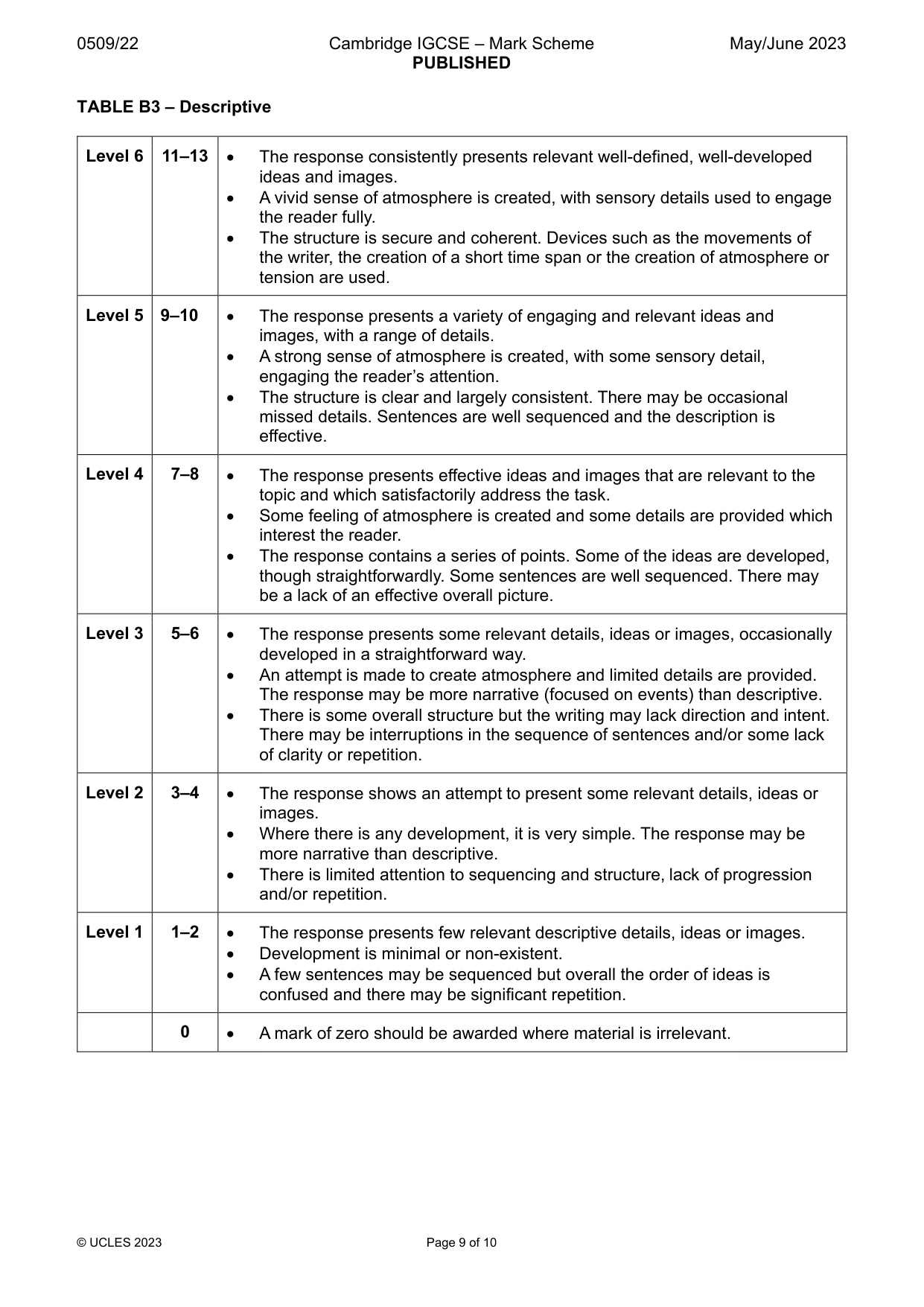
0509/22 Cambridge IGCSE – Mark Scheme PUBLISHED May/June 2023 © UCLES 2023 Page 9 of 10 TABLE B3 – Descriptive Level 6 11–13 The response consistently presents relevant well-defined, well-developed ideas and images. A vivid sense of atmosphere is created, with sensory details used to engage the reader fully. The structure is secure and coherent. Devices such as the movements of the writer, the creation of a short time span or the creation of atmosphere or tension are used. Level 5 9–10 The response presents a variety of engaging and relevant ideas and images, with a range of details. A strong sense of atmosphere is created, with some sensory detail, engaging the reader’s attention. The structure is clear and largely consistent. There may be occasional missed details. Sentences are well sequenced and the description is effective. Level 4 7–8 The response presents effective ideas and images that are relevant to the topic and which satisfactorily address the task. Some feeling of atmosphere is created and some details are provided which interest the reader. The response contains a series of points. Some of the ideas are developed, though straightforwardly. Some sentences are well sequenced. There may be a lack of an effective overall picture. Level 3 5–6 The response presents some relevant details, ideas or images, occasionally developed in a straightforward way. An attempt is made to create atmosphere and limited details are provided. The response may be more narrative (focused on events) than descriptive. There is some overall structure but the writing may lack direction and intent. There may be interruptions in the sequence of sentences and/or some lack of clarity or repetition. Level 2 3–4 The response shows an attempt to present some relevant details, ideas or images. Where there is any development, it is very simple. The response may be more narrative than descriptive. There is limited attention to sequencing and structure, lack of progression and/or repetition. Level 1 1–2 The response presents few relevant descriptive details, ideas or images. Development is minimal or non-existent. A few sentences may be sequenced but overall the order of ideas is confused and there may be significant repetition. 0 A mark of zero should be awarded where material is irrelevant.
Mark scheme, page 10
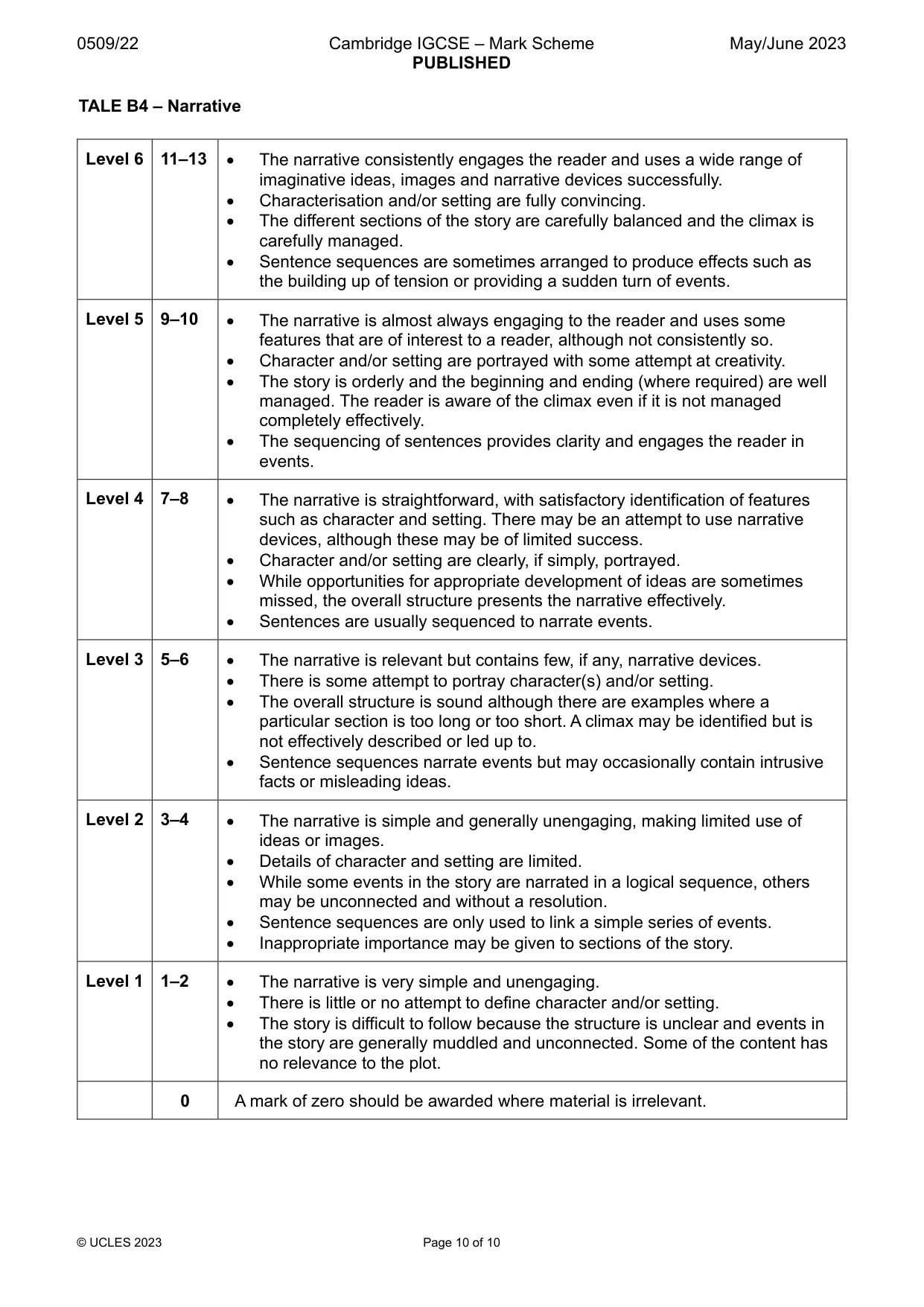
0509/22 Cambridge IGCSE – Mark Scheme PUBLISHED May/June 2023 © UCLES 2023 Page 10 of 10 TALE B4 – Narrative Level 6 11–13 The narrative consistently engages the reader and uses a wide range of imaginative ideas, images and narrative devices successfully. Characterisation and/or setting are fully convincing. The different sections of the story are carefully balanced and the climax is carefully managed. Sentence sequences are sometimes arranged to produce effects such as the building up of tension or providing a sudden turn of events. Level 5 9–10 The narrative is almost always engaging to the reader and uses some features that are of interest to a reader, although not consistently so. Character and/or setting are portrayed with some attempt at creativity. The story is orderly and the beginning and ending (where required) are well managed. The reader is aware of the climax even if it is not managed completely effectively. The sequencing of sentences provides clarity and engages the reader in events. Level 4 7–8 The narrative is straightforward, with satisfactory identification of features such as character and setting. There may be an attempt to use narrative devices, although these may be of limited success. Character and/or setting are clearly, if simply, portrayed. While opportunities for appropriate development of ideas are sometimes missed, the overall structure presents the narrative effectively. Sentences are usually sequenced to narrate events. Level 3 5–6 The narrative is relevant but contains few, if any, narrative devices. There is some attempt to portray character(s) and/or setting. The overall structure is sound although there are examples where a particular section is too long or too short. A climax may be identified but is not effectively described or led up to. Sentence sequences narrate events but may occasionally contain intrusive facts or misleading ideas. Level 2 3–4 The narrative is simple and generally unengaging, making limited use of ideas or images. Details of character and setting are limited. While some events in the story are narrated in a logical sequence, others may be unconnected and without a resolution. Sentence sequences are only used to link a simple series of events. Inappropriate importance may be given to sections of the story. Level 1 1–2 The narrative is very simple and unengaging. There is little or no attempt to define character and/or setting. The story is difficult to follow because the structure is unclear and events in the story are generally muddled and unconnected. Some of the content has no relevance to the plot. 0 A mark of zero should be awarded where material is irrelevant.
What you needed in this session
Cambridge’s own grade thresholds for 2023 May/June, Paper 2 · Variant 2. A higher threshold means an easier paper — the bar moves with how the cohort did.