Cambridge IGCSE Chemistry (9-1) 0971 — 2019 Oct/Nov Paper 5 · Variant 2
0971/52/O/N/19 · 3 questions · 40 marks · ≈45 min
The question paper and its mark scheme, free to read here and free to download. This is Cambridge’s own paper, exactly as it was sat.
Question paper12 pages
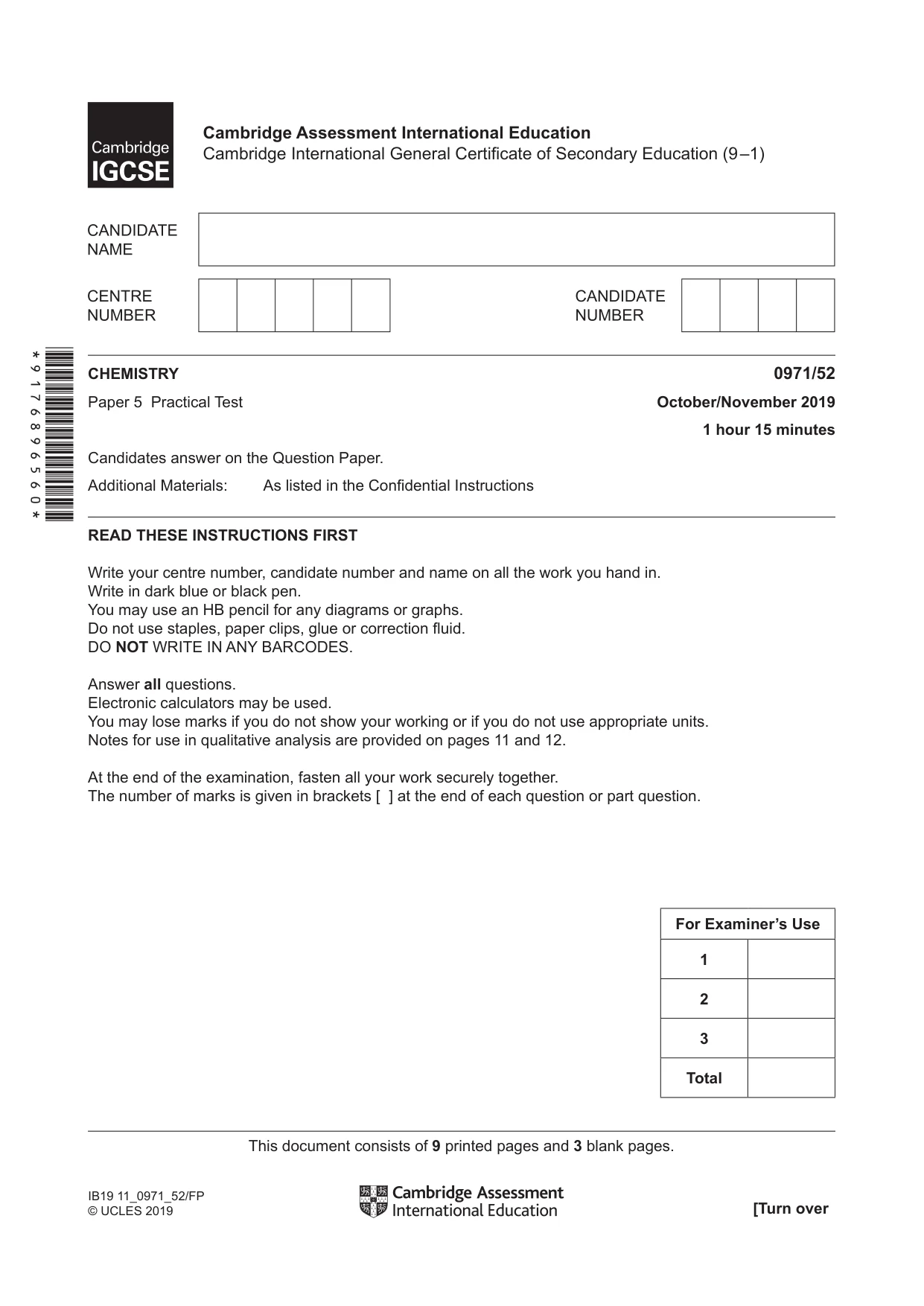



Mark scheme7 pages
Answers below. Sit the paper first if you are practising.
Questions as text
Q1 · You are going to investigate the temperature changes when two different solids, N and O…
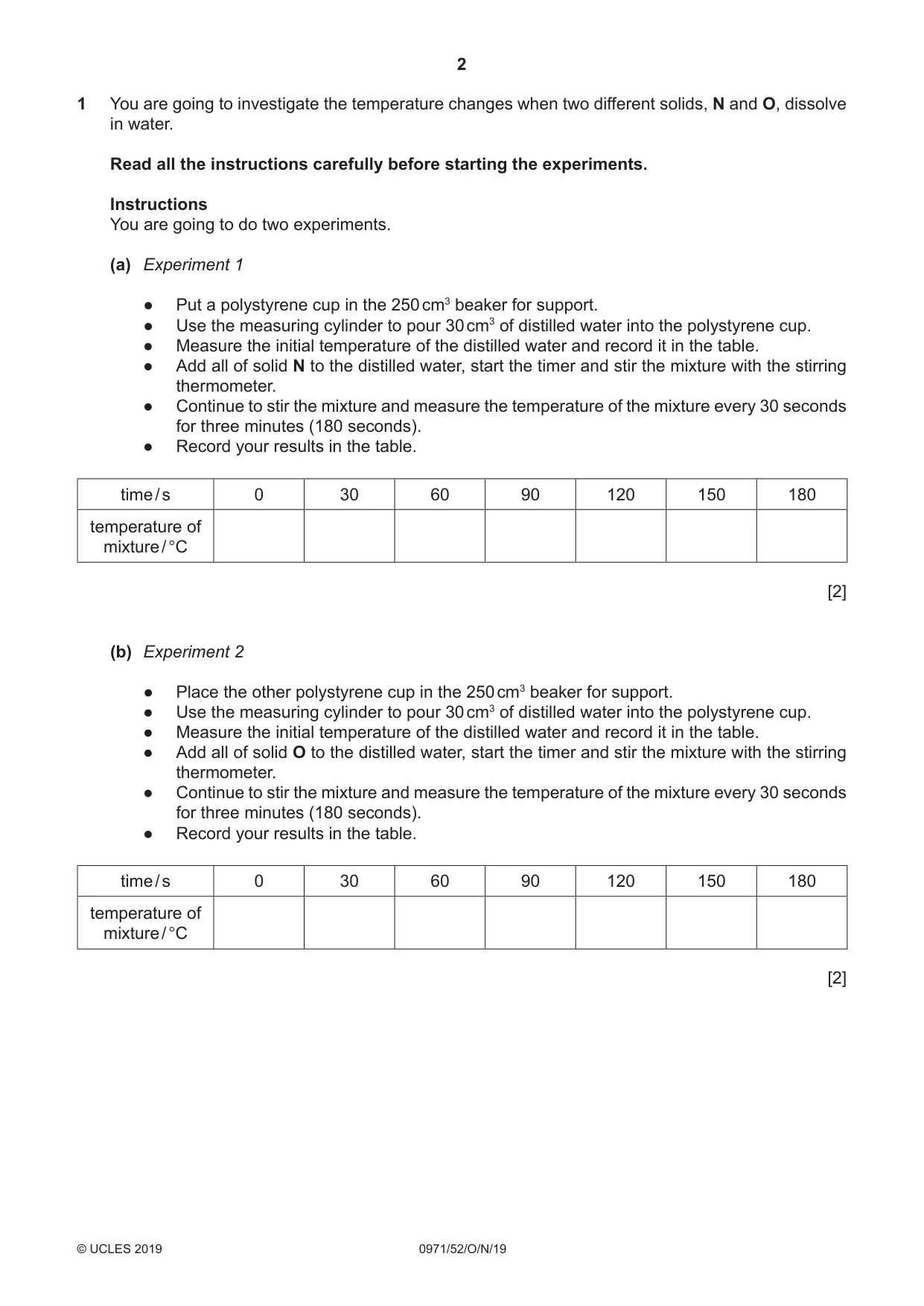
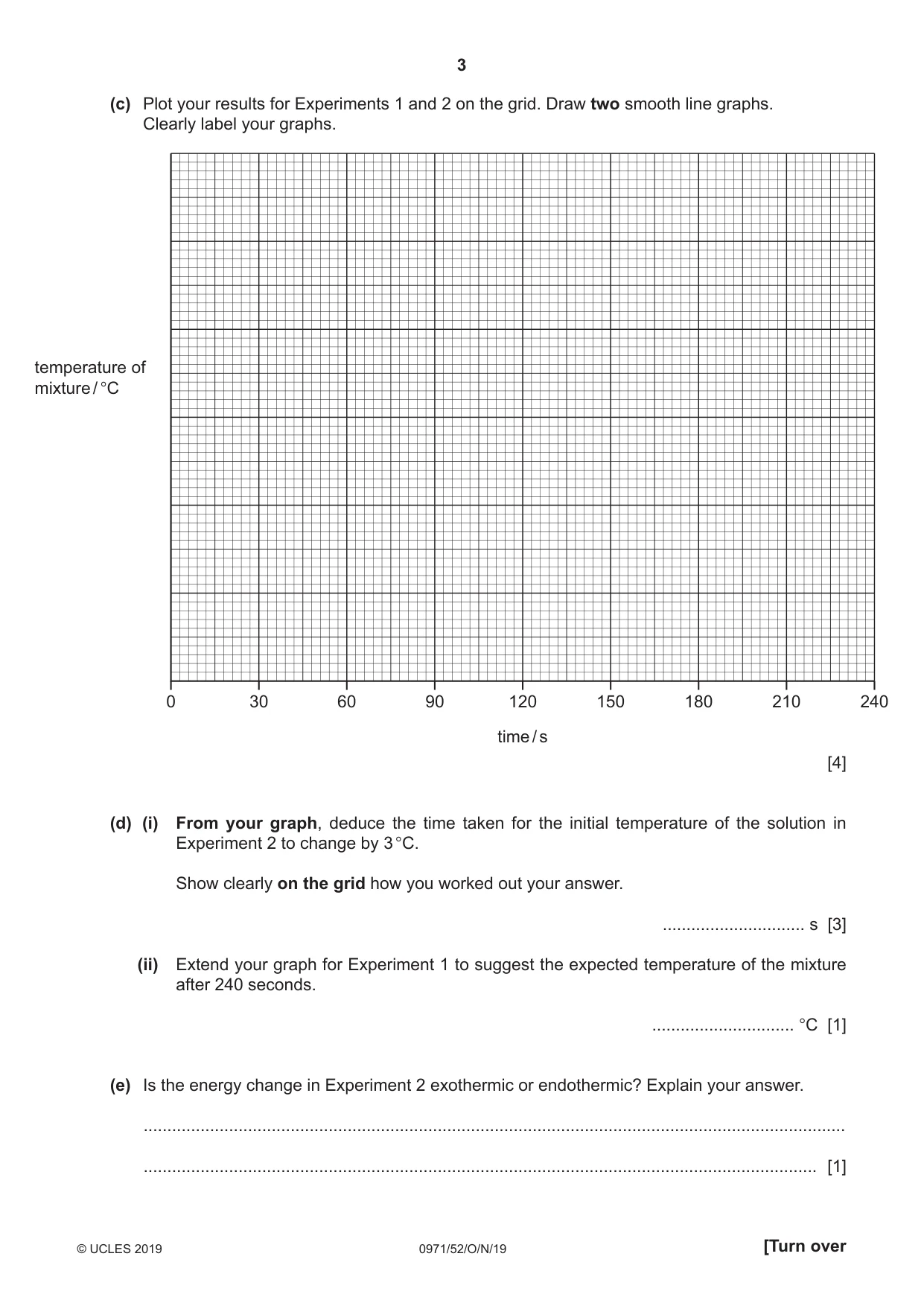
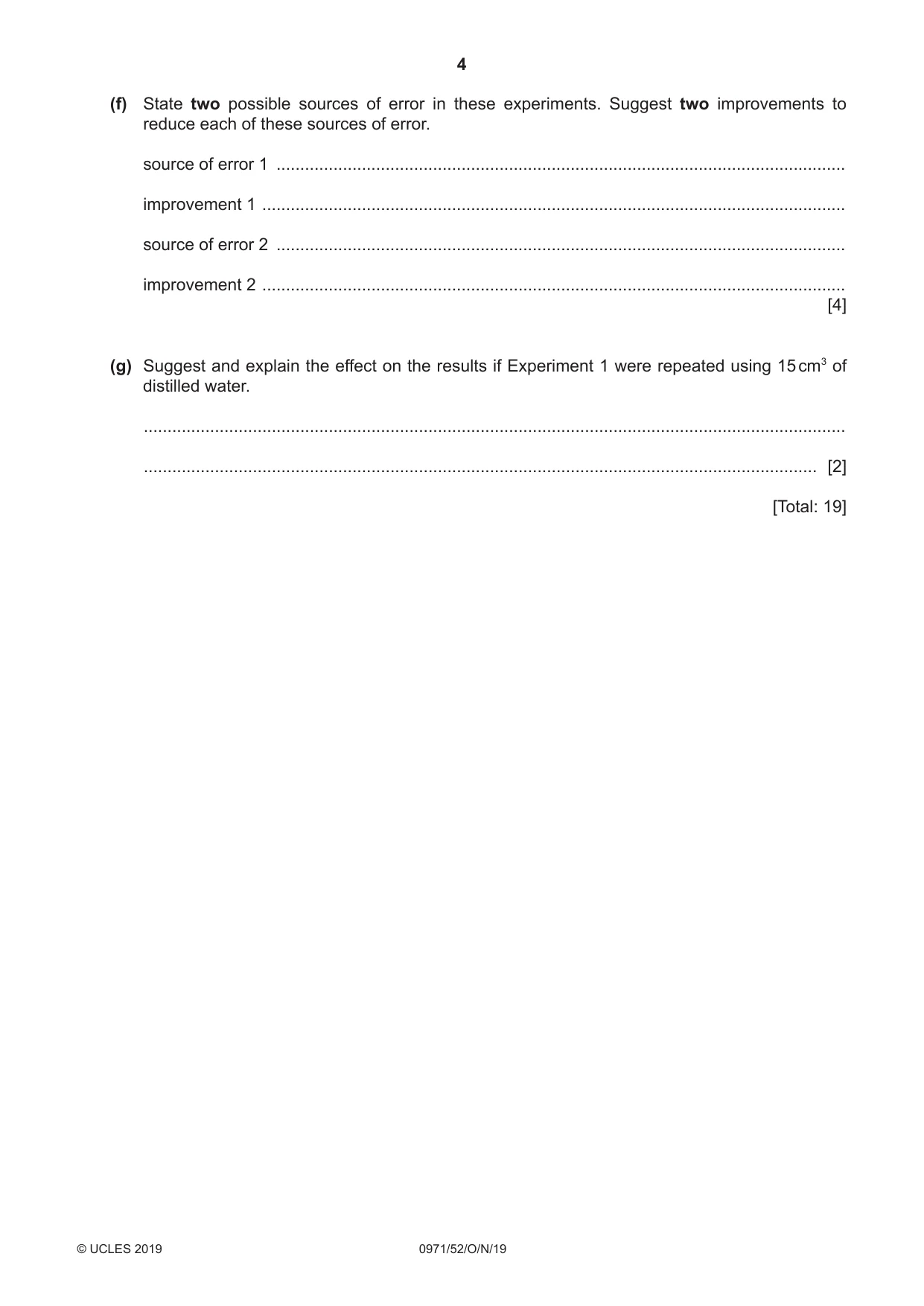
1 You are going to investigate the temperature changes when two different solids, N and O, dissolve in water. Read all the instructions carefully before starting the experiments. Instructions You are going to do two experiments. (a) Experiment 1 ●● Put a polystyrene cup in the 250 cm3 beaker for support. ●● Use the measuring cylinder to pour 30 cm3 of distilled water into the polystyrene cup. ●● Measure the initial temperature of the distilled water and record it in the table. ●● Add all of solid N to the distilled water, start the timer and stir the mixture with the stirring thermometer. ●● Continue to stir the mixture and measure the temperature of the mixture every 30 seconds for three minutes (180 seconds). ●● Record your results in the table. time / s 0 30 60 90 120 150 180 temperature of mixture / °C [2] (b) Experiment 2 ●● Place the other polystyrene cup in the 250 cm3 beaker for support. ●● Use the measuring cylinder to pour 30 cm3 of distilled water into the polystyrene cup. ●● Measure the initial temperature of the distilled water and record it in the table. ●● Add all of solid O to the distilled water, start the timer and stir the mixture with the stirring thermometer. ●● Continue to stir the mixture and measure the temperature of the mixture every 30 seconds for three minutes (180 seconds). ●● Record your results in the table. time / s 0 30 60 90 120 150 180 temperature of mixture / °C [2] (c) Plot your results for Experiments 1 and 2 on the grid. Draw two smooth line graphs. Clearly label your graphs. temperature of mixture / °C 0 30 60 90 120 150 180 210 240 time / s [4] (d) (i) From your graph, deduce the time taken for the initial temperature of the solution in Experiment 2 to change by 3 °C. Show clearly on the grid how you worked out your answer. .............................. s [3] (ii) Extend your graph for Experiment 1 to suggest the expected temperature of the mixture after 240 seconds. .............................. °C [1] (e) Is the energy change in Experiment 2 exothermic or endothermic? Explain your answer. .................................................................................................................................................... .............................................................................................................................................. [1] (f) State two possible sources of error in these experiments. Suggest two improvements to reduce each of these sources of error. source of error 1 ......................................................................................................................... improvement 1 ........................................................................................................................... source of error 2 ......................................................................................................................... improvement 2 ........................................................................................................................... [4] (g) Suggest and explain the effect on the results if Experiment 1 were repeated using 15 cm3 of distilled water. .................................................................................................................................................... .............................................................................................................................................. [2] [Total: 19]
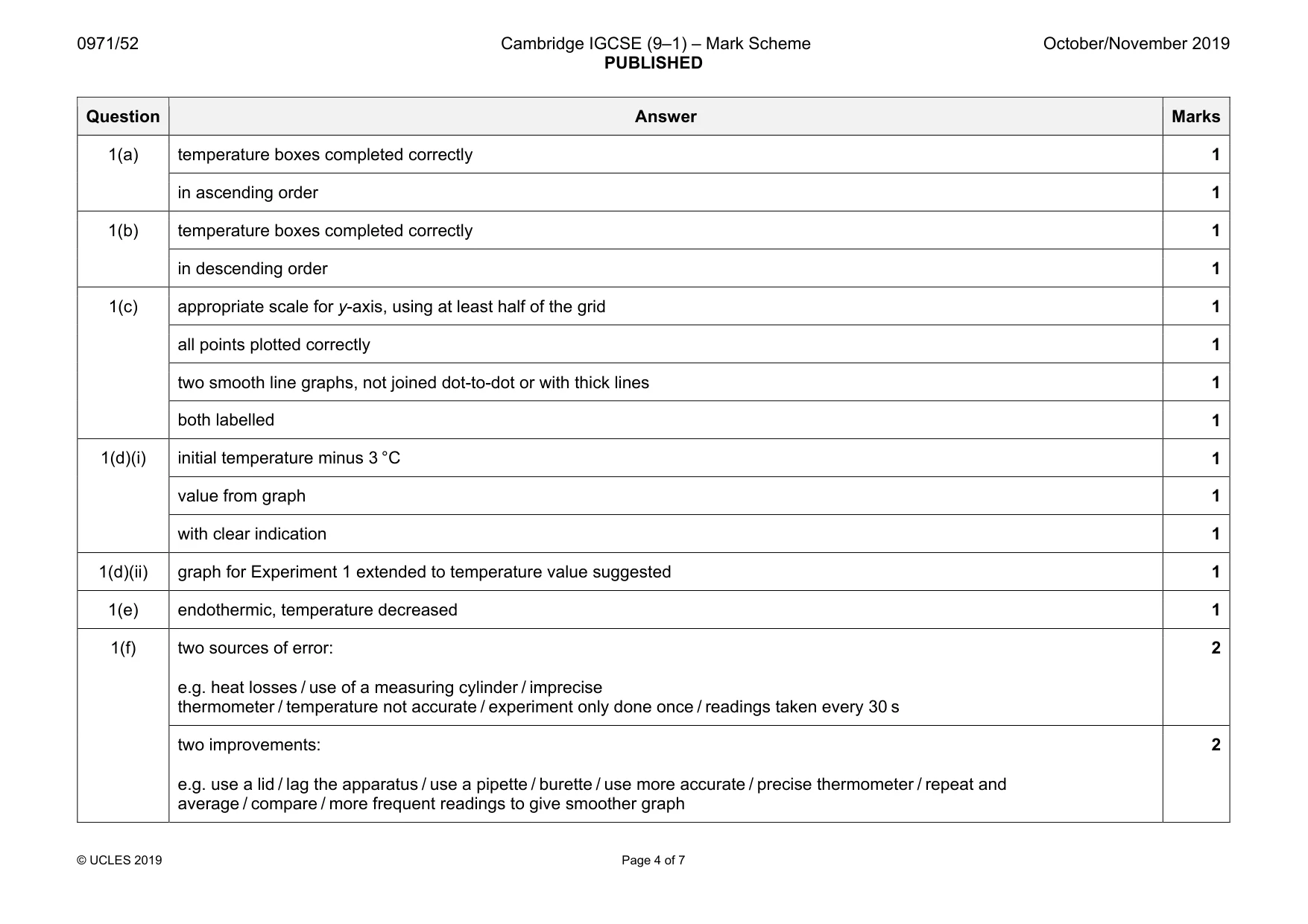
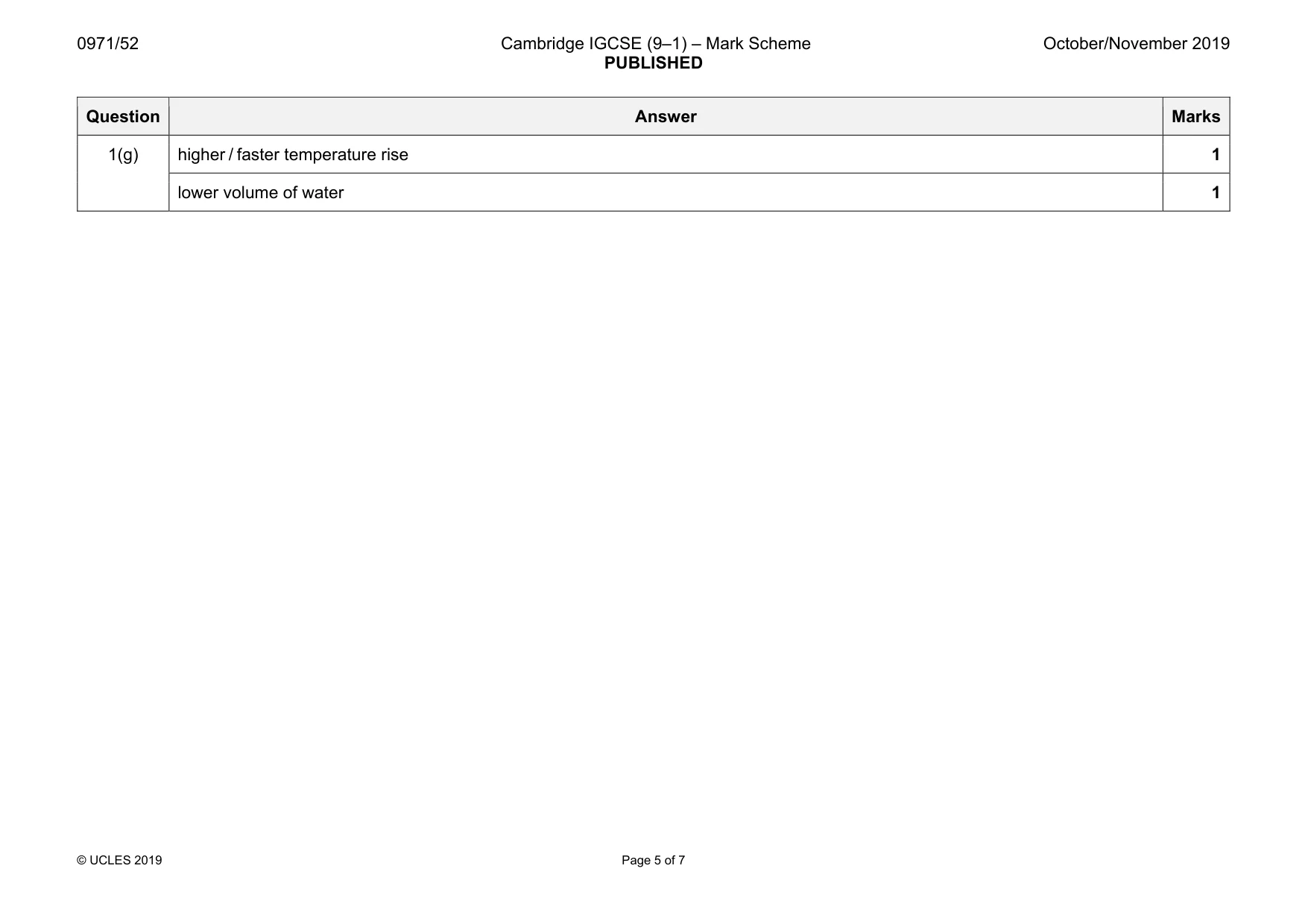
Mark scheme: 1(a) temperature boxes completed correctly 1 in ascending order 1 1(b) temperature boxes completed correctly 1 in descending order 1 1(c) appropriate scale for y-axis, using at least half of the grid 1 all points plotted correctly 1 two smooth line graphs, not joined dot-to-dot or with thick lines 1 both labelled 1 1(d)(i) initial temperature minus 3 °C 1 value from graph 1 with clear indication 1 1(d)(ii) graph for Experiment 1 extended to temperature value suggested 1 1(e) endothermic, temperature decreased 1 1(f) two sources of error: e.g. heat losses / use of a measuring cylinder / imprecise thermometer / temperature not accurate / experiment only done once / readings taken every 30 s 2 two improvements: e.g. use a lid / lag the apparatus / use a pipette / burette / use more accurate / precise thermometer / repeat and average / compare / more frequent readings to give smoother graph 2 Question Answer Marks 1(g) higher / faster temperature rise 1 lower volume of water 1
Q2 · You are provided with two solids, P and Q, which are both salts
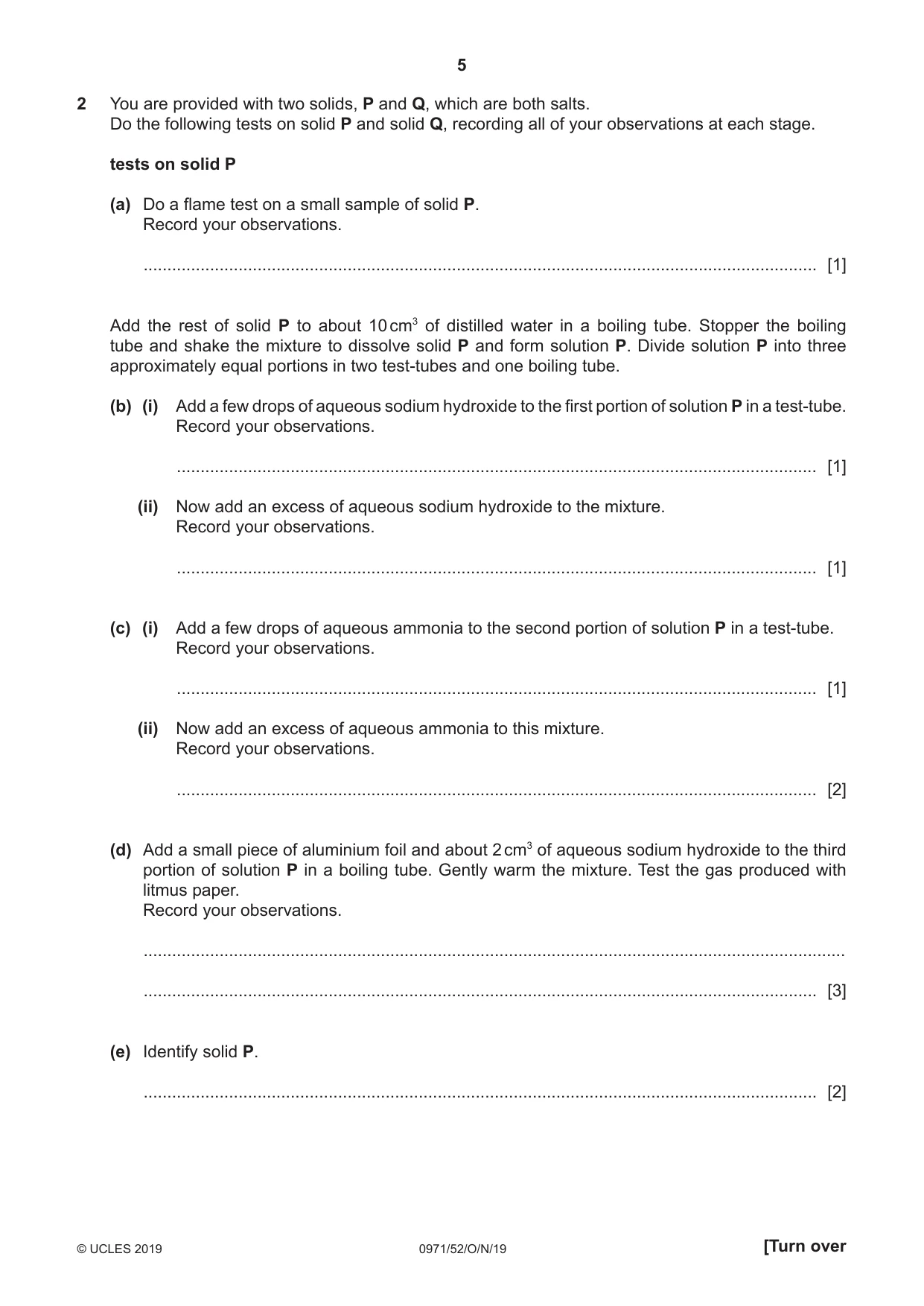
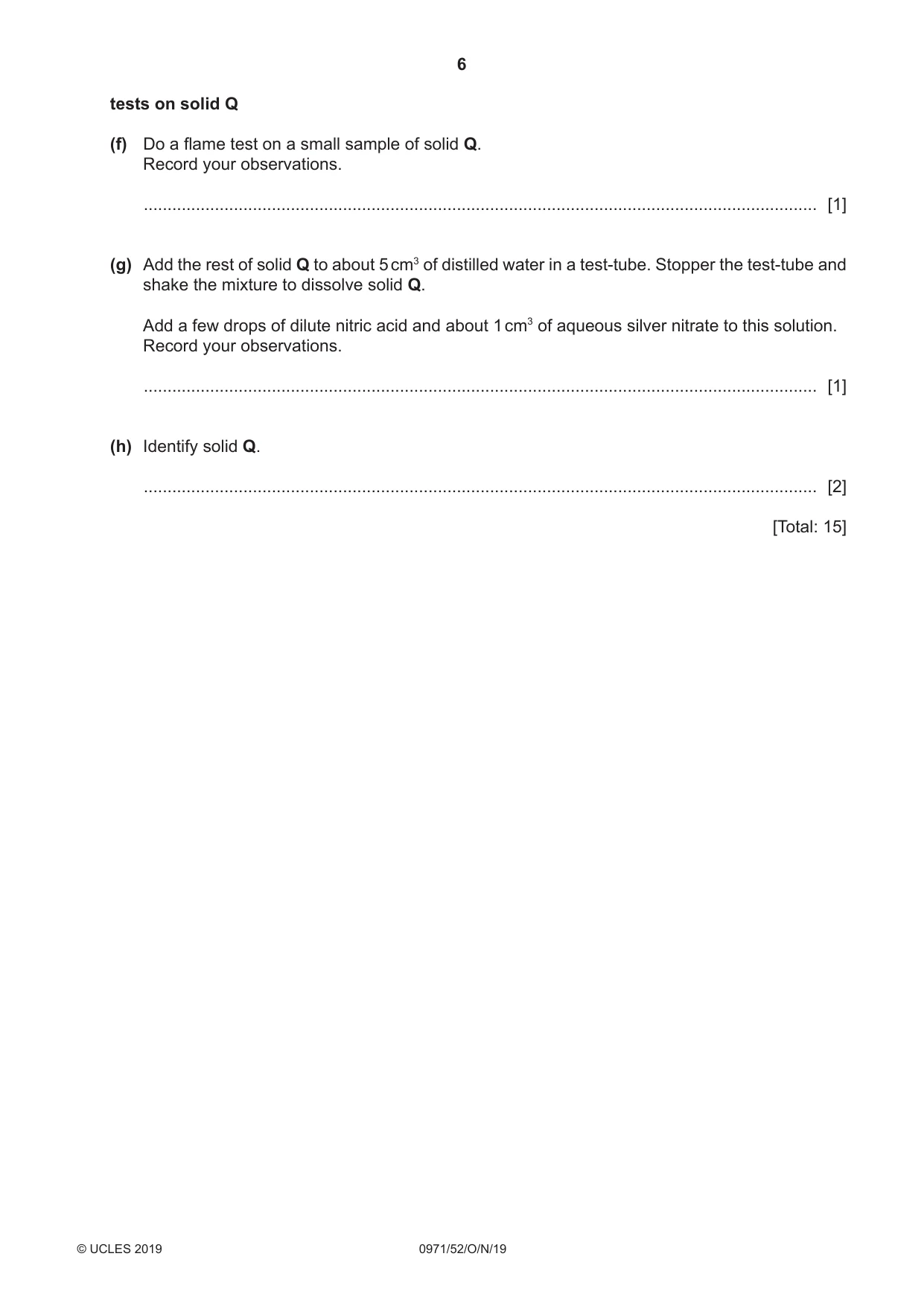
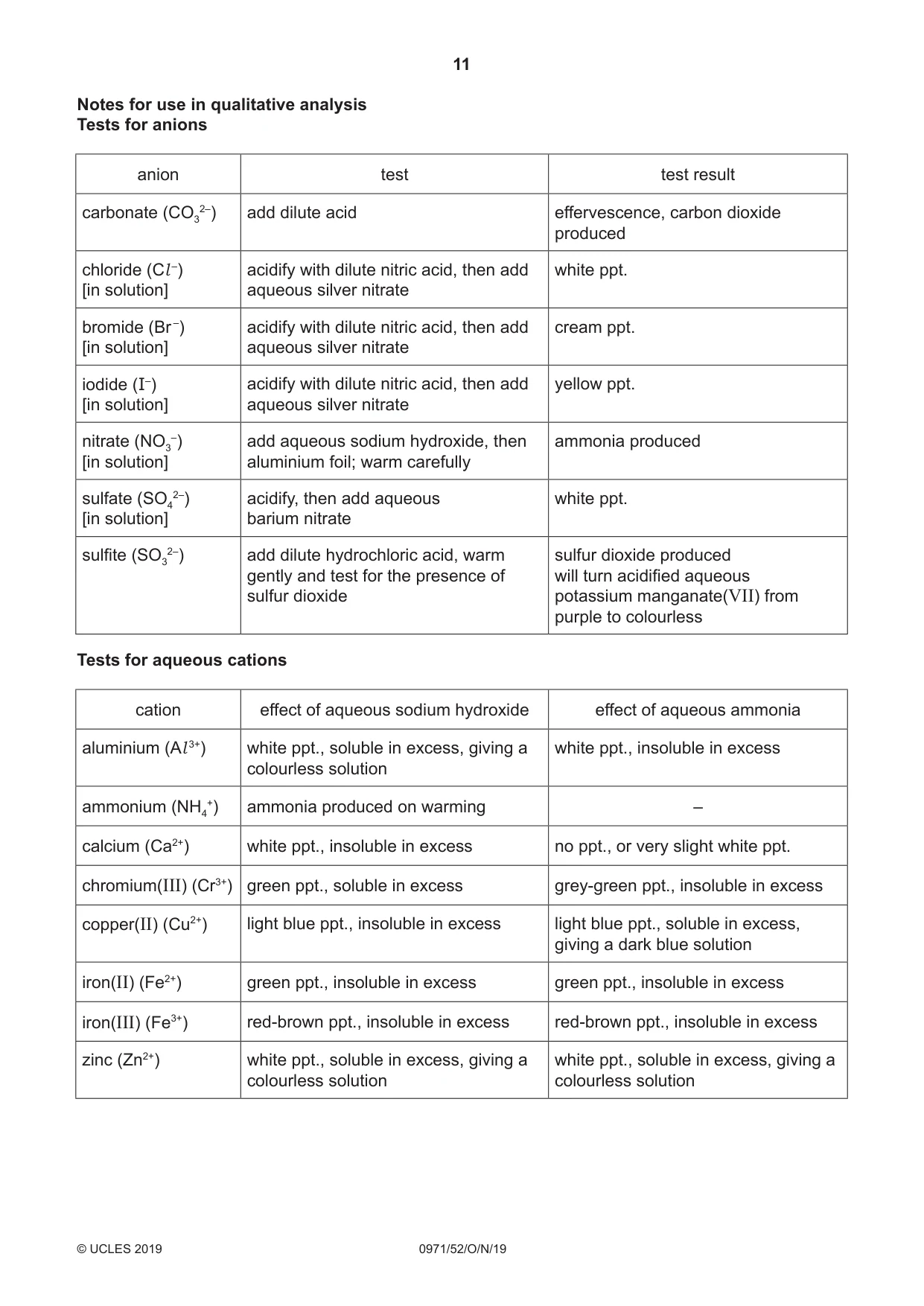
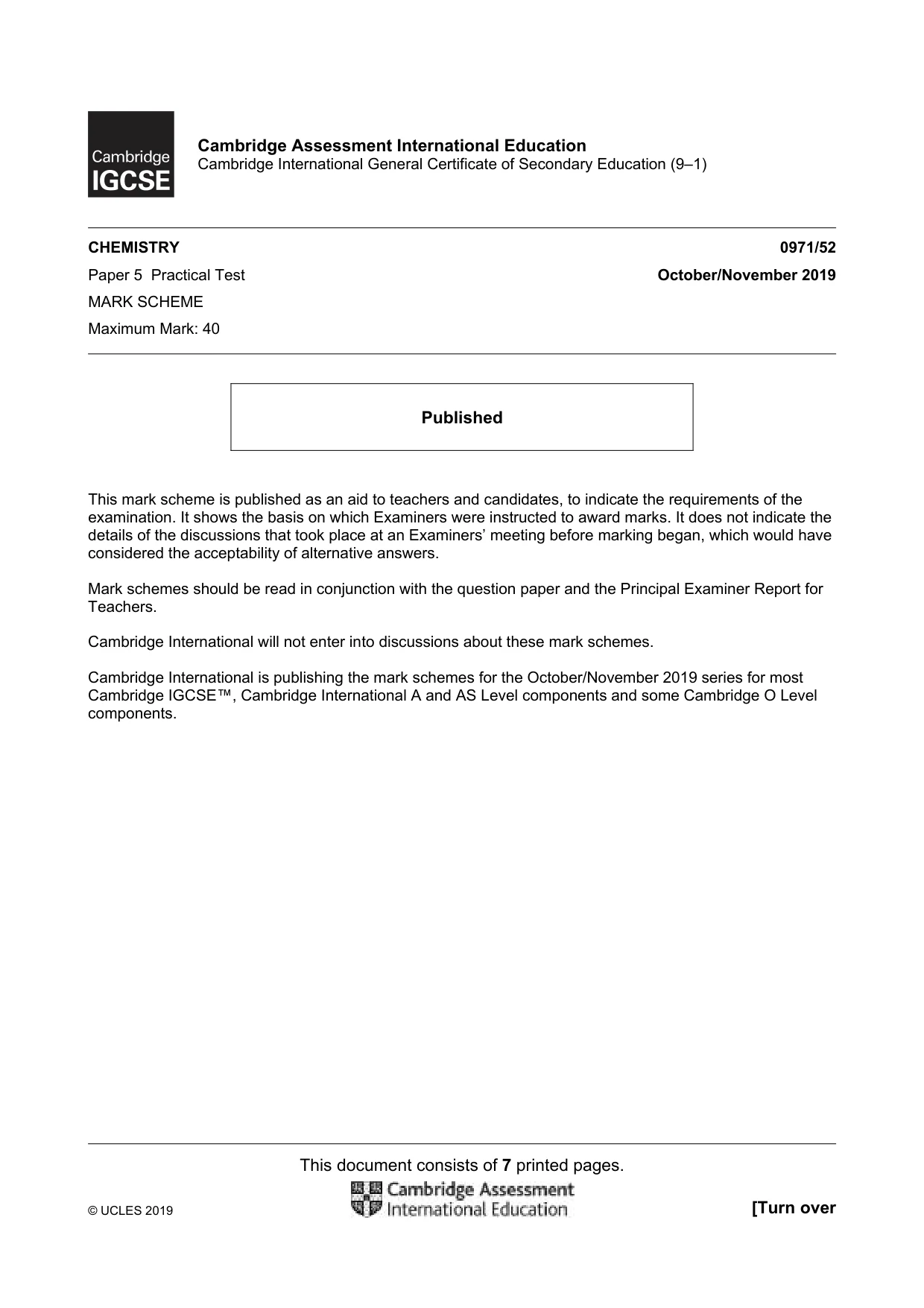
2 You are provided with two solids, P and Q, which are both salts. Do the following tests on solid P and solid Q, recording all of your observations at each stage. tests on solid P (a) Do a flame test on a small sample of solid P. Record your observations. .............................................................................................................................................. [1] Add the rest of solid P to about 10 cm3 of distilled water in a boiling tube. Stopper the boiling tube and shake the mixture to dissolve solid P and form solution P. Divide solution P into three approximately equal portions in two test-tubes and one boiling tube. (b) (i) Add a few drops of aqueous sodium hydroxide to the first portion of solution P in a test‑tube. Record your observations. ....................................................................................................................................... [1] (ii) Now add an excess of aqueous sodium hydroxide to the mixture. Record your observations. ....................................................................................................................................... [1] (c) (i) Add a few drops of aqueous ammonia to the second portion of solution P in a test‑tube. Record your observations. ....................................................................................................................................... [1] (ii) Now add an excess of aqueous ammonia to this mixture. Record your observations. ....................................................................................................................................... [2] (d) Add a small piece of aluminium foil and about 2 cm3 of aqueous sodium hydroxide to the third portion of solution P in a boiling tube. Gently warm the mixture. Test the gas produced with litmus paper. Record your observations. .................................................................................................................................................... .............................................................................................................................................. [3] (e) Identify solid P. .............................................................................................................................................. [2] tests on solid Q (f) Do a flame test on a small sample of solid Q. Record your observations. .............................................................................................................................................. [1] (g) Add the rest of solid Q to about 5 cm3 of distilled water in a test‑tube. Stopper the test‑tube and shake the mixture to dissolve solid Q. Add a few drops of dilute nitric acid and about 1 cm3 of aqueous silver nitrate to this solution. Record your observations. .............................................................................................................................................. [1] (h) Identify solid Q. .............................................................................................................................................. [2] [Total: 15]
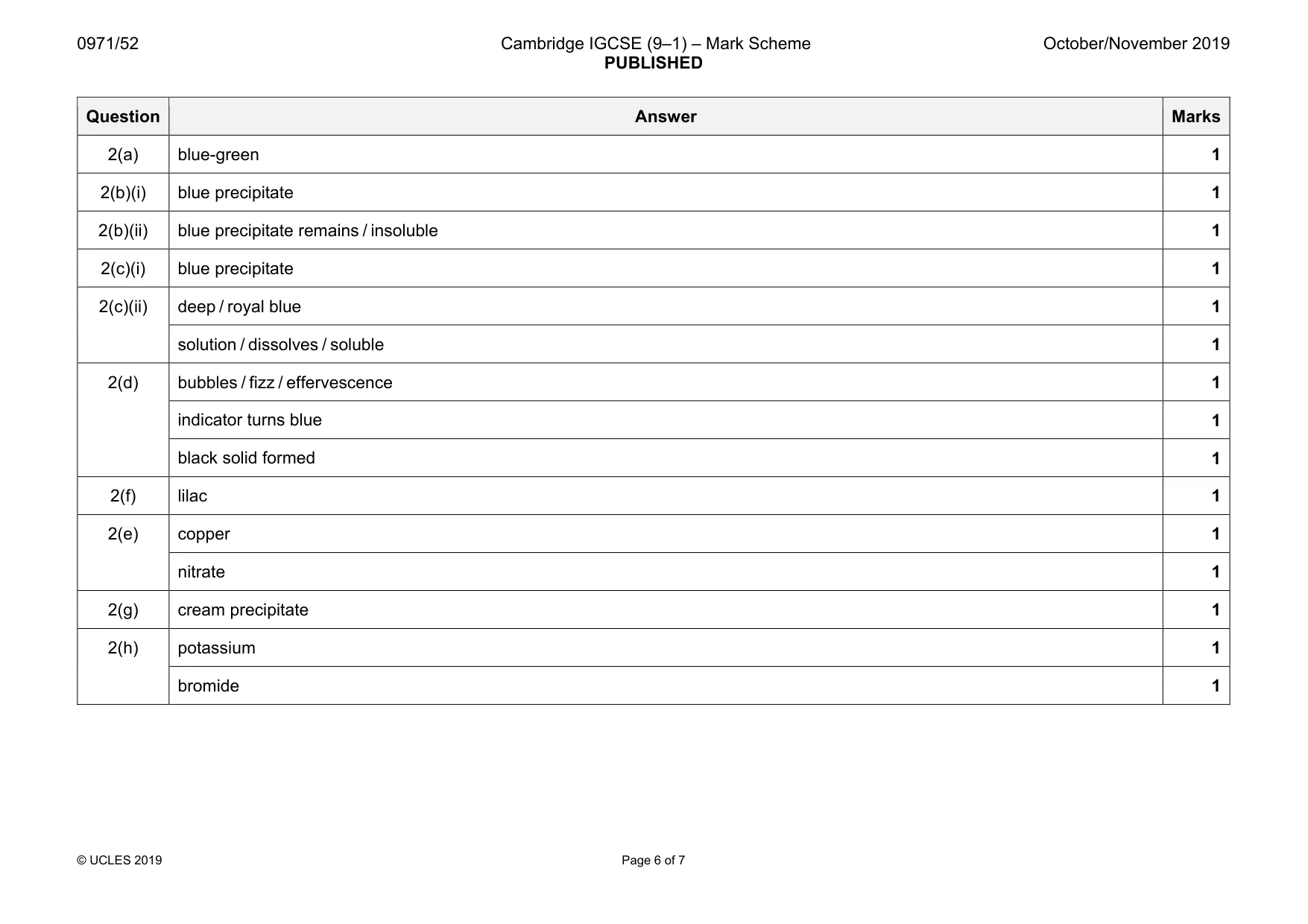
Mark scheme: 2(a) blue-green 1 2(b)(i) blue precipitate 1 2(b)(ii) blue precipitate remains / insoluble 1 2(c)(i) blue precipitate 1 2(c)(ii) deep / royal blue 1 solution / dissolves / soluble 1 2(d) bubbles / fizz / effervescence 1 indicator turns blue 1 black solid formed 1 2(f) lilac 1 2(e) copper 1 nitrate 1 2(g) cream precipitate 1 2(h) potassium 1 bromide 1
Q3 · The table gives some information about the properties of three substances found in a hand…
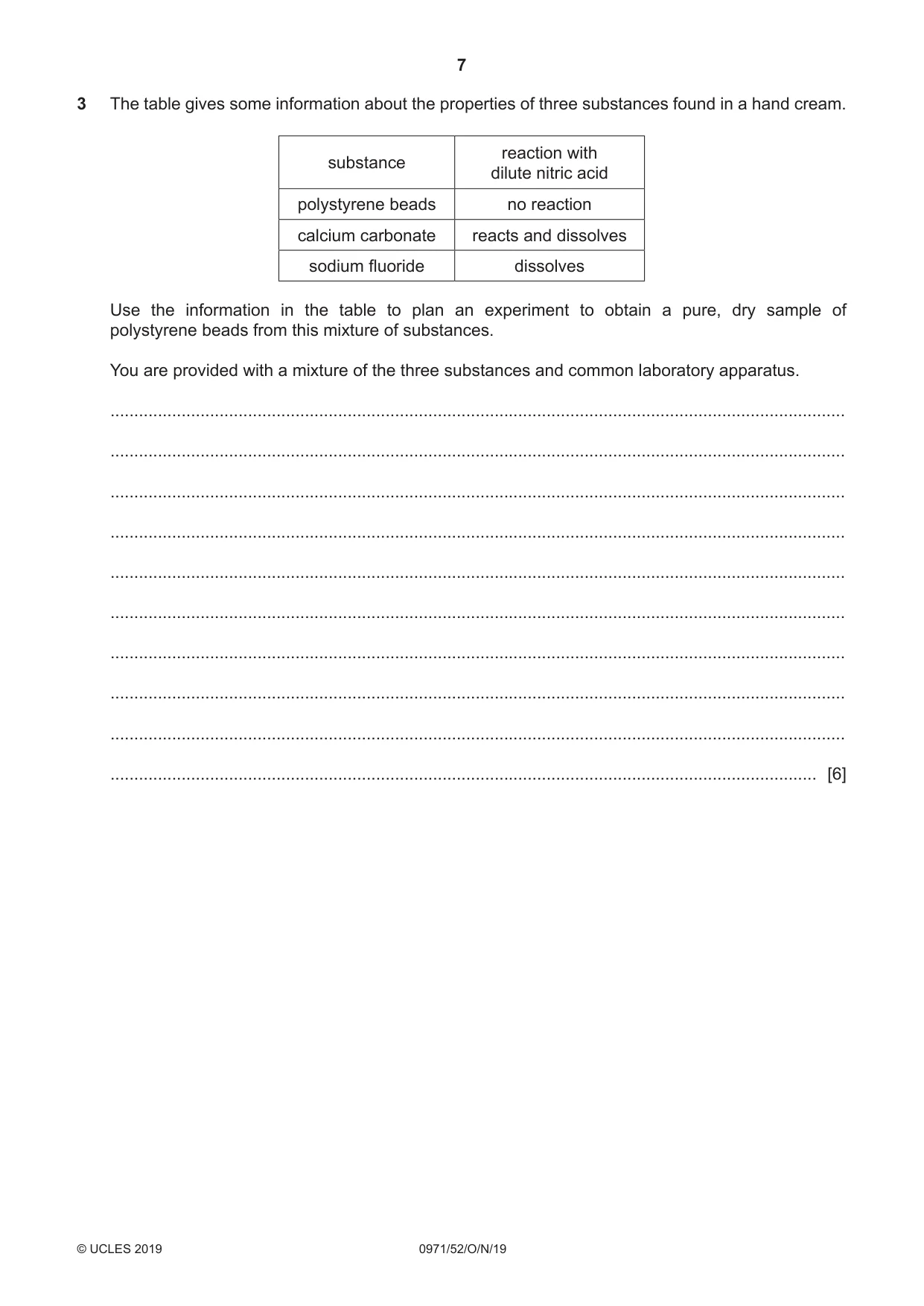
3 The table gives some information about the properties of three substances found in a hand cream. reaction with substance dilute nitric acid polystyrene beads no reaction calcium carbonate reacts and dissolves sodium fluoride dissolves Use the information in the table to plan an experiment to obtain a pure, dry sample of polystyrene beads from this mixture of substances. You are provided with a mixture of the three substances and common laboratory apparatus. ........................................................................................................................................................... ........................................................................................................................................................... ........................................................................................................................................................... ........................................................................................................................................................... ........................................................................................................................................................... ........................................................................................................................................................... ........................................................................................................................................................... ........................................................................................................................................................... ........................................................................................................................................................... ..................................................................................................................................................... [6]
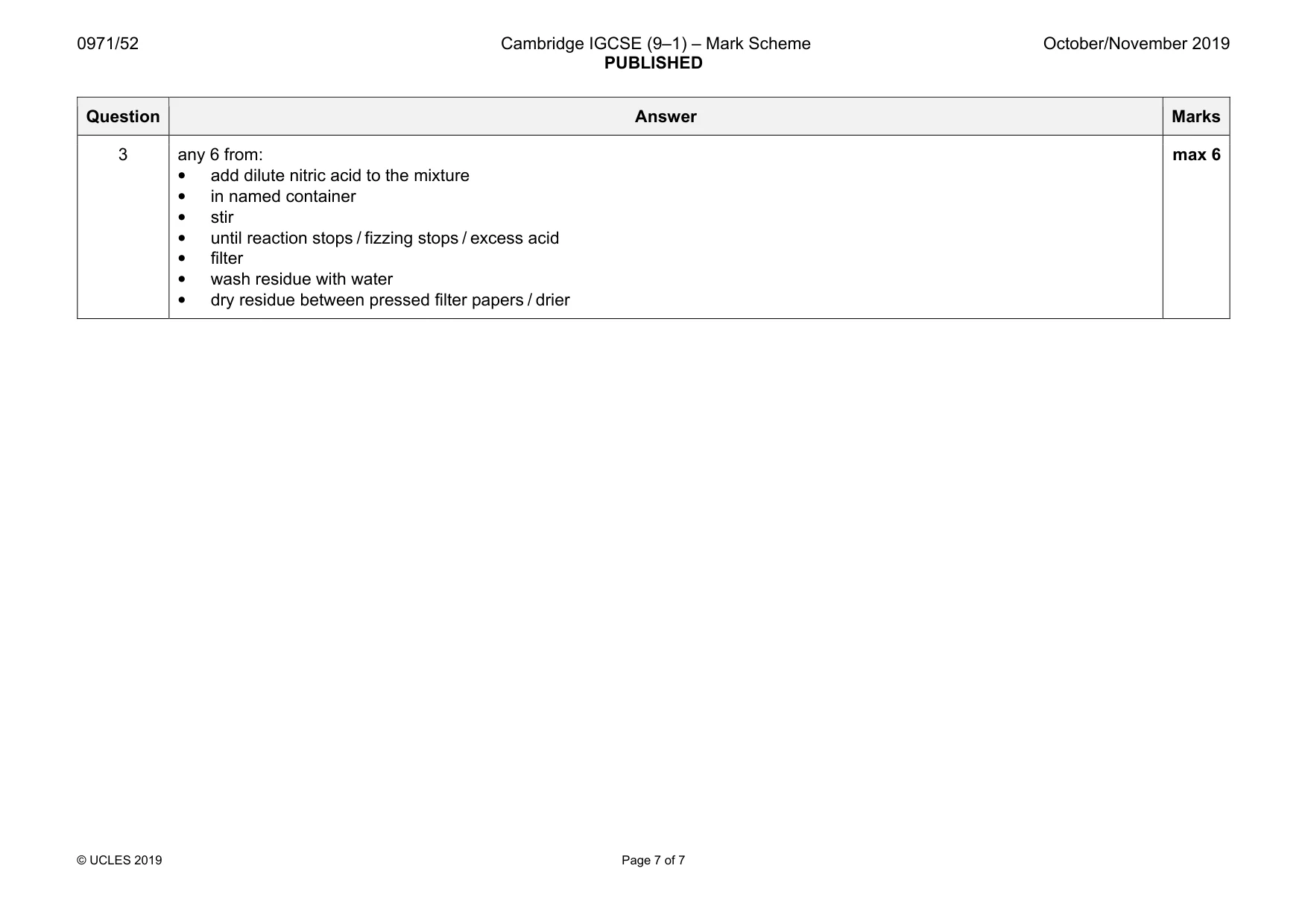
Mark scheme: 3 any 6 from: • add dilute nitric acid to the mixture • in named container • stir • until reaction stops / fizzing stops / excess acid • filter • wash residue with water • dry residue between pressed filter papers / drier max 6
What was in this paper
The subtopics covered by these 3 questions, and how many questions each got. Open one in a new tab to see every Cambridge question on it.
What you needed in this session
Cambridge’s own grade thresholds for 2019 Oct/Nov, Paper 5 · Variant 2. A higher threshold means an easier paper — the bar moves with how the cohort did.