Cambridge IGCSE Business Studies 0450 — 2022 Oct/Nov Paper 2 · Variant 2
0450/22/O/N/22 · 80 marks · ≈90 min
The question paper and its mark scheme, free to read here and free to download. This is Cambridge’s own paper, exactly as it was sat.
Question paper12 pages




Mark scheme21 pages
Answers below. Sit the paper first if you are practising.

Paper as text
Question paper, page 1
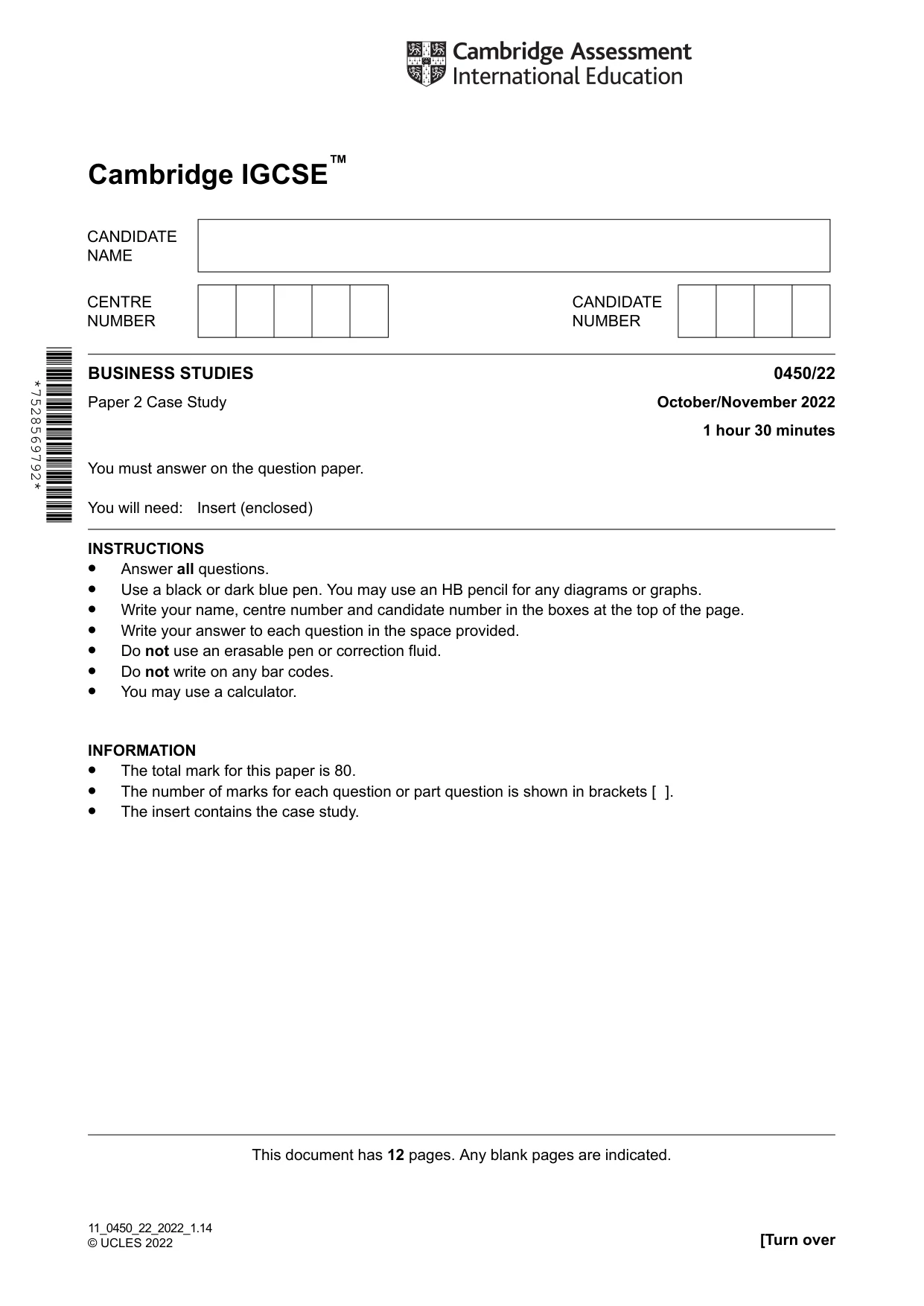
Cambridge IGCSE™ 0450/22 October/November 2022 1 hour 30 minutes BUSINESS STUDIES Paper 2 Case Study You must answer on the question paper. You will need: Insert (enclosed) INSTRUCTIONS • Answer all questions. • Use a black or dark blue pen. You may use an HB pencil for any diagrams or graphs. • Write your name, centre number and candidate number in the boxes at the top of the page. • Write your answer to each question in the space provided. • Do not use an erasable pen or correction fluid. • Do not write on any bar codes. • You may use a calculator. INFORMATION • The total mark for this paper is 80. • The number of marks for each question or part question is shown in brackets [ ]. • The insert contains the case study. This document has 12 pages. Any blank pages are indicated. [Turn over 11_0450_22_2022_1.14 © UCLES 2022 *7528569792*
Question paper, page 2
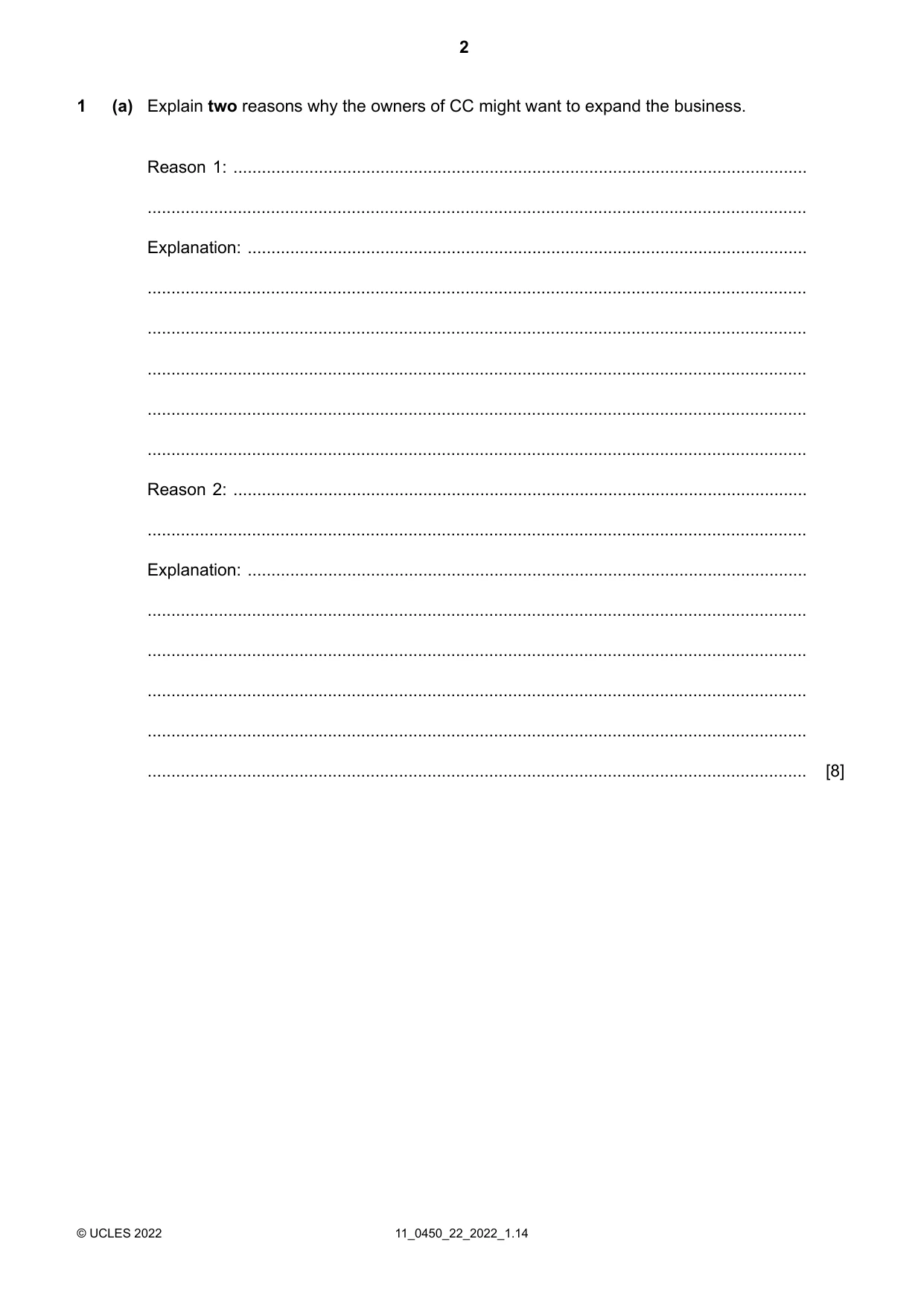
Explain two reasons why the owners of CC might want to expand the business. (a) 1 Reason 1: … … Explanation: … … … … … … Reason 2: … … Explanation: … … … … … … [8] 11_0450_22_2022_1.14 © UCLES 2022 2
Question paper, page 3
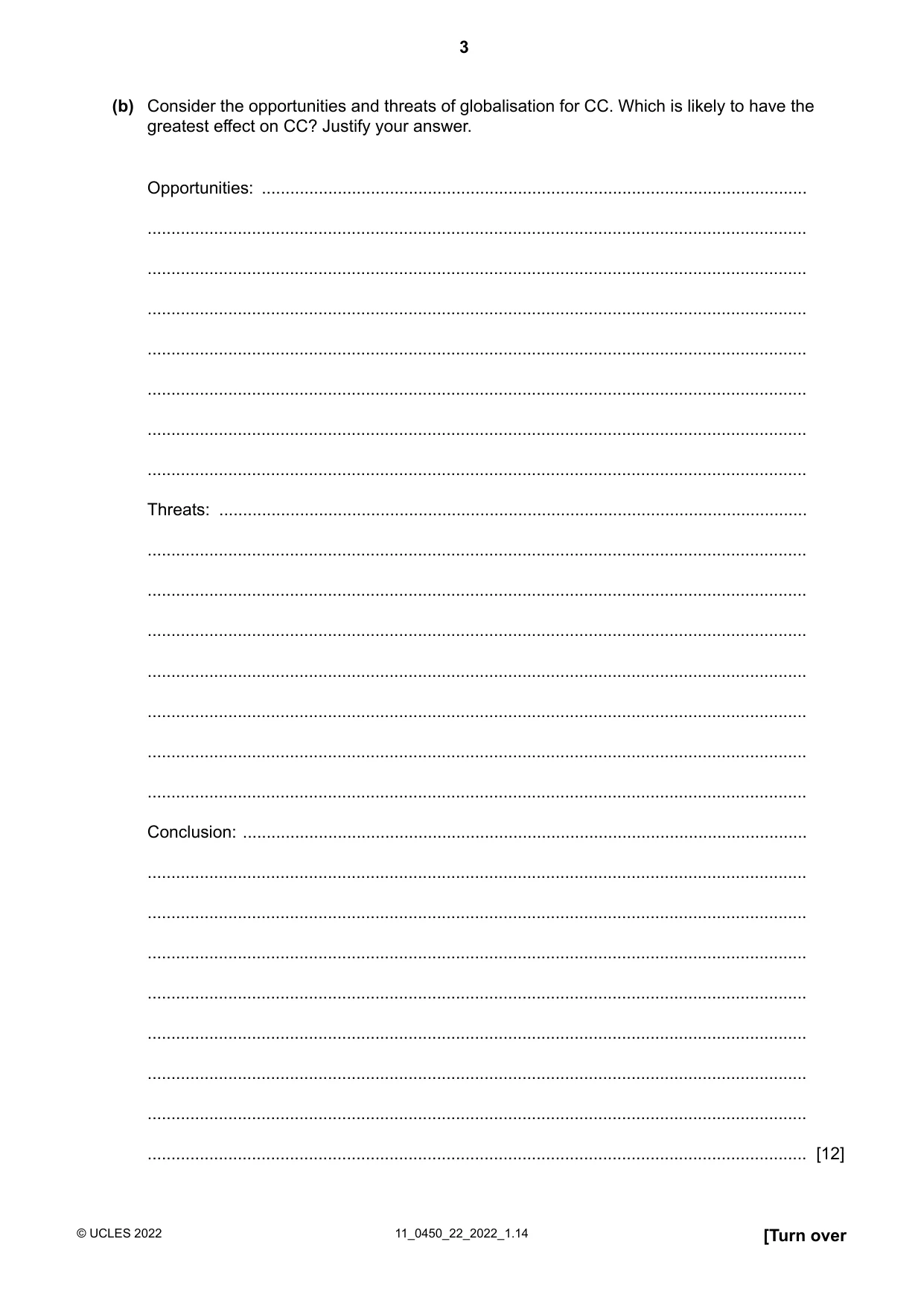
Consider the opportunities and threats of globalisation for CC. Which is likely to have the greatest effect on CC? Justify your answer. (b) Opportunities: … … … … … … … … Threats: … … … … … … … … Conclusion: … … … … … … … … … [12] [Turn over 11_0450_22_2022_1.14 © UCLES 2022 3
Question paper, page 4
Explain four roles of packaging for CC’s products. (a) 2 Role 1: … … … … Role 2: … … … … Role 3: … … … … Role 4: … … … … [8] 11_0450_22_2022_1.14 © UCLES 2022 4
Question paper, page 5
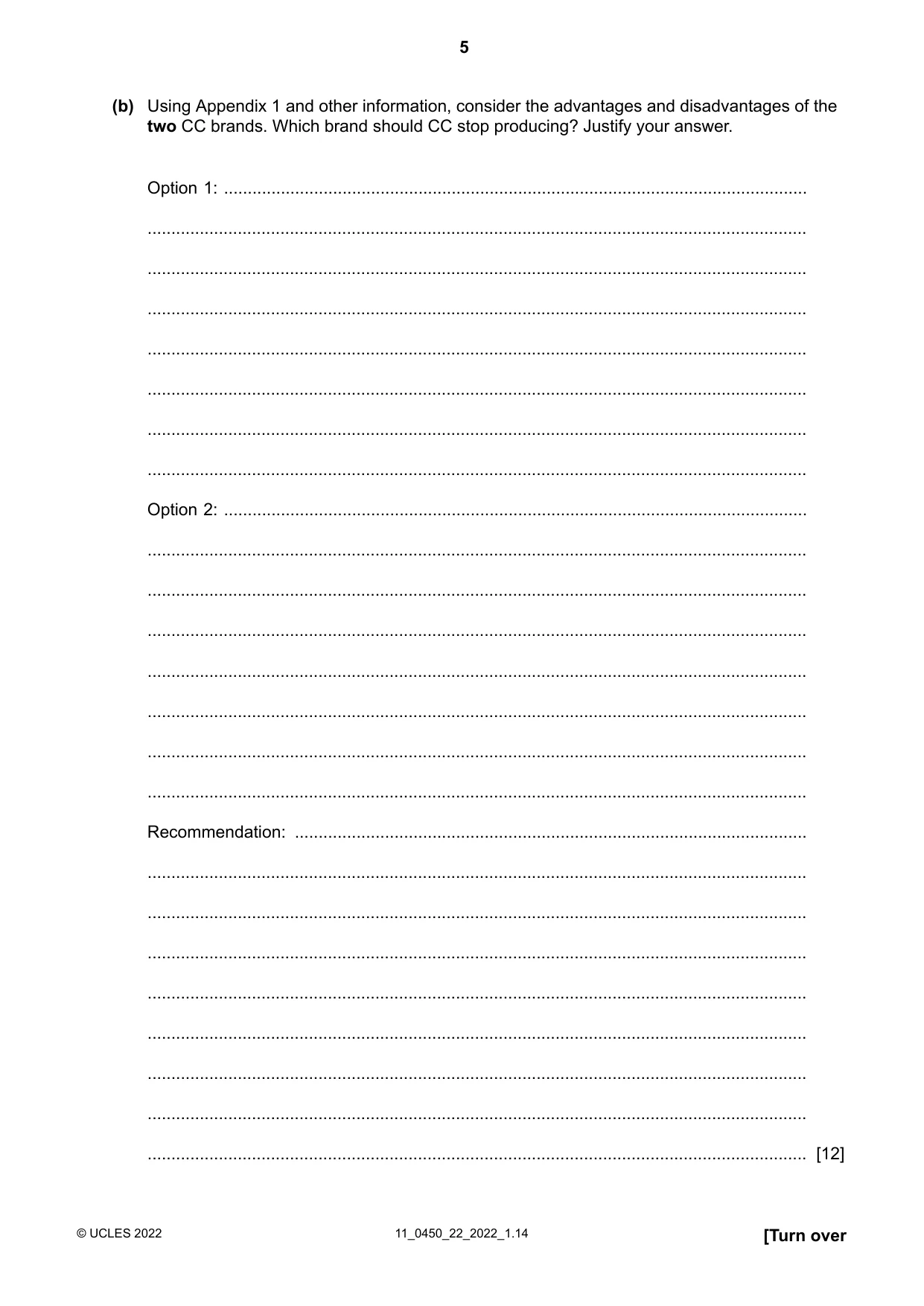
Using Appendix 1 and other information, consider the advantages and disadvantages of the two CC brands. Which brand should CC stop producing? Justify your answer. (b) Option 1: … … … … … … … … Option 2: … … … … … … … … Recommendation: … … … … … … … … … [12] [Turn over 11_0450_22_2022_1.14 © UCLES 2022 5
Question paper, page 6
Explain two diseconomies of scale CC might experience as it expands. (a) 3 Diseconomy of scale 1: … … Explanation: … … … … … … Diseconomy of scale 2: … … Explanation: … … … … … … [8] 11_0450_22_2022_1.14 © UCLES 2022 6
Question paper, page 7
Consider the information about the two managers outlined in Appendix 2. Who should be chosen as the Operations Manager for the NM factory? Justify your answer. (b) Samuel: … … … … … … … … Ritesh: … … … … … … … … Recommendation: … … … … … … … … … [12] [Turn over 11_0450_22_2022_1.14 © UCLES 2022 7
Question paper, page 8
Explain four benefits to employees of being members of a trade union. (a) 4 Benefit 1: … … … … Benefit 2: … … … … Benefit 3: … … … … Benefit 4: … … … … [8] 11_0450_22_2022_1.14 © UCLES 2022 8
Question paper, page 9
Using Appendix 3 and other information, consider how the financial statements might be useful to the following three stakeholder groups. Which stakeholder group will find the financial information most useful? Justify your answer. (b) • NM’s shareholders • CC’s managers • CC’s bank manager NM’s shareholders: … … … … … … CC’s managers: … … … … … … CC’s bank manager: … … … … … … Conclusion: … … … … … [12] 11_0450_22_2022_1.14 © UCLES 2022 9
Question paper, page 10
BLANK PAGE 11_0450_22_2022_1.14 © UCLES 2022 10
Question paper, page 11
BLANK PAGE 11_0450_22_2022_1.14 © UCLES 2022 11
Question paper, page 12
BLANK PAGE Permission to reproduce items where third-party owned material protected by copyright is included has been sought and cleared where possible. Every reasonable effort has been made by the publisher (UCLES) to trace copyright holders, but if any items requiring clearance have unwittingly been included, the publisher will be pleased to make amends at the earliest possible opportunity. To avoid the issue of disclosure of answer-related information to candidates, all copyright acknowledgements are reproduced online in the Cambridge Assessment International Education Copyright Acknowledgements Booklet. This is produced for each series of examinations and is freely available to download at www.cambridgeinternational.org after the live examination series. Cambridge Assessment International Education is part of Cambridge Assessment. Cambridge Assessment is the brand name of the University of Cambridge Local Examinations Syndicate (UCLES), which is a department of the University of Cambridge. 11_0450_22_2022_1.14 © UCLES 2022 12
Mark scheme, page 1
This document consists of 21 printed pages. © UCLES 2022 [Turn over Cambridge IGCSE™ BUSINESS STUDIES 0450/22 Paper 2 Case Study October/November 2022 MARK SCHEME Maximum Mark: 80 Published This mark scheme is published as an aid to teachers and candidates, to indicate the requirements of the examination. It shows the basis on which Examiners were instructed to award marks. It does not indicate the details of the discussions that took place at an Examiners’ meeting before marking began, which would have considered the acceptability of alternative answers. Mark schemes should be read in conjunction with the question paper and the Principal Examiner Report for Teachers. Cambridge International will not enter into discussions about these mark schemes. Cambridge International is publishing the mark schemes for the October/November 2022 series for most Cambridge IGCSE™, Cambridge International A and AS Level components and some Cambridge O Level components.
Mark scheme, page 2
0450/22 Cambridge IGCSE – Mark Scheme PUBLISHED October/November 2022 © UCLES 2022 Page 2 of 21 Generic Marking Principles These general marking principles must be applied by all examiners when marking candidate answers. They should be applied alongside the specific content of the mark scheme or generic level descriptors for a question. Each question paper and mark scheme will also comply with these marking principles. GENERIC MARKING PRINCIPLE 1: Marks must be awarded in line with: • the specific content of the mark scheme or the generic level descriptors for the question • the specific skills defined in the mark scheme or in the generic level descriptors for the question • the standard of response required by a candidate as exemplified by the standardisation scripts. GENERIC MARKING PRINCIPLE 2: Marks awarded are always whole marks (not half marks, or other fractions). GENERIC MARKING PRINCIPLE 3: Marks must be awarded positively: • marks are awarded for correct/valid answers, as defined in the mark scheme. However, credit is given for valid answers which go beyond the scope of the syllabus and mark scheme, referring to your Team Leader as appropriate • marks are awarded when candidates clearly demonstrate what they know and can do • marks are not deducted for errors • marks are not deducted for omissions • answers should only be judged on the quality of spelling, punctuation and grammar when these features are specifically assessed by the question as indicated by the mark scheme. The meaning, however, should be unambiguous. GENERIC MARKING PRINCIPLE 4: Rules must be applied consistently, e.g. in situations where candidates have not followed instructions or in the application of generic level descriptors. GENERIC MARKING PRINCIPLE 5: Marks should be awarded using the full range of marks defined in the mark scheme for the question (however; the use of the full mark range may be limited according to the quality of the candidate responses seen). GENERIC MARKING PRINCIPLE 6: Marks awarded are based solely on the requirements as defined in the mark scheme. Marks should not be awarded with grade thresholds or grade descriptors in mind.
Mark scheme, page 3
0450/22 Cambridge IGCSE – Mark Scheme PUBLISHED October/November 2022 © UCLES 2022 Page 3 of 21 Social Science-Specific Marking Principles (for point-based marking) 1 Components using point-based marking: • Point marking is often used to reward knowledge, understanding and application of skills. We give credit where the candidate’s answer shows relevant knowledge, understanding and application of skills in answering the question. We do not give credit where the answer shows confusion. From this it follows that we: a DO credit answers which are worded differently from the mark scheme if they clearly convey the same meaning (unless the mark scheme requires a specific term) b DO credit alternative answers/examples which are not written in the mark scheme if they are correct c DO credit answers where candidates give more than one correct answer in one prompt/numbered/scaffolded space where extended writing is required rather than list-type answers. For example, questions that require n reasons (e.g. State two reasons …). d DO NOT credit answers simply for using a ‘key term’ unless that is all that is required. (Check for evidence it is understood and not used wrongly.) e DO NOT credit answers which are obviously self-contradicting or trying to cover all possibilities f DO NOT give further credit for what is effectively repetition of a correct point already credited unless the language itself is being tested. This applies equally to ‘mirror statements’ (i.e. polluted/not polluted). g DO NOT require spellings to be correct, unless this is part of the test. However spellings of syllabus terms must allow for clear and unambiguous separation from other syllabus terms with which they may be confused (e.g. Corrasion/Corrosion) 2 Presentation of mark scheme: • Slashes (/) or the word ‘or’ separate alternative ways of making the same point. • Semi colons (;) bullet points (•) or figures in brackets (1) separate different points. • Content in the answer column in brackets is for examiner information/context to clarify the marking but is not required to earn the mark (except Accounting syllabuses where they indicate negative numbers). 3 Calculation questions: • The mark scheme will show the steps in the most likely correct method(s), the mark for each step, the correct answer(s) and the mark for each answer • If working/explanation is considered essential for full credit, this will be indicated in the question paper and in the mark scheme. In all other instances, the correct answer to a calculation should be given full credit, even if no supporting working is shown. • Where the candidate uses a valid method which is not covered by the mark scheme, award equivalent marks for reaching equivalent stages. • Where an answer makes use of a candidate’s own incorrect figure from previous working, the ‘own figure rule’ applies: full marks will be given if a correct and complete method is used. Further guidance will be included in the mark scheme where necessary and any exceptions to this general principle will be noted.
Mark scheme, page 4
0450/22 Cambridge IGCSE – Mark Scheme PUBLISHED October/November 2022 © UCLES 2022 Page 4 of 21 4 Annotation: • For point marking, ticks can be used to indicate correct answers and crosses can be used to indicate wrong answers. There is no direct relationship between ticks and marks. Ticks have no defined meaning for levels of response marking. • For levels of response marking, the level awarded should be annotated on the script. • Other annotations will be used by examiners as agreed during standardisation, and the meaning will be understood by all examiners who marked that paper.
Mark scheme, page 5
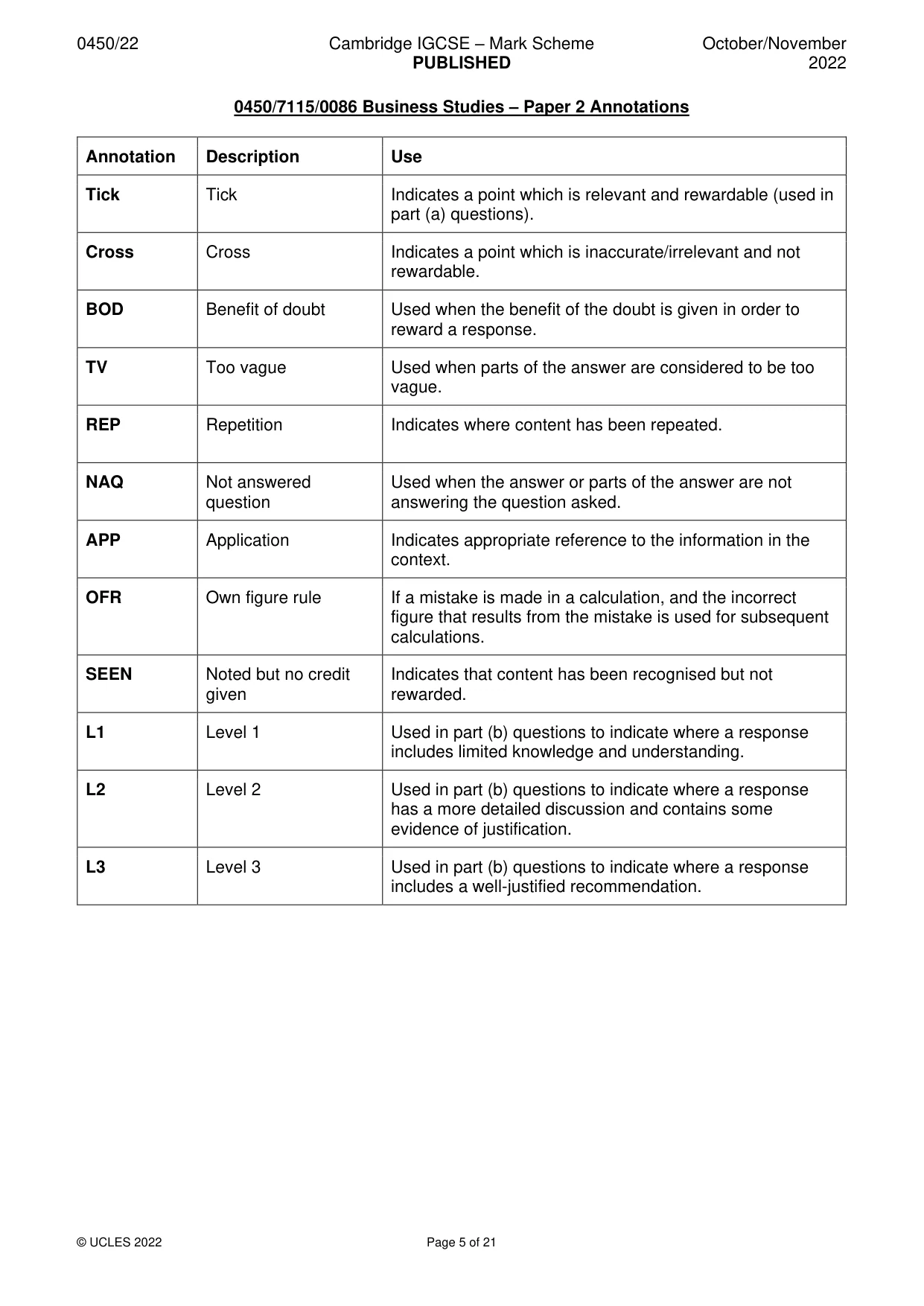
0450/22 Cambridge IGCSE – Mark Scheme PUBLISHED October/November 2022 © UCLES 2022 Page 5 of 21 0450/7115/0086 Business Studies – Paper 2 Annotations Annotation Description Use Tick Tick Indicates a point which is relevant and rewardable (used in part (a) questions). Cross Cross Indicates a point which is inaccurate/irrelevant and not rewardable. BOD Benefit of doubt Used when the benefit of the doubt is given in order to reward a response. TV Too vague Used when parts of the answer are considered to be too vague. REP Repetition Indicates where content has been repeated. NAQ Not answered question Used when the answer or parts of the answer are not answering the question asked. APP Application Indicates appropriate reference to the information in the context. OFR Own figure rule If a mistake is made in a calculation, and the incorrect figure that results from the mistake is used for subsequent calculations. SEEN Noted but no credit given Indicates that content has been recognised but not rewarded. L1 Level 1 Used in part (b) questions to indicate where a response includes limited knowledge and understanding. L2 Level 2 Used in part (b) questions to indicate where a response has a more detailed discussion and contains some evidence of justification. L3 Level 3 Used in part (b) questions to indicate where a response includes a well-justified recommendation.
Mark scheme, page 6
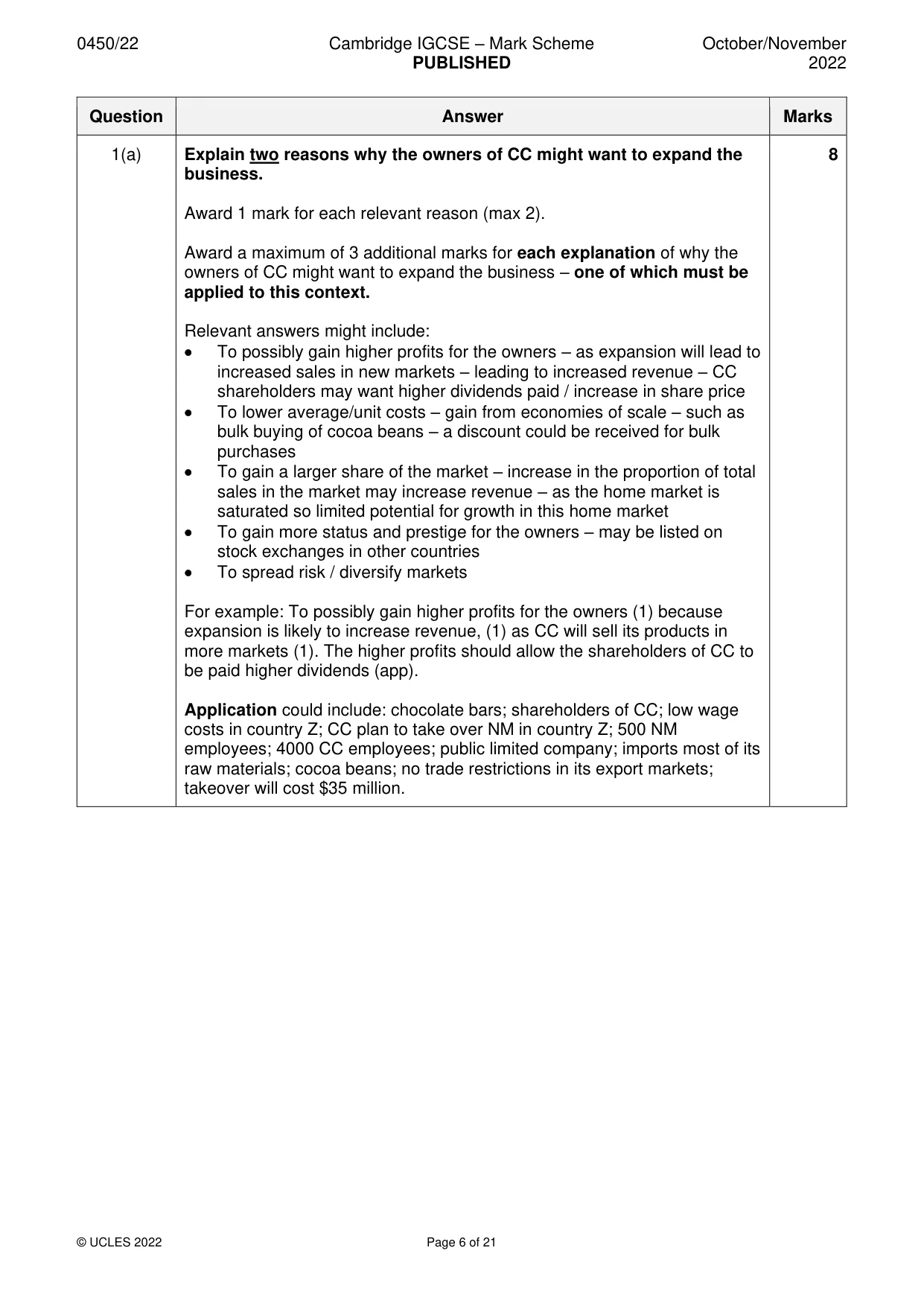
0450/22 Cambridge IGCSE – Mark Scheme PUBLISHED October/November 2022 © UCLES 2022 Page 6 of 21 Question Answer Marks 1(a) Explain two reasons why the owners of CC might want to expand the business. Award 1 mark for each relevant reason (max 2). Award a maximum of 3 additional marks for each explanation of why the owners of CC might want to expand the business – one of which must be applied to this context. Relevant answers might include: • To possibly gain higher profits for the owners – as expansion will lead to increased sales in new markets – leading to increased revenue – CC shareholders may want higher dividends paid / increase in share price • To lower average/unit costs – gain from economies of scale – such as bulk buying of cocoa beans – a discount could be received for bulk purchases • To gain a larger share of the market – increase in the proportion of total sales in the market may increase revenue – as the home market is saturated so limited potential for growth in this home market • To gain more status and prestige for the owners – may be listed on stock exchanges in other countries • To spread risk / diversify markets For example: To possibly gain higher profits for the owners (1) because expansion is likely to increase revenue, (1) as CC will sell its products in more markets (1). The higher profits should allow the shareholders of CC to be paid higher dividends (app). Application could include: chocolate bars; shareholders of CC; low wage costs in country Z; CC plan to take over NM in country Z; 500 NM employees; 4000 CC employees; public limited company; imports most of its raw materials; cocoa beans; no trade restrictions in its export markets; takeover will cost $35 million. 8
Mark scheme, page 7
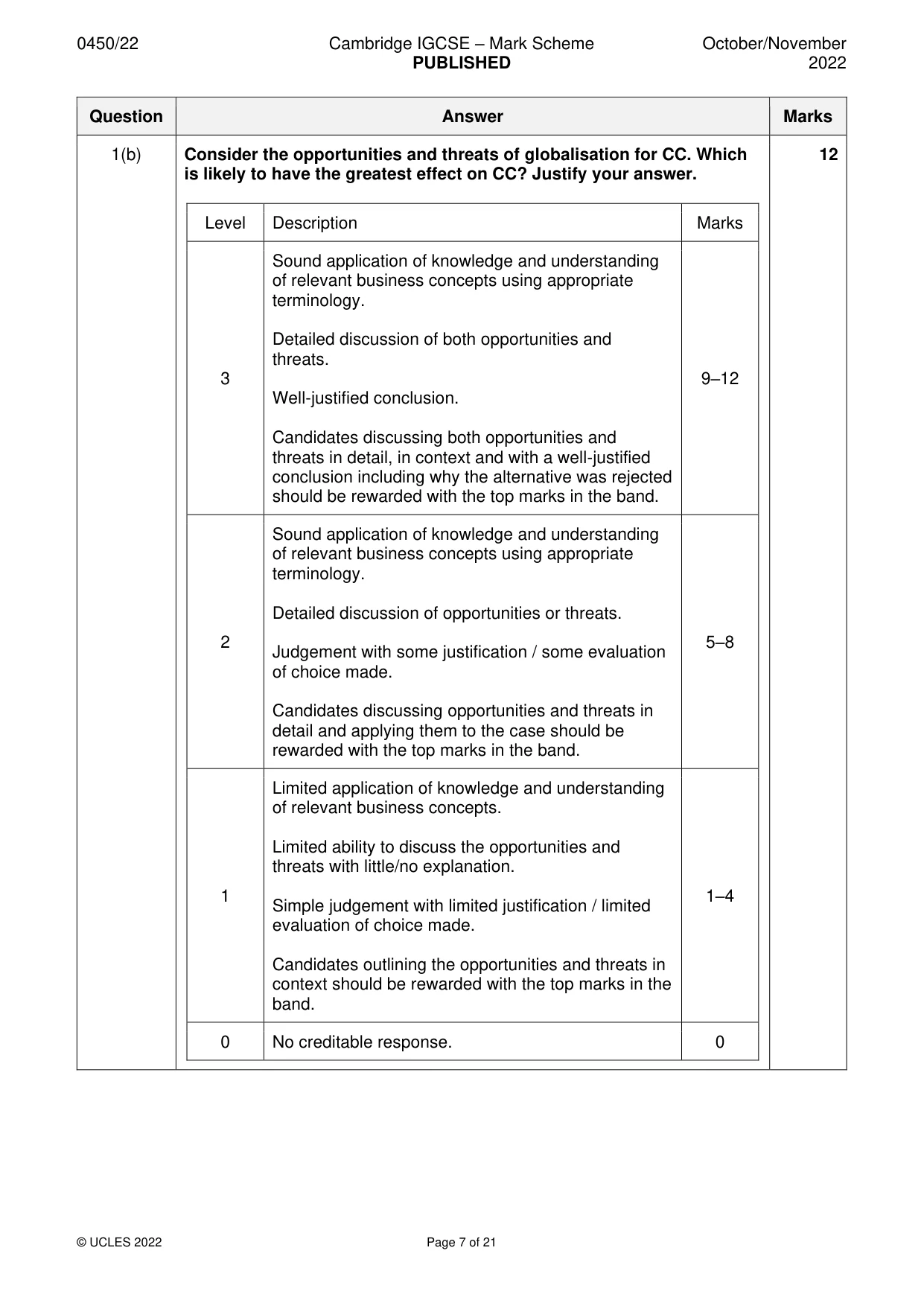
0450/22 Cambridge IGCSE – Mark Scheme PUBLISHED October/November 2022 © UCLES 2022 Page 7 of 21 Question Answer Marks 1(b) Consider the opportunities and threats of globalisation for CC. Which is likely to have the greatest effect on CC? Justify your answer. Level Description Marks 3 Sound application of knowledge and understanding of relevant business concepts using appropriate terminology. Detailed discussion of both opportunities and threats. Well-justified conclusion. Candidates discussing both opportunities and threats in detail, in context and with a well-justified conclusion including why the alternative was rejected should be rewarded with the top marks in the band. 9–12 2 Sound application of knowledge and understanding of relevant business concepts using appropriate terminology. Detailed discussion of opportunities or threats. Judgement with some justification / some evaluation of choice made. Candidates discussing opportunities and threats in detail and applying them to the case should be rewarded with the top marks in the band. 5–8 1 Limited application of knowledge and understanding of relevant business concepts. Limited ability to discuss the opportunities and threats with little/no explanation. Simple judgement with limited justification / limited evaluation of choice made. Candidates outlining the opportunities and threats in context should be rewarded with the top marks in the band. 1–4 0 No creditable response. 0 12
Mark scheme, page 8
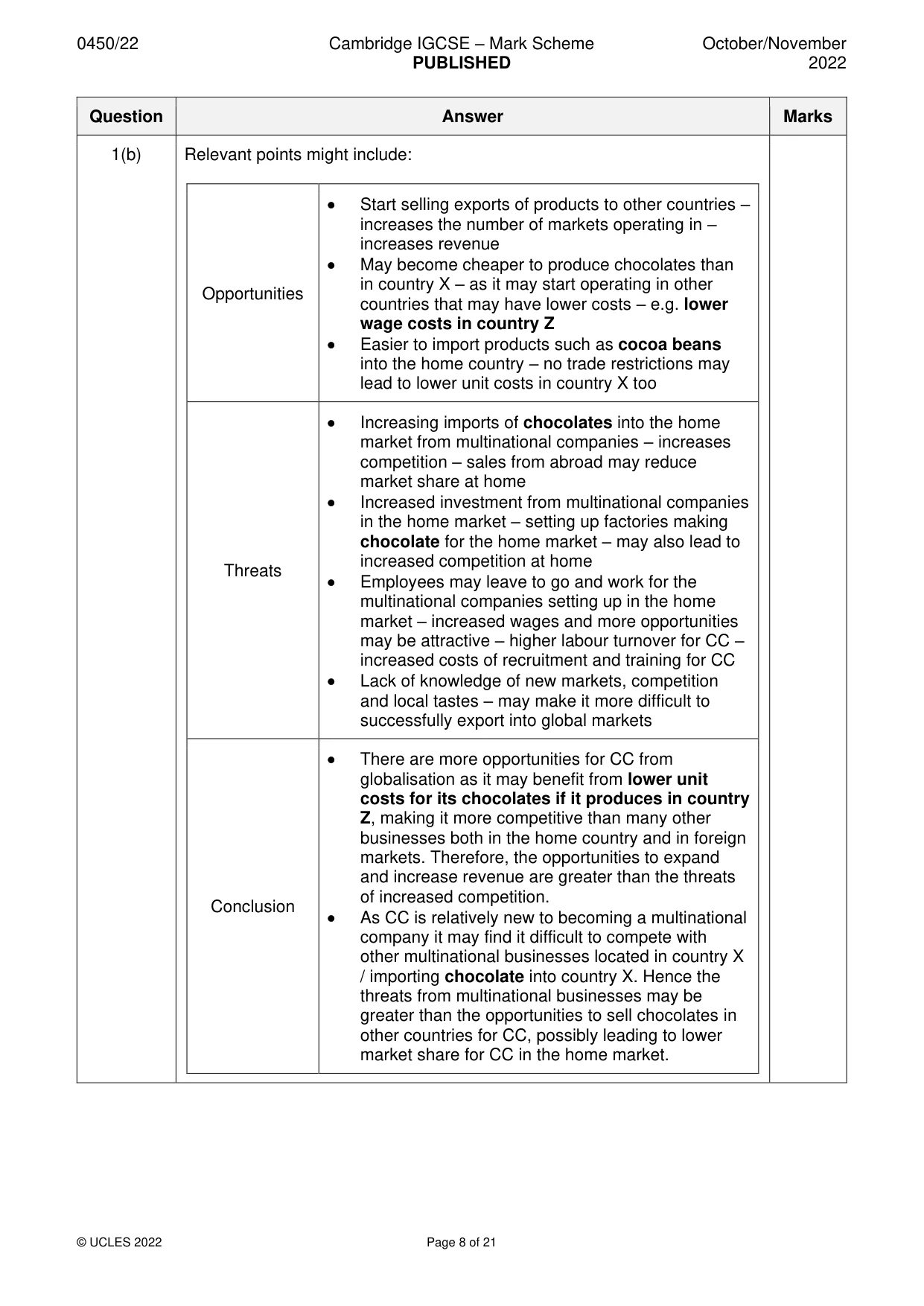
0450/22 Cambridge IGCSE – Mark Scheme PUBLISHED October/November 2022 © UCLES 2022 Page 8 of 21 Question Answer Marks 1(b) Relevant points might include: Opportunities • Start selling exports of products to other countries – increases the number of markets operating in – increases revenue • May become cheaper to produce chocolates than in country X – as it may start operating in other countries that may have lower costs – e.g. lower wage costs in country Z • Easier to import products such as cocoa beans into the home country – no trade restrictions may lead to lower unit costs in country X too Threats • Increasing imports of chocolates into the home market from multinational companies – increases competition – sales from abroad may reduce market share at home • Increased investment from multinational companies in the home market – setting up factories making chocolate for the home market – may also lead to increased competition at home • Employees may leave to go and work for the multinational companies setting up in the home market – increased wages and more opportunities may be attractive – higher labour turnover for CC – increased costs of recruitment and training for CC • Lack of knowledge of new markets, competition and local tastes – may make it more difficult to successfully export into global markets Conclusion • There are more opportunities for CC from globalisation as it may benefit from lower unit costs for its chocolates if it produces in country Z, making it more competitive than many other businesses both in the home country and in foreign markets. Therefore, the opportunities to expand and increase revenue are greater than the threats of increased competition. • As CC is relatively new to becoming a multinational company it may find it difficult to compete with other multinational businesses located in country X / importing chocolate into country X. Hence the threats from multinational businesses may be greater than the opportunities to sell chocolates in other countries for CC, possibly leading to lower market share for CC in the home market.
Mark scheme, page 9
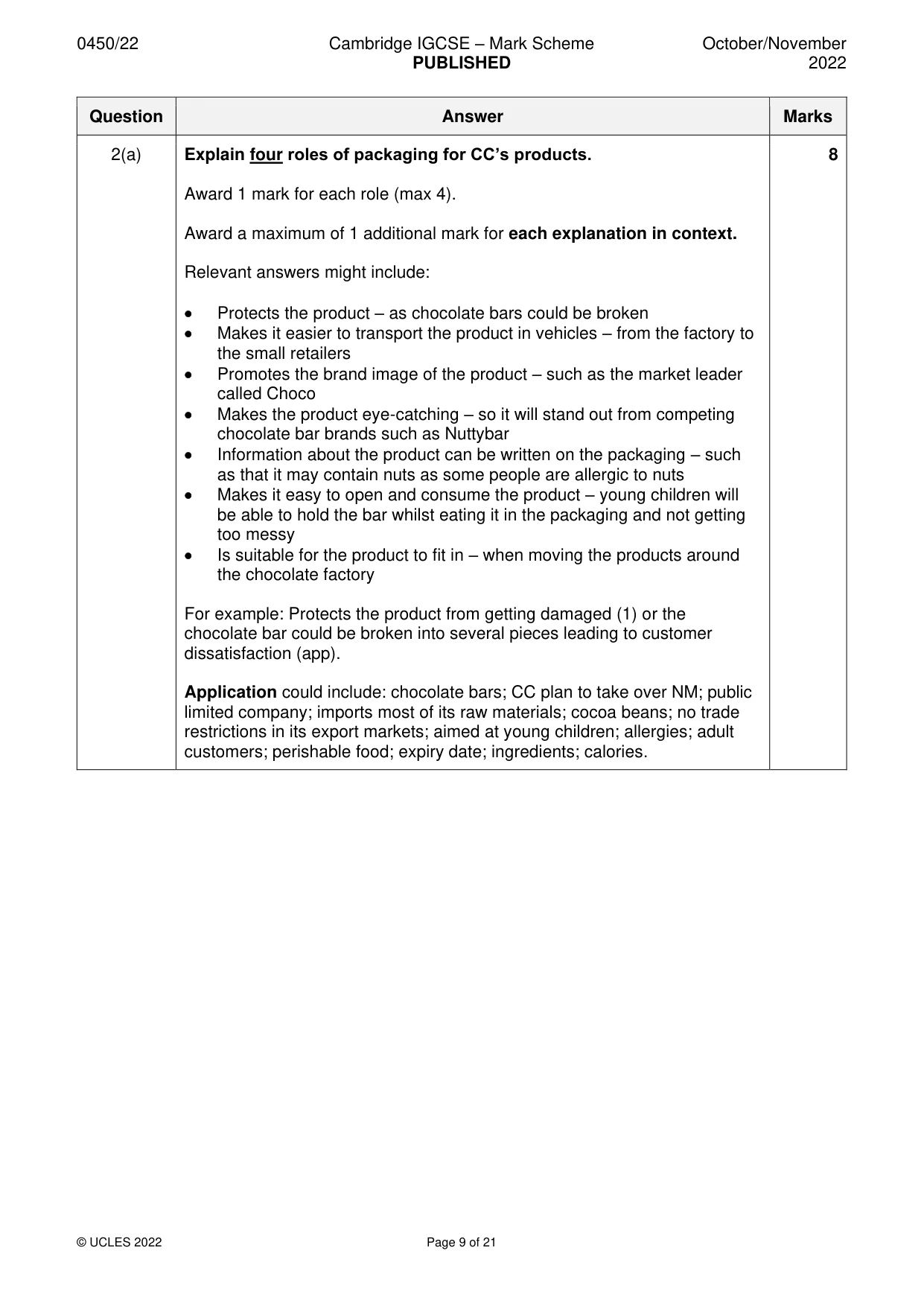
0450/22 Cambridge IGCSE – Mark Scheme PUBLISHED October/November 2022 © UCLES 2022 Page 9 of 21 Question Answer Marks 2(a) Explain four roles of packaging for CC’s products. Award 1 mark for each role (max 4). Award a maximum of 1 additional mark for each explanation in context. Relevant answers might include: • Protects the product – as chocolate bars could be broken • Makes it easier to transport the product in vehicles – from the factory to the small retailers • Promotes the brand image of the product – such as the market leader called Choco • Makes the product eye-catching – so it will stand out from competing chocolate bar brands such as Nuttybar • Information about the product can be written on the packaging – such as that it may contain nuts as some people are allergic to nuts • Makes it easy to open and consume the product – young children will be able to hold the bar whilst eating it in the packaging and not getting too messy • Is suitable for the product to fit in – when moving the products around the chocolate factory For example: Protects the product from getting damaged (1) or the chocolate bar could be broken into several pieces leading to customer dissatisfaction (app). Application could include: chocolate bars; CC plan to take over NM; public limited company; imports most of its raw materials; cocoa beans; no trade restrictions in its export markets; aimed at young children; allergies; adult customers; perishable food; expiry date; ingredients; calories. 8
Mark scheme, page 10
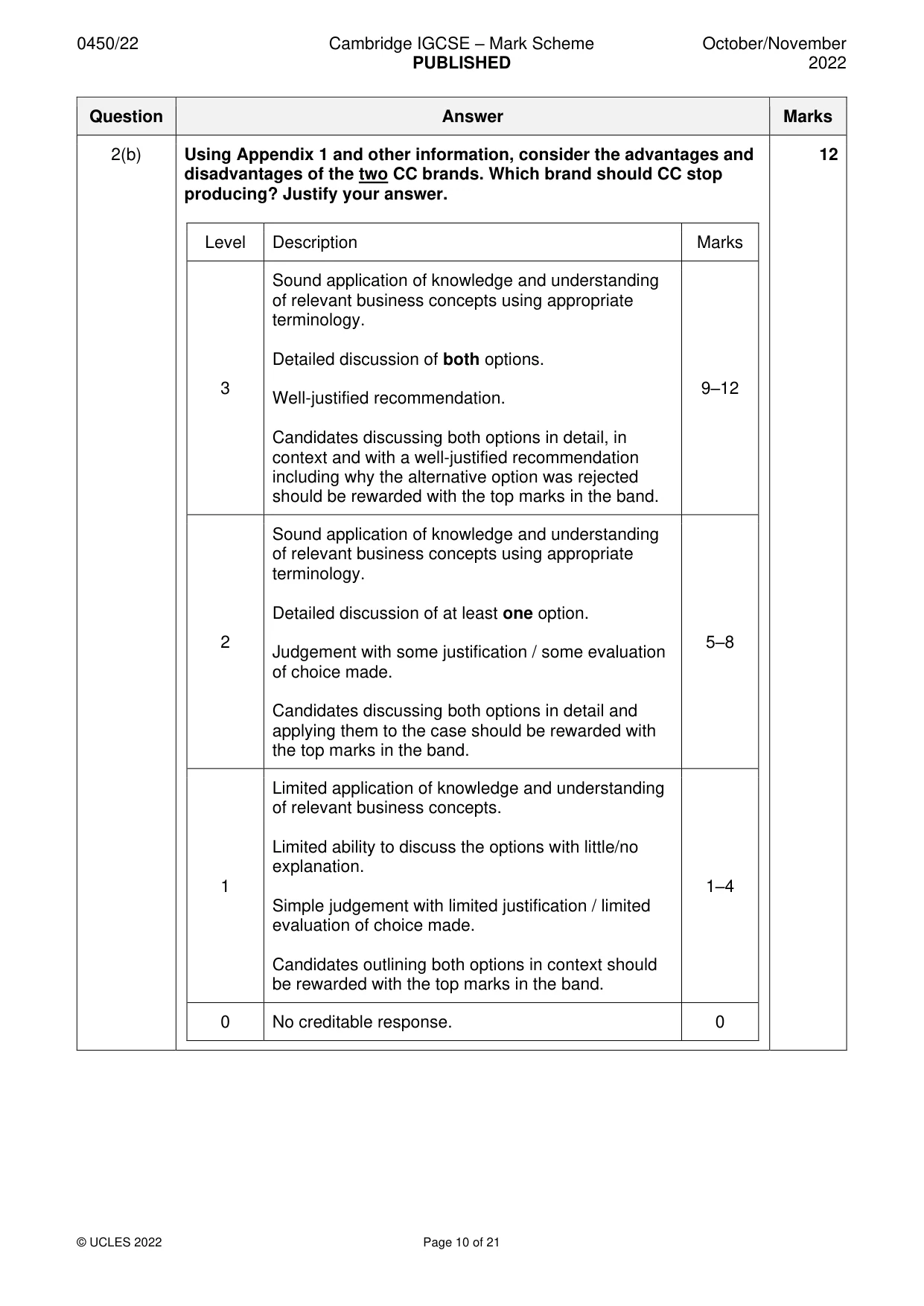
0450/22 Cambridge IGCSE – Mark Scheme PUBLISHED October/November 2022 © UCLES 2022 Page 10 of 21 Question Answer Marks 2(b) Using Appendix 1 and other information, consider the advantages and disadvantages of the two CC brands. Which brand should CC stop producing? Justify your answer. Level Description Marks 3 Sound application of knowledge and understanding of relevant business concepts using appropriate terminology. Detailed discussion of both options. Well-justified recommendation. Candidates discussing both options in detail, in context and with a well-justified recommendation including why the alternative option was rejected should be rewarded with the top marks in the band. 9–12 2 Sound application of knowledge and understanding of relevant business concepts using appropriate terminology. Detailed discussion of at least one option. Judgement with some justification / some evaluation of choice made. Candidates discussing both options in detail and applying them to the case should be rewarded with the top marks in the band. 5–8 1 Limited application of knowledge and understanding of relevant business concepts. Limited ability to discuss the options with little/no explanation. Simple judgement with limited justification / limited evaluation of choice made. Candidates outlining both options in context should be rewarded with the top marks in the band. 1–4 0 No creditable response. 0 12
Mark scheme, page 11
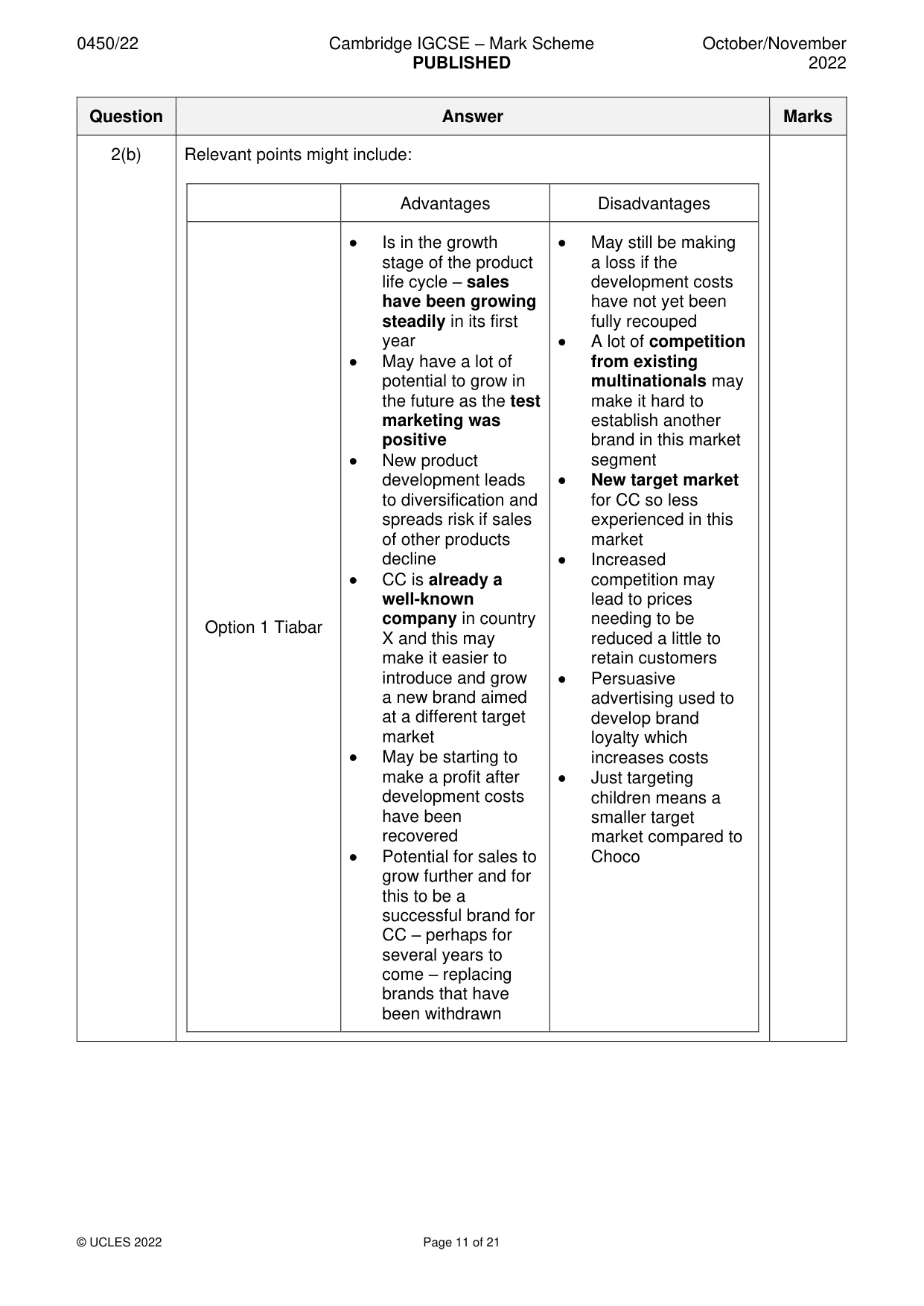
0450/22 Cambridge IGCSE – Mark Scheme PUBLISHED October/November 2022 © UCLES 2022 Page 11 of 21 Question Answer Marks 2(b) Relevant points might include: Advantages Disadvantages Option 1 Tiabar • Is in the growth stage of the product life cycle – sales have been growing steadily in its first year • May have a lot of potential to grow in the future as the test marketing was positive • New product development leads to diversification and spreads risk if sales of other products decline • CC is already a well-known company in country X and this may make it easier to introduce and grow a new brand aimed at a different target market • May be starting to make a profit after development costs have been recovered • Potential for sales to grow further and for this to be a successful brand for CC – perhaps for several years to come – replacing brands that have been withdrawn • May still be making a loss if the development costs have not yet been fully recouped • A lot of competition from existing multinationals may make it hard to establish another brand in this market segment • New target market for CC so less experienced in this market • Increased competition may lead to prices needing to be reduced a little to retain customers • Persuasive advertising used to develop brand loyalty which increases costs • Just targeting children means a smaller target market compared to Choco
Mark scheme, page 12
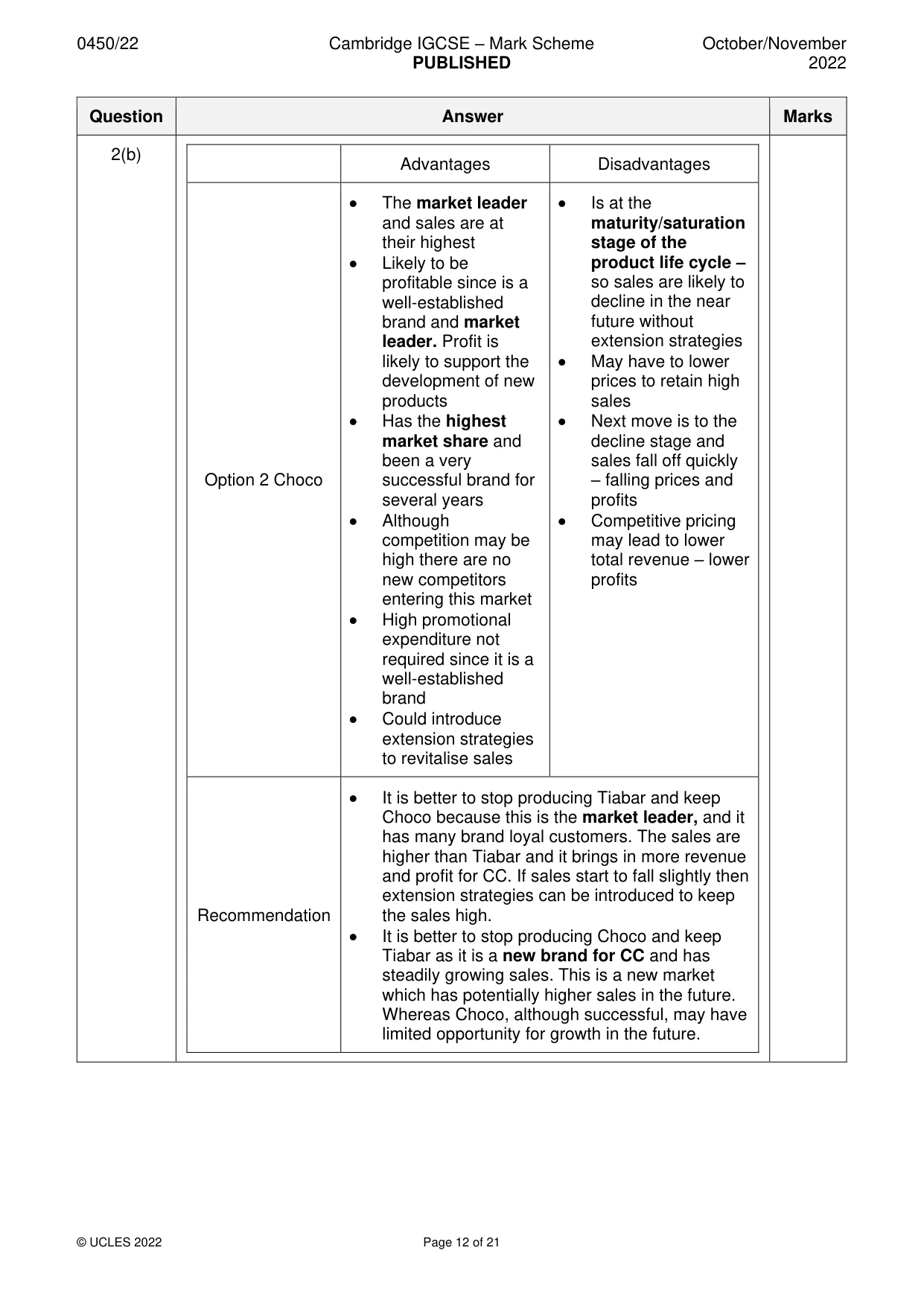
0450/22 Cambridge IGCSE – Mark Scheme PUBLISHED October/November 2022 © UCLES 2022 Page 12 of 21 Question Answer Marks 2(b) Advantages Disadvantages Option 2 Choco • The market leader and sales are at their highest • Likely to be profitable since is a well-established brand and market leader. Profit is likely to support the development of new products • Has the highest market share and been a very successful brand for several years • Although competition may be high there are no new competitors entering this market • High promotional expenditure not required since it is a well-established brand • Could introduce extension strategies to revitalise sales • Is at the maturity/saturation stage of the product life cycle – so sales are likely to decline in the near future without extension strategies • May have to lower prices to retain high sales • Next move is to the decline stage and sales fall off quickly – falling prices and profits • Competitive pricing may lead to lower total revenue – lower profits Recommendation • It is better to stop producing Tiabar and keep Choco because this is the market leader, and it has many brand loyal customers. The sales are higher than Tiabar and it brings in more revenue and profit for CC. If sales start to fall slightly then extension strategies can be introduced to keep the sales high. • It is better to stop producing Choco and keep Tiabar as it is a new brand for CC and has steadily growing sales. This is a new market which has potentially higher sales in the future. Whereas Choco, although successful, may have limited opportunity for growth in the future.
Mark scheme, page 13
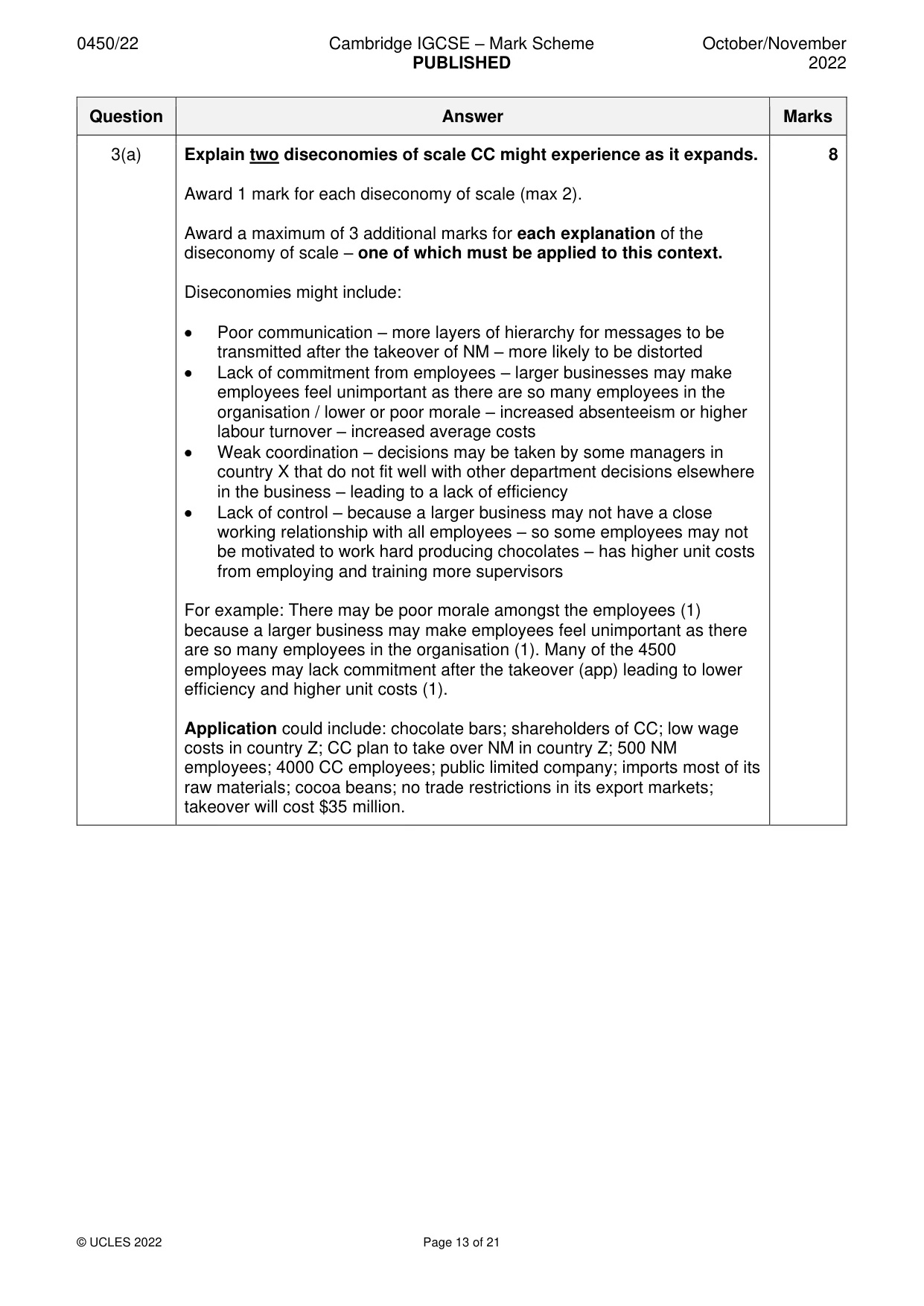
0450/22 Cambridge IGCSE – Mark Scheme PUBLISHED October/November 2022 © UCLES 2022 Page 13 of 21 Question Answer Marks 3(a) Explain two diseconomies of scale CC might experience as it expands. Award 1 mark for each diseconomy of scale (max 2). Award a maximum of 3 additional marks for each explanation of the diseconomy of scale – one of which must be applied to this context. Diseconomies might include: • Poor communication – more layers of hierarchy for messages to be transmitted after the takeover of NM – more likely to be distorted • Lack of commitment from employees – larger businesses may make employees feel unimportant as there are so many employees in the organisation / lower or poor morale – increased absenteeism or higher labour turnover – increased average costs • Weak coordination – decisions may be taken by some managers in country X that do not fit well with other department decisions elsewhere in the business – leading to a lack of efficiency • Lack of control – because a larger business may not have a close working relationship with all employees – so some employees may not be motivated to work hard producing chocolates – has higher unit costs from employing and training more supervisors For example: There may be poor morale amongst the employees (1) because a larger business may make employees feel unimportant as there are so many employees in the organisation (1). Many of the 4500 employees may lack commitment after the takeover (app) leading to lower efficiency and higher unit costs (1). Application could include: chocolate bars; shareholders of CC; low wage costs in country Z; CC plan to take over NM in country Z; 500 NM employees; 4000 CC employees; public limited company; imports most of its raw materials; cocoa beans; no trade restrictions in its export markets; takeover will cost $35 million. 8
Mark scheme, page 14
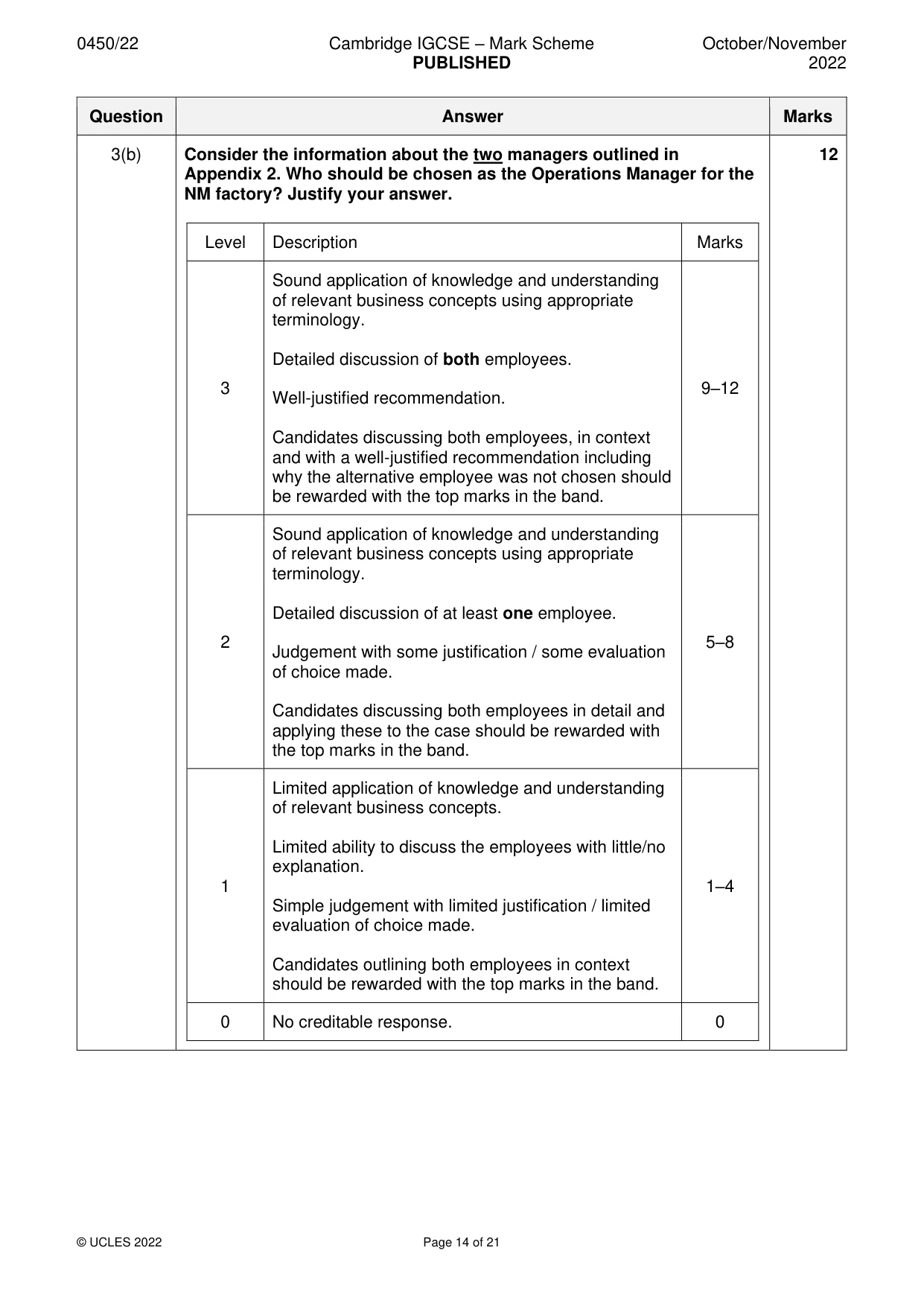
0450/22 Cambridge IGCSE – Mark Scheme PUBLISHED October/November 2022 © UCLES 2022 Page 14 of 21 Question Answer Marks 3(b) Consider the information about the two managers outlined in Appendix 2. Who should be chosen as the Operations Manager for the NM factory? Justify your answer. Level Description Marks 3 Sound application of knowledge and understanding of relevant business concepts using appropriate terminology. Detailed discussion of both employees. Well-justified recommendation. Candidates discussing both employees, in context and with a well-justified recommendation including why the alternative employee was not chosen should be rewarded with the top marks in the band. 9–12 2 Sound application of knowledge and understanding of relevant business concepts using appropriate terminology. Detailed discussion of at least one employee. Judgement with some justification / some evaluation of choice made. Candidates discussing both employees in detail and applying these to the case should be rewarded with the top marks in the band. 5–8 1 Limited application of knowledge and understanding of relevant business concepts. Limited ability to discuss the employees with little/no explanation. Simple judgement with limited justification / limited evaluation of choice made. Candidates outlining both employees in context should be rewarded with the top marks in the band. 1–4 0 No creditable response. 0 12
Mark scheme, page 15
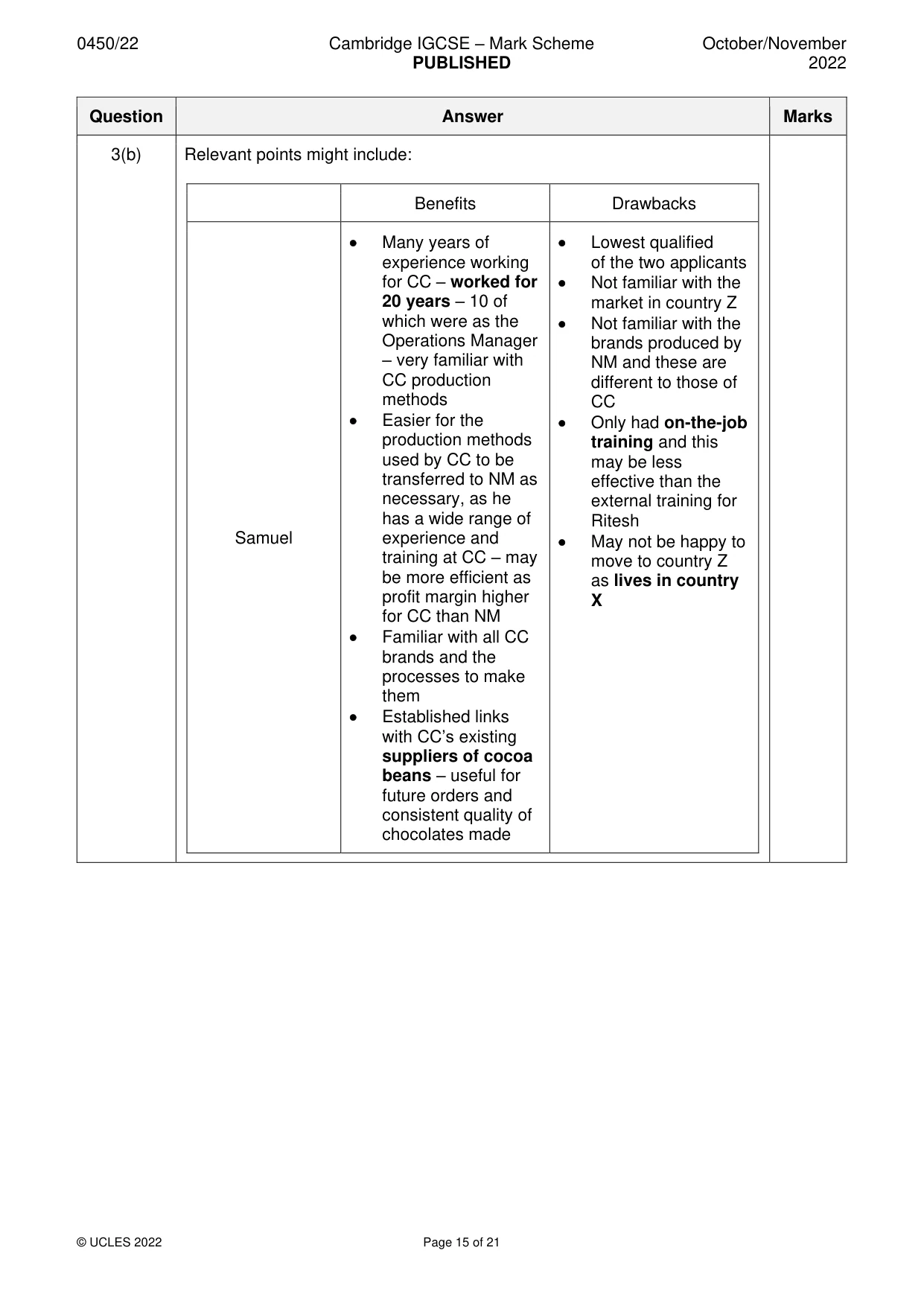
0450/22 Cambridge IGCSE – Mark Scheme PUBLISHED October/November 2022 © UCLES 2022 Page 15 of 21 Question Answer Marks 3(b) Relevant points might include: Benefits Drawbacks Samuel • Many years of experience working for CC – worked for 20 years – 10 of which were as the Operations Manager – very familiar with CC production methods • Easier for the production methods used by CC to be transferred to NM as necessary, as he has a wide range of experience and training at CC – may be more efficient as profit margin higher for CC than NM • Familiar with all CC brands and the processes to make them • Established links with CC’s existing suppliers of cocoa beans – useful for future orders and consistent quality of chocolates made • Lowest qualified of the two applicants • Not familiar with the market in country Z • Not familiar with the brands produced by NM and these are different to those of CC • Only had on-the-job training and this may be less effective than the external training for Ritesh • May not be happy to move to country Z as lives in country X
Mark scheme, page 16
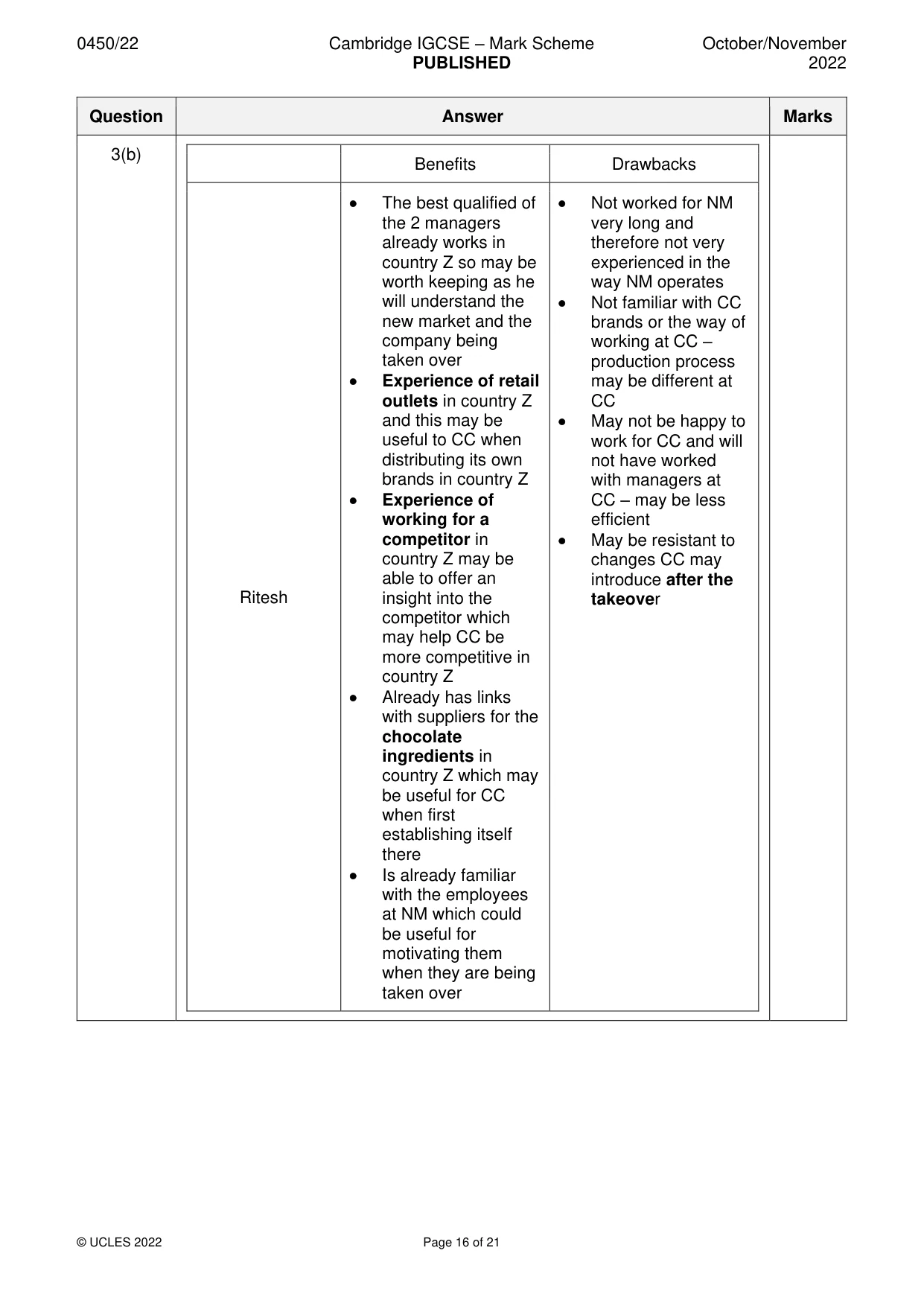
0450/22 Cambridge IGCSE – Mark Scheme PUBLISHED October/November 2022 © UCLES 2022 Page 16 of 21 Question Answer Marks 3(b) Benefits Drawbacks Ritesh • The best qualified of the 2 managers already works in country Z so may be worth keeping as he will understand the new market and the company being taken over • Experience of retail outlets in country Z and this may be useful to CC when distributing its own brands in country Z • Experience of working for a competitor in country Z may be able to offer an insight into the competitor which may help CC be more competitive in country Z • Already has links with suppliers for the chocolate ingredients in country Z which may be useful for CC when first establishing itself there • Is already familiar with the employees at NM which could be useful for motivating them when they are being taken over • Not worked for NM very long and therefore not very experienced in the way NM operates • Not familiar with CC brands or the way of working at CC – production process may be different at CC • May not be happy to work for CC and will not have worked with managers at CC – may be less efficient • May be resistant to changes CC may introduce after the takeover
Mark scheme, page 17
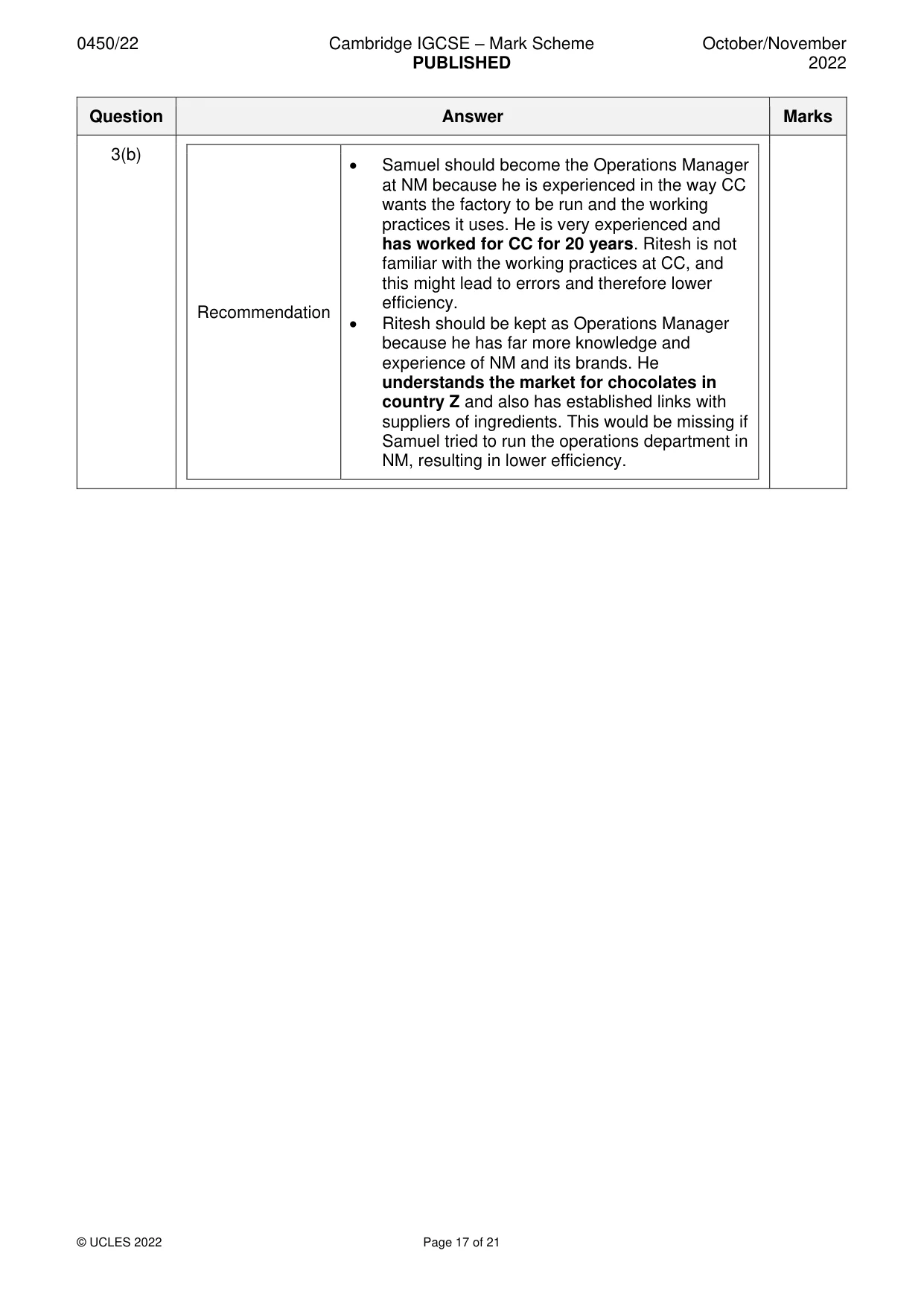
0450/22 Cambridge IGCSE – Mark Scheme PUBLISHED October/November 2022 © UCLES 2022 Page 17 of 21 Question Answer Marks 3(b) Recommendation • Samuel should become the Operations Manager at NM because he is experienced in the way CC wants the factory to be run and the working practices it uses. He is very experienced and has worked for CC for 20 years. Ritesh is not familiar with the working practices at CC, and this might lead to errors and therefore lower efficiency. • Ritesh should be kept as Operations Manager because he has far more knowledge and experience of NM and its brands. He understands the market for chocolates in country Z and also has established links with suppliers of ingredients. This would be missing if Samuel tried to run the operations department in NM, resulting in lower efficiency.
Mark scheme, page 18
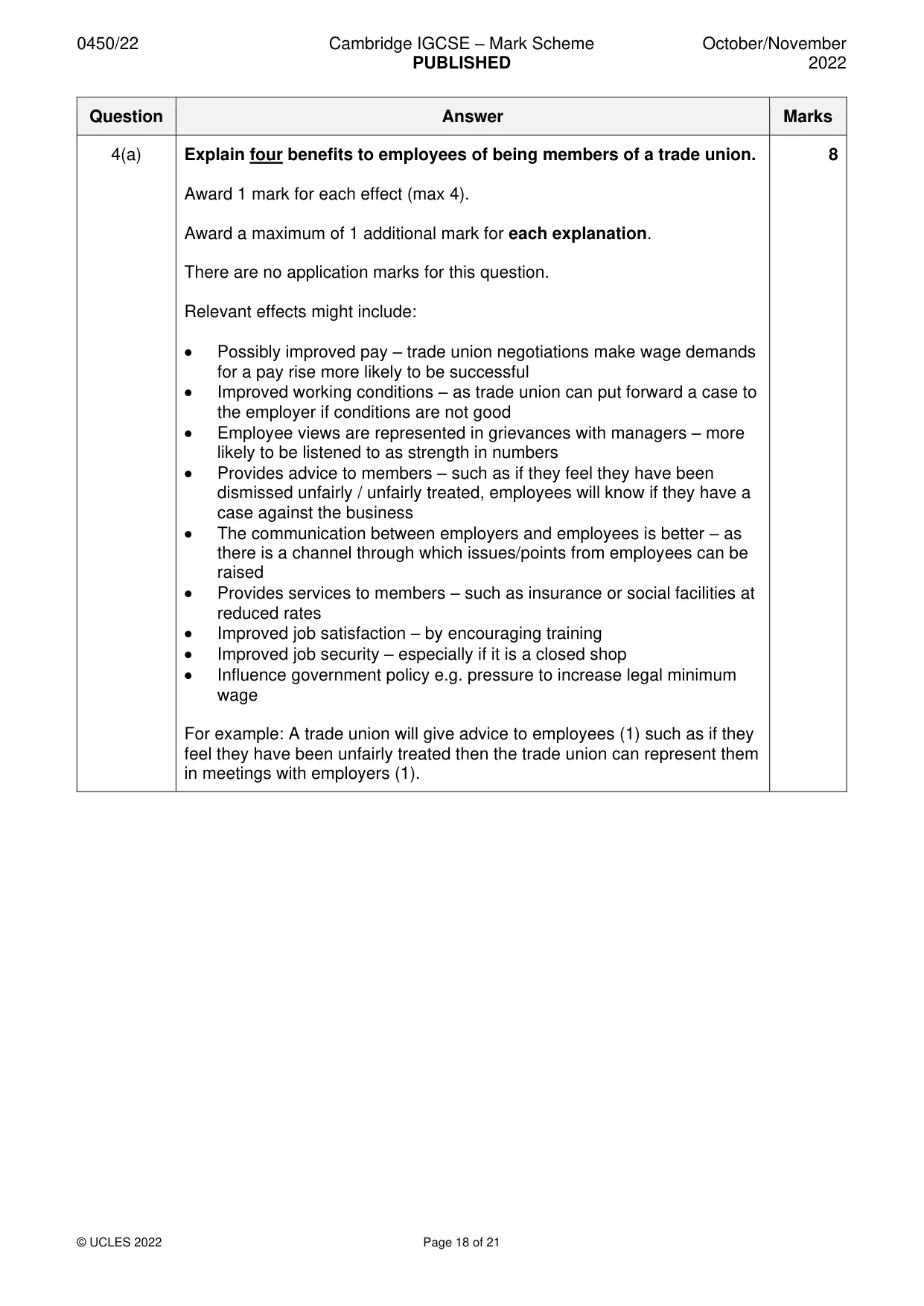
0450/22 Cambridge IGCSE – Mark Scheme PUBLISHED October/November 2022 © UCLES 2022 Page 18 of 21 Question Answer Marks 4(a) Explain four benefits to employees of being members of a trade union. Award 1 mark for each effect (max 4). Award a maximum of 1 additional mark for each explanation. There are no application marks for this question. Relevant effects might include: • Possibly improved pay – trade union negotiations make wage demands for a pay rise more likely to be successful • Improved working conditions – as trade union can put forward a case to the employer if conditions are not good • Employee views are represented in grievances with managers – more likely to be listened to as strength in numbers • Provides advice to members – such as if they feel they have been dismissed unfairly / unfairly treated, employees will know if they have a case against the business • The communication between employers and employees is better – as there is a channel through which issues/points from employees can be raised • Provides services to members – such as insurance or social facilities at reduced rates • Improved job satisfaction – by encouraging training • Improved job security – especially if it is a closed shop • Influence government policy e.g. pressure to increase legal minimum wage For example: A trade union will give advice to employees (1) such as if they feel they have been unfairly treated then the trade union can represent them in meetings with employers (1). 8
Mark scheme, page 19
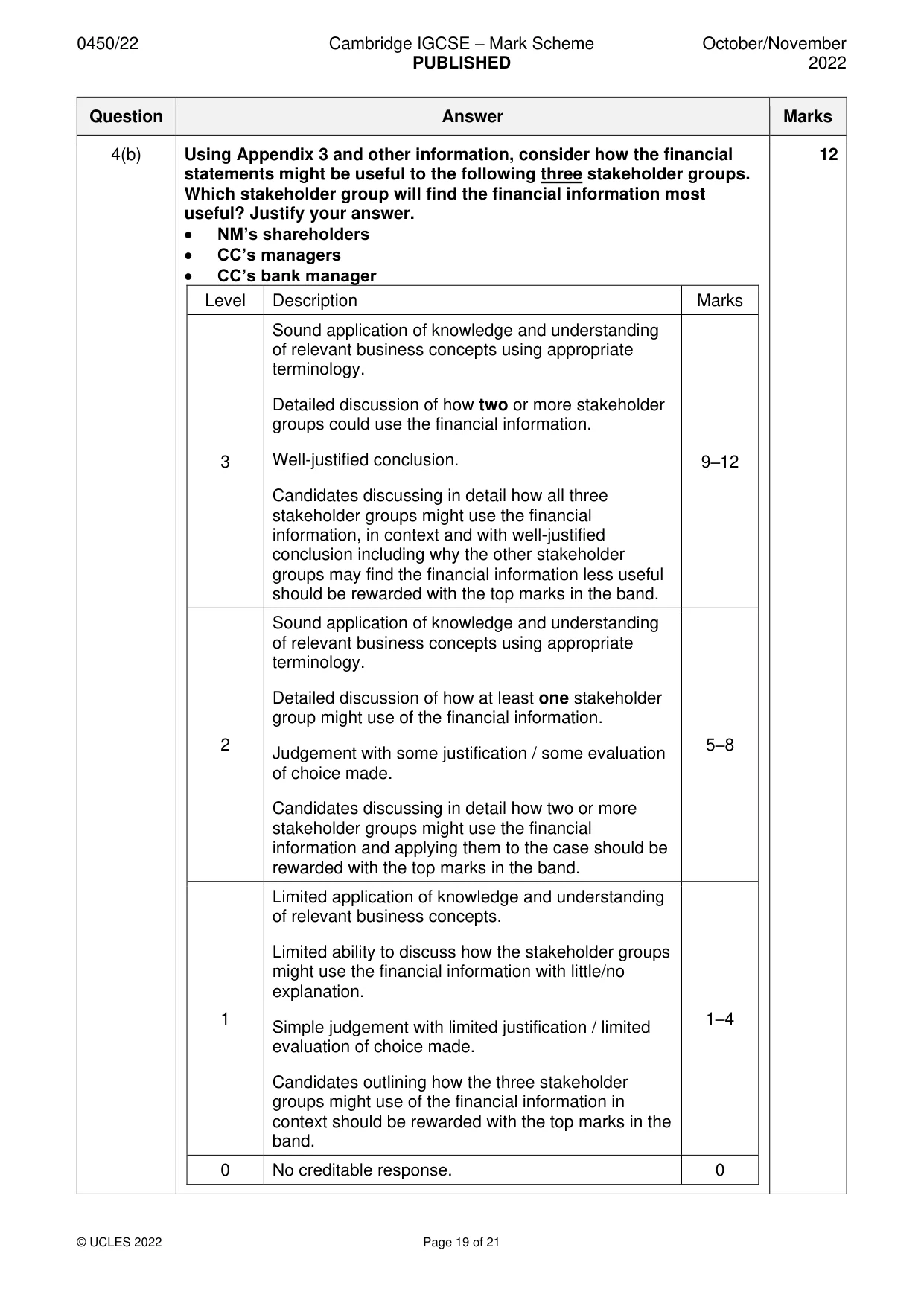
0450/22 Cambridge IGCSE – Mark Scheme PUBLISHED October/November 2022 © UCLES 2022 Page 19 of 21 Question Answer Marks 4(b) Using Appendix 3 and other information, consider how the financial statements might be useful to the following three stakeholder groups. Which stakeholder group will find the financial information most useful? Justify your answer. • NM’s shareholders • CC’s managers • CC’s bank manager Level Description Marks 3 Sound application of knowledge and understanding of relevant business concepts using appropriate terminology. Detailed discussion of how two or more stakeholder groups could use the financial information. Well-justified conclusion. Candidates discussing in detail how all three stakeholder groups might use the financial information, in context and with well-justified conclusion including why the other stakeholder groups may find the financial information less useful should be rewarded with the top marks in the band. 9–12 2 Sound application of knowledge and understanding of relevant business concepts using appropriate terminology. Detailed discussion of how at least one stakeholder group might use of the financial information. Judgement with some justification / some evaluation of choice made. Candidates discussing in detail how two or more stakeholder groups might use the financial information and applying them to the case should be rewarded with the top marks in the band. 5–8 1 Limited application of knowledge and understanding of relevant business concepts. Limited ability to discuss how the stakeholder groups might use the financial information with little/no explanation. Simple judgement with limited justification / limited evaluation of choice made. Candidates outlining how the three stakeholder groups might use of the financial information in context should be rewarded with the top marks in the band. 1–4 0 No creditable response. 0 12
Mark scheme, page 20
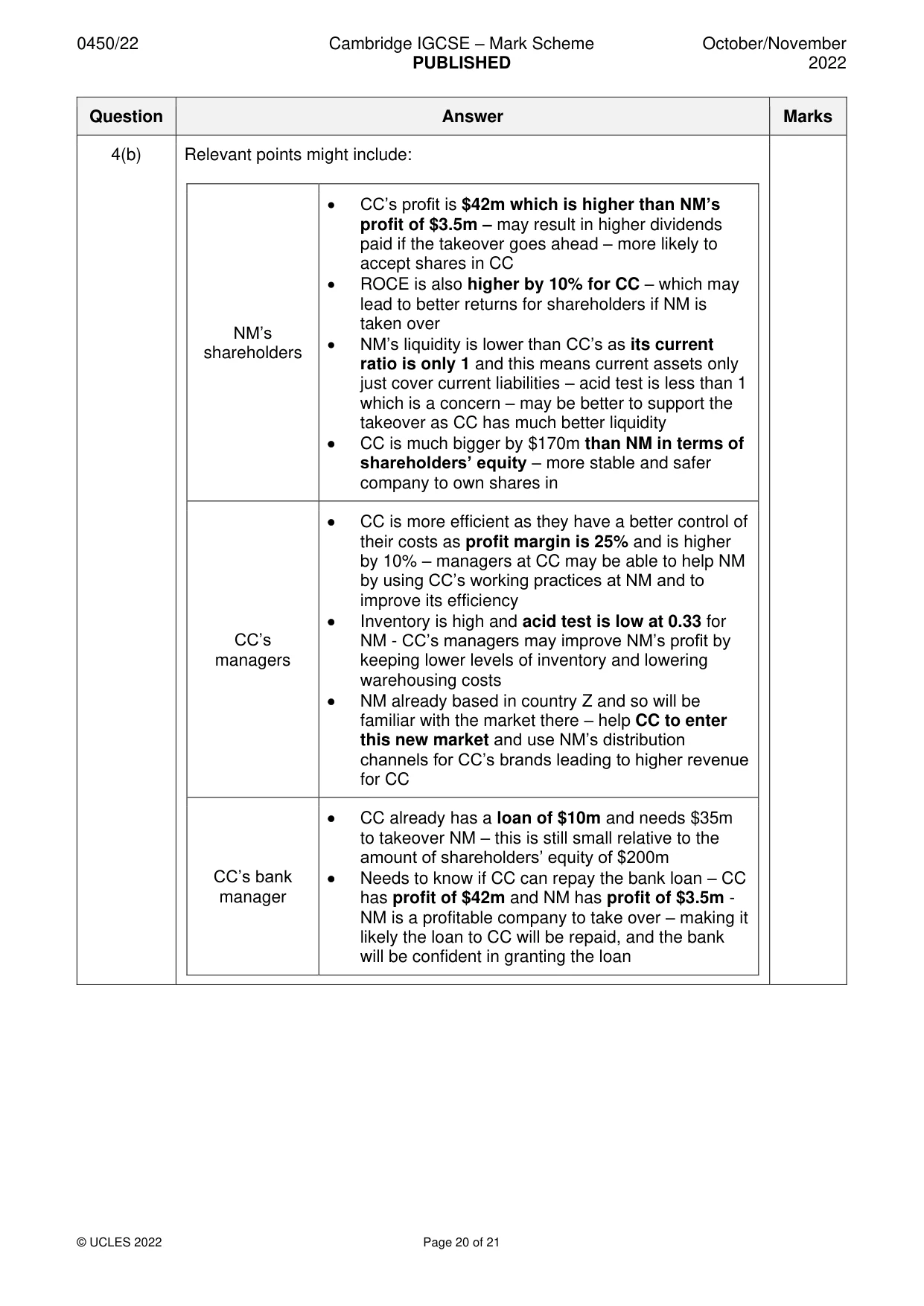
0450/22 Cambridge IGCSE – Mark Scheme PUBLISHED October/November 2022 © UCLES 2022 Page 20 of 21 Question Answer Marks 4(b) Relevant points might include: NM’s shareholders • CC’s profit is $42m which is higher than NM’s profit of $3.5m – may result in higher dividends paid if the takeover goes ahead – more likely to accept shares in CC • ROCE is also higher by 10% for CC – which may lead to better returns for shareholders if NM is taken over • NM’s liquidity is lower than CC’s as its current ratio is only 1 and this means current assets only just cover current liabilities – acid test is less than 1 which is a concern – may be better to support the takeover as CC has much better liquidity • CC is much bigger by $170m than NM in terms of shareholders’ equity – more stable and safer company to own shares in CC’s managers • CC is more efficient as they have a better control of their costs as profit margin is 25% and is higher by 10% – managers at CC may be able to help NM by using CC’s working practices at NM and to improve its efficiency • Inventory is high and acid test is low at 0.33 for NM - CC’s managers may improve NM’s profit by keeping lower levels of inventory and lowering warehousing costs • NM already based in country Z and so will be familiar with the market there – help CC to enter this new market and use NM’s distribution channels for CC’s brands leading to higher revenue for CC CC’s bank manager • CC already has a loan of $10m and needs $35m to takeover NM – this is still small relative to the amount of shareholders’ equity of $200m • Needs to know if CC can repay the bank loan – CC has profit of $42m and NM has profit of $3.5m - NM is a profitable company to take over – making it likely the loan to CC will be repaid, and the bank will be confident in granting the loan
Mark scheme, page 21
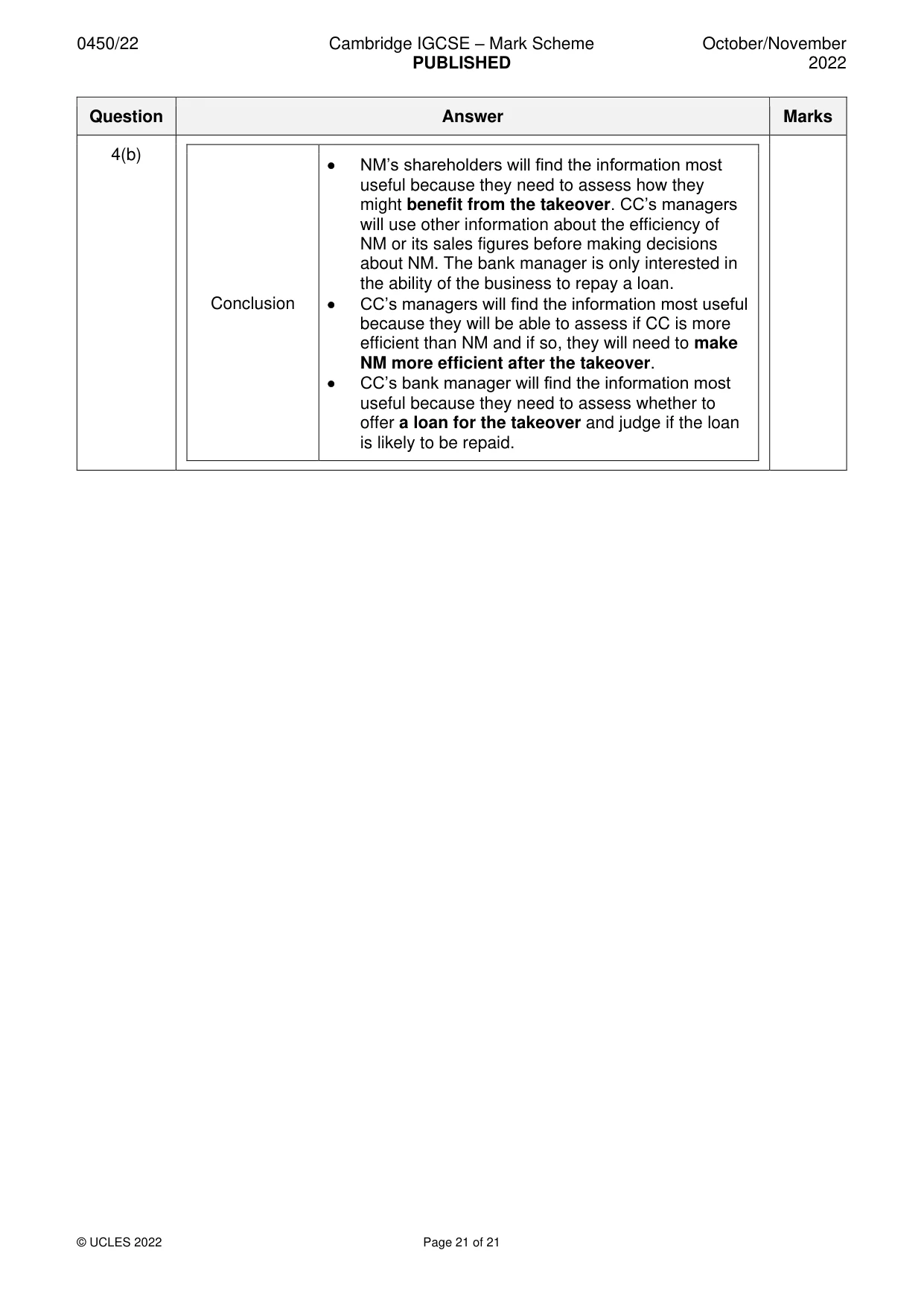
0450/22 Cambridge IGCSE – Mark Scheme PUBLISHED October/November 2022 © UCLES 2022 Page 21 of 21 Question Answer Marks 4(b) Conclusion • NM’s shareholders will find the information most useful because they need to assess how they might benefit from the takeover. CC’s managers will use other information about the efficiency of NM or its sales figures before making decisions about NM. The bank manager is only interested in the ability of the business to repay a loan. • CC’s managers will find the information most useful because they will be able to assess if CC is more efficient than NM and if so, they will need to make NM more efficient after the takeover. • CC’s bank manager will find the information most useful because they need to assess whether to offer a loan for the takeover and judge if the loan is likely to be repaid.
What you needed in this session
Cambridge’s own grade thresholds for 2022 Oct/Nov, Paper 2 · Variant 2. A higher threshold means an easier paper — the bar moves with how the cohort did.