Cambridge IGCSE Business Studies 0450 — 2022 May/June Paper 2 · Variant 2
0450/22/M/J/22 · 80 marks · ≈90 min
The question paper and its mark scheme, free to read here and free to download. This is Cambridge’s own paper, exactly as it was sat.
Question paper12 pages



Mark scheme17 pages
Answers below. Sit the paper first if you are practising.
Paper as text
Question paper, page 1
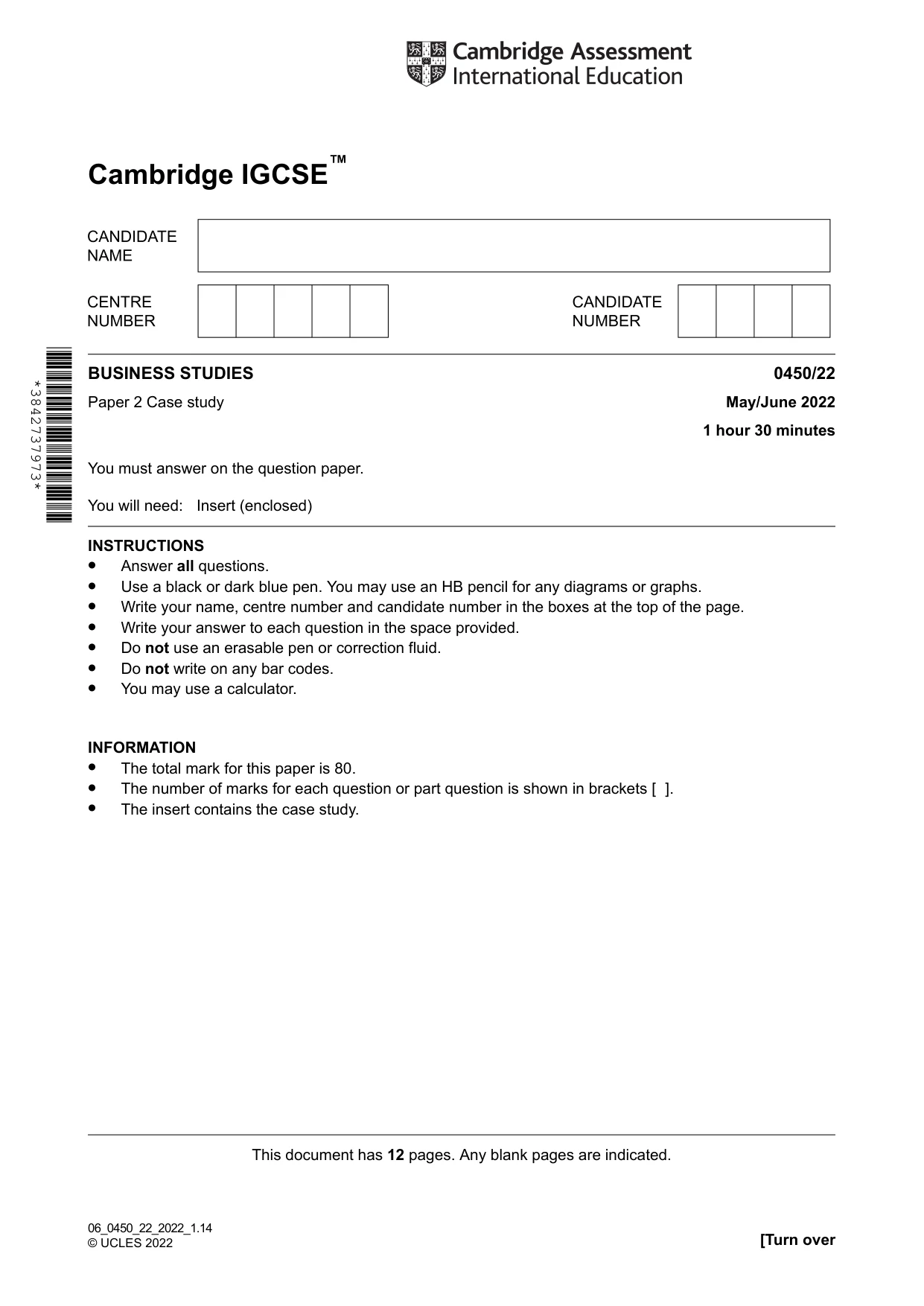
Cambridge IGCSE™ 0450/22 May/June 2022 1 hour 30 minutes BUSINESS STUDIES Paper 2 Case study You must answer on the question paper. You will need: Insert (enclosed) INSTRUCTIONS • Answer all questions. • Use a black or dark blue pen. You may use an HB pencil for any diagrams or graphs. • Write your name, centre number and candidate number in the boxes at the top of the page. • Write your answer to each question in the space provided. • Do not use an erasable pen or correction fluid. • Do not write on any bar codes. • You may use a calculator. INFORMATION • The total mark for this paper is 80. • The number of marks for each question or part question is shown in brackets [ ]. • The insert contains the case study. This document has 12 pages. Any blank pages are indicated. [Turn over 06_0450_22_2022_1.14 © UCLES 2022 *3842737973*
Question paper, page 2
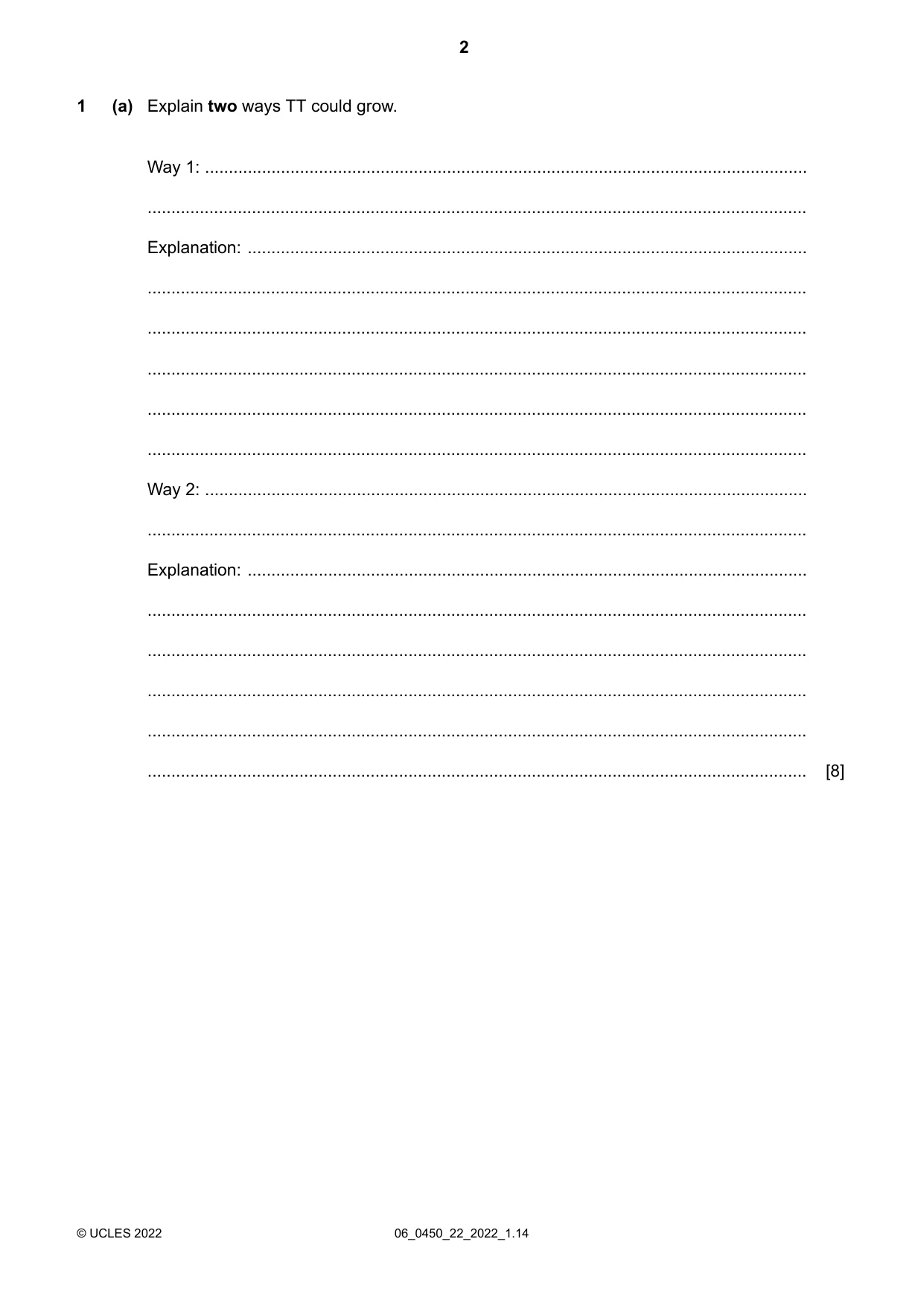
Explain two ways TT could grow. (a) 1 Way 1: … … Explanation: … … … … … … Way 2: … … Explanation: … … … … … … [8] 06_0450_22_2022_1.14 © UCLES 2022 2
Question paper, page 3
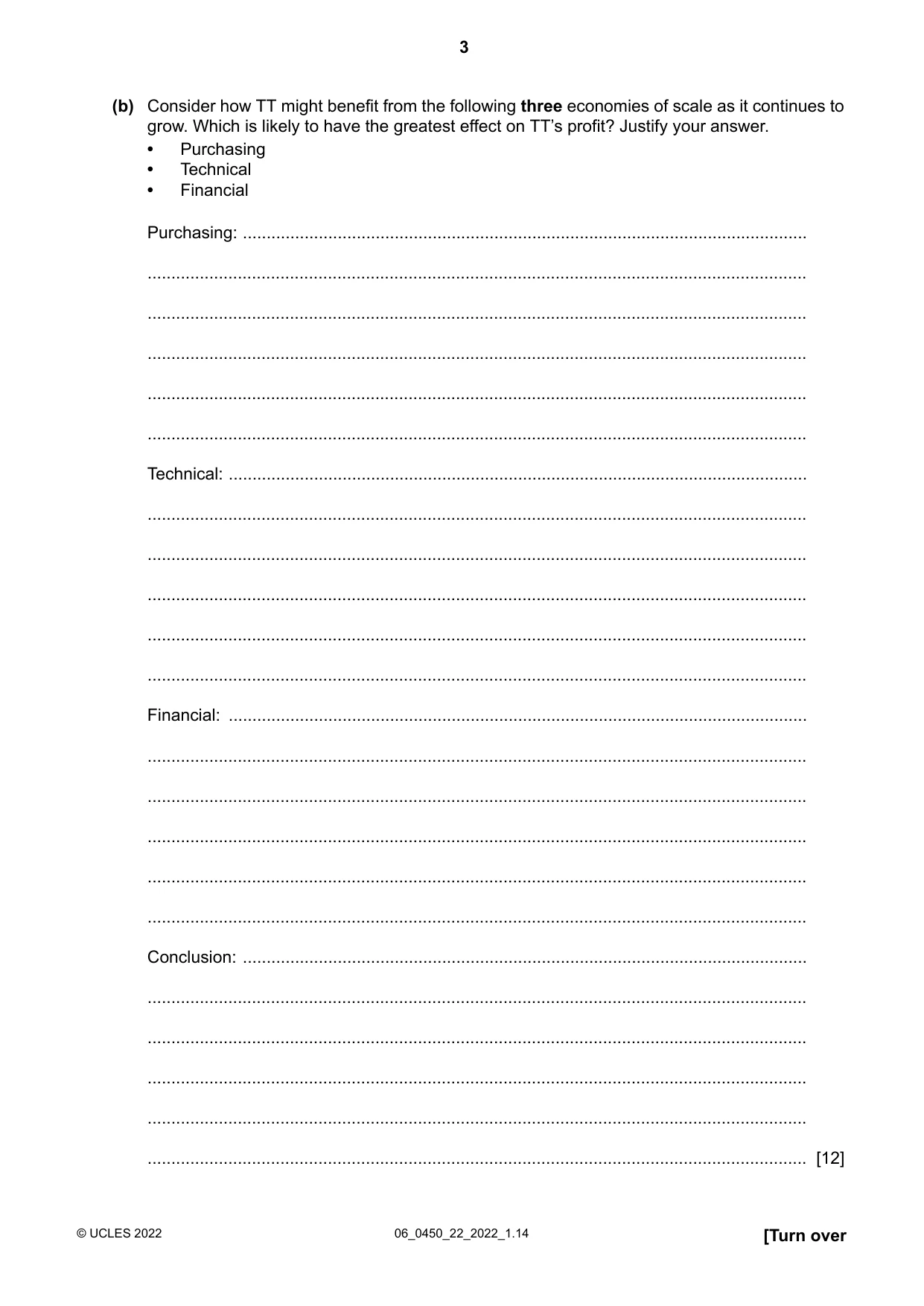
Consider how TT might benefit from the following three economies of scale as it continues to grow. Which is likely to have the greatest effect on TT’s profit? Justify your answer. (b) • Purchasing • Technical • Financial Purchasing: … … … … … … Technical: … … … … … … Financial: … … … … … … Conclusion: … … … … … … [12] [Turn over 06_0450_22_2022_1.14 © UCLES 2022 3
Question paper, page 4
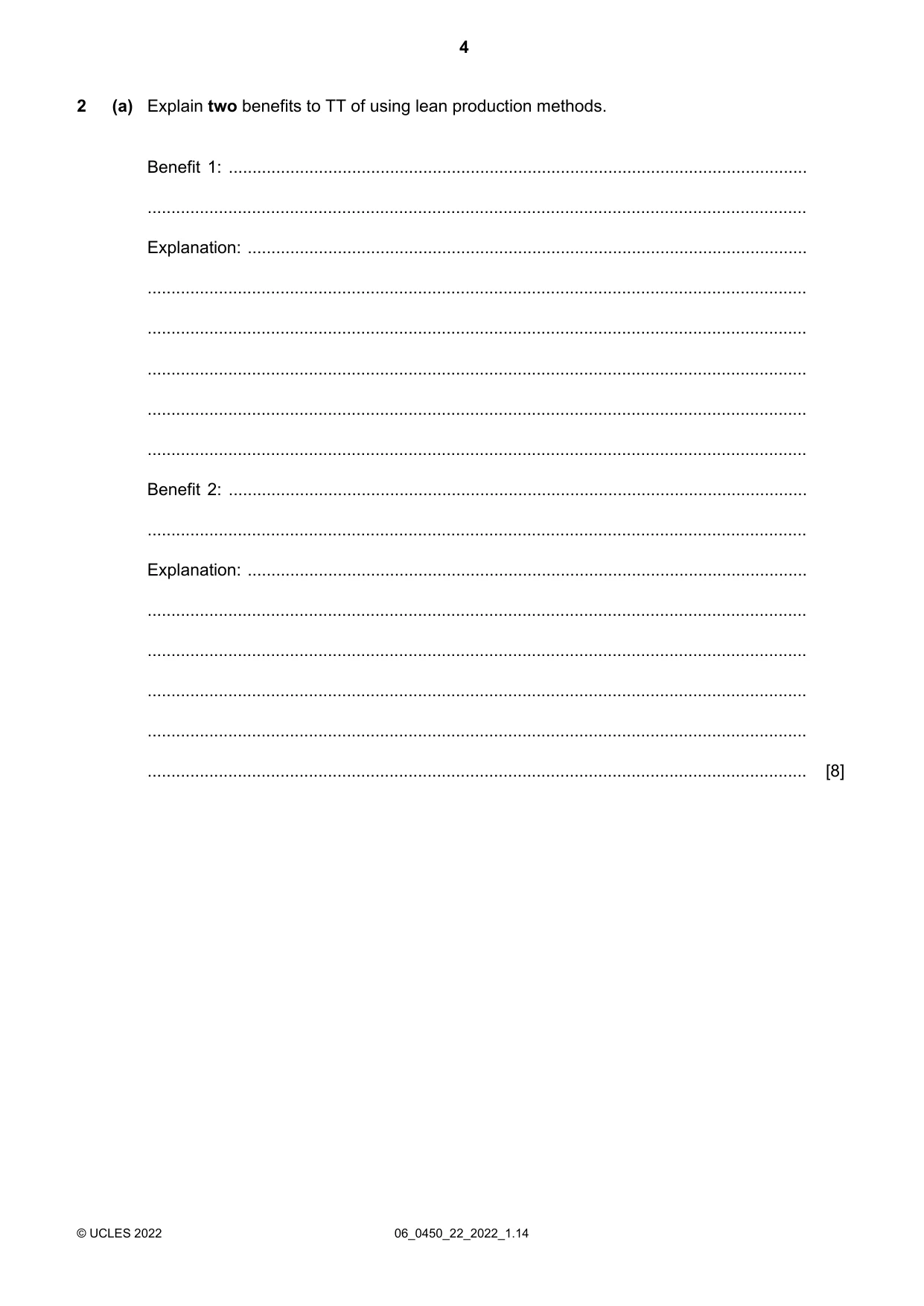
Explain two benefits to TT of using lean production methods. (a) 2 Benefit 1: … … Explanation: … … … … … … Benefit 2: … … Explanation: … … … … … … [8] 06_0450_22_2022_1.14 © UCLES 2022 4
Question paper, page 5
Using Appendix 2 and other information, consider TT’s financial position. Do you think TT is in a good financial position to expand? Justify your answer using suitable calculations. (b) … … … … … … … … … … … … … … … … … … … … … … … … … [12] [Turn over 06_0450_22_2022_1.14 © UCLES 2022 5
Question paper, page 6
Explain one way the information in each chart in Appendix 1 might be useful to TT. (a) 3 Chart 1: … … … … Chart 2: … … … … Chart 3: … … … … Chart 4: … … … … [8] 06_0450_22_2022_1.14 © UCLES 2022 6
Question paper, page 7
Using Appendix 3 and other information, consider the three applicants for the job of Marketing Manager for country Z. Who is the best applicant for the job? Justify your answer. (b) Labiba: … … … … … … Shahin: … … … … … … Samihah: … … … … … … Recommendation: … … … … … … … [12] [Turn over 06_0450_22_2022_1.14 © UCLES 2022 7
Question paper, page 8
Explain four effects of training on a business. (a) 4 Effect 1: … … … … Effect 2: … … … … Effect 3: … … … … Effect 4: … … … … [8] 06_0450_22_2022_1.14 © UCLES 2022 8
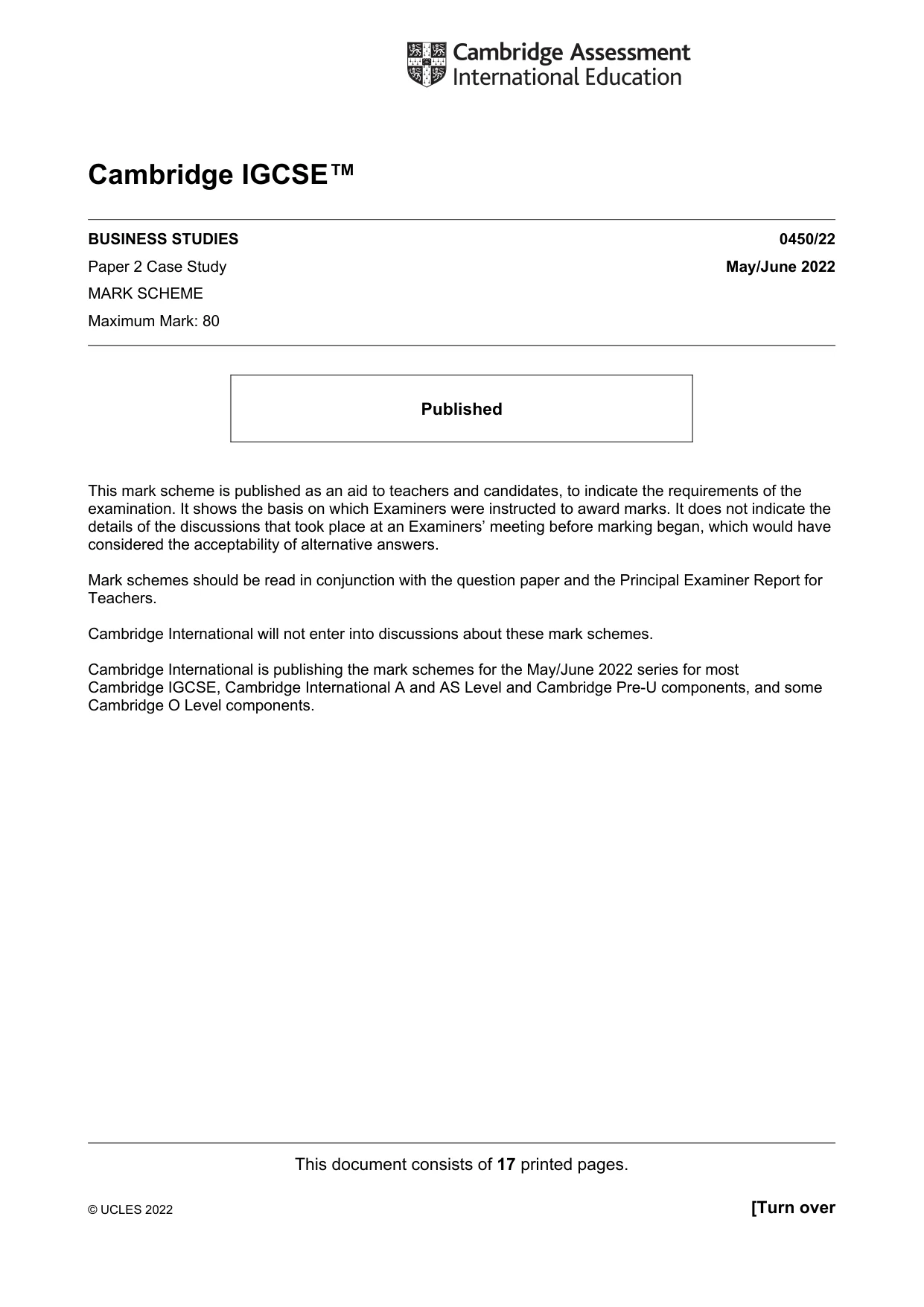
Question paper, page 9
Consider the benefits and drawbacks for country Z if TT builds a factory there. Do you think the government of country Z should allow TT to build this factory? Justify your answer. (b) Benefits for country Z: … … … … … … … … Drawbacks for country Z: … … … … … … … … Conclusion: … … … … … … … … … [12] 06_0450_22_2022_1.14 © UCLES 2022 9
Question paper, page 10
BLANK PAGE 06_0450_22_2022_1.14 © UCLES 2022 10
Question paper, page 11
BLANK PAGE 06_0450_22_2022_1.14 © UCLES 2022 11
Question paper, page 12
BLANK PAGE Permission to reproduce items where third-party owned material protected by copyright is included has been sought and cleared where possible. Every reasonable effort has been made by the publisher (UCLES) to trace copyright holders, but if any items requiring clearance have unwittingly been included, the publisher will be pleased to make amends at the earliest possible opportunity. To avoid the issue of disclosure of answer-related information to candidates, all copyright acknowledgements are reproduced online in the Cambridge Assessment International Education Copyright Acknowledgements Booklet. This is produced for each series of examinations and is freely available to download at www.cambridgeinternational.org after the live examination series. Cambridge Assessment International Education is part of Cambridge Assessment. Cambridge Assessment is the brand name of the University of Cambridge Local Examinations Syndicate (UCLES), which is a department of the University of Cambridge. 06_0450_22_2022_1.14 © UCLES 2022 12
Mark scheme, page 1
This document consists of 17 printed pages. © UCLES 2022 [Turn over Cambridge IGCSE™ BUSINESS STUDIES 0450/22 Paper 2 Case Study May/June 2022 MARK SCHEME Maximum Mark: 80 Published This mark scheme is published as an aid to teachers and candidates, to indicate the requirements of the examination. It shows the basis on which Examiners were instructed to award marks. It does not indicate the details of the discussions that took place at an Examiners’ meeting before marking began, which would have considered the acceptability of alternative answers. Mark schemes should be read in conjunction with the question paper and the Principal Examiner Report for Teachers. Cambridge International will not enter into discussions about these mark schemes. Cambridge International is publishing the mark schemes for the May/June 2022 series for most Cambridge IGCSE, Cambridge International A and AS Level and Cambridge Pre-U components, and some Cambridge O Level components.
Mark scheme, page 2
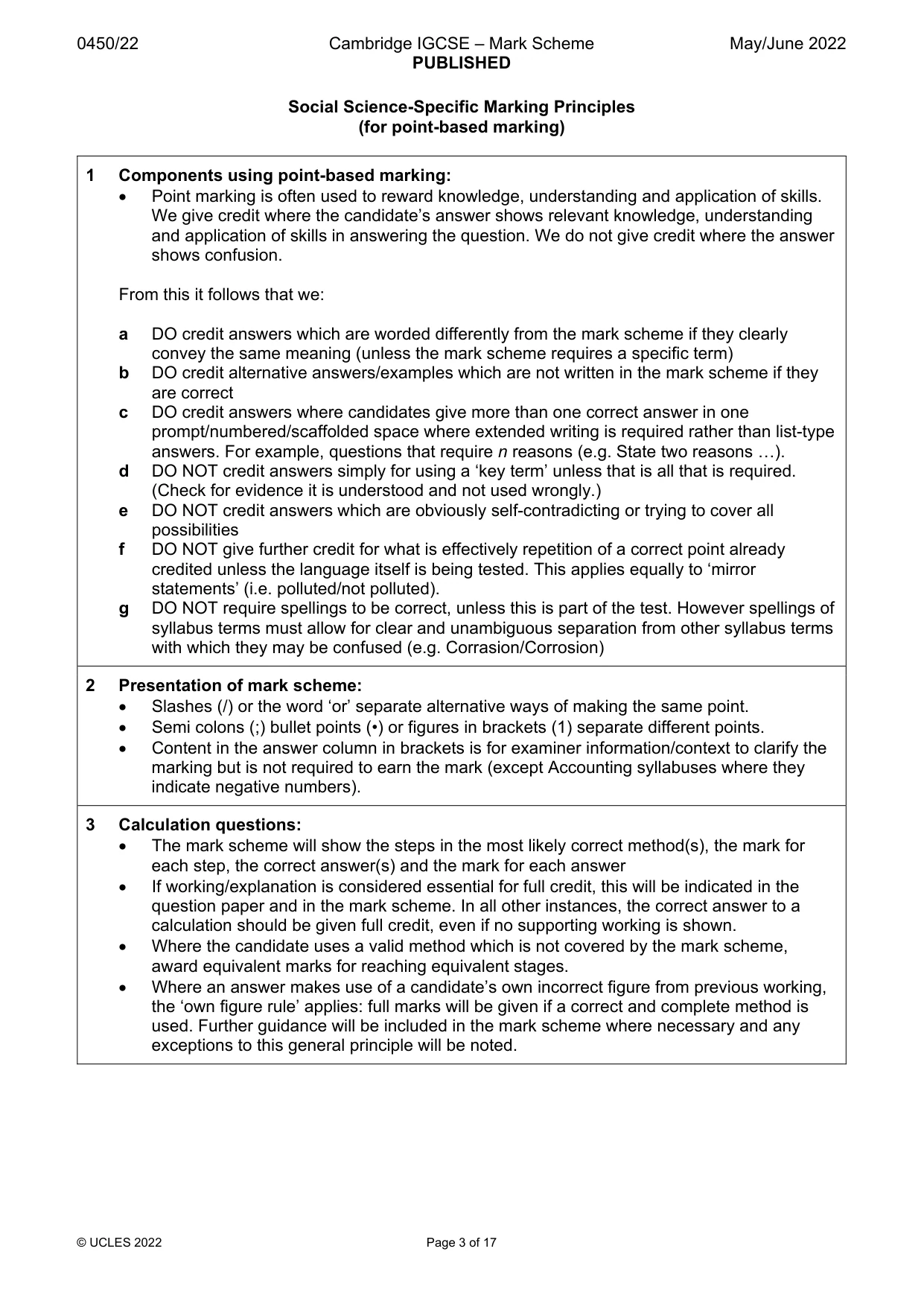
0450/22 Cambridge IGCSE – Mark Scheme PUBLISHED May/June 2022 © UCLES 2022 Page 2 of 17 Generic Marking Principles These general marking principles must be applied by all examiners when marking candidate answers. They should be applied alongside the specific content of the mark scheme or generic level descriptors for a question. Each question paper and mark scheme will also comply with these marking principles. GENERIC MARKING PRINCIPLE 1: Marks must be awarded in line with: the specific content of the mark scheme or the generic level descriptors for the question the specific skills defined in the mark scheme or in the generic level descriptors for the question the standard of response required by a candidate as exemplified by the standardisation scripts. GENERIC MARKING PRINCIPLE 2: Marks awarded are always whole marks (not half marks, or other fractions). GENERIC MARKING PRINCIPLE 3: Marks must be awarded positively: marks are awarded for correct/valid answers, as defined in the mark scheme. However, credit is given for valid answers which go beyond the scope of the syllabus and mark scheme, referring to your Team Leader as appropriate marks are awarded when candidates clearly demonstrate what they know and can do marks are not deducted for errors marks are not deducted for omissions answers should only be judged on the quality of spelling, punctuation and grammar when these features are specifically assessed by the question as indicated by the mark scheme. The meaning, however, should be unambiguous. GENERIC MARKING PRINCIPLE 4: Rules must be applied consistently, e.g. in situations where candidates have not followed instructions or in the application of generic level descriptors. GENERIC MARKING PRINCIPLE 5: Marks should be awarded using the full range of marks defined in the mark scheme for the question (however; the use of the full mark range may be limited according to the quality of the candidate responses seen). GENERIC MARKING PRINCIPLE 6: Marks awarded are based solely on the requirements as defined in the mark scheme. Marks should not be awarded with grade thresholds or grade descriptors in mind.
Mark scheme, page 3
0450/22 Cambridge IGCSE – Mark Scheme PUBLISHED May/June 2022 © UCLES 2022 Page 3 of 17 Social Science-Specific Marking Principles (for point-based marking) 1 Components using point-based marking: Point marking is often used to reward knowledge, understanding and application of skills. We give credit where the candidate’s answer shows relevant knowledge, understanding and application of skills in answering the question. We do not give credit where the answer shows confusion. From this it follows that we: a DO credit answers which are worded differently from the mark scheme if they clearly convey the same meaning (unless the mark scheme requires a specific term) b DO credit alternative answers/examples which are not written in the mark scheme if they are correct c DO credit answers where candidates give more than one correct answer in one prompt/numbered/scaffolded space where extended writing is required rather than list-type answers. For example, questions that require n reasons (e.g. State two reasons …). d DO NOT credit answers simply for using a ‘key term’ unless that is all that is required. (Check for evidence it is understood and not used wrongly.) e DO NOT credit answers which are obviously self-contradicting or trying to cover all possibilities f DO NOT give further credit for what is effectively repetition of a correct point already credited unless the language itself is being tested. This applies equally to ‘mirror statements’ (i.e. polluted/not polluted). g DO NOT require spellings to be correct, unless this is part of the test. However spellings of syllabus terms must allow for clear and unambiguous separation from other syllabus terms with which they may be confused (e.g. Corrasion/Corrosion) 2 Presentation of mark scheme: Slashes (/) or the word ‘or’ separate alternative ways of making the same point. Semi colons (;) bullet points (•) or figures in brackets (1) separate different points. Content in the answer column in brackets is for examiner information/context to clarify the marking but is not required to earn the mark (except Accounting syllabuses where they indicate negative numbers). 3 Calculation questions: The mark scheme will show the steps in the most likely correct method(s), the mark for each step, the correct answer(s) and the mark for each answer If working/explanation is considered essential for full credit, this will be indicated in the question paper and in the mark scheme. In all other instances, the correct answer to a calculation should be given full credit, even if no supporting working is shown. Where the candidate uses a valid method which is not covered by the mark scheme, award equivalent marks for reaching equivalent stages. Where an answer makes use of a candidate’s own incorrect figure from previous working, the ‘own figure rule’ applies: full marks will be given if a correct and complete method is used. Further guidance will be included in the mark scheme where necessary and any exceptions to this general principle will be noted.
Mark scheme, page 4
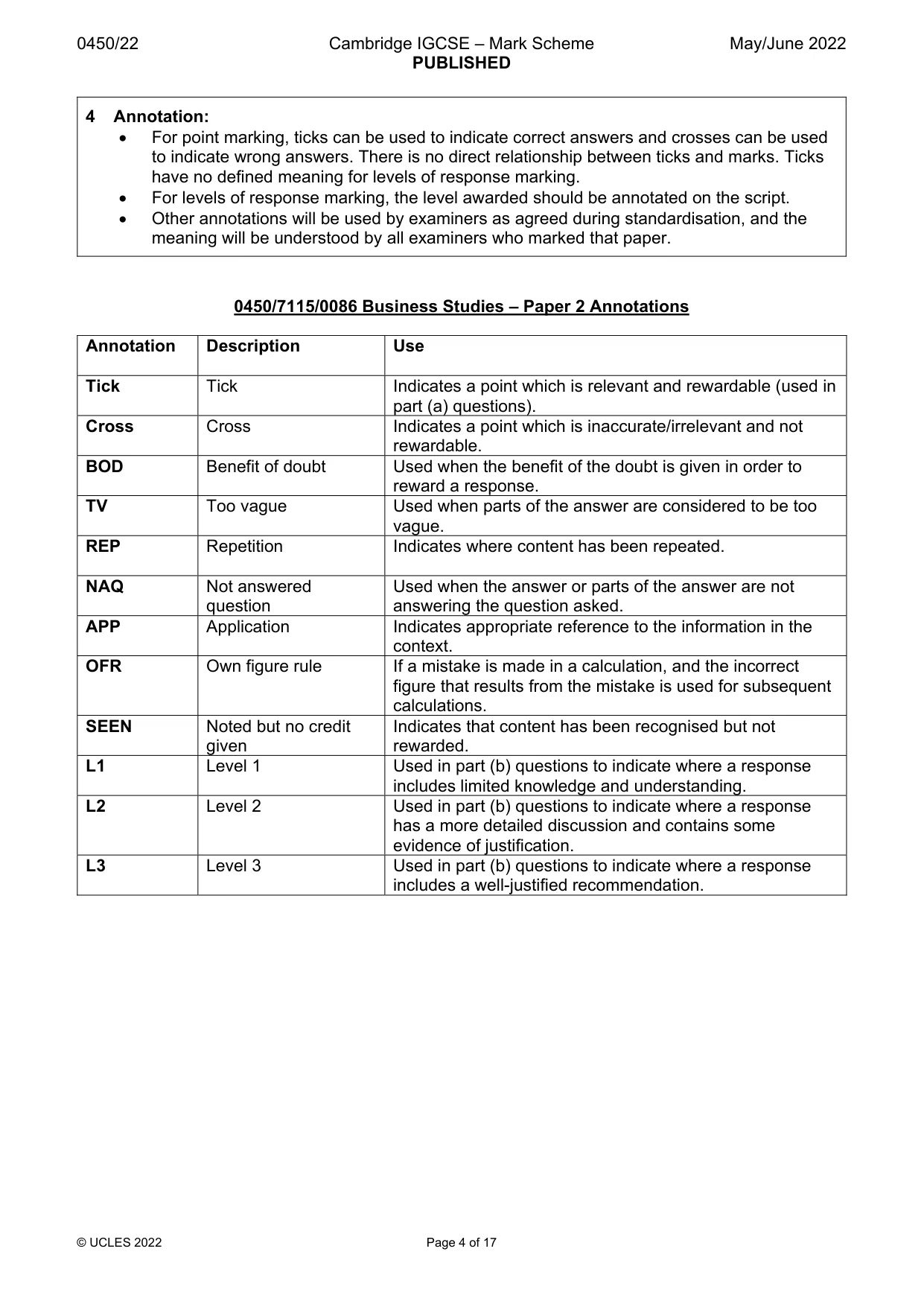
0450/22 Cambridge IGCSE – Mark Scheme PUBLISHED May/June 2022 © UCLES 2022 Page 4 of 17 4 Annotation: For point marking, ticks can be used to indicate correct answers and crosses can be used to indicate wrong answers. There is no direct relationship between ticks and marks. Ticks have no defined meaning for levels of response marking. For levels of response marking, the level awarded should be annotated on the script. Other annotations will be used by examiners as agreed during standardisation, and the meaning will be understood by all examiners who marked that paper. 0450/7115/0086 Business Studies – Paper 2 Annotations Annotation Description Use Tick Tick Indicates a point which is relevant and rewardable (used in part (a) questions). Cross Cross Indicates a point which is inaccurate/irrelevant and not rewardable. BOD Benefit of doubt Used when the benefit of the doubt is given in order to reward a response. TV Too vague Used when parts of the answer are considered to be too vague. REP Repetition Indicates where content has been repeated. NAQ Not answered question Used when the answer or parts of the answer are not answering the question asked. APP Application Indicates appropriate reference to the information in the context. OFR Own figure rule If a mistake is made in a calculation, and the incorrect figure that results from the mistake is used for subsequent calculations. SEEN Noted but no credit given Indicates that content has been recognised but not rewarded. L1 Level 1 Used in part (b) questions to indicate where a response includes limited knowledge and understanding. L2 Level 2 Used in part (b) questions to indicate where a response has a more detailed discussion and contains some evidence of justification. L3 Level 3 Used in part (b) questions to indicate where a response includes a well-justified recommendation.
Mark scheme, page 5
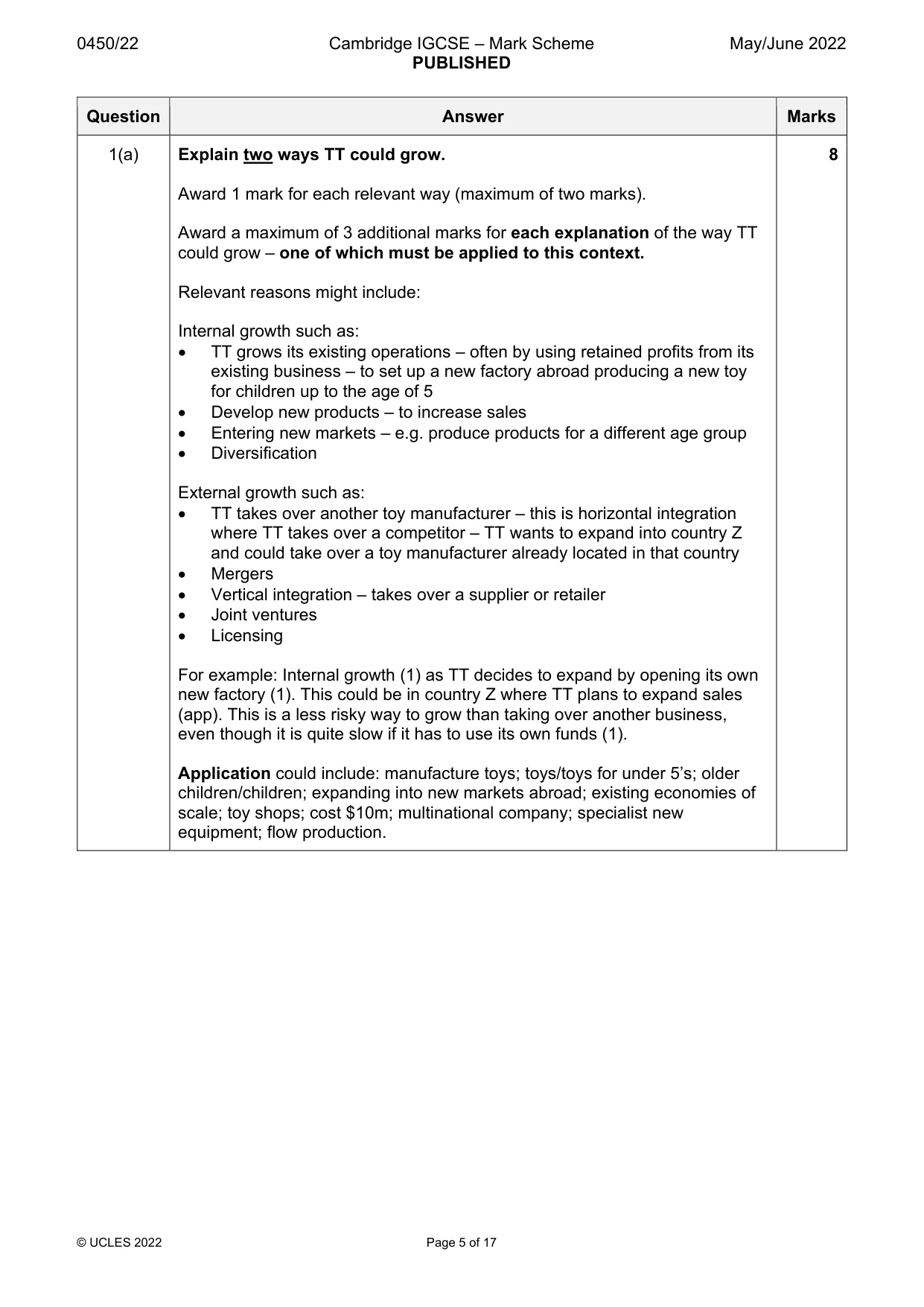
0450/22 Cambridge IGCSE – Mark Scheme PUBLISHED May/June 2022 © UCLES 2022 Page 5 of 17 Question Answer Marks 1(a) Explain two ways TT could grow. Award 1 mark for each relevant way (maximum of two marks). Award a maximum of 3 additional marks for each explanation of the way TT could grow – one of which must be applied to this context. Relevant reasons might include: Internal growth such as: TT grows its existing operations – often by using retained profits from its existing business – to set up a new factory abroad producing a new toy for children up to the age of 5 Develop new products – to increase sales Entering new markets – e.g. produce products for a different age group Diversification External growth such as: TT takes over another toy manufacturer – this is horizontal integration where TT takes over a competitor – TT wants to expand into country Z and could take over a toy manufacturer already located in that country Mergers Vertical integration – takes over a supplier or retailer Joint ventures Licensing For example: Internal growth (1) as TT decides to expand by opening its own new factory (1). This could be in country Z where TT plans to expand sales (app). This is a less risky way to grow than taking over another business, even though it is quite slow if it has to use its own funds (1). Application could include: manufacture toys; toys/toys for under 5’s; older children/children; expanding into new markets abroad; existing economies of scale; toy shops; cost $10m; multinational company; specialist new equipment; flow production. 8
Mark scheme, page 6
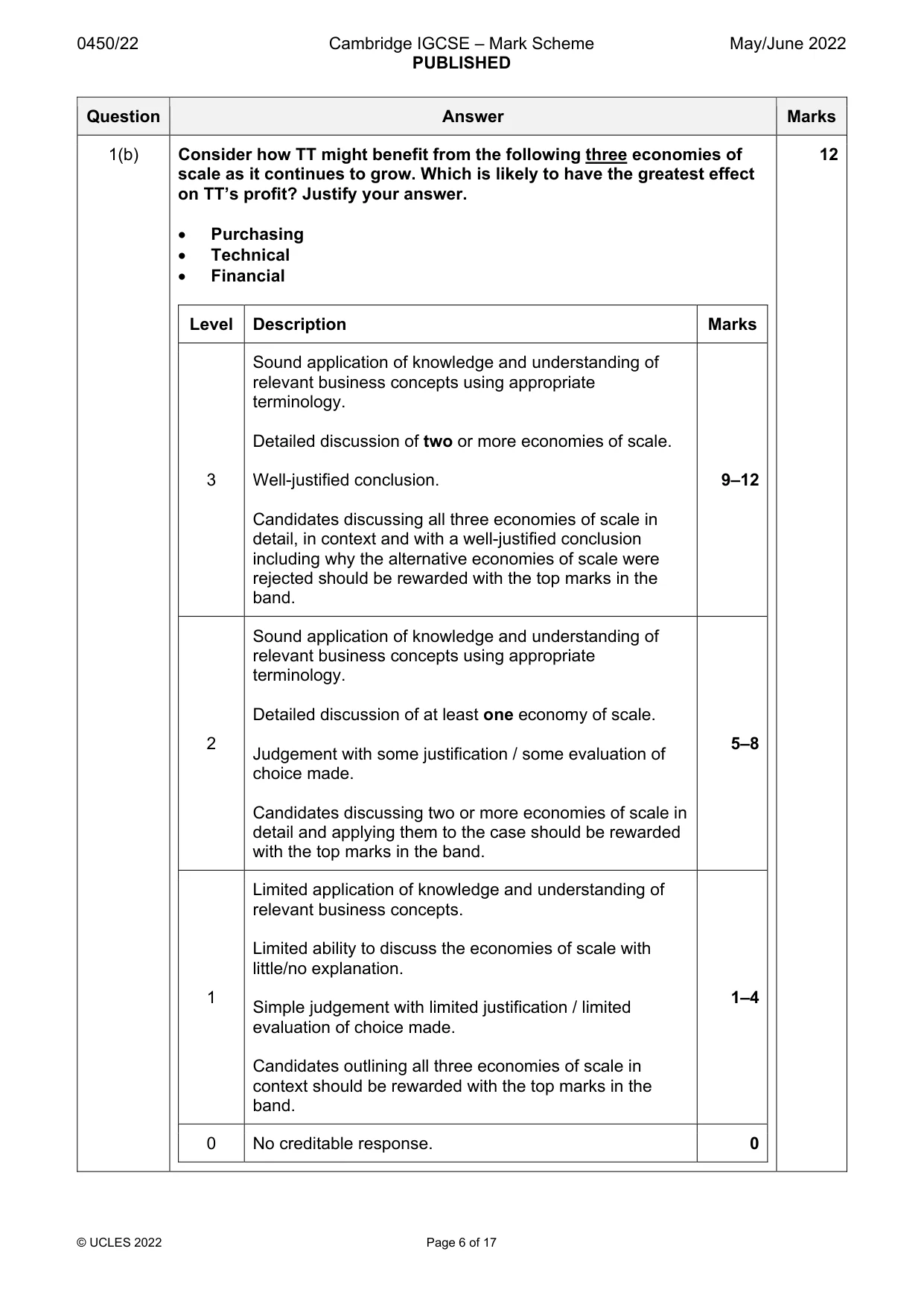
0450/22 Cambridge IGCSE – Mark Scheme PUBLISHED May/June 2022 © UCLES 2022 Page 6 of 17 Question Answer Marks 1(b) Consider how TT might benefit from the following three economies of scale as it continues to grow. Which is likely to have the greatest effect on TT’s profit? Justify your answer. Purchasing Technical Financial Level Description Marks 3 Sound application of knowledge and understanding of relevant business concepts using appropriate terminology. Detailed discussion of two or more economies of scale. Well-justified conclusion. Candidates discussing all three economies of scale in detail, in context and with a well-justified conclusion including why the alternative economies of scale were rejected should be rewarded with the top marks in the band. 9–12 2 Sound application of knowledge and understanding of relevant business concepts using appropriate terminology. Detailed discussion of at least one economy of scale. Judgement with some justification / some evaluation of choice made. Candidates discussing two or more economies of scale in detail and applying them to the case should be rewarded with the top marks in the band. 5–8 1 Limited application of knowledge and understanding of relevant business concepts. Limited ability to discuss the economies of scale with little/no explanation. Simple judgement with limited justification / limited evaluation of choice made. Candidates outlining all three economies of scale in context should be rewarded with the top marks in the band. 1–4 0 No creditable response. 0 12
Mark scheme, page 7
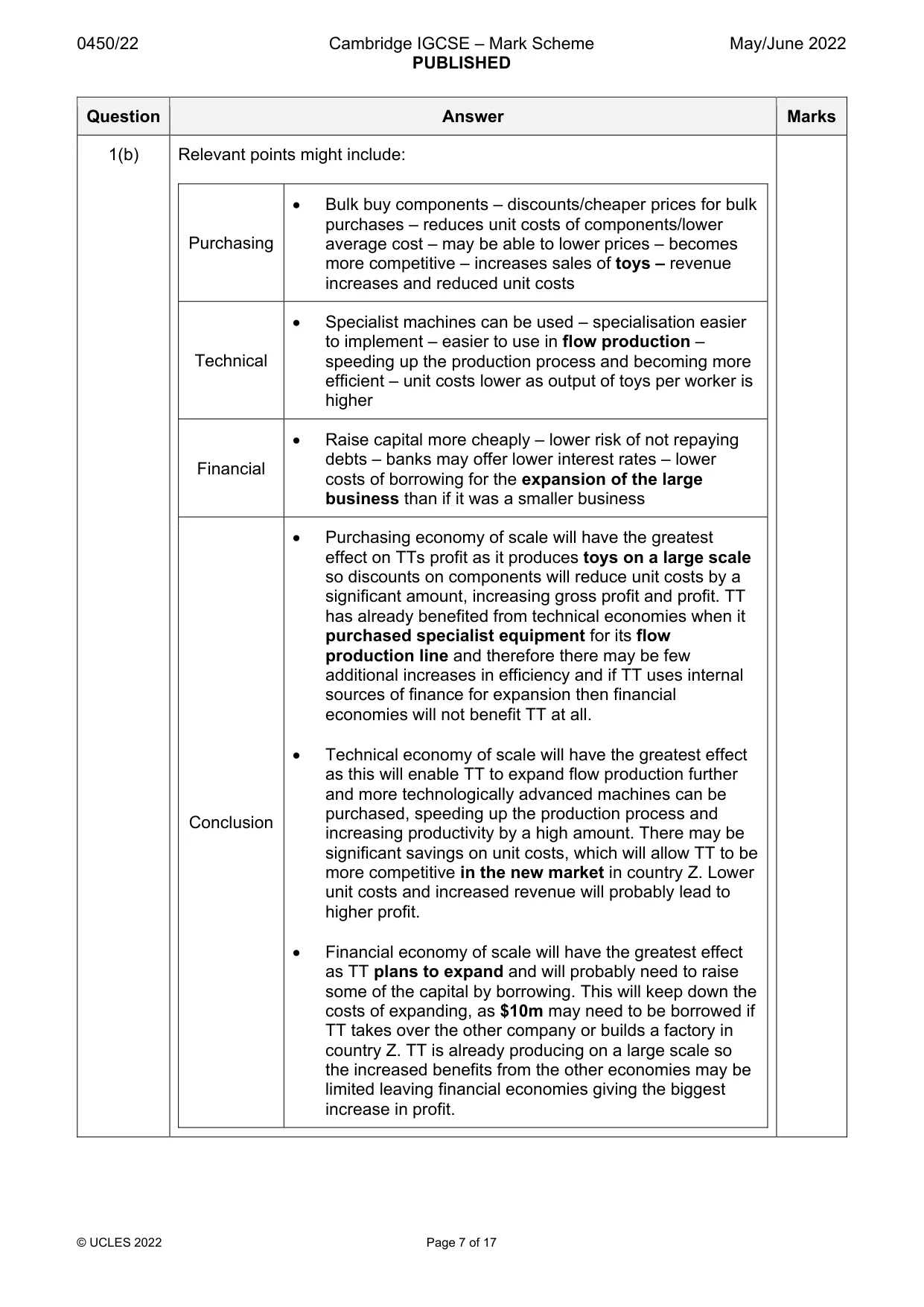
0450/22 Cambridge IGCSE – Mark Scheme PUBLISHED May/June 2022 © UCLES 2022 Page 7 of 17 Question Answer Marks 1(b) Relevant points might include: Purchasing Bulk buy components – discounts/cheaper prices for bulk purchases – reduces unit costs of components/lower average cost – may be able to lower prices – becomes more competitive – increases sales of toys – revenue increases and reduced unit costs Technical Specialist machines can be used – specialisation easier to implement – easier to use in flow production – speeding up the production process and becoming more efficient – unit costs lower as output of toys per worker is higher Financial Raise capital more cheaply – lower risk of not repaying debts – banks may offer lower interest rates – lower costs of borrowing for the expansion of the large business than if it was a smaller business Conclusion Purchasing economy of scale will have the greatest effect on TTs profit as it produces toys on a large scale so discounts on components will reduce unit costs by a significant amount, increasing gross profit and profit. TT has already benefited from technical economies when it purchased specialist equipment for its flow production line and therefore there may be few additional increases in efficiency and if TT uses internal sources of finance for expansion then financial economies will not benefit TT at all. Technical economy of scale will have the greatest effect as this will enable TT to expand flow production further and more technologically advanced machines can be purchased, speeding up the production process and increasing productivity by a high amount. There may be significant savings on unit costs, which will allow TT to be more competitive in the new market in country Z. Lower unit costs and increased revenue will probably lead to higher profit. Financial economy of scale will have the greatest effect as TT plans to expand and will probably need to raise some of the capital by borrowing. This will keep down the costs of expanding, as $10m may need to be borrowed if TT takes over the other company or builds a factory in country Z. TT is already producing on a large scale so the increased benefits from the other economies may be limited leaving financial economies giving the biggest increase in profit.
Mark scheme, page 8
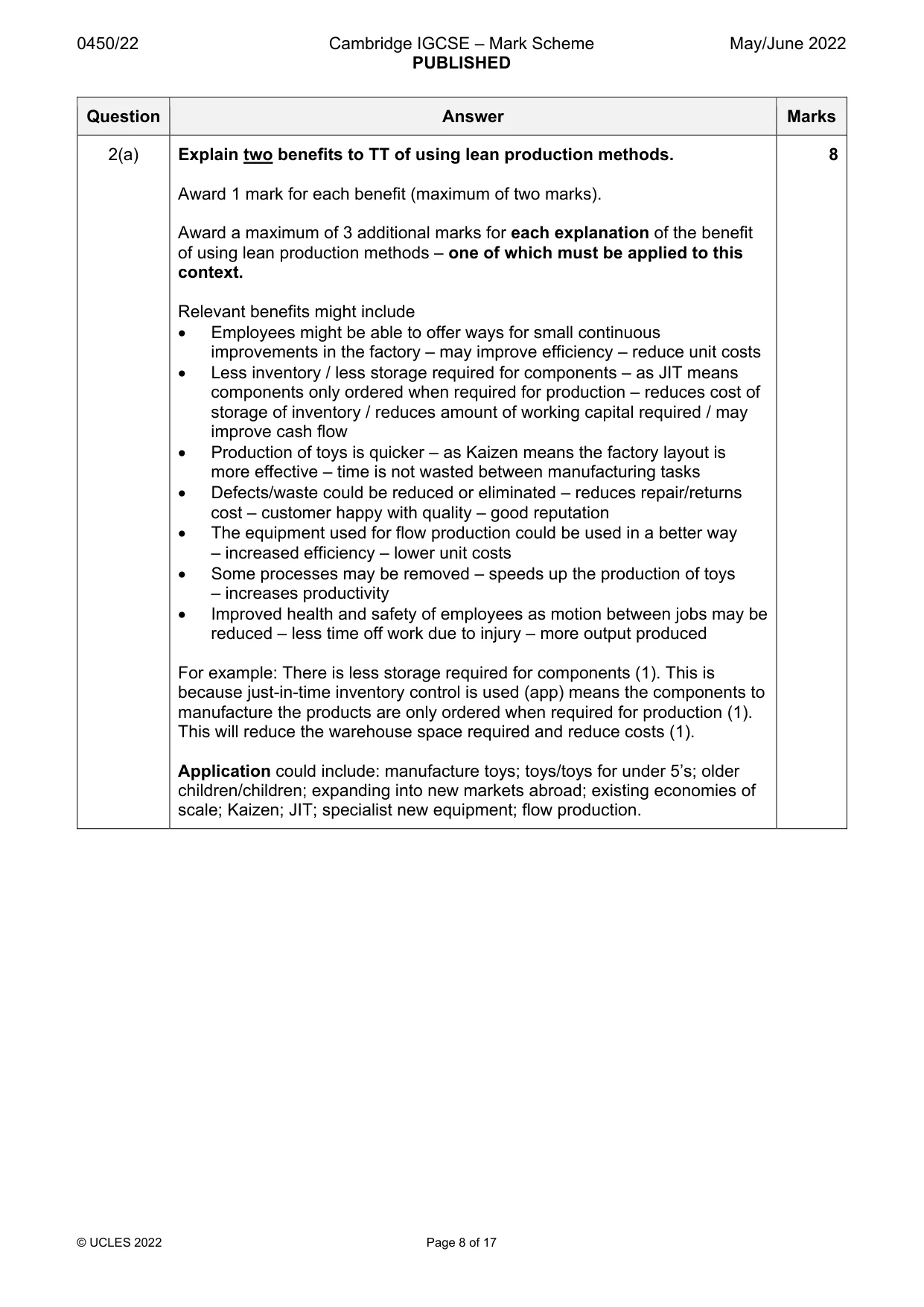
0450/22 Cambridge IGCSE – Mark Scheme PUBLISHED May/June 2022 © UCLES 2022 Page 8 of 17 Question Answer Marks 2(a) Explain two benefits to TT of using lean production methods. Award 1 mark for each benefit (maximum of two marks). Award a maximum of 3 additional marks for each explanation of the benefit of using lean production methods – one of which must be applied to this context. Relevant benefits might include Employees might be able to offer ways for small continuous improvements in the factory – may improve efficiency – reduce unit costs Less inventory / less storage required for components – as JIT means components only ordered when required for production – reduces cost of storage of inventory / reduces amount of working capital required / may improve cash flow Production of toys is quicker – as Kaizen means the factory layout is more effective – time is not wasted between manufacturing tasks Defects/waste could be reduced or eliminated – reduces repair/returns cost – customer happy with quality – good reputation The equipment used for flow production could be used in a better way – increased efficiency – lower unit costs Some processes may be removed – speeds up the production of toys – increases productivity Improved health and safety of employees as motion between jobs may be reduced – less time off work due to injury – more output produced For example: There is less storage required for components (1). This is because just-in-time inventory control is used (app) means the components to manufacture the products are only ordered when required for production (1). This will reduce the warehouse space required and reduce costs (1). Application could include: manufacture toys; toys/toys for under 5’s; older children/children; expanding into new markets abroad; existing economies of scale; Kaizen; JIT; specialist new equipment; flow production. 8
Mark scheme, page 9
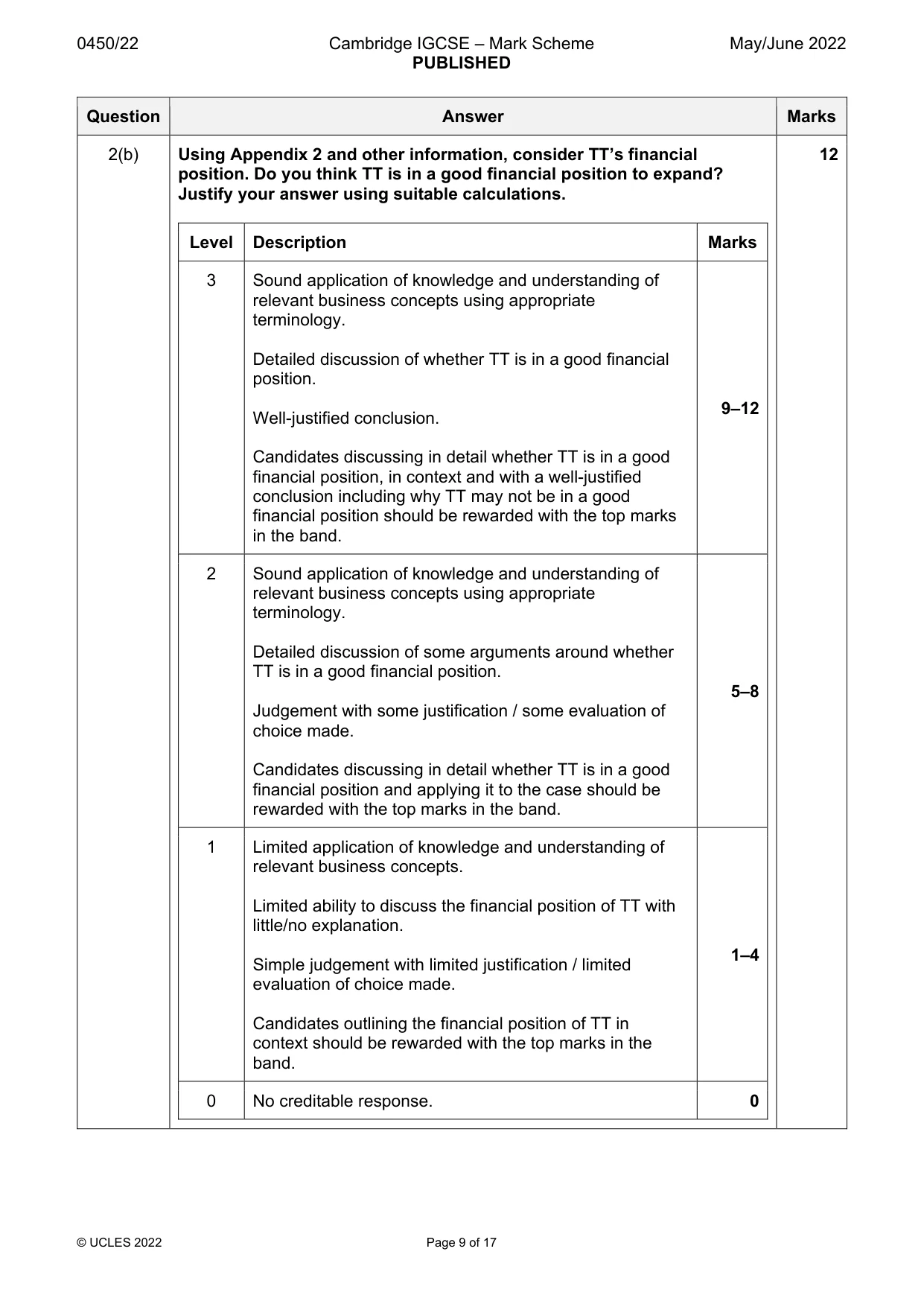
0450/22 Cambridge IGCSE – Mark Scheme PUBLISHED May/June 2022 © UCLES 2022 Page 9 of 17 Question Answer Marks 2(b) Using Appendix 2 and other information, consider TT’s financial position. Do you think TT is in a good financial position to expand? Justify your answer using suitable calculations. Level Description Marks 3 Sound application of knowledge and understanding of relevant business concepts using appropriate terminology. Detailed discussion of whether TT is in a good financial position. Well-justified conclusion. Candidates discussing in detail whether TT is in a good financial position, in context and with a well-justified conclusion including why TT may not be in a good financial position should be rewarded with the top marks in the band. 9–12 2 Sound application of knowledge and understanding of relevant business concepts using appropriate terminology. Detailed discussion of some arguments around whether TT is in a good financial position. Judgement with some justification / some evaluation of choice made. Candidates discussing in detail whether TT is in a good financial position and applying it to the case should be rewarded with the top marks in the band. 5–8 1 Limited application of knowledge and understanding of relevant business concepts. Limited ability to discuss the financial position of TT with little/no explanation. Simple judgement with limited justification / limited evaluation of choice made. Candidates outlining the financial position of TT in context should be rewarded with the top marks in the band. 1–4 0 No creditable response. 0 12
Mark scheme, page 10
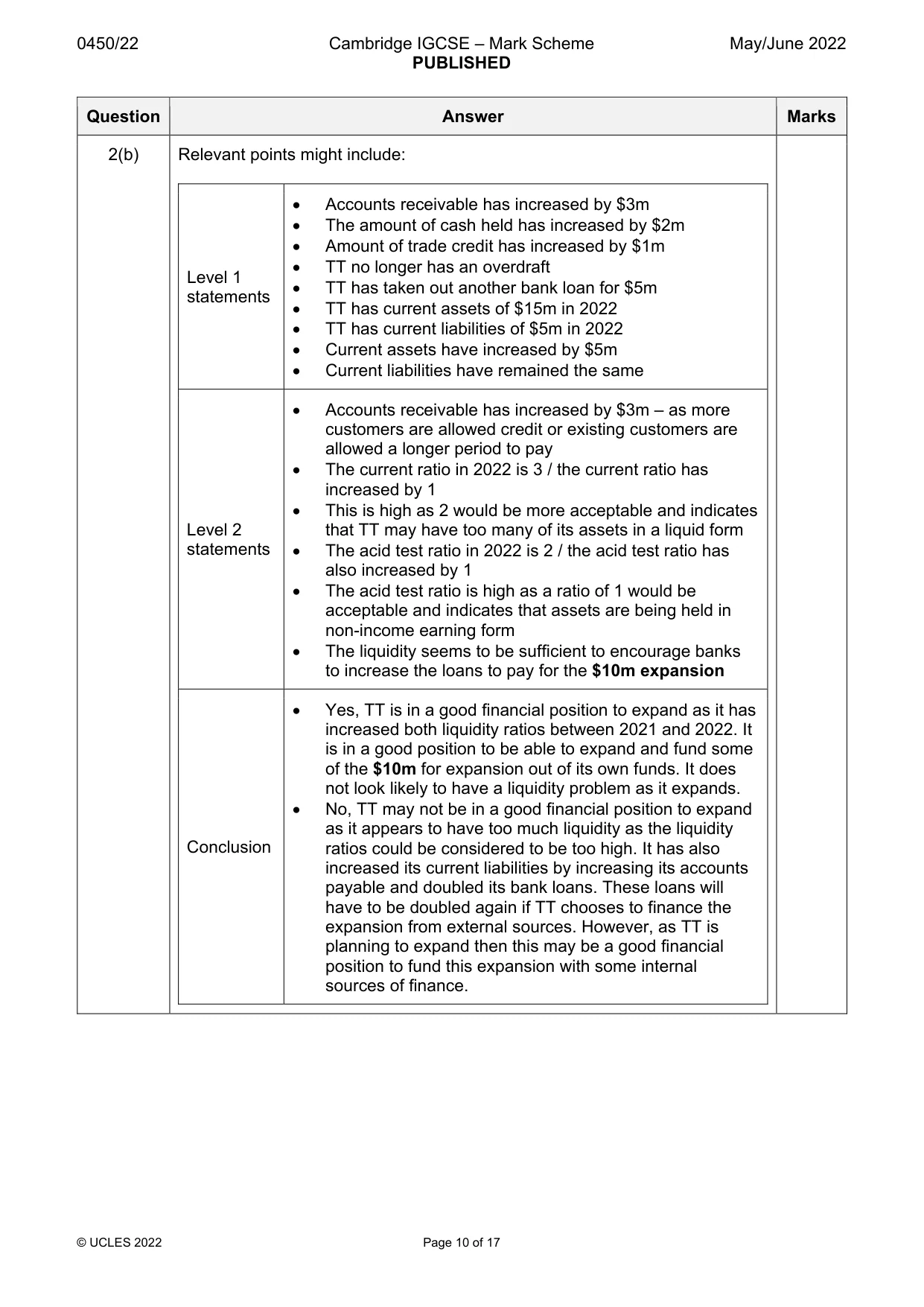
0450/22 Cambridge IGCSE – Mark Scheme PUBLISHED May/June 2022 © UCLES 2022 Page 10 of 17 Question Answer Marks 2(b) Relevant points might include: Level 1 statements Accounts receivable has increased by $3m The amount of cash held has increased by $2m Amount of trade credit has increased by $1m TT no longer has an overdraft TT has taken out another bank loan for $5m TT has current assets of $15m in 2022 TT has current liabilities of $5m in 2022 Current assets have increased by $5m Current liabilities have remained the same Level 2 statements Accounts receivable has increased by $3m – as more customers are allowed credit or existing customers are allowed a longer period to pay The current ratio in 2022 is 3 / the current ratio has increased by 1 This is high as 2 would be more acceptable and indicates that TT may have too many of its assets in a liquid form The acid test ratio in 2022 is 2 / the acid test ratio has also increased by 1 The acid test ratio is high as a ratio of 1 would be acceptable and indicates that assets are being held in non-income earning form The liquidity seems to be sufficient to encourage banks to increase the loans to pay for the $10m expansion Conclusion Yes, TT is in a good financial position to expand as it has increased both liquidity ratios between 2021 and 2022. It is in a good position to be able to expand and fund some of the $10m for expansion out of its own funds. It does not look likely to have a liquidity problem as it expands. No, TT may not be in a good financial position to expand as it appears to have too much liquidity as the liquidity ratios could be considered to be too high. It has also increased its current liabilities by increasing its accounts payable and doubled its bank loans. These loans will have to be doubled again if TT chooses to finance the expansion from external sources. However, as TT is planning to expand then this may be a good financial position to fund this expansion with some internal sources of finance.
Mark scheme, page 11
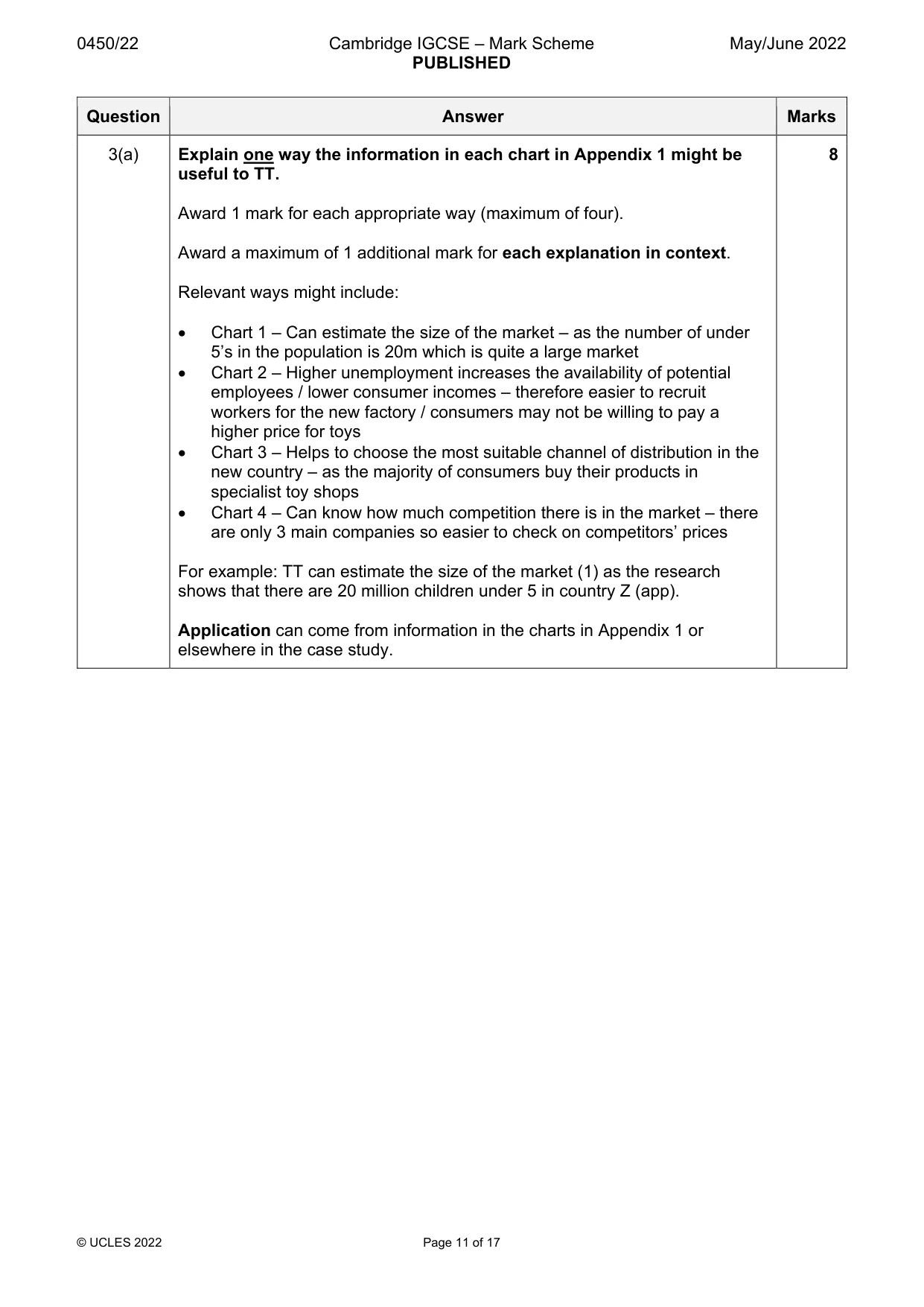
0450/22 Cambridge IGCSE – Mark Scheme PUBLISHED May/June 2022 © UCLES 2022 Page 11 of 17 Question Answer Marks 3(a) Explain one way the information in each chart in Appendix 1 might be useful to TT. Award 1 mark for each appropriate way (maximum of four). Award a maximum of 1 additional mark for each explanation in context. Relevant ways might include: Chart 1 – Can estimate the size of the market – as the number of under 5’s in the population is 20m which is quite a large market Chart 2 – Higher unemployment increases the availability of potential employees / lower consumer incomes – therefore easier to recruit workers for the new factory / consumers may not be willing to pay a higher price for toys Chart 3 – Helps to choose the most suitable channel of distribution in the new country – as the majority of consumers buy their products in specialist toy shops Chart 4 – Can know how much competition there is in the market – there are only 3 main companies so easier to check on competitors’ prices For example: TT can estimate the size of the market (1) as the research shows that there are 20 million children under 5 in country Z (app). Application can come from information in the charts in Appendix 1 or elsewhere in the case study. 8
Mark scheme, page 12
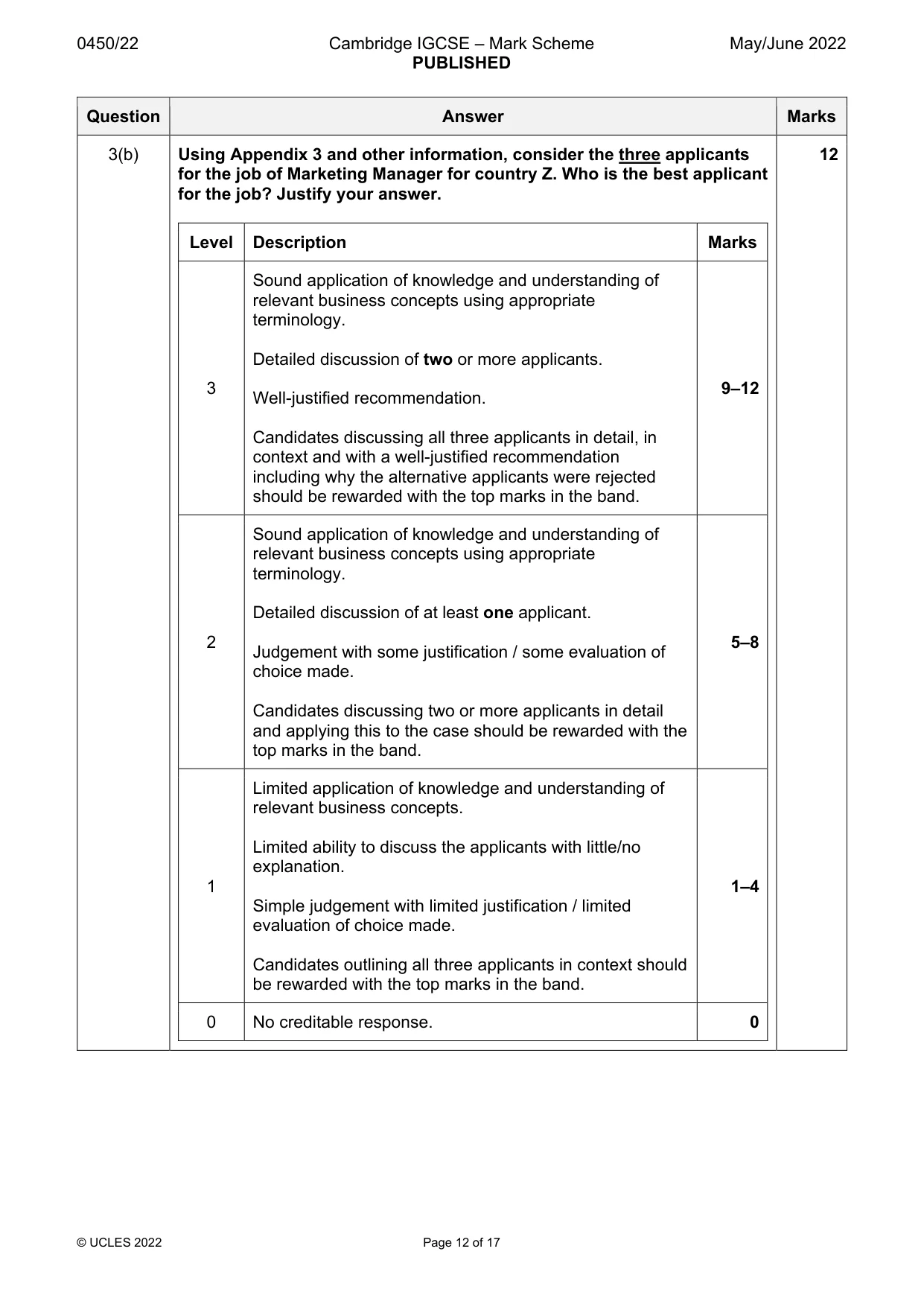
0450/22 Cambridge IGCSE – Mark Scheme PUBLISHED May/June 2022 © UCLES 2022 Page 12 of 17 Question Answer Marks 3(b) Using Appendix 3 and other information, consider the three applicants for the job of Marketing Manager for country Z. Who is the best applicant for the job? Justify your answer. Level Description Marks 3 Sound application of knowledge and understanding of relevant business concepts using appropriate terminology. Detailed discussion of two or more applicants. Well-justified recommendation. Candidates discussing all three applicants in detail, in context and with a well-justified recommendation including why the alternative applicants were rejected should be rewarded with the top marks in the band. 9–12 2 Sound application of knowledge and understanding of relevant business concepts using appropriate terminology. Detailed discussion of at least one applicant. Judgement with some justification / some evaluation of choice made. Candidates discussing two or more applicants in detail and applying this to the case should be rewarded with the top marks in the band. 5–8 1 Limited application of knowledge and understanding of relevant business concepts. Limited ability to discuss the applicants with little/no explanation. Simple judgement with limited justification / limited evaluation of choice made. Candidates outlining all three applicants in context should be rewarded with the top marks in the band. 1–4 0 No creditable response. 0 12
Mark scheme, page 13
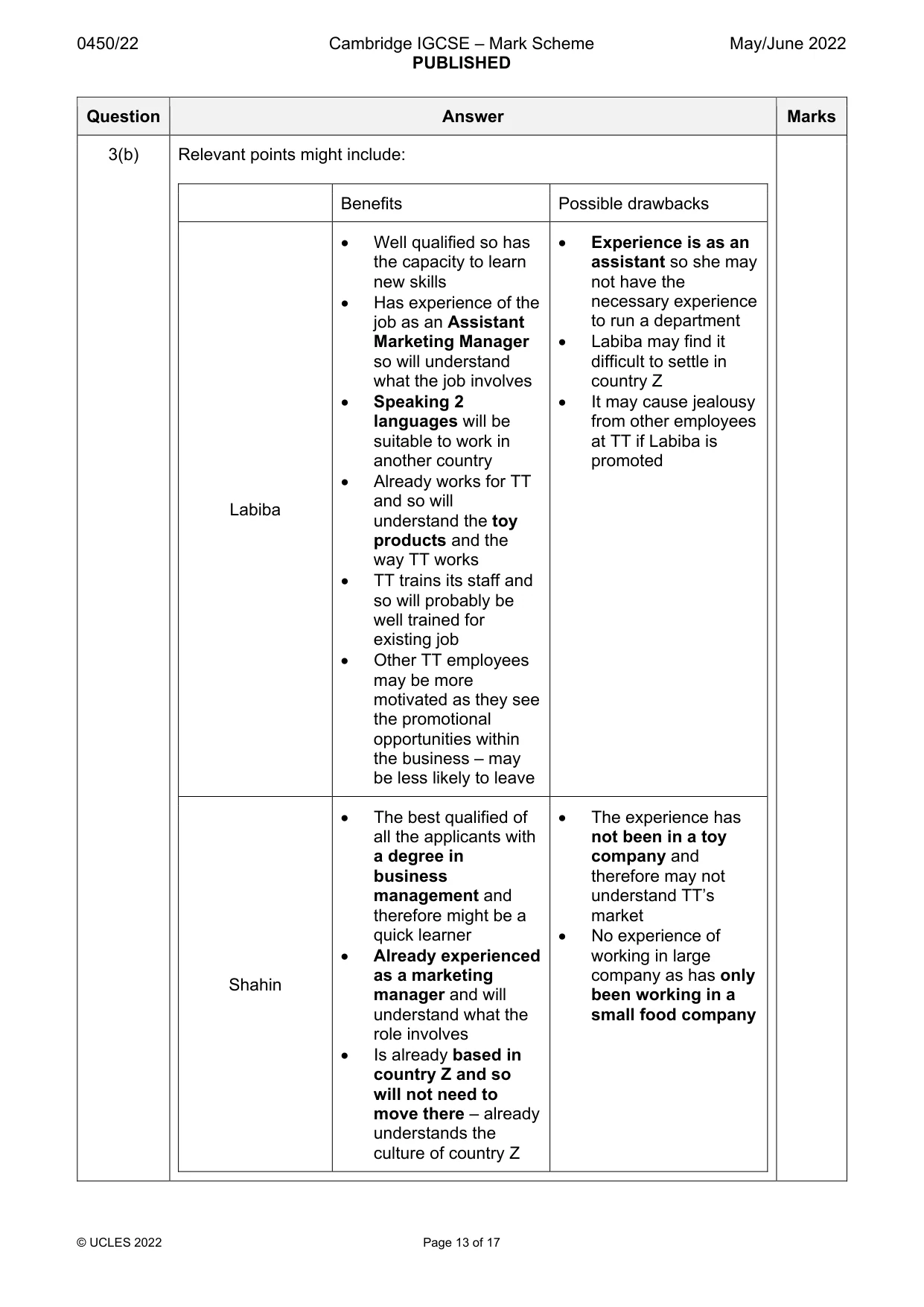
0450/22 Cambridge IGCSE – Mark Scheme PUBLISHED May/June 2022 © UCLES 2022 Page 13 of 17 Question Answer Marks 3(b) Relevant points might include: Benefits Possible drawbacks Labiba Well qualified so has the capacity to learn new skills Has experience of the job as an Assistant Marketing Manager so will understand what the job involves Speaking 2 languages will be suitable to work in another country Already works for TT and so will understand the toy products and the way TT works TT trains its staff and so will probably be well trained for existing job Other TT employees may be more motivated as they see the promotional opportunities within the business – may be less likely to leave Experience is as an assistant so she may not have the necessary experience to run a department Labiba may find it difficult to settle in country Z It may cause jealousy from other employees at TT if Labiba is promoted Shahin The best qualified of all the applicants with a degree in business management and therefore might be a quick learner Already experienced as a marketing manager and will understand what the role involves Is already based in country Z and so will not need to move there – already understands the culture of country Z The experience has not been in a toy company and therefore may not understand TT’s market No experience of working in large company as has only been working in a small food company
Mark scheme, page 14
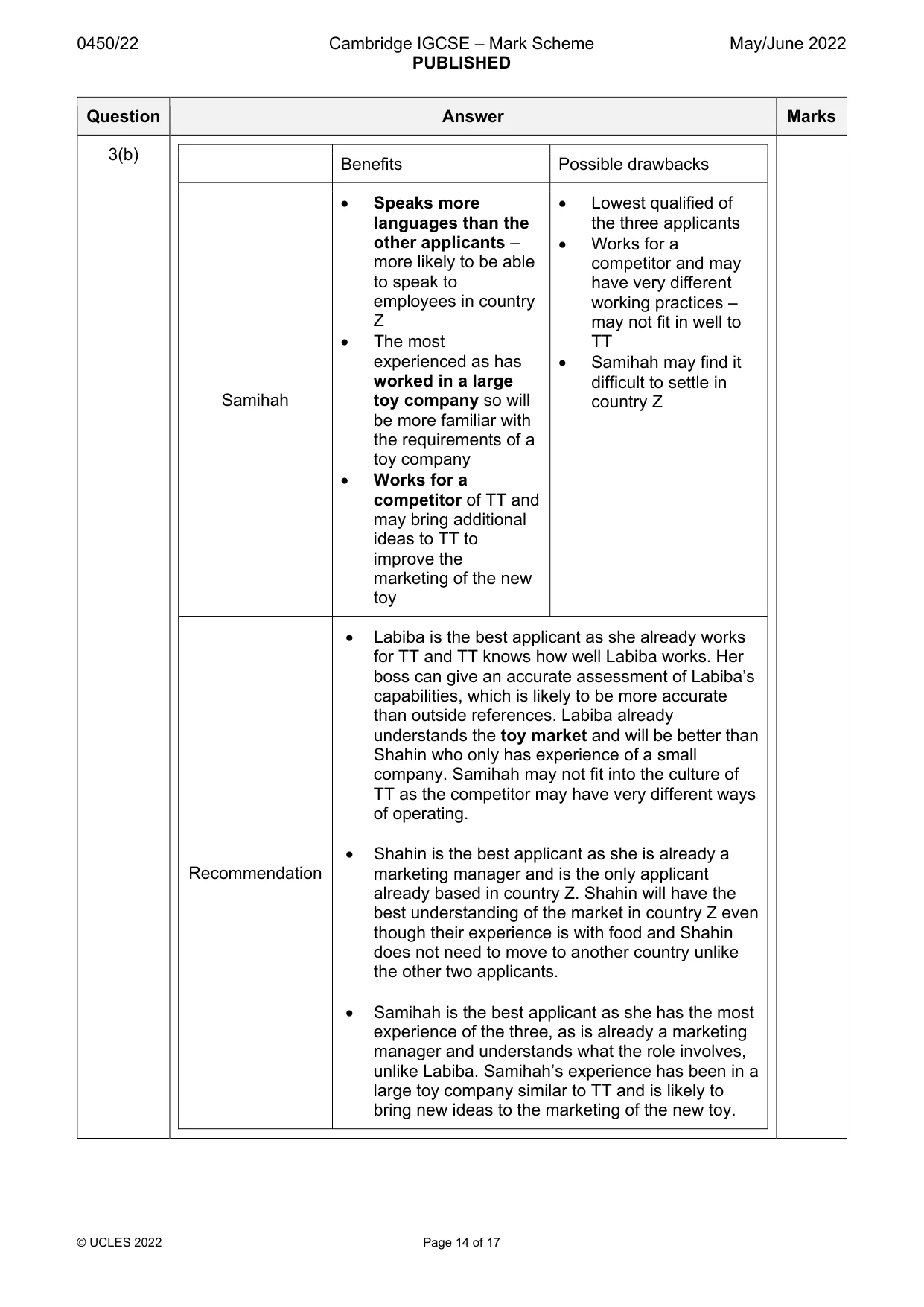
0450/22 Cambridge IGCSE – Mark Scheme PUBLISHED May/June 2022 © UCLES 2022 Page 14 of 17 Question Answer Marks 3(b) Benefits Possible drawbacks Samihah Speaks more languages than the other applicants – more likely to be able to speak to employees in country Z The most experienced as has worked in a large toy company so will be more familiar with the requirements of a toy company Works for a competitor of TT and may bring additional ideas to TT to improve the marketing of the new toy Lowest qualified of the three applicants Works for a competitor and may have very different working practices – may not fit in well to TT Samihah may find it difficult to settle in country Z Recommendation Labiba is the best applicant as she already works for TT and TT knows how well Labiba works. Her boss can give an accurate assessment of Labiba’s capabilities, which is likely to be more accurate than outside references. Labiba already understands the toy market and will be better than Shahin who only has experience of a small company. Samihah may not fit into the culture of TT as the competitor may have very different ways of operating. Shahin is the best applicant as she is already a marketing manager and is the only applicant already based in country Z. Shahin will have the best understanding of the market in country Z even though their experience is with food and Shahin does not need to move to another country unlike the other two applicants. Samihah is the best applicant as she has the most experience of the three, as is already a marketing manager and understands what the role involves, unlike Labiba. Samihah’s experience has been in a large toy company similar to TT and is likely to bring new ideas to the marketing of the new toy.
Mark scheme, page 15
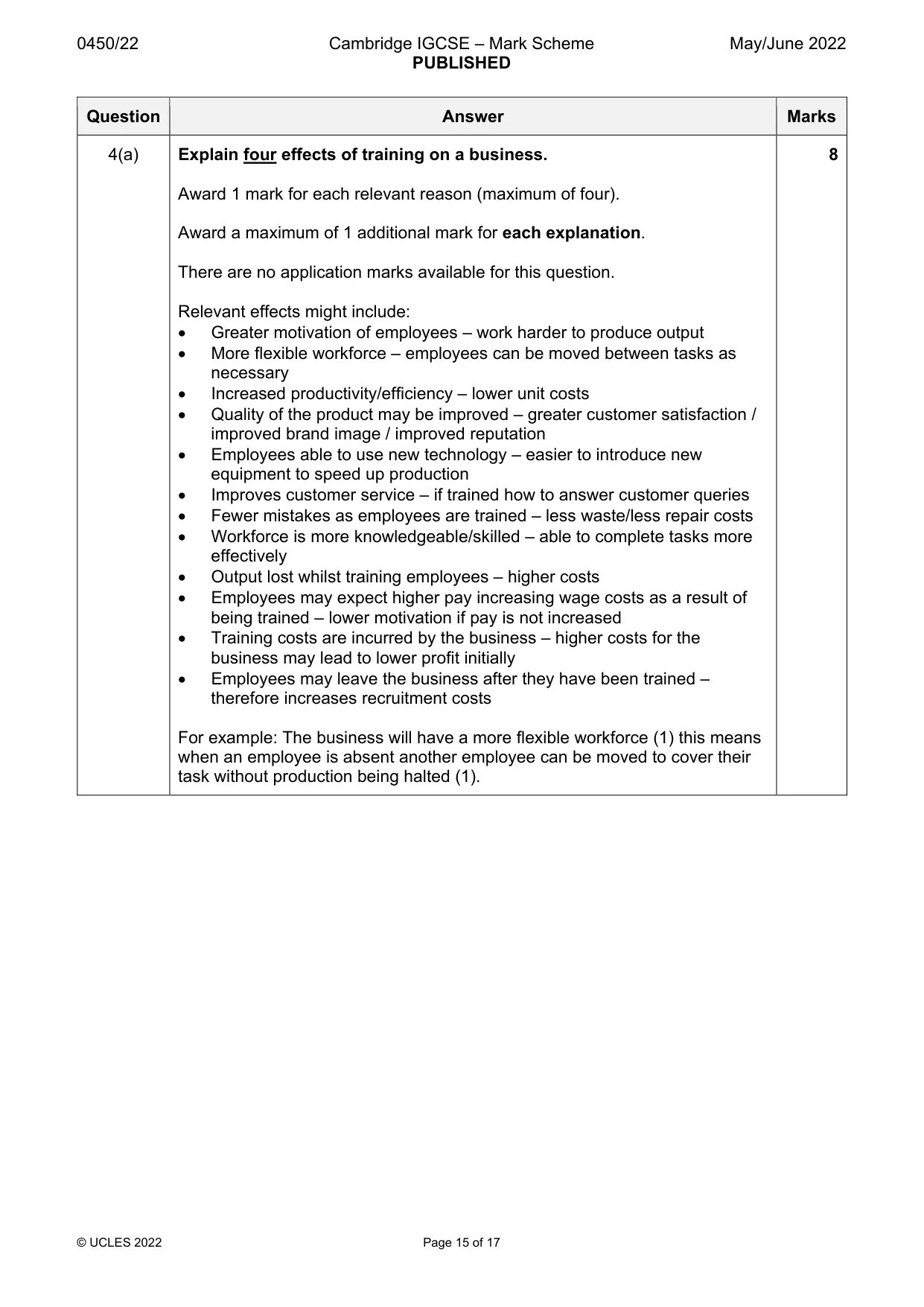
0450/22 Cambridge IGCSE – Mark Scheme PUBLISHED May/June 2022 © UCLES 2022 Page 15 of 17 Question Answer Marks 4(a) Explain four effects of training on a business. Award 1 mark for each relevant reason (maximum of four). Award a maximum of 1 additional mark for each explanation. There are no application marks available for this question. Relevant effects might include: Greater motivation of employees – work harder to produce output More flexible workforce – employees can be moved between tasks as necessary Increased productivity/efficiency – lower unit costs Quality of the product may be improved – greater customer satisfaction / improved brand image / improved reputation Employees able to use new technology – easier to introduce new equipment to speed up production Improves customer service – if trained how to answer customer queries Fewer mistakes as employees are trained – less waste/less repair costs Workforce is more knowledgeable/skilled – able to complete tasks more effectively Output lost whilst training employees – higher costs Employees may expect higher pay increasing wage costs as a result of being trained – lower motivation if pay is not increased Training costs are incurred by the business – higher costs for the business may lead to lower profit initially Employees may leave the business after they have been trained – therefore increases recruitment costs For example: The business will have a more flexible workforce (1) this means when an employee is absent another employee can be moved to cover their task without production being halted (1). 8
Mark scheme, page 16
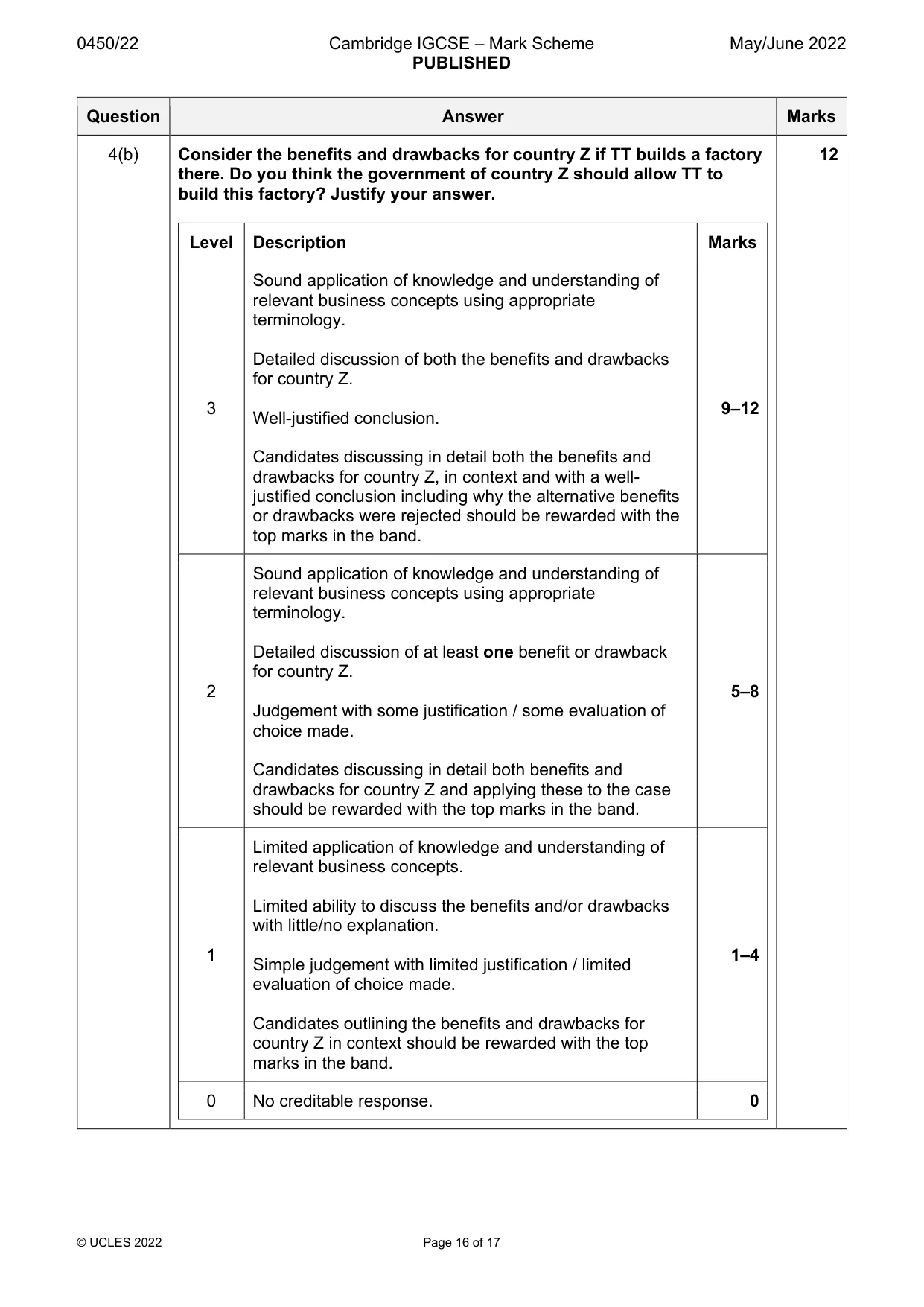
0450/22 Cambridge IGCSE – Mark Scheme PUBLISHED May/June 2022 © UCLES 2022 Page 16 of 17 Question Answer Marks 4(b) Consider the benefits and drawbacks for country Z if TT builds a factory there. Do you think the government of country Z should allow TT to build this factory? Justify your answer. Level Description Marks 3 Sound application of knowledge and understanding of relevant business concepts using appropriate terminology. Detailed discussion of both the benefits and drawbacks for country Z. Well-justified conclusion. Candidates discussing in detail both the benefits and drawbacks for country Z, in context and with a well- justified conclusion including why the alternative benefits or drawbacks were rejected should be rewarded with the top marks in the band. 9–12 2 Sound application of knowledge and understanding of relevant business concepts using appropriate terminology. Detailed discussion of at least one benefit or drawback for country Z. Judgement with some justification / some evaluation of choice made. Candidates discussing in detail both benefits and drawbacks for country Z and applying these to the case should be rewarded with the top marks in the band. 5–8 1 Limited application of knowledge and understanding of relevant business concepts. Limited ability to discuss the benefits and/or drawbacks with little/no explanation. Simple judgement with limited justification / limited evaluation of choice made. Candidates outlining the benefits and drawbacks for country Z in context should be rewarded with the top marks in the band. 1–4 0 No creditable response. 0 12
Mark scheme, page 17
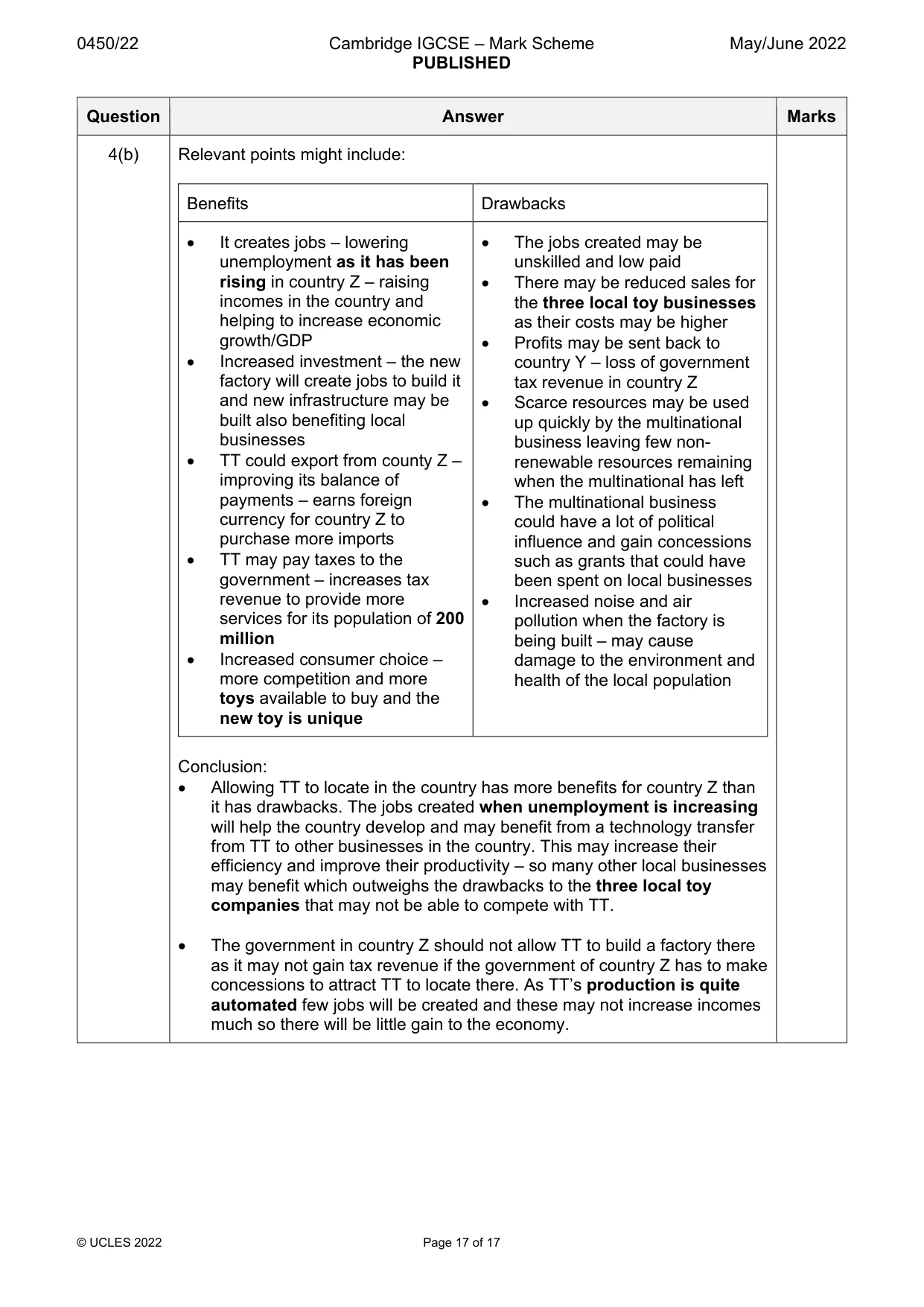
0450/22 Cambridge IGCSE – Mark Scheme PUBLISHED May/June 2022 © UCLES 2022 Page 17 of 17 Question Answer Marks 4(b) Relevant points might include: Benefits Drawbacks It creates jobs – lowering unemployment as it has been rising in country Z – raising incomes in the country and helping to increase economic growth/GDP Increased investment – the new factory will create jobs to build it and new infrastructure may be built also benefiting local businesses TT could export from county Z – improving its balance of payments – earns foreign currency for country Z to purchase more imports TT may pay taxes to the government – increases tax revenue to provide more services for its population of 200 million Increased consumer choice – more competition and more toys available to buy and the new toy is unique The jobs created may be unskilled and low paid There may be reduced sales for the three local toy businesses as their costs may be higher Profits may be sent back to country Y – loss of government tax revenue in country Z Scarce resources may be used up quickly by the multinational business leaving few non- renewable resources remaining when the multinational has left The multinational business could have a lot of political influence and gain concessions such as grants that could have been spent on local businesses Increased noise and air pollution when the factory is being built – may cause damage to the environment and health of the local population Conclusion: Allowing TT to locate in the country has more benefits for country Z than it has drawbacks. The jobs created when unemployment is increasing will help the country develop and may benefit from a technology transfer from TT to other businesses in the country. This may increase their efficiency and improve their productivity – so many other local businesses may benefit which outweighs the drawbacks to the three local toy companies that may not be able to compete with TT. The government in country Z should not allow TT to build a factory there as it may not gain tax revenue if the government of country Z has to make concessions to attract TT to locate there. As TT’s production is quite automated few jobs will be created and these may not increase incomes much so there will be little gain to the economy.
What you needed in this session
Cambridge’s own grade thresholds for 2022 May/June, Paper 2 · Variant 2. A higher threshold means an easier paper — the bar moves with how the cohort did.