Cambridge IGCSE Business Studies 0450 — 2021 Oct/Nov Paper 2 · Variant 2
0450/22/O/N/21 · 80 marks · ≈90 min
The question paper and its mark scheme, free to read here and free to download. This is Cambridge’s own paper, exactly as it was sat.
Question paper12 pages



Mark scheme19 pages
Answers below. Sit the paper first if you are practising.

Paper as text
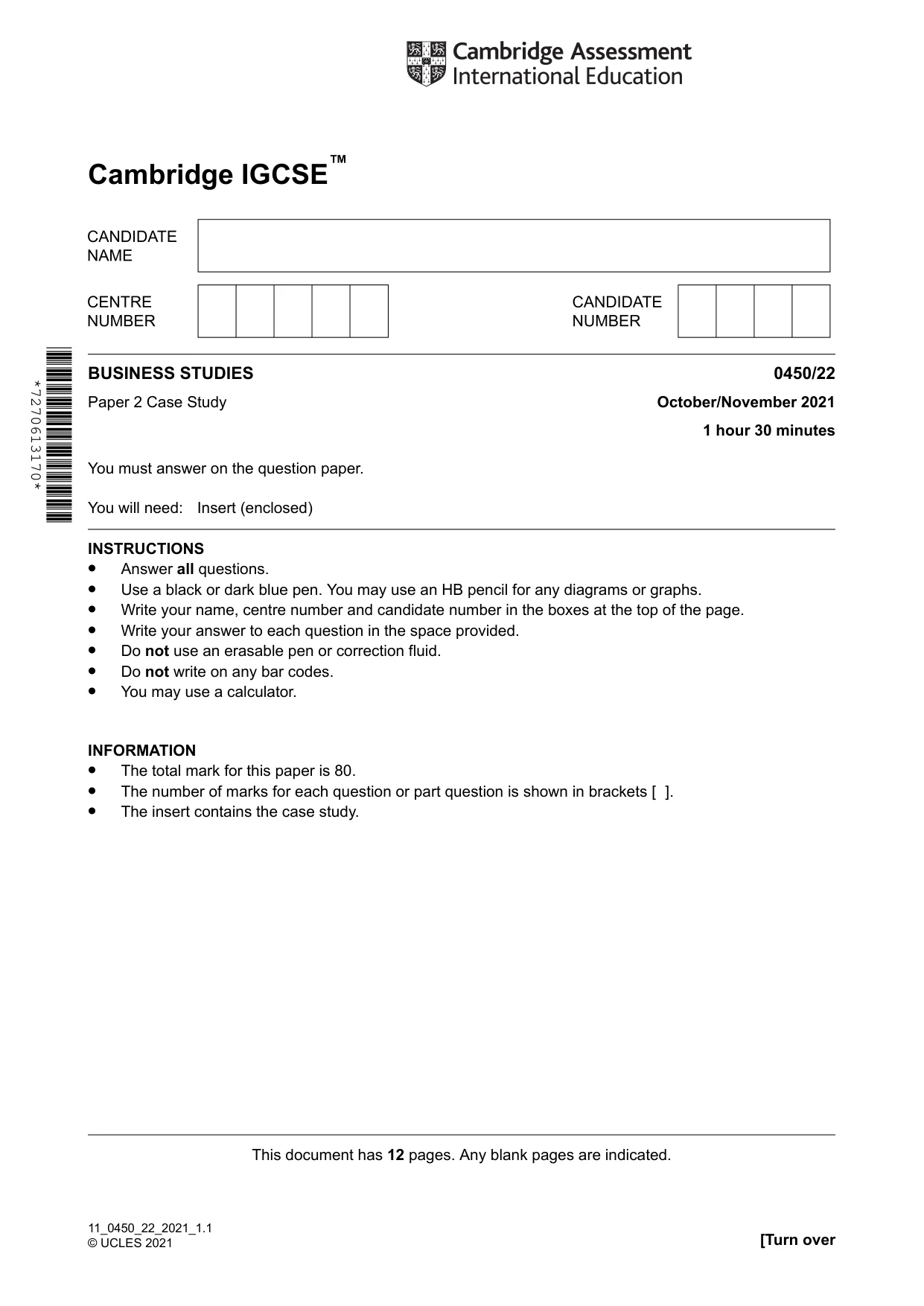
Question paper, page 1
Cambridge IGCSE™ 0450/22 October/November 2021 1 hour 30 minutes BUSINESS STUDIES Paper 2 Case Study You must answer on the question paper. You will need: Insert (enclosed) INSTRUCTIONS • Answer all questions. • Use a black or dark blue pen. You may use an HB pencil for any diagrams or graphs. • Write your name, centre number and candidate number in the boxes at the top of the page. • Write your answer to each question in the space provided. • Do not use an erasable pen or correction fluid. • Do not write on any bar codes. • You may use a calculator. INFORMATION • The total mark for this paper is 80. • The number of marks for each question or part question is shown in brackets [ ]. • The insert contains the case study. This document has 12 pages. Any blank pages are indicated. [Turn over 11_0450_22_2021_1.1 © UCLES 2021 *7270613170*
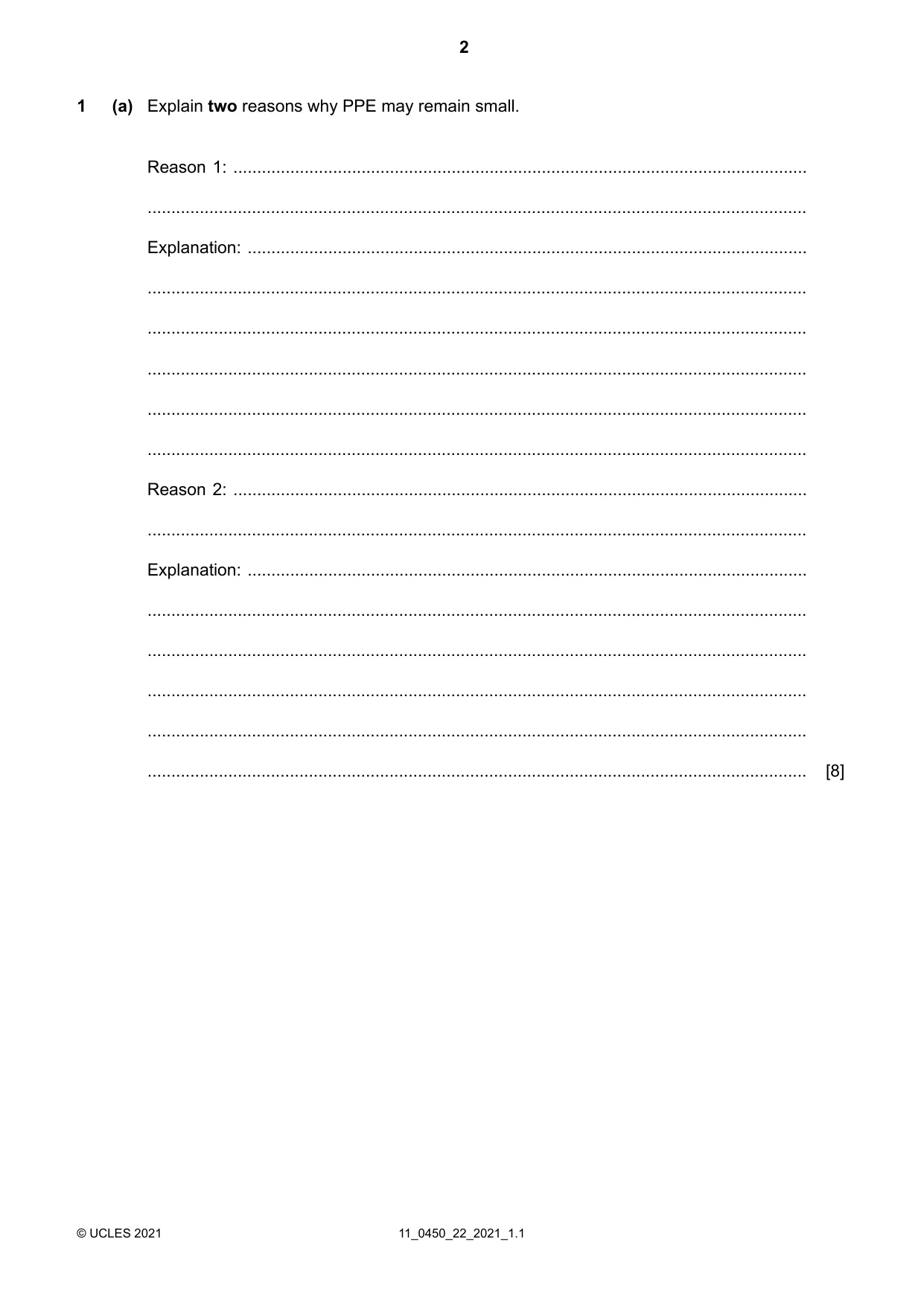
Question paper, page 2
Explain two reasons why PPE may remain small. (a) 1 Reason 1: … … Explanation: … … … … … … Reason 2: … … Explanation: … … … … … … [8] 11_0450_22_2021_1.1 © UCLES 2021 2
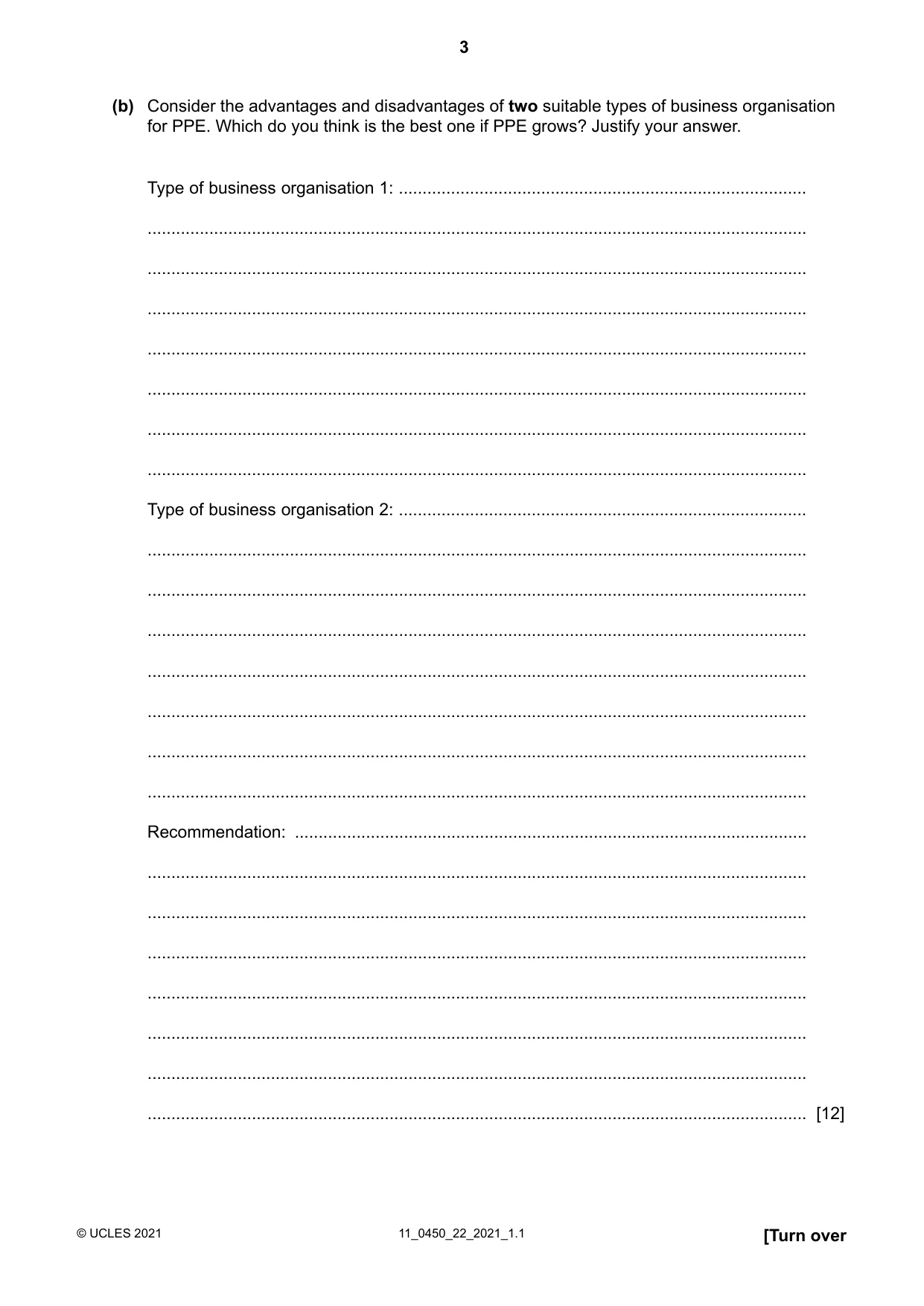
Question paper, page 3
Consider the advantages and disadvantages of two suitable types of business organisation for PPE. Which do you think is the best one if PPE grows? Justify your answer. (b) Type of business organisation 1: … … … … … … … … Type of business organisation 2: … … … … … … … … Recommendation: … … … … … … … … [12] [Turn over 11_0450_22_2021_1.1 © UCLES 2021 3
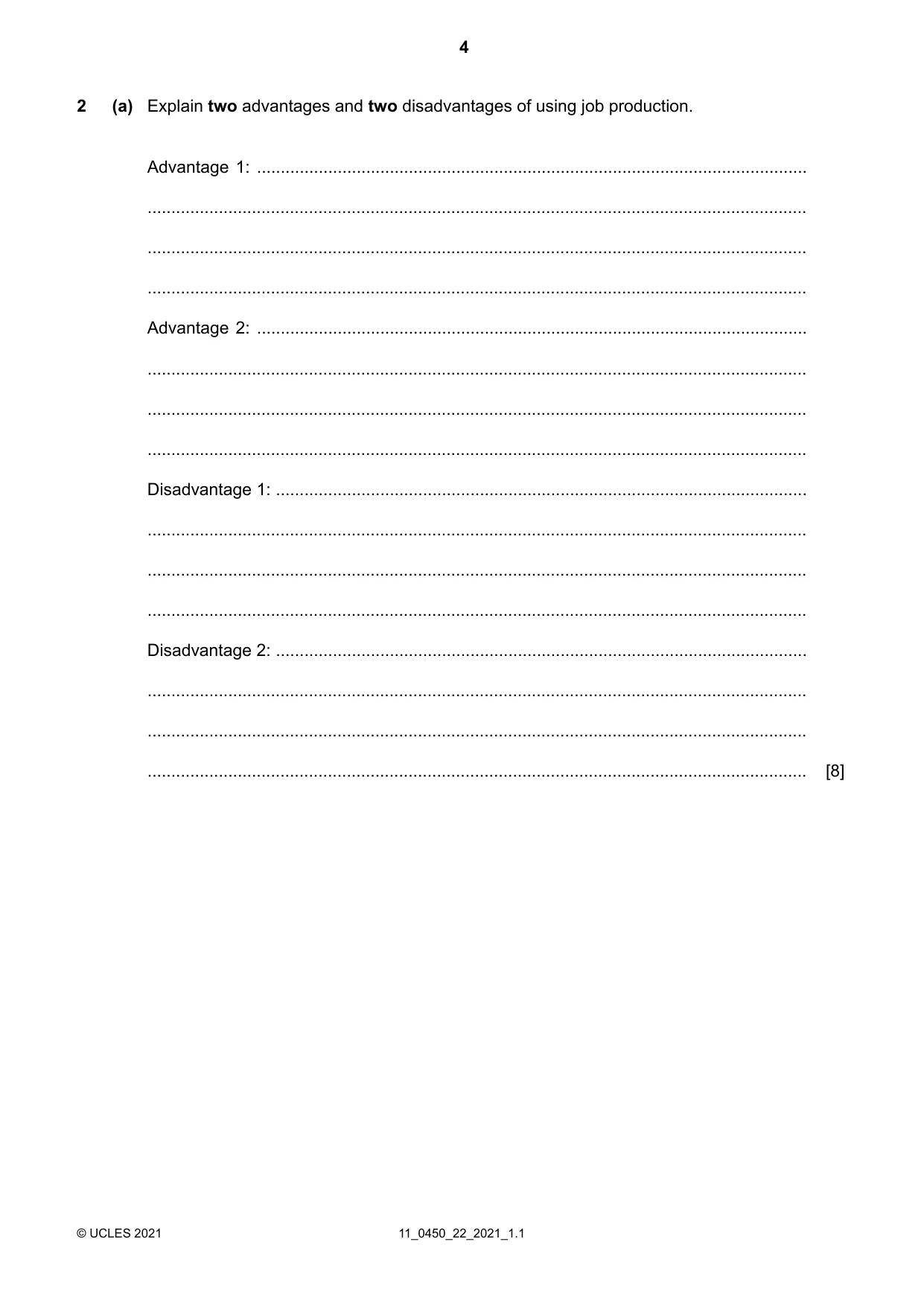
Question paper, page 4
Explain two advantages and two disadvantages of using job production. (a) 2 Advantage 1: … … … … Advantage 2: … … … … Disadvantage 1: … … … … Disadvantage 2: … … … … [8] 11_0450_22_2021_1.1 © UCLES 2021 4
Question paper, page 5
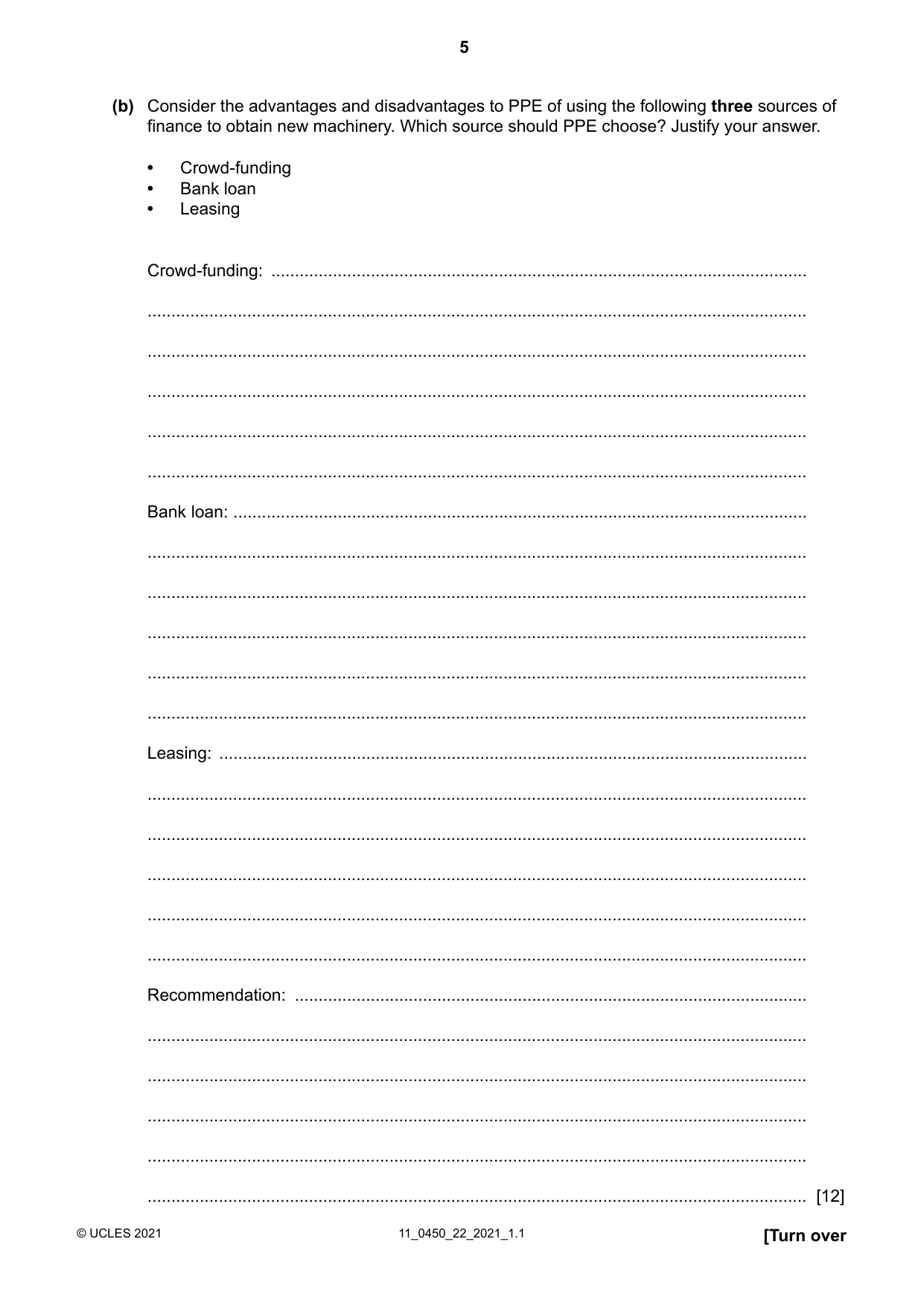
Consider the advantages and disadvantages to PPE of using the following three sources of finance to obtain new machinery. Which source should PPE choose? Justify your answer. (b) • Crowd-funding • Bank loan • Leasing Crowd-funding: … … … … … … Bank loan: … … … … … … Leasing: … … … … … … Recommendation: … … … … … … [12] [Turn over 11_0450_22_2021_1.1 © UCLES 2021 5
Question paper, page 6
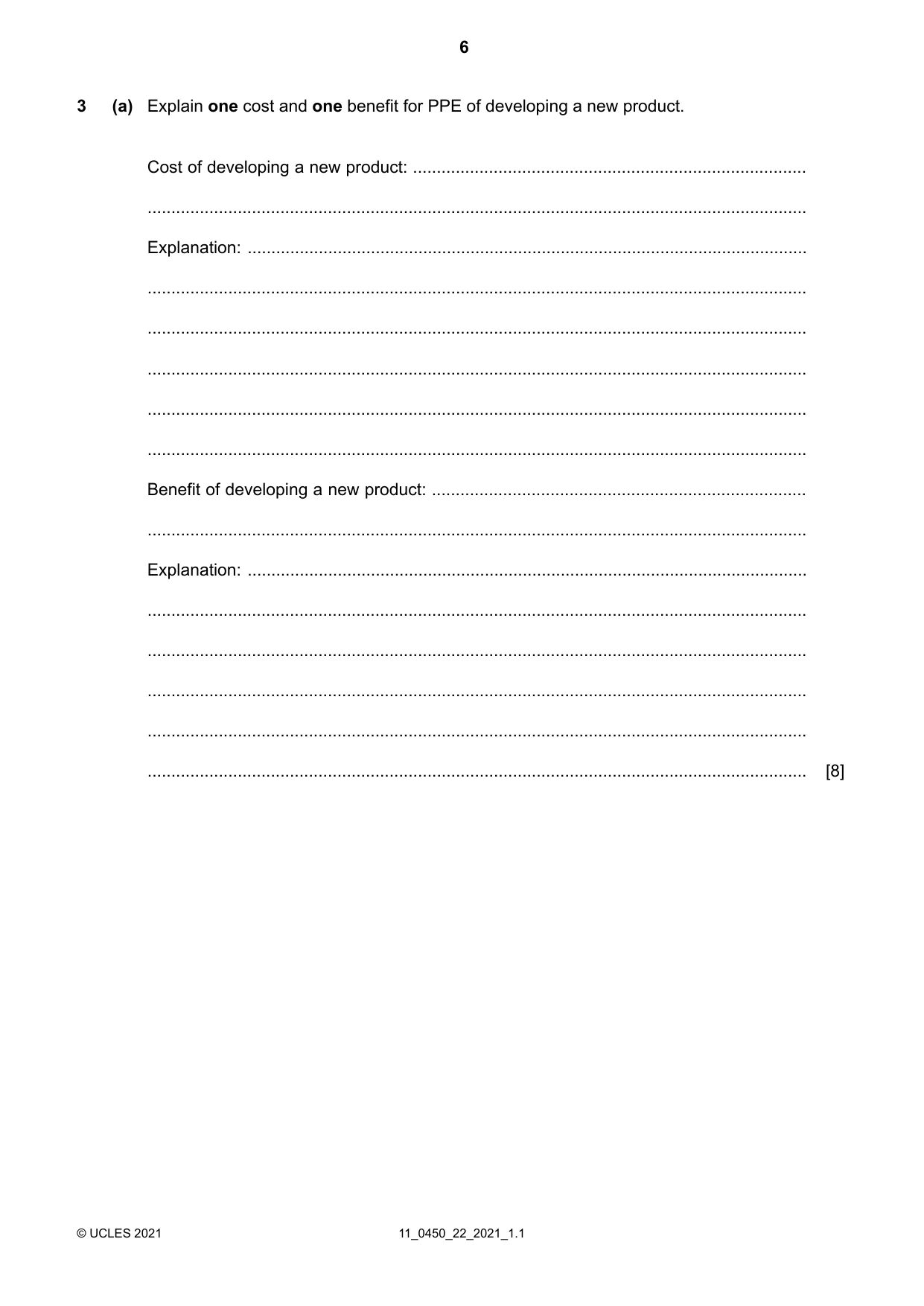
Explain one cost and one benefit for PPE of developing a new product. (a) 3 Cost of developing a new product: … … Explanation: … … … … … … Benefit of developing a new product: … … Explanation: … … … … … … [8] 11_0450_22_2021_1.1 © UCLES 2021 6
Question paper, page 7
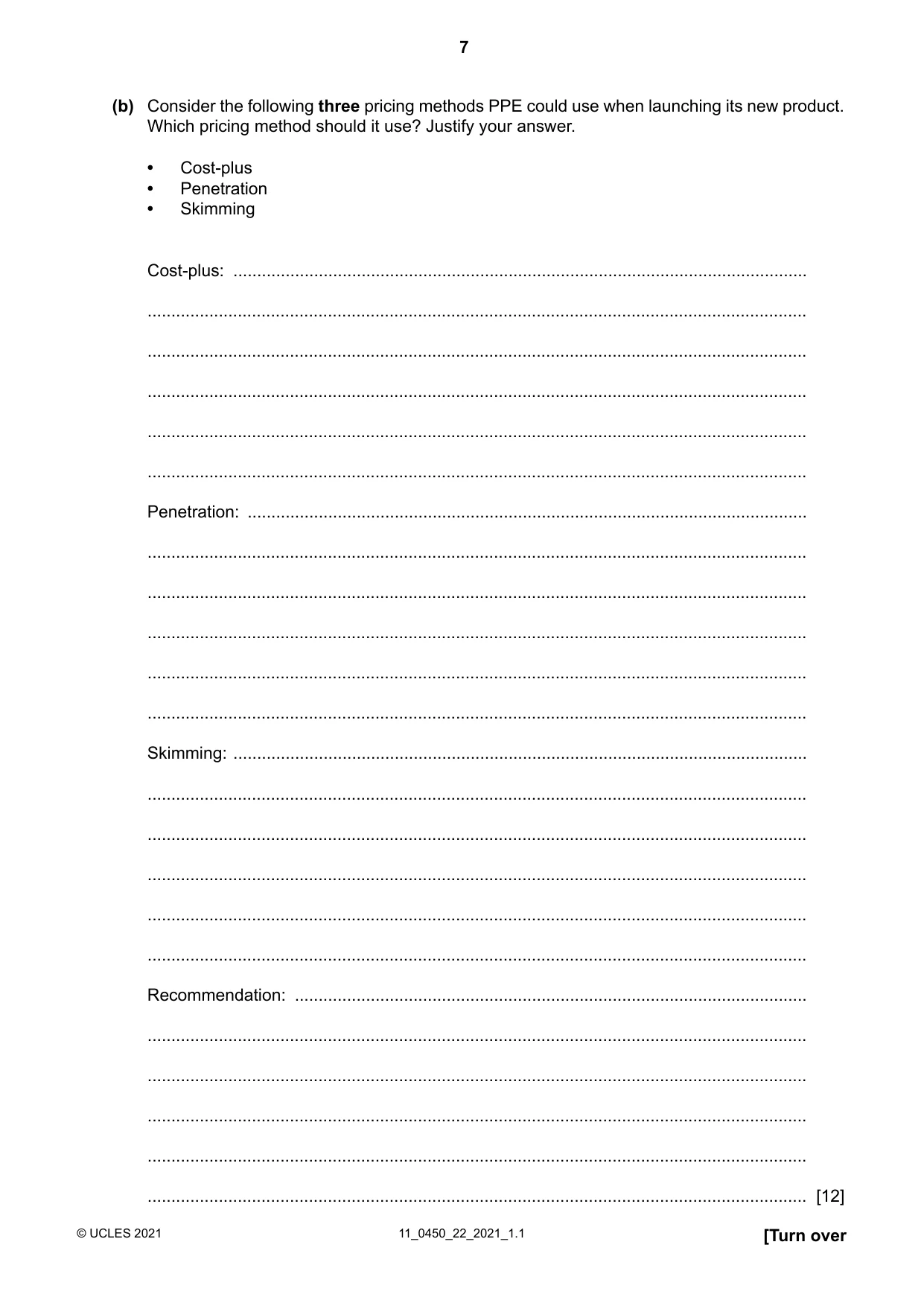
Consider the following three pricing methods PPE could use when launching its new product. Which pricing method should it use? Justify your answer. (b) • Cost-plus • Penetration • Skimming Cost-plus: … … … … … … Penetration: … … … … … … Skimming: … … … … … … Recommendation: … … … … … … [12] [Turn over 11_0450_22_2021_1.1 © UCLES 2021 7
Question paper, page 8
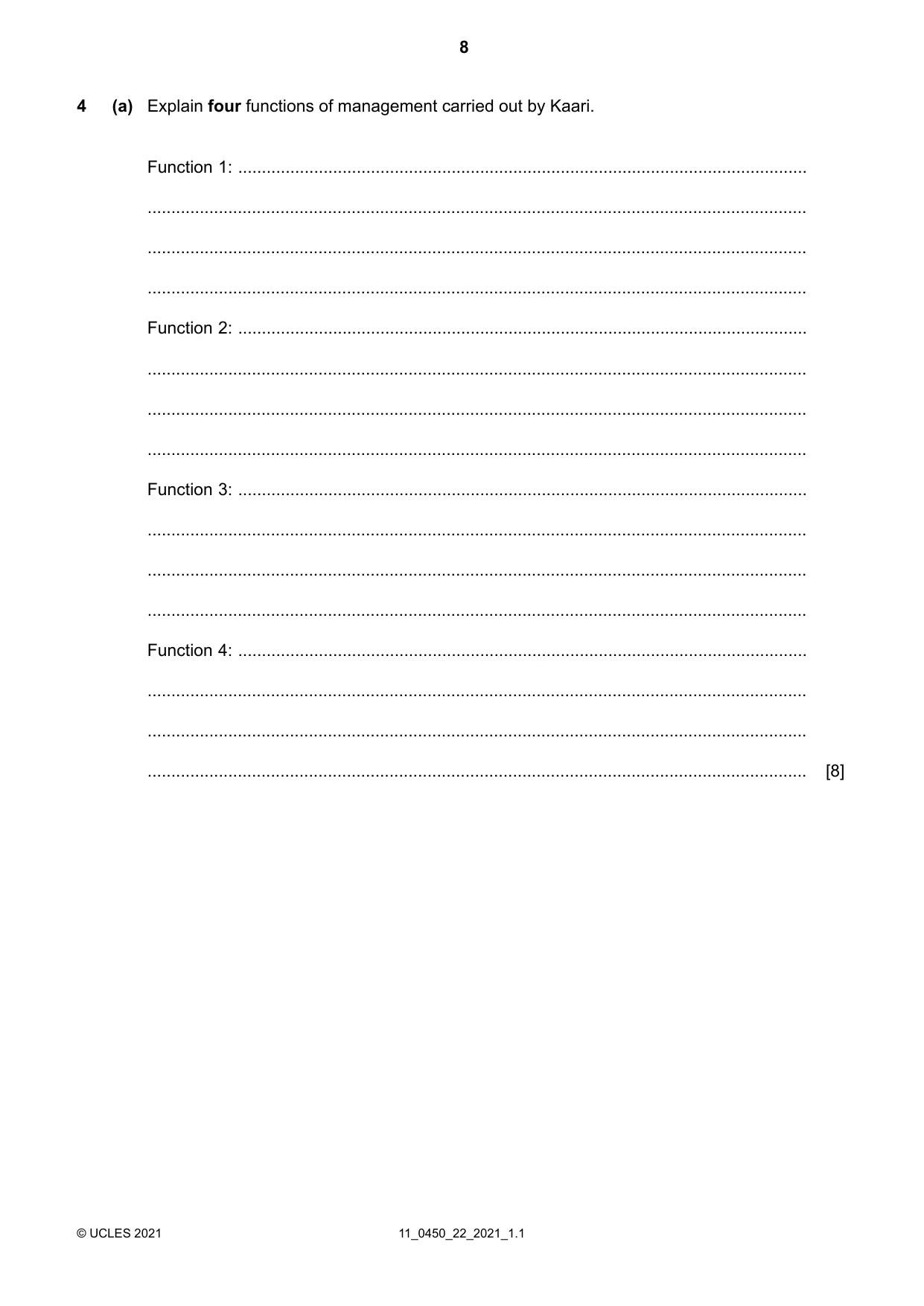
Explain four functions of management carried out by Kaari. (a) 4 Function 1: … … … … Function 2: … … … … Function 3: … … … … Function 4: … … … … [8] 11_0450_22_2021_1.1 © UCLES 2021 8
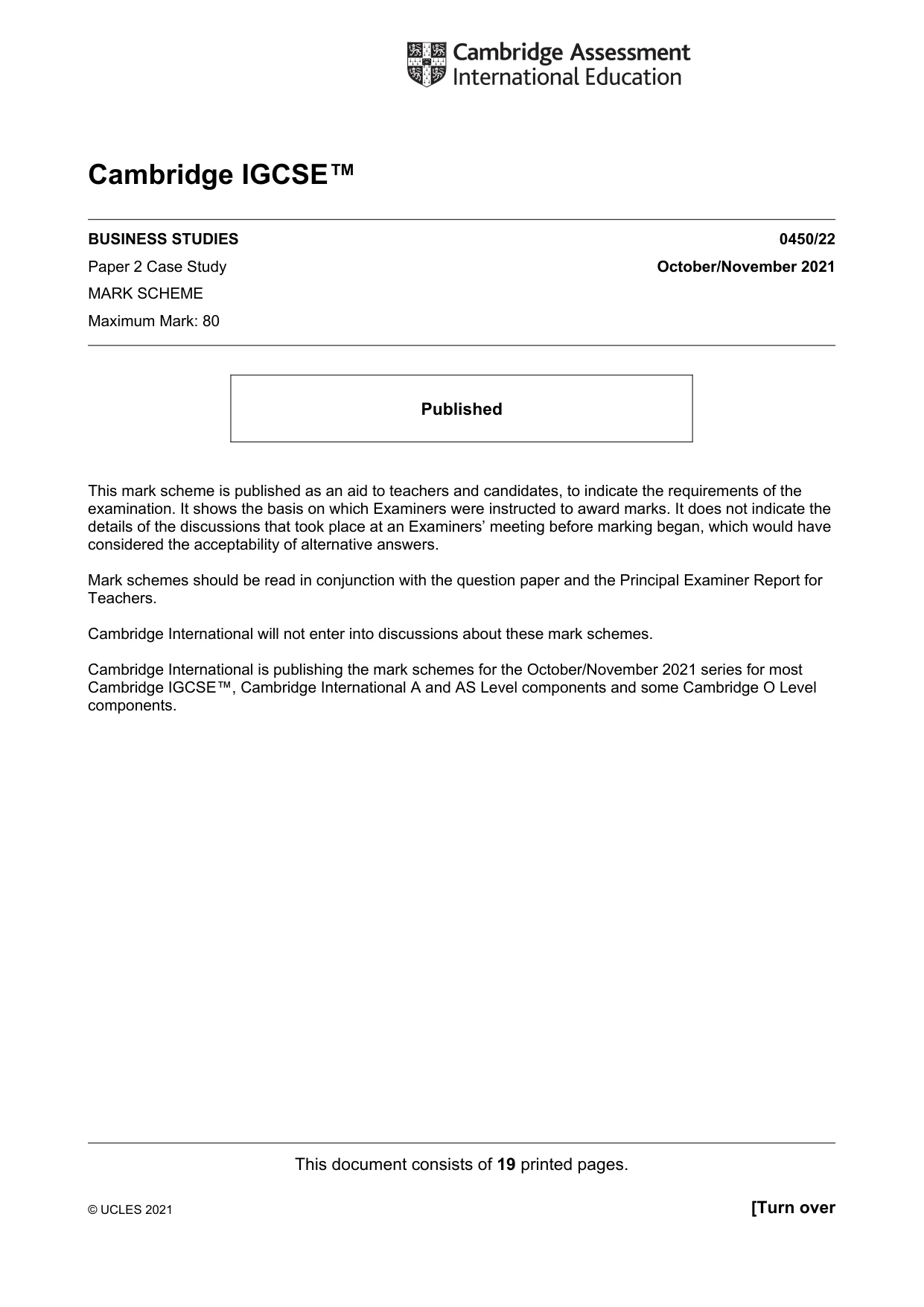
Question paper, page 9
Using Appendix 2 and other information, consider whether PPE should produce only large items of playground equipment or produce only small items of playground equipment. Justify your answer using suitable calculations. (b) Produce only large items of playground equipment: … … … … … … … … Produce only small items of playground equipment: … … … … … … … … Conclusion: … … … … … … … … [12] 11_0450_22_2021_1.1 © UCLES 2021 9
Question paper, page 10
BLANK PAGE 11_0450_22_2021_1.1 © UCLES 2021 10
Question paper, page 11
BLANK PAGE 11_0450_22_2021_1.1 © UCLES 2021 11
Question paper, page 12
BLANK PAGE Permission to reproduce items where third-party owned material protected by copyright is included has been sought and cleared where possible. Every reasonable effort has been made by the publisher (UCLES) to trace copyright holders, but if any items requiring clearance have unwittingly been included, the publisher will be pleased to make amends at the earliest possible opportunity. To avoid the issue of disclosure of answer-related information to candidates, all copyright acknowledgements are reproduced online in the Cambridge Assessment International Education Copyright Acknowledgements Booklet. This is produced for each series of examinations and is freely available to download at www.cambridgeinternational.org after the live examination series. Cambridge Assessment International Education is part of the Cambridge Assessment Group. Cambridge Assessment is the brand name of the University of Cambridge Local Examinations Syndicate (UCLES), which itself is a department of the University of Cambridge. 11_0450_22_2021_1.1 © UCLES 2021 12
Mark scheme, page 1
This document consists of 19 printed pages. © UCLES 2021 [Turn over Cambridge IGCSE™ BUSINESS STUDIES 0450/22 Paper 2 Case Study October/November 2021 MARK SCHEME Maximum Mark: 80 Published This mark scheme is published as an aid to teachers and candidates, to indicate the requirements of the examination. It shows the basis on which Examiners were instructed to award marks. It does not indicate the details of the discussions that took place at an Examiners’ meeting before marking began, which would have considered the acceptability of alternative answers. Mark schemes should be read in conjunction with the question paper and the Principal Examiner Report for Teachers. Cambridge International will not enter into discussions about these mark schemes. Cambridge International is publishing the mark schemes for the October/November 2021 series for most Cambridge IGCSE™, Cambridge International A and AS Level components and some Cambridge O Level components.
Mark scheme, page 2
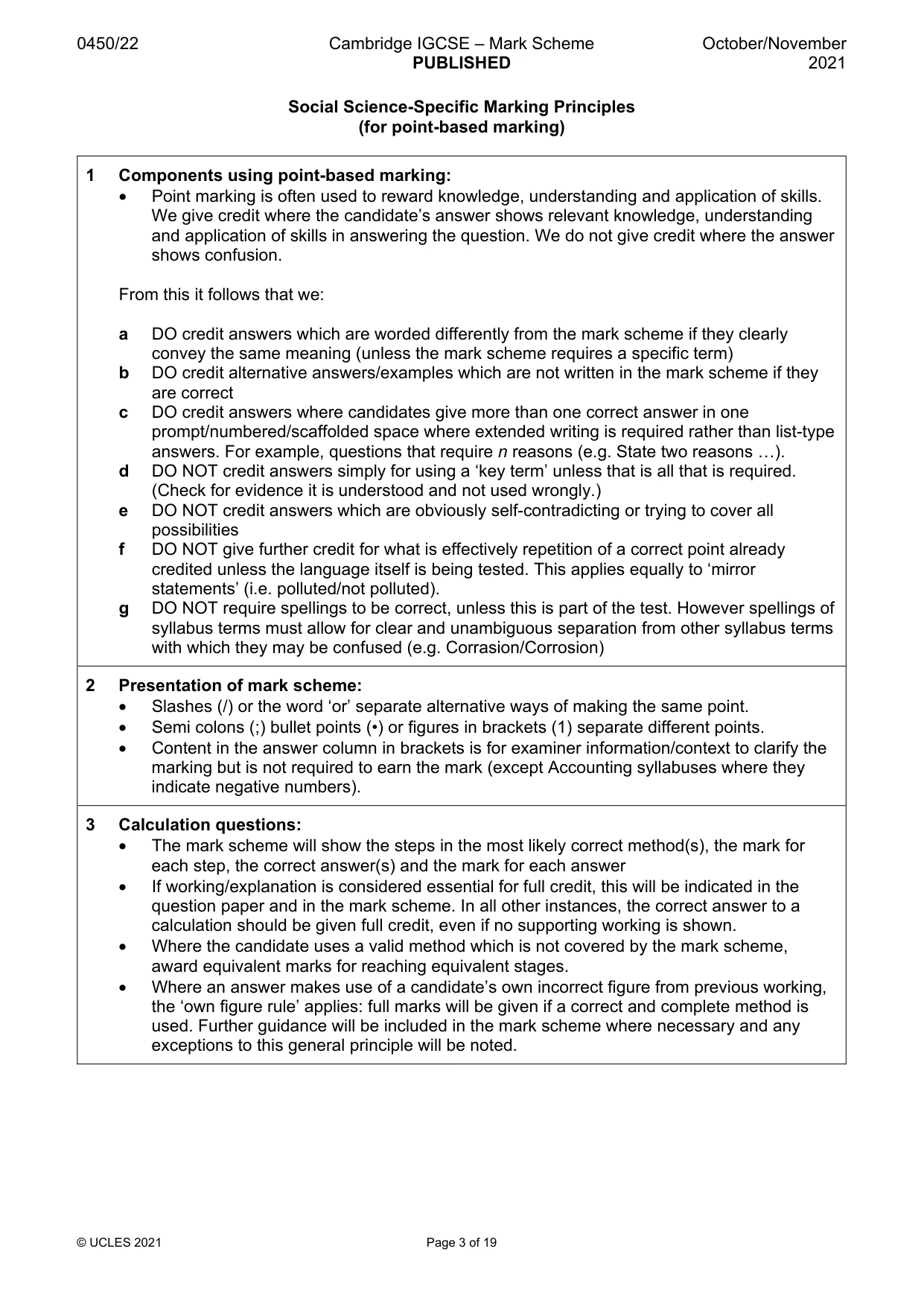
0450/22 Cambridge IGCSE – Mark Scheme PUBLISHED October/November 2021 © UCLES 2021 Page 2 of 19 Generic Marking Principles These general marking principles must be applied by all examiners when marking candidate answers. They should be applied alongside the specific content of the mark scheme or generic level descriptors for a question. Each question paper and mark scheme will also comply with these marking principles. GENERIC MARKING PRINCIPLE 1: Marks must be awarded in line with: • the specific content of the mark scheme or the generic level descriptors for the question • the specific skills defined in the mark scheme or in the generic level descriptors for the question • the standard of response required by a candidate as exemplified by the standardisation scripts. GENERIC MARKING PRINCIPLE 2: Marks awarded are always whole marks (not half marks, or other fractions). GENERIC MARKING PRINCIPLE 3: Marks must be awarded positively: • marks are awarded for correct/valid answers, as defined in the mark scheme. However, credit is given for valid answers which go beyond the scope of the syllabus and mark scheme, referring to your Team Leader as appropriate • marks are awarded when candidates clearly demonstrate what they know and can do • marks are not deducted for errors • marks are not deducted for omissions • answers should only be judged on the quality of spelling, punctuation and grammar when these features are specifically assessed by the question as indicated by the mark scheme. The meaning, however, should be unambiguous. GENERIC MARKING PRINCIPLE 4: Rules must be applied consistently, e.g. in situations where candidates have not followed instructions or in the application of generic level descriptors. GENERIC MARKING PRINCIPLE 5: Marks should be awarded using the full range of marks defined in the mark scheme for the question (however; the use of the full mark range may be limited according to the quality of the candidate responses seen). GENERIC MARKING PRINCIPLE 6: Marks awarded are based solely on the requirements as defined in the mark scheme. Marks should not be awarded with grade thresholds or grade descriptors in mind.
Mark scheme, page 3
0450/22 Cambridge IGCSE – Mark Scheme PUBLISHED October/November 2021 © UCLES 2021 Page 3 of 19 Social Science-Specific Marking Principles (for point-based marking) 1 Components using point-based marking: • Point marking is often used to reward knowledge, understanding and application of skills. We give credit where the candidate’s answer shows relevant knowledge, understanding and application of skills in answering the question. We do not give credit where the answer shows confusion. From this it follows that we: a DO credit answers which are worded differently from the mark scheme if they clearly convey the same meaning (unless the mark scheme requires a specific term) b DO credit alternative answers/examples which are not written in the mark scheme if they are correct c DO credit answers where candidates give more than one correct answer in one prompt/numbered/scaffolded space where extended writing is required rather than list-type answers. For example, questions that require n reasons (e.g. State two reasons …). d DO NOT credit answers simply for using a ‘key term’ unless that is all that is required. (Check for evidence it is understood and not used wrongly.) e DO NOT credit answers which are obviously self-contradicting or trying to cover all possibilities f DO NOT give further credit for what is effectively repetition of a correct point already credited unless the language itself is being tested. This applies equally to ‘mirror statements’ (i.e. polluted/not polluted). g DO NOT require spellings to be correct, unless this is part of the test. However spellings of syllabus terms must allow for clear and unambiguous separation from other syllabus terms with which they may be confused (e.g. Corrasion/Corrosion) 2 Presentation of mark scheme: • Slashes (/) or the word ‘or’ separate alternative ways of making the same point. • Semi colons (;) bullet points (•) or figures in brackets (1) separate different points. • Content in the answer column in brackets is for examiner information/context to clarify the marking but is not required to earn the mark (except Accounting syllabuses where they indicate negative numbers). 3 Calculation questions: • The mark scheme will show the steps in the most likely correct method(s), the mark for each step, the correct answer(s) and the mark for each answer • If working/explanation is considered essential for full credit, this will be indicated in the question paper and in the mark scheme. In all other instances, the correct answer to a calculation should be given full credit, even if no supporting working is shown. • Where the candidate uses a valid method which is not covered by the mark scheme, award equivalent marks for reaching equivalent stages. • Where an answer makes use of a candidate’s own incorrect figure from previous working, the ‘own figure rule’ applies: full marks will be given if a correct and complete method is used. Further guidance will be included in the mark scheme where necessary and any exceptions to this general principle will be noted.
Mark scheme, page 4
0450/22 Cambridge IGCSE – Mark Scheme PUBLISHED October/November 2021 © UCLES 2021 Page 4 of 19 4 Annotation: • For point marking, ticks can be used to indicate correct answers and crosses can be used to indicate wrong answers. There is no direct relationship between ticks and marks. Ticks have no defined meaning for levels of response marking. • For levels of response marking, the level awarded should be annotated on the script. • Other annotations will be used by examiners as agreed during standardisation, and the meaning will be understood by all examiners who marked that paper.
Mark scheme, page 5
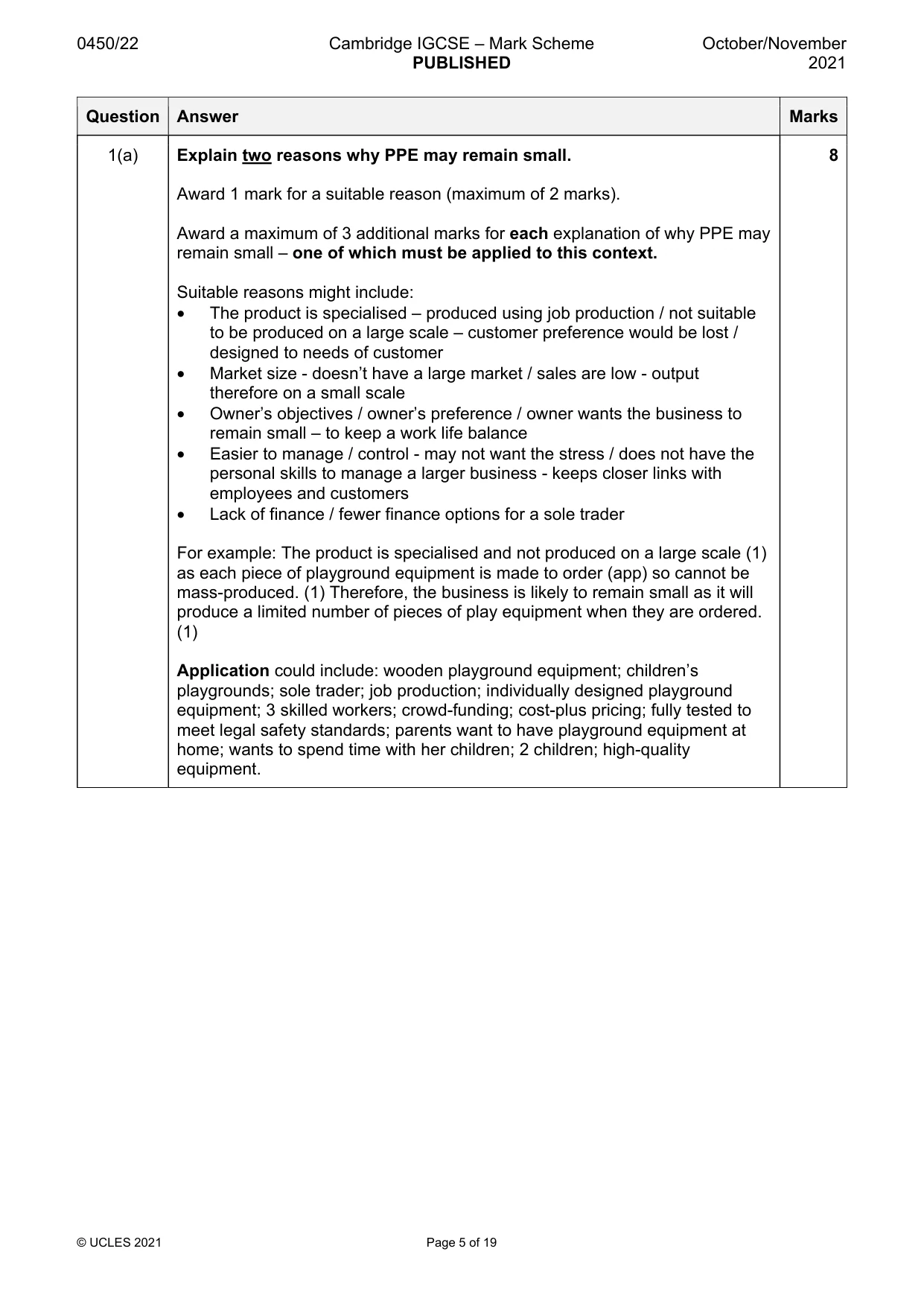
0450/22 Cambridge IGCSE – Mark Scheme PUBLISHED October/November 2021 © UCLES 2021 Page 5 of 19 Question Answer Marks 1(a) Explain two reasons why PPE may remain small. Award 1 mark for a suitable reason (maximum of 2 marks). Award a maximum of 3 additional marks for each explanation of why PPE may remain small – one of which must be applied to this context. Suitable reasons might include: • The product is specialised – produced using job production / not suitable to be produced on a large scale – customer preference would be lost / designed to needs of customer • Market size - doesn’t have a large market / sales are low - output therefore on a small scale • Owner’s objectives / owner’s preference / owner wants the business to remain small – to keep a work life balance • Easier to manage / control - may not want the stress / does not have the personal skills to manage a larger business - keeps closer links with employees and customers • Lack of finance / fewer finance options for a sole trader For example: The product is specialised and not produced on a large scale (1) as each piece of playground equipment is made to order (app) so cannot be mass-produced. (1) Therefore, the business is likely to remain small as it will produce a limited number of pieces of play equipment when they are ordered. (1) Application could include: wooden playground equipment; children’s playgrounds; sole trader; job production; individually designed playground equipment; 3 skilled workers; crowd-funding; cost-plus pricing; fully tested to meet legal safety standards; parents want to have playground equipment at home; wants to spend time with her children; 2 children; high-quality equipment. 8
Mark scheme, page 6
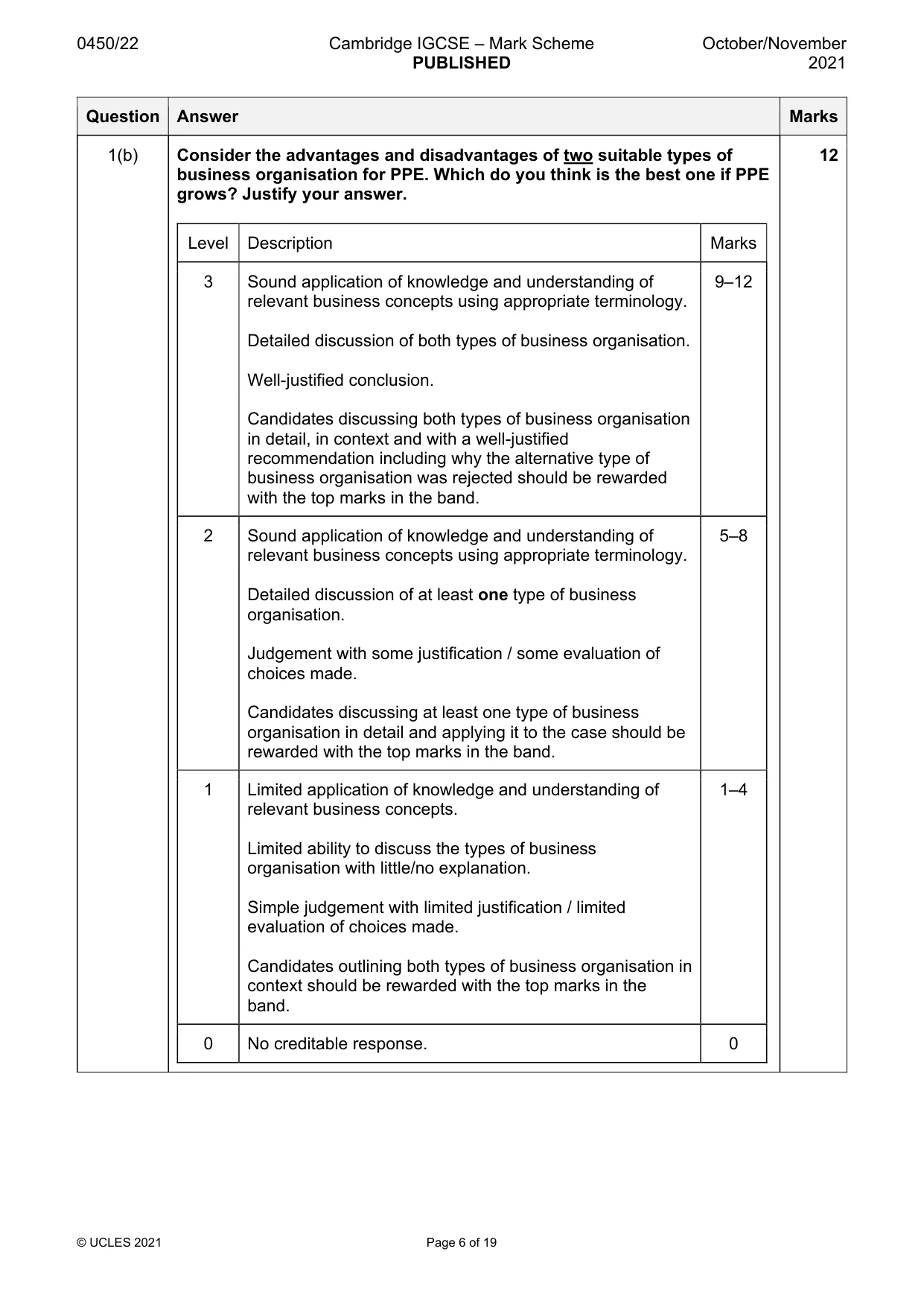
0450/22 Cambridge IGCSE – Mark Scheme PUBLISHED October/November 2021 © UCLES 2021 Page 6 of 19 Question Answer Marks 1(b) Consider the advantages and disadvantages of two suitable types of business organisation for PPE. Which do you think is the best one if PPE grows? Justify your answer. Level Description Marks 3 Sound application of knowledge and understanding of relevant business concepts using appropriate terminology. Detailed discussion of both types of business organisation. Well-justified conclusion. Candidates discussing both types of business organisation in detail, in context and with a well-justified recommendation including why the alternative type of business organisation was rejected should be rewarded with the top marks in the band. 9–12 2 Sound application of knowledge and understanding of relevant business concepts using appropriate terminology. Detailed discussion of at least one type of business organisation. Judgement with some justification / some evaluation of choices made. Candidates discussing at least one type of business organisation in detail and applying it to the case should be rewarded with the top marks in the band. 5–8 1 Limited application of knowledge and understanding of relevant business concepts. Limited ability to discuss the types of business organisation with little/no explanation. Simple judgement with limited justification / limited evaluation of choices made. Candidates outlining both types of business organisation in context should be rewarded with the top marks in the band. 1–4 0 No creditable response. 0 12
Mark scheme, page 7
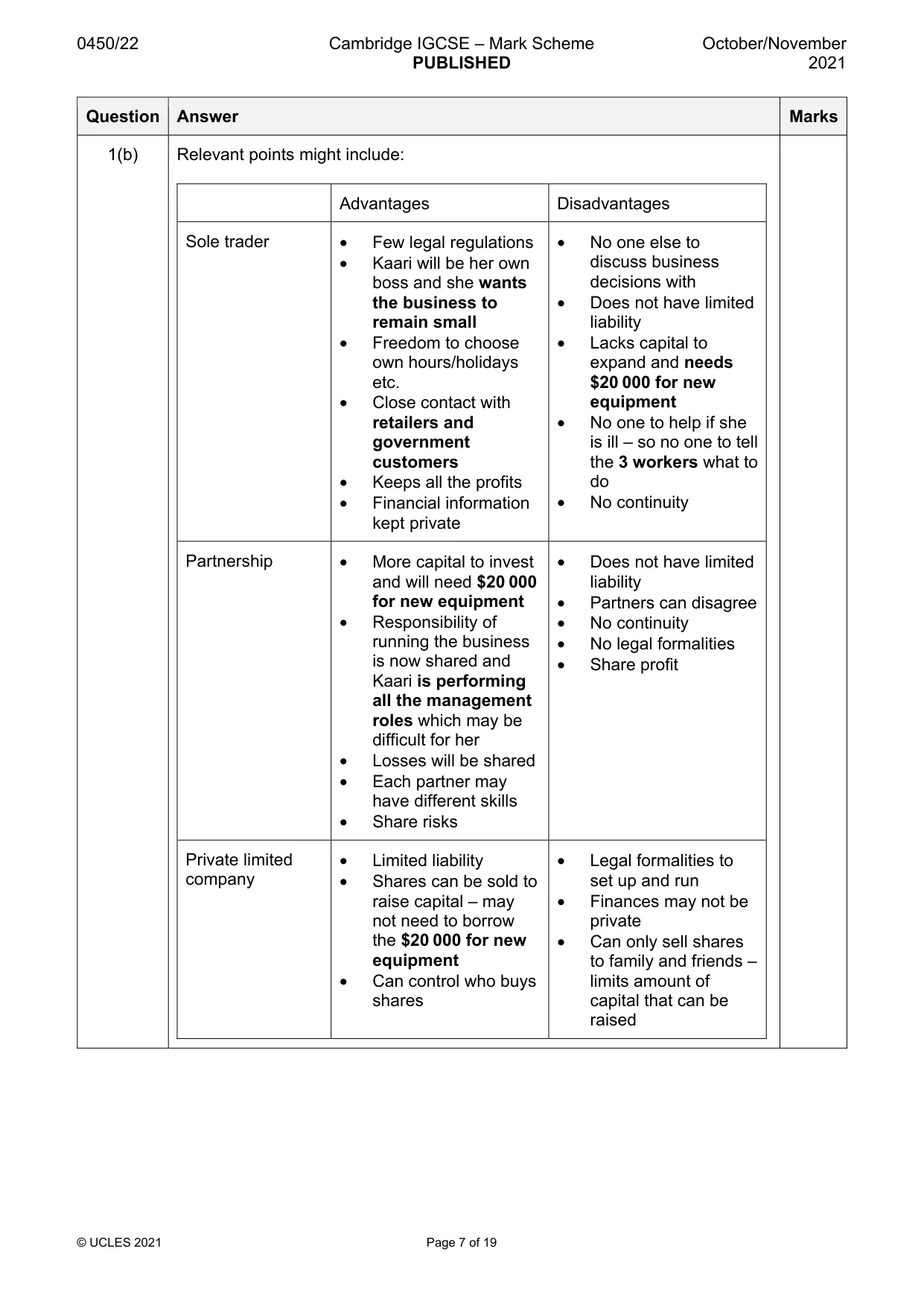
0450/22 Cambridge IGCSE – Mark Scheme PUBLISHED October/November 2021 © UCLES 2021 Page 7 of 19 Question Answer Marks 1(b) Relevant points might include: Advantages Disadvantages Sole trader • Few legal regulations • Kaari will be her own boss and she wants the business to remain small • Freedom to choose own hours/holidays etc. • Close contact with retailers and government customers • Keeps all the profits • Financial information kept private • No one else to discuss business decisions with • Does not have limited liability • Lacks capital to expand and needs $20 000 for new equipment • No one to help if she is ill – so no one to tell the 3 workers what to do • No continuity Partnership • More capital to invest and will need $20 000 for new equipment • Responsibility of running the business is now shared and Kaari is performing all the management roles which may be difficult for her • Losses will be shared • Each partner may have different skills • Share risks • Does not have limited liability • Partners can disagree • No continuity • No legal formalities • Share profit Private limited company • Limited liability • Shares can be sold to raise capital – may not need to borrow the $20 000 for new equipment • Can control who buys shares • Legal formalities to set up and run • Finances may not be private • Can only sell shares to family and friends – limits amount of capital that can be raised
Mark scheme, page 8
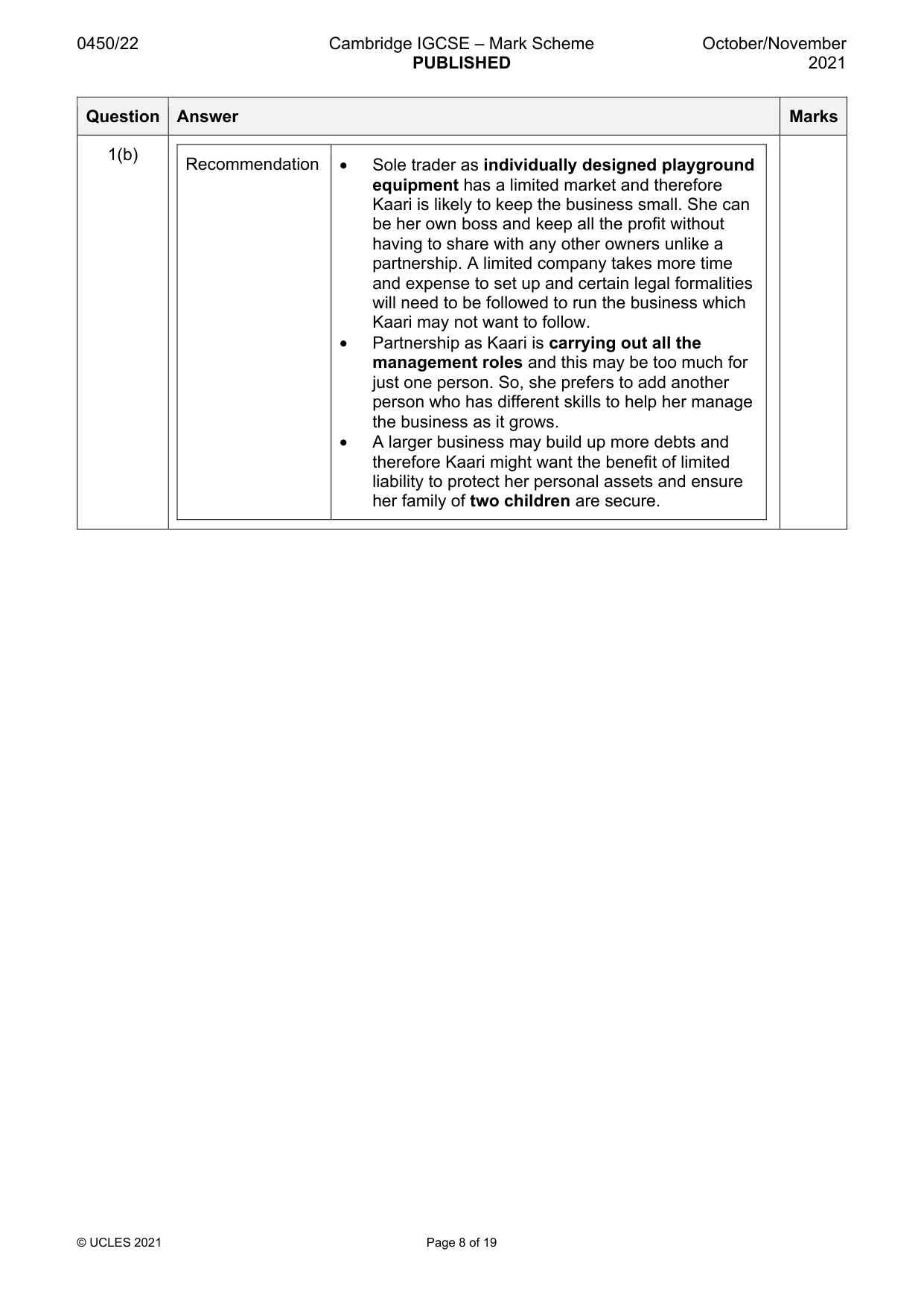
0450/22 Cambridge IGCSE – Mark Scheme PUBLISHED October/November 2021 © UCLES 2021 Page 8 of 19 Question Answer Marks 1(b) Recommendation • Sole trader as individually designed playground equipment has a limited market and therefore Kaari is likely to keep the business small. She can be her own boss and keep all the profit without having to share with any other owners unlike a partnership. A limited company takes more time and expense to set up and certain legal formalities will need to be followed to run the business which Kaari may not want to follow. • Partnership as Kaari is carrying out all the management roles and this may be too much for just one person. So, she prefers to add another person who has different skills to help her manage the business as it grows. • A larger business may build up more debts and therefore Kaari might want the benefit of limited liability to protect her personal assets and ensure her family of two children are secure.
Mark scheme, page 9
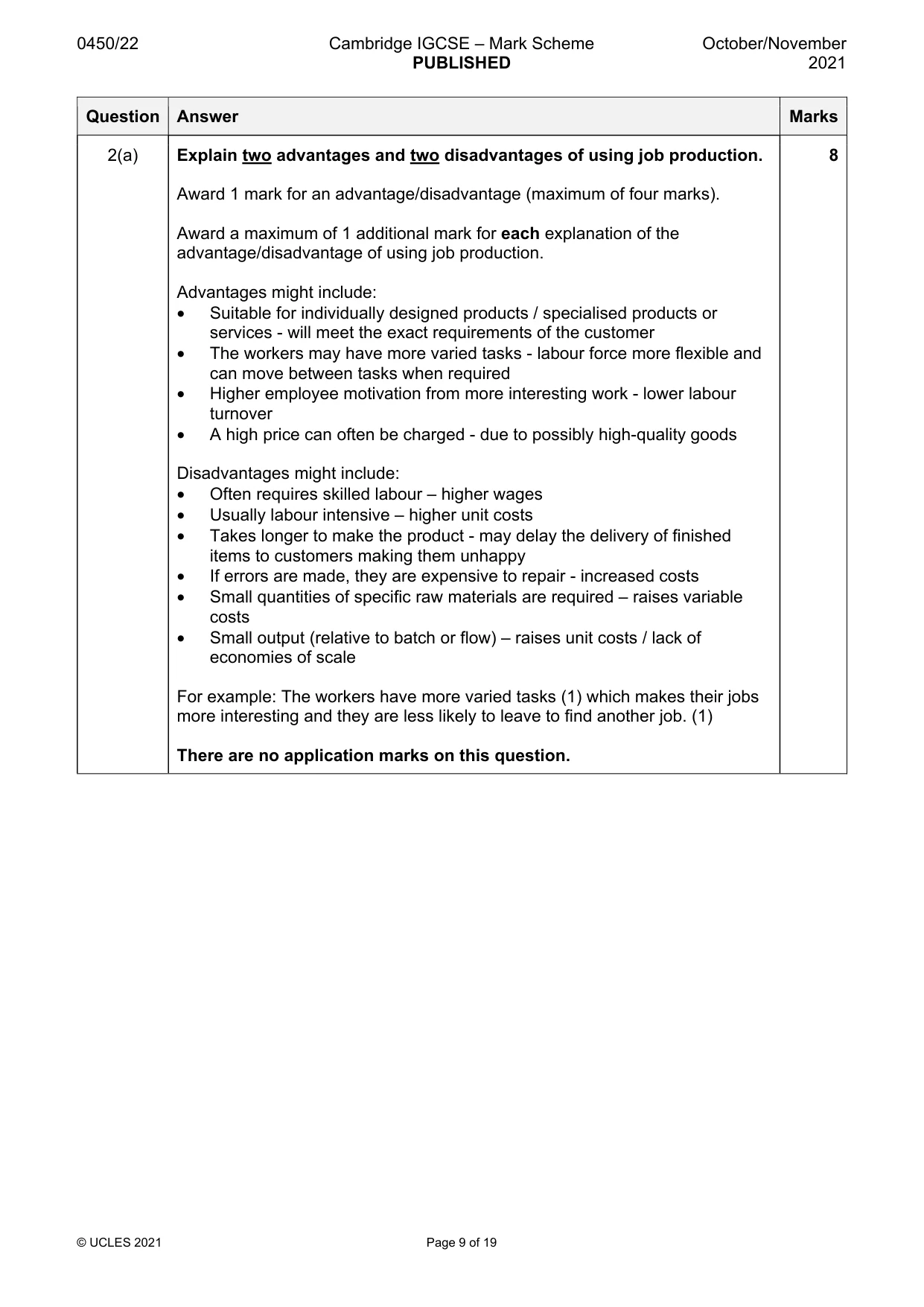
0450/22 Cambridge IGCSE – Mark Scheme PUBLISHED October/November 2021 © UCLES 2021 Page 9 of 19 Question Answer Marks 2(a) Explain two advantages and two disadvantages of using job production. Award 1 mark for an advantage/disadvantage (maximum of four marks). Award a maximum of 1 additional mark for each explanation of the advantage/disadvantage of using job production. Advantages might include: • Suitable for individually designed products / specialised products or services - will meet the exact requirements of the customer • The workers may have more varied tasks - labour force more flexible and can move between tasks when required • Higher employee motivation from more interesting work - lower labour turnover • A high price can often be charged - due to possibly high-quality goods Disadvantages might include: • Often requires skilled labour – higher wages • Usually labour intensive – higher unit costs • Takes longer to make the product - may delay the delivery of finished items to customers making them unhappy • If errors are made, they are expensive to repair - increased costs • Small quantities of specific raw materials are required – raises variable costs • Small output (relative to batch or flow) – raises unit costs / lack of economies of scale For example: The workers have more varied tasks (1) which makes their jobs more interesting and they are less likely to leave to find another job. (1) There are no application marks on this question. 8
Mark scheme, page 10
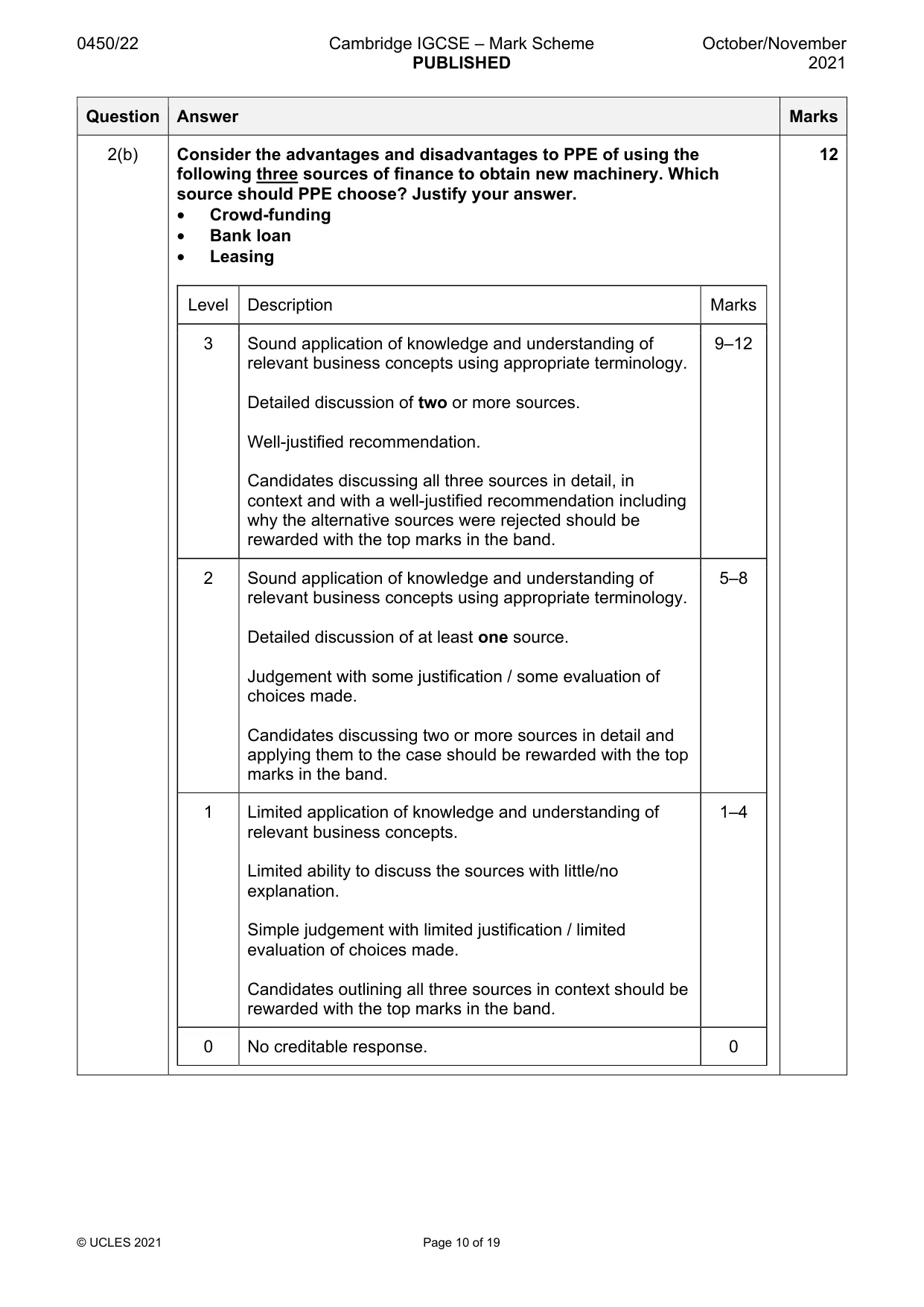
0450/22 Cambridge IGCSE – Mark Scheme PUBLISHED October/November 2021 © UCLES 2021 Page 10 of 19 Question Answer Marks 2(b) Consider the advantages and disadvantages to PPE of using the following three sources of finance to obtain new machinery. Which source should PPE choose? Justify your answer. • Crowd-funding • Bank loan • Leasing Level Description Marks 3 Sound application of knowledge and understanding of relevant business concepts using appropriate terminology. Detailed discussion of two or more sources. Well-justified recommendation. Candidates discussing all three sources in detail, in context and with a well-justified recommendation including why the alternative sources were rejected should be rewarded with the top marks in the band. 9–12 2 Sound application of knowledge and understanding of relevant business concepts using appropriate terminology. Detailed discussion of at least one source. Judgement with some justification / some evaluation of choices made. Candidates discussing two or more sources in detail and applying them to the case should be rewarded with the top marks in the band. 5–8 1 Limited application of knowledge and understanding of relevant business concepts. Limited ability to discuss the sources with little/no explanation. Simple judgement with limited justification / limited evaluation of choices made. Candidates outlining all three sources in context should be rewarded with the top marks in the band. 1–4 0 No creditable response. 0 12
Mark scheme, page 11
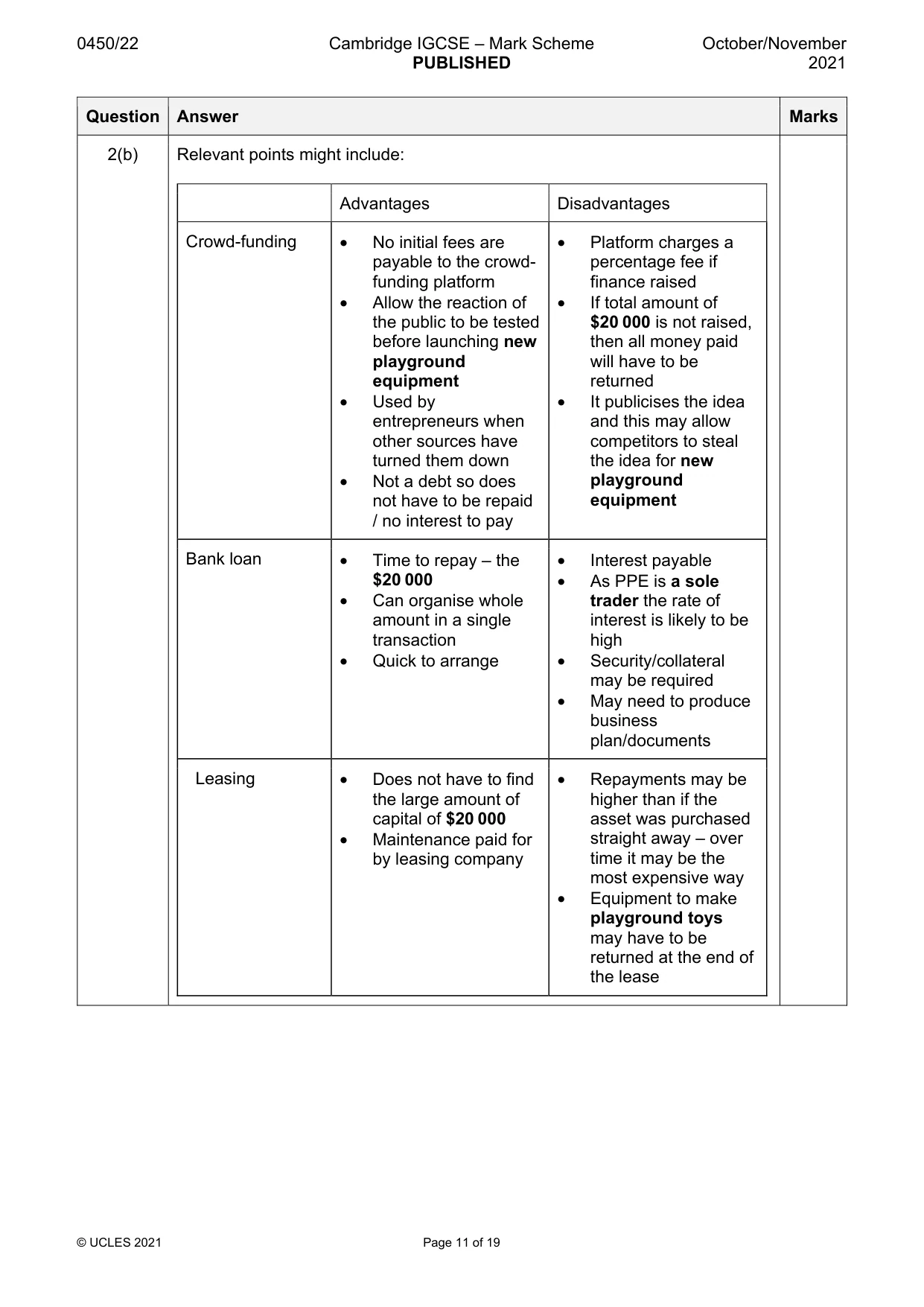
0450/22 Cambridge IGCSE – Mark Scheme PUBLISHED October/November 2021 © UCLES 2021 Page 11 of 19 Question Answer Marks 2(b) Relevant points might include: Advantages Disadvantages Crowd-funding • No initial fees are payable to the crowd- funding platform • Allow the reaction of the public to be tested before launching new playground equipment • Used by entrepreneurs when other sources have turned them down • Not a debt so does not have to be repaid / no interest to pay • Platform charges a percentage fee if finance raised • If total amount of $20 000 is not raised, then all money paid will have to be returned • It publicises the idea and this may allow competitors to steal the idea for new playground equipment Bank loan • Time to repay – the $20 000 • Can organise whole amount in a single transaction • Quick to arrange • Interest payable • As PPE is a sole trader the rate of interest is likely to be high • Security/collateral may be required • May need to produce business plan/documents Leasing • Does not have to find the large amount of capital of $20 000 • Maintenance paid for by leasing company • Repayments may be higher than if the asset was purchased straight away – over time it may be the most expensive way • Equipment to make playground toys may have to be returned at the end of the lease
Mark scheme, page 12
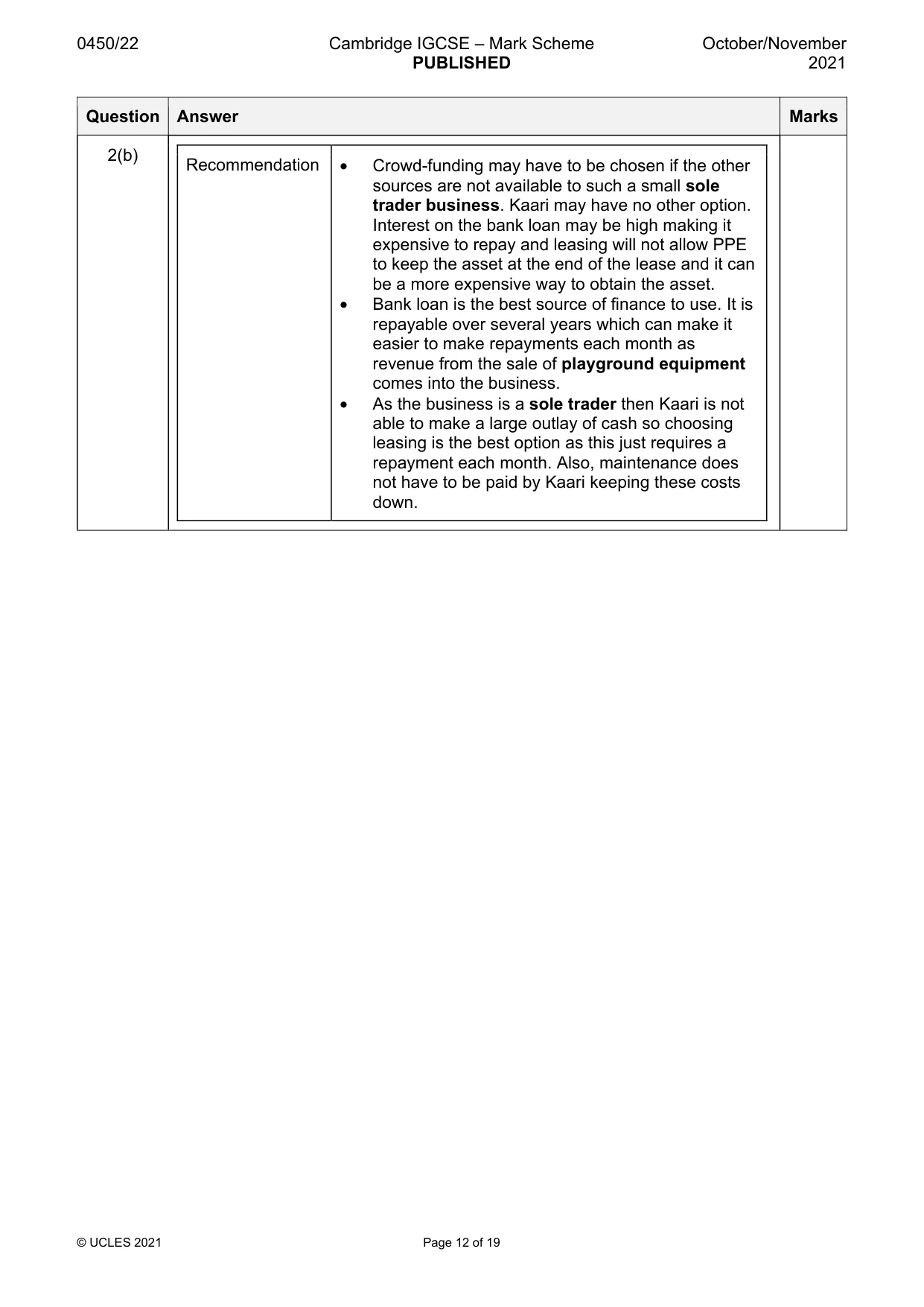
0450/22 Cambridge IGCSE – Mark Scheme PUBLISHED October/November 2021 © UCLES 2021 Page 12 of 19 Question Answer Marks 2(b) Recommendation • Crowd-funding may have to be chosen if the other sources are not available to such a small sole trader business. Kaari may have no other option. Interest on the bank loan may be high making it expensive to repay and leasing will not allow PPE to keep the asset at the end of the lease and it can be a more expensive way to obtain the asset. • Bank loan is the best source of finance to use. It is repayable over several years which can make it easier to make repayments each month as revenue from the sale of playground equipment comes into the business. • As the business is a sole trader then Kaari is not able to make a large outlay of cash so choosing leasing is the best option as this just requires a repayment each month. Also, maintenance does not have to be paid by Kaari keeping these costs down.
Mark scheme, page 13
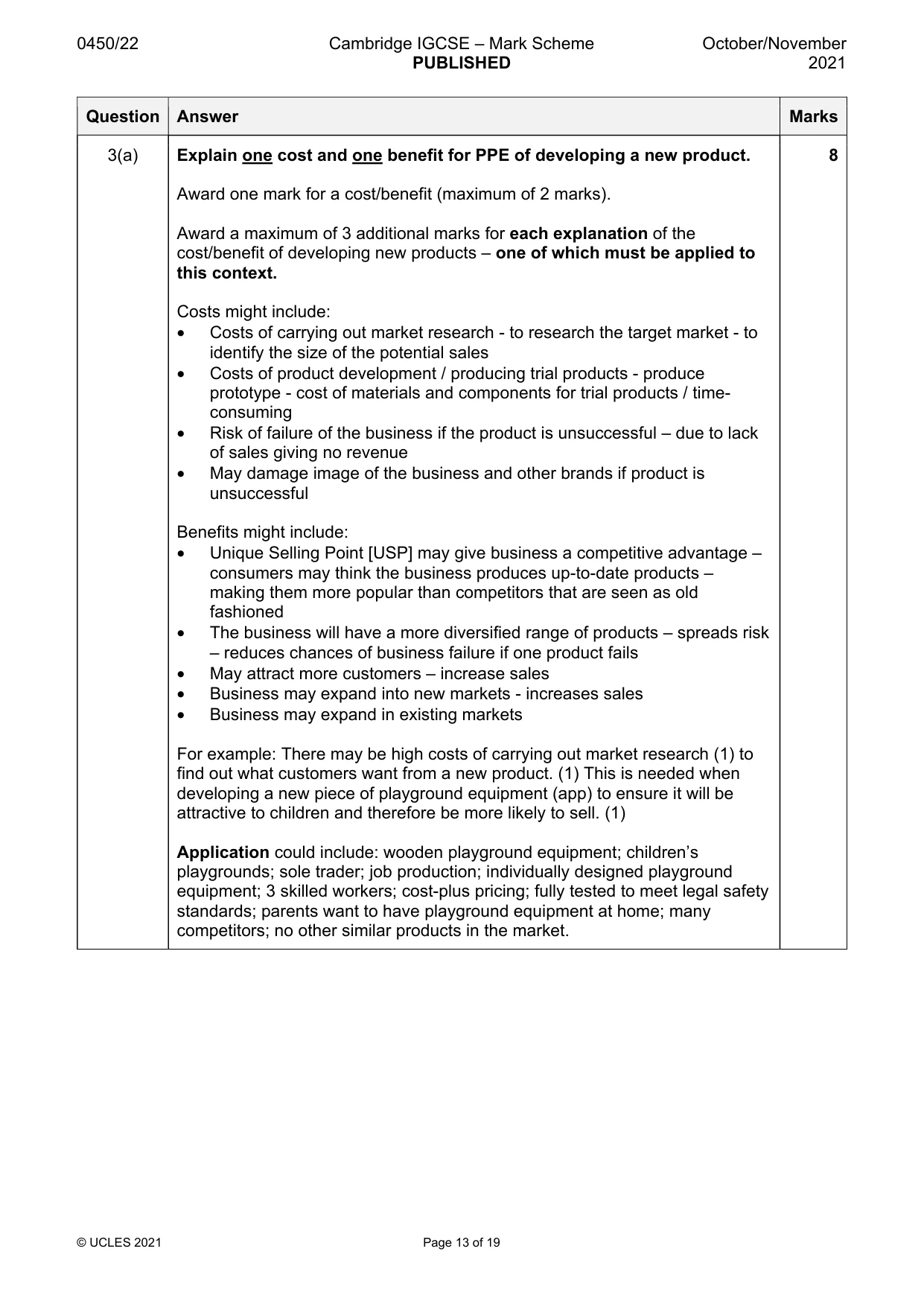
0450/22 Cambridge IGCSE – Mark Scheme PUBLISHED October/November 2021 © UCLES 2021 Page 13 of 19 Question Answer Marks 3(a) Explain one cost and one benefit for PPE of developing a new product. Award one mark for a cost/benefit (maximum of 2 marks). Award a maximum of 3 additional marks for each explanation of the cost/benefit of developing new products – one of which must be applied to this context. Costs might include: • Costs of carrying out market research - to research the target market - to identify the size of the potential sales • Costs of product development / producing trial products - produce prototype - cost of materials and components for trial products / time- consuming • Risk of failure of the business if the product is unsuccessful – due to lack of sales giving no revenue • May damage image of the business and other brands if product is unsuccessful Benefits might include: • Unique Selling Point [USP] may give business a competitive advantage – consumers may think the business produces up-to-date products – making them more popular than competitors that are seen as old fashioned • The business will have a more diversified range of products – spreads risk – reduces chances of business failure if one product fails • May attract more customers – increase sales • Business may expand into new markets - increases sales • Business may expand in existing markets For example: There may be high costs of carrying out market research (1) to find out what customers want from a new product. (1) This is needed when developing a new piece of playground equipment (app) to ensure it will be attractive to children and therefore be more likely to sell. (1) Application could include: wooden playground equipment; children’s playgrounds; sole trader; job production; individually designed playground equipment; 3 skilled workers; cost-plus pricing; fully tested to meet legal safety standards; parents want to have playground equipment at home; many competitors; no other similar products in the market. 8
Mark scheme, page 14
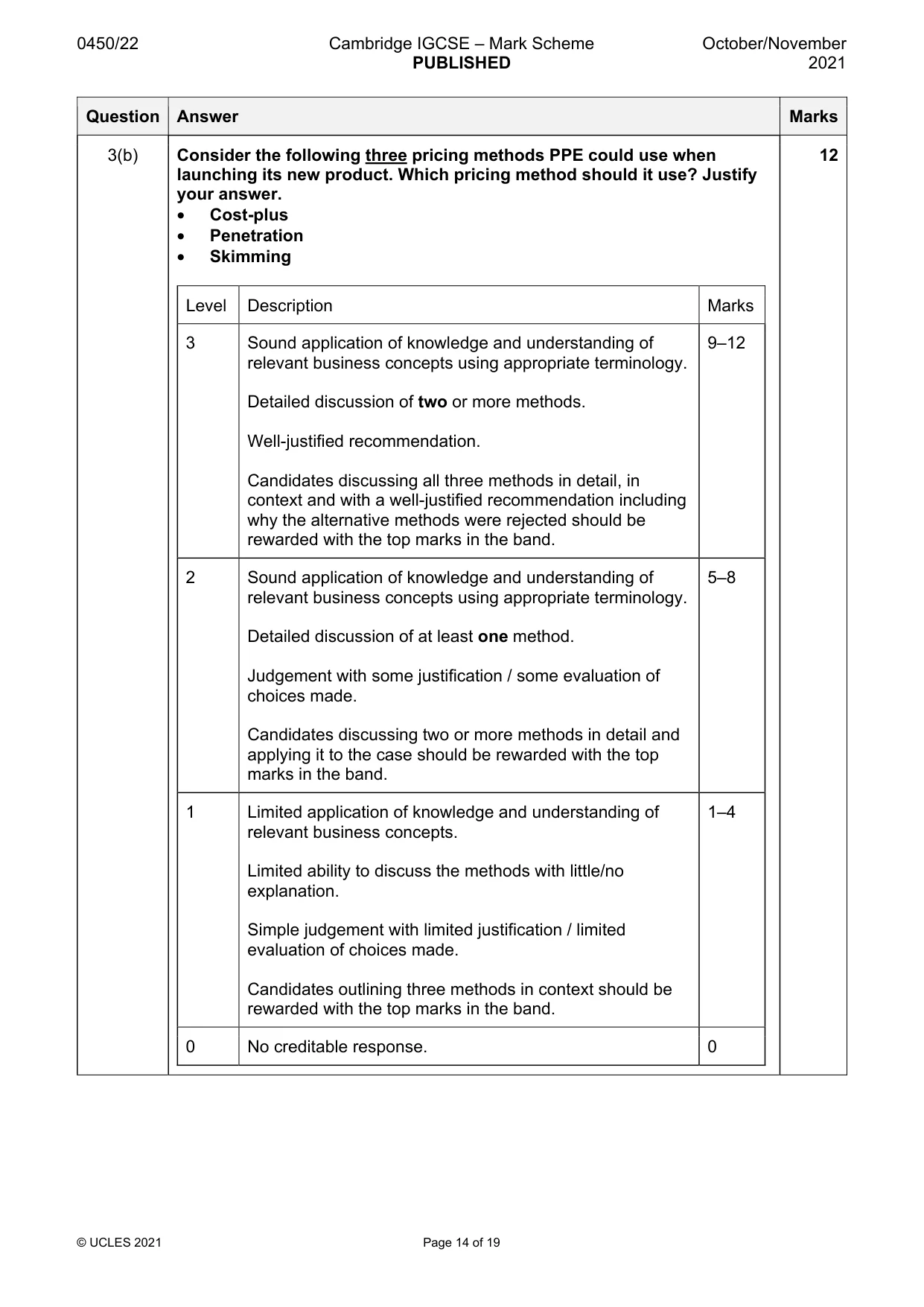
0450/22 Cambridge IGCSE – Mark Scheme PUBLISHED October/November 2021 © UCLES 2021 Page 14 of 19 Question Answer Marks 3(b) Consider the following three pricing methods PPE could use when launching its new product. Which pricing method should it use? Justify your answer. • Cost-plus • Penetration • Skimming Level Description Marks 3 Sound application of knowledge and understanding of relevant business concepts using appropriate terminology. Detailed discussion of two or more methods. Well-justified recommendation. Candidates discussing all three methods in detail, in context and with a well-justified recommendation including why the alternative methods were rejected should be rewarded with the top marks in the band. 9–12 2 Sound application of knowledge and understanding of relevant business concepts using appropriate terminology. Detailed discussion of at least one method. Judgement with some justification / some evaluation of choices made. Candidates discussing two or more methods in detail and applying it to the case should be rewarded with the top marks in the band. 5–8 1 Limited application of knowledge and understanding of relevant business concepts. Limited ability to discuss the methods with little/no explanation. Simple judgement with limited justification / limited evaluation of choices made. Candidates outlining three methods in context should be rewarded with the top marks in the band. 1–4 0 No creditable response. 0 12
Mark scheme, page 15
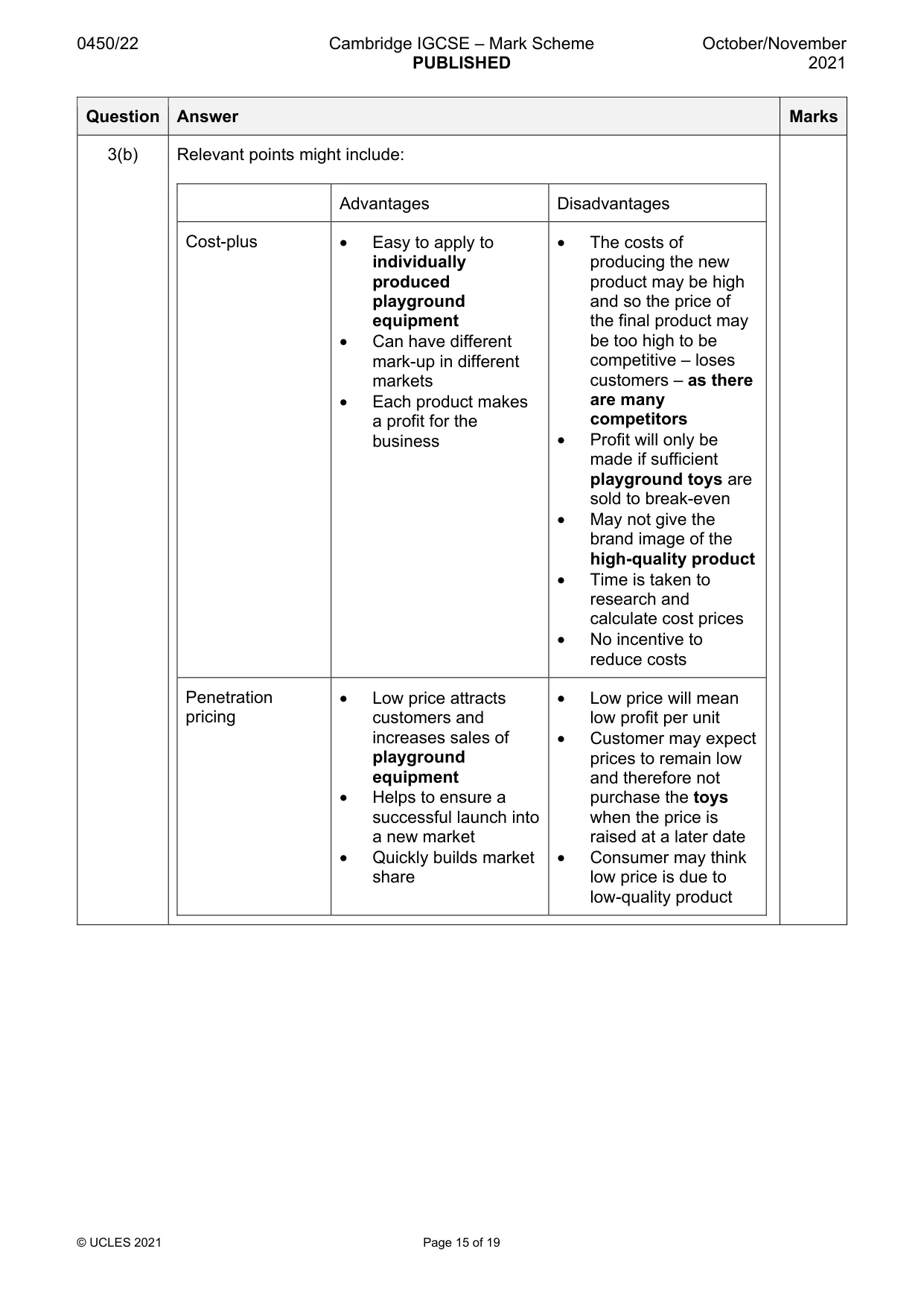
0450/22 Cambridge IGCSE – Mark Scheme PUBLISHED October/November 2021 © UCLES 2021 Page 15 of 19 Question Answer Marks 3(b) Relevant points might include: Advantages Disadvantages Cost-plus • Easy to apply to individually produced playground equipment • Can have different mark-up in different markets • Each product makes a profit for the business • The costs of producing the new product may be high and so the price of the final product may be too high to be competitive – loses customers – as there are many competitors • Profit will only be made if sufficient playground toys are sold to break-even • May not give the brand image of the high-quality product • Time is taken to research and calculate cost prices • No incentive to reduce costs Penetration pricing • Low price attracts customers and increases sales of playground equipment • Helps to ensure a successful launch into a new market • Quickly builds market share • Low price will mean low profit per unit • Customer may expect prices to remain low and therefore not purchase the toys when the price is raised at a later date • Consumer may think low price is due to low-quality product
Mark scheme, page 16
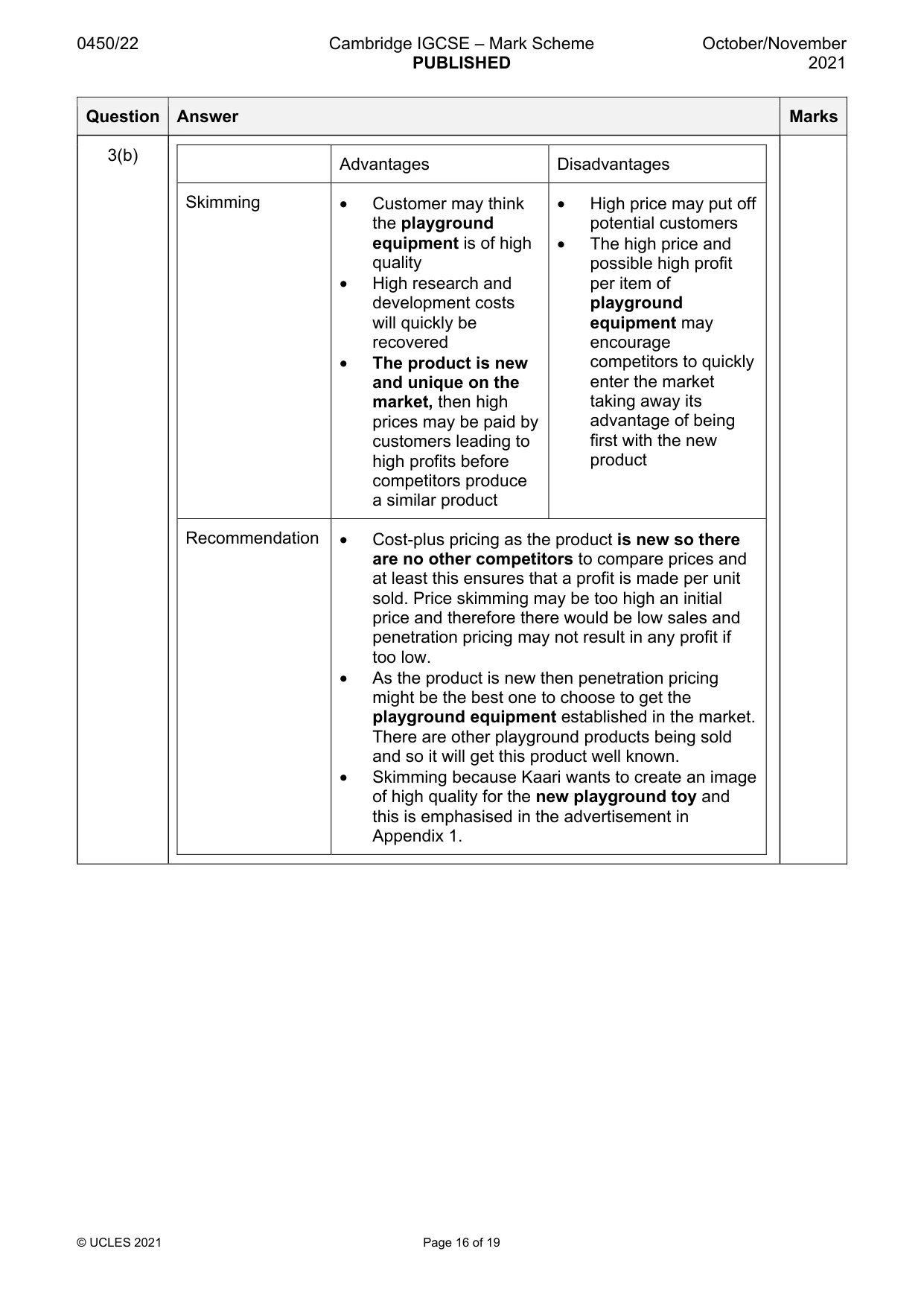
0450/22 Cambridge IGCSE – Mark Scheme PUBLISHED October/November 2021 © UCLES 2021 Page 16 of 19 Question Answer Marks 3(b) Advantages Disadvantages Skimming • Customer may think the playground equipment is of high quality • High research and development costs will quickly be recovered • The product is new and unique on the market, then high prices may be paid by customers leading to high profits before competitors produce a similar product • High price may put off potential customers • The high price and possible high profit per item of playground equipment may encourage competitors to quickly enter the market taking away its advantage of being first with the new product Recommendation • Cost-plus pricing as the product is new so there are no other competitors to compare prices and at least this ensures that a profit is made per unit sold. Price skimming may be too high an initial price and therefore there would be low sales and penetration pricing may not result in any profit if too low. • As the product is new then penetration pricing might be the best one to choose to get the playground equipment established in the market. There are other playground products being sold and so it will get this product well known. • Skimming because Kaari wants to create an image of high quality for the new playground toy and this is emphasised in the advertisement in Appendix 1.
Mark scheme, page 17
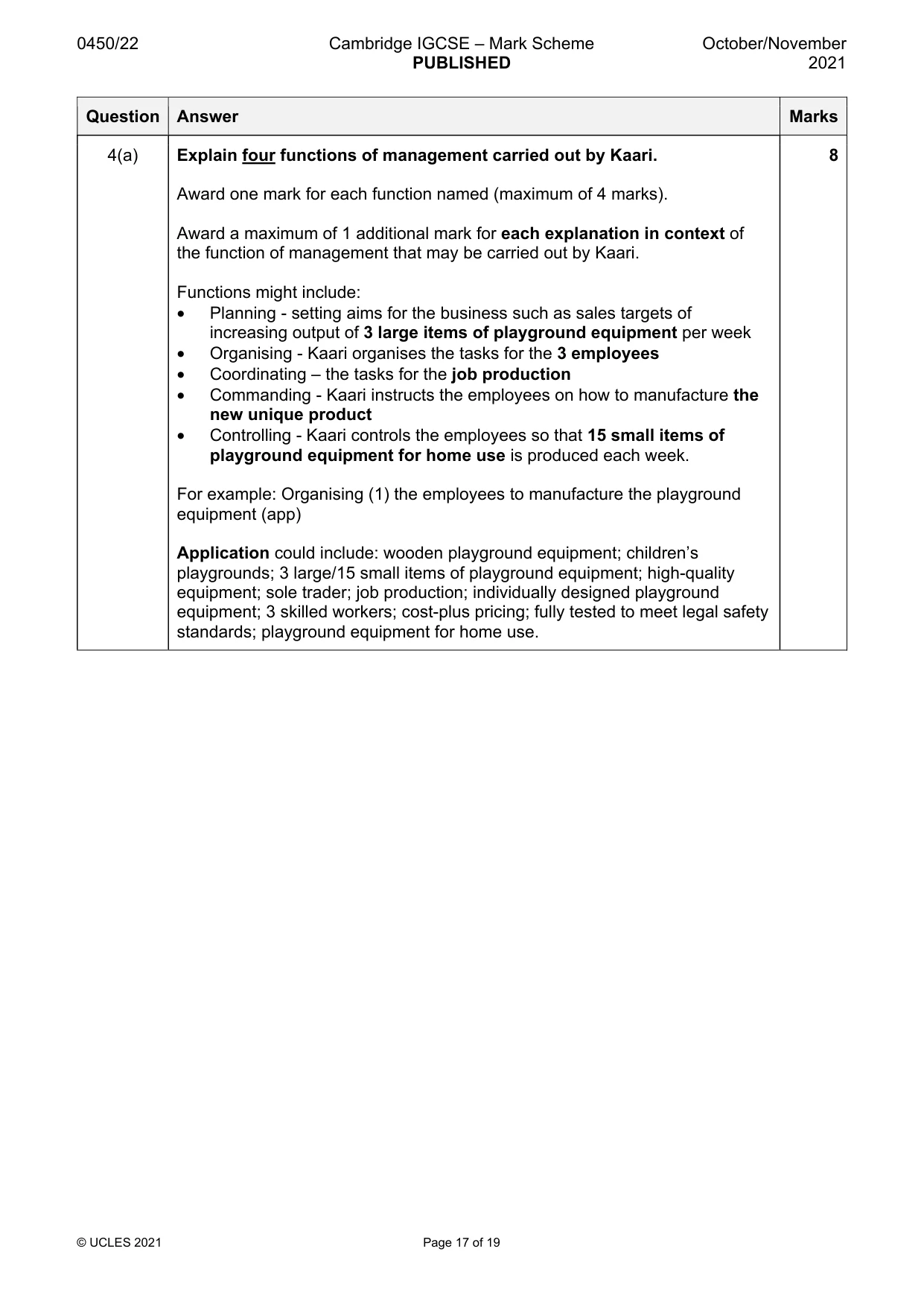
0450/22 Cambridge IGCSE – Mark Scheme PUBLISHED October/November 2021 © UCLES 2021 Page 17 of 19 Question Answer Marks 4(a) Explain four functions of management carried out by Kaari. Award one mark for each function named (maximum of 4 marks). Award a maximum of 1 additional mark for each explanation in context of the function of management that may be carried out by Kaari. Functions might include: • Planning - setting aims for the business such as sales targets of increasing output of 3 large items of playground equipment per week • Organising - Kaari organises the tasks for the 3 employees • Coordinating – the tasks for the job production • Commanding - Kaari instructs the employees on how to manufacture the new unique product • Controlling - Kaari controls the employees so that 15 small items of playground equipment for home use is produced each week. For example: Organising (1) the employees to manufacture the playground equipment (app) Application could include: wooden playground equipment; children’s playgrounds; 3 large/15 small items of playground equipment; high-quality equipment; sole trader; job production; individually designed playground equipment; 3 skilled workers; cost-plus pricing; fully tested to meet legal safety standards; playground equipment for home use. 8
Mark scheme, page 18
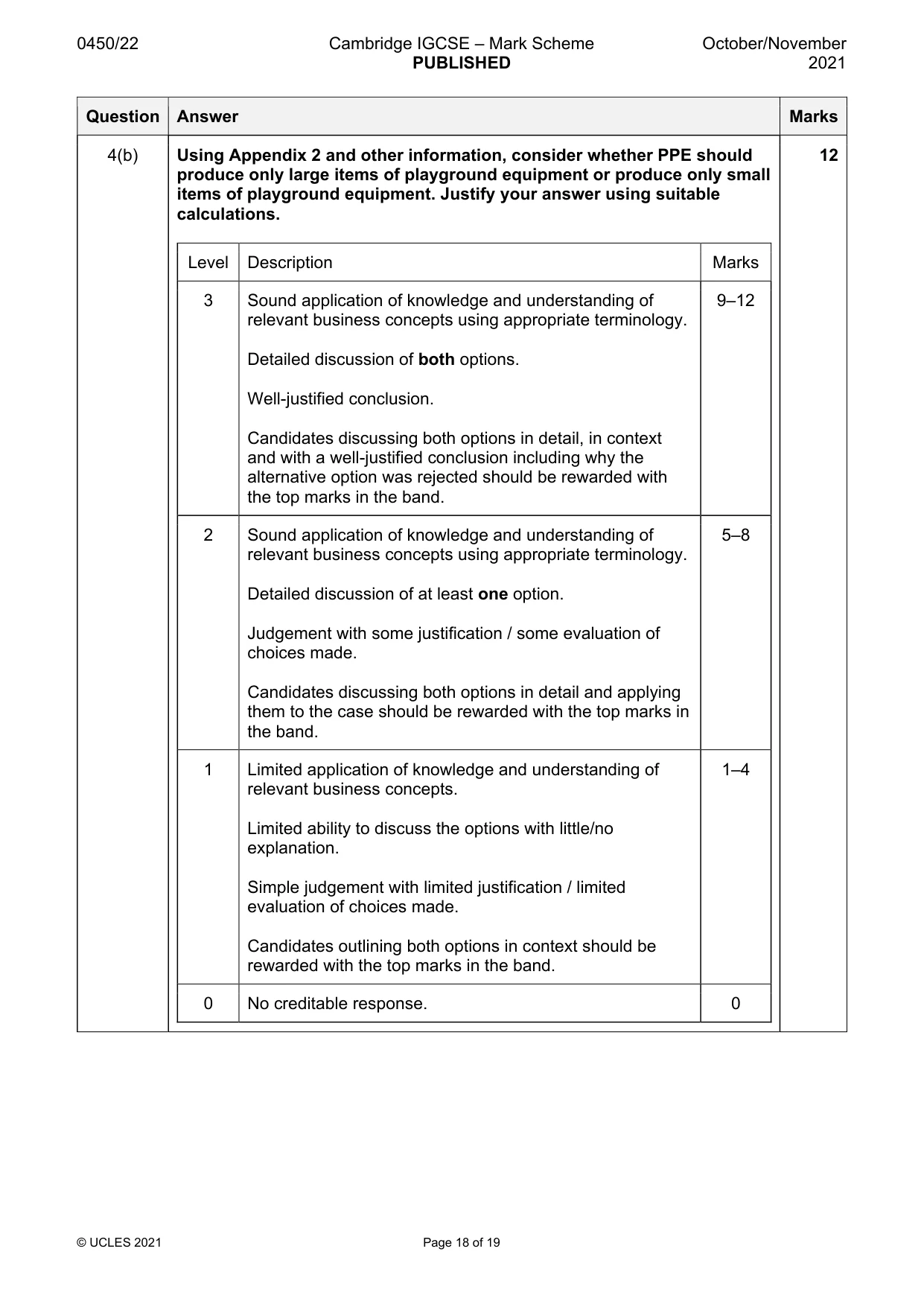
0450/22 Cambridge IGCSE – Mark Scheme PUBLISHED October/November 2021 © UCLES 2021 Page 18 of 19 Question Answer Marks 4(b) Using Appendix 2 and other information, consider whether PPE should produce only large items of playground equipment or produce only small items of playground equipment. Justify your answer using suitable calculations. Level Description Marks 3 Sound application of knowledge and understanding of relevant business concepts using appropriate terminology. Detailed discussion of both options. Well-justified conclusion. Candidates discussing both options in detail, in context and with a well-justified conclusion including why the alternative option was rejected should be rewarded with the top marks in the band. 9–12 2 Sound application of knowledge and understanding of relevant business concepts using appropriate terminology. Detailed discussion of at least one option. Judgement with some justification / some evaluation of choices made. Candidates discussing both options in detail and applying them to the case should be rewarded with the top marks in the band. 5–8 1 Limited application of knowledge and understanding of relevant business concepts. Limited ability to discuss the options with little/no explanation. Simple judgement with limited justification / limited evaluation of choices made. Candidates outlining both options in context should be rewarded with the top marks in the band. 1–4 0 No creditable response. 0 12
Mark scheme, page 19
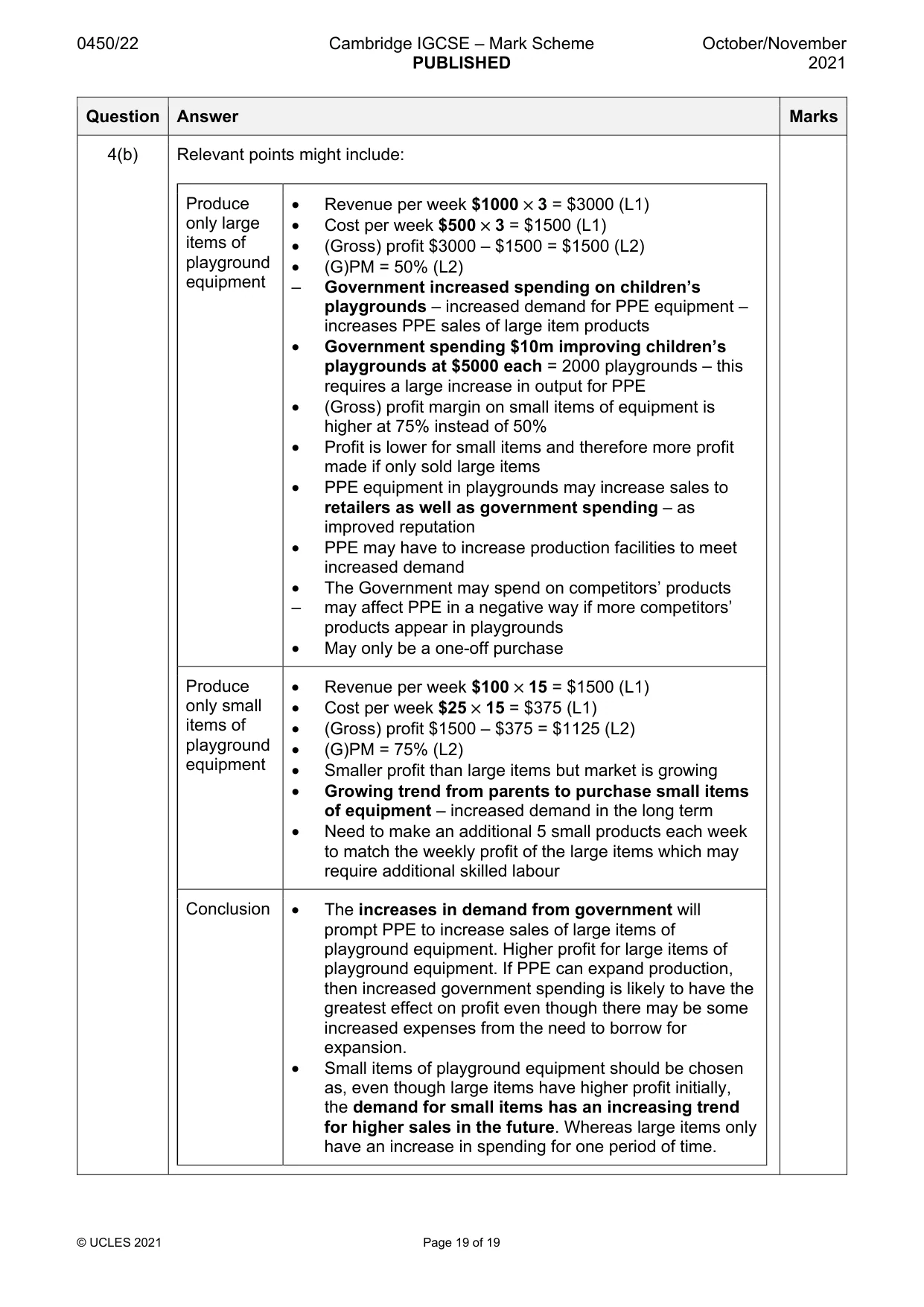
0450/22 Cambridge IGCSE – Mark Scheme PUBLISHED October/November 2021 © UCLES 2021 Page 19 of 19 Question Answer Marks 4(b) Relevant points might include: Produce only large items of playground equipment • Revenue per week $1000 × 3 = $3000 (L1) • Cost per week $500 × 3 = $1500 (L1) • (Gross) profit $3000 – $1500 = $1500 (L2) • (G)PM = 50% (L2) – Government increased spending on children’s playgrounds – increased demand for PPE equipment – increases PPE sales of large item products • Government spending $10m improving children’s playgrounds at $5000 each = 2000 playgrounds – this requires a large increase in output for PPE • (Gross) profit margin on small items of equipment is higher at 75% instead of 50% • Profit is lower for small items and therefore more profit made if only sold large items • PPE equipment in playgrounds may increase sales to retailers as well as government spending – as improved reputation • PPE may have to increase production facilities to meet increased demand • The Government may spend on competitors’ products – may affect PPE in a negative way if more competitors’ products appear in playgrounds • May only be a one-off purchase Produce only small items of playground equipment • Revenue per week $100 × 15 = $1500 (L1) • Cost per week $25 × 15 = $375 (L1) • (Gross) profit $1500 – $375 = $1125 (L2) • (G)PM = 75% (L2) • Smaller profit than large items but market is growing • Growing trend from parents to purchase small items of equipment – increased demand in the long term • Need to make an additional 5 small products each week to match the weekly profit of the large items which may require additional skilled labour Conclusion • The increases in demand from government will prompt PPE to increase sales of large items of playground equipment. Higher profit for large items of playground equipment. If PPE can expand production, then increased government spending is likely to have the greatest effect on profit even though there may be some increased expenses from the need to borrow for expansion. • Small items of playground equipment should be chosen as, even though large items have higher profit initially, the demand for small items has an increasing trend for higher sales in the future. Whereas large items only have an increase in spending for one period of time.
What you needed in this session
Cambridge’s own grade thresholds for 2021 Oct/Nov, Paper 2 · Variant 2. A higher threshold means an easier paper — the bar moves with how the cohort did.