Cambridge IGCSE Business Studies 0450 — 2020 May/June Paper 1 · Variant 3
0450/13/M/J/20
The question paper and its mark scheme, free to read here and free to download. This is Cambridge’s own paper, exactly as it was sat.
Question paper12 pages


Mark scheme12 pages
Answers below. Sit the paper first if you are practising.
Paper as text
Question paper, page 1
Cambridge IGCSE™ 0450/13 May/June 2020 1 hour 30 minutes BUSINESS STUDIES Paper 1 Short Answer and Data Response You must answer on the question paper. No additional materials are needed. INSTRUCTIONS • Answer all questions. • Use a black or dark blue pen. You may use an HB pencil for any diagrams or graphs. • Write your name, centre number and candidate number in the boxes at the top of the page. • Write your answer to each question in the space provided. • Do not use an erasable pen or correction fluid. • Do not write on any bar codes. • You may use a calculator. INFORMATION • The total mark for this paper is 80. • The number of marks for each question or part question is shown in brackets [ ]. This document has 12 pages. Blank pages are indicated. [Turn over 06_0450_13_2020_1.12 © UCLES 2020 *8417120905*
Question paper, page 2
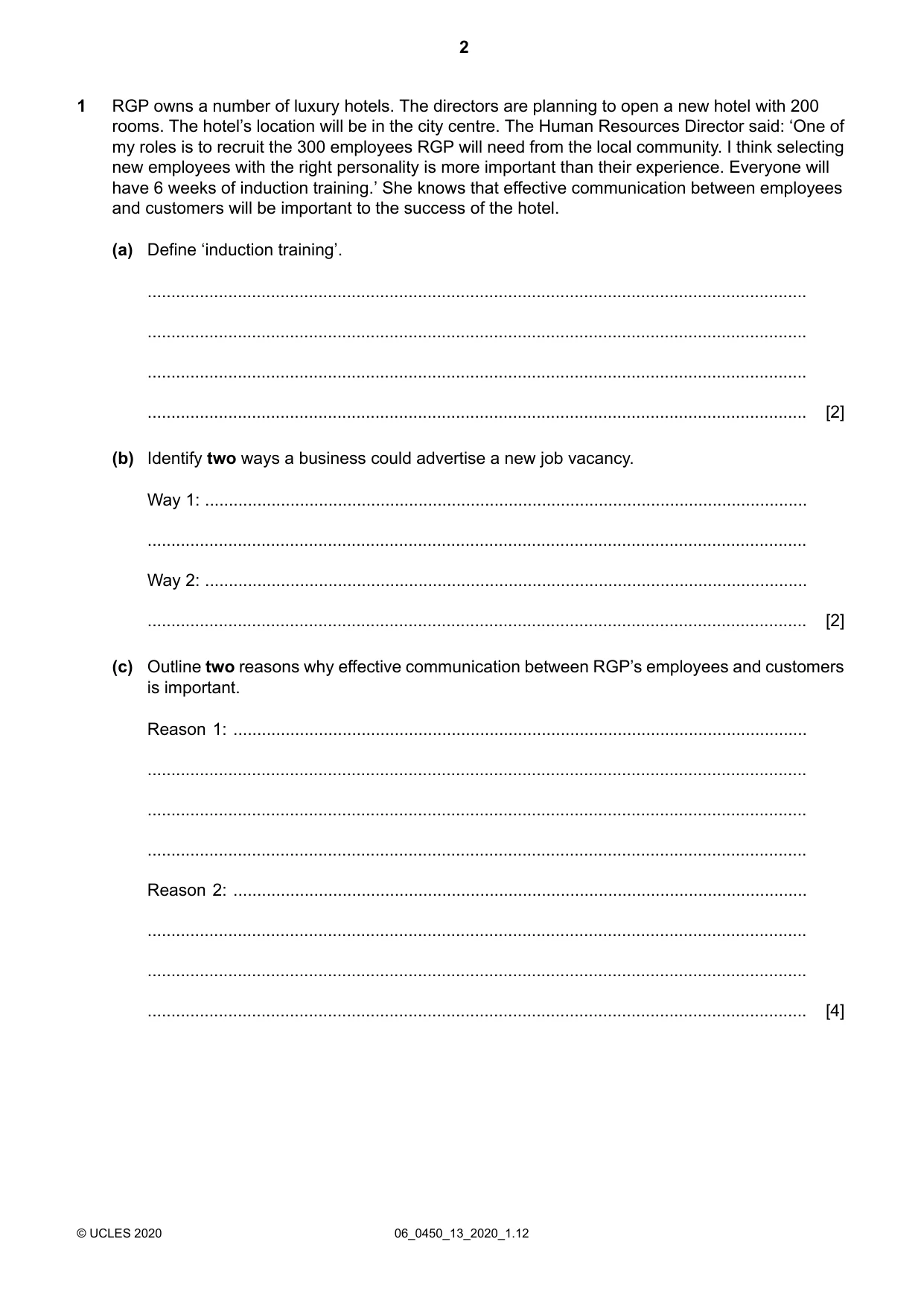
RGP owns a number of luxury hotels. The directors are planning to open a new hotel with 200 rooms. The hotel’s location will be in the city centre. The Human Resources Director said: ‘One of 1 my roles is to recruit the 300 employees RGP will need from the local community. I think selecting new employees with the right personality is more important than their experience. Everyone will have 6 weeks of induction training.’ She knows that effective communication between employees and customers will be important to the success of the hotel. Define ‘induction training’. (a) … … … … [2] Identify two ways a business could advertise a new job vacancy. (b) Way 1: … … Way 2: … … [2] Outline two reasons why effective communication between RGP’s employees and customers is important. (c) Reason 1: … … … … Reason 2: … … … … [4] 06_0450_13_2020_1.12 © UCLES 2020 2
Question paper, page 3
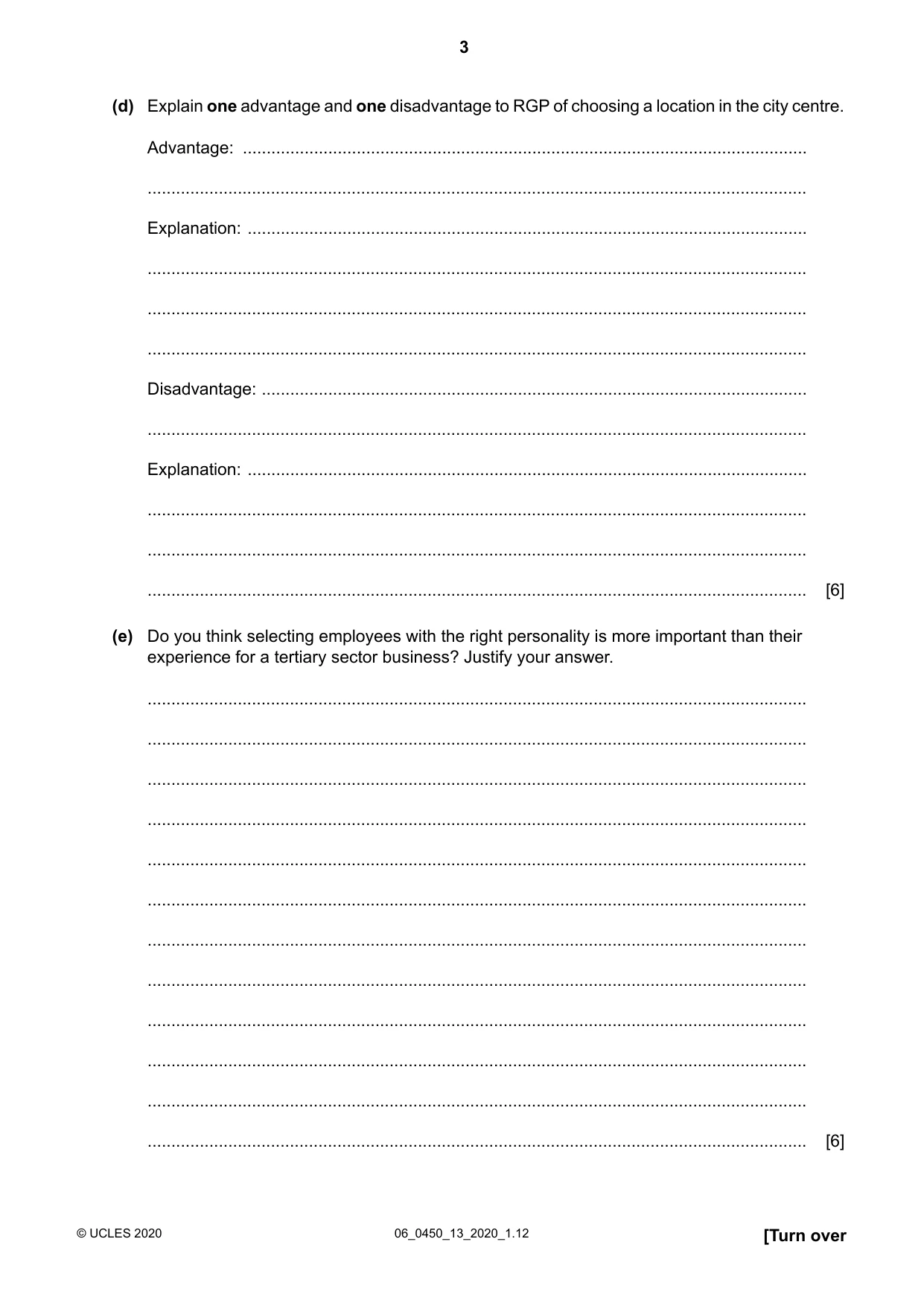
Explain one advantage and one disadvantage to RGP of choosing a location in the city centre. (d) Advantage: … … Explanation: … … … … Disadvantage: … … Explanation: … … … … [6] Do you think selecting employees with the right personality is more important than their experience for a tertiary sector business? Justify your answer. (e) … … … … … … … … … … … … [6] [Turn over 06_0450_13_2020_1.12 © UCLES 2020 3
Question paper, page 4
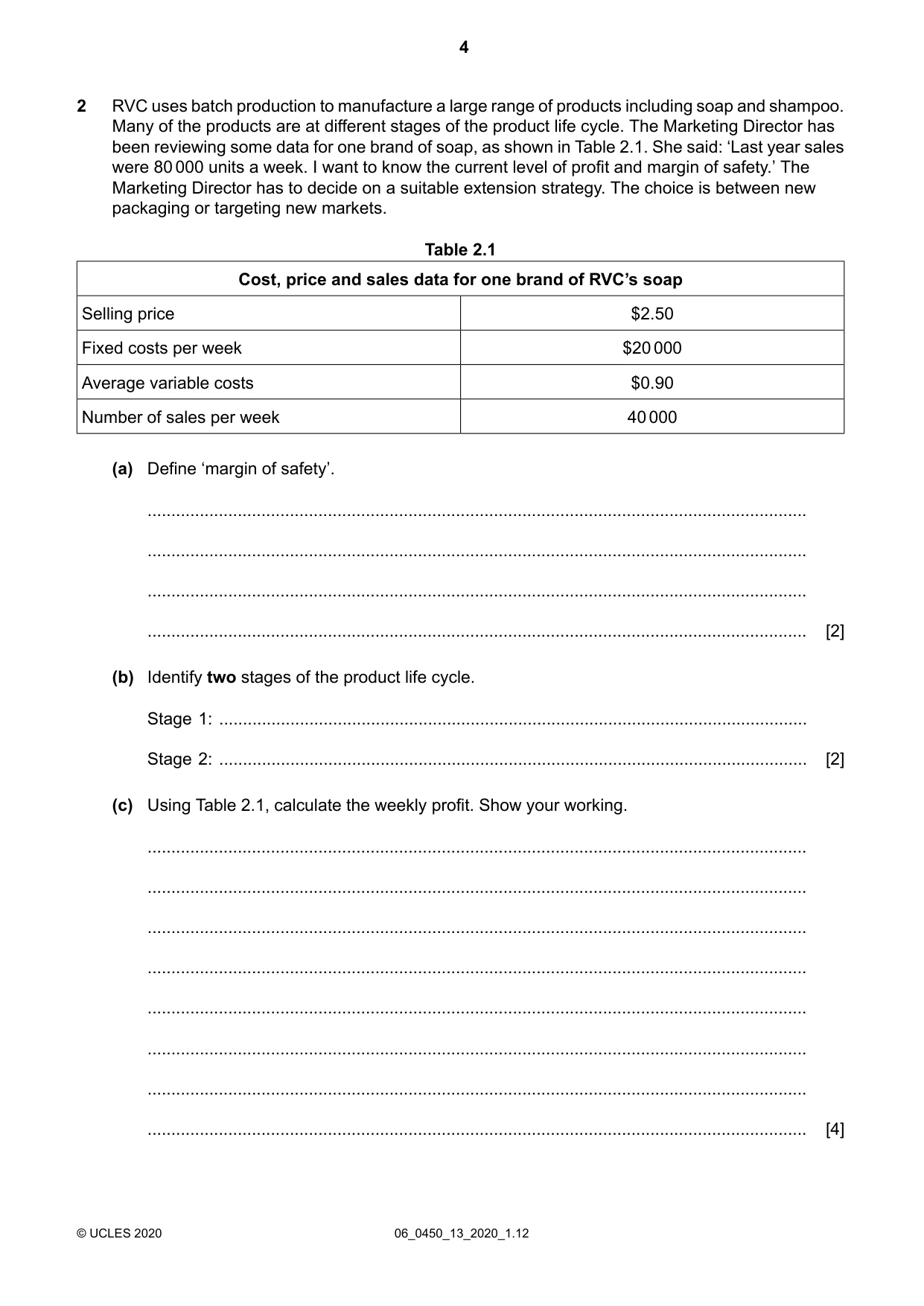
RVC uses batch production to manufacture a large range of products including soap and shampoo. Many of the products are at different stages of the product life cycle. The Marketing Director has 2 been reviewing some data for one brand of soap, as shown in Table 2.1. She said: ‘Last year sales were 80000 units a week. I want to know the current level of profit and margin of safety.’ The Marketing Director has to decide on a suitable extension strategy. The choice is between new packaging or targeting new markets. Table 2.1 Cost, price and sales data for one brand of RVC’s soap $2.50 Selling price $20000 Fixed costs per week $0.90 Average variable costs 40000 Number of sales per week Define ‘margin of safety’. (a) … … … … [2] Identify two stages of the product life cycle. (b) Stage 1: … Stage 2: … [2] Using Table 2.1, calculate the weekly profit. Show your working. (c) … … … … … … … … [4] 06_0450_13_2020_1.12 © UCLES 2020 4
Question paper, page 5
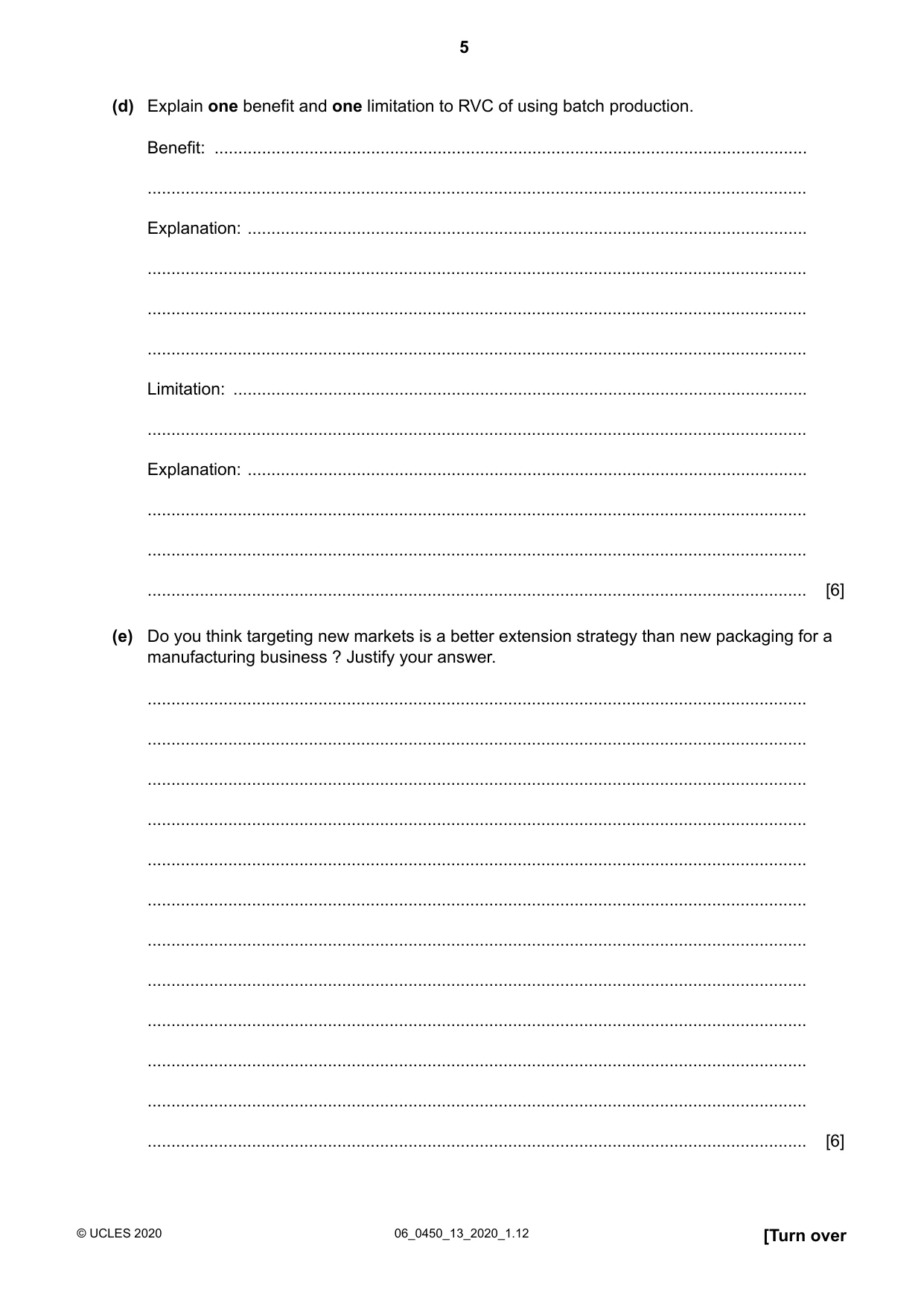
Explain one benefit and one limitation to RVC of using batch production. (d) Benefit: … … Explanation: … … … … Limitation: … … Explanation: … … … … [6] Do you think targeting new markets is a better extension strategy than new packaging for a manufacturing business ? Justify your answer. (e) … … … … … … … … … … … … [6] [Turn over 06_0450_13_2020_1.12 © UCLES 2020 5
Question paper, page 6
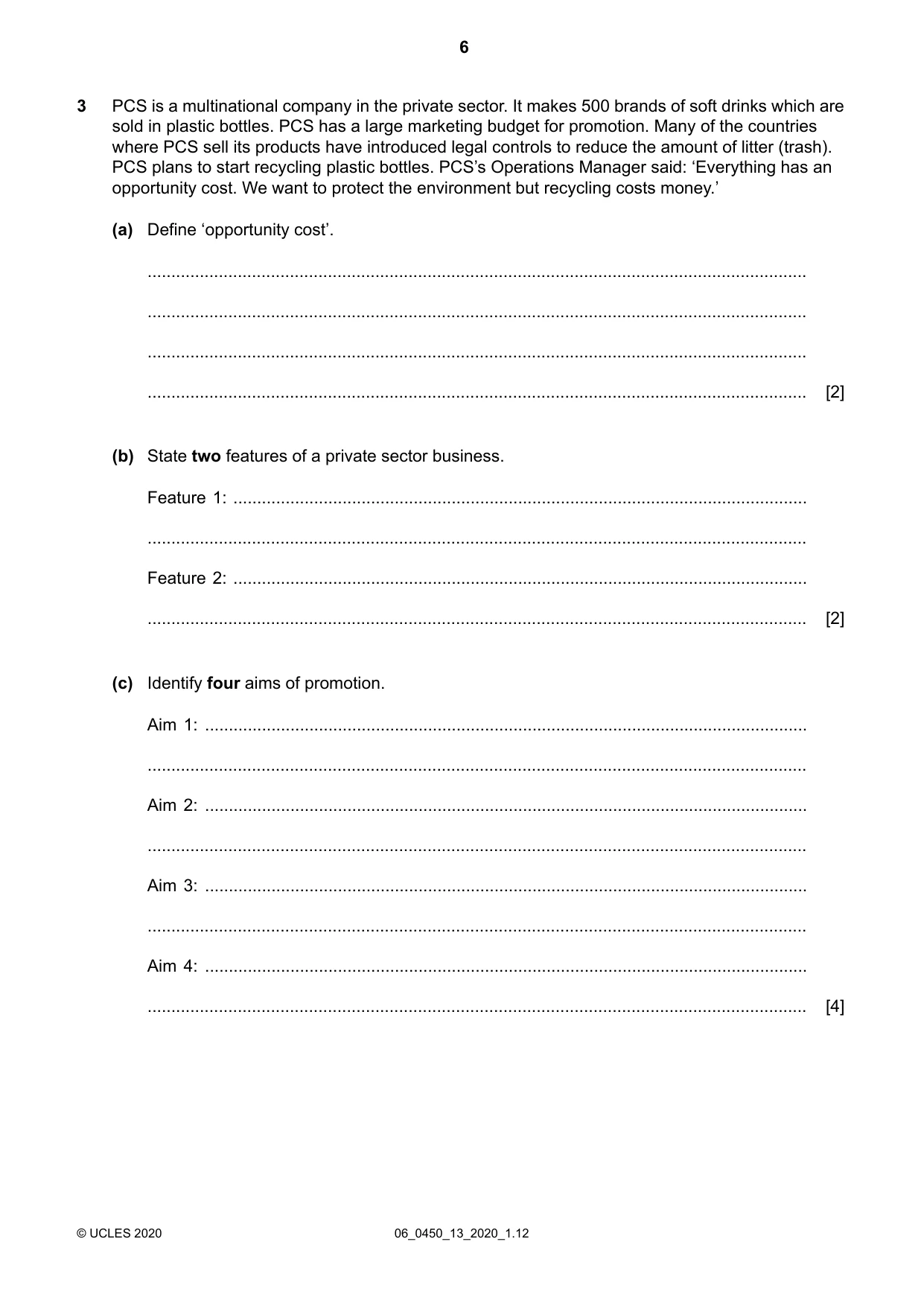
PCS is a multinational company in the private sector. It makes 500 brands of soft drinks which are sold in plastic bottles. PCS has a large marketing budget for promotion. Many of the countries 3 where PCS sell its products have introduced legal controls to reduce the amount of litter (trash). PCS plans to start recycling plastic bottles. PCS’s Operations Manager said: ‘Everything has an opportunity cost. We want to protect the environment but recycling costs money.’ Define ‘opportunity cost’. (a) … … … … [2] State two features of a private sector business. (b) Feature 1: … … Feature 2: … … [2] Identify four aims of promotion. (c) Aim 1: … … Aim 2: … … Aim 3: … … Aim 4: … … [4] 06_0450_13_2020_1.12 © UCLES 2020 6
Question paper, page 7
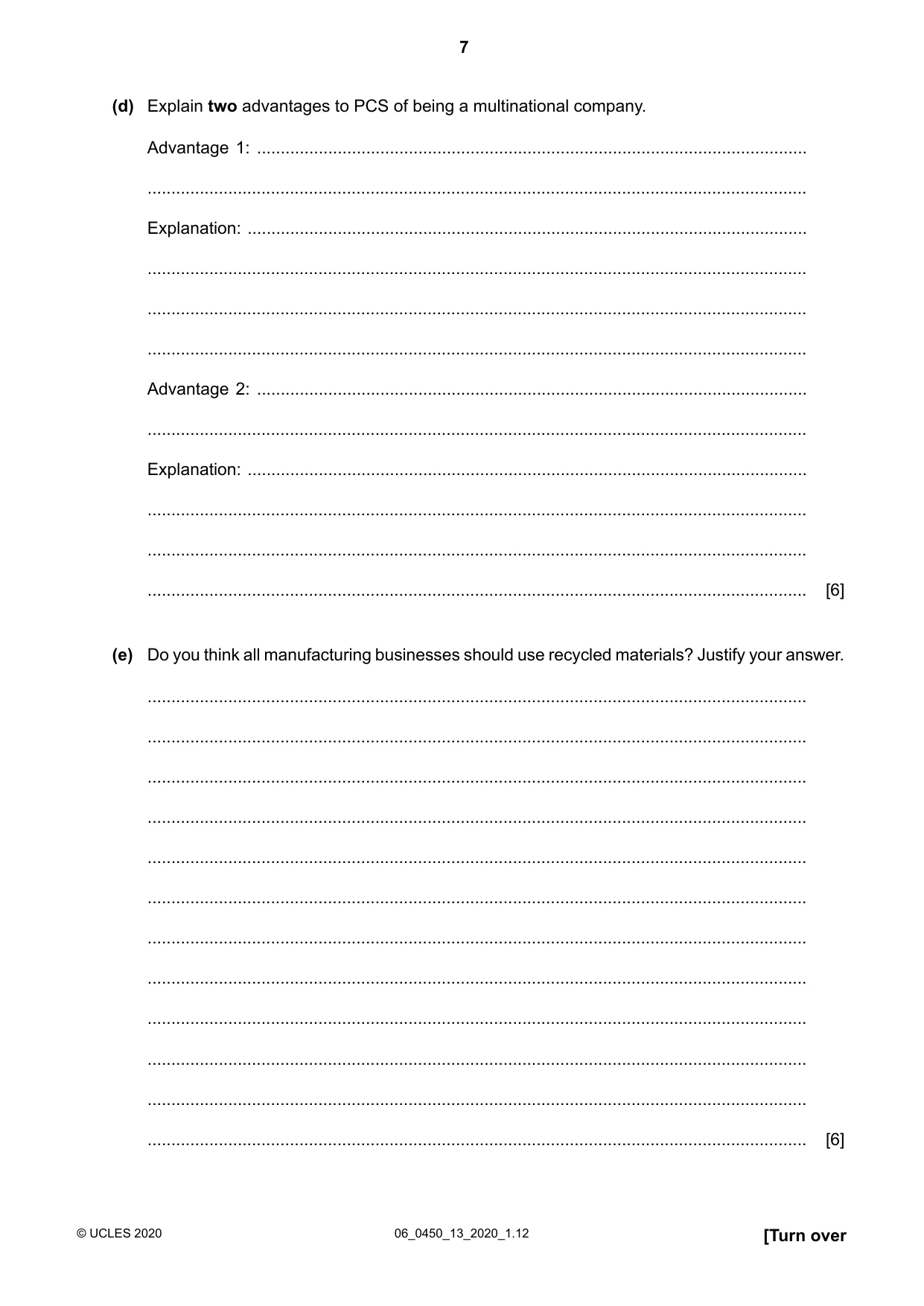
Explain two advantages to PCS of being a multinational company. (d) Advantage 1: … … Explanation: … … … … Advantage 2: … … Explanation: … … … … [6] Do you think all manufacturing businesses should use recycled materials? Justify your answer. (e) … … … … … … … … … … … … [6] [Turn over 06_0450_13_2020_1.12 © UCLES 2020 7
Question paper, page 8
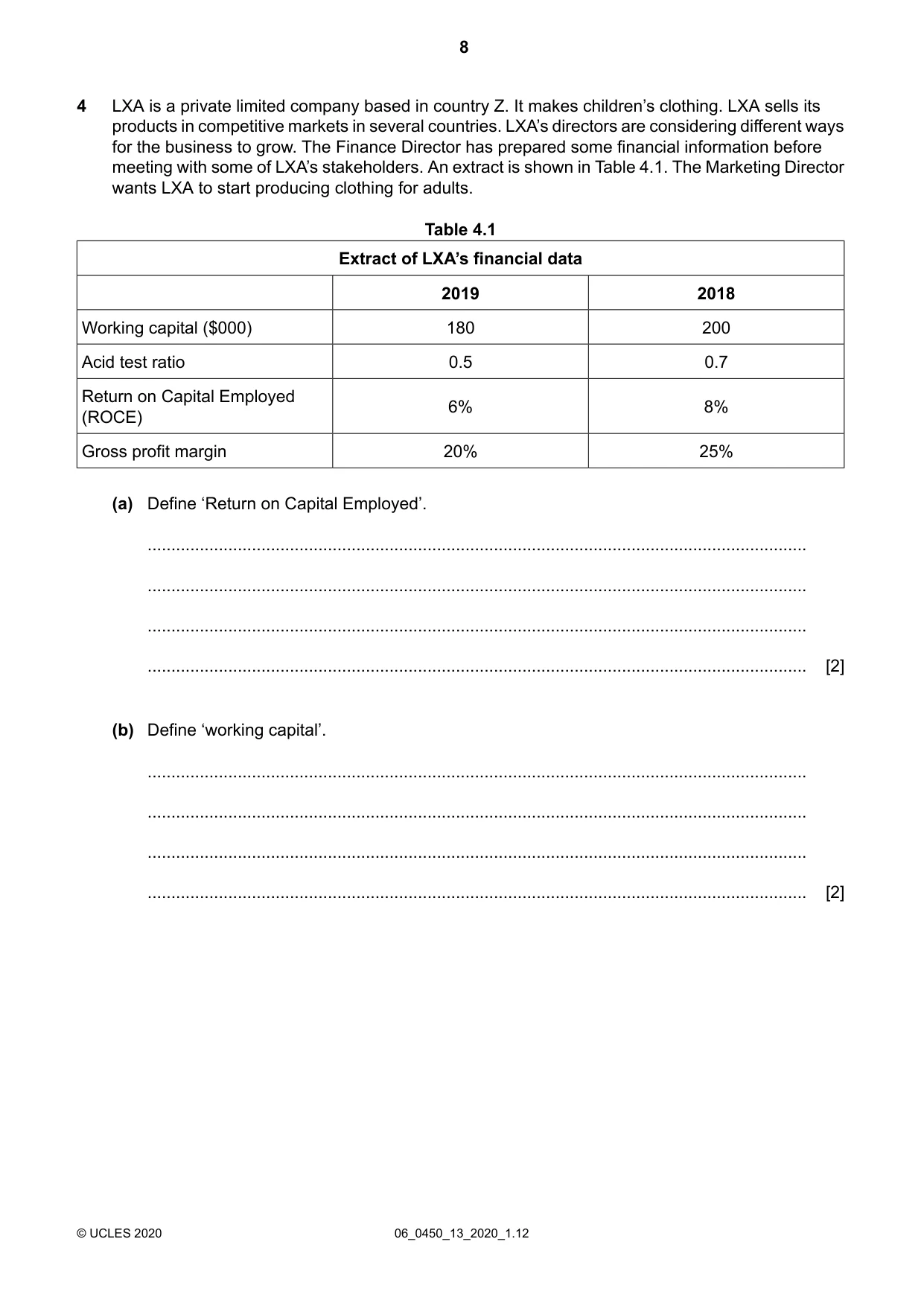
LXA is a private limited company based in country Z. It makes children’s clothing. LXA sells its products in competitive markets in several countries. LXA’s directors are considering different ways 4 for the business to grow. The Finance Director has prepared some financial information before meeting with some of LXA’s stakeholders. An extract is shown in Table 4.1. The Marketing Director wants LXA to start producing clothing for adults. Table 4.1 Extract of LXA’s financial data 2018 2019 200 180 Working capital ($000) 0.7 0.5 Acid test ratio 8% 6% Return on Capital Employed (ROCE) 25% 20% Gross profit margin Define ‘Return on Capital Employed’. (a) … … … … [2] Define ‘working capital’. (b) … … … … [2] 06_0450_13_2020_1.12 © UCLES 2020 8
Question paper, page 9
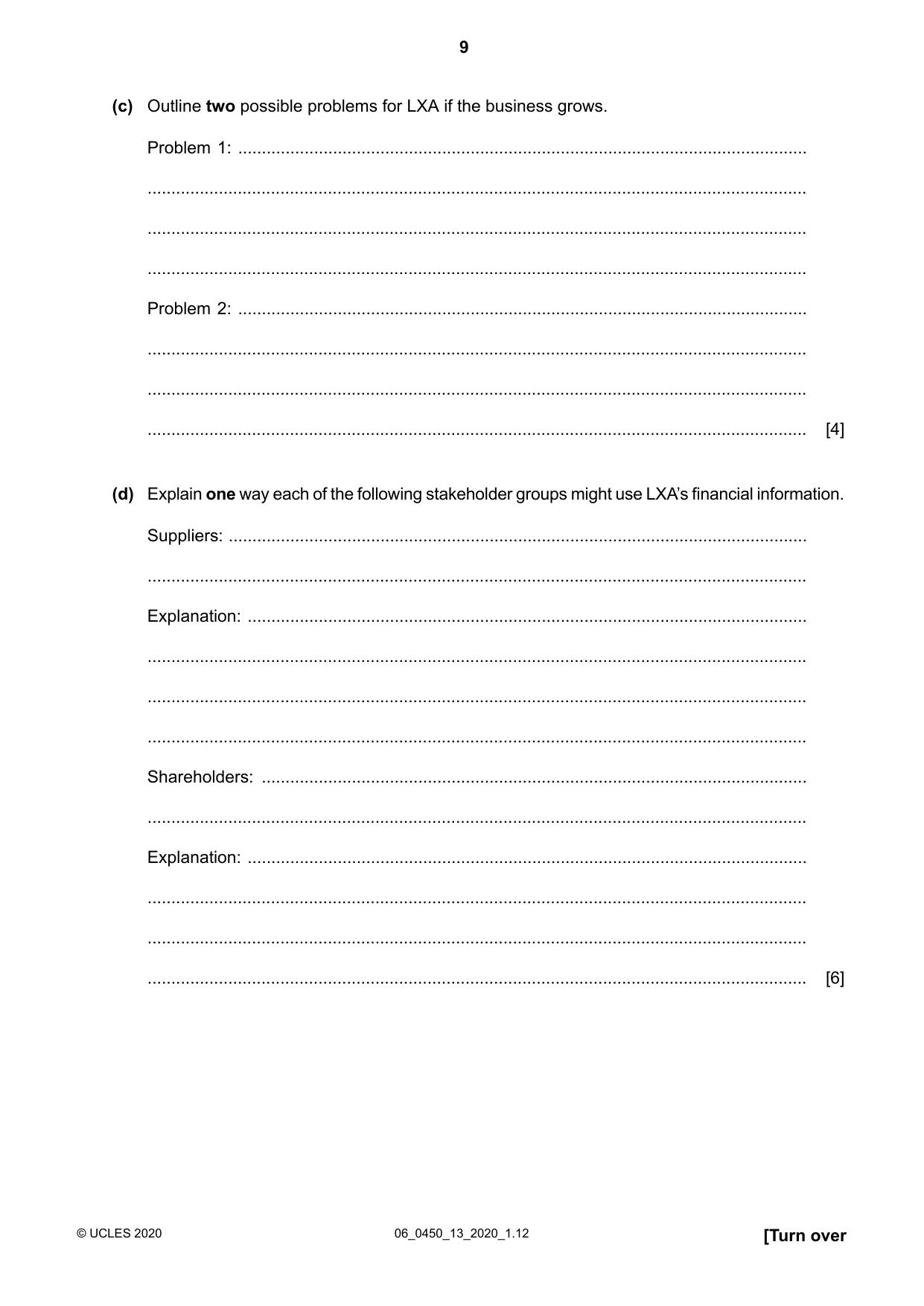
Outline two possible problems for LXA if the business grows. (c) Problem 1: … … … … Problem 2: … … … … [4] Explain one way each of the following stakeholder groups might use LXA’s financial information. (d) Suppliers: … … Explanation: … … … … Shareholders: … … Explanation: … … … … [6] [Turn over 06_0450_13_2020_1.12 © UCLES 2020 9
Question paper, page 10
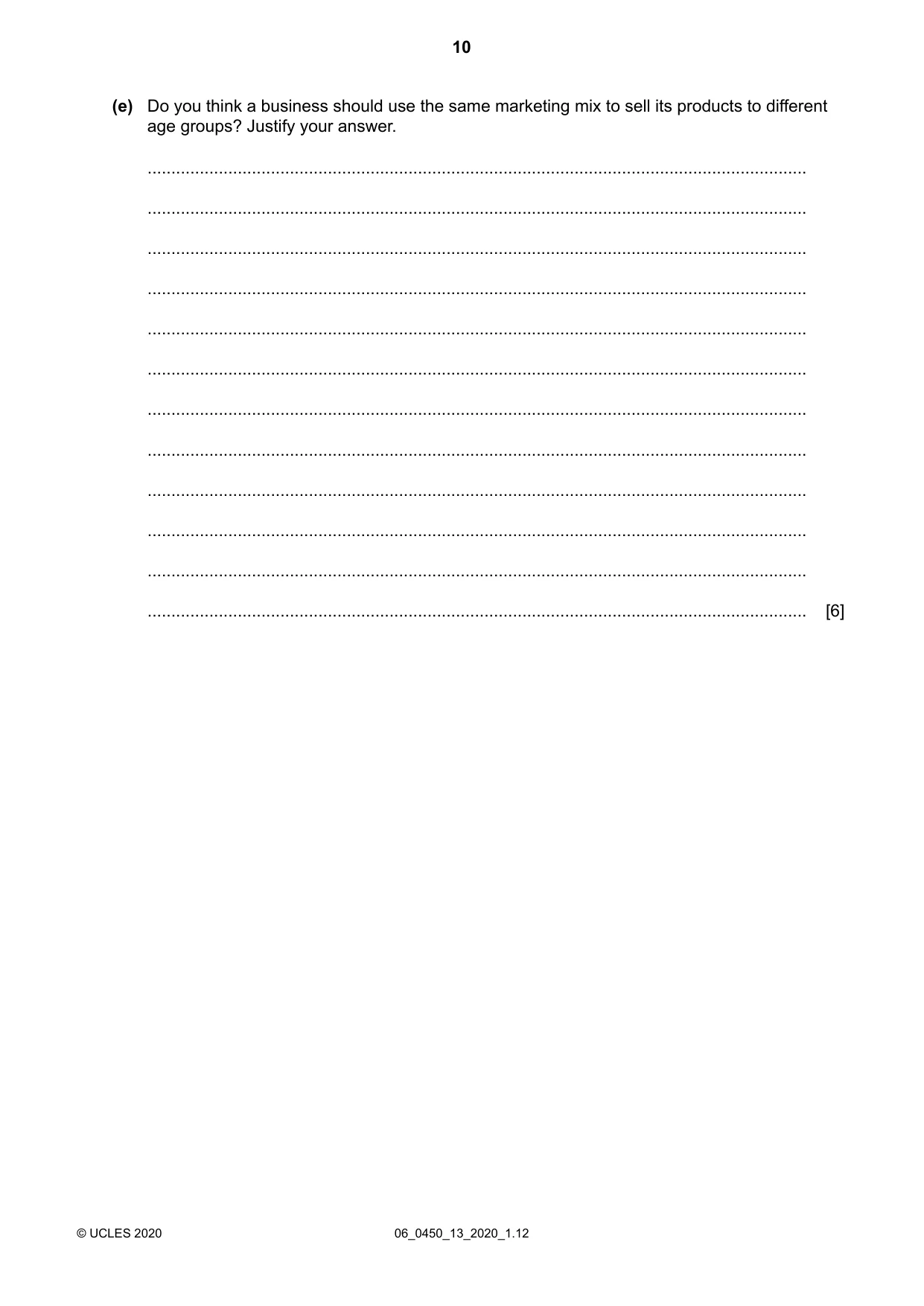
Do you think a business should use the same marketing mix to sell its products to different age groups? Justify your answer. (e) … … … … … … … … … … … … [6] 06_0450_13_2020_1.12 © UCLES 2020 10
Question paper, page 11
BLANK PAGE 06_0450_13_2020_1.12 © UCLES 2020 11
Question paper, page 12
BLANK PAGE Permission to reproduce items where third-party owned material protected by copyright is included has been sought and cleared where possible. Every reasonable effort has been made by the publisher (UCLES) to trace copyright holders, but if any items requiring clearance have unwittingly been included, the publisher will be pleased to make amends at the earliest possible opportunity. To avoid the issue of disclosure of answer-related information to candidates, all copyright acknowledgements are reproduced online in the Cambridge Assessment International Education Copyright Acknowledgements Booklet. This is produced for each series of examinations and is freely available to download at www.cambridgeinternational.org after the live examination series. Cambridge Assessment International Education is part of the Cambridge Assessment Group. Cambridge Assessment is the brand name of the University of Cambridge Local Examinations Syndicate (UCLES), which itself is a department of the University of Cambridge. 06_0450_13_2020_1.12 © UCLES 2020 12
Mark scheme, page 1
This document consists of 12 printed pages. © UCLES 2020 [Turn over Cambridge IGCSE™ BUSINESS STUDIES 0450/13 Paper 1 Short Answer/Structured Response May/June 2020 MARK SCHEME Maximum Mark: 80 Published Students did not sit exam papers in the June 2020 series due to the Covid-19 global pandemic. This mark scheme is published to support teachers and students and should be read together with the question paper. It shows the requirements of the exam. The answer column of the mark scheme shows the proposed basis on which Examiners would award marks for this exam. Where appropriate, this column also provides the most likely acceptable alternative responses expected from students. Examiners usually review the mark scheme after they have seen student responses and update the mark scheme if appropriate. In the June series, Examiners were unable to consider the acceptability of alternative responses, as there were no student responses to consider. Mark schemes should usually be read together with the Principal Examiner Report for Teachers. However, because students did not sit exam papers, there is no Principal Examiner Report for Teachers for the June 2020 series. Cambridge International will not enter into discussions about these mark schemes. Cambridge International is publishing the mark schemes for the June 2020 series for most Cambridge IGCSE™ and Cambridge International A & AS Level components, and some Cambridge O Level components.
Mark scheme, page 2
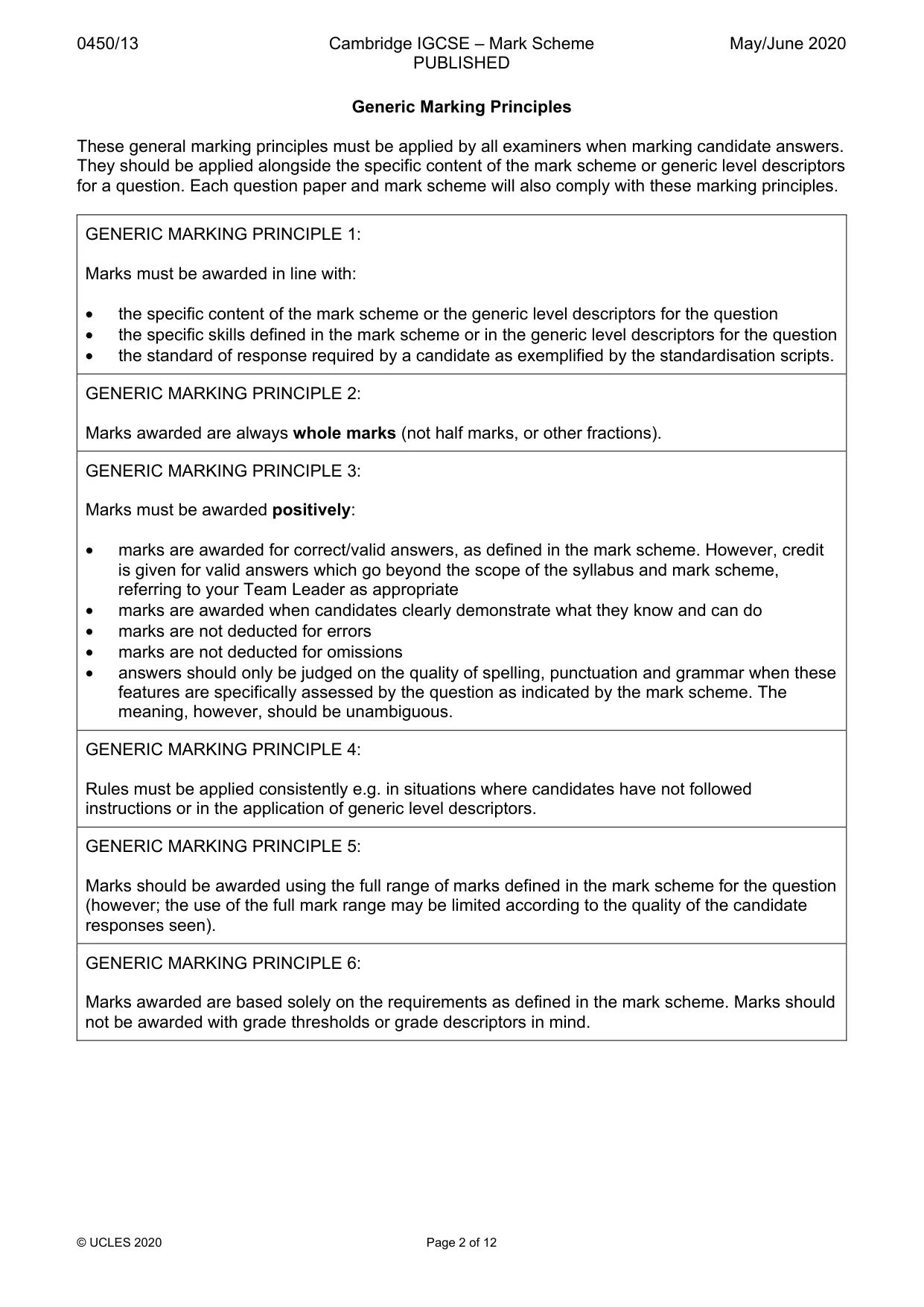
0450/13 Cambridge IGCSE – Mark Scheme PUBLISHED May/June 2020 © UCLES 2020 Page 2 of 12 Generic Marking Principles These general marking principles must be applied by all examiners when marking candidate answers. They should be applied alongside the specific content of the mark scheme or generic level descriptors for a question. Each question paper and mark scheme will also comply with these marking principles. GENERIC MARKING PRINCIPLE 1: Marks must be awarded in line with: • the specific content of the mark scheme or the generic level descriptors for the question • the specific skills defined in the mark scheme or in the generic level descriptors for the question • the standard of response required by a candidate as exemplified by the standardisation scripts. GENERIC MARKING PRINCIPLE 2: Marks awarded are always whole marks (not half marks, or other fractions). GENERIC MARKING PRINCIPLE 3: Marks must be awarded positively: • marks are awarded for correct/valid answers, as defined in the mark scheme. However, credit is given for valid answers which go beyond the scope of the syllabus and mark scheme, referring to your Team Leader as appropriate • marks are awarded when candidates clearly demonstrate what they know and can do • marks are not deducted for errors • marks are not deducted for omissions • answers should only be judged on the quality of spelling, punctuation and grammar when these features are specifically assessed by the question as indicated by the mark scheme. The meaning, however, should be unambiguous. GENERIC MARKING PRINCIPLE 4: Rules must be applied consistently e.g. in situations where candidates have not followed instructions or in the application of generic level descriptors. GENERIC MARKING PRINCIPLE 5: Marks should be awarded using the full range of marks defined in the mark scheme for the question (however; the use of the full mark range may be limited according to the quality of the candidate responses seen). GENERIC MARKING PRINCIPLE 6: Marks awarded are based solely on the requirements as defined in the mark scheme. Marks should not be awarded with grade thresholds or grade descriptors in mind.
Mark scheme, page 3
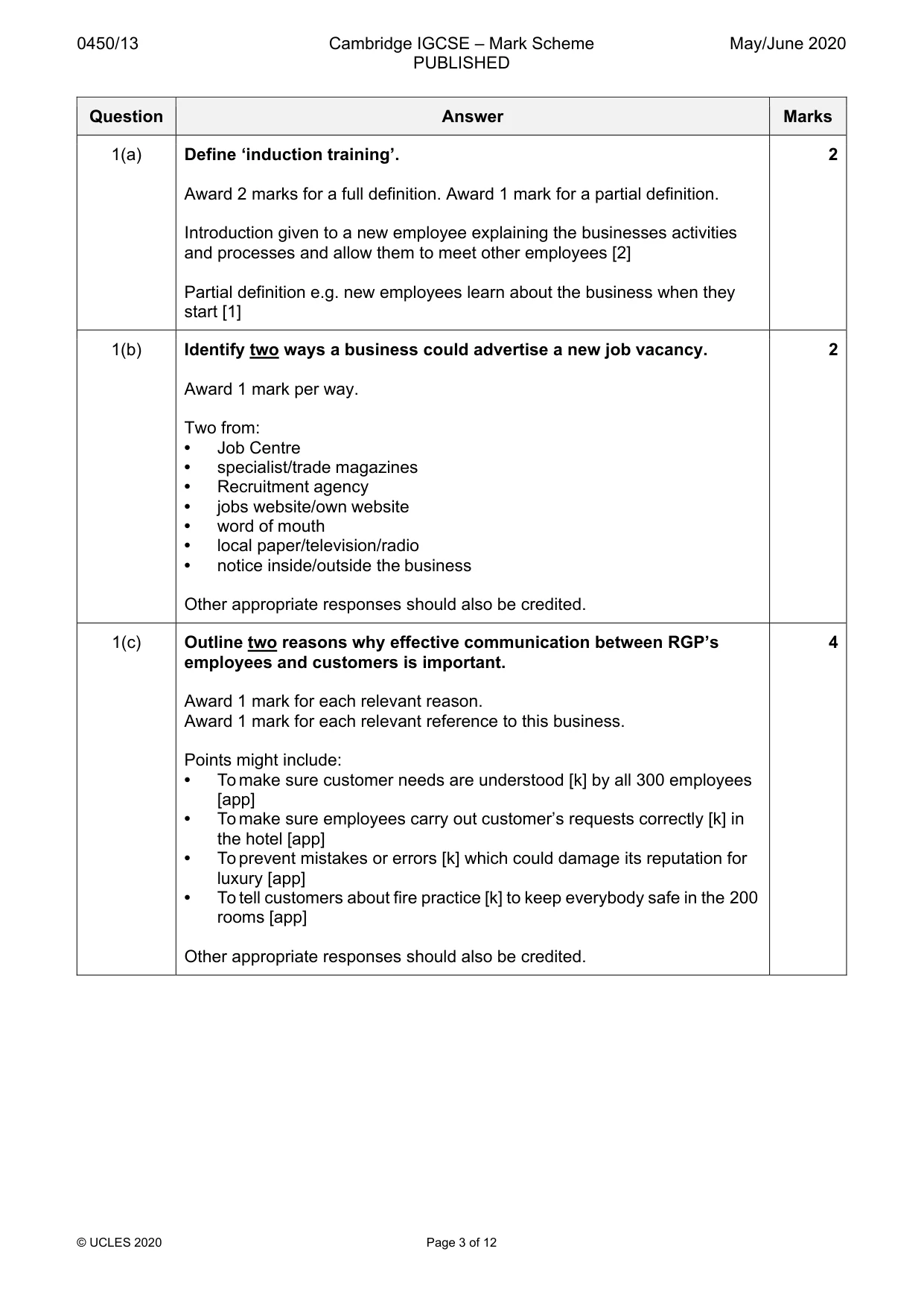
0450/13 Cambridge IGCSE – Mark Scheme PUBLISHED May/June 2020 © UCLES 2020 Page 3 of 12 Question Answer Marks 1(a) Define ‘induction training’. Award 2 marks for a full definition. Award 1 mark for a partial definition. Introduction given to a new employee explaining the businesses activities and processes and allow them to meet other employees [2] Partial definition e.g. new employees learn about the business when they start [1] 2 1(b) Identify two ways a business could advertise a new job vacancy. Award 1 mark per way. Two from: • Job Centre • specialist/trade magazines • Recruitment agency • jobs website/own website • word of mouth • local paper/television/radio • notice inside/outside the business Other appropriate responses should also be credited. 2 1(c) Outline two reasons why effective communication between RGP’s employees and customers is important. Award 1 mark for each relevant reason. Award 1 mark for each relevant reference to this business. Points might include: • To make sure customer needs are understood [k] by all 300 employees [app] • To make sure employees carry out customer’s requests correctly [k] in the hotel [app] • To prevent mistakes or errors [k] which could damage its reputation for luxury [app] • To tell customers about fire practice [k] to keep everybody safe in the 200 rooms [app] Other appropriate responses should also be credited. 4
Mark scheme, page 4
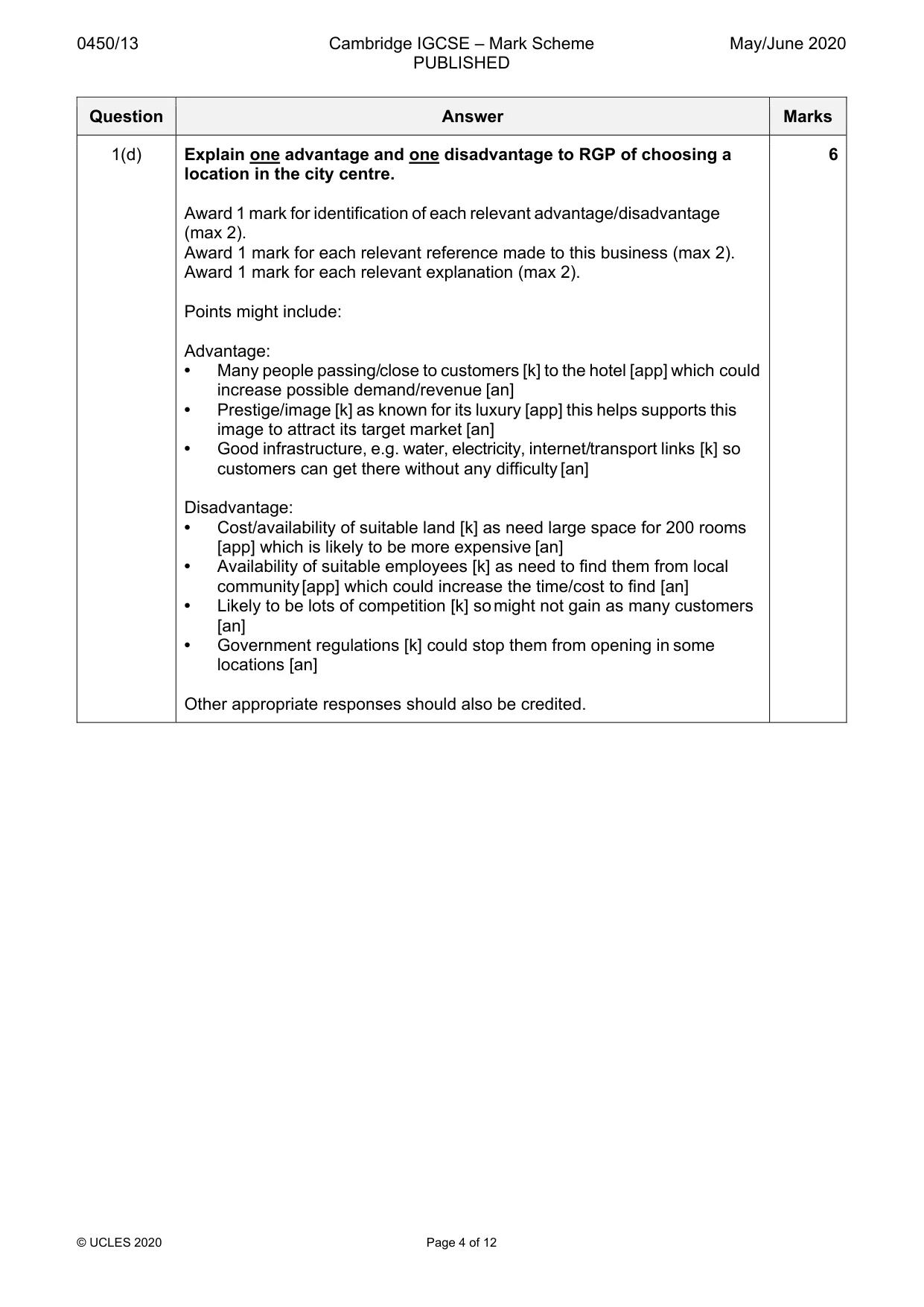
0450/13 Cambridge IGCSE – Mark Scheme PUBLISHED May/June 2020 © UCLES 2020 Page 4 of 12 Question Answer Marks 1(d) Explain one advantage and one disadvantage to RGP of choosing a location in the city centre. Award 1 mark for identification of each relevant advantage/disadvantage (max 2). Award 1 mark for each relevant reference made to this business (max 2). Award 1 mark for each relevant explanation (max 2). Points might include: Advantage: • Many people passing/close to customers [k] to the hotel [app] which could increase possible demand/revenue [an] • Prestige/image [k] as known for its luxury [app] this helps supports this image to attract its target market [an] • Good infrastructure, e.g. water, electricity, internet/transport links [k] so customers can get there without any difficulty [an] Disadvantage: • Cost/availability of suitable land [k] as need large space for 200 rooms [app] which is likely to be more expensive [an] • Availability of suitable employees [k] as need to find them from local community [app] which could increase the time/cost to find [an] • Likely to be lots of competition [k] so might not gain as many customers [an] • Government regulations [k] could stop them from opening in some locations [an] Other appropriate responses should also be credited. 6
Mark scheme, page 5
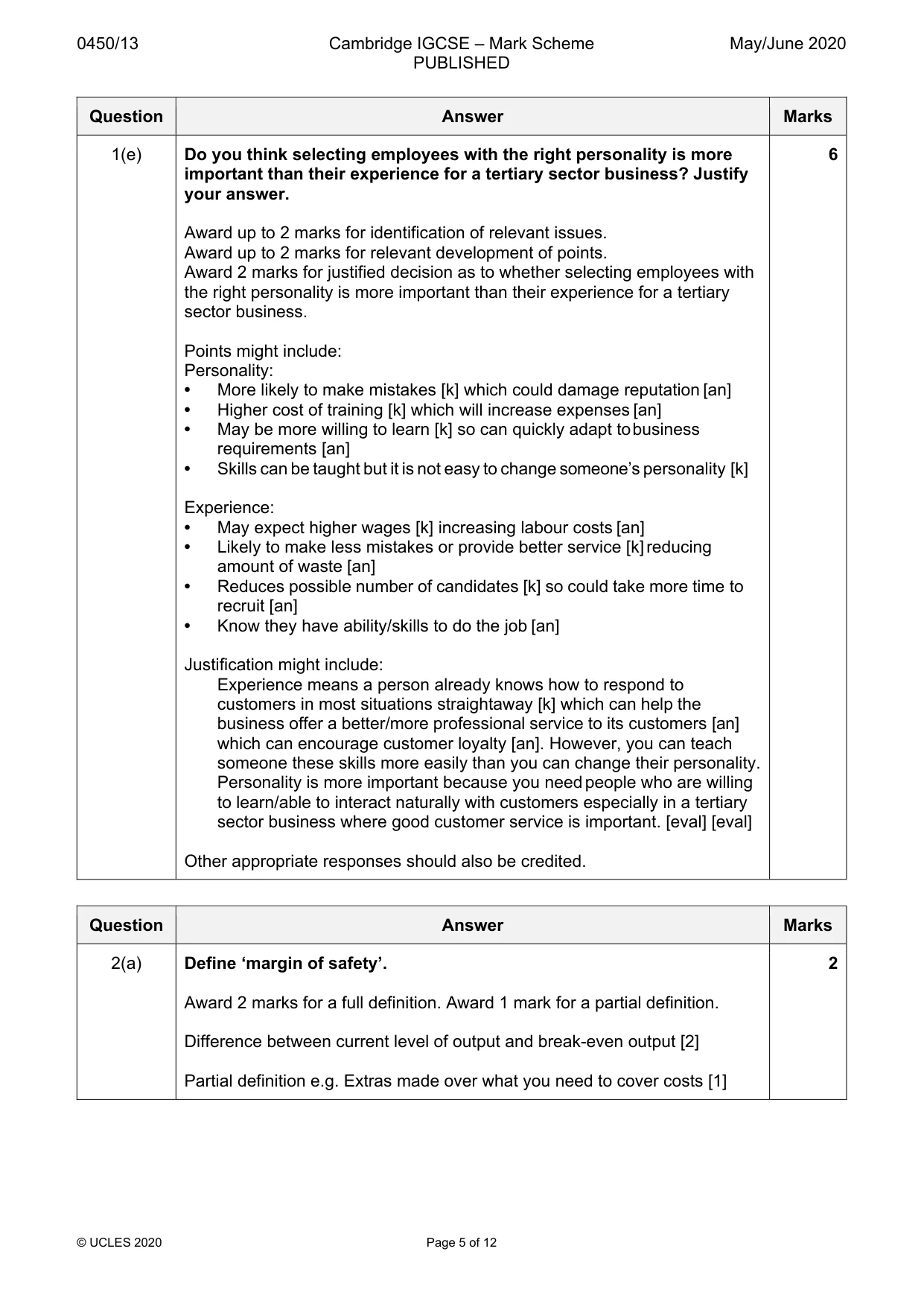
0450/13 Cambridge IGCSE – Mark Scheme PUBLISHED May/June 2020 © UCLES 2020 Page 5 of 12 Question Answer Marks 1(e) Do you think selecting employees with the right personality is more important than their experience for a tertiary sector business? Justify your answer. Award up to 2 marks for identification of relevant issues. Award up to 2 marks for relevant development of points. Award 2 marks for justified decision as to whether selecting employees with the right personality is more important than their experience for a tertiary sector business. Points might include: Personality: • More likely to make mistakes [k] which could damage reputation [an] • Higher cost of training [k] which will increase expenses [an] • May be more willing to learn [k] so can quickly adapt to business requirements [an] • Skills can be taught but it is not easy to change someone’s personality [k] Experience: • May expect higher wages [k] increasing labour costs [an] • Likely to make less mistakes or provide better service [k] reducing amount of waste [an] • Reduces possible number of candidates [k] so could take more time to recruit [an] • Know they have ability/skills to do the job [an] Justification might include: Experience means a person already knows how to respond to customers in most situations straightaway [k] which can help the business offer a better/more professional service to its customers [an] which can encourage customer loyalty [an]. However, you can teach someone these skills more easily than you can change their personality. Personality is more important because you need people who are willing to learn/able to interact naturally with customers especially in a tertiary sector business where good customer service is important. [eval] [eval] Other appropriate responses should also be credited. 6 Question Answer Marks 2(a) Define ‘margin of safety’. Award 2 marks for a full definition. Award 1 mark for a partial definition. Difference between current level of output and break-even output [2] Partial definition e.g. Extras made over what you need to cover costs [1] 2
Mark scheme, page 6
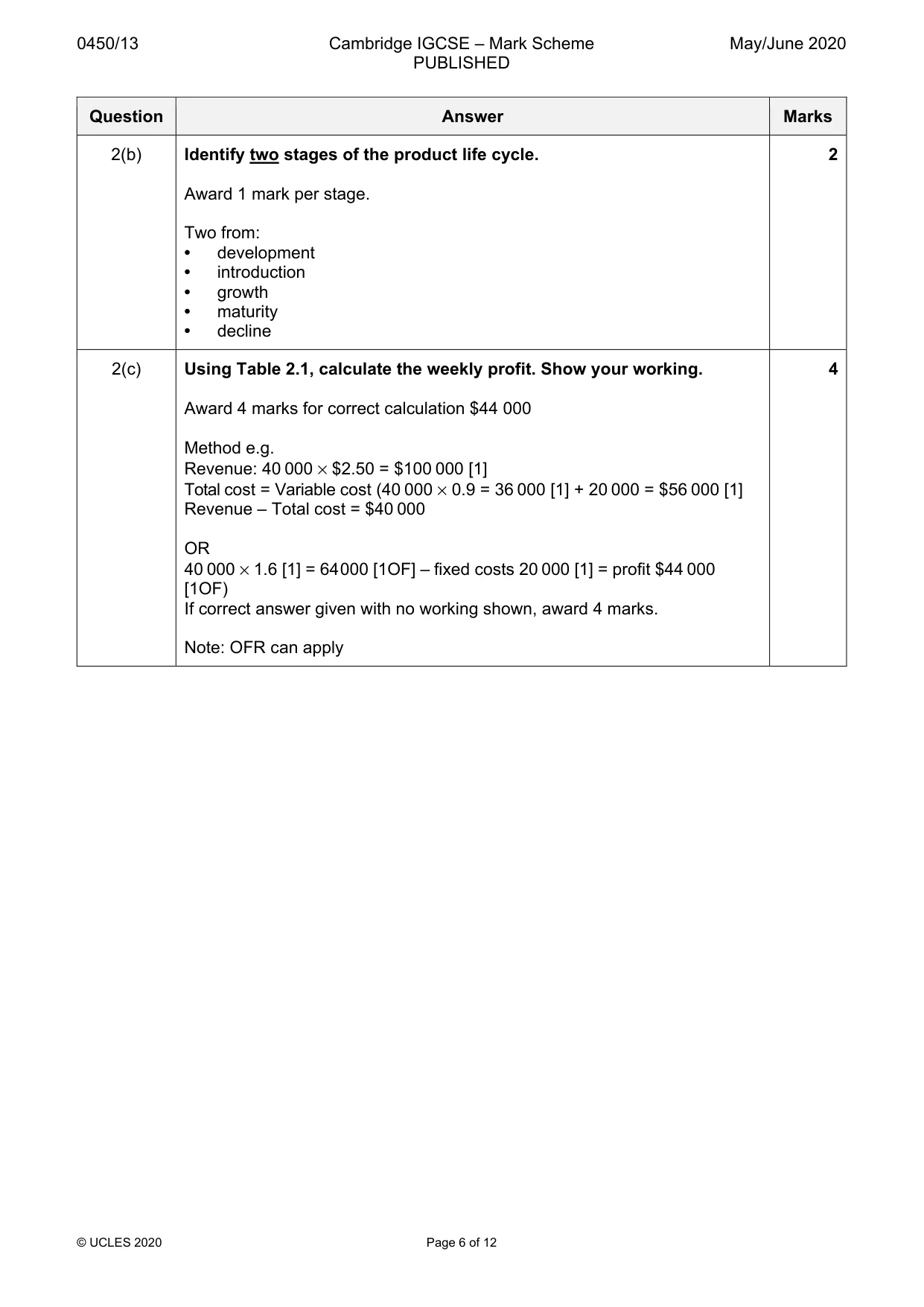
0450/13 Cambridge IGCSE – Mark Scheme PUBLISHED May/June 2020 © UCLES 2020 Page 6 of 12 Question Answer Marks 2(b) Identify two stages of the product life cycle. Award 1 mark per stage. Two from: • development • introduction • growth • maturity • decline 2 2(c) Using Table 2.1, calculate the weekly profit. Show your working. Award 4 marks for correct calculation $44 000 Method e.g. Revenue: 40 000 × $2.50 = $100 000 [1] Total cost = Variable cost (40 000 × 0.9 = 36 000 [1] + 20 000 = $56 000 [1] Revenue – Total cost = $40 000 OR 40 000 × 1.6 [1] = 64 000 [1OF] – fixed costs 20 000 [1] = profit $44 000 [1OF) If correct answer given with no working shown, award 4 marks. Note: OFR can apply 4
Mark scheme, page 7
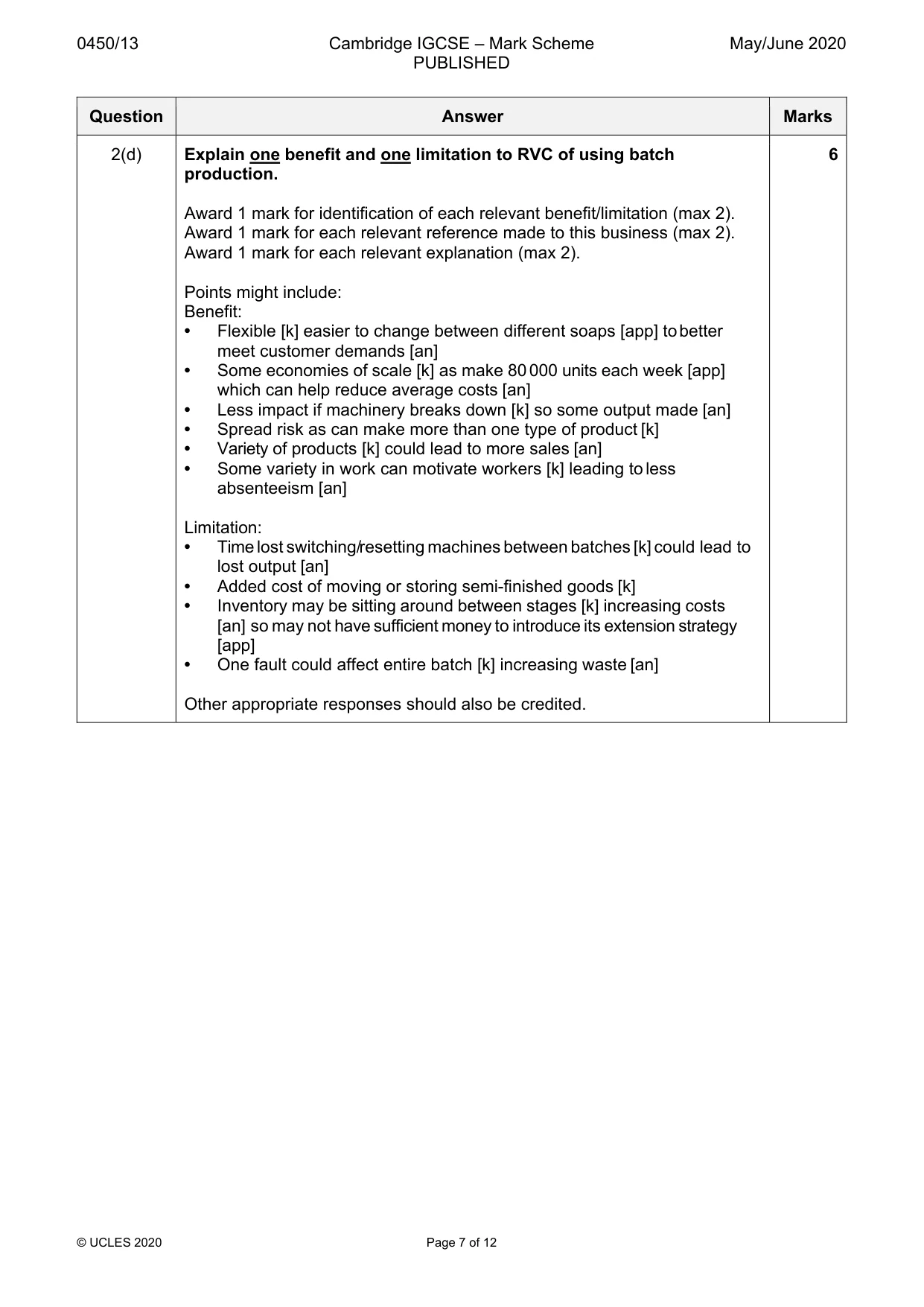
0450/13 Cambridge IGCSE – Mark Scheme PUBLISHED May/June 2020 © UCLES 2020 Page 7 of 12 Question Answer Marks 2(d) Explain one benefit and one limitation to RVC of using batch production. Award 1 mark for identification of each relevant benefit/limitation (max 2). Award 1 mark for each relevant reference made to this business (max 2). Award 1 mark for each relevant explanation (max 2). Points might include: Benefit: • Flexible [k] easier to change between different soaps [app] to better meet customer demands [an] • Some economies of scale [k] as make 80 000 units each week [app] which can help reduce average costs [an] • Less impact if machinery breaks down [k] so some output made [an] • Spread risk as can make more than one type of product [k] • Variety of products [k] could lead to more sales [an] • Some variety in work can motivate workers [k] leading to less absenteeism [an] Limitation: • Time lost switching/resetting machines between batches [k] could lead to lost output [an] • Added cost of moving or storing semi-finished goods [k] • Inventory may be sitting around between stages [k] increasing costs [an] so may not have sufficient money to introduce its extension strategy [app] • One fault could affect entire batch [k] increasing waste [an] Other appropriate responses should also be credited. 6
Mark scheme, page 8
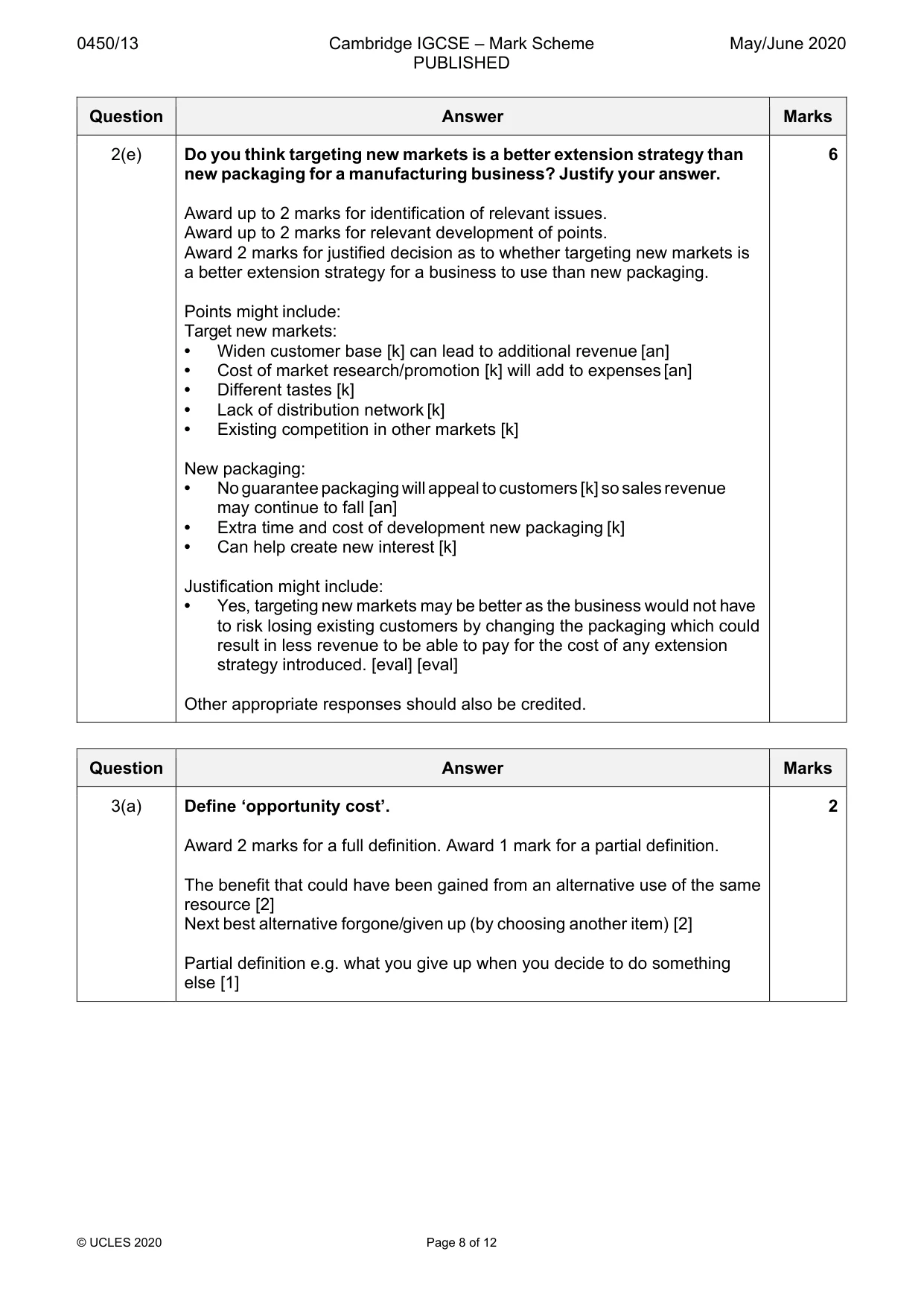
0450/13 Cambridge IGCSE – Mark Scheme PUBLISHED May/June 2020 © UCLES 2020 Page 8 of 12 Question Answer Marks 2(e) Do you think targeting new markets is a better extension strategy than new packaging for a manufacturing business? Justify your answer. Award up to 2 marks for identification of relevant issues. Award up to 2 marks for relevant development of points. Award 2 marks for justified decision as to whether targeting new markets is a better extension strategy for a business to use than new packaging. Points might include: Target new markets: • Widen customer base [k] can lead to additional revenue [an] • Cost of market research/promotion [k] will add to expenses [an] • Different tastes [k] • Lack of distribution network [k] • Existing competition in other markets [k] New packaging: • No guarantee packaging will appeal to customers [k] so sales revenue may continue to fall [an] • Extra time and cost of development new packaging [k] • Can help create new interest [k] Justification might include: • Yes, targeting new markets may be better as the business would not have to risk losing existing customers by changing the packaging which could result in less revenue to be able to pay for the cost of any extension strategy introduced. [eval] [eval] Other appropriate responses should also be credited. 6 Question Answer Marks 3(a) Define ‘opportunity cost’. Award 2 marks for a full definition. Award 1 mark for a partial definition. The benefit that could have been gained from an alternative use of the same resource [2] Next best alternative forgone/given up (by choosing another item) [2] Partial definition e.g. what you give up when you decide to do something else [1] 2
Mark scheme, page 9
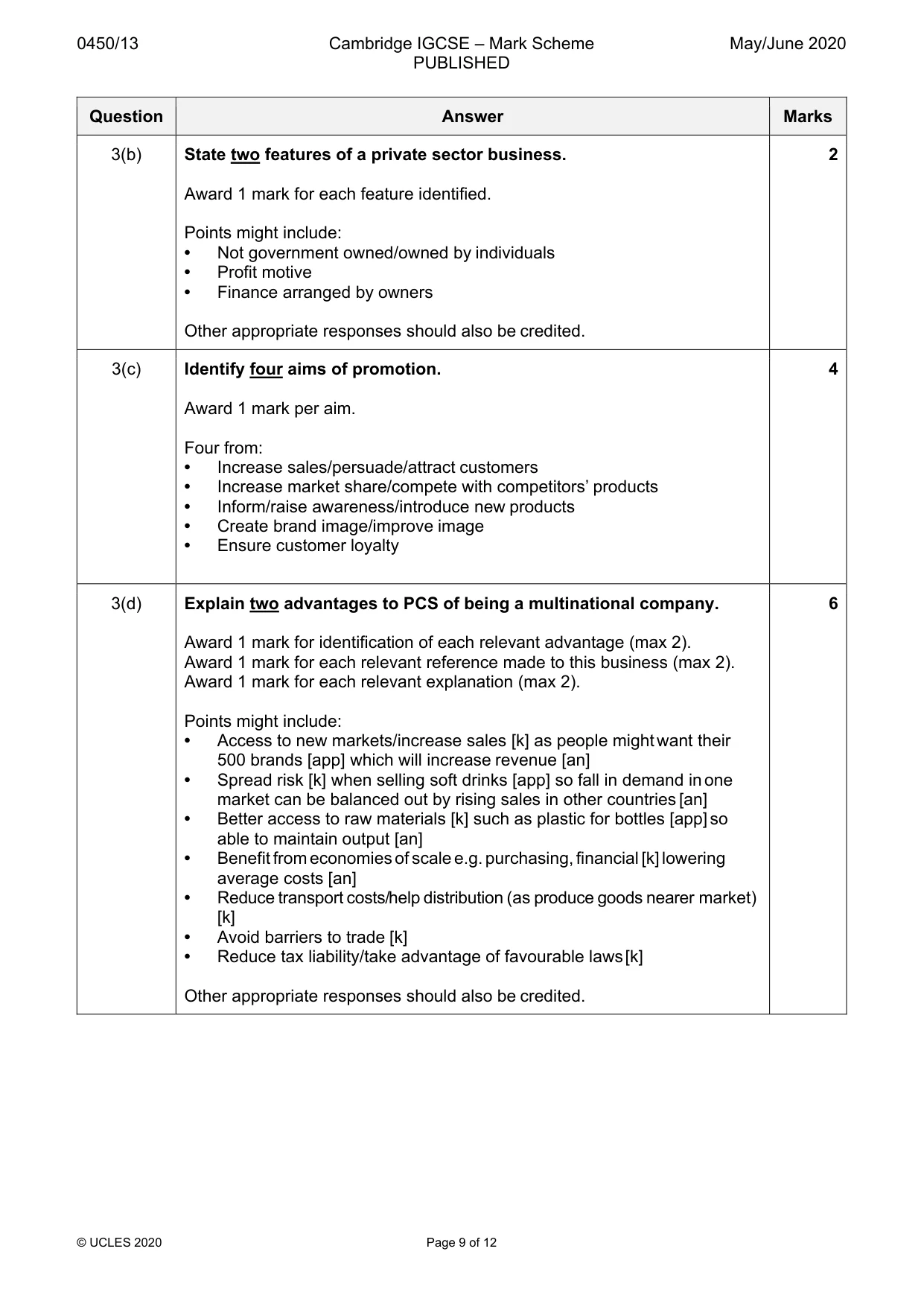
0450/13 Cambridge IGCSE – Mark Scheme PUBLISHED May/June 2020 © UCLES 2020 Page 9 of 12 Question Answer Marks 3(b) State two features of a private sector business. Award 1 mark for each feature identified. Points might include: • Not government owned/owned by individuals • Profit motive • Finance arranged by owners Other appropriate responses should also be credited. 2 3(c) Identify four aims of promotion. Award 1 mark per aim. Four from: • Increase sales/persuade/attract customers • Increase market share/compete with competitors’ products • Inform/raise awareness/introduce new products • Create brand image/improve image • Ensure customer loyalty 4 3(d) Explain two advantages to PCS of being a multinational company. Award 1 mark for identification of each relevant advantage (max 2). Award 1 mark for each relevant reference made to this business (max 2). Award 1 mark for each relevant explanation (max 2). Points might include: • Access to new markets/increase sales [k] as people might want their 500 brands [app] which will increase revenue [an] • Spread risk [k] when selling soft drinks [app] so fall in demand in one market can be balanced out by rising sales in other countries [an] • Better access to raw materials [k] such as plastic for bottles [app] so able to maintain output [an] • Benefit from economies of scale e.g. purchasing, financial [k] lowering average costs [an] • Reduce transport costs/help distribution (as produce goods nearer market) [k] • Avoid barriers to trade [k] • Reduce tax liability/take advantage of favourable laws [k] Other appropriate responses should also be credited. 6
Mark scheme, page 10
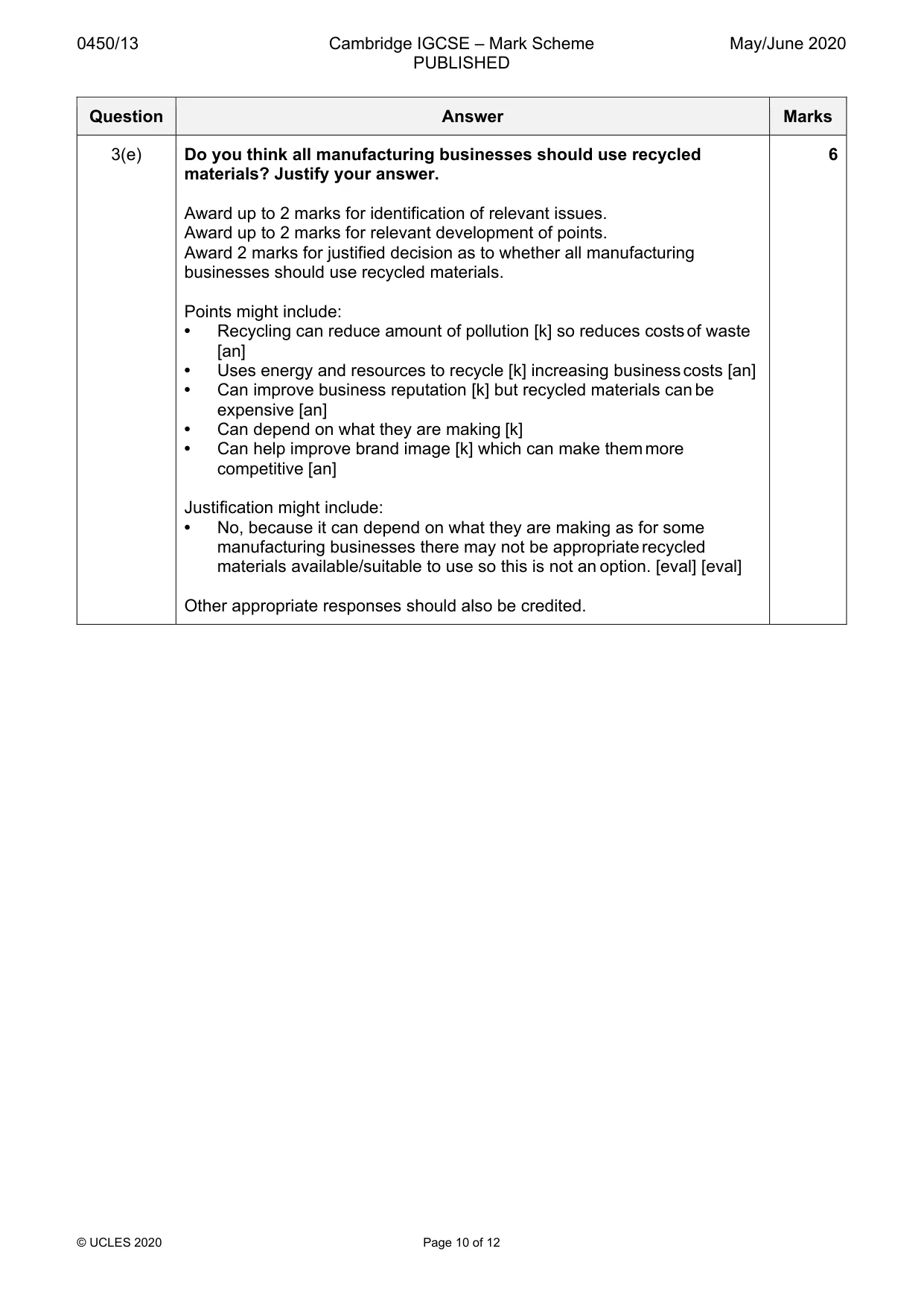
0450/13 Cambridge IGCSE – Mark Scheme PUBLISHED May/June 2020 © UCLES 2020 Page 10 of 12 Question Answer Marks 3(e) Do you think all manufacturing businesses should use recycled materials? Justify your answer. Award up to 2 marks for identification of relevant issues. Award up to 2 marks for relevant development of points. Award 2 marks for justified decision as to whether all manufacturing businesses should use recycled materials. Points might include: • Recycling can reduce amount of pollution [k] so reduces costs of waste [an] • Uses energy and resources to recycle [k] increasing business costs [an] • Can improve business reputation [k] but recycled materials can be expensive [an] • Can depend on what they are making [k] • Can help improve brand image [k] which can make them more competitive [an] Justification might include: • No, because it can depend on what they are making as for some manufacturing businesses there may not be appropriate recycled materials available/suitable to use so this is not an option. [eval] [eval] Other appropriate responses should also be credited. 6
Mark scheme, page 11
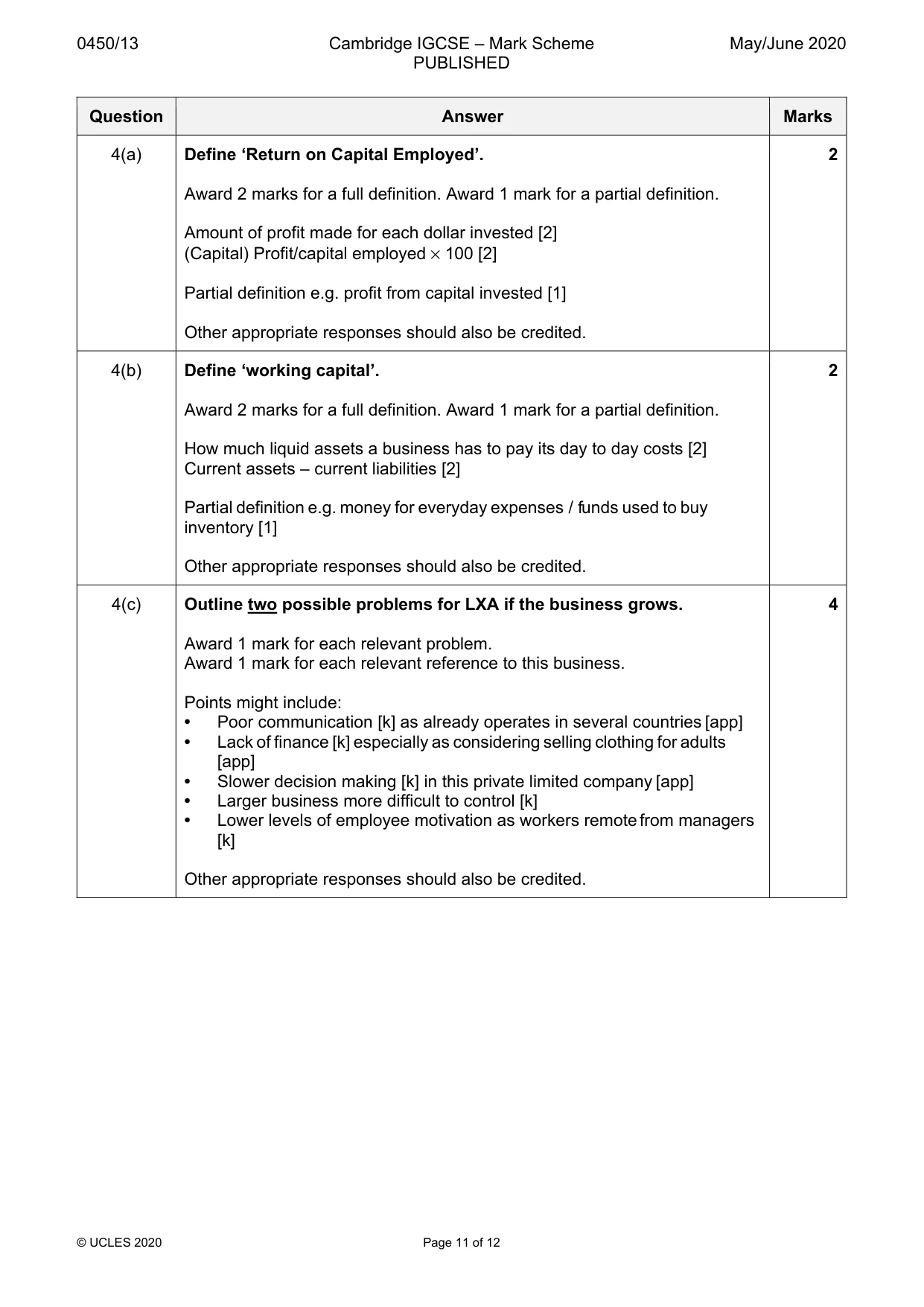
0450/13 Cambridge IGCSE – Mark Scheme PUBLISHED May/June 2020 © UCLES 2020 Page 11 of 12 Question Answer Marks 4(a) Define ‘Return on Capital Employed’. Award 2 marks for a full definition. Award 1 mark for a partial definition. Amount of profit made for each dollar invested [2] (Capital) Profit/capital employed × 100 [2] Partial definition e.g. profit from capital invested [1] Other appropriate responses should also be credited. 2 4(b) Define ‘working capital’. Award 2 marks for a full definition. Award 1 mark for a partial definition. How much liquid assets a business has to pay its day to day costs [2] Current assets – current liabilities [2] Partial definition e.g. money for everyday expenses / funds used to buy inventory [1] Other appropriate responses should also be credited. 2 4(c) Outline two possible problems for LXA if the business grows. Award 1 mark for each relevant problem. Award 1 mark for each relevant reference to this business. Points might include: • Poor communication [k] as already operates in several countries [app] • Lack of finance [k] especially as considering selling clothing for adults [app] • Slower decision making [k] in this private limited company [app] • Larger business more difficult to control [k] • Lower levels of employee motivation as workers remote from managers [k] Other appropriate responses should also be credited. 4
Mark scheme, page 12
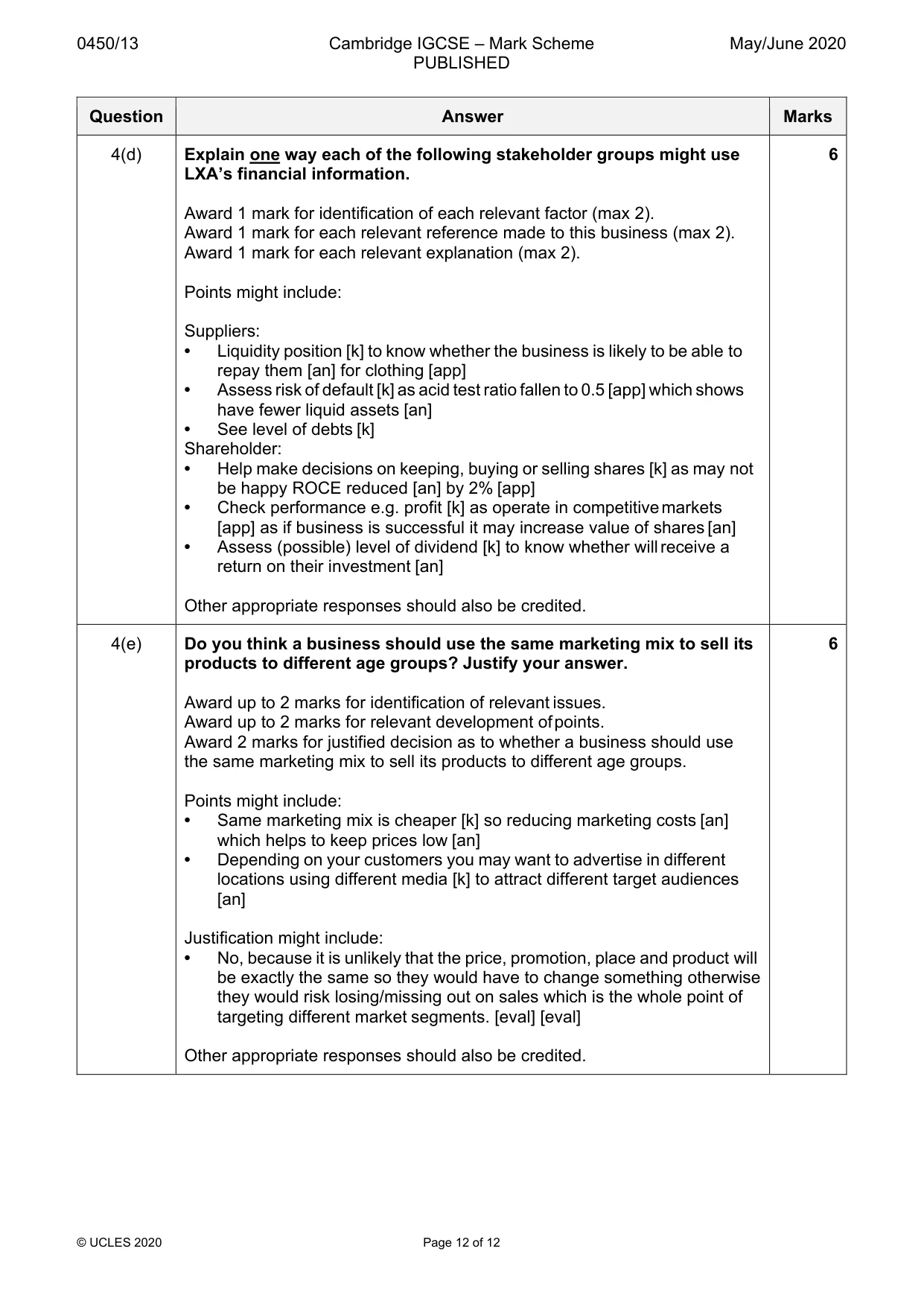
0450/13 Cambridge IGCSE – Mark Scheme PUBLISHED May/June 2020 © UCLES 2020 Page 12 of 12 Question Answer Marks 4(d) Explain one way each of the following stakeholder groups might use LXA’s financial information. Award 1 mark for identification of each relevant factor (max 2). Award 1 mark for each relevant reference made to this business (max 2). Award 1 mark for each relevant explanation (max 2). Points might include: Suppliers: • Liquidity position [k] to know whether the business is likely to be able to repay them [an] for clothing [app] • Assess risk of default [k] as acid test ratio fallen to 0.5 [app] which shows have fewer liquid assets [an] • See level of debts [k] Shareholder: • Help make decisions on keeping, buying or selling shares [k] as may not be happy ROCE reduced [an] by 2% [app] • Check performance e.g. profit [k] as operate in competitive markets [app] as if business is successful it may increase value of shares [an] • Assess (possible) level of dividend [k] to know whether will receive a return on their investment [an] Other appropriate responses should also be credited. 6 4(e) Do you think a business should use the same marketing mix to sell its products to different age groups? Justify your answer. Award up to 2 marks for identification of relevant issues. Award up to 2 marks for relevant development of points. Award 2 marks for justified decision as to whether a business should use the same marketing mix to sell its products to different age groups. Points might include: • Same marketing mix is cheaper [k] so reducing marketing costs [an] which helps to keep prices low [an] • Depending on your customers you may want to advertise in different locations using different media [k] to attract different target audiences [an] Justification might include: • No, because it is unlikely that the price, promotion, place and product will be exactly the same so they would have to change something otherwise they would risk losing/missing out on sales which is the whole point of targeting different market segments. [eval] [eval] Other appropriate responses should also be credited. 6