Cambridge IGCSE Business Studies 0450 — 2020 Feb/March Paper 2 · Variant 2
0450/22/F/M/20 · 80 marks · ≈90 min
The question paper and its mark scheme, free to read here and free to download. This is Cambridge’s own paper, exactly as it was sat.
Question paper12 pages



Mark scheme15 pages
Answers below. Sit the paper first if you are practising.
Paper as text
Question paper, page 1
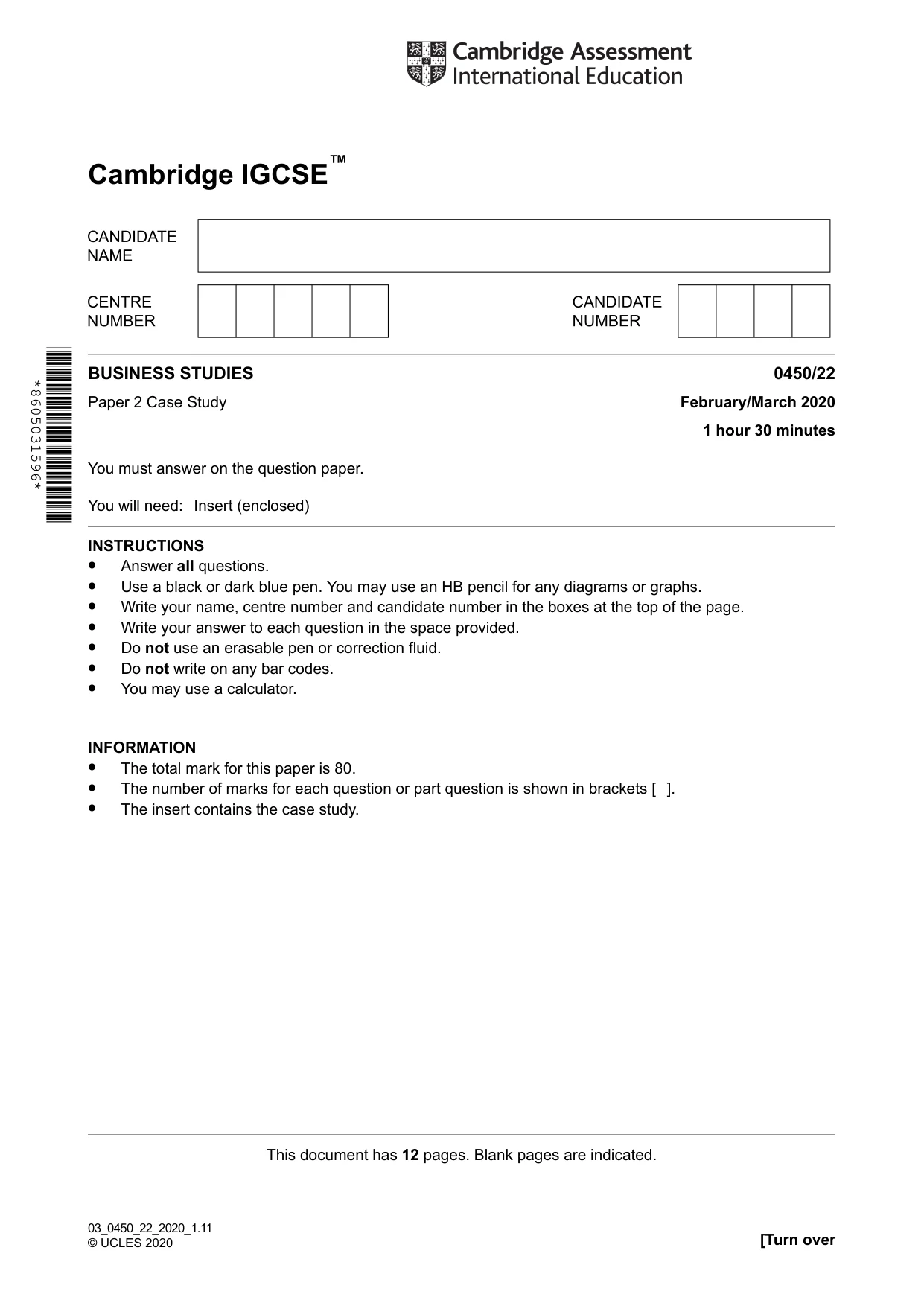
Cambridge IGCSE™ 0450/22 February/March 2020 1 hour 30 minutes BUSINESS STUDIES Paper 2 Case Study You must answer on the question paper. You will need: Insert (enclosed) INSTRUCTIONS • Answer all questions. • Use a black or dark blue pen. You may use an HB pencil for any diagrams or graphs. • Write your name, centre number and candidate number in the boxes at the top of the page. • Write your answer to each question in the space provided. • Do not use an erasable pen or correction fluid. • Do not write on any bar codes. • You may use a calculator. INFORMATION • The total mark for this paper is 80. • The number of marks for each question or part question is shown in brackets [ ]. • The insert contains the case study. This document has 12 pages. Blank pages are indicated. [Turn over 03_0450_22_2020_1.11 © UCLES 2020 *8605031596*
Question paper, page 2
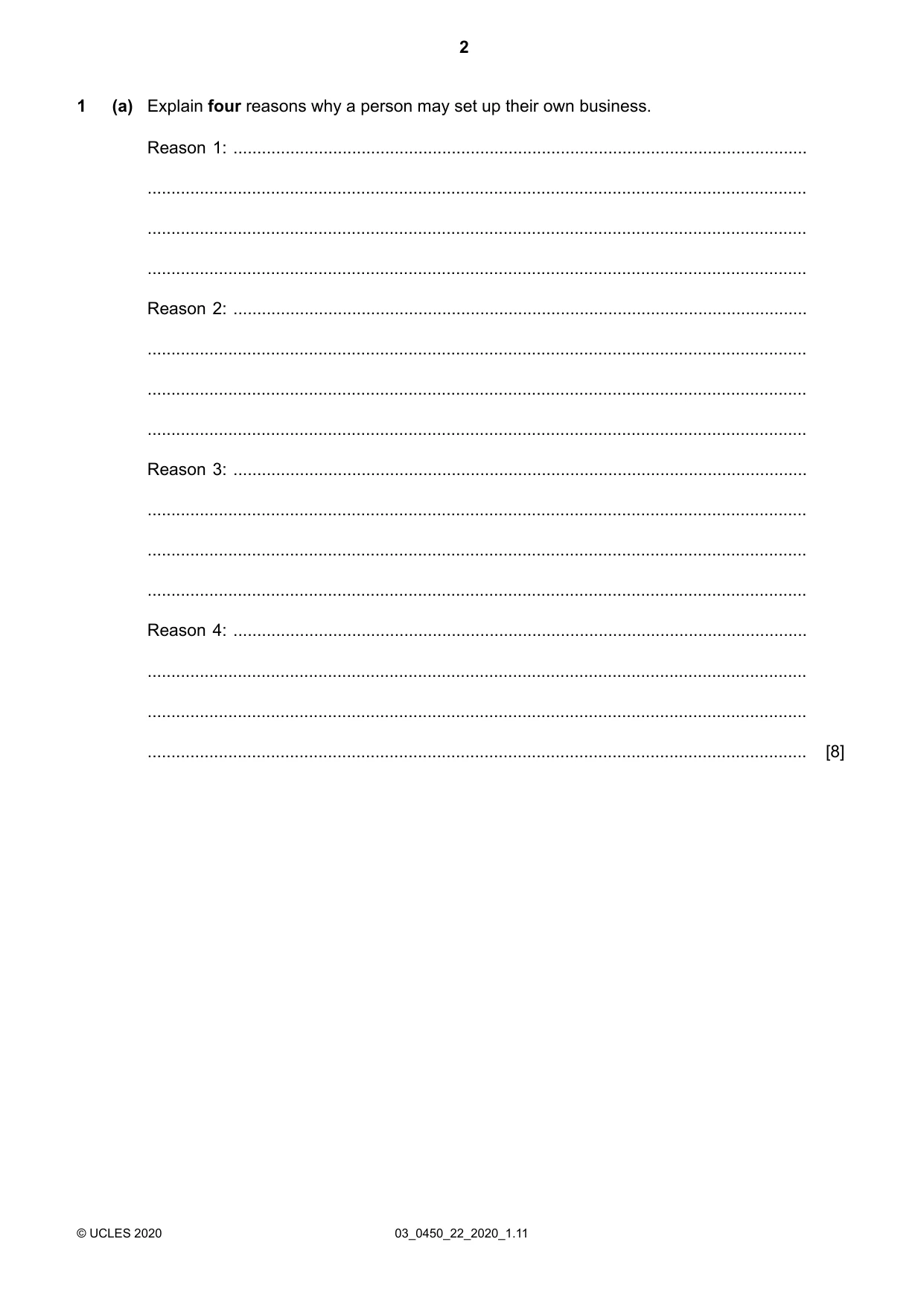
Explain four reasons why a person may set up their own business. (a) 1 Reason 1: … … … … Reason 2: … … … … Reason 3: … … … … Reason 4: … … … … [8] 03_0450_22_2020_1.11 © UCLES 2020 2
Question paper, page 3
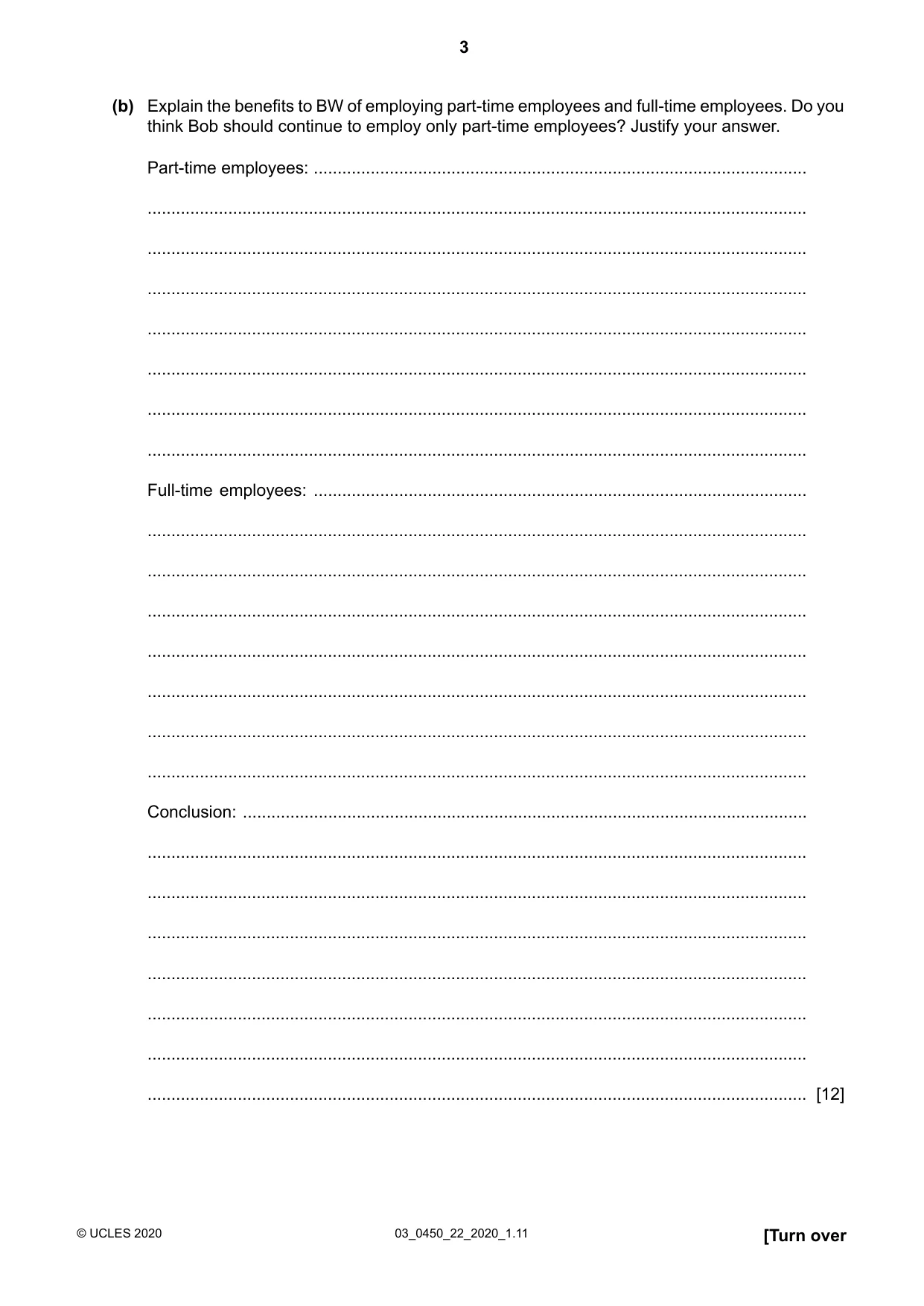
Explain the benefits to BW of employing part-time employees and full-time employees. Do you think Bob should continue to employ only part-time employees? Justify your answer. (b) Part-time employees: … … … … … … … … Full-time employees: … … … … … … … … Conclusion: … … … … … … … … [12] [Turn over 03_0450_22_2020_1.11 © UCLES 2020 3
Question paper, page 4
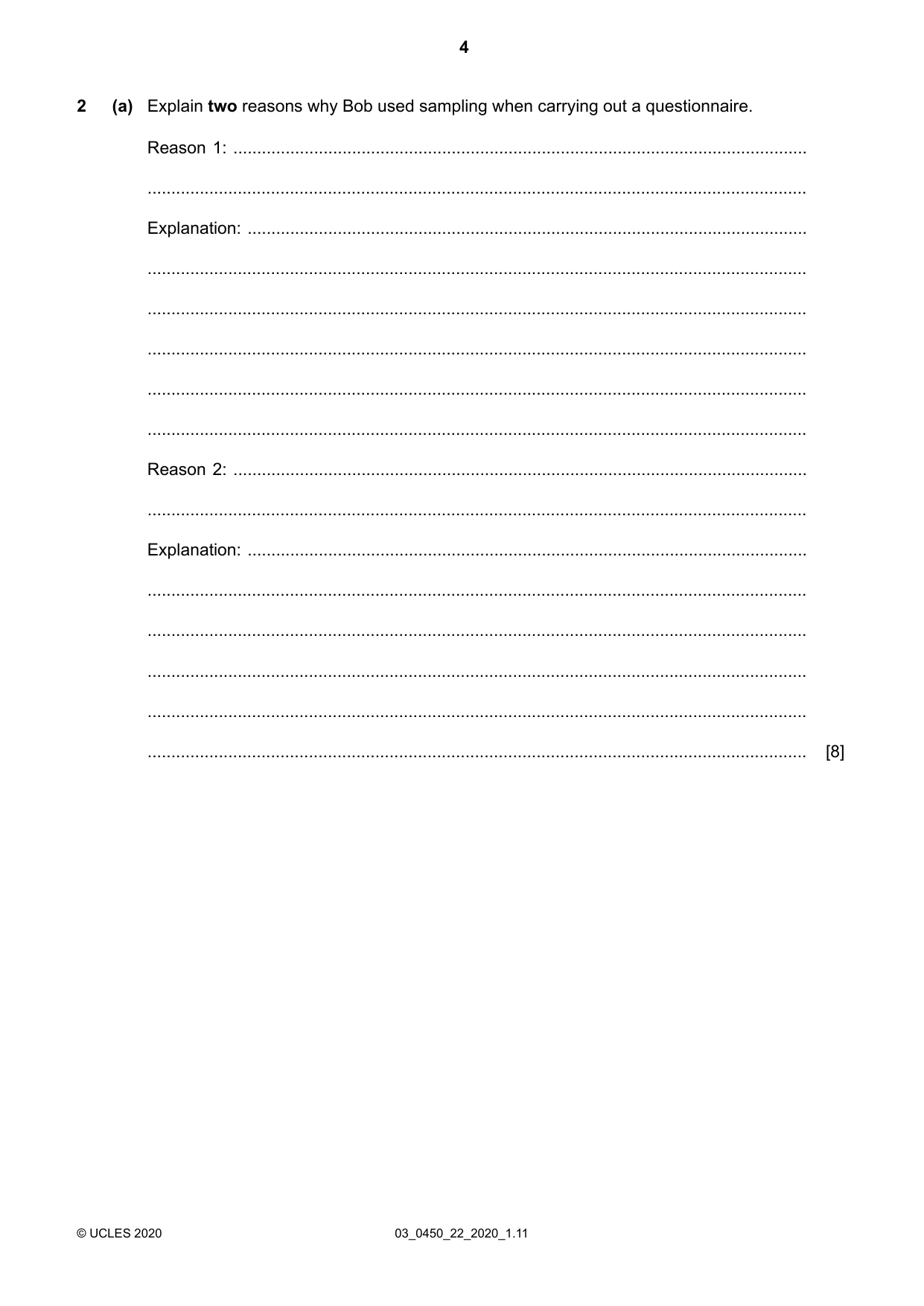
Explain two reasons why Bob used sampling when carrying out a questionnaire. (a) 2 Reason 1: … … Explanation: … … … … … … Reason 2: … … Explanation: … … … … … … [8] 03_0450_22_2020_1.11 © UCLES 2020 4
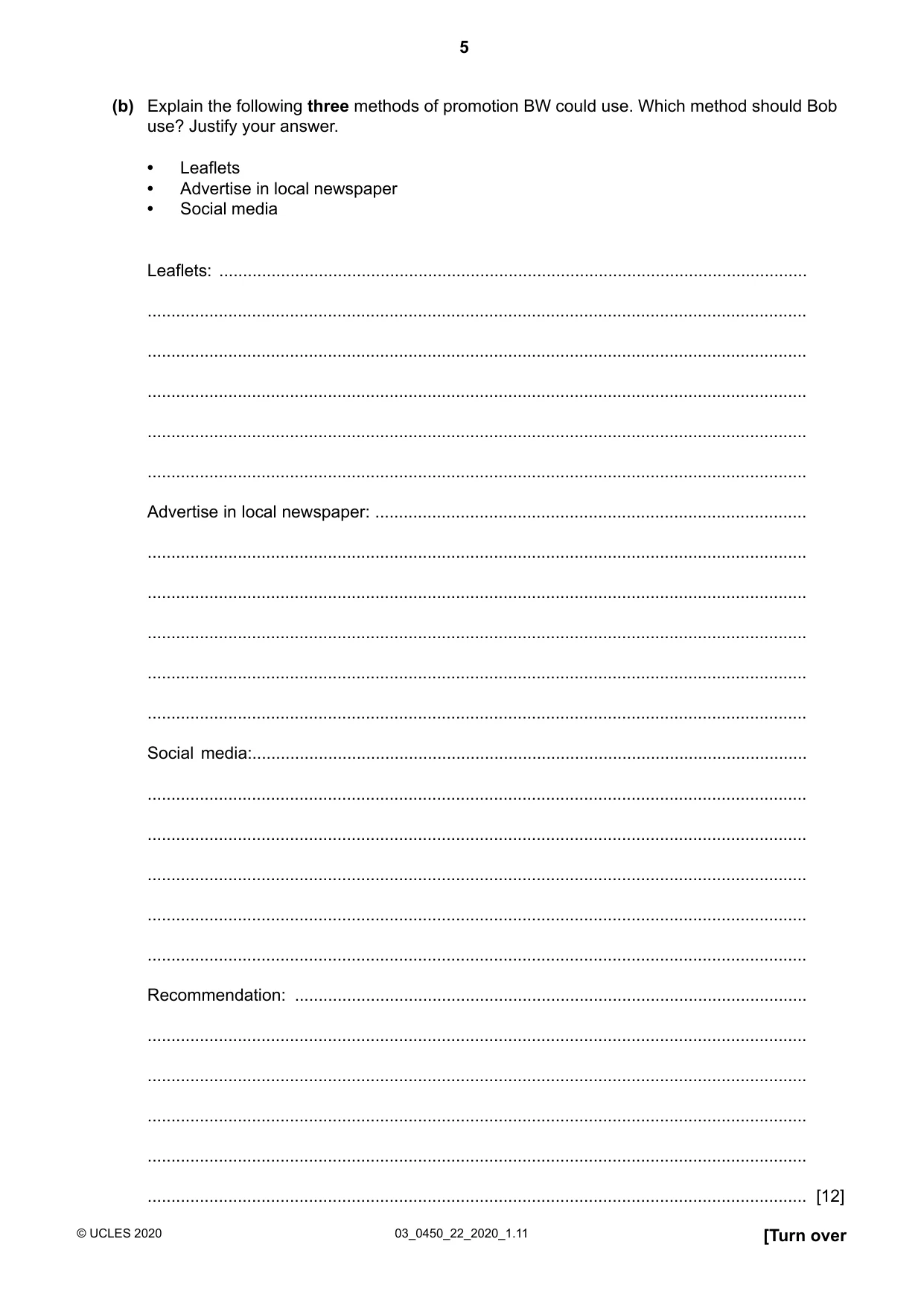
Question paper, page 5
Explain the following three methods of promotion BW could use. Which method should Bob use? Justify your answer. (b) • Leaflets • Advertise in local newspaper • Social media Leaflets: … … … … … … Advertise in local newspaper: … … … … … … Social media:… … … … … … Recommendation: … … … … … … [12] [Turn over 03_0450_22_2020_1.11 © UCLES 2020 5
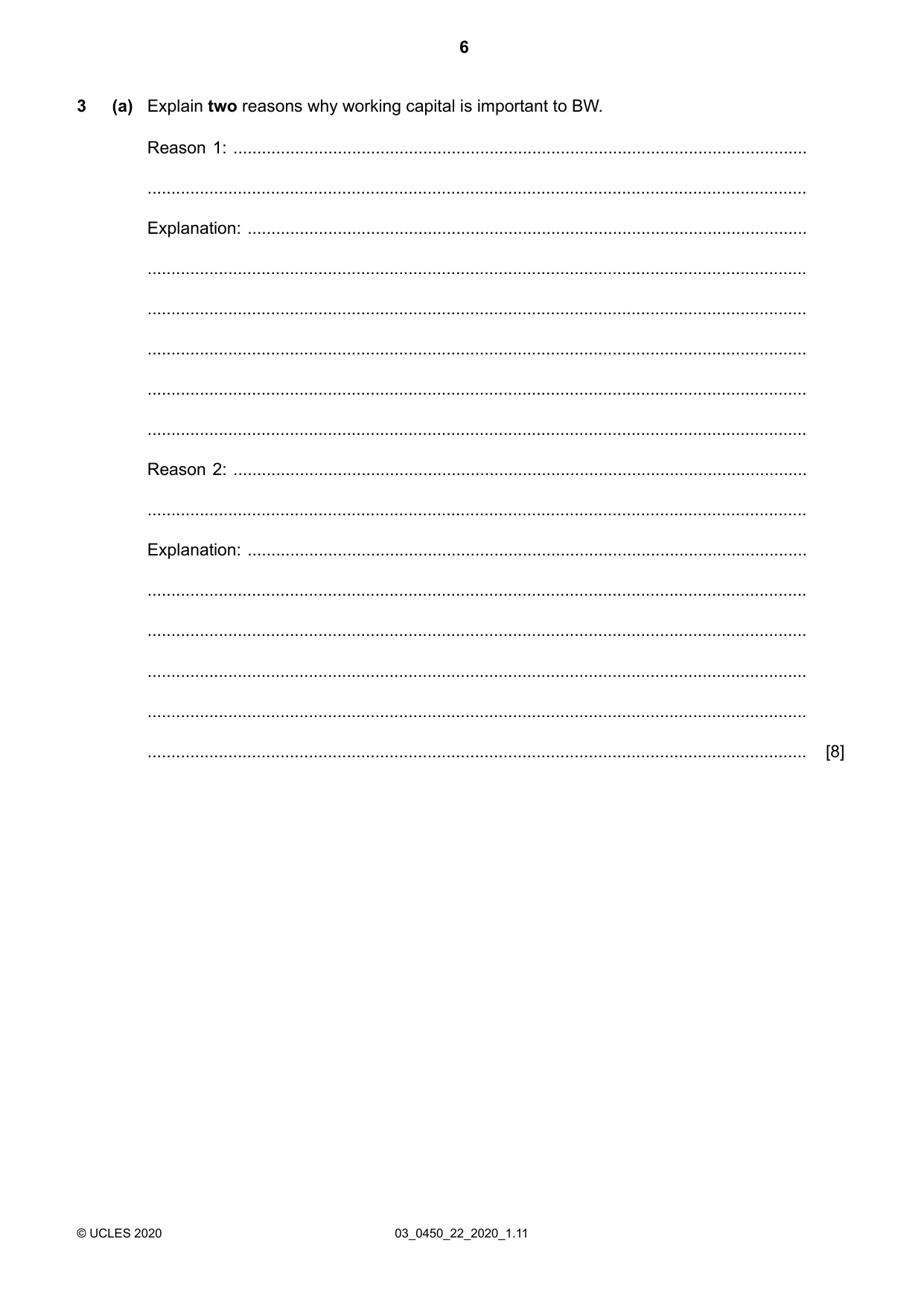
Question paper, page 6
Explain two reasons why working capital is important to BW. (a) 3 Reason 1: … … Explanation: … … … … … … Reason 2: … … Explanation: … … … … … … [8] 03_0450_22_2020_1.11 © UCLES 2020 6
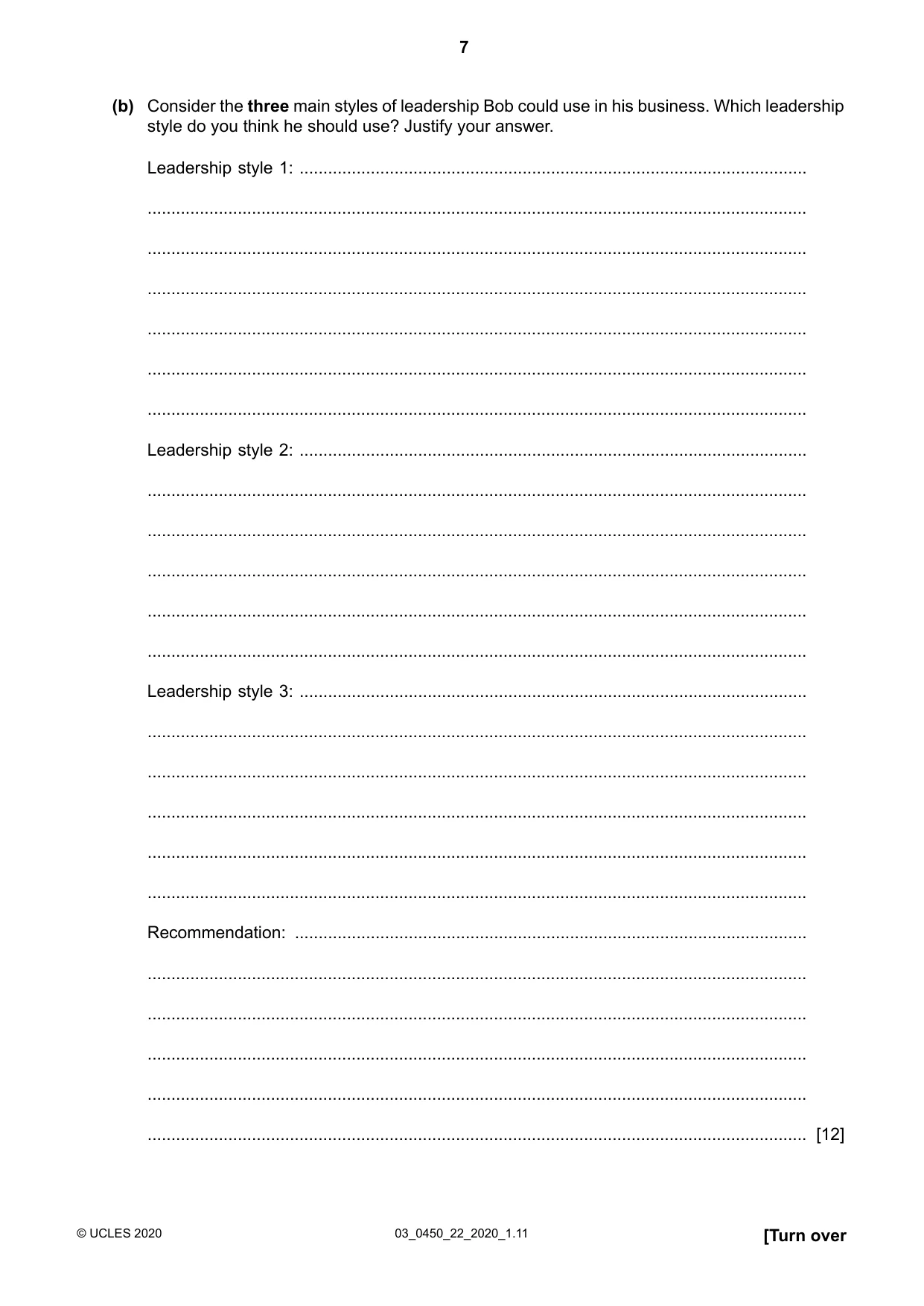
Question paper, page 7
Consider the three main styles of leadership Bob could use in his business. Which leadership style do you think he should use? Justify your answer. (b) Leadership style 1: … … … … … … … Leadership style 2: … … … … … … Leadership style 3: … … … … … … Recommendation: … … … … … … [12] [Turn over 03_0450_22_2020_1.11 © UCLES 2020 7
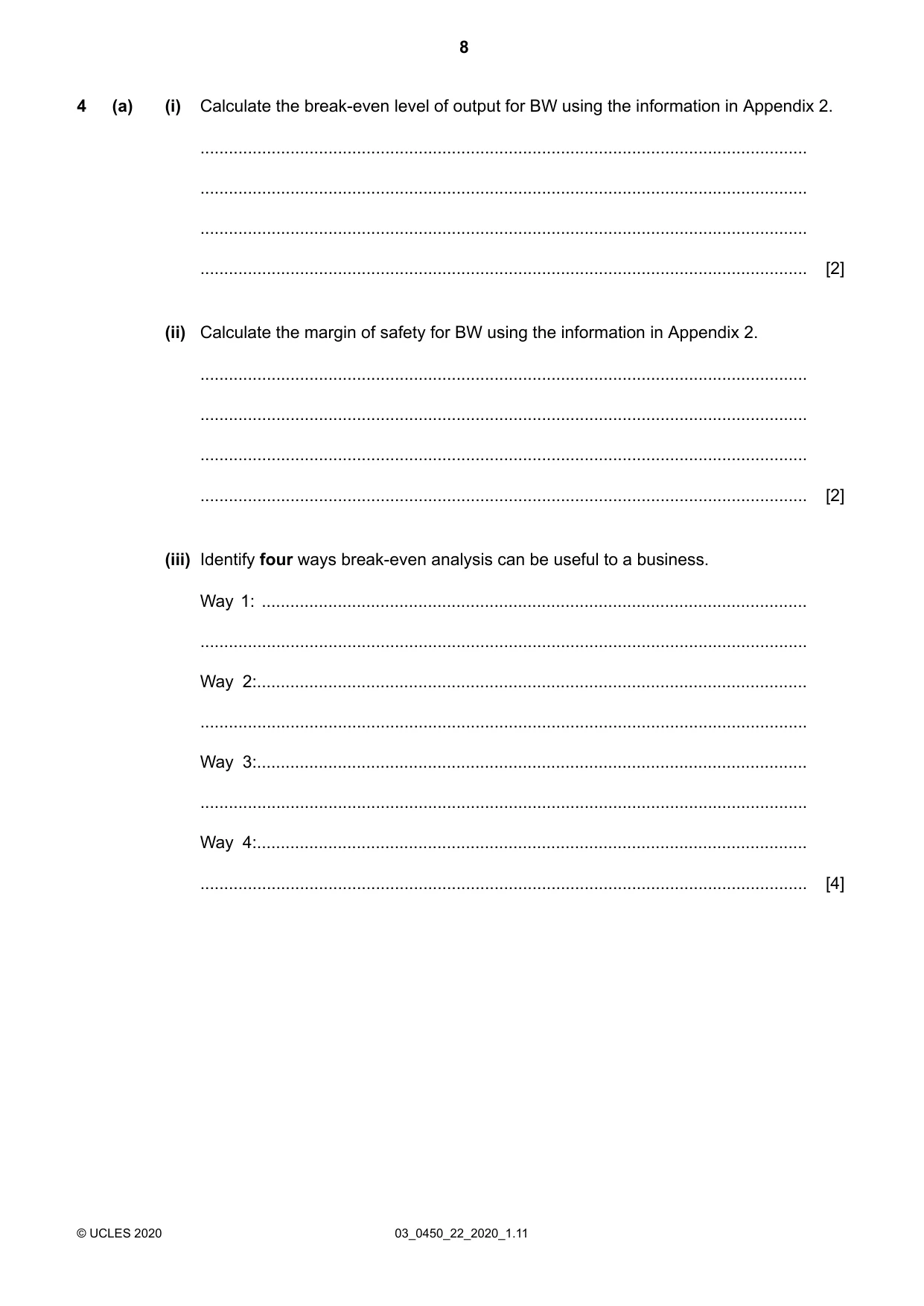
Question paper, page 8
Calculate the break-even level of output for BW using the information in Appendix 2. (i) (a) 4 … … … … [2] Calculate the margin of safety for BW using the information in Appendix 2. (ii) … … … … [2] Identify four ways break-even analysis can be useful to a business. (iii) Way 1: … … Way 2:… … Way 3:… … Way 4:… … [4] 03_0450_22_2020_1.11 © UCLES 2020 8
Question paper, page 9
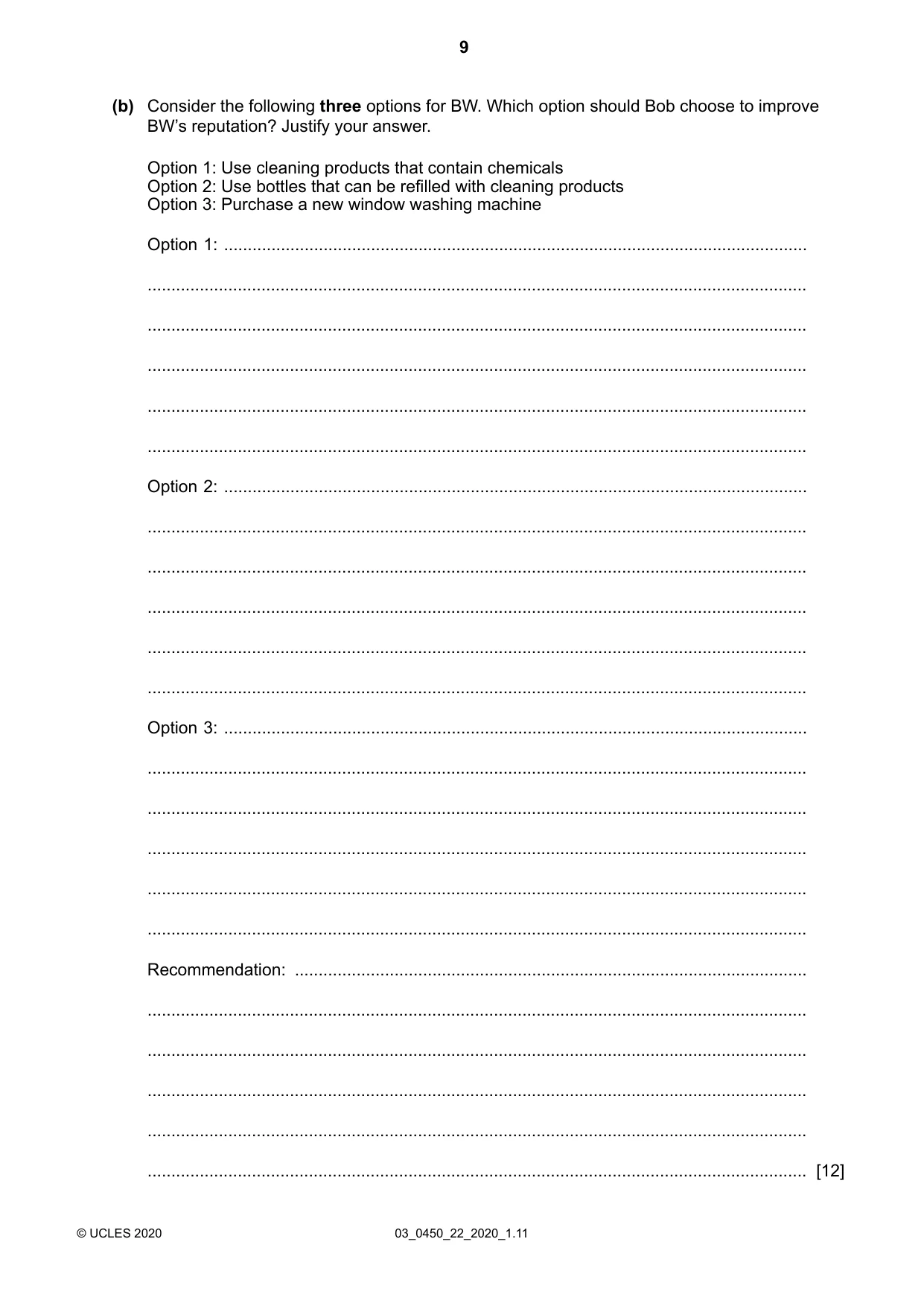
Consider the following three options for BW. Which option should Bob choose to improve BW’s reputation? Justify your answer. Option 1: Use cleaning products that contain chemicals Option 2: Use bottles that can be refilled with cleaning products Option 3: Purchase a new window washing machine (b) Option 1: … … … … … … Option 2: … … … … … … Option 3: … … … … … … Recommendation: … … … … … … [12] 03_0450_22_2020_1.11 © UCLES 2020 9
Question paper, page 10
BLANK PAGE 03_0450_22_2020_1.11 © UCLES 2020 10
Question paper, page 11
BLANK PAGE 03_0450_22_2020_1.11 © UCLES 2020 11
Question paper, page 12
BLANK PAGE Permission to reproduce items where third-party owned material protected by copyright is included has been sought and cleared where possible. Every reasonable effort has been made by the publisher (UCLES) to trace copyright holders, but if any items requiring clearance have unwittingly been included, the publisher will be pleased to make amends at the earliest possible opportunity. To avoid the issue of disclosure of answer-related information to candidates, all copyright acknowledgements are reproduced online in the Cambridge Assessment International Education Copyright Acknowledgements Booklet. This is produced for each series of examinations and is freely available to download at www.cambridgeinternational.org after the live examination series. Cambridge Assessment International Education is part of the Cambridge Assessment Group. Cambridge Assessment is the brand name of the University of Cambridge Local Examinations Syndicate (UCLES), which itself is a department of the University of Cambridge. 03_0450_22_2020_1.11 © UCLES 2020 12
Mark scheme, page 1
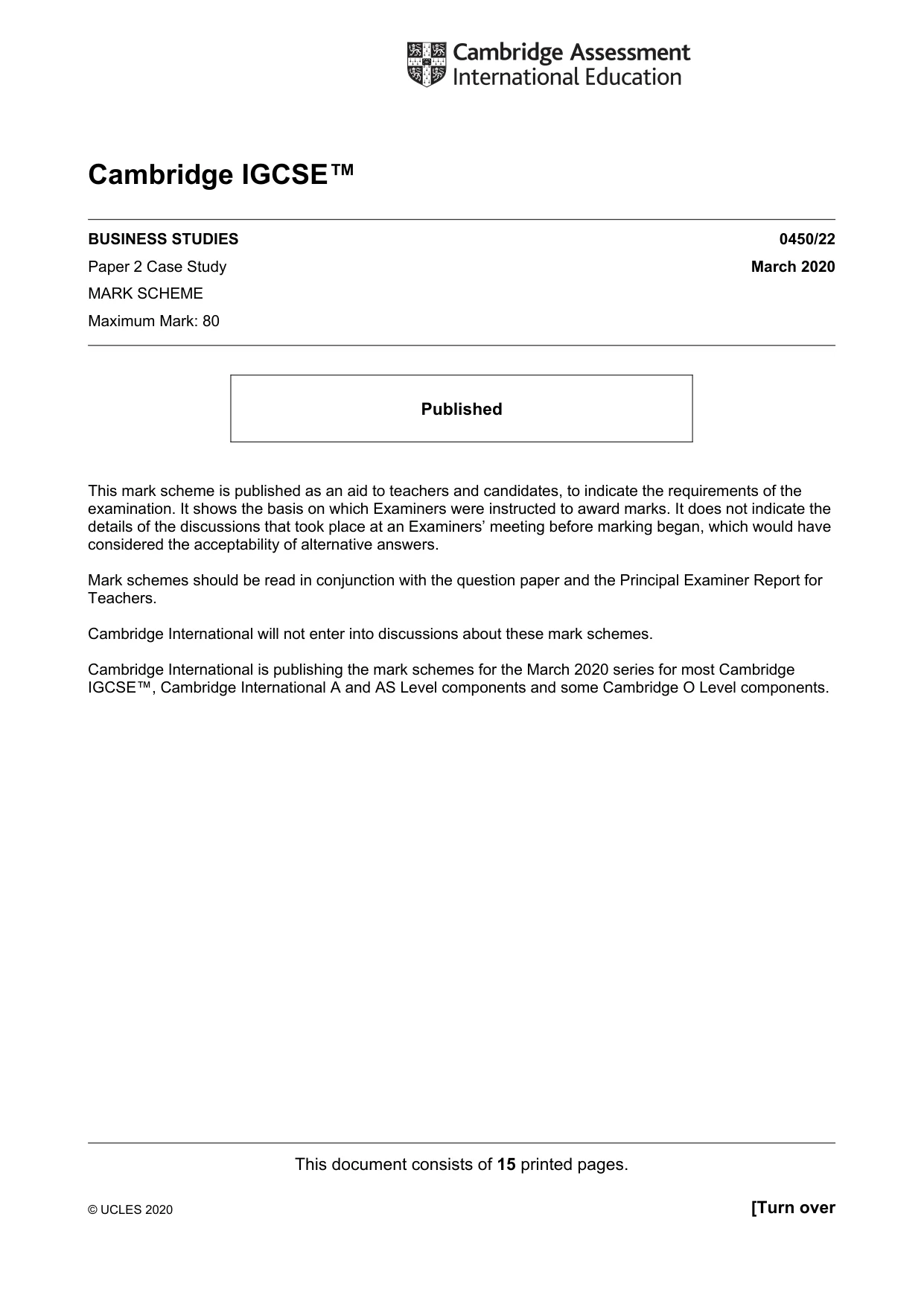
This document consists of 15 printed pages. © UCLES 2020 [Turn over Cambridge IGCSE™ BUSINESS STUDIES 0450/22 Paper 2 Case Study March 2020 MARK SCHEME Maximum Mark: 80 Published This mark scheme is published as an aid to teachers and candidates, to indicate the requirements of the examination. It shows the basis on which Examiners were instructed to award marks. It does not indicate the details of the discussions that took place at an Examiners’ meeting before marking began, which would have considered the acceptability of alternative answers. Mark schemes should be read in conjunction with the question paper and the Principal Examiner Report for Teachers. Cambridge International will not enter into discussions about these mark schemes. Cambridge International is publishing the mark schemes for the March 2020 series for most Cambridge IGCSE™, Cambridge International A and AS Level components and some Cambridge O Level components.
Mark scheme, page 2
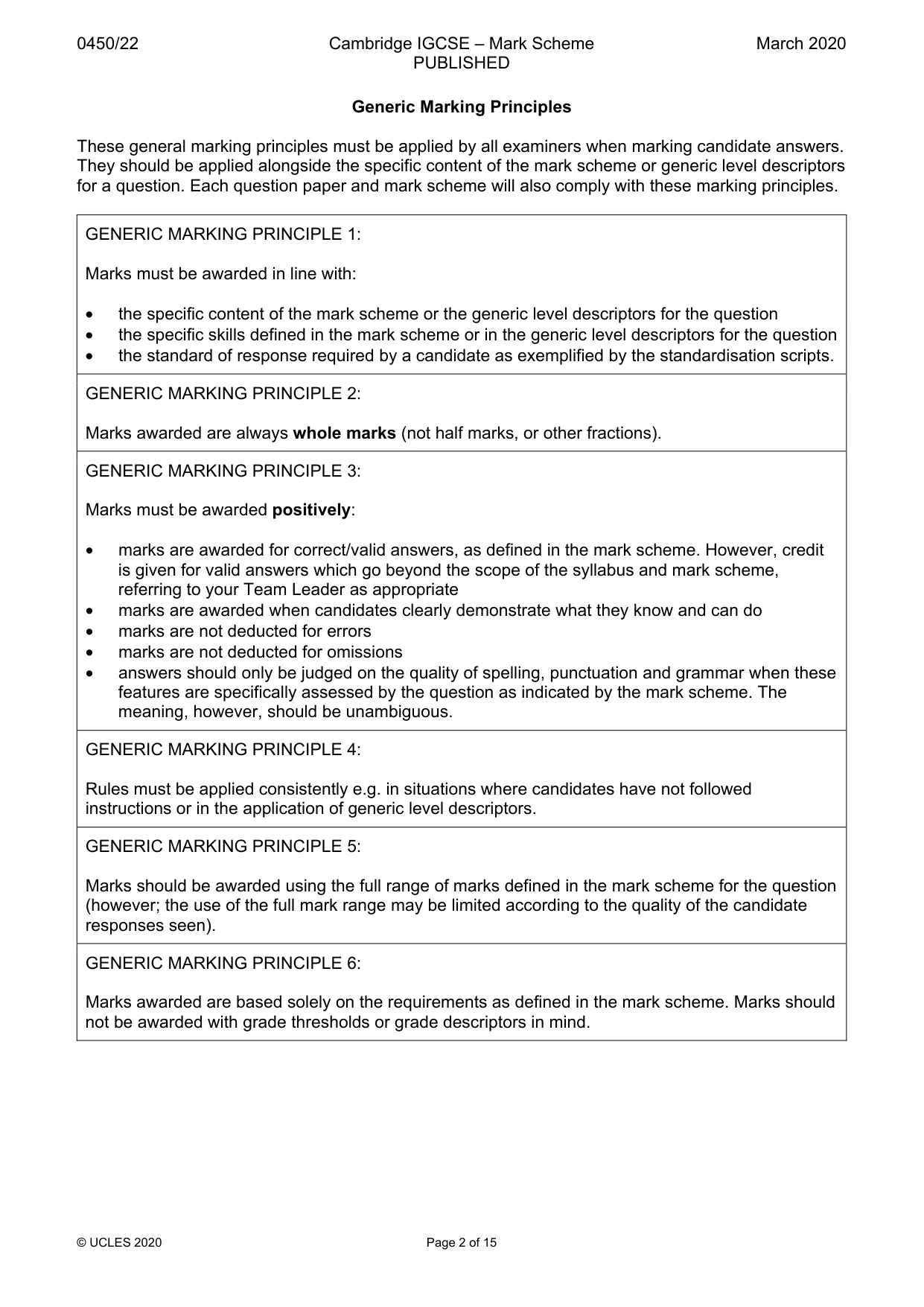
0450/22 Cambridge IGCSE – Mark Scheme PUBLISHED March 2020 © UCLES 2020 Page 2 of 15 Generic Marking Principles These general marking principles must be applied by all examiners when marking candidate answers. They should be applied alongside the specific content of the mark scheme or generic level descriptors for a question. Each question paper and mark scheme will also comply with these marking principles. GENERIC MARKING PRINCIPLE 1: Marks must be awarded in line with: • the specific content of the mark scheme or the generic level descriptors for the question • the specific skills defined in the mark scheme or in the generic level descriptors for the question • the standard of response required by a candidate as exemplified by the standardisation scripts. GENERIC MARKING PRINCIPLE 2: Marks awarded are always whole marks (not half marks, or other fractions). GENERIC MARKING PRINCIPLE 3: Marks must be awarded positively: • marks are awarded for correct/valid answers, as defined in the mark scheme. However, credit is given for valid answers which go beyond the scope of the syllabus and mark scheme, referring to your Team Leader as appropriate • marks are awarded when candidates clearly demonstrate what they know and can do • marks are not deducted for errors • marks are not deducted for omissions • answers should only be judged on the quality of spelling, punctuation and grammar when these features are specifically assessed by the question as indicated by the mark scheme. The meaning, however, should be unambiguous. GENERIC MARKING PRINCIPLE 4: Rules must be applied consistently e.g. in situations where candidates have not followed instructions or in the application of generic level descriptors. GENERIC MARKING PRINCIPLE 5: Marks should be awarded using the full range of marks defined in the mark scheme for the question (however; the use of the full mark range may be limited according to the quality of the candidate responses seen). GENERIC MARKING PRINCIPLE 6: Marks awarded are based solely on the requirements as defined in the mark scheme. Marks should not be awarded with grade thresholds or grade descriptors in mind.
Mark scheme, page 3
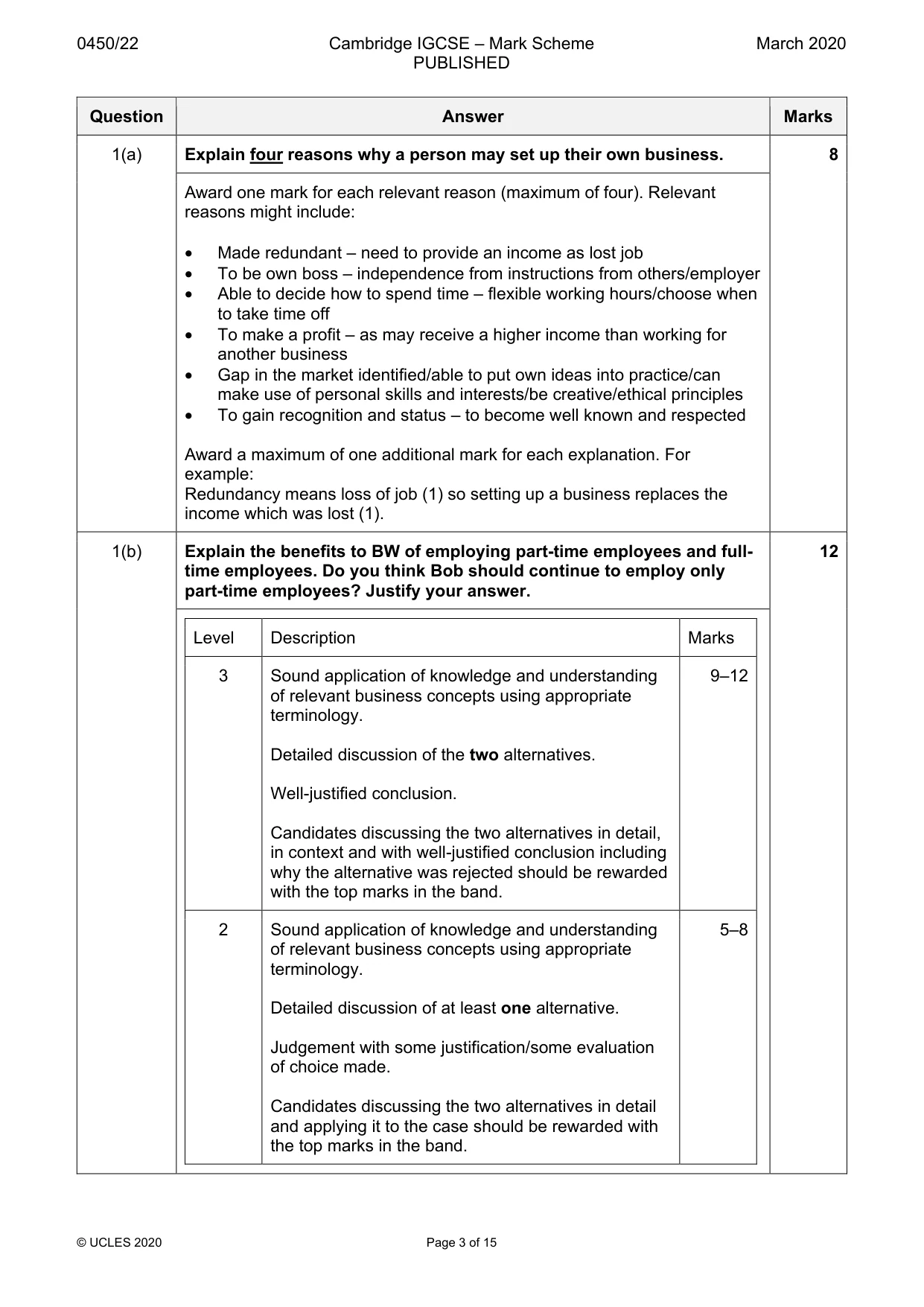
0450/22 Cambridge IGCSE – Mark Scheme PUBLISHED March 2020 © UCLES 2020 Page 3 of 15 Question Answer Marks 1(a) Explain four reasons why a person may set up their own business. 8 Award one mark for each relevant reason (maximum of four). Relevant reasons might include: • Made redundant – need to provide an income as lost job • To be own boss – independence from instructions from others/employer • Able to decide how to spend time – flexible working hours/choose when to take time off • To make a profit – as may receive a higher income than working for another business • Gap in the market identified/able to put own ideas into practice/can make use of personal skills and interests/be creative/ethical principles • To gain recognition and status – to become well known and respected Award a maximum of one additional mark for each explanation. For example: Redundancy means loss of job (1) so setting up a business replaces the income which was lost (1). 1(b) Explain the benefits to BW of employing part-time employees and full- time employees. Do you think Bob should continue to employ only part-time employees? Justify your answer. 12 Level Description Marks 3 Sound application of knowledge and understanding of relevant business concepts using appropriate terminology. Detailed discussion of the two alternatives. Well-justified conclusion. Candidates discussing the two alternatives in detail, in context and with well-justified conclusion including why the alternative was rejected should be rewarded with the top marks in the band. 9–12 2 Sound application of knowledge and understanding of relevant business concepts using appropriate terminology. Detailed discussion of at least one alternative. Judgement with some justification/some evaluation of choice made. Candidates discussing the two alternatives in detail and applying it to the case should be rewarded with the top marks in the band. 5–8
Mark scheme, page 4
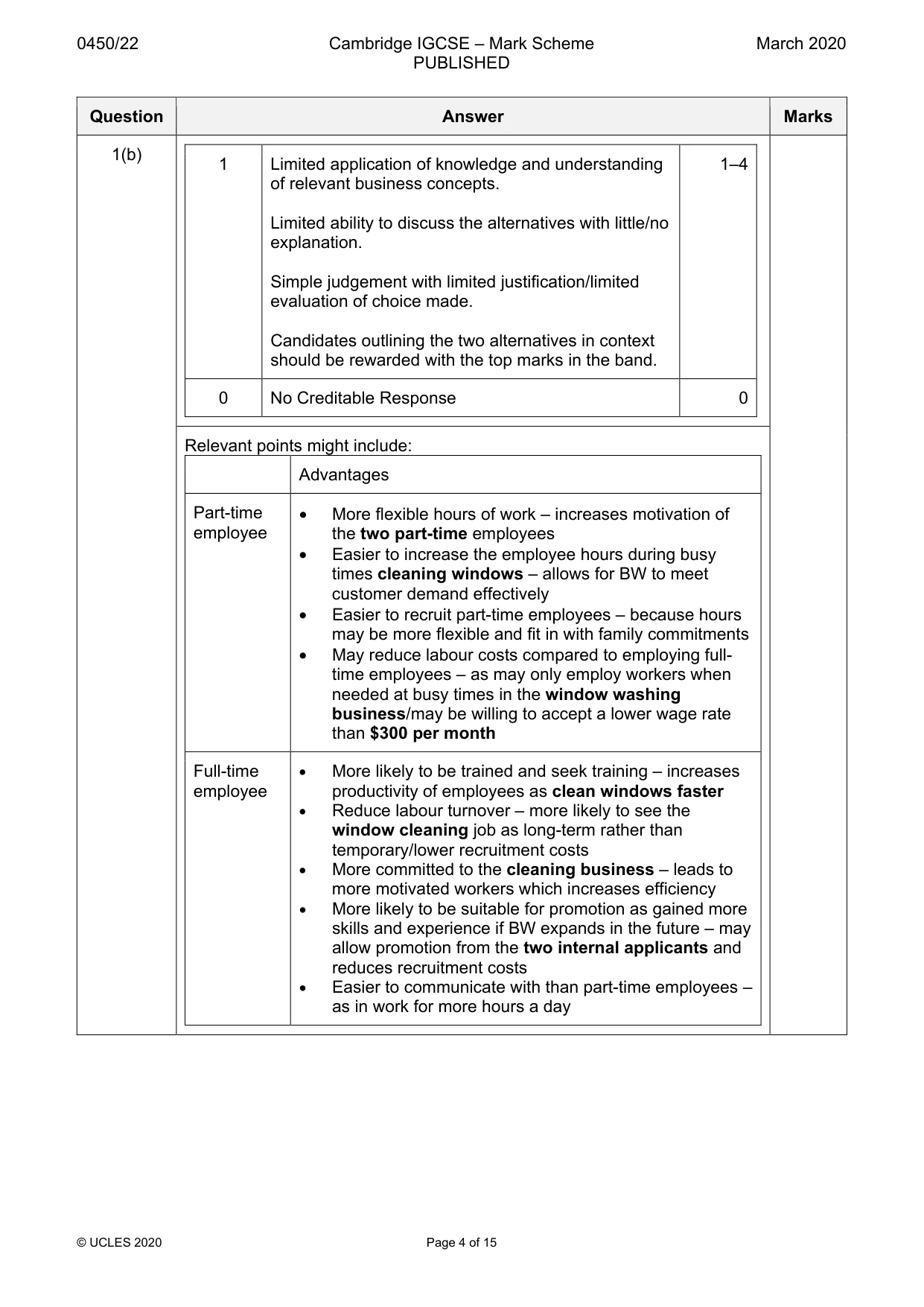
0450/22 Cambridge IGCSE – Mark Scheme PUBLISHED March 2020 © UCLES 2020 Page 4 of 15 Question Answer Marks 1(b) 1 Limited application of knowledge and understanding of relevant business concepts. Limited ability to discuss the alternatives with little/no explanation. Simple judgement with limited justification/limited evaluation of choice made. Candidates outlining the two alternatives in context should be rewarded with the top marks in the band. 1–4 0 No Creditable Response 0 Relevant points might include: Advantages Part-time employee • More flexible hours of work – increases motivation of the two part-time employees • Easier to increase the employee hours during busy times cleaning windows – allows for BW to meet customer demand effectively • Easier to recruit part-time employees – because hours may be more flexible and fit in with family commitments • May reduce labour costs compared to employing full- time employees – as may only employ workers when needed at busy times in the window washing business/may be willing to accept a lower wage rate than $300 per month Full-time employee • More likely to be trained and seek training – increases productivity of employees as clean windows faster • Reduce labour turnover – more likely to see the window cleaning job as long-term rather than temporary/lower recruitment costs • More committed to the cleaning business – leads to more motivated workers which increases efficiency • More likely to be suitable for promotion as gained more skills and experience if BW expands in the future – may allow promotion from the two internal applicants and reduces recruitment costs • Easier to communicate with than part-time employees – as in work for more hours a day
Mark scheme, page 5
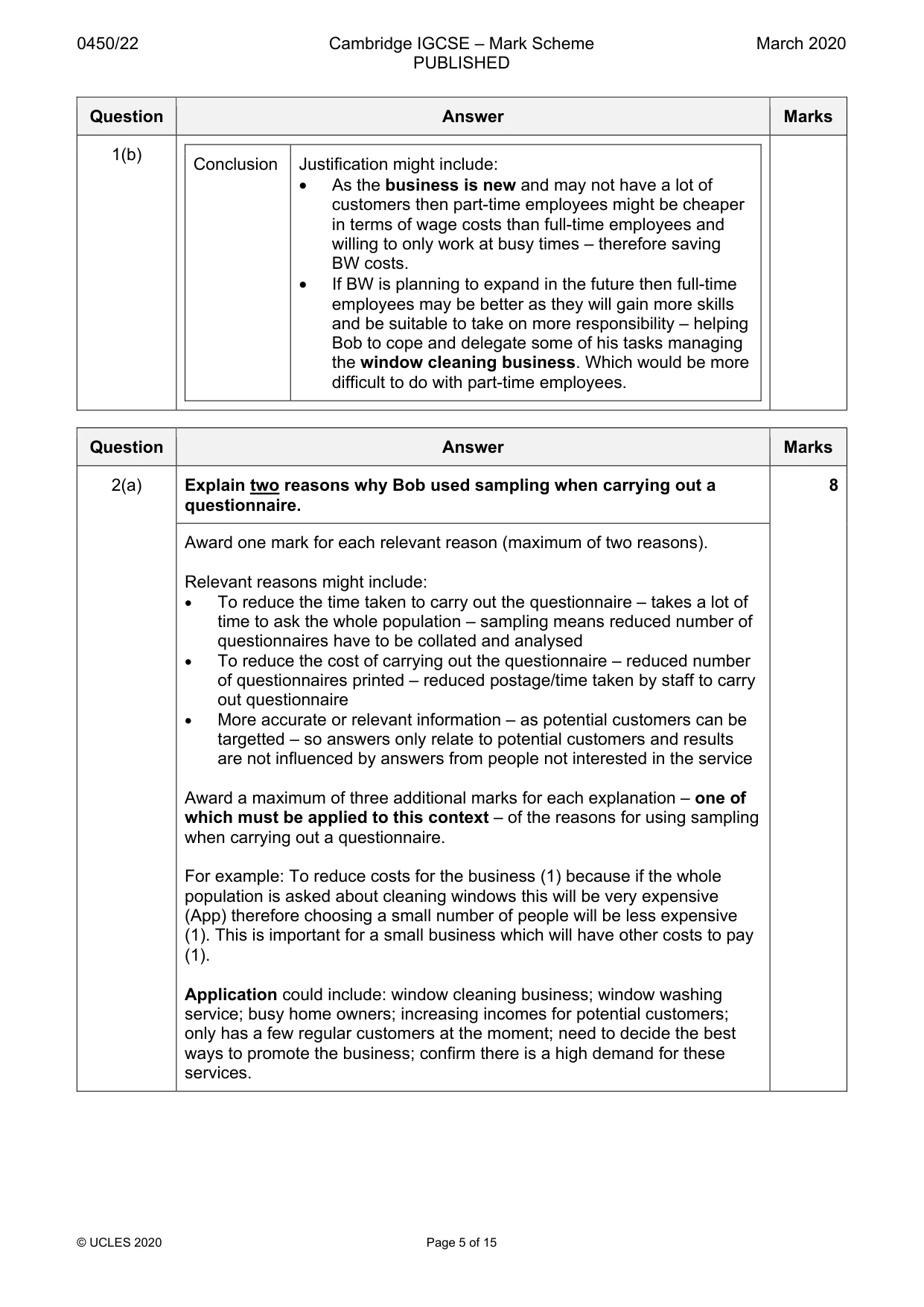
0450/22 Cambridge IGCSE – Mark Scheme PUBLISHED March 2020 © UCLES 2020 Page 5 of 15 Question Answer Marks 1(b) Conclusion Justification might include: • As the business is new and may not have a lot of customers then part-time employees might be cheaper in terms of wage costs than full-time employees and willing to only work at busy times – therefore saving BW costs. • If BW is planning to expand in the future then full-time employees may be better as they will gain more skills and be suitable to take on more responsibility – helping Bob to cope and delegate some of his tasks managing the window cleaning business. Which would be more difficult to do with part-time employees. Question Answer Marks 2(a) Explain two reasons why Bob used sampling when carrying out a questionnaire. 8 Award one mark for each relevant reason (maximum of two reasons). Relevant reasons might include: • To reduce the time taken to carry out the questionnaire – takes a lot of time to ask the whole population – sampling means reduced number of questionnaires have to be collated and analysed • To reduce the cost of carrying out the questionnaire – reduced number of questionnaires printed – reduced postage/time taken by staff to carry out questionnaire • More accurate or relevant information – as potential customers can be targetted – so answers only relate to potential customers and results are not influenced by answers from people not interested in the service Award a maximum of three additional marks for each explanation – one of which must be applied to this context – of the reasons for using sampling when carrying out a questionnaire. For example: To reduce costs for the business (1) because if the whole population is asked about cleaning windows this will be very expensive (App) therefore choosing a small number of people will be less expensive (1). This is important for a small business which will have other costs to pay (1). Application could include: window cleaning business; window washing service; busy home owners; increasing incomes for potential customers; only has a few regular customers at the moment; need to decide the best ways to promote the business; confirm there is a high demand for these services.
Mark scheme, page 6
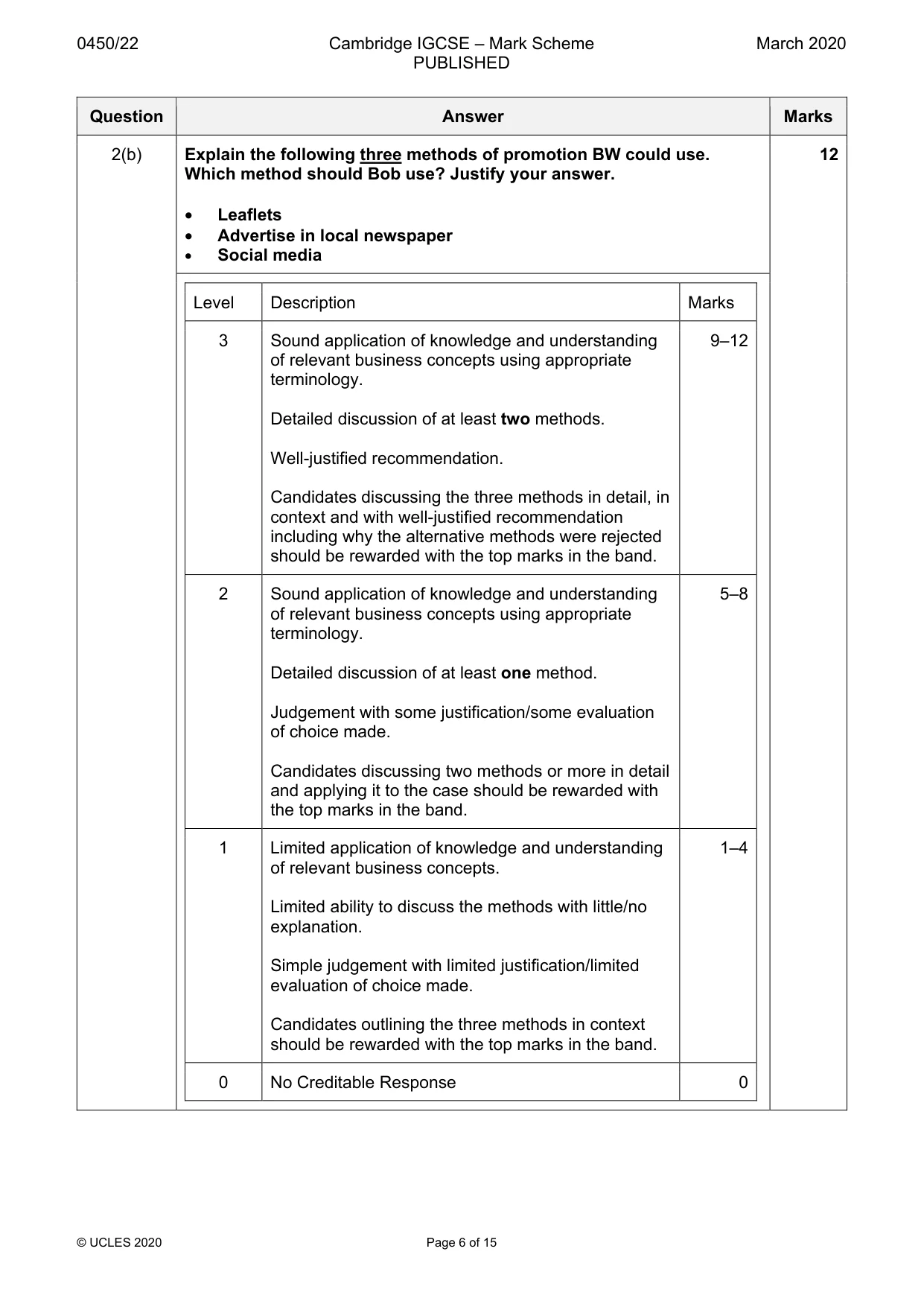
0450/22 Cambridge IGCSE – Mark Scheme PUBLISHED March 2020 © UCLES 2020 Page 6 of 15 Question Answer Marks 2(b) Explain the following three methods of promotion BW could use. Which method should Bob use? Justify your answer. • Leaflets • Advertise in local newspaper • Social media 12 Level Description Marks 3 Sound application of knowledge and understanding of relevant business concepts using appropriate terminology. Detailed discussion of at least two methods. Well-justified recommendation. Candidates discussing the three methods in detail, in context and with well-justified recommendation including why the alternative methods were rejected should be rewarded with the top marks in the band. 9–12 2 Sound application of knowledge and understanding of relevant business concepts using appropriate terminology. Detailed discussion of at least one method. Judgement with some justification/some evaluation of choice made. Candidates discussing two methods or more in detail and applying it to the case should be rewarded with the top marks in the band. 5–8 1 Limited application of knowledge and understanding of relevant business concepts. Limited ability to discuss the methods with little/no explanation. Simple judgement with limited justification/limited evaluation of choice made. Candidates outlining the three methods in context should be rewarded with the top marks in the band. 1–4 0 No Creditable Response 0
Mark scheme, page 7
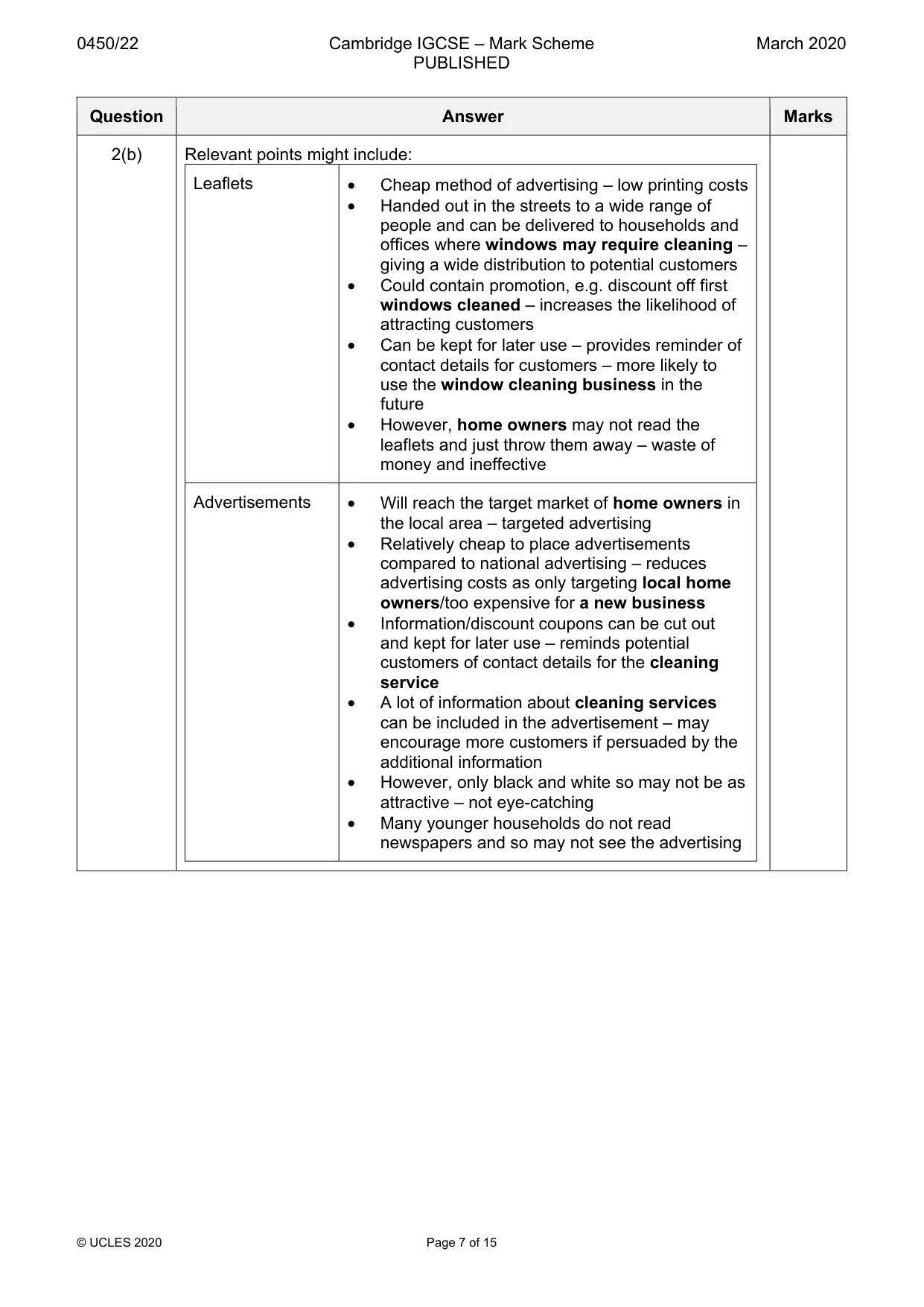
0450/22 Cambridge IGCSE – Mark Scheme PUBLISHED March 2020 © UCLES 2020 Page 7 of 15 Question Answer Marks 2(b) Relevant points might include: Leaflets • Cheap method of advertising – low printing costs • Handed out in the streets to a wide range of people and can be delivered to households and offices where windows may require cleaning – giving a wide distribution to potential customers • Could contain promotion, e.g. discount off first windows cleaned – increases the likelihood of attracting customers • Can be kept for later use – provides reminder of contact details for customers – more likely to use the window cleaning business in the future • However, home owners may not read the leaflets and just throw them away – waste of money and ineffective Advertisements • Will reach the target market of home owners in the local area – targeted advertising • Relatively cheap to place advertisements compared to national advertising – reduces advertising costs as only targeting local home owners/too expensive for a new business • Information/discount coupons can be cut out and kept for later use – reminds potential customers of contact details for the cleaning service • A lot of information about cleaning services can be included in the advertisement – may encourage more customers if persuaded by the additional information • However, only black and white so may not be as attractive – not eye-catching • Many younger households do not read newspapers and so may not see the advertising
Mark scheme, page 8
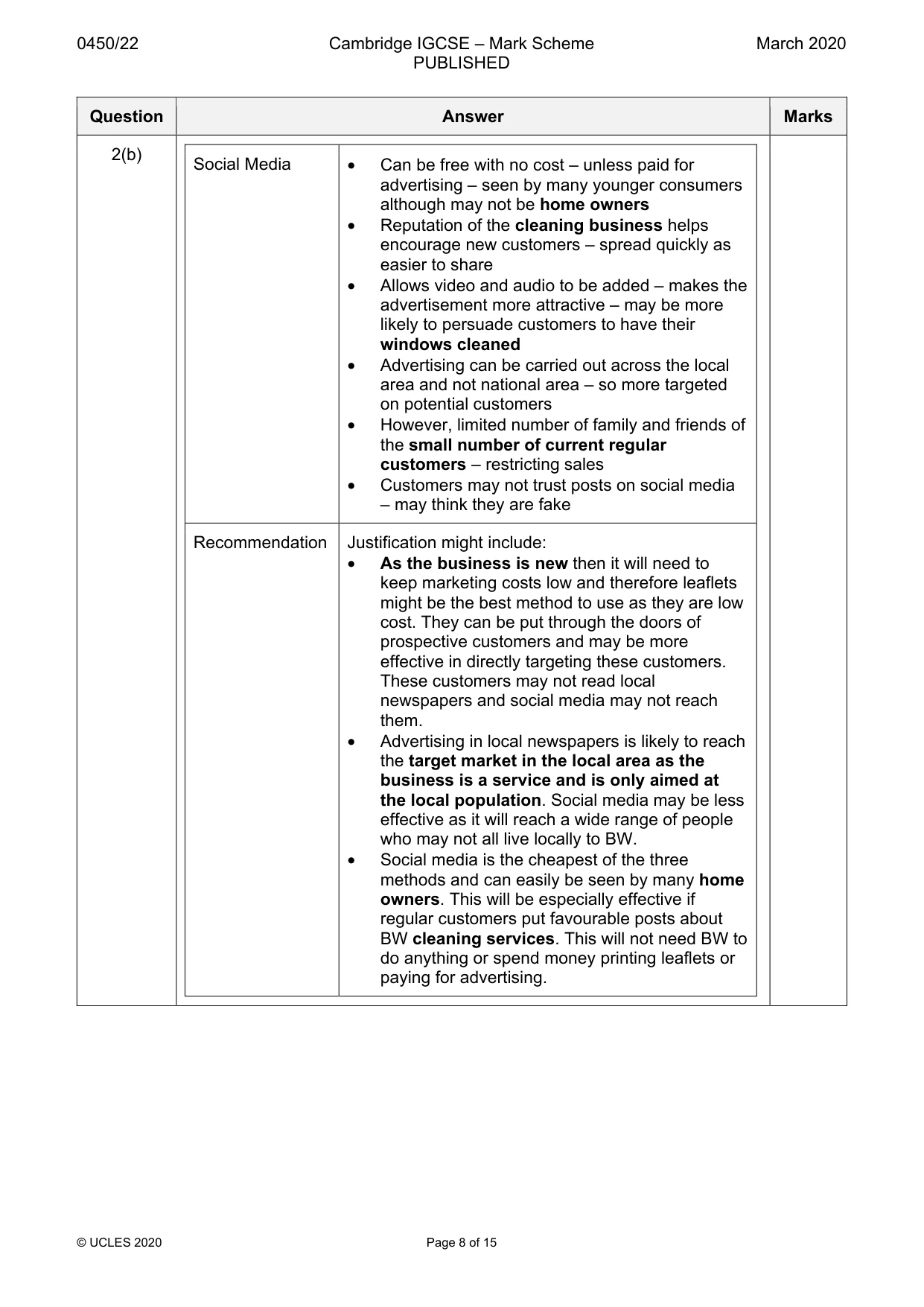
0450/22 Cambridge IGCSE – Mark Scheme PUBLISHED March 2020 © UCLES 2020 Page 8 of 15 Question Answer Marks 2(b) Social Media • Can be free with no cost – unless paid for advertising – seen by many younger consumers although may not be home owners • Reputation of the cleaning business helps encourage new customers – spread quickly as easier to share • Allows video and audio to be added – makes the advertisement more attractive – may be more likely to persuade customers to have their windows cleaned • Advertising can be carried out across the local area and not national area – so more targeted on potential customers • However, limited number of family and friends of the small number of current regular customers – restricting sales • Customers may not trust posts on social media – may think they are fake Recommendation Justification might include: • As the business is new then it will need to keep marketing costs low and therefore leaflets might be the best method to use as they are low cost. They can be put through the doors of prospective customers and may be more effective in directly targeting these customers. These customers may not read local newspapers and social media may not reach them. • Advertising in local newspapers is likely to reach the target market in the local area as the business is a service and is only aimed at the local population. Social media may be less effective as it will reach a wide range of people who may not all live locally to BW. • Social media is the cheapest of the three methods and can easily be seen by many home owners. This will be especially effective if regular customers put favourable posts about BW cleaning services. This will not need BW to do anything or spend money printing leaflets or paying for advertising.
Mark scheme, page 9
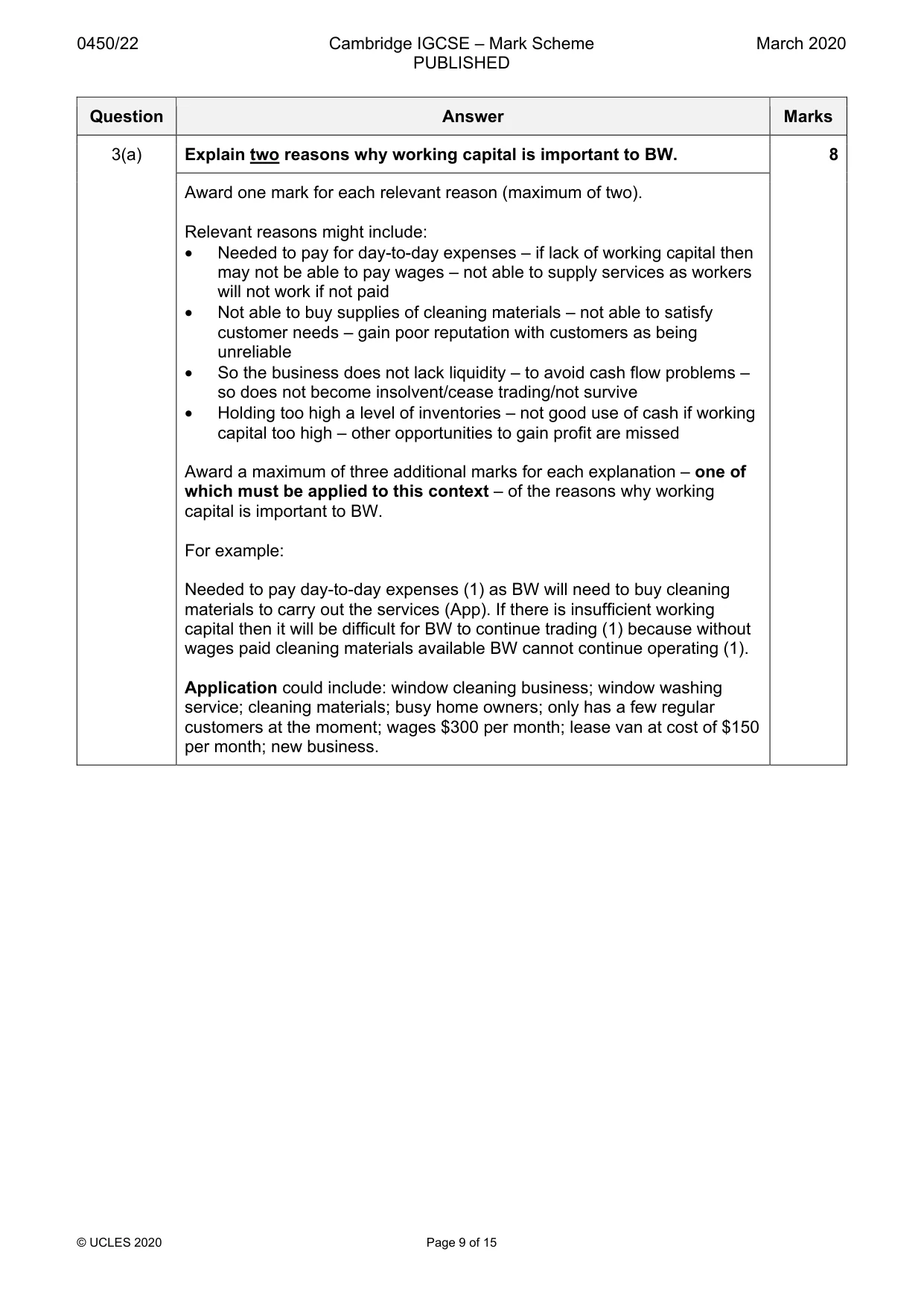
0450/22 Cambridge IGCSE – Mark Scheme PUBLISHED March 2020 © UCLES 2020 Page 9 of 15 Question Answer Marks 3(a) Explain two reasons why working capital is important to BW. 8 Award one mark for each relevant reason (maximum of two). Relevant reasons might include: • Needed to pay for day-to-day expenses – if lack of working capital then may not be able to pay wages – not able to supply services as workers will not work if not paid • Not able to buy supplies of cleaning materials – not able to satisfy customer needs – gain poor reputation with customers as being unreliable • So the business does not lack liquidity – to avoid cash flow problems – so does not become insolvent/cease trading/not survive • Holding too high a level of inventories – not good use of cash if working capital too high – other opportunities to gain profit are missed Award a maximum of three additional marks for each explanation – one of which must be applied to this context – of the reasons why working capital is important to BW. For example: Needed to pay day-to-day expenses (1) as BW will need to buy cleaning materials to carry out the services (App). If there is insufficient working capital then it will be difficult for BW to continue trading (1) because without wages paid cleaning materials available BW cannot continue operating (1). Application could include: window cleaning business; window washing service; cleaning materials; busy home owners; only has a few regular customers at the moment; wages $300 per month; lease van at cost of $150 per month; new business.
Mark scheme, page 10
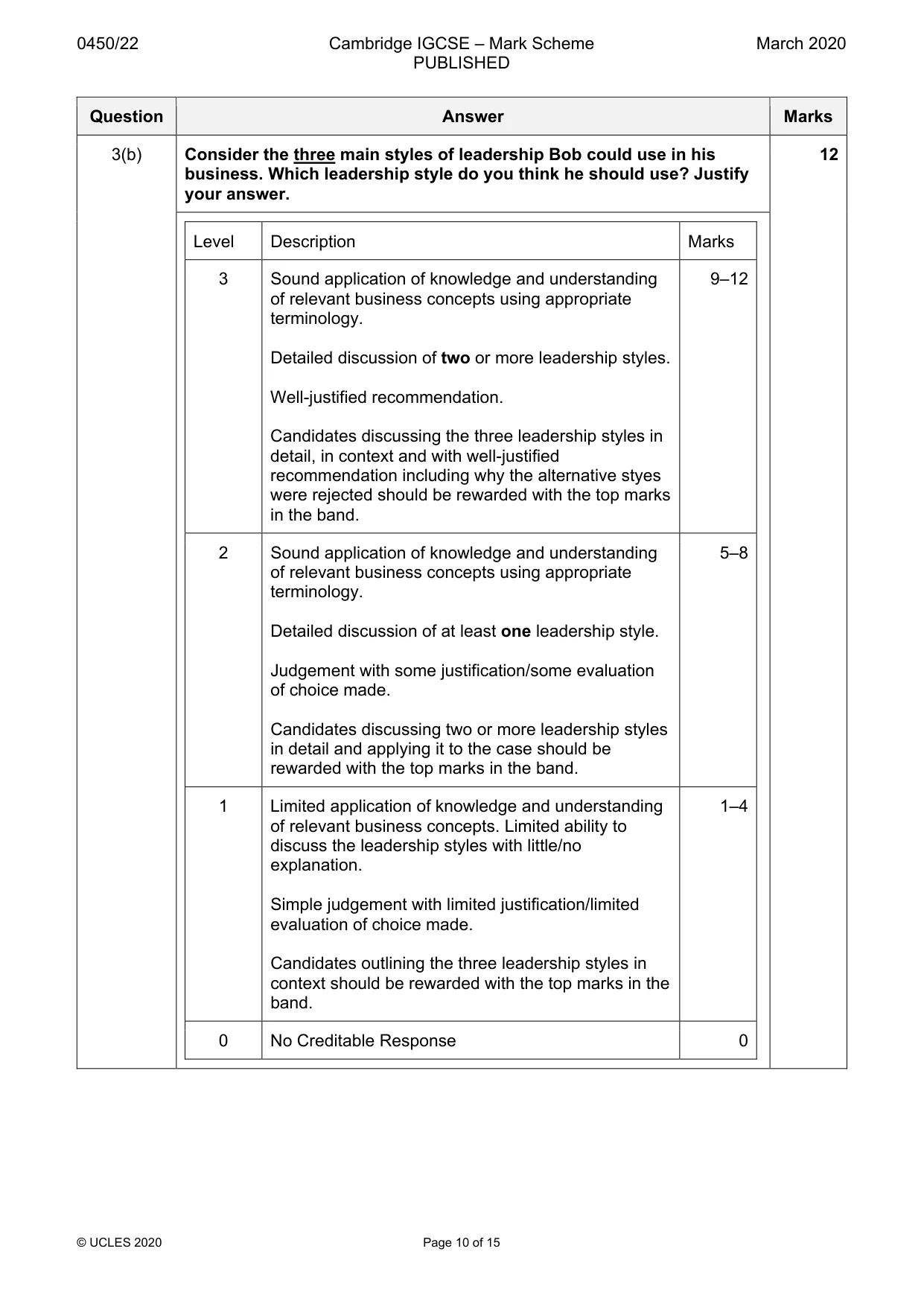
0450/22 Cambridge IGCSE – Mark Scheme PUBLISHED March 2020 © UCLES 2020 Page 10 of 15 Question Answer Marks 3(b) Consider the three main styles of leadership Bob could use in his business. Which leadership style do you think he should use? Justify your answer. 12 Level Description Marks 3 Sound application of knowledge and understanding of relevant business concepts using appropriate terminology. Detailed discussion of two or more leadership styles. Well-justified recommendation. Candidates discussing the three leadership styles in detail, in context and with well-justified recommendation including why the alternative styes were rejected should be rewarded with the top marks in the band. 9–12 2 Sound application of knowledge and understanding of relevant business concepts using appropriate terminology. Detailed discussion of at least one leadership style. Judgement with some justification/some evaluation of choice made. Candidates discussing two or more leadership styles in detail and applying it to the case should be rewarded with the top marks in the band. 5–8 1 Limited application of knowledge and understanding of relevant business concepts. Limited ability to discuss the leadership styles with little/no explanation. Simple judgement with limited justification/limited evaluation of choice made. Candidates outlining the three leadership styles in context should be rewarded with the top marks in the band. 1–4 0 No Creditable Response 0
Mark scheme, page 11
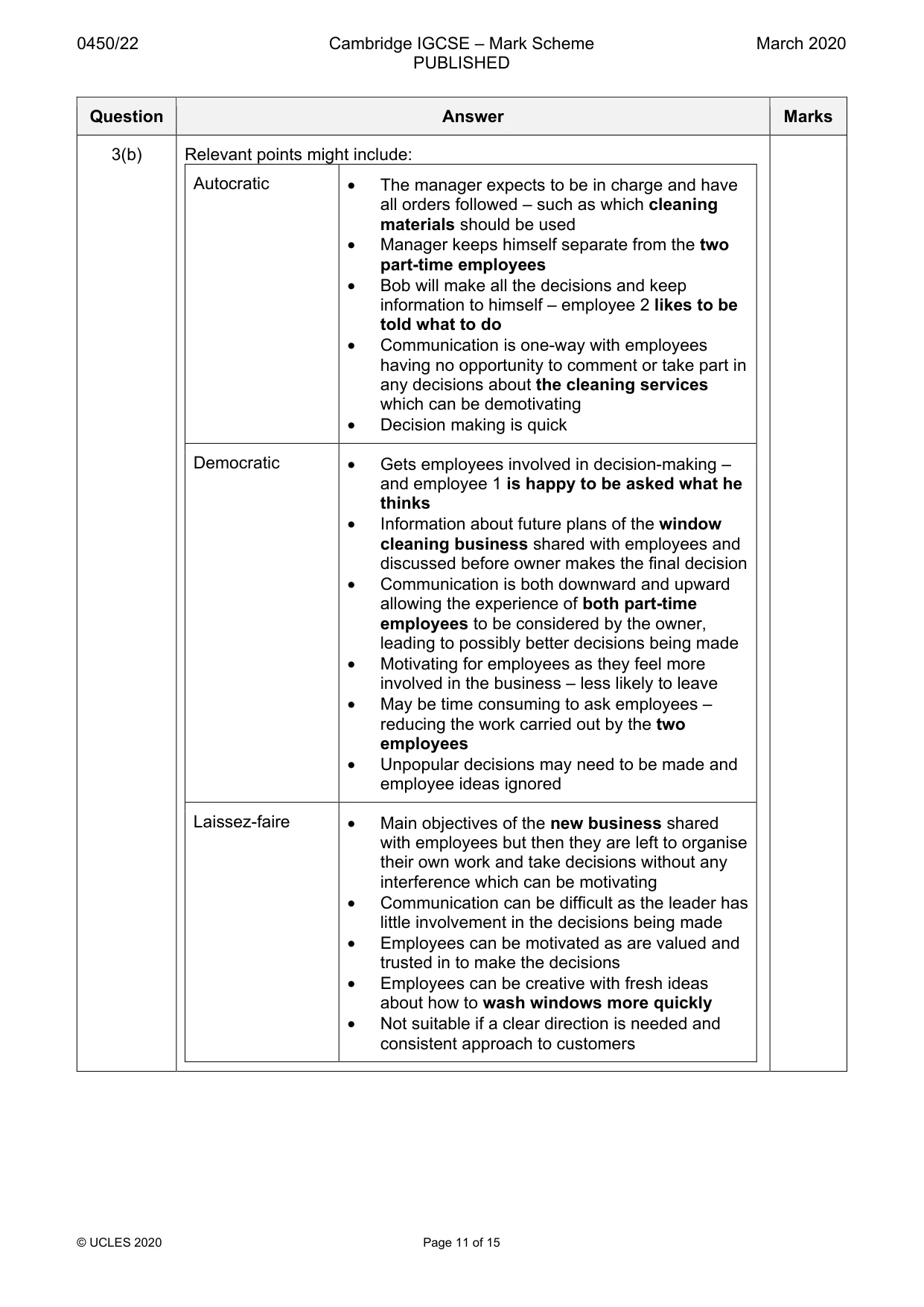
0450/22 Cambridge IGCSE – Mark Scheme PUBLISHED March 2020 © UCLES 2020 Page 11 of 15 Question Answer Marks 3(b) Relevant points might include: Autocratic • The manager expects to be in charge and have all orders followed – such as which cleaning materials should be used • Manager keeps himself separate from the two part-time employees • Bob will make all the decisions and keep information to himself – employee 2 likes to be told what to do • Communication is one-way with employees having no opportunity to comment or take part in any decisions about the cleaning services which can be demotivating • Decision making is quick Democratic • Gets employees involved in decision-making – and employee 1 is happy to be asked what he thinks • Information about future plans of the window cleaning business shared with employees and discussed before owner makes the final decision • Communication is both downward and upward allowing the experience of both part-time employees to be considered by the owner, leading to possibly better decisions being made • Motivating for employees as they feel more involved in the business – less likely to leave • May be time consuming to ask employees – reducing the work carried out by the two employees • Unpopular decisions may need to be made and employee ideas ignored Laissez-faire • Main objectives of the new business shared with employees but then they are left to organise their own work and take decisions without any interference which can be motivating • Communication can be difficult as the leader has little involvement in the decisions being made • Employees can be motivated as are valued and trusted in to make the decisions • Employees can be creative with fresh ideas about how to wash windows more quickly • Not suitable if a clear direction is needed and consistent approach to customers
Mark scheme, page 12
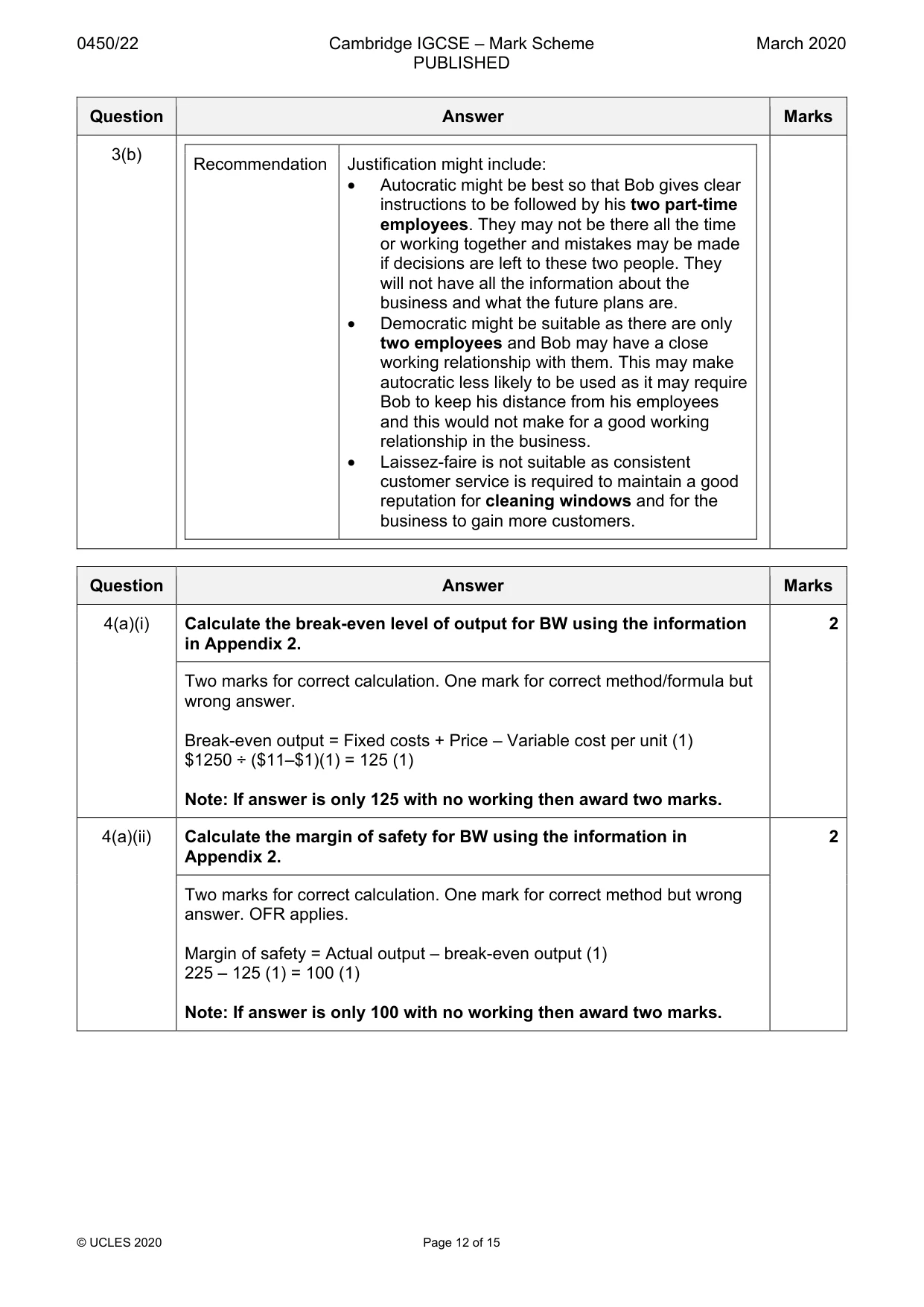
0450/22 Cambridge IGCSE – Mark Scheme PUBLISHED March 2020 © UCLES 2020 Page 12 of 15 Question Answer Marks 3(b) Recommendation Justification might include: • Autocratic might be best so that Bob gives clear instructions to be followed by his two part-time employees. They may not be there all the time or working together and mistakes may be made if decisions are left to these two people. They will not have all the information about the business and what the future plans are. • Democratic might be suitable as there are only two employees and Bob may have a close working relationship with them. This may make autocratic less likely to be used as it may require Bob to keep his distance from his employees and this would not make for a good working relationship in the business. • Laissez-faire is not suitable as consistent customer service is required to maintain a good reputation for cleaning windows and for the business to gain more customers. Question Answer Marks 4(a)(i) Calculate the break-even level of output for BW using the information in Appendix 2. 2 Two marks for correct calculation. One mark for correct method/formula but wrong answer. Break-even output = Fixed costs + Price – Variable cost per unit (1) $1250 ÷ ($11–$1)(1) = 125 (1) Note: If answer is only 125 with no working then award two marks. 4(a)(ii) Calculate the margin of safety for BW using the information in Appendix 2. 2 Two marks for correct calculation. One mark for correct method but wrong answer. OFR applies. Margin of safety = Actual output – break-even output (1) 225 – 125 (1) = 100 (1) Note: If answer is only 100 with no working then award two marks.
Mark scheme, page 13
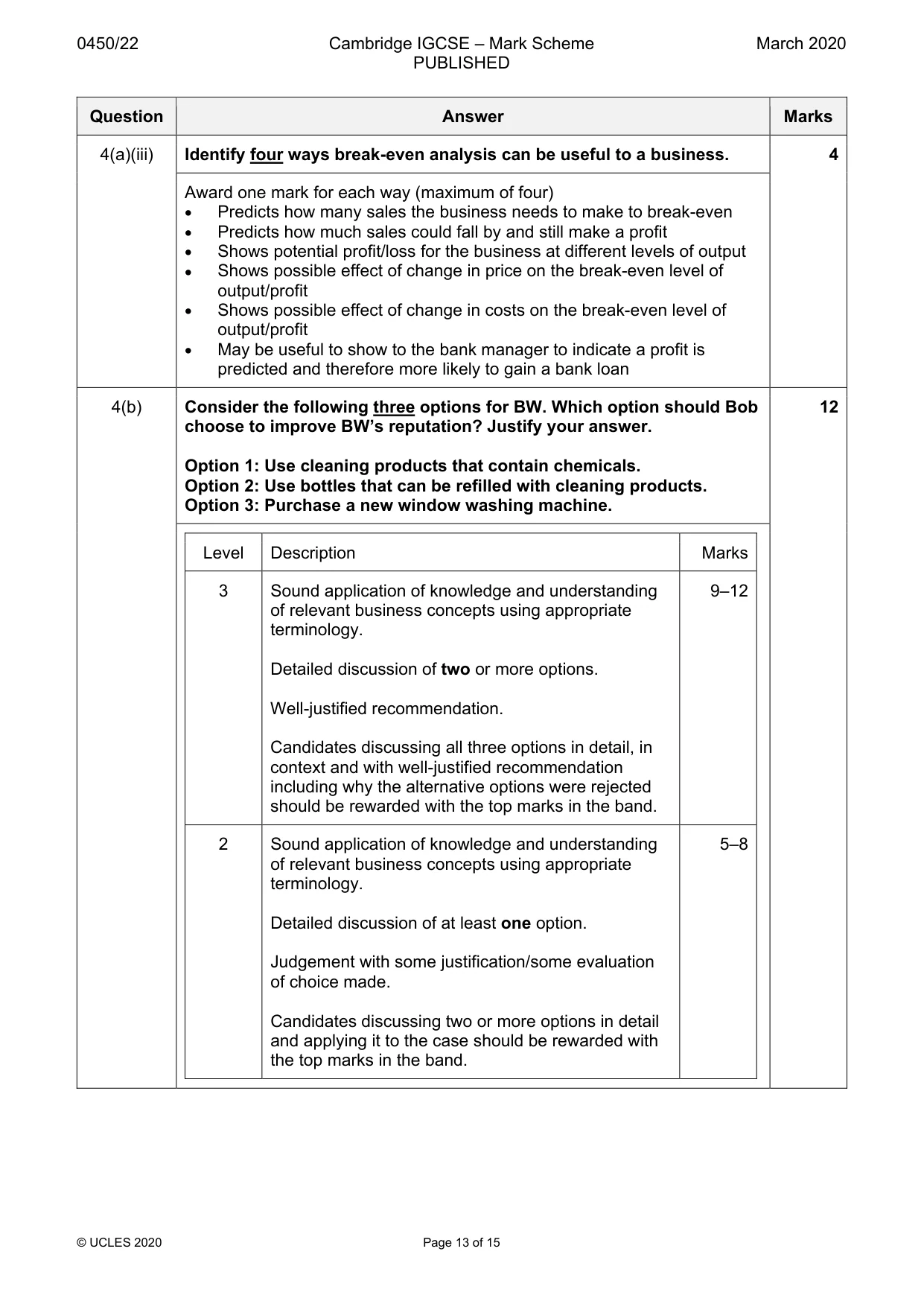
0450/22 Cambridge IGCSE – Mark Scheme PUBLISHED March 2020 © UCLES 2020 Page 13 of 15 Question Answer Marks 4(a)(iii) Identify four ways break-even analysis can be useful to a business. 4 Award one mark for each way (maximum of four) • Predicts how many sales the business needs to make to break-even • Predicts how much sales could fall by and still make a profit • Shows potential profit/loss for the business at different levels of output • Shows possible effect of change in price on the break-even level of output/profit • Shows possible effect of change in costs on the break-even level of output/profit • May be useful to show to the bank manager to indicate a profit is predicted and therefore more likely to gain a bank loan 4(b) Consider the following three options for BW. Which option should Bob choose to improve BW’s reputation? Justify your answer. Option 1: Use cleaning products that contain chemicals. Option 2: Use bottles that can be refilled with cleaning products. Option 3: Purchase a new window washing machine. 12 Level Description Marks 3 Sound application of knowledge and understanding of relevant business concepts using appropriate terminology. Detailed discussion of two or more options. Well-justified recommendation. Candidates discussing all three options in detail, in context and with well-justified recommendation including why the alternative options were rejected should be rewarded with the top marks in the band. 9–12 2 Sound application of knowledge and understanding of relevant business concepts using appropriate terminology. Detailed discussion of at least one option. Judgement with some justification/some evaluation of choice made. Candidates discussing two or more options in detail and applying it to the case should be rewarded with the top marks in the band. 5–8
Mark scheme, page 14
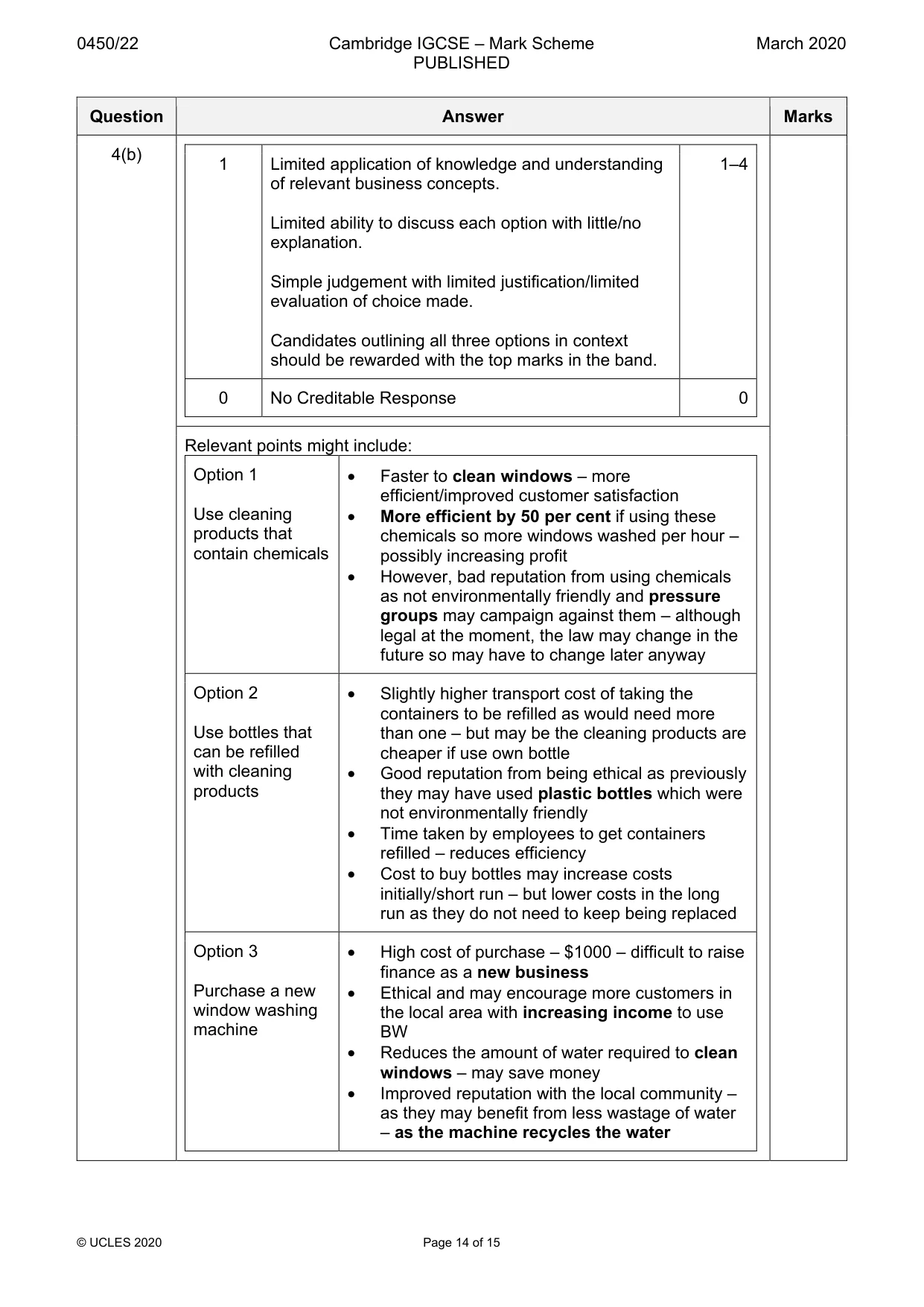
0450/22 Cambridge IGCSE – Mark Scheme PUBLISHED March 2020 © UCLES 2020 Page 14 of 15 Question Answer Marks 4(b) 1 Limited application of knowledge and understanding of relevant business concepts. Limited ability to discuss each option with little/no explanation. Simple judgement with limited justification/limited evaluation of choice made. Candidates outlining all three options in context should be rewarded with the top marks in the band. 1–4 0 No Creditable Response 0 Relevant points might include: Option 1 Use cleaning products that contain chemicals • Faster to clean windows – more efficient/improved customer satisfaction • More efficient by 50 per cent if using these chemicals so more windows washed per hour – possibly increasing profit • However, bad reputation from using chemicals as not environmentally friendly and pressure groups may campaign against them – although legal at the moment, the law may change in the future so may have to change later anyway Option 2 Use bottles that can be refilled with cleaning products • Slightly higher transport cost of taking the containers to be refilled as would need more than one – but may be the cleaning products are cheaper if use own bottle • Good reputation from being ethical as previously they may have used plastic bottles which were not environmentally friendly • Time taken by employees to get containers refilled – reduces efficiency • Cost to buy bottles may increase costs initially/short run – but lower costs in the long run as they do not need to keep being replaced Option 3 Purchase a new window washing machine • High cost of purchase – $1000 – difficult to raise finance as a new business • Ethical and may encourage more customers in the local area with increasing income to use BW • Reduces the amount of water required to clean windows – may save money • Improved reputation with the local community – as they may benefit from less wastage of water – as the machine recycles the water
Mark scheme, page 15
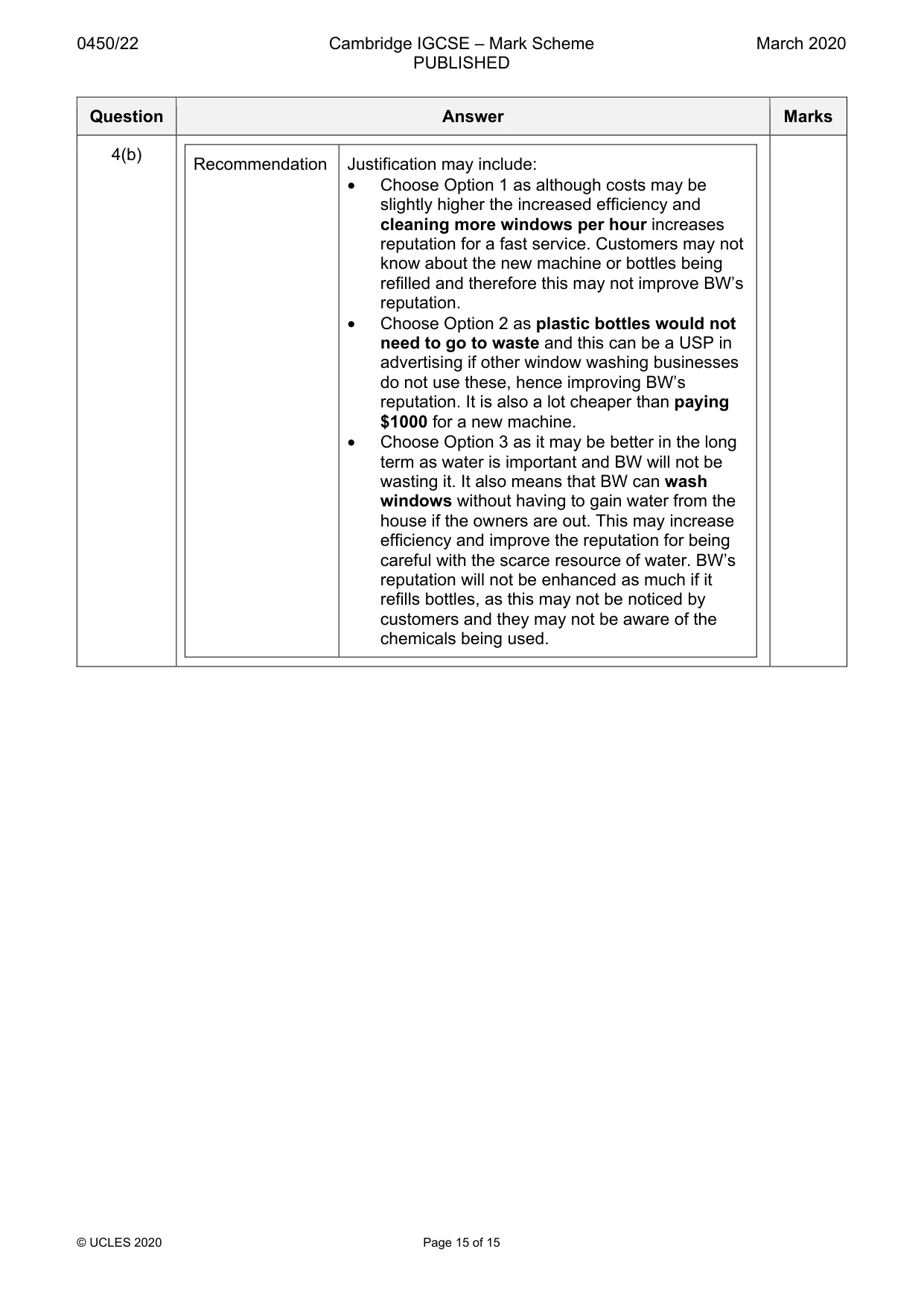
0450/22 Cambridge IGCSE – Mark Scheme PUBLISHED March 2020 © UCLES 2020 Page 15 of 15 Question Answer Marks 4(b) Recommendation Justification may include: • Choose Option 1 as although costs may be slightly higher the increased efficiency and cleaning more windows per hour increases reputation for a fast service. Customers may not know about the new machine or bottles being refilled and therefore this may not improve BW’s reputation. • Choose Option 2 as plastic bottles would not need to go to waste and this can be a USP in advertising if other window washing businesses do not use these, hence improving BW’s reputation. It is also a lot cheaper than paying $1000 for a new machine. • Choose Option 3 as it may be better in the long term as water is important and BW will not be wasting it. It also means that BW can wash windows without having to gain water from the house if the owners are out. This may increase efficiency and improve the reputation for being careful with the scarce resource of water. BW’s reputation will not be enhanced as much if it refills bottles, as this may not be noticed by customers and they may not be aware of the chemicals being used.
What you needed in this session
Cambridge’s own grade thresholds for 2020 Feb/March, Paper 2 · Variant 2. A higher threshold means an easier paper — the bar moves with how the cohort did.