Cambridge IGCSE Business Studies 0450 — 2017 Oct/Nov Paper 2 · Variant 3
0450/23/O/N/17 · 80 marks · ≈90 min
The question paper and its mark scheme, free to read here and free to download. This is Cambridge’s own paper, exactly as it was sat.
Question paper12 pages

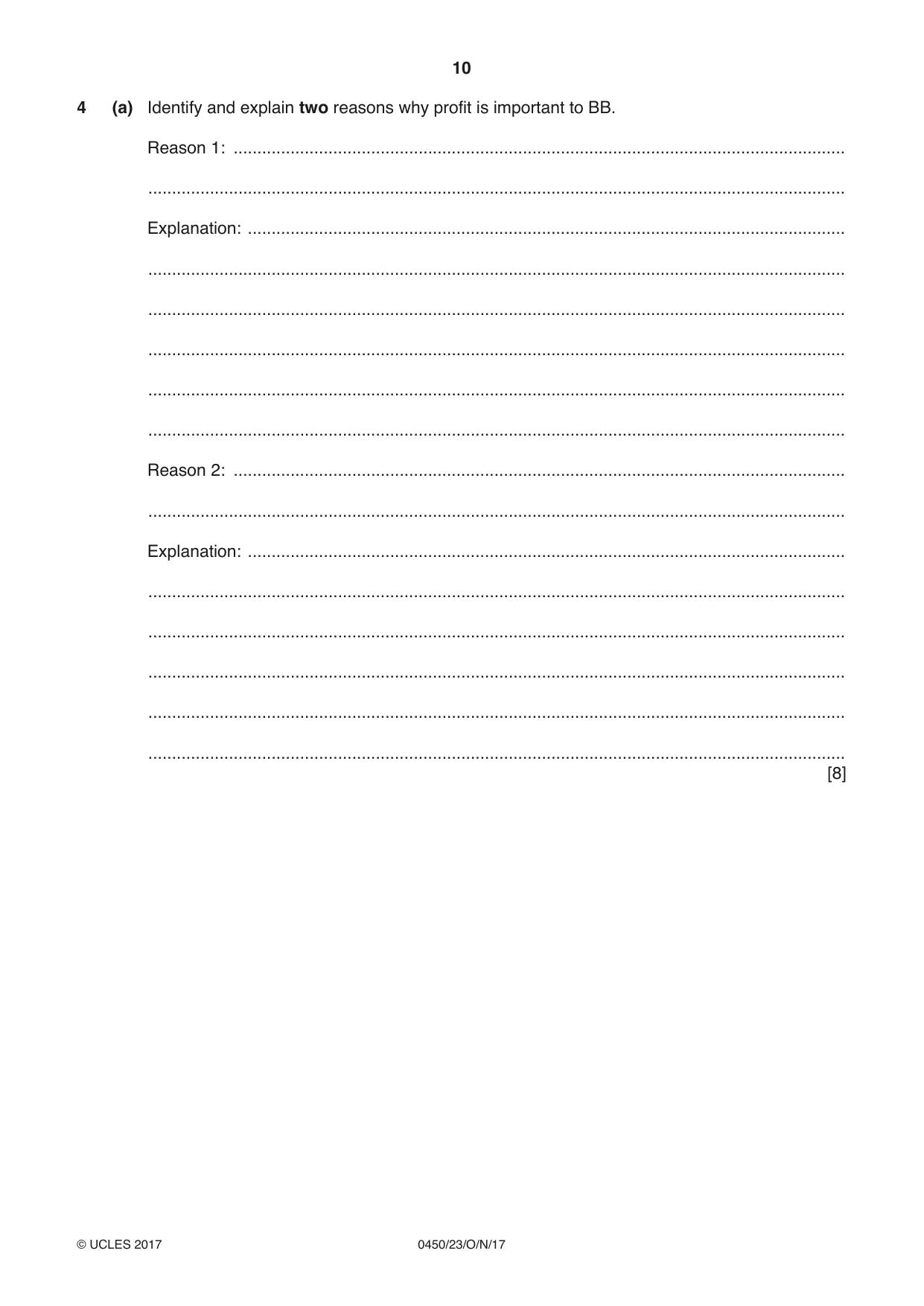
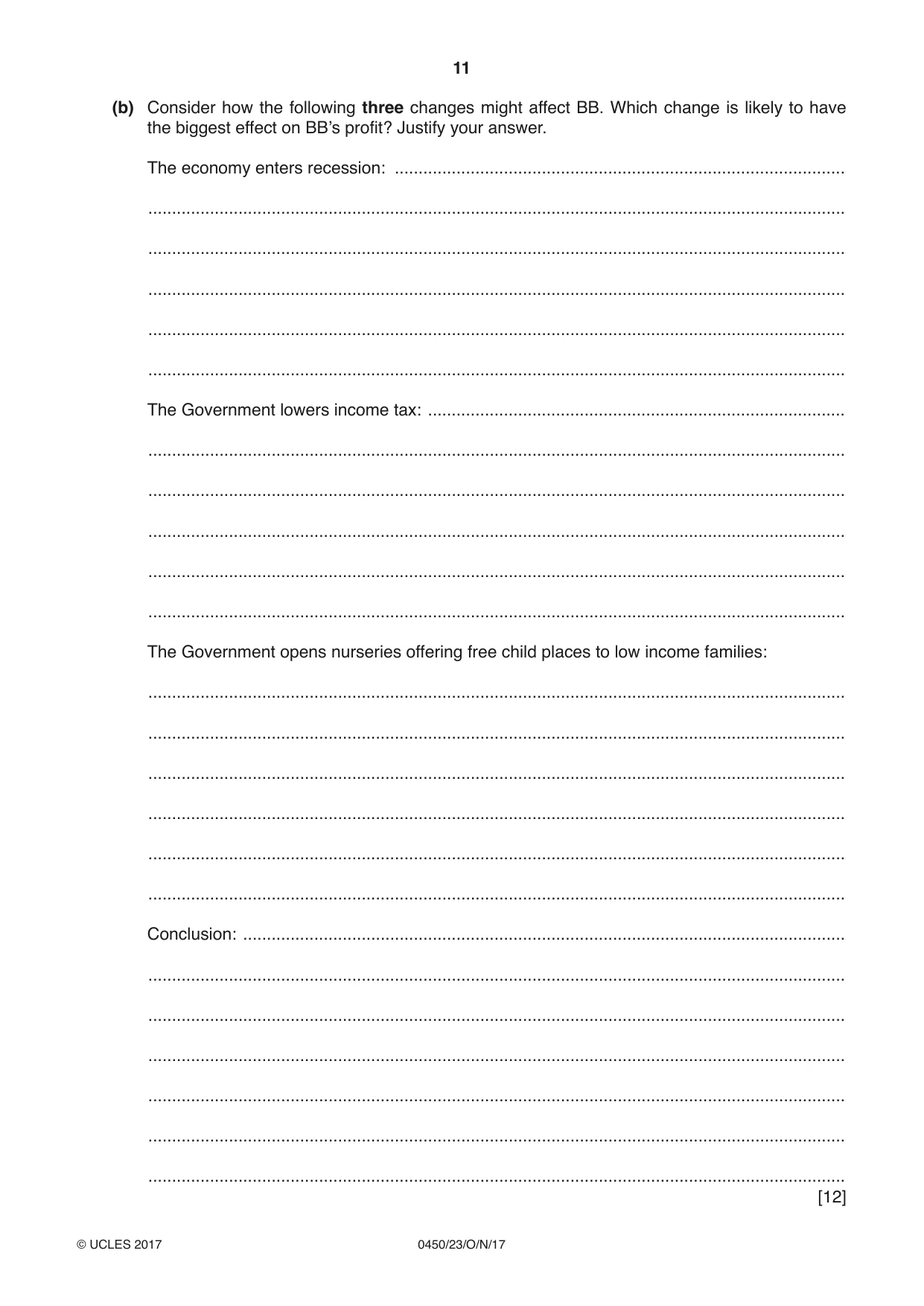

Mark scheme12 pages
Answers below. Sit the paper first if you are practising.
Paper as text
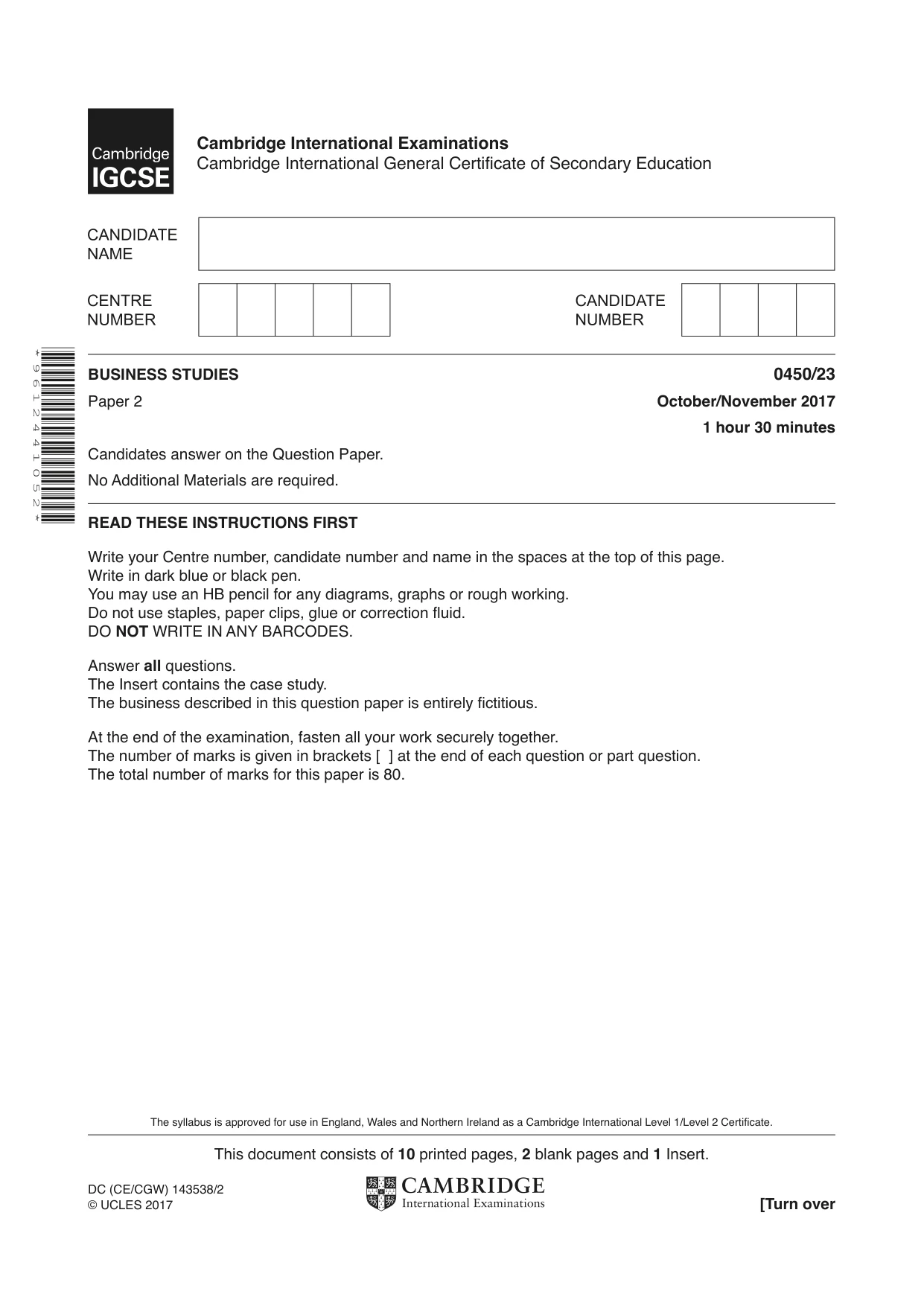
Question paper, page 1
* 9 6 1 2 4 4 1 0 5 2 * This document consists of 10 printed pages, 2 blank pages and 1 Insert. DC (CE/CGW) 143538/2 © UCLES 2017 [Turn over Cambridge International Examinations Cambridge International General Certificate of Secondary Education BUSINESS STUDIES 0450/23 Paper 2 October/November 2017 1 hour 30 minutes Candidates answer on the Question Paper. No Additional Materials are required. READ THESE INSTRUCTIONS FIRST Write your Centre number, candidate number and name in the spaces at the top of this page. Write in dark blue or black pen. You may use an HB pencil for any diagrams, graphs or rough working. Do not use staples, paper clips, glue or correction fluid. DO NOT WRITE IN ANY BARCODES. Answer all questions. The Insert contains the case study. The business described in this question paper is entirely fictitious. At the end of the examination, fasten all your work securely together. The number of marks is given in brackets [ ] at the end of each question or part question. The total number of marks for this paper is 80. The syllabus is approved for use in England, Wales and Northern Ireland as a Cambridge International Level 1/Level 2 Certificate.
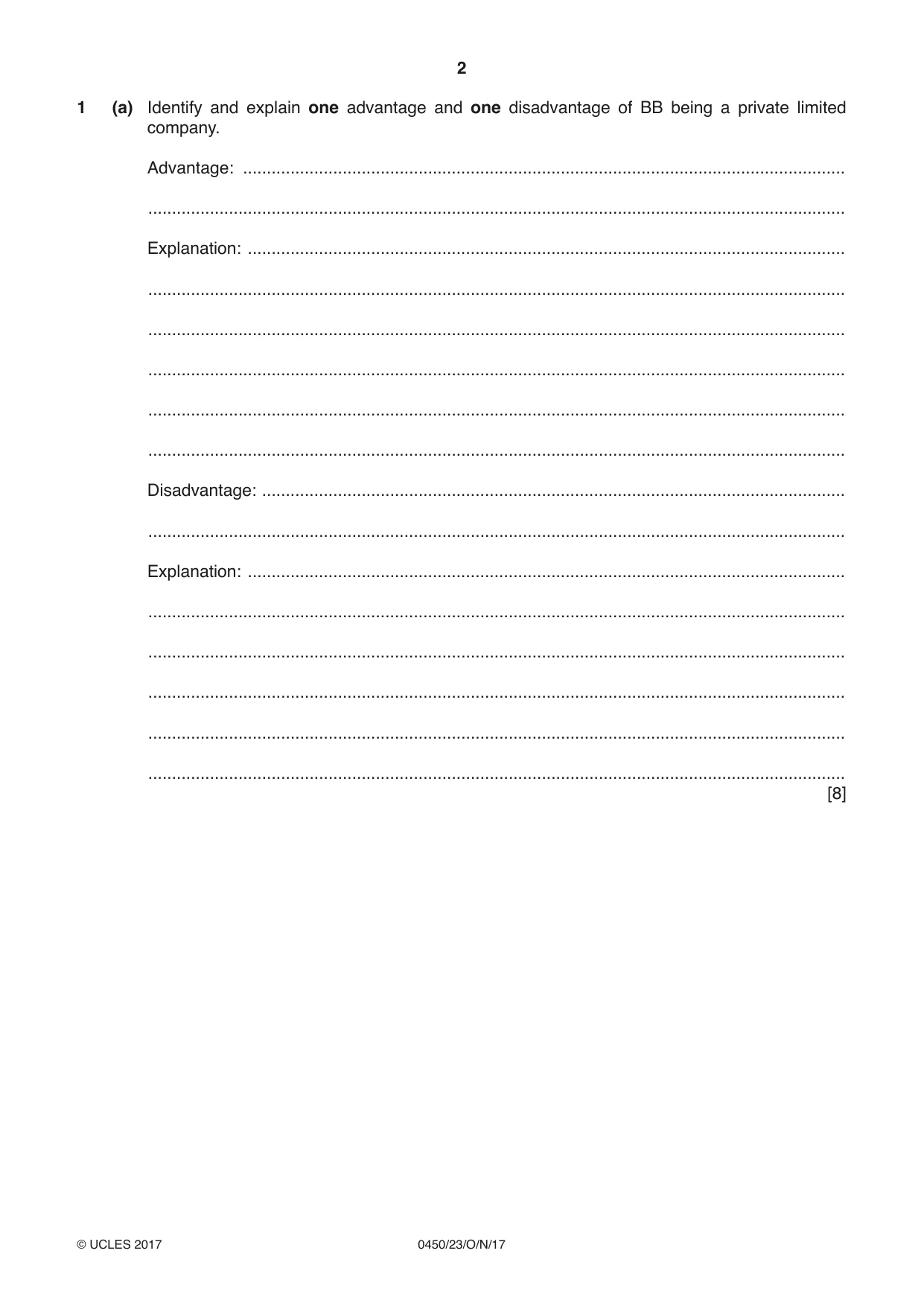
Question paper, page 2
2 0450/23/O/N/17 © UCLES 2017 1 (a) Identify and explain one advantage and one disadvantage of BB being a private limited company. Advantage: … … Explanation: … … … … … … Disadvantage: … … Explanation: … … … … … … [8]
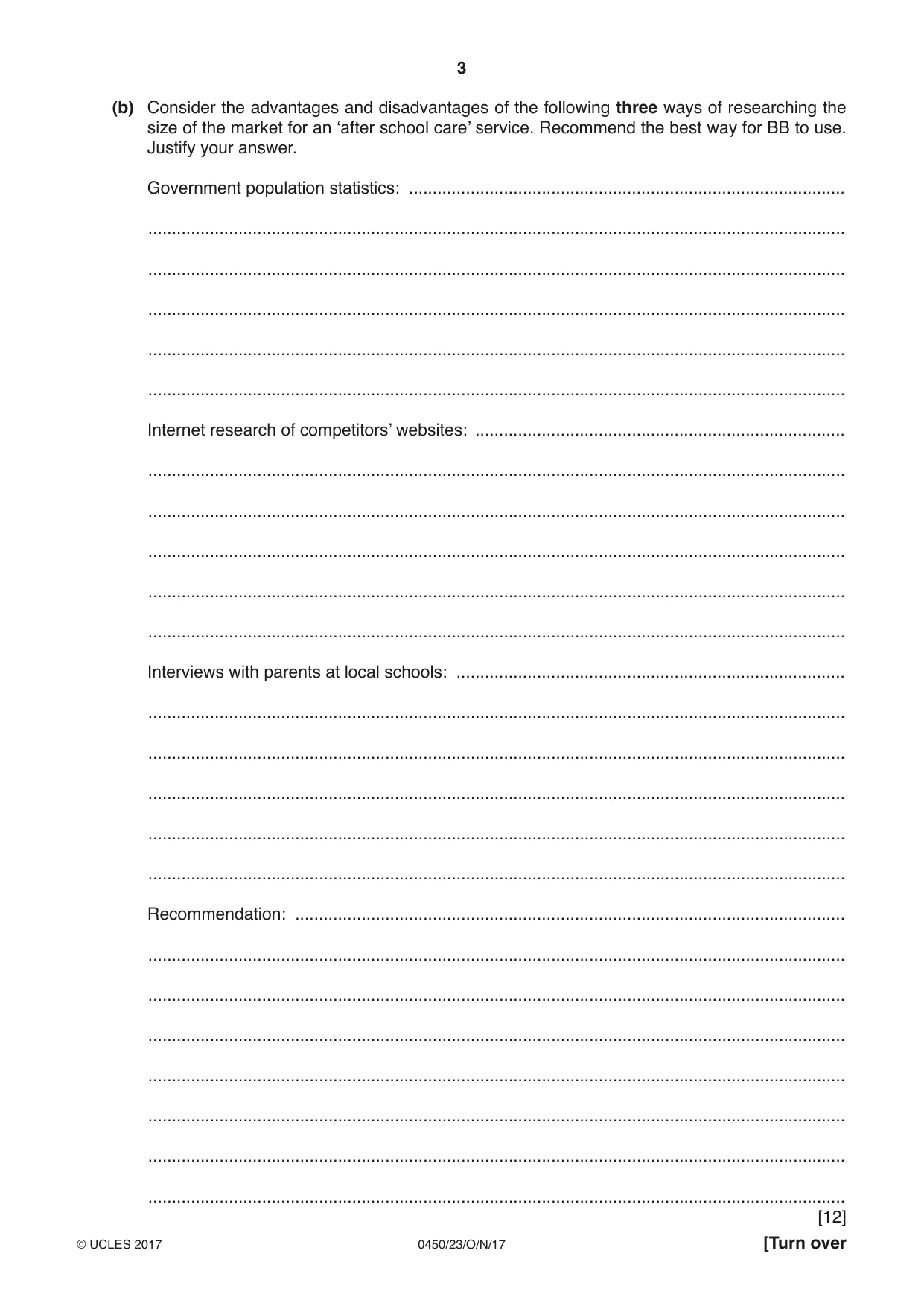
Question paper, page 3
3 0450/23/O/N/17 © UCLES 2017 [Turn over (b) Consider the advantages and disadvantages of the following three ways of researching the size of the market for an ‘after school care’ service. Recommend the best way for BB to use. Justify your answer. Government population statistics: … … … … … … Internet research of competitors’ websites: … … … … … … Interviews with parents at local schools: … … … … … … Recommendation: … … … … … … … … [12]
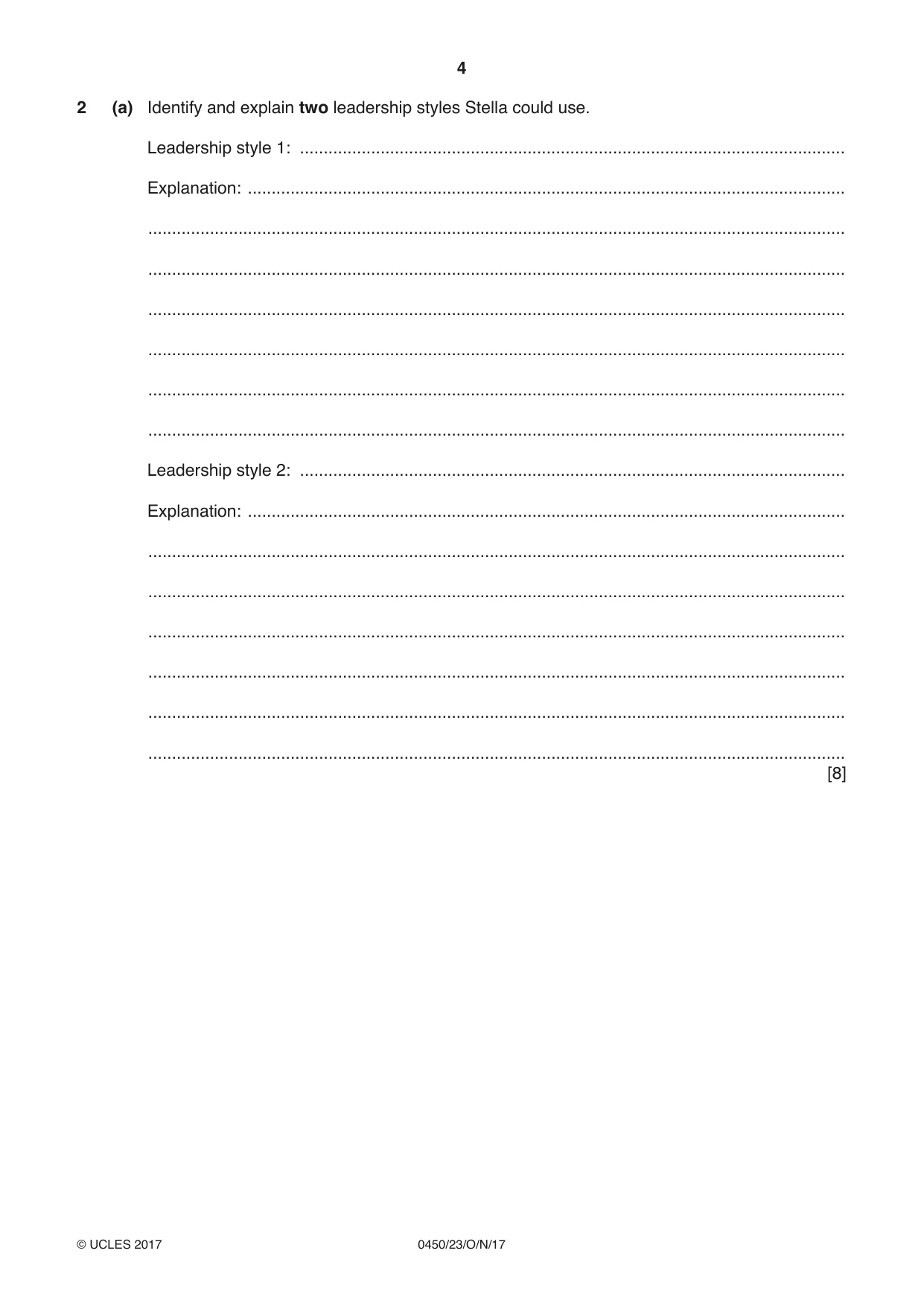
Question paper, page 4
4 0450/23/O/N/17 © UCLES 2017 2 (a) Identify and explain two leadership styles Stella could use. Leadership style 1: … Explanation: … … … … … … … Leadership style 2: … Explanation: … … … … … … … [8]
Question paper, page 5
5 0450/23/O/N/17 © UCLES 2017 [Turn over (b) Consider the advantages and disadvantages of the two options for BB to expand. Recommend the best option to choose. Justify your answer. Option 1: … … … … … … … … Option 2: … … … … … … … … Recommendation: … … … … … … … … … … [12]
Question paper, page 6
6 0450/23/O/N/17 © UCLES 2017 3 (a) Refer to the organisation chart in Appendix 2. Identify and explain the chain of command for BB and the span of control for Stella. Chain of command for BB: … … … … … … … … Span of control for Stella: … … … … … … … … [8]
Question paper, page 7
7 0450/23/O/N/17 © UCLES 2017 [Turn over BLANK PAGE Please turn over. Question 3 continues on page 8.
Question paper, page 8
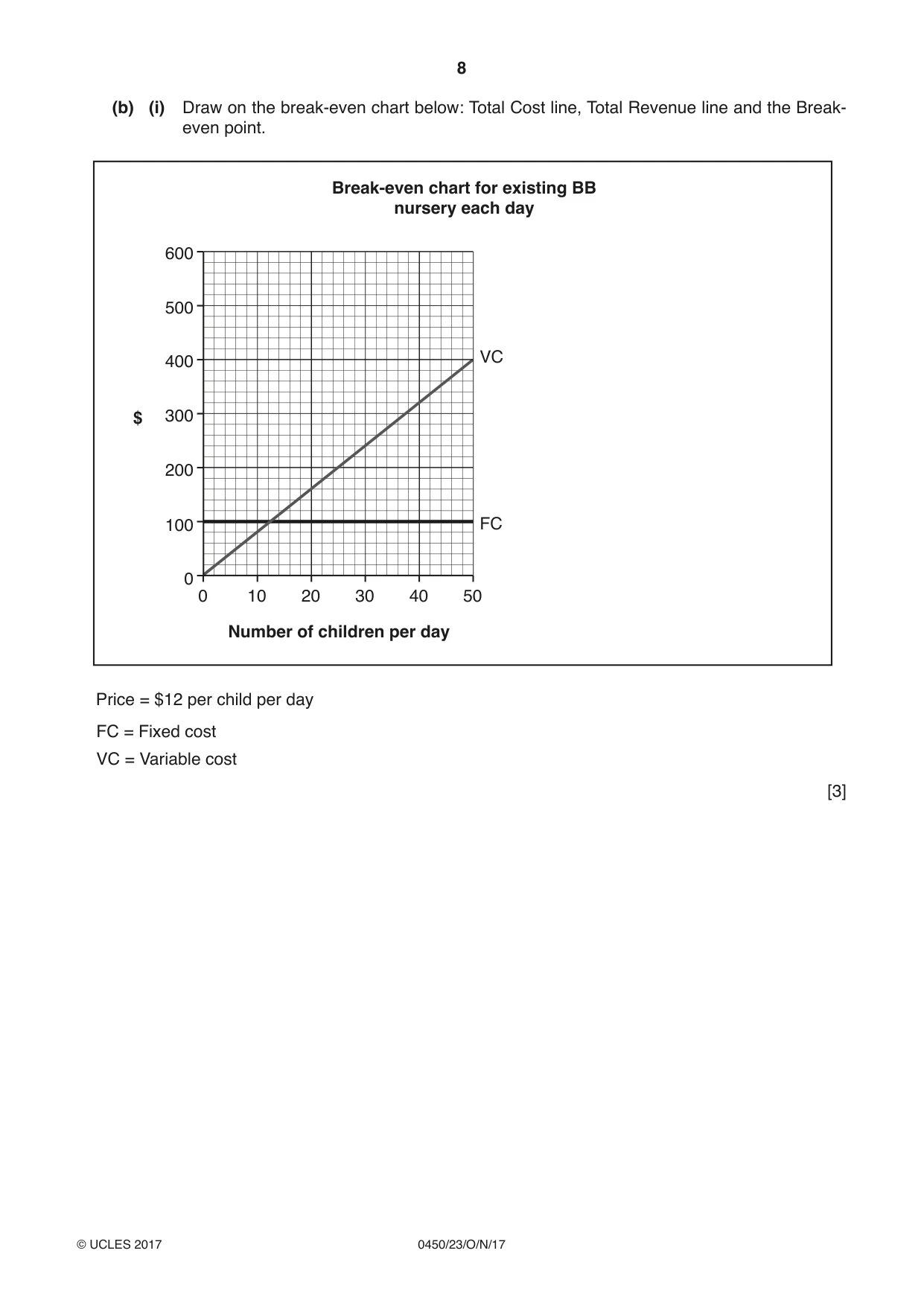
8 0450/23/O/N/17 © UCLES 2017 (b) (i) Draw on the break-even chart below: Total Cost line, Total Revenue line and the Break- even point. 0 0 10 20 30 40 VC = Variable cost VC FC FC = Fixed cost Price = $12 per child per day 50 100 200 300 400 600 Break-even chart for existing BB nursery each day Number of children per day $ 500 [3]
Question paper, page 9
9 0450/23/O/N/17 © UCLES 2017 [Turn over (ii) Consider two ways BB could use to reduce this break-even output. Recommend the best way to choose. Justify your answer. Way 1: … … … … … … Way 2: … … … … … … Recommendation: … … … … … … … … [9]
Question paper, page 10
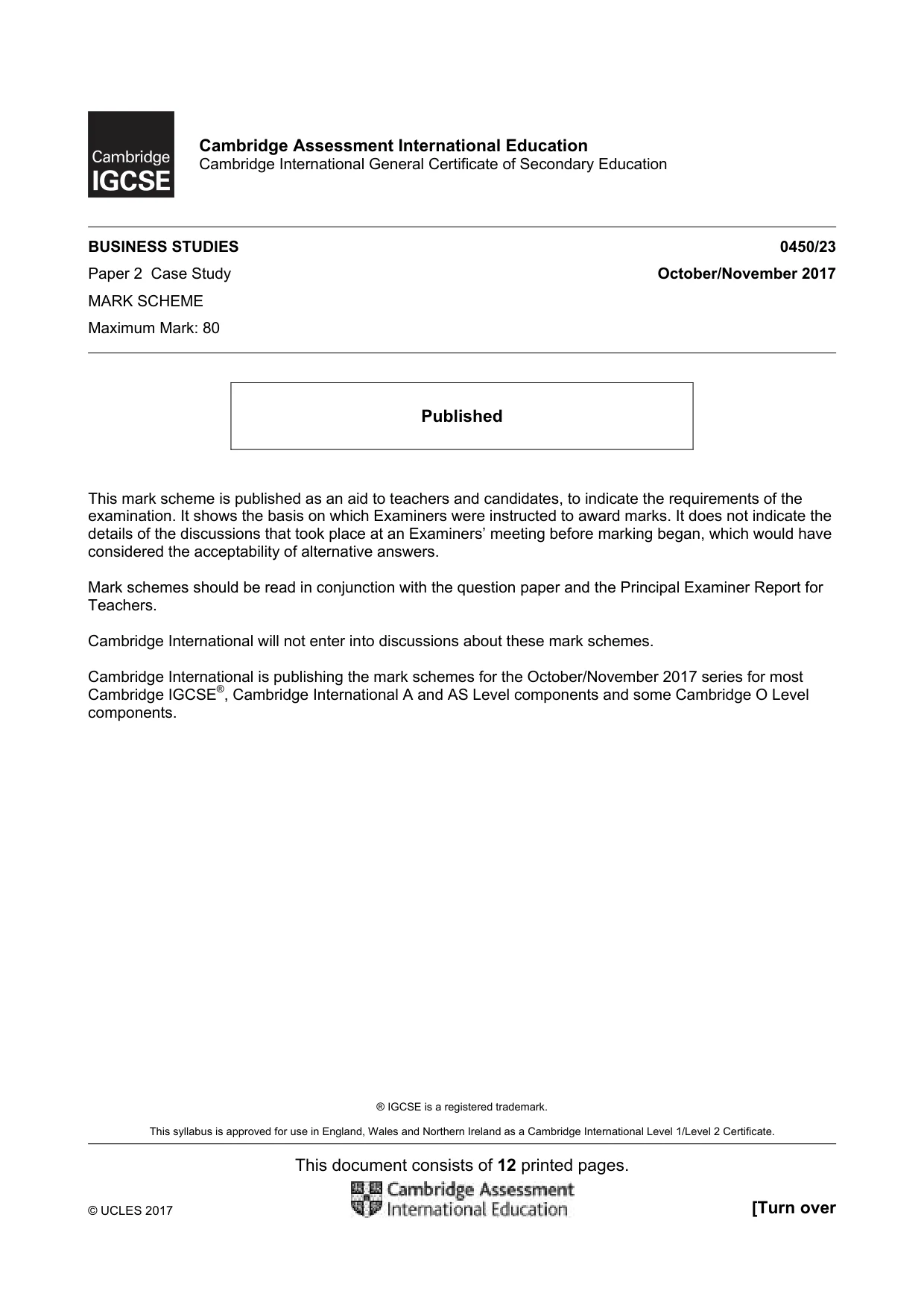
10 0450/23/O/N/17 © UCLES 2017 4 (a) Identify and explain two reasons why profit is important to BB. Reason 1: … … Explanation: … … … … … … Reason 2: … … Explanation: … … … … … … [8]
Question paper, page 11
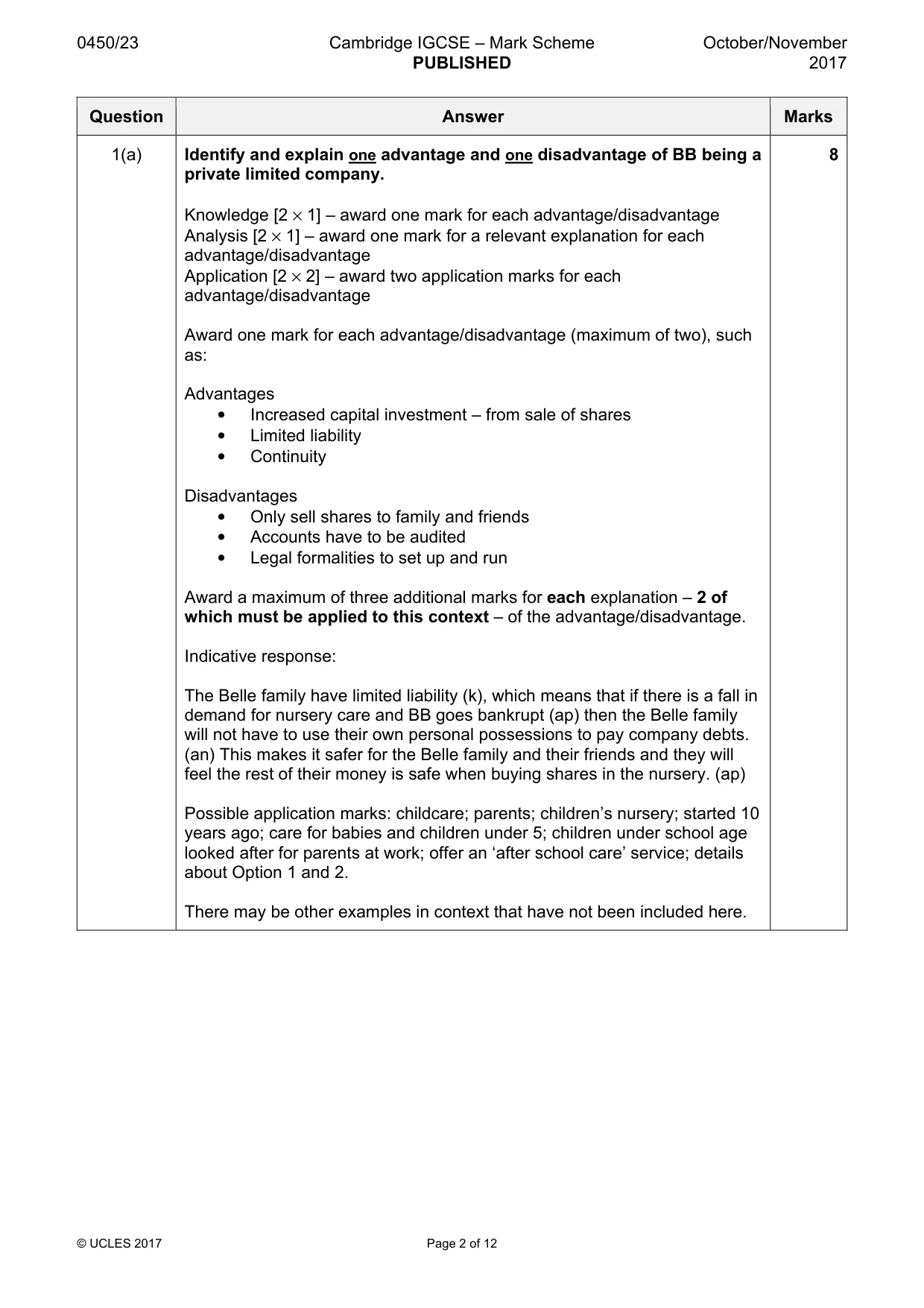
11 0450/23/O/N/17 © UCLES 2017 (b) Consider how the following three changes might affect BB. Which change is likely to have the biggest effect on BB’s profit? Justify your answer. The economy enters recession: … … … … … … The Government lowers income tax: … … … … … … The Government opens nurseries offering free child places to low income families: … … … … … … Conclusion: … … … … … … … [12]
Question paper, page 12
12 0450/23/O/N/17 © UCLES 2017 Permission to reproduce items where third-party owned material protected by copyright is included has been sought and cleared where possible. Every reasonable effort has been made by the publisher (UCLES) to trace copyright holders, but if any items requiring clearance have unwittingly been included, the publisher will be pleased to make amends at the earliest possible opportunity. To avoid the issue of disclosure of answer-related information to candidates, all copyright acknowledgements are reproduced online in the Cambridge International Examinations Copyright Acknowledgements Booklet. This is produced for each series of examinations and is freely available to download at www.cie.org.uk after the live examination series. Cambridge International Examinations is part of the Cambridge Assessment Group. Cambridge Assessment is the brand name of University of Cambridge Local Examinations Syndicate (UCLES), which is itself a department of the University of Cambridge. BLANK PAGE
Mark scheme, page 1
® IGCSE is a registered trademark. This syllabus is approved for use in England, Wales and Northern Ireland as a Cambridge International Level 1/Level 2 Certificate. This document consists of 12 printed pages. © UCLES 2017 [Turn over Cambridge Assessment International Education Cambridge International General Certificate of Secondary Education BUSINESS STUDIES 0450/23 Paper 2 Case Study October/November 2017 MARK SCHEME Maximum Mark: 80 Published This mark scheme is published as an aid to teachers and candidates, to indicate the requirements of the examination. It shows the basis on which Examiners were instructed to award marks. It does not indicate the details of the discussions that took place at an Examiners’ meeting before marking began, which would have considered the acceptability of alternative answers. Mark schemes should be read in conjunction with the question paper and the Principal Examiner Report for Teachers. Cambridge International will not enter into discussions about these mark schemes. Cambridge International is publishing the mark schemes for the October/November 2017 series for most Cambridge IGCSE®, Cambridge International A and AS Level components and some Cambridge O Level components.
Mark scheme, page 2
0450/23 Cambridge IGCSE – Mark Scheme PUBLISHED October/November 2017 © UCLES 2017 Page 2 of 12 Question Answer Marks 1(a) Identify and explain one advantage and one disadvantage of BB being a private limited company. Knowledge [2 × 1] – award one mark for each advantage/disadvantage Analysis [2 × 1] – award one mark for a relevant explanation for each advantage/disadvantage Application [2 × 2] – award two application marks for each advantage/disadvantage Award one mark for each advantage/disadvantage (maximum of two), such as: Advantages • Increased capital investment – from sale of shares • Limited liability • Continuity Disadvantages • Only sell shares to family and friends • Accounts have to be audited • Legal formalities to set up and run Award a maximum of three additional marks for each explanation – 2 of which must be applied to this context – of the advantage/disadvantage. Indicative response: The Belle family have limited liability (k), which means that if there is a fall in demand for nursery care and BB goes bankrupt (ap) then the Belle family will not have to use their own personal possessions to pay company debts. (an) This makes it safer for the Belle family and their friends and they will feel the rest of their money is safe when buying shares in the nursery. (ap) Possible application marks: childcare; parents; children’s nursery; started 10 years ago; care for babies and children under 5; children under school age looked after for parents at work; offer an ‘after school care’ service; details about Option 1 and 2. There may be other examples in context that have not been included here. 8
Mark scheme, page 3
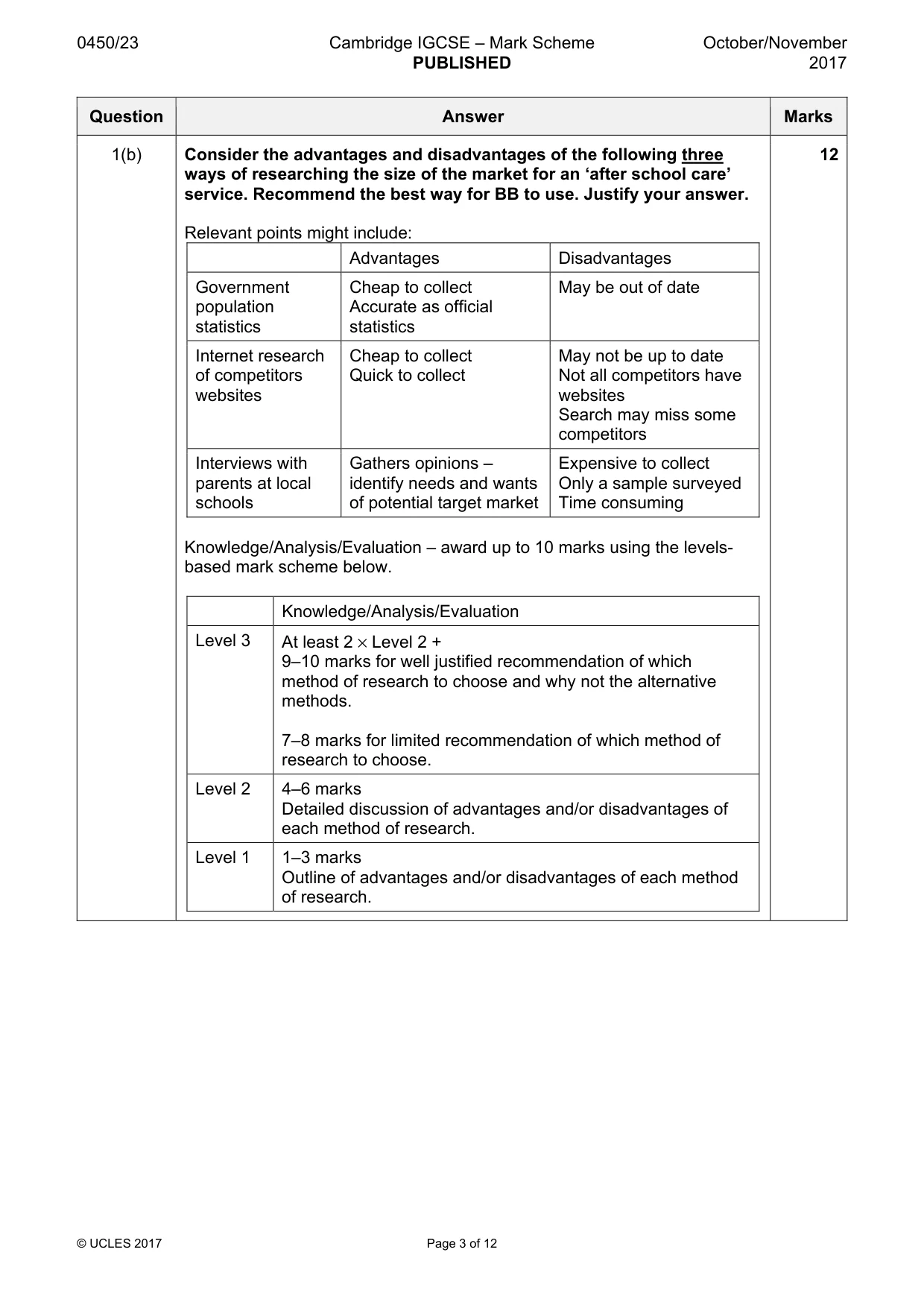
0450/23 Cambridge IGCSE – Mark Scheme PUBLISHED October/November 2017 © UCLES 2017 Page 3 of 12 Question Answer Marks 1(b) Consider the advantages and disadvantages of the following three ways of researching the size of the market for an ‘after school care’ service. Recommend the best way for BB to use. Justify your answer. Relevant points might include: Advantages Disadvantages Government population statistics Cheap to collect Accurate as official statistics May be out of date Internet research of competitors websites Cheap to collect Quick to collect May not be up to date Not all competitors have websites Search may miss some competitors Interviews with parents at local schools Gathers opinions – identify needs and wants of potential target market Expensive to collect Only a sample surveyed Time consuming Knowledge/Analysis/Evaluation – award up to 10 marks using the levels- based mark scheme below. Knowledge/Analysis/Evaluation Level 3 At least 2 × Level 2 + 9–10 marks for well justified recommendation of which method of research to choose and why not the alternative methods. 7–8 marks for limited recommendation of which method of research to choose. Level 2 4–6 marks Detailed discussion of advantages and/or disadvantages of each method of research. Level 1 1–3 marks Outline of advantages and/or disadvantages of each method of research. 12
Mark scheme, page 4
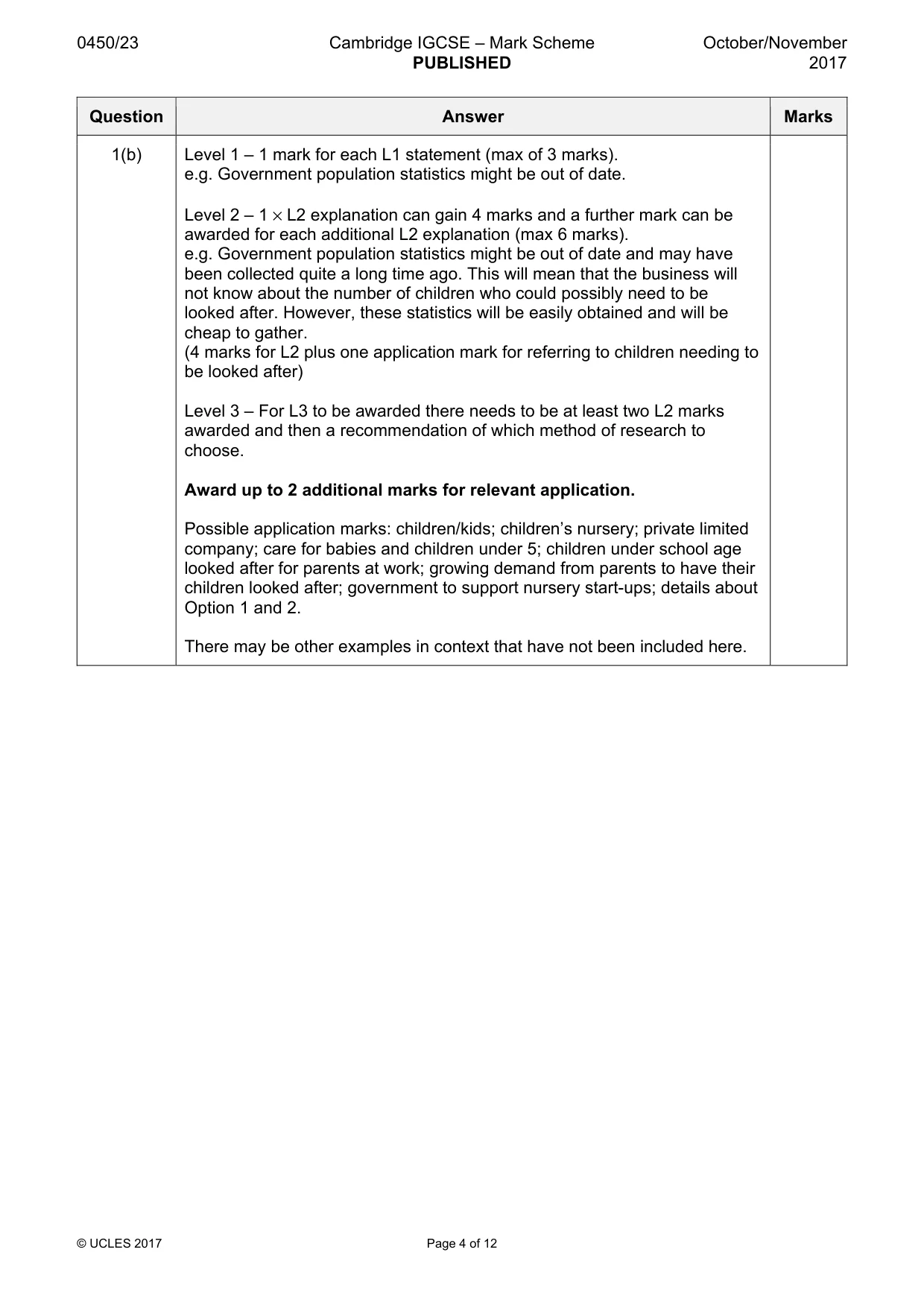
0450/23 Cambridge IGCSE – Mark Scheme PUBLISHED October/November 2017 © UCLES 2017 Page 4 of 12 Question Answer Marks 1(b) Level 1 – 1 mark for each L1 statement (max of 3 marks). e.g. Government population statistics might be out of date. Level 2 – 1 × L2 explanation can gain 4 marks and a further mark can be awarded for each additional L2 explanation (max 6 marks). e.g. Government population statistics might be out of date and may have been collected quite a long time ago. This will mean that the business will not know about the number of children who could possibly need to be looked after. However, these statistics will be easily obtained and will be cheap to gather. (4 marks for L2 plus one application mark for referring to children needing to be looked after) Level 3 – For L3 to be awarded there needs to be at least two L2 marks awarded and then a recommendation of which method of research to choose. Award up to 2 additional marks for relevant application. Possible application marks: children/kids; children’s nursery; private limited company; care for babies and children under 5; children under school age looked after for parents at work; growing demand from parents to have their children looked after; government to support nursery start-ups; details about Option 1 and 2. There may be other examples in context that have not been included here.
Mark scheme, page 5
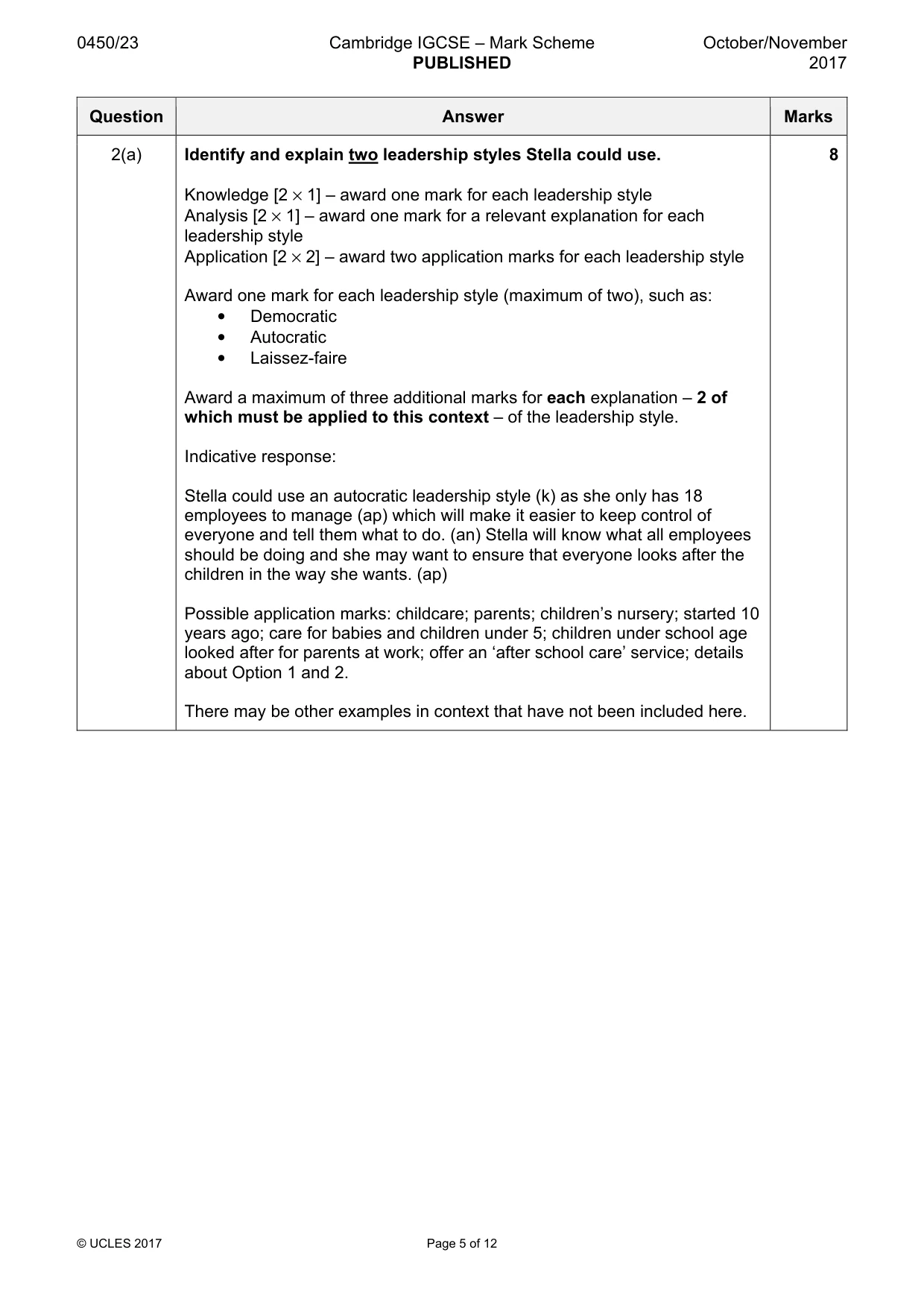
0450/23 Cambridge IGCSE – Mark Scheme PUBLISHED October/November 2017 © UCLES 2017 Page 5 of 12 Question Answer Marks 2(a) Identify and explain two leadership styles Stella could use. Knowledge [2 × 1] – award one mark for each leadership style Analysis [2 × 1] – award one mark for a relevant explanation for each leadership style Application [2 × 2] – award two application marks for each leadership style Award one mark for each leadership style (maximum of two), such as: • Democratic • Autocratic • Laissez-faire Award a maximum of three additional marks for each explanation – 2 of which must be applied to this context – of the leadership style. Indicative response: Stella could use an autocratic leadership style (k) as she only has 18 employees to manage (ap) which will make it easier to keep control of everyone and tell them what to do. (an) Stella will know what all employees should be doing and she may want to ensure that everyone looks after the children in the way she wants. (ap) Possible application marks: childcare; parents; children’s nursery; started 10 years ago; care for babies and children under 5; children under school age looked after for parents at work; offer an ‘after school care’ service; details about Option 1 and 2. There may be other examples in context that have not been included here. 8
Mark scheme, page 6
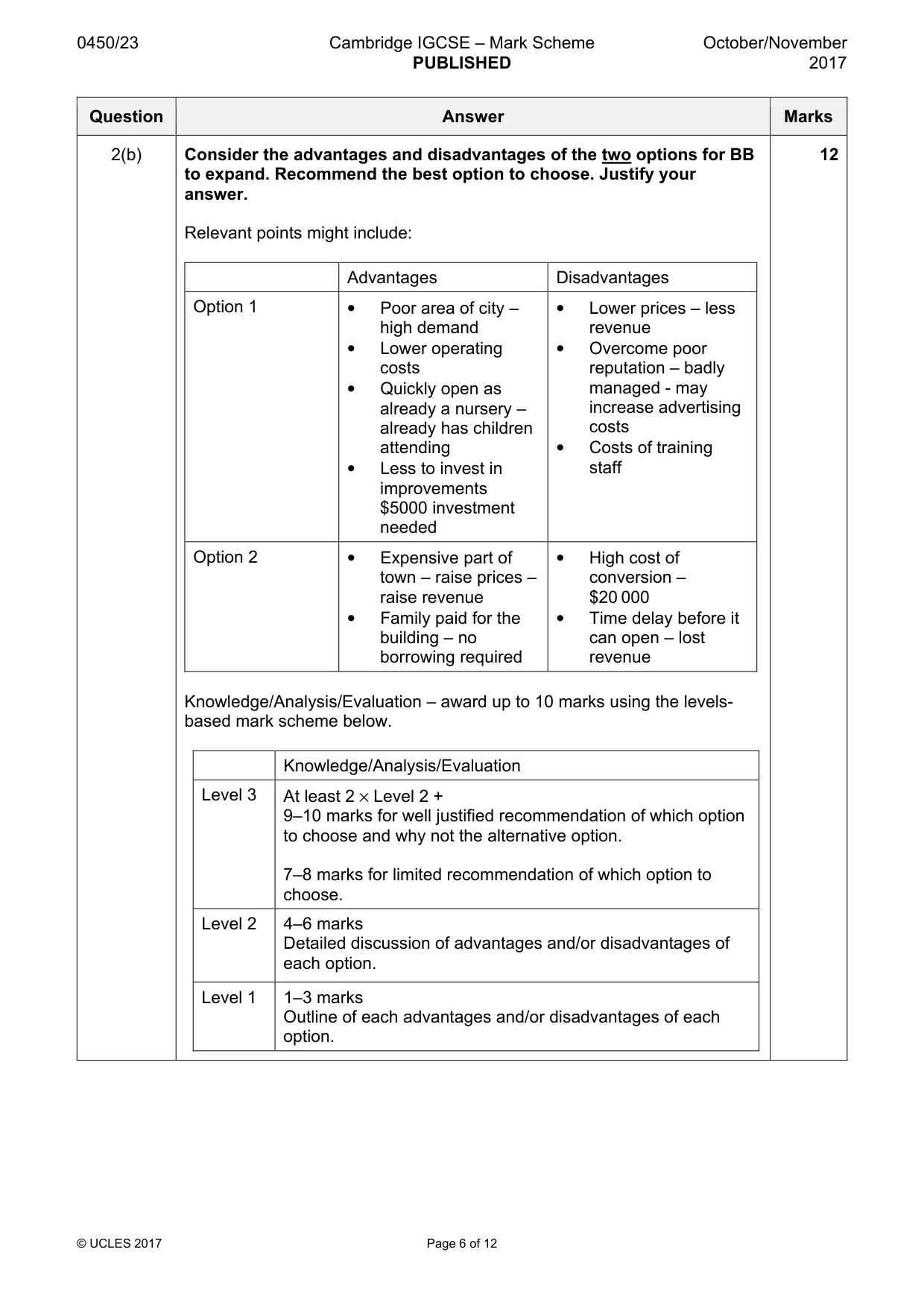
0450/23 Cambridge IGCSE – Mark Scheme PUBLISHED October/November 2017 © UCLES 2017 Page 6 of 12 Question Answer Marks 2(b) Consider the advantages and disadvantages of the two options for BB to expand. Recommend the best option to choose. Justify your answer. Relevant points might include: Advantages Disadvantages Option 1 • Poor area of city – high demand • Lower operating costs • Quickly open as already a nursery – already has children attending • Less to invest in improvements $5000 investment needed • Lower prices – less revenue • Overcome poor reputation – badly managed - may increase advertising costs • Costs of training staff Option 2 • Expensive part of town – raise prices – raise revenue • Family paid for the building – no borrowing required • High cost of conversion – $20 000 • Time delay before it can open – lost revenue Knowledge/Analysis/Evaluation – award up to 10 marks using the levels- based mark scheme below. Knowledge/Analysis/Evaluation Level 3 At least 2 × Level 2 + 9–10 marks for well justified recommendation of which option to choose and why not the alternative option. 7–8 marks for limited recommendation of which option to choose. Level 2 4–6 marks Detailed discussion of advantages and/or disadvantages of each option. Level 1 1–3 marks Outline of each advantages and/or disadvantages of each option. 12
Mark scheme, page 7
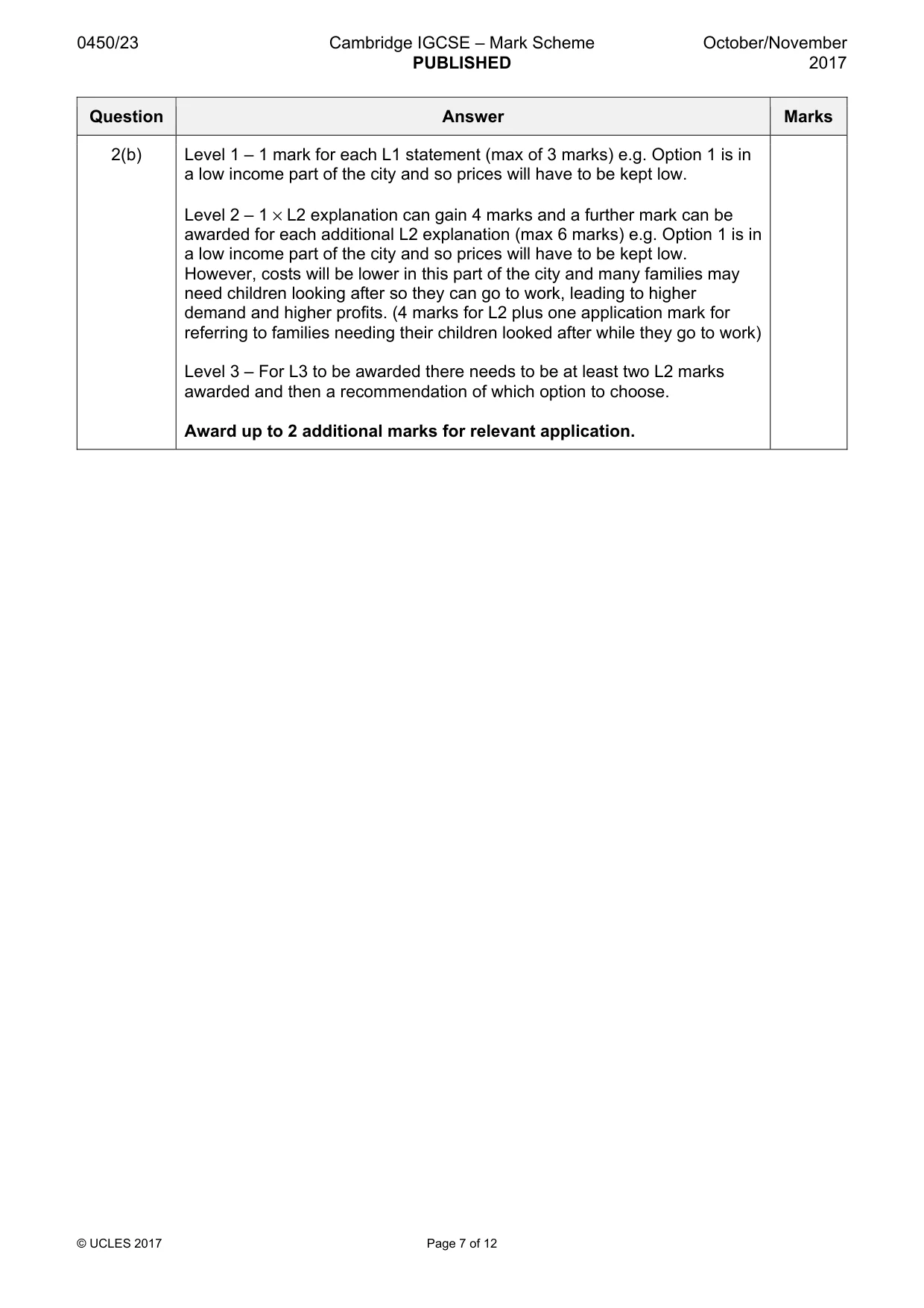
0450/23 Cambridge IGCSE – Mark Scheme PUBLISHED October/November 2017 © UCLES 2017 Page 7 of 12 Question Answer Marks 2(b) Level 1 – 1 mark for each L1 statement (max of 3 marks) e.g. Option 1 is in a low income part of the city and so prices will have to be kept low. Level 2 – 1 × L2 explanation can gain 4 marks and a further mark can be awarded for each additional L2 explanation (max 6 marks) e.g. Option 1 is in a low income part of the city and so prices will have to be kept low. However, costs will be lower in this part of the city and many families may need children looking after so they can go to work, leading to higher demand and higher profits. (4 marks for L2 plus one application mark for referring to families needing their children looked after while they go to work) Level 3 – For L3 to be awarded there needs to be at least two L2 marks awarded and then a recommendation of which option to choose. Award up to 2 additional marks for relevant application.
Mark scheme, page 8
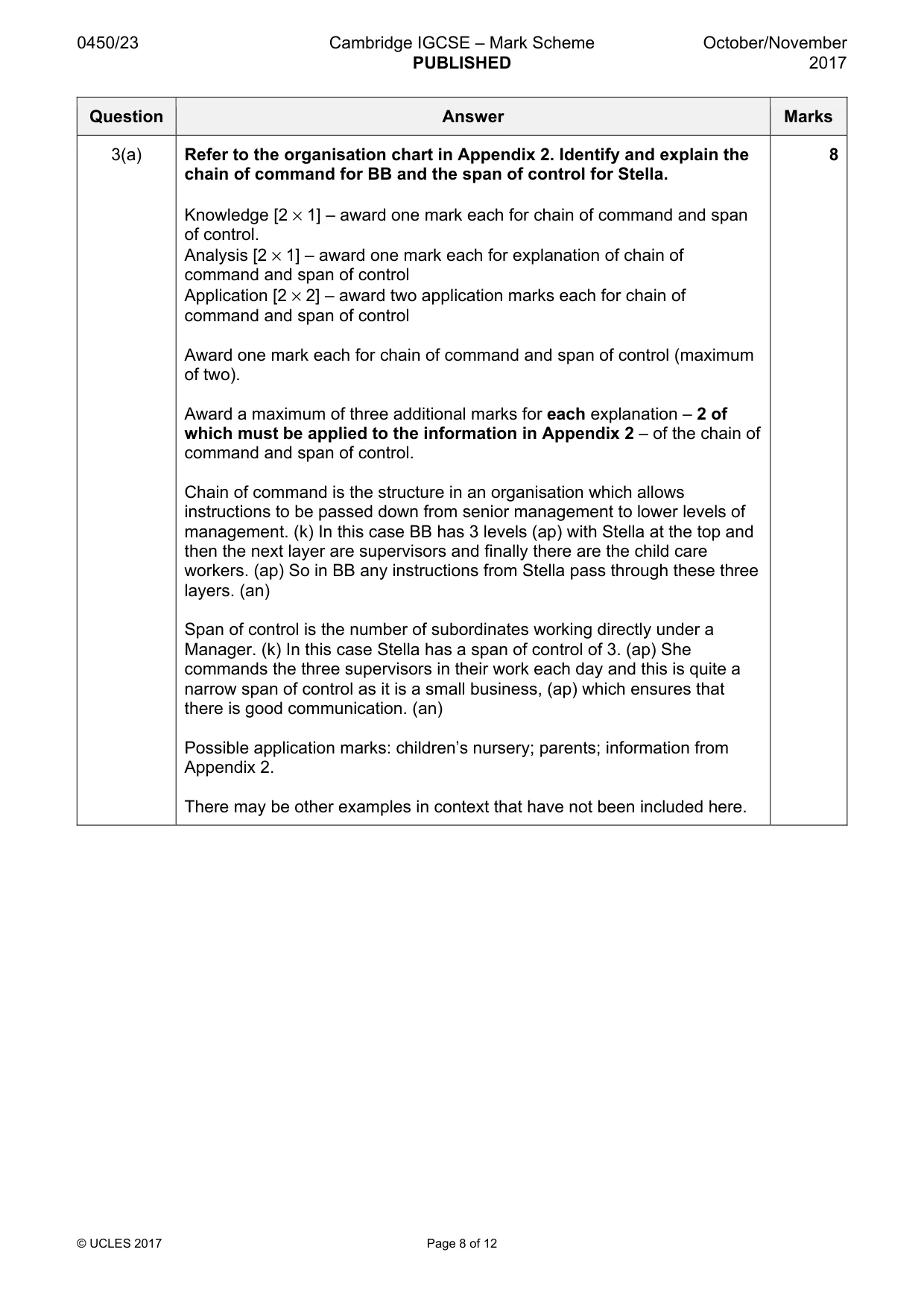
0450/23 Cambridge IGCSE – Mark Scheme PUBLISHED October/November 2017 © UCLES 2017 Page 8 of 12 Question Answer Marks 3(a) Refer to the organisation chart in Appendix 2. Identify and explain the chain of command for BB and the span of control for Stella. Knowledge [2 × 1] – award one mark each for chain of command and span of control. Analysis [2 × 1] – award one mark each for explanation of chain of command and span of control Application [2 × 2] – award two application marks each for chain of command and span of control Award one mark each for chain of command and span of control (maximum of two). Award a maximum of three additional marks for each explanation – 2 of which must be applied to the information in Appendix 2 – of the chain of command and span of control. Chain of command is the structure in an organisation which allows instructions to be passed down from senior management to lower levels of management. (k) In this case BB has 3 levels (ap) with Stella at the top and then the next layer are supervisors and finally there are the child care workers. (ap) So in BB any instructions from Stella pass through these three layers. (an) Span of control is the number of subordinates working directly under a Manager. (k) In this case Stella has a span of control of 3. (ap) She commands the three supervisors in their work each day and this is quite a narrow span of control as it is a small business, (ap) which ensures that there is good communication. (an) Possible application marks: children’s nursery; parents; information from Appendix 2. There may be other examples in context that have not been included here. 8
Mark scheme, page 9
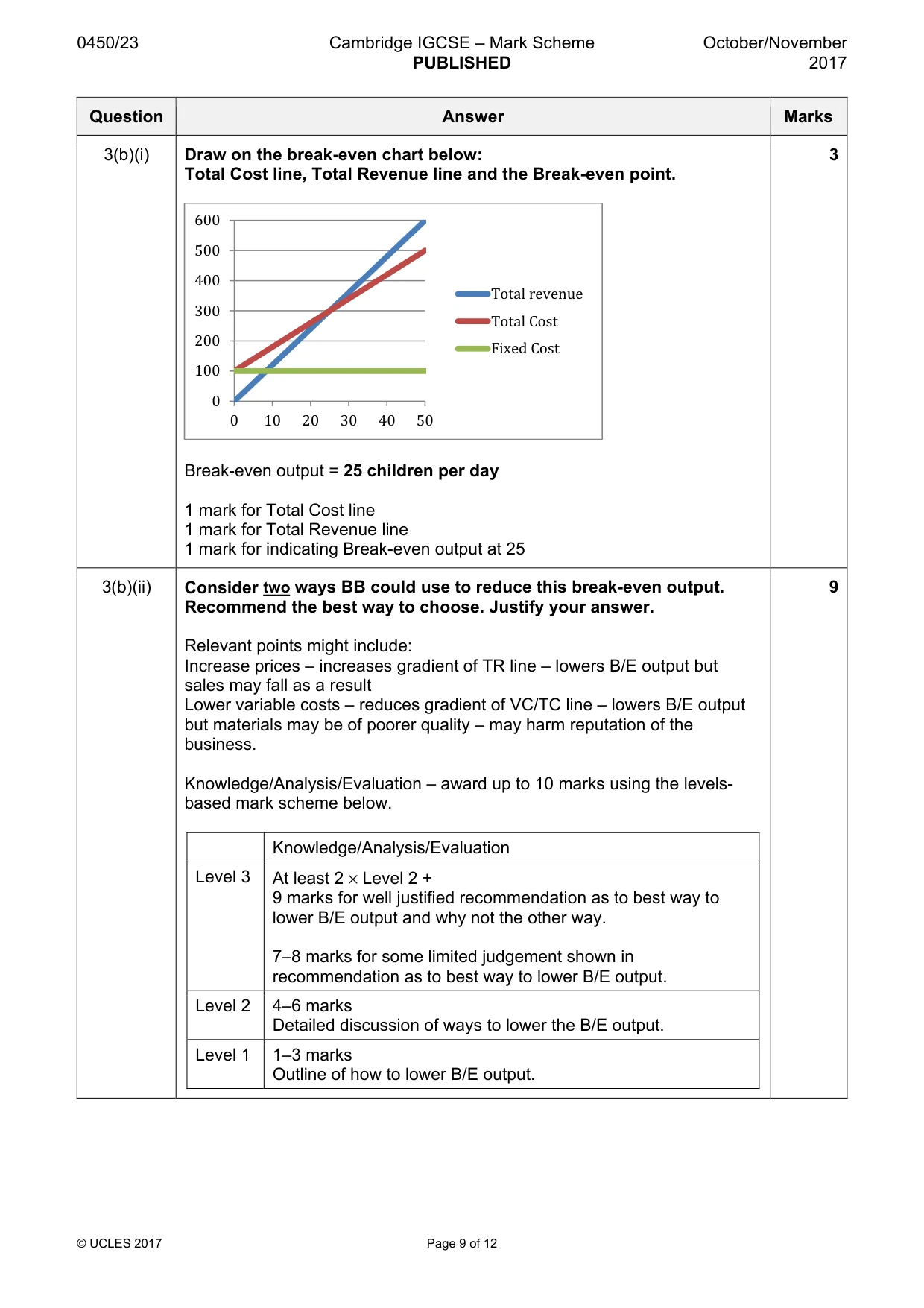
0450/23 Cambridge IGCSE – Mark Scheme PUBLISHED October/November 2017 © UCLES 2017 Page 9 of 12 Question Answer Marks 3(b)(i) Draw on the break-even chart below: Total Cost line, Total Revenue line and the Break-even point. Break-even output = 25 children per day 1 mark for Total Cost line 1 mark for Total Revenue line 1 mark for indicating Break-even output at 25 3 3(b)(ii) Consider two ways BB could use to reduce this break-even output. Recommend the best way to choose. Justify your answer. Relevant points might include: Increase prices – increases gradient of TR line – lowers B/E output but sales may fall as a result Lower variable costs – reduces gradient of VC/TC line – lowers B/E output but materials may be of poorer quality – may harm reputation of the business. Knowledge/Analysis/Evaluation – award up to 10 marks using the levels- based mark scheme below. Knowledge/Analysis/Evaluation Level 3 At least 2 × Level 2 + 9 marks for well justified recommendation as to best way to lower B/E output and why not the other way. 7–8 marks for some limited judgement shown in recommendation as to best way to lower B/E output. Level 2 4–6 marks Detailed discussion of ways to lower the B/E output. Level 1 1–3 marks Outline of how to lower B/E output. 9 0 100 200 300 400 500 600 0 10 20 30 40 50 Total revenue Total Cost Fixed Cost
Mark scheme, page 10
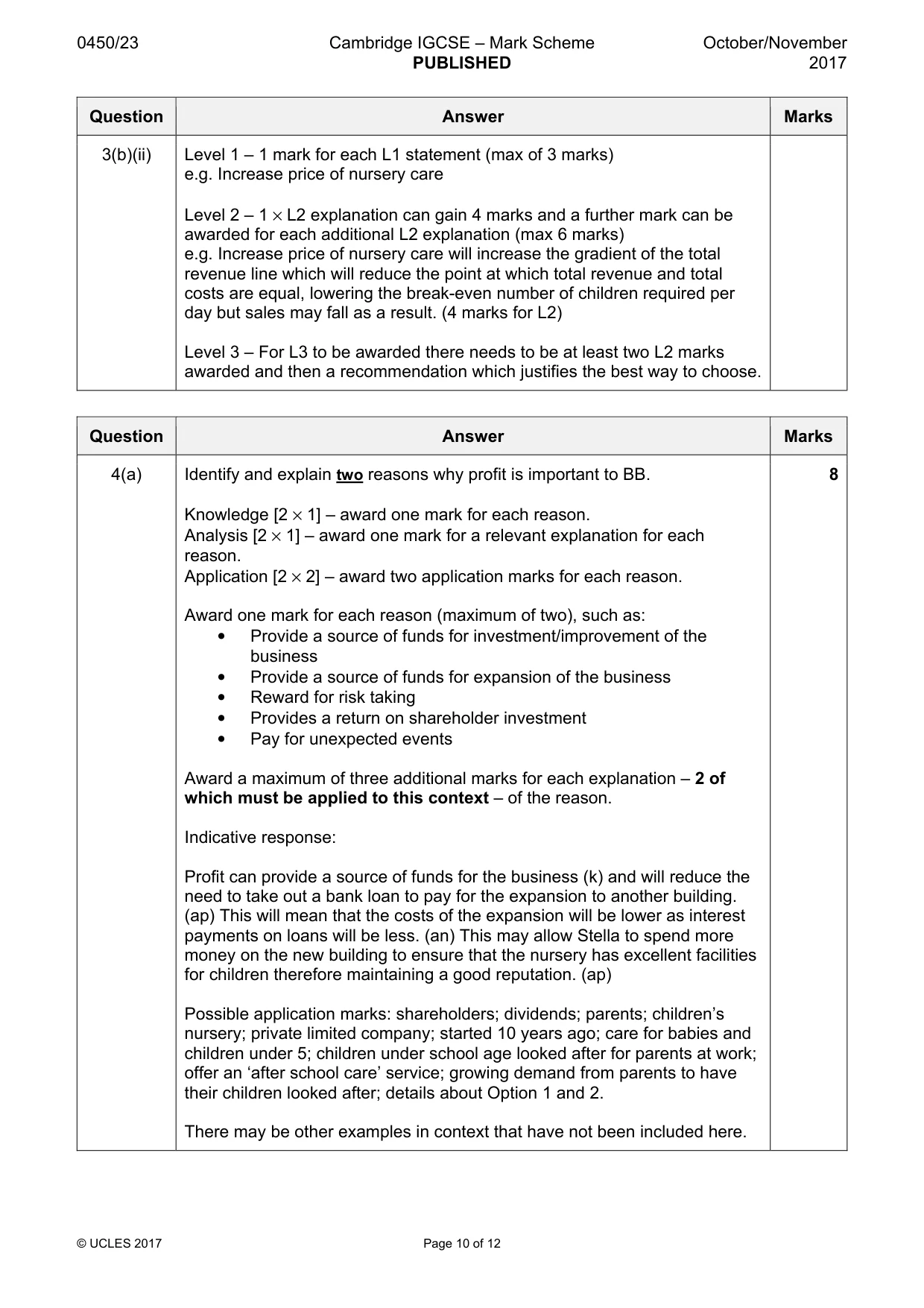
0450/23 Cambridge IGCSE – Mark Scheme PUBLISHED October/November 2017 © UCLES 2017 Page 10 of 12 Question Answer Marks 3(b)(ii) Level 1 – 1 mark for each L1 statement (max of 3 marks) e.g. Increase price of nursery care Level 2 – 1 × L2 explanation can gain 4 marks and a further mark can be awarded for each additional L2 explanation (max 6 marks) e.g. Increase price of nursery care will increase the gradient of the total revenue line which will reduce the point at which total revenue and total costs are equal, lowering the break-even number of children required per day but sales may fall as a result. (4 marks for L2) Level 3 – For L3 to be awarded there needs to be at least two L2 marks awarded and then a recommendation which justifies the best way to choose. Question Answer Marks 4(a) Identify and explain two reasons why profit is important to BB. Knowledge [2 × 1] – award one mark for each reason. Analysis [2 × 1] – award one mark for a relevant explanation for each reason. Application [2 × 2] – award two application marks for each reason. Award one mark for each reason (maximum of two), such as: • Provide a source of funds for investment/improvement of the business • Provide a source of funds for expansion of the business • Reward for risk taking • Provides a return on shareholder investment • Pay for unexpected events Award a maximum of three additional marks for each explanation – 2 of which must be applied to this context – of the reason. Indicative response: Profit can provide a source of funds for the business (k) and will reduce the need to take out a bank loan to pay for the expansion to another building. (ap) This will mean that the costs of the expansion will be lower as interest payments on loans will be less. (an) This may allow Stella to spend more money on the new building to ensure that the nursery has excellent facilities for children therefore maintaining a good reputation. (ap) Possible application marks: shareholders; dividends; parents; children’s nursery; private limited company; started 10 years ago; care for babies and children under 5; children under school age looked after for parents at work; offer an ‘after school care’ service; growing demand from parents to have their children looked after; details about Option 1 and 2. There may be other examples in context that have not been included here. 8
Mark scheme, page 11
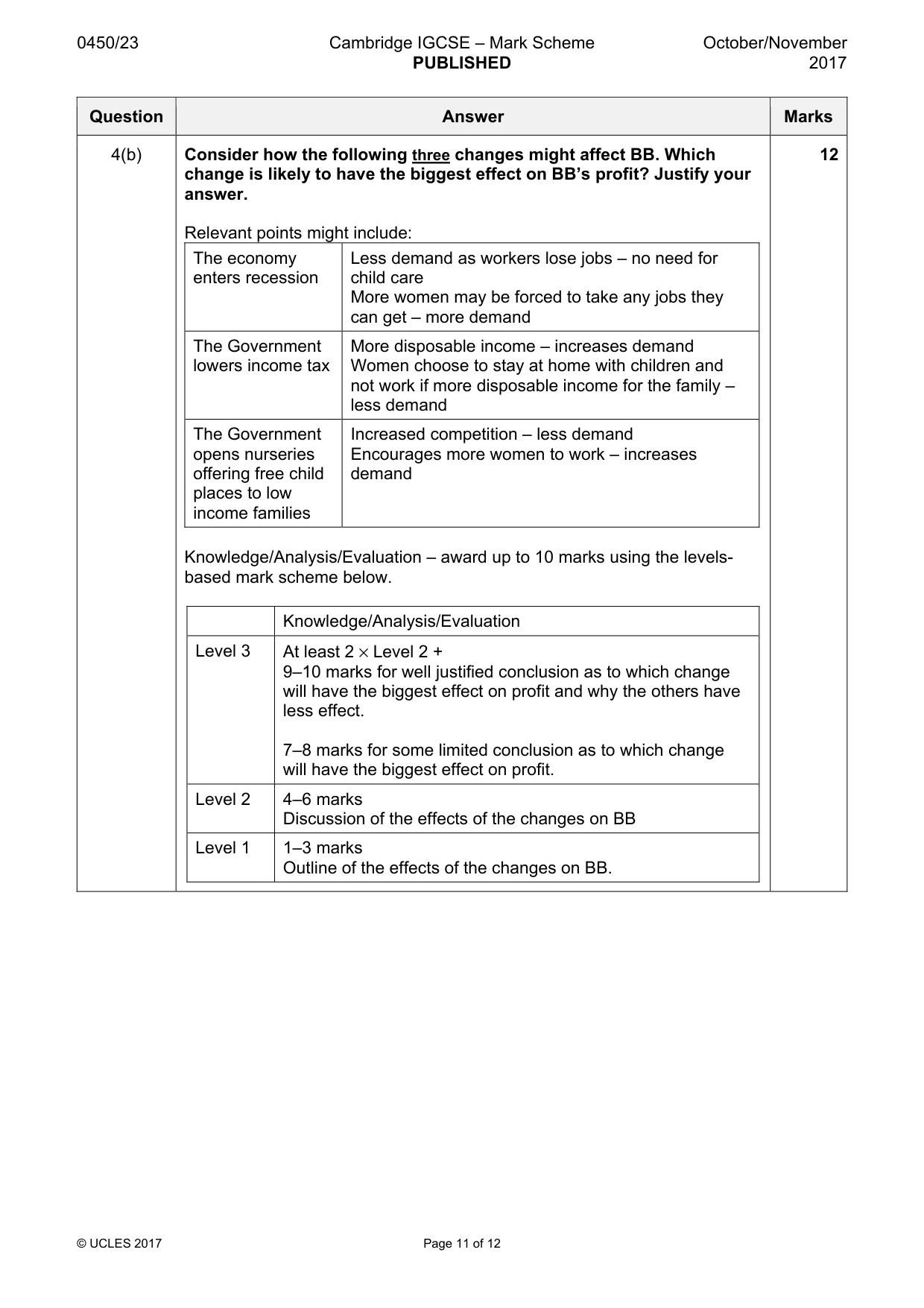
0450/23 Cambridge IGCSE – Mark Scheme PUBLISHED October/November 2017 © UCLES 2017 Page 11 of 12 Question Answer Marks 4(b) Consider how the following three changes might affect BB. Which change is likely to have the biggest effect on BB’s profit? Justify your answer. Relevant points might include: The economy enters recession Less demand as workers lose jobs – no need for child care More women may be forced to take any jobs they can get – more demand The Government lowers income tax More disposable income – increases demand Women choose to stay at home with children and not work if more disposable income for the family – less demand The Government opens nurseries offering free child places to low income families Increased competition – less demand Encourages more women to work – increases demand Knowledge/Analysis/Evaluation – award up to 10 marks using the levels- based mark scheme below. Knowledge/Analysis/Evaluation Level 3 At least 2 × Level 2 + 9–10 marks for well justified conclusion as to which change will have the biggest effect on profit and why the others have less effect. 7–8 marks for some limited conclusion as to which change will have the biggest effect on profit. Level 2 4–6 marks Discussion of the effects of the changes on BB Level 1 1–3 marks Outline of the effects of the changes on BB. 12
Mark scheme, page 12
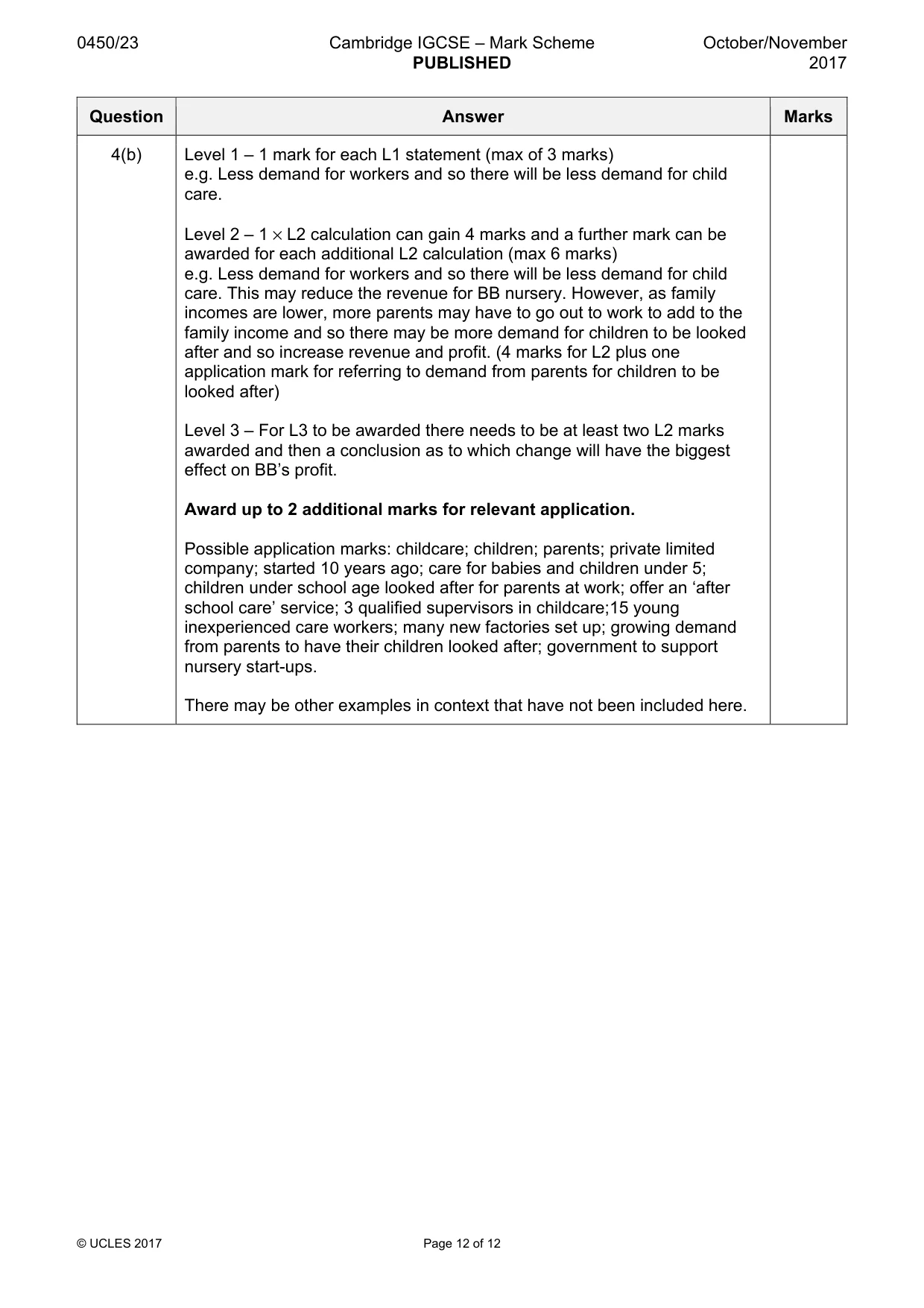
0450/23 Cambridge IGCSE – Mark Scheme PUBLISHED October/November 2017 © UCLES 2017 Page 12 of 12 Question Answer Marks 4(b) Level 1 – 1 mark for each L1 statement (max of 3 marks) e.g. Less demand for workers and so there will be less demand for child care. Level 2 – 1 × L2 calculation can gain 4 marks and a further mark can be awarded for each additional L2 calculation (max 6 marks) e.g. Less demand for workers and so there will be less demand for child care. This may reduce the revenue for BB nursery. However, as family incomes are lower, more parents may have to go out to work to add to the family income and so there may be more demand for children to be looked after and so increase revenue and profit. (4 marks for L2 plus one application mark for referring to demand from parents for children to be looked after) Level 3 – For L3 to be awarded there needs to be at least two L2 marks awarded and then a conclusion as to which change will have the biggest effect on BB’s profit. Award up to 2 additional marks for relevant application. Possible application marks: childcare; children; parents; private limited company; started 10 years ago; care for babies and children under 5; children under school age looked after for parents at work; offer an ‘after school care’ service; 3 qualified supervisors in childcare;15 young inexperienced care workers; many new factories set up; growing demand from parents to have their children looked after; government to support nursery start-ups. There may be other examples in context that have not been included here.
What you needed in this session
Cambridge’s own grade thresholds for 2017 Oct/Nov, Paper 2 · Variant 3. A higher threshold means an easier paper — the bar moves with how the cohort did.