Cambridge IGCSE Business Studies 0450 — 2017 May/June Paper 2 · Variant 3
0450/23/M/J/17 · 80 marks · ≈90 min
The question paper and its mark scheme, free to read here and free to download. This is Cambridge’s own paper, exactly as it was sat.
Question paper12 pages




Mark scheme10 pages
Answers below. Sit the paper first if you are practising.
Paper as text
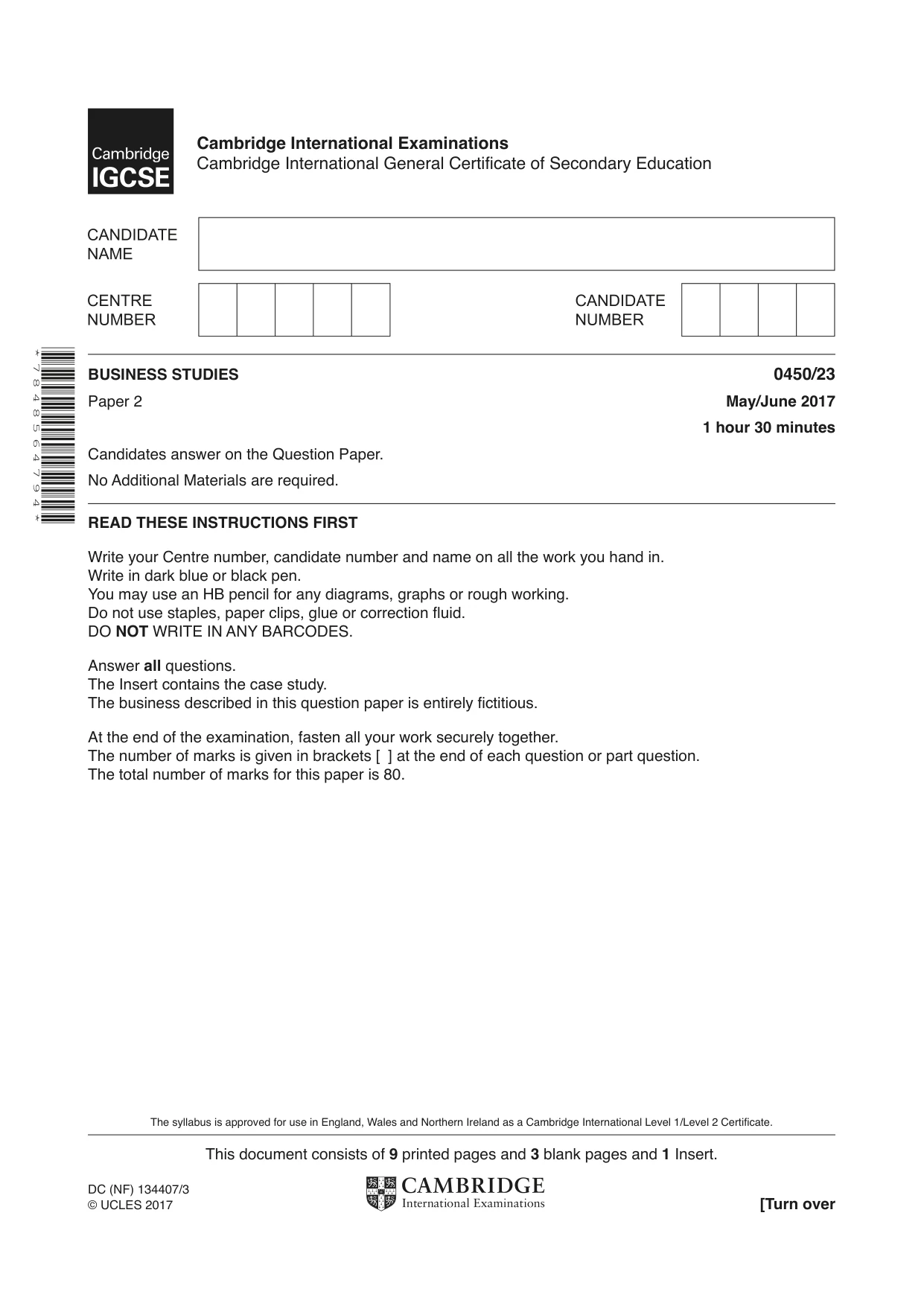
Question paper, page 1
* 7 8 4 8 5 6 4 7 9 4 * This document consists of 9 printed pages and 3 blank pages and 1 Insert. DC (NF) 134407/3 © UCLES 2017 [Turn over Cambridge International Examinations Cambridge International General Certificate of Secondary Education BUSINESS STUDIES 0450/23 Paper 2 May/June 2017 1 hour 30 minutes Candidates answer on the Question Paper. No Additional Materials are required. READ THESE INSTRUCTIONS FIRST Write your Centre number, candidate number and name on all the work you hand in. Write in dark blue or black pen. You may use an HB pencil for any diagrams, graphs or rough working. Do not use staples, paper clips, glue or correction fluid. DO NOT WRITE IN ANY BARCODES. Answer all questions. The Insert contains the case study. The business described in this question paper is entirely fictitious. At the end of the examination, fasten all your work securely together. The number of marks is given in brackets [ ] at the end of each question or part question. The total number of marks for this paper is 80. The syllabus is approved for use in England, Wales and Northern Ireland as a Cambridge International Level 1/Level 2 Certificate.
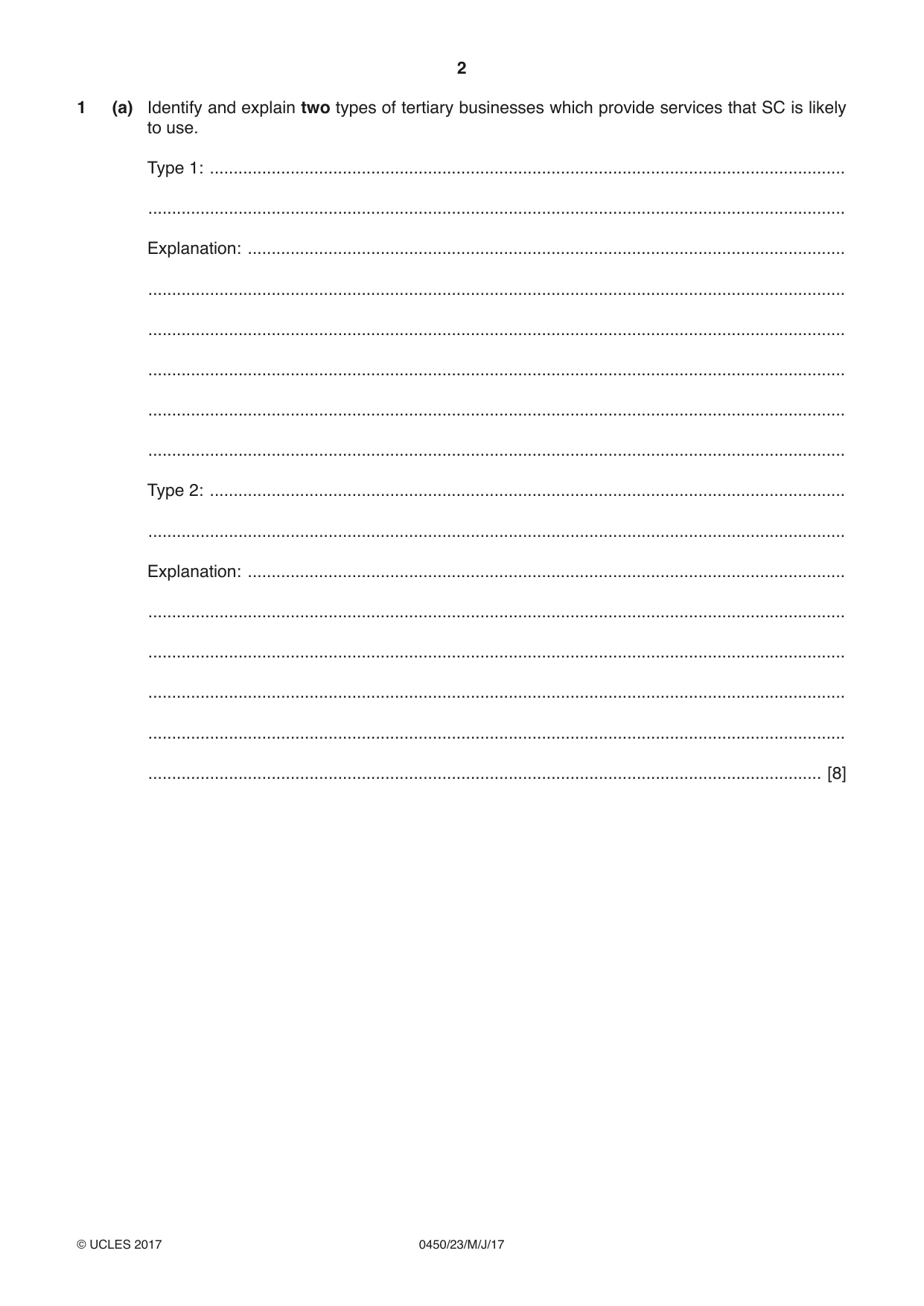
Question paper, page 2
2 0450/23/M/J/17 © UCLES 2017 1 (a) Identify and explain two types of tertiary businesses which provide services that SC is likely to use. Type 1: … … Explanation: … … … … … … Type 2: … … Explanation: … … … … … … [8]
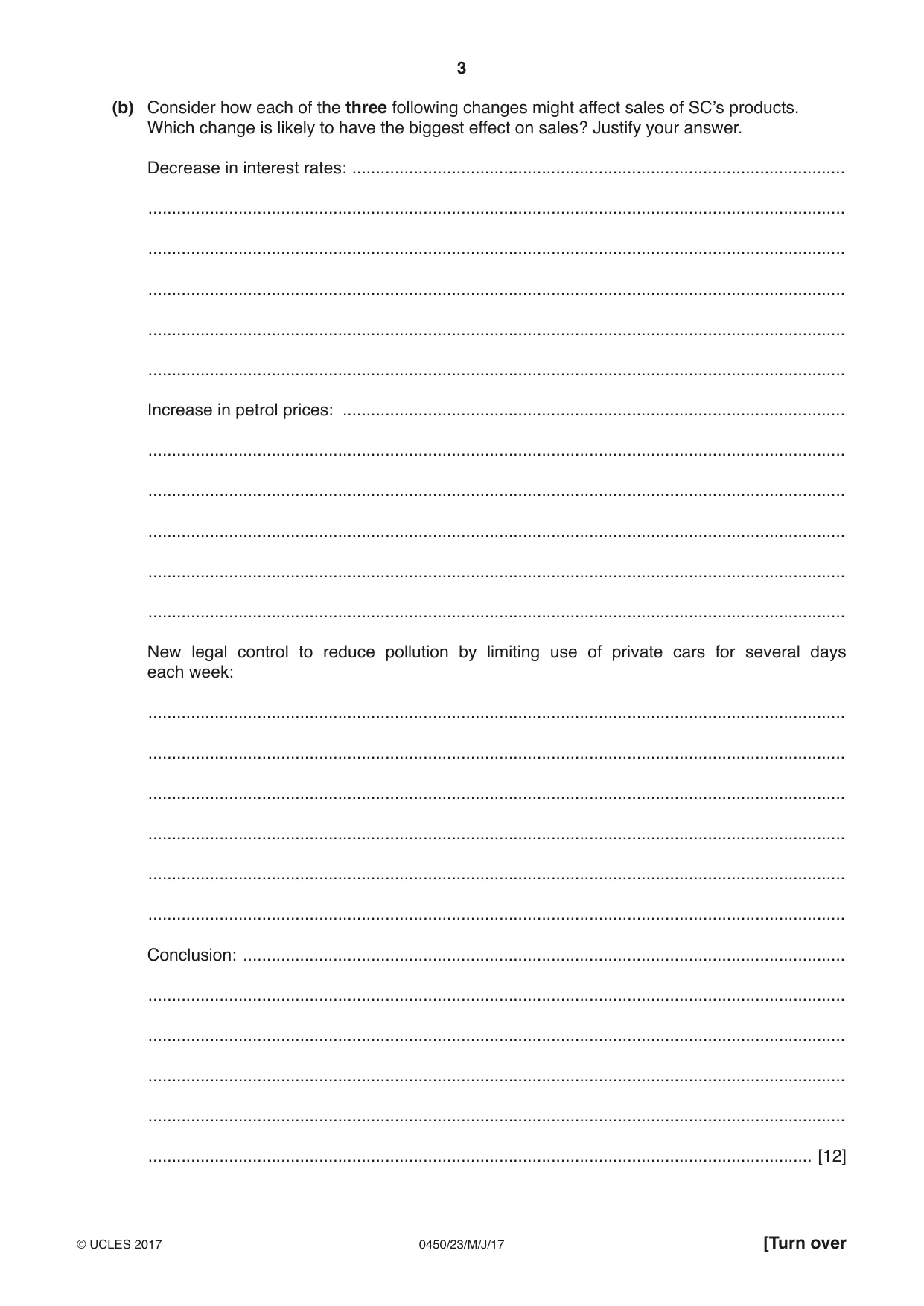
Question paper, page 3
3 0450/23/M/J/17 © UCLES 2017 [Turn over (b) Consider how each of the three following changes might affect sales of SC’s products. Which change is likely to have the biggest effect on sales? Justify your answer. Decrease in interest rates: … … … … … … Increase in petrol prices: … … … … … … New legal control to reduce pollution by limiting use of private cars for several days each week: … … … … … … Conclusion: … … … … … … [12]
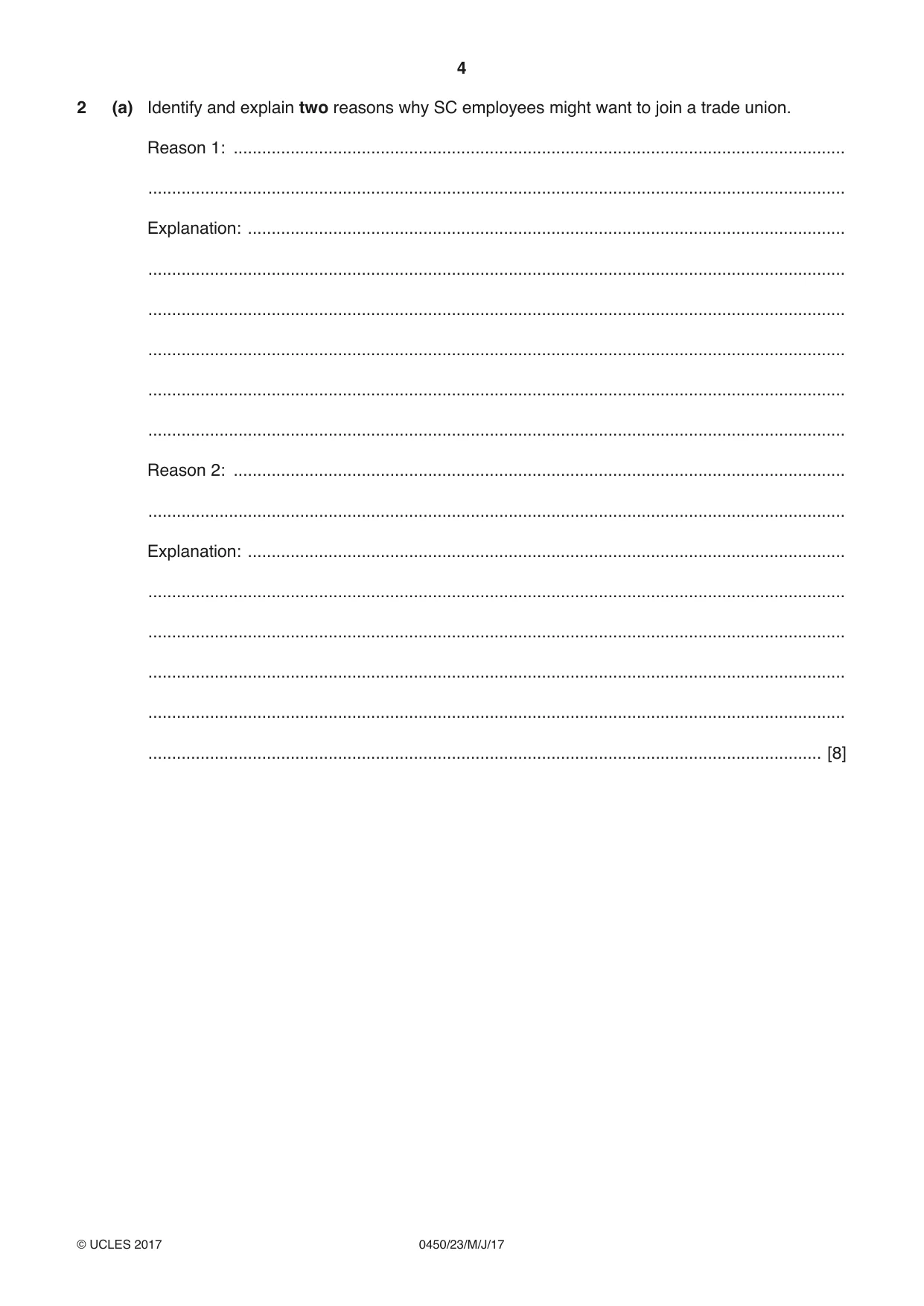
Question paper, page 4
4 0450/23/M/J/17 © UCLES 2017 2 (a) Identify and explain two reasons why SC employees might want to join a trade union. Reason 1: … … Explanation: … … … … … … Reason 2: … … Explanation: … … … … … … [8]
Question paper, page 5
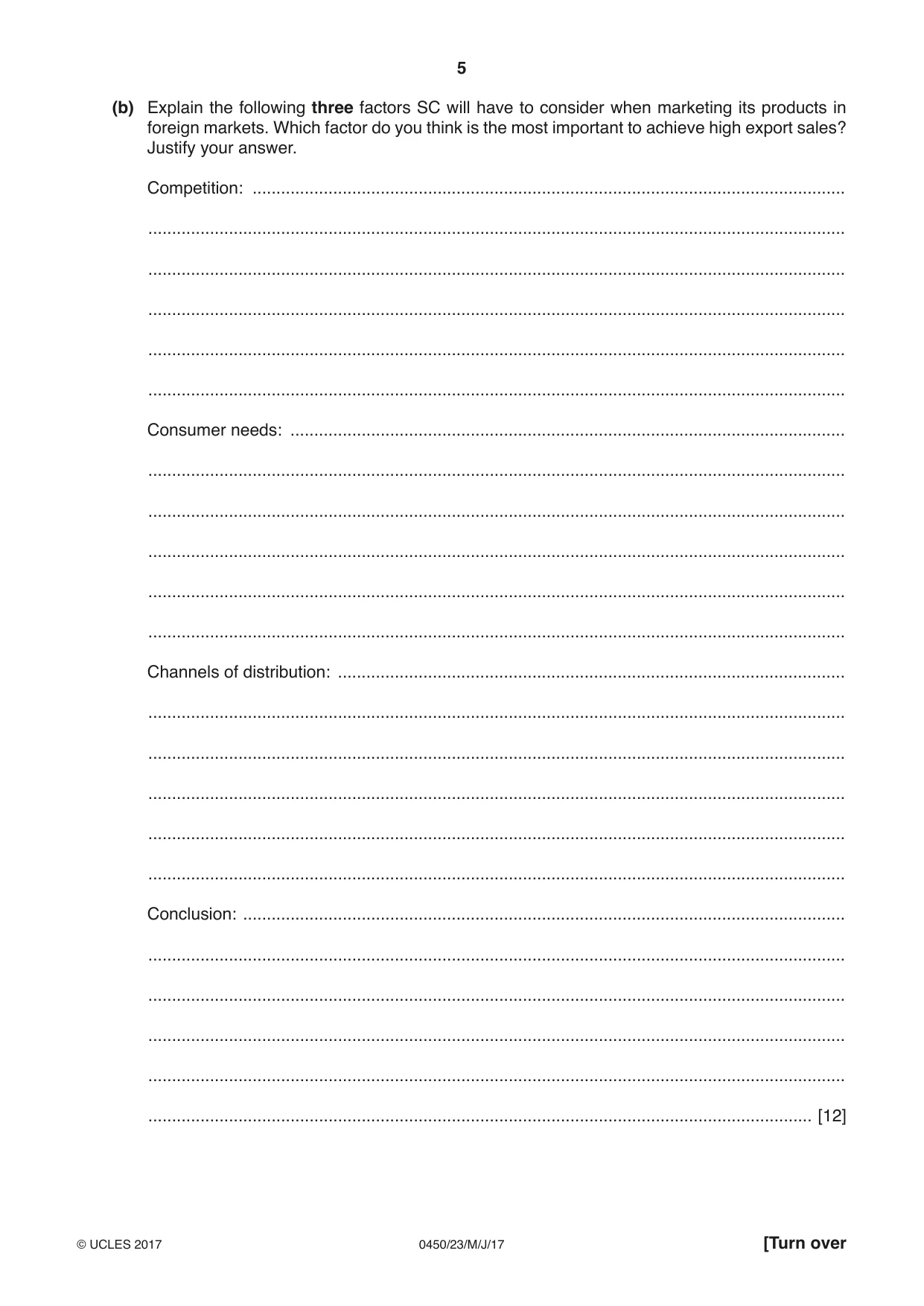
5 0450/23/M/J/17 © UCLES 2017 [Turn over (b) Explain the following three factors SC will have to consider when marketing its products in foreign markets. Which factor do you think is the most important to achieve high export sales? Justify your answer. Competition: … … … … … … Consumer needs: … … … … … … Channels of distribution: … … … … … … Conclusion: … … … … … … [12]
Question paper, page 6
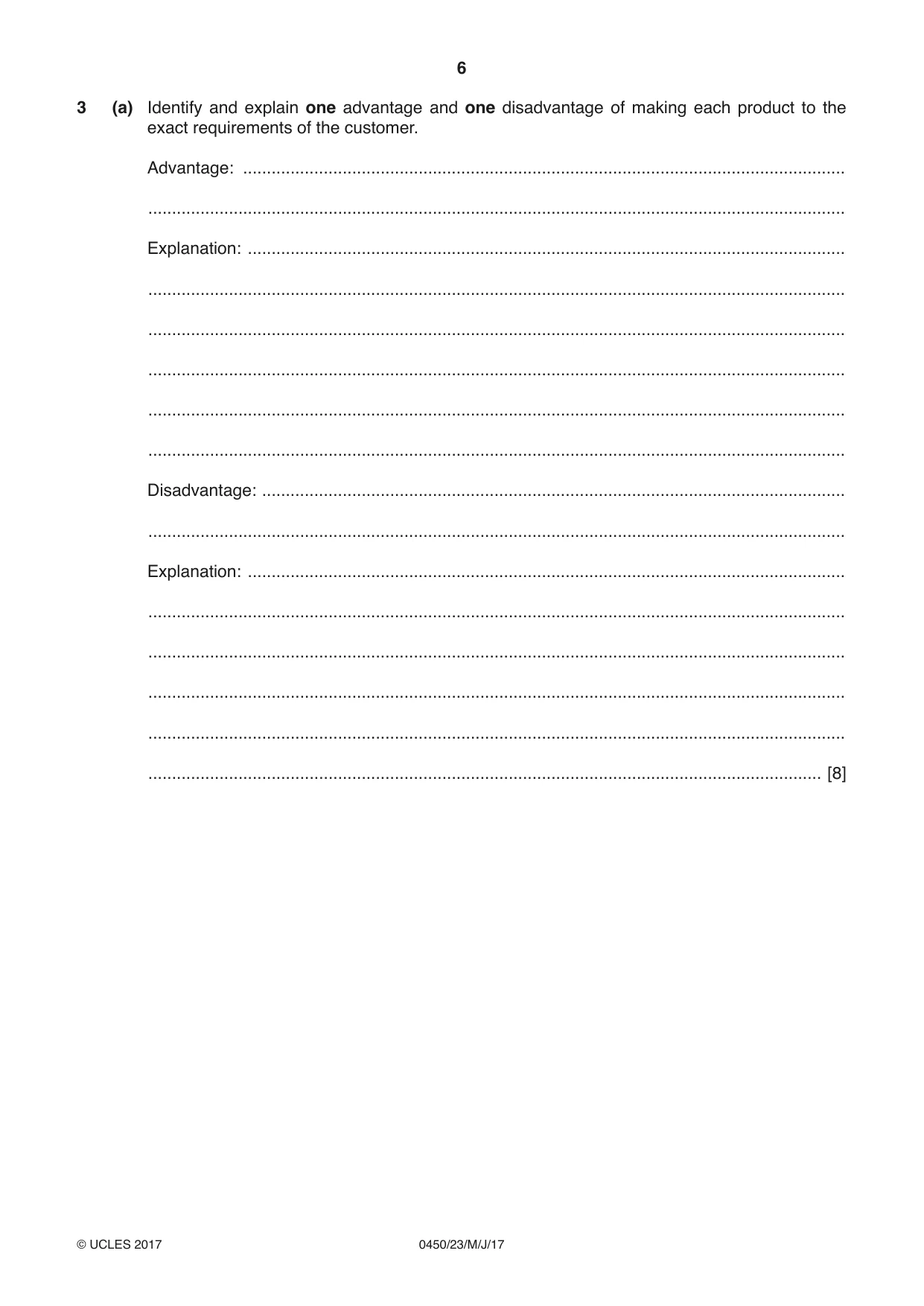
6 0450/23/M/J/17 © UCLES 2017 3 (a) Identify and explain one advantage and one disadvantage of making each product to the exact requirements of the customer. Advantage: … … Explanation: … … … … … … Disadvantage: … … Explanation: … … … … … … [8]
Question paper, page 7
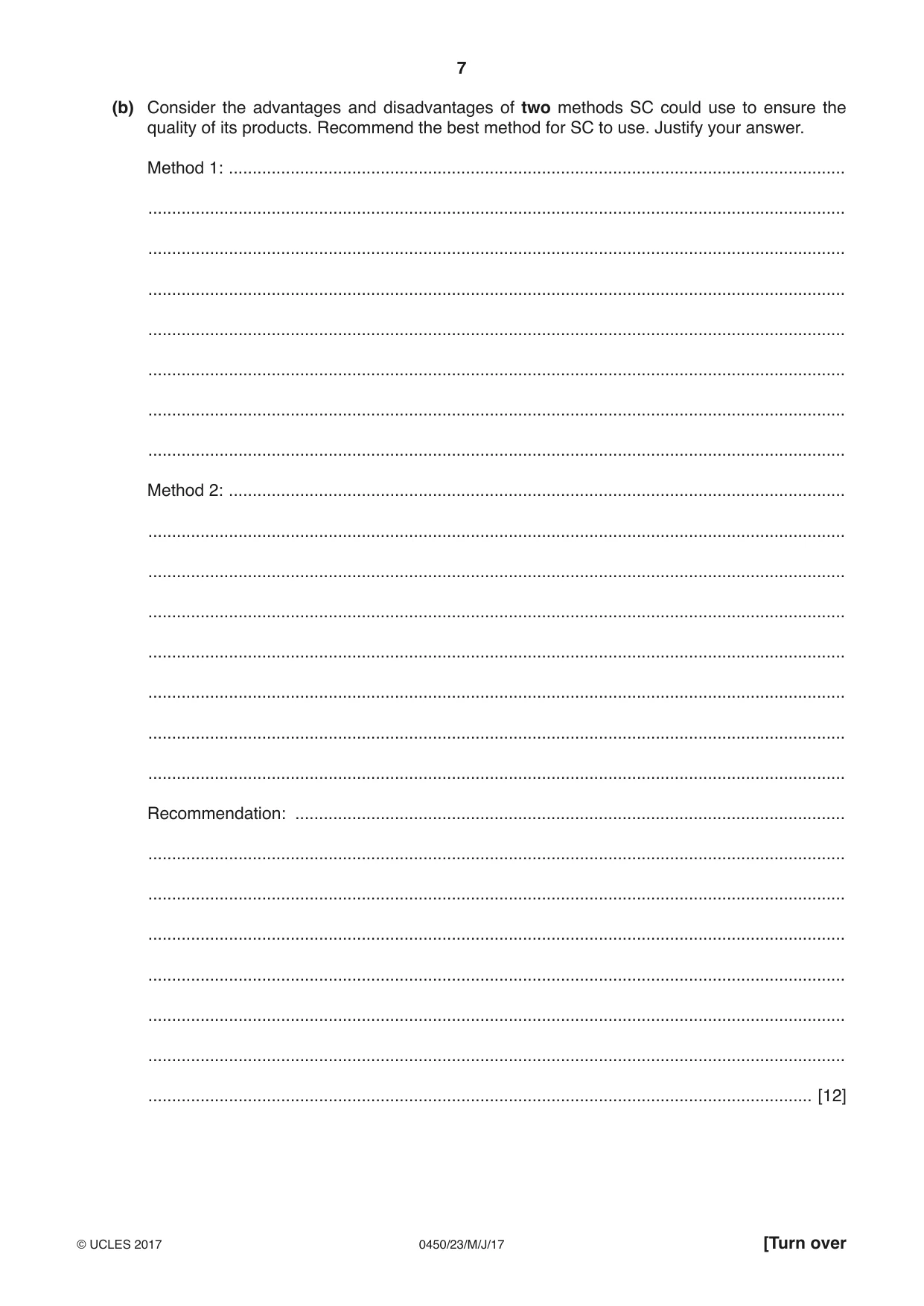
7 0450/23/M/J/17 © UCLES 2017 [Turn over (b) Consider the advantages and disadvantages of two methods SC could use to ensure the quality of its products. Recommend the best method for SC to use. Justify your answer. Method 1: … … … … … … … … Method 2: … … … … … … … … Recommendation: … … … … … … … … [12]
Question paper, page 8
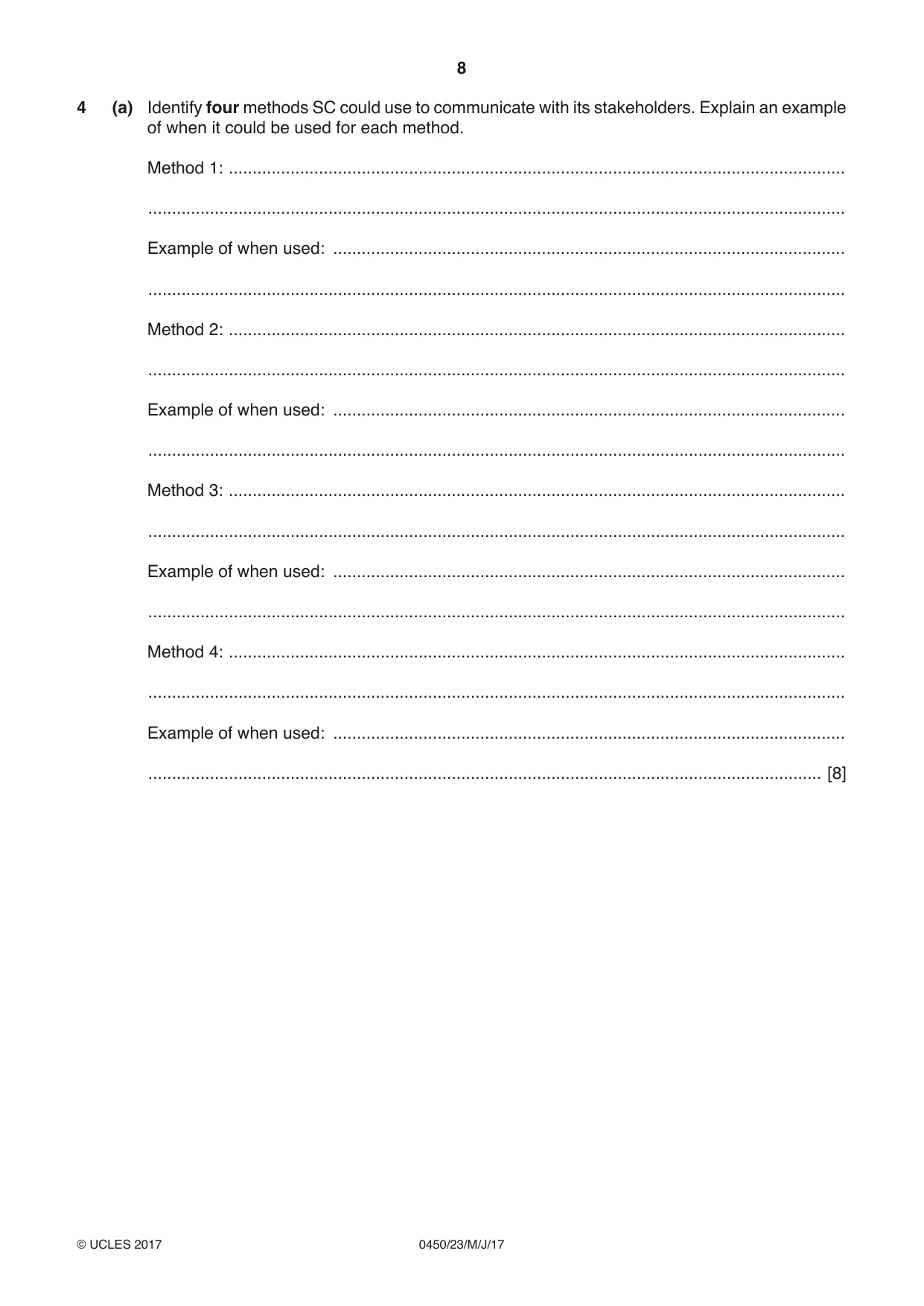
8 0450/23/M/J/17 © UCLES 2017 4 (a) Identify four methods SC could use to communicate with its stakeholders. Explain an example of when it could be used for each method. Method 1: … … Example of when used: … … Method 2: … … Example of when used: … … Method 3: … … Example of when used: … … Method 4: … … Example of when used: … … [8]
Question paper, page 9
9 0450/23/M/J/17 © UCLES 2017 (b) Refer to Appendix 2. Calculate the profitability of SC for both years. Would you recommend a potential shareholder to buy shares in SC? Justify your answer. … … … … … … … … … … … … … … … … … … … … … … … … [12]
Question paper, page 10
10 0450/23/M/J/17 © UCLES 2017 BLANK PAGE
Question paper, page 11
11 0450/23/M/J/17 © UCLES 2017 BLANK PAGE
Question paper, page 12
12 0450/23/M/J/17 © UCLES 2017 Permission to reproduce items where third-party owned material protected by copyright is included has been sought and cleared where possible. Every reasonable effort has been made by the publisher (UCLES) to trace copyright holders, but if any items requiring clearance have unwittingly been included, the publisher will be pleased to make amends at the earliest possible opportunity. To avoid the issue of disclosure of answer-related information to candidates, all copyright acknowledgements are reproduced online in the Cambridge International Examinations Copyright Acknowledgements Booklet. This is produced for each series of examinations and is freely available to download at www.cie.org.uk after the live examination series. Cambridge International Examinations is part of the Cambridge Assessment Group. Cambridge Assessment is the brand name of University of Cambridge Local Examinations Syndicate (UCLES), which is itself a department of the University of Cambridge. BLANK PAGE
Mark scheme, page 1
® IGCSE is a registered trademark. This syllabus is approved for use in England, Wales and Northern Ireland as a Cambridge International Level 1/Level 2 Certificate. This document consists of 10 printed pages. © UCLES 2017 [Turn over Cambridge International Examinations Cambridge International General Certificate of Secondary Education BUSINESS STUDIES 0450/23 Paper 2 Case Study May/June 2017 MARK SCHEME Maximum Mark: 80 Published This mark scheme is published as an aid to teachers and candidates, to indicate the requirements of the examination. It shows the basis on which Examiners were instructed to award marks. It does not indicate the details of the discussions that took place at an Examiners’ meeting before marking began, which would have considered the acceptability of alternative answers. Mark schemes should be read in conjunction with the question paper and the Principal Examiner Report for Teachers. Cambridge will not enter into discussions about these mark schemes. Cambridge is publishing the mark schemes for the May/June 2017 series for most Cambridge IGCSE®, Cambridge International A and AS Level and Cambridge Pre-U components, and some Cambridge O Level components.
Mark scheme, page 2
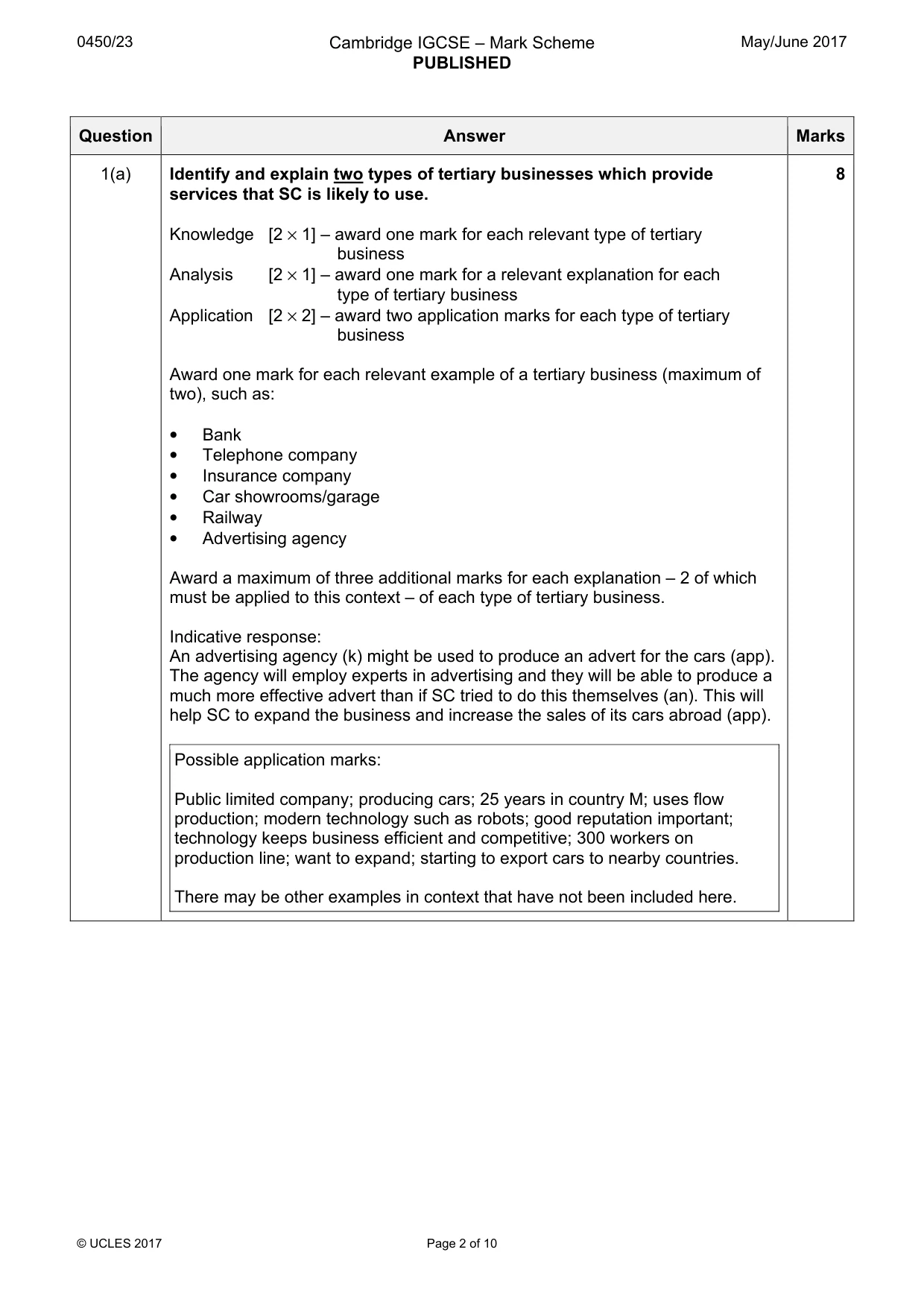
0450/23 Cambridge IGCSE – Mark Scheme PUBLISHED May/June 2017 © UCLES 2017 Page 2 of 10 Question Answer Marks 1(a) Identify and explain two types of tertiary businesses which provide services that SC is likely to use. Knowledge [2 × 1] – award one mark for each relevant type of tertiary business Analysis [2 × 1] – award one mark for a relevant explanation for each type of tertiary business Application [2 × 2] – award two application marks for each type of tertiary business Award one mark for each relevant example of a tertiary business (maximum of two), such as: • Bank • Telephone company • Insurance company • Car showrooms/garage • Railway • Advertising agency Award a maximum of three additional marks for each explanation – 2 of which must be applied to this context – of each type of tertiary business. Indicative response: An advertising agency (k) might be used to produce an advert for the cars (app). The agency will employ experts in advertising and they will be able to produce a much more effective advert than if SC tried to do this themselves (an). This will help SC to expand the business and increase the sales of its cars abroad (app). Possible application marks: Public limited company; producing cars; 25 years in country M; uses flow production; modern technology such as robots; good reputation important; technology keeps business efficient and competitive; 300 workers on production line; want to expand; starting to export cars to nearby countries. There may be other examples in context that have not been included here. 8
Mark scheme, page 3
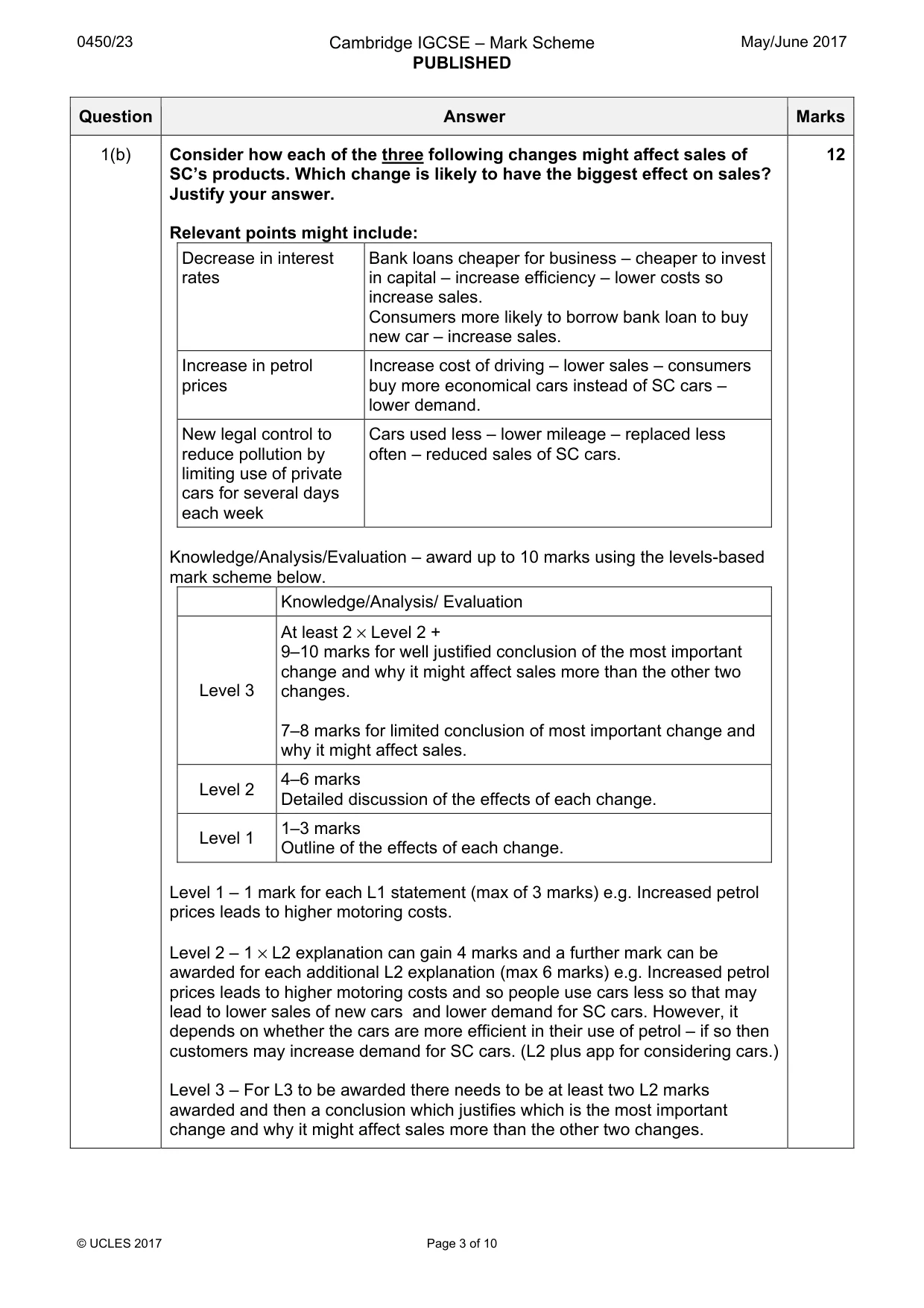
0450/23 Cambridge IGCSE – Mark Scheme PUBLISHED May/June 2017 © UCLES 2017 Page 3 of 10 Question Answer Marks 1(b) Consider how each of the three following changes might affect sales of SC’s products. Which change is likely to have the biggest effect on sales? Justify your answer. Relevant points might include: Decrease in interest rates Bank loans cheaper for business – cheaper to invest in capital – increase efficiency – lower costs so increase sales. Consumers more likely to borrow bank loan to buy new car – increase sales. Increase in petrol prices Increase cost of driving – lower sales – consumers buy more economical cars instead of SC cars – lower demand. New legal control to reduce pollution by limiting use of private cars for several days each week Cars used less – lower mileage – replaced less often – reduced sales of SC cars. Knowledge/Analysis/Evaluation – award up to 10 marks using the levels-based mark scheme below. Knowledge/Analysis/ Evaluation Level 3 At least 2 × Level 2 + 9–10 marks for well justified conclusion of the most important change and why it might affect sales more than the other two changes. 7–8 marks for limited conclusion of most important change and why it might affect sales. Level 2 4–6 marks Detailed discussion of the effects of each change. Level 1 1–3 marks Outline of the effects of each change. Level 1 – 1 mark for each L1 statement (max of 3 marks) e.g. Increased petrol prices leads to higher motoring costs. Level 2 – 1 × L2 explanation can gain 4 marks and a further mark can be awarded for each additional L2 explanation (max 6 marks) e.g. Increased petrol prices leads to higher motoring costs and so people use cars less so that may lead to lower sales of new cars and lower demand for SC cars. However, it depends on whether the cars are more efficient in their use of petrol – if so then customers may increase demand for SC cars. (L2 plus app for considering cars.) Level 3 – For L3 to be awarded there needs to be at least two L2 marks awarded and then a conclusion which justifies which is the most important change and why it might affect sales more than the other two changes. 12
Mark scheme, page 4
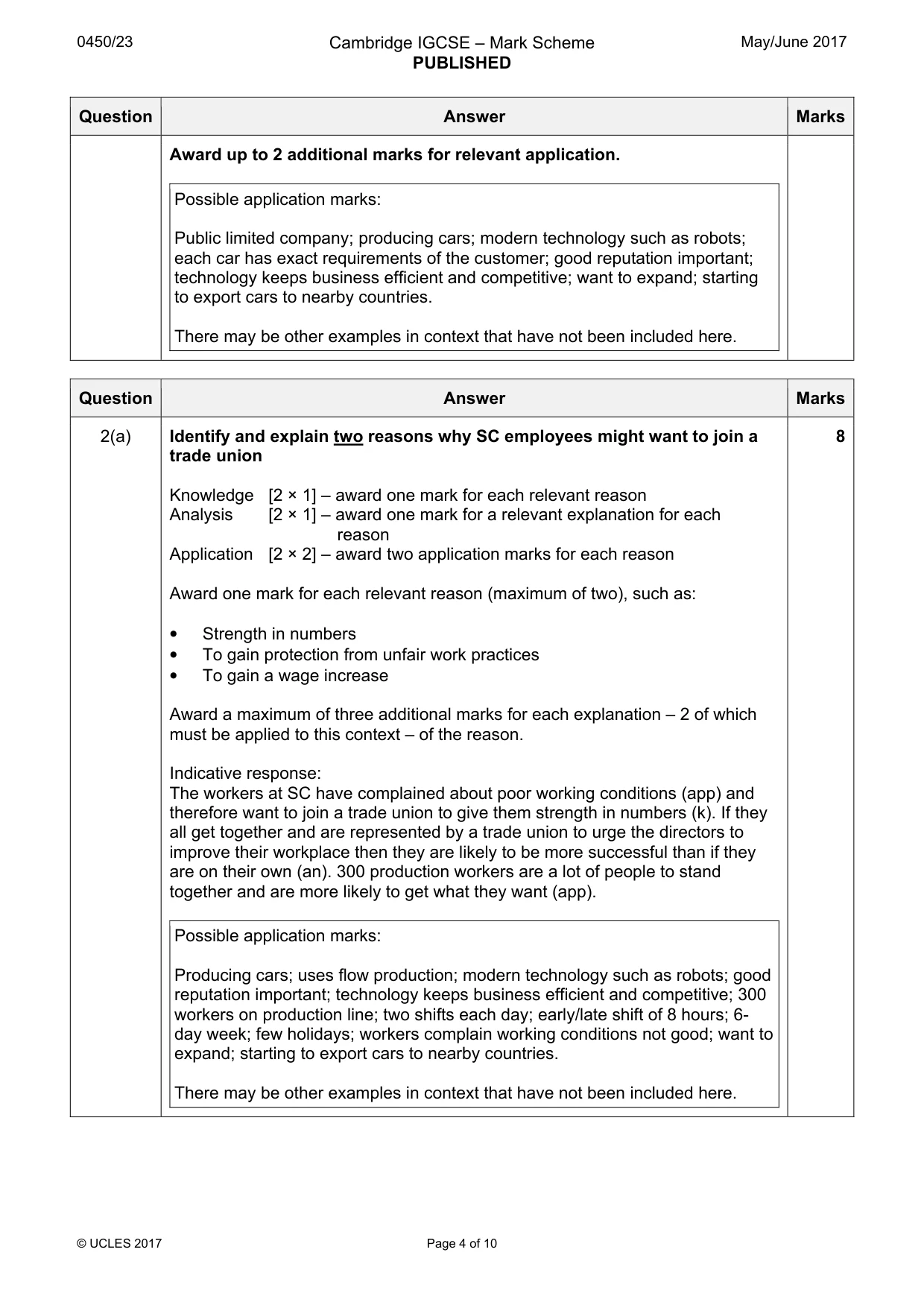
0450/23 Cambridge IGCSE – Mark Scheme PUBLISHED May/June 2017 © UCLES 2017 Page 4 of 10 Question Answer Marks Award up to 2 additional marks for relevant application. Possible application marks: Public limited company; producing cars; modern technology such as robots; each car has exact requirements of the customer; good reputation important; technology keeps business efficient and competitive; want to expand; starting to export cars to nearby countries. There may be other examples in context that have not been included here. Question Answer Marks 2(a) Identify and explain two reasons why SC employees might want to join a trade union Knowledge [2 × 1] – award one mark for each relevant reason Analysis [2 × 1] – award one mark for a relevant explanation for each reason Application [2 × 2] – award two application marks for each reason Award one mark for each relevant reason (maximum of two), such as: • Strength in numbers • To gain protection from unfair work practices • To gain a wage increase Award a maximum of three additional marks for each explanation – 2 of which must be applied to this context – of the reason. Indicative response: The workers at SC have complained about poor working conditions (app) and therefore want to join a trade union to give them strength in numbers (k). If they all get together and are represented by a trade union to urge the directors to improve their workplace then they are likely to be more successful than if they are on their own (an). 300 production workers are a lot of people to stand together and are more likely to get what they want (app). Possible application marks: Producing cars; uses flow production; modern technology such as robots; good reputation important; technology keeps business efficient and competitive; 300 workers on production line; two shifts each day; early/late shift of 8 hours; 6- day week; few holidays; workers complain working conditions not good; want to expand; starting to export cars to nearby countries. There may be other examples in context that have not been included here. 8
Mark scheme, page 5
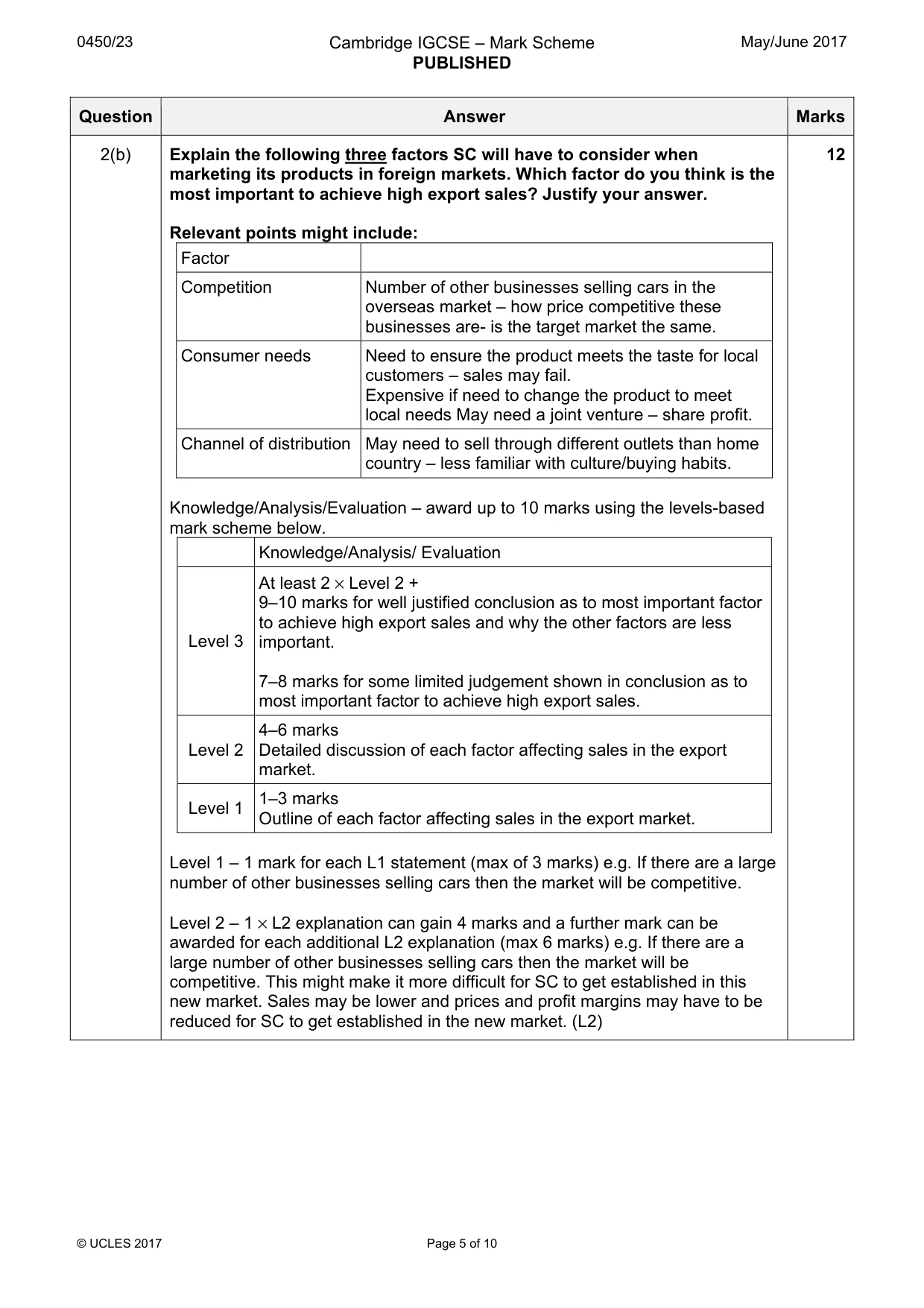
0450/23 Cambridge IGCSE – Mark Scheme PUBLISHED May/June 2017 © UCLES 2017 Page 5 of 10 Question Answer Marks 2(b) Explain the following three factors SC will have to consider when marketing its products in foreign markets. Which factor do you think is the most important to achieve high export sales? Justify your answer. Relevant points might include: Factor Competition Number of other businesses selling cars in the overseas market – how price competitive these businesses are- is the target market the same. Consumer needs Need to ensure the product meets the taste for local customers – sales may fail. Expensive if need to change the product to meet local needs May need a joint venture – share profit. Channel of distribution May need to sell through different outlets than home country – less familiar with culture/buying habits. Knowledge/Analysis/Evaluation – award up to 10 marks using the levels-based mark scheme below. Knowledge/Analysis/ Evaluation Level 3 At least 2 × Level 2 + 9–10 marks for well justified conclusion as to most important factor to achieve high export sales and why the other factors are less important. 7–8 marks for some limited judgement shown in conclusion as to most important factor to achieve high export sales. Level 2 4–6 marks Detailed discussion of each factor affecting sales in the export market. Level 1 1–3 marks Outline of each factor affecting sales in the export market. Level 1 – 1 mark for each L1 statement (max of 3 marks) e.g. If there are a large number of other businesses selling cars then the market will be competitive. Level 2 – 1 × L2 explanation can gain 4 marks and a further mark can be awarded for each additional L2 explanation (max 6 marks) e.g. If there are a large number of other businesses selling cars then the market will be competitive. This might make it more difficult for SC to get established in this new market. Sales may be lower and prices and profit margins may have to be reduced for SC to get established in the new market. (L2) 12
Mark scheme, page 6
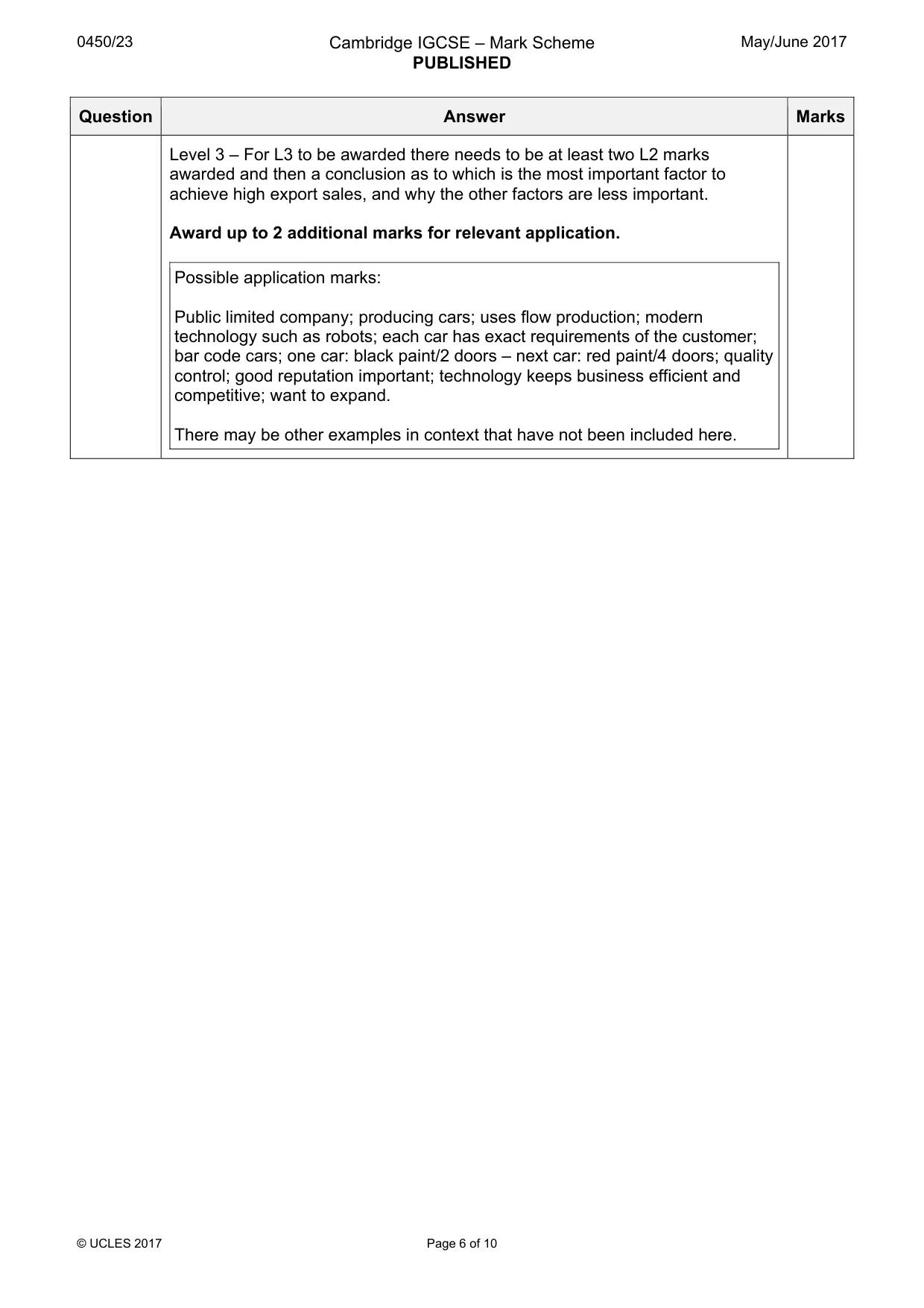
0450/23 Cambridge IGCSE – Mark Scheme PUBLISHED May/June 2017 © UCLES 2017 Page 6 of 10 Question Answer Marks Level 3 – For L3 to be awarded there needs to be at least two L2 marks awarded and then a conclusion as to which is the most important factor to achieve high export sales, and why the other factors are less important. Award up to 2 additional marks for relevant application. Possible application marks: Public limited company; producing cars; uses flow production; modern technology such as robots; each car has exact requirements of the customer; bar code cars; one car: black paint/2 doors – next car: red paint/4 doors; quality control; good reputation important; technology keeps business efficient and competitive; want to expand. There may be other examples in context that have not been included here.
Mark scheme, page 7
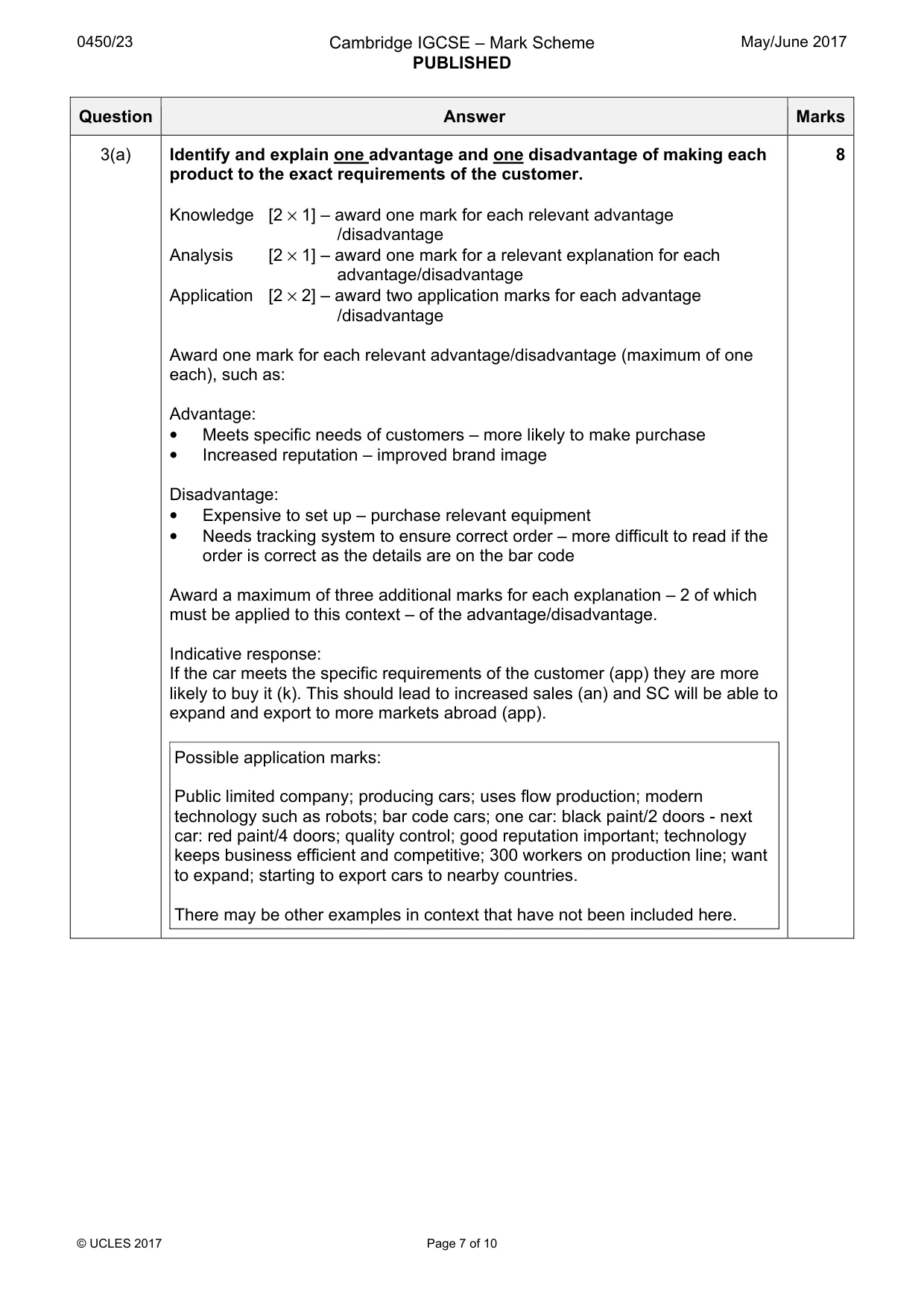
0450/23 Cambridge IGCSE – Mark Scheme PUBLISHED May/June 2017 © UCLES 2017 Page 7 of 10 Question Answer Marks 3(a) Identify and explain one advantage and one disadvantage of making each product to the exact requirements of the customer. Knowledge [2 × 1] – award one mark for each relevant advantage /disadvantage Analysis [2 × 1] – award one mark for a relevant explanation for each advantage/disadvantage Application [2 × 2] – award two application marks for each advantage /disadvantage Award one mark for each relevant advantage/disadvantage (maximum of one each), such as: Advantage: • Meets specific needs of customers – more likely to make purchase • Increased reputation – improved brand image Disadvantage: • Expensive to set up – purchase relevant equipment • Needs tracking system to ensure correct order – more difficult to read if the order is correct as the details are on the bar code Award a maximum of three additional marks for each explanation – 2 of which must be applied to this context – of the advantage/disadvantage. Indicative response: If the car meets the specific requirements of the customer (app) they are more likely to buy it (k). This should lead to increased sales (an) and SC will be able to expand and export to more markets abroad (app). Possible application marks: Public limited company; producing cars; uses flow production; modern technology such as robots; bar code cars; one car: black paint/2 doors - next car: red paint/4 doors; quality control; good reputation important; technology keeps business efficient and competitive; 300 workers on production line; want to expand; starting to export cars to nearby countries. There may be other examples in context that have not been included here. 8
Mark scheme, page 8
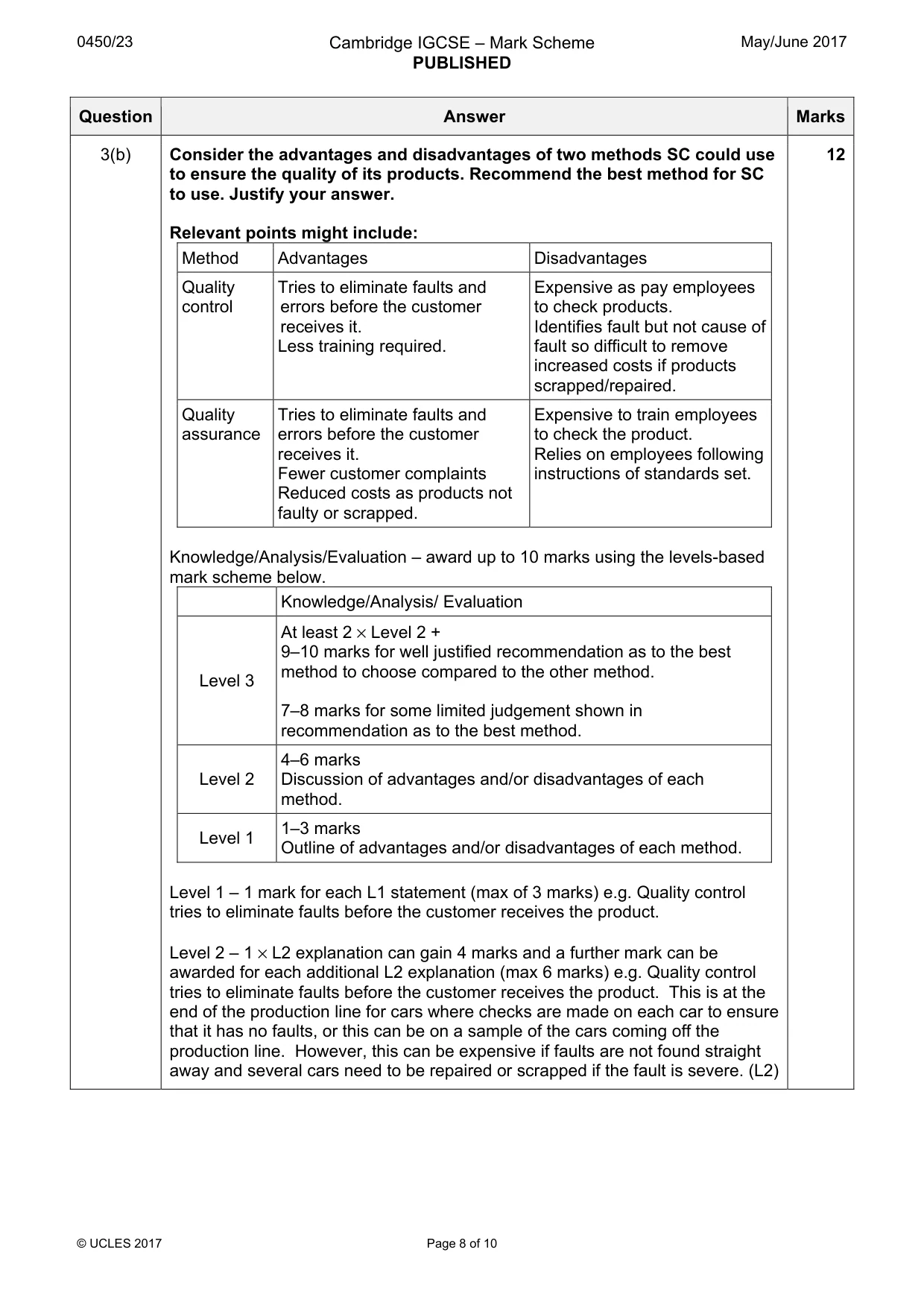
0450/23 Cambridge IGCSE – Mark Scheme PUBLISHED May/June 2017 © UCLES 2017 Page 8 of 10 Question Answer Marks 3(b) Consider the advantages and disadvantages of two methods SC could use to ensure the quality of its products. Recommend the best method for SC to use. Justify your answer. Relevant points might include: Method Advantages Disadvantages Quality control Tries to eliminate faults and errors before the customer receives it. Less training required. Expensive as pay employees to check products. Identifies fault but not cause of fault so difficult to remove increased costs if products scrapped/repaired. Quality assurance Tries to eliminate faults and errors before the customer receives it. Fewer customer complaints Reduced costs as products not faulty or scrapped. Expensive to train employees to check the product. Relies on employees following instructions of standards set. Knowledge/Analysis/Evaluation – award up to 10 marks using the levels-based mark scheme below. Knowledge/Analysis/ Evaluation Level 3 At least 2 × Level 2 + 9–10 marks for well justified recommendation as to the best method to choose compared to the other method. 7–8 marks for some limited judgement shown in recommendation as to the best method. Level 2 4–6 marks Discussion of advantages and/or disadvantages of each method. Level 1 1–3 marks Outline of advantages and/or disadvantages of each method. Level 1 – 1 mark for each L1 statement (max of 3 marks) e.g. Quality control tries to eliminate faults before the customer receives the product. Level 2 – 1 × L2 explanation can gain 4 marks and a further mark can be awarded for each additional L2 explanation (max 6 marks) e.g. Quality control tries to eliminate faults before the customer receives the product. This is at the end of the production line for cars where checks are made on each car to ensure that it has no faults, or this can be on a sample of the cars coming off the production line. However, this can be expensive if faults are not found straight away and several cars need to be repaired or scrapped if the fault is severe. (L2) 12
Mark scheme, page 9
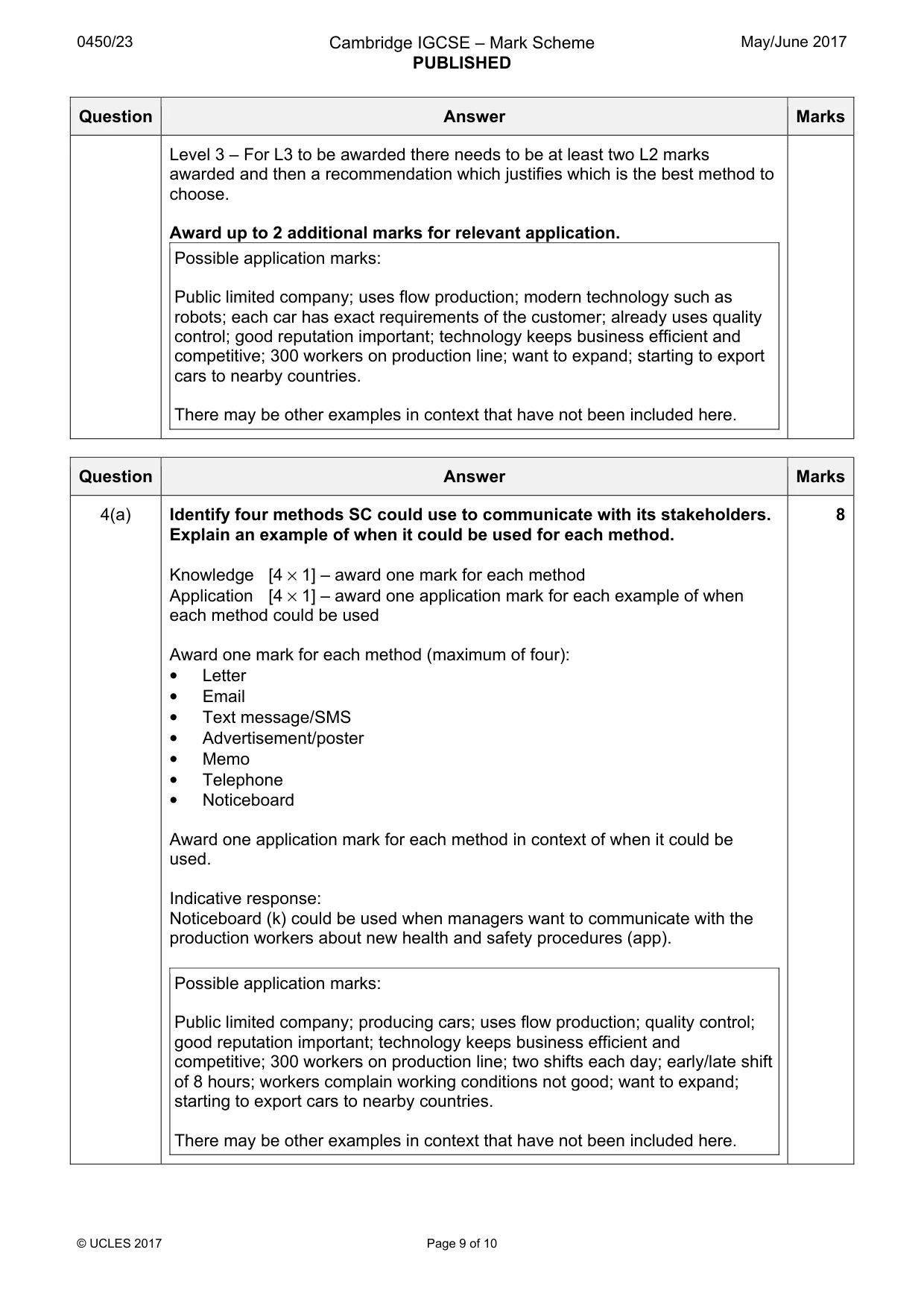
0450/23 Cambridge IGCSE – Mark Scheme PUBLISHED May/June 2017 © UCLES 2017 Page 9 of 10 Question Answer Marks Level 3 – For L3 to be awarded there needs to be at least two L2 marks awarded and then a recommendation which justifies which is the best method to choose. Award up to 2 additional marks for relevant application. Possible application marks: Public limited company; uses flow production; modern technology such as robots; each car has exact requirements of the customer; already uses quality control; good reputation important; technology keeps business efficient and competitive; 300 workers on production line; want to expand; starting to export cars to nearby countries. There may be other examples in context that have not been included here. Question Answer Marks 4(a) Identify four methods SC could use to communicate with its stakeholders. Explain an example of when it could be used for each method. Knowledge [4 × 1] – award one mark for each method Application [4 × 1] – award one application mark for each example of when each method could be used Award one mark for each method (maximum of four): • Letter • Email • Text message/SMS • Advertisement/poster • Memo • Telephone • Noticeboard Award one application mark for each method in context of when it could be used. Indicative response: Noticeboard (k) could be used when managers want to communicate with the production workers about new health and safety procedures (app). Possible application marks: Public limited company; producing cars; uses flow production; quality control; good reputation important; technology keeps business efficient and competitive; 300 workers on production line; two shifts each day; early/late shift of 8 hours; workers complain working conditions not good; want to expand; starting to export cars to nearby countries. There may be other examples in context that have not been included here. 8
Mark scheme, page 10
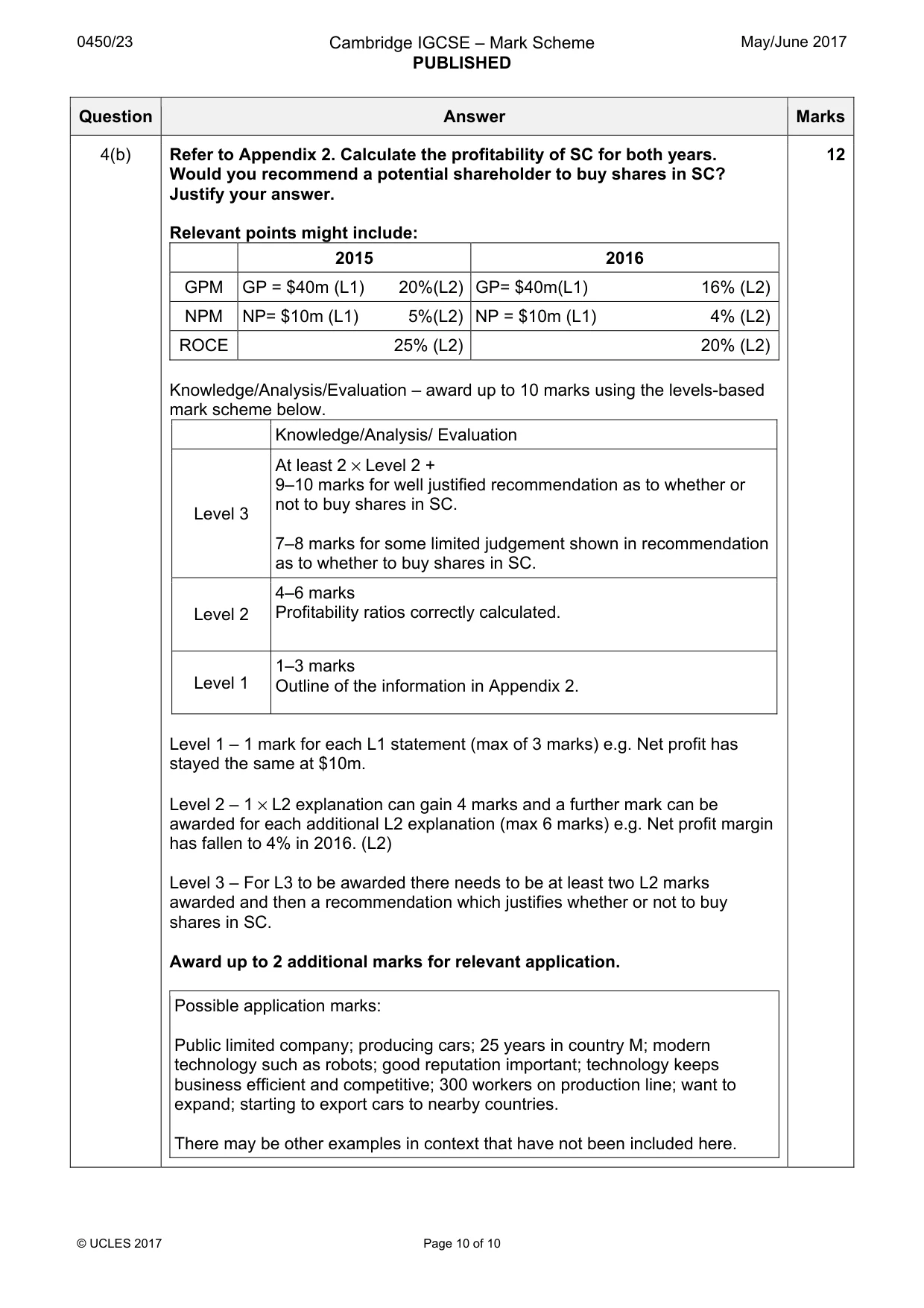
0450/23 Cambridge IGCSE – Mark Scheme PUBLISHED May/June 2017 © UCLES 2017 Page 10 of 10 Question Answer Marks 4(b) Refer to Appendix 2. Calculate the profitability of SC for both years. Would you recommend a potential shareholder to buy shares in SC? Justify your answer. Relevant points might include: 2015 2016 GPM GP = $40m (L1) 20%(L2) GP= $40m(L1) 16% (L2) NPM NP= $10m (L1) 5%(L2) NP = $10m (L1) 4% (L2) ROCE 25% (L2) 20% (L2) Knowledge/Analysis/Evaluation – award up to 10 marks using the levels-based mark scheme below. Knowledge/Analysis/ Evaluation Level 3 At least 2 × Level 2 + 9–10 marks for well justified recommendation as to whether or not to buy shares in SC. 7–8 marks for some limited judgement shown in recommendation as to whether to buy shares in SC. Level 2 4–6 marks Profitability ratios correctly calculated. Level 1 1–3 marks Outline of the information in Appendix 2. Level 1 – 1 mark for each L1 statement (max of 3 marks) e.g. Net profit has stayed the same at $10m. Level 2 – 1 × L2 explanation can gain 4 marks and a further mark can be awarded for each additional L2 explanation (max 6 marks) e.g. Net profit margin has fallen to 4% in 2016. (L2) Level 3 – For L3 to be awarded there needs to be at least two L2 marks awarded and then a recommendation which justifies whether or not to buy shares in SC. Award up to 2 additional marks for relevant application. Possible application marks: Public limited company; producing cars; 25 years in country M; modern technology such as robots; good reputation important; technology keeps business efficient and competitive; 300 workers on production line; want to expand; starting to export cars to nearby countries. There may be other examples in context that have not been included here. 12
What you needed in this session
Cambridge’s own grade thresholds for 2017 May/June, Paper 2 · Variant 3. A higher threshold means an easier paper — the bar moves with how the cohort did.