Cambridge IGCSE Business Studies 0450 — 2016 Feb/March Paper 2 · Variant 2
0450/22/F/M/16 · 80 marks · ≈90 min
The question paper and its mark scheme, free to read here and free to download. This is Cambridge’s own paper, exactly as it was sat.
Question paper12 pages



Mark scheme10 pages
Answers below. Sit the paper first if you are practising.

Paper as text
Question paper, page 1
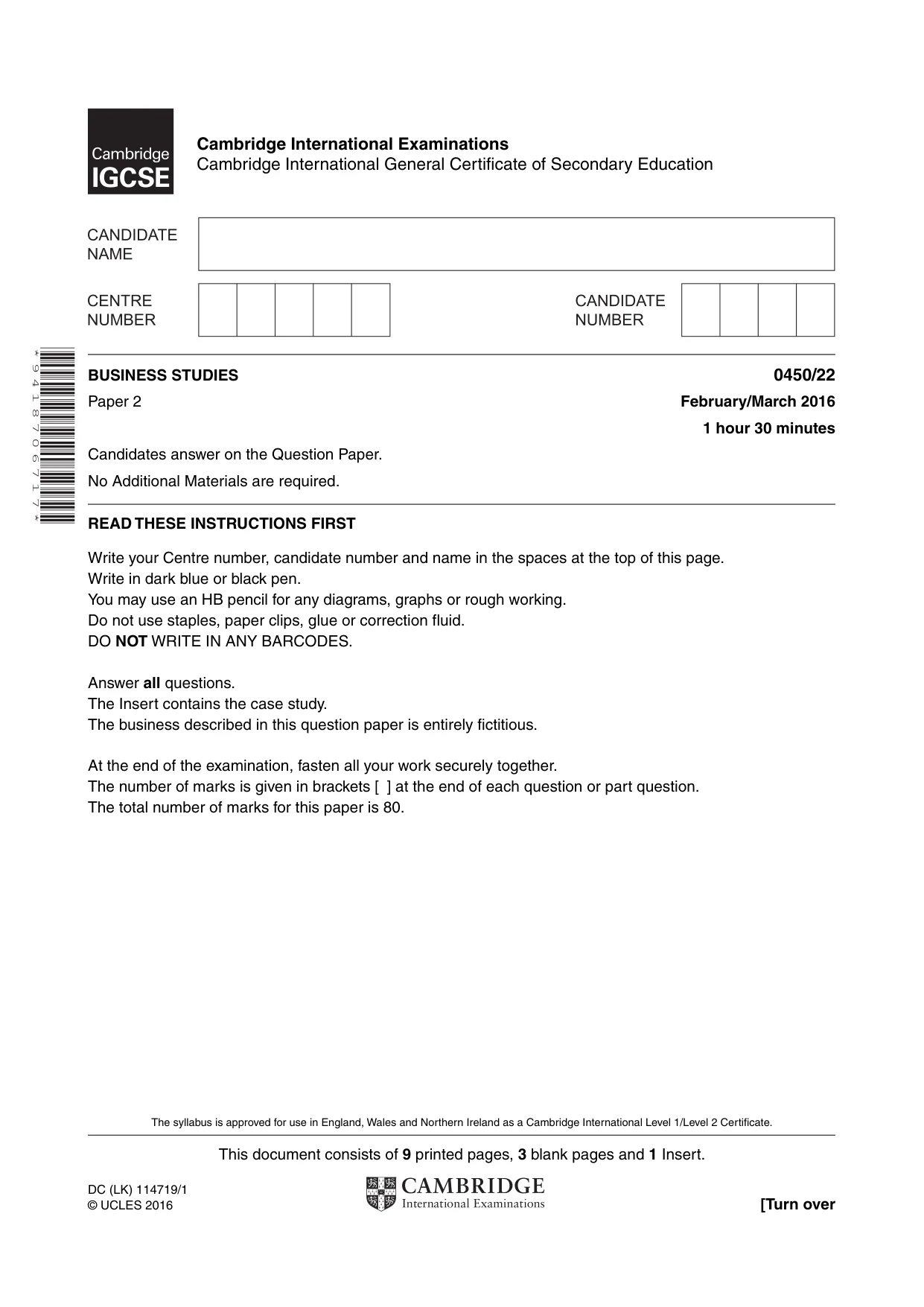
This document consists of 9 printed pages, 3 blank pages and 1 Insert. DC (LK) 114719/1 © UCLES 2016 [Turn over Cambridge International Examinations Cambridge International General Certificate of Secondary Education * 9 4 1 8 7 0 6 7 1 7 * BUSINESS STUDIES 0450/22 Paper 2 February/March 2016 1 hour 30 minutes Candidates answer on the Question Paper. No Additional Materials are required. READ THESE INSTRUCTIONS FIRST Write your Centre number, candidate number and name in the spaces at the top of this page. Write in dark blue or black pen. You may use an HB pencil for any diagrams, graphs or rough working. Do not use staples, paper clips, glue or correction fluid. DO NOT WRITE IN ANY BARCODES. Answer all questions. The Insert contains the case study. The business described in this question paper is entirely fictitious. At the end of the examination, fasten all your work securely together. The number of marks is given in brackets [ ] at the end of each question or part question. The total number of marks for this paper is 80. The syllabus is approved for use in England, Wales and Northern Ireland as a Cambridge International Level 1/Level 2 Certificate.
Question paper, page 2
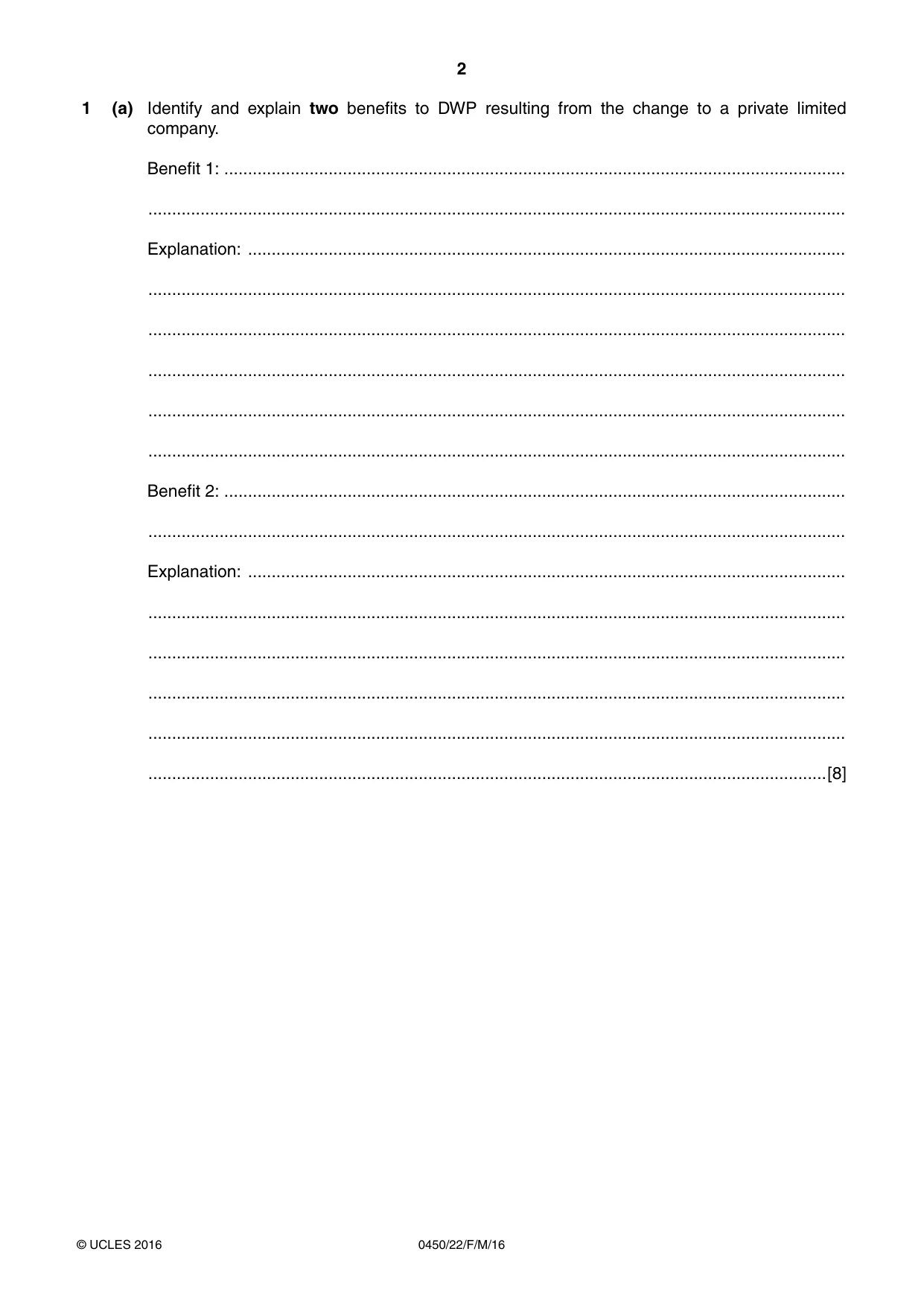
2 0450/22/F/M/16 © UCLES 2016 1 (a) Identify and explain two benefits to DWP resulting from the change to a private limited company. Benefit 1: … … Explanation: … … … … … … Benefit 2: … … Explanation: … … … … … …[8]
Question paper, page 3
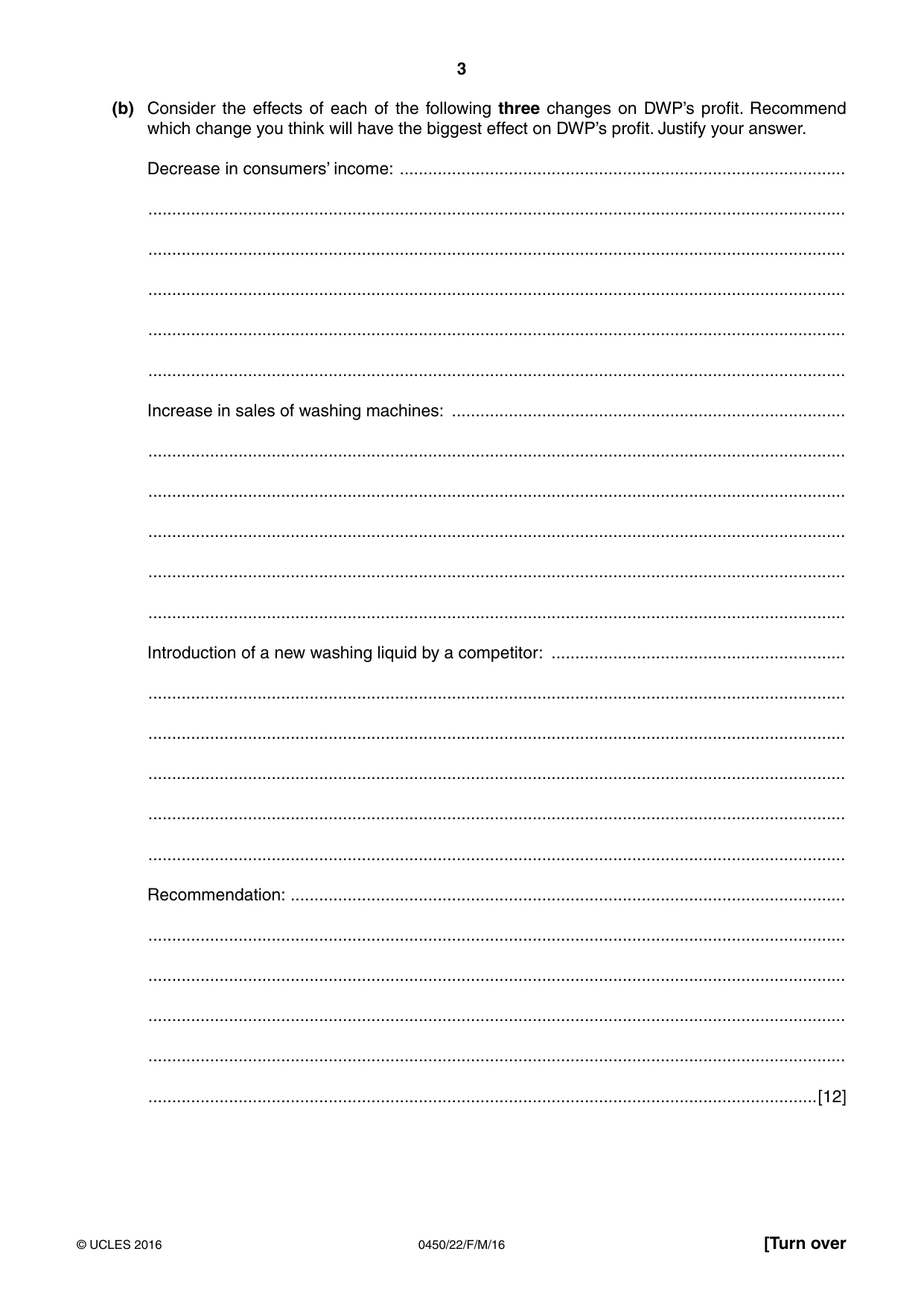
3 0450/22/F/M/16 © UCLES 2016 [Turn over (b) Consider the effects of each of the following three changes on DWP’s profit. Recommend which change you think will have the biggest effect on DWP’s profit. Justify your answer. Decrease in consumers’ income: … … … … … … Increase in sales of washing machines: … … … … … … Introduction of a new washing liquid by a competitor: … … … … … … Recommendation: … … … … … …[12]
Question paper, page 4
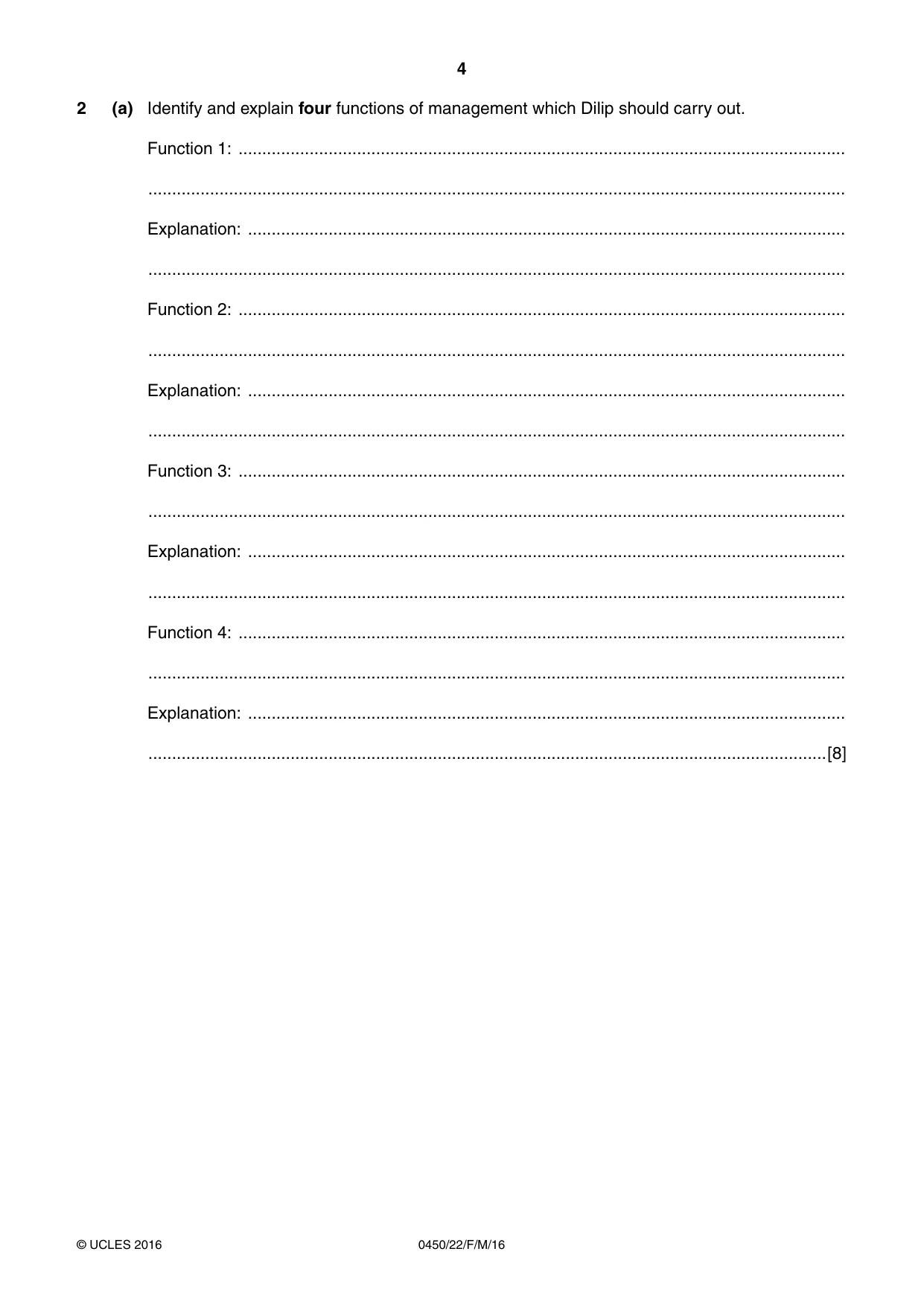
4 0450/22/F/M/16 © UCLES 2016 2 (a) Identify and explain four functions of management which Dilip should carry out. Function 1: … … Explanation: … … Function 2: … … Explanation: … … Function 3: … … Explanation: … … Function 4: … … Explanation: … …[8]
Question paper, page 5
5 0450/22/F/M/16 © UCLES 2016 [Turn over (b) Refer to Appendix 3. Consider the three options to increase output. Recommend the best option for Dilip to choose. Justify your answer. Purchase new equipment: … … … … … … Employ 10 additional production workers: … … … … … … Purchase partly processed raw materials: … … … … … … Recommendation: … … … … … …[12]
Question paper, page 6
6 0450/22/F/M/16 © UCLES 2016 3 (a) Identify and explain one advantage and one disadvantage to the business of Dilip training production employees using on-the-job training. Advantage: … … Explanation: … … … … … … Disadvantage: … … Explanation: … … … … … …[8]
Question paper, page 7
7 0450/22/F/M/16 © UCLES 2016 [Turn over (b) Place is an important part of the marketing mix. Consider three suitable channels of distribution Dilip could use for his new product in country X. Recommend which channel of distribution would be the best one to choose. Justify your answer. Channel 1: … … … … … … Channel 2: … … … … … … Channel 3: … … … … … … Recommendation: … … … … … …[12]
Question paper, page 8
8 0450/22/F/M/16 © UCLES 2016 4 (a) Identify and explain two possible effects on DWP of strict legal controls on how businesses describe their products in advertisements. Effect 1: … … Explanation: … … … … … … Effect 2: … … Explanation: … … … … … …[8]
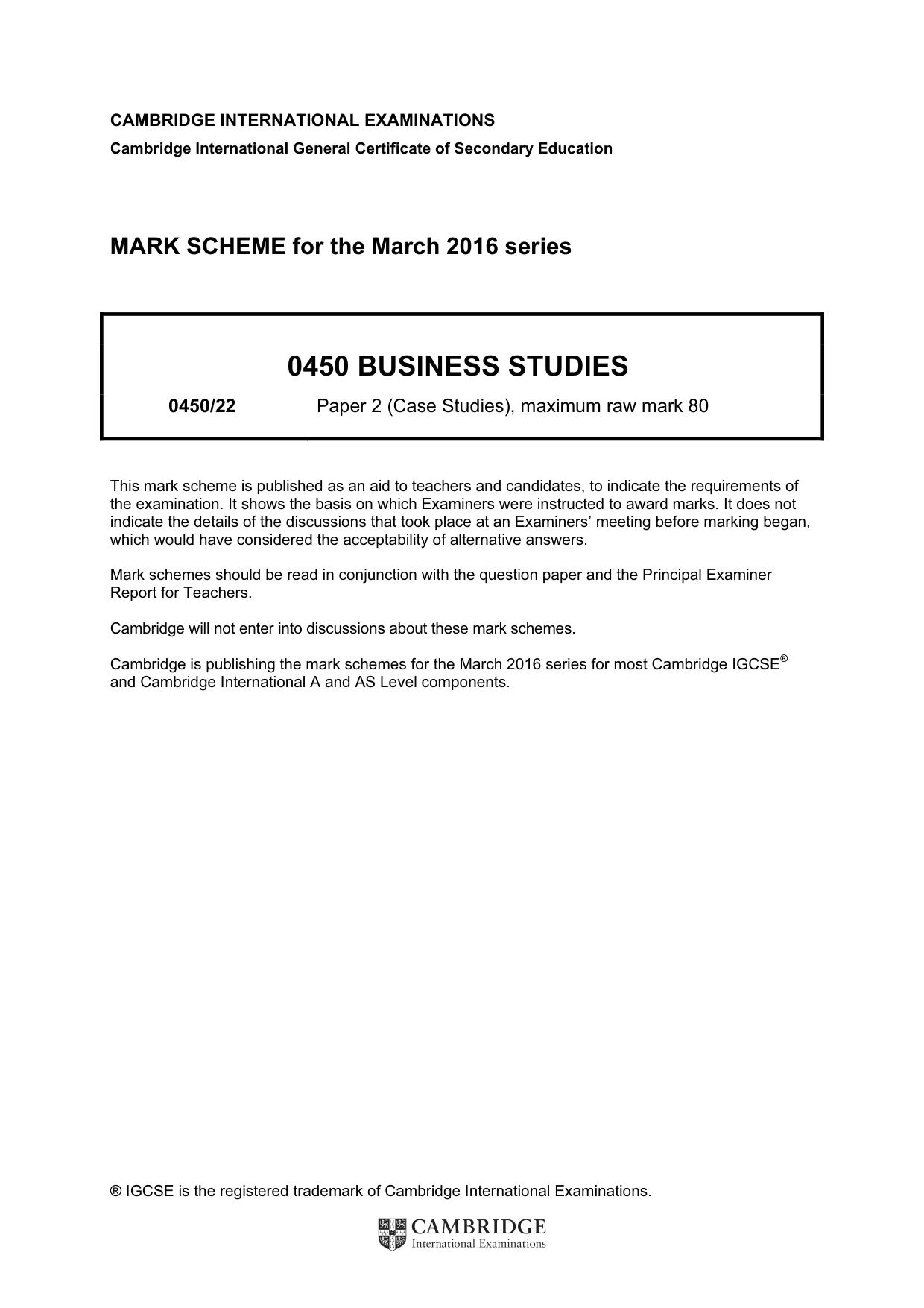
Question paper, page 9
9 0450/22/F/M/16 © UCLES 2016 (b) Dilip is thinking of selling DWP’s products in other countries. Consider three problems to DWP of entering foreign markets. Recommend whether DWP should sell in foreign markets. Justify your answer. Problem 1: … … … … … … Problem 2: … … … … … … Problem 3: … … … … … … Recommendation: … … … … … …[12]
Question paper, page 10
10 0450/22/F/M/16 © UCLES 2016 BLANK PAGE
Question paper, page 11
11 0450/22/F/M/16 © UCLES 2016 BLANK PAGE
Question paper, page 12
12 0450/22/F/M/16 © UCLES 2016 Permission to reproduce items where third-party owned material protected by copyright is included has been sought and cleared where possible. Every reasonable effort has been made by the publisher (UCLES) to trace copyright holders, but if any items requiring clearance have unwittingly been included, the publisher will be pleased to make amends at the earliest possible opportunity. To avoid the issue of disclosure of answer-related information to candidates, all copyright acknowledgements are reproduced online in the Cambridge International Examinations Copyright Acknowledgements Booklet. This is produced for each series of examinations and is freely available to download at www.cie.org.uk after the live examination series. Cambridge International Examinations is part of the Cambridge Assessment Group. Cambridge Assessment is the brand name of University of Cambridge Local Examinations Syndicate (UCLES), which is itself a department of the University of Cambridge. BLANK PAGE
Mark scheme, page 1
® IGCSE is the registered trademark of Cambridge International Examinations. CAMBRIDGE INTERNATIONAL EXAMINATIONS Cambridge International General Certificate of Secondary Education MARK SCHEME for the March 2016 series 0450 BUSINESS STUDIES 0450/22 Paper 2 (Case Studies), maximum raw mark 80 This mark scheme is published as an aid to teachers and candidates, to indicate the requirements of the examination. It shows the basis on which Examiners were instructed to award marks. It does not indicate the details of the discussions that took place at an Examiners’ meeting before marking began, which would have considered the acceptability of alternative answers. Mark schemes should be read in conjunction with the question paper and the Principal Examiner Report for Teachers. Cambridge will not enter into discussions about these mark schemes. Cambridge is publishing the mark schemes for the March 2016 series for most Cambridge IGCSE® and Cambridge International A and AS Level components.
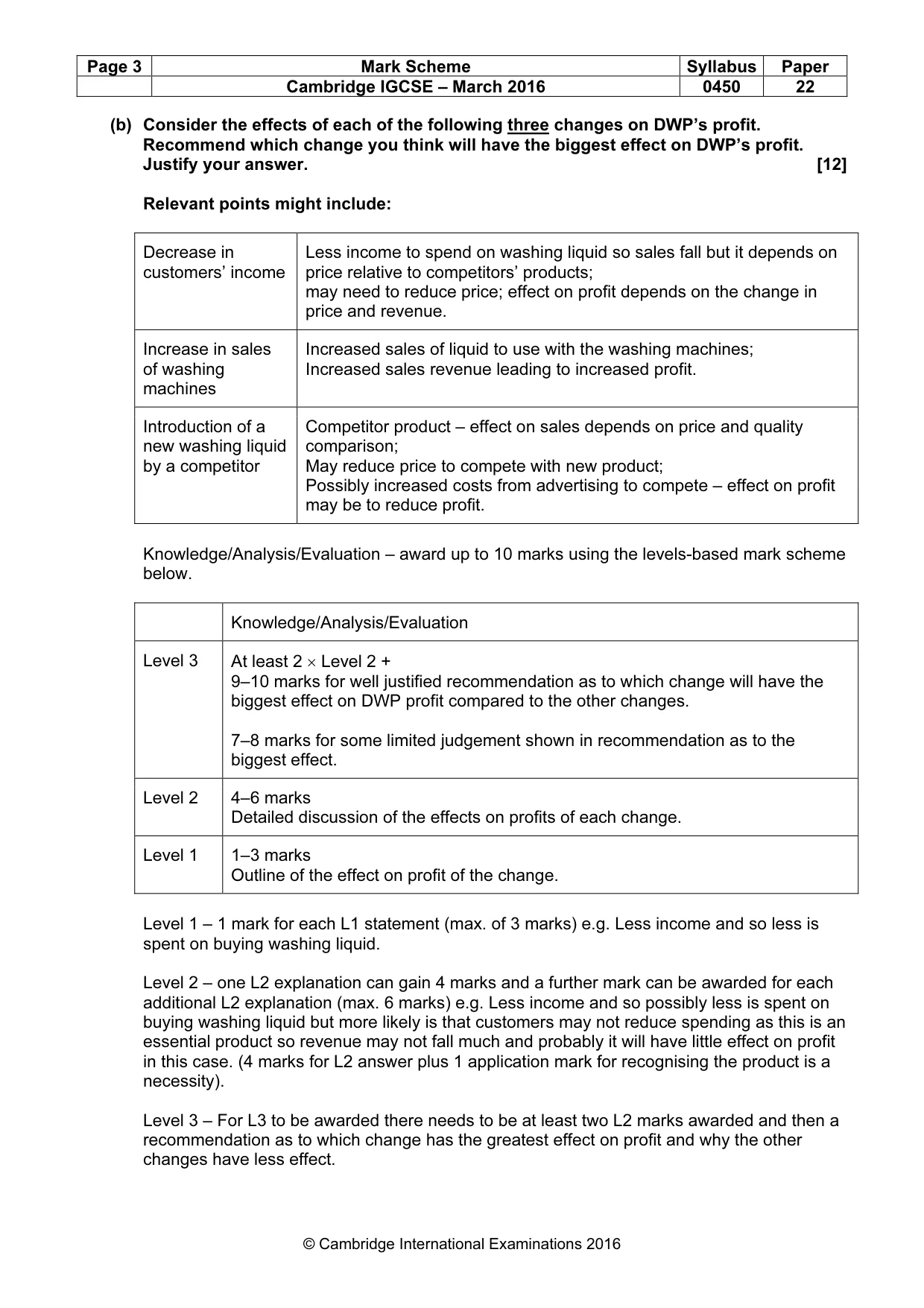
Mark scheme, page 2
Page 2 Mark Scheme Syllabus Paper Cambridge IGCSE – March 2016 0450 22 © Cambridge International Examinations 2016 1 (a) Identify and explain two benefits to DWP resulting from the change to a private limited company. [8] Knowledge (2 × 1) – award one mark for each relevant benefit identified Analysis (2 × 1) – award one mark for a relevant explanation of each benefit Application (2 × 2) – award two application marks for each relevant benefit Relevant reasons might include: Award one mark for each relevant benefit (maximum of two), such as: • Limited liability • Increased availability of capital • Continuity Award a maximum of three additional marks for each explanation – 2 of which must be applied to this context – of the benefit. Indicative response: Limited liability (k) as Dilip changed the business into a private limited company 1 year ago (ap) but when he was a sole trader his personal possessions were at risk (an). The business has a lot of money invested and as a private limited company Dilip can only lose the money he invested as part of the $250 000 shares sold if it went bankrupt (ap). Possible application marks: started 5 years ago as a sole trader; makes liquid soap; washing liquid; $50 000 profit; washing clothes; sold to wholesaler and small shops; sells the new product in country X; $250 000 share value; large factory with room for expansion; purchase new equipment for factory; double production workers to increase output; information from Appendix 3. There may be other examples in context which have not been included here.
Mark scheme, page 3
Page 3 Mark Scheme Syllabus Paper Cambridge IGCSE – March 2016 0450 22 © Cambridge International Examinations 2016 (b) Consider the effects of each of the following three changes on DWP’s profit. Recommend which change you think will have the biggest effect on DWP’s profit. Justify your answer. [12] Relevant points might include: Decrease in customers’ income Less income to spend on washing liquid so sales fall but it depends on price relative to competitors’ products; may need to reduce price; effect on profit depends on the change in price and revenue. Increase in sales of washing machines Increased sales of liquid to use with the washing machines; Increased sales revenue leading to increased profit. Introduction of a new washing liquid by a competitor Competitor product – effect on sales depends on price and quality comparison; May reduce price to compete with new product; Possibly increased costs from advertising to compete – effect on profit may be to reduce profit. Knowledge/Analysis/Evaluation – award up to 10 marks using the levels-based mark scheme below. Knowledge/Analysis/Evaluation Level 3 At least 2 × Level 2 + 9–10 marks for well justified recommendation as to which change will have the biggest effect on DWP profit compared to the other changes. 7–8 marks for some limited judgement shown in recommendation as to the biggest effect. Level 2 4–6 marks Detailed discussion of the effects on profits of each change. Level 1 1–3 marks Outline of the effect on profit of the change. Level 1 – 1 mark for each L1 statement (max. of 3 marks) e.g. Less income and so less is spent on buying washing liquid. Level 2 – one L2 explanation can gain 4 marks and a further mark can be awarded for each additional L2 explanation (max. 6 marks) e.g. Less income and so possibly less is spent on buying washing liquid but more likely is that customers may not reduce spending as this is an essential product so revenue may not fall much and probably it will have little effect on profit in this case. (4 marks for L2 answer plus 1 application mark for recognising the product is a necessity). Level 3 – For L3 to be awarded there needs to be at least two L2 marks awarded and then a recommendation as to which change has the greatest effect on profit and why the other changes have less effect.
Mark scheme, page 4
Page 4 Mark Scheme Syllabus Paper Cambridge IGCSE – March 2016 0450 22 © Cambridge International Examinations 2016 Award up to 2 additional marks for relevant application. Possible application marks: changed to a private limited company; makes liquid soap; $50 000 profit; hand wash clothes; washing clothes; sold to wholesaler and small shops; wants to expand the business; sells the new product in country X; information from Appendix 1. There may be other examples in context which have not been included here.
Mark scheme, page 5
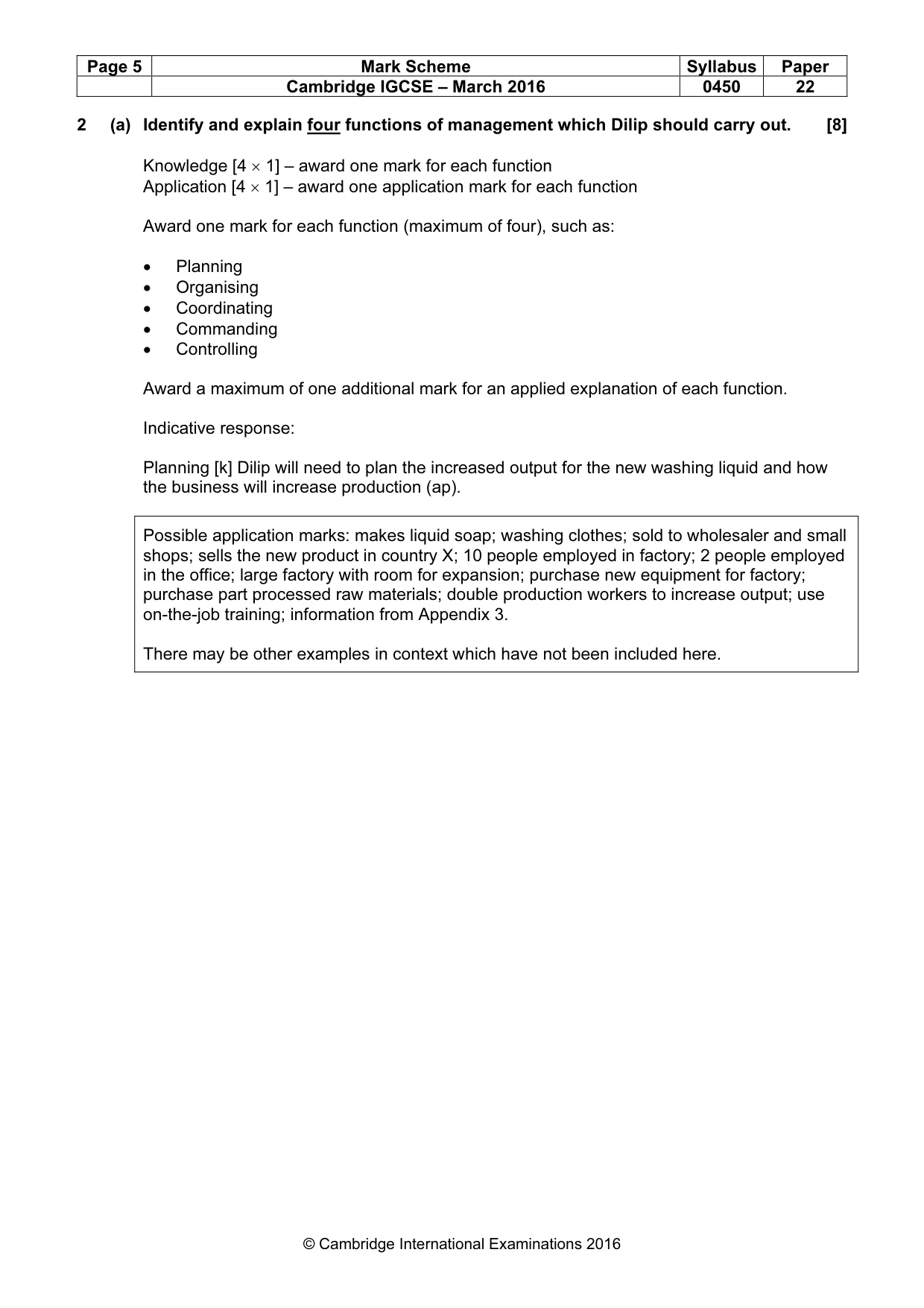
Page 5 Mark Scheme Syllabus Paper Cambridge IGCSE – March 2016 0450 22 © Cambridge International Examinations 2016 2 (a) Identify and explain four functions of management which Dilip should carry out. [8] Knowledge [4 × 1] – award one mark for each function Application [4 × 1] – award one application mark for each function Award one mark for each function (maximum of four), such as: • Planning • Organising • Coordinating • Commanding • Controlling Award a maximum of one additional mark for an applied explanation of each function. Indicative response: Planning [k] Dilip will need to plan the increased output for the new washing liquid and how the business will increase production (ap). Possible application marks: makes liquid soap; washing clothes; sold to wholesaler and small shops; sells the new product in country X; 10 people employed in factory; 2 people employed in the office; large factory with room for expansion; purchase new equipment for factory; purchase part processed raw materials; double production workers to increase output; use on-the-job training; information from Appendix 3. There may be other examples in context which have not been included here.
Mark scheme, page 6
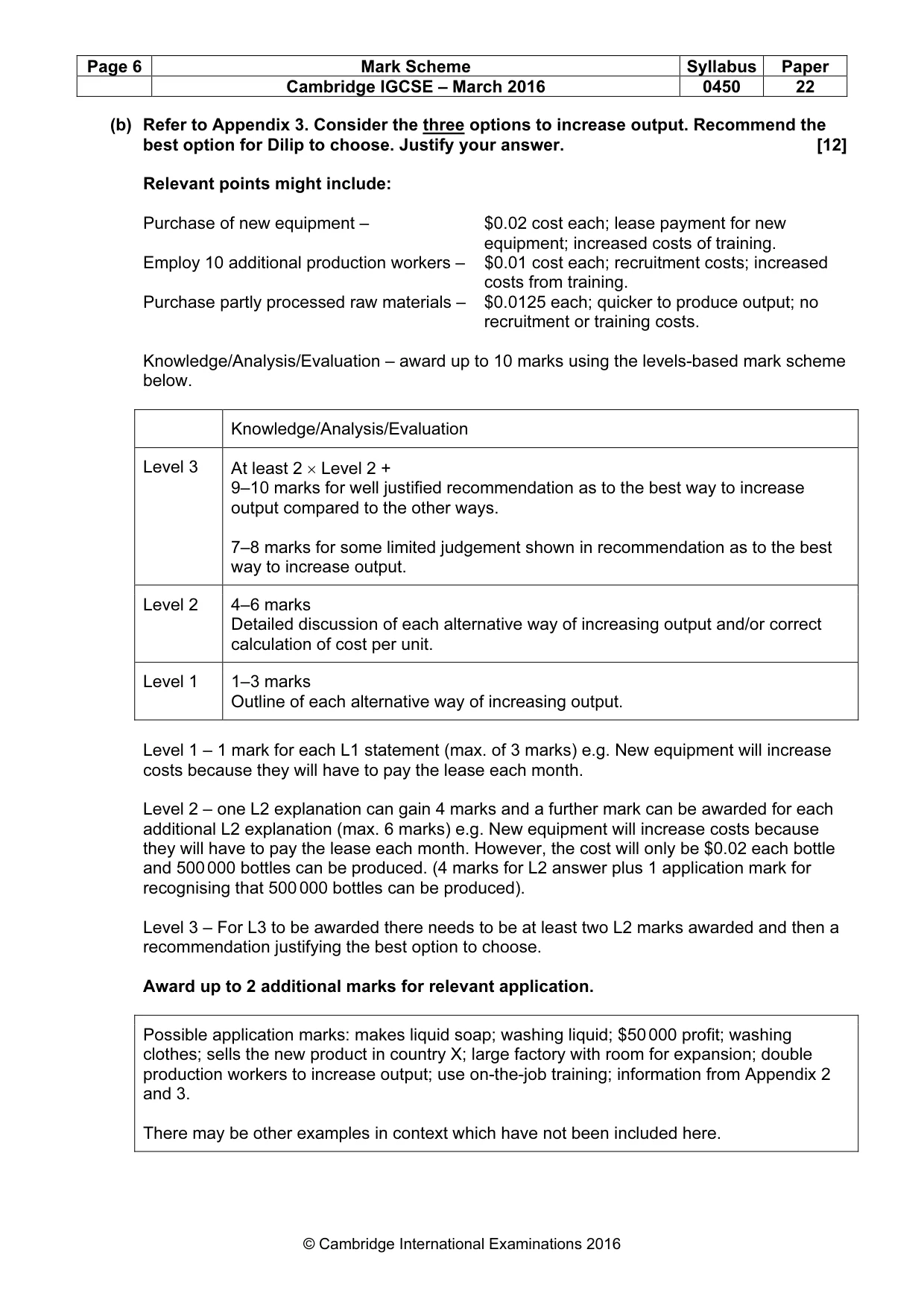
Page 6 Mark Scheme Syllabus Paper Cambridge IGCSE – March 2016 0450 22 © Cambridge International Examinations 2016 (b) Refer to Appendix 3. Consider the three options to increase output. Recommend the best option for Dilip to choose. Justify your answer. [12] Relevant points might include: Purchase of new equipment – $0.02 cost each; lease payment for new equipment; increased costs of training. Employ 10 additional production workers – $0.01 cost each; recruitment costs; increased costs from training. Purchase partly processed raw materials – $0.0125 each; quicker to produce output; no recruitment or training costs. Knowledge/Analysis/Evaluation – award up to 10 marks using the levels-based mark scheme below. Knowledge/Analysis/Evaluation Level 3 At least 2 × Level 2 + 9–10 marks for well justified recommendation as to the best way to increase output compared to the other ways. 7–8 marks for some limited judgement shown in recommendation as to the best way to increase output. Level 2 4–6 marks Detailed discussion of each alternative way of increasing output and/or correct calculation of cost per unit. Level 1 1–3 marks Outline of each alternative way of increasing output. Level 1 – 1 mark for each L1 statement (max. of 3 marks) e.g. New equipment will increase costs because they will have to pay the lease each month. Level 2 – one L2 explanation can gain 4 marks and a further mark can be awarded for each additional L2 explanation (max. 6 marks) e.g. New equipment will increase costs because they will have to pay the lease each month. However, the cost will only be $0.02 each bottle and 500 000 bottles can be produced. (4 marks for L2 answer plus 1 application mark for recognising that 500 000 bottles can be produced). Level 3 – For L3 to be awarded there needs to be at least two L2 marks awarded and then a recommendation justifying the best option to choose. Award up to 2 additional marks for relevant application. Possible application marks: makes liquid soap; washing liquid; $50 000 profit; washing clothes; sells the new product in country X; large factory with room for expansion; double production workers to increase output; use on-the-job training; information from Appendix 2 and 3. There may be other examples in context which have not been included here.
Mark scheme, page 7
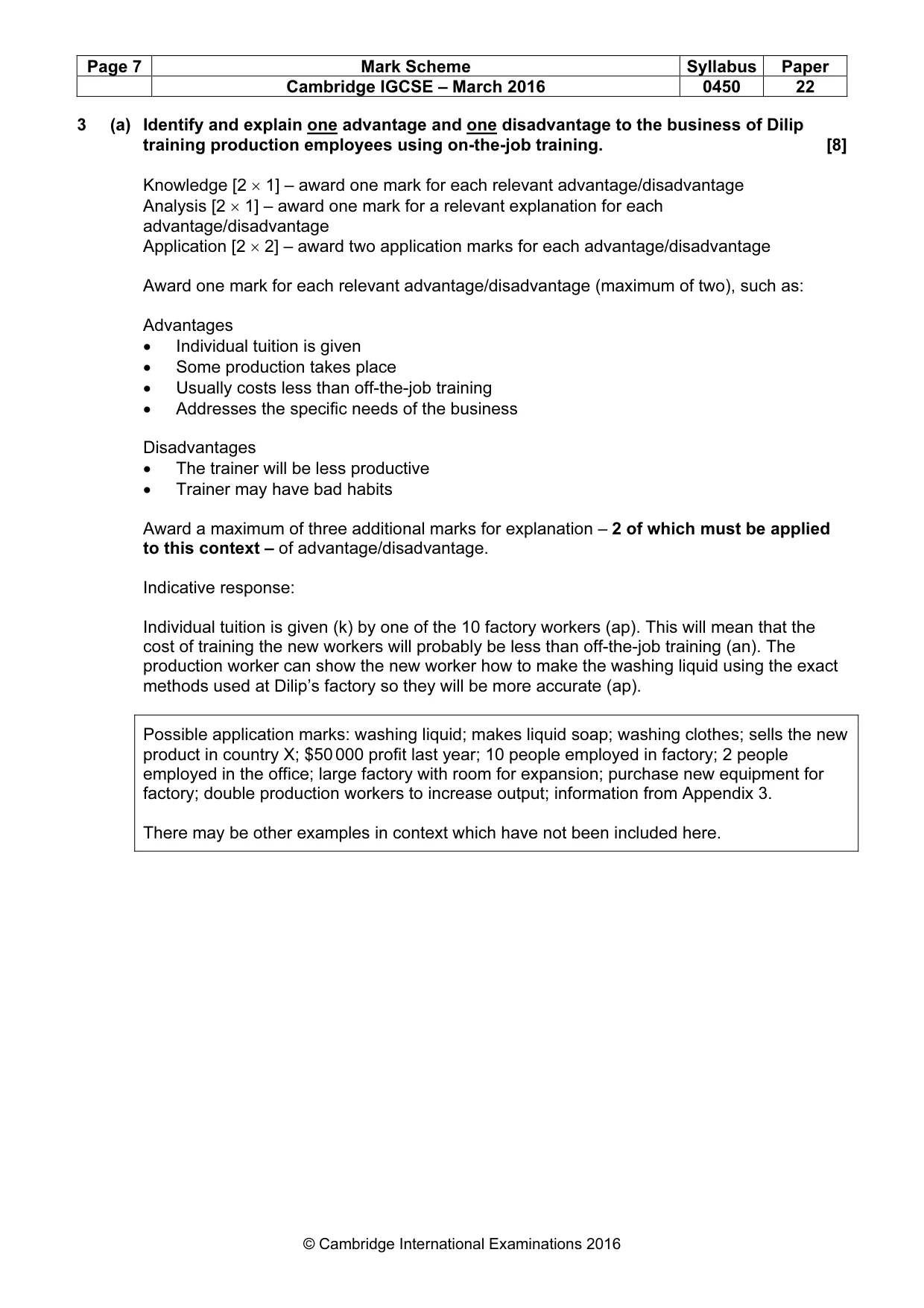
Page 7 Mark Scheme Syllabus Paper Cambridge IGCSE – March 2016 0450 22 © Cambridge International Examinations 2016 3 (a) Identify and explain one advantage and one disadvantage to the business of Dilip training production employees using on-the-job training. [8] Knowledge [2 × 1] – award one mark for each relevant advantage/disadvantage Analysis [2 × 1] – award one mark for a relevant explanation for each advantage/disadvantage Application [2 × 2] – award two application marks for each advantage/disadvantage Award one mark for each relevant advantage/disadvantage (maximum of two), such as: Advantages • Individual tuition is given • Some production takes place • Usually costs less than off-the-job training • Addresses the specific needs of the business Disadvantages • The trainer will be less productive • Trainer may have bad habits Award a maximum of three additional marks for explanation – 2 of which must be applied to this context – of advantage/disadvantage. Indicative response: Individual tuition is given (k) by one of the 10 factory workers (ap). This will mean that the cost of training the new workers will probably be less than off-the-job training (an). The production worker can show the new worker how to make the washing liquid using the exact methods used at Dilip’s factory so they will be more accurate (ap). Possible application marks: washing liquid; makes liquid soap; washing clothes; sells the new product in country X; $50 000 profit last year; 10 people employed in factory; 2 people employed in the office; large factory with room for expansion; purchase new equipment for factory; double production workers to increase output; information from Appendix 3. There may be other examples in context which have not been included here.
Mark scheme, page 8
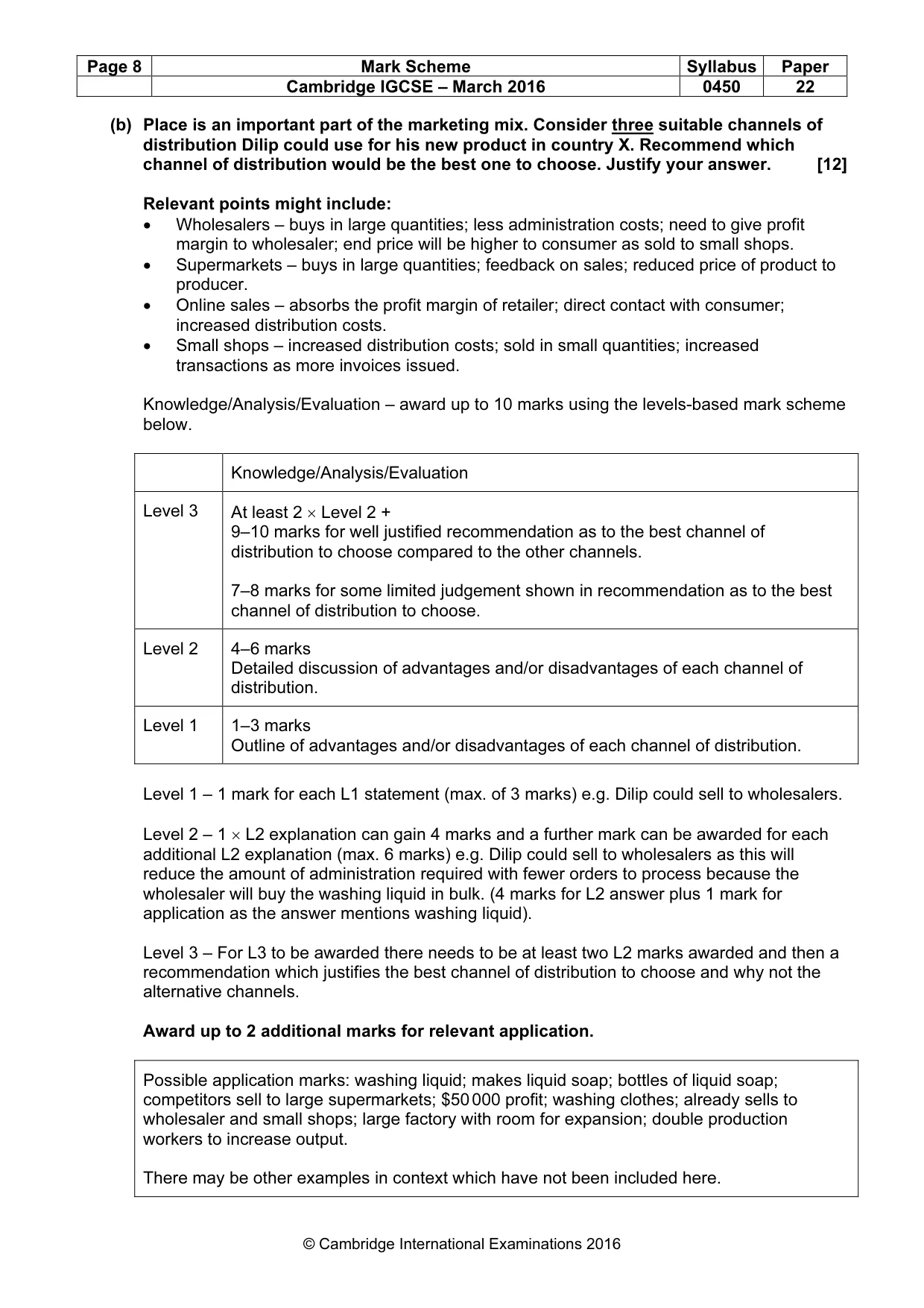
Page 8 Mark Scheme Syllabus Paper Cambridge IGCSE – March 2016 0450 22 © Cambridge International Examinations 2016 (b) Place is an important part of the marketing mix. Consider three suitable channels of distribution Dilip could use for his new product in country X. Recommend which channel of distribution would be the best one to choose. Justify your answer. [12] Relevant points might include: • Wholesalers – buys in large quantities; less administration costs; need to give profit margin to wholesaler; end price will be higher to consumer as sold to small shops. • Supermarkets – buys in large quantities; feedback on sales; reduced price of product to producer. • Online sales – absorbs the profit margin of retailer; direct contact with consumer; increased distribution costs. • Small shops – increased distribution costs; sold in small quantities; increased transactions as more invoices issued. Knowledge/Analysis/Evaluation – award up to 10 marks using the levels-based mark scheme below. Knowledge/Analysis/Evaluation Level 3 At least 2 × Level 2 + 9–10 marks for well justified recommendation as to the best channel of distribution to choose compared to the other channels. 7–8 marks for some limited judgement shown in recommendation as to the best channel of distribution to choose. Level 2 4–6 marks Detailed discussion of advantages and/or disadvantages of each channel of distribution. Level 1 1–3 marks Outline of advantages and/or disadvantages of each channel of distribution. Level 1 – 1 mark for each L1 statement (max. of 3 marks) e.g. Dilip could sell to wholesalers. Level 2 – 1 × L2 explanation can gain 4 marks and a further mark can be awarded for each additional L2 explanation (max. 6 marks) e.g. Dilip could sell to wholesalers as this will reduce the amount of administration required with fewer orders to process because the wholesaler will buy the washing liquid in bulk. (4 marks for L2 answer plus 1 mark for application as the answer mentions washing liquid). Level 3 – For L3 to be awarded there needs to be at least two L2 marks awarded and then a recommendation which justifies the best channel of distribution to choose and why not the alternative channels. Award up to 2 additional marks for relevant application. Possible application marks: washing liquid; makes liquid soap; bottles of liquid soap; competitors sell to large supermarkets; $50 000 profit; washing clothes; already sells to wholesaler and small shops; large factory with room for expansion; double production workers to increase output. There may be other examples in context which have not been included here.
Mark scheme, page 9
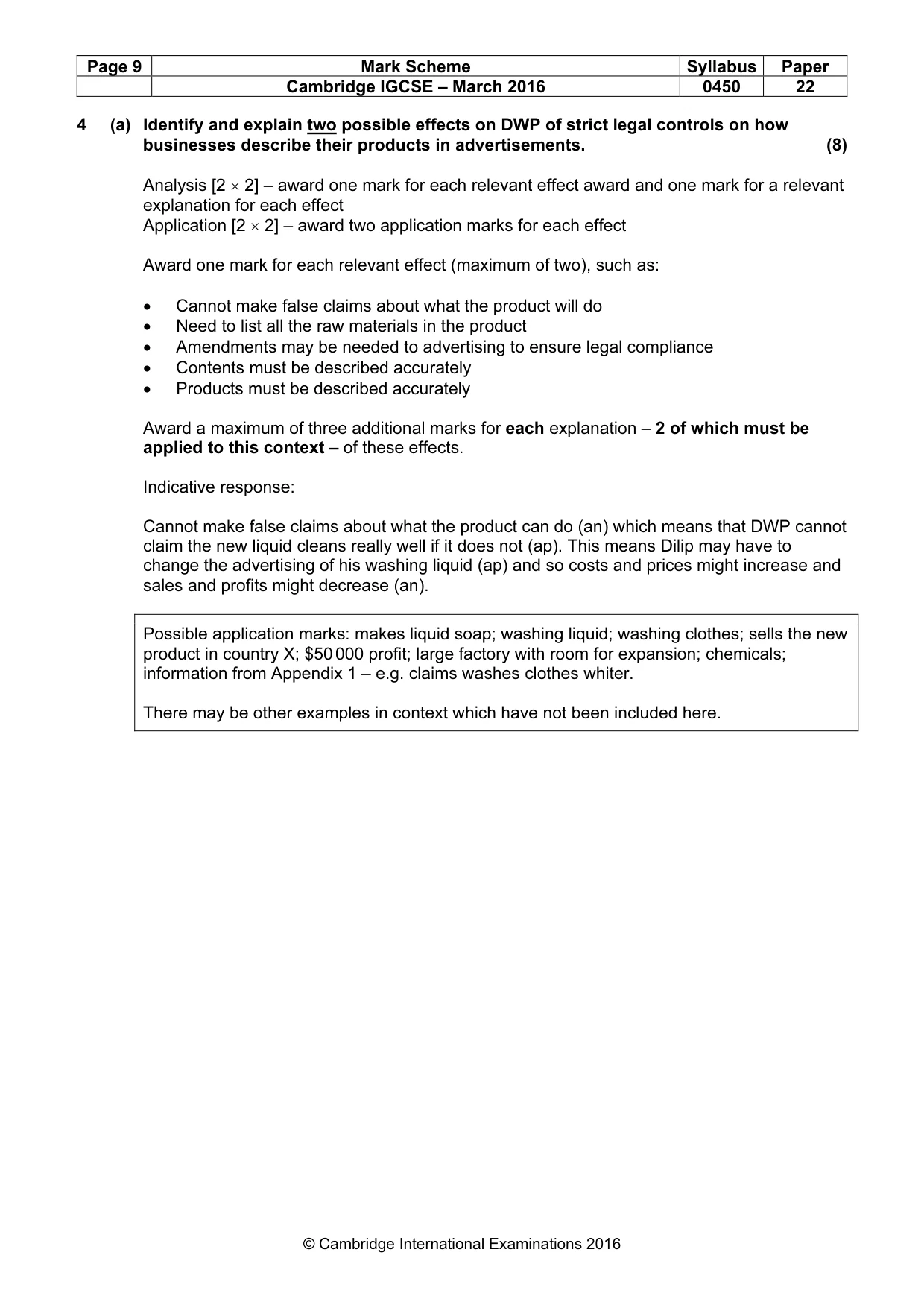
Page 9 Mark Scheme Syllabus Paper Cambridge IGCSE – March 2016 0450 22 © Cambridge International Examinations 2016 4 (a) Identify and explain two possible effects on DWP of strict legal controls on how businesses describe their products in advertisements. (8) Analysis [2 × 2] – award one mark for each relevant effect award and one mark for a relevant explanation for each effect Application [2 × 2] – award two application marks for each effect Award one mark for each relevant effect (maximum of two), such as: • Cannot make false claims about what the product will do • Need to list all the raw materials in the product • Amendments may be needed to advertising to ensure legal compliance • Contents must be described accurately • Products must be described accurately Award a maximum of three additional marks for each explanation – 2 of which must be applied to this context – of these effects. Indicative response: Cannot make false claims about what the product can do (an) which means that DWP cannot claim the new liquid cleans really well if it does not (ap). This means Dilip may have to change the advertising of his washing liquid (ap) and so costs and prices might increase and sales and profits might decrease (an). Possible application marks: makes liquid soap; washing liquid; washing clothes; sells the new product in country X; $50 000 profit; large factory with room for expansion; chemicals; information from Appendix 1 – e.g. claims washes clothes whiter. There may be other examples in context which have not been included here.
Mark scheme, page 10
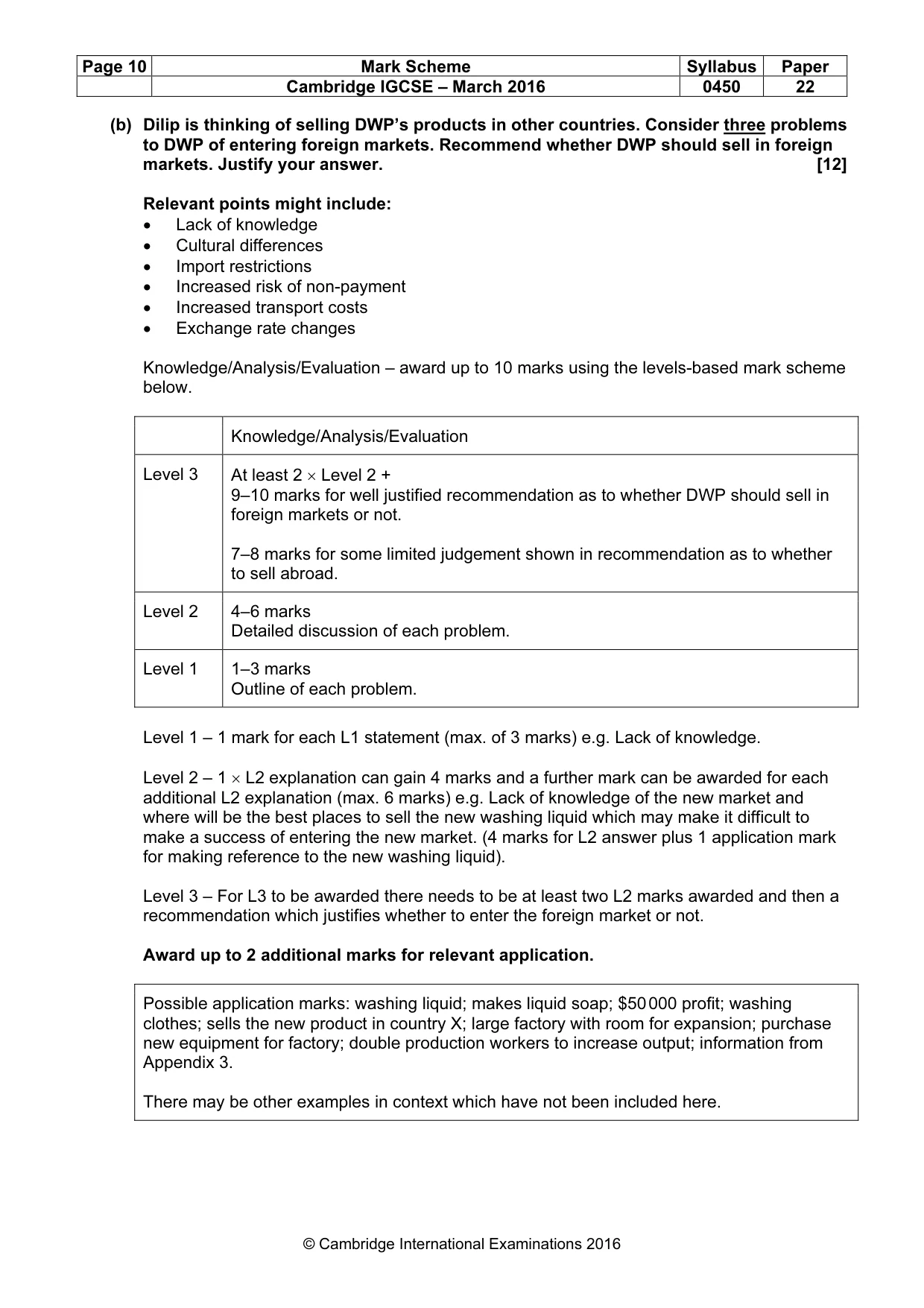
Page 10 Mark Scheme Syllabus Paper Cambridge IGCSE – March 2016 0450 22 © Cambridge International Examinations 2016 (b) Dilip is thinking of selling DWP’s products in other countries. Consider three problems to DWP of entering foreign markets. Recommend whether DWP should sell in foreign markets. Justify your answer. [12] Relevant points might include: • Lack of knowledge • Cultural differences • Import restrictions • Increased risk of non-payment • Increased transport costs • Exchange rate changes Knowledge/Analysis/Evaluation – award up to 10 marks using the levels-based mark scheme below. Knowledge/Analysis/Evaluation Level 3 At least 2 × Level 2 + 9–10 marks for well justified recommendation as to whether DWP should sell in foreign markets or not. 7–8 marks for some limited judgement shown in recommendation as to whether to sell abroad. Level 2 4–6 marks Detailed discussion of each problem. Level 1 1–3 marks Outline of each problem. Level 1 – 1 mark for each L1 statement (max. of 3 marks) e.g. Lack of knowledge. Level 2 – 1 × L2 explanation can gain 4 marks and a further mark can be awarded for each additional L2 explanation (max. 6 marks) e.g. Lack of knowledge of the new market and where will be the best places to sell the new washing liquid which may make it difficult to make a success of entering the new market. (4 marks for L2 answer plus 1 application mark for making reference to the new washing liquid). Level 3 – For L3 to be awarded there needs to be at least two L2 marks awarded and then a recommendation which justifies whether to enter the foreign market or not. Award up to 2 additional marks for relevant application. Possible application marks: washing liquid; makes liquid soap; $50 000 profit; washing clothes; sells the new product in country X; large factory with room for expansion; purchase new equipment for factory; double production workers to increase output; information from Appendix 3. There may be other examples in context which have not been included here.
What you needed in this session
Cambridge’s own grade thresholds for 2016 Feb/March, Paper 2 · Variant 2. A higher threshold means an easier paper — the bar moves with how the cohort did.