Cambridge IGCSE Business Studies 0450 — 2015 Oct/Nov Paper 2 · Variant 3
0450/23/O/N/15 · 80 marks · ≈90 min
The question paper and its mark scheme, free to read here and free to download. This is Cambridge’s own paper, exactly as it was sat.
Question paper12 pages


Mark scheme9 pages
Answers below. Sit the paper first if you are practising.
Paper as text
Question paper, page 1
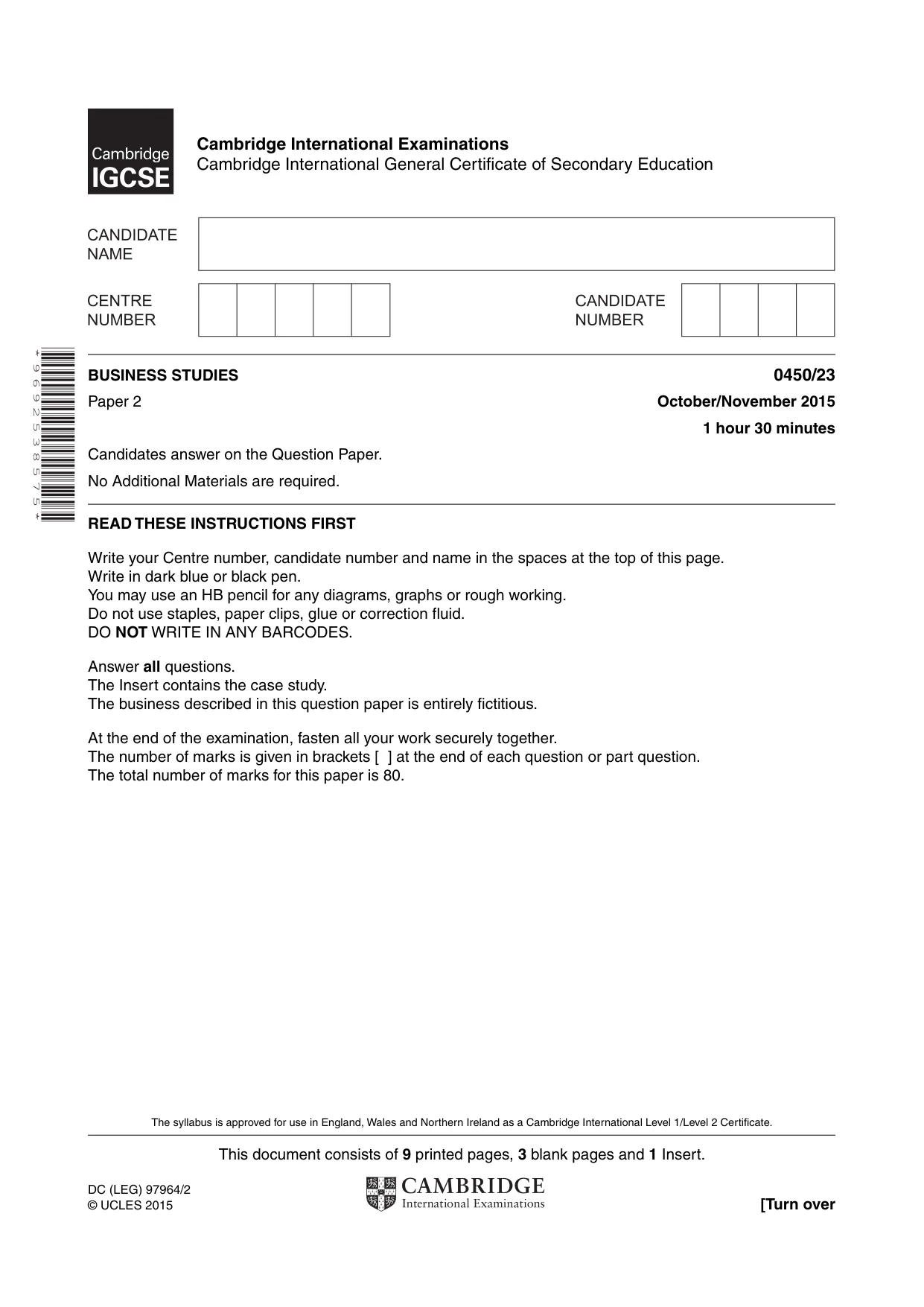
This document consists of 9 printed pages, 3 blank pages and 1 Insert. DC (LEG) 97964/2 © UCLES 2015 [Turn over Cambridge International Examinations Cambridge International General Certificate of Secondary Education * 9 6 9 2 5 3 8 5 7 5 * BUSINESS STUDIES 0450/23 Paper 2 October/November 2015 1 hour 30 minutes Candidates answer on the Question Paper. No Additional Materials are required. READ THESE INSTRUCTIONS FIRST Write your Centre number, candidate number and name in the spaces at the top of this page. Write in dark blue or black pen. You may use an HB pencil for any diagrams, graphs or rough working. Do not use staples, paper clips, glue or correction fluid. DO NOT WRITE IN ANY BARCODES. Answer all questions. The Insert contains the case study. The business described in this question paper is entirely fictitious. At the end of the examination, fasten all your work securely together. The number of marks is given in brackets [ ] at the end of each question or part question. The total number of marks for this paper is 80. The syllabus is approved for use in England, Wales and Northern Ireland as a Cambridge International Level 1/Level 2 Certificate.
Question paper, page 2
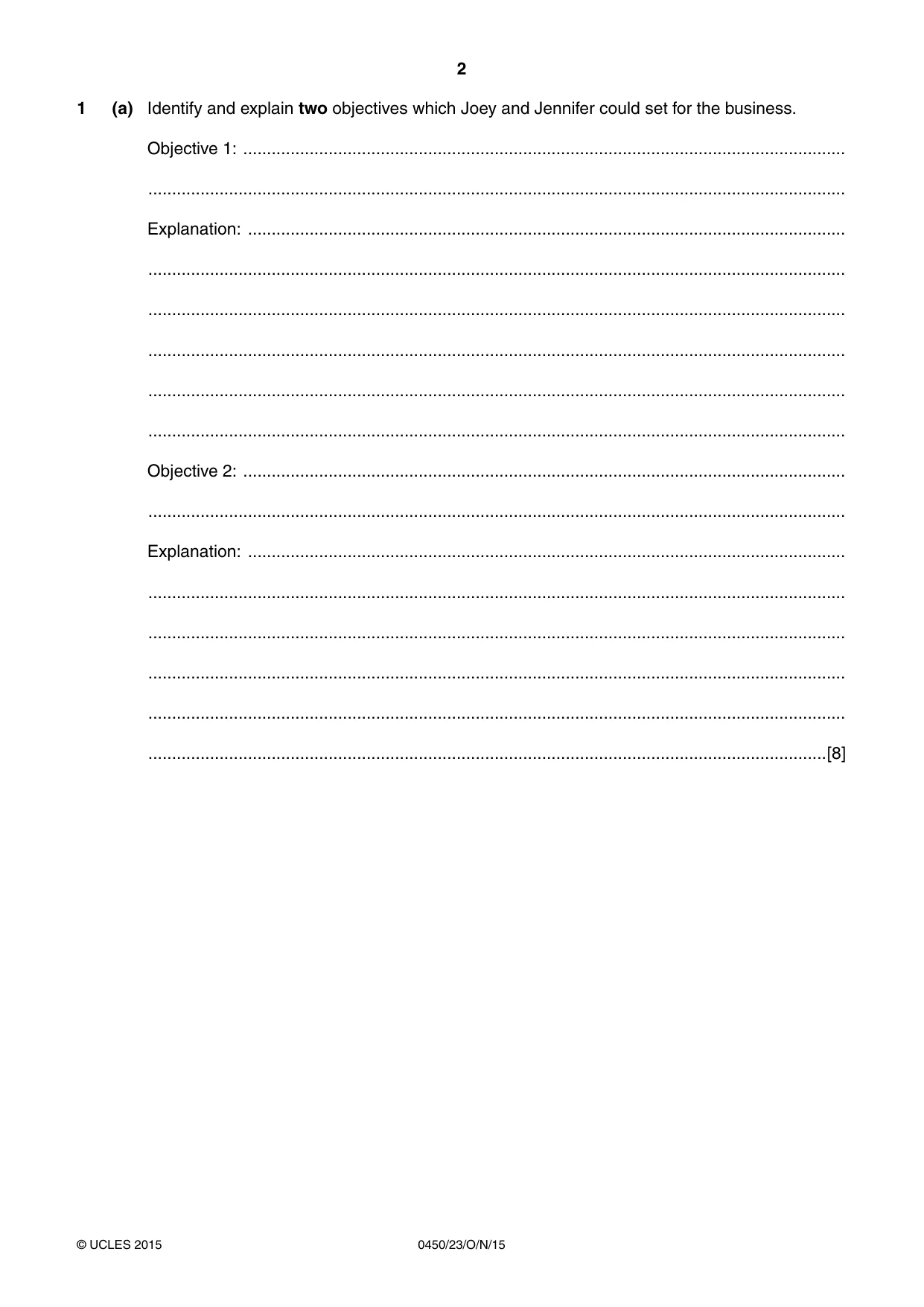
2 0450/23/O/N/15 © UCLES 2015 1 (a) Identify and explain two objectives which Joey and Jennifer could set for the business. Objective 1: … … Explanation: … … … … … … Objective 2: … … Explanation: … … … … … …[8]
Question paper, page 3
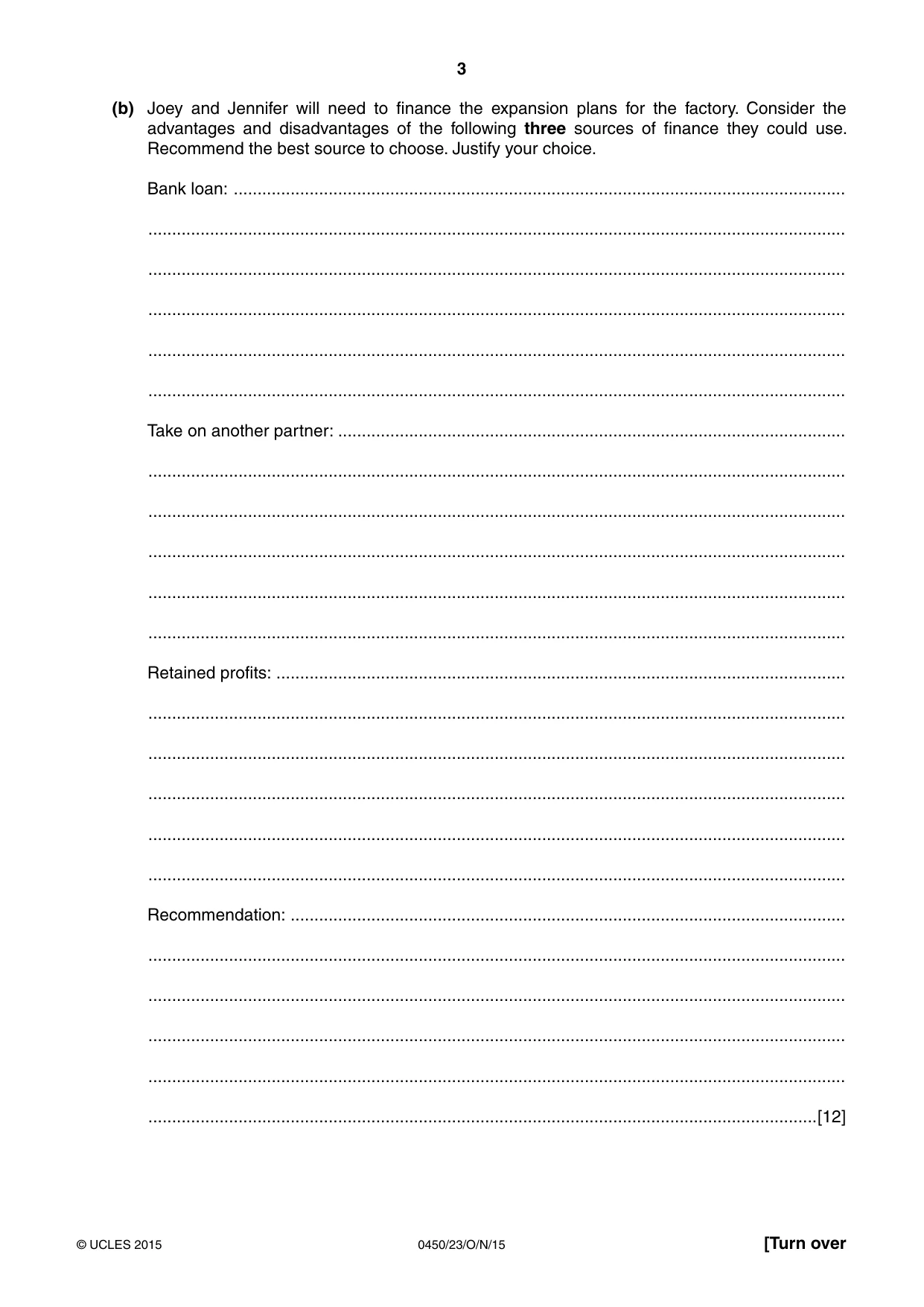
3 0450/23/O/N/15 © UCLES 2015 [Turn over (b) Joey and Jennifer will need to finance the expansion plans for the factory. Consider the advantages and disadvantages of the following three sources of finance they could use. Recommend the best source to choose. Justify your choice. Bank loan: … … … … … … Take on another partner: … … … … … … Retained profits: … … … … … … Recommendation: … … … … … …[12]
Question paper, page 4
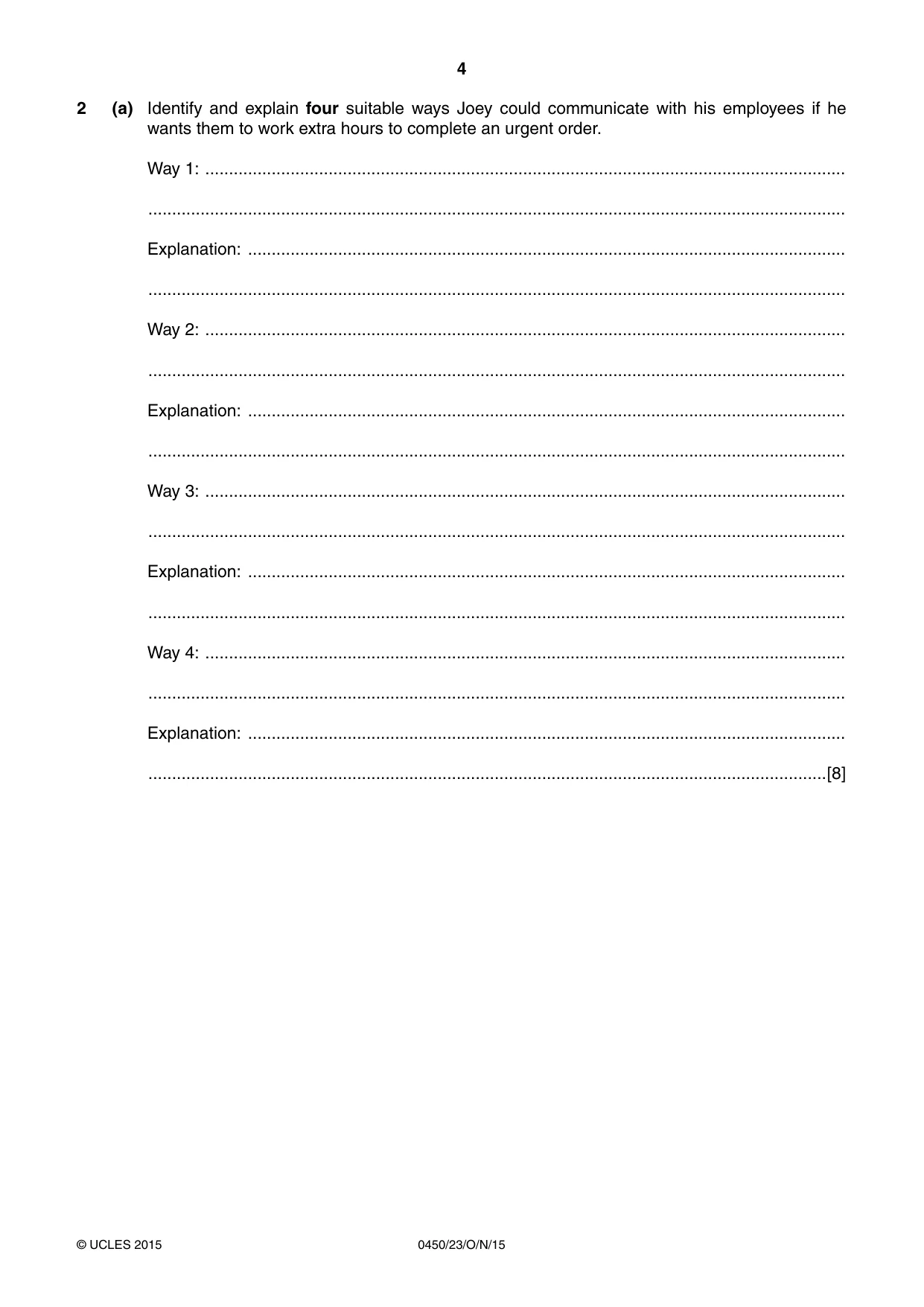
4 0450/23/O/N/15 © UCLES 2015 2 (a) Identify and explain four suitable ways Joey could communicate with his employees if he wants them to work extra hours to complete an urgent order. Way 1: … … Explanation: … … Way 2: … … Explanation: … … Way 3: … … Explanation: … … Way 4: … … Explanation: … …[8]
Question paper, page 5
5 0450/23/O/N/15 © UCLES 2015 [Turn over (b) Jennifer wants to increase sales. Consider the advantages and disadvantages of each of the following three pricing strategies TP could use to increase sales. Recommend which is the best pricing strategy for TP to use. Justify your answer. Cost plus: … … … … … … Competitive: … … … … … … Skimming: … … … … … … Recommendation: … … … … … …[12]
Question paper, page 6
6 0450/23/O/N/15 © UCLES 2015 3 (a) Identify and explain two leadership styles which would be suitable for Joey to use with the production workers. Leadership style 1: … Explanation: … … … … … … … Leadership style 2: … Explanation: … … … … … … …[8]
Question paper, page 7
7 0450/23/O/N/15 © UCLES 2015 [Turn over (b) (i) Refer to the cash flow forecast in Appendix 2. Calculate values for W, X, Y and Z and write your answers below. W: … X: … Y: … Z: …[4] (ii) Consider two ways of improving the cash flow position. Recommend the best way for Jennifer to improve the cash flow over the next six months. Justify your answer. Way 1: … … … … … Way 2: … … … … … Recommendation: … … … … … …[8]
Question paper, page 8
8 0450/23/O/N/15 © UCLES 2015 4 (a) Identify and explain two possible reasons why TP could fail. Reason 1: … … Explanation: … … … … … … Reason 2: … … Explanation: … … … … … …[8]
Question paper, page 9
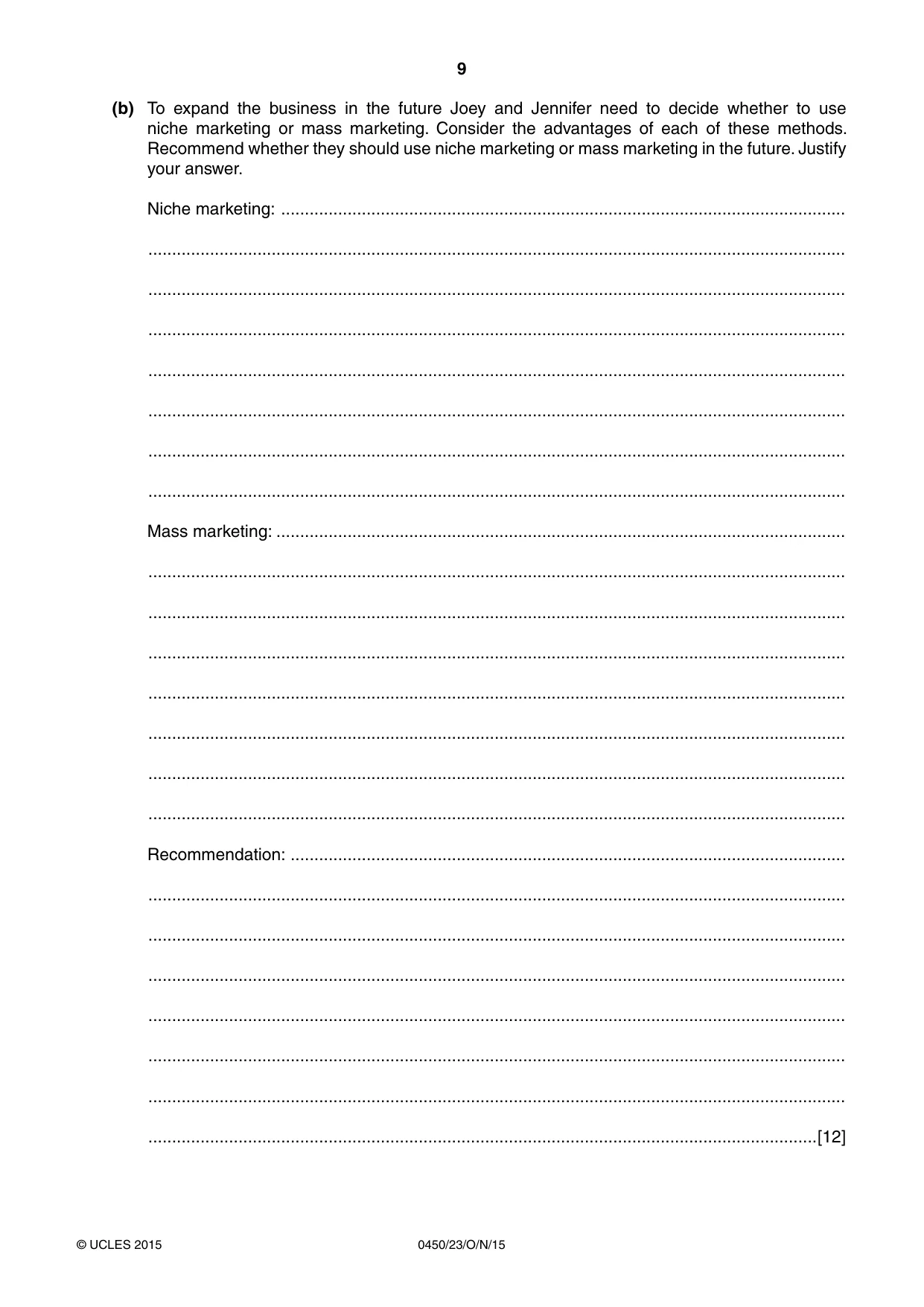
9 0450/23/O/N/15 © UCLES 2015 (b) To expand the business in the future Joey and Jennifer need to decide whether to use niche marketing or mass marketing. Consider the advantages of each of these methods. Recommend whether they should use niche marketing or mass marketing in the future. Justify your answer. Niche marketing: … … … … … … … … Mass marketing: … … … … … … … … Recommendation: … … … … … … … …[12]
Question paper, page 10
10 0450/23/O/N/15 © UCLES 2015 BLANK PAGE
Question paper, page 11
11 0450/23/O/N/15 © UCLES 2015 BLANK PAGE
Question paper, page 12
12 0450/23/O/N/15 © UCLES 2015 Permission to reproduce items where third-party owned material protected by copyright is included has been sought and cleared where possible. Every reasonable effort has been made by the publisher (UCLES) to trace copyright holders, but if any items requiring clearance have unwittingly been included, the publisher will be pleased to make amends at the earliest possible opportunity. To avoid the issue of disclosure of answer-related information to candidates, all copyright acknowledgements are reproduced online in the Cambridge International Examinations Copyright Acknowledgements Booklet. This is produced for each series of examinations and is freely available to download at www.cie.org.uk after the live examination series. Cambridge International Examinations is part of the Cambridge Assessment Group. Cambridge Assessment is the brand name of University of Cambridge Local Examinations Syndicate (UCLES), which is itself a department of the University of Cambridge. BLANK PAGE
Mark scheme, page 1
® IGCSE is the registered trademark of Cambridge International Examinations. CAMBRIDGE INTERNATIONAL EXAMINATIONS Cambridge International General Certificate of Secondary Education MARK SCHEME for the October/November 2015 series 0450 BUSINESS STUDIES 0450/23 Paper 2 (Case Study), maximum raw mark 80 This mark scheme is published as an aid to teachers and candidates, to indicate the requirements of the examination. It shows the basis on which Examiners were instructed to award marks. It does not indicate the details of the discussions that took place at an Examiners’ meeting before marking began, which would have considered the acceptability of alternative answers. Mark schemes should be read in conjunction with the question paper and the Principal Examiner Report for Teachers. Cambridge will not enter into discussions about these mark schemes. Cambridge is publishing the mark schemes for the October/November 2015 series for most Cambridge IGCSE®, Cambridge International A and AS Level components and some Cambridge O Level components.
Mark scheme, page 2
Page 2 Mark Scheme Syllabus Paper Cambridge IGCSE – October/November 2015 0450 23 © Cambridge International Examinations 2015 1 (a) Identify and explain two objectives which Joey and Jennifer could set for the business. [8] Knowledge [2 × 1] – award one mark for each relevant objective Analysis [2 × 1] – award one mark for a relevant explanation for each objective Application [2 × 2] – award two application marks for each objective Award one mark for each relevant objective (maximum of two), such as: • To survive • To make a profit • To grow the business/expansion • To increase market share • To produce a quality product • To increase sales/revenue • To create a good brand image Award a maximum of three additional marks for each explanation of these objectives – 2 of which must be applied to this context. Indicative response: To make a profit (k) as Joey and Jennifer have invested their own money into setting up the business as a partnership (ap) they will want a return on the investment as their money is at risk (an). This is because the business idea is new and does not have a market yet and so there is a risk that they could lose their money (ap). Possible application marks: partnership; tent manufacturing; set up 2 years ago; young people backpacking; train new workers; 20 production workers and two office workers; quickly expand the factory; lightweight fabric to make the tent; new design; two person and four person tent; priced just above the cost of production/cost-plus pricing; superior quality to competitors’ tents; growing market; sales of TP products is increasing. There may be other examples in context which have not been included here.
Mark scheme, page 3
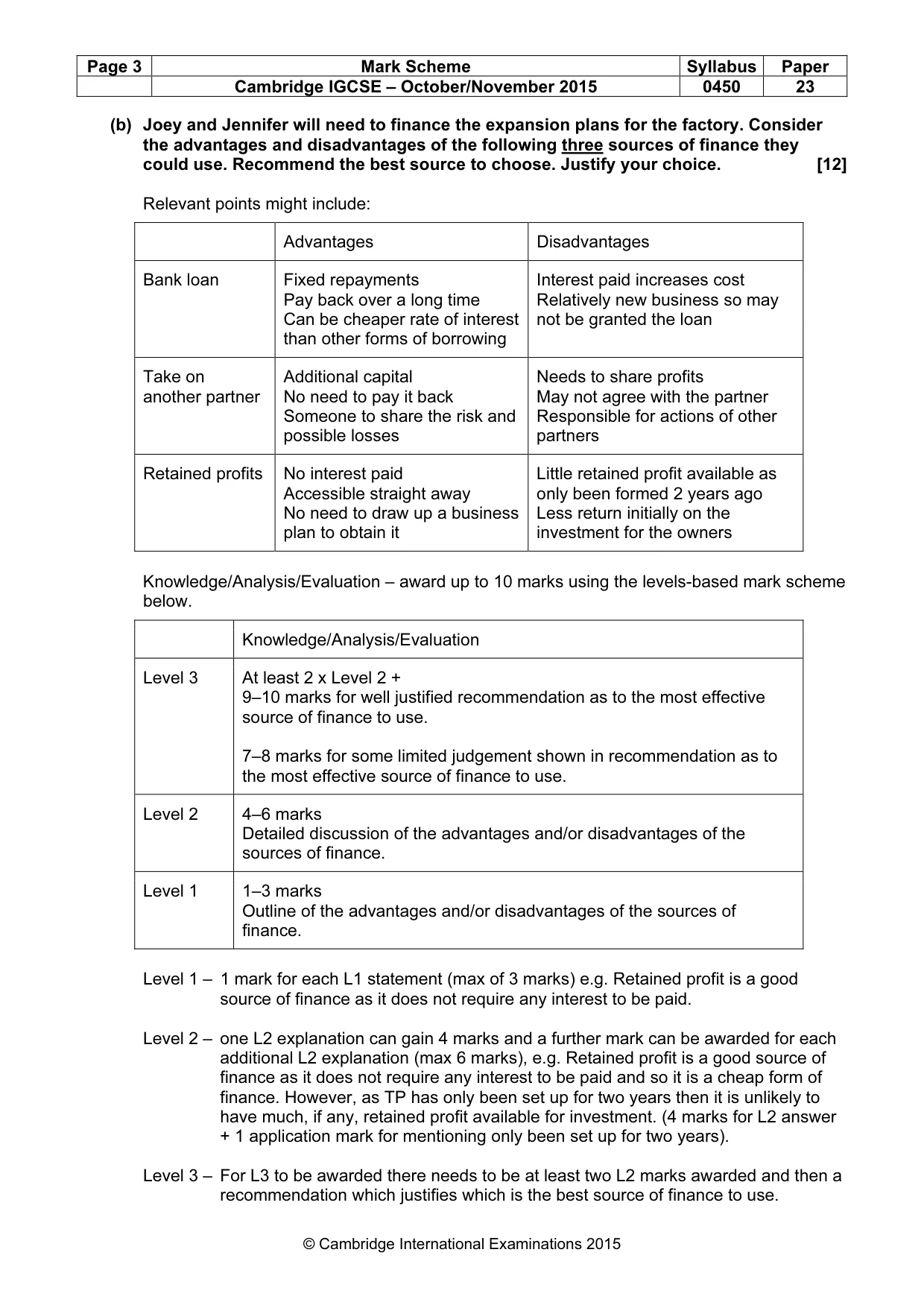
Page 3 Mark Scheme Syllabus Paper Cambridge IGCSE – October/November 2015 0450 23 © Cambridge International Examinations 2015 (b) Joey and Jennifer will need to finance the expansion plans for the factory. Consider the advantages and disadvantages of the following three sources of finance they could use. Recommend the best source to choose. Justify your choice. [12] Relevant points might include: Advantages Disadvantages Bank loan Fixed repayments Pay back over a long time Can be cheaper rate of interest than other forms of borrowing Interest paid increases cost Relatively new business so may not be granted the loan Take on another partner Additional capital No need to pay it back Someone to share the risk and possible losses Needs to share profits May not agree with the partner Responsible for actions of other partners Retained profits No interest paid Accessible straight away No need to draw up a business plan to obtain it Little retained profit available as only been formed 2 years ago Less return initially on the investment for the owners Knowledge/Analysis/Evaluation – award up to 10 marks using the levels-based mark scheme below. Knowledge/Analysis/Evaluation Level 3 At least 2 x Level 2 + 9–10 marks for well justified recommendation as to the most effective source of finance to use. 7–8 marks for some limited judgement shown in recommendation as to the most effective source of finance to use. Level 2 4–6 marks Detailed discussion of the advantages and/or disadvantages of the sources of finance. Level 1 1–3 marks Outline of the advantages and/or disadvantages of the sources of finance. Level 1 – 1 mark for each L1 statement (max of 3 marks) e.g. Retained profit is a good source of finance as it does not require any interest to be paid. Level 2 – one L2 explanation can gain 4 marks and a further mark can be awarded for each additional L2 explanation (max 6 marks), e.g. Retained profit is a good source of finance as it does not require any interest to be paid and so it is a cheap form of finance. However, as TP has only been set up for two years then it is unlikely to have much, if any, retained profit available for investment. (4 marks for L2 answer + 1 application mark for mentioning only been set up for two years). Level 3 – For L3 to be awarded there needs to be at least two L2 marks awarded and then a recommendation which justifies which is the best source of finance to use.
Mark scheme, page 4
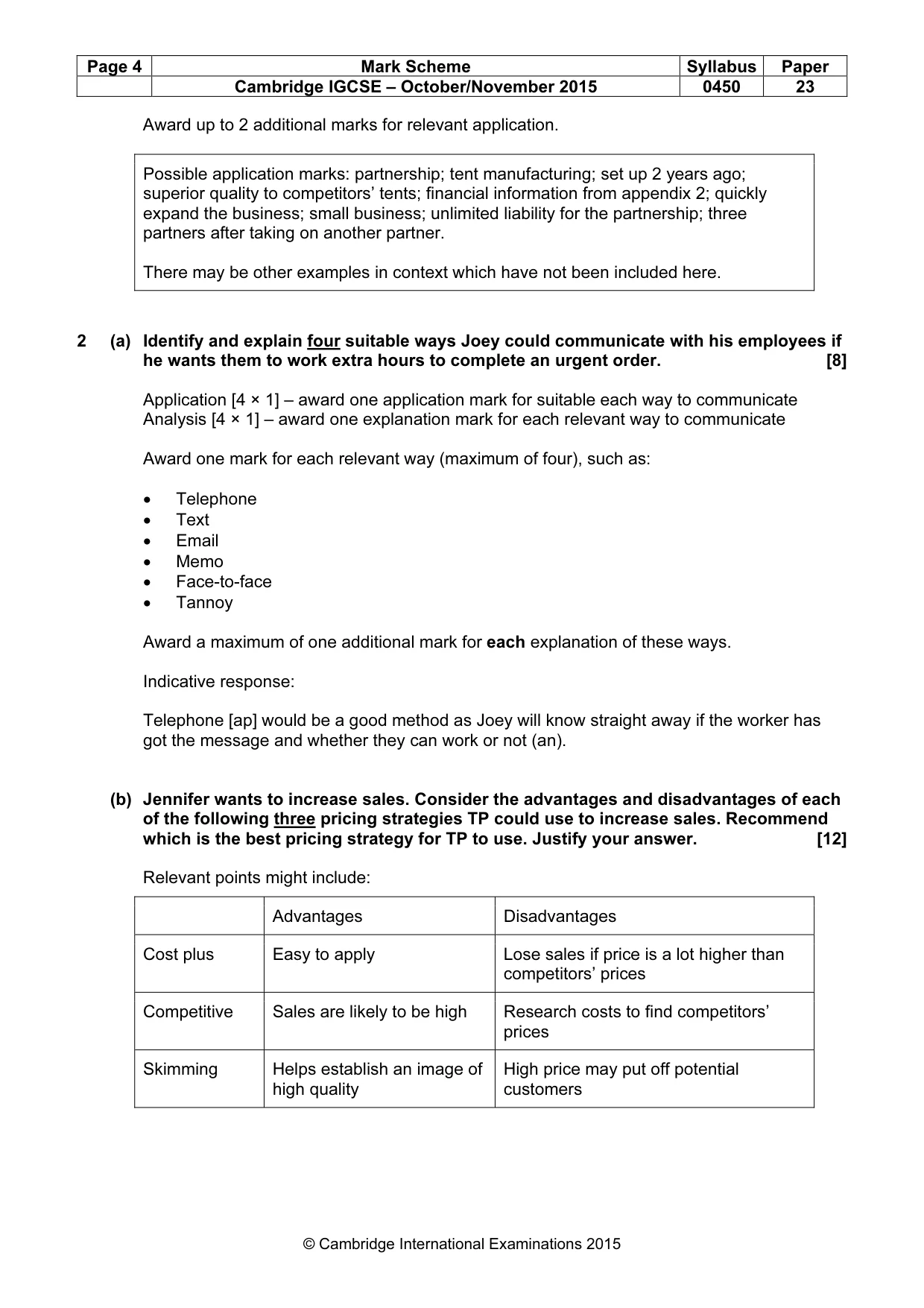
Page 4 Mark Scheme Syllabus Paper Cambridge IGCSE – October/November 2015 0450 23 © Cambridge International Examinations 2015 Award up to 2 additional marks for relevant application. Possible application marks: partnership; tent manufacturing; set up 2 years ago; superior quality to competitors’ tents; financial information from appendix 2; quickly expand the business; small business; unlimited liability for the partnership; three partners after taking on another partner. There may be other examples in context which have not been included here. 2 (a) Identify and explain four suitable ways Joey could communicate with his employees if he wants them to work extra hours to complete an urgent order. [8] Application [4 × 1] – award one application mark for suitable each way to communicate Analysis [4 × 1] – award one explanation mark for each relevant way to communicate Award one mark for each relevant way (maximum of four), such as: • Telephone • Text • Email • Memo • Face-to-face • Tannoy Award a maximum of one additional mark for each explanation of these ways. Indicative response: Telephone [ap] would be a good method as Joey will know straight away if the worker has got the message and whether they can work or not (an). (b) Jennifer wants to increase sales. Consider the advantages and disadvantages of each of the following three pricing strategies TP could use to increase sales. Recommend which is the best pricing strategy for TP to use. Justify your answer. [12] Relevant points might include: Advantages Disadvantages Cost plus Easy to apply Lose sales if price is a lot higher than competitors’ prices Competitive Sales are likely to be high Research costs to find competitors’ prices Skimming Helps establish an image of high quality High price may put off potential customers
Mark scheme, page 5
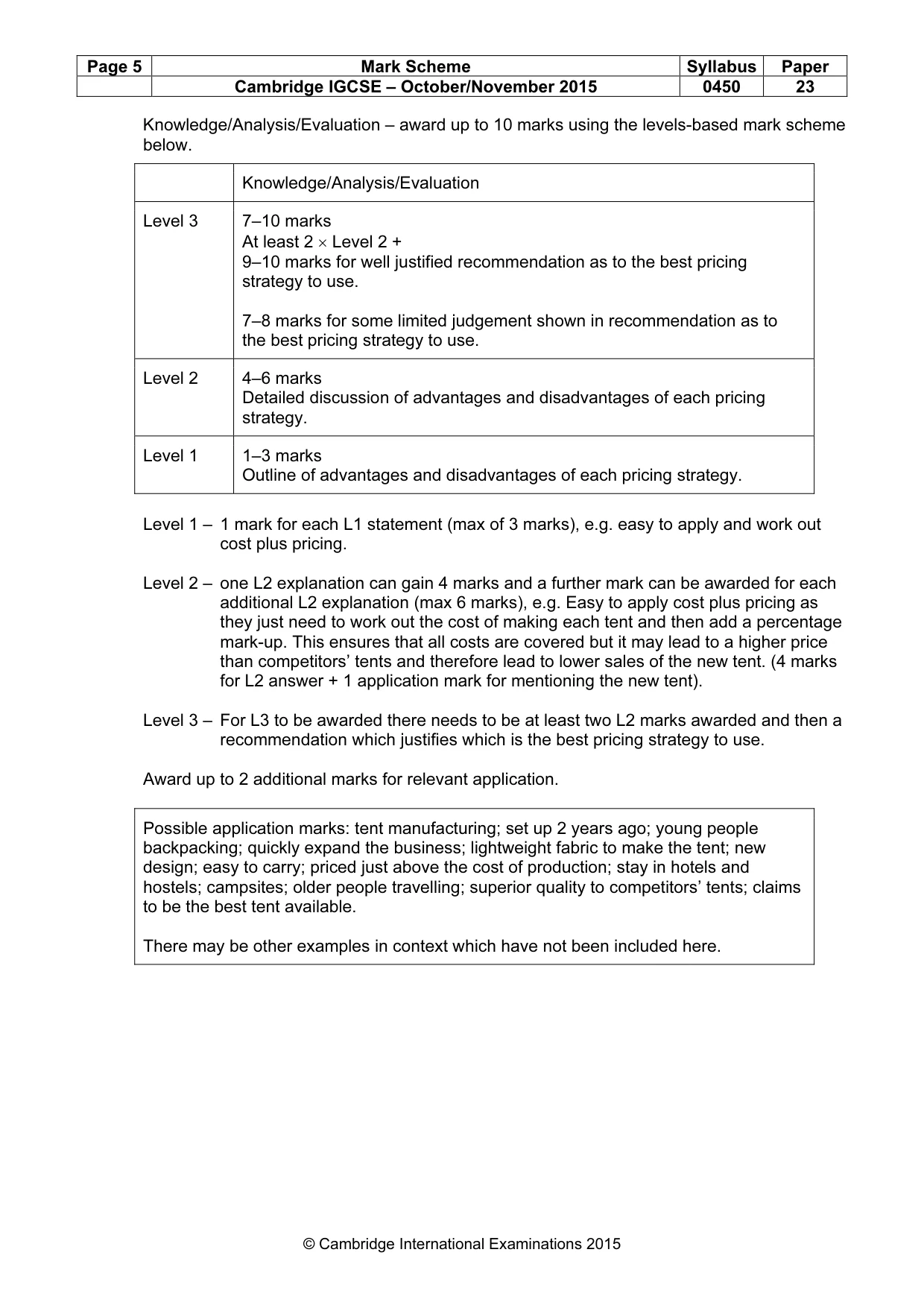
Page 5 Mark Scheme Syllabus Paper Cambridge IGCSE – October/November 2015 0450 23 © Cambridge International Examinations 2015 Knowledge/Analysis/Evaluation – award up to 10 marks using the levels-based mark scheme below. Knowledge/Analysis/Evaluation Level 3 7–10 marks At least 2 × Level 2 + 9–10 marks for well justified recommendation as to the best pricing strategy to use. 7–8 marks for some limited judgement shown in recommendation as to the best pricing strategy to use. Level 2 4–6 marks Detailed discussion of advantages and disadvantages of each pricing strategy. Level 1 1–3 marks Outline of advantages and disadvantages of each pricing strategy. Level 1 – 1 mark for each L1 statement (max of 3 marks), e.g. easy to apply and work out cost plus pricing. Level 2 – one L2 explanation can gain 4 marks and a further mark can be awarded for each additional L2 explanation (max 6 marks), e.g. Easy to apply cost plus pricing as they just need to work out the cost of making each tent and then add a percentage mark-up. This ensures that all costs are covered but it may lead to a higher price than competitors’ tents and therefore lead to lower sales of the new tent. (4 marks for L2 answer + 1 application mark for mentioning the new tent). Level 3 – For L3 to be awarded there needs to be at least two L2 marks awarded and then a recommendation which justifies which is the best pricing strategy to use. Award up to 2 additional marks for relevant application. Possible application marks: tent manufacturing; set up 2 years ago; young people backpacking; quickly expand the business; lightweight fabric to make the tent; new design; easy to carry; priced just above the cost of production; stay in hotels and hostels; campsites; older people travelling; superior quality to competitors’ tents; claims to be the best tent available. There may be other examples in context which have not been included here.
Mark scheme, page 6
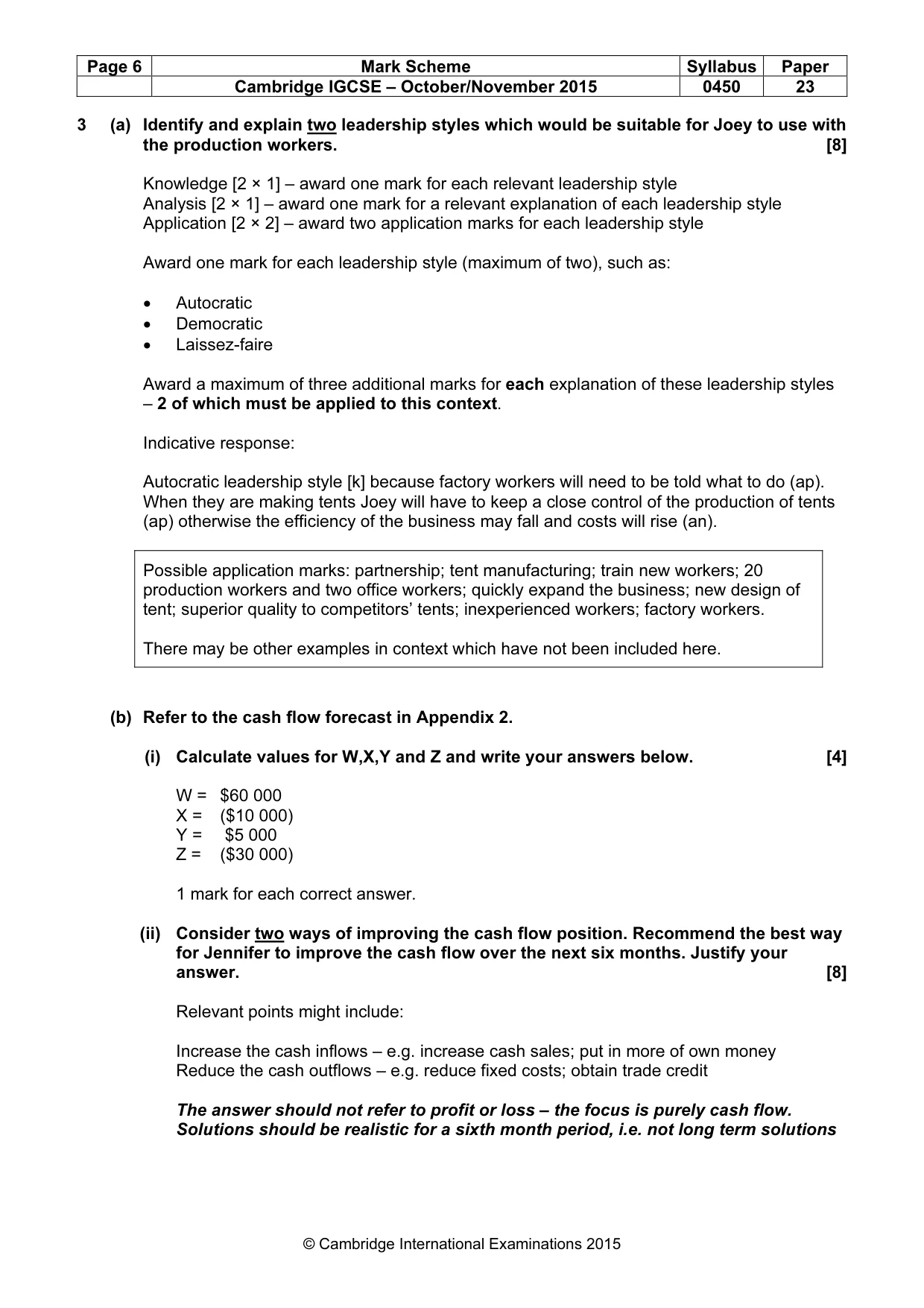
Page 6 Mark Scheme Syllabus Paper Cambridge IGCSE – October/November 2015 0450 23 © Cambridge International Examinations 2015 3 (a) Identify and explain two leadership styles which would be suitable for Joey to use with the production workers. [8] Knowledge [2 × 1] – award one mark for each relevant leadership style Analysis [2 × 1] – award one mark for a relevant explanation of each leadership style Application [2 × 2] – award two application marks for each leadership style Award one mark for each leadership style (maximum of two), such as: • Autocratic • Democratic • Laissez-faire Award a maximum of three additional marks for each explanation of these leadership styles – 2 of which must be applied to this context. Indicative response: Autocratic leadership style [k] because factory workers will need to be told what to do (ap). When they are making tents Joey will have to keep a close control of the production of tents (ap) otherwise the efficiency of the business may fall and costs will rise (an). Possible application marks: partnership; tent manufacturing; train new workers; 20 production workers and two office workers; quickly expand the business; new design of tent; superior quality to competitors’ tents; inexperienced workers; factory workers. There may be other examples in context which have not been included here. (b) Refer to the cash flow forecast in Appendix 2. (i) Calculate values for W,X,Y and Z and write your answers below. [4] W = $60 000 X = ($10 000) Y = $5 000 Z = ($30 000) 1 mark for each correct answer. (ii) Consider two ways of improving the cash flow position. Recommend the best way for Jennifer to improve the cash flow over the next six months. Justify your answer. [8] Relevant points might include: Increase the cash inflows – e.g. increase cash sales; put in more of own money Reduce the cash outflows – e.g. reduce fixed costs; obtain trade credit The answer should not refer to profit or loss – the focus is purely cash flow. Solutions should be realistic for a sixth month period, i.e. not long term solutions
Mark scheme, page 7
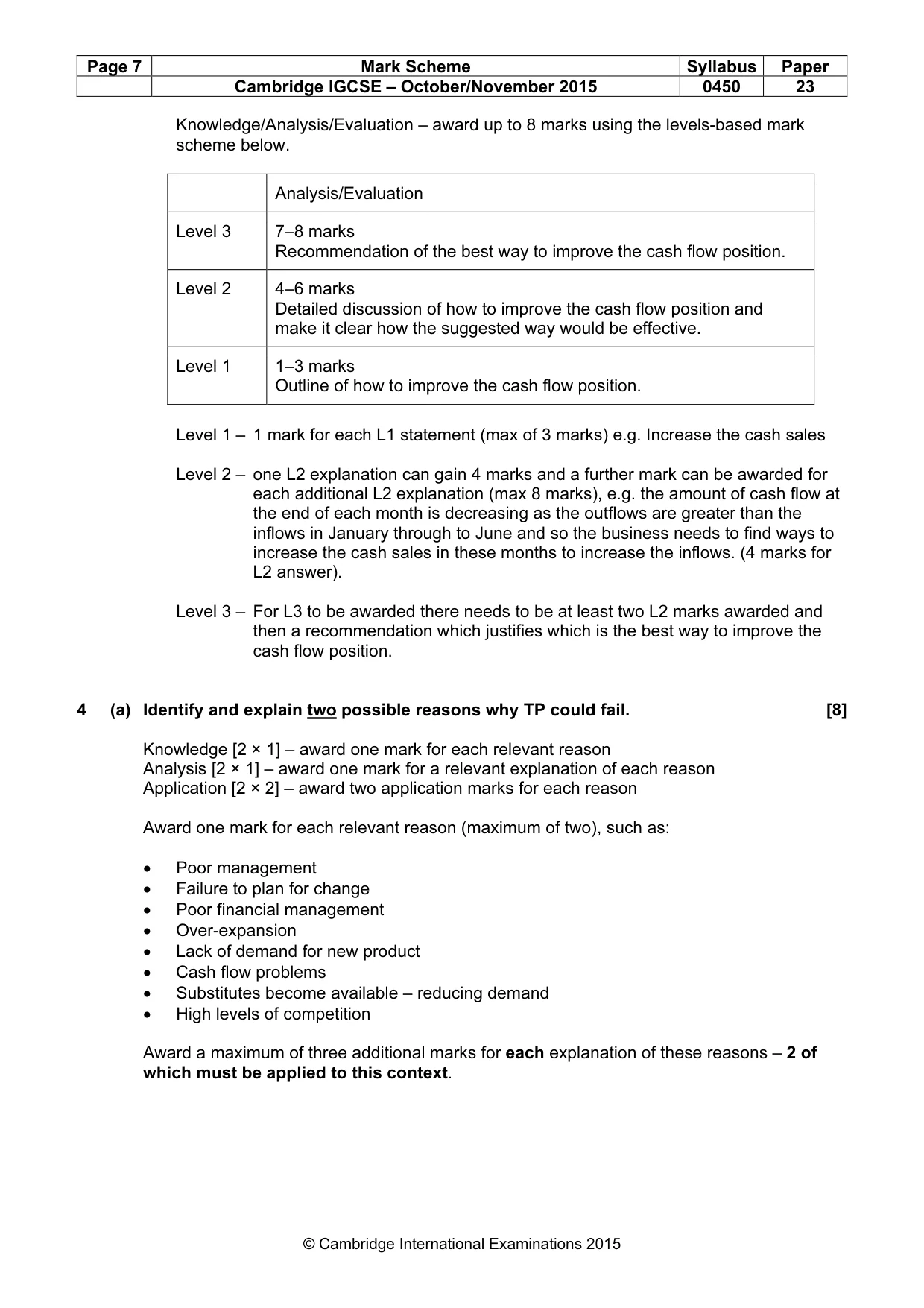
Page 7 Mark Scheme Syllabus Paper Cambridge IGCSE – October/November 2015 0450 23 © Cambridge International Examinations 2015 Knowledge/Analysis/Evaluation – award up to 8 marks using the levels-based mark scheme below. Analysis/Evaluation Level 3 7–8 marks Recommendation of the best way to improve the cash flow position. Level 2 4–6 marks Detailed discussion of how to improve the cash flow position and make it clear how the suggested way would be effective. Level 1 1–3 marks Outline of how to improve the cash flow position. Level 1 – 1 mark for each L1 statement (max of 3 marks) e.g. Increase the cash sales Level 2 – one L2 explanation can gain 4 marks and a further mark can be awarded for each additional L2 explanation (max 8 marks), e.g. the amount of cash flow at the end of each month is decreasing as the outflows are greater than the inflows in January through to June and so the business needs to find ways to increase the cash sales in these months to increase the inflows. (4 marks for L2 answer). Level 3 – For L3 to be awarded there needs to be at least two L2 marks awarded and then a recommendation which justifies which is the best way to improve the cash flow position. 4 (a) Identify and explain two possible reasons why TP could fail. [8] Knowledge [2 × 1] – award one mark for each relevant reason Analysis [2 × 1] – award one mark for a relevant explanation of each reason Application [2 × 2] – award two application marks for each reason Award one mark for each relevant reason (maximum of two), such as: • Poor management • Failure to plan for change • Poor financial management • Over-expansion • Lack of demand for new product • Cash flow problems • Substitutes become available – reducing demand • High levels of competition Award a maximum of three additional marks for each explanation of these reasons – 2 of which must be applied to this context.
Mark scheme, page 8
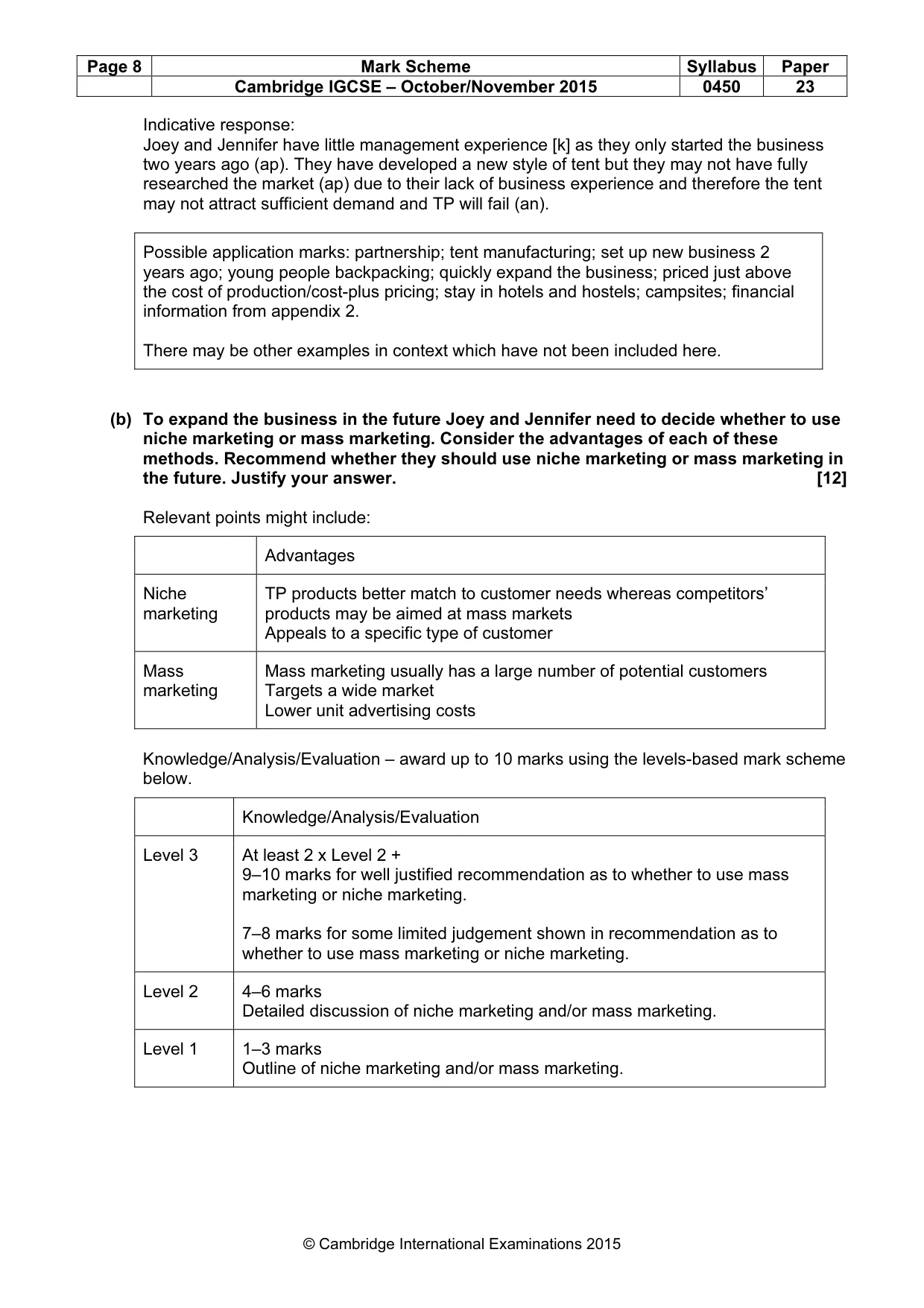
Page 8 Mark Scheme Syllabus Paper Cambridge IGCSE – October/November 2015 0450 23 © Cambridge International Examinations 2015 Indicative response: Joey and Jennifer have little management experience [k] as they only started the business two years ago (ap). They have developed a new style of tent but they may not have fully researched the market (ap) due to their lack of business experience and therefore the tent may not attract sufficient demand and TP will fail (an). Possible application marks: partnership; tent manufacturing; set up new business 2 years ago; young people backpacking; quickly expand the business; priced just above the cost of production/cost-plus pricing; stay in hotels and hostels; campsites; financial information from appendix 2. There may be other examples in context which have not been included here. (b) To expand the business in the future Joey and Jennifer need to decide whether to use niche marketing or mass marketing. Consider the advantages of each of these methods. Recommend whether they should use niche marketing or mass marketing in the future. Justify your answer. [12] Relevant points might include: Advantages Niche marketing TP products better match to customer needs whereas competitors’ products may be aimed at mass markets Appeals to a specific type of customer Mass marketing Mass marketing usually has a large number of potential customers Targets a wide market Lower unit advertising costs Knowledge/Analysis/Evaluation – award up to 10 marks using the levels-based mark scheme below. Knowledge/Analysis/Evaluation Level 3 At least 2 x Level 2 + 9–10 marks for well justified recommendation as to whether to use mass marketing or niche marketing. 7–8 marks for some limited judgement shown in recommendation as to whether to use mass marketing or niche marketing. Level 2 4–6 marks Detailed discussion of niche marketing and/or mass marketing. Level 1 1–3 marks Outline of niche marketing and/or mass marketing.
Mark scheme, page 9
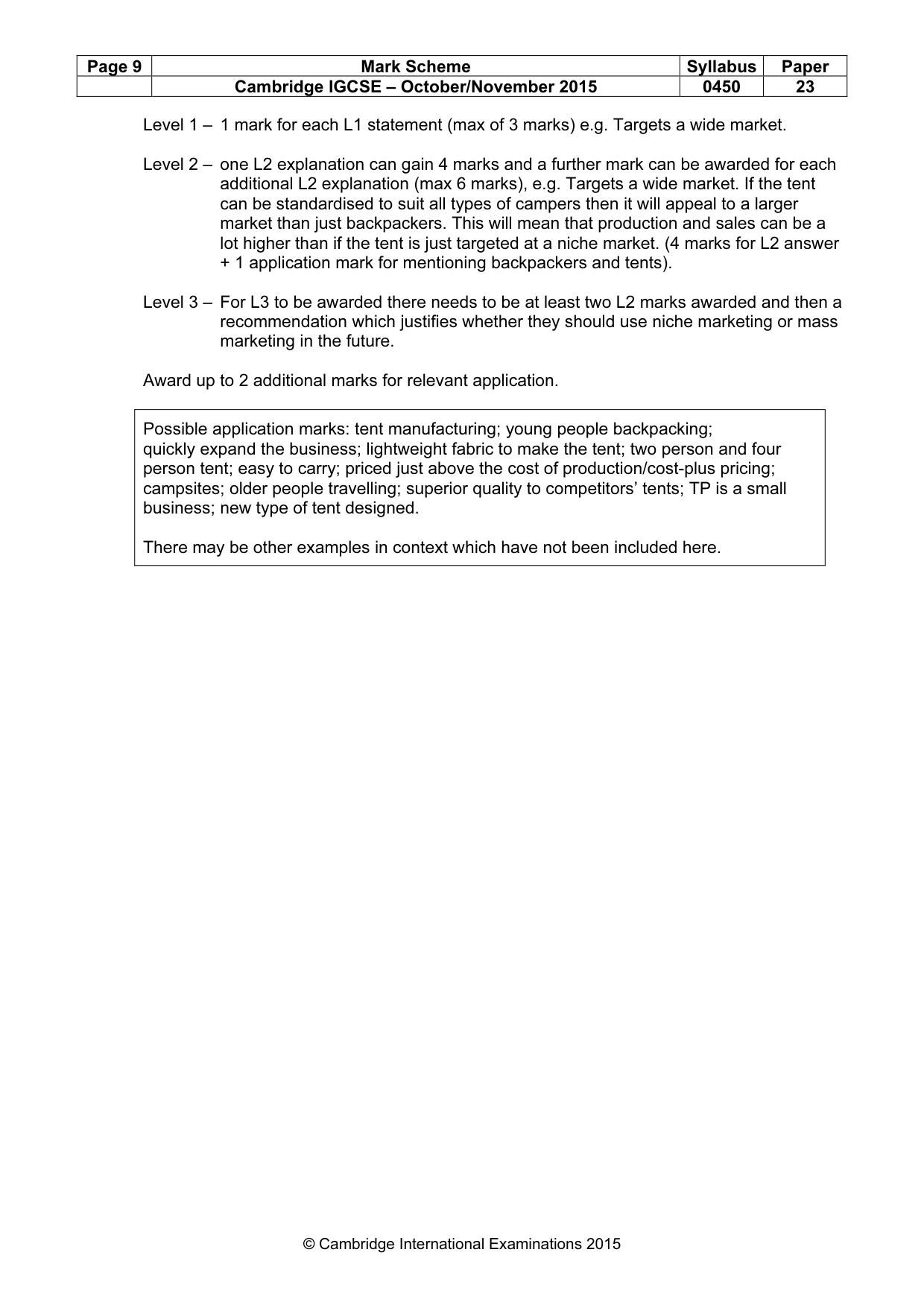
Page 9 Mark Scheme Syllabus Paper Cambridge IGCSE – October/November 2015 0450 23 © Cambridge International Examinations 2015 Level 1 – 1 mark for each L1 statement (max of 3 marks) e.g. Targets a wide market. Level 2 – one L2 explanation can gain 4 marks and a further mark can be awarded for each additional L2 explanation (max 6 marks), e.g. Targets a wide market. If the tent can be standardised to suit all types of campers then it will appeal to a larger market than just backpackers. This will mean that production and sales can be a lot higher than if the tent is just targeted at a niche market. (4 marks for L2 answer + 1 application mark for mentioning backpackers and tents). Level 3 – For L3 to be awarded there needs to be at least two L2 marks awarded and then a recommendation which justifies whether they should use niche marketing or mass marketing in the future. Award up to 2 additional marks for relevant application. Possible application marks: tent manufacturing; young people backpacking; quickly expand the business; lightweight fabric to make the tent; two person and four person tent; easy to carry; priced just above the cost of production/cost-plus pricing; campsites; older people travelling; superior quality to competitors’ tents; TP is a small business; new type of tent designed. There may be other examples in context which have not been included here.
What you needed in this session
Cambridge’s own grade thresholds for 2015 Oct/Nov, Paper 2 · Variant 3. A higher threshold means an easier paper — the bar moves with how the cohort did.