Cambridge IGCSE Business Studies 0450 — 2014 May/June Paper 1 · Variant 3
0450/13/M/J/14 · 100 marks · ≈113 min
The question paper and its mark scheme, free to read here and free to download. This is Cambridge’s own paper, exactly as it was sat.
Question paper12 pages

Mark scheme10 pages
Answers below. Sit the paper first if you are practising.
Paper as text
Question paper, page 1
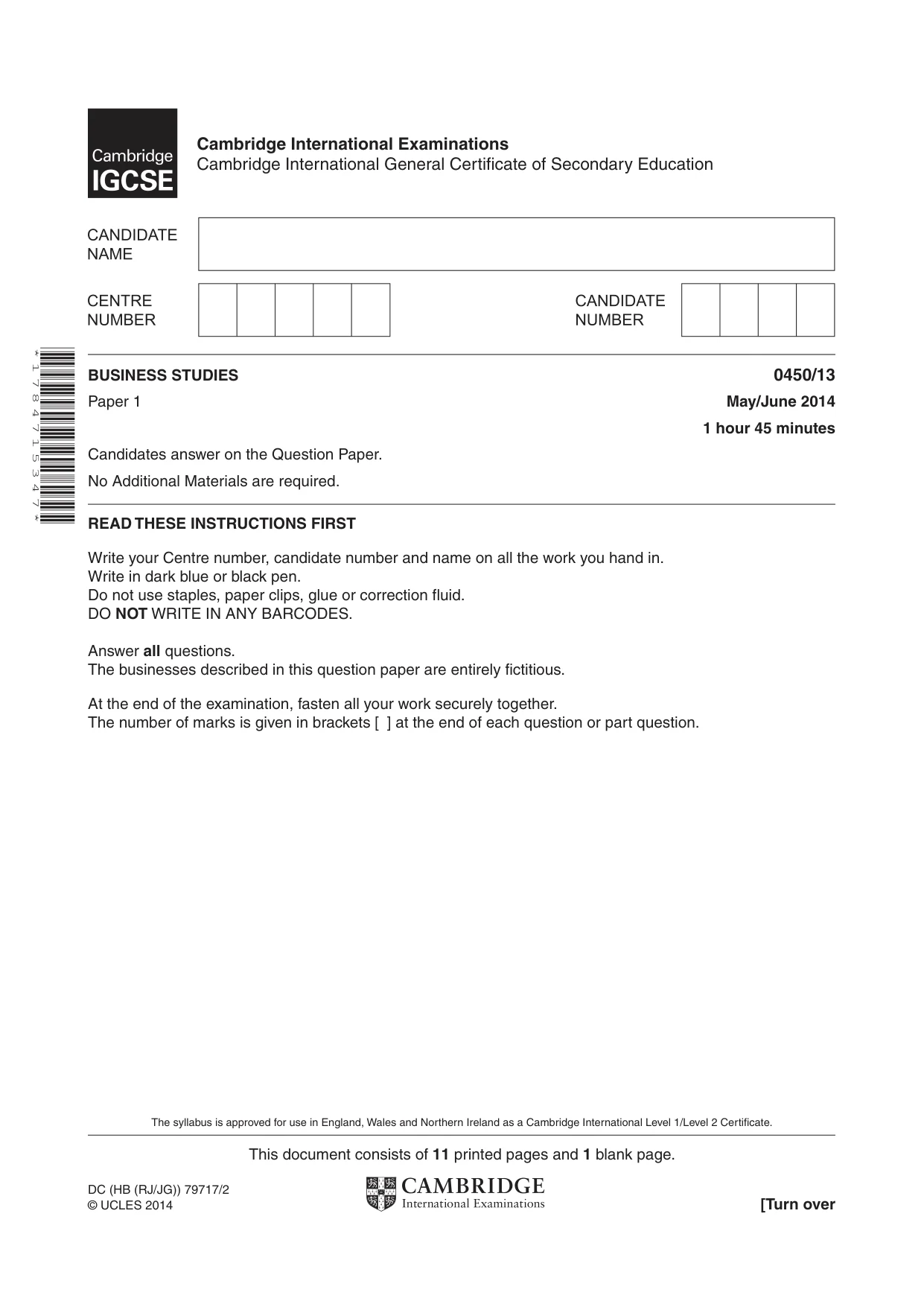
This document consists of 11 printed pages and 1 blank page. DC (HB (RJ/JG)) 79717/2 © UCLES 2014 [Turn over Cambridge International Examinations Cambridge International General Certificate of Secondary Education * 1 7 8 4 7 1 5 3 4 7 * BUSINESS STUDIES 0450/13 Paper 1 May/June 2014 1 hour 45 minutes Candidates answer on the Question Paper. No Additional Materials are required. READ THESE INSTRUCTIONS FIRST Write your Centre number, candidate number and name on all the work you hand in. Write in dark blue or black pen. Do not use staples, paper clips, glue or correction fluid. DO NOT WRITE IN ANY BARCODES. Answer all questions. The businesses described in this question paper are entirely fictitious. At the end of the examination, fasten all your work securely together. The number of marks is given in brackets [ ] at the end of each question or part question. The syllabus is approved for use in England, Wales and Northern Ireland as a Cambridge International Level 1/Level 2 Certificate.
Question paper, page 2
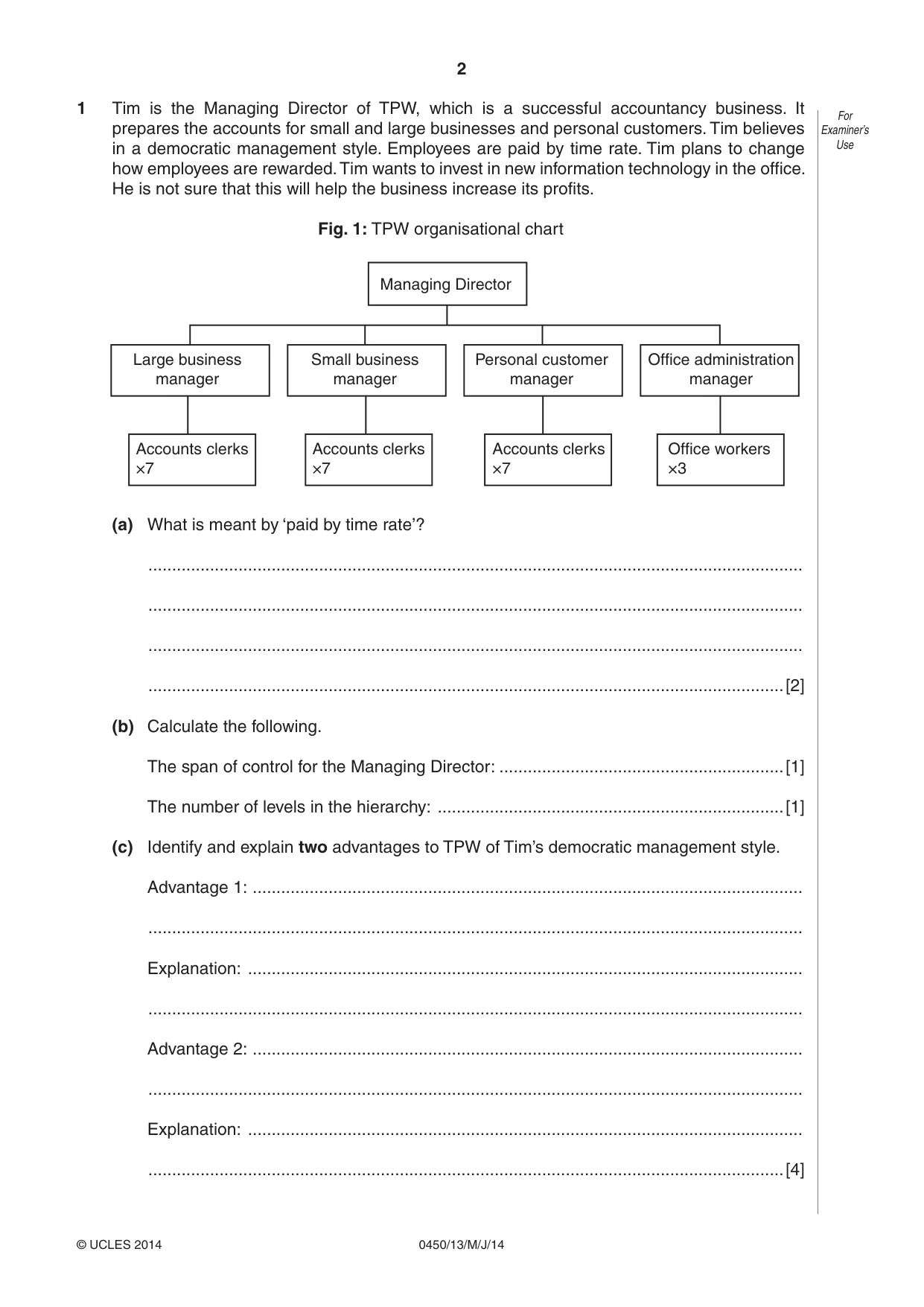
2 0450/13/M/J/14 © UCLES 2014 For Examiner’s Use 1 Tim is the Managing Director of TPW, which is a successful accountancy business. It prepares the accounts for small and large businesses and personal customers. Tim believes in a democratic management style. Employees are paid by time rate. Tim plans to change how employees are rewarded. Tim wants to invest in new information technology in the office. He is not sure that this will help the business increase its profits. Fig. 1: TPW organisational chart Managing Director Large business manager Small business manager Personal customer manager Office administration manager Accounts clerks ×7 Accounts clerks ×7 Accounts clerks ×7 Office workers ×3 (a) What is meant by ‘paid by time rate’? … … … …[2] (b) Calculate the following. The span of control for the Managing Director: …[1] The number of levels in the hierarchy: …[1] (c) Identify and explain two advantages to TPW of Tim’s democratic management style. Advantage 1: … … Explanation: … … Advantage 2: … … Explanation: … …[4]
Question paper, page 3
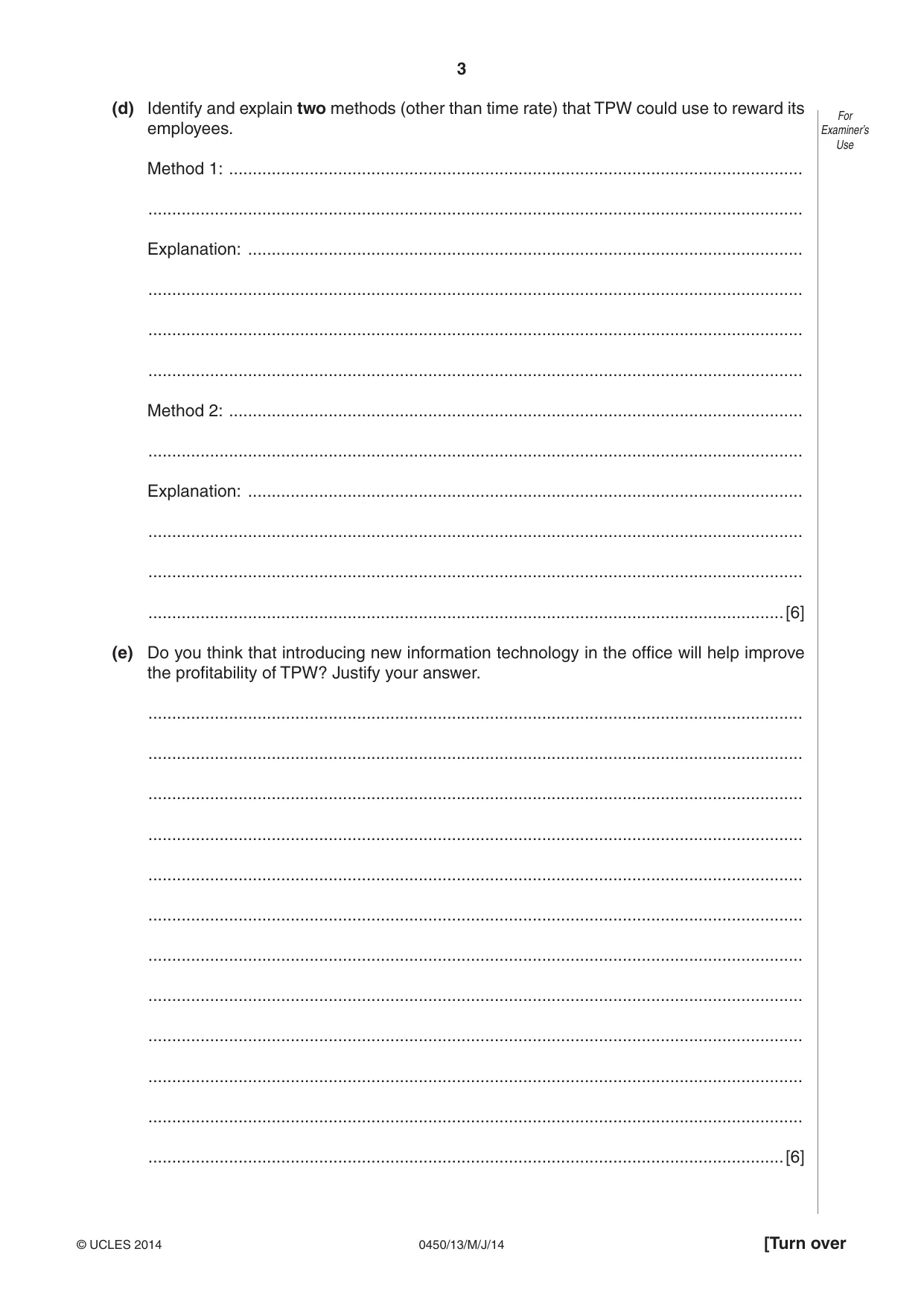
3 0450/13/M/J/14 © UCLES 2014 [Turn over For Examiner’s Use (d) Identify and explain two methods (other than time rate) that TPW could use to reward its employees. Method 1: … … Explanation: … … … … Method 2: … … Explanation: … … … …[6] (e) Do you think that introducing new information technology in the office will help improve the profitability of TPW? Justify your answer. … … … … … … … … … … … …[6]
Question paper, page 4
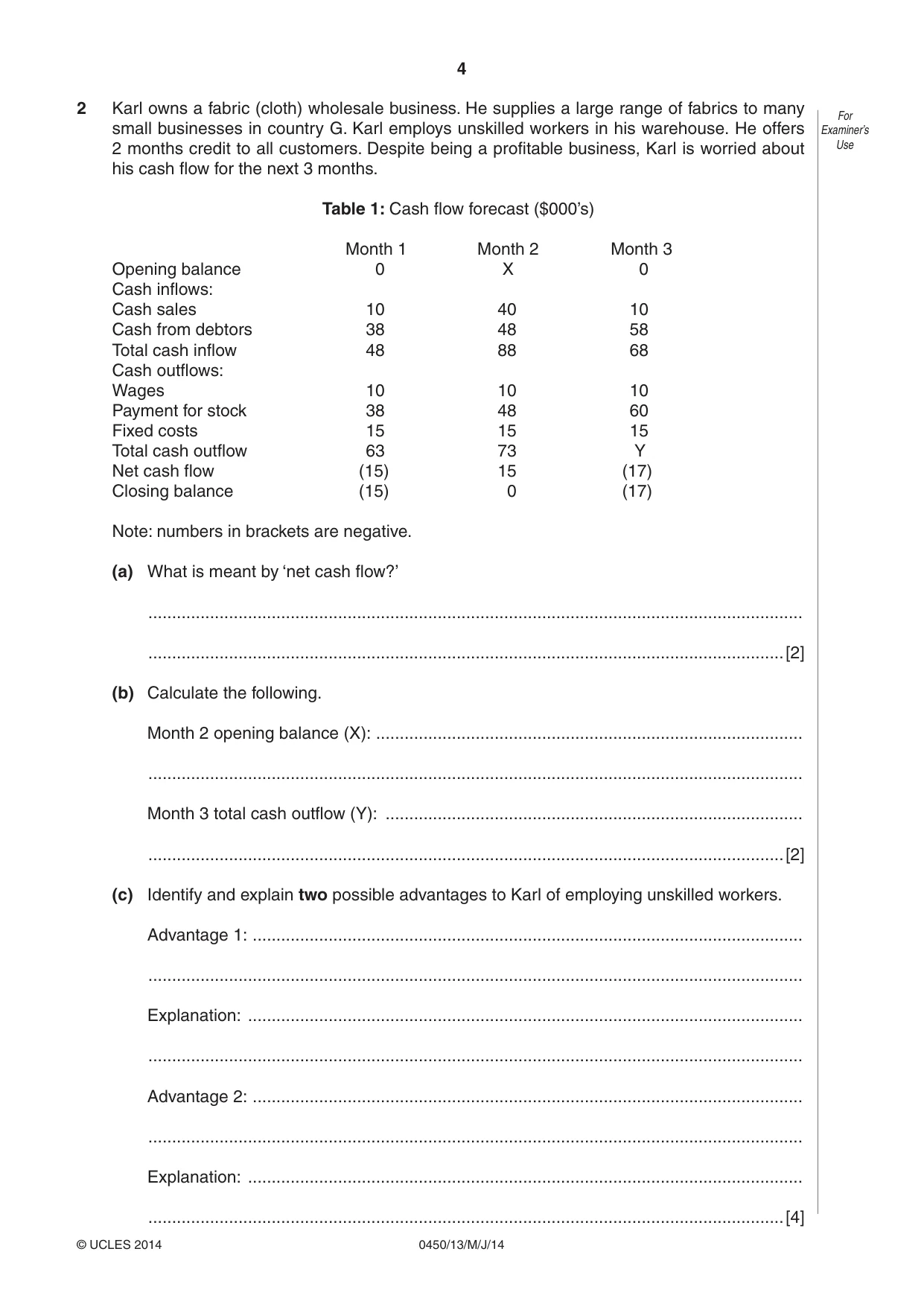
4 0450/13/M/J/14 © UCLES 2014 For Examiner’s Use 2 Karl owns a fabric (cloth) wholesale business. He supplies a large range of fabrics to many small businesses in country G. Karl employs unskilled workers in his warehouse. He offers 2 months credit to all customers. Despite being a profitable business, Karl is worried about his cash flow for the next 3 months. Table 1: Cash flow forecast ($000’s) Month 1 Month 2 Month 3 Opening balance 0 X 0 Cash inflows: Cash sales 10 40 10 Cash from debtors 38 48 58 Total cash inflow 48 88 68 Cash outflows: Wages 10 10 10 Payment for stock 38 48 60 Fixed costs 15 15 15 Total cash outflow 63 73 Y Net cash flow (15) 15 (17) Closing balance (15) 0 (17) Note: numbers in brackets are negative. (a) What is meant by ‘net cash flow?’ … …[2] (b) Calculate the following. Month 2 opening balance (X): … … Month 3 total cash outflow (Y): … …[2] (c) Identify and explain two possible advantages to Karl of employing unskilled workers. Advantage 1: … … Explanation: … … Advantage 2: … … Explanation: … …[4]
Question paper, page 5
5 0450/13/M/J/14 © UCLES 2014 [Turn over For Examiner’s Use (d) Identify and explain two possible advantages to small business customers of buying from a wholesale business such as Karl’s. Advantage 1: … … Explanation: … … … … Advantage 2: … … Explanation: … … … …[6] (e) Explain two ways that Karl could use to improve his cash flow. Recommend which one he should use. Justify your answer. Way 1: … … … … Way 2: … … … … Recommendation: … … … …[6]
Question paper, page 6
6 0450/13/M/J/14 © UCLES 2014 For Examiner’s Use 3 ABC manufactures a range of cars. ABC plans to build a new type of car at its factory in country X. This will expand production capacity at the factory by 100 000 cars per year. ABC hopes to benefit from economies of scale, which should help to reduce the break-even level of output. ‘It’s good that we have motivated workers’ said the Operations manager. ABC plans to start exporting some of its cars. (a) What is meant by ‘break-even level of output’? … … … …[2] (b) Identify two factors which could influence employee motivation at ABC. Factor 1: … … Factor 2: … …[2] (c) Identify and explain two economies of scale that ABC could benefit from. Economy of scale 1: … Explanation: … … … Economy of scale 2: … Explanation: … … …[4]
Question paper, page 7
7 0450/13/M/J/14 © UCLES 2014 [Turn over For Examiner’s Use (d) Identify and explain two possible problems for ABC of increasing production. Problem 1: … … Explanation: … … … … Problem 2: … … Explanation: … … … …[6] (e) Do you think it is a good idea for ABC to start exporting some of its cars? Justify your answer. … … … … … … … … … … … …[6]
Question paper, page 8
8 0450/13/M/J/14 © UCLES 2014 For Examiner’s Use 4 Kyle is an entrepreneur. He plans to buy a Frydays franchise. Frydays is a leading fast food (take-away) business. Each franchise costs $100 000. Frydays would provide some promotion. ‘I only need to find the right location, hire some people and raise the finance’ said Kyle. ‘I am certain to make a profit.’ (a) What is meant by an ‘entrepreneur’? … … … …[2] (b) Identify two methods of promotion Frydays might use. Method 1: … Method 2: …[2] (c) Identify and explain two factors that would affect Kyle’s choice of source of finance. Factor 1: … … Explanation: … … Factor 2: … … Explanation: … …[4]
Question paper, page 9
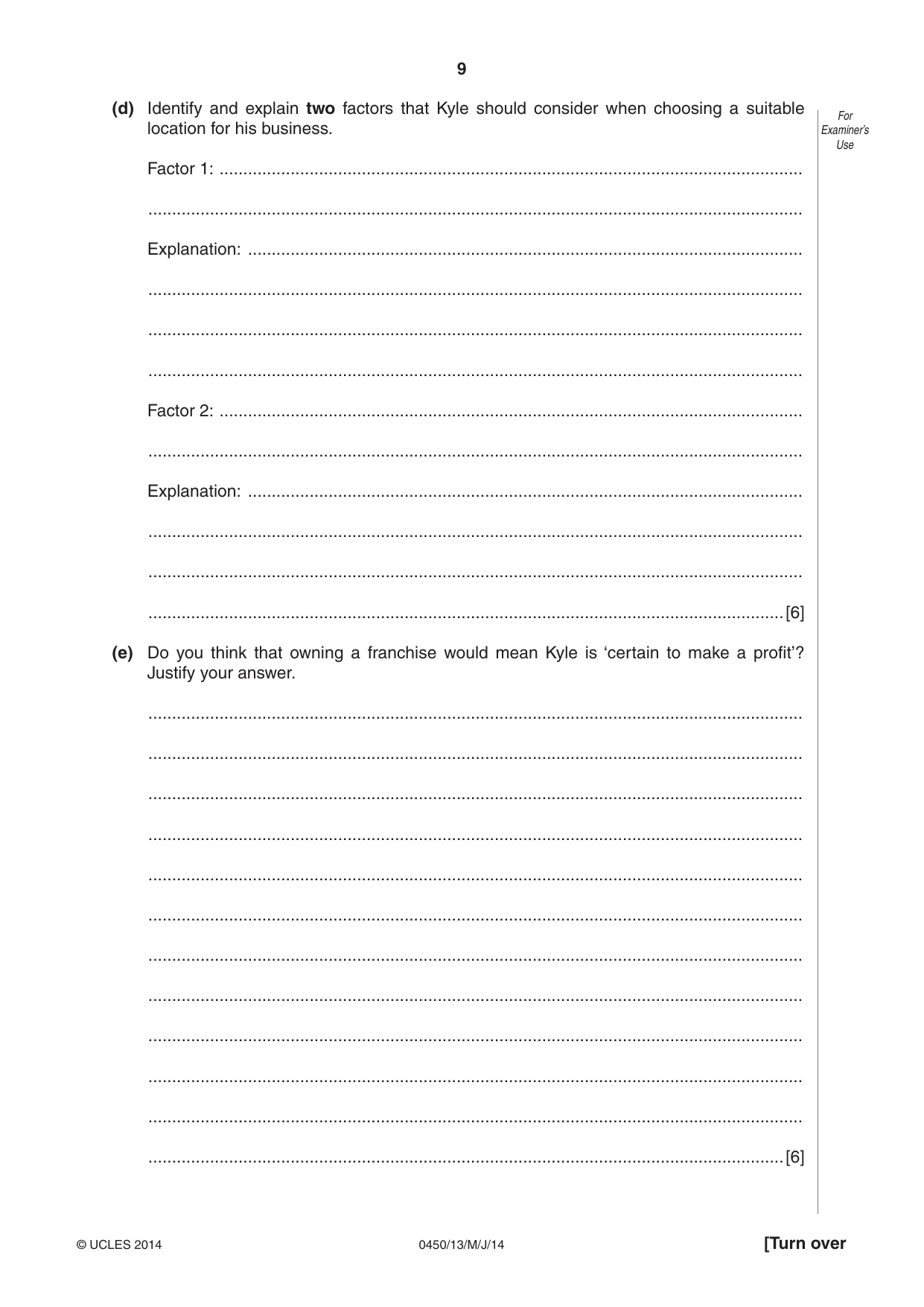
9 0450/13/M/J/14 © UCLES 2014 [Turn over For Examiner’s Use (d) Identify and explain two factors that Kyle should consider when choosing a suitable location for his business. Factor 1: … … Explanation: … … … … Factor 2: … … Explanation: … … … …[6] (e) Do you think that owning a franchise would mean Kyle is ‘certain to make a profit’? Justify your answer. … … … … … … … … … … … …[6]
Question paper, page 10
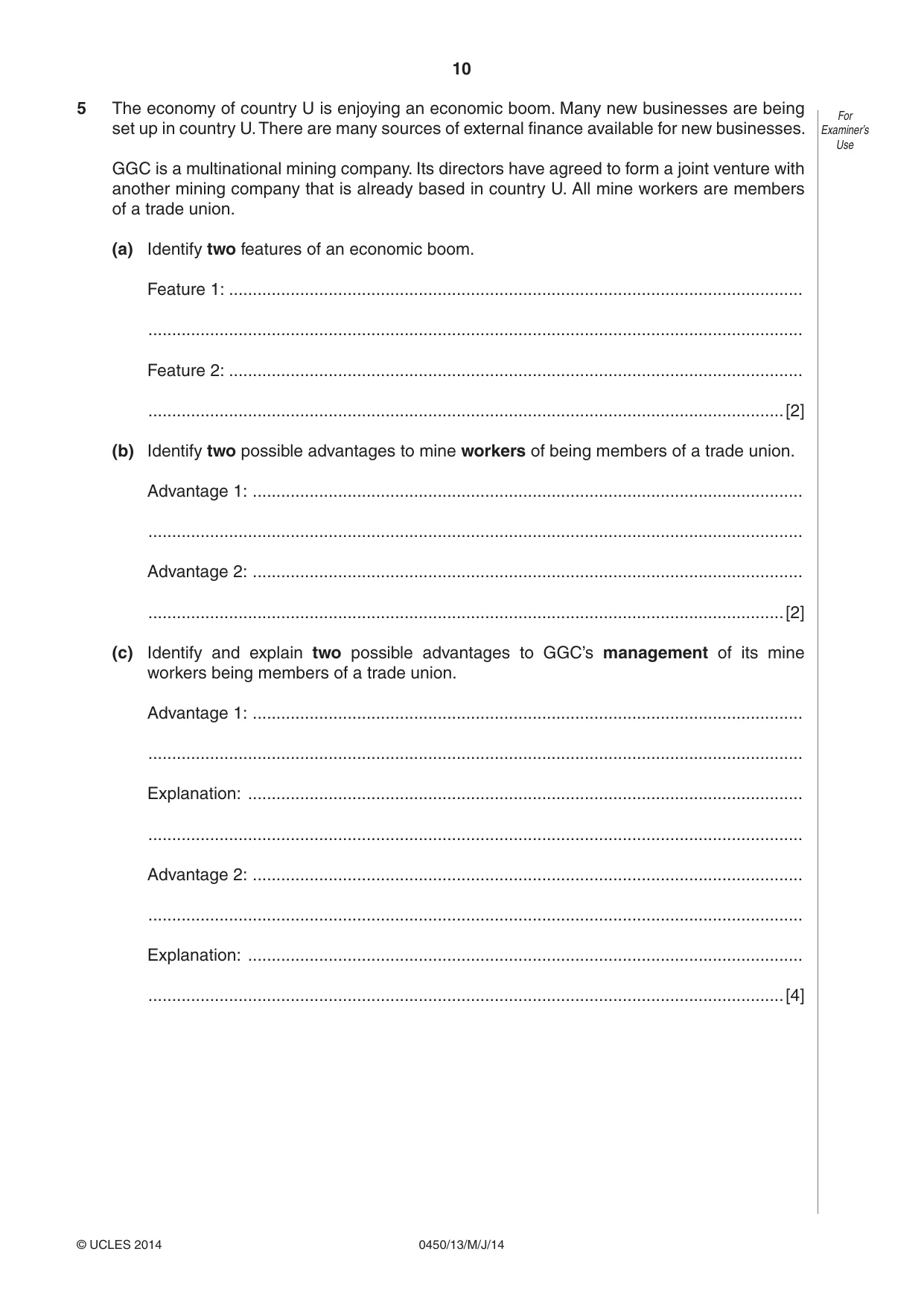
10 0450/13/M/J/14 © UCLES 2014 For Examiner’s Use 5 The economy of country U is enjoying an economic boom. Many new businesses are being set up in country U. There are many sources of external finance available for new businesses. GGC is a multinational mining company. Its directors have agreed to form a joint venture with another mining company that is already based in country U. All mine workers are members of a trade union. (a) Identify two features of an economic boom. Feature 1: … … Feature 2: … …[2] (b) Identify two possible advantages to mine workers of being members of a trade union. Advantage 1: … … Advantage 2: … …[2] (c) Identify and explain two possible advantages to GGC’s management of its mine workers being members of a trade union. Advantage 1: … … Explanation: … … Advantage 2: … … Explanation: … …[4]
Question paper, page 11
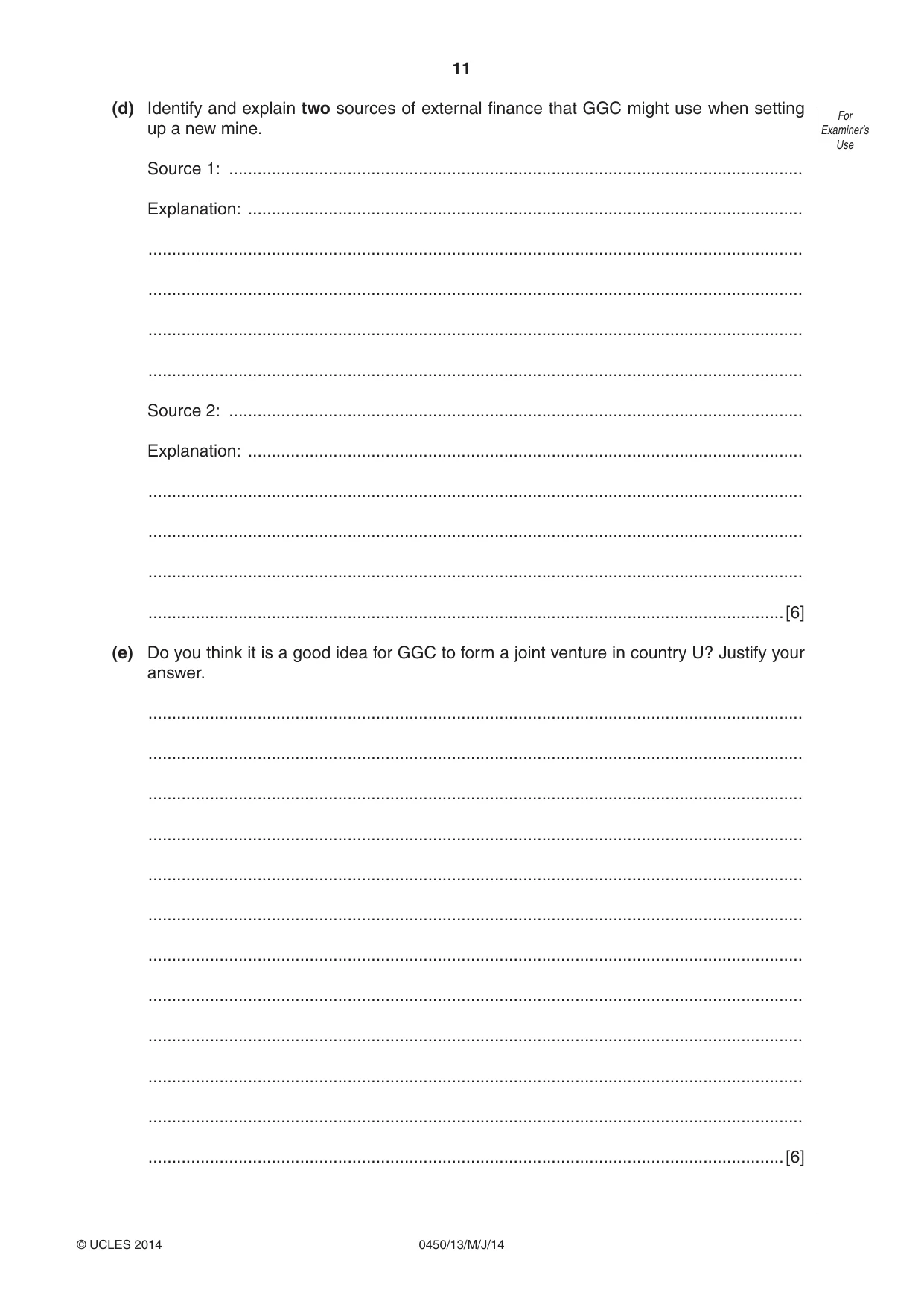
11 0450/13/M/J/14 © UCLES 2014 For Examiner’s Use (d) Identify and explain two sources of external finance that GGC might use when setting up a new mine. Source 1: … Explanation: … … … … … Source 2: … Explanation: … … … … …[6] (e) Do you think it is a good idea for GGC to form a joint venture in country U? Justify your answer. … … … … … … … … … … … …[6]
Question paper, page 12
12 0450/13/M/J/14 © UCLES 2014 Permission to reproduce items where third-party owned material protected by copyright is included has been sought and cleared where possible. Every reasonable effort has been made by the publisher (UCLES) to trace copyright holders, but if any items requiring clearance have unwittingly been included, the publisher will be pleased to make amends at the earliest possible opportunity. Cambridge International Examinations is part of the Cambridge Assessment Group. Cambridge Assessment is the brand name of University of Cambridge Local Examinations Syndicate (UCLES), which is itself a department of the University of Cambridge. BLANK PAGE
Mark scheme, page 1
CAMBRIDGE INTERNATIONAL EXAMINATIONS International General Certificate of Secondary Education MARK SCHEME for the May/June 2014 series 0450 BUSINESS STUDIES 0450/13 Paper 1 (Short Answer/Structured Response), maximum raw mark 100 This mark scheme is published as an aid to teachers and candidates, to indicate the requirements of the examination. It shows the basis on which Examiners were instructed to award marks. It does not indicate the details of the discussions that took place at an Examiners’ meeting before marking began, which would have considered the acceptability of alternative answers. Mark schemes should be read in conjunction with the question paper and the Principal Examiner Report for Teachers. Cambridge will not enter into discussions about these mark schemes. Cambridge is publishing the mark schemes for the May/June 2014 series for most IGCSE, GCE Advanced Level and Advanced Subsidiary Level components and some Ordinary Level components.
Mark scheme, page 2
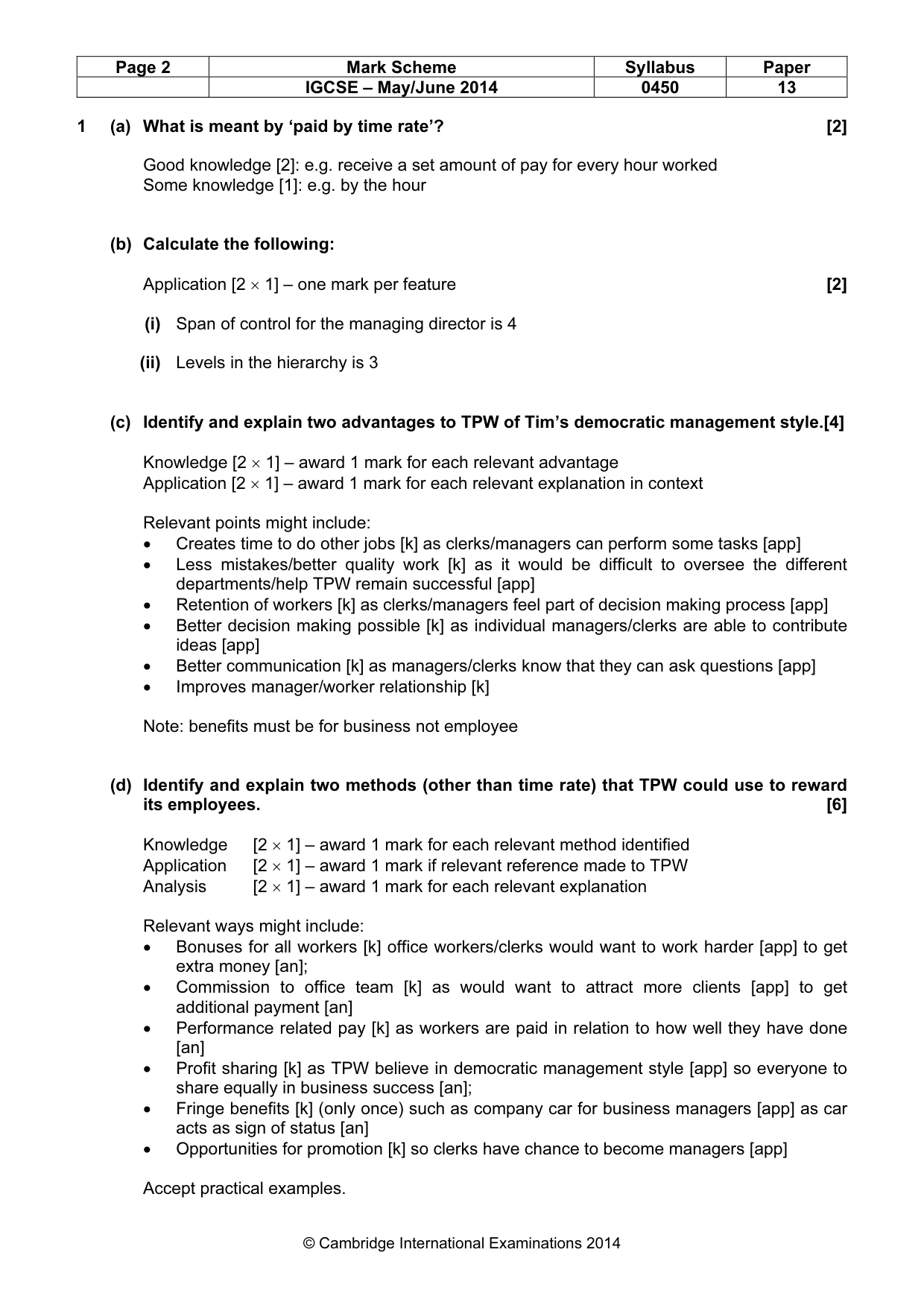
Page 2 Mark Scheme Syllabus Paper IGCSE – May/June 2014 0450 13 © Cambridge International Examinations 2014 1 (a) What is meant by ‘paid by time rate’? [2] Good knowledge [2]: e.g. receive a set amount of pay for every hour worked Some knowledge [1]: e.g. by the hour (b) Calculate the following: Application [2 × 1] – one mark per feature [2] (i) Span of control for the managing director is 4 (ii) Levels in the hierarchy is 3 (c) Identify and explain two advantages to TPW of Tim’s democratic management style.[4] Knowledge [2 × 1] – award 1 mark for each relevant advantage Application [2 × 1] – award 1 mark for each relevant explanation in context Relevant points might include: • Creates time to do other jobs [k] as clerks/managers can perform some tasks [app] • Less mistakes/better quality work [k] as it would be difficult to oversee the different departments/help TPW remain successful [app] • Retention of workers [k] as clerks/managers feel part of decision making process [app] • Better decision making possible [k] as individual managers/clerks are able to contribute ideas [app] • Better communication [k] as managers/clerks know that they can ask questions [app] • Improves manager/worker relationship [k] Note: benefits must be for business not employee (d) Identify and explain two methods (other than time rate) that TPW could use to reward its employees. [6] Knowledge [2 × 1] – award 1 mark for each relevant method identified Application [2 × 1] – award 1 mark if relevant reference made to TPW Analysis [2 × 1] – award 1 mark for each relevant explanation Relevant ways might include: • Bonuses for all workers [k] office workers/clerks would want to work harder [app] to get extra money [an]; • Commission to office team [k] as would want to attract more clients [app] to get additional payment [an] • Performance related pay [k] as workers are paid in relation to how well they have done [an] • Profit sharing [k] as TPW believe in democratic management style [app] so everyone to share equally in business success [an]; • Fringe benefits [k] (only once) such as company car for business managers [app] as car acts as sign of status [an] • Opportunities for promotion [k] so clerks have chance to become managers [app] Accept practical examples.
Mark scheme, page 3
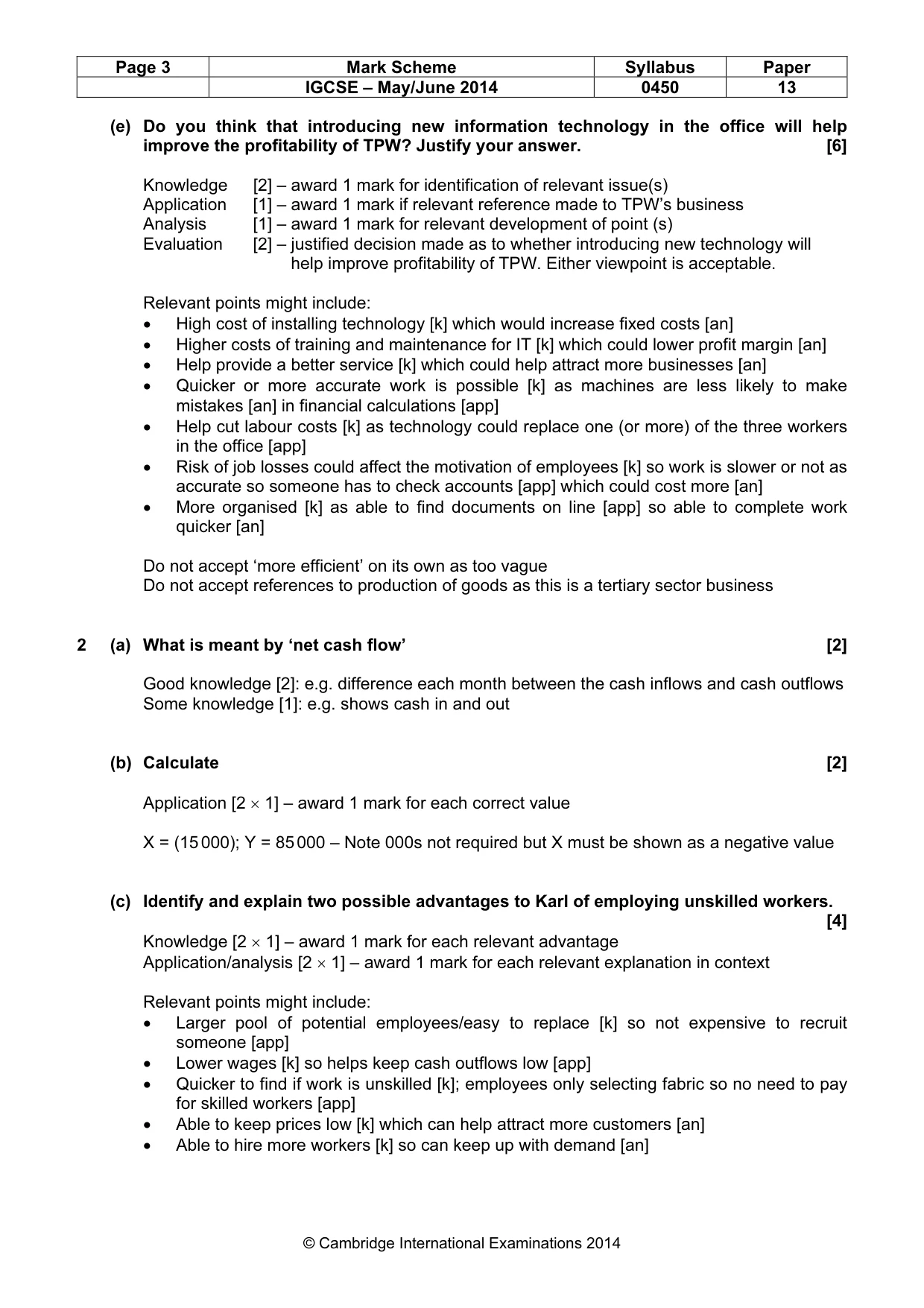
Page 3 Mark Scheme Syllabus Paper IGCSE – May/June 2014 0450 13 © Cambridge International Examinations 2014 (e) Do you think that introducing new information technology in the office will help improve the profitability of TPW? Justify your answer. [6] Knowledge [2] – award 1 mark for identification of relevant issue(s) Application [1] – award 1 mark if relevant reference made to TPW’s business Analysis [1] – award 1 mark for relevant development of point (s) Evaluation [2] – justified decision made as to whether introducing new technology will help improve profitability of TPW. Either viewpoint is acceptable. Relevant points might include: • High cost of installing technology [k] which would increase fixed costs [an] • Higher costs of training and maintenance for IT [k] which could lower profit margin [an] • Help provide a better service [k] which could help attract more businesses [an] • Quicker or more accurate work is possible [k] as machines are less likely to make mistakes [an] in financial calculations [app] • Help cut labour costs [k] as technology could replace one (or more) of the three workers in the office [app] • Risk of job losses could affect the motivation of employees [k] so work is slower or not as accurate so someone has to check accounts [app] which could cost more [an] • More organised [k] as able to find documents on line [app] so able to complete work quicker [an] Do not accept ‘more efficient’ on its own as too vague Do not accept references to production of goods as this is a tertiary sector business 2 (a) What is meant by ‘net cash flow’ [2] Good knowledge [2]: e.g. difference each month between the cash inflows and cash outflows Some knowledge [1]: e.g. shows cash in and out (b) Calculate [2] Application [2 × 1] – award 1 mark for each correct value X = (15 000); Y = 85 000 – Note 000s not required but X must be shown as a negative value (c) Identify and explain two possible advantages to Karl of employing unskilled workers. [4] Knowledge [2 × 1] – award 1 mark for each relevant advantage Application/analysis [2 × 1] – award 1 mark for each relevant explanation in context Relevant points might include: • Larger pool of potential employees/easy to replace [k] so not expensive to recruit someone [app] • Lower wages [k] so helps keep cash outflows low [app] • Quicker to find if work is unskilled [k]; employees only selecting fabric so no need to pay for skilled workers [app] • Able to keep prices low [k] which can help attract more customers [an] • Able to hire more workers [k] so can keep up with demand [an]
Mark scheme, page 4
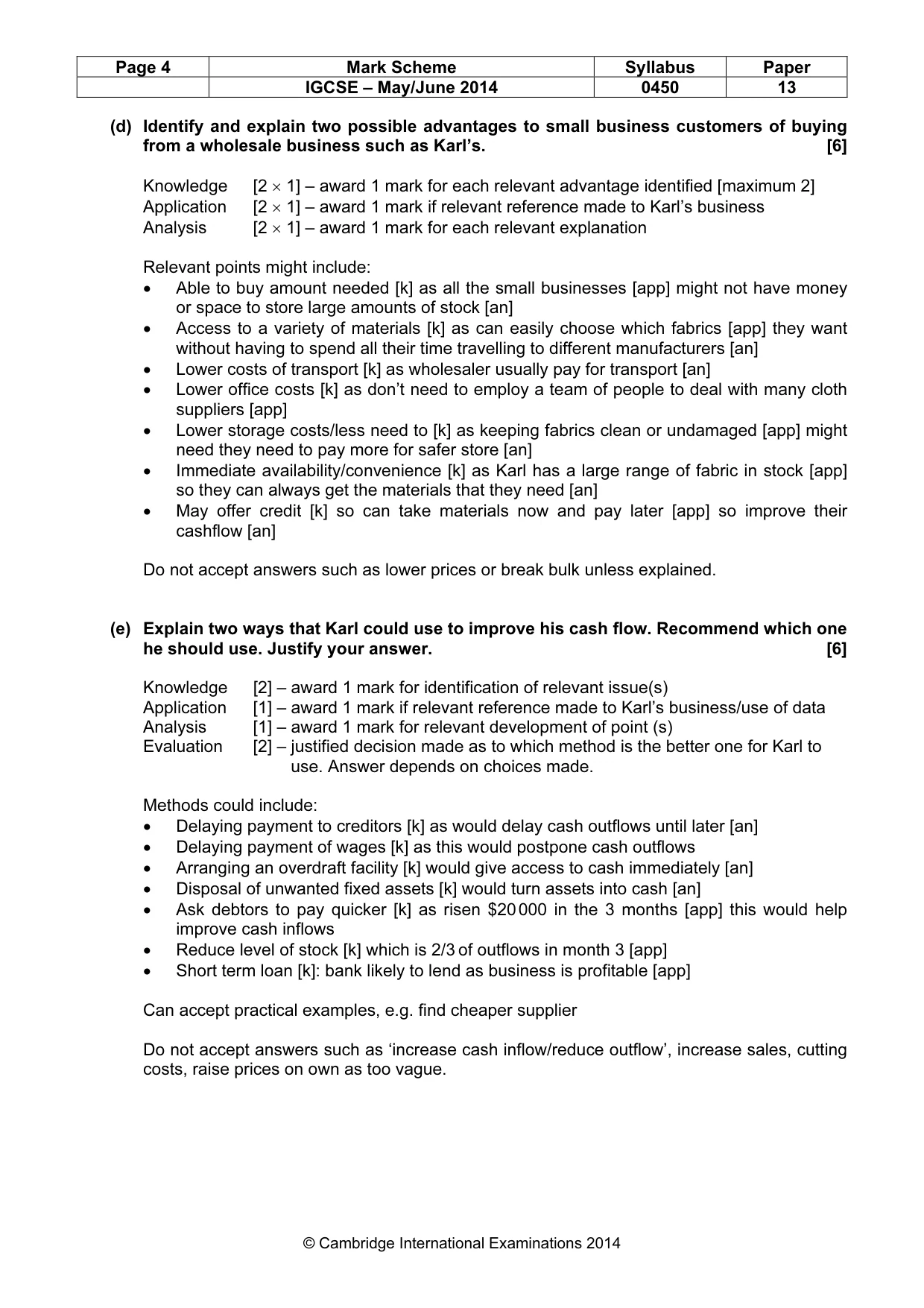
Page 4 Mark Scheme Syllabus Paper IGCSE – May/June 2014 0450 13 © Cambridge International Examinations 2014 (d) Identify and explain two possible advantages to small business customers of buying from a wholesale business such as Karl’s. [6] Knowledge [2 × 1] – award 1 mark for each relevant advantage identified [maximum 2] Application [2 × 1] – award 1 mark if relevant reference made to Karl’s business Analysis [2 × 1] – award 1 mark for each relevant explanation Relevant points might include: • Able to buy amount needed [k] as all the small businesses [app] might not have money or space to store large amounts of stock [an] • Access to a variety of materials [k] as can easily choose which fabrics [app] they want without having to spend all their time travelling to different manufacturers [an] • Lower costs of transport [k] as wholesaler usually pay for transport [an] • Lower office costs [k] as don’t need to employ a team of people to deal with many cloth suppliers [app] • Lower storage costs/less need to [k] as keeping fabrics clean or undamaged [app] might need they need to pay more for safer store [an] • Immediate availability/convenience [k] as Karl has a large range of fabric in stock [app] so they can always get the materials that they need [an] • May offer credit [k] so can take materials now and pay later [app] so improve their cashflow [an] Do not accept answers such as lower prices or break bulk unless explained. (e) Explain two ways that Karl could use to improve his cash flow. Recommend which one he should use. Justify your answer. [6] Knowledge [2] – award 1 mark for identification of relevant issue(s) Application [1] – award 1 mark if relevant reference made to Karl’s business/use of data Analysis [1] – award 1 mark for relevant development of point (s) Evaluation [2] – justified decision made as to which method is the better one for Karl to use. Answer depends on choices made. Methods could include: • Delaying payment to creditors [k] as would delay cash outflows until later [an] • Delaying payment of wages [k] as this would postpone cash outflows • Arranging an overdraft facility [k] would give access to cash immediately [an] • Disposal of unwanted fixed assets [k] would turn assets into cash [an] • Ask debtors to pay quicker [k] as risen $20 000 in the 3 months [app] this would help improve cash inflows • Reduce level of stock [k] which is 2/3 of outflows in month 3 [app] • Short term loan [k]: bank likely to lend as business is profitable [app] Can accept practical examples, e.g. find cheaper supplier Do not accept answers such as ‘increase cash inflow/reduce outflow’, increase sales, cutting costs, raise prices on own as too vague.
Mark scheme, page 5
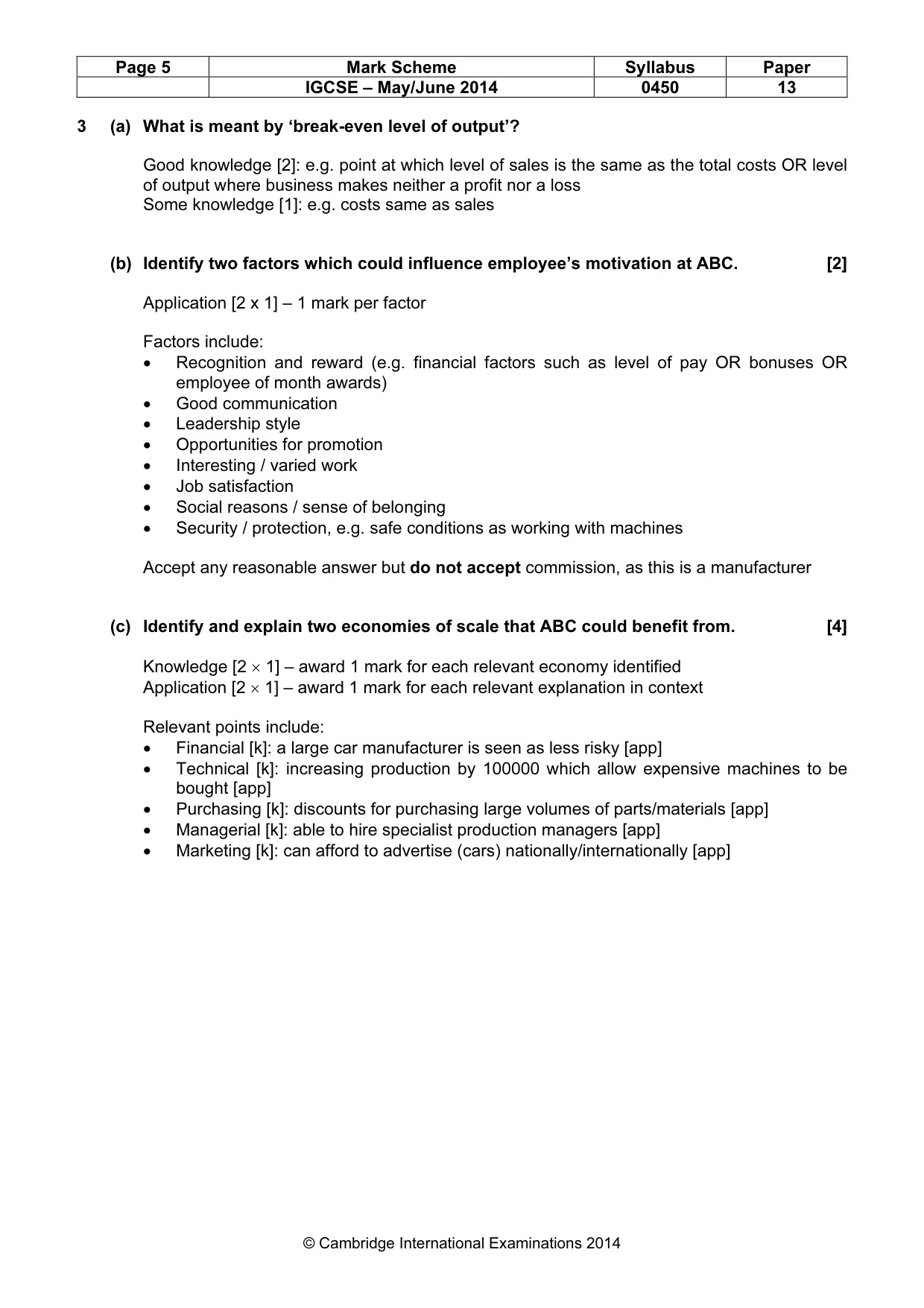
Page 5 Mark Scheme Syllabus Paper IGCSE – May/June 2014 0450 13 © Cambridge International Examinations 2014 3 (a) What is meant by ‘break-even level of output’? Good knowledge [2]: e.g. point at which level of sales is the same as the total costs OR level of output where business makes neither a profit nor a loss Some knowledge [1]: e.g. costs same as sales (b) Identify two factors which could influence employee’s motivation at ABC. [2] Application [2 x 1] – 1 mark per factor Factors include: • Recognition and reward (e.g. financial factors such as level of pay OR bonuses OR employee of month awards) • Good communication • Leadership style • Opportunities for promotion • Interesting / varied work • Job satisfaction • Social reasons / sense of belonging • Security / protection, e.g. safe conditions as working with machines Accept any reasonable answer but do not accept commission, as this is a manufacturer (c) Identify and explain two economies of scale that ABC could benefit from. [4] Knowledge [2 × 1] – award 1 mark for each relevant economy identified Application [2 × 1] – award 1 mark for each relevant explanation in context Relevant points include: • Financial [k]: a large car manufacturer is seen as less risky [app] • Technical [k]: increasing production by 100000 which allow expensive machines to be bought [app] • Purchasing [k]: discounts for purchasing large volumes of parts/materials [app] • Managerial [k]: able to hire specialist production managers [app] • Marketing [k]: can afford to advertise (cars) nationally/internationally [app]
Mark scheme, page 6
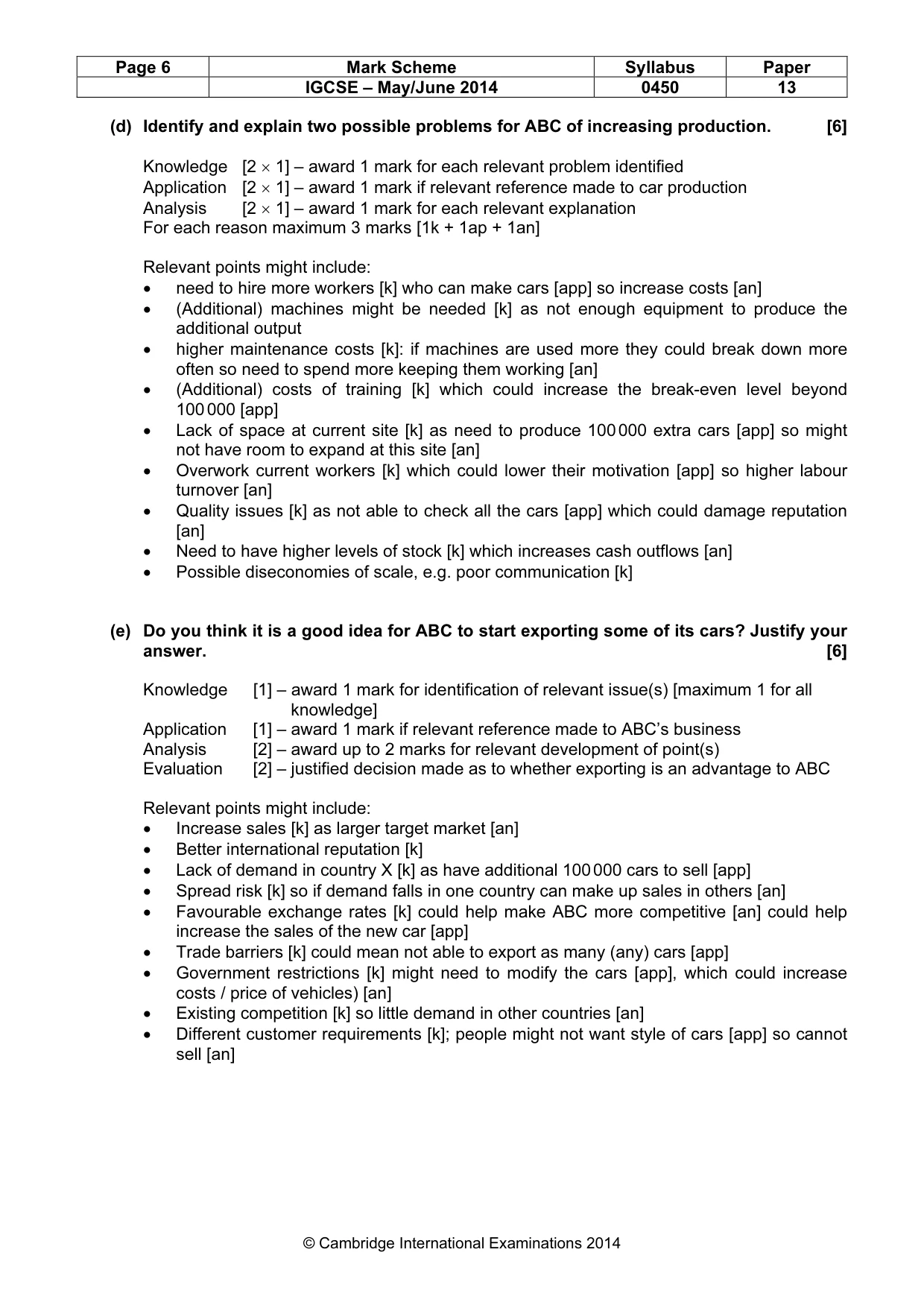
Page 6 Mark Scheme Syllabus Paper IGCSE – May/June 2014 0450 13 © Cambridge International Examinations 2014 (d) Identify and explain two possible problems for ABC of increasing production. [6] Knowledge [2 × 1] – award 1 mark for each relevant problem identified Application [2 × 1] – award 1 mark if relevant reference made to car production Analysis [2 × 1] – award 1 mark for each relevant explanation For each reason maximum 3 marks [1k + 1ap + 1an] Relevant points might include: • need to hire more workers [k] who can make cars [app] so increase costs [an] • (Additional) machines might be needed [k] as not enough equipment to produce the additional output • higher maintenance costs [k]: if machines are used more they could break down more often so need to spend more keeping them working [an] • (Additional) costs of training [k] which could increase the break-even level beyond 100 000 [app] • Lack of space at current site [k] as need to produce 100 000 extra cars [app] so might not have room to expand at this site [an] • Overwork current workers [k] which could lower their motivation [app] so higher labour turnover [an] • Quality issues [k] as not able to check all the cars [app] which could damage reputation [an] • Need to have higher levels of stock [k] which increases cash outflows [an] • Possible diseconomies of scale, e.g. poor communication [k] (e) Do you think it is a good idea for ABC to start exporting some of its cars? Justify your answer. [6] Knowledge [1] – award 1 mark for identification of relevant issue(s) [maximum 1 for all knowledge] Application [1] – award 1 mark if relevant reference made to ABC’s business Analysis [2] – award up to 2 marks for relevant development of point(s) Evaluation [2] – justified decision made as to whether exporting is an advantage to ABC Relevant points might include: • Increase sales [k] as larger target market [an] • Better international reputation [k] • Lack of demand in country X [k] as have additional 100 000 cars to sell [app] • Spread risk [k] so if demand falls in one country can make up sales in others [an] • Favourable exchange rates [k] could help make ABC more competitive [an] could help increase the sales of the new car [app] • Trade barriers [k] could mean not able to export as many (any) cars [app] • Government restrictions [k] might need to modify the cars [app], which could increase costs / price of vehicles) [an] • Existing competition [k] so little demand in other countries [an] • Different customer requirements [k]; people might not want style of cars [app] so cannot sell [an]
Mark scheme, page 7
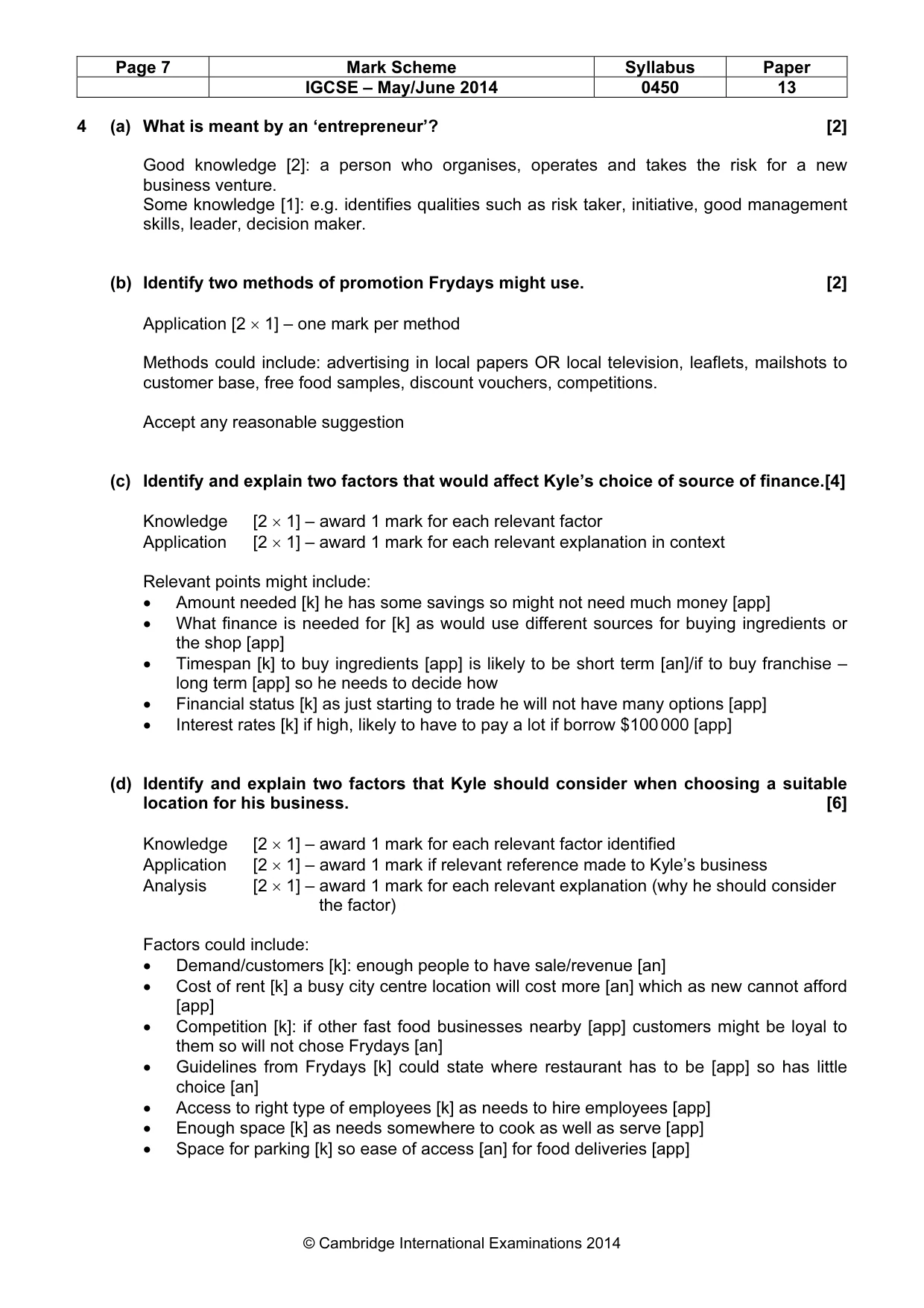
Page 7 Mark Scheme Syllabus Paper IGCSE – May/June 2014 0450 13 © Cambridge International Examinations 2014 4 (a) What is meant by an ‘entrepreneur’? [2] Good knowledge [2]: a person who organises, operates and takes the risk for a new business venture. Some knowledge [1]: e.g. identifies qualities such as risk taker, initiative, good management skills, leader, decision maker. (b) Identify two methods of promotion Frydays might use. [2] Application [2 × 1] – one mark per method Methods could include: advertising in local papers OR local television, leaflets, mailshots to customer base, free food samples, discount vouchers, competitions. Accept any reasonable suggestion (c) Identify and explain two factors that would affect Kyle’s choice of source of finance.[4] Knowledge [2 × 1] – award 1 mark for each relevant factor Application [2 × 1] – award 1 mark for each relevant explanation in context Relevant points might include: • Amount needed [k] he has some savings so might not need much money [app] • What finance is needed for [k] as would use different sources for buying ingredients or the shop [app] • Timespan [k] to buy ingredients [app] is likely to be short term [an]/if to buy franchise – long term [app] so he needs to decide how • Financial status [k] as just starting to trade he will not have many options [app] • Interest rates [k] if high, likely to have to pay a lot if borrow $100 000 [app] (d) Identify and explain two factors that Kyle should consider when choosing a suitable location for his business. [6] Knowledge [2 × 1] – award 1 mark for each relevant factor identified Application [2 × 1] – award 1 mark if relevant reference made to Kyle’s business Analysis [2 × 1] – award 1 mark for each relevant explanation (why he should consider the factor) Factors could include: • Demand/customers [k]: enough people to have sale/revenue [an] • Cost of rent [k] a busy city centre location will cost more [an] which as new cannot afford [app] • Competition [k]: if other fast food businesses nearby [app] customers might be loyal to them so will not chose Frydays [an] • Guidelines from Frydays [k] could state where restaurant has to be [app] so has little choice [an] • Access to right type of employees [k] as needs to hire employees [app] • Enough space [k] as needs somewhere to cook as well as serve [app] • Space for parking [k] so ease of access [an] for food deliveries [app]
Mark scheme, page 8
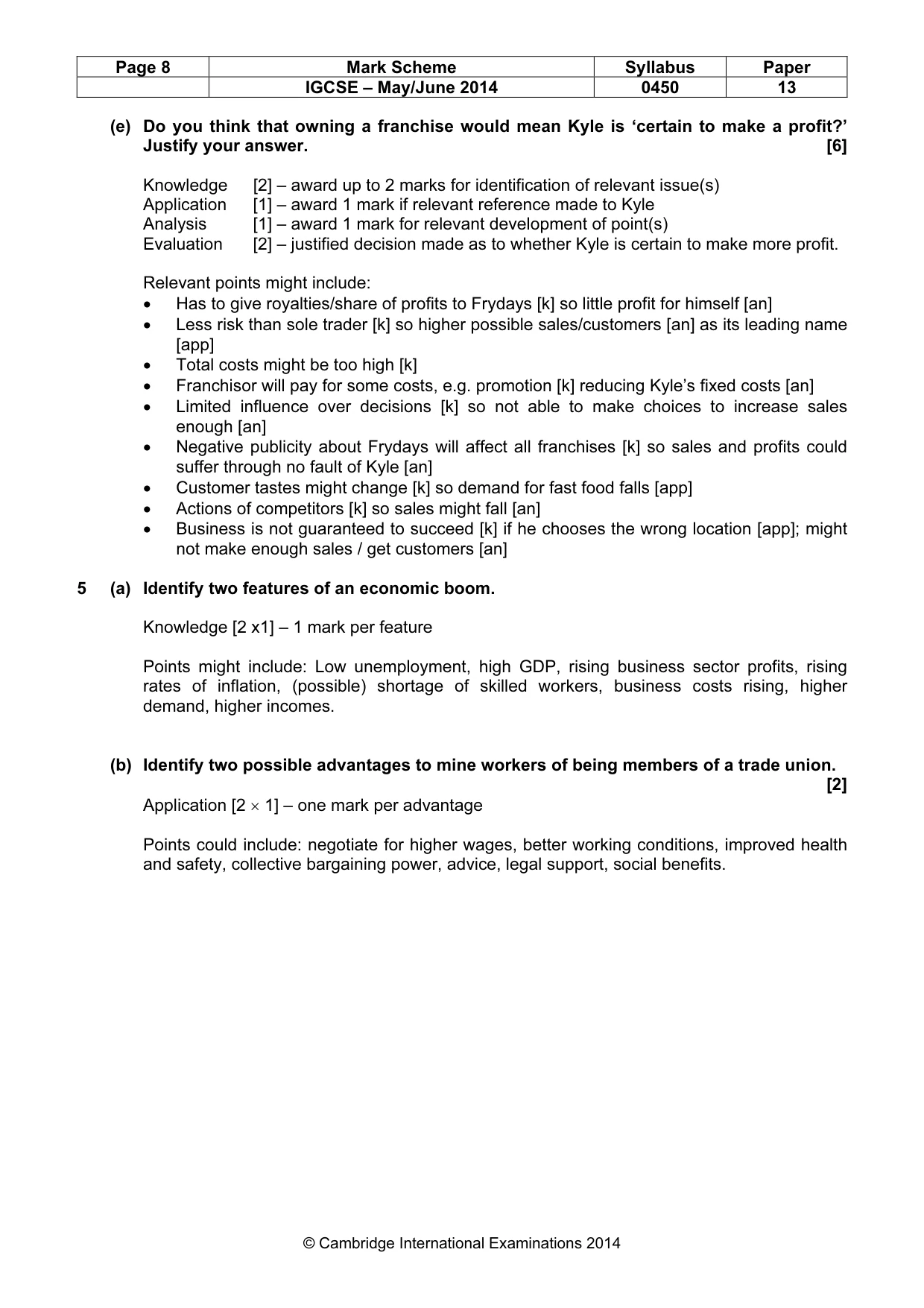
Page 8 Mark Scheme Syllabus Paper IGCSE – May/June 2014 0450 13 © Cambridge International Examinations 2014 (e) Do you think that owning a franchise would mean Kyle is ‘certain to make a profit?’ Justify your answer. [6] Knowledge [2] – award up to 2 marks for identification of relevant issue(s) Application [1] – award 1 mark if relevant reference made to Kyle Analysis [1] – award 1 mark for relevant development of point(s) Evaluation [2] – justified decision made as to whether Kyle is certain to make more profit. Relevant points might include: • Has to give royalties/share of profits to Frydays [k] so little profit for himself [an] • Less risk than sole trader [k] so higher possible sales/customers [an] as its leading name [app] • Total costs might be too high [k] • Franchisor will pay for some costs, e.g. promotion [k] reducing Kyle’s fixed costs [an] • Limited influence over decisions [k] so not able to make choices to increase sales enough [an] • Negative publicity about Frydays will affect all franchises [k] so sales and profits could suffer through no fault of Kyle [an] • Customer tastes might change [k] so demand for fast food falls [app] • Actions of competitors [k] so sales might fall [an] • Business is not guaranteed to succeed [k] if he chooses the wrong location [app]; might not make enough sales / get customers [an] 5 (a) Identify two features of an economic boom. Knowledge [2 x1] – 1 mark per feature Points might include: Low unemployment, high GDP, rising business sector profits, rising rates of inflation, (possible) shortage of skilled workers, business costs rising, higher demand, higher incomes. (b) Identify two possible advantages to mine workers of being members of a trade union. [2] Application [2 × 1] – one mark per advantage Points could include: negotiate for higher wages, better working conditions, improved health and safety, collective bargaining power, advice, legal support, social benefits.
Mark scheme, page 9
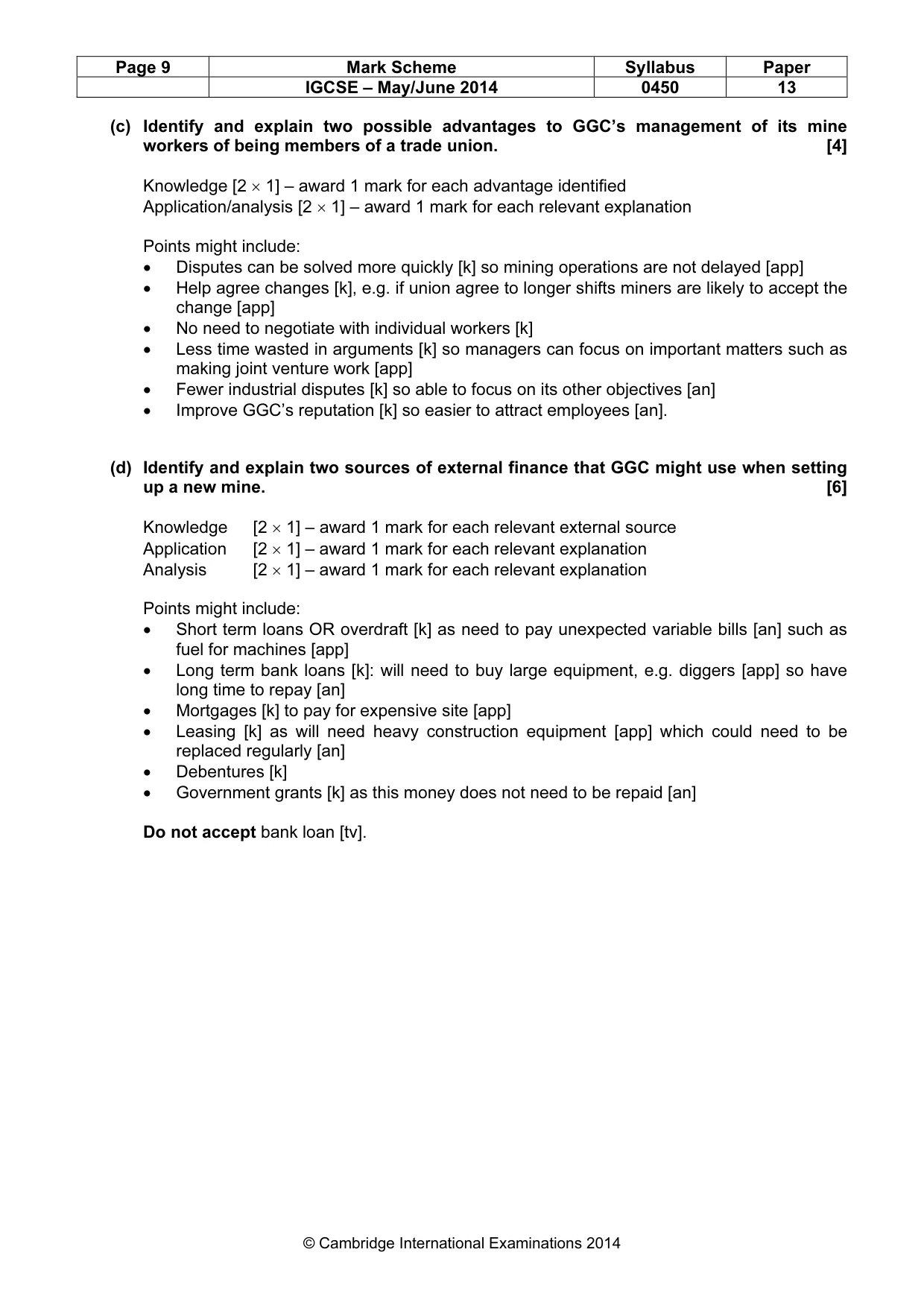
Page 9 Mark Scheme Syllabus Paper IGCSE – May/June 2014 0450 13 © Cambridge International Examinations 2014 (c) Identify and explain two possible advantages to GGC’s management of its mine workers of being members of a trade union. [4] Knowledge [2 × 1] – award 1 mark for each advantage identified Application/analysis [2 × 1] – award 1 mark for each relevant explanation Points might include: • Disputes can be solved more quickly [k] so mining operations are not delayed [app] • Help agree changes [k], e.g. if union agree to longer shifts miners are likely to accept the change [app] • No need to negotiate with individual workers [k] • Less time wasted in arguments [k] so managers can focus on important matters such as making joint venture work [app] • Fewer industrial disputes [k] so able to focus on its other objectives [an] • Improve GGC’s reputation [k] so easier to attract employees [an]. (d) Identify and explain two sources of external finance that GGC might use when setting up a new mine. [6] Knowledge [2 × 1] – award 1 mark for each relevant external source Application [2 × 1] – award 1 mark for each relevant explanation Analysis [2 × 1] – award 1 mark for each relevant explanation Points might include: • Short term loans OR overdraft [k] as need to pay unexpected variable bills [an] such as fuel for machines [app] • Long term bank loans [k]: will need to buy large equipment, e.g. diggers [app] so have long time to repay [an] • Mortgages [k] to pay for expensive site [app] • Leasing [k] as will need heavy construction equipment [app] which could need to be replaced regularly [an] • Debentures [k] • Government grants [k] as this money does not need to be repaid [an] Do not accept bank loan [tv].
Mark scheme, page 10
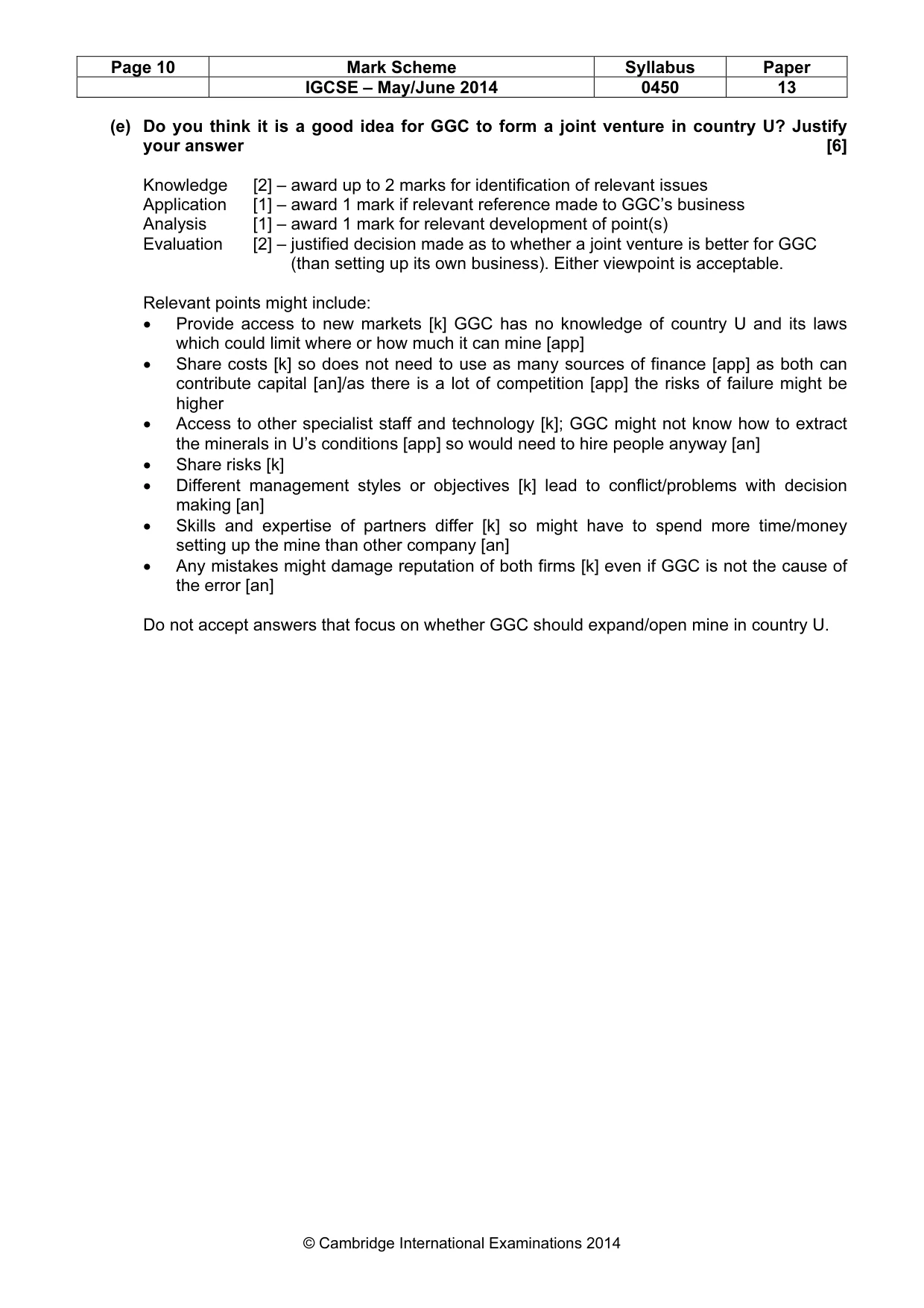
Page 10 Mark Scheme Syllabus Paper IGCSE – May/June 2014 0450 13 © Cambridge International Examinations 2014 (e) Do you think it is a good idea for GGC to form a joint venture in country U? Justify your answer [6] Knowledge [2] – award up to 2 marks for identification of relevant issues Application [1] – award 1 mark if relevant reference made to GGC’s business Analysis [1] – award 1 mark for relevant development of point(s) Evaluation [2] – justified decision made as to whether a joint venture is better for GGC (than setting up its own business). Either viewpoint is acceptable. Relevant points might include: • Provide access to new markets [k] GGC has no knowledge of country U and its laws which could limit where or how much it can mine [app] • Share costs [k] so does not need to use as many sources of finance [app] as both can contribute capital [an]/as there is a lot of competition [app] the risks of failure might be higher • Access to other specialist staff and technology [k]; GGC might not know how to extract the minerals in U’s conditions [app] so would need to hire people anyway [an] • Share risks [k] • Different management styles or objectives [k] lead to conflict/problems with decision making [an] • Skills and expertise of partners differ [k] so might have to spend more time/money setting up the mine than other company [an] • Any mistakes might damage reputation of both firms [k] even if GGC is not the cause of the error [an] Do not accept answers that focus on whether GGC should expand/open mine in country U.
What you needed in this session
Cambridge’s own grade thresholds for 2014 May/June, Paper 1 · Variant 3. A higher threshold means an easier paper — the bar moves with how the cohort did.