Cambridge IGCSE Business Studies 0450 — 2011 Oct/Nov Paper 2 · Variant 3
0450/23/O/N/11 · 100 marks · ≈113 min
The question paper and its mark scheme, free to read here and free to download. This is Cambridge’s own paper, exactly as it was sat.
Question paper12 pages

Mark scheme13 pages
Answers below. Sit the paper first if you are practising.
Paper as text
Question paper, page 1
This document consists of 11 printed pages, 1 blank page and 1 Insert. DC (LEO) 32725/2 © UCLES 2011 [Turn over UNIVERSITY OF CAMBRIDGE INTERNATIONAL EXAMINATIONS International General Certificate of Secondary Education * 8 1 1 3 4 5 7 9 8 4 * BUSINESS STUDIES 0450/23 Paper 2 October/November 2011 1 hour 45 minutes Candidates answer on the Question Paper. Additional Materials: Insert READ THESE INSTRUCTIONS FIRST Write your Centre number, candidate number and name on all the work you hand in. Write in dark blue or black pen. Do not use staples, paper clips, highlighters, glue or correction fluid. DO NOT WRITE IN ANY BARCODES. Answer all questions. The Insert contains the case study. The businesses described in this question paper are entirely fictitious. At the end of the examination, fasten all your work securely together. The number of marks is given in brackets [ ] at the end of each question or part question. For Examiner’s Use 1 2 3 4 5 Total
Question paper, page 2
2 0450/23/O/N/11 © UCLES 2011 For Examiner’s Use 1 (a) The directors of LL Drinks want to increase its market share. Identify and explain two other aims the directors might have for the business. Aim 1: … Explanation: … … … … … … … Aim 2: … Explanation: … … … … … … …[8]
Question paper, page 3
3 0450/23/O/N/11 © UCLES 2011 [Turn over For Examiner’s Use (b) If LL Drinks follow Option 1 and try to sell their drinks in several new countries they will have a number of problems to overcome. Consider three problems for the business when entering a new market in a different country. Do you think each of these problems can be easily solved? Justify your answer. Problem 1: … … … … … … Problem 2: … … … … … … Problem 3: … … … … … … Conclusion: … … … … … …[12]
Question paper, page 4
4 0450/23/O/N/11 © UCLES 2011 For Examiner’s Use 2 (a) Referring to the information in the case, identify and explain two reasons why people might want to become shareholders of LL Drinks. Reason 1: … … Explanation: … … … … … … Reason 2: … … Explanation: … … … … … …[8]
Question paper, page 5
5 0450/23/O/N/11 © UCLES 2011 [Turn over For Examiner’s Use (b) LL Drinks might take over a competitor (Option 2). Identify four stakeholders of LL Drinks that would be affected by this takeover. Do you think each of these stakeholders would benefit from the takeover? Justify your answer. Stakeholder 1: … … … … … … Stakeholder 2: … … … … … … Stakeholder 3: … … … … … … Stakeholder 4: … … … … … …[12]
Question paper, page 6
6 0450/23/O/N/11 © UCLES 2011 For Examiner’s Use 3 (a) LL Drinks sells a wide range of branded drinks. Identify and explain two ways that LL Drinks could promote a new fruit drink aimed at young children. First way: … … Explanation: … … … … … … Second way: … … Explanation: … … … … … …[8]
Question paper, page 7
7 0450/23/O/N/11 © UCLES 2011 [Turn over For Examiner’s Use (b) Using the information in Appendix 1 and the rest of the case, consider the two options for increasing the market share of LL Drinks. Recommend which one of the two options the directors should choose. Justify your choice using appropriate calculations of profitability ratios. Option 1 (Sell existing brands in more countries): … … … … … … … … … Option 2 (Take over competitor): … … … … … … … … … Recommendation: … … … … … …[12]
Question paper, page 8
8 0450/23/O/N/11 © UCLES 2011 For Examiner’s Use 4 (a) As LL Drinks expands it could gain from economies of scale. Identify and explain two examples of economies of scale the business might benefit from as it expands. Example 1: … Explanation: … … … … … … … Example 2: … Explanation: … … … … … … …[8]
Question paper, page 9
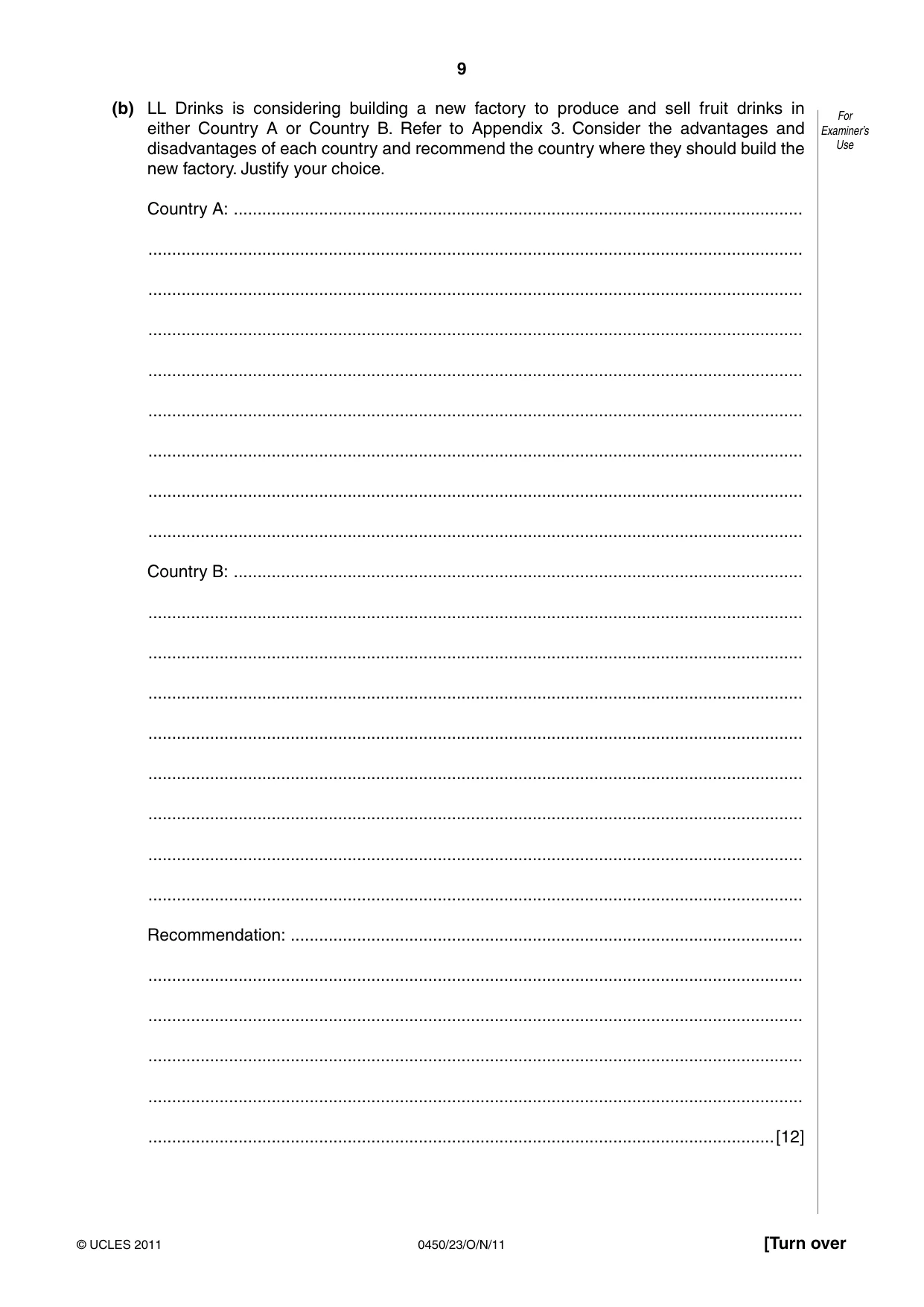
9 0450/23/O/N/11 © UCLES 2011 [Turn over For Examiner’s Use (b) LL Drinks is considering building a new factory to produce and sell fruit drinks in either Country A or Country B. Refer to Appendix 3. Consider the advantages and disadvantages of each country and recommend the country where they should build the new factory. Justify your choice. Country A: … … … … … … … … … Country B: … … … … … … … … … Recommendation: … … … … … …[12]
Question paper, page 10
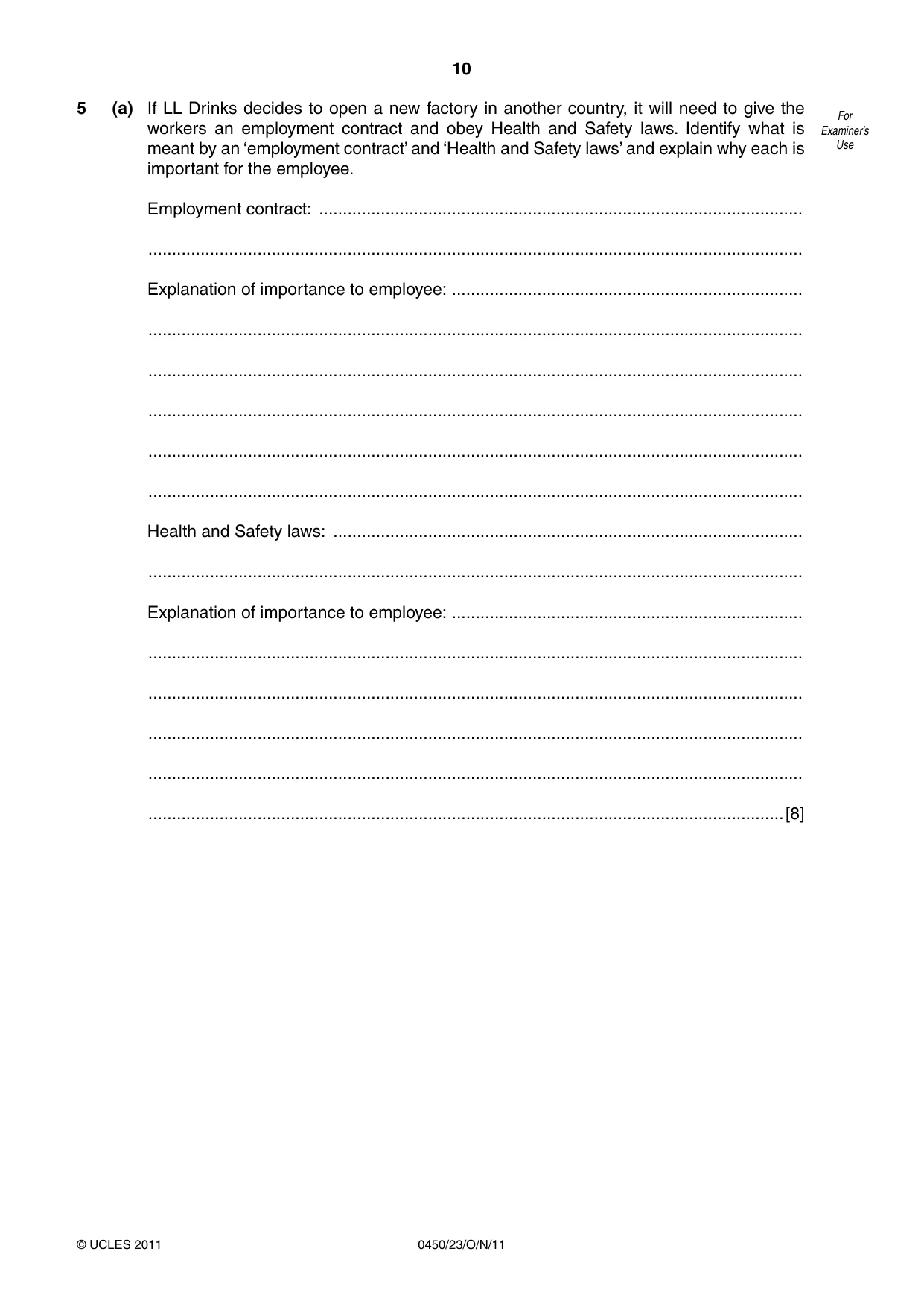
10 0450/23/O/N/11 © UCLES 2011 For Examiner’s Use 5 (a) If LL Drinks decides to open a new factory in another country, it will need to give the workers an employment contract and obey Health and Safety laws. Identify what is meant by an ‘employment contract’ and ‘Health and Safety laws’ and explain why each is important for the employee. Employment contract: … … Explanation of importance to employee: … … … … … … Health and Safety laws: … … Explanation of importance to employee: … … … … … …[8]
Question paper, page 11
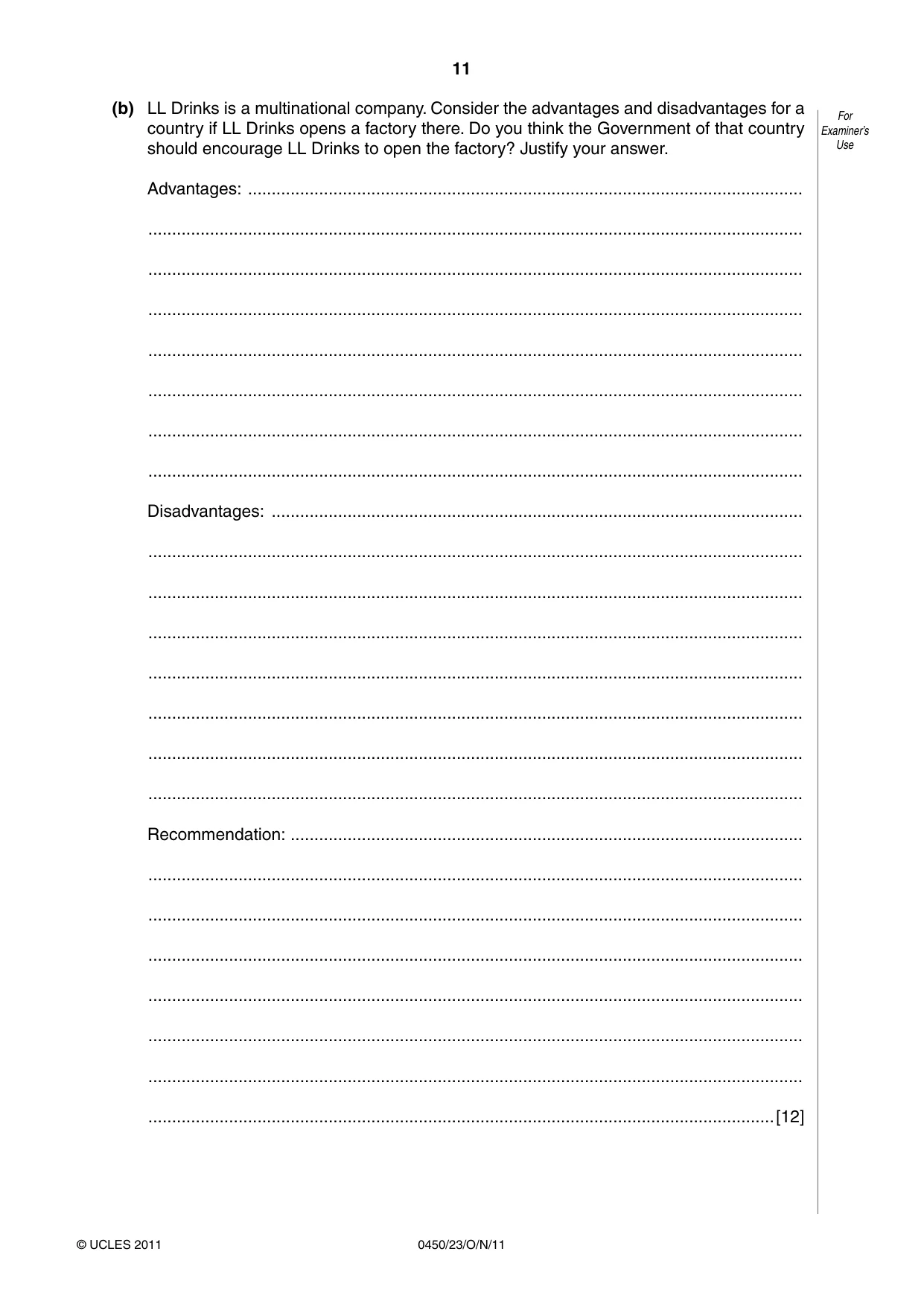
11 0450/23/O/N/11 © UCLES 2011 For Examiner’s Use (b) LL Drinks is a multinational company. Consider the advantages and disadvantages for a country if LL Drinks opens a factory there. Do you think the Government of that country should encourage LL Drinks to open the factory? Justify your answer. Advantages: … … … … … … … … Disadvantages: … … … … … … … … Recommendation: … … … … … … … …[12]
Question paper, page 12
12 0450/23/O/N/11 © UCLES 2011 Permission to reproduce items where third-party owned material protected by copyright is included has been sought and cleared where possible. Every reasonable effort has been made by the publisher (UCLES) to trace copyright holders, but if any items requiring clearance have unwittingly been included, the publisher will be pleased to make amends at the earliest possible opportunity. University of Cambridge International Examinations is part of the Cambridge Assessment Group. Cambridge Assessment is the brand name of University of Cambridge Local Examinations Syndicate (UCLES), which is itself a department of the University of Cambridge. BLANK PAGE
Mark scheme, page 1
UNIVERSITY OF CAMBRIDGE INTERNATIONAL EXAMINATIONS International General Certificate of Secondary Education MARK SCHEME for the October/November 2011 question paper for the guidance of teachers 0450 BUSINESS STUDIES 0450/23 Paper 2 (Case Study), maximum raw mark 100 This mark scheme is published as an aid to teachers and candidates, to indicate the requirements of the examination. It shows the basis on which Examiners were instructed to award marks. It does not indicate the details of the discussions that took place at an Examiners’ meeting before marking began, which would have considered the acceptability of alternative answers. Mark schemes must be read in conjunction with the question papers and the report on the examination. • Cambridge will not enter into discussions or correspondence in connection with these mark schemes. Cambridge is publishing the mark schemes for the October/November 2011 question papers for most IGCSE, GCE Advanced Level and Advanced Subsidiary Level syllabuses and some Ordinary Level syllabuses.
Mark scheme, page 2
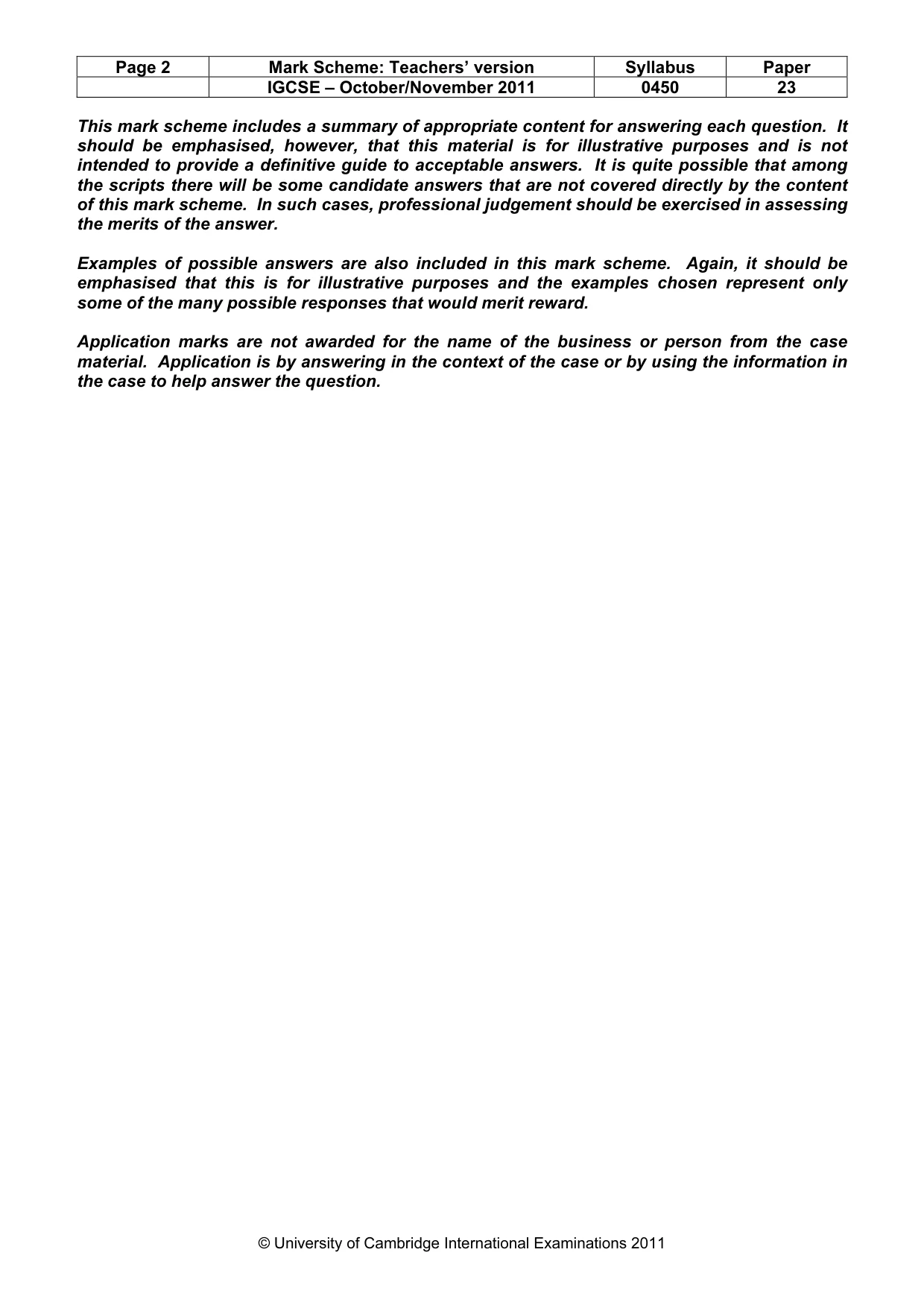
Page 2 Mark Scheme: Teachers’ version Syllabus Paper IGCSE – October/November 2011 0450 23 © University of Cambridge International Examinations 2011 This mark scheme includes a summary of appropriate content for answering each question. It should be emphasised, however, that this material is for illustrative purposes and is not intended to provide a definitive guide to acceptable answers. It is quite possible that among the scripts there will be some candidate answers that are not covered directly by the content of this mark scheme. In such cases, professional judgement should be exercised in assessing the merits of the answer. Examples of possible answers are also included in this mark scheme. Again, it should be emphasised that this is for illustrative purposes and the examples chosen represent only some of the many possible responses that would merit reward. Application marks are not awarded for the name of the business or person from the case material. Application is by answering in the context of the case or by using the information in the case to help answer the question.
Mark scheme, page 3
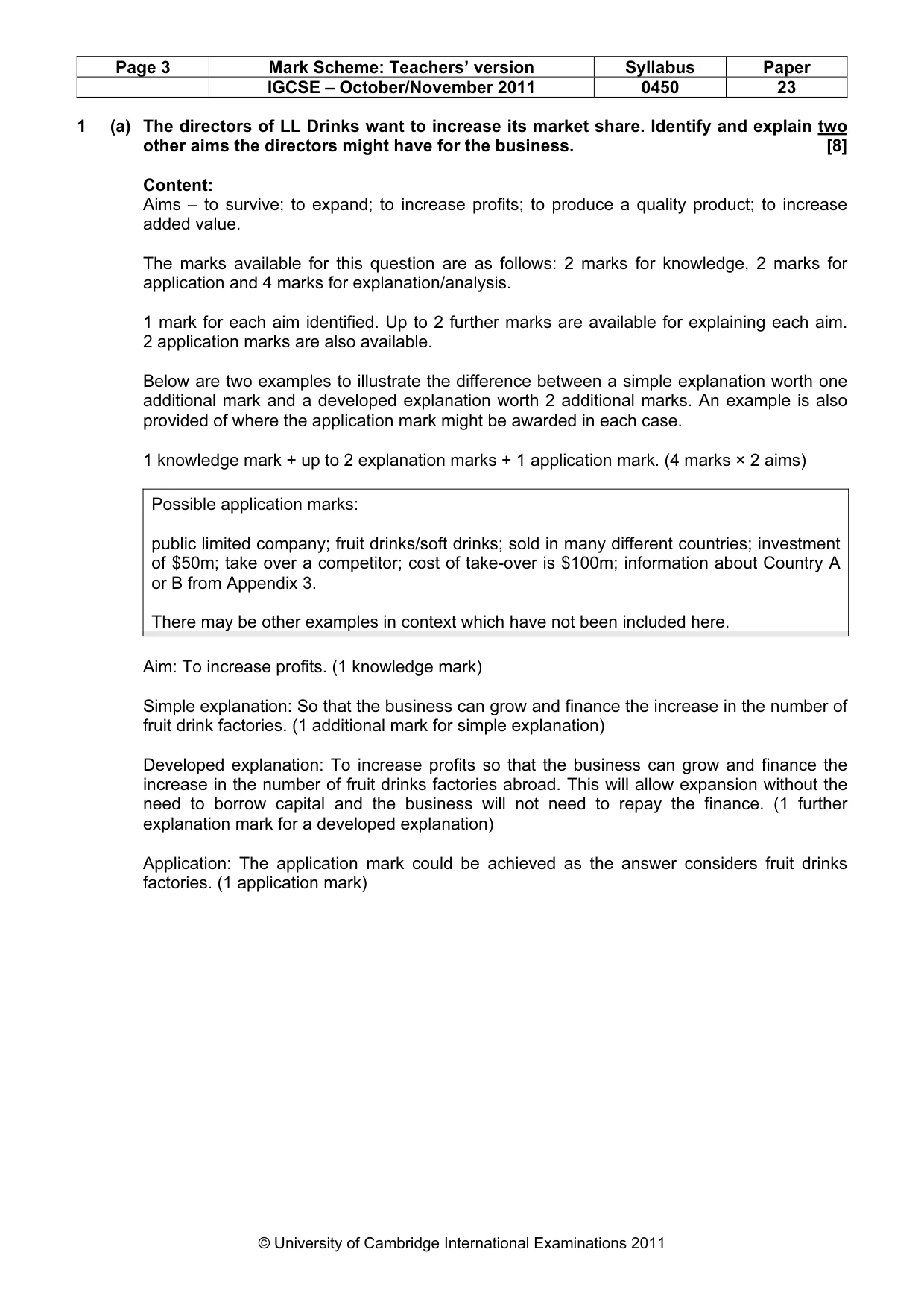
Page 3 Mark Scheme: Teachers’ version Syllabus Paper IGCSE – October/November 2011 0450 23 © University of Cambridge International Examinations 2011 1 (a) The directors of LL Drinks want to increase its market share. Identify and explain two other aims the directors might have for the business. [8] Content: Aims – to survive; to expand; to increase profits; to produce a quality product; to increase added value. The marks available for this question are as follows: 2 marks for knowledge, 2 marks for application and 4 marks for explanation/analysis. 1 mark for each aim identified. Up to 2 further marks are available for explaining each aim. 2 application marks are also available. Below are two examples to illustrate the difference between a simple explanation worth one additional mark and a developed explanation worth 2 additional marks. An example is also provided of where the application mark might be awarded in each case. 1 knowledge mark + up to 2 explanation marks + 1 application mark. (4 marks × 2 aims) Possible application marks: public limited company; fruit drinks/soft drinks; sold in many different countries; investment of $50m; take over a competitor; cost of take-over is $100m; information about Country A or B from Appendix 3. There may be other examples in context which have not been included here. Aim: To increase profits. (1 knowledge mark) Simple explanation: So that the business can grow and finance the increase in the number of fruit drink factories. (1 additional mark for simple explanation) Developed explanation: To increase profits so that the business can grow and finance the increase in the number of fruit drinks factories abroad. This will allow expansion without the need to borrow capital and the business will not need to repay the finance. (1 further explanation mark for a developed explanation) Application: The application mark could be achieved as the answer considers fruit drinks factories. (1 application mark)
Mark scheme, page 4
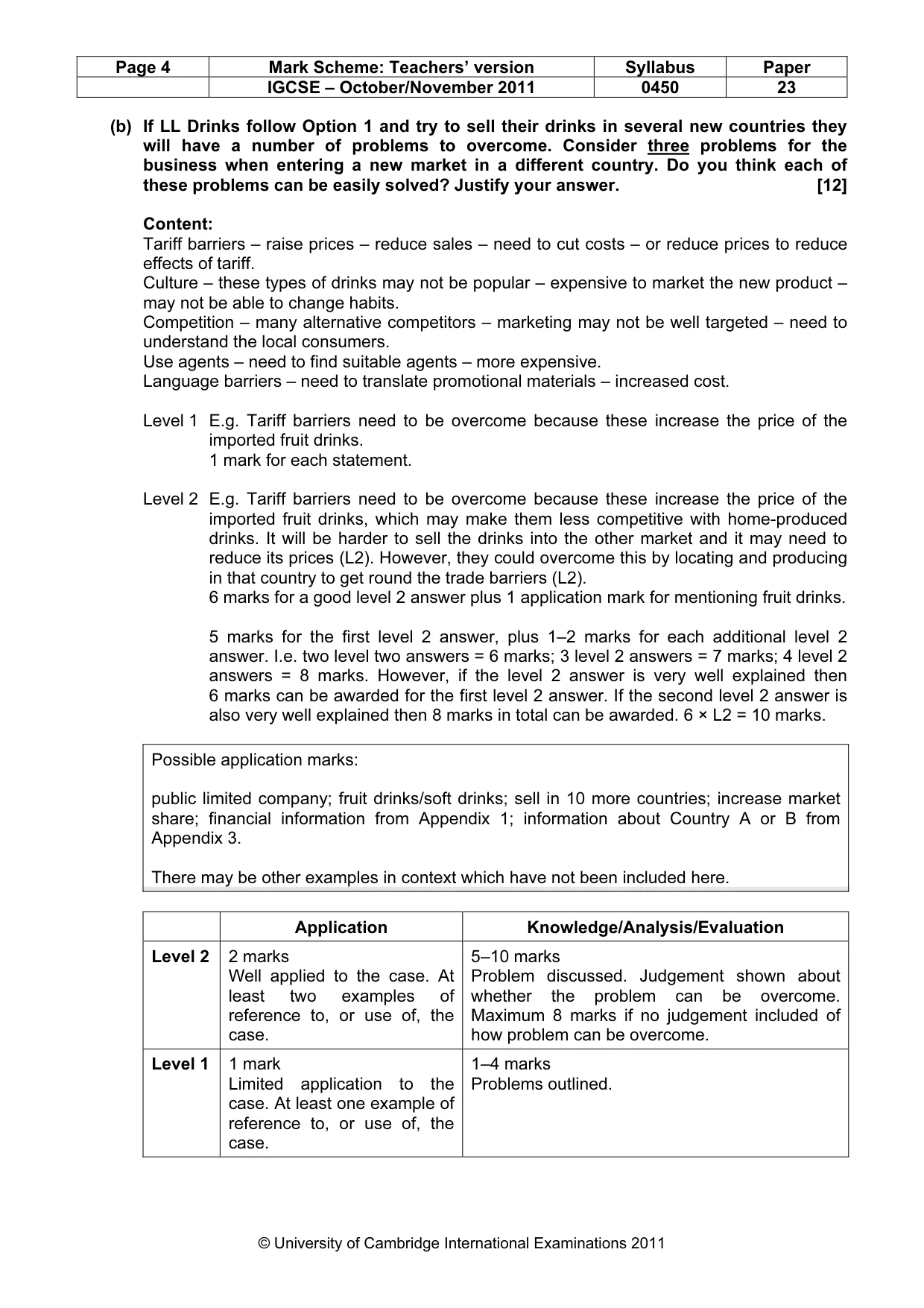
Page 4 Mark Scheme: Teachers’ version Syllabus Paper IGCSE – October/November 2011 0450 23 © University of Cambridge International Examinations 2011 (b) If LL Drinks follow Option 1 and try to sell their drinks in several new countries they will have a number of problems to overcome. Consider three problems for the business when entering a new market in a different country. Do you think each of these problems can be easily solved? Justify your answer. [12] Content: Tariff barriers – raise prices – reduce sales – need to cut costs – or reduce prices to reduce effects of tariff. Culture – these types of drinks may not be popular – expensive to market the new product – may not be able to change habits. Competition – many alternative competitors – marketing may not be well targeted – need to understand the local consumers. Use agents – need to find suitable agents – more expensive. Language barriers – need to translate promotional materials – increased cost. Level 1 E.g. Tariff barriers need to be overcome because these increase the price of the imported fruit drinks. 1 mark for each statement. Level 2 E.g. Tariff barriers need to be overcome because these increase the price of the imported fruit drinks, which may make them less competitive with home-produced drinks. It will be harder to sell the drinks into the other market and it may need to reduce its prices (L2). However, they could overcome this by locating and producing in that country to get round the trade barriers (L2). 6 marks for a good level 2 answer plus 1 application mark for mentioning fruit drinks. 5 marks for the first level 2 answer, plus 1–2 marks for each additional level 2 answer. I.e. two level two answers = 6 marks; 3 level 2 answers = 7 marks; 4 level 2 answers = 8 marks. However, if the level 2 answer is very well explained then 6 marks can be awarded for the first level 2 answer. If the second level 2 answer is also very well explained then 8 marks in total can be awarded. 6 × L2 = 10 marks. Possible application marks: public limited company; fruit drinks/soft drinks; sell in 10 more countries; increase market share; financial information from Appendix 1; information about Country A or B from Appendix 3. There may be other examples in context which have not been included here. Application Knowledge/Analysis/Evaluation Level 2 2 marks Well applied to the case. At least two examples of reference to, or use of, the case. 5–10 marks Problem discussed. Judgement shown about whether the problem can be overcome. Maximum 8 marks if no judgement included of how problem can be overcome. Level 1 1 mark Limited application to the case. At least one example of reference to, or use of, the case. 1–4 marks Problems outlined.
Mark scheme, page 5
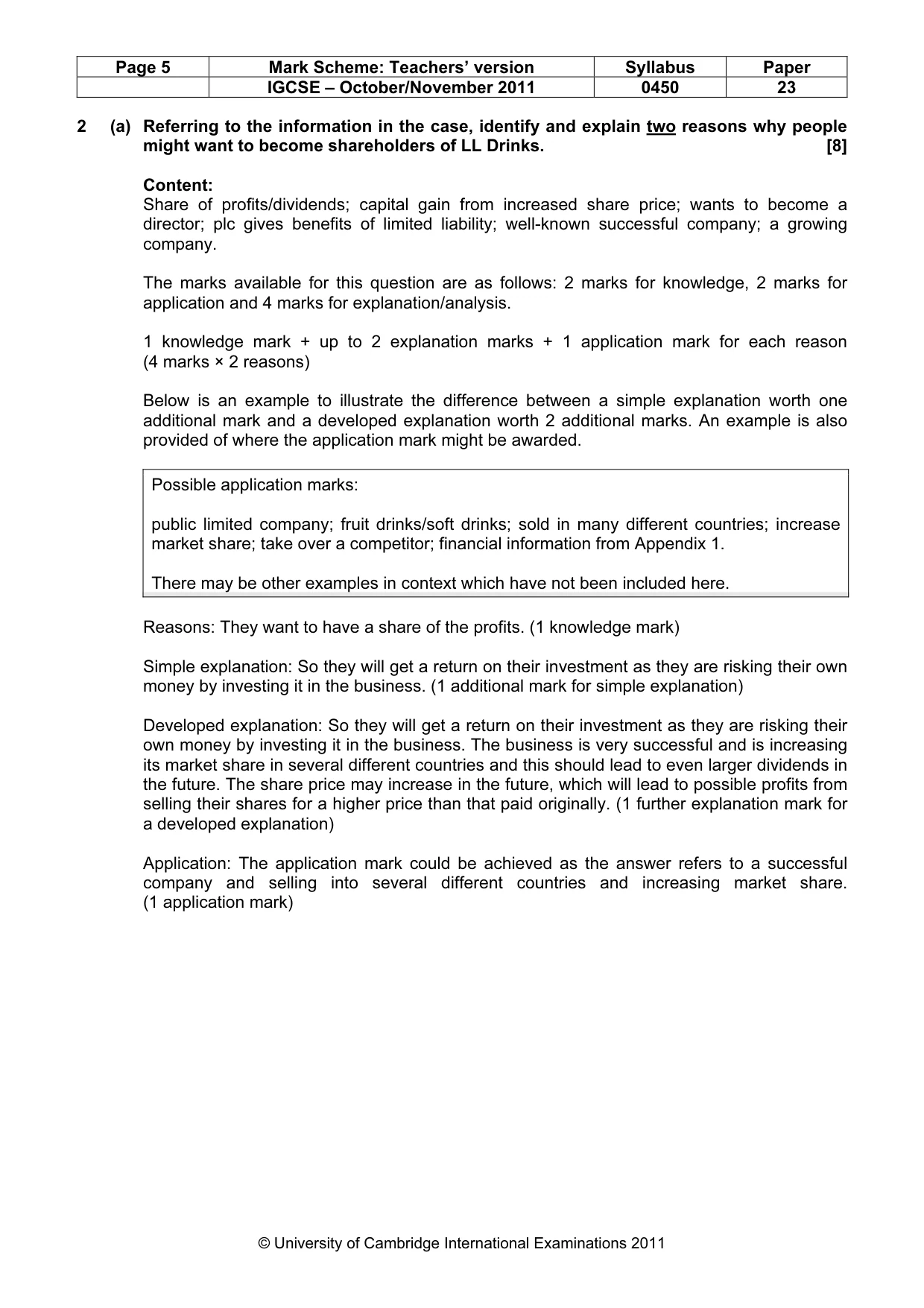
Page 5 Mark Scheme: Teachers’ version Syllabus Paper IGCSE – October/November 2011 0450 23 © University of Cambridge International Examinations 2011 2 (a) Referring to the information in the case, identify and explain two reasons why people might want to become shareholders of LL Drinks. [8] Content: Share of profits/dividends; capital gain from increased share price; wants to become a director; plc gives benefits of limited liability; well-known successful company; a growing company. The marks available for this question are as follows: 2 marks for knowledge, 2 marks for application and 4 marks for explanation/analysis. 1 knowledge mark + up to 2 explanation marks + 1 application mark for each reason (4 marks × 2 reasons) Below is an example to illustrate the difference between a simple explanation worth one additional mark and a developed explanation worth 2 additional marks. An example is also provided of where the application mark might be awarded. Possible application marks: public limited company; fruit drinks/soft drinks; sold in many different countries; increase market share; take over a competitor; financial information from Appendix 1. There may be other examples in context which have not been included here. Reasons: They want to have a share of the profits. (1 knowledge mark) Simple explanation: So they will get a return on their investment as they are risking their own money by investing it in the business. (1 additional mark for simple explanation) Developed explanation: So they will get a return on their investment as they are risking their own money by investing it in the business. The business is very successful and is increasing its market share in several different countries and this should lead to even larger dividends in the future. The share price may increase in the future, which will lead to possible profits from selling their shares for a higher price than that paid originally. (1 further explanation mark for a developed explanation) Application: The application mark could be achieved as the answer refers to a successful company and selling into several different countries and increasing market share. (1 application mark)
Mark scheme, page 6
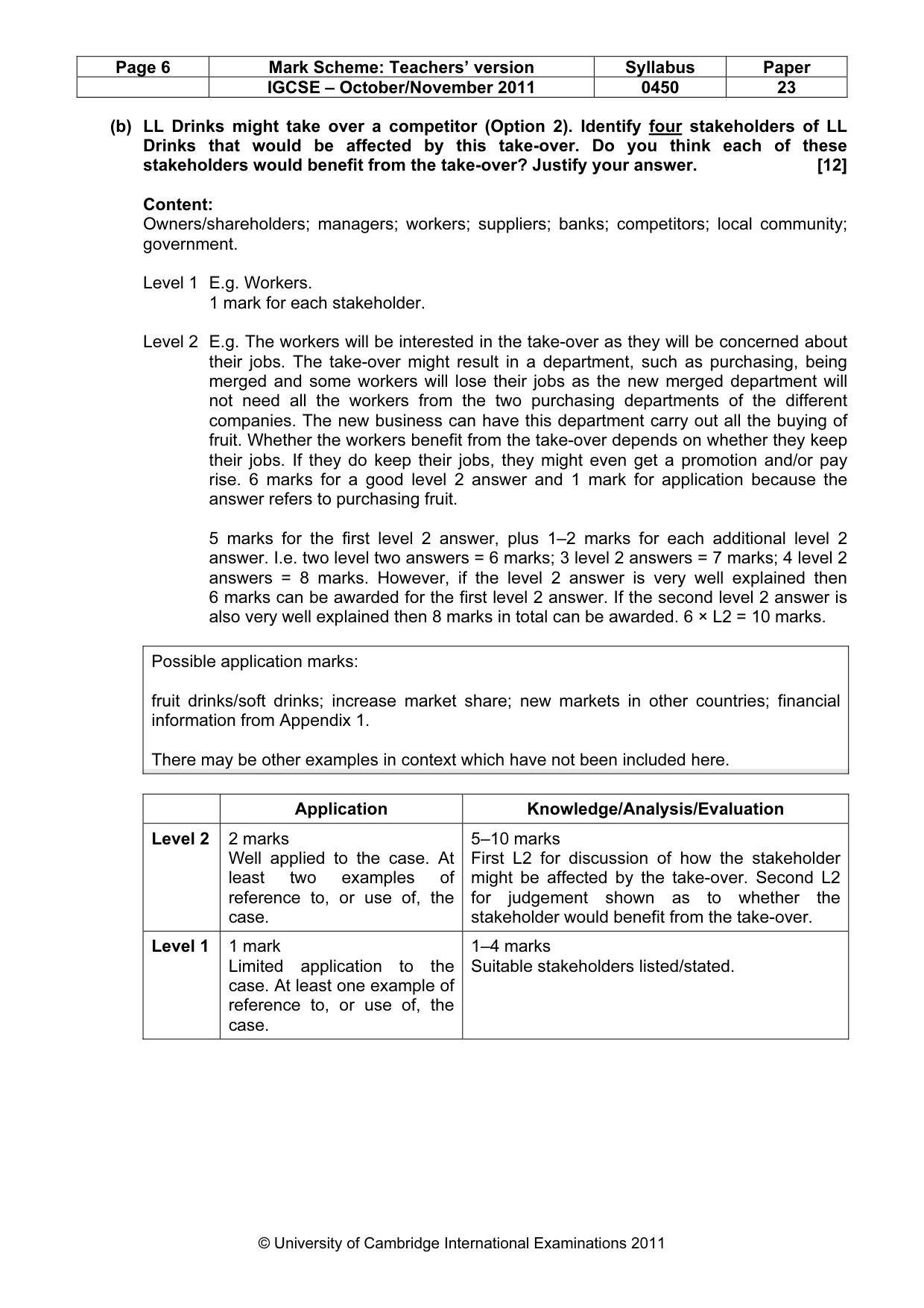
Page 6 Mark Scheme: Teachers’ version Syllabus Paper IGCSE – October/November 2011 0450 23 © University of Cambridge International Examinations 2011 (b) LL Drinks might take over a competitor (Option 2). Identify four stakeholders of LL Drinks that would be affected by this take-over. Do you think each of these stakeholders would benefit from the take-over? Justify your answer. [12] Content: Owners/shareholders; managers; workers; suppliers; banks; competitors; local community; government. Level 1 E.g. Workers. 1 mark for each stakeholder. Level 2 E.g. The workers will be interested in the take-over as they will be concerned about their jobs. The take-over might result in a department, such as purchasing, being merged and some workers will lose their jobs as the new merged department will not need all the workers from the two purchasing departments of the different companies. The new business can have this department carry out all the buying of fruit. Whether the workers benefit from the take-over depends on whether they keep their jobs. If they do keep their jobs, they might even get a promotion and/or pay rise. 6 marks for a good level 2 answer and 1 mark for application because the answer refers to purchasing fruit. 5 marks for the first level 2 answer, plus 1–2 marks for each additional level 2 answer. I.e. two level two answers = 6 marks; 3 level 2 answers = 7 marks; 4 level 2 answers = 8 marks. However, if the level 2 answer is very well explained then 6 marks can be awarded for the first level 2 answer. If the second level 2 answer is also very well explained then 8 marks in total can be awarded. 6 × L2 = 10 marks. Possible application marks: fruit drinks/soft drinks; increase market share; new markets in other countries; financial information from Appendix 1. There may be other examples in context which have not been included here. Application Knowledge/Analysis/Evaluation Level 2 2 marks Well applied to the case. At least two examples of reference to, or use of, the case. 5–10 marks First L2 for discussion of how the stakeholder might be affected by the take-over. Second L2 for judgement shown as to whether the stakeholder would benefit from the take-over. Level 1 1 mark Limited application to the case. At least one example of reference to, or use of, the case. 1–4 marks Suitable stakeholders listed/stated.
Mark scheme, page 7
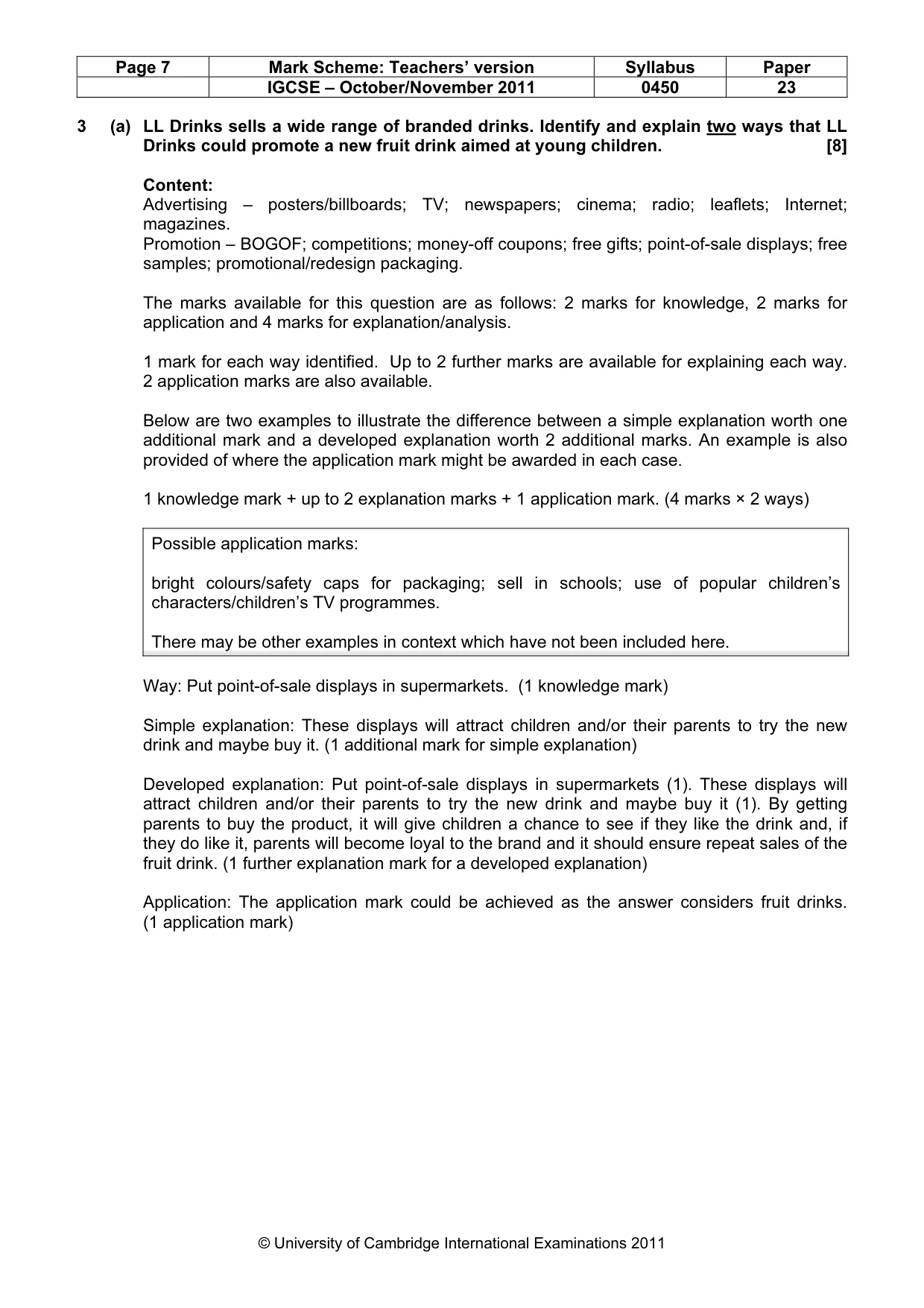
Page 7 Mark Scheme: Teachers’ version Syllabus Paper IGCSE – October/November 2011 0450 23 © University of Cambridge International Examinations 2011 3 (a) LL Drinks sells a wide range of branded drinks. Identify and explain two ways that LL Drinks could promote a new fruit drink aimed at young children. [8] Content: Advertising – posters/billboards; TV; newspapers; cinema; radio; leaflets; Internet; magazines. Promotion – BOGOF; competitions; money-off coupons; free gifts; point-of-sale displays; free samples; promotional/redesign packaging. The marks available for this question are as follows: 2 marks for knowledge, 2 marks for application and 4 marks for explanation/analysis. 1 mark for each way identified. Up to 2 further marks are available for explaining each way. 2 application marks are also available. Below are two examples to illustrate the difference between a simple explanation worth one additional mark and a developed explanation worth 2 additional marks. An example is also provided of where the application mark might be awarded in each case. 1 knowledge mark + up to 2 explanation marks + 1 application mark. (4 marks × 2 ways) Possible application marks: bright colours/safety caps for packaging; sell in schools; use of popular children’s characters/children’s TV programmes. There may be other examples in context which have not been included here. Way: Put point-of-sale displays in supermarkets. (1 knowledge mark) Simple explanation: These displays will attract children and/or their parents to try the new drink and maybe buy it. (1 additional mark for simple explanation) Developed explanation: Put point-of-sale displays in supermarkets (1). These displays will attract children and/or their parents to try the new drink and maybe buy it (1). By getting parents to buy the product, it will give children a chance to see if they like the drink and, if they do like it, parents will become loyal to the brand and it should ensure repeat sales of the fruit drink. (1 further explanation mark for a developed explanation) Application: The application mark could be achieved as the answer considers fruit drinks. (1 application mark)
Mark scheme, page 8
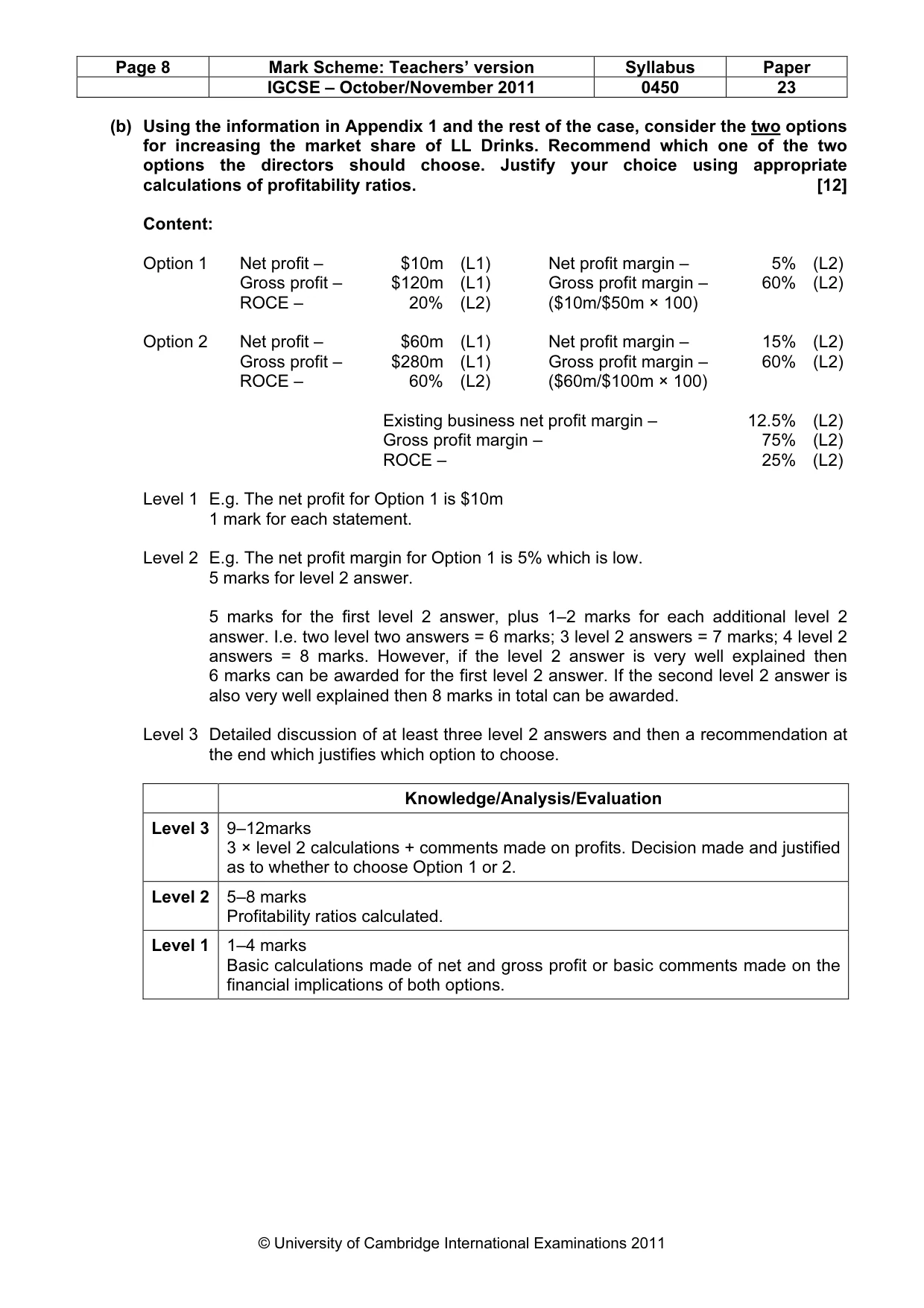
Page 8 Mark Scheme: Teachers’ version Syllabus Paper IGCSE – October/November 2011 0450 23 © University of Cambridge International Examinations 2011 (b) Using the information in Appendix 1 and the rest of the case, consider the two options for increasing the market share of LL Drinks. Recommend which one of the two options the directors should choose. Justify your choice using appropriate calculations of profitability ratios. [12] Content: Option 1 Net profit – $10m (L1) Net profit margin – 5% (L2) Gross profit – $120m (L1) Gross profit margin – 60% (L2) ROCE – 20% (L2) ($10m/$50m × 100) Option 2 Net profit – $60m (L1) Net profit margin – 15% (L2) Gross profit – $280m (L1) Gross profit margin – 60% (L2) ROCE – 60% (L2) ($60m/$100m × 100) Existing business net profit margin – 12.5% (L2) Gross profit margin – 75% (L2) ROCE – 25% (L2) Level 1 E.g. The net profit for Option 1 is $10m 1 mark for each statement. Level 2 E.g. The net profit margin for Option 1 is 5% which is low. 5 marks for level 2 answer. 5 marks for the first level 2 answer, plus 1–2 marks for each additional level 2 answer. I.e. two level two answers = 6 marks; 3 level 2 answers = 7 marks; 4 level 2 answers = 8 marks. However, if the level 2 answer is very well explained then 6 marks can be awarded for the first level 2 answer. If the second level 2 answer is also very well explained then 8 marks in total can be awarded. Level 3 Detailed discussion of at least three level 2 answers and then a recommendation at the end which justifies which option to choose. Knowledge/Analysis/Evaluation Level 3 9–12marks 3 × level 2 calculations + comments made on profits. Decision made and justified as to whether to choose Option 1 or 2. Level 2 5–8 marks Profitability ratios calculated. Level 1 1–4 marks Basic calculations made of net and gross profit or basic comments made on the financial implications of both options.
Mark scheme, page 9
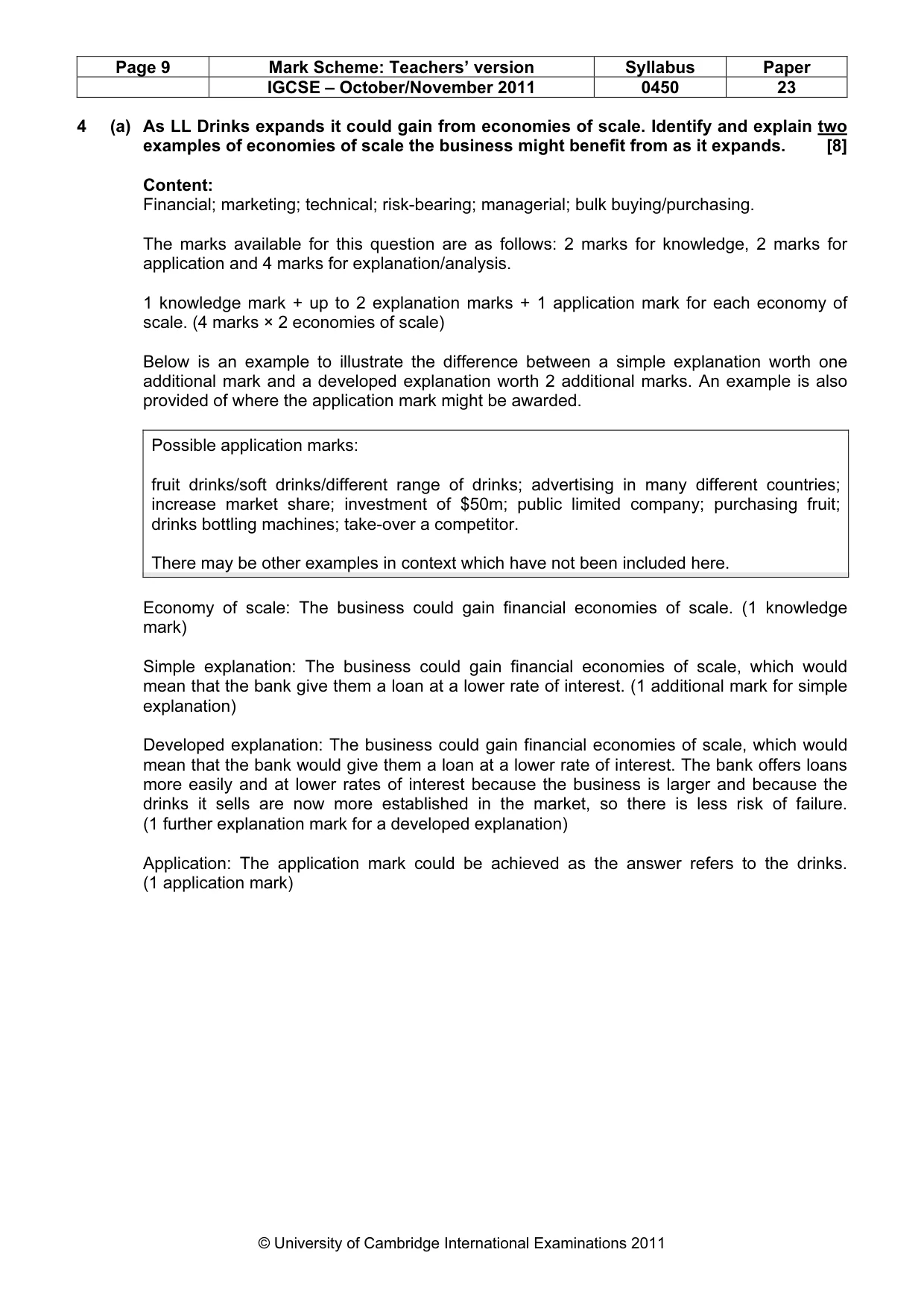
Page 9 Mark Scheme: Teachers’ version Syllabus Paper IGCSE – October/November 2011 0450 23 © University of Cambridge International Examinations 2011 4 (a) As LL Drinks expands it could gain from economies of scale. Identify and explain two examples of economies of scale the business might benefit from as it expands. [8] Content: Financial; marketing; technical; risk-bearing; managerial; bulk buying/purchasing. The marks available for this question are as follows: 2 marks for knowledge, 2 marks for application and 4 marks for explanation/analysis. 1 knowledge mark + up to 2 explanation marks + 1 application mark for each economy of scale. (4 marks × 2 economies of scale) Below is an example to illustrate the difference between a simple explanation worth one additional mark and a developed explanation worth 2 additional marks. An example is also provided of where the application mark might be awarded. Possible application marks: fruit drinks/soft drinks/different range of drinks; advertising in many different countries; increase market share; investment of $50m; public limited company; purchasing fruit; drinks bottling machines; take-over a competitor. There may be other examples in context which have not been included here. Economy of scale: The business could gain financial economies of scale. (1 knowledge mark) Simple explanation: The business could gain financial economies of scale, which would mean that the bank give them a loan at a lower rate of interest. (1 additional mark for simple explanation) Developed explanation: The business could gain financial economies of scale, which would mean that the bank would give them a loan at a lower rate of interest. The bank offers loans more easily and at lower rates of interest because the business is larger and because the drinks it sells are now more established in the market, so there is less risk of failure. (1 further explanation mark for a developed explanation) Application: The application mark could be achieved as the answer refers to the drinks. (1 application mark)
Mark scheme, page 10
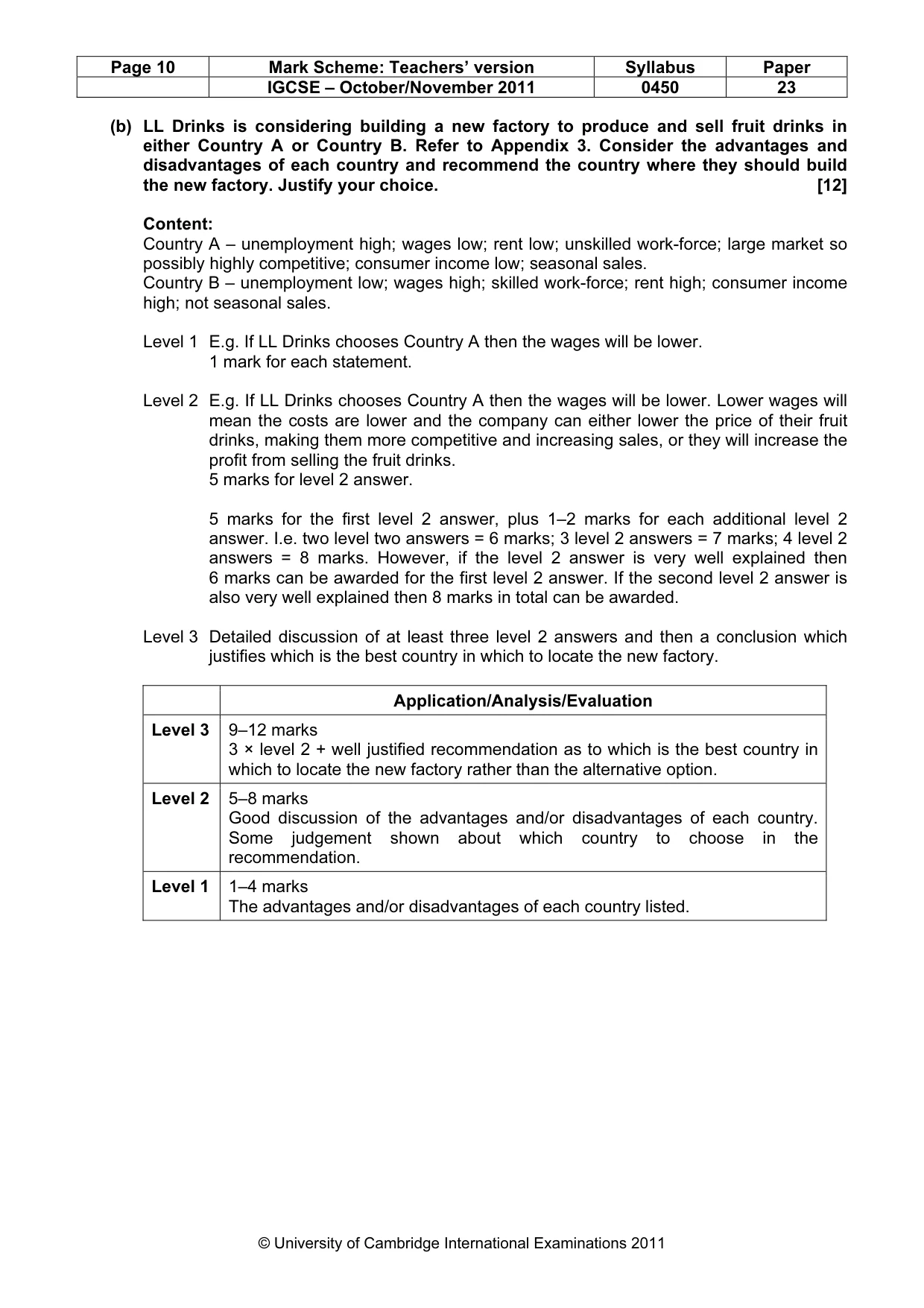
Page 10 Mark Scheme: Teachers’ version Syllabus Paper IGCSE – October/November 2011 0450 23 © University of Cambridge International Examinations 2011 (b) LL Drinks is considering building a new factory to produce and sell fruit drinks in either Country A or Country B. Refer to Appendix 3. Consider the advantages and disadvantages of each country and recommend the country where they should build the new factory. Justify your choice. [12] Content: Country A – unemployment high; wages low; rent low; unskilled work-force; large market so possibly highly competitive; consumer income low; seasonal sales. Country B – unemployment low; wages high; skilled work-force; rent high; consumer income high; not seasonal sales. Level 1 E.g. If LL Drinks chooses Country A then the wages will be lower. 1 mark for each statement. Level 2 E.g. If LL Drinks chooses Country A then the wages will be lower. Lower wages will mean the costs are lower and the company can either lower the price of their fruit drinks, making them more competitive and increasing sales, or they will increase the profit from selling the fruit drinks. 5 marks for level 2 answer. 5 marks for the first level 2 answer, plus 1–2 marks for each additional level 2 answer. I.e. two level two answers = 6 marks; 3 level 2 answers = 7 marks; 4 level 2 answers = 8 marks. However, if the level 2 answer is very well explained then 6 marks can be awarded for the first level 2 answer. If the second level 2 answer is also very well explained then 8 marks in total can be awarded. Level 3 Detailed discussion of at least three level 2 answers and then a conclusion which justifies which is the best country in which to locate the new factory. Application/Analysis/Evaluation Level 3 9–12 marks 3 × level 2 + well justified recommendation as to which is the best country in which to locate the new factory rather than the alternative option. Level 2 5–8 marks Good discussion of the advantages and/or disadvantages of each country. Some judgement shown about which country to choose in the recommendation. Level 1 1–4 marks The advantages and/or disadvantages of each country listed.
Mark scheme, page 11
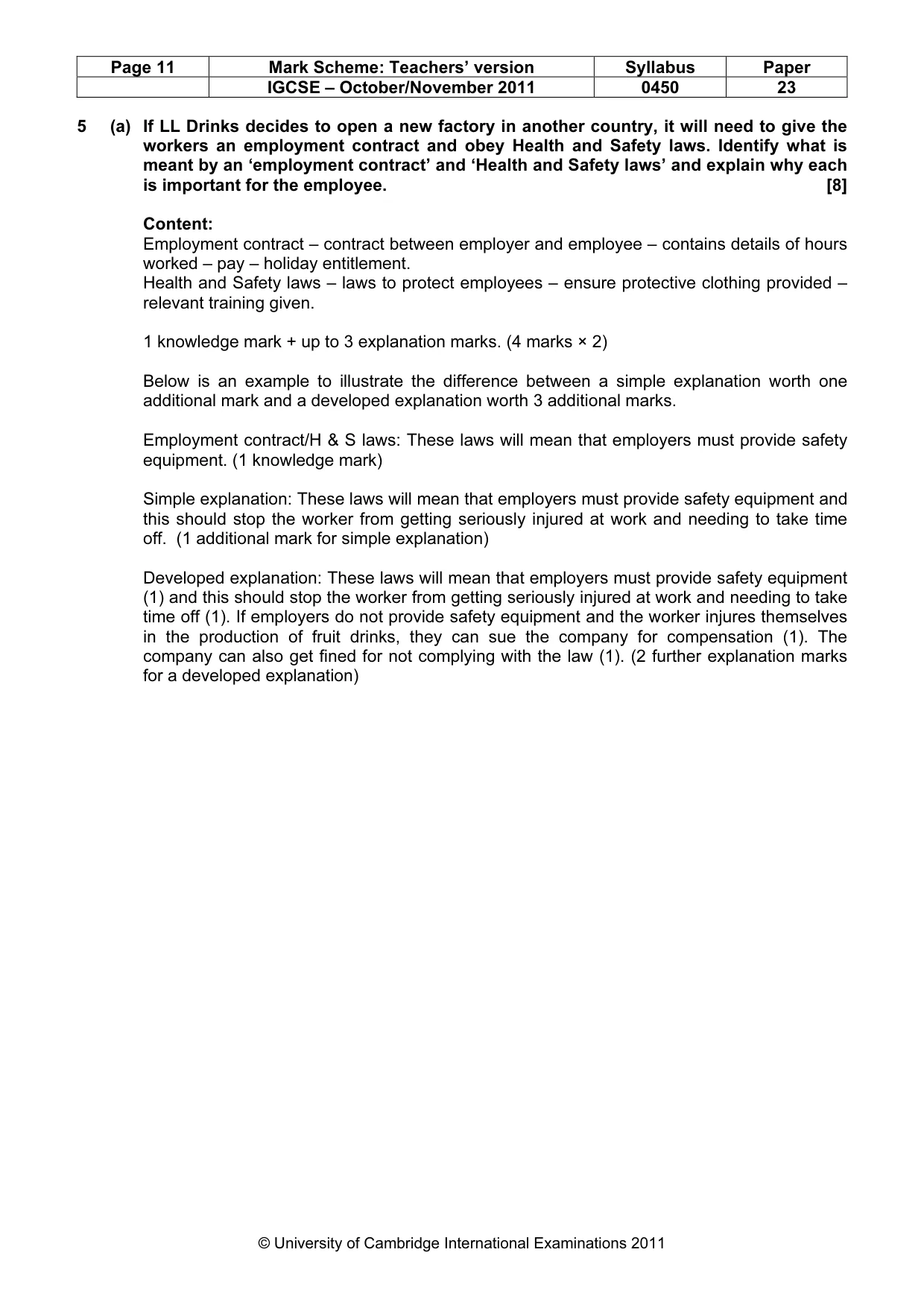
Page 11 Mark Scheme: Teachers’ version Syllabus Paper IGCSE – October/November 2011 0450 23 © University of Cambridge International Examinations 2011 5 (a) If LL Drinks decides to open a new factory in another country, it will need to give the workers an employment contract and obey Health and Safety laws. Identify what is meant by an ‘employment contract’ and ‘Health and Safety laws’ and explain why each is important for the employee. [8] Content: Employment contract – contract between employer and employee – contains details of hours worked – pay – holiday entitlement. Health and Safety laws – laws to protect employees – ensure protective clothing provided – relevant training given. 1 knowledge mark + up to 3 explanation marks. (4 marks × 2) Below is an example to illustrate the difference between a simple explanation worth one additional mark and a developed explanation worth 3 additional marks. Employment contract/H & S laws: These laws will mean that employers must provide safety equipment. (1 knowledge mark) Simple explanation: These laws will mean that employers must provide safety equipment and this should stop the worker from getting seriously injured at work and needing to take time off. (1 additional mark for simple explanation) Developed explanation: These laws will mean that employers must provide safety equipment (1) and this should stop the worker from getting seriously injured at work and needing to take time off (1). If employers do not provide safety equipment and the worker injures themselves in the production of fruit drinks, they can sue the company for compensation (1). The company can also get fined for not complying with the law (1). (2 further explanation marks for a developed explanation)
Mark scheme, page 12
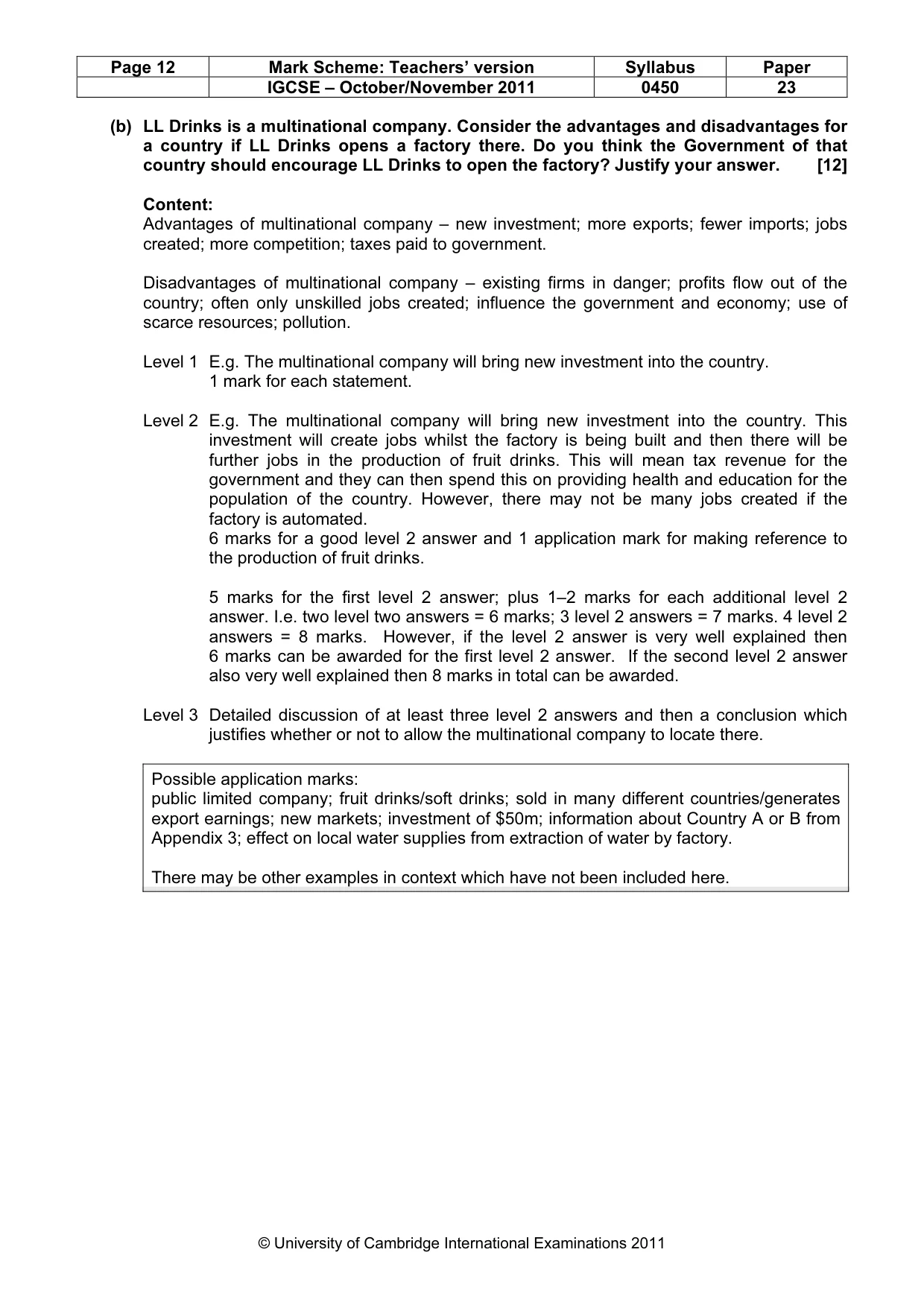
Page 12 Mark Scheme: Teachers’ version Syllabus Paper IGCSE – October/November 2011 0450 23 © University of Cambridge International Examinations 2011 (b) LL Drinks is a multinational company. Consider the advantages and disadvantages for a country if LL Drinks opens a factory there. Do you think the Government of that country should encourage LL Drinks to open the factory? Justify your answer. [12] Content: Advantages of multinational company – new investment; more exports; fewer imports; jobs created; more competition; taxes paid to government. Disadvantages of multinational company – existing firms in danger; profits flow out of the country; often only unskilled jobs created; influence the government and economy; use of scarce resources; pollution. Level 1 E.g. The multinational company will bring new investment into the country. 1 mark for each statement. Level 2 E.g. The multinational company will bring new investment into the country. This investment will create jobs whilst the factory is being built and then there will be further jobs in the production of fruit drinks. This will mean tax revenue for the government and they can then spend this on providing health and education for the population of the country. However, there may not be many jobs created if the factory is automated. 6 marks for a good level 2 answer and 1 application mark for making reference to the production of fruit drinks. 5 marks for the first level 2 answer; plus 1–2 marks for each additional level 2 answer. I.e. two level two answers = 6 marks; 3 level 2 answers = 7 marks. 4 level 2 answers = 8 marks. However, if the level 2 answer is very well explained then 6 marks can be awarded for the first level 2 answer. If the second level 2 answer also very well explained then 8 marks in total can be awarded. Level 3 Detailed discussion of at least three level 2 answers and then a conclusion which justifies whether or not to allow the multinational company to locate there. Possible application marks: public limited company; fruit drinks/soft drinks; sold in many different countries/generates export earnings; new markets; investment of $50m; information about Country A or B from Appendix 3; effect on local water supplies from extraction of water by factory. There may be other examples in context which have not been included here.
Mark scheme, page 13
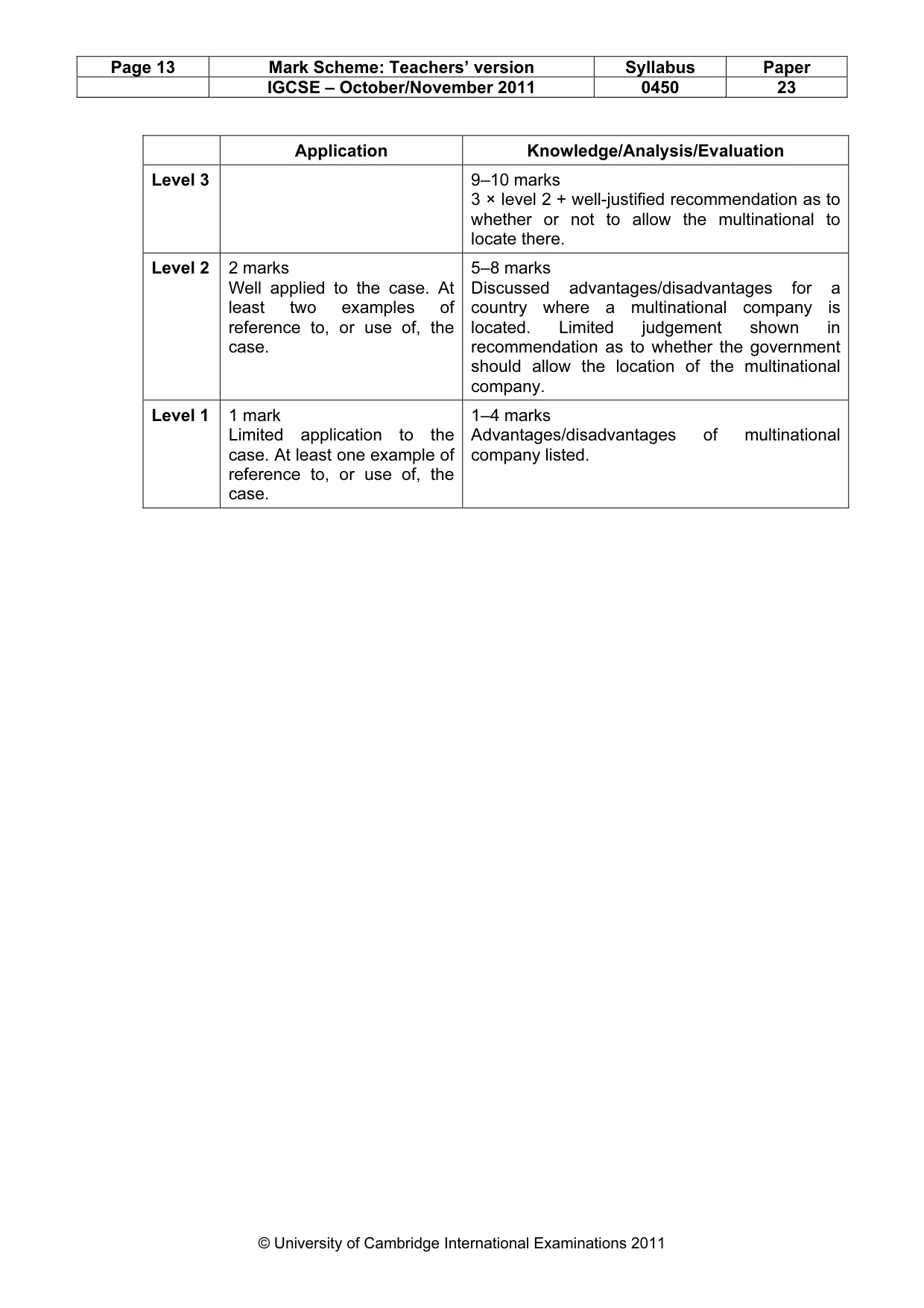
Page 13 Mark Scheme: Teachers’ version Syllabus Paper IGCSE – October/November 2011 0450 23 © University of Cambridge International Examinations 2011 Application Knowledge/Analysis/Evaluation Level 3 9–10 marks 3 × level 2 + well-justified recommendation as to whether or not to allow the multinational to locate there. Level 2 2 marks Well applied to the case. At least two examples of reference to, or use of, the case. 5–8 marks Discussed advantages/disadvantages for a country where a multinational company is located. Limited judgement shown in recommendation as to whether the government should allow the location of the multinational company. Level 1 1 mark Limited application to the case. At least one example of reference to, or use of, the case. 1–4 marks Advantages/disadvantages of multinational company listed.
What you needed in this session
Cambridge’s own grade thresholds for 2011 Oct/Nov, Paper 2 · Variant 3. A higher threshold means an easier paper — the bar moves with how the cohort did.