Cambridge IGCSE Business Studies 0450 — 2010 May/June Paper 1 · Variant 3
0450/13/M/J/10 · 100 marks · ≈113 min
The question paper and its mark scheme, free to read here and free to download. This is Cambridge’s own paper, exactly as it was sat.
Question paper12 pages

Mark scheme11 pages
Answers below. Sit the paper first if you are practising.

Paper as text
Question paper, page 1
This document consists of 11 printed pages and 1 blank page. DC (CW/SW) 28028 © UCLES 2010 [Turn over UNIVERSITY OF CAMBRIDGE INTERNATIONAL EXAMINATIONS International General Certificate of Secondary Education * 5 7 1 4 7 2 8 6 9 2 * BUSINESS STUDIES 0450/13 Paper 1 May/June 2010 1 hour 45 minutes Candidates answer on the Question Paper. No Additional Materials are required. READ THESE INSTRUCTIONS FIRST Write your Centre number, candidate number and name on all the work you hand in. Write in dark blue or black pen. Do not use staples, paper clips, highlighters, glue or correction fluid. DO NOT WRITE IN ANY BARCODES. Answer all questions. The businesses described in this question paper are entirely fictitious. At the end of the examination, fasten all your work securely together. The number of marks is given in brackets [ ] at the end of each question or part question. For Examiner’s Use 1 2 3 4 5 Total
Question paper, page 2
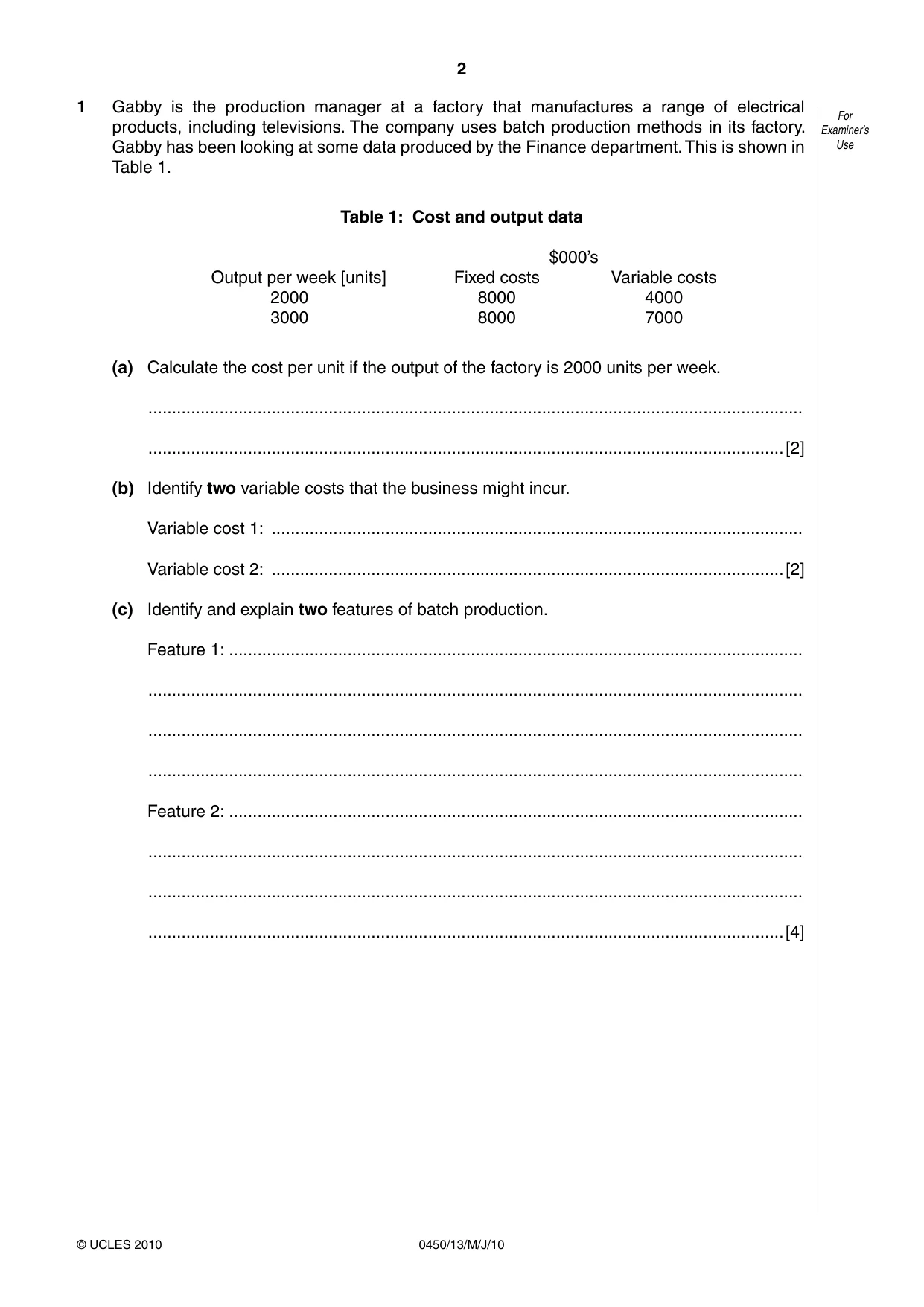
2 0450/13/M/J/10 © UCLES 2010 For Examiner’s Use 1 Gabby is the production manager at a factory that manufactures a range of electrical products, including televisions. The company uses batch production methods in its factory. Gabby has been looking at some data produced by the Finance department. This is shown in Table 1. Table 1: Cost and output data $000’s Output per week [units] Fixed costs Variable costs 2000 8000 4000 3000 8000 7000 (a) Calculate the cost per unit if the output of the factory is 2000 units per week. … …[2] (b) Identify two variable costs that the business might incur. Variable cost 1: … Variable cost 2: …[2] (c) Identify and explain two features of batch production. Feature 1: … … … … Feature 2: … … … …[4]
Question paper, page 3
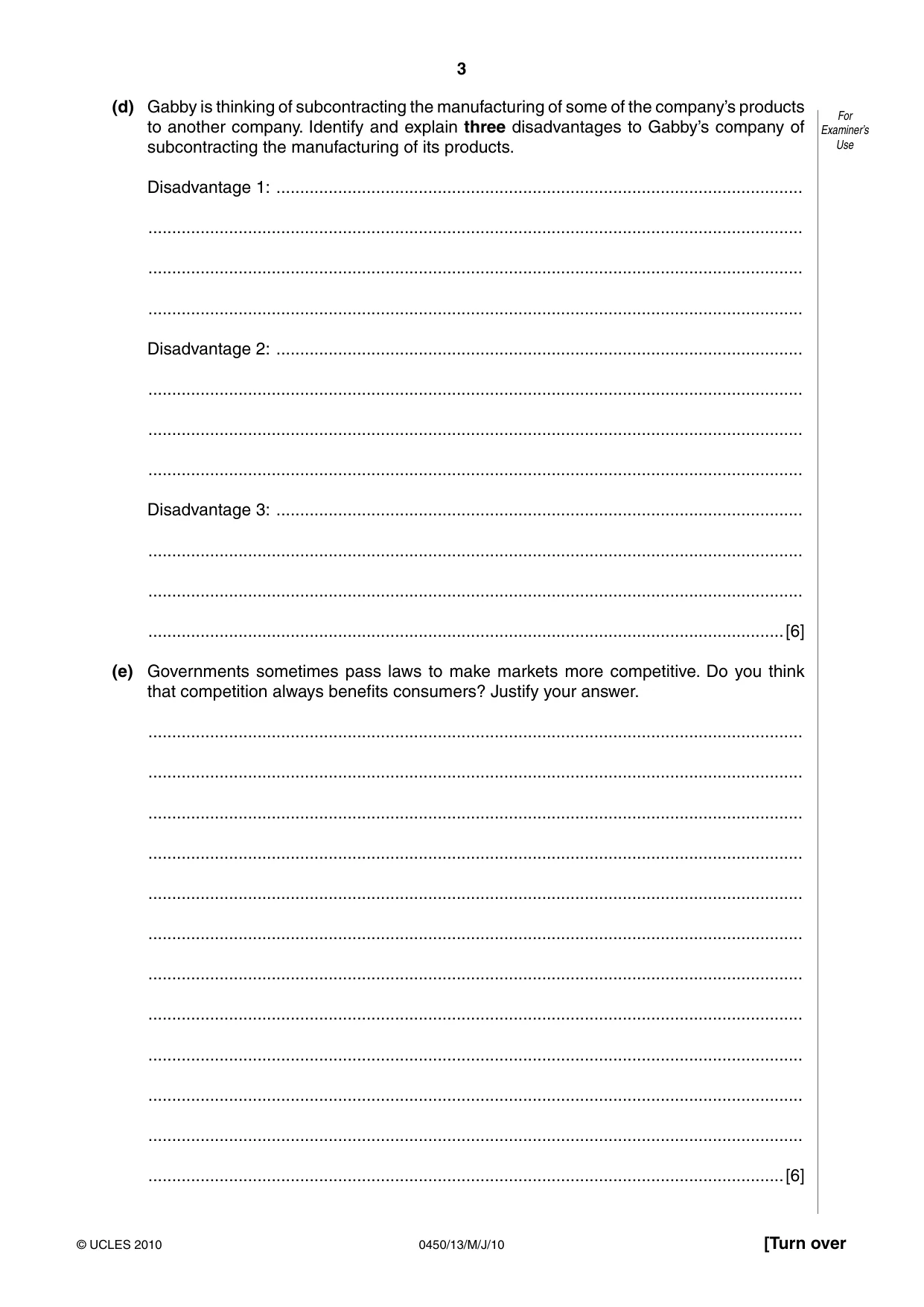
3 0450/13/M/J/10 © UCLES 2010 [Turn over For Examiner’s Use (d) Gabby is thinking of subcontracting the manufacturing of some of the company’s products to another company. Identify and explain three disadvantages to Gabby’s company of subcontracting the manufacturing of its products. Disadvantage 1: … … … … Disadvantage 2: … … … … Disadvantage 3: … … … …[6] (e) Governments sometimes pass laws to make markets more competitive. Do you think that competition always benefits consumers? Justify your answer. … … … … … … … … … … … …[6]
Question paper, page 4
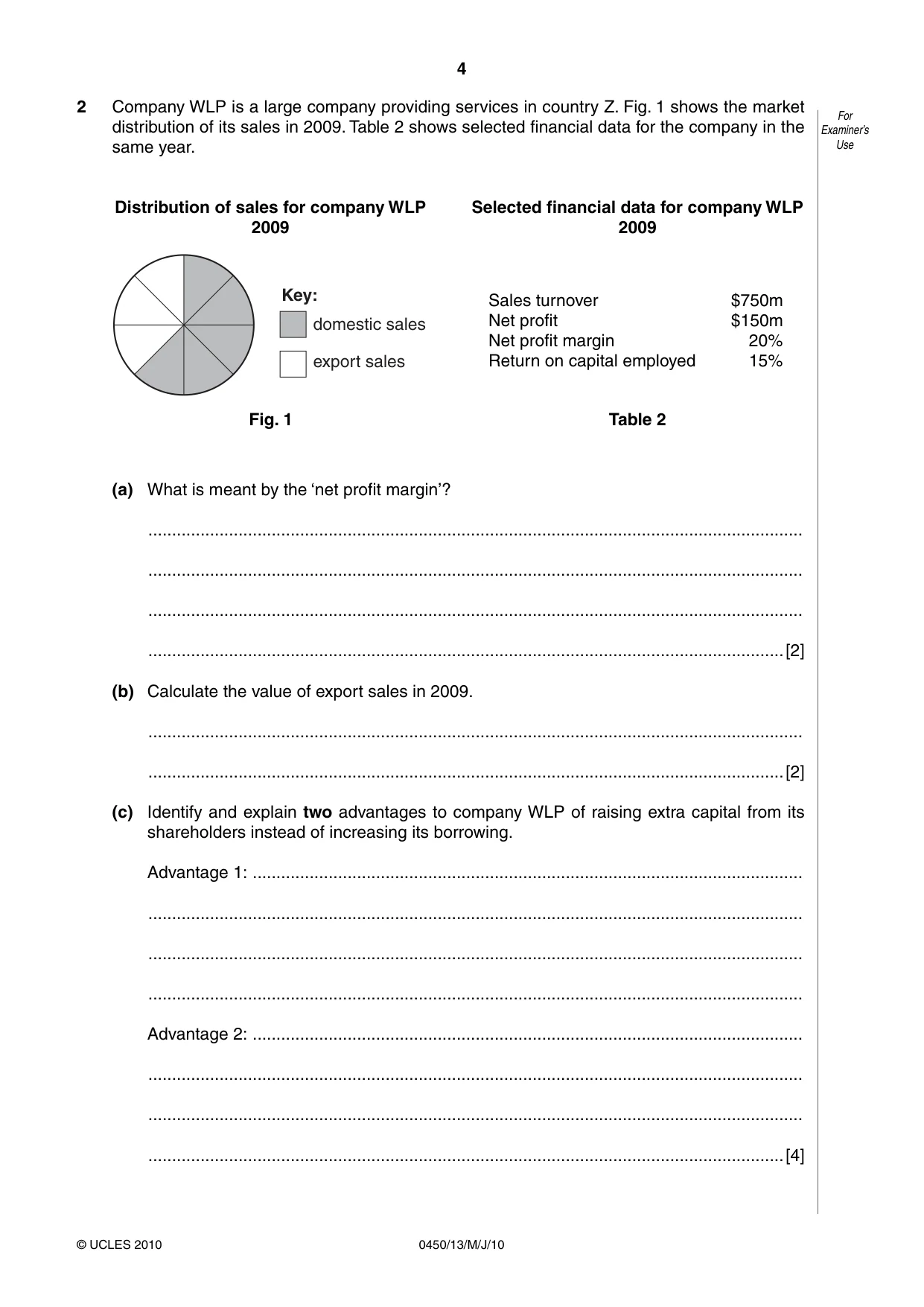
4 0450/13/M/J/10 © UCLES 2010 For Examiner’s Use 2 Company WLP is a large company providing services in country Z. Fig. 1 shows the market distribution of its sales in 2009. Table 2 shows selected financial data for the company in the same year. Distribution of sales for company WLP Selected financial data for company WLP 2009 2009 domestic sales export sales Key: Sales turnover $750m Net profit $150m Net profit margin 20% Return on capital employed 15% Fig. 1 Table 2 (a) What is meant by the ‘net profit margin’? … … … …[2] (b) Calculate the value of export sales in 2009. … …[2] (c) Identify and explain two advantages to company WLP of raising extra capital from its shareholders instead of increasing its borrowing. Advantage 1: … … … … Advantage 2: … … … …[4]
Question paper, page 5
5 0450/13/M/J/10 © UCLES 2010 [Turn over For Examiner’s Use (d) The economy of country Z is experiencing a high rate of inflation. Identify and explain three ways in which high inflation might affect WLP. Way 1: … … … … Way 2: … … … … Way 3: … … … …[6] (e) WLP is now in financial difficulties. If WLP stops trading this will affect the interests of its stakeholders. Should the Government in country Z provide financial support in these circumstances? Justify your answer. … … … … … … … … … … … …[6]
Question paper, page 6
6 0450/13/M/J/10 © UCLES 2010 For Examiner’s Use 3 Halitec makes computers using flow production. It is the market leader and is well known for the quality of its products. The business is ‘product orientated’ and its management believe that this is the reason for its success. However, the management know that efficiency in its factory can be improved. (a) What is meant by a business that is ‘product orientated’? … … … …[2] (b) What is meant by ‘market leader’? … … … …[2] (c) Identify and explain two advantages to Halitec of using flow production. Advantage 1: … … … … Advantage 2: … … … …[4]
Question paper, page 7
7 0450/13/M/J/10 © UCLES 2010 [Turn over For Examiner’s Use (d) Identify and explain three methods that Halitec could use to improve efficiency in its factory. Method 1: … … … … Method 2: … … … … Method 3: … … … …[6] (e) Do you think that Halitec would benefit from spending money on market research? Justify your answer. … … … … … … … … … … … …[6]
Question paper, page 8
8 0450/13/M/J/10 © UCLES 2010 For Examiner’s Use 4 Michelle is the Head Teacher of a large school. She is an autocratic leader. She believes that highly motivated teachers are very important if the school is to get good examination results. The teachers are all paid the same salary. (a) What is meant by an ‘autocratic leader’? … … … …[2] (b) What is meant by ‘highly motivated’? … … … …[2] (c) Identify and explain one advantage and one disadvantage to the teachers of them all being paid the same salary. Advantage: … Explanation: … … … Disadvantage: … Explanation: … … …[4]
Question paper, page 9
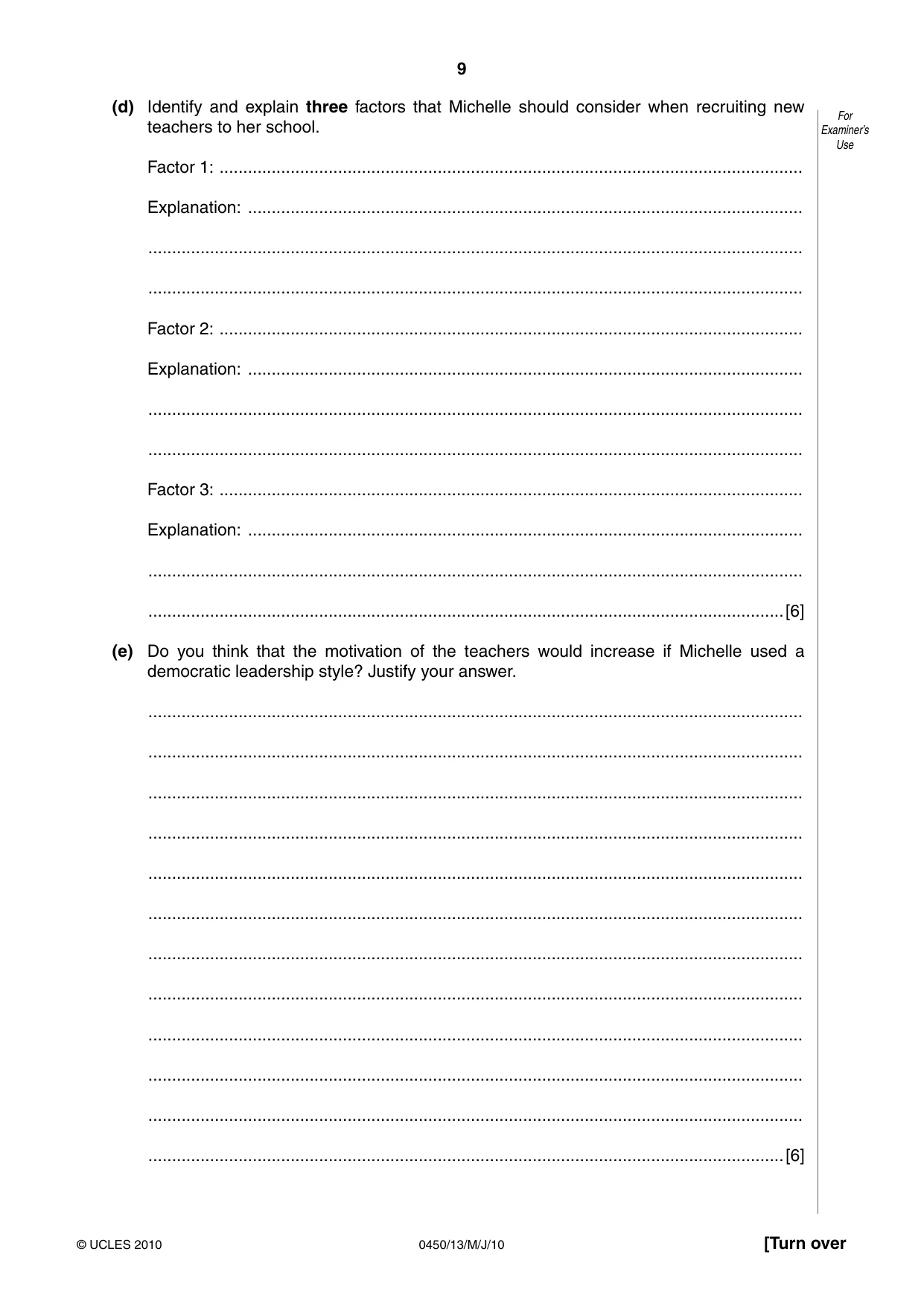
9 0450/13/M/J/10 © UCLES 2010 [Turn over For Examiner’s Use (d) Identify and explain three factors that Michelle should consider when recruiting new teachers to her school. Factor 1: … Explanation: … … … Factor 2: … Explanation: … … … Factor 3: … Explanation: … … …[6] (e) Do you think that the motivation of the teachers would increase if Michelle used a democratic leadership style? Justify your answer. … … … … … … … … … … … …[6]
Question paper, page 10
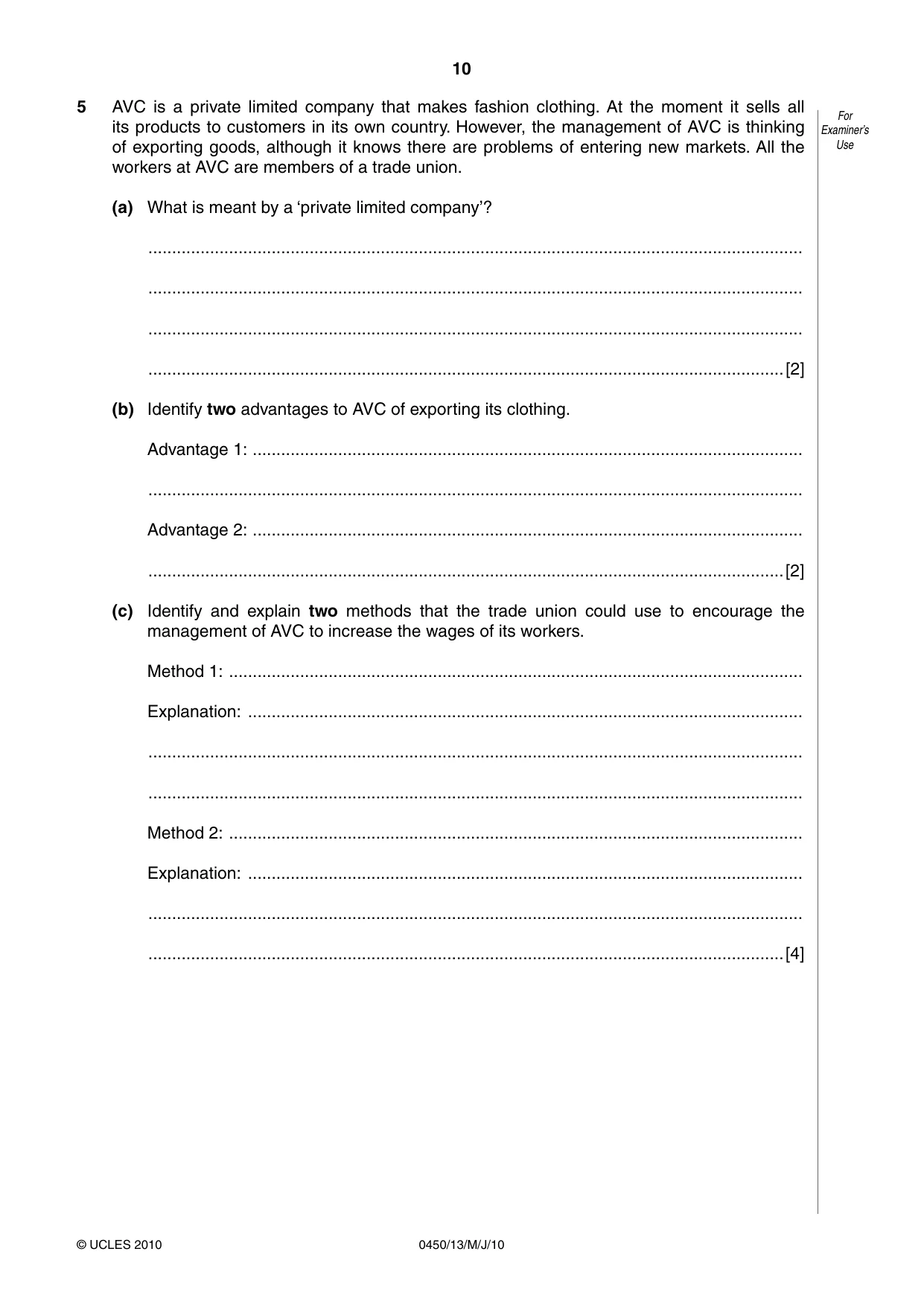
10 0450/13/M/J/10 © UCLES 2010 For Examiner’s Use 5 AVC is a private limited company that makes fashion clothing. At the moment it sells all its products to customers in its own country. However, the management of AVC is thinking of exporting goods, although it knows there are problems of entering new markets. All the workers at AVC are members of a trade union. (a) What is meant by a ‘private limited company’? … … … …[2] (b) Identify two advantages to AVC of exporting its clothing. Advantage 1: … … Advantage 2: … …[2] (c) Identify and explain two methods that the trade union could use to encourage the management of AVC to increase the wages of its workers. Method 1: … Explanation: … … … Method 2: … Explanation: … … …[4]
Question paper, page 11
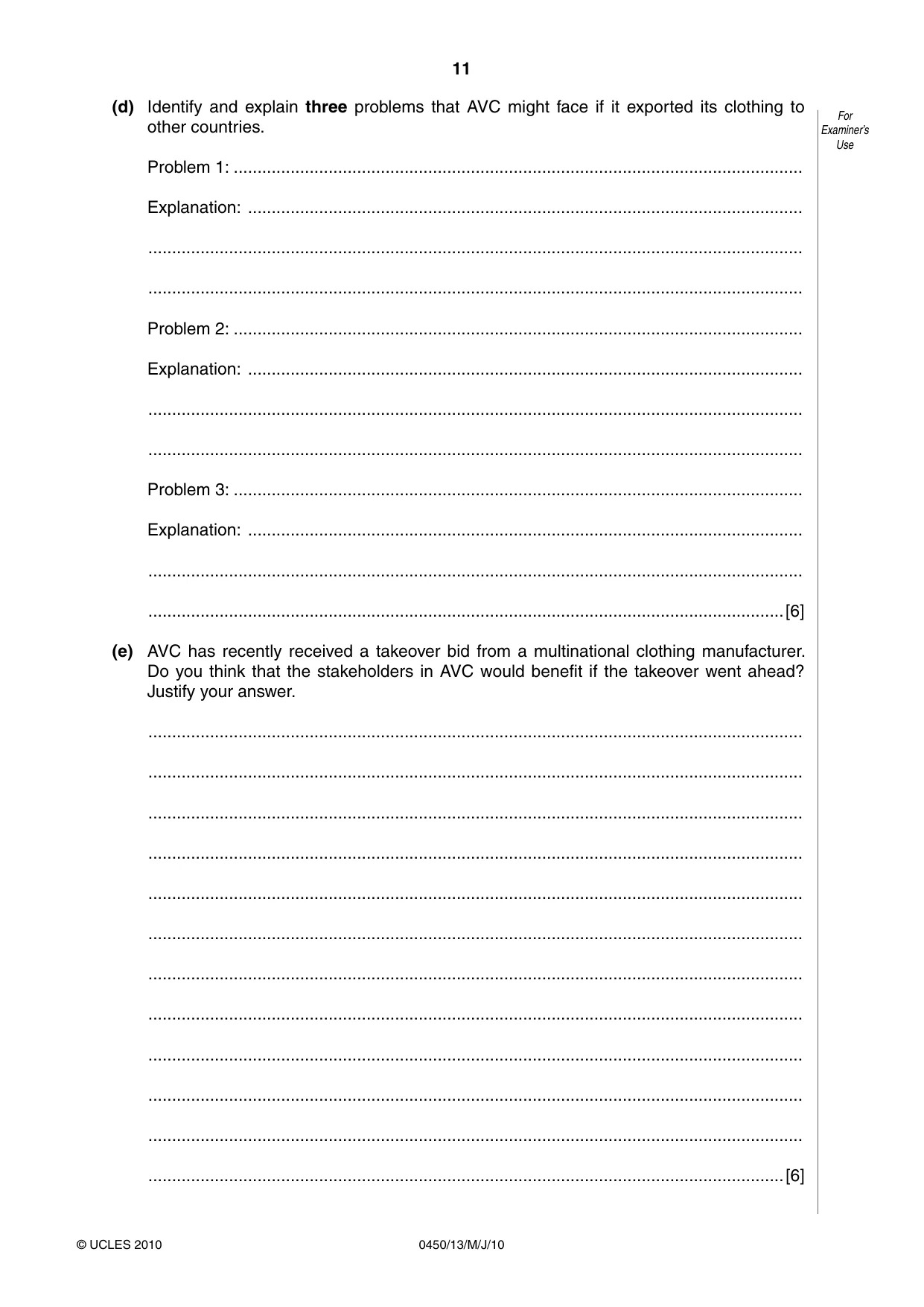
11 0450/13/M/J/10 © UCLES 2010 For Examiner’s Use (d) Identify and explain three problems that AVC might face if it exported its clothing to other countries. Problem 1: … Explanation: … … … Problem 2: … Explanation: … … … Problem 3: … Explanation: … … …[6] (e) AVC has recently received a takeover bid from a multinational clothing manufacturer. Do you think that the stakeholders in AVC would benefit if the takeover went ahead? Justify your answer. … … … … … … … … … … … …[6]
Question paper, page 12
12 0450/13/M/J/10 © UCLES 2010 Permission to reproduce items where third-party owned material protected by copyright is included has been sought and cleared where possible. Every reasonable effort has been made by the publisher (UCLES) to trace copyright holders, but if any items requiring clearance have unwittingly been included, the publisher will be pleased to make amends at the earliest possible opportunity. University of Cambridge International Examinations is part of the Cambridge Assessment Group. Cambridge Assessment is the brand name of University of Cambridge Local Examinations Syndicate (UCLES), which is itself a department of the University of Cambridge. BLANK PAGE
Mark scheme, page 1
UNIVERSITY OF CAMBRIDGE INTERNATIONAL EXAMINATIONS International General Certificate of Secondary Education MARK SCHEME for the May/June 2010 question paper for the guidance of teachers 0450 BUSINESS STUDIES 0450/13 Paper 13 (Short Answer/Structured Response), maximum raw mark 100 This mark scheme is published as an aid to teachers and candidates, to indicate the requirements of the examination. It shows the basis on which Examiners were instructed to award marks. It does not indicate the details of the discussions that took place at an Examiners’ meeting before marking began, which would have considered the acceptability of alternative answers. Mark schemes must be read in conjunction with the question papers and the report on the examination. • CIE will not enter into discussions or correspondence in connection with these mark schemes. CIE is publishing the mark schemes for the May/June 2010 question papers for most IGCSE, GCE Advanced Level and Advanced Subsidiary Level syllabuses and some Ordinary Level syllabuses.
Mark scheme, page 2
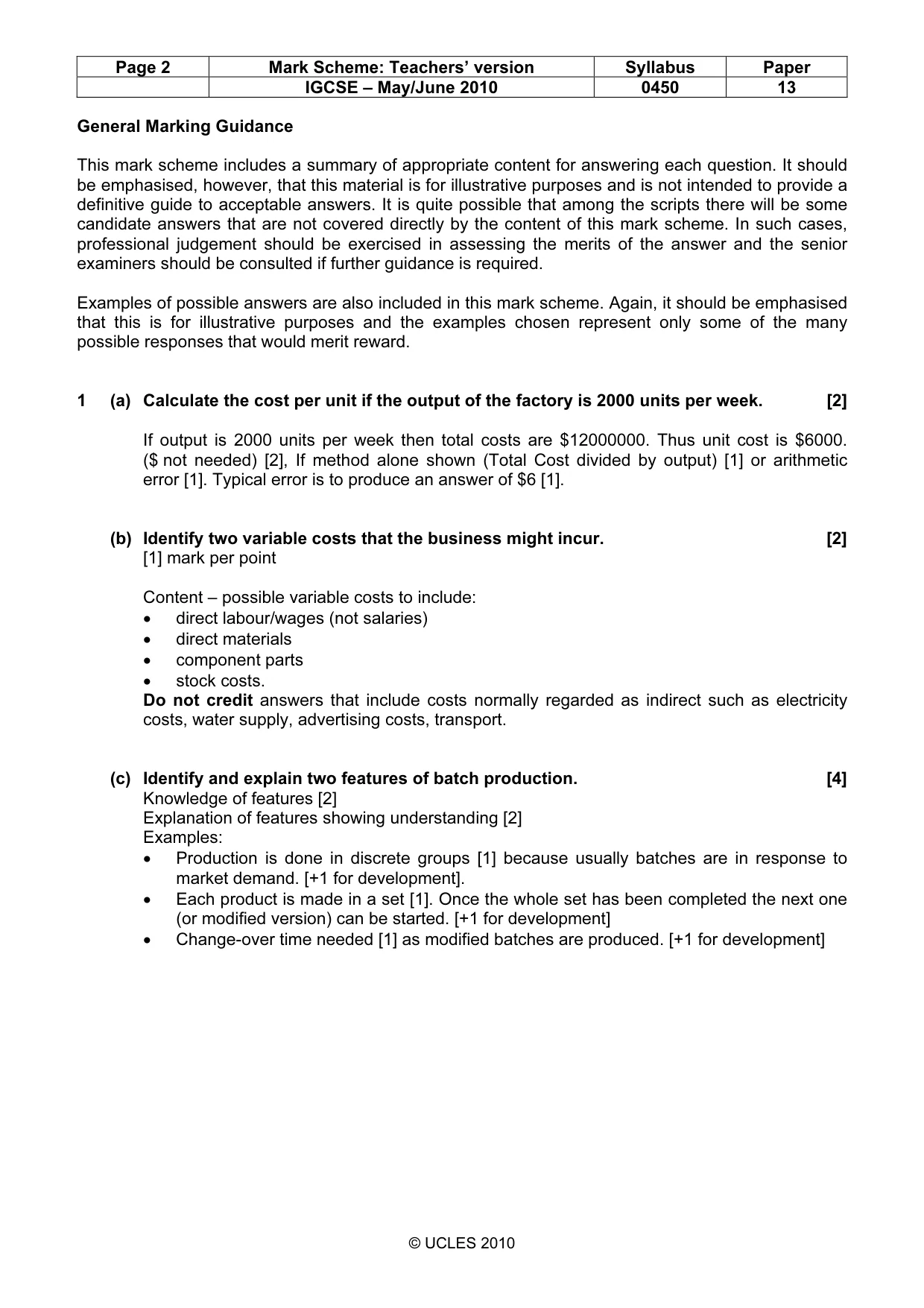
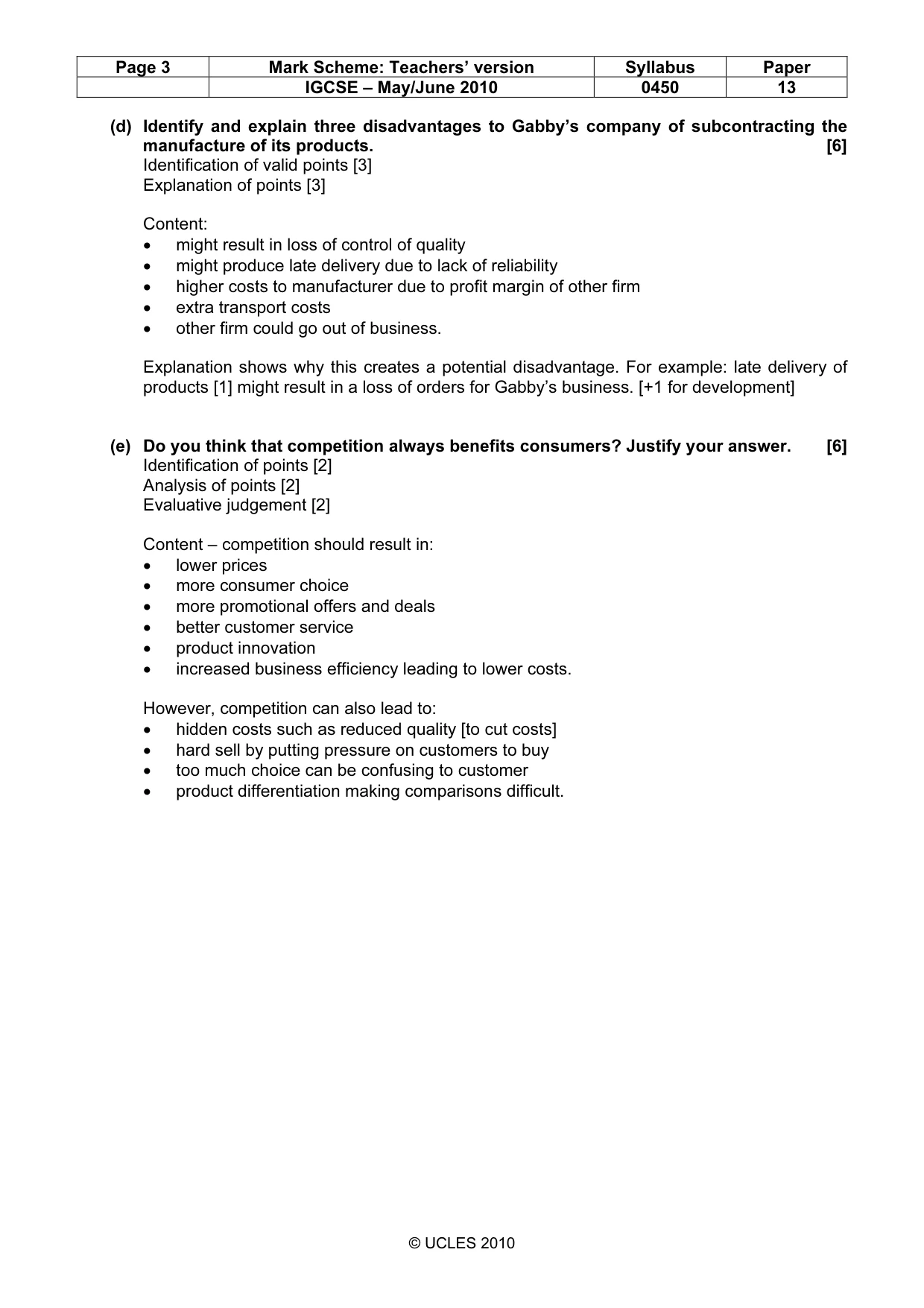
Page 2 Mark Scheme: Teachers’ version Syllabus Paper IGCSE – May/June 2010 0450 13 © UCLES 2010 General Marking Guidance This mark scheme includes a summary of appropriate content for answering each question. It should be emphasised, however, that this material is for illustrative purposes and is not intended to provide a definitive guide to acceptable answers. It is quite possible that among the scripts there will be some candidate answers that are not covered directly by the content of this mark scheme. In such cases, professional judgement should be exercised in assessing the merits of the answer and the senior examiners should be consulted if further guidance is required. Examples of possible answers are also included in this mark scheme. Again, it should be emphasised that this is for illustrative purposes and the examples chosen represent only some of the many possible responses that would merit reward. 1 (a) Calculate the cost per unit if the output of the factory is 2000 units per week. [2] If output is 2000 units per week then total costs are $12000000. Thus unit cost is $6000. ($ not needed) [2], If method alone shown (Total Cost divided by output) [1] or arithmetic error [1]. Typical error is to produce an answer of $6 [1]. (b) Identify two variable costs that the business might incur. [2] [1] mark per point Content – possible variable costs to include: • direct labour/wages (not salaries) • direct materials • component parts • stock costs. Do not credit answers that include costs normally regarded as indirect such as electricity costs, water supply, advertising costs, transport. (c) Identify and explain two features of batch production. [4] Knowledge of features [2] Explanation of features showing understanding [2] Examples: • Production is done in discrete groups [1] because usually batches are in response to market demand. [+1 for development]. • Each product is made in a set [1]. Once the whole set has been completed the next one (or modified version) can be started. [+1 for development] • Change-over time needed [1] as modified batches are produced. [+1 for development]
Mark scheme, page 3
Page 3 Mark Scheme: Teachers’ version Syllabus Paper IGCSE – May/June 2010 0450 13 © UCLES 2010 (d) Identify and explain three disadvantages to Gabby’s company of subcontracting the manufacture of its products. [6] Identification of valid points [3] Explanation of points [3] Content: • might result in loss of control of quality • might produce late delivery due to lack of reliability • higher costs to manufacturer due to profit margin of other firm • extra transport costs • other firm could go out of business. Explanation shows why this creates a potential disadvantage. For example: late delivery of products [1] might result in a loss of orders for Gabby’s business. [+1 for development] (e) Do you think that competition always benefits consumers? Justify your answer. [6] Identification of points [2] Analysis of points [2] Evaluative judgement [2] Content – competition should result in: • lower prices • more consumer choice • more promotional offers and deals • better customer service • product innovation • increased business efficiency leading to lower costs. However, competition can also lead to: • hidden costs such as reduced quality [to cut costs] • hard sell by putting pressure on customers to buy • too much choice can be confusing to customer • product differentiation making comparisons difficult.
Mark scheme, page 4
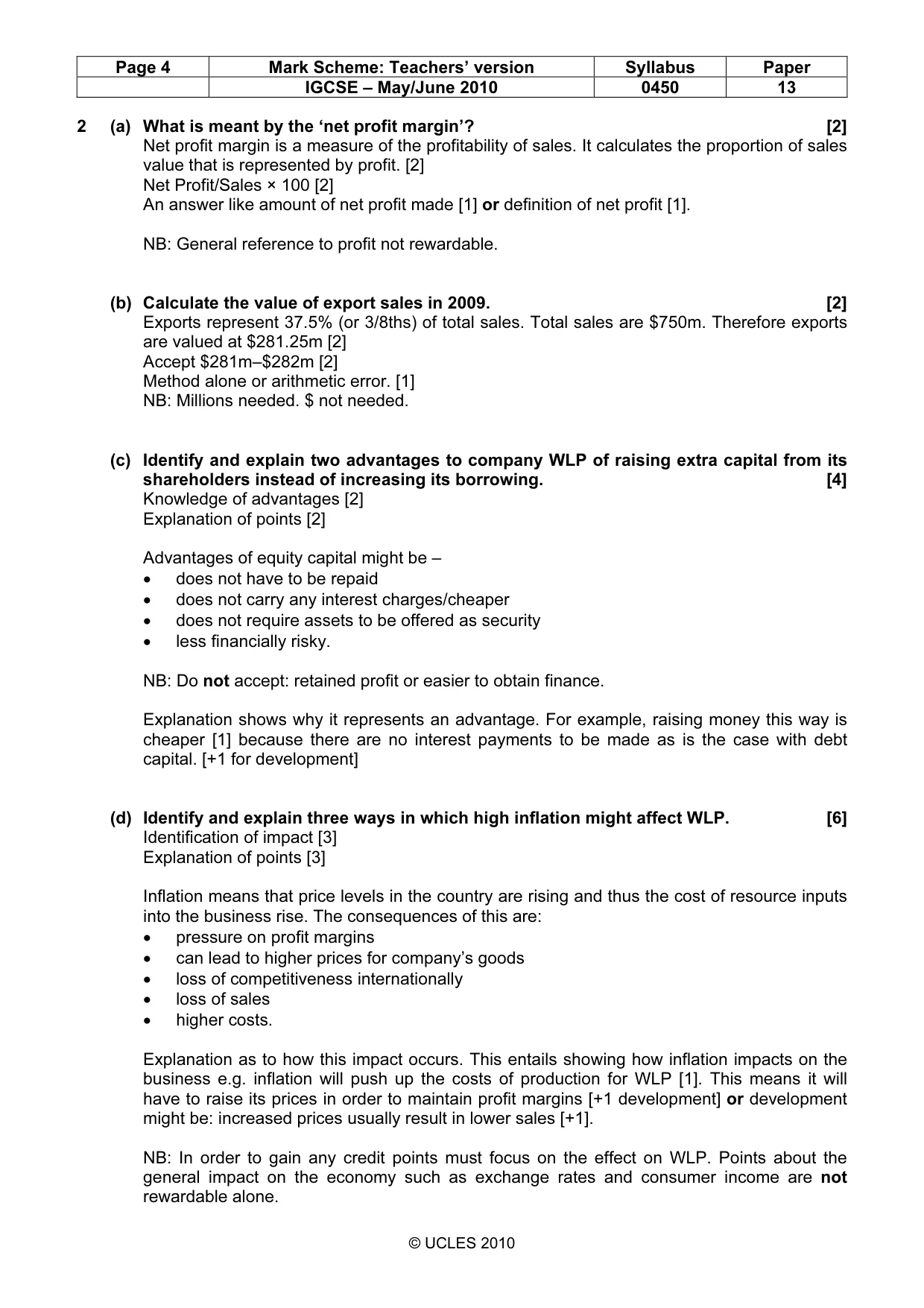
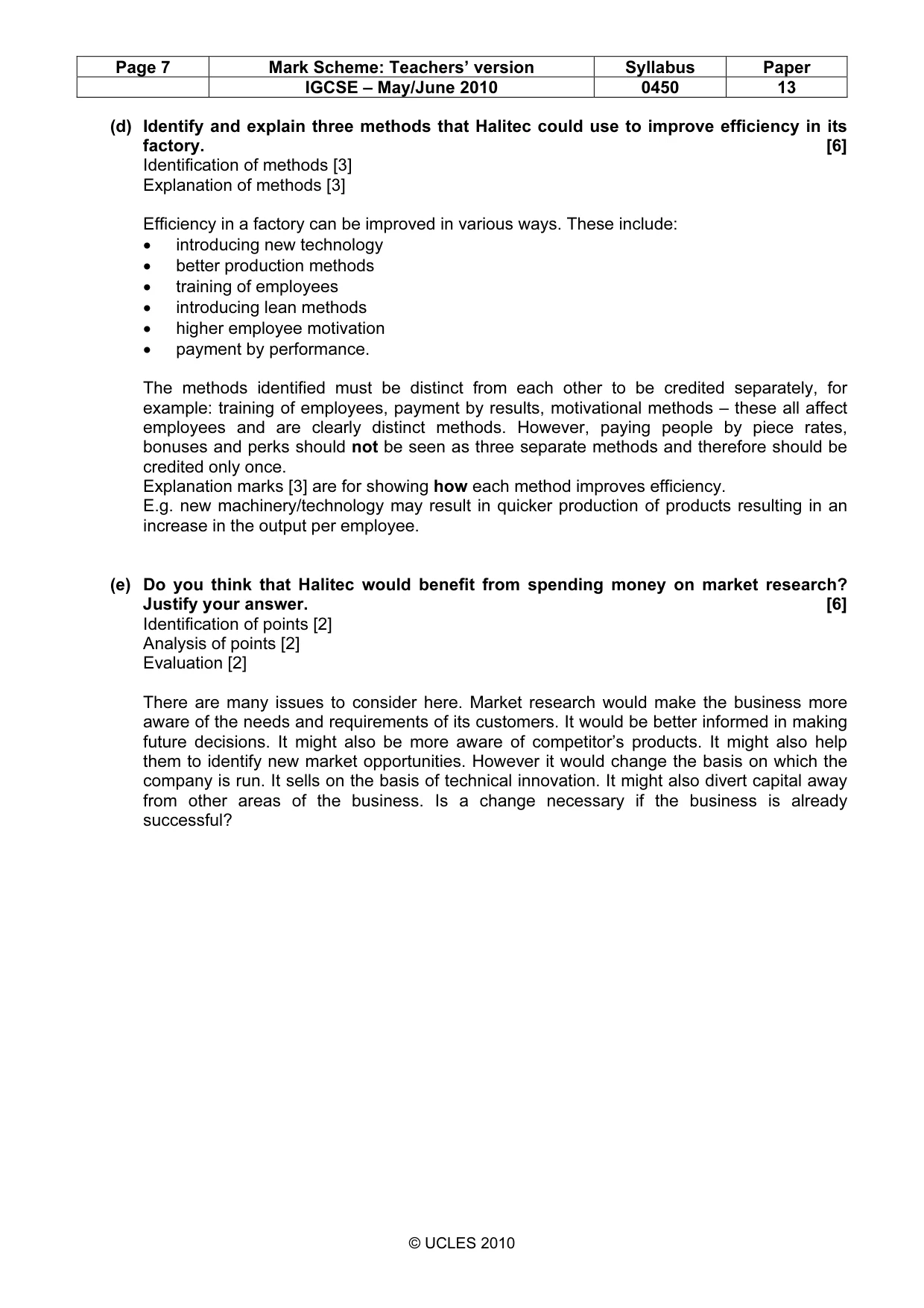
Page 4 Mark Scheme: Teachers’ version Syllabus Paper IGCSE – May/June 2010 0450 13 © UCLES 2010 2 (a) What is meant by the ‘net profit margin’? [2] Net profit margin is a measure of the profitability of sales. It calculates the proportion of sales value that is represented by profit. [2] Net Profit/Sales × 100 [2] An answer like amount of net profit made [1] or definition of net profit [1]. NB: General reference to profit not rewardable. (b) Calculate the value of export sales in 2009. [2] Exports represent 37.5% (or 3/8ths) of total sales. Total sales are $750m. Therefore exports are valued at $281.25m [2] Accept $281m–$282m [2] Method alone or arithmetic error. [1] NB: Millions needed. $ not needed. (c) Identify and explain two advantages to company WLP of raising extra capital from its shareholders instead of increasing its borrowing. [4] Knowledge of advantages [2] Explanation of points [2] Advantages of equity capital might be – • does not have to be repaid • does not carry any interest charges/cheaper • does not require assets to be offered as security • less financially risky. NB: Do not accept: retained profit or easier to obtain finance. Explanation shows why it represents an advantage. For example, raising money this way is cheaper [1] because there are no interest payments to be made as is the case with debt capital. [+1 for development] (d) Identify and explain three ways in which high inflation might affect WLP. [6] Identification of impact [3] Explanation of points [3] Inflation means that price levels in the country are rising and thus the cost of resource inputs into the business rise. The consequences of this are: • pressure on profit margins • can lead to higher prices for company’s goods • loss of competitiveness internationally • loss of sales • higher costs. Explanation as to how this impact occurs. This entails showing how inflation impacts on the business e.g. inflation will push up the costs of production for WLP [1]. This means it will have to raise its prices in order to maintain profit margins [+1 development] or development might be: increased prices usually result in lower sales [+1]. NB: In order to gain any credit points must focus on the effect on WLP. Points about the general impact on the economy such as exchange rates and consumer income are not rewardable alone.
Mark scheme, page 5
Page 5 Mark Scheme: Teachers’ version Syllabus Paper IGCSE – May/June 2010 0450 13 © UCLES 2010 (e) Should the Government in country Z provide financial support in these circumstances? Justify your answer. [6] Identification of issues [2] Analysis of issues [2] Evaluation of issues [2] If WLP collapses then most stakeholders lose out. If WLP is supported then there is an opportunity cost of the use of taxpayers’ funds. Stakeholder groups benefit but tax payer loses. Can this be justified? Much depends upon the importance of WLP as a business. How many jobs will be lost? What impact would it have on the local community? NB: Answers could be approached via consideration of impact upon individual stakeholders.
Mark scheme, page 6
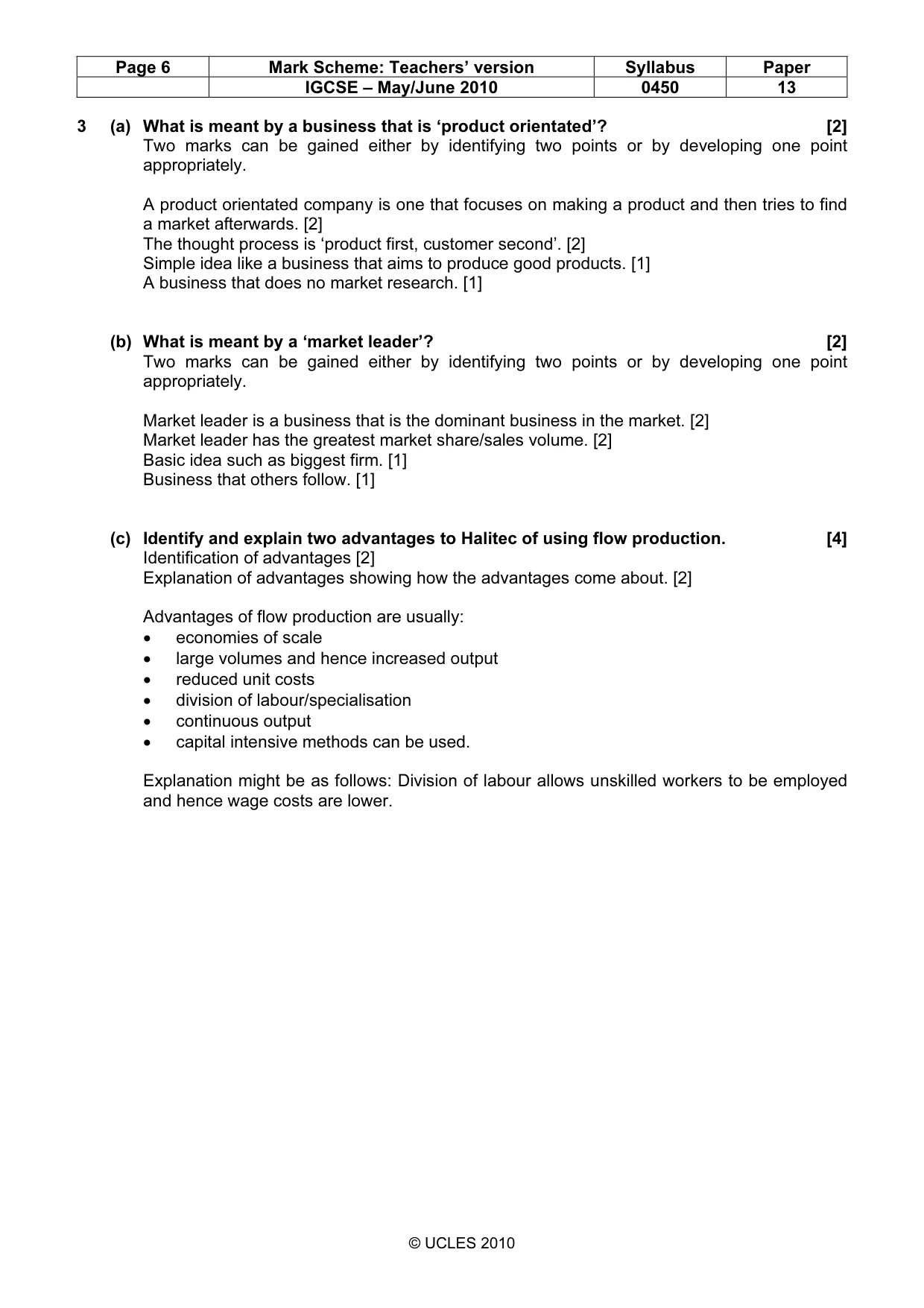
Page 6 Mark Scheme: Teachers’ version Syllabus Paper IGCSE – May/June 2010 0450 13 © UCLES 2010 3 (a) What is meant by a business that is ‘product orientated’? [2] Two marks can be gained either by identifying two points or by developing one point appropriately. A product orientated company is one that focuses on making a product and then tries to find a market afterwards. [2] The thought process is ‘product first, customer second’. [2] Simple idea like a business that aims to produce good products. [1] A business that does no market research. [1] (b) What is meant by a ‘market leader’? [2] Two marks can be gained either by identifying two points or by developing one point appropriately. Market leader is a business that is the dominant business in the market. [2] Market leader has the greatest market share/sales volume. [2] Basic idea such as biggest firm. [1] Business that others follow. [1] (c) Identify and explain two advantages to Halitec of using flow production. [4] Identification of advantages [2] Explanation of advantages showing how the advantages come about. [2] Advantages of flow production are usually: • economies of scale • large volumes and hence increased output • reduced unit costs • division of labour/specialisation • continuous output • capital intensive methods can be used. Explanation might be as follows: Division of labour allows unskilled workers to be employed and hence wage costs are lower.
Mark scheme, page 7
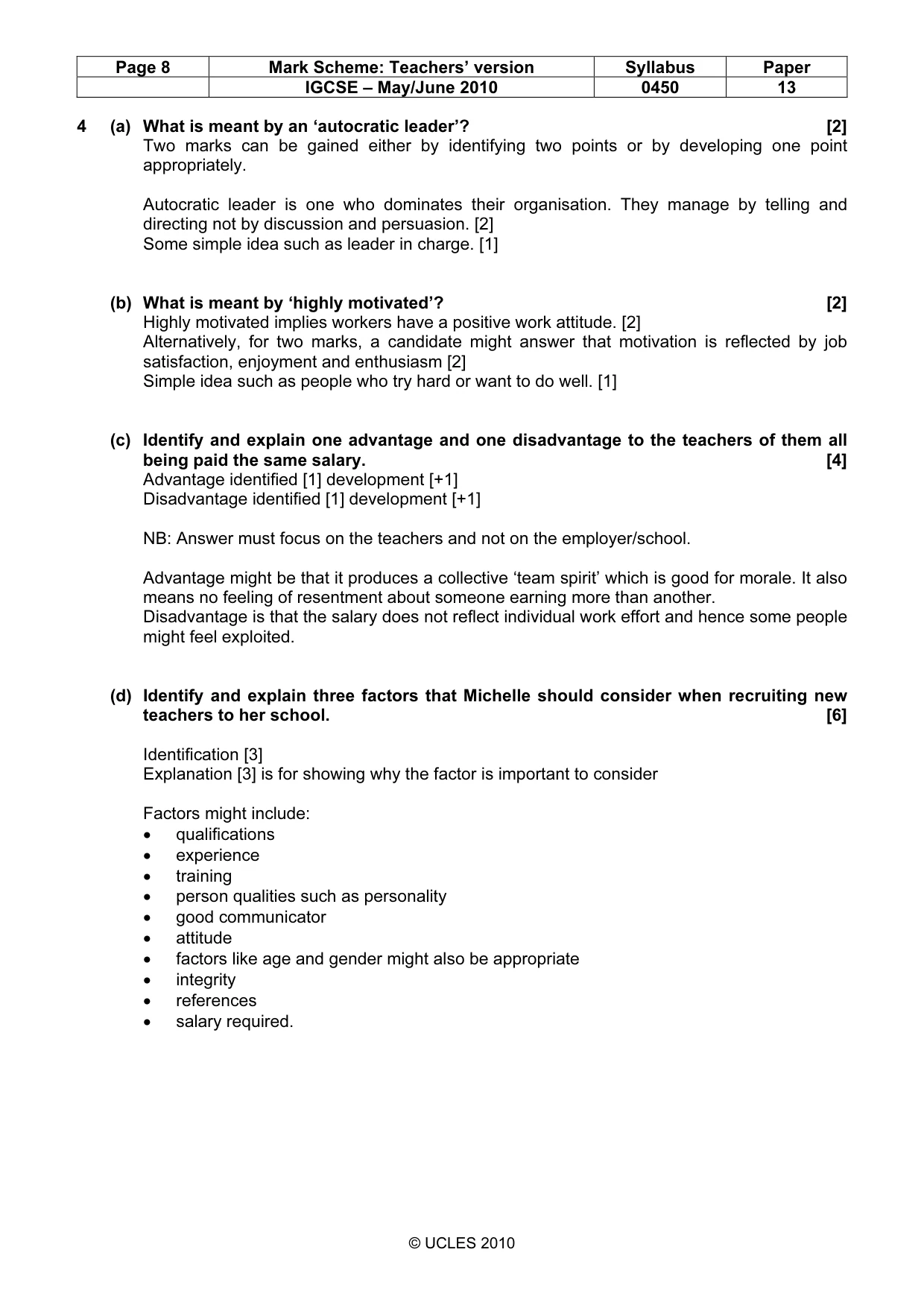
Page 7 Mark Scheme: Teachers’ version Syllabus Paper IGCSE – May/June 2010 0450 13 © UCLES 2010 (d) Identify and explain three methods that Halitec could use to improve efficiency in its factory. [6] Identification of methods [3] Explanation of methods [3] Efficiency in a factory can be improved in various ways. These include: • introducing new technology • better production methods • training of employees • introducing lean methods • higher employee motivation • payment by performance. The methods identified must be distinct from each other to be credited separately, for example: training of employees, payment by results, motivational methods – these all affect employees and are clearly distinct methods. However, paying people by piece rates, bonuses and perks should not be seen as three separate methods and therefore should be credited only once. Explanation marks [3] are for showing how each method improves efficiency. E.g. new machinery/technology may result in quicker production of products resulting in an increase in the output per employee. (e) Do you think that Halitec would benefit from spending money on market research? Justify your answer. [6] Identification of points [2] Analysis of points [2] Evaluation [2] There are many issues to consider here. Market research would make the business more aware of the needs and requirements of its customers. It would be better informed in making future decisions. It might also be more aware of competitor’s products. It might also help them to identify new market opportunities. However it would change the basis on which the company is run. It sells on the basis of technical innovation. It might also divert capital away from other areas of the business. Is a change necessary if the business is already successful?
Mark scheme, page 8
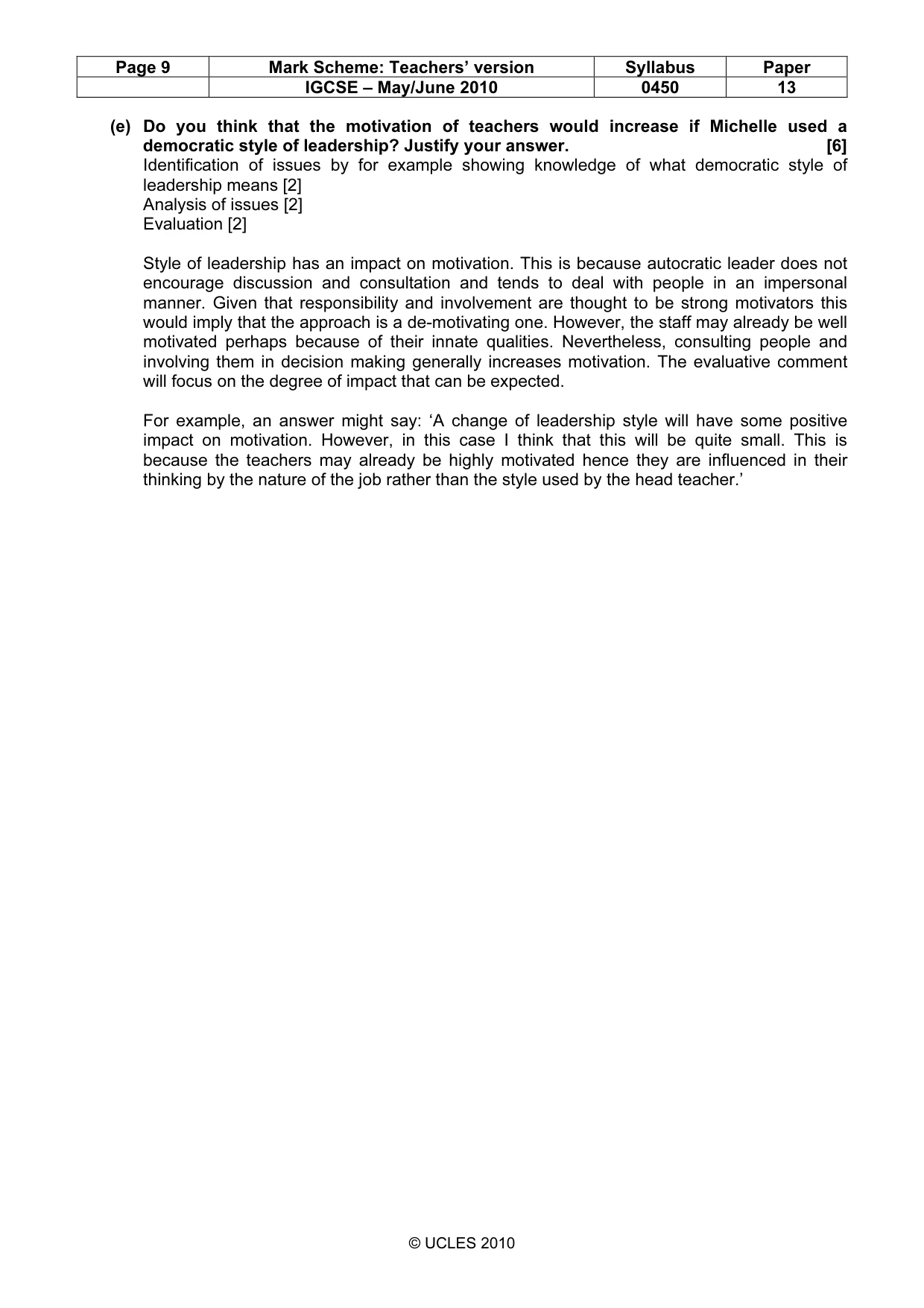
Page 8 Mark Scheme: Teachers’ version Syllabus Paper IGCSE – May/June 2010 0450 13 © UCLES 2010 4 (a) What is meant by an ‘autocratic leader’? [2] Two marks can be gained either by identifying two points or by developing one point appropriately. Autocratic leader is one who dominates their organisation. They manage by telling and directing not by discussion and persuasion. [2] Some simple idea such as leader in charge. [1] (b) What is meant by ‘highly motivated’? [2] Highly motivated implies workers have a positive work attitude. [2] Alternatively, for two marks, a candidate might answer that motivation is reflected by job satisfaction, enjoyment and enthusiasm [2] Simple idea such as people who try hard or want to do well. [1] (c) Identify and explain one advantage and one disadvantage to the teachers of them all being paid the same salary. [4] Advantage identified [1] development [+1] Disadvantage identified [1] development [+1] NB: Answer must focus on the teachers and not on the employer/school. Advantage might be that it produces a collective ‘team spirit’ which is good for morale. It also means no feeling of resentment about someone earning more than another. Disadvantage is that the salary does not reflect individual work effort and hence some people might feel exploited. (d) Identify and explain three factors that Michelle should consider when recruiting new teachers to her school. [6] Identification [3] Explanation [3] is for showing why the factor is important to consider Factors might include: • qualifications • experience • training • person qualities such as personality • good communicator • attitude • factors like age and gender might also be appropriate • integrity • references • salary required.
Mark scheme, page 9
Page 9 Mark Scheme: Teachers’ version Syllabus Paper IGCSE – May/June 2010 0450 13 © UCLES 2010 (e) Do you think that the motivation of teachers would increase if Michelle used a democratic style of leadership? Justify your answer. [6] Identification of issues by for example showing knowledge of what democratic style of leadership means [2] Analysis of issues [2] Evaluation [2] Style of leadership has an impact on motivation. This is because autocratic leader does not encourage discussion and consultation and tends to deal with people in an impersonal manner. Given that responsibility and involvement are thought to be strong motivators this would imply that the approach is a de-motivating one. However, the staff may already be well motivated perhaps because of their innate qualities. Nevertheless, consulting people and involving them in decision making generally increases motivation. The evaluative comment will focus on the degree of impact that can be expected. For example, an answer might say: ‘A change of leadership style will have some positive impact on motivation. However, in this case I think that this will be quite small. This is because the teachers may already be highly motivated hence they are influenced in their thinking by the nature of the job rather than the style used by the head teacher.’
Mark scheme, page 10
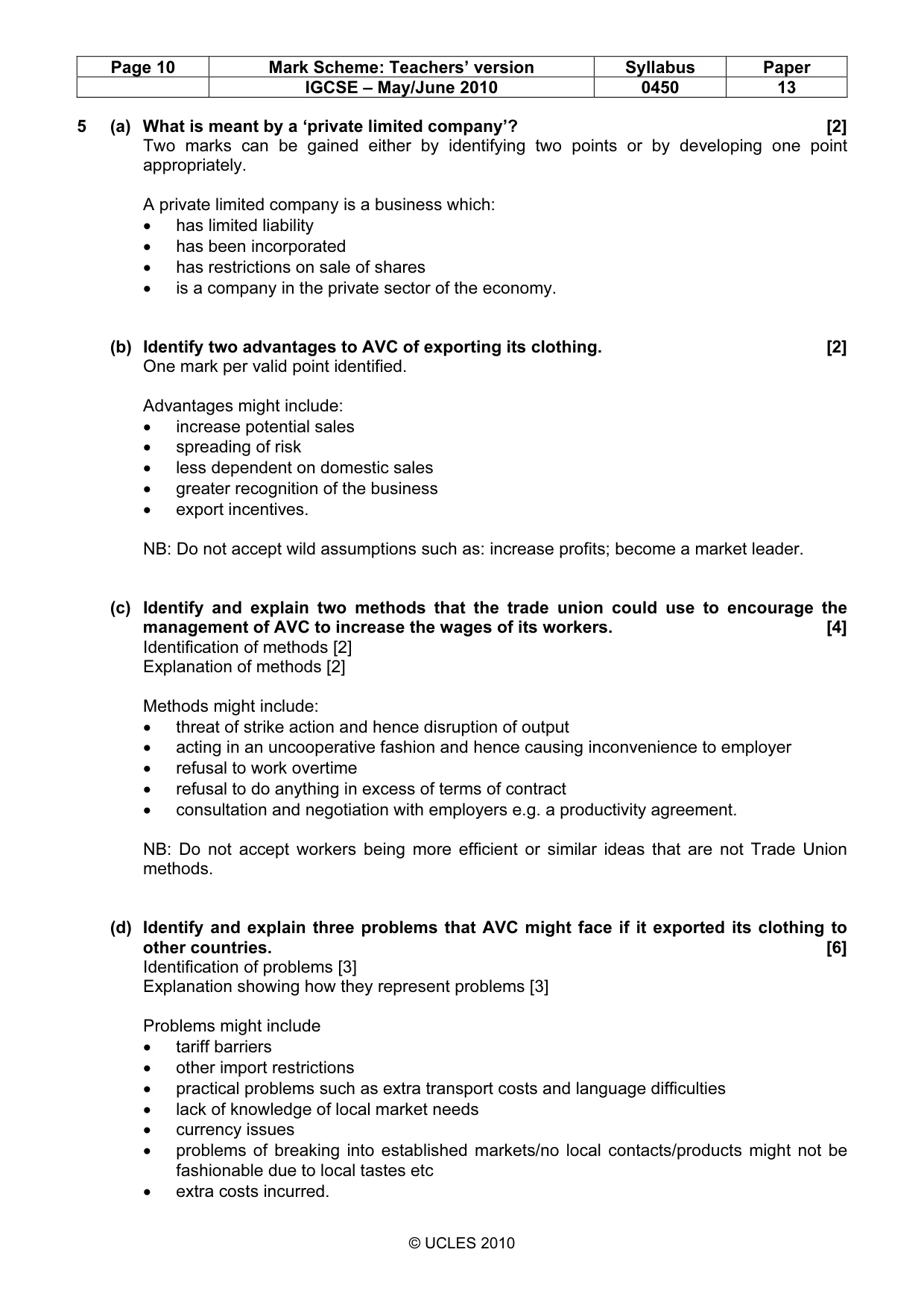
Page 10 Mark Scheme: Teachers’ version Syllabus Paper IGCSE – May/June 2010 0450 13 © UCLES 2010 5 (a) What is meant by a ‘private limited company’? [2] Two marks can be gained either by identifying two points or by developing one point appropriately. A private limited company is a business which: • has limited liability • has been incorporated • has restrictions on sale of shares • is a company in the private sector of the economy. (b) Identify two advantages to AVC of exporting its clothing. [2] One mark per valid point identified. Advantages might include: • increase potential sales • spreading of risk • less dependent on domestic sales • greater recognition of the business • export incentives. NB: Do not accept wild assumptions such as: increase profits; become a market leader. (c) Identify and explain two methods that the trade union could use to encourage the management of AVC to increase the wages of its workers. [4] Identification of methods [2] Explanation of methods [2] Methods might include: • threat of strike action and hence disruption of output • acting in an uncooperative fashion and hence causing inconvenience to employer • refusal to work overtime • refusal to do anything in excess of terms of contract • consultation and negotiation with employers e.g. a productivity agreement. NB: Do not accept workers being more efficient or similar ideas that are not Trade Union methods. (d) Identify and explain three problems that AVC might face if it exported its clothing to other countries. [6] Identification of problems [3] Explanation showing how they represent problems [3] Problems might include • tariff barriers • other import restrictions • practical problems such as extra transport costs and language difficulties • lack of knowledge of local market needs • currency issues • problems of breaking into established markets/no local contacts/products might not be fashionable due to local tastes etc • extra costs incurred.
Mark scheme, page 11
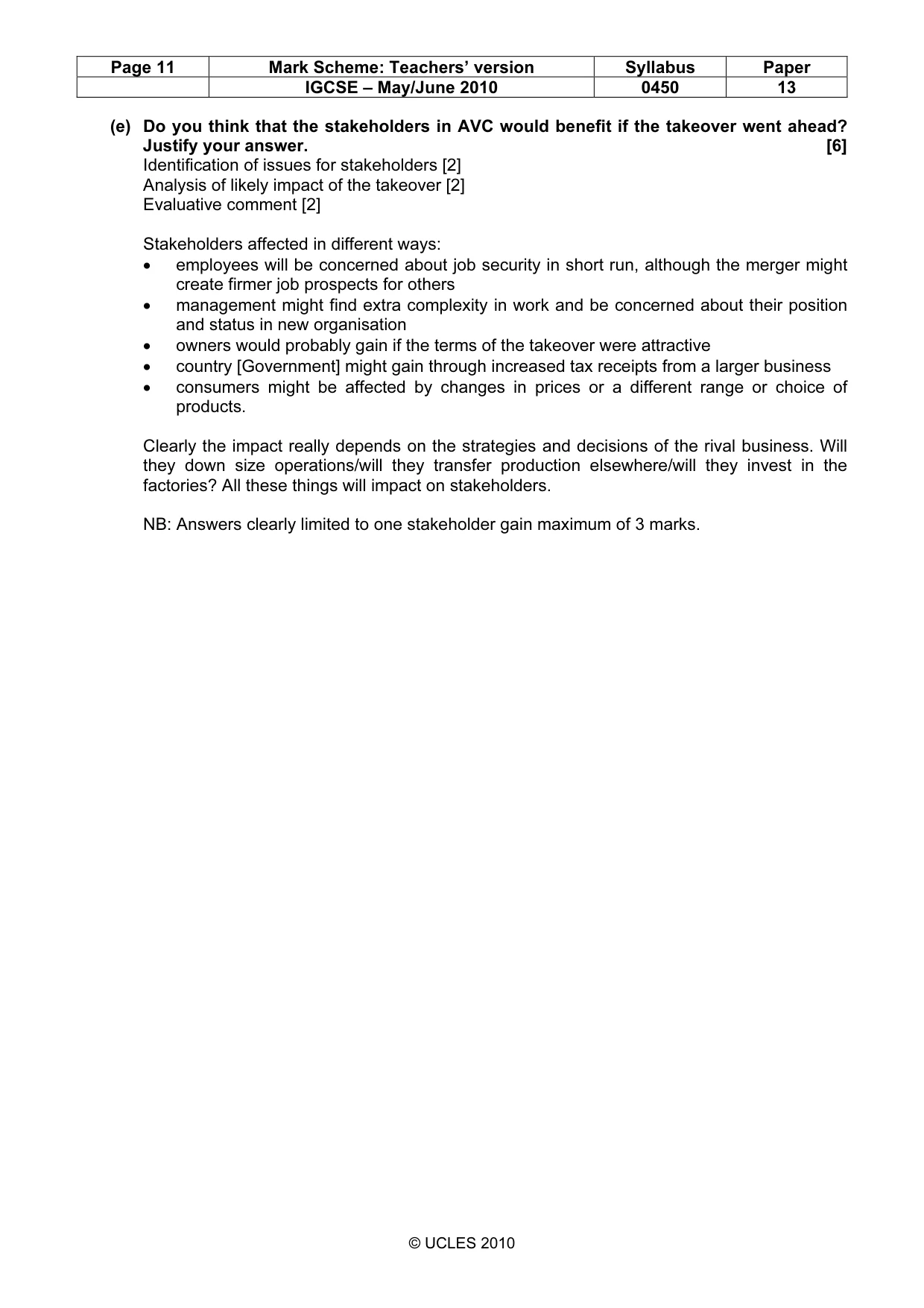
Page 11 Mark Scheme: Teachers’ version Syllabus Paper IGCSE – May/June 2010 0450 13 © UCLES 2010 (e) Do you think that the stakeholders in AVC would benefit if the takeover went ahead? Justify your answer. [6] Identification of issues for stakeholders [2] Analysis of likely impact of the takeover [2] Evaluative comment [2] Stakeholders affected in different ways: • employees will be concerned about job security in short run, although the merger might create firmer job prospects for others • management might find extra complexity in work and be concerned about their position and status in new organisation • owners would probably gain if the terms of the takeover were attractive • country [Government] might gain through increased tax receipts from a larger business • consumers might be affected by changes in prices or a different range or choice of products. Clearly the impact really depends on the strategies and decisions of the rival business. Will they down size operations/will they transfer production elsewhere/will they invest in the factories? All these things will impact on stakeholders. NB: Answers clearly limited to one stakeholder gain maximum of 3 marks.
What you needed in this session
Cambridge’s own grade thresholds for 2010 May/June, Paper 1 · Variant 3. A higher threshold means an easier paper — the bar moves with how the cohort did.