Cambridge IGCSE Business Studies 0450 — 2009 Oct/Nov Paper 1 · Variant 1
0450/11/O/N/09 · 100 marks · ≈113 min
The question paper and its mark scheme, free to read here and free to download. This is Cambridge’s own paper, exactly as it was sat.
Question paper12 pages

Mark scheme9 pages
Answers below. Sit the paper first if you are practising.
Paper as text
Question paper, page 1
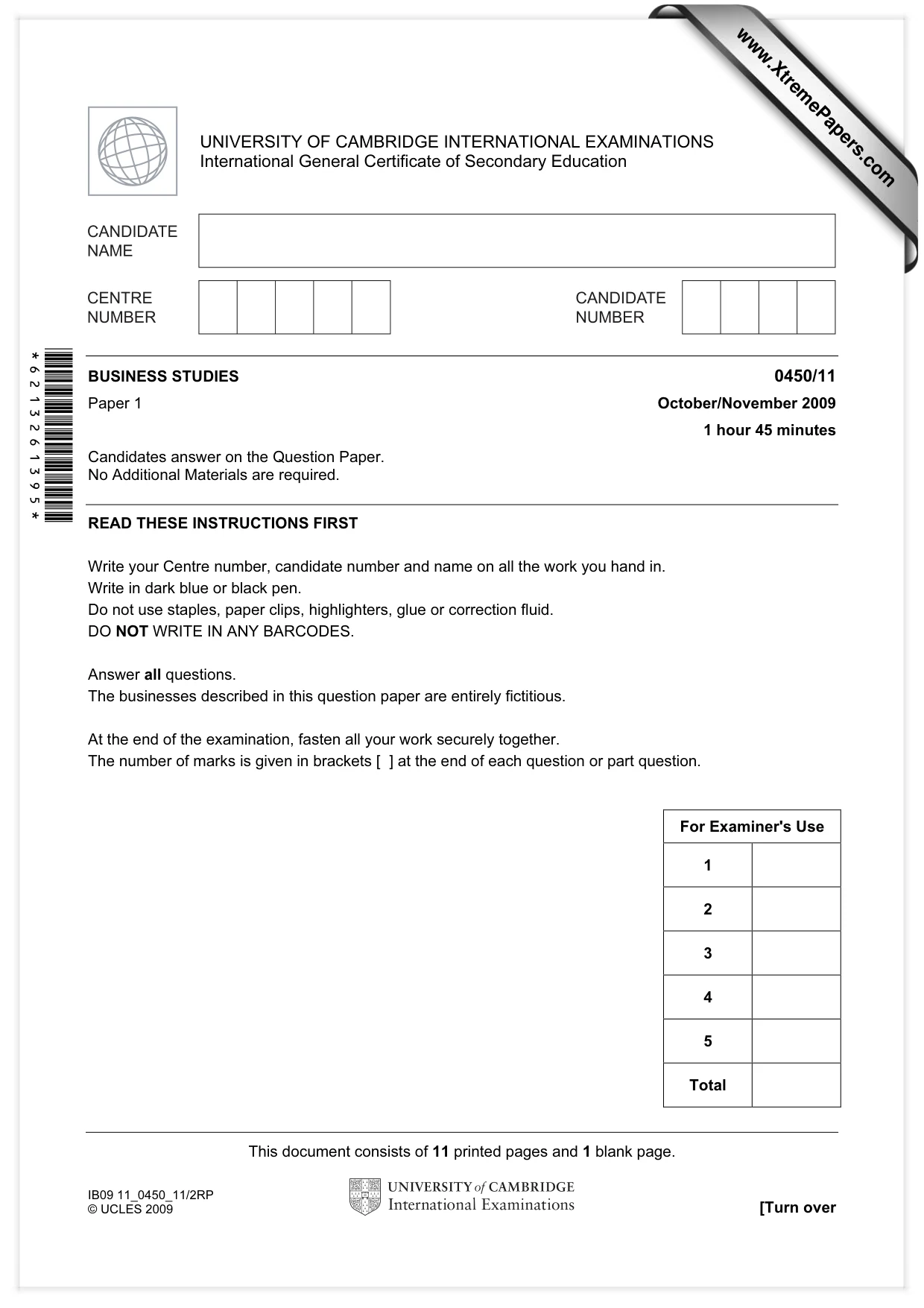
This document consists of 11 printed pages and 1 blank page. IB09 11_0450_11/2RP © UCLES 2009 [Turn over *6213261395* For Examiner's Use 1 2 3 4 5 Total UNIVERSITY OF CAMBRIDGE INTERNATIONAL EXAMINATIONS International General Certificate of Secondary Education BUSINESS STUDIES 0450/11 Paper 1 October/November 2009 1 hour 45 minutes Candidates answer on the Question Paper. No Additional Materials are required. READ THESE INSTRUCTIONS FIRST Write your Centre number, candidate number and name on all the work you hand in. Write in dark blue or black pen. Do not use staples, paper clips, highlighters, glue or correction fluid. DO NOT WRITE IN ANY BARCODES. Answer all questions. The businesses described in this question paper are entirely fictitious. At the end of the examination, fasten all your work securely together. The number of marks is given in brackets [ ] at the end of each question or part question. www.XtremePapers.com
Question paper, page 2
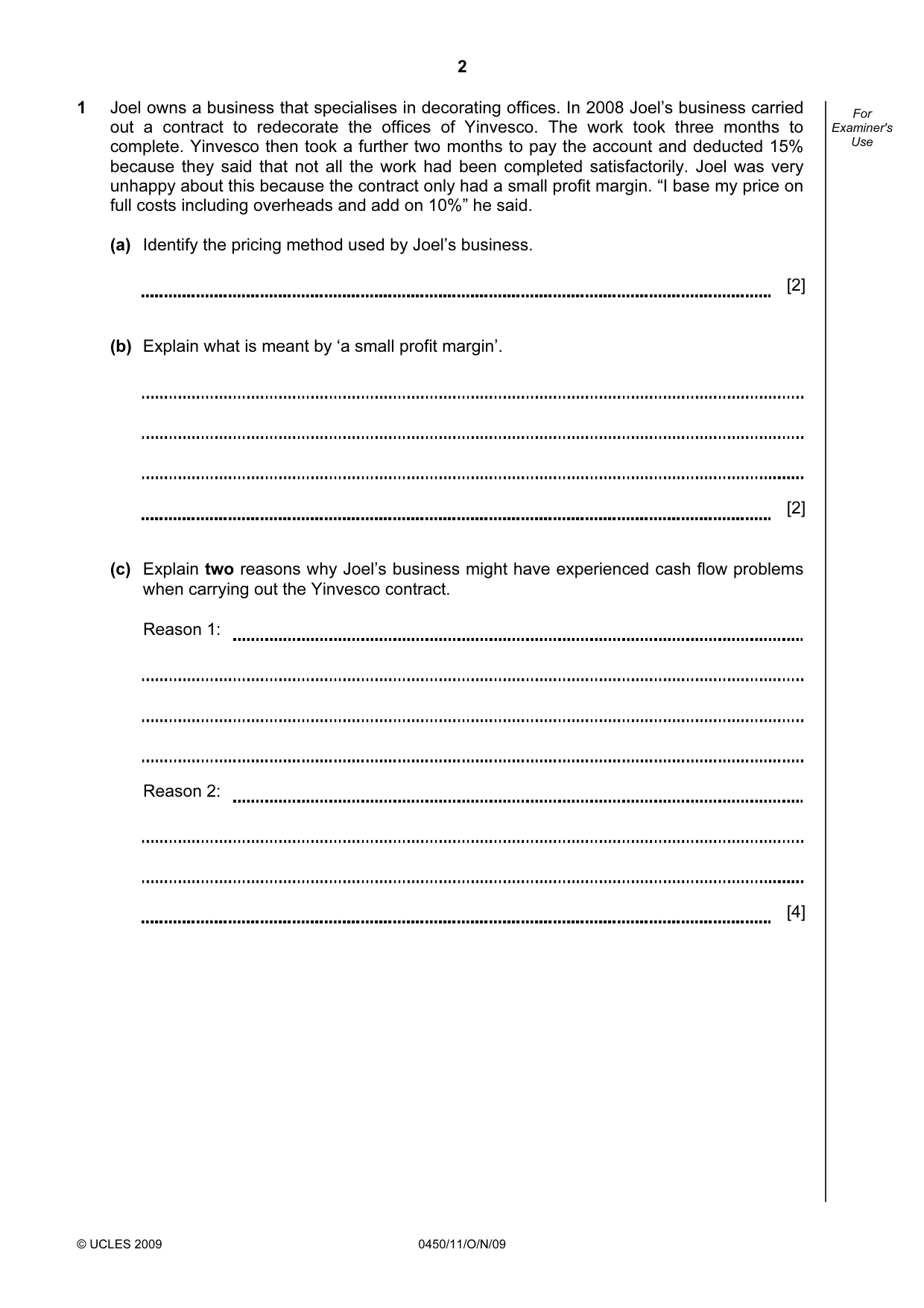
2 © UCLES 2009 0450/11/O/N/09 For Examiner's Use 1 Joel owns a business that specialises in decorating offices. In 2008 Joel’s business carried out a contract to redecorate the offices of Yinvesco. The work took three months to complete. Yinvesco then took a further two months to pay the account and deducted 15% because they said that not all the work had been completed satisfactorily. Joel was very unhappy about this because the contract only had a small profit margin. “I base my price on full costs including overheads and add on 10%” he said. (a) Identify the pricing method used by Joel’s business. [2] (b) Explain what is meant by ‘a small profit margin’. [2] (c) Explain two reasons why Joel’s business might have experienced cash flow problems when carrying out the Yinvesco contract. Reason 1: Reason 2: [4]
Question paper, page 3
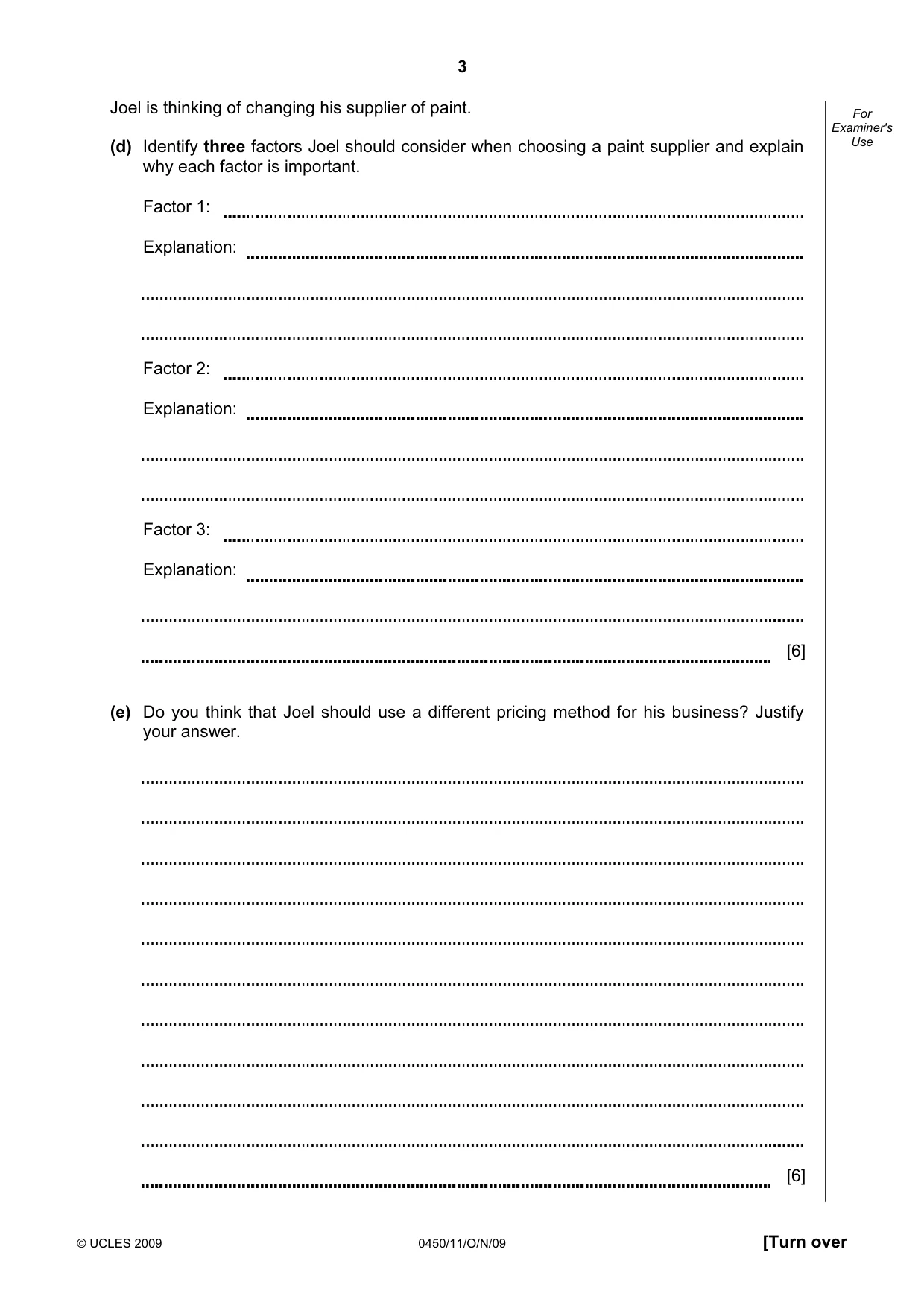
3 © UCLES 2009 0450/11/O/N/09 [Turn over For Examiner's Use Joel is thinking of changing his supplier of paint. (d) Identify three factors Joel should consider when choosing a paint supplier and explain why each factor is important. Factor 1: Explanation: Factor 2: Explanation: Factor 3: Explanation: [6] (e) Do you think that Joel should use a different pricing method for his business? Justify your answer. [6]
Question paper, page 4
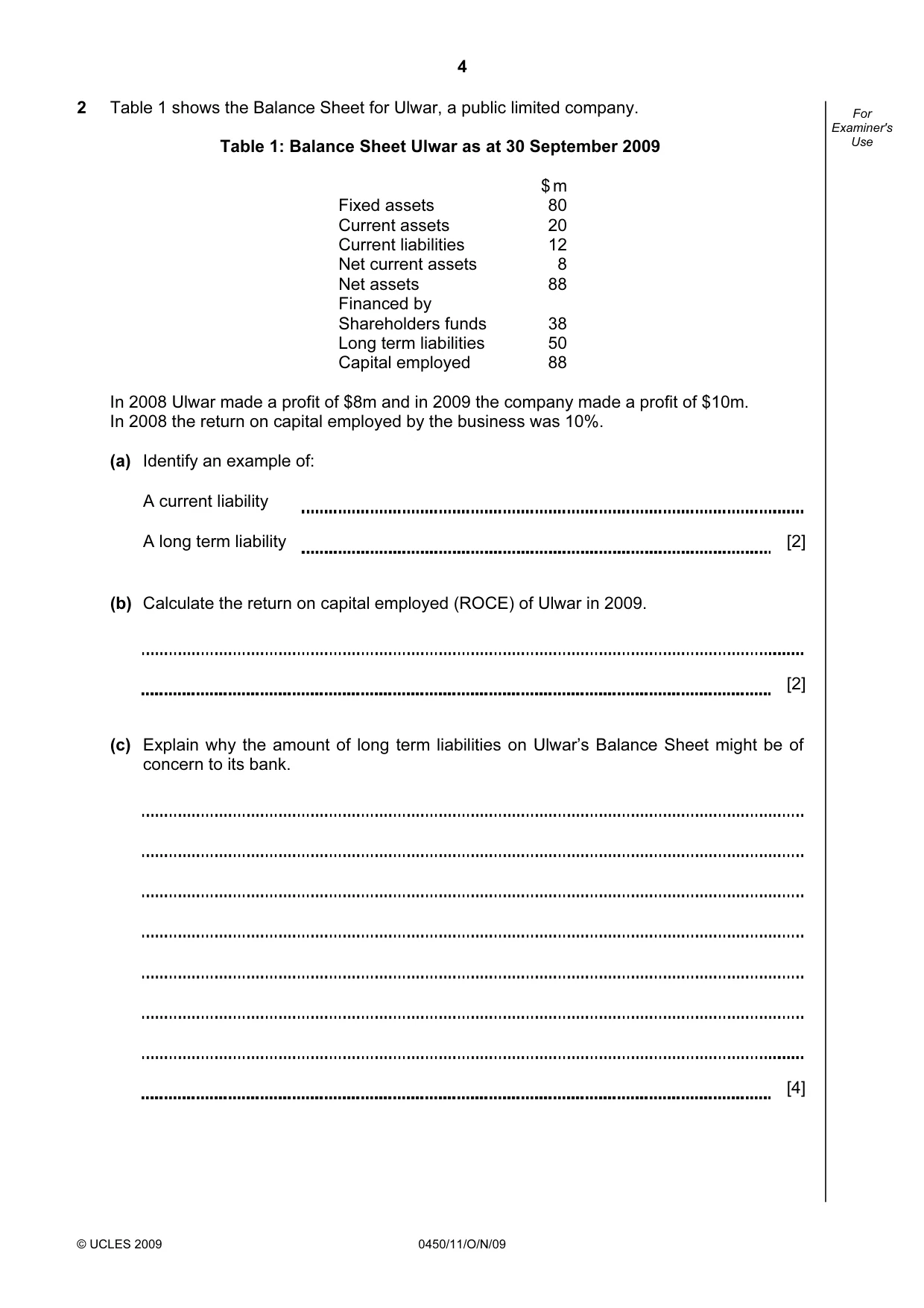
4 © UCLES 2009 0450/11/O/N/09 For Examiner's Use 2 Table 1 shows the Balance Sheet for Ulwar, a public limited company. Table 1: Balance Sheet Ulwar as at 30 September 2009 $ m Fixed assets 80 Current assets 20 Current liabilities 12 Net current assets 8 Net assets 88 Financed by Shareholders funds 38 Long term liabilities 50 Capital employed 88 In 2008 Ulwar made a profit of $8m and in 2009 the company made a profit of $10m. In 2008 the return on capital employed by the business was 10%. (a) Identify an example of: A current liability A long term liability [2] (b) Calculate the return on capital employed (ROCE) of Ulwar in 2009. [2] (c) Explain why the amount of long term liabilities on Ulwar’s Balance Sheet might be of concern to its bank. [4]
Question paper, page 5
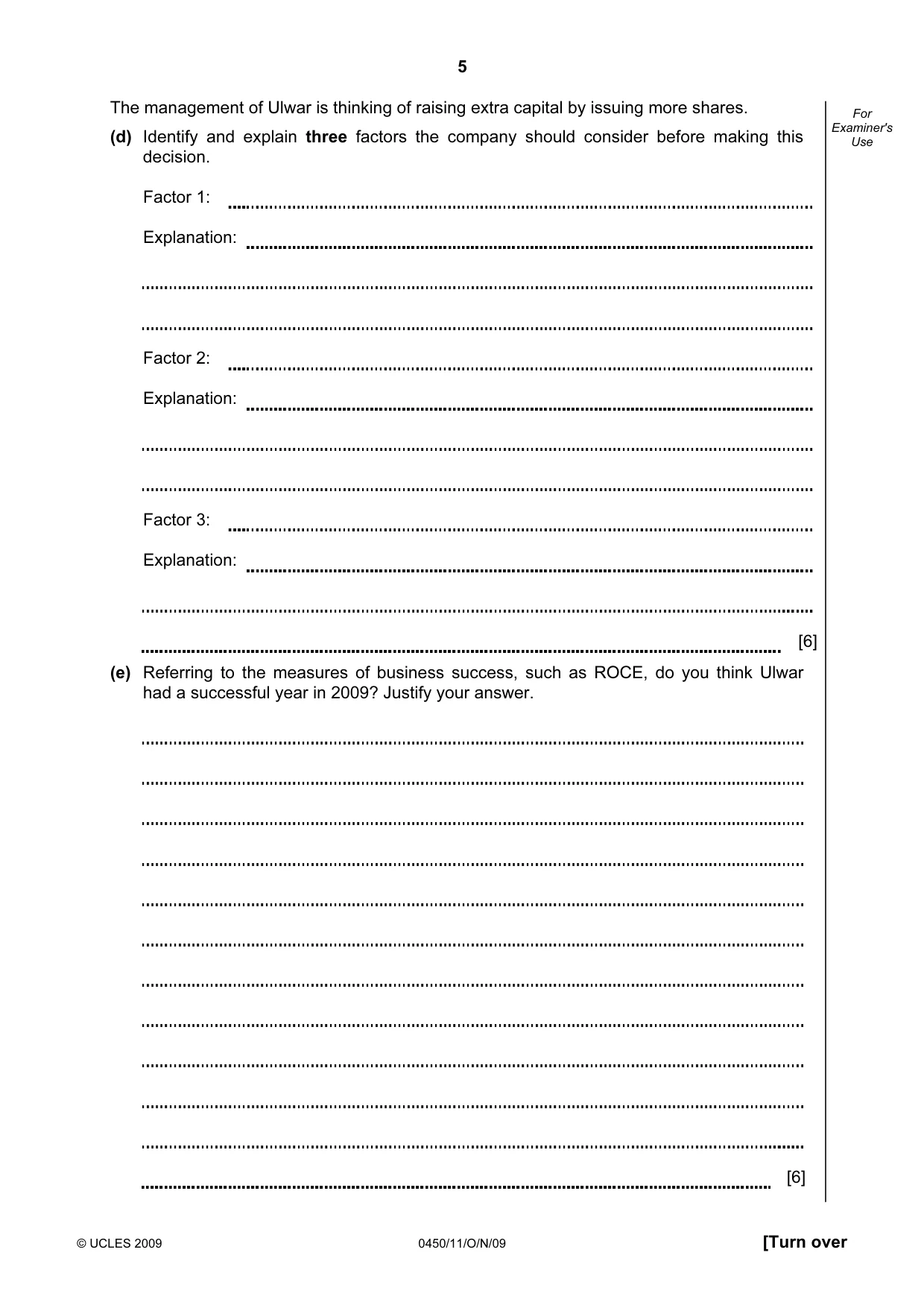
5 © UCLES 2009 0450/11/O/N/09 [Turn over For Examiner's Use The management of Ulwar is thinking of raising extra capital by issuing more shares. (d) Identify and explain three factors the company should consider before making this decision. Factor 1: Explanation: Factor 2: Explanation: Factor 3: Explanation: [6] (e) Referring to the measures of business success, such as ROCE, do you think Ulwar had a successful year in 2009? Justify your answer. [6]
Question paper, page 6
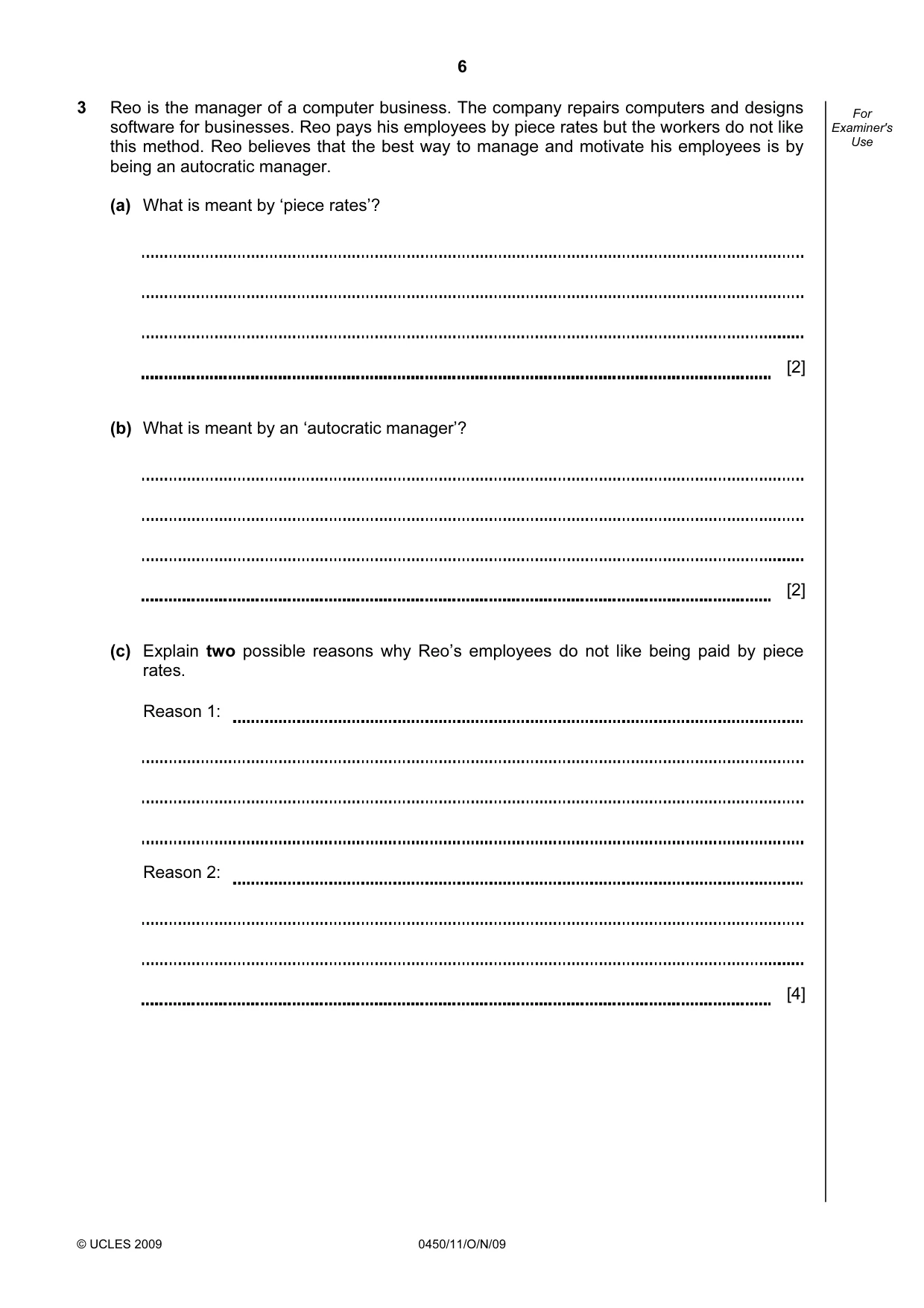
6 © UCLES 2009 0450/11/O/N/09 For Examiner's Use 3 Reo is the manager of a computer business. The company repairs computers and designs software for businesses. Reo pays his employees by piece rates but the workers do not like this method. Reo believes that the best way to manage and motivate his employees is by being an autocratic manager. (a) What is meant by ‘piece rates’? [2] (b) What is meant by an ‘autocratic manager’? [2] (c) Explain two possible reasons why Reo’s employees do not like being paid by piece rates. Reason 1: Reason 2: [4]
Question paper, page 7
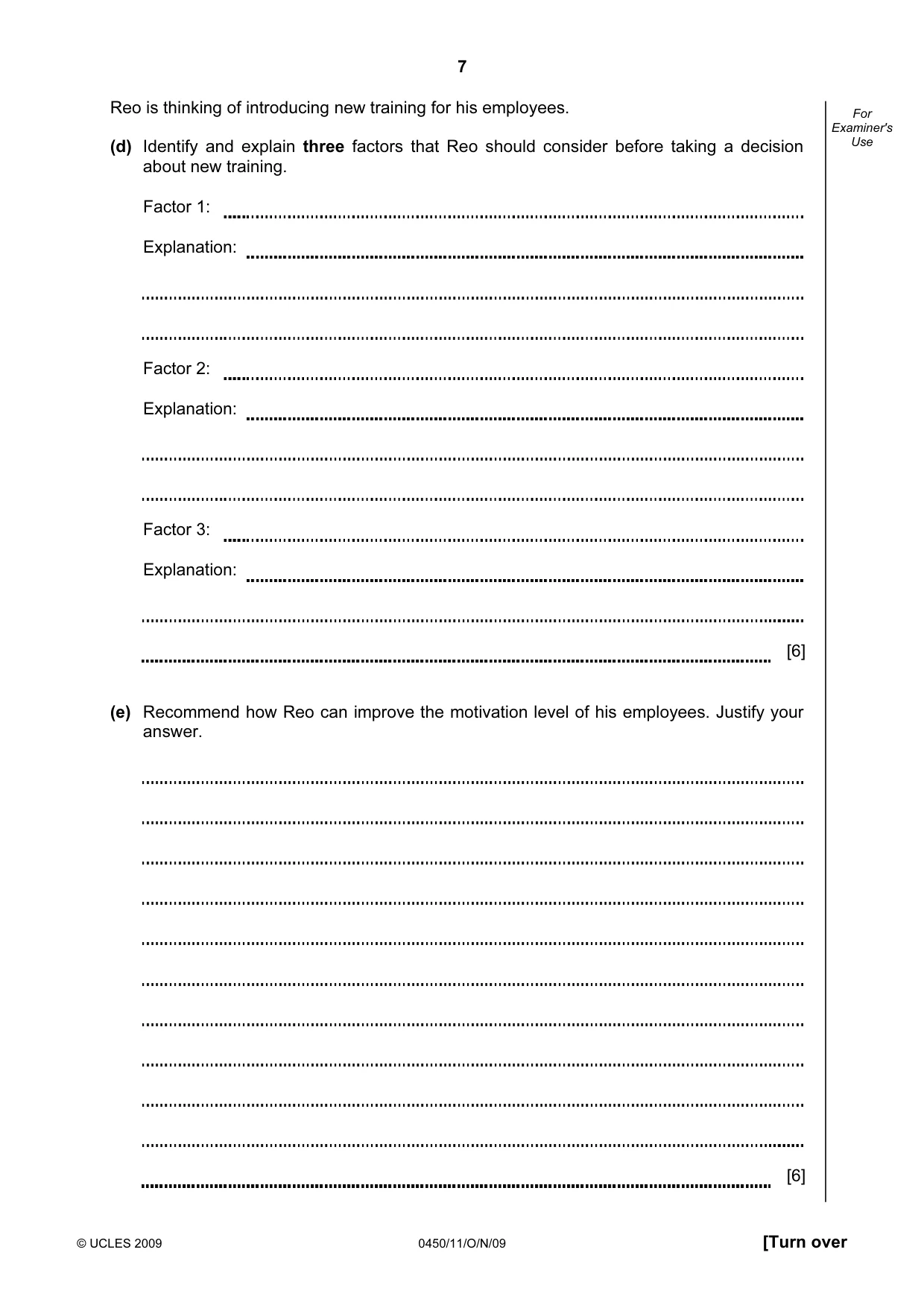
7 © UCLES 2009 0450/11/O/N/09 [Turn over For Examiner's Use Reo is thinking of introducing new training for his employees. (d) Identify and explain three factors that Reo should consider before taking a decision about new training. Factor 1: Explanation: Factor 2: Explanation: Factor 3: Explanation: [6] (e) Recommend how Reo can improve the motivation level of his employees. Justify your answer. [6]
Question paper, page 8
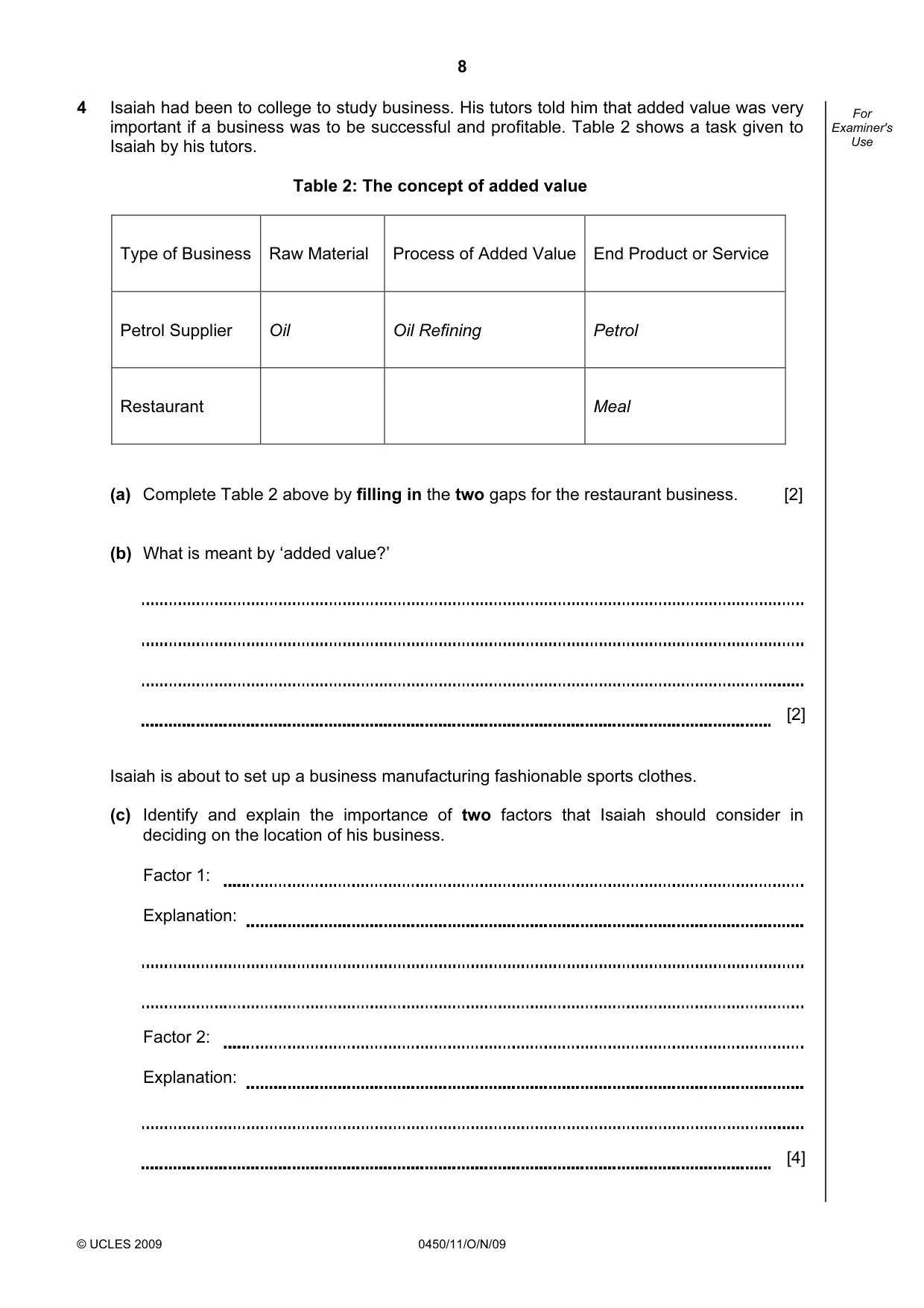
8 © UCLES 2009 0450/11/O/N/09 For Examiner's Use 4 Isaiah had been to college to study business. His tutors told him that added value was very important if a business was to be successful and profitable. Table 2 shows a task given to Isaiah by his tutors. Table 2: The concept of added value Type of Business Raw Material Process of Added Value End Product or Service Petrol Supplier Oil Oil Refining Petrol Restaurant Meal (a) Complete Table 2 above by filling in the two gaps for the restaurant business. [2] (b) What is meant by ‘added value?’ [2] Isaiah is about to set up a business manufacturing fashionable sports clothes. (c) Identify and explain the importance of two factors that Isaiah should consider in deciding on the location of his business. Factor 1: Explanation: Factor 2: Explanation: [4]
Question paper, page 9
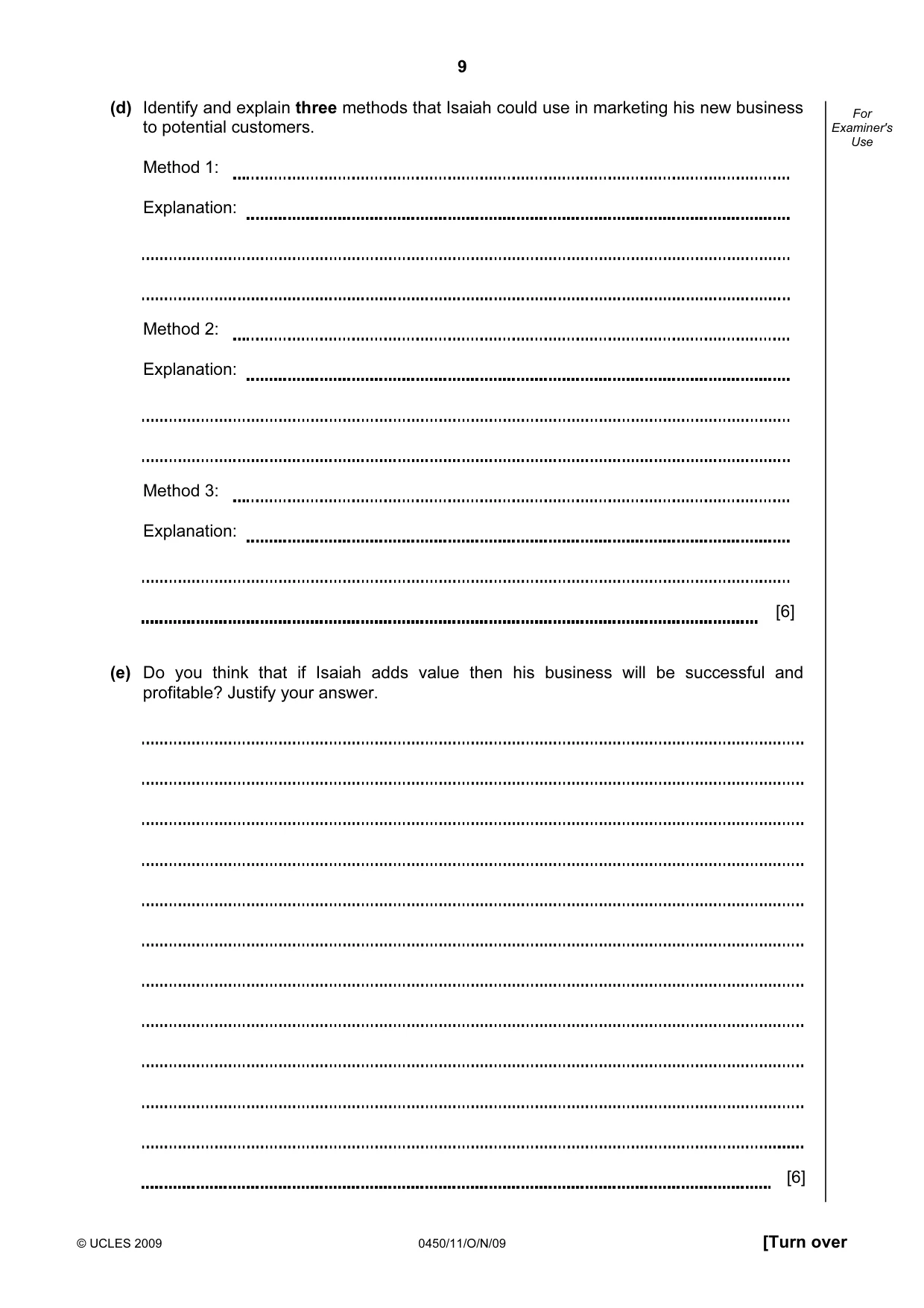
9 © UCLES 2009 0450/11/O/N/09 [Turn over For Examiner's Use (d) Identify and explain three methods that Isaiah could use in marketing his new business to potential customers. Method 1: Explanation: Method 2: Explanation: Method 3: Explanation: [6] (e) Do you think that if Isaiah adds value then his business will be successful and profitable? Justify your answer. [6]
Question paper, page 10
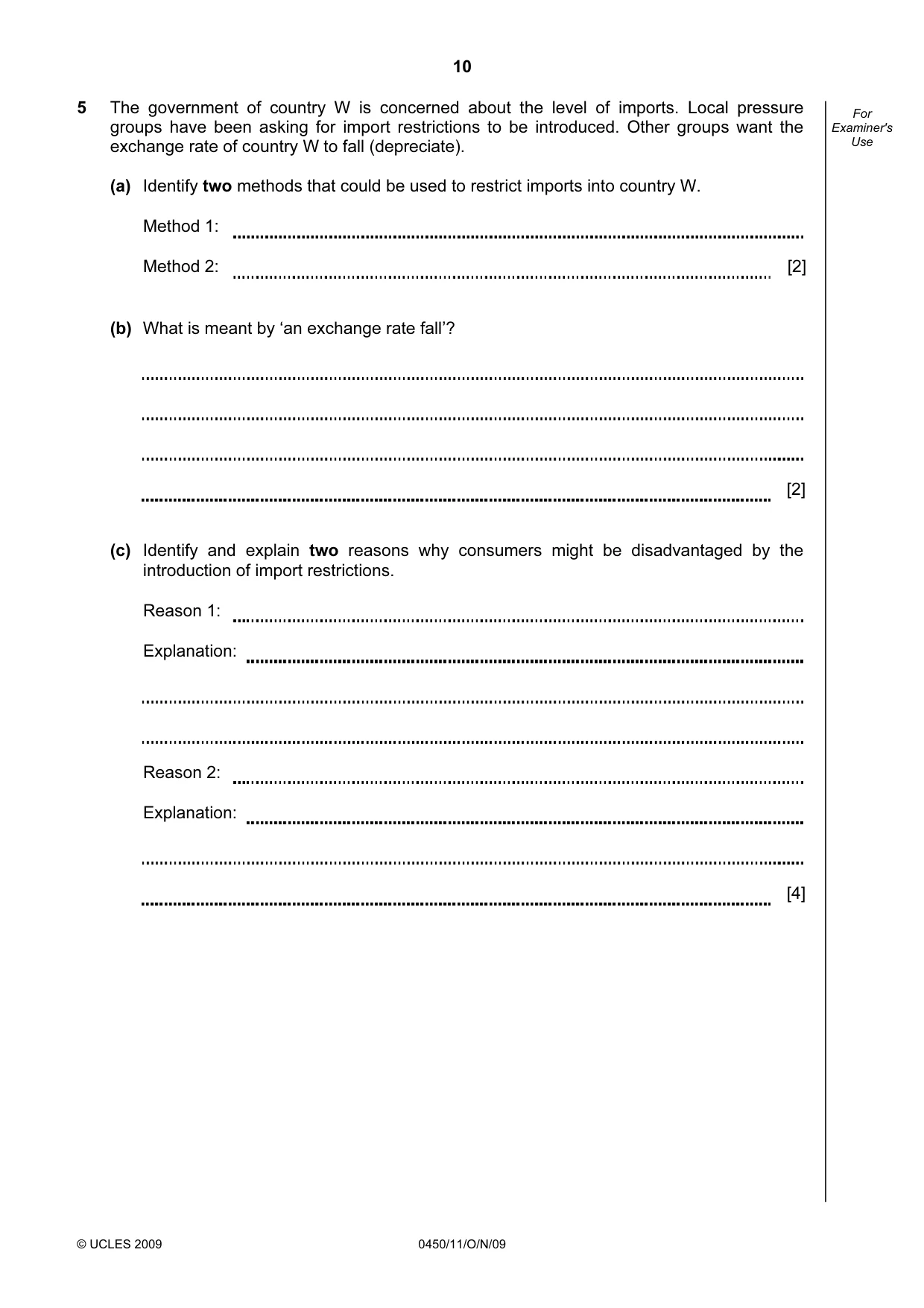
10 © UCLES 2009 0450/11/O/N/09 For Examiner's Use 5 The government of country W is concerned about the level of imports. Local pressure groups have been asking for import restrictions to be introduced. Other groups want the exchange rate of country W to fall (depreciate). (a) Identify two methods that could be used to restrict imports into country W. Method 1: Method 2: [2] (b) What is meant by ‘an exchange rate fall’? [2] (c) Identify and explain two reasons why consumers might be disadvantaged by the introduction of import restrictions. Reason 1: Explanation: Reason 2: Explanation: [4]
Question paper, page 11
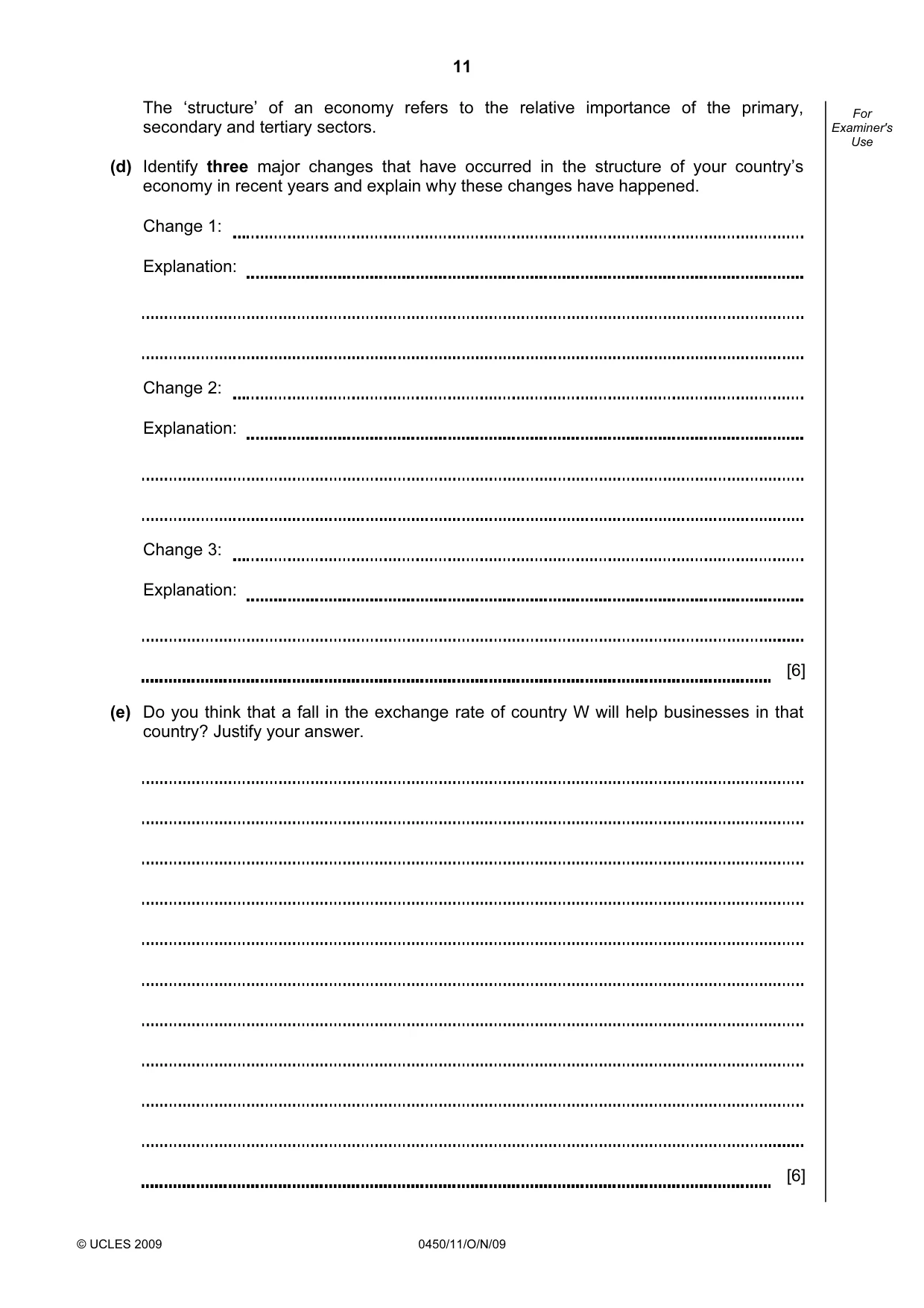
11 © UCLES 2009 0450/11/O/N/09 For Examiner's Use The ‘structure’ of an economy refers to the relative importance of the primary, secondary and tertiary sectors. (d) Identify three major changes that have occurred in the structure of your country’s economy in recent years and explain why these changes have happened. Change 1: Explanation: Change 2: Explanation: Change 3: Explanation: [6] (e) Do you think that a fall in the exchange rate of country W will help businesses in that country? Justify your answer. [6]
Question paper, page 12
12 BLANK PAGE Permission to reproduce items where third-party owned material protected by copyright is included has been sought and cleared where possible. Every reasonable effort has been made by the publisher (UCLES) to trace copyright holders, but if any items requiring clearance have unwittingly been included, the publisher will be pleased to make amends at the earliest possible opportunity. University of Cambridge International Examinations is part of the Cambridge Assessment Group. Cambridge Assessment is the brand name of University of Cambridge Local Examinations Syndicate (UCLES), which is itself a department of the University of Cambridge. 0450/11/O/N/09
Mark scheme, page 1
UNIVERSITY OF CAMBRIDGE INTERNATIONAL EXAMINATIONS International General Certificate of Secondary Education MARK SCHEME for the October/November 2009 question paper for the guidance of teachers 0450 BUSINESS STUDIES 0450/11 Paper 11 (Short Answer/Structured Response), maximum raw mark 100 This mark scheme is published as an aid to teachers and candidates, to indicate the requirements of the examination. It shows the basis on which Examiners were instructed to award marks. It does not indicate the details of the discussions that took place at an Examiners’ meeting before marking began, which would have considered the acceptability of alternative answers. Mark schemes must be read in conjunction with the question papers and the report on the examination. • CIE will not enter into discussions or correspondence in connection with these mark schemes. CIE is publishing the mark schemes for the October/November 2009 question papers for most IGCSE, GCE Advanced Level and Advanced Subsidiary Level syllabuses and some Ordinary Level syllabuses. www.XtremePapers.com
Mark scheme, page 2
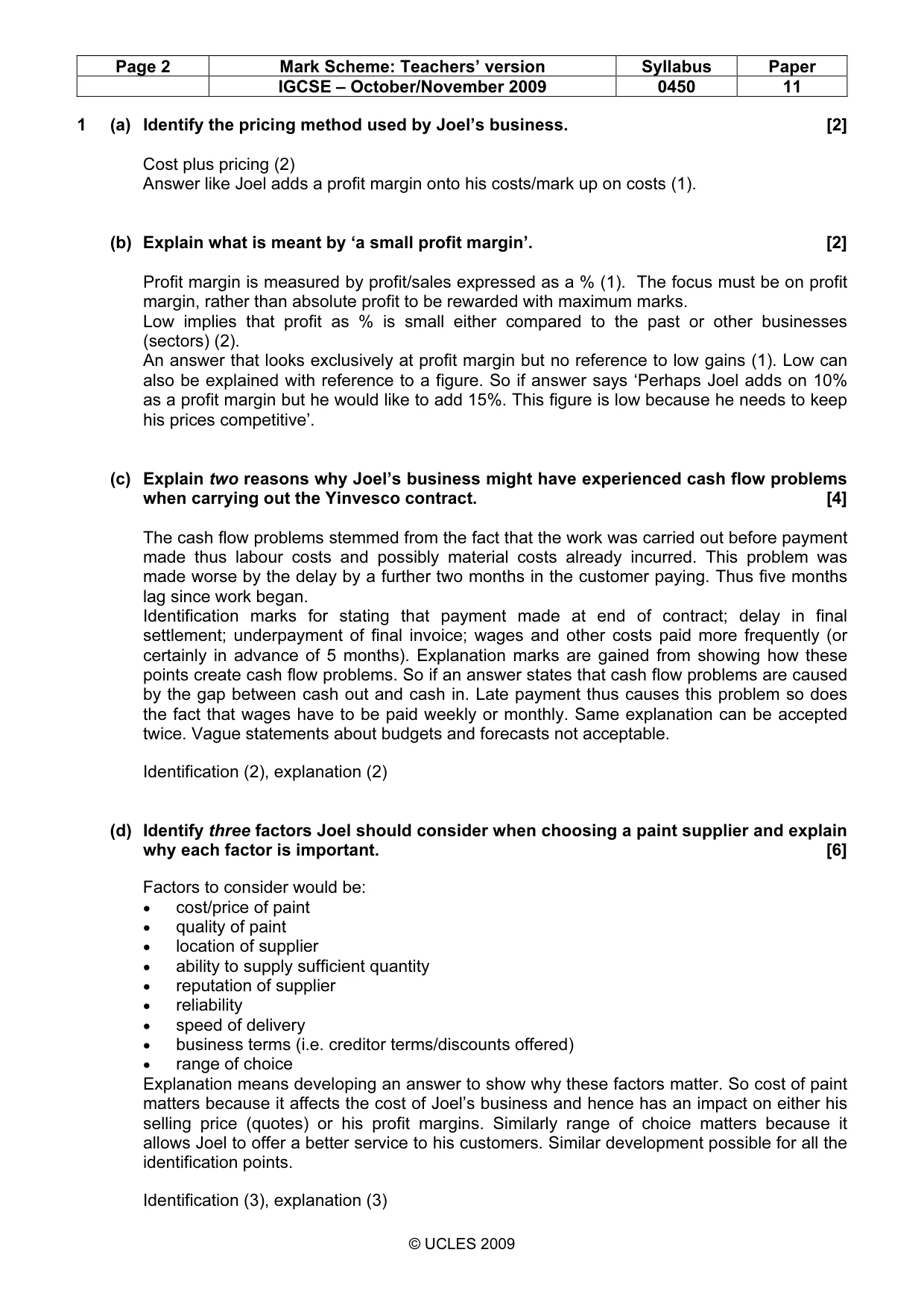
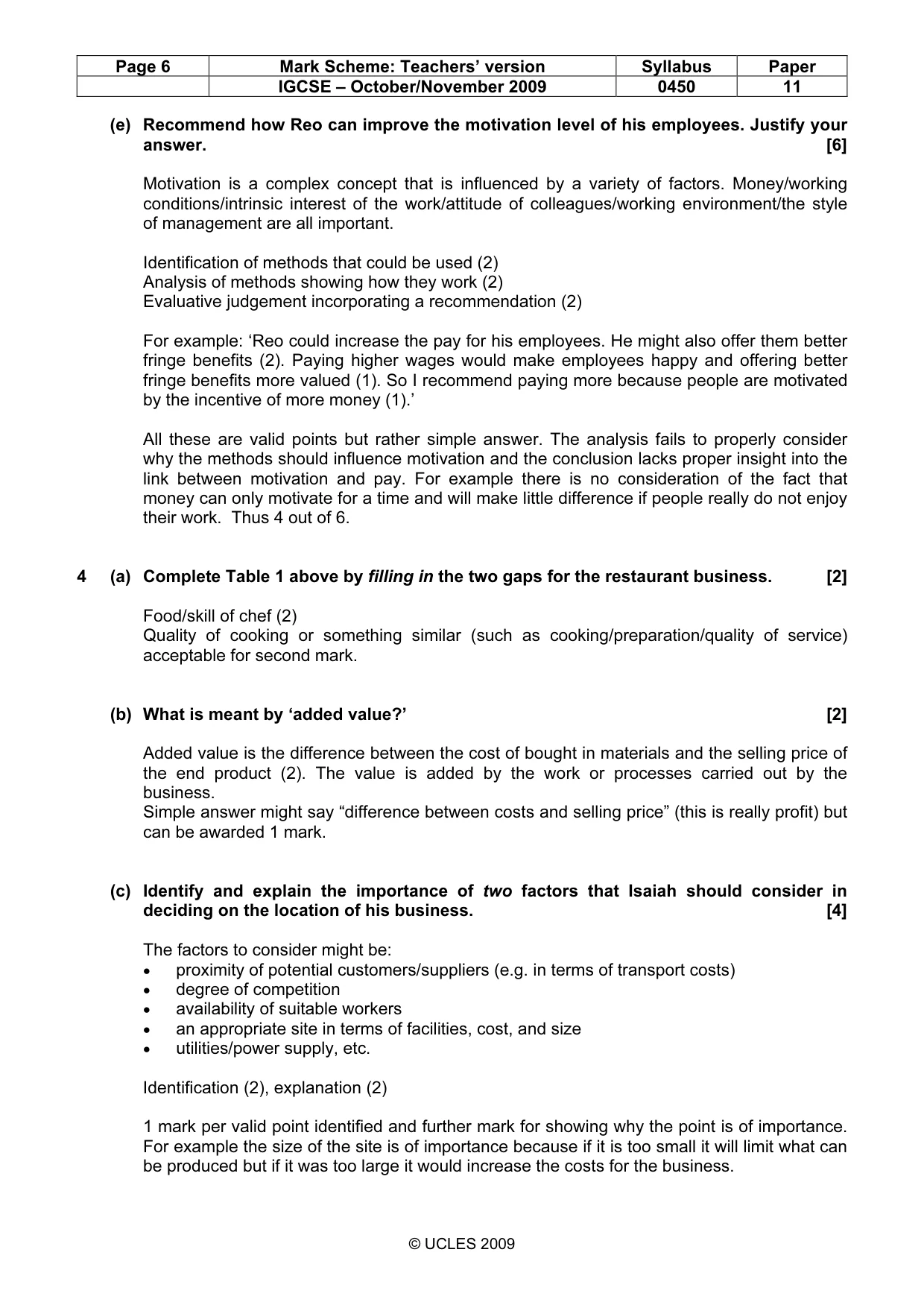
Page 2 Mark Scheme: Teachers’ version Syllabus Paper IGCSE – October/November 2009 0450 11 © UCLES 2009 1 (a) Identify the pricing method used by Joel’s business. [2] Cost plus pricing (2) Answer like Joel adds a profit margin onto his costs/mark up on costs (1). (b) Explain what is meant by ‘a small profit margin’. [2] Profit margin is measured by profit/sales expressed as a % (1). The focus must be on profit margin, rather than absolute profit to be rewarded with maximum marks. Low implies that profit as % is small either compared to the past or other businesses (sectors) (2). An answer that looks exclusively at profit margin but no reference to low gains (1). Low can also be explained with reference to a figure. So if answer says ‘Perhaps Joel adds on 10% as a profit margin but he would like to add 15%. This figure is low because he needs to keep his prices competitive’. (c) Explain two reasons why Joel’s business might have experienced cash flow problems when carrying out the Yinvesco contract. [4] The cash flow problems stemmed from the fact that the work was carried out before payment made thus labour costs and possibly material costs already incurred. This problem was made worse by the delay by a further two months in the customer paying. Thus five months lag since work began. Identification marks for stating that payment made at end of contract; delay in final settlement; underpayment of final invoice; wages and other costs paid more frequently (or certainly in advance of 5 months). Explanation marks are gained from showing how these points create cash flow problems. So if an answer states that cash flow problems are caused by the gap between cash out and cash in. Late payment thus causes this problem so does the fact that wages have to be paid weekly or monthly. Same explanation can be accepted twice. Vague statements about budgets and forecasts not acceptable. Identification (2), explanation (2) (d) Identify three factors Joel should consider when choosing a paint supplier and explain why each factor is important. [6] Factors to consider would be: • cost/price of paint • quality of paint • location of supplier • ability to supply sufficient quantity • reputation of supplier • reliability • speed of delivery • business terms (i.e. creditor terms/discounts offered) • range of choice Explanation means developing an answer to show why these factors matter. So cost of paint matters because it affects the cost of Joel’s business and hence has an impact on either his selling price (quotes) or his profit margins. Similarly range of choice matters because it allows Joel to offer a better service to his customers. Similar development possible for all the identification points. Identification (3), explanation (3)
Mark scheme, page 3
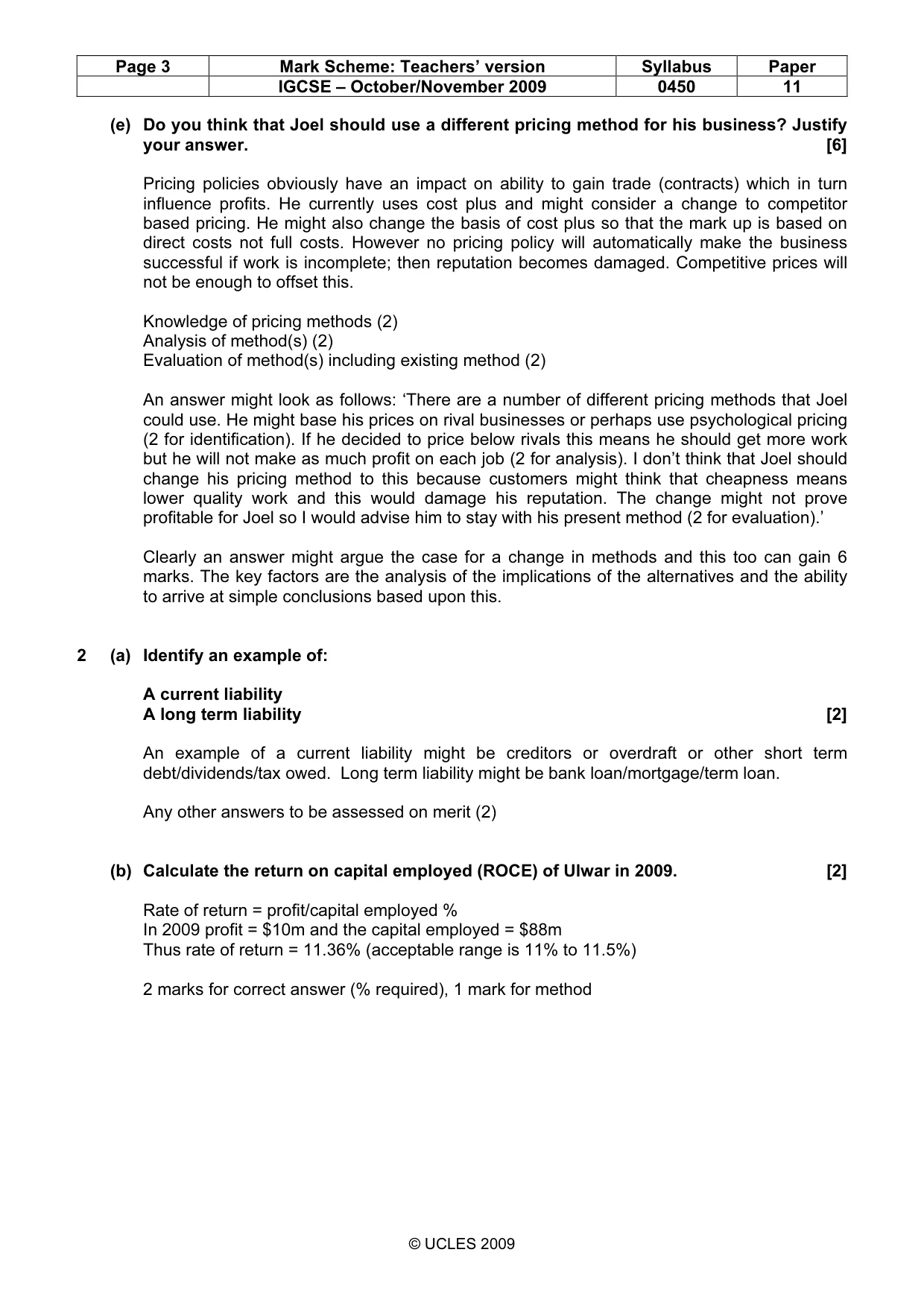
Page 3 Mark Scheme: Teachers’ version Syllabus Paper IGCSE – October/November 2009 0450 11 © UCLES 2009 (e) Do you think that Joel should use a different pricing method for his business? Justify your answer. [6] Pricing policies obviously have an impact on ability to gain trade (contracts) which in turn influence profits. He currently uses cost plus and might consider a change to competitor based pricing. He might also change the basis of cost plus so that the mark up is based on direct costs not full costs. However no pricing policy will automatically make the business successful if work is incomplete; then reputation becomes damaged. Competitive prices will not be enough to offset this. Knowledge of pricing methods (2) Analysis of method(s) (2) Evaluation of method(s) including existing method (2) An answer might look as follows: ‘There are a number of different pricing methods that Joel could use. He might base his prices on rival businesses or perhaps use psychological pricing (2 for identification). If he decided to price below rivals this means he should get more work but he will not make as much profit on each job (2 for analysis). I don’t think that Joel should change his pricing method to this because customers might think that cheapness means lower quality work and this would damage his reputation. The change might not prove profitable for Joel so I would advise him to stay with his present method (2 for evaluation).’ Clearly an answer might argue the case for a change in methods and this too can gain 6 marks. The key factors are the analysis of the implications of the alternatives and the ability to arrive at simple conclusions based upon this. 2 (a) Identify an example of: A current liability A long term liability [2] An example of a current liability might be creditors or overdraft or other short term debt/dividends/tax owed. Long term liability might be bank loan/mortgage/term loan. Any other answers to be assessed on merit (2) (b) Calculate the return on capital employed (ROCE) of Ulwar in 2009. [2] Rate of return = profit/capital employed % In 2009 profit = $10m and the capital employed = $88m Thus rate of return = 11.36% (acceptable range is 11% to 11.5%) 2 marks for correct answer (% required), 1 mark for method
Mark scheme, page 4
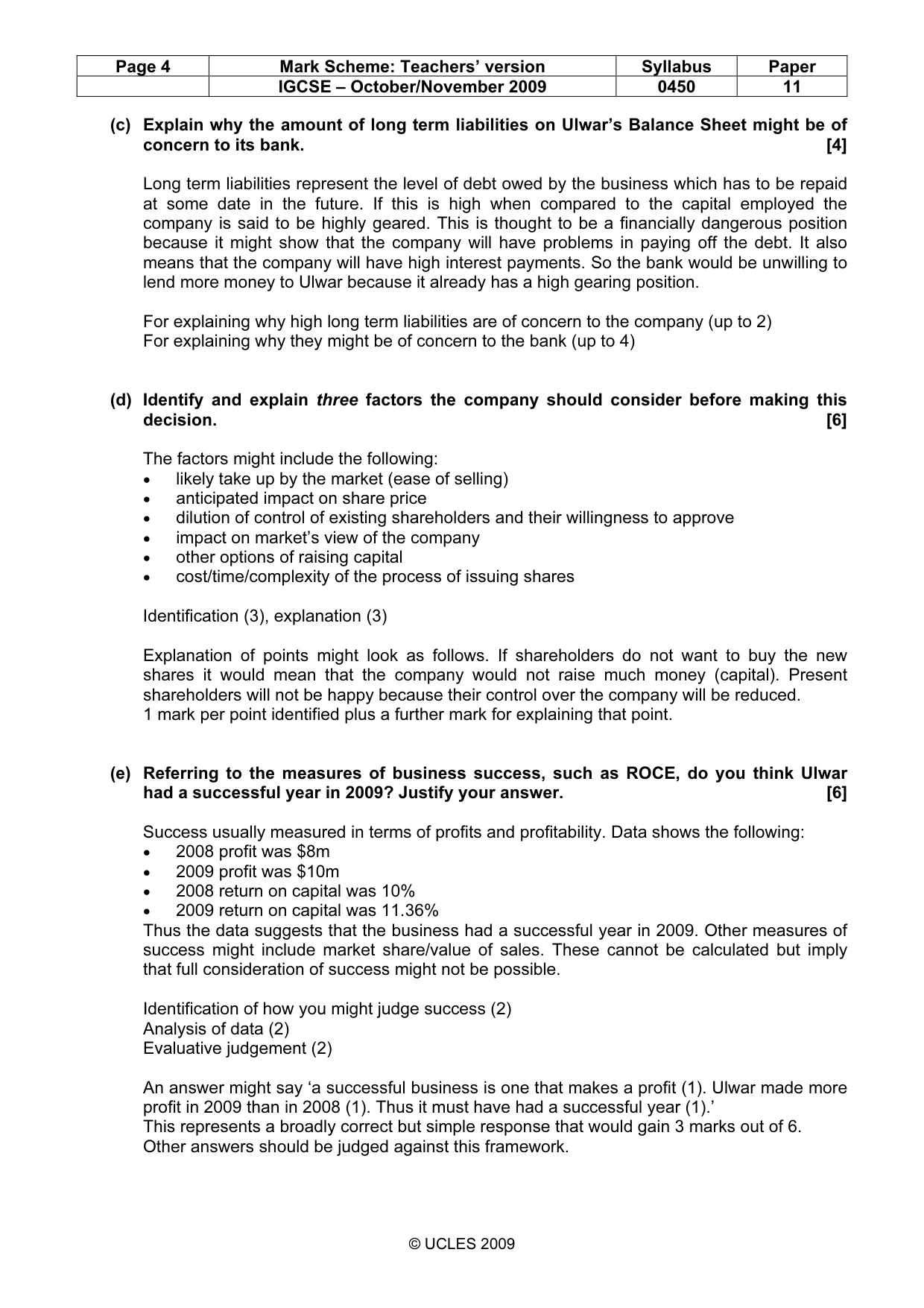
Page 4 Mark Scheme: Teachers’ version Syllabus Paper IGCSE – October/November 2009 0450 11 © UCLES 2009 (c) Explain why the amount of long term liabilities on Ulwar’s Balance Sheet might be of concern to its bank. [4] Long term liabilities represent the level of debt owed by the business which has to be repaid at some date in the future. If this is high when compared to the capital employed the company is said to be highly geared. This is thought to be a financially dangerous position because it might show that the company will have problems in paying off the debt. It also means that the company will have high interest payments. So the bank would be unwilling to lend more money to Ulwar because it already has a high gearing position. For explaining why high long term liabilities are of concern to the company (up to 2) For explaining why they might be of concern to the bank (up to 4) (d) Identify and explain three factors the company should consider before making this decision. [6] The factors might include the following: • likely take up by the market (ease of selling) • anticipated impact on share price • dilution of control of existing shareholders and their willingness to approve • impact on market’s view of the company • other options of raising capital • cost/time/complexity of the process of issuing shares Identification (3), explanation (3) Explanation of points might look as follows. If shareholders do not want to buy the new shares it would mean that the company would not raise much money (capital). Present shareholders will not be happy because their control over the company will be reduced. 1 mark per point identified plus a further mark for explaining that point. (e) Referring to the measures of business success, such as ROCE, do you think Ulwar had a successful year in 2009? Justify your answer. [6] Success usually measured in terms of profits and profitability. Data shows the following: • 2008 profit was $8m • 2009 profit was $10m • 2008 return on capital was 10% • 2009 return on capital was 11.36% Thus the data suggests that the business had a successful year in 2009. Other measures of success might include market share/value of sales. These cannot be calculated but imply that full consideration of success might not be possible. Identification of how you might judge success (2) Analysis of data (2) Evaluative judgement (2) An answer might say ‘a successful business is one that makes a profit (1). Ulwar made more profit in 2009 than in 2008 (1). Thus it must have had a successful year (1).’ This represents a broadly correct but simple response that would gain 3 marks out of 6. Other answers should be judged against this framework.
Mark scheme, page 5
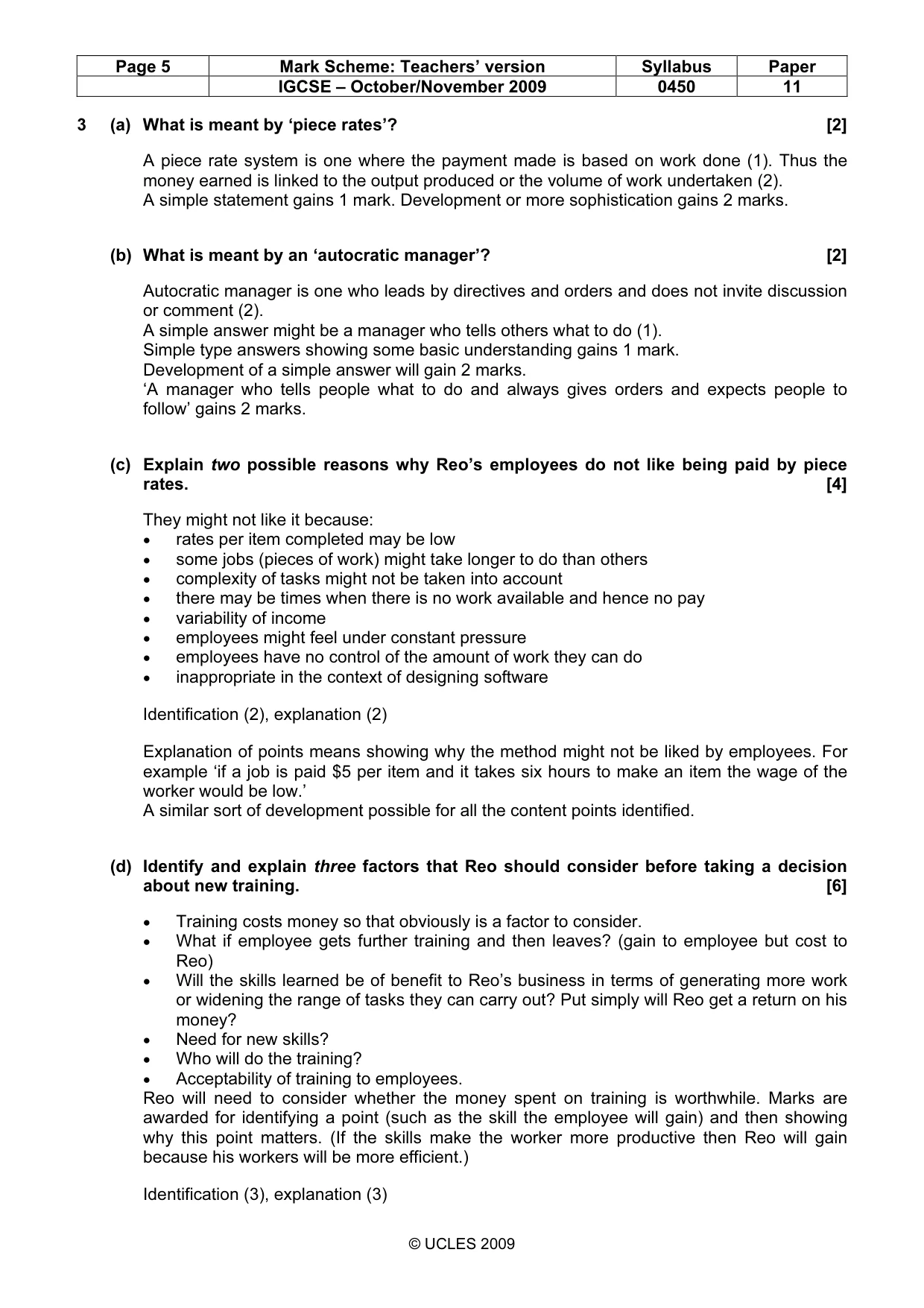
Page 5 Mark Scheme: Teachers’ version Syllabus Paper IGCSE – October/November 2009 0450 11 © UCLES 2009 3 (a) What is meant by ‘piece rates’? [2] A piece rate system is one where the payment made is based on work done (1). Thus the money earned is linked to the output produced or the volume of work undertaken (2). A simple statement gains 1 mark. Development or more sophistication gains 2 marks. (b) What is meant by an ‘autocratic manager’? [2] Autocratic manager is one who leads by directives and orders and does not invite discussion or comment (2). A simple answer might be a manager who tells others what to do (1). Simple type answers showing some basic understanding gains 1 mark. Development of a simple answer will gain 2 marks. ‘A manager who tells people what to do and always gives orders and expects people to follow’ gains 2 marks. (c) Explain two possible reasons why Reo’s employees do not like being paid by piece rates. [4] They might not like it because: • rates per item completed may be low • some jobs (pieces of work) might take longer to do than others • complexity of tasks might not be taken into account • there may be times when there is no work available and hence no pay • variability of income • employees might feel under constant pressure • employees have no control of the amount of work they can do • inappropriate in the context of designing software Identification (2), explanation (2) Explanation of points means showing why the method might not be liked by employees. For example ‘if a job is paid $5 per item and it takes six hours to make an item the wage of the worker would be low.’ A similar sort of development possible for all the content points identified. (d) Identify and explain three factors that Reo should consider before taking a decision about new training. [6] • Training costs money so that obviously is a factor to consider. • What if employee gets further training and then leaves? (gain to employee but cost to Reo) • Will the skills learned be of benefit to Reo’s business in terms of generating more work or widening the range of tasks they can carry out? Put simply will Reo get a return on his money? • Need for new skills? • Who will do the training? • Acceptability of training to employees. Reo will need to consider whether the money spent on training is worthwhile. Marks are awarded for identifying a point (such as the skill the employee will gain) and then showing why this point matters. (If the skills make the worker more productive then Reo will gain because his workers will be more efficient.) Identification (3), explanation (3)
Mark scheme, page 6
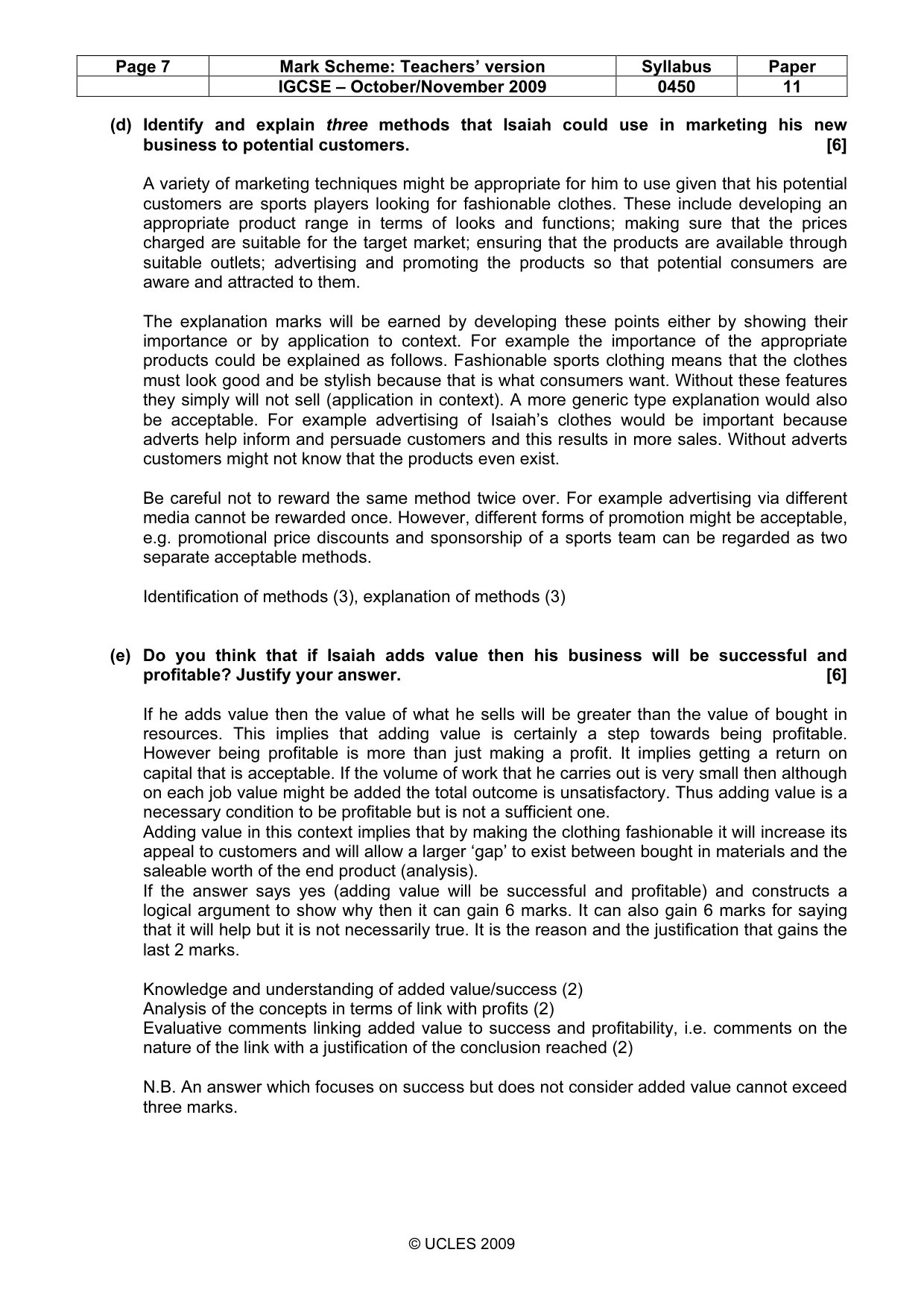
Page 6 Mark Scheme: Teachers’ version Syllabus Paper IGCSE – October/November 2009 0450 11 © UCLES 2009 (e) Recommend how Reo can improve the motivation level of his employees. Justify your answer. [6] Motivation is a complex concept that is influenced by a variety of factors. Money/working conditions/intrinsic interest of the work/attitude of colleagues/working environment/the style of management are all important. Identification of methods that could be used (2) Analysis of methods showing how they work (2) Evaluative judgement incorporating a recommendation (2) For example: ‘Reo could increase the pay for his employees. He might also offer them better fringe benefits (2). Paying higher wages would make employees happy and offering better fringe benefits more valued (1). So I recommend paying more because people are motivated by the incentive of more money (1).’ All these are valid points but rather simple answer. The analysis fails to properly consider why the methods should influence motivation and the conclusion lacks proper insight into the link between motivation and pay. For example there is no consideration of the fact that money can only motivate for a time and will make little difference if people really do not enjoy their work. Thus 4 out of 6. 4 (a) Complete Table 1 above by filling in the two gaps for the restaurant business. [2] Food/skill of chef (2) Quality of cooking or something similar (such as cooking/preparation/quality of service) acceptable for second mark. (b) What is meant by ‘added value?’ [2] Added value is the difference between the cost of bought in materials and the selling price of the end product (2). The value is added by the work or processes carried out by the business. Simple answer might say “difference between costs and selling price” (this is really profit) but can be awarded 1 mark. (c) Identify and explain the importance of two factors that Isaiah should consider in deciding on the location of his business. [4] The factors to consider might be: • proximity of potential customers/suppliers (e.g. in terms of transport costs) • degree of competition • availability of suitable workers • an appropriate site in terms of facilities, cost, and size • utilities/power supply, etc. Identification (2), explanation (2) 1 mark per valid point identified and further mark for showing why the point is of importance. For example the size of the site is of importance because if it is too small it will limit what can be produced but if it was too large it would increase the costs for the business.
Mark scheme, page 7
Page 7 Mark Scheme: Teachers’ version Syllabus Paper IGCSE – October/November 2009 0450 11 © UCLES 2009 (d) Identify and explain three methods that Isaiah could use in marketing his new business to potential customers. [6] A variety of marketing techniques might be appropriate for him to use given that his potential customers are sports players looking for fashionable clothes. These include developing an appropriate product range in terms of looks and functions; making sure that the prices charged are suitable for the target market; ensuring that the products are available through suitable outlets; advertising and promoting the products so that potential consumers are aware and attracted to them. The explanation marks will be earned by developing these points either by showing their importance or by application to context. For example the importance of the appropriate products could be explained as follows. Fashionable sports clothing means that the clothes must look good and be stylish because that is what consumers want. Without these features they simply will not sell (application in context). A more generic type explanation would also be acceptable. For example advertising of Isaiah’s clothes would be important because adverts help inform and persuade customers and this results in more sales. Without adverts customers might not know that the products even exist. Be careful not to reward the same method twice over. For example advertising via different media cannot be rewarded once. However, different forms of promotion might be acceptable, e.g. promotional price discounts and sponsorship of a sports team can be regarded as two separate acceptable methods. Identification of methods (3), explanation of methods (3) (e) Do you think that if Isaiah adds value then his business will be successful and profitable? Justify your answer. [6] If he adds value then the value of what he sells will be greater than the value of bought in resources. This implies that adding value is certainly a step towards being profitable. However being profitable is more than just making a profit. It implies getting a return on capital that is acceptable. If the volume of work that he carries out is very small then although on each job value might be added the total outcome is unsatisfactory. Thus adding value is a necessary condition to be profitable but is not a sufficient one. Adding value in this context implies that by making the clothing fashionable it will increase its appeal to customers and will allow a larger ‘gap’ to exist between bought in materials and the saleable worth of the end product (analysis). If the answer says yes (adding value will be successful and profitable) and constructs a logical argument to show why then it can gain 6 marks. It can also gain 6 marks for saying that it will help but it is not necessarily true. It is the reason and the justification that gains the last 2 marks. Knowledge and understanding of added value/success (2) Analysis of the concepts in terms of link with profits (2) Evaluative comments linking added value to success and profitability, i.e. comments on the nature of the link with a justification of the conclusion reached (2) N.B. An answer which focuses on success but does not consider added value cannot exceed three marks.
Mark scheme, page 8
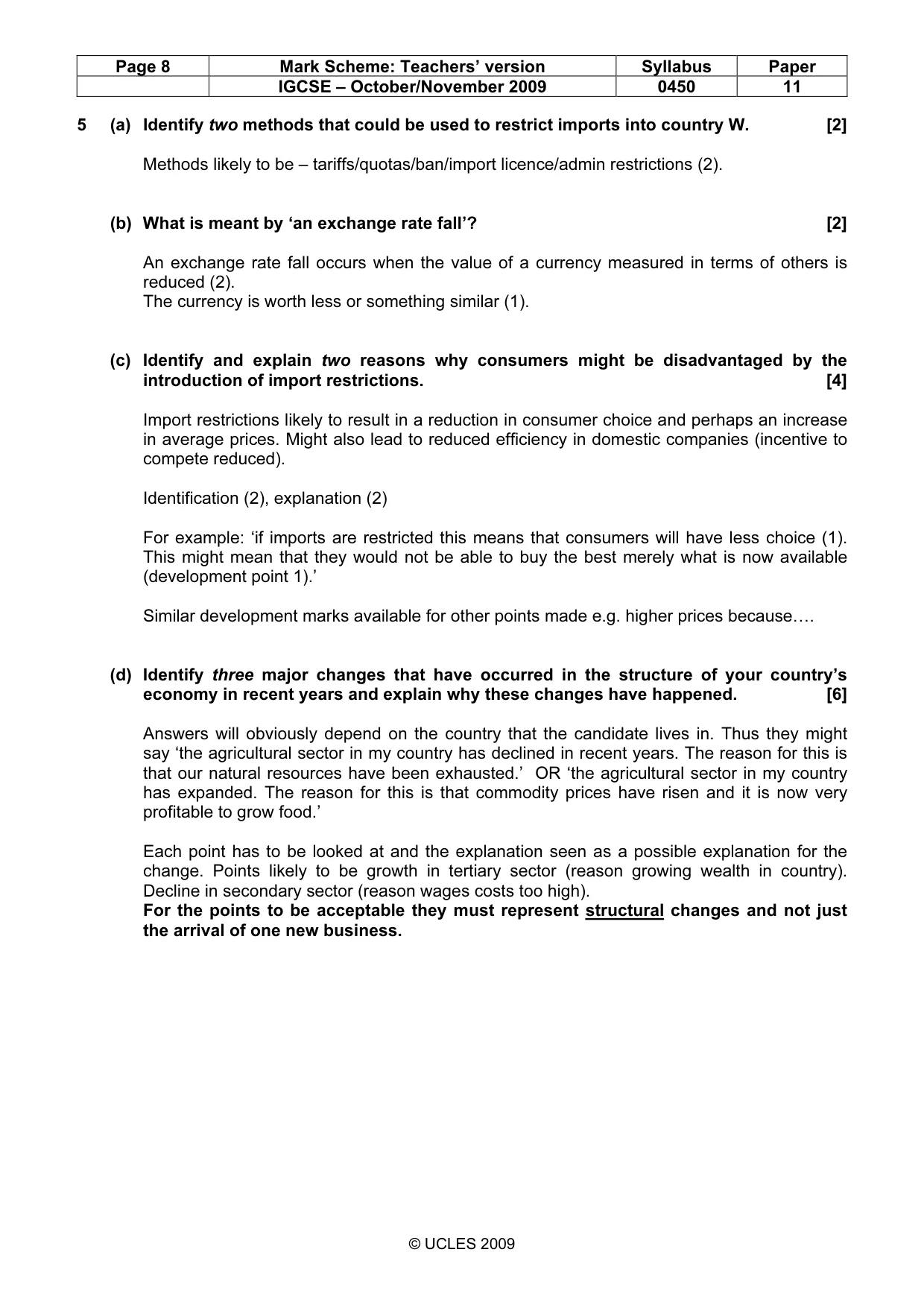
Page 8 Mark Scheme: Teachers’ version Syllabus Paper IGCSE – October/November 2009 0450 11 © UCLES 2009 5 (a) Identify two methods that could be used to restrict imports into country W. [2] Methods likely to be – tariffs/quotas/ban/import licence/admin restrictions (2). (b) What is meant by ‘an exchange rate fall’? [2] An exchange rate fall occurs when the value of a currency measured in terms of others is reduced (2). The currency is worth less or something similar (1). (c) Identify and explain two reasons why consumers might be disadvantaged by the introduction of import restrictions. [4] Import restrictions likely to result in a reduction in consumer choice and perhaps an increase in average prices. Might also lead to reduced efficiency in domestic companies (incentive to compete reduced). Identification (2), explanation (2) For example: ‘if imports are restricted this means that consumers will have less choice (1). This might mean that they would not be able to buy the best merely what is now available (development point 1).’ Similar development marks available for other points made e.g. higher prices because…. (d) Identify three major changes that have occurred in the structure of your country’s economy in recent years and explain why these changes have happened. [6] Answers will obviously depend on the country that the candidate lives in. Thus they might say ‘the agricultural sector in my country has declined in recent years. The reason for this is that our natural resources have been exhausted.’ OR ‘the agricultural sector in my country has expanded. The reason for this is that commodity prices have risen and it is now very profitable to grow food.’ Each point has to be looked at and the explanation seen as a possible explanation for the change. Points likely to be growth in tertiary sector (reason growing wealth in country). Decline in secondary sector (reason wages costs too high). For the points to be acceptable they must represent structural changes and not just the arrival of one new business.
Mark scheme, page 9
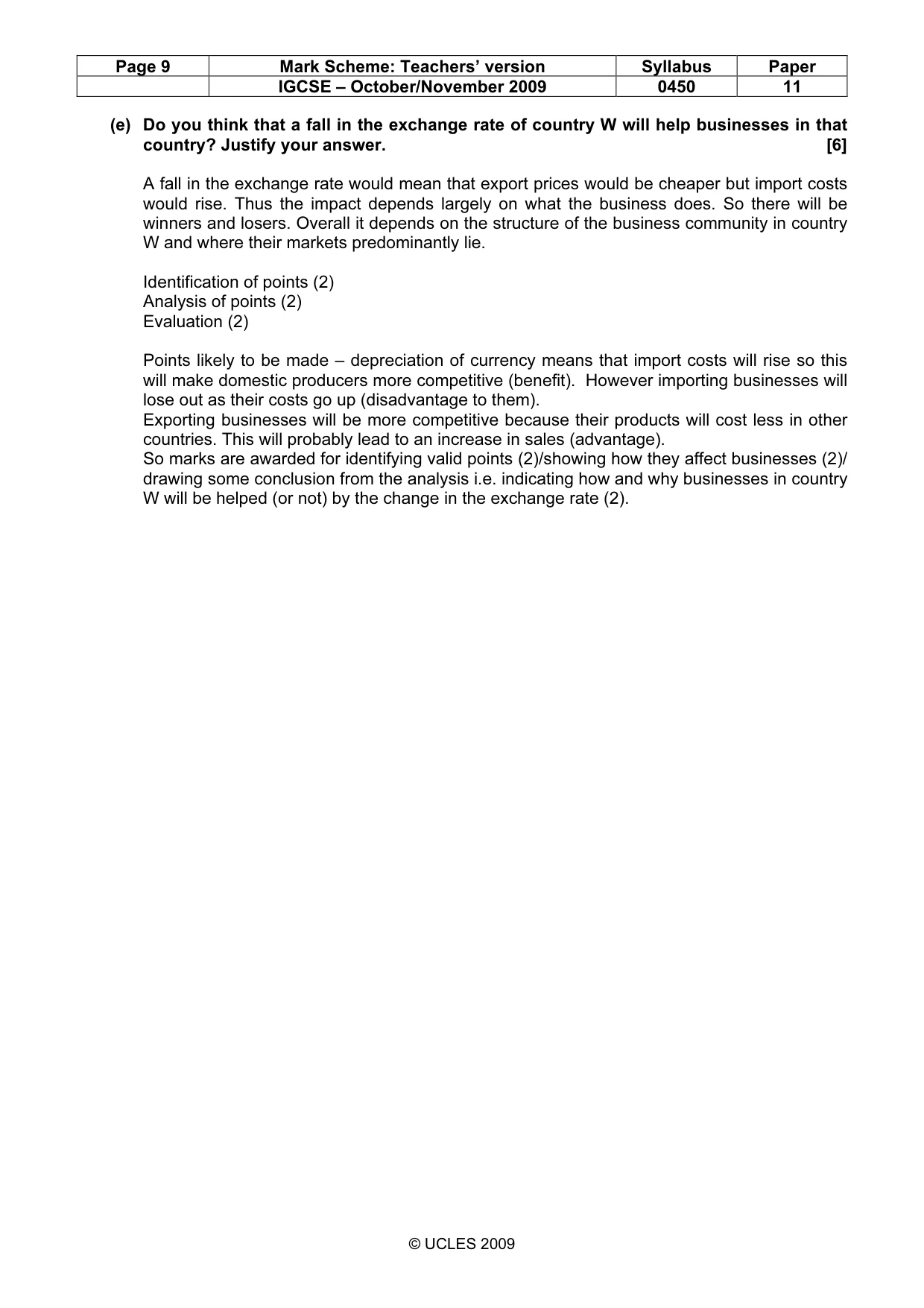
Page 9 Mark Scheme: Teachers’ version Syllabus Paper IGCSE – October/November 2009 0450 11 © UCLES 2009 (e) Do you think that a fall in the exchange rate of country W will help businesses in that country? Justify your answer. [6] A fall in the exchange rate would mean that export prices would be cheaper but import costs would rise. Thus the impact depends largely on what the business does. So there will be winners and losers. Overall it depends on the structure of the business community in country W and where their markets predominantly lie. Identification of points (2) Analysis of points (2) Evaluation (2) Points likely to be made – depreciation of currency means that import costs will rise so this will make domestic producers more competitive (benefit). However importing businesses will lose out as their costs go up (disadvantage to them). Exporting businesses will be more competitive because their products will cost less in other countries. This will probably lead to an increase in sales (advantage). So marks are awarded for identifying valid points (2)/showing how they affect businesses (2)/ drawing some conclusion from the analysis i.e. indicating how and why businesses in country W will be helped (or not) by the change in the exchange rate (2).
What you needed in this session
Cambridge’s own grade thresholds for 2009 Oct/Nov, Paper 1 · Variant 1. A higher threshold means an easier paper — the bar moves with how the cohort did.