Cambridge IGCSE Business Studies 0450 — 2009 May/June Paper 1 · Variant 1
0450/11/M/J/09
The question paper and its mark scheme, free to read here and free to download. This is Cambridge’s own paper, exactly as it was sat.
Question paper25 pages


Mark scheme21 pages
Answers below. Sit the paper first if you are practising.
Paper as text
Question paper, page 1
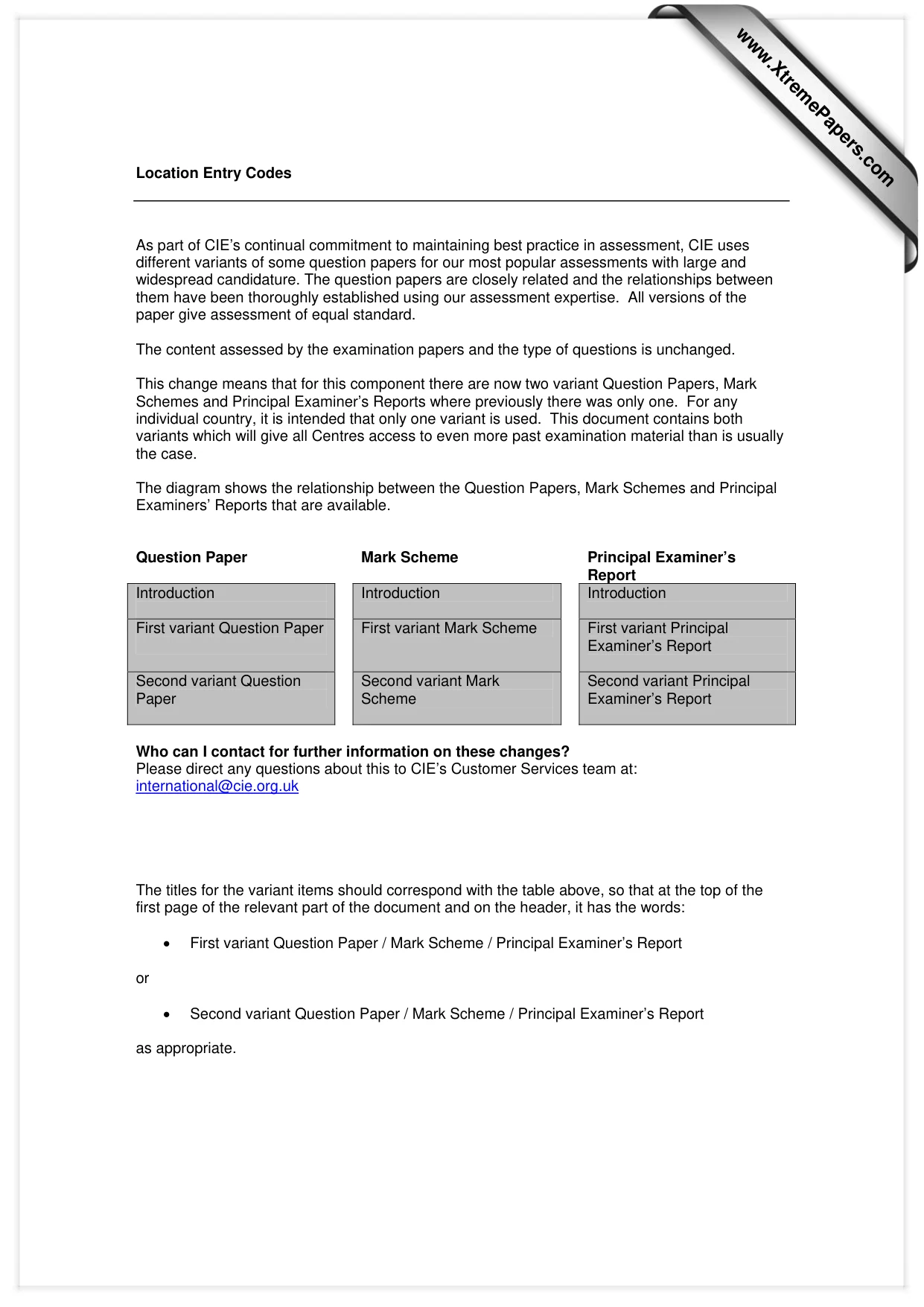
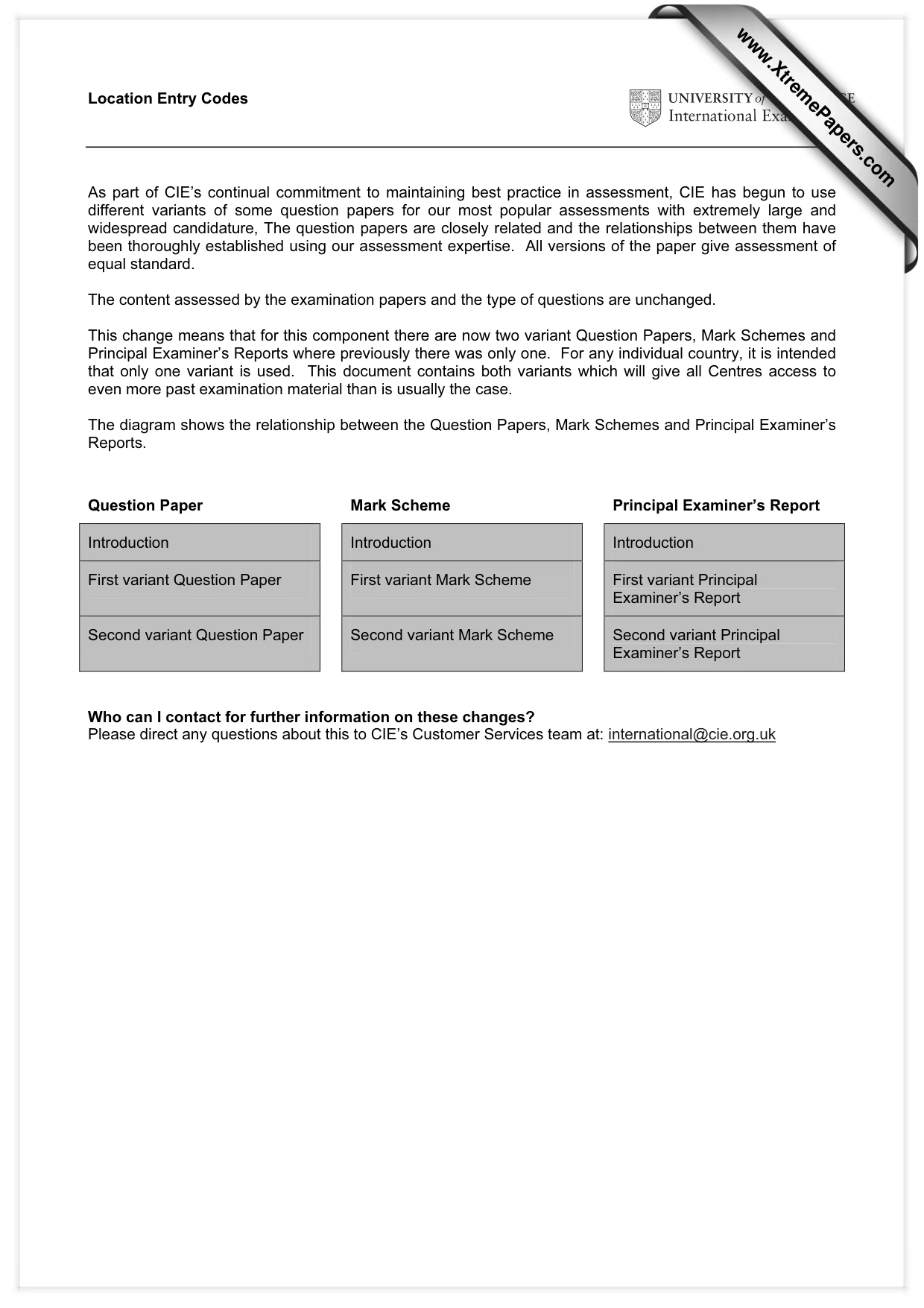
Location Entry Codes As part of CIE’s continual commitment to maintaining best practice in assessment, CIE uses different variants of some question papers for our most popular assessments with large and widespread candidature. The question papers are closely related and the relationships between them have been thoroughly established using our assessment expertise. All versions of the paper give assessment of equal standard. The content assessed by the examination papers and the type of questions is unchanged. This change means that for this component there are now two variant Question Papers, Mark Schemes and Principal Examiner’s Reports where previously there was only one. For any individual country, it is intended that only one variant is used. This document contains both variants which will give all Centres access to even more past examination material than is usually the case. The diagram shows the relationship between the Question Papers, Mark Schemes and Principal Examiners’ Reports that are available. Question Paper Mark Scheme Principal Examiner’s Report Introduction Introduction Introduction First variant Question Paper First variant Mark Scheme First variant Principal Examiner’s Report Second variant Question Paper Second variant Mark Scheme Second variant Principal Examiner’s Report Who can I contact for further information on these changes? Please direct any questions about this to CIE’s Customer Services team at: international@cie.org.uk The titles for the variant items should correspond with the table above, so that at the top of the first page of the relevant part of the document and on the header, it has the words: • First variant Question Paper / Mark Scheme / Principal Examiner’s Report or • Second variant Question Paper / Mark Scheme / Principal Examiner’s Report as appropriate. www.XtremePapers.com
Question paper, page 2
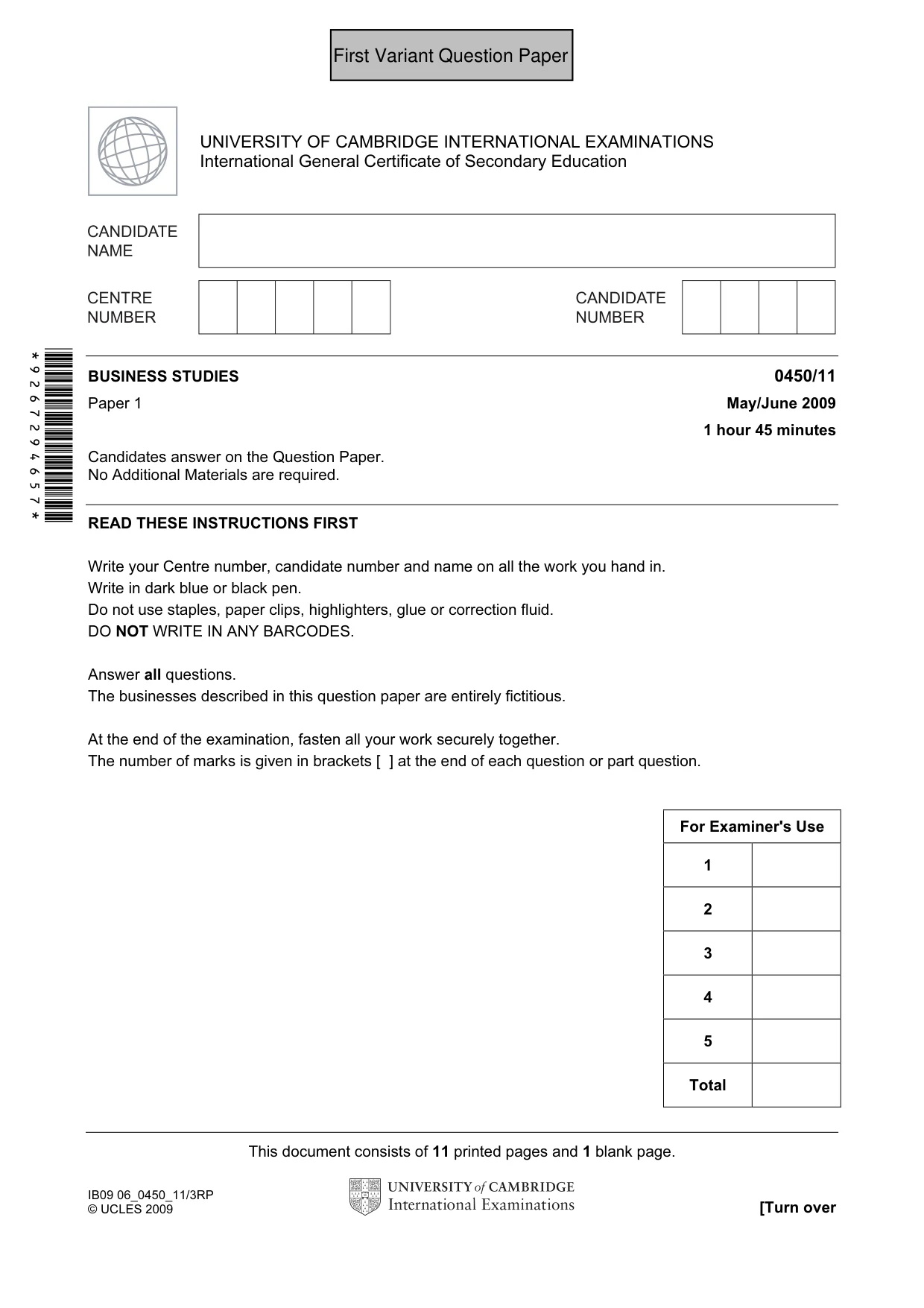
This document consists of 11 printed pages and 1 blank page. IB09 06_0450_11/3RP © UCLES 2009 [Turn over *9267294657* For Examiner's Use 1 2 3 4 5 Total UNIVERSITY OF CAMBRIDGE INTERNATIONAL EXAMINATIONS International General Certificate of Secondary Education BUSINESS STUDIES 0450/11 Paper 1 May/June 2009 1 hour 45 minutes Candidates answer on the Question Paper. No Additional Materials are required. READ THESE INSTRUCTIONS FIRST Write your Centre number, candidate number and name on all the work you hand in. Write in dark blue or black pen. Do not use staples, paper clips, highlighters, glue or correction fluid. DO NOT WRITE IN ANY BARCODES. Answer all questions. The businesses described in this question paper are entirely fictitious. At the end of the examination, fasten all your work securely together. The number of marks is given in brackets [ ] at the end of each question or part question. First Variant Question Paper
Question paper, page 3
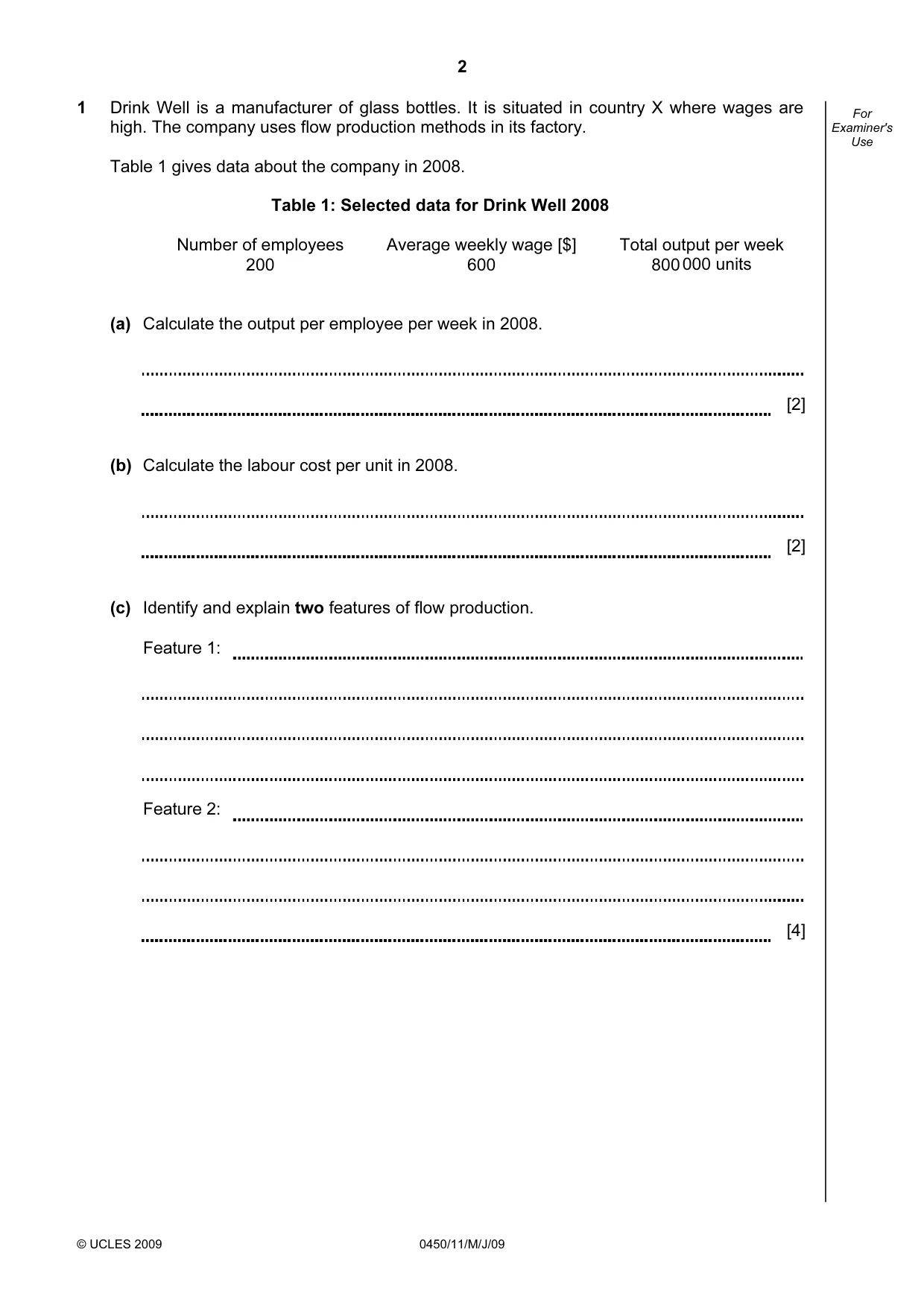
2 © UCLES 2009 0450/11/M/J/09 For Examiner's Use 1 Drink Well is a manufacturer of glass bottles. It is situated in country X where wages are high. The company uses flow production methods in its factory. Table 1 gives data about the company in 2008. Table 1: Selected data for Drink Well 2008 Number of employees Average weekly wage [$] Total output per week 200 600 800 000 units (a) Calculate the output per employee per week in 2008. [2] (b) Calculate the labour cost per unit in 2008. [2] (c) Identify and explain two features of flow production. Feature 1: Feature 2: [4]
Question paper, page 4
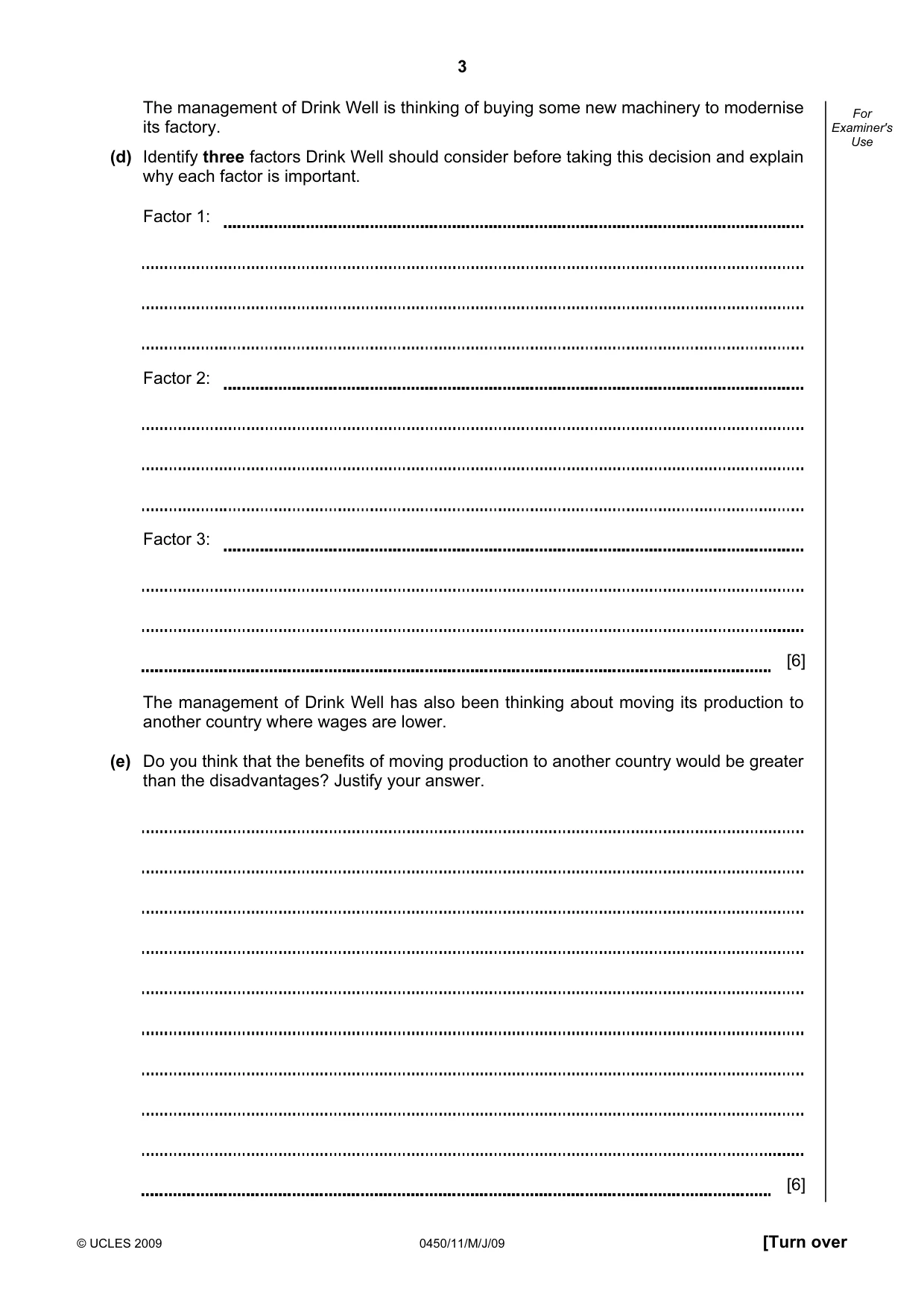
3 © UCLES 2009 0450/11/M/J/09 [Turn over For Examiner's Use The management of Drink Well is thinking of buying some new machinery to modernise its factory. (d) Identify three factors Drink Well should consider before taking this decision and explain why each factor is important. Factor 1: Factor 2: Factor 3: [6] The management of Drink Well has also been thinking about moving its production to another country where wages are lower. (e) Do you think that the benefits of moving production to another country would be greater than the disadvantages? Justify your answer. [6]
Question paper, page 5
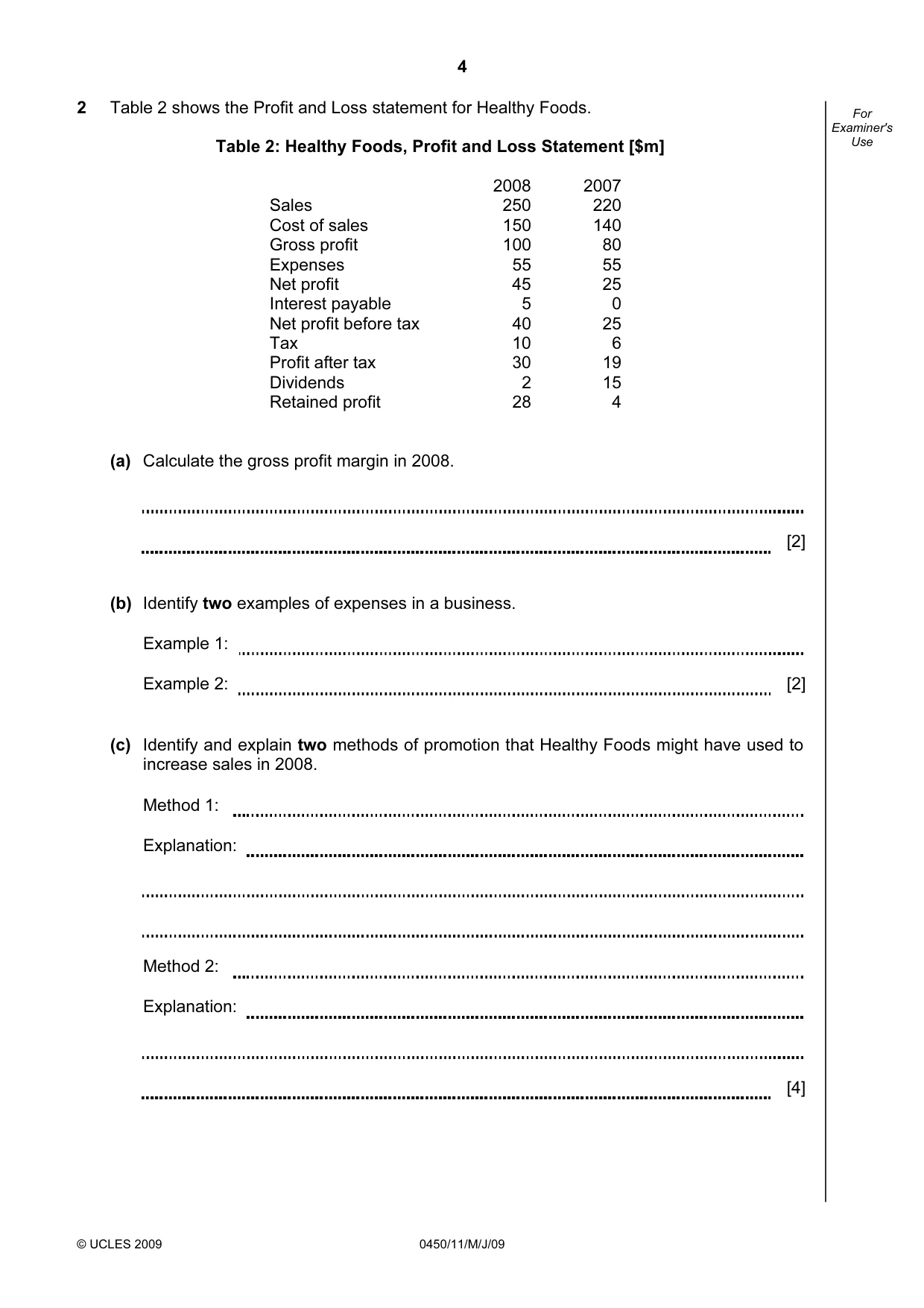
4 © UCLES 2009 0450/11/M/J/09 For Examiner's Use 2 Table 2 shows the Profit and Loss statement for Healthy Foods. Table 2: Healthy Foods, Profit and Loss Statement [$m] 2008 2007 Sales 250 220 Cost of sales 150 140 Gross profit 100 80 Expenses 55 55 Net profit 45 25 Interest payable 5 0 Net profit before tax 40 25 Tax 10 6 Profit after tax 30 19 Dividends 2 15 Retained profit 28 4 (a) Calculate the gross profit margin in 2008. [2] (b) Identify two examples of expenses in a business. Example 1: Example 2: [2] (c) Identify and explain two methods of promotion that Healthy Foods might have used to increase sales in 2008. Method 1: Explanation: Method 2: Explanation: [4]
Question paper, page 6
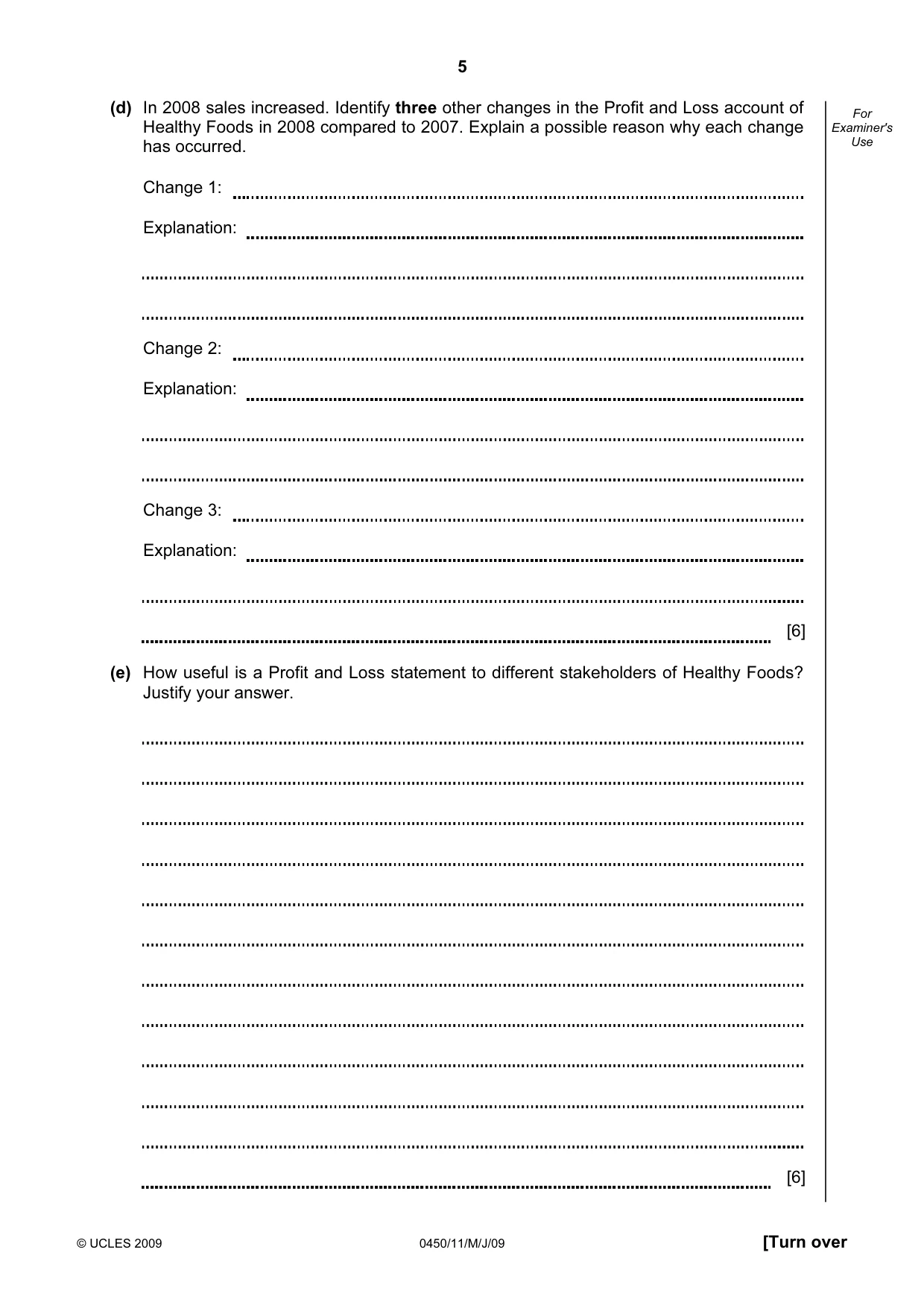
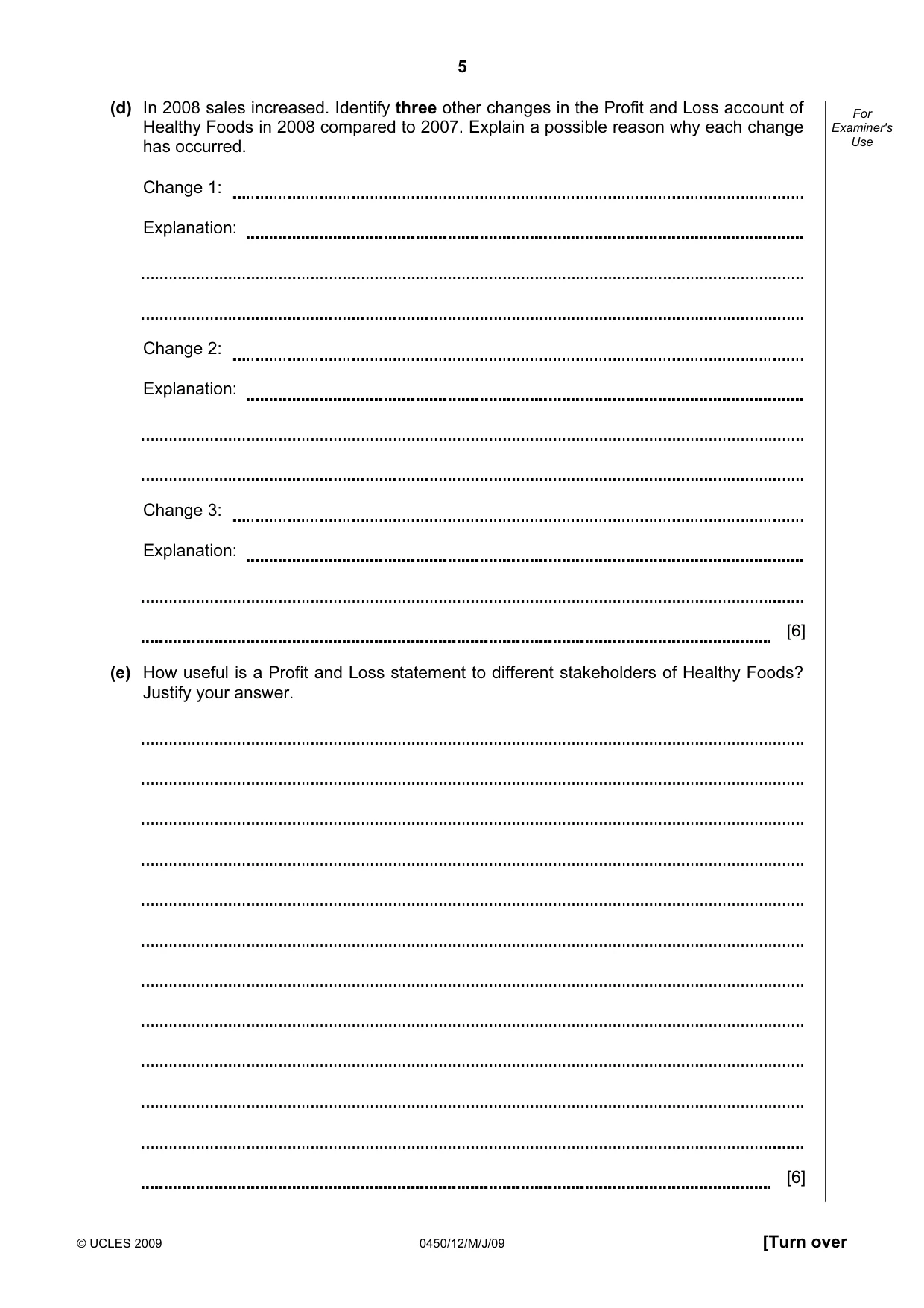
5 © UCLES 2009 0450/11/M/J/09 [Turn over For Examiner's Use (d) In 2008 sales increased. Identify three other changes in the Profit and Loss account of Healthy Foods in 2008 compared to 2007. Explain a possible reason why each change has occurred. Change 1: Explanation: Change 2: Explanation: Change 3: Explanation: [6] (e) How useful is a Profit and Loss statement to different stakeholders of Healthy Foods? Justify your answer. [6]
Question paper, page 7
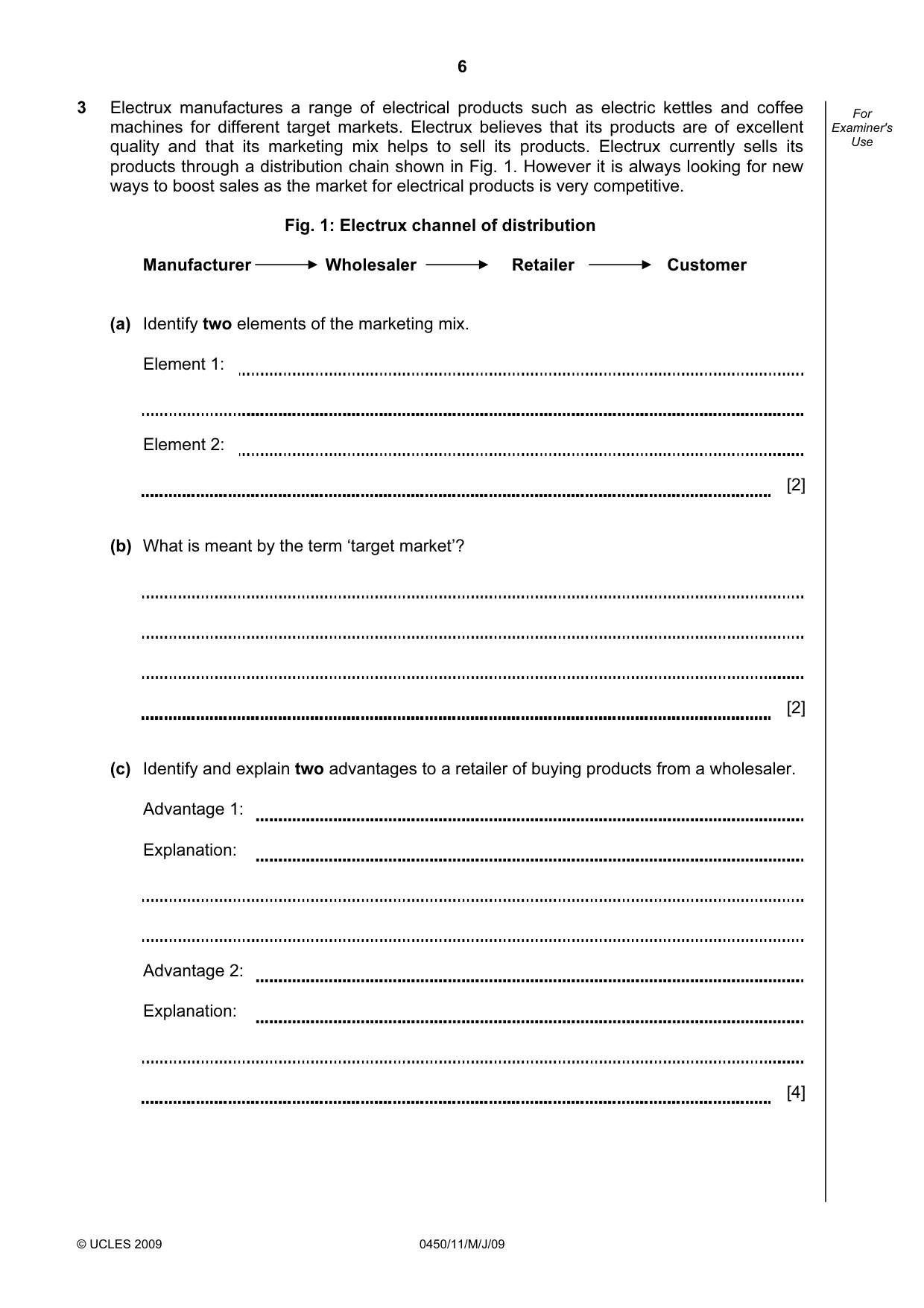
6 © UCLES 2009 0450/11/M/J/09 For Examiner's Use 3 Electrux manufactures a range of electrical products such as electric kettles and coffee machines for different target markets. Electrux believes that its products are of excellent quality and that its marketing mix helps to sell its products. Electrux currently sells its products through a distribution chain shown in Fig. 1. However it is always looking for new ways to boost sales as the market for electrical products is very competitive. Fig. 1: Electrux channel of distribution Manufacturer Wholesaler Retailer Customer (a) Identify two elements of the marketing mix. Element 1: Element 2: [2] (b) What is meant by the term ‘target market’? [2] (c) Identify and explain two advantages to a retailer of buying products from a wholesaler. Advantage 1: Explanation: Advantage 2: Explanation: [4]
Question paper, page 8
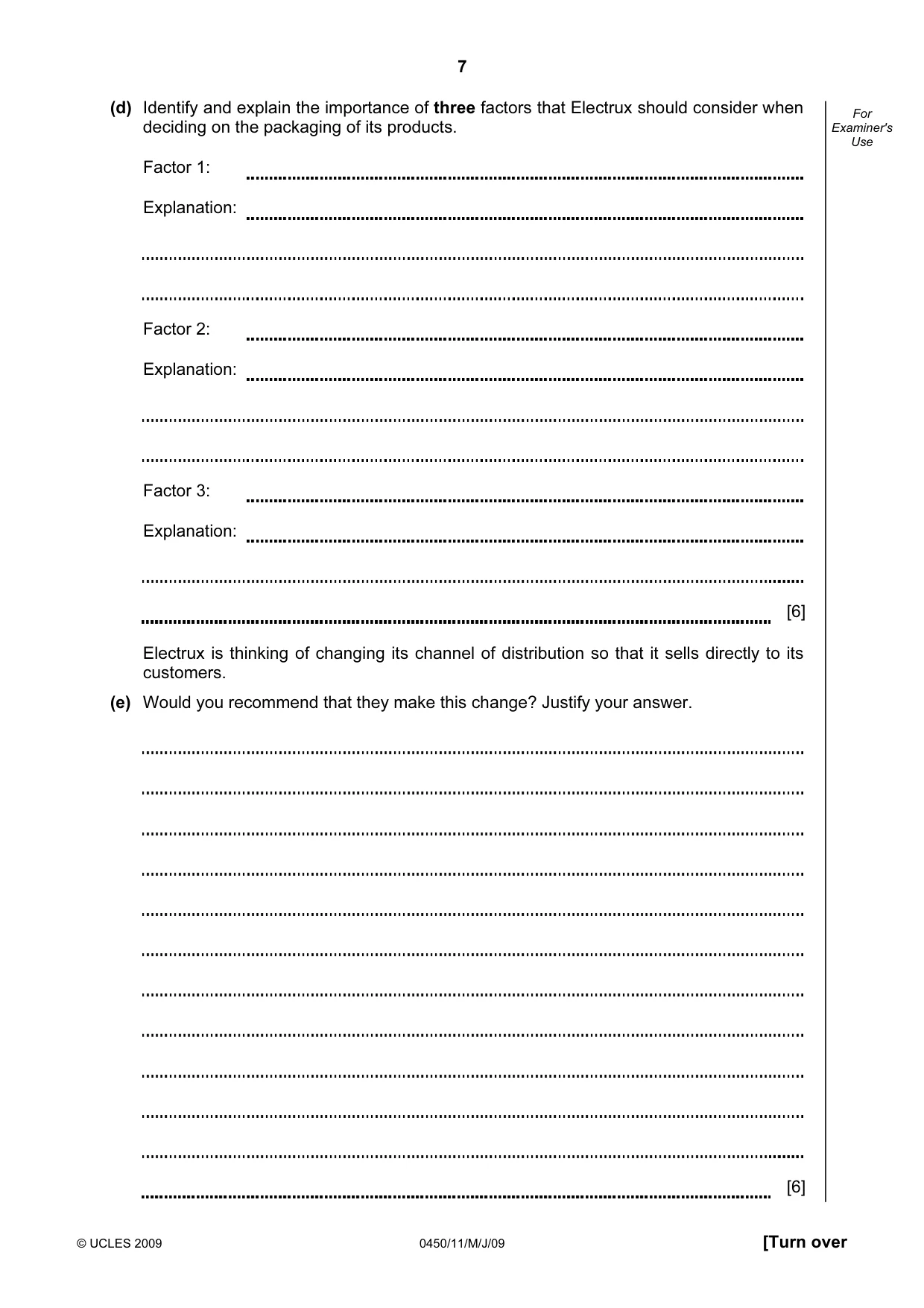
7 © UCLES 2009 0450/11/M/J/09 [Turn over For Examiner's Use (d) Identify and explain the importance of three factors that Electrux should consider when deciding on the packaging of its products. Factor 1: Explanation: Factor 2: Explanation: Factor 3: Explanation: [6] Electrux is thinking of changing its channel of distribution so that it sells directly to its customers. (e) Would you recommend that they make this change? Justify your answer. [6]
Question paper, page 9
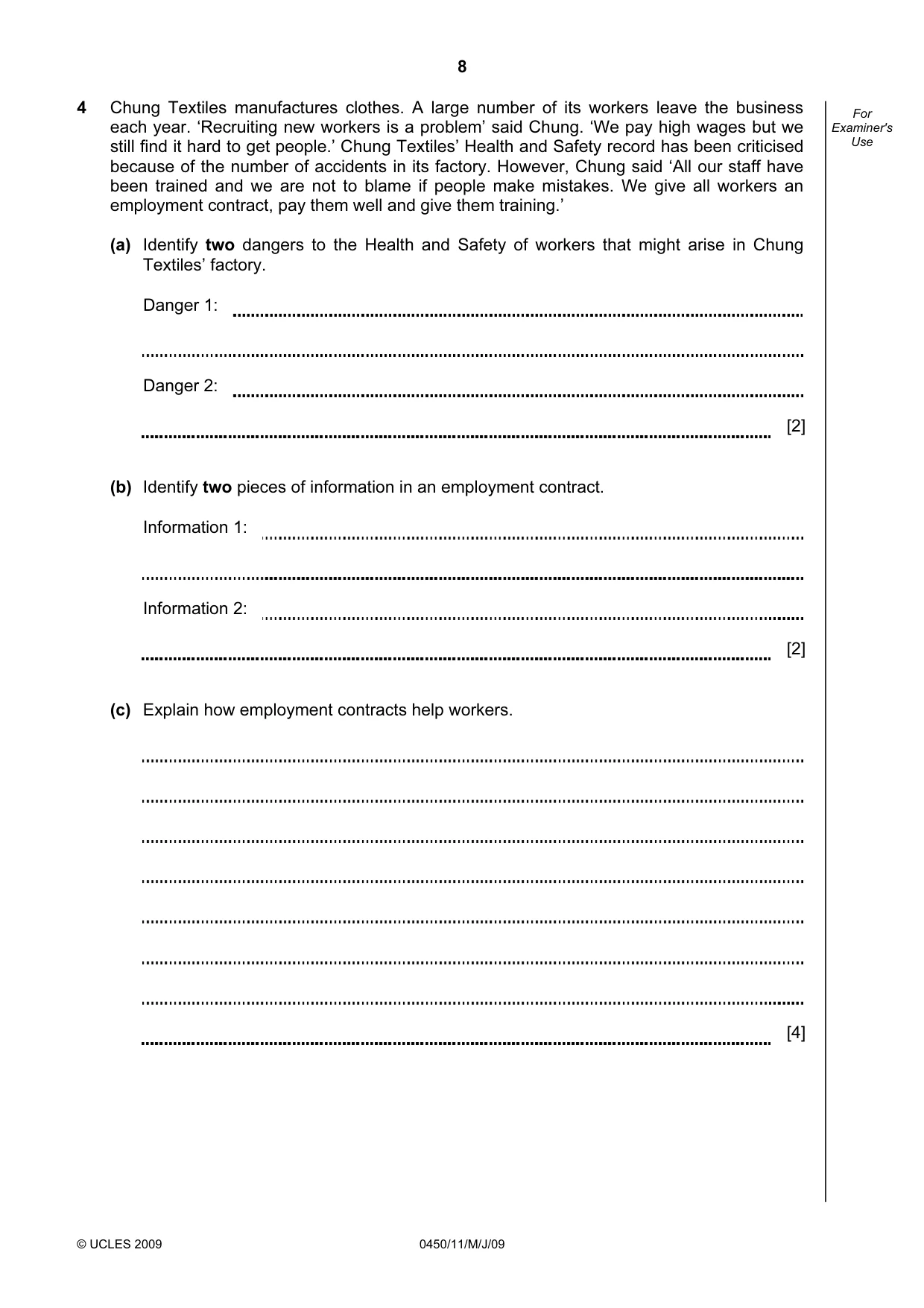
8 © UCLES 2009 0450/11/M/J/09 For Examiner's Use 4 Chung Textiles manufactures clothes. A large number of its workers leave the business each year. ‘Recruiting new workers is a problem’ said Chung. ‘We pay high wages but we still find it hard to get people.’ Chung Textiles’ Health and Safety record has been criticised because of the number of accidents in its factory. However, Chung said ‘All our staff have been trained and we are not to blame if people make mistakes. We give all workers an employment contract, pay them well and give them training.’ (a) Identify two dangers to the Health and Safety of workers that might arise in Chung Textiles’ factory. Danger 1: Danger 2: [2] (b) Identify two pieces of information in an employment contract. Information 1: Information 2: [2] (c) Explain how employment contracts help workers. [4]
Question paper, page 10
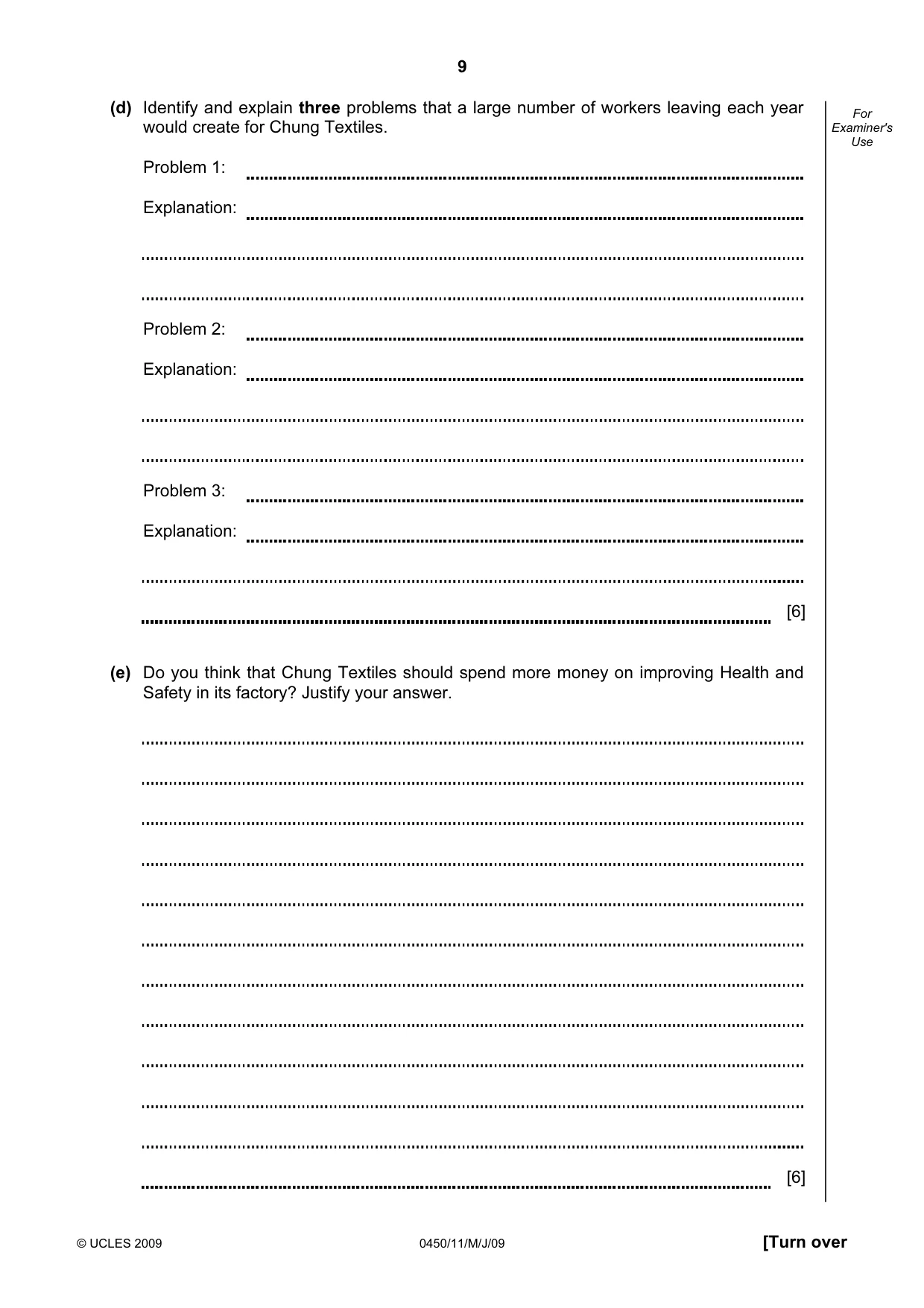
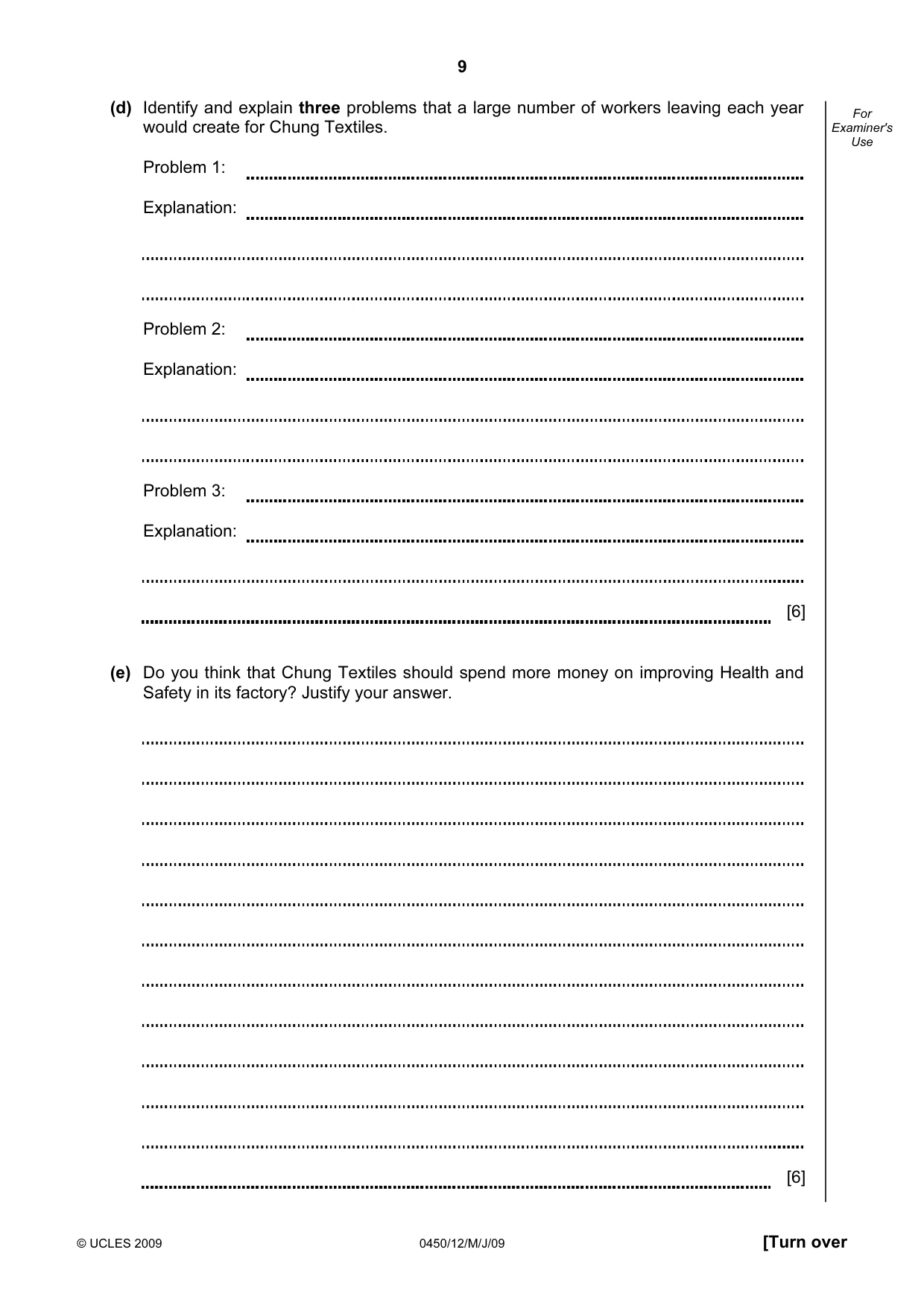
9 © UCLES 2009 0450/11/M/J/09 [Turn over For Examiner's Use (d) Identify and explain three problems that a large number of workers leaving each year would create for Chung Textiles. Problem 1: Explanation: Problem 2: Explanation: Problem 3: Explanation: [6] (e) Do you think that Chung Textiles should spend more money on improving Health and Safety in its factory? Justify your answer. [6]
Question paper, page 11
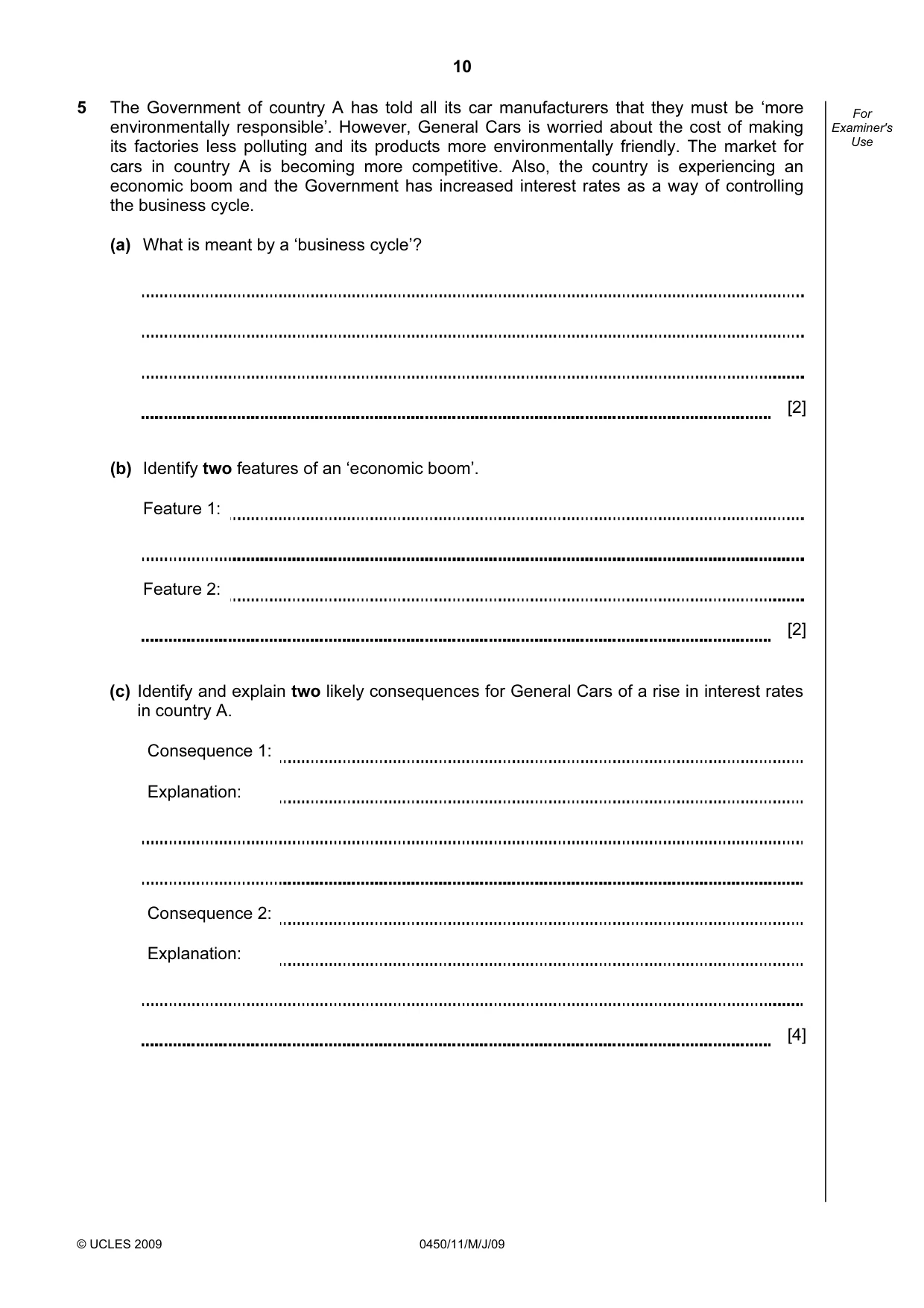
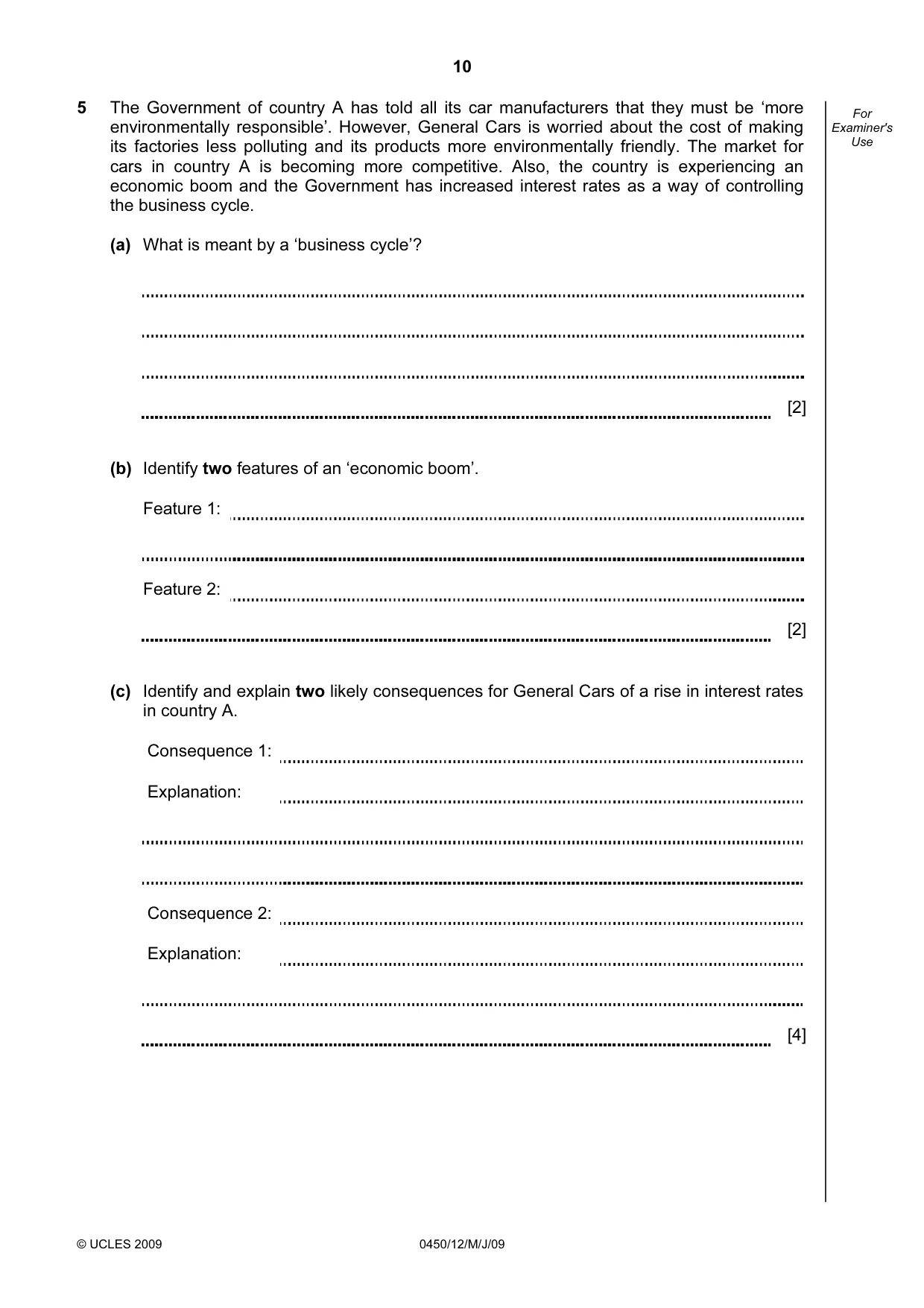
10 © UCLES 2009 0450/11/M/J/09 For Examiner's Use 5 The Government of country A has told all its car manufacturers that they must be ‘more environmentally responsible’. However, General Cars is worried about the cost of making its factories less polluting and its products more environmentally friendly. The market for cars in country A is becoming more competitive. Also, the country is experiencing an economic boom and the Government has increased interest rates as a way of controlling the business cycle. (a) What is meant by a ‘business cycle’? [2] (b) Identify two features of an ‘economic boom’. Feature 1: Feature 2: [2] (c) Identify and explain two likely consequences for General Cars of a rise in interest rates in country A. Consequence 1: Explanation: Consequence 2: Explanation: [4]
Question paper, page 12
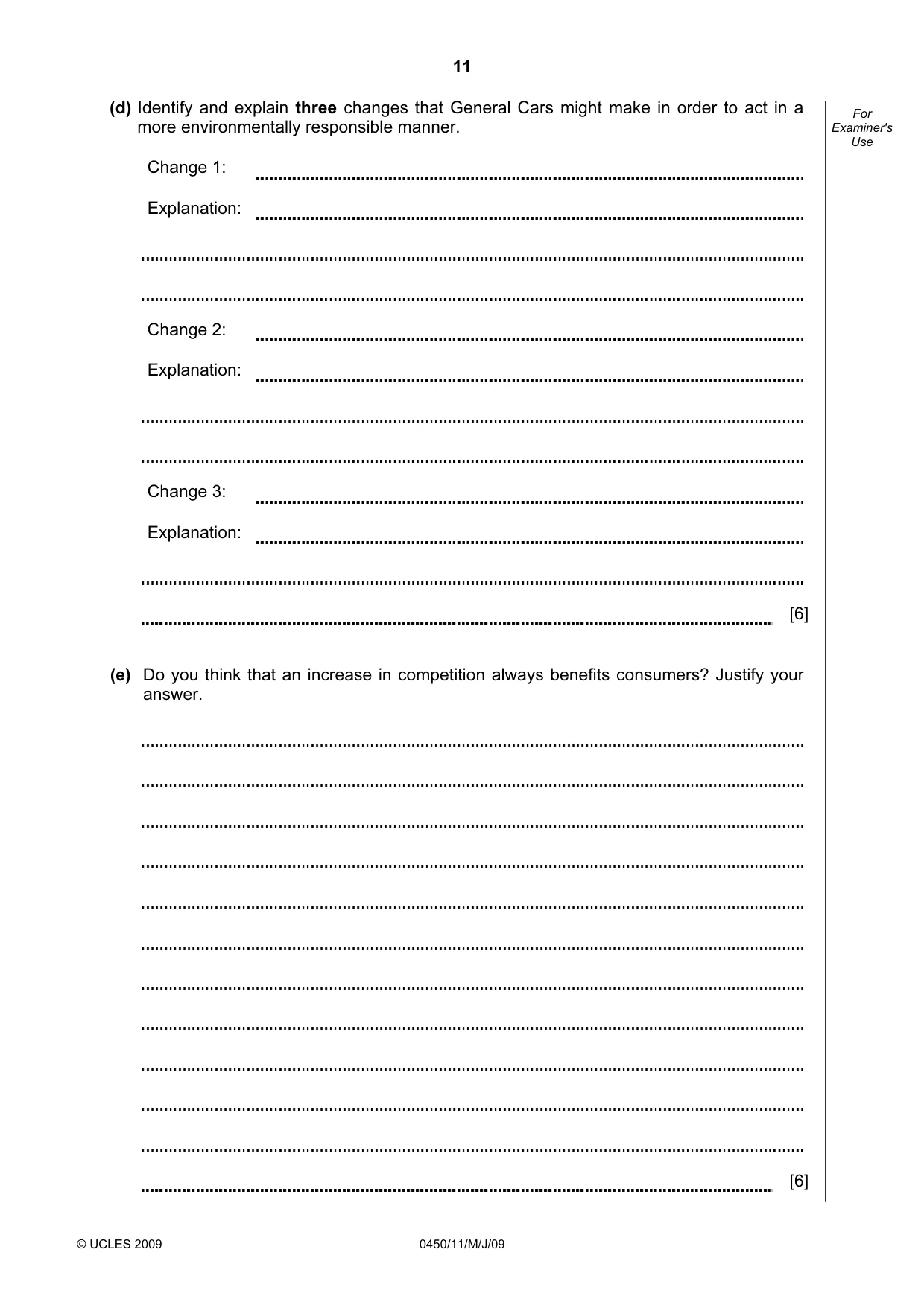
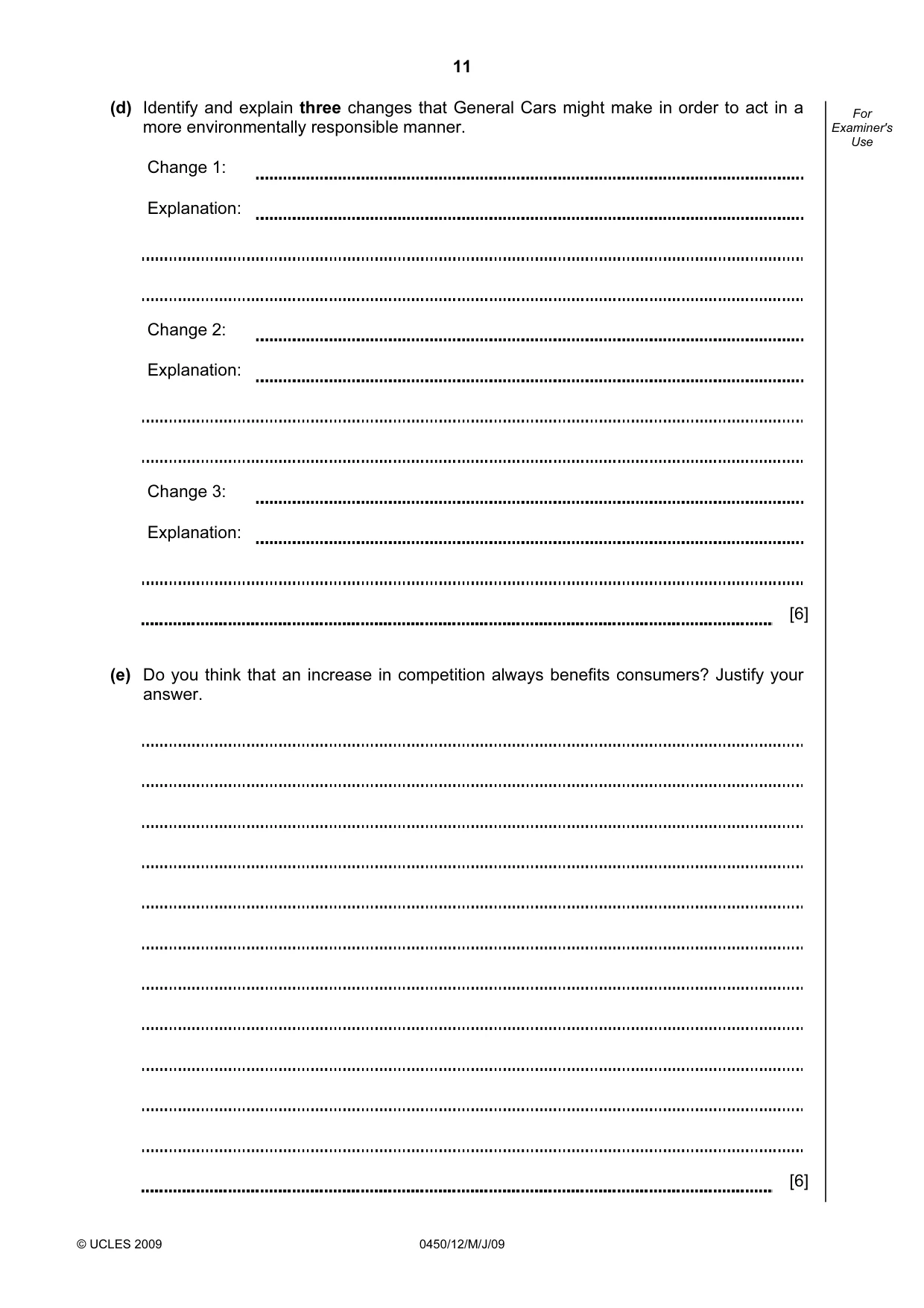
11 © UCLES 2009 0450/11/M/J/09 For Examiner's Use (d) Identify and explain three changes that General Cars might make in order to act in a more environmentally responsible manner. Change 1: Explanation: Change 2: Explanation: Change 3: Explanation: [6] (e) Do you think that an increase in competition always benefits consumers? Justify your answer. [6]
Question paper, page 13
12 BLANK PAGE Permission to reproduce items where third-party owned material protected by copyright is included has been sought and cleared where possible. Every reasonable effort has been made by the publisher (UCLES) to trace copyright holders, but if any items requiring clearance have unwittingly been included, the publisher will be pleased to make amends at the earliest possible opportunity. University of Cambridge International Examinations is part of the Cambridge Assessment Group. Cambridge Assessment is the brand name of University of Cambridge Local Examinations Syndicate (UCLES), which is itself a department of the University of Cambridge. 0450/11/M/J/09
Question paper, page 14
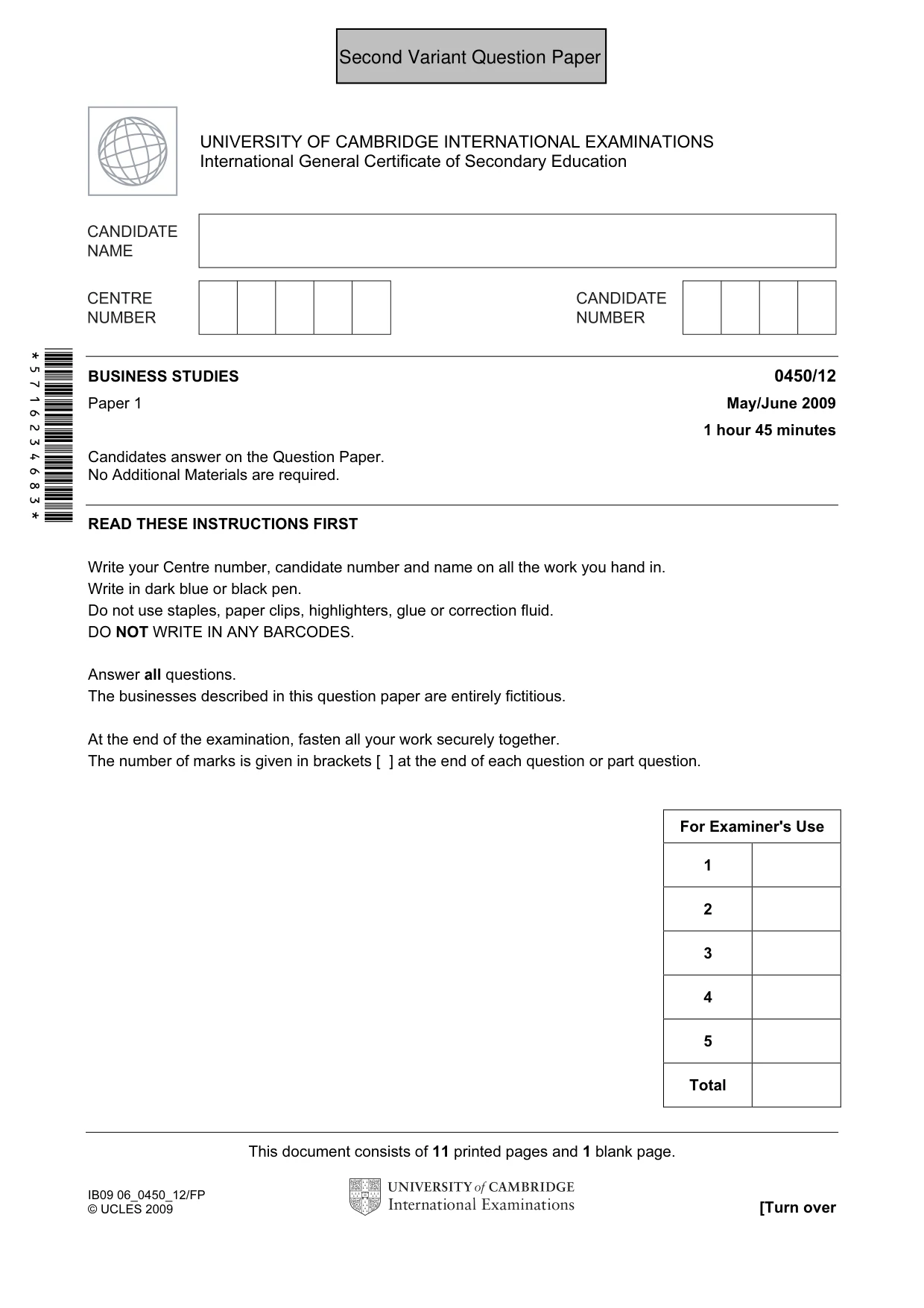
This document consists of 11 printed pages and 1 blank page. IB09 06_0450_12/FP © UCLES 2009 [Turn over *5716234683* For Examiner's Use 1 2 3 4 5 Total UNIVERSITY OF CAMBRIDGE INTERNATIONAL EXAMINATIONS International General Certificate of Secondary Education BUSINESS STUDIES 0450/12 Paper 1 May/June 2009 1 hour 45 minutes Candidates answer on the Question Paper. No Additional Materials are required. READ THESE INSTRUCTIONS FIRST Write your Centre number, candidate number and name on all the work you hand in. Write in dark blue or black pen. Do not use staples, paper clips, highlighters, glue or correction fluid. DO NOT WRITE IN ANY BARCODES. Answer all questions. The businesses described in this question paper are entirely fictitious. At the end of the examination, fasten all your work securely together. The number of marks is given in brackets [ ] at the end of each question or part question. Second Variant Question Paper
Question paper, page 15
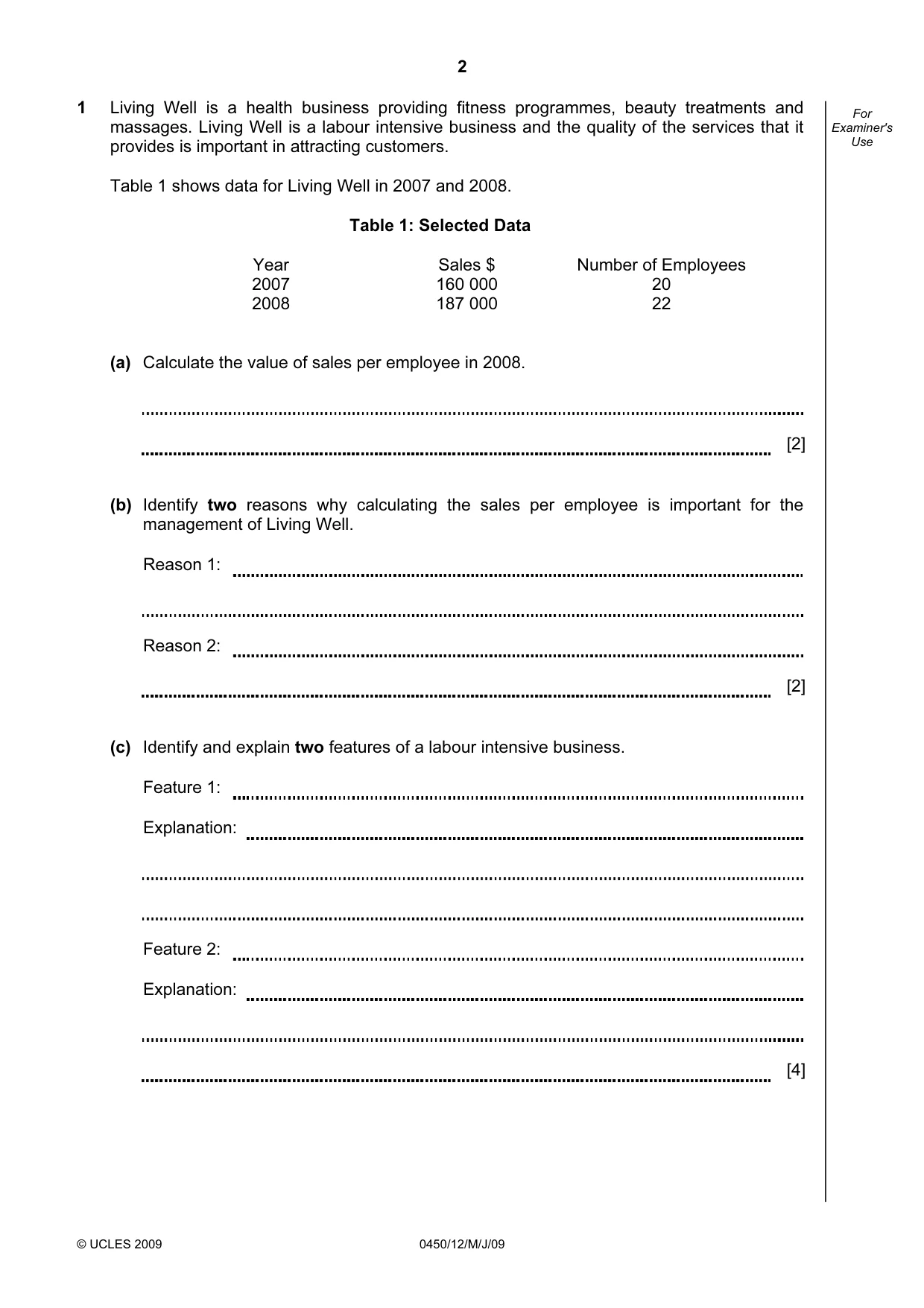
2 © UCLES 2009 0450/12/M/J/09 For Examiner's Use 1 Living Well is a health business providing fitness programmes, beauty treatments and massages. Living Well is a labour intensive business and the quality of the services that it provides is important in attracting customers. Table 1 shows data for Living Well in 2007 and 2008. Table 1: Selected Data Year Sales $ Number of Employees 2007 160 000 20 2008 187 000 22 (a) Calculate the value of sales per employee in 2008. [2] (b) Identify two reasons why calculating the sales per employee is important for the management of Living Well. Reason 1: Reason 2: [2] (c) Identify and explain two features of a labour intensive business. Feature 1: Explanation: Feature 2: Explanation: [4]
Question paper, page 16
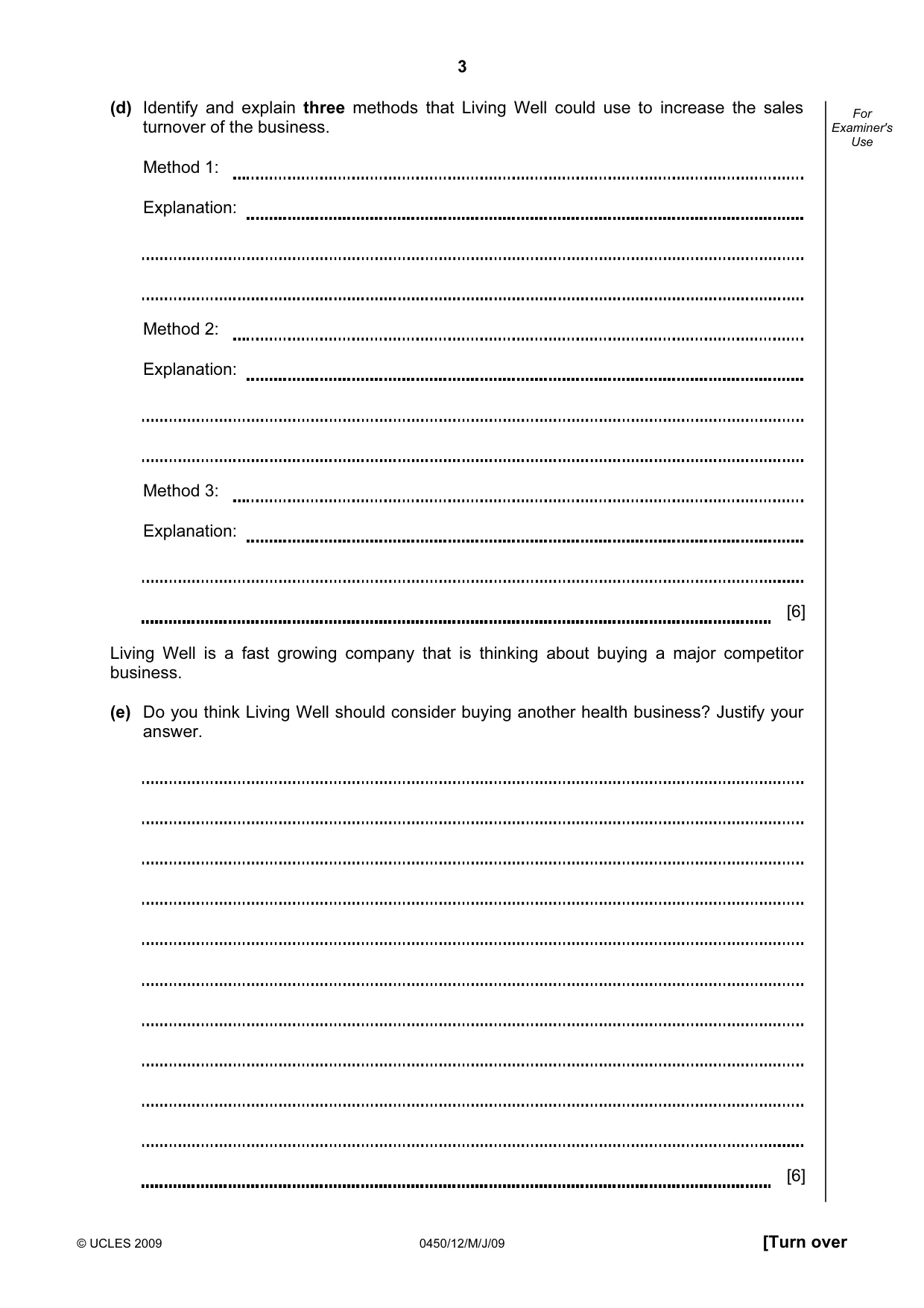
3 © UCLES 2009 0450/12/M/J/09 [Turn over For Examiner's Use (d) Identify and explain three methods that Living Well could use to increase the sales turnover of the business. Method 1: Explanation: Method 2: Explanation: Method 3: Explanation: [6] Living Well is a fast growing company that is thinking about buying a major competitor business. (e) Do you think Living Well should consider buying another health business? Justify your answer. [6]
Question paper, page 17
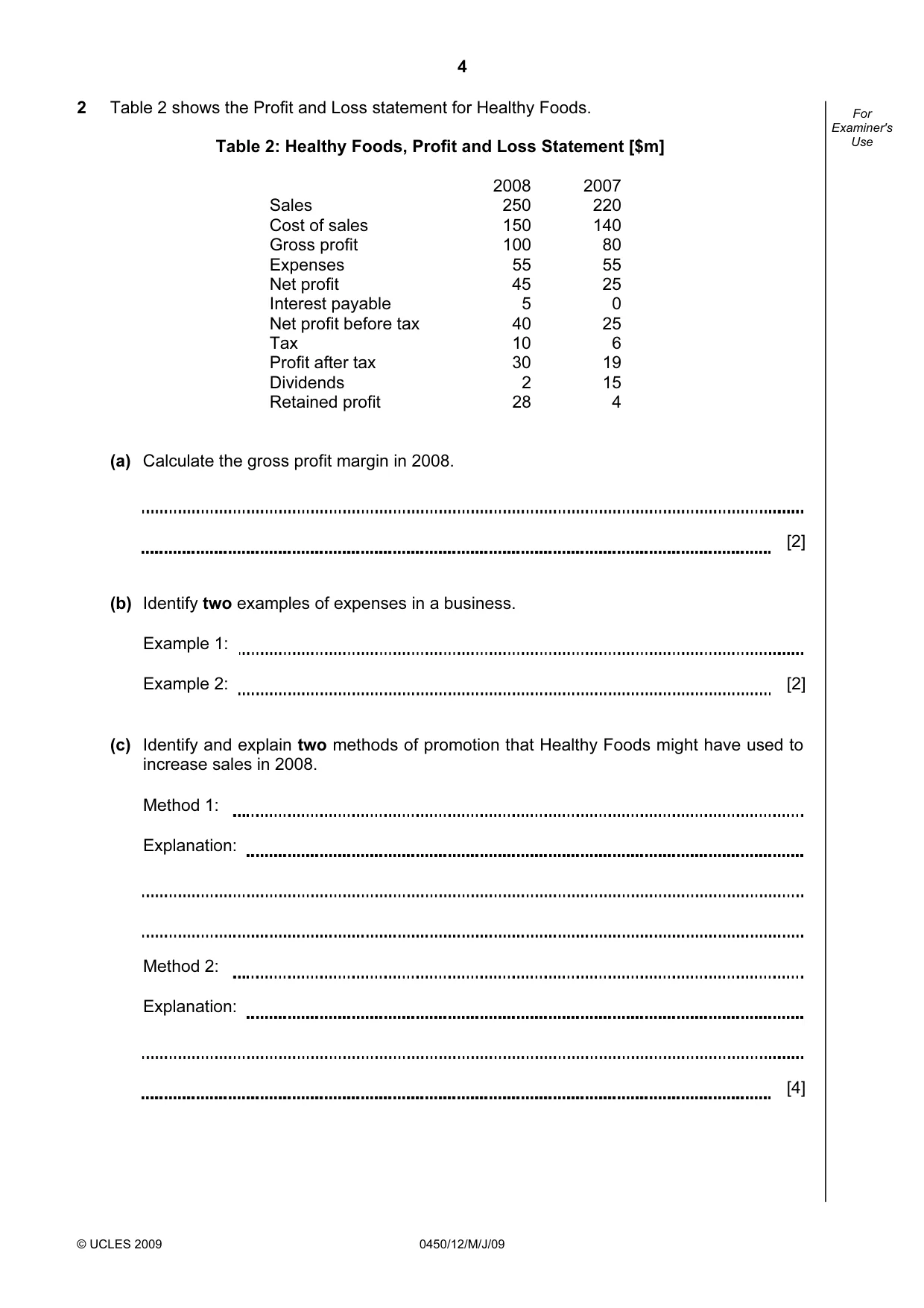
4 © UCLES 2009 0450/12/M/J/09 For Examiner's Use 2 Table 2 shows the Profit and Loss statement for Healthy Foods. Table 2: Healthy Foods, Profit and Loss Statement [$m] 2008 2007 Sales 250 220 Cost of sales 150 140 Gross profit 100 80 Expenses 55 55 Net profit 45 25 Interest payable 5 0 Net profit before tax 40 25 Tax 10 6 Profit after tax 30 19 Dividends 2 15 Retained profit 28 4 (a) Calculate the gross profit margin in 2008. [2] (b) Identify two examples of expenses in a business. Example 1: Example 2: [2] (c) Identify and explain two methods of promotion that Healthy Foods might have used to increase sales in 2008. Method 1: Explanation: Method 2: Explanation: [4]
Question paper, page 18
5 © UCLES 2009 0450/12/M/J/09 [Turn over For Examiner's Use (d) In 2008 sales increased. Identify three other changes in the Profit and Loss account of Healthy Foods in 2008 compared to 2007. Explain a possible reason why each change has occurred. Change 1: Explanation: Change 2: Explanation: Change 3: Explanation: [6] (e) How useful is a Profit and Loss statement to different stakeholders of Healthy Foods? Justify your answer. [6]
Question paper, page 19
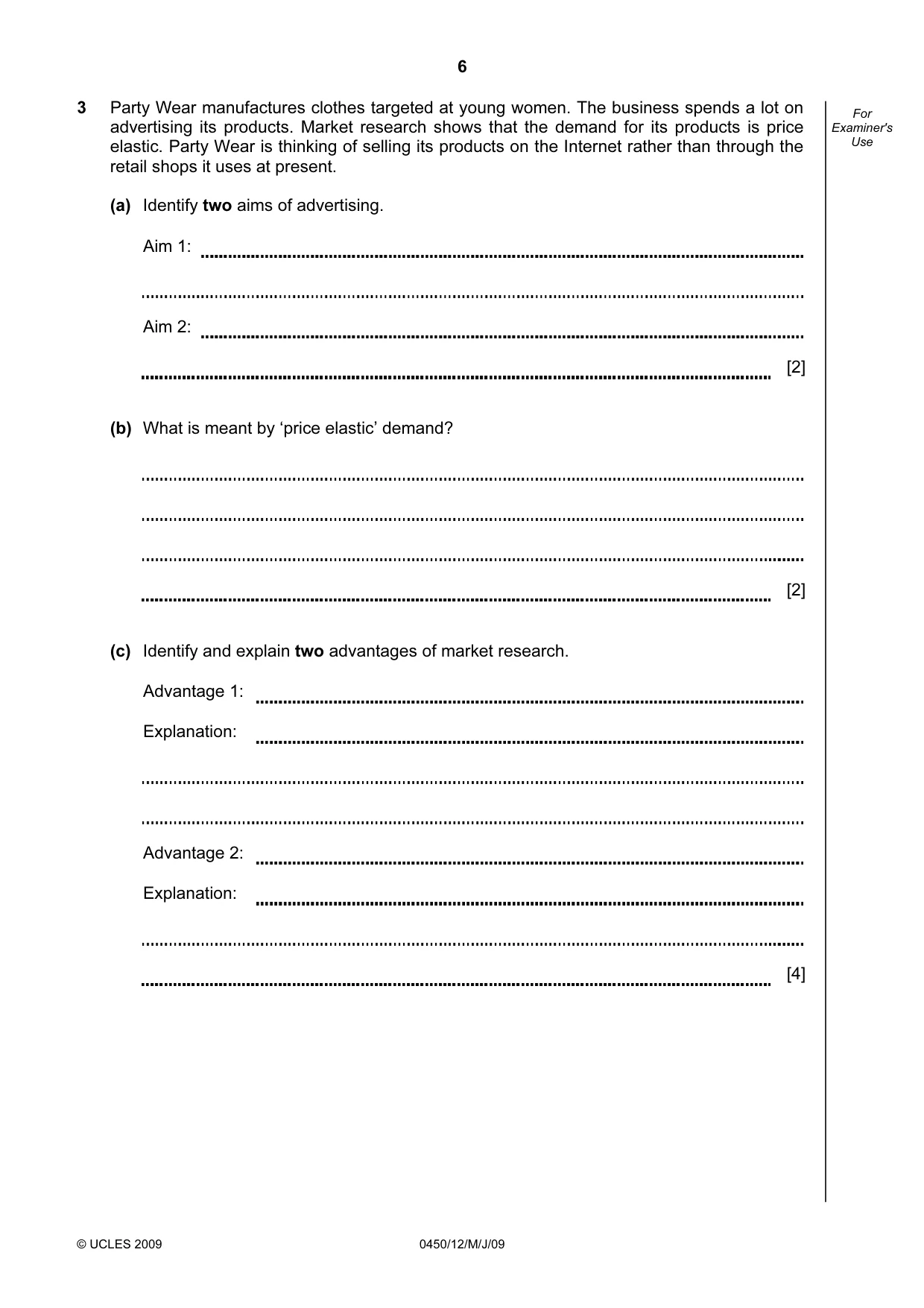
6 © UCLES 2009 0450/12/M/J/09 For Examiner's Use 3 Party Wear manufactures clothes targeted at young women. The business spends a lot on advertising its products. Market research shows that the demand for its products is price elastic. Party Wear is thinking of selling its products on the Internet rather than through the retail shops it uses at present. (a) Identify two aims of advertising. Aim 1: Aim 2: [2] (b) What is meant by ‘price elastic’ demand? [2] (c) Identify and explain two advantages of market research. Advantage 1: Explanation: Advantage 2: Explanation: [4]
Question paper, page 20
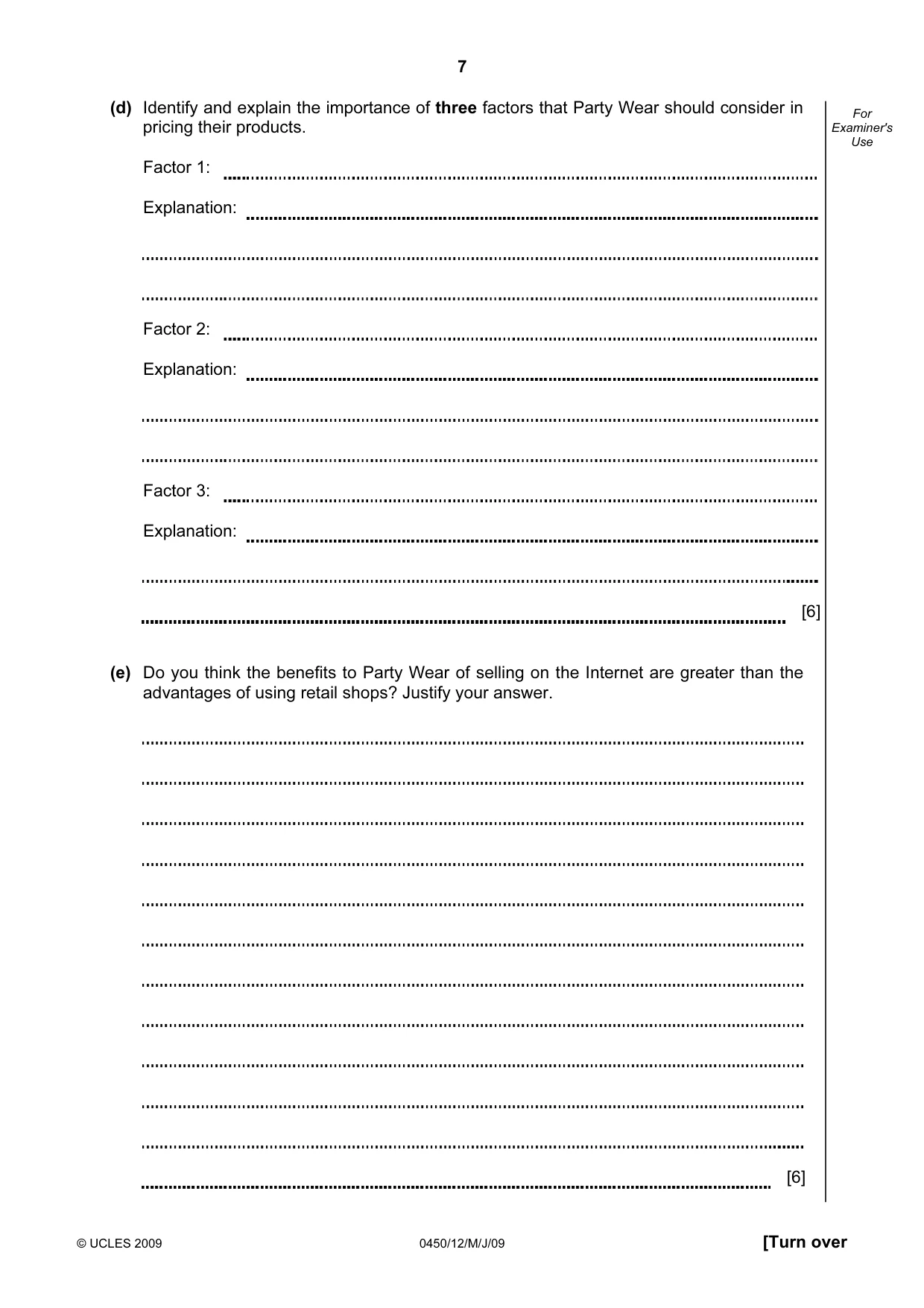
7 © UCLES 2009 0450/12/M/J/09 [Turn over For Examiner's Use (d) Identify and explain the importance of three factors that Party Wear should consider in pricing their products. Factor 1: Explanation: Factor 2: Explanation: Factor 3: Explanation: [6] (e) Do you think the benefits to Party Wear of selling on the Internet are greater than the advantages of using retail shops? Justify your answer. [6]
Question paper, page 21
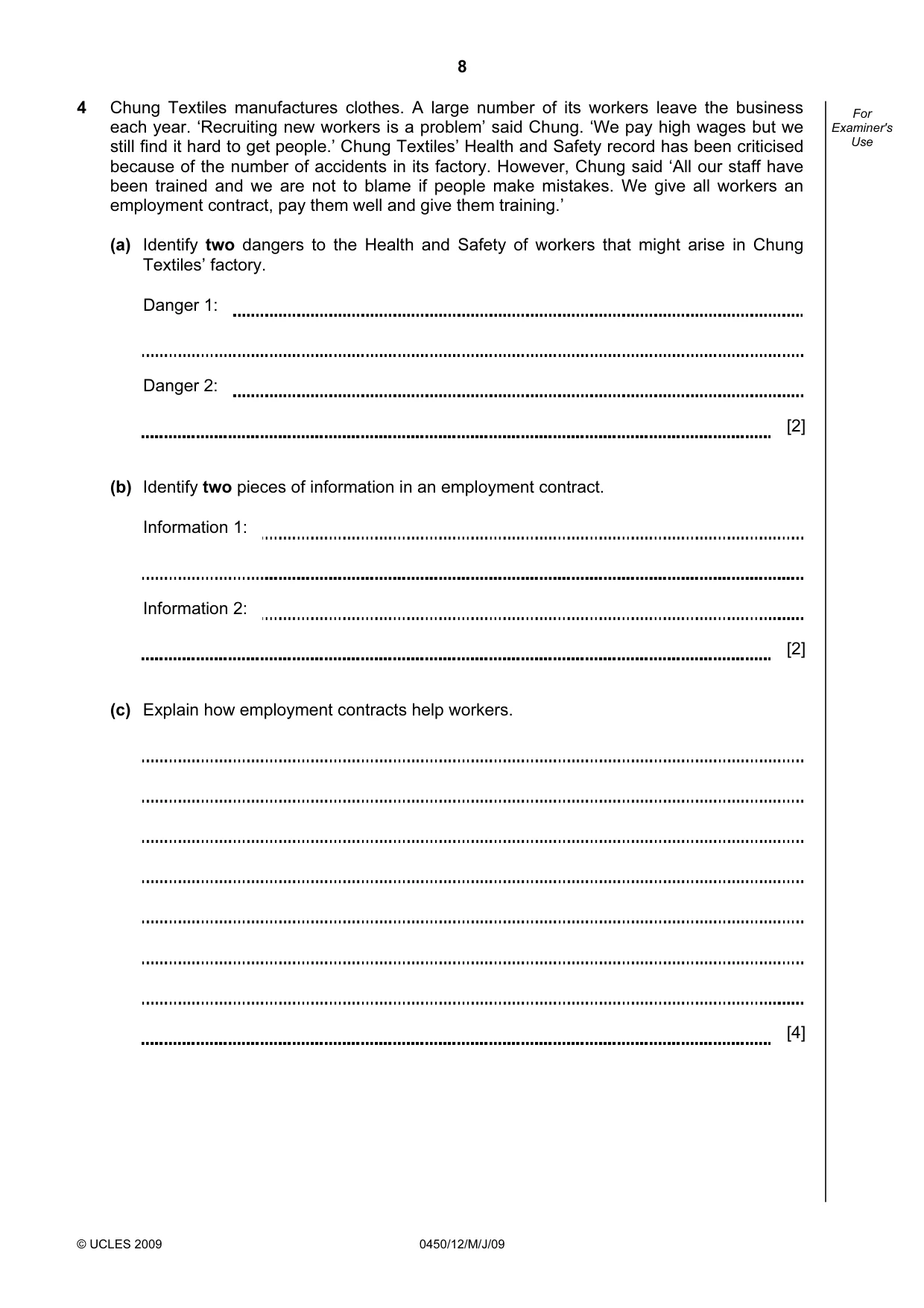
8 © UCLES 2009 0450/12/M/J/09 For Examiner's Use 4 Chung Textiles manufactures clothes. A large number of its workers leave the business each year. ‘Recruiting new workers is a problem’ said Chung. ‘We pay high wages but we still find it hard to get people.’ Chung Textiles’ Health and Safety record has been criticised because of the number of accidents in its factory. However, Chung said ‘All our staff have been trained and we are not to blame if people make mistakes. We give all workers an employment contract, pay them well and give them training.’ (a) Identify two dangers to the Health and Safety of workers that might arise in Chung Textiles’ factory. Danger 1: Danger 2: [2] (b) Identify two pieces of information in an employment contract. Information 1: Information 2: [2] (c) Explain how employment contracts help workers. [4]
Question paper, page 22
9 © UCLES 2009 0450/12/M/J/09 [Turn over For Examiner's Use (d) Identify and explain three problems that a large number of workers leaving each year would create for Chung Textiles. Problem 1: Explanation: Problem 2: Explanation: Problem 3: Explanation: [6] (e) Do you think that Chung Textiles should spend more money on improving Health and Safety in its factory? Justify your answer. [6]
Question paper, page 23
10 © UCLES 2009 0450/12/M/J/09 For Examiner's Use 5 The Government of country A has told all its car manufacturers that they must be ‘more environmentally responsible’. However, General Cars is worried about the cost of making its factories less polluting and its products more environmentally friendly. The market for cars in country A is becoming more competitive. Also, the country is experiencing an economic boom and the Government has increased interest rates as a way of controlling the business cycle. (a) What is meant by a ‘business cycle’? [2] (b) Identify two features of an ‘economic boom’. Feature 1: Feature 2: [2] (c) Identify and explain two likely consequences for General Cars of a rise in interest rates in country A. Consequence 1: Explanation: Consequence 2: Explanation: [4]
Question paper, page 24
11 © UCLES 2009 0450/12/M/J/09 For Examiner's Use (d) Identify and explain three changes that General Cars might make in order to act in a more environmentally responsible manner. Change 1: Explanation: Change 2: Explanation: Change 3: Explanation: [6] (e) Do you think that an increase in competition always benefits consumers? Justify your answer. [6]
Question paper, page 25
12 BLANK PAGE Permission to reproduce items where third-party owned material protected by copyright is included has been sought and cleared where possible. Every reasonable effort has been made by the publisher (UCLES) to trace copyright holders, but if any items requiring clearance have unwittingly been included, the publisher will be pleased to make amends at the earliest possible opportunity. University of Cambridge International Examinations is part of the Cambridge Assessment Group. Cambridge Assessment is the brand name of University of Cambridge Local Examinations Syndicate (UCLES), which is itself a department of the University of Cambridge. 0450/12/M/J/09
Mark scheme, page 1
Location Entry Codes As part of CIE’s continual commitment to maintaining best practice in assessment, CIE has begun to use different variants of some question papers for our most popular assessments with extremely large and widespread candidature, The question papers are closely related and the relationships between them have been thoroughly established using our assessment expertise. All versions of the paper give assessment of equal standard. The content assessed by the examination papers and the type of questions are unchanged. This change means that for this component there are now two variant Question Papers, Mark Schemes and Principal Examiner’s Reports where previously there was only one. For any individual country, it is intended that only one variant is used. This document contains both variants which will give all Centres access to even more past examination material than is usually the case. The diagram shows the relationship between the Question Papers, Mark Schemes and Principal Examiner’s Reports. Question Paper Mark Scheme Principal Examiner’s Report Introduction Introduction Introduction First variant Question Paper First variant Mark Scheme First variant Principal Examiner’s Report Second variant Question Paper Second variant Mark Scheme Second variant Principal Examiner’s Report Who can I contact for further information on these changes? Please direct any questions about this to CIE’s Customer Services team at: international@cie.org.uk www.XtremePapers.com
Mark scheme, page 2
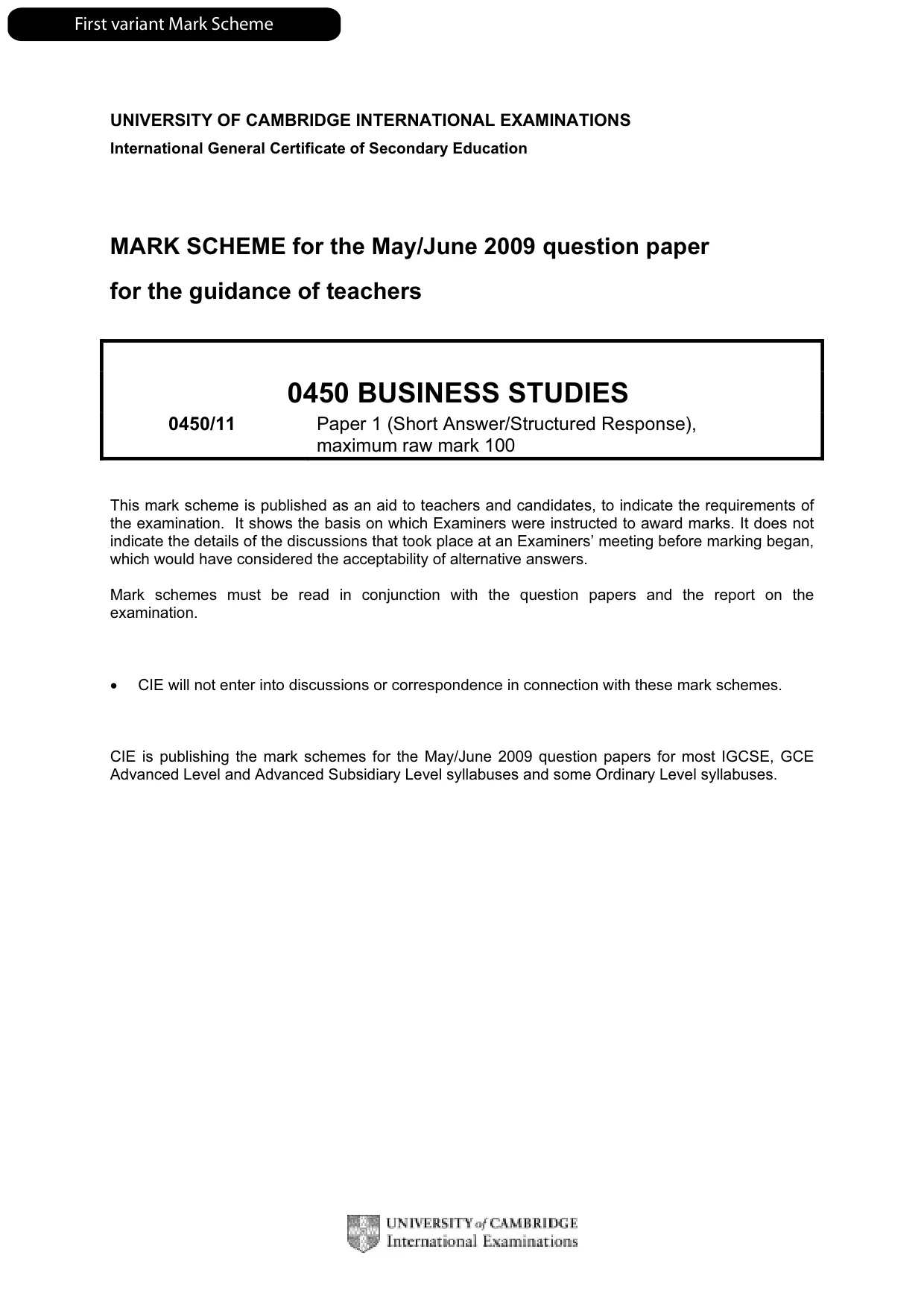
UNIVERSITY OF CAMBRIDGE INTERNATIONAL EXAMINATIONS International General Certificate of Secondary Education MARK SCHEME for the May/June 2009 question paper for the guidance of teachers 0450 BUSINESS STUDIES 0450/11 Paper 1 (Short Answer/Structured Response), maximum raw mark 100 This mark scheme is published as an aid to teachers and candidates, to indicate the requirements of the examination. It shows the basis on which Examiners were instructed to award marks. It does not indicate the details of the discussions that took place at an Examiners’ meeting before marking began, which would have considered the acceptability of alternative answers. Mark schemes must be read in conjunction with the question papers and the report on the examination. • CIE will not enter into discussions or correspondence in connection with these mark schemes. CIE is publishing the mark schemes for the May/June 2009 question papers for most IGCSE, GCE Advanced Level and Advanced Subsidiary Level syllabuses and some Ordinary Level syllabuses. First variant Mark Scheme
Mark scheme, page 3
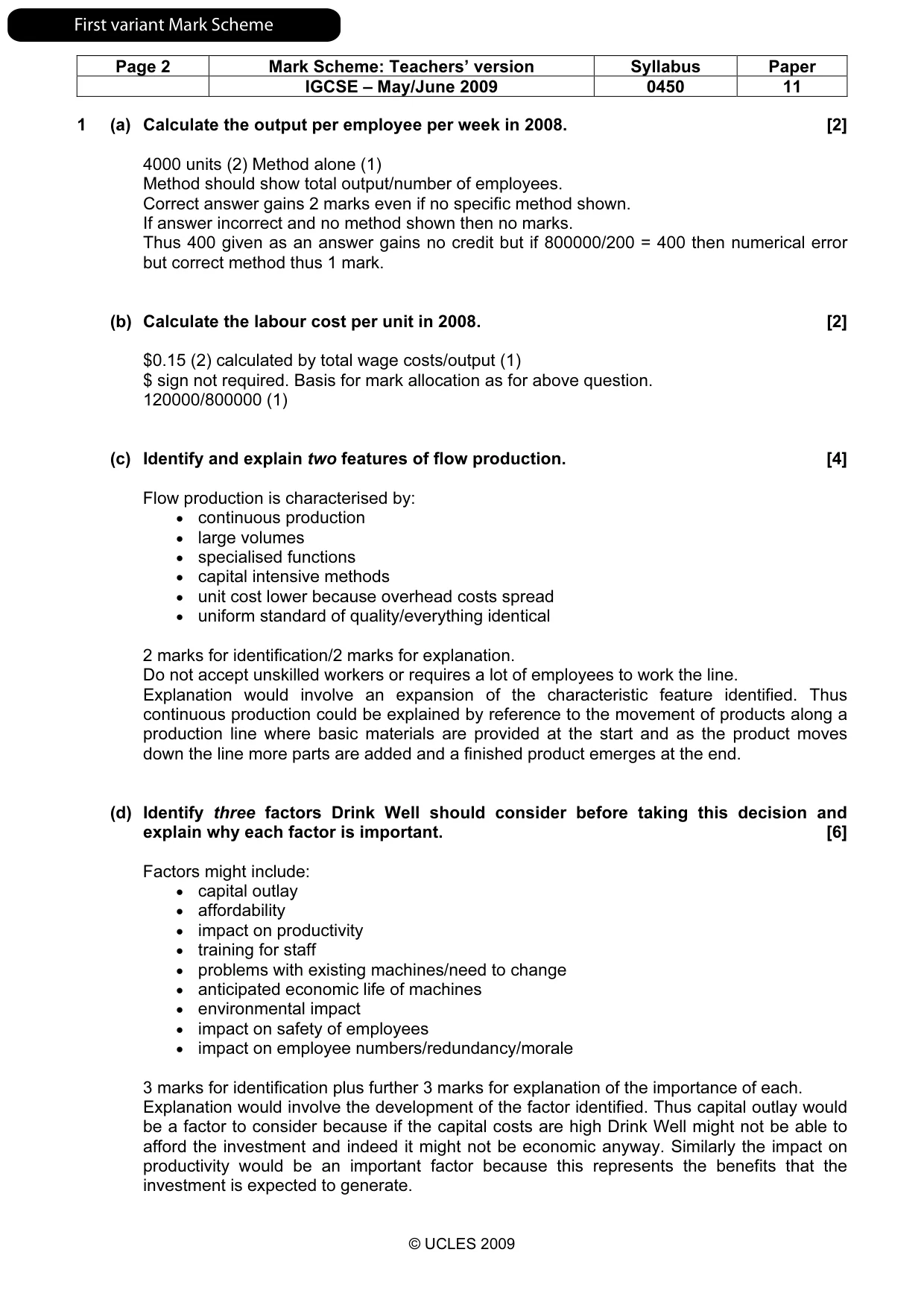
Page 2 Mark Scheme: Teachers’ version Syllabus Paper IGCSE – May/June 2009 0450 11 © UCLES 2009 1 (a) Calculate the output per employee per week in 2008. [2] 4000 units (2) Method alone (1) Method should show total output/number of employees. Correct answer gains 2 marks even if no specific method shown. If answer incorrect and no method shown then no marks. Thus 400 given as an answer gains no credit but if 800000/200 = 400 then numerical error but correct method thus 1 mark. (b) Calculate the labour cost per unit in 2008. [2] $0.15 (2) calculated by total wage costs/output (1) $ sign not required. Basis for mark allocation as for above question. 120000/800000 (1) (c) Identify and explain two features of flow production. [4] Flow production is characterised by: • continuous production • large volumes • specialised functions • capital intensive methods • unit cost lower because overhead costs spread • uniform standard of quality/everything identical 2 marks for identification/2 marks for explanation. Do not accept unskilled workers or requires a lot of employees to work the line. Explanation would involve an expansion of the characteristic feature identified. Thus continuous production could be explained by reference to the movement of products along a production line where basic materials are provided at the start and as the product moves down the line more parts are added and a finished product emerges at the end. (d) Identify three factors Drink Well should consider before taking this decision and explain why each factor is important. [6] Factors might include: • capital outlay • affordability • impact on productivity • training for staff • problems with existing machines/need to change • anticipated economic life of machines • environmental impact • impact on safety of employees • impact on employee numbers/redundancy/morale 3 marks for identification plus further 3 marks for explanation of the importance of each. Explanation would involve the development of the factor identified. Thus capital outlay would be a factor to consider because if the capital costs are high Drink Well might not be able to afford the investment and indeed it might not be economic anyway. Similarly the impact on productivity would be an important factor because this represents the benefits that the investment is expected to generate. First variant Mark Scheme
Mark scheme, page 4
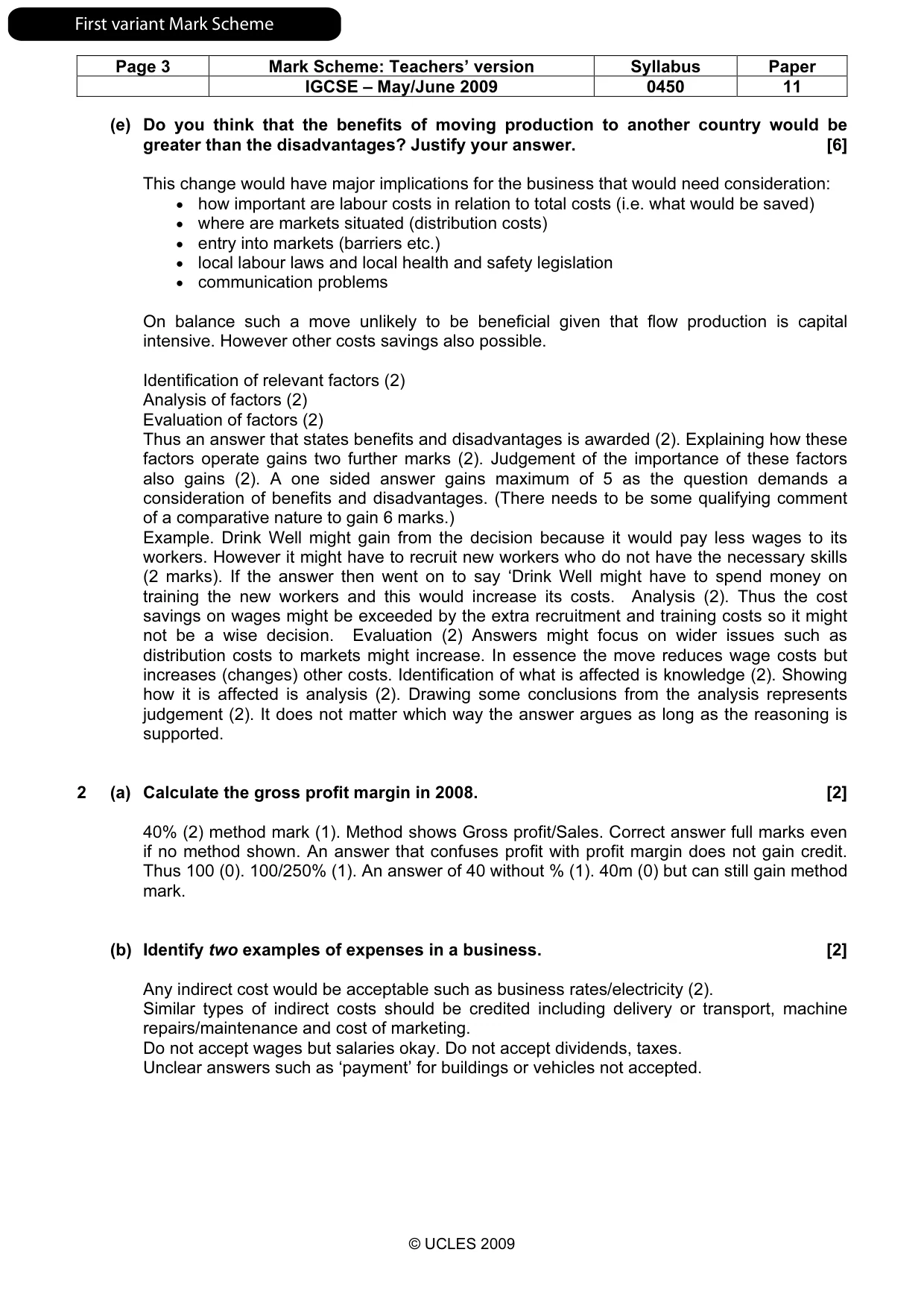
Page 3 Mark Scheme: Teachers’ version Syllabus Paper IGCSE – May/June 2009 0450 11 © UCLES 2009 (e) Do you think that the benefits of moving production to another country would be greater than the disadvantages? Justify your answer. [6] This change would have major implications for the business that would need consideration: • how important are labour costs in relation to total costs (i.e. what would be saved) • where are markets situated (distribution costs) • entry into markets (barriers etc.) • local labour laws and local health and safety legislation • communication problems On balance such a move unlikely to be beneficial given that flow production is capital intensive. However other costs savings also possible. Identification of relevant factors (2) Analysis of factors (2) Evaluation of factors (2) Thus an answer that states benefits and disadvantages is awarded (2). Explaining how these factors operate gains two further marks (2). Judgement of the importance of these factors also gains (2). A one sided answer gains maximum of 5 as the question demands a consideration of benefits and disadvantages. (There needs to be some qualifying comment of a comparative nature to gain 6 marks.) Example. Drink Well might gain from the decision because it would pay less wages to its workers. However it might have to recruit new workers who do not have the necessary skills (2 marks). If the answer then went on to say ‘Drink Well might have to spend money on training the new workers and this would increase its costs. Analysis (2). Thus the cost savings on wages might be exceeded by the extra recruitment and training costs so it might not be a wise decision. Evaluation (2) Answers might focus on wider issues such as distribution costs to markets might increase. In essence the move reduces wage costs but increases (changes) other costs. Identification of what is affected is knowledge (2). Showing how it is affected is analysis (2). Drawing some conclusions from the analysis represents judgement (2). It does not matter which way the answer argues as long as the reasoning is supported. 2 (a) Calculate the gross profit margin in 2008. [2] 40% (2) method mark (1). Method shows Gross profit/Sales. Correct answer full marks even if no method shown. An answer that confuses profit with profit margin does not gain credit. Thus 100 (0). 100/250% (1). An answer of 40 without % (1). 40m (0) but can still gain method mark. (b) Identify two examples of expenses in a business. [2] Any indirect cost would be acceptable such as business rates/electricity (2). Similar types of indirect costs should be credited including delivery or transport, machine repairs/maintenance and cost of marketing. Do not accept wages but salaries okay. Do not accept dividends, taxes. Unclear answers such as ‘payment’ for buildings or vehicles not accepted. First variant Mark Scheme
Mark scheme, page 5
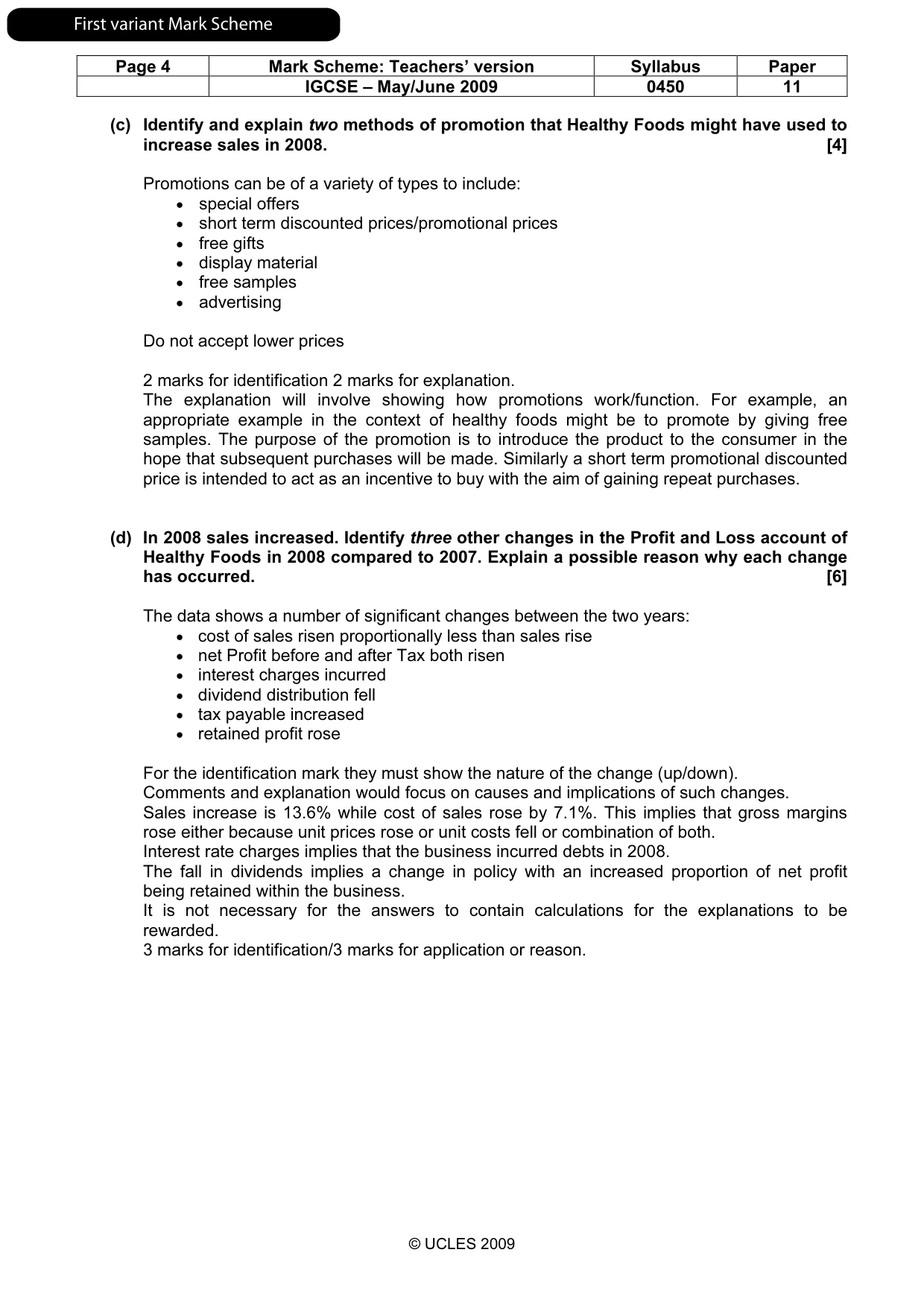
Page 4 Mark Scheme: Teachers’ version Syllabus Paper IGCSE – May/June 2009 0450 11 © UCLES 2009 (c) Identify and explain two methods of promotion that Healthy Foods might have used to increase sales in 2008. [4] Promotions can be of a variety of types to include: • special offers • short term discounted prices/promotional prices • free gifts • display material • free samples • advertising Do not accept lower prices 2 marks for identification 2 marks for explanation. The explanation will involve showing how promotions work/function. For example, an appropriate example in the context of healthy foods might be to promote by giving free samples. The purpose of the promotion is to introduce the product to the consumer in the hope that subsequent purchases will be made. Similarly a short term promotional discounted price is intended to act as an incentive to buy with the aim of gaining repeat purchases. (d) In 2008 sales increased. Identify three other changes in the Profit and Loss account of Healthy Foods in 2008 compared to 2007. Explain a possible reason why each change has occurred. [6] The data shows a number of significant changes between the two years: • cost of sales risen proportionally less than sales rise • net Profit before and after Tax both risen • interest charges incurred • dividend distribution fell • tax payable increased • retained profit rose For the identification mark they must show the nature of the change (up/down). Comments and explanation would focus on causes and implications of such changes. Sales increase is 13.6% while cost of sales rose by 7.1%. This implies that gross margins rose either because unit prices rose or unit costs fell or combination of both. Interest rate charges implies that the business incurred debts in 2008. The fall in dividends implies a change in policy with an increased proportion of net profit being retained within the business. It is not necessary for the answers to contain calculations for the explanations to be rewarded. 3 marks for identification/3 marks for application or reason. First variant Mark Scheme
Mark scheme, page 6
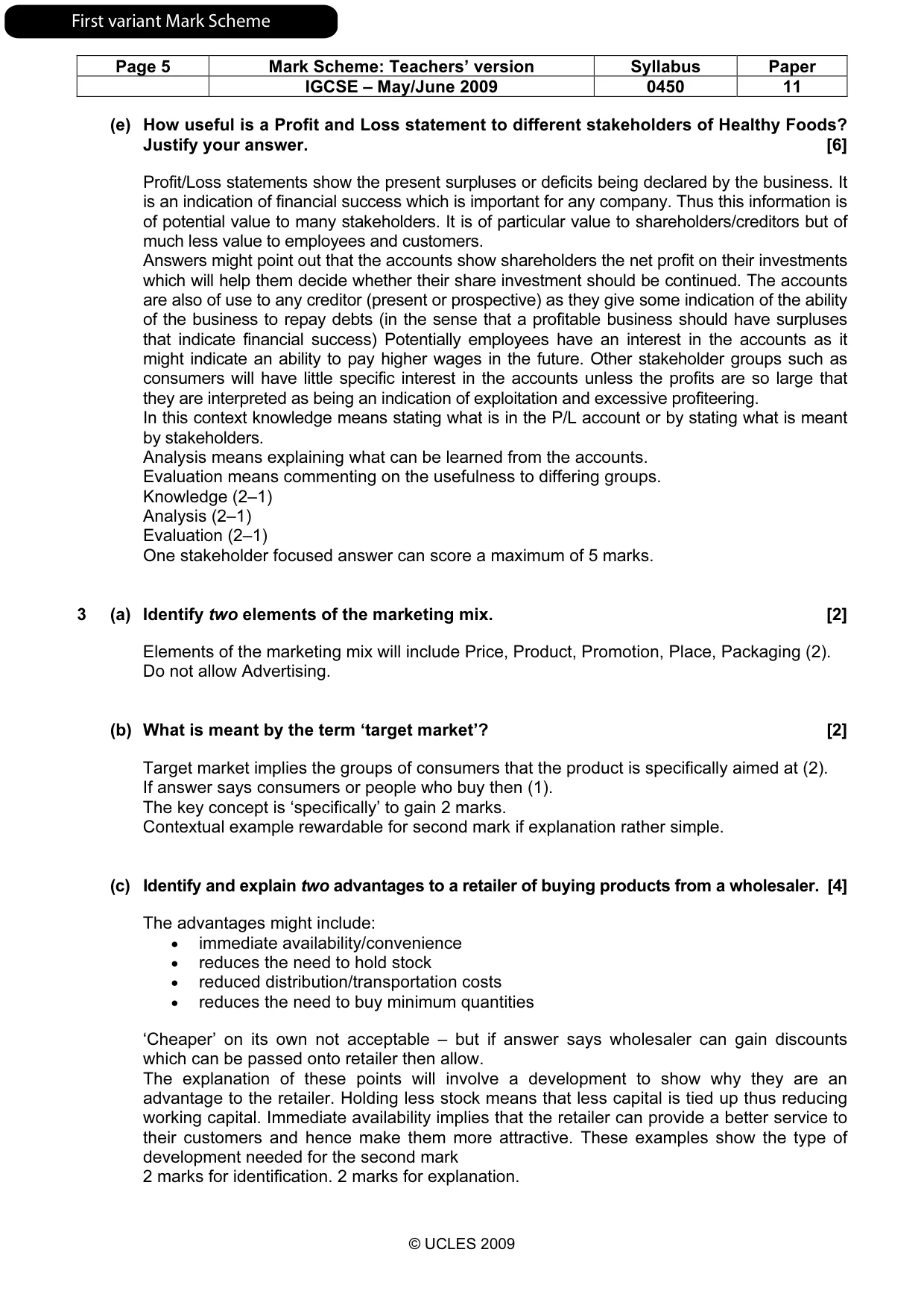
Page 5 Mark Scheme: Teachers’ version Syllabus Paper IGCSE – May/June 2009 0450 11 © UCLES 2009 (e) How useful is a Profit and Loss statement to different stakeholders of Healthy Foods? Justify your answer. [6] Profit/Loss statements show the present surpluses or deficits being declared by the business. It is an indication of financial success which is important for any company. Thus this information is of potential value to many stakeholders. It is of particular value to shareholders/creditors but of much less value to employees and customers. Answers might point out that the accounts show shareholders the net profit on their investments which will help them decide whether their share investment should be continued. The accounts are also of use to any creditor (present or prospective) as they give some indication of the ability of the business to repay debts (in the sense that a profitable business should have surpluses that indicate financial success) Potentially employees have an interest in the accounts as it might indicate an ability to pay higher wages in the future. Other stakeholder groups such as consumers will have little specific interest in the accounts unless the profits are so large that they are interpreted as being an indication of exploitation and excessive profiteering. In this context knowledge means stating what is in the P/L account or by stating what is meant by stakeholders. Analysis means explaining what can be learned from the accounts. Evaluation means commenting on the usefulness to differing groups. Knowledge (2–1) Analysis (2–1) Evaluation (2–1) One stakeholder focused answer can score a maximum of 5 marks. 3 (a) Identify two elements of the marketing mix. [2] Elements of the marketing mix will include Price, Product, Promotion, Place, Packaging (2). Do not allow Advertising. (b) What is meant by the term ‘target market’? [2] Target market implies the groups of consumers that the product is specifically aimed at (2). If answer says consumers or people who buy then (1). The key concept is ‘specifically’ to gain 2 marks. Contextual example rewardable for second mark if explanation rather simple. (c) Identify and explain two advantages to a retailer of buying products from a wholesaler. [4] The advantages might include: • immediate availability/convenience • reduces the need to hold stock • reduced distribution/transportation costs • reduces the need to buy minimum quantities ‘Cheaper’ on its own not acceptable – but if answer says wholesaler can gain discounts which can be passed onto retailer then allow. The explanation of these points will involve a development to show why they are an advantage to the retailer. Holding less stock means that less capital is tied up thus reducing working capital. Immediate availability implies that the retailer can provide a better service to their customers and hence make them more attractive. These examples show the type of development needed for the second mark 2 marks for identification. 2 marks for explanation. First variant Mark Scheme
Mark scheme, page 7
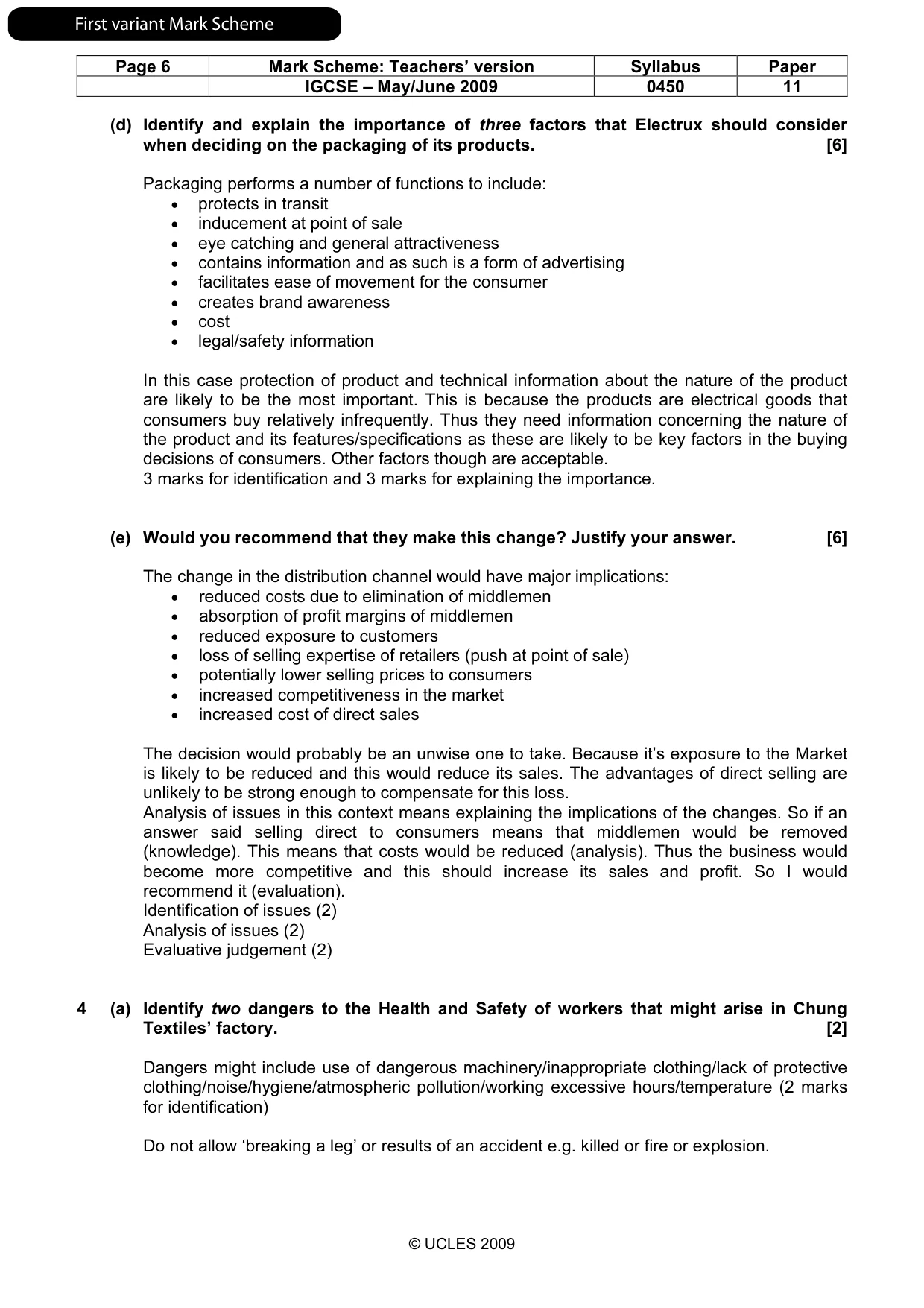
Page 6 Mark Scheme: Teachers’ version Syllabus Paper IGCSE – May/June 2009 0450 11 © UCLES 2009 (d) Identify and explain the importance of three factors that Electrux should consider when deciding on the packaging of its products. [6] Packaging performs a number of functions to include: • protects in transit • inducement at point of sale • eye catching and general attractiveness • contains information and as such is a form of advertising • facilitates ease of movement for the consumer • creates brand awareness • cost • legal/safety information In this case protection of product and technical information about the nature of the product are likely to be the most important. This is because the products are electrical goods that consumers buy relatively infrequently. Thus they need information concerning the nature of the product and its features/specifications as these are likely to be key factors in the buying decisions of consumers. Other factors though are acceptable. 3 marks for identification and 3 marks for explaining the importance. (e) Would you recommend that they make this change? Justify your answer. [6] The change in the distribution channel would have major implications: • reduced costs due to elimination of middlemen • absorption of profit margins of middlemen • reduced exposure to customers • loss of selling expertise of retailers (push at point of sale) • potentially lower selling prices to consumers • increased competitiveness in the market • increased cost of direct sales The decision would probably be an unwise one to take. Because it’s exposure to the Market is likely to be reduced and this would reduce its sales. The advantages of direct selling are unlikely to be strong enough to compensate for this loss. Analysis of issues in this context means explaining the implications of the changes. So if an answer said selling direct to consumers means that middlemen would be removed (knowledge). This means that costs would be reduced (analysis). Thus the business would become more competitive and this should increase its sales and profit. So I would recommend it (evaluation). Identification of issues (2) Analysis of issues (2) Evaluative judgement (2) 4 (a) Identify two dangers to the Health and Safety of workers that might arise in Chung Textiles’ factory. [2] Dangers might include use of dangerous machinery/inappropriate clothing/lack of protective clothing/noise/hygiene/atmospheric pollution/working excessive hours/temperature (2 marks for identification) Do not allow ‘breaking a leg’ or results of an accident e.g. killed or fire or explosion. First variant Mark Scheme
Mark scheme, page 8
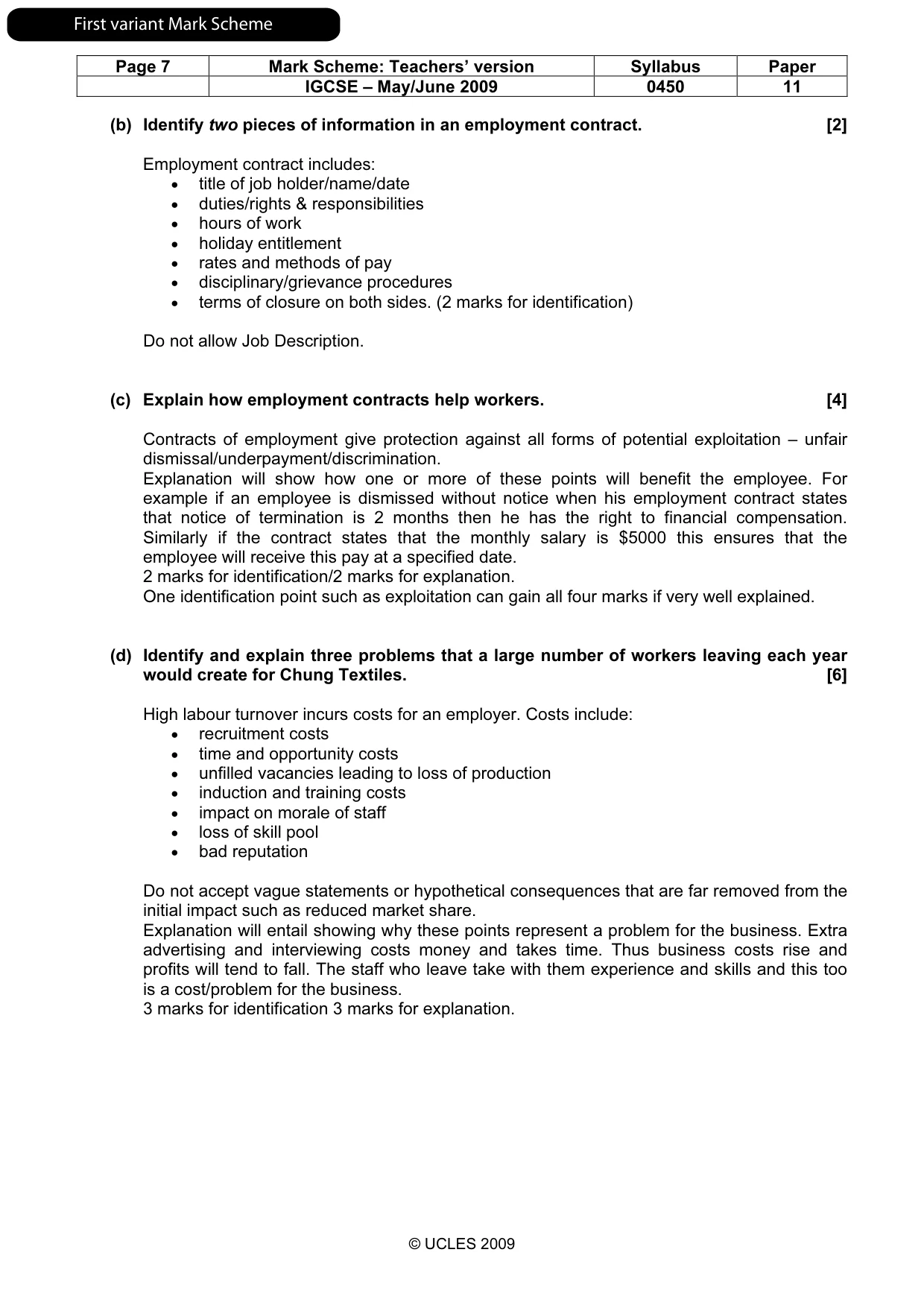
Page 7 Mark Scheme: Teachers’ version Syllabus Paper IGCSE – May/June 2009 0450 11 © UCLES 2009 (b) Identify two pieces of information in an employment contract. [2] Employment contract includes: • title of job holder/name/date • duties/rights & responsibilities • hours of work • holiday entitlement • rates and methods of pay • disciplinary/grievance procedures • terms of closure on both sides. (2 marks for identification) Do not allow Job Description. (c) Explain how employment contracts help workers. [4] Contracts of employment give protection against all forms of potential exploitation – unfair dismissal/underpayment/discrimination. Explanation will show how one or more of these points will benefit the employee. For example if an employee is dismissed without notice when his employment contract states that notice of termination is 2 months then he has the right to financial compensation. Similarly if the contract states that the monthly salary is $5000 this ensures that the employee will receive this pay at a specified date. 2 marks for identification/2 marks for explanation. One identification point such as exploitation can gain all four marks if very well explained. (d) Identify and explain three problems that a large number of workers leaving each year would create for Chung Textiles. [6] High labour turnover incurs costs for an employer. Costs include: • recruitment costs • time and opportunity costs • unfilled vacancies leading to loss of production • induction and training costs • impact on morale of staff • loss of skill pool • bad reputation Do not accept vague statements or hypothetical consequences that are far removed from the initial impact such as reduced market share. Explanation will entail showing why these points represent a problem for the business. Extra advertising and interviewing costs money and takes time. Thus business costs rise and profits will tend to fall. The staff who leave take with them experience and skills and this too is a cost/problem for the business. 3 marks for identification 3 marks for explanation. First variant Mark Scheme
Mark scheme, page 9
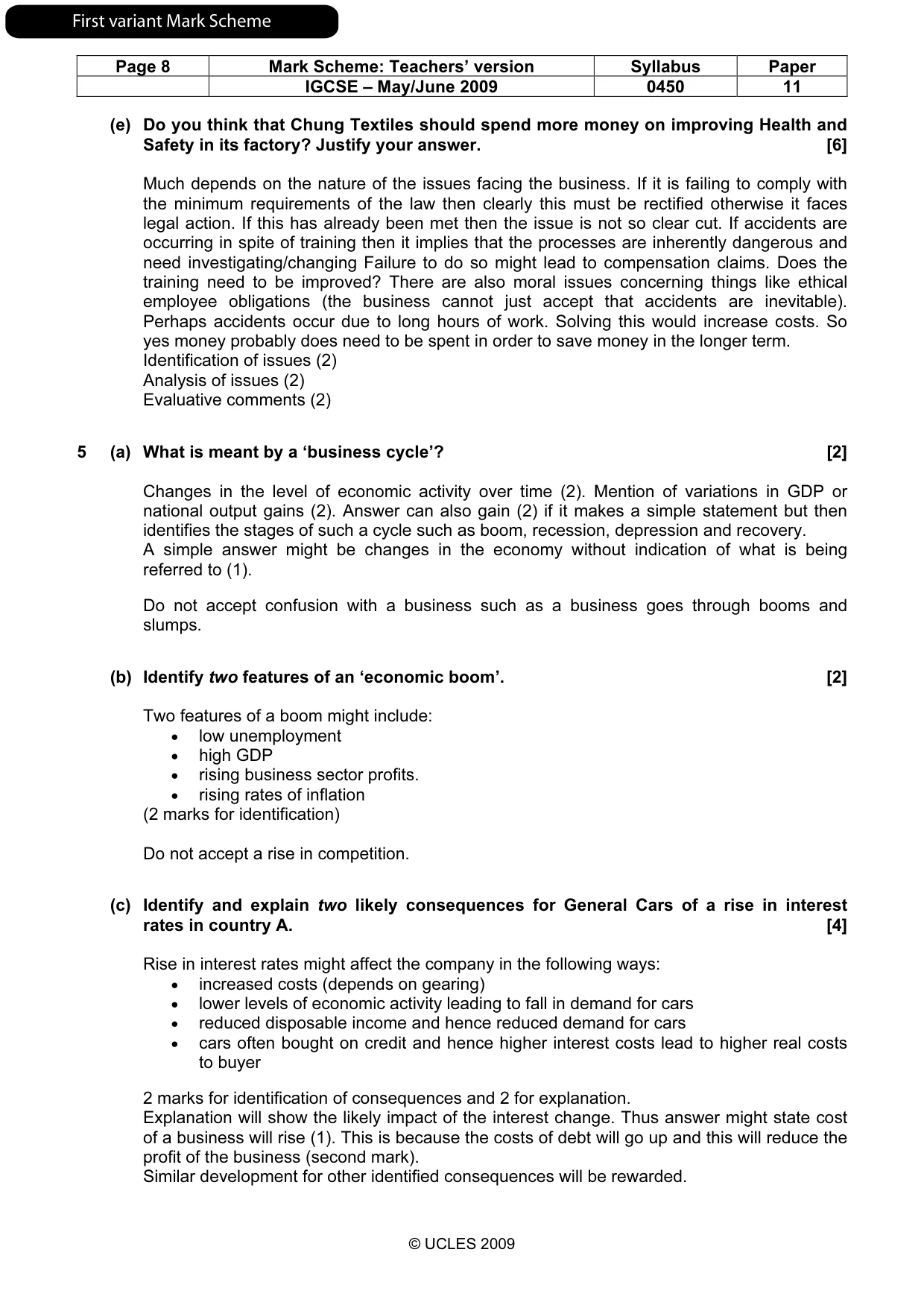
Page 8 Mark Scheme: Teachers’ version Syllabus Paper IGCSE – May/June 2009 0450 11 © UCLES 2009 (e) Do you think that Chung Textiles should spend more money on improving Health and Safety in its factory? Justify your answer. [6] Much depends on the nature of the issues facing the business. If it is failing to comply with the minimum requirements of the law then clearly this must be rectified otherwise it faces legal action. If this has already been met then the issue is not so clear cut. If accidents are occurring in spite of training then it implies that the processes are inherently dangerous and need investigating/changing Failure to do so might lead to compensation claims. Does the training need to be improved? There are also moral issues concerning things like ethical employee obligations (the business cannot just accept that accidents are inevitable). Perhaps accidents occur due to long hours of work. Solving this would increase costs. So yes money probably does need to be spent in order to save money in the longer term. Identification of issues (2) Analysis of issues (2) Evaluative comments (2) 5 (a) What is meant by a ‘business cycle’? [2] Changes in the level of economic activity over time (2). Mention of variations in GDP or national output gains (2). Answer can also gain (2) if it makes a simple statement but then identifies the stages of such a cycle such as boom, recession, depression and recovery. A simple answer might be changes in the economy without indication of what is being referred to (1). Do not accept confusion with a business such as a business goes through booms and slumps. (b) Identify two features of an ‘economic boom’. [2] Two features of a boom might include: • low unemployment • high GDP • rising business sector profits. • rising rates of inflation (2 marks for identification) Do not accept a rise in competition. (c) Identify and explain two likely consequences for General Cars of a rise in interest rates in country A. [4] Rise in interest rates might affect the company in the following ways: • increased costs (depends on gearing) • lower levels of economic activity leading to fall in demand for cars • reduced disposable income and hence reduced demand for cars • cars often bought on credit and hence higher interest costs lead to higher real costs to buyer 2 marks for identification of consequences and 2 for explanation. Explanation will show the likely impact of the interest change. Thus answer might state cost of a business will rise (1). This is because the costs of debt will go up and this will reduce the profit of the business (second mark). Similar development for other identified consequences will be rewarded. First variant Mark Scheme
Mark scheme, page 10
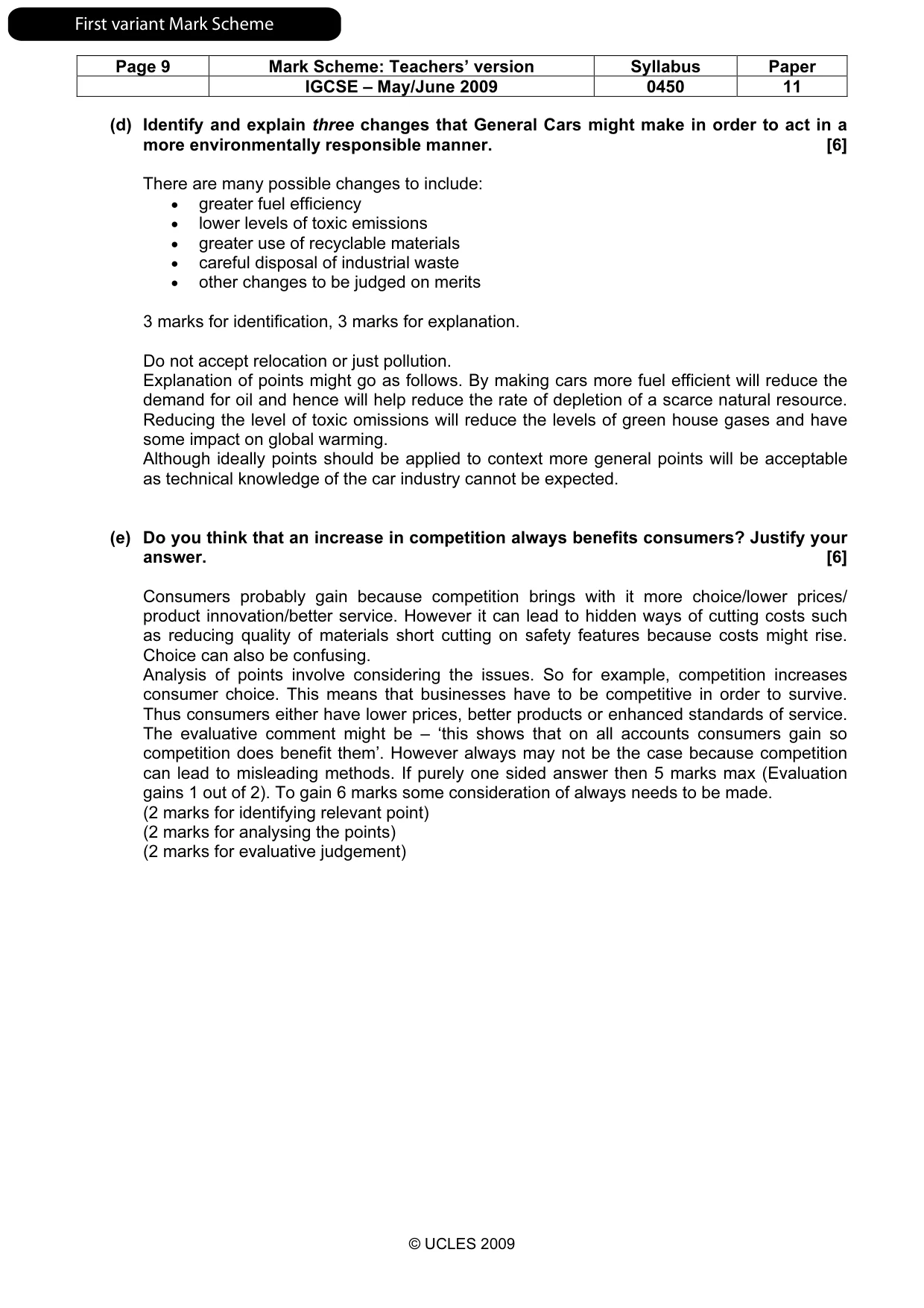
Page 9 Mark Scheme: Teachers’ version Syllabus Paper IGCSE – May/June 2009 0450 11 © UCLES 2009 (d) Identify and explain three changes that General Cars might make in order to act in a more environmentally responsible manner. [6] There are many possible changes to include: • greater fuel efficiency • lower levels of toxic emissions • greater use of recyclable materials • careful disposal of industrial waste • other changes to be judged on merits 3 marks for identification, 3 marks for explanation. Do not accept relocation or just pollution. Explanation of points might go as follows. By making cars more fuel efficient will reduce the demand for oil and hence will help reduce the rate of depletion of a scarce natural resource. Reducing the level of toxic omissions will reduce the levels of green house gases and have some impact on global warming. Although ideally points should be applied to context more general points will be acceptable as technical knowledge of the car industry cannot be expected. (e) Do you think that an increase in competition always benefits consumers? Justify your answer. [6] Consumers probably gain because competition brings with it more choice/lower prices/ product innovation/better service. However it can lead to hidden ways of cutting costs such as reducing quality of materials short cutting on safety features because costs might rise. Choice can also be confusing. Analysis of points involve considering the issues. So for example, competition increases consumer choice. This means that businesses have to be competitive in order to survive. Thus consumers either have lower prices, better products or enhanced standards of service. The evaluative comment might be – ‘this shows that on all accounts consumers gain so competition does benefit them’. However always may not be the case because competition can lead to misleading methods. If purely one sided answer then 5 marks max (Evaluation gains 1 out of 2). To gain 6 marks some consideration of always needs to be made. (2 marks for identifying relevant point) (2 marks for analysing the points) (2 marks for evaluative judgement) First variant Mark Scheme
Mark scheme, page 11
UNIVERSITY OF CAMBRIDGE INTERNATIONAL EXAMINATIONS International General Certificate of Secondary Education MARK SCHEME for the May/June 2009 question paper for the guidance of teachers 0450 BUSINESS STUDIES 0450/12 Paper 1 (Short Answer/Structured Response), maximum raw mark 100 This mark scheme is published as an aid to teachers and candidates, to indicate the requirements of the examination. It shows the basis on which Examiners were instructed to award marks. It does not indicate the details of the discussions that took place at an Examiners’ meeting before marking began, which would have considered the acceptability of alternative answers. Mark schemes must be read in conjunction with the question papers and the report on the examination. • CIE will not enter into discussions or correspondence in connection with these mark schemes. CIE is publishing the mark schemes for the May/June 2009 question papers for most IGCSE, GCE Advanced Level and Advanced Subsidiary Level syllabuses and some Ordinary Level syllabuses. Second variant Mark Scheme
Mark scheme, page 12
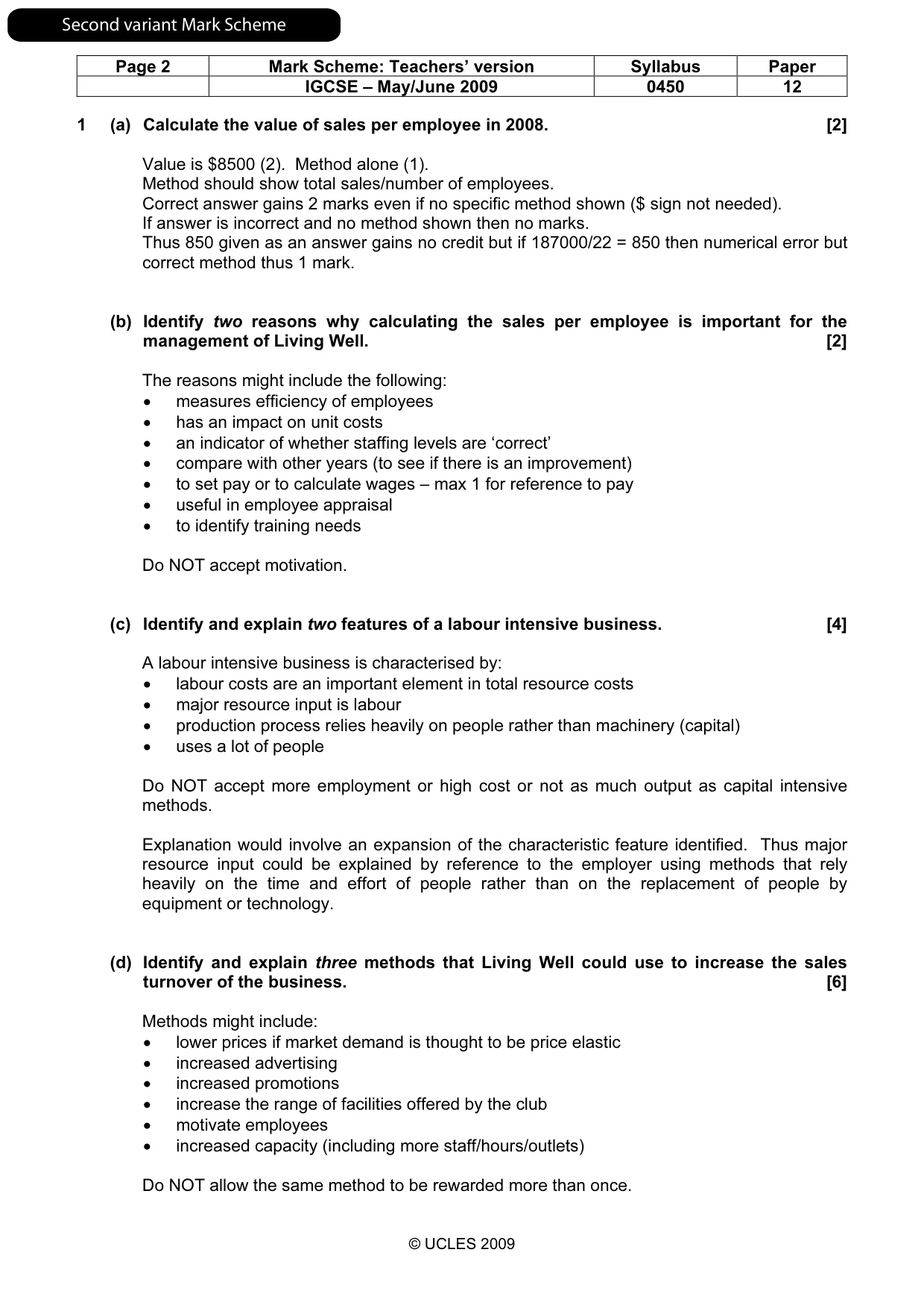
Page 2 Mark Scheme: Teachers’ version Syllabus Paper IGCSE – May/June 2009 0450 12 © UCLES 2009 1 (a) Calculate the value of sales per employee in 2008. [2] Value is $8500 (2). Method alone (1). Method should show total sales/number of employees. Correct answer gains 2 marks even if no specific method shown ($ sign not needed). If answer is incorrect and no method shown then no marks. Thus 850 given as an answer gains no credit but if 187000/22 = 850 then numerical error but correct method thus 1 mark. (b) Identify two reasons why calculating the sales per employee is important for the management of Living Well. [2] The reasons might include the following: • measures efficiency of employees • has an impact on unit costs • an indicator of whether staffing levels are ‘correct’ • compare with other years (to see if there is an improvement) • to set pay or to calculate wages – max 1 for reference to pay • useful in employee appraisal • to identify training needs Do NOT accept motivation. (c) Identify and explain two features of a labour intensive business. [4] A labour intensive business is characterised by: • labour costs are an important element in total resource costs • major resource input is labour • production process relies heavily on people rather than machinery (capital) • uses a lot of people Do NOT accept more employment or high cost or not as much output as capital intensive methods. Explanation would involve an expansion of the characteristic feature identified. Thus major resource input could be explained by reference to the employer using methods that rely heavily on the time and effort of people rather than on the replacement of people by equipment or technology. (d) Identify and explain three methods that Living Well could use to increase the sales turnover of the business. [6] Methods might include: • lower prices if market demand is thought to be price elastic • increased advertising • increased promotions • increase the range of facilities offered by the club • motivate employees • increased capacity (including more staff/hours/outlets) Do NOT allow the same method to be rewarded more than once. Second variant Mark Scheme
Mark scheme, page 13
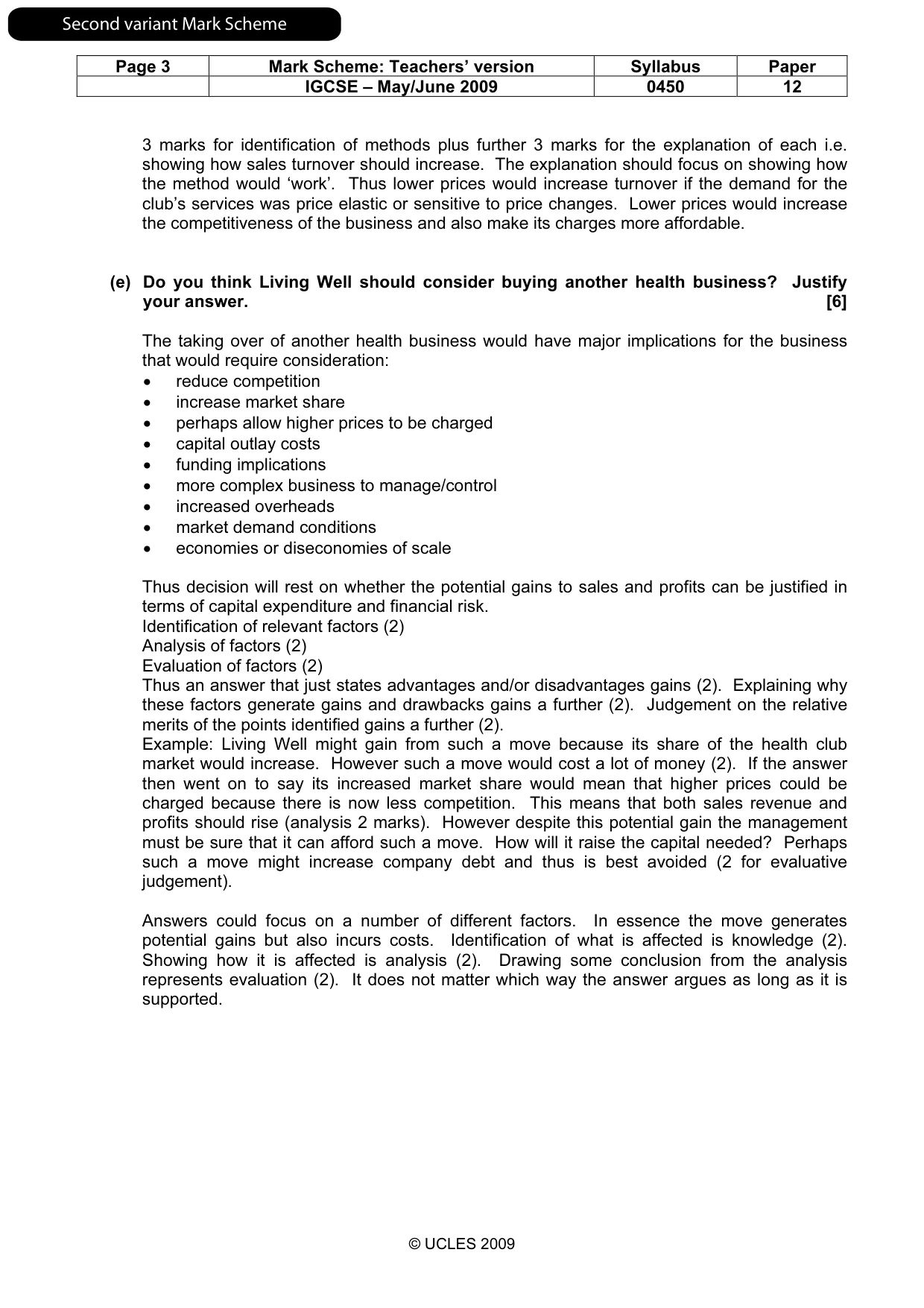
Page 3 Mark Scheme: Teachers’ version Syllabus Paper IGCSE – May/June 2009 0450 12 © UCLES 2009 3 marks for identification of methods plus further 3 marks for the explanation of each i.e. showing how sales turnover should increase. The explanation should focus on showing how the method would ‘work’. Thus lower prices would increase turnover if the demand for the club’s services was price elastic or sensitive to price changes. Lower prices would increase the competitiveness of the business and also make its charges more affordable. (e) Do you think Living Well should consider buying another health business? Justify your answer. [6] The taking over of another health business would have major implications for the business that would require consideration: • reduce competition • increase market share • perhaps allow higher prices to be charged • capital outlay costs • funding implications • more complex business to manage/control • increased overheads • market demand conditions • economies or diseconomies of scale Thus decision will rest on whether the potential gains to sales and profits can be justified in terms of capital expenditure and financial risk. Identification of relevant factors (2) Analysis of factors (2) Evaluation of factors (2) Thus an answer that just states advantages and/or disadvantages gains (2). Explaining why these factors generate gains and drawbacks gains a further (2). Judgement on the relative merits of the points identified gains a further (2). Example: Living Well might gain from such a move because its share of the health club market would increase. However such a move would cost a lot of money (2). If the answer then went on to say its increased market share would mean that higher prices could be charged because there is now less competition. This means that both sales revenue and profits should rise (analysis 2 marks). However despite this potential gain the management must be sure that it can afford such a move. How will it raise the capital needed? Perhaps such a move might increase company debt and thus is best avoided (2 for evaluative judgement). Answers could focus on a number of different factors. In essence the move generates potential gains but also incurs costs. Identification of what is affected is knowledge (2). Showing how it is affected is analysis (2). Drawing some conclusion from the analysis represents evaluation (2). It does not matter which way the answer argues as long as it is supported. Second variant Mark Scheme
Mark scheme, page 14
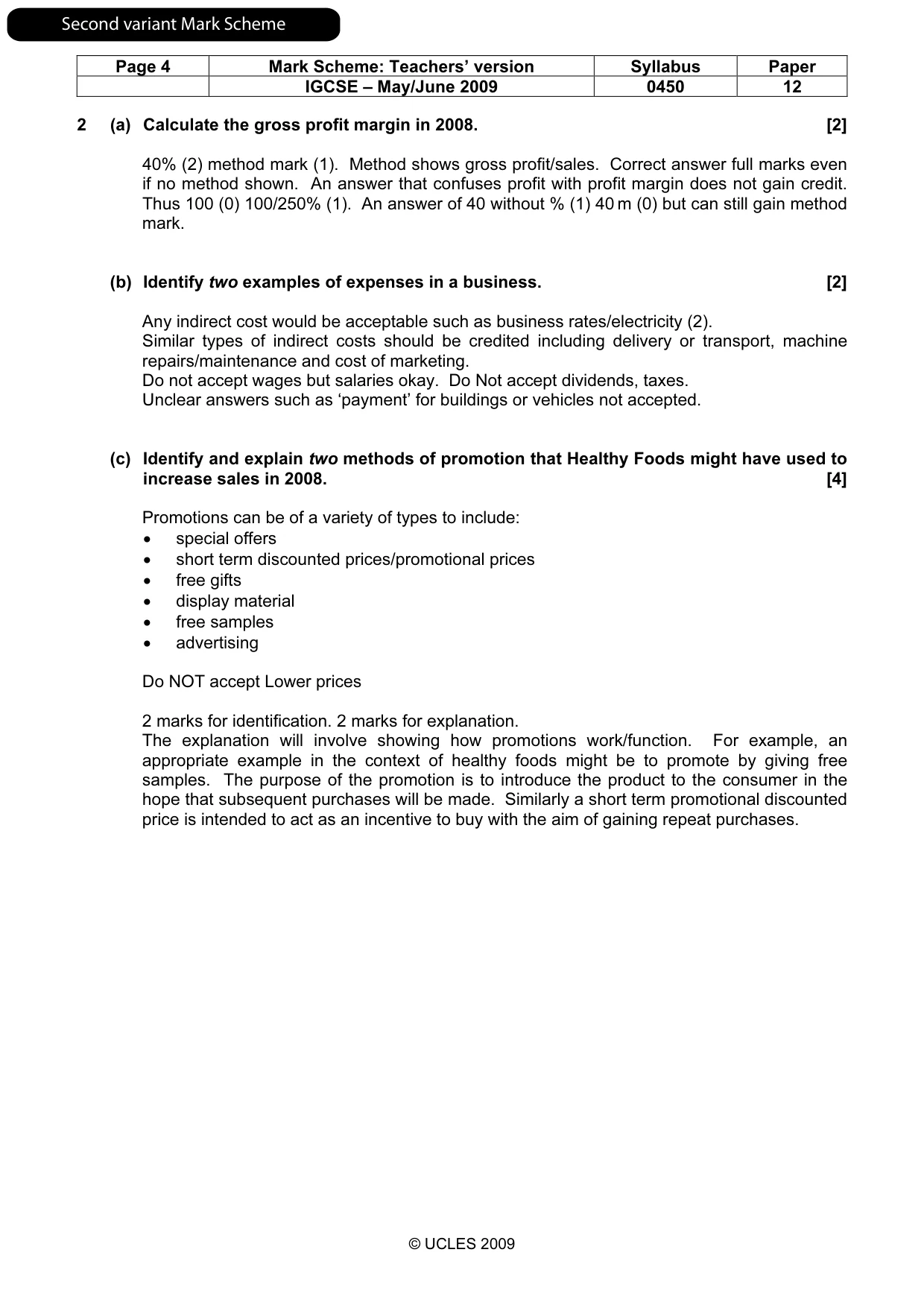
Page 4 Mark Scheme: Teachers’ version Syllabus Paper IGCSE – May/June 2009 0450 12 © UCLES 2009 2 (a) Calculate the gross profit margin in 2008. [2] 40% (2) method mark (1). Method shows gross profit/sales. Correct answer full marks even if no method shown. An answer that confuses profit with profit margin does not gain credit. Thus 100 (0) 100/250% (1). An answer of 40 without % (1) 40 m (0) but can still gain method mark. (b) Identify two examples of expenses in a business. [2] Any indirect cost would be acceptable such as business rates/electricity (2). Similar types of indirect costs should be credited including delivery or transport, machine repairs/maintenance and cost of marketing. Do not accept wages but salaries okay. Do Not accept dividends, taxes. Unclear answers such as ‘payment’ for buildings or vehicles not accepted. (c) Identify and explain two methods of promotion that Healthy Foods might have used to increase sales in 2008. [4] Promotions can be of a variety of types to include: • special offers • short term discounted prices/promotional prices • free gifts • display material • free samples • advertising Do NOT accept Lower prices 2 marks for identification. 2 marks for explanation. The explanation will involve showing how promotions work/function. For example, an appropriate example in the context of healthy foods might be to promote by giving free samples. The purpose of the promotion is to introduce the product to the consumer in the hope that subsequent purchases will be made. Similarly a short term promotional discounted price is intended to act as an incentive to buy with the aim of gaining repeat purchases. Second variant Mark Scheme
Mark scheme, page 15
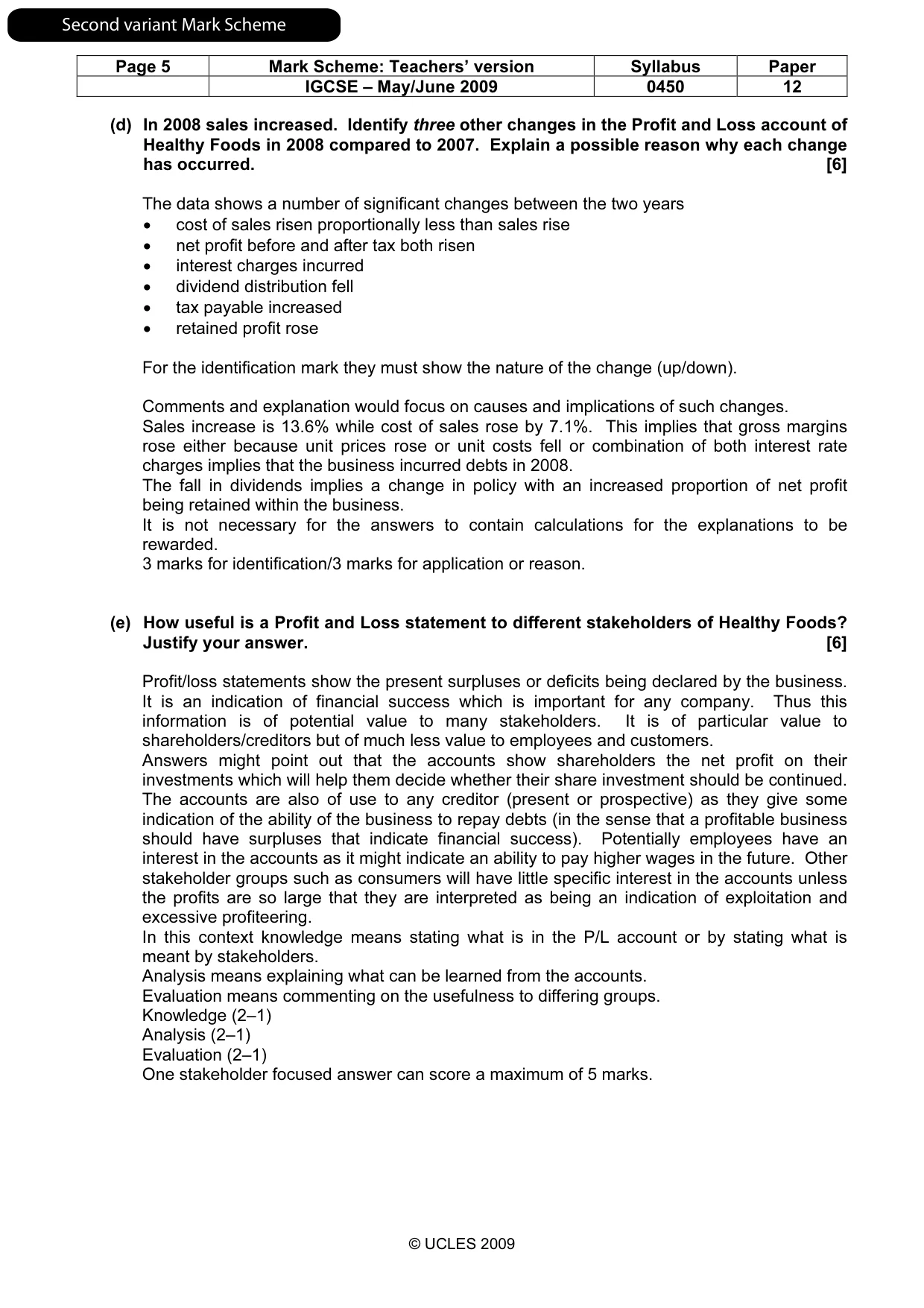
Page 5 Mark Scheme: Teachers’ version Syllabus Paper IGCSE – May/June 2009 0450 12 © UCLES 2009 (d) In 2008 sales increased. Identify three other changes in the Profit and Loss account of Healthy Foods in 2008 compared to 2007. Explain a possible reason why each change has occurred. [6] The data shows a number of significant changes between the two years • cost of sales risen proportionally less than sales rise • net profit before and after tax both risen • interest charges incurred • dividend distribution fell • tax payable increased • retained profit rose For the identification mark they must show the nature of the change (up/down). Comments and explanation would focus on causes and implications of such changes. Sales increase is 13.6% while cost of sales rose by 7.1%. This implies that gross margins rose either because unit prices rose or unit costs fell or combination of both interest rate charges implies that the business incurred debts in 2008. The fall in dividends implies a change in policy with an increased proportion of net profit being retained within the business. It is not necessary for the answers to contain calculations for the explanations to be rewarded. 3 marks for identification/3 marks for application or reason. (e) How useful is a Profit and Loss statement to different stakeholders of Healthy Foods? Justify your answer. [6] Profit/loss statements show the present surpluses or deficits being declared by the business. It is an indication of financial success which is important for any company. Thus this information is of potential value to many stakeholders. It is of particular value to shareholders/creditors but of much less value to employees and customers. Answers might point out that the accounts show shareholders the net profit on their investments which will help them decide whether their share investment should be continued. The accounts are also of use to any creditor (present or prospective) as they give some indication of the ability of the business to repay debts (in the sense that a profitable business should have surpluses that indicate financial success). Potentially employees have an interest in the accounts as it might indicate an ability to pay higher wages in the future. Other stakeholder groups such as consumers will have little specific interest in the accounts unless the profits are so large that they are interpreted as being an indication of exploitation and excessive profiteering. In this context knowledge means stating what is in the P/L account or by stating what is meant by stakeholders. Analysis means explaining what can be learned from the accounts. Evaluation means commenting on the usefulness to differing groups. Knowledge (2–1) Analysis (2–1) Evaluation (2–1) One stakeholder focused answer can score a maximum of 5 marks. Second variant Mark Scheme
Mark scheme, page 16
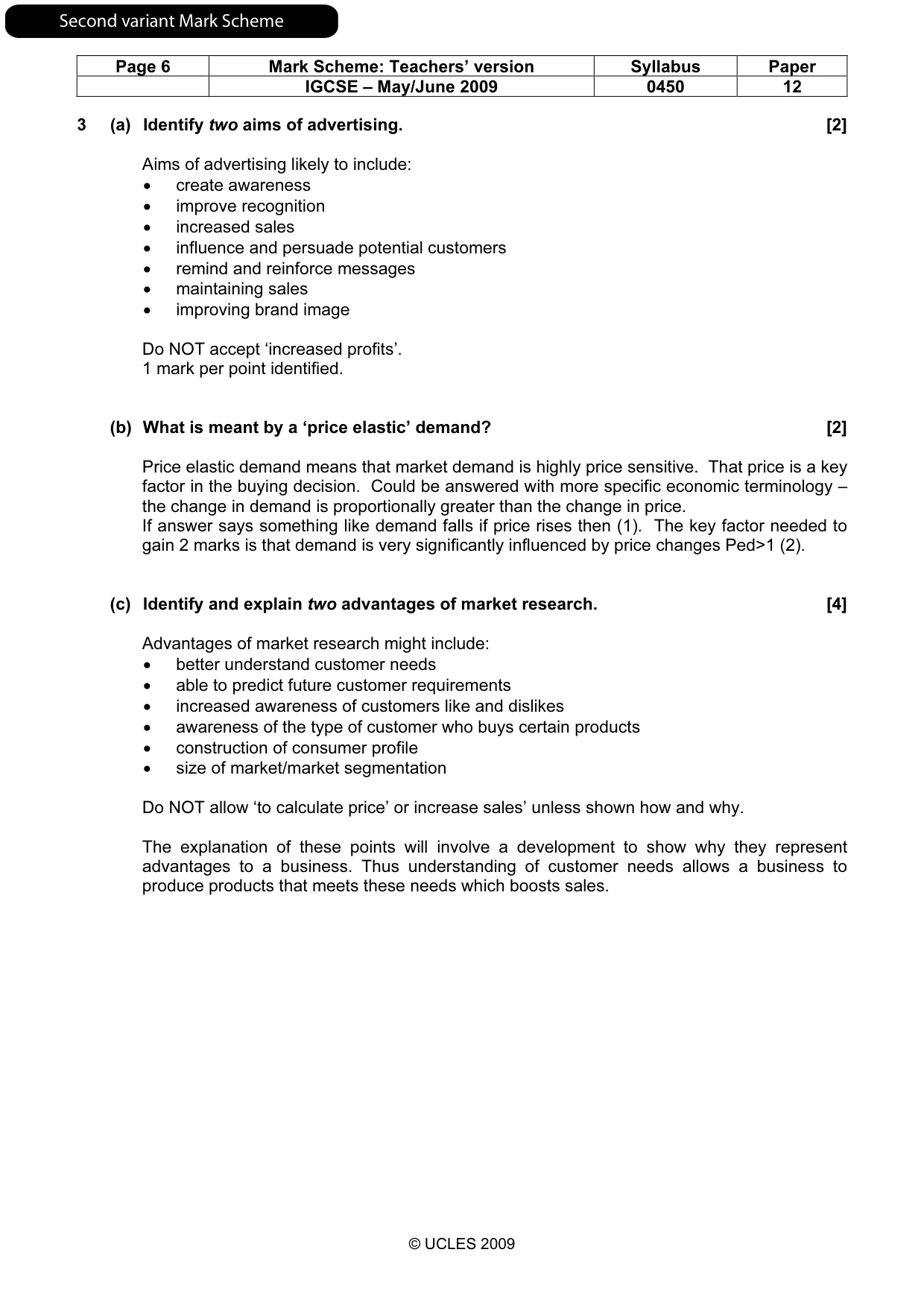
Page 6 Mark Scheme: Teachers’ version Syllabus Paper IGCSE – May/June 2009 0450 12 © UCLES 2009 3 (a) Identify two aims of advertising. [2] Aims of advertising likely to include: • create awareness • improve recognition • increased sales • influence and persuade potential customers • remind and reinforce messages • maintaining sales • improving brand image Do NOT accept ‘increased profits’. 1 mark per point identified. (b) What is meant by a ‘price elastic’ demand? [2] Price elastic demand means that market demand is highly price sensitive. That price is a key factor in the buying decision. Could be answered with more specific economic terminology – the change in demand is proportionally greater than the change in price. If answer says something like demand falls if price rises then (1). The key factor needed to gain 2 marks is that demand is very significantly influenced by price changes Ped>1 (2). (c) Identify and explain two advantages of market research. [4] Advantages of market research might include: • better understand customer needs • able to predict future customer requirements • increased awareness of customers like and dislikes • awareness of the type of customer who buys certain products • construction of consumer profile • size of market/market segmentation Do NOT allow ‘to calculate price’ or increase sales’ unless shown how and why. The explanation of these points will involve a development to show why they represent advantages to a business. Thus understanding of customer needs allows a business to produce products that meets these needs which boosts sales. Second variant Mark Scheme
Mark scheme, page 17
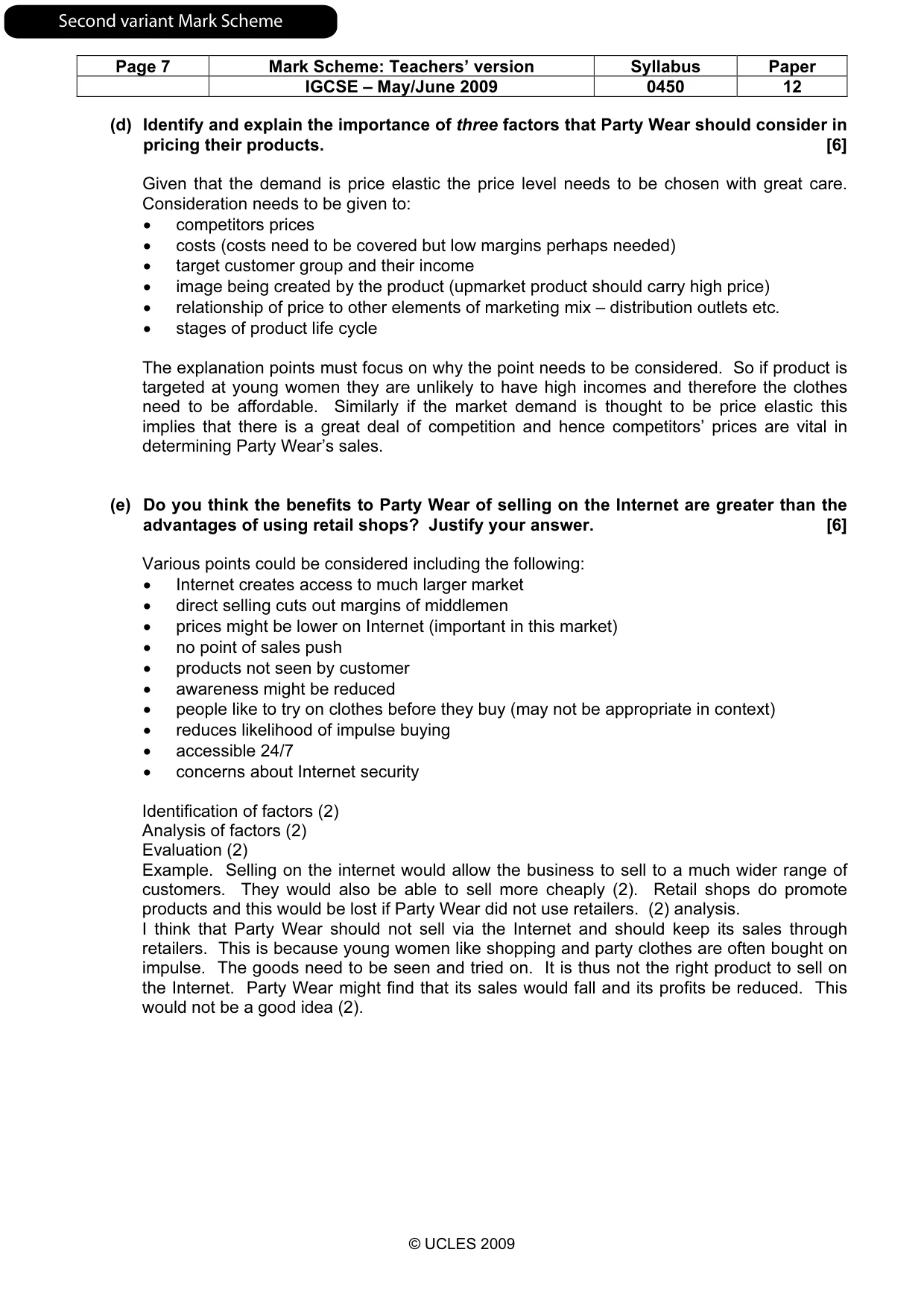
Page 7 Mark Scheme: Teachers’ version Syllabus Paper IGCSE – May/June 2009 0450 12 © UCLES 2009 (d) Identify and explain the importance of three factors that Party Wear should consider in pricing their products. [6] Given that the demand is price elastic the price level needs to be chosen with great care. Consideration needs to be given to: • competitors prices • costs (costs need to be covered but low margins perhaps needed) • target customer group and their income • image being created by the product (upmarket product should carry high price) • relationship of price to other elements of marketing mix – distribution outlets etc. • stages of product life cycle The explanation points must focus on why the point needs to be considered. So if product is targeted at young women they are unlikely to have high incomes and therefore the clothes need to be affordable. Similarly if the market demand is thought to be price elastic this implies that there is a great deal of competition and hence competitors’ prices are vital in determining Party Wear’s sales. (e) Do you think the benefits to Party Wear of selling on the Internet are greater than the advantages of using retail shops? Justify your answer. [6] Various points could be considered including the following: • Internet creates access to much larger market • direct selling cuts out margins of middlemen • prices might be lower on Internet (important in this market) • no point of sales push • products not seen by customer • awareness might be reduced • people like to try on clothes before they buy (may not be appropriate in context) • reduces likelihood of impulse buying • accessible 24/7 • concerns about Internet security Identification of factors (2) Analysis of factors (2) Evaluation (2) Example. Selling on the internet would allow the business to sell to a much wider range of customers. They would also be able to sell more cheaply (2). Retail shops do promote products and this would be lost if Party Wear did not use retailers. (2) analysis. I think that Party Wear should not sell via the Internet and should keep its sales through retailers. This is because young women like shopping and party clothes are often bought on impulse. The goods need to be seen and tried on. It is thus not the right product to sell on the Internet. Party Wear might find that its sales would fall and its profits be reduced. This would not be a good idea (2). Second variant Mark Scheme
Mark scheme, page 18
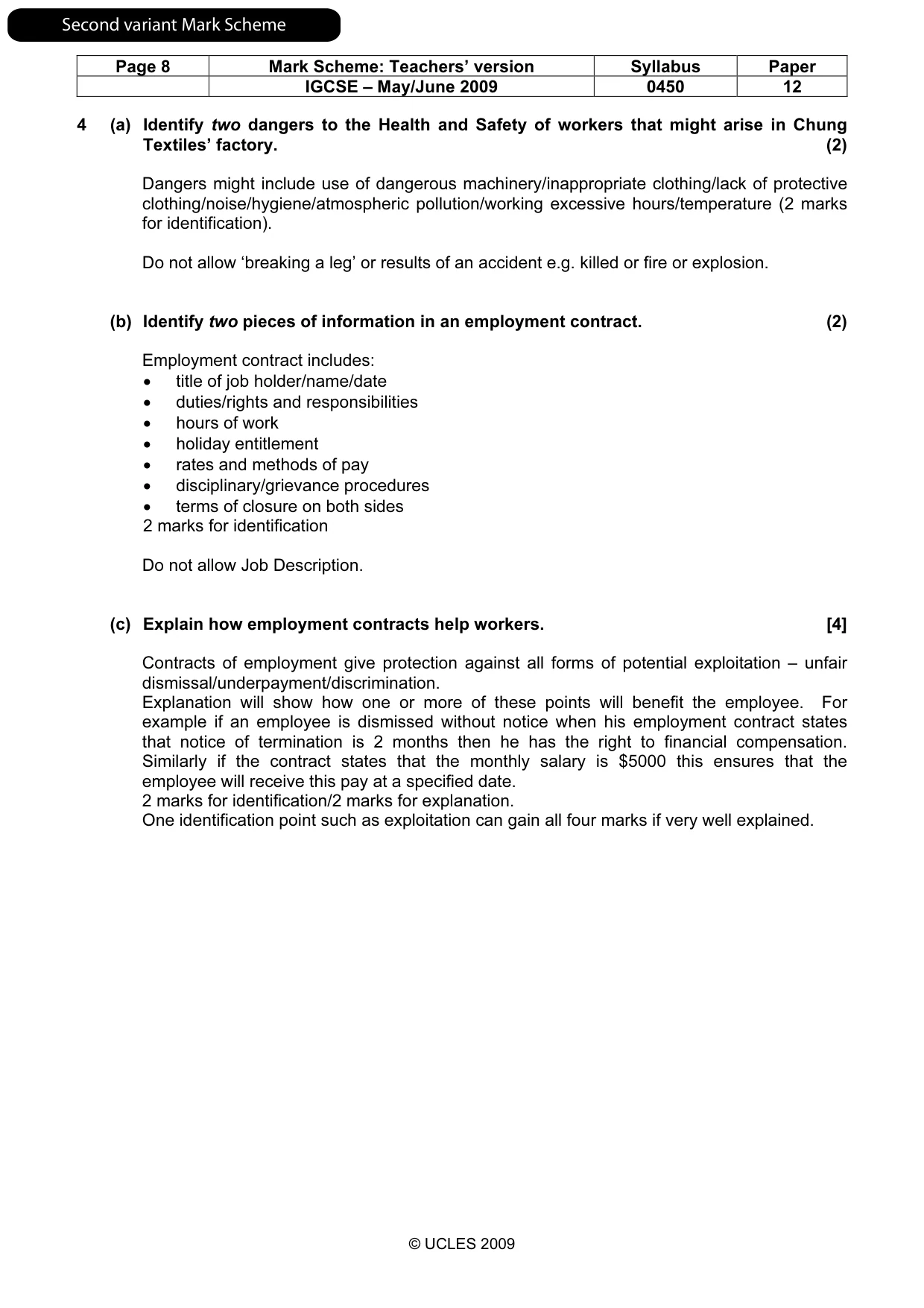
Page 8 Mark Scheme: Teachers’ version Syllabus Paper IGCSE – May/June 2009 0450 12 © UCLES 2009 4 (a) Identify two dangers to the Health and Safety of workers that might arise in Chung Textiles’ factory. (2) Dangers might include use of dangerous machinery/inappropriate clothing/lack of protective clothing/noise/hygiene/atmospheric pollution/working excessive hours/temperature (2 marks for identification). Do not allow ‘breaking a leg’ or results of an accident e.g. killed or fire or explosion. (b) Identify two pieces of information in an employment contract. (2) Employment contract includes: • title of job holder/name/date • duties/rights and responsibilities • hours of work • holiday entitlement • rates and methods of pay • disciplinary/grievance procedures • terms of closure on both sides 2 marks for identification Do not allow Job Description. (c) Explain how employment contracts help workers. [4] Contracts of employment give protection against all forms of potential exploitation – unfair dismissal/underpayment/discrimination. Explanation will show how one or more of these points will benefit the employee. For example if an employee is dismissed without notice when his employment contract states that notice of termination is 2 months then he has the right to financial compensation. Similarly if the contract states that the monthly salary is $5000 this ensures that the employee will receive this pay at a specified date. 2 marks for identification/2 marks for explanation. One identification point such as exploitation can gain all four marks if very well explained. Second variant Mark Scheme
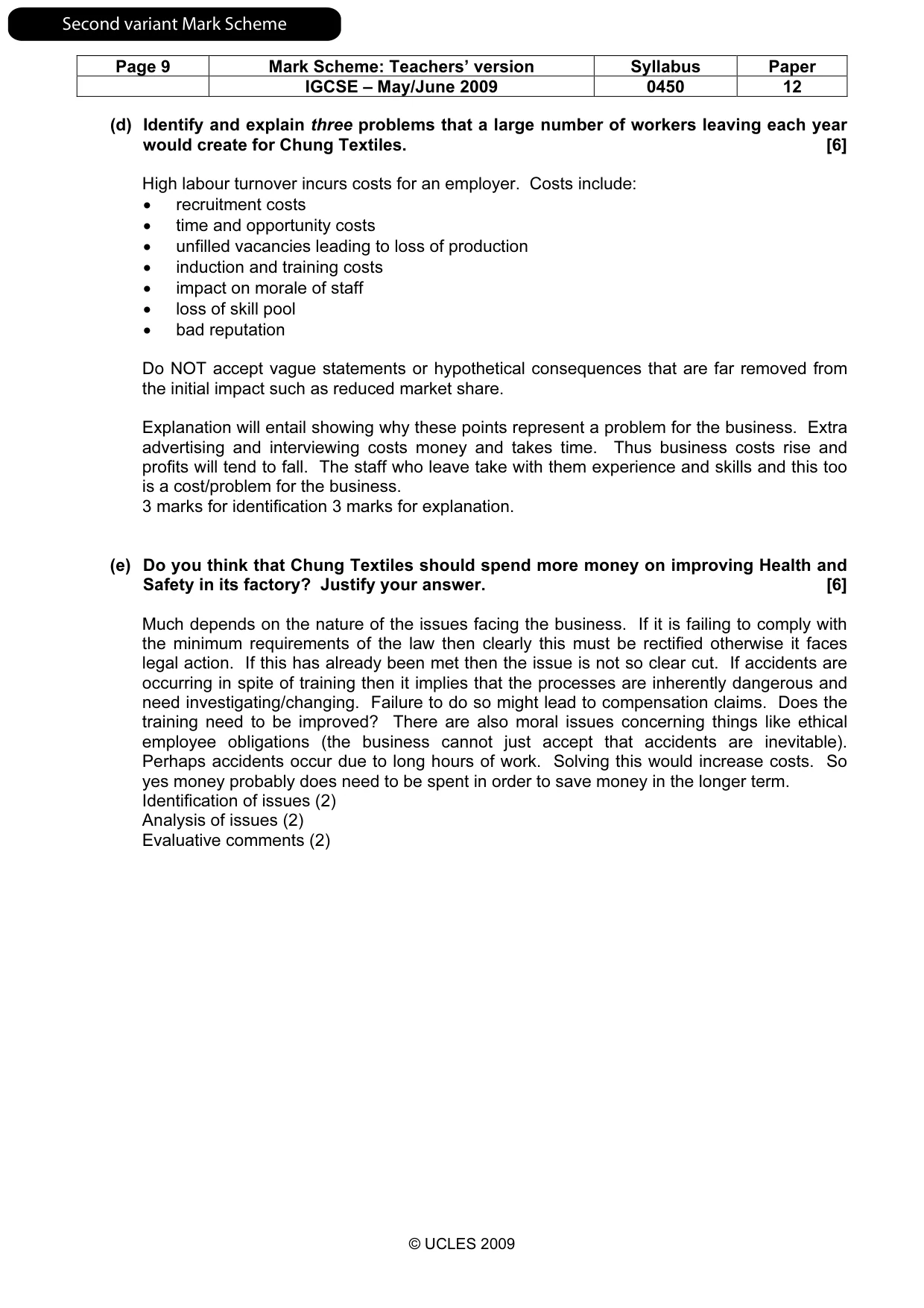
Mark scheme, page 19
Page 9 Mark Scheme: Teachers’ version Syllabus Paper IGCSE – May/June 2009 0450 12 © UCLES 2009 (d) Identify and explain three problems that a large number of workers leaving each year would create for Chung Textiles. [6] High labour turnover incurs costs for an employer. Costs include: • recruitment costs • time and opportunity costs • unfilled vacancies leading to loss of production • induction and training costs • impact on morale of staff • loss of skill pool • bad reputation Do NOT accept vague statements or hypothetical consequences that are far removed from the initial impact such as reduced market share. Explanation will entail showing why these points represent a problem for the business. Extra advertising and interviewing costs money and takes time. Thus business costs rise and profits will tend to fall. The staff who leave take with them experience and skills and this too is a cost/problem for the business. 3 marks for identification 3 marks for explanation. (e) Do you think that Chung Textiles should spend more money on improving Health and Safety in its factory? Justify your answer. [6] Much depends on the nature of the issues facing the business. If it is failing to comply with the minimum requirements of the law then clearly this must be rectified otherwise it faces legal action. If this has already been met then the issue is not so clear cut. If accidents are occurring in spite of training then it implies that the processes are inherently dangerous and need investigating/changing. Failure to do so might lead to compensation claims. Does the training need to be improved? There are also moral issues concerning things like ethical employee obligations (the business cannot just accept that accidents are inevitable). Perhaps accidents occur due to long hours of work. Solving this would increase costs. So yes money probably does need to be spent in order to save money in the longer term. Identification of issues (2) Analysis of issues (2) Evaluative comments (2) Second variant Mark Scheme
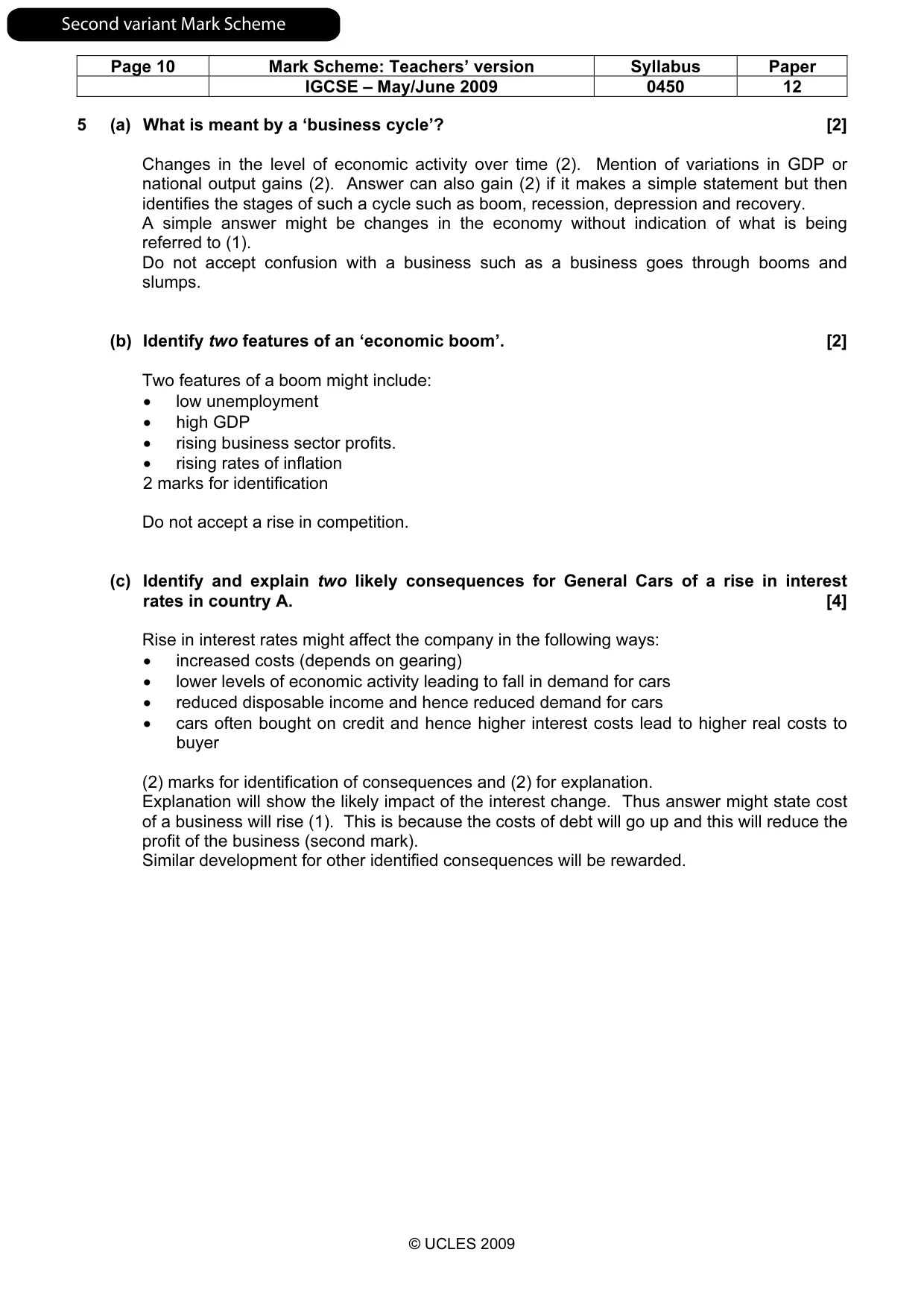
Mark scheme, page 20
Page 10 Mark Scheme: Teachers’ version Syllabus Paper IGCSE – May/June 2009 0450 12 © UCLES 2009 5 (a) What is meant by a ‘business cycle’? [2] Changes in the level of economic activity over time (2). Mention of variations in GDP or national output gains (2). Answer can also gain (2) if it makes a simple statement but then identifies the stages of such a cycle such as boom, recession, depression and recovery. A simple answer might be changes in the economy without indication of what is being referred to (1). Do not accept confusion with a business such as a business goes through booms and slumps. (b) Identify two features of an ‘economic boom’. [2] Two features of a boom might include: • low unemployment • high GDP • rising business sector profits. • rising rates of inflation 2 marks for identification Do not accept a rise in competition. (c) Identify and explain two likely consequences for General Cars of a rise in interest rates in country A. [4] Rise in interest rates might affect the company in the following ways: • increased costs (depends on gearing) • lower levels of economic activity leading to fall in demand for cars • reduced disposable income and hence reduced demand for cars • cars often bought on credit and hence higher interest costs lead to higher real costs to buyer (2) marks for identification of consequences and (2) for explanation. Explanation will show the likely impact of the interest change. Thus answer might state cost of a business will rise (1). This is because the costs of debt will go up and this will reduce the profit of the business (second mark). Similar development for other identified consequences will be rewarded. Second variant Mark Scheme
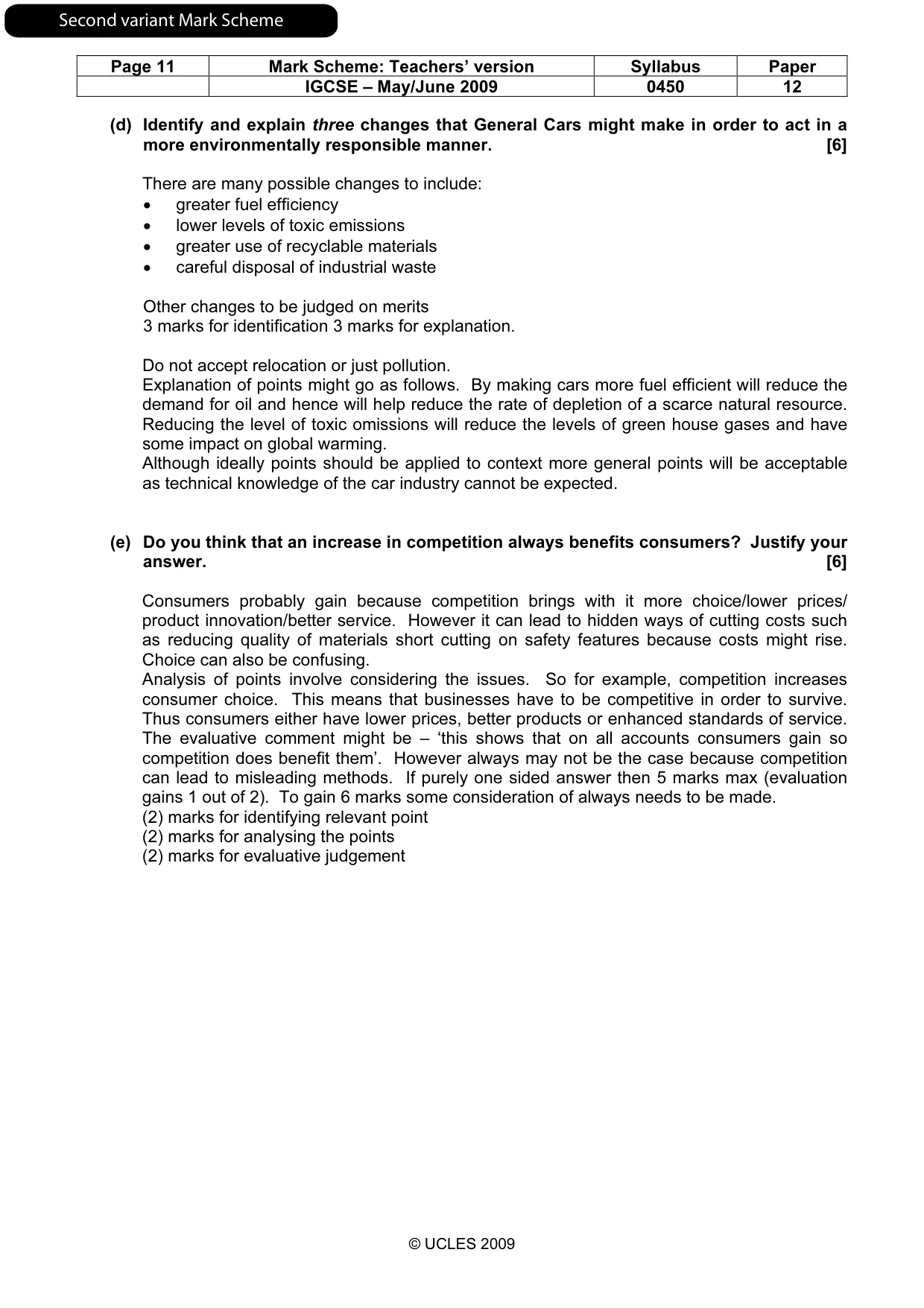
Mark scheme, page 21
Page 11 Mark Scheme: Teachers’ version Syllabus Paper IGCSE – May/June 2009 0450 12 © UCLES 2009 (d) Identify and explain three changes that General Cars might make in order to act in a more environmentally responsible manner. [6] There are many possible changes to include: • greater fuel efficiency • lower levels of toxic emissions • greater use of recyclable materials • careful disposal of industrial waste Other changes to be judged on merits 3 marks for identification 3 marks for explanation. Do not accept relocation or just pollution. Explanation of points might go as follows. By making cars more fuel efficient will reduce the demand for oil and hence will help reduce the rate of depletion of a scarce natural resource. Reducing the level of toxic omissions will reduce the levels of green house gases and have some impact on global warming. Although ideally points should be applied to context more general points will be acceptable as technical knowledge of the car industry cannot be expected. (e) Do you think that an increase in competition always benefits consumers? Justify your answer. [6] Consumers probably gain because competition brings with it more choice/lower prices/ product innovation/better service. However it can lead to hidden ways of cutting costs such as reducing quality of materials short cutting on safety features because costs might rise. Choice can also be confusing. Analysis of points involve considering the issues. So for example, competition increases consumer choice. This means that businesses have to be competitive in order to survive. Thus consumers either have lower prices, better products or enhanced standards of service. The evaluative comment might be – ‘this shows that on all accounts consumers gain so competition does benefit them’. However always may not be the case because competition can lead to misleading methods. If purely one sided answer then 5 marks max (evaluation gains 1 out of 2). To gain 6 marks some consideration of always needs to be made. (2) marks for identifying relevant point (2) marks for analysing the points (2) marks for evaluative judgement Second variant Mark Scheme