Cambridge IGCSE Business Studies 0450 — 2007 Oct/Nov Paper 1 · Variant 1
0450/11/O/N/07 · 100 marks · ≈113 min
The question paper and its mark scheme, free to read here and free to download. This is Cambridge’s own paper, exactly as it was sat.
Question paper16 pages



Mark scheme6 pages
Answers below. Sit the paper first if you are practising.
Paper as text
Question paper, page 1
This document consists of 14 printed pages and 2 blank pages. SP (NH/NH) T29298/4 © UCLES 2008 [Turn over UNIVERSITY OF CAMBRIDGE INTERNATIONAL EXAMINATIONS International General Certificate of Secondary Education READ THESE INSTRUCTIONS FIRST Write your Centre number, candidate number and name on all the work you hand in. Write in dark blue or black pen. Do not use staples, paper clips, highlighters, glue or correction fluid. DO NOT WRITE IN ANY BARCODES. Answer all questions. The businesses described in this question paper are entirely fictitious. At the end of the examination, fasten all your work securely together. The number of marks is given in brackets [ ] at the end of each question or part question. * 8 4 7 3 2 2 5 3 7 7 * BUSINESS STUDIES 0450/01 Paper 1 October/November 2007 1 hour 45 minutes Candidates answer on the Question Paper. No Additional Materials required. For Examiner’s Use 1 2 3 4 5 Total www.XtremePapers.com
Question paper, page 2
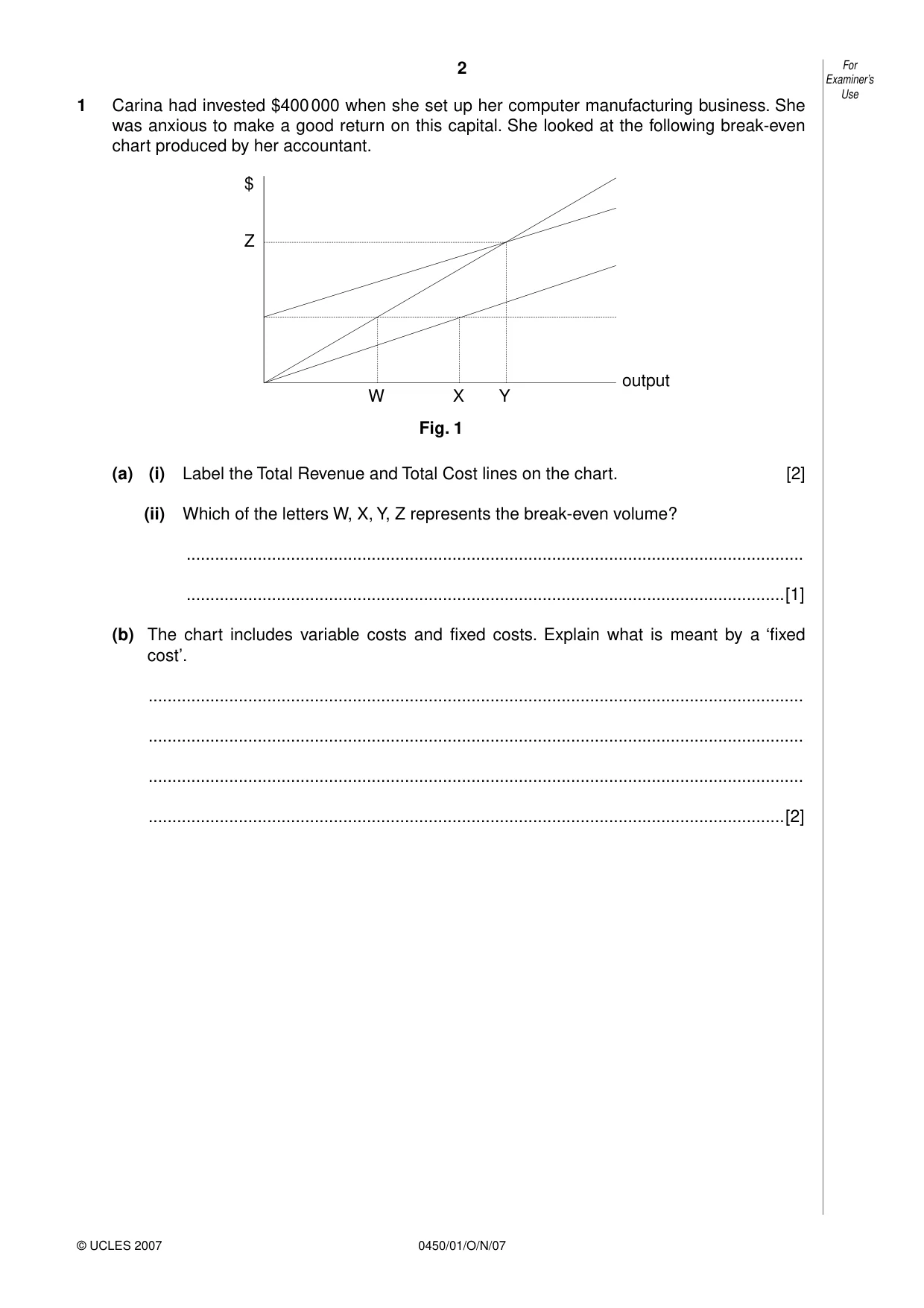
2 0450/01/O/N/07 For Examiner’s Use © UCLES 2007 1 Carina had invested $400 000 when she set up her computer manufacturing business. She was anxious to make a good return on this capital. She looked at the following break-even chart produced by her accountant. Fig. 1 (a) (i) Label the Total Revenue and Total Cost lines on the chart. [2] (ii) Which of the letters W, X, Y, Z represents the break-even volume? … …[1] (b) The chart includes variable costs and fixed costs. Explain what is meant by a ‘fixed cost’. … … … …[2] output $ Z W X Y
Question paper, page 3
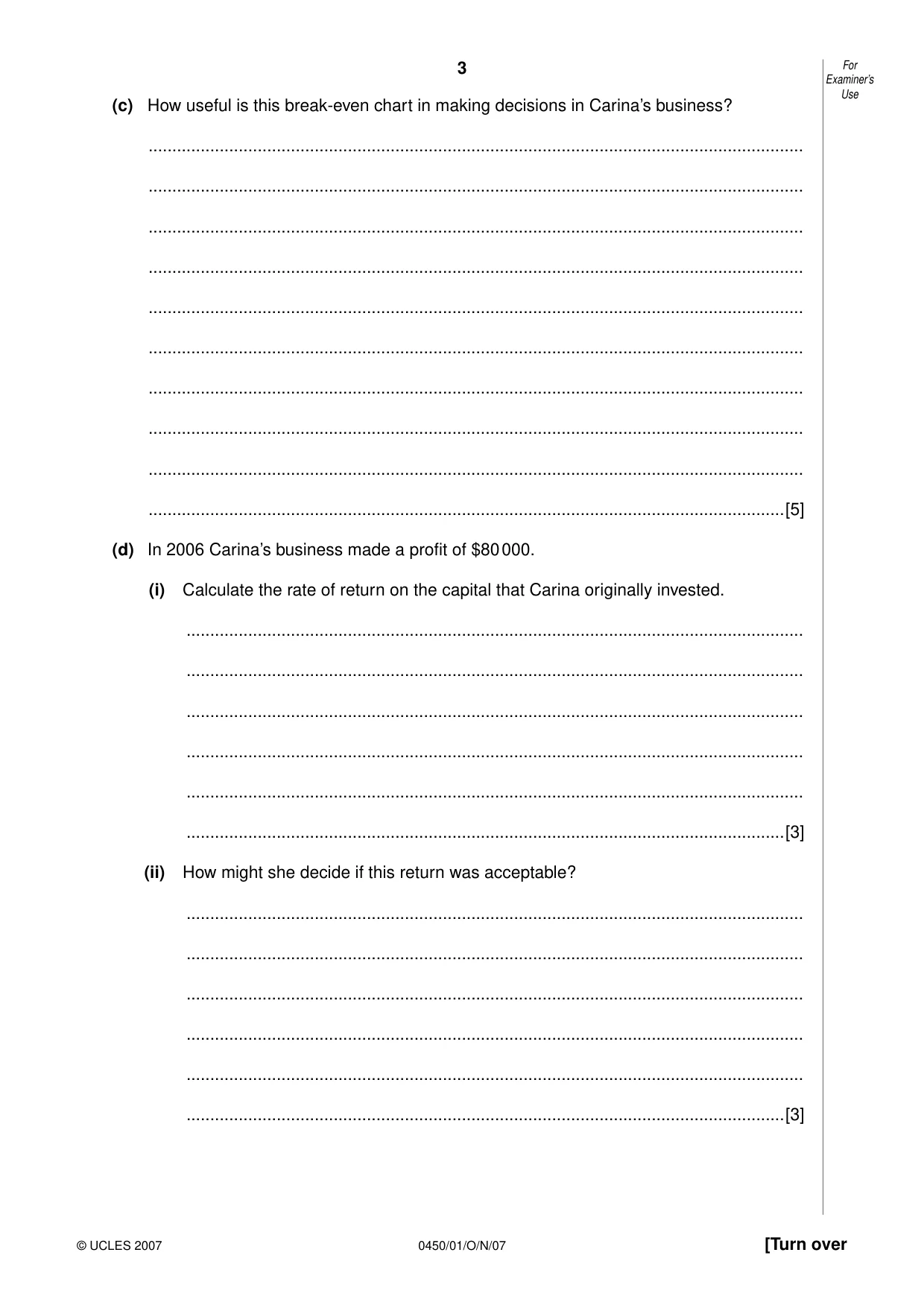
3 0450/01/O/N/07 [Turn over For Examiner’s Use © UCLES 2007 (c) How useful is this break-even chart in making decisions in Carina’s business? … … … … … … … … … …[5] (d) In 2006 Carina’s business made a profit of $80 000. (i) Calculate the rate of return on the capital that Carina originally invested. … … … … … …[3] (ii) How might she decide if this return was acceptable? … … … … … …[3]
Question paper, page 4
4 0450/01/O/N/07 For Examiner’s Use © UCLES 2007 (e) Carina’s bank manager told her that a cash flow statement was more important than a profit and loss statement. Do you agree? … … … … … … … …[4]
Question paper, page 5
5 0450/01/O/N/07 [Turn over For Examiner’s Use © UCLES 2007 2 General Plastics is a multinational company that has recently set up a factory in Country J. This General Plastics factory imports some of the raw materials that it uses and assembles them at the factory. The finished products are then exported from Country J. (a) Identify and explain two reasons why this General Plastics factory might import its raw materials. Reason 1: … … … … Reason 2: … … … …[4] (b) Changes in currency exchange rates can cause problems for multinational companies. If the currency of Country J increased in value [appreciated], would this benefit General Plastics? Explain your answer. … … … … … … … …[4]
Question paper, page 6
6 0450/01/O/N/07 For Examiner’s Use © UCLES 2007 (c) General Plastics expected to reduce its costs when it opened its new factory in country J. Identify and explain three ways by which the company hoped that its costs might be reduced. Cost reduction 1: … … … … Cost reduction 2: … … … … Cost reduction 3: … … … …[6] (d) Country J had been enjoying an economic boom. (i) What is meant by the term ‘economic boom’? … … … …[2] (ii) Do you think that the economic boom would be beneficial to General Plastics? Justify your answer. … … … … … … … …[4]
Question paper, page 7
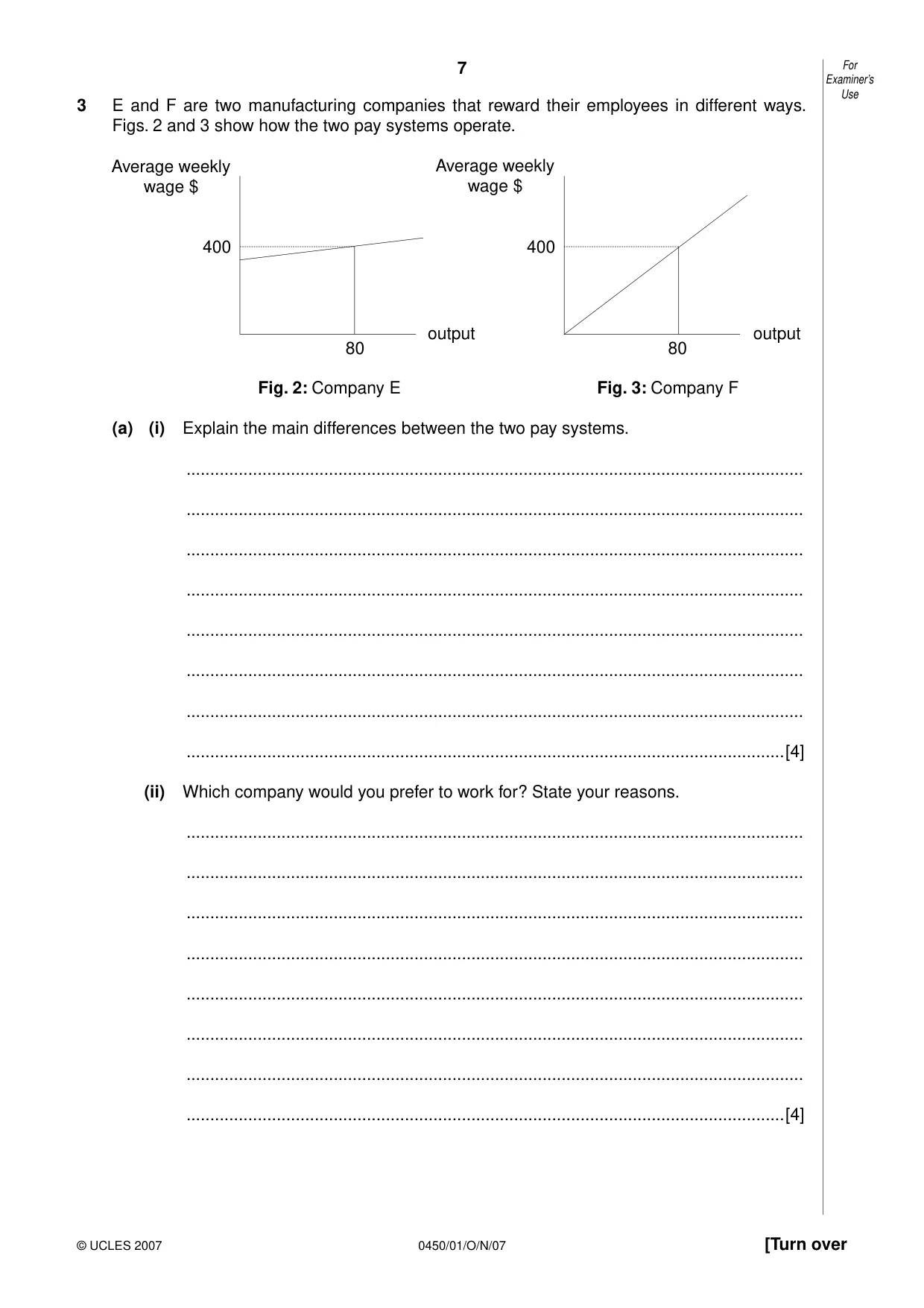
7 0450/01/O/N/07 [Turn over For Examiner’s Use © UCLES 2007 3 E and F are two manufacturing companies that reward their employees in different ways. Figs. 2 and 3 show how the two pay systems operate. Fig. 2: Company E Fig. 3: Company F (a) (i) Explain the main differences between the two pay systems. … … … … … … … …[4] (ii) Which company would you prefer to work for? State your reasons. … … … … … … … …[4] Average weekly wage $ 400 Average weekly wage $ 400 output output 80 80
Question paper, page 8
8 0450/01/O/N/07 For Examiner’s Use © UCLES 2007 (b) The management of another company G pays all its employees the same wage per week. It believes that motivation is best achieved by non-financial methods such as praising [thanking] employees for ‘good performances’. Do you think that this would be an effective method of motivation? State your reasons. … … … … … … … …[4] (c) The Human Resource Manager at company G believes that it is important to train employees. The company currently uses internal methods of training, such as ‘on the job training’. (i) Why do you think that company G trains its employees? … … … … … … … …[4]
Question paper, page 9
9 0450/01/O/N/07 [Turn over For Examiner’s Use © UCLES 2007 (ii) Would you advise the Human Resource Manager to use external training methods? Justify your recommendation. … … … … … … … …[4]
Question paper, page 10
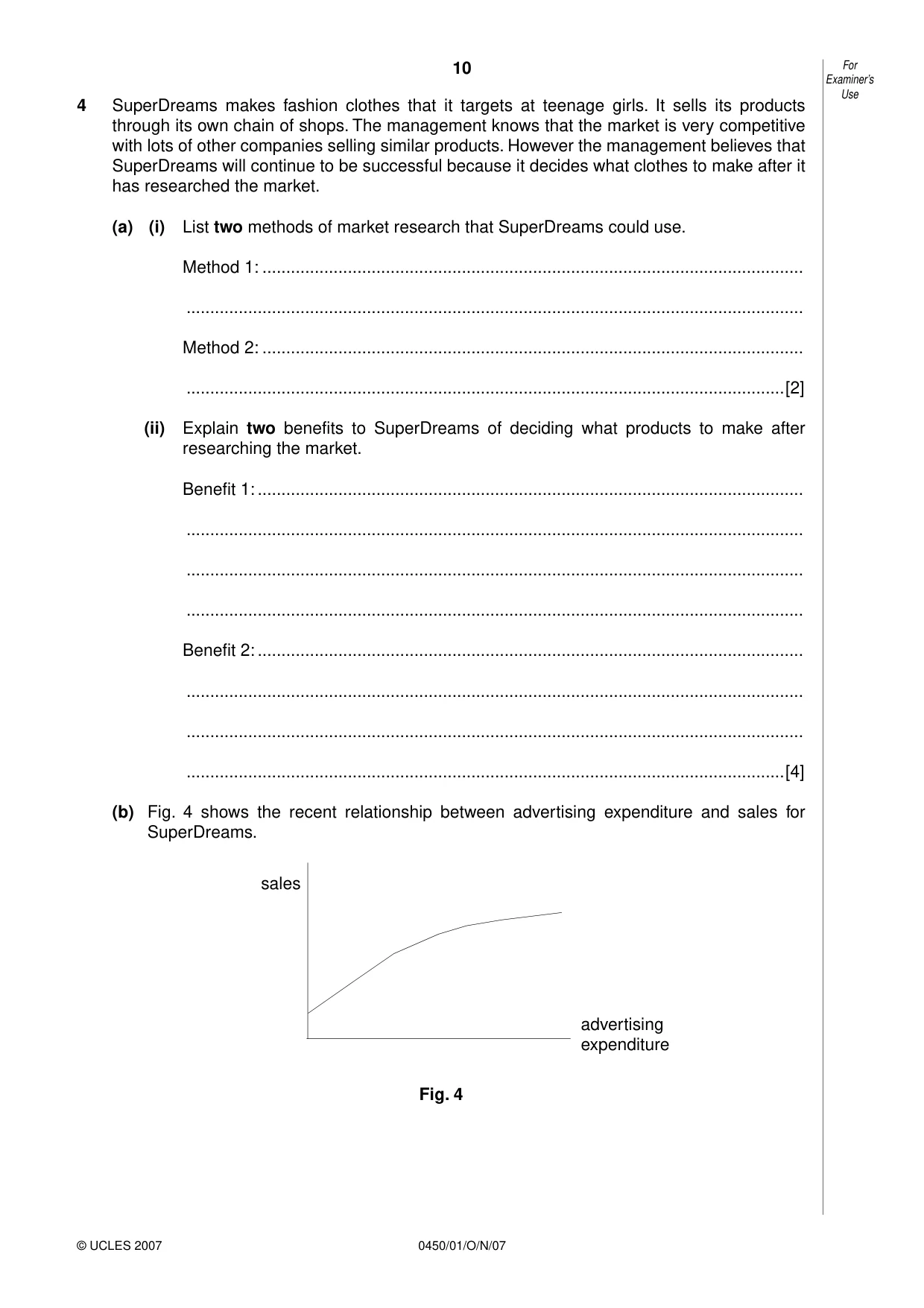
10 0450/01/O/N/07 For Examiner’s Use © UCLES 2007 4 SuperDreams makes fashion clothes that it targets at teenage girls. It sells its products through its own chain of shops. The management knows that the market is very competitive with lots of other companies selling similar products. However the management believes that SuperDreams will continue to be successful because it decides what clothes to make after it has researched the market. (a) (i) List two methods of market research that SuperDreams could use. Method 1: … … Method 2: … …[2] (ii) Explain two benefits to SuperDreams of deciding what products to make after researching the market. Benefit 1: … … … … Benefit 2: … … … …[4] (b) Fig. 4 shows the recent relationship between advertising expenditure and sales for SuperDreams. Fig. 4 sales advertising expenditure
Question paper, page 11
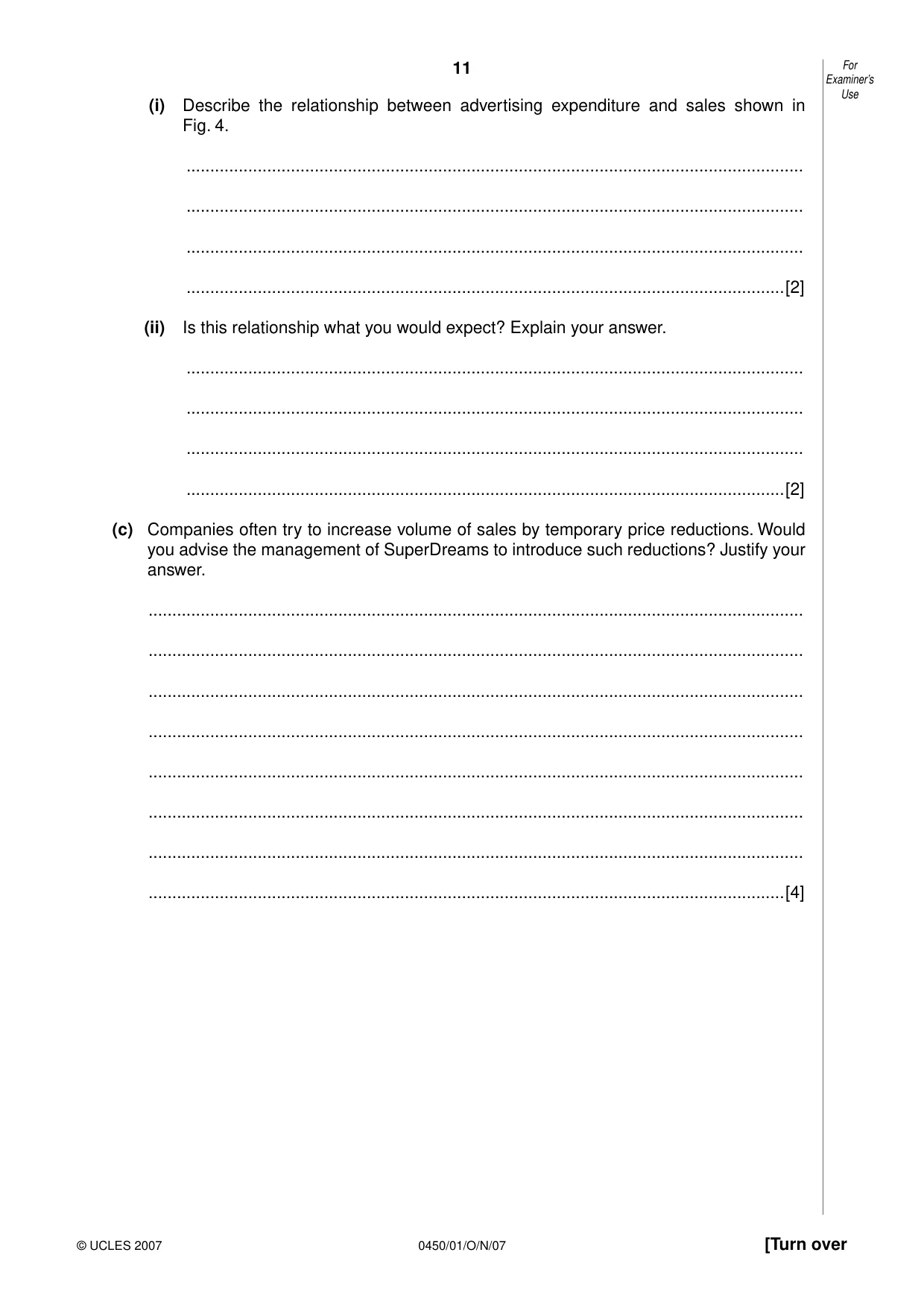
11 0450/01/O/N/07 [Turn over For Examiner’s Use © UCLES 2007 (i) Describe the relationship between advertising expenditure and sales shown in Fig. 4. … … … …[2] (ii) Is this relationship what you would expect? Explain your answer. … … … …[2] (c) Companies often try to increase volume of sales by temporary price reductions. Would you advise the management of SuperDreams to introduce such reductions? Justify your answer. … … … … … … … …[4]
Question paper, page 12
12 0450/01/O/N/07 For Examiner’s Use © UCLES 2007 (d) The Internet has changed the way some people do their shopping. Do you think that SuperDreams should start selling their clothes on the Internet? Justify your answer. … … … … … … … … … … … …[6]
Question paper, page 13
13 0450/01/O/N/07 [Turn over For Examiner’s Use © UCLES 2007 5 The management of Wang Electricals know that good internal communications within a business are important. They also know that sometimes communications break down. The company currently has factories in six different countries. (a) (i) Explain two reasons why good internal communications are important to a business. Reason 1: … … … … Reason 2: … … … …[4] (ii) Outline two reasons why internal communications within Wang Electricals might break down. Reason 1: … … … … Reason 2: … … … …[4] (b) The management of Wang Electricals are thinking of expanding their business into another country. Two alternative methods are being considered, namely either to set up a franchise or to operate a joint venture. (i) What is meant by a ‘franchise’? … … … …[2]
Question paper, page 14
14 0450/01/O/N/07 For Examiner’s Use © UCLES 2007 (ii) Explain two advantages that a joint venture might offer Wang Electricals. Advantage 1: … … … … Advantage 2: … … … …[4] (c) The stakeholders of Wang Electricals are watching the expansion plans with interest. (i) List two stakeholder groups. Stakeholder group 1: … … Stakeholder group 2: … …[2] (ii) Do you think that these two stakeholder groups would benefit from the company’s expansion? Justify your answer. … … … … … … … …[4]
Question paper, page 16
16 0450/01/O/N/07 Permission to reproduce items where third-party owned material protected by copyright is included has been sought and cleared where possible. Every reasonable effort has been made by the publisher (UCLES) to trace copyright holders, but if any items requiring clearance have unwittingly been included, the publisher will be pleased to make amends at the earliest possible opportunity. University of Cambridge International Examinations is part of the Cambridge Assessment Group. Cambridge Assessment is the brand name of University of Cambridge Local Examinations Syndicate (UCLES), which is itself a department of the University of Cambridge. BLANK PAGE
Mark scheme, page 1
UNIVERSITY OF CAMBRIDGE INTERNATIONAL EXAMINATIONS International General Certificate of Secondary Education MARK SCHEME for the October/November 2007 question paper 0450 BUSINESS STUDIES 0450/01 Paper 1 (Short Answer/Structured Response), maximum raw mark 100 This mark scheme is published as an aid to teachers and candidates, to indicate the requirements of the examination. It shows the basis on which Examiners were instructed to award marks. It does not indicate the details of the discussions that took place at an Examiners’ meeting before marking began. All Examiners are instructed that alternative correct answers and unexpected approaches in candidates’ scripts must be given marks that fairly reflect the relevant knowledge and skills demonstrated. Mark schemes must be read in conjunction with the question papers and the report on the examination. • CIE will not enter into discussions or correspondence in connection with these mark schemes. CIE is publishing the mark schemes for the October/November 2007 question papers for most IGCSE, GCE Advanced Level and Advanced Subsidiary Level syllabuses and some Ordinary Level syllabuses. www.XtremePapers.com
Mark scheme, page 2
Page 2 Mark Scheme Syllabus Paper IGCSE – October/November 2007 0450 01 © UCLES 2007 1 (a) (i) 1 mark for each of the Total Revenue and Total Cost lines correctly identified and labelled. (ii) Y= 1 mark [nothing else acceptable]. (b) Fixed cost is a cost that is unrelated to output and is incurred as a result of the existence of a business [2]. Some understanding of the concept for example costs that stay the same [1]. An example of a fixed cost e.g. rent [1]. (c) Break-even chart shows the relationship between revenue and costs at different levels of output. Thus potentially very useful as it allows a prediction of the level of profit that can be expected at different output levels. However its usefulness in practice is much reduced because of the underlying assumptions that it is based upon. However it is an aid to decision making. Identifications of value of the technique [2–1] Pros of the technique. Identification of limitations [2–1] Cons of the technique. Judgement showing evaluation [1]. (d) (i) 20% [3] 1 mark for method. 2 marks for accuracy. Rate of return = profit/capital employed %. $80000/$400000 % = 20%. If % left out then [2] marks for 20. Also for [2] marks 0.2 or 1/5. If answer is $80000/$400000 [2]. If profit /capital alone then [1]. (ii) Compare with last year/other businesses/own targets/opportunity cost. Identification of yardsticks [2–1] Explanation [1] so if opportunity cost of funds is 10% then clearly 20% is highly acceptable. (e) Cash flow statement is a forecast of the timing and amounts of money in and out of a business. P/L account is a statement of revenue and allocated costs during a specific time period, based upon given accounting conventions. Recognition of the differences between the two [2–1]. Evaluative judgement [2–1]. Cash is necessary for survival in the short run and hence the cash flow statement is of great importance. However profit is a measure of performance so the P/L account indicates the degree of success achieved by the business.
Mark scheme, page 3
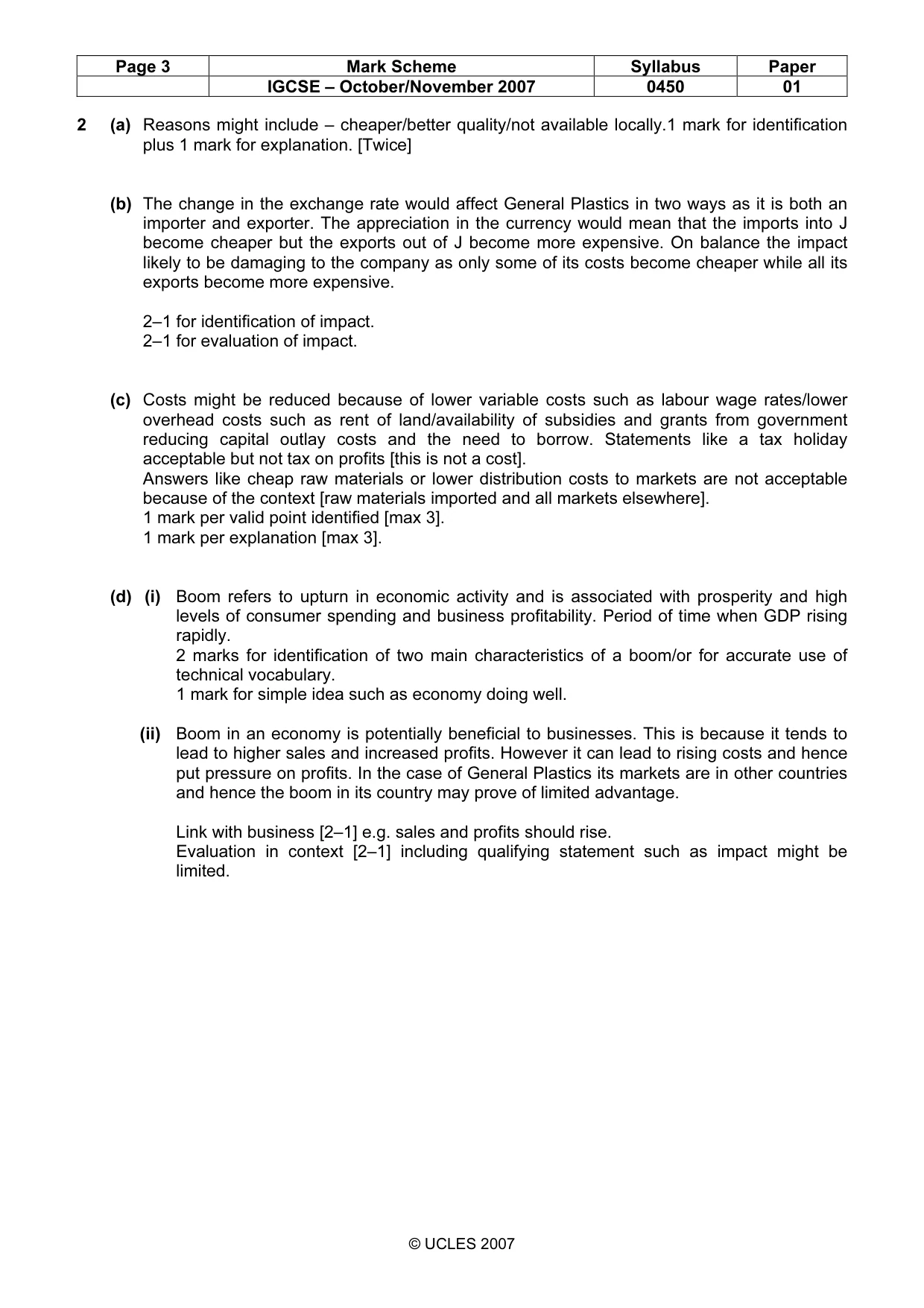
Page 3 Mark Scheme Syllabus Paper IGCSE – October/November 2007 0450 01 © UCLES 2007 2 (a) Reasons might include – cheaper/better quality/not available locally.1 mark for identification plus 1 mark for explanation. [Twice] (b) The change in the exchange rate would affect General Plastics in two ways as it is both an importer and exporter. The appreciation in the currency would mean that the imports into J become cheaper but the exports out of J become more expensive. On balance the impact likely to be damaging to the company as only some of its costs become cheaper while all its exports become more expensive. 2–1 for identification of impact. 2–1 for evaluation of impact. (c) Costs might be reduced because of lower variable costs such as labour wage rates/lower overhead costs such as rent of land/availability of subsidies and grants from government reducing capital outlay costs and the need to borrow. Statements like a tax holiday acceptable but not tax on profits [this is not a cost]. Answers like cheap raw materials or lower distribution costs to markets are not acceptable because of the context [raw materials imported and all markets elsewhere]. 1 mark per valid point identified [max 3]. 1 mark per explanation [max 3]. (d) (i) Boom refers to upturn in economic activity and is associated with prosperity and high levels of consumer spending and business profitability. Period of time when GDP rising rapidly. 2 marks for identification of two main characteristics of a boom/or for accurate use of technical vocabulary. 1 mark for simple idea such as economy doing well. (ii) Boom in an economy is potentially beneficial to businesses. This is because it tends to lead to higher sales and increased profits. However it can lead to rising costs and hence put pressure on profits. In the case of General Plastics its markets are in other countries and hence the boom in its country may prove of limited advantage. Link with business [2–1] e.g. sales and profits should rise. Evaluation in context [2–1] including qualifying statement such as impact might be limited.
Mark scheme, page 4
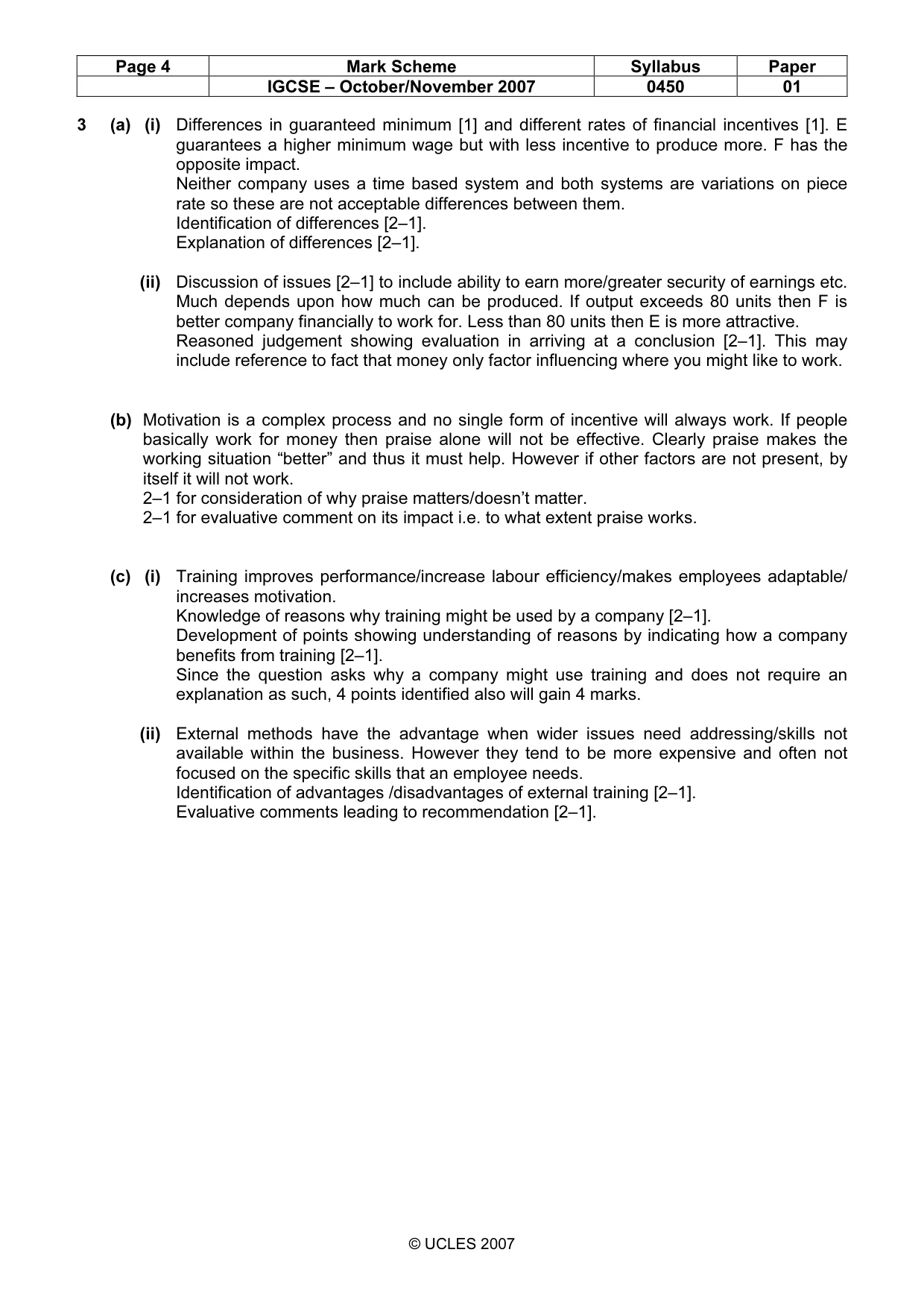
Page 4 Mark Scheme Syllabus Paper IGCSE – October/November 2007 0450 01 © UCLES 2007 3 (a) (i) Differences in guaranteed minimum [1] and different rates of financial incentives [1]. E guarantees a higher minimum wage but with less incentive to produce more. F has the opposite impact. Neither company uses a time based system and both systems are variations on piece rate so these are not acceptable differences between them. Identification of differences [2–1]. Explanation of differences [2–1]. (ii) Discussion of issues [2–1] to include ability to earn more/greater security of earnings etc. Much depends upon how much can be produced. If output exceeds 80 units then F is better company financially to work for. Less than 80 units then E is more attractive. Reasoned judgement showing evaluation in arriving at a conclusion [2–1]. This may include reference to fact that money only factor influencing where you might like to work. (b) Motivation is a complex process and no single form of incentive will always work. If people basically work for money then praise alone will not be effective. Clearly praise makes the working situation “better” and thus it must help. However if other factors are not present, by itself it will not work. 2–1 for consideration of why praise matters/doesn’t matter. 2–1 for evaluative comment on its impact i.e. to what extent praise works. (c) (i) Training improves performance/increase labour efficiency/makes employees adaptable/ increases motivation. Knowledge of reasons why training might be used by a company [2–1]. Development of points showing understanding of reasons by indicating how a company benefits from training [2–1]. Since the question asks why a company might use training and does not require an explanation as such, 4 points identified also will gain 4 marks. (ii) External methods have the advantage when wider issues need addressing/skills not available within the business. However they tend to be more expensive and often not focused on the specific skills that an employee needs. Identification of advantages /disadvantages of external training [2–1]. Evaluative comments leading to recommendation [2–1].
Mark scheme, page 5
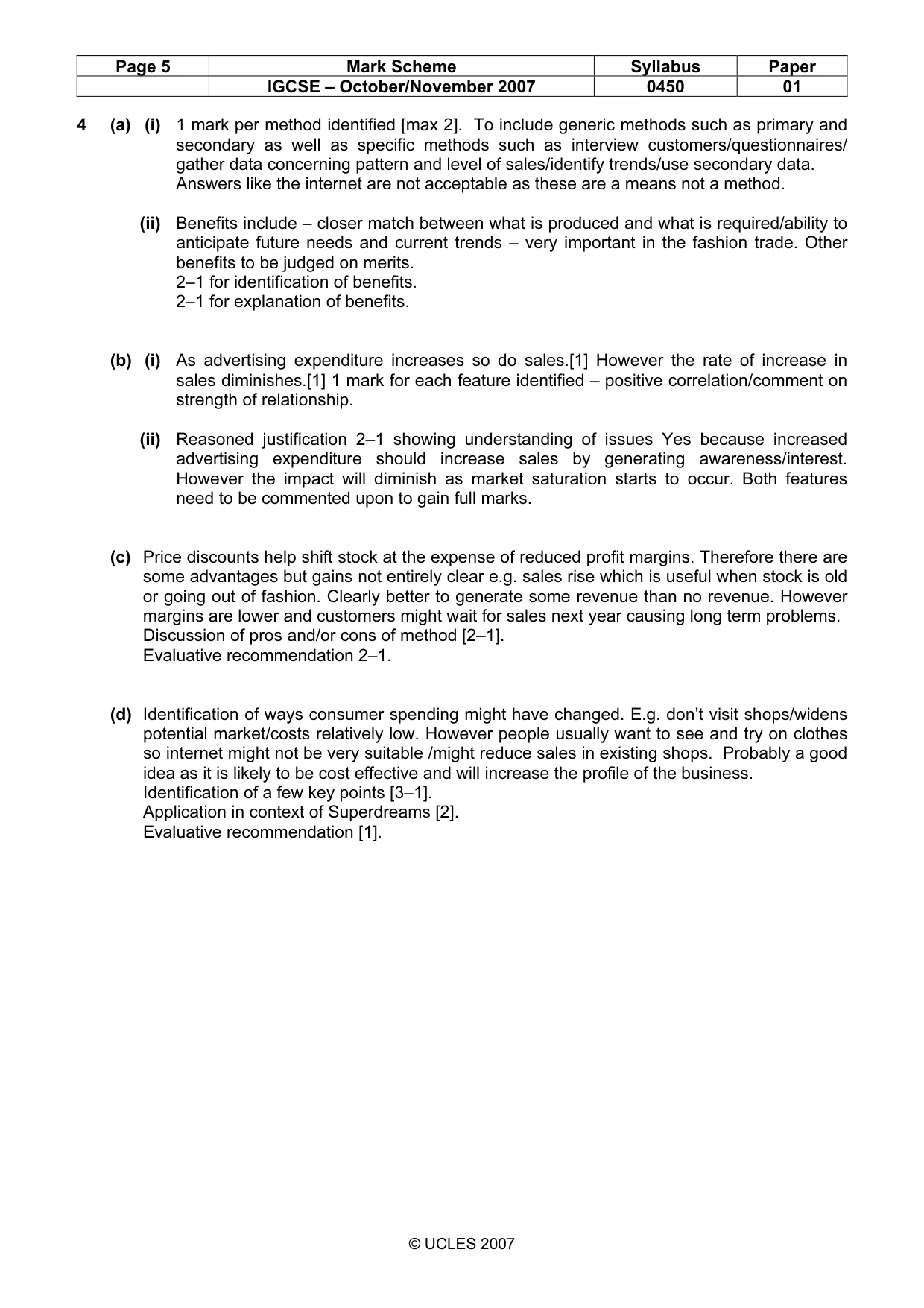
Page 5 Mark Scheme Syllabus Paper IGCSE – October/November 2007 0450 01 © UCLES 2007 4 (a) (i) 1 mark per method identified [max 2]. To include generic methods such as primary and secondary as well as specific methods such as interview customers/questionnaires/ gather data concerning pattern and level of sales/identify trends/use secondary data. Answers like the internet are not acceptable as these are a means not a method. (ii) Benefits include – closer match between what is produced and what is required/ability to anticipate future needs and current trends – very important in the fashion trade. Other benefits to be judged on merits. 2–1 for identification of benefits. 2–1 for explanation of benefits. (b) (i) As advertising expenditure increases so do sales.[1] However the rate of increase in sales diminishes.[1] 1 mark for each feature identified – positive correlation/comment on strength of relationship. (ii) Reasoned justification 2–1 showing understanding of issues Yes because increased advertising expenditure should increase sales by generating awareness/interest. However the impact will diminish as market saturation starts to occur. Both features need to be commented upon to gain full marks. (c) Price discounts help shift stock at the expense of reduced profit margins. Therefore there are some advantages but gains not entirely clear e.g. sales rise which is useful when stock is old or going out of fashion. Clearly better to generate some revenue than no revenue. However margins are lower and customers might wait for sales next year causing long term problems. Discussion of pros and/or cons of method [2–1]. Evaluative recommendation 2–1. (d) Identification of ways consumer spending might have changed. E.g. don’t visit shops/widens potential market/costs relatively low. However people usually want to see and try on clothes so internet might not be very suitable /might reduce sales in existing shops. Probably a good idea as it is likely to be cost effective and will increase the profile of the business. Identification of a few key points [3–1]. Application in context of Superdreams [2]. Evaluative recommendation [1].
Mark scheme, page 6
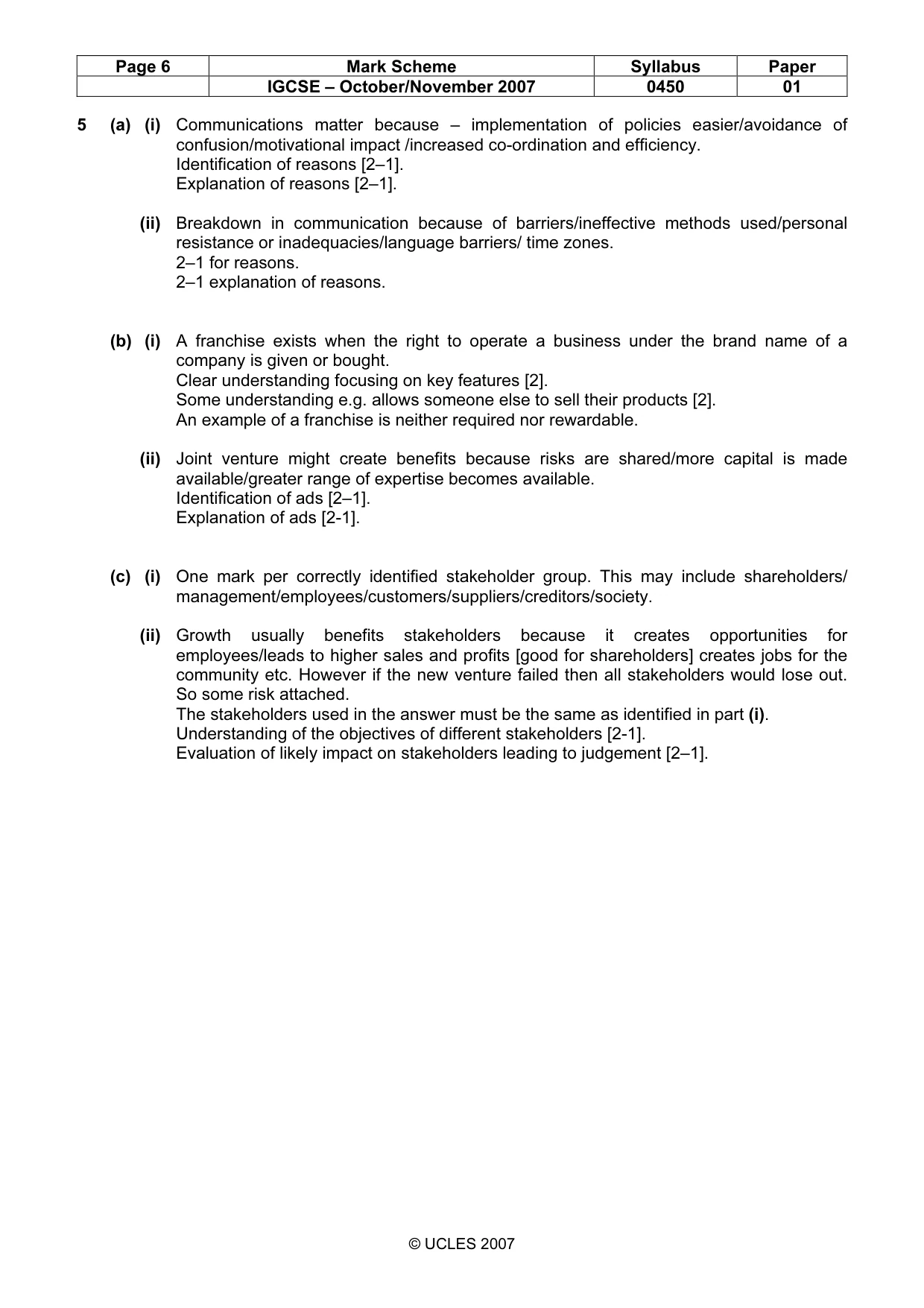
Page 6 Mark Scheme Syllabus Paper IGCSE – October/November 2007 0450 01 © UCLES 2007 5 (a) (i) Communications matter because – implementation of policies easier/avoidance of confusion/motivational impact /increased co-ordination and efficiency. Identification of reasons [2–1]. Explanation of reasons [2–1]. (ii) Breakdown in communication because of barriers/ineffective methods used/personal resistance or inadequacies/language barriers/ time zones. 2–1 for reasons. 2–1 explanation of reasons. (b) (i) A franchise exists when the right to operate a business under the brand name of a company is given or bought. Clear understanding focusing on key features [2]. Some understanding e.g. allows someone else to sell their products [2]. An example of a franchise is neither required nor rewardable. (ii) Joint venture might create benefits because risks are shared/more capital is made available/greater range of expertise becomes available. Identification of ads [2–1]. Explanation of ads [2-1]. (c) (i) One mark per correctly identified stakeholder group. This may include shareholders/ management/employees/customers/suppliers/creditors/society. (ii) Growth usually benefits stakeholders because it creates opportunities for employees/leads to higher sales and profits [good for shareholders] creates jobs for the community etc. However if the new venture failed then all stakeholders would lose out. So some risk attached. The stakeholders used in the answer must be the same as identified in part (i). Understanding of the objectives of different stakeholders [2-1]. Evaluation of likely impact on stakeholders leading to judgement [2–1].
What you needed in this session
Cambridge’s own grade thresholds for 2007 Oct/Nov, Paper 1 · Variant 1. A higher threshold means an easier paper — the bar moves with how the cohort did.